Nobody Recognized the Old Farmer Standing Outside the K9 Memorial Rope—Until 10 Decorated Working Dogs Broke Formation and Ran Straight to Him.
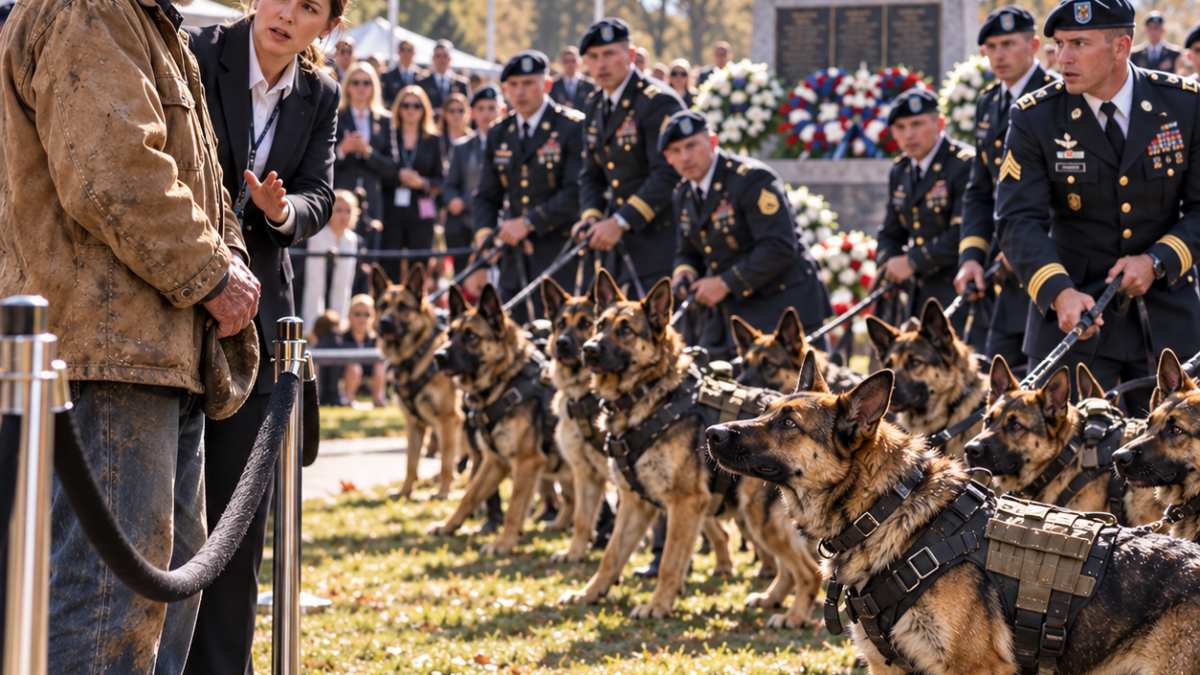
Nobody Recognized the Old Farmer Standing Outside the K9 Memorial Rope—Until 10 Decorated Working Dogs Broke Formation and Ran Straight to Him.
“Sir, you can’t be back here.”
Virgil Blackwood said it the way he had said everything that morning.
Clipped.
Rushed.
Already moving on before the sentence had fully landed.
He had ten dogs to stage, ten handlers to position, ten folded flags to align beside ten photographs, and a mayor arriving in less than forty minutes who would expect the whole memorial to look dignified, polished, and ready for cameras.
He did not have time for an old man in a coat the color of dead wheat drifting toward the staging line like he had misplaced himself.
The old man did not answer right away.
His name was Lane Kowalski, though nobody in that park knew it yet.
He kept his eyes low, near the grass, tracking the sable shepherd third from the end of the formation.
The dog had shifted weight from paw to paw.
Not much.
Just enough.
Enough for someone like Lane to notice.
“You hear me?”
Virgil stepped into his line of sight.
“This area is for ceremony personnel only. I need you back past the barrier with everyone else.”
Lane looked at him then.
Not sharply.
Not offended.
Not the way people look when they are about to argue about rules.
He looked at Virgil the way an old farmer might look at a gate that had swollen in the rain.
Something in the way.
Nothing personal.
Then he stepped back.
Careful.
Unhurried.
No sudden movement to spook anything.
Dog or human.
His boots found the gravel edge of the path, and he stopped three feet outside the tape line with his hands settled easy at his sides.
Virgil watched him go, satisfied, already turning back to the scattered chaos of folding chairs, volunteer badges, extension cords, and a sound system that would not stop feeding back.
He had a ceremony to run.
Ten dogs.
Ten handlers.
Ten names.
Ten men who were not coming home.
PART2:
And he did not have time for some old farmer standing where he was not supposed to stand.
But Lane’s eyes were already working.
He watched the formation the way another man might watch weather coming in.
Not staring exactly.
Tracking.
There were ten dogs arranged in a loose line near the flagpole, each one paired with a handler in dress uniform or tactical black, depending on the department they represented.
A young shepherd kept shifting foot to foot, ears swiveling every time the speaker whined with feedback.
An older Malinois sat with the deep discipline that came only from years of repetition, but Lane noticed the slight list in his hips.
The careful way he settled instead of dropped.
Hip dysplasia.
Maybe worse.
Lane’s right hand went into his coat pocket.
Not for the peppermints.
Not yet.
For the gloves.
They were leather, once black, now the color of strong tea.
The seams had gone pale where his hands had worn them thin over decades.
Someone had repaired the palms by hand with small uneven stitches.
Not a cobbler’s work.
PART3:
A man’s own.
Done at a kitchen table some winter night with a curved needle, waxed thread, and silence for company.
Lane turned the gloves over once.
He felt the stiffness in the left one where the leather had cracked, been mended, cracked again, and held anyway.
He did not put them on.
He only held them.
The way another man might hold a photograph.
Near the back corner of the formation, a handler crouched to fix a slipped collar.
The dog beside him swung its head toward a squirrel crossing the grass.
Too fast.
Too eager.
A young dog still learning what patience cost.
Lane’s mouth moved.
Almost nothing.
Just breath shaped into a word.
“Down.”
He did not say it loud enough for any person to hear.
The dog settled anyway.
Half a second later.
As if the air itself had asked him to.
Virgil, twenty feet away and snapping at a volunteer about extension cords, did not see it.
Nobody did.
Except maybe the young shepherd with sore ears, who turned her head a fraction toward the tape line and held it there one beat longer than curiosity required.
Lane noticed.
He always noticed things like that.
He slid the gloves back into his pocket beside the three peppermints he had carried from his truck since six that morning.
Exactly three.
Never more.
It was not superstition.
It was arithmetic.
Three peppermints fit in a coat pocket without the wrappers crackling every time he moved.
And a crackling wrapper could spook a nervous dog faster than a gunshot.
The park filled slowly.
Folding chairs unfolded in rows.
A card table went up near the entrance with a guest book on it, blue cover stiff, pen tied to the spine with twine.
Someone replaced that twine every spring because it frayed through by fall.
Lane had watched that pen get tied on nine times.
He had never once picked it up.
He came every year before the crowd thickened.
He stood near the back fence.
He fed whichever dog found him first.
Sometimes two if the wind carried his scent well.
He never approached the guest table.
Never signed his name.
Never let anyone read him back later as proof he had been there.
And when the color guard formed up, when someone stepped to the podium with folded paper and read the names of handlers who would not be walking home again, Lane was usually already three streets away.
Truck pointed toward the county road.
Windows down.
Working gloves back on his hands out of habit.
Though there was nothing left to work.
Because some of those names had been spoken to him before they were carved in stone.
Some of those names he had heard over radio static.
Some he had carried in letters.
Some he had delivered to front doors alongside dogs who did not understand why the man they loved was not stepping out behind him.
He put those thoughts away the way he had learned to put most things away.
Folded small.
Set somewhere behind the ribs.
Somewhere it would not show in his face.
The young shepherd broke first.
Young ones often did.
She drifted from the loose cluster near the staging tent, nose down, following some invisible scent trail only she could read. Her handler, distracted by a collar adjustment two dogs over, did not notice.
The shepherd wandered toward the back fence.
Toward Lane.
She did not bark.
Did not wag.
She simply stopped three feet away and sat square, correct, and formal, the way a dog sits when it has decided a person is worth attention but has not yet decided why.
“Hey now,” Lane said.
Barely breath.
He did not crouch.
His knees would not allow that gracefully anymore, and a handler crouching too fast telegraphed too much.
Instead, he opened his right hand at his side.
Palm up.
Fingers loose.
One peppermint resting in the creases of his palm as if it had grown there.
The shepherd closed the last of the distance in her own time.
On her own terms.
She nosed the candy from his hand with a delicacy that would have surprised anyone who had only seen working dogs at county demonstrations, snapping at padded sleeves while crowds applauded.
Lane had trained enough of them to know the softness was the real work.
Any fool could teach a dog to bite hard.
Teaching one to be gentle when gentleness was called for took years.
He rested two fingers against the dog’s jaw for exactly long enough to check the whites of her eyes, the pace of her breathing, and the tension in the muscles under her skin.
Then he let her go.
She returned to her handler before anyone noticed she had wandered at all.
That was the whole of it most years.
A peppermint.
A quiet check.
A dog’s head against his hand for one breath.
Then Lane would leave before the ceremony became too crowded with memory.
But this year, Virgil came back.
He crossed the grass at a clip that told Lane the boy had been sent by stress, not choice.
“Sir.”
The word came out clipped, already tired of itself.
“I told you already. This area is for ceremony staff and registered handlers only.”
Virgil had a lanyard around his neck with a laminated card that caught the morning light. He kept glancing down at it as if the badge might answer for him if he ran out of authority.
“General public viewing is past the flagpole,” he continued. “There are chairs set up. Programs. You can hear everything from there.”
“I’m fine here,” Lane said.
“You’re not, though. You’re inside the rope line.”
Virgil pointed at the rope as if Lane needed help identifying it.
“We’ve got a color guard forming in twenty minutes and a formation of working dogs trained not to break for anybody. I can’t have civilians wandering the perimeter. It’s a liability thing.”
Lane looked past him.
Not through him.
Past him.
The way he might look beyond a man to check a horizon.
Ten dogs stood near the staging tent now, handlers adjusting leads and collars.
The young shepherd sat with her ears swiveling at every new sound.
Lane’s eyes went to her feet first.
Weight wrong on the left hip.
Favoring something.
Bracing, maybe.
He filed it away without meaning to.
Old habit.
The kind you do not get to retire even when they retire you.
“I’m not going to touch the dogs,” Lane said. “I never have.”
“That’s not really the point, sir.”
Virgil’s voice climbed half a register, the particular strain of a young man who had already said the same sentence to four different problems that morning.
“The point is, you’re not on the list. I’ve got check-in for family, handlers, press, ceremony staff. I don’t have a name for you anywhere.”
He lifted the clipboard like evidence.
Lane did not look at it.
“I don’t need to be on it.”
“Everybody needs to be on it. That’s how we know who’s supposed to stand where.”
Virgil exhaled through his nose and glanced back toward the tent, checking whether anyone saw him handling the old man quickly enough.
“Look, I get it. A lot of folks come out for these things and get emotional and wander somewhere they shouldn’t. I’m not trying to be a hard case. But you need to stand with everybody else, or I’ll have to get event security.”
Lane did not answer right away.
He was watching the shepherd again.
Her head had come up.
Ears forward.
Nose working the air in Lane’s direction.
The wind was wrong for scent, blowing crossways, carrying almost nothing.
Still, she searched.
Lane’s fingers wanted the peppermint.
He did not take it out.
He only let his thumb rest against the twist of paper inside his pocket.
A coin he was not ready to spend.
“Sir?” Virgil said.
“I hear you.”
“Okay. Good. Then—”
“I’m not on your program,” Lane said.
“That is exactly my point.”
Lane’s hand came out of his pocket empty.
He set it back down at his side.
Low.
Open.
Fingers loose.
Virgil did not notice that.
Nobody who had never handled a dog noticed that.
He was looking instead at the frayed collar of the wheat-colored coat, the cracked boots, the faded shape of a man he had already decided did not belong.
“Folks pay respect from general seating,” Virgil said, gentler now.
The kind of gentle people use when they think they are being kind to someone slow.
“There is a program and everything.”
“I’ve heard it plenty of times.”
“Then you know where to stand.”
Twenty yards away, Harlan Boone worked his way along the dog formation with a water bottle in one hand and a checklist in his head.
Harlan had run K-9 for the county sheriff’s office for eleven years before taking over the memorial coordination, and he still walked a formation the way he used to walk a kennel row.
Eyes moving dog to dog.
Reading small things.
He stopped on the seventh dog.
A Belgian Malinois.
Seven years old.
A veteran of two overseas rotations before retirement.
Steady as stone in every rehearsal that week.
Her handler had her at heel, at ease, leash slack, nothing wrong to a casual eye.
But Harlan saw her ears lift.
Forward.
Not toward the flags.
Not toward the speaker feedback.
Toward the back fence line.
Toward the two men standing there in low argument.
Her weight shifted onto her back legs.
Tail low.
Stiff.
Harlan frowned.
Filed it away.
Kept moving.
“Sir,” Virgil said again, and this time there was an edge under the patience. Thin as wire. “I really am going to have to ask you to step back to the public area. I don’t want to have someone escort you.”
Lane looked at him then.
Not unkindly.
And for one moment, something moved behind the old man’s eyes that had nothing to do with Virgil at all.
Some private arithmetic.
Some old county no map showed.
Behind Virgil, the Malinois shifted again.
A small restless motion.
Head swinging half an inch toward them and back, like a compass needle unable to settle on true north.
“Sir,” Virgil said, drawing breath for another round of the same sentence, “I’m asking you—”
He never finished.
The Malinois broke.
Not a trot.
Not a curious drift toward the fence the way dogs sometimes wander when discipline slackens.
She came off her mark at a dead run.
Ears back.
Tail low.
Driving.
Straight through the gap between two handlers who had not even seen her go.
One lunged for a lead that was no longer in his hand.
His mouth shaped her name, some command that should have dropped her to the ground where she stood.
It did not.
She reached Lane at full speed.
But she did not jump.
Did not knock him back.
She folded herself against his shins and hip like water finding low ground.
Her whole body pressed into his leg.
Then she pushed her head up under his open hand, the hand that had been hanging loose at his side the entire time.
Waiting for exactly this.
For one breath, nobody moved.
Virgil’s mouth was still open on the unfinished word.
Then the second dog went.
A Belgian shepherd two spots down broke formation clean.
No hesitation.
As if the Malinois leaving had cut some invisible wire holding the rest in place.
Then a third.
A fourth.
By the fifth, it was no longer dogs breaking one at a time.
It was the whole line dissolving at once.
Nine.
Then ten.
Boots, leads, shouted names, and ceremony order left behind in the grass.
Every dog ran toward the same place.
The back fence line.
The old man in the wheat-colored coat.
The peppermints going soft in his pocket.
“What is—” Virgil’s voice lost its edge entirely. “What is happening?”
Nobody answered.
Nobody was listening.
Lane went down on one knee in the grass.
Not fast.
Not slow.
With the unhurried economy of a man who had done this ten thousand times and never once needed to think about how.
Both hands came out now.
Low.
Palms up.
The dogs came into them the way water comes into a low place.
Nosing his coat.
His sleeves.
The frayed cuffs.
One working shepherd shoved his nose so hard into Lane’s collar that the old man rocked back on his heel and let out something that was almost a laugh.
Almost not.
Handlers shouted commands.
Dogs ignored them.
Not in rebellion.
In recognition.
That was what made the entire field go silent.
The dogs were not wild.
They were not confused.
They were not out of control.
They were home to something.
And nobody understood what.
Harlan Boone was already moving.
He cut across the grass at a flat run he had not used since he was half his current age, shouting handler names, telling people to hold positions nobody was holding.
Then he skidded to a stop at the edge of the pile of dogs and the old man kneeling in the middle.
Whatever Harlan had meant to say died somewhere between his throat and his mouth.
Because he had seen that kneel before.
Those hands.
Low and open.
Palms turned up like an offering.
He had seen it in a training compound half a lifetime ago, in a place that did not appear on any map given to families.
Seeing it now, here, in a public park with folding chairs and printed programs, struck him like something dropped from a great height.
“No,” Harlan said softly. “No, it can’t be.”
Virgil stood nearby with his printed schedule crumpling slowly in one fist.
Ten decorated working dogs, dogs with medals on their vests, dogs drilled for eight straight weeks to hold formation through cannon-fire recordings, flag volleys, crowd noise, bagpipes, sobbing families, and gun salutes, now leaned bodily into an old farmer as if he were the only fixed point left in the world.
Harlan stepped closer.
He did not call the dogs off.
Twenty years around K-9 units had taught him at least that much.
You do not fight a dog’s instinct when the instinct is right.
“Down,” Lane said.
Quiet.
Almost gentle.
One syllable.
A half beat.
Then his hand dropped low and open at his side.
Palm up.
Fingers loose.
All ten dogs went down together.
Not scattered.
Not ragged.
Together.
Elbows folding into the grass in a line so clean it looked rehearsed, though none of those dogs had ever drilled with him a day in their lives.
Harlan made a sound that was not quite a laugh.
“Say that cadence again,” he said.
Lane glanced at him mildly, as if he had been asked the time.
“Down.”
“No.” Harlan shook his head slowly. “The whole sequence. The pause before the hand.”
Lane did not answer.
Harlan’s eyes were bright now.
“Nobody teaches it with that pause anymore. Everybody compressed it, quickened it, because some manual forty years back said latency costs you in the field. Except the manual was wrong, and everybody who ever ran the course after him inherited the mistake without knowing where it came from.”
He was talking fast now.
Half to Virgil.
Half to the dogs.
Half to himself.
“I run obedience certifications for six departments. I’ve taught that pause a thousand times. I tell every handler the half second is not hesitation. It is the dog checking your hand is still there.”
Harlan looked at Lane like he already knew and simply needed to hear it said.
“You’re Kowalski.”
Virgil blinked.
Harlan’s voice lowered.
“Lane Kowalski. You wrote the obedience protocol. The one they still teach out of the regional program. I learned it from a photocopy of a photocopy with your name half worn off the header.”
Lane did not answer right away.
He crouched instead, knees popping audibly, and let the nearest gray-muzzled shepherd press her head into the flat of his palm.
His other hand found a peppermint in his coat pocket.
He unwrapped it one-handed and held it low.
“Name’s Kowalski,” he said finally. “Nobody’s called me that out loud at one of these in a long while.”
Virgil had not moved.
The schedule remained balled in his fist, ink smearing faint gray onto his palm.
“He wrote the protocol?” Virgil repeated, testing the words for weight.
“The one on the laminated card?” Harlan said. “The one taped inside every kennel truck in this county? Yes.”
“For how long?”
“For everyone,” Harlan said. “For thirty years.”
Lane straightened slowly, one hand braced on his knee.
His eyes did what they always did.
Dropped to ankle height.
Checking gait.
Checking weight distribution.
Checking the small hitch in a stride that meant something was wrong before any person thought to look.
Reflex.
It had outlived the war.
Outlived the training grounds.
Outlived the years since.
It would probably outlive him.
Then his eyes lifted briefly to Virgil’s face.
Not long enough to accuse.
Just long enough to register the young man’s stunned silence.
Then Lane’s gaze went back to the dogs.
That was when Duchess went down.
It happened fast.
And wrong.
One second, the black-and-tan Malinois with the graying muzzle stood in the number four slot of the formation, swaying the way the restless one had swayed minutes before.
The next, her legs folded sideways.
She hit the grass hard.
Her body went rigid.
Jaw working.
Paws paddling at nothing.
A low sound came out of her.
Not bark.
Not whine.
Something between.
Something that did not belong to a healthy animal.
“Oh God. Duchess!”
Her handler, a young corporal in dress uniform, dropped to his knees with his hands hovering uselessly over her body.
Somebody shouted for water.
Somebody else shouted for the medic tent, though the medic tent stood two hundred yards away and was set up for people, not dogs.
Lane was already moving.
He did not run.
Running would add noise to a situation that needed less.
He crossed the grass at a fast, economical walk, the kind that eats distance without looking urgent, and was on his knees beside Duchess before the corporal finished asking whether anyone knew what to do.
“Heat and stress,” Lane said.
Low.
Flat.
Not looking up.
“Both at once. She’s been standing locked in sun for forty minutes in a working coat. It’s not a bite. It’s not poison. It’s a seizure.”
“What do I—”
“Don’t hold her down. Don’t put anything in her mouth. Clear space around her. Get water, but don’t pour it on her head. Belly and pads of the feet. Slow. Everybody quiet.”
The corporal obeyed as if it came from someone senior.
Which, in every way that mattered, it did.
Lane’s hand found Duchess’s shoulder.
Not gripping.
Resting.
Weight distributed flat and even.
His voice dropped into something the crowd had never heard from him.
Low.
Level.
Almost sung.
Three descending syllables repeated on the same cadence.
No urgency.
No panic.
No performance.
It was not a word anyone recognized.
It was older than the ceremony.
Older than the printed protocol.
Older than most of the handlers standing frozen around him.
The paddling slowed.
Lane moved his free hand into Duchess’s line of sight.
Low.
Palm down.
Fingers together.
He drew it flat through the air once.
Unhurried.
A signal that only means something if a thousand repetitions have already worn a path into an animal’s nervous system.
Down.
Rest.
Come back to me.
The seizure broke.
Duchess’s legs stopped their frantic motion.
Her breathing, ragged and fast, began to even under Lane’s palm.
Her eyes, wild a moment before, found his face.
Held there.
“There you are,” Lane said.
Quieter now.
Almost private.
“There you are.”
Water came.
Lane guided the corporal’s hands himself.
Where to pour.
How much.
How slow.
Two minutes passed with nobody in the field saying a word beyond what Lane instructed.
Then Duchess’s tail thumped once against the grass.
Weak.
But real.
The corporal made a sound that was half laugh and half sob.
Only then did the other nine dogs seem to remember they had been trained for something.
One by one, they folded into rough sits around Lane’s feet, watching him the way soldiers watch an officer who has just proven, without a single wasted word, why he outranks everyone present.
Duchess’s breathing settled by the time Lane finally stood.
His knees took the weight badly.
One hand braced against his thigh.
Nobody moved to help him, because nobody there yet understood that a man who could do what he had just done did not need help standing.
He pulled the repaired leather gloves onto his hands slowly.
Like the motion itself was a kind of putting away.
Harlan waited until Duchess had been carried into the shade, water bowl steady between the corporal’s knees, before stepping close to Virgil.
His voice was low.
Not for secrecy.
For weight.
“You know what you almost sent home?”
Virgil shook his head.
He could not take his eyes off Lane.
Off the gloves.
Off the way the nine dogs still tracked every small movement the old man made.
“Forty years ago,” Harlan said, “this program did not exist. There was no memorial. No formation. No regional K-9 ceremony.”
Virgil swallowed.
“There was a man who trained scout dogs for a unit that never made it onto any roster families got to see. When handlers did not come home, somebody had to bring the dogs back.”
Harlan paused.
“Somebody had to knock on those doors.”
Virgil turned slowly.
“That was him?”
“Three times,” Harlan said. “Three dogs. Three families.”
The wind moved through the flags.
Harlan’s jaw worked once.
“He drove them himself. His own truck. His own dime. Because the Army was not in the business of grief counseling, and somebody higher up decided a working dog with nowhere to go was a problem to be solved, not a life to be honored.”
Virgil looked at Lane again.
Canvas coat.
Cracked boots.
Low open hand.
Frayed collar.
Things he had mistaken for reasons to dismiss him.
Things that had always meant exactly what they looked like.
A man who had worn out everything except what mattered.
“He never told anyone?”
“No,” Harlan said. “My father trained under him. Even he only found out by accident.”
Lane had heard enough.
He did not turn around right away.
When he did, his voice was even.
Unhurried.
The same cadence he had used to bring Duchess back from wherever her body had tried to take her.
“I did not train them to find bombs, son,” Lane said. “I trained them to find their way back to somebody.”
No one spoke.
He looked past Virgil toward the ten dogs settling back into their handlers’ sides, the formation reassembling itself without anyone giving an order.
“Some mornings, I was the only somebody left.”
Even Harlan, who had known the shape of the story for years, looked like hearing it said plain cost him something.
Lane glanced toward the front row, where ten framed photographs waited beside ten folded flags.
“Those families did not want a program or a plaque,” he said. “They wanted their boy’s dog to walk through the front door one more time and not know he wasn’t coming.”
He looked down at his gloves.
“I could not give them their sons back.”
His thumb moved over the repaired seam.
“I could give them that.”
The park had gone silent around him.
“I never considered it duty. Nobody assigned it to me. I just could not let those dogs sit in kennels wondering where their people went. Not after what they had done for us.”
He looked toward the guest book, still untouched on the folding table near the entrance, pages riffling faintly in the wind.
“That is why I never sign it,” Lane said. “This is not my ceremony. It is theirs.”
He nodded toward the formation.
Toward the space where the names of fallen handlers would be read aloud to dogs who could not understand words but understood silence.
“I come to feed the ones who wander close enough. Then I go home before they start reading.”
His voice roughened slightly.
“Because I already know every name on that list.”
Virgil’s mouth opened.
Closed.
Whatever protocol remained in him was not worth saying aloud anymore.
The ceremony began late.
Not by much.
Eleven minutes.
The mayor looked annoyed until someone whispered something in his ear and his face rearranged itself into solemn humility.
The sound system still fed back twice.
A child cried during the prayer.
The wind kept trying to turn the pages of the speaker’s notes.
But the dogs held formation.
All ten.
Duchess rested in the shade instead of in line, but when her handler’s name was called, she lifted her head.
That was enough.
Lane stood at the back fence line.
Not in the chairs.
Not near the podium.
Just where he always stood.
Only this time, nobody asked him to move.
When the first name was read, Lane’s eyes lowered to the grass.
When the second came, his hands closed slightly inside the gloves.
By the fifth, the shepherd who had first taken the peppermint turned her head toward him.
Her handler looked down.
Then, carefully, without breaking formation, loosened the lead one inch.
The dog did not move.
She only looked.
Lane looked back.
At the tenth name, the flag snapped once in the wind and fell still.
No one clapped.
Memorials do not need applause.
They need witnesses.
For years, Lane had refused to be one in any official sense.
He had believed standing too close might take attention from the dead.
But as the dogs sat beneath the flags, eyes forward, bodies steady, Lane began to understand something he had spent decades avoiding.
A man can disappear so thoroughly that even honor forgets where to find him.
And sometimes the living need the story too.
After the final bell rang, people stood slowly.
Chairs scraped.
Families wiped eyes.
Handlers bent to touch their dogs.
The mayor shook hands.
Reporters asked questions in quiet voices.
Virgil did not leave his post.
He stood near the guest table with the clipboard tucked under one arm and watched Lane kneel at the back fence line.
The first shepherd came without being called.
The same one who had found him earlier.
She lowered her head into his open palm and stayed there, breathing slow while the peppermint softened between them.
Lane’s gloved fingers rested lightly along her jaw.
No ownership.
No performance.
Just contact.
Virgil walked over slowly.
He stopped outside the dog’s space.
He had learned that much.
“Mr. Kowalski?”
Lane looked up.
“You can call me Lane.”
Virgil swallowed.
“I owe you an apology.”
Lane’s face did not change.
“I was where I wasn’t supposed to be.”
“No, sir.” Virgil looked back at the formation area. “I think maybe I didn’t understand where you were supposed to be.”
Lane considered him.
The shepherd breathed against his palm.
“That happens.”
“I didn’t know who you were.”
“Most people don’t.”
“That does not excuse it.”
“No.”
Virgil winced.
Lane almost smiled.
“Young men are allowed to learn things.”
Virgil’s throat worked.
“Would you sign the guest book?”
Lane’s eyes moved toward the blue-covered book on the table.
The pen tied with twine.
The pages he had avoided for nine years.
“No.”
Virgil nodded too quickly.
“Of course. I’m sorry. I shouldn’t have—”
“I don’t sign guest books.”
“Right.”
Lane looked down at the shepherd.
Then back toward the table.
“I might write something else.”
Virgil went still.
“What?”
“Get me a blank card.”
Virgil moved so fast he nearly tripped over the rope line.
Five minutes later, he returned with a white memorial program opened to the inside blank page and the twine-tied pen.
Lane removed one glove.
His hand looked older without leather on it.
He held the pen awkwardly for a moment, as if writing were harder than handling ten dogs.
Then he wrote one sentence.
Virgil did not read it until Lane handed it to him.
For the dogs who waited when we could not explain.
Virgil stared at the words.
Lane put his glove back on.
“That enough?”
Virgil’s eyes were wet.
“Yes, sir.”
“Put it wherever it belongs.”
Virgil nodded.
“I will.”
By late afternoon, the crowd thinned.
Chairs folded.
Trucks pulled out of the gravel lot one by one.
The mayor left.
The reporters left.
The color guard packed the flags in long canvas sleeves.
The park emptied until it held only the fence, the wind, a few forgotten programs, and the smell of cut grass.
Virgil stayed longer than he needed to.
He filled a steel bowl at the spigot behind the tables and carried it to Duchess, who was standing on unsteady legs now but standing.
Her corporal handler thanked him quietly.
Virgil did not know what to say, so he only nodded.
Harlan found Lane near the back fence.
“Thought you’d be gone.”
Lane worked the last peppermint loose from his coat pocket.
“Usually am.”
Harlan leaned on the fence beside him.
They stood that way a while.
Two men with more history between them than conversation could hold.
“My father talked about you,” Harlan said.
Lane unwrapped the peppermint.
“No, he didn’t.”
Harlan smiled faintly.
“No. Not by name.”
The shepherd came again.
Lane held out the candy low.
She took it gently and pressed her muzzle into his palm afterward, as if sweetness had never been the main reason she came.
Harlan watched.
“You should come next year.”
“I do come every year.”
“You should stay.”
Lane said nothing.
“You should let them know.”
“The dogs know.”
“That may not be enough anymore.”
Lane looked at him.
Harlan held his gaze.
“The people need to learn what the dogs already remember.”
Wind moved through the dry grass.
Lane’s eyes dropped to the shepherd.
The old habit.
The safer place.
“Maybe,” he said.
For Lane Kowalski, maybe was a large word.
Harlan accepted it.
As the sun lowered, Duchess’s handler came over carrying the dog’s vest folded across both arms.
The young corporal looked no older than twenty-four.
His face held the shaken humility of someone who had nearly lost something and understood it only after someone else saved it.
“Sir,” he said.
Lane looked up.
“I wanted to thank you.”
Lane nodded.
“She needs the vet tonight. Not tomorrow.”
“Yes, sir. We’re going now.”
“Cool her slow. No ice water.”
“Yes, sir.”
The corporal hesitated.
Then held out a small metal tag from Duchess’s vest.
Not a medal.
Not official.
A temporary memorial tag with her name engraved for the ceremony.
“I know it isn’t much,” he said. “But she would not be standing if you hadn’t been here.”
Lane did not take it.
For a long moment, the young man stood with his hand extended.
Then Lane reached out.
The metal tag sat in his palm.
Duchess.
He closed his fingers around it.
“Tell her she did good.”
The corporal smiled through emotion.
“I will.”
When Lane finally walked toward his truck, Virgil did not stop him.
No one did.
But every dog that remained in the park turned its head as he passed.
One by one.
Quiet.
Alert.
Not breaking.
Just acknowledging.
The shepherd gave one soft whine.
Lane paused.
He did not look back at the people.
Only at the dogs.
His hand lifted slightly.
Low.
Open.
The smallest signal.
Ten tails moved.
Not wildly.
Not for show.
A single controlled sweep through the grass.
Then stillness.
Lane climbed into his old truck.
The seat groaned under him.
The cab smelled of dust, peppermint, leather gloves, and the faint oil scent of tools left too long under the bench.
For a moment, he did not start the engine.
He looked through the windshield at the emptying park.
At the flags being lowered.
At the guest book table.
At Virgil standing beside it, holding the memorial program like something fragile.
At Harlan talking quietly with the young corporal beside Duchess.
Lane reached into his coat pocket and found the gloves.
He folded them once.
Set them on the passenger seat.
Then he started the truck.
The engine turned over rough, then settled.
He drove out slowly.
Past the flagpole.
Past the chairs.
Past the line where he had been told he did not belong.
At the edge of the road, he passed the memorial stone.
Ten names from this year.
Many more beneath them from years before.
Lane did not stop.
But his right hand lifted from the wheel.
Not a salute exactly.
Something older.
Something smaller.
A handler’s acknowledgment to those still on watch.
The next spring, the guest book table stood in the same place.
Blue cover.
Pen tied with twine.
The chairs were arranged in rows.
The sound system still threatened to misbehave.
Virgil Blackwood, older by one year and changed by more than that, checked the staging lane with a clipboard in hand.
He had added one new line to the staff list.
Lane Kowalski — Honorary Handler Emeritus.
No one had asked Lane’s permission.
Virgil suspected Lane might object if asked.
So he did not ask.
He simply left the badge on the back fence post where Lane always stood.
Beside it, wrapped in plain white paper, were three peppermints.
Exactly three.
Never more.
When Lane arrived before the crowd thickened, he stopped at the fence post and looked at the badge for a long time.
His face revealed nothing.
Then he took the peppermints and put them in his coat pocket.
The badge stayed on the post.
Virgil, watching from across the field, almost smiled.
That was enough.
For now.
The dogs began to arrive.
One by one.
Handlers straightened leads.
Families took seats.
Flags lifted in the spring wind.
Lane stood at the back fence line in the coat the color of dead wheat, hands low at his sides, palms soft, peppermints quiet in his pocket.
He still did not sign the guest book.
He still did not sit in the front row.
He still did not want applause.
But when the first dog turned its head toward him, Lane did not look away.
And when the names were read that year, he stayed.
All the way to the end.


