A Retired Navy SEAL Went to Adopt a Beagle Puppy—Then the Shelter Begged Him to Meet a Malinois Who Hadn’t Eaten in Four Days.
A Retired Navy SEAL Went to Adopt a Beagle Puppy—Then the Shelter Begged Him to Meet a Malinois Who Hadn’t Eaten in Four Days.
I drove forty minutes through a gray Montana morning to adopt a beagle puppy and came home with a dog that looked like every ghost I had spent nine years trying not to name.
The shelter director begged me to meet him because he had not eaten in four days, and every time someone opened his kennel, he looked past them for a man who was never coming back.
I told myself I was only going to foster him for forty-eight hours, but then he carried my dead wife’s gardening glove to the front door and placed it on my boot like he was asking me not to disappear too.
My name is Grant Ives.
I am fifty-three years old.
Former Navy SEAL.
Retired, though retired never felt like the right word.
Retired makes it sound like something ended cleanly.
Like a door closed and another one opened.
For me, it was more like a machine that had been running too hot for too long finally grinding down in pieces.
First my knees.
Then my shoulder.
Then my patience.
Then my ability to pretend I could keep living inside a world where everything was measured by readiness, threat, movement, and the likelihood that a quiet room was only quiet because something in it had not happened yet.
Twenty-two years in the Navy will teach a man how to move through darkness.
It does not teach him how to sit alone at a kitchen table after the mission ends and the people he loved are gone.
I lived on eleven acres outside Bozeman, Montana, in a gray-planked farmhouse my wife Miriam had chosen before we ever walked through the front door.
She had driven out there on a wet Saturday in March, stood at the back fence line with the Bridger Range half-hidden behind clouds, and said, “This is the one.”
I had looked at the house.
Then at her.
“We haven’t even gone inside.”
She shrugged.
“I don’t need to.”
That was Miriam.
Quick hands.
Dark hair.
A laugh that sounded like she had genuinely found something funny instead of offering politeness to keep the room comfortable.
She trusted her instincts.
She trusted land.
She trusted weather.
She trusted dogs before people.
She died eighteen months before the morning I went to Clearwater Animal Haven for a beagle.
Cancer.
The kind of death that gives a person just enough time to say the important things and not nearly enough time to finish saying them.
She died in our bedroom with snow pressed against the windows and her hand in mine.
She told me not to become a ghost before my body did.
I promised her I would try.
Then I failed quietly for a year and a half.
My daughter Abby lived in Denver.
She called more often than I returned the calls.
PART2:
She had Miriam’s directness, which meant she did not decorate hard truths before handing them to me.
“You need a dog, Dad.”
“I had dogs.”
“You had working dogs. You need a living thing in the house.”
“I have deer in the meadow.”
“Dad.”
“I have mice in the barn.”
“Dad.”
“I’m fine.”
“You are absolutely not fine.”
The listing she sent was for an eight-week-old beagle mix.
Big ears.
Spotted paws.
Already named Milo by the shelter, which felt presumptuous but forgivable because he looked like a dog who would forgive anything.
Abby wrote:
Just go look.
I printed the shelter address on the back of an old envelope because I still did things like that, drove into town on a Tuesday morning, and told myself I was not making a life decision.
I was only looking.
That was the lie I brought with me.
The truth was simpler.
I wanted a dog small enough not to remind me of Ajax.
Ajax had been my dog in Kandahar.
Belgian Malinois.
Compact.
Dark-faced.
Fast in a way that seemed less like movement and more like water finding the fastest path downhill.
He could clear a room with me without a sound.
He knew my breathing.
My hand.
My silence.
He knew when I was angry before I did.
He knew when I was afraid and never judged me for it.
PART3:
Door closers.
Boilers.
Drywall.
Broken lockers.
Furniture.
People assumed I had learned those things in construction.
I never corrected them.
If somebody asked what I had done before, I usually said:
“Government work.”
That phrase killed most conversations immediately.
Principal Karen Whitfield had worked in the same building with me for eleven years.
Good woman.
Organized.
Cared about the kids.
She knew I was a veteran because some employment paperwork required disclosure.
She did not know what kind.
She never pushed.
That was one reason I stayed.
At Lincoln Heights, I was useful without being important.
There is a freedom in that.
People imagine men who once carried rank miss being saluted.
Some probably do.
I didn’t.
After enough years making decisions that affected lives, the ability to repair a leaking sink and have the problem actually stay solved felt almost luxurious.
Pipe leaks.
Replace washer.
Test.
Done.
War is rarely that cooperative.
At school, I worked mostly alone.
Teachers saw me in hallways.
Students saw me pushing a cart.
Parents saw me spreading salt on icy sidewalks.
Very few people looked long enough to notice details.
The scars on my hands.
The way I checked exits when entering crowded rooms.
The fact that I never sat with my back to a door.
How quickly I responded when a child screamed, even if the scream came from three hallways away.
How I could identify which classroom’s smoke detector was chirping before anyone else found it.
Those habits do not disappear because you trade tactical gear for gray work pants.
But habits are easy to overlook when the man performing them carries a mop.
That suited me.
For eighteen years after retiring, I had been trying to become forgettable.
Then Diesel walked onto our schoolyard.
The event was part of Military Appreciation Week.
Local VFW.
Police department.
Regional military outreach office.
A K9 demonstration.
Students had spent the week making paper flags and writing letters to veterans.
One bulletin board read:
THANK YOU FOR KEEPING US SAFE.
I walked past it three times before I could look directly at it.
The assembly was scheduled for Tuesday morning.
Nearly three hundred people were expected.
Students.
Parents.
Teachers.
Local officials.
Veterans.
Two visiting Army officers.
A newspaper crew.
I had no intention of attending.
I only had to set up chairs.
At 6:15, I unlocked the equipment shed.
By 7:30, two hundred folding chairs stood in rows facing a temporary platform near the flagpole.
I checked every row twice because children plus unstable metal furniture produces predictable results.
At eight, Principal Whitfield found me running an extension cable.
“Walter.”
“Yes, ma’am?”
“You don’t have to disappear during the ceremony.”
“I have work.”
“You are a veteran.”
“So are half the men at Ruthie’s diner before breakfast.”
She smiled.
“You could at least watch.”
“I’ll be around.”
That was all I promised.
By nine o’clock the schoolyard had filled.
Children sat near the front.
Parents behind them.
Mayor Donald Pierce arrived in a dark overcoat.
Police Chief Renee Castillo sat beside him.
Two Army officers in dress uniforms took seats in the first row.
One of them was Major Daniel Hutchins.
I did not know his name then.
Master Sergeant Ken Ramirez stood beside the demonstration area.
His dog sat at heel.
Diesel.
Seven-year-old German Shepherd.
Large.
Dark saddle across his back.
Scar near the left side of his muzzle.
His posture told me everything before anybody introduced him.
Working dog.
Experienced.
Disciplined.
Not anxious.
Not distracted.
Ramirez held the leash loosely because a dog like that did not need to be dragged into obedience.
I stood near the rear fence with a push broom.
I should have left.
I almost did.
Then Diesel turned his head.
Not toward the children.
Toward me.
His ears came forward.
I stopped moving.
Ramirez began a basic obedience demonstration.
Heel.
Sit.
Down.
Directional movement.
Diesel was clean.
Fast.
Sharp.
The younger kids laughed every time he snapped instantly into position.
I watched his feet.
His eyes.
His handler’s timing.
Old habits.
Ramirez walked him in a slow circle around the demonstration space.
Diesel completed half the loop.
Then stopped.
His head turned again.
Straight toward me.
I felt something cold move through my chest.
“Diesel, heel.”
Nothing.
Ramirez repeated it.
The dog stayed planted.
A few parents laughed.
They thought it was part of the demonstration.
Ramirez didn’t.
I could see that immediately.
His wrist changed position on the leash.
His shoulders tightened.
“Diesel. Heel.”
The dog’s body went rigid.
Then he lunged.
Ramirez was not ready.
The leash burned through his gloved hand.
Diesel broke free.
For one terrible second, the crowd believed a military dog was attacking someone.
Parents grabbed children.
Police Chief Castillo rose.
The two Army officers were on their feet immediately.
I did not move.
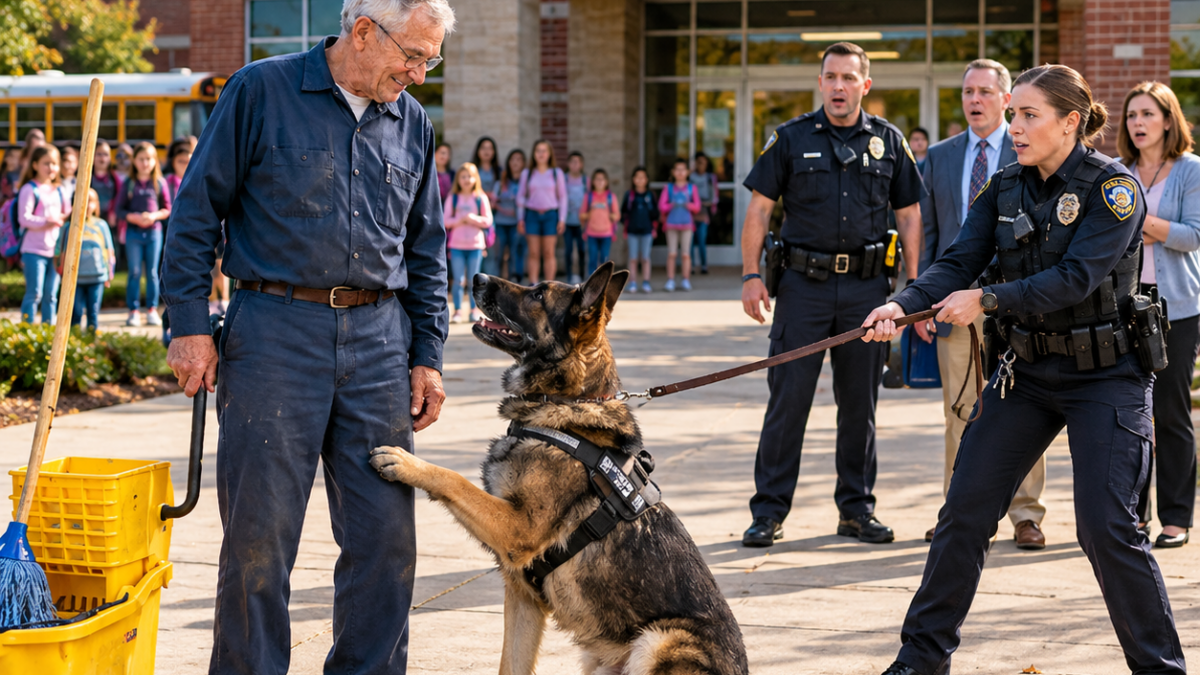
Diesel came straight at me.
Thirty yards.
Twenty.
Ten.
I saw his eyes.
Not aggression.
Recognition would be too strong a word.
But there was something.
Urgency.
He stopped at my boots so hard his paws slid in the grass.
Then his body dropped.
Not an obedience down.
Something else.
He pressed his chest against my legs.
Trembling.
A low sound came from him.
I had heard working dogs bark.
Growl.
Whine.
Alert.
Scream from injury.
This was different.
It sounded like grief.
The entire schoolyard became silent.
I looked down.
Diesel looked up.
And eighteen years disappeared.
For one second, he was not Diesel.
He was Bravo.
Dust.
Concrete.
Smoke.
Blood.
A young corporal screaming through a radio that never received an answer.
I gripped the broom handle harder.
Diesel pushed his head against my knee.
Master Sergeant Ramirez ran toward us.
“Sir, don’t move.”
I barely heard him.
“Diesel!”
The dog ignored him.
“Diesel, heel!”
Nothing.
Ramirez slowed as he approached.
Confusion replaced urgency.
“Sir, I am so sorry. He’s never—”
I let go of the broom.
It fell.
Then I lowered myself slowly onto one knee.
My right knee complained.
Age does what bullets cannot.
Diesel’s nose moved toward my hand.
I held it open.
He sniffed.
Once.
Again.
Then he pressed his head into my palm.
My hand started shaking.
“Easy.”
The word came out differently than I had spoken in years.
Lower.
Steadier.
Command without volume.
Diesel froze.
His eyes locked on mine.
Ramirez froze too.
I scratched once behind the dog’s ear.
“Easy, boy.”
Diesel exhaled.
Then pushed closer.
Ramirez stared at me.
“Sir.”
I looked up.
“Do you know this dog?”
“No.”
He frowned.
I looked back at Diesel.
“At least I don’t think I do.”
Principal Whitfield was walking toward us.
The mayor remained standing.
Every child in the school seemed to be staring.
“Walter?”
Karen stopped.
She had worked beside me for eleven years.
It might have been the first time I saw actual uncertainty on her face when looking at me.
“What just happened?”
“I don’t know.”
One of the Army officers approached.
Major Hutchins.
He studied me in a way military people study other military people when something does not fit.
“You worked with dogs?”
I should have lied.
I had become very good at giving true answers small enough to function as lies.
“Years ago.”
“What branch?”
I stood.
Diesel rose immediately.
Pressed himself against my leg.
I stepped once.
He stepped with me.
Ramirez whispered:
“You’ve got to be kidding me.”
Hutchins heard him.
“What?”
“Sir, that’s not random.”
Diesel’s body had shifted.
He stood slightly forward of me.
Protective angle.
Ramirez pointed subtly.
“He’s guarding him.”
Hutchins looked.
Ramirez continued:
“I’ve seen that posture with bonded handlers.”
“That dog has never met him.”
“I know.”
“You’re sure?”
Ramirez looked at me.
“I was.”
The crowd began whispering.
Children asking parents questions.
Parents asking teachers.
Teachers asking each other.
One man said loud enough for me to hear:
“Maybe he used to train police dogs.”
Another:
“Why wouldn’t he tell anybody?”
Someone else:
“Maybe something happened.”
Suspicion grows faster than understanding.
Always has.
Karen stepped closer.
“Walter, do you have some kind of military K9 background?”
I looked at her.
Then at the three hundred people waiting.
For eighteen years I had avoided exactly this.
Attention.
Questions.
Names.
Old records.
People calling me hero.
That word had driven me farther into hiding than any enemy ever had.
“I used to work around dogs like him.”
Hutchins asked:
“What unit?”
“It was a long time ago.”
“Sir.”
His tone was respectful but firm.
“That’s not much of an answer.”
“No.”
“Then give me one.”
I looked at his rank.
Then his face.
Young enough that he could have been one of the men I trained near the end.
Probably not.
Still possible.
“Why?”
“Because a military K9 with nine years under Sergeant Ramirez just broke command discipline, crossed a crowded schoolyard, and assumed a protective position on a man nobody knew had any K9 background.”
He paused.
“I’d like to understand why.”
Fair.
Karen said softly:
“Walter, nobody’s accusing you of anything.”
That almost made me smile.
People say that most often when a crowd is beginning to do exactly that.
Diesel nudged my hand.
His nose found the scar across my knuckles.
Thin.
White.
It started between my index finger and thumb and disappeared beneath my sleeve.
He sniffed it carefully.
Then whined.
My chest tightened.
Major Hutchins noticed.
“That scar.”
I curled my hand instinctively.
“What about it?”
“Shrapnel?”
I said nothing.
“Close-range blast?”
“It’s old.”
Diesel pressed his nose into the scar again.
Ramirez stared.
“It matters to him.”
I looked at the dog.
He was right.
Hutchins asked:
“What’s your full name?”
“Walter Briggs.”
“Middle?”
“James.”
Something in his face changed.
“Service branch?”
I looked toward the flag.
Wind moved it once.
Then I said:
“Navy.”
“Rank?”
“Retired.”
“Sir.”
I had spent eighteen years making sure nobody asked the next question.
Diesel had destroyed that plan in less than two minutes.
I sighed.
“Master Chief.”
Hutchins stopped breathing for half a second.
“Master Chief?”
“Yes.”
“Of what?”
“Naval Special Warfare.”
The murmuring spread immediately.
Even civilians recognized parts of that.
One parent whispered:
“SEALs?”
A boy near the front said:
“Is Mr. Briggs a secret agent?”
His mother shushed him.
I almost laughed.
Major Hutchins did not.
“How many years?”
“Twenty-six.”
“You were a SEAL?”
“Yes.”
His eyes narrowed.
“What command?”
“I finished as Command Master Chief out of Coronado.”
Ramirez looked like somebody had slapped him.
“You’re serious?”
“I generally am.”
Diesel sat directly in front of me.
Then lifted one paw.
Placed it against my chest.
That finished whatever remained of the schoolyard’s composure.
Gasps.
Phones lifted.
Children pointing.
Karen whispered:
“My God.”
I placed my hand over Diesel’s paw.
“No.”
Not God.
Just a dog.
But dogs have a way of finding doors people nail shut.
Major Hutchins stepped away.
“I need to make a call.”
“Don’t.”
He stopped.
“Sir?”
“There’s nothing to call about.”
“With respect, Master Chief, that’s obviously not true.”
“I’ve been retired eighteen years.”
“And?”
“And retirement is supposed to mean people stop calling.”
That almost made Ramirez laugh.
Hutchins did not.
“I’ll be back.”
He walked away with his phone.
I sat on an overturned equipment crate because my knee hurt and because Diesel refused to leave.
Ramirez tried once.
“Diesel, come.”
Diesel looked at him.
Then at me.
Then lay across my boots.
Ramirez stared.
“Traitor.”
Diesel closed his eyes.
For the first time that morning, people laughed.
It loosened something.
Karen brought me water.
She sat beside me.
“You lied on your application.”
“No.”
“I would’ve remembered Navy SEAL.”
“The form asked veteran status.”
“You checked yes.”
“Correct.”
“It asked last occupation.”
“Federal service.”
She stared.
“That is technically true.”
“I spent decades being technically correct.”
“You didn’t think being a Command Master Chief was relevant?”
“To cleaning elementary-school floors?”
She looked at the children.
“They adore you.”
“They adore the man who rescues basketballs from the gym rafters.”
“That is not all they know.”
“It was enough.”
Karen turned the bottle in her hands.
“Why hide?”
That question hurt more than I expected.
I looked at Diesel.
“I didn’t hide at first.”
“What happened?”
I could have told her to leave it alone.
She would have.
Instead I said:
“Too many people I couldn’t bring home.”
Her voice softened.
“Walter.”
“I got tired of being introduced by what I survived.”
She did not answer.
That is one reason I respected her.
She knew when silence was better.
Twenty minutes later, Hutchins returned.
Two more uniformed officers came with him.
My stomach dropped.
“Major.”
“Master Chief.”
“That’s unnecessary.”
“Apparently not.”
He carried a tablet.
“I pulled what I could access.”
“I didn’t authorize that.”
“Your service record is not entirely private, sir.”
“Should be.”
Ramirez stood.
Hutchins looked at the screen.
“Twenty-six years.”
I stared at him.
“Three Bronze Stars.”
“Major.”
“One Silver Star.”
“Hutchins.”
“Multiple commendations.”
“Hutchins.”
He finally looked at me.
“Sir, most of this record is redacted.”
“Good.”
“But enough isn’t.”
The crowd had begun gathering again.
Teachers tried keeping the children occupied, but adults are terrible at hiding curiosity, especially when their school custodian turns out to have a classified service record.
Hutchins continued.
“There’s also repeated reference to working-dog programs.”
Ramirez’s attention sharpened.
“K9?”
“Joint programs.”
Hutchins scrolled.
“Handler conditioning.”
“Stress transfer.”
“Protective positioning around injured personnel.”
“Environmental desensitization.”
Ramirez slowly looked at me.
“No.”
I knew what he was thinking.
He asked:
“Sir, did you develop any of the early Coronado handler-bonding protocols?”
I said nothing.
His mouth opened.
“Oh, you’ve got to be kidding me.”
Karen looked between us.
“What does that mean?”
Ramirez was no longer looking at me like a custodian.
Or even like an old veteran.
He looked at me the way I once looked at instructors whose manuals I had studied.
“When Diesel was in training, we used a handler-bonding system everybody calls the Coronado method.”
He turned toward Hutchins.
“That’s what this is?”
Hutchins nodded slowly.
“Looks like pieces of it.”
Ramirez stared.
“Master Chief.”
I wished very badly for my mop cart.
“You wrote that?”
“I helped.”
“Helped?”
“Nothing useful is written by one person.”
“Sir, every handler in my unit learned that protocol.”
“Then I hope they corrected the bad parts.”
Ramirez laughed once.
More disbelief than humor.
Diesel lifted his head when Ramirez’s voice rose.
Then rested it against my boot again.
Hutchins looked at me.
“There’s something else.”
Of course there was.
The universe had apparently decided subtlety was finished.
He pulled up another record.
“Eighteen years ago.”
My body tightened before he said anything more.
He noticed.
So did Diesel.
The dog stood.
Hutchins slowed.
“Joint overseas operation.”
“No.”
“Master Chief—”
“No.”
The schoolyard disappeared.
Dust.
Concrete.
Night.
A radio scream.
A handler I could not reach.
A dog covered in gray powder.
My own blood running down my fingers.
Hutchins said quietly:
“Collapsed structure.”
I closed my eyes.
“Stop.”
“Sir, the handler was killed.”
Diesel pressed against me.
“The report says a senior enlisted operator entered during secondary collapse risk and extracted the K9 despite shrapnel injuries.”
My scar burned even though scars do not do that.
Memory does.
Hutchins asked:
“Was that you?”
I looked at him.
Then the dog.
His name came out before I decided to speak.
“Bravo.”
Hutchins waited.
“That dog’s name was Bravo.”
No one moved.
I had not said that name aloud in years.
“He was three.”
German Shepherd.
Dark face.
One ear permanently slightly lower after an injury.
“His handler was Corporal Danny Whitlock.”
Twenty-two years old.
Newly married.
Good operator.
Better man.
Liked terrible country music.
Could fall asleep anywhere.
Had a daughter on the way although he did not know yet.
The building came down after the first breach.
Not all of it.
Enough.
We heard Danny.
Then lost him.
Bravo stayed near the collapse point.
Would not leave.
I went in because I believed there was still time.
There wasn’t.
I found Bravo pinned beneath broken material.
One hind leg trapped.
Dust in his mouth.
Blood around one eye.
He snapped when I reached him.
Not because he was vicious.
Because his handler was gone and the world had become noise.
I used the bonding command cadence we had developed with dog teams.
Low voice.
Minimal movement.
Hand where he could see it.
Bravo stopped fighting.
I freed him.
Then secondary material shifted.
Shrapnel and debris caught my hands and forearm.
I barely felt it.
Adrenaline is generous until the work stops.
I carried Bravo out.
Forty yards.
Maybe more.
He kept twisting in my arms trying to return.
Back to Danny.
I remember saying:
“I know.”
Again.
Again.
“I know.”
That might be why Diesel’s sound had hit me so hard that morning.
Same grief.
Different dog.
I told the schoolyard only the part I could.
“Bravo’s handler didn’t make it.”
My voice sounded unfamiliar.
“I couldn’t reach Danny.”
I rubbed the scar on my hand.
“But I could reach the dog.”
“So I brought him out.”
Karen had tears in her eyes.
Several parents did too.
I hated it.
Not them.
The feeling.
Being watched while memory stripped you open.
Hutchins said:
“Bravo served another six years.”
I looked at him.
“What?”
“You didn’t know?”
“No.”
“He was reassigned after recovery.”
I swallowed.
“I assumed he retired.”
“No.”
Hutchins scrolled.
“Domestic program.”
“Then continued training support.”
He stopped.
“Master Chief, there’s something strange here.”
“What?”
He turned the tablet.
Old photograph.
My breath stopped.
Bravo.
Older.
Grayer muzzle.
Standing at a military working-dog training facility.
Behind him were young dogs.
A breeding and development program.
Ramirez leaned closer.
“What year?”
Hutchins told him.
Ramirez pulled out his phone.
Checked something.
Then looked at Diesel.
“No way.”
“What?”
“Diesel’s line.”
Hutchins nodded.
“That’s what I thought.”
Karen asked:
“What line?”
Ramirez crouched beside Diesel.
“Working-dog breeding records.”
He looked up at me.
“Diesel’s pedigree traces back to dogs from that program.”
“Bravo?”
“Not directly in a simple father-to-son line.”
He studied the records.
“But Bravo’s genetic line contributed to the program that produced Diesel’s later lineage.”
The crowd reacted as if somebody had revealed a ghost story.
I didn’t.
Because genetics does not pass memories of individual people.
Dogs do not inherit a photograph of a man’s face.
I knew that.
Ramirez knew it.
Hutchins knew it.
But connection can be real without becoming magic.
Diesel had been trained using methods I helped develop.
His bloodline came through a program influenced by Bravo’s service.
And something about me—my posture, my voice, my scent, perhaps the way I instinctively gave him space—had triggered a response powerful enough to override ordinary behavior.
That was enough.
More than enough.
Ramirez said quietly:
“I don’t think he knows you because Bravo knew you.”
“Good.”
I looked at him.
“Because that isn’t how dogs work.”
He nodded.
“But something about you is familiar to him.”
“Training cues.”
“Maybe.”
“Scent.”
“Could be.”
“Body language.”
“Definitely.”
Diesel leaned harder against my leg.
Ramirez smiled.
“Whatever it is, he picked you.”
I looked down.
“Poor judgment.”
Then a black government sedan entered the parking lot.
I actually said:
“Oh, come on.”
Karen looked at me.
“What?”
“Nothing good arrives that fast in a government sedan.”
The vehicle stopped.
Rear door opened.
An older man stepped out in Navy dress uniform.
Gray hair.
Straight posture.
Rear admiral.
Retired, judging by the details.
I knew the face.
Older now.
But I knew the name before Hutchins whispered it.
Thomas Whitlock.
Danny’s father.
My throat closed.
No.
Not today.
Not here.
Admiral Whitlock walked across the grass.
People moved out of his way without being asked.
Diesel stood beside me.
Protective again.
I rose.
Old instincts took over.
Back straight.
Hands still.
Whitlock stopped several feet away.
Neither of us spoke.
Eighteen years existed between us.
He broke first.
“Master Chief Briggs.”
“Admiral.”
His eyes shone.
“Do you have any idea how long we’ve been looking for you?”
I genuinely did not understand.
“I retired.”
“I know.”
“Then why would anybody be looking?”
His face changed.
Pain.
“My son was Danny Whitlock.”
I looked down.
“I know.”
“His wife spent years trying to learn who brought Bravo out.”
I said nothing.
“The operational report was sealed.”
I knew.
“Names removed.”
I knew.
“By the time enough restrictions lifted for us to start asking the right questions, you had disappeared.”
“I didn’t disappear.”
His eyebrows rose.
“You work under ‘W. Briggs’ at an elementary school and never mention twenty-six years in Naval Special Warfare.”
“Privacy.”
“That’s one word for it.”
A few people almost laughed.
Whitlock stepped closer.
“Danny’s daughter was born four months after he died.”
That hit harder than anything else.
“He never knew?”
“No.”
I looked away.
Whitlock continued.
“She grew up with a photograph of her father and Bravo.”
My jaw tightened.
“She knew Bravo lived.”
“Yes.”
“He served?”
“Six more years.”
“Good.”
The word broke.
Whitlock’s voice softened.
“She always wanted to know who saved him.”
“I didn’t save the person who mattered.”
His response came immediately.
“You saved a life that mattered too.”
I shook my head.
“Admiral—”
“No.”
His tone became command again.
“You do not get to decide what my son’s family was allowed to value.”
That stopped me.
“You couldn’t reach Danny.”
“No.”
“But you reached Bravo.”
“Yes.”
“You brought him home.”
“Yes.”
“My granddaughter grew up knowing one piece of her father’s life survived because somebody refused to leave his dog behind.”
I had no answer.
Whitlock reached inside his jacket.
Small velvet case.
I almost backed away.
“No.”
He ignored me.
Typical admiral.
“This should have reached you years ago.”
“I don’t need it.”
“This isn’t about what you need.”
He opened the box.
A commendation connected to the rescue and actions around that operation.
My name.
Walter J. Briggs.
I stared.
I had never seen it.
“Why?”
“The recommendation was delayed through classification review.”
He said.
“Then administrative error.”
“Then you retired.”
“That sounds like the Navy.”
“Yes.”
For the first time, Whitlock smiled.
Small.
Sad.
Then he pinned it to my gray custodial work shirt.
That felt ridiculous.
Medal against fabric with bleach stains.
A radio clipped to my belt.
Work boots.
Diesel sitting beside me.
And somehow it also felt more truthful than a dress uniform ever had.
The crowd remained quiet.
No dramatic music.
Just wind and children breathing.
Then Whitlock turned toward the sedan.
A young woman stepped out.
Early twenties.
Dark hair.
Photograph in both hands.
I knew before anybody introduced her.
Danny’s daughter.
She walked toward me.
Every step became harder to watch.
Whitlock said:
“Master Chief Briggs, this is Emily.”
She stopped.
“Sir.”
“Walter.”
Her mouth trembled.
“My mom says I should call you Master Chief.”
“Your mom hasn’t met me.”
That made her laugh through tears.
Good.
I needed that.
She held out the photograph.
Danny.
Twenty-two.
Alive.
Grinning at the camera.
Bravo beside him.
Desert behind them.
My vision blurred.
Emily said:
“My dad sent this before his last deployment.”
I touched the edge.
Did not take it yet.
“She told me Bravo came home but my dad didn’t.”
I swallowed.
“She told me somebody carried Bravo out.”
I looked at Whitlock.
He nodded.
“She said whoever did that gave us one more piece of Dad to remember.”
Emily extended the photograph farther.
“I wanted you to have this.”
“No.”
She looked confused.
“That belongs to you.”
“We have copies.”
“Still.”
She shook her head.
“My mother wants you to have it.”
That defeated me.
I took the picture.
My hands shook.
First time all morning.
I stared at Danny.
The boy I could not save.
Eighteen years I had treated that failure like a sentence.
Not because anyone else blamed me.
Because I did.
Emily whispered:
“Thank you for not leaving Bravo.”
Something inside me broke.
Not loudly.
No collapse.
No dramatic speech.
Just one breath I could not finish.
“I tried to get your father.”
“I know.”
“I couldn’t.”
“I know.”
“I’m sorry.”
She stepped forward.
Then hugged me.
I did not expect that.
My arms stayed at my sides for a second.
Then I hugged her back.
Behind us, Diesel whined.
Of course he did.
Always the professional.
Applause began somewhere near the first row.
I hated applause.
Still do.
But that day I let it happen.
Children stood.
Teachers.
Parents.
Veterans.
Police Chief Castillo.
Mayor Pierce.
Major Hutchins.
Ramirez.
Three hundred people who had walked past me or never known me stood in a schoolyard applauding.
Not the man with a mop.
Not the SEAL.
Not the Master Chief.
Something between them.
Principal Whitfield returned to the microphone.
Her voice shook.
“Ladies and gentlemen…”
I groaned quietly.
Karen heard me.
Ignored me.
“…I think Lincoln Heights owes Mr. Briggs a proper introduction.”
The children cheered.
One yelled:
“MR. BROOMS!”
That saved me.
I laughed.
Real laugh.
First in longer than I realized.
Diesel looked up.
Tail moved.
The formal part ended eventually.
Everything does.
Parents went home.
Children returned to classrooms.
Reporters called.
The Fairview Gazette ran a story the next morning.
THE HERO HIDING IN PLAIN SIGHT.
I hated the headline.
Karen framed it.
Hung it in the staff room.
I threatened to remove it.
She threatened to fire me.
We both knew neither thing would happen.
The school board met the following week.
They wanted to rename the courtyard.
I said no.
They did it anyway.
Briggs Square.
I insisted the plaque contain no medals.
No SEAL reference.
No list of decorations.
Just:
IN HONOR OF THOSE WHO SERVE WITHOUT NEEDING TO BE SEEN.
I could live with that.
The strangest change was people.
Teachers who had nodded at me for years began stopping.
Not to ask about combat.
Mostly just:
“How are you, Walter?”
And waiting.
That part was harder than being recognized.
Being invisible had protected me.
Being known required participation.
A fourth-grade teacher named Mrs. Collins invited me to eat lunch in the teachers’ room.
I said no.
She asked the next day.
No.
The next.
“No.”
Friday:
“Walter, are you aware persistence is a core educational value?”
“Sounds like harassment.”
“12:15.”
I went.
Nobody asked about SEALs.
They complained about copier toner.
One teacher’s husband had forgotten their anniversary.
Someone heated fish in the microwave and everybody nearly declared war.
Normal people.
Normal conversation.
I realized I had spent eighteen years assuming the only options were hero or ghost.
There was a third option.
Person.
Diesel returned a month later.
Special permission.
Ramirez brought him through the gate.
The dog ignored thirty excited children and found me beside the boiler room.
I heard nails on tile.
Turned.
Diesel rounded the corner.
Tail moving.
I put down my wrench.
“Still making bad choices, huh?”
He walked directly into me.
Ramirez arrived seconds later.
“Sir, I swear he knows the building now better than I do.”
“He follows smell.”
“What do you smell like?”
“Industrial cleaner.”
Ramirez laughed.
Diesel visited every few months.
Always found me first.
We eventually understood more of his reaction.
Not mystery.
Not inherited memories.
He had been trained heavily around particular handler cues rooted in the old protocols.
I still used some without realizing.
My stance.
Hand position.
Vocal cadence.
Where I placed myself in relation to him.
More importantly, working dogs read human bodies in ways most people underestimate.
Maybe he smelled adrenaline change.
Maybe old scars carry different scent.
Maybe he saw a man reacting to him without fear or excitement.
Ramirez once said:
“Maybe he just knew you were dog people.”
“Scientific.”
“I’m a sergeant, not a neuroscientist.”
Fair.
But I stopped needing an explanation.
Diesel had found me.
That was enough.
The media wanted interviews.
Most I declined.
One national program offered money.
No.
A veterans organization asked me to speak about trauma.
No.
Another asked me to help advise a K9 handler program.
That one I considered.
Eventually agreed.
Quietly.
No cameras.
Young handlers.
Old training problems.
New technology.
Dogs had changed.
Equipment had changed.
Certain fundamentals had not.
I told them:
“The leash is not the relationship.”
They wrote it down.
“Commands are not trust.”
More writing.
“If your dog only works because he fears correction, you don’t have a partner.”
A young handler asked:
“Then what do we have?”
“Compliance.”
I pointed toward Diesel, asleep beside Ramirez.
“You want that?”
“Yes, Master Chief.”
“Earn it.”
I hadn’t used that voice in eighteen years.
It came back quickly.
Too quickly, according to Ramirez.
“You enjoyed that.”
“No.”
“Liar.”
Maybe.
The first time I visited a training facility again, I nearly left before entering.
Smell.
Kennels.
Metal.
Dust.
Barking.
Memory hit like a physical force.
Bravo.
Danny.
The collapse.
I stood outside.
Ramirez stayed beside me.
No advice.
No speech.
Eventually I said:
“Give me a minute.”
He said:
“Take two.”
That was enough.
I entered.
Healing did not arrive in one dramatic schoolyard reveal.
That’s not how it works.
Diesel opened a door.
I still had to walk through.
I finally started seeing a therapist through the VA.
Eighteen years late.
She was younger than some of the boots I used to train.
Dr. Megan Price.
First session:
“Why now?”
“A dog embarrassed me publicly.”
She waited.
“Military K9.”
Still waited.
“In front of three hundred people.”
Nothing.
“You’re not very conversational.”
“I’m paid to let you become conversational.”
I disliked her immediately.
Which meant she was probably useful.
She asked about Danny.
Bravo.
The men I lost.
Things I had done correctly but still regretted.
Things I had done incorrectly and could not undo.
I told her I had failed Danny.
She asked:
“Could you reach him?”
“No.”
“Did you attempt?”
“Yes.”
“Could you physically have saved him?”
“No.”
“Then what exactly was the failure?”
“I came out.”
She studied me.
“He didn’t.”
“Yes.”
“That isn’t failure.”
“It feels like it.”
“That I believe.”
Important distinction.
For years I had mistaken feeling guilty for being guilty.
Not the same.
Bravo lived six more years.
Protected other people.
That did not erase Danny.
It did mean the rescue mattered.
Emily kept in touch.
She visited Fairview with her grandfather again.
She became a nurse.
I asked why.
“My dad was a medic.”
I did not tell her that scared me.
Every generation chooses its own dangerous form of service.
She brought more photographs.
Danny holding Bravo.
Danny sleeping with Bravo’s head across his chest.
Bravo after recovery.
Older.
Gray muzzle.
Happy.
One photo showed Bravo beside another handler.
For years I had imagined him grieving forever.
He hadn’t.
That affected me more than expected.
He had bonded again.
Worked again.
Lived.
He did not forget Danny.
He continued.
Those are not opposites.
That may have been the thing I needed Bravo to teach me eighteen years late.
Continuation is not betrayal.
I had believed becoming somebody new would dishonor men who never had the chance.
So instead I became nobody.
But Danny’s dog did not spend six years punishing himself for surviving.
He worked.
Protected.
Ate.
Played.
Slept.
Loved another handler.
Dogs sometimes understand grief better than operators.
Diesel aged too.
His outreach duties became lighter.
Fewer demonstrations.
More educational appearances.
Eventually Ramirez retired from active handling.
The decision came after Diesel developed arthritis.
The Army worked through his placement.
Ramirez adopted him.
Obviously.
If he hadn’t, I might have.
Karen would have objected to a German Shepherd living in the boiler room.
Weak leadership.
After retirement, Diesel still visited Lincoln Heights.
No leash required in controlled settings.
He would arrive with Ramirez, cross the courtyard, and find me.
Children knew the routine.
“DIESEL’S HERE!”
Thirty small people would run toward the windows.
Diesel ignored celebrity.
Walked to me.
Sat.
Got his ears scratched.
Then accepted the children.
Priorities.
Years after the first assembly, a new third-grade student asked:
“Mr. Briggs, were you really a Navy SEAL?”
“Yes.”
“Did you fight bad guys?”
“Sometimes.”
“Did you jump out of airplanes?”
“Yes.”
“Were you scared?”
The question caught me.
Children ask the best ones.
“Yes.”
His eyes widened.
“But you’re a SEAL.”
“So?”
“I thought SEALs aren’t scared.”
I put down the screwdriver in my hand.
“Anybody who says they’re never scared is either lying or not paying attention.”
He considered that.
“Then how do you be brave?”
“Do the right thing while scared.”
He nodded like I had explained multiplication.
Then:
“Can you fix my desk?”
That was better.
“Yes.”
Life returned to useful size.
One afternoon, Karen found me sitting near Briggs Square.
School empty.
Flag moving lightly.
She sat beside me.
“You’re smiling more.”
“No.”
“You are.”
“Probably neurological decline.”
She rolled her eyes.
“Do you regret people finding out?”
I thought about it.
“Yes.”
She laughed.
“Walter.”
“And no.”
“Better.”
“I liked privacy.”
“You still have privacy.”
“Children ask whether I’ve killed ninjas.”
“That seems fair.”
“One asked whether I know Batman.”
“Do you?”
“Classified.”
She laughed.
Then became serious.
“I used to feel guilty.”
“For what?”
“Eleven years.”
I knew what she meant.
“I walked past you every day.”
“So?”
“I never asked.”
“You respected my boundaries.”
“I didn’t know there were boundaries.”
“Same result.”
She looked toward the school.
“I think about how many people we reduce to jobs.”
“Teacher.”
“Janitor.”
“Cashier.”
“Driver.”
“Old man.”
“Young kid.”
She nodded.
“Then one day a dog runs across a field and everybody realizes they never asked a question.”
I looked at her.
“People don’t owe us their histories, Karen.”
“I know.”
“But?”
“But we could notice them.”
That was true.
Recognition does not require interrogation.
Sometimes just learning the person’s name is enough.
Walter.
Not janitor.
Mr. Briggs.
Not the guy with the mop.
That change mattered more than the newspaper article.
Admiral Whitlock died several years later.
Emily called me.
The funeral was in Virginia.
I went.
First military funeral I had voluntarily attended since leaving the Navy.
I almost turned around in the parking lot.
Then saw Emily.
Stayed.
At the reception, she handed me a small envelope.
“My grandfather wanted you to have this.”
Inside was a note.
Walter,
My son died believing the men around him would take care of Bravo if he couldn’t.
You proved him right.
Stop calling that failure.
—Tom
I sat alone for a while after reading it.
Then read it again.
Admirals remain bossy even after death.
The note now lives in one of the boxes that used to stay locked in my closet.
The boxes are no longer locked.
That is progress.
I added photographs to the walls too.
Not medals.
People.
My old team.
Emily and Admiral Whitlock.
Karen and several teachers at a retirement party that somehow became a food fight.
Ramirez with Diesel.
Bravo and Danny.
The photograph Emily gave me.
I put that one where I see it most.
Not because I enjoy pain.
Because memory deserves air.
Hidden things grow strange shapes.
I had learned that.
When I finally retired from Lincoln Heights, I had worked there sixteen years.
The school held an assembly.
I objected.
Nobody cared.
Children made signs.
Teachers cried.
Karen, already retired herself, returned just to annoy me.
Ramirez came.
Diesel did not.
He had died the winter before.
Fourteen years old.
Good life.
Good retirement.
Ramirez called me before it happened.
“He’s having a bad day.”
I knew what he meant.
I drove over.
Diesel lay on a blanket near the fireplace.
Older.
Thin.
Eyes still sharp.
I sat beside him.
His tail moved once.
“Hey, trouble.”
He lifted his head.
Pressed his nose against my scar.
Same hand.
Same place.
Then rested again.
Ramirez wiped his face.
“I don’t know how he keeps doing that.”
“Habit.”
“Maybe.”
We stayed until the veterinarian came.
I did not leave.
Neither did Ramirez.
At the end, Diesel’s head rested partly on his handler and partly against my leg.
I thought about the schoolyard.
A leash hitting grass.
Three hundred people gasping.
A dog choosing a man who had worked very hard not to be chosen.
“You did enough.”
I whispered.
Diesel breathed out.
Then was gone.
I cried.
No shame.
Took me long enough to learn that too.
Lincoln Heights planted a tree near Briggs Square for him.
I argued.
Again, nobody cared.
The plaque reads:
DIESEL
HE SAW PEOPLE BEFORE THE REST OF US DID.
That one I liked.
My own retirement assembly ended with students asking questions.
No reporters.
No military spectacle.
Exactly how I wanted.
One girl asked:
“What are you going to do now?”
“Sleep past 4:30.”
The room laughed.
I did not.
I still wake at 4:30.
Some programming is permanent.
Another asked:
“Will you miss fixing things?”
“Yes.”
Then a boy in the back shouted:
“Who’s gonna get balls off the gym roof?”
Good question.
The new custodian, Marcus Hill, stood beside the doors.
Thirty-six.
Father of two.
Former Army mechanic.
He raised his hand.
“I got it.”
I liked him immediately.
After everyone left, I walked through the school alone one final time.
Kindergarten.
Library.
Cafeteria.
Gym.
Hallway where generations of shoes had worn the floor slightly dull in the center.
Boiler room.
My old cart.
Gray uniform hanging from a hook.
I touched it.
The job had saved me.
People thought Diesel revealed the hero hiding inside the janitor.
That’s not how I see it.
The janitor saved the SEAL.
Walter Briggs of Naval Special Warfare knew how to fight.
Walter Briggs of Lincoln Heights learned how to live when there was no enemy left.
Both mattered.
One was not disguise.
One was recovery.
It took me eighteen years to understand that.
When I left through the front doors, Briggs Square sat in afternoon light.
Diesel’s tree moved slightly in the wind.
I stopped beside it.
A group of children were waiting for buses.
One waved.
“Bye, Mr. Briggs!”
Another:
“Bye, Master Chief!”
Then:
“Bye, Mr. Brooms!”
I smiled.
“That’s the one.”
These days I volunteer twice a month with a veterans’ working-dog program.
Not in charge.
I refuse titles.
They call me Walter.
Sometimes Master Chief when they want to irritate me.
Young handlers bring problems.
Dog won’t engage.
Dog overprotective.
Dog shuts down after injury.
Handler forcing too much.
I watch.
Usually the dog tells you what’s wrong before the human does.
You just have to stop being the loudest thing in the room.
One young sailor asked me recently:
“Do dogs remember forever?”
I thought about Bravo.
Diesel.
Danny.
Schoolyard grass.
My scar.
“I don’t know.”
He looked disappointed.
Then I added:
“They remember enough.”
“Enough for what?”
“To find their way back to what matters.”
He nodded.
I am not sure he understood.
That’s all right.
Took me most of my life.
For years people in Fairview told the story as if Diesel exposed some grand secret.
Nobody knew the janitor was a retired Navy SEAL.
Military dog reveals hidden hero.
Good headline.
Easy story.
The truth was messier.
Diesel did not reveal that I had been a hero.
He revealed that I was still hiding.
From grief.
From guilt.
From people.
From the possibility that what I had done could matter without becoming the only thing I was allowed to be.
He did not care about my medals.
He did not care about Silver Stars or rank.
He did not care that a training manual contained procedures I helped develop.
He cared that something about me told him:
Safe.
Known.
Trust.
Dogs reduce people to essentials.
Maybe that’s why we need them.
Humans see uniform.
Job.
Money.
Age.
Status.
Dogs notice the things underneath.
Fear.
Calm.
Threat.
Grief.
Kindness.
Familiarity.
I spent eleven years surrounded by hundreds of people who saw gray work clothes.
Diesel crossed one schoolyard and saw a man worth sitting beside.
That changed me.
Not because he made everybody else notice.
Because he forced me to notice too.
Sometimes I still walk past Lincoln Heights.
Usually early.
Before sunrise.
The building looks different when empty.
Quiet windows.
Flagpole.
Tree near Briggs Square.
My name on a plaque I never wanted.
Diesel’s name on one I did.
I stand there for a minute.
Think about Danny.
Bravo.
Admiral Whitlock.
Ramirez.
Karen.
Children who are probably in high school or college now.
Then I continue my walk.
People occasionally recognize me around town.
“Master Chief!”
I wave.
Some want the story.
Most just say hello.
That’s better.
I no longer need to be invisible.
I also do not need to be impressive.
Turns out those were never the only two choices.
A few months ago, I was in Ruthie’s diner when a little boy stared at me from the next booth.
His mother whispered something.
He approached.
“Are you the SEAL janitor?”
I nearly choked on coffee.
“Depends.”
“On what?”
“Whether you’re planning to make me fix something.”
He grinned.
Then asked:
“Was Diesel really the first one who knew?”
I considered the question.
“No.”
The boy frowned.
“Who knew before him?”
“Me.”
That answer surprised even me.
Because somewhere underneath the uniform, retirement, guilt, mop, silence, and years of trying to erase myself, I had always known who I was.
I just did not know whether that person deserved to come back.
Diesel answered that.
Not with a command.
Not with magic.
Not because some memory passed through a bloodline.
He simply ran toward me when everyone else expected him to stay where he had been told.
Then he refused to leave.
Maybe that is why the moment still matters.
Eighteen years earlier, I had carried a dog away from a place he refused to leave because the man he loved was gone.
Eighteen years later, another dog came to me when I had spent half my life refusing to leave the place where grief had put me.
Bravo needed someone to carry him out.
Diesel made me walk out myself.
And in the end, maybe those two dogs saved exactly the same man.

