Nobody Could Control the 5 Navy SEAL K9s—Then a Quiet Nurse Said “Calm,” All Five Sat Down, and the Handlers Realized the Dogs Already Knew Her.
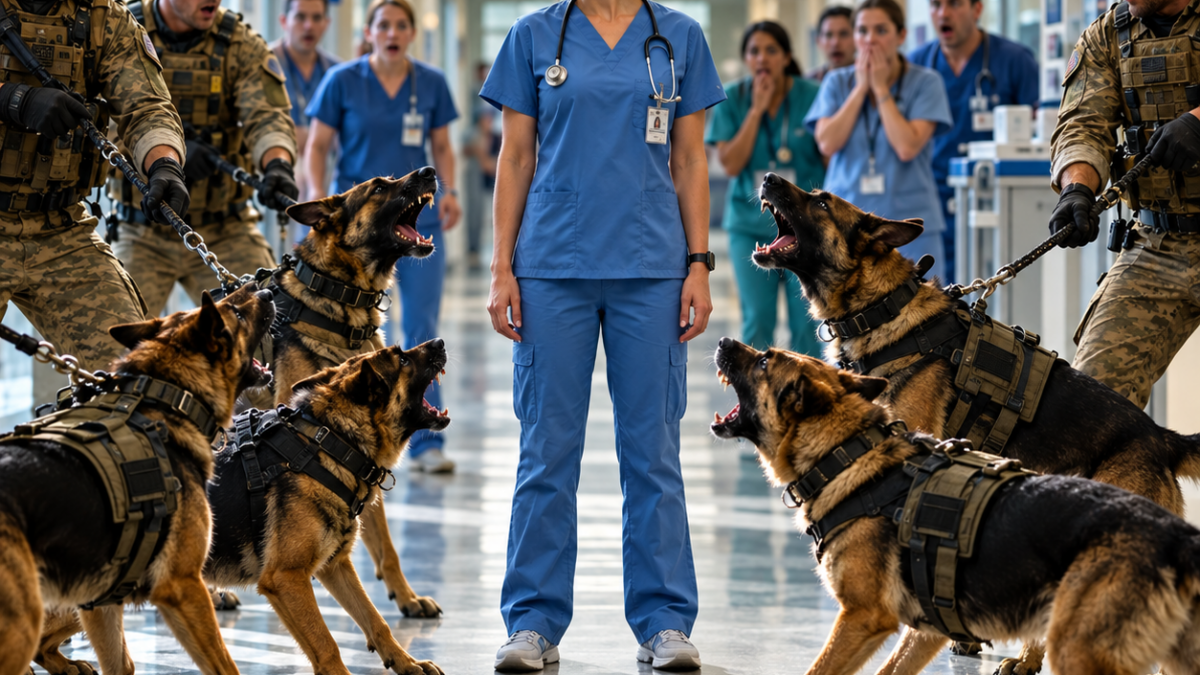
PART3:
“Then tell Commander Hayes the dogs aren’t attacking his handlers.”
The officer almost smiled.
“Lady, three guys are getting stitched up upstairs.”
“They’re not attacking.”
“What would you call it?”
Elena looked toward the sound.
“Drowning.”
The officer’s smile vanished.
Twenty seconds later, Commander Nathan Hayes heard someone arguing outside the containment control room.
“Sir, she’s ER staff.”
“Then why is she down here?”
“She heard the dogs.”
“So did everyone in the building.”
“She says they’re drowning.”
Hayes turned.
He was fifty-one years old, broad through the shoulders, silver beginning at his temples, and exhausted enough that his face had lost the practiced neutrality of command.
Behind him, five reinforced kennels sat beyond thick observation glass.
Inside them were five of the most valuable military working dogs on the East Coast.
And every one of them had become uncontrollable within the same thirty-seven-minute period.
The first was Atlas, a massive Belgian Malinois with a pale scar crossing his muzzle.
Beside him was Rook, black-coated and lean, trained for explosives detection.
Mako was younger, faster, and normally so disciplined his handler could stop him mid-sprint with a whispered command.
Sable, the only female, had completed four deployments.
Ghost had survived a roadside blast that killed his first handler.
That morning, all five had begun behaving as though every human approaching them was an enemy.
No infection.
No toxin anyone had identified.
No obvious injury.
Sedation had made Atlas worse.
Traditional commands failed.
Three handlers had been bitten or knocked down.
One veterinarian had refused to reenter after Ghost shattered a polycarbonate feeding tray and hurled himself against the gate.
Hayes was considering an option he did not want to name.
Then the door opened.
Elena walked in.
Master Chief Daniel Briggs, senior K9 handler, immediately stepped between her and the observation glass.
“No.”
Elena stopped.
Briggs pointed toward the door.
“Absolutely not. Get her out.”
Hayes looked at her.
“You’re the nurse?”
“Elena Moore.”
“You have experience with military dogs?”
She hesitated.
It was so brief most people would have missed it.
Hayes didn’t.
“Ms. Moore?”
“I have experience with trauma.”
Briggs laughed once.
“These aren’t scared golden retrievers at a shelter.”
Elena looked through the glass.
Atlas was pacing.
Seven steps.
Turn.
Seven steps.
Turn.
Mako was biting at the corner of his kennel door.
Sable’s pupils were wide.
Ghost kept looking toward the ceiling ventilation duct.
Rook was trembling so violently his tags clicked against his collar.
Elena’s expression changed.
Not fear.
Recognition.
Briggs noticed.
“You know something?”
She moved closer.
Briggs blocked her again.
“You don’t go any farther.”
Elena pointed at Ghost.
“Turn off the ventilation system.”
“What?”
“Turn it off.”
Hayes frowned.
“Why?”
“Because he’s tracking something in the airflow.”
Briggs shook his head. “We already checked for chemical exposure.”
“I’m not talking about chemicals.”
Elena looked toward a ceiling speaker.
“Turn off every electronic device in the kennel room that isn’t necessary to keep them alive.”
Briggs gave Hayes a look.
Hayes studied Elena.
“Do it.”
“Commander—”
“Do it.”
A technician powered down the ventilation fans.
Nothing happened.
Then auxiliary monitors.
Still nothing.
When he disabled an old training-frequency transmitter mounted above the far wall, Rook stopped trembling.
Everyone saw it.
Briggs turned slowly toward the technician.
“What did you just shut off?”
“Training receiver. It’s not active.”
“Apparently it was,” Elena said.
Atlas slammed the kennel again.
Briggs flinched.
Elena didn’t.
She walked to the glass.
All five dogs saw her.
The effect was immediate.
Atlas stopped mid-step.
Ghost lifted his head.
Sable froze.
Mako released the steel latch from his teeth.
Rook stared.
For three full seconds, there was no barking.
No growling.
No claws scraping concrete.
Nothing.
Then Atlas moved to the front of his kennel.
Slowly.
Briggs whispered, “What the hell?”
Elena put her palm against the glass.
Atlas’s ears shifted forward.
His chest rose and fell rapidly.
He stared at her face.
Not her hand.
Her face.
Elena’s throat tightened.
He was older.
Gray around the muzzle.
One ear carried a notch that had not been there before.
But she knew those eyes.
Hayes stepped closer.
“You’ve seen that dog before.”
Elena said nothing.
Atlas made a sound.
Small.
Almost a whine.
Briggs stared at him.
“I’ve never heard him make that sound.”
Elena’s eyes filled.
She whispered, “Neither have I.”
Atlas pressed his forehead against the kennel bars.
Sable moved next.
Then Rook.
Ghost stopped watching the ceiling and turned entirely toward Elena.
Mako sat.
Briggs looked at her.
“Who are you?”
Elena didn’t answer him.
She watched Atlas.
Her hand trembled against the glass.
Hayes spoke carefully.
“Ms. Moore, whatever you know, I need it now.”
Elena swallowed.
“They’re not aggressive.”
Briggs looked at the bandage wrapped around his forearm.
“You’re kidding.”
“They’re overwhelmed.”
“They put Chief Nolan in surgery.”
“Because Nolan cornered Atlas while Atlas thought he was being attacked.”
“He’s his handler.”
“Not in Atlas’s head right now.”
Briggs stepped toward her.
“And you know what’s in his head?”
Elena finally looked at him.
“Yes.”
The room went still.
Hayes said, “Explain.”
Elena turned back to the dogs.
“Not yet.”
Briggs laughed in disbelief.
“You walk into my containment unit in scrubs, tell me five Tier One dogs aren’t dangerous after they injured three men, refuse to identify your experience, and now you’re giving us conditions?”
Elena looked at Atlas.
“Open his door.”
Every man in the room spoke at once.
“No.”
“Absolutely not.”
“Commander—”
Hayes raised a hand.
Silence.
He stared at Elena.
“If I open that kennel and you’re wrong, he could kill you.”
Elena nodded.
“Yes.”
“You understand that?”
“Better than anyone here.”
Briggs stepped closer.
“No civilian is walking into that room.”
Elena looked at him.
“Then put me in a bite suit.”
“He’ll go through it.”
“I know.”
“Lady, what part of—”
“Master Chief.”
Her voice changed.
Briggs stopped talking.
Elena pointed toward Atlas.
“Look at his back legs.”
Briggs did.
Atlas’s hindquarters were trembling.
“Now his tail.”
Low.
Tucked almost against his abdomen.
“His ears.”
Forward, then flat, then forward again.
“His jaw.”
Closed.
Briggs’s expression changed slightly.
Elena continued.
“He doesn’t want to attack. He’s trying not to.”
Briggs looked at her.
“How do you know?”
“Because somebody is using an aversive conditioning frequency he associates with capture.”
Hayes turned toward the disabled transmitter.
“Capture by whom?”
Elena looked at him.
And for the first time, there was fear in her eyes.
“People who should not exist anymore.”
No one said anything.
Hayes walked to the security console himself.
He entered a code.
The outer observation door unlocked.
Briggs stepped in front of him.
“Sir.”
Hayes kept his eyes on Elena.
“You get one attempt.”
Elena nodded.
“No weapons aimed at him.”
Briggs almost exploded.
“Absolutely not.”
“If he sees rifles, he’ll read posture before he reads faces.”
“Then nobody goes inside.”
Elena turned to Hayes.
“Commander, if somebody activated that transmitter remotely, they’re expecting these dogs to fail.”
Hayes stared.
“Why?”
“Because then you’ll do exactly what the protocol says.”
He knew what she meant.
Behaviorally unstable military working dogs could be removed from service.
In an extreme case, euthanized.
Elena lowered her voice.
“Someone wants five witnesses destroyed.”
Briggs frowned.
“Witnesses? They’re dogs.”
Elena looked at him.
“That’s what makes them perfect.”
Hayes unlocked the final door.
Elena entered alone.
The smell hit her first.
Disinfectant.
Steel.
Dog.
Adrenaline.
Memory.
Atlas stood behind the kennel gate.
He was less than eight feet away.
Elena stopped.
“Hey, big man.”
His ears twitched.
Briggs watched from behind the glass with his hand clenched.
“That’s not his call sign.”
Elena ignored him.
She took one more step.
Atlas growled.
Every handler tensed.
Elena stopped immediately.
She turned her body slightly sideways.
No eye contact.
No reaching.
No command.
Just breathing.
Slow.
Measured.
Atlas growled again.
Elena whispered, “I know.”
His breathing changed.
She crouched.
Behind the glass, Briggs muttered, “She is out of her mind.”
Hayes said, “No.”
“What?”
“Look at the dog.”
Atlas’s growl had ended.
Elena lowered herself completely to one knee.
A few feet separated them.
Her eyes were wet now.
“You got old.”
Atlas stared.
“And stubborn.”
His nose worked furiously.
Elena raised one hand but didn’t extend it.
Then she said the word.
“Calm.”
Atlas collapsed.
Not violently.
Not from sedation.
His rear legs folded beneath him.
His chest touched the floor.
He released a sound somewhere between a whine and a breath.
Then he crawled forward.
Master Chief Briggs stared at the glass.
“No.”
Atlas pushed his nose between the kennel bars.
Elena covered her mouth.
The dog closed his eyes.
“Calm,” she repeated.
Sable lay down.
Rook sat.
Mako stopped pacing completely.
Ghost walked to the front of his kennel and lowered his head.
Five dogs.
Five trained combat animals who had ignored every certified handler in the building.
Silent.
Briggs’s face lost its color.
Hayes whispered, “What did you just do?”
Elena rested her forehead against Atlas’s.
She answered without turning around.
“I reminded them where home was.”
Twenty minutes later, Elena sat in a secure conference room with four armed guards outside.
She had changed nothing about her appearance.
Same bloodstained scrubs.
Same exhausted face.
Same hospital badge clipped at her waist.
Yet no one in the room saw an ordinary nurse anymore.
Commander Hayes sat across from her.
Briggs stood behind him.
A legal officer had joined them.
So had Captain Rebecca Shaw, chief veterinarian for the facility.
A digital recorder sat in the middle of the table.
Hayes pressed record.
“State your name.”
“Elena Claire Moore.”
“Current occupation.”
“Emergency department nurse.”
“Previous military service?”
Elena stared at the recorder.
“Army Medical Service Corps.”
Briggs’s eyebrows lifted.
“Rank?”
“Captain.”
“Unit?”
Elena didn’t answer.
Hayes leaned forward.
“Ms. Moore.”
“It’s classified.”
“So is half this building.”
“You don’t have clearance.”
Hayes’s jaw tightened.
“I command this facility.”
“That’s not enough.”
Briggs folded his arms.
“What was enough?”
Elena looked at him.
“Blackridge.”
Briggs stopped breathing for a moment.
Captain Shaw frowned.
“I don’t know that name.”
Hayes did.
Elena saw it.
“You’ve heard of it.”
Hayes didn’t confirm.
Didn’t deny.
Instead he asked, “How do you know those dogs?”
Elena looked through the conference-room window toward the security corridor.
“Because eleven years ago, I helped train them not to die.”
Briggs shook his head.
“Atlas is nine.”
“Atlas isn’t the dog I originally worked with.”
Silence.
Elena continued.
“He’s from the third behavioral line.”
Shaw leaned forward.
“Behavioral line?”
“A breeding and selection program.”
“Military working dog breeding is documented.”
“Not this one.”
Elena closed her eyes briefly.
“Blackridge started after commanders noticed something no one wanted to talk about. Dogs were surviving missions physically and coming home psychologically destroyed. Hypervigilance. Shutdown. Handler aggression. Refusal to work. Sleep disruption. Sound-triggered panic.”
Shaw nodded slowly.
“Post-traumatic stress.”
“Yes.”
Briggs said, “We treat that.”
“Now you do.”
Elena looked at him.
“Back then, some people treated it like equipment failure.”
The words settled heavily.
“Blackridge was supposed to change that. I joined because I believed we were developing humane reintegration protocols. Predictable environments. scent anchors. decompression routines. handler-bond restoration.”
Hayes asked, “And the word?”
“Calm.”
“What is it?”
“Nothing magical.”
Her voice cracked slightly.
“It was the last cue we used after every stabilization session. Not an obedience command. More like a promise.”
Briggs frowned.
“A promise?”
“That nobody would touch them. Nobody would test them. Nobody would hurt them. It meant the work was over.”
Elena looked toward the corridor again.
“For some of them, it was the only word they trusted.”
Hayes sat back.
“And then?”
Elena’s expression hardened.
“Then Colonel Adrian Voss took control of Blackridge.”
The legal officer typed the name into a secure terminal.
Nothing appeared.
“There’s no Colonel Adrian Voss in the database.”
“There won’t be.”
“Why?”
“Because the man understood records better than he understood mercy.”
Elena looked at Hayes.
“Voss saw our success and asked a different question.”
“What question?”
“If trauma could be reduced through conditioning, could loyalty be transferred the same way?”
Briggs’s face tightened.
“What does that mean?”
“He wanted dogs who would override their primary handlers on hidden signals.”
“No.”
“He wanted deniable control.”
Shaw whispered, “That violates every ethical working-dog protocol we have.”
“That never stopped him.”
Elena’s voice grew colder.
“They exposed dogs to stress, then paired relief with encrypted acoustic signals. They called it resilience testing. It wasn’t. They were building animals who could be destabilized and redirected.”
Hayes glanced at the disabled transmitter report.
“The frequency today.”
“Same family.”
“You recognized it?”
“I recognized the response.”
Briggs stared at her.
“And Atlas?”
Elena’s eyes softened.
“The dog I knew was Alpha Three.”
“Atlas?”
“His predecessor.”
She swallowed.
“The bloodline was continued.”
Briggs shook his head.
“That doesn’t explain why Atlas recognized you.”
“No.”
Elena looked at him.
“It doesn’t.”
The room became very quiet.
Hayes asked, “Then explain it.”
“I can’t yet.”
Briggs slapped one palm against the table.
“Three of my people are injured.”
Elena didn’t flinch.
“And five of your dogs were tortured this morning.”
“You don’t know that.”
“I do.”
“How?”
“Because panic doesn’t synchronize across five separate kennels without a shared stimulus.”
Briggs leaned closer.
“Then prove it.”
Elena looked at Hayes.
“Give me access to yesterday’s surveillance logs.”
The legal officer objected.
Hayes overruled him.
For the next two hours, nobody left.
They watched forty-eight hours of footage.
At 2:13 the previous morning, a maintenance technician entered the corridor.
Normal uniform.
Normal badge.
Toolbox in hand.
He spent eleven minutes checking ventilation sensors.
At 2:19, he looked directly toward a security camera.
At 2:20, the feed glitched for seventeen seconds.
When the picture returned, he was walking away.
Elena paused the video.
“Zoom in.”
The technician enlarged it.
She pointed.
“His toolbox.”
Briggs leaned closer.
A black antenna barely visible between two metal latches.
Hayes looked toward the training transmitter mounted in the kennel room.
“Can that device be accessed remotely?”
The technician’s face tightened.
“It shouldn’t be.”
“That’s not what I asked.”
“Yes.”
Hayes turned.
“Who was the maintenance man?”
A database search returned the answer.
No employee matched his badge number.
The photograph belonged to a contractor who had died four years earlier.
Hayes stood.
“Lock down the building.”
Briggs was already reaching for his radio.
Hayes pointed at the legal officer.
“Get NCIS.”
Elena said, “Not yet.”
Hayes turned sharply.
“You’ve had enough control of this conversation.”
“Commander, if Blackridge still exists, the first thing they monitor is formal escalation.”
“You expect me not to report an infiltration?”
“I expect you to think about why someone wanted those dogs declared dangerous before they stole them.”
Briggs said, “Steal them?”
Elena nodded.
“Or destroy them.”
Hayes stared at her for a long moment.
Then he asked, “What do these dogs know?”
Elena’s answer was barely audible.
“Maybe everything.”
That night, Elena did not go home.
Neither did Hayes.
Briggs refused to leave his dogs.
Captain Shaw performed full neurological and toxicological exams. Nothing explained the synchronized breakdown.
The dogs remained quiet whenever Elena was nearby.
When she left the corridor, Atlas paced.
When she returned, he settled.
By midnight, Briggs’s irritation had turned into something more complicated.
He found Elena sitting on the floor outside Atlas’s kennel, her back against the wall.
“You should sleep.”
“So should you.”
“I’m on duty.”
“You’ve been on duty nineteen hours.”
“So have you.”
He sat across from her.
Atlas watched them through the bars.
After a long silence, Briggs said, “He nearly broke Nolan’s wrist.”
“I know.”
“Nolan raised him for six years.”
“I know.”
“He feels like the dog betrayed him.”
Elena looked at Atlas.
“Atlas probably feels the same way.”
Briggs frowned.
“What?”
“Imagine waking up in your own house and suddenly hearing the sound that played every time somebody hurt you eleven years ago.”
She met Briggs’s eyes.
“Then the person you trust most walks toward you wearing the same tactical posture as the people who used to restrain you.”
Briggs looked toward Atlas.
“He didn’t know Nolan.”
“Not for a few minutes.”
That landed harder than Briggs expected.
He rubbed his face.
“God.”
Elena nodded.
“That’s what trauma does. It doesn’t ask permission before replacing the present with the past.”
Briggs was quiet.
Then he said, “You talk about that like you know.”
Elena smiled without humor.
“I do.”
He waited.
She didn’t continue.
Briggs stood.
“I owe you an apology.”
Elena looked up.
“For?”
“I treated you like an idiot because you were wearing scrubs.”
“You treated me like an idiot because you were scared.”
He almost smiled.
“That too.”
Elena looked at Atlas.
“So was he.”
At 2:41 a.m., Captain Shaw entered the corridor holding a tablet.
“You need to see this.”
The five dogs had been examined for implanted identifiers.
Standard microchips were present.
So were five things that were not standard.
Tiny subcutaneous devices located near the shoulder blades.
Each smaller than a grain of rice.
Briggs stared at the scan.
“What are those?”
Shaw shook her head.
“I don’t know.”
Elena did.
Her face went completely white.
“Get them out.”
Shaw looked at her.
“Surgery?”
“Now.”
“Elena—”
“Get them out.”
Hayes arrived minutes later.
When he saw Elena, he stopped.
“What are they?”
She whispered, “Blackridge tags.”
“For tracking?”
“Worse.”
Her hands were shaking.
“Signal reception.”
Briggs swore.
Hayes said, “You told us the external transmitter caused the reaction.”
“It started it.”
“And those?”
Elena looked through the glass.
“They finished it.”
The removal procedures began before dawn.
Atlas went first.
Elena stayed beside him while anesthesia took effect.
His head rested against her leg.
Briggs watched from the surgical doorway.
“You sure he’ll let us operate when he wakes up?”
Elena stroked Atlas’s ear.
“Yes.”
“How?”
“Because he’ll wake up without someone screaming inside his skull.”
Captain Shaw removed the device.
It had no manufacturer marking.
No serial number.
No registered military designation.
Hayes sent it to a secure electronics lab.
At 6:17 a.m., the first result came back.
The device was capable of receiving low-frequency encoded pulses.
At 6:31, the second result arrived.
The device contained a tiny encrypted memory component.
At 6:45, a federal security team arrived at the hospital.
Elena saw them through the window.
Black uniforms.
No branch insignia.
Six men.
One woman.
Their leader was tall, gray-haired, and carried himself with the casual confidence of someone accustomed to entering rooms nobody could stop him from entering.
Elena froze.
Briggs noticed.
“You know him?”
She whispered one name.
“Voss.”
Commander Hayes turned toward the approaching team.
“Colonel Adrian Voss?”
Elena shook her head.
“He hasn’t been a colonel in any official capacity for years.”
Voss stopped outside the security door.
He smiled through the glass.
At Elena.
Not Hayes.
Elena stood perfectly still.
Eleven years disappeared from her face.
She was thirty-one again.
Dust in her hair.
Blood on her uniform.
A dog screaming behind a steel door.
Voss leaning against a table.
You care too much, Captain Moore.
That is why you will never understand how useful fear can be.
Hayes stepped into the corridor.
“Nobody opens that door.”
Voss pressed the intercom.
“Commander Hayes.”
Hayes did not respond.
“You’re holding restricted government property.”
Hayes looked at Elena.
She shook her head once.
Voss continued.
“Five canine assets and one former program employee are subject to immediate federal retrieval.”
Briggs muttered, “Canine assets.”
Elena heard the anger in his voice.
Voss pressed the intercom again.
“Commander, I suggest you avoid turning an administrative situation into a career-ending misunderstanding.”
Hayes stepped toward the glass.
“I’m Commander Nathan Hayes, United States Navy. Identify your agency and present lawful transfer orders.”
Voss smiled.
“You’re not cleared for our agency.”
“Then you’re not cleared for my door.”
For the first time, Voss’s smile faded.
He held up a folder.
“Executive recovery authorization.”
Hayes’s legal officer took a photograph through the glass and began verification.
Two minutes later, he whispered, “Sir.”
“What?”
“The signature is legitimate.”
Elena closed her eyes.
Hayes asked, “Whose?”
The lawyer named an undersecretary at the Department of Defense.
Hayes looked toward the dogs.
Voss pressed the intercom.
“You have five minutes.”
Elena said, “He’ll kill them.”
Hayes looked at her.
“You know that?”
“I watched him do it before.”
Briggs stepped closer.
“What happened at Blackridge?”
Elena stared at Voss through the glass.
“He ordered seventeen dogs euthanized in one night.”
Nobody spoke.
“Why?”
“Because an inspector was coming.”
Briggs’s mouth opened.
No words came.
Elena continued.
“The program had produced severe neurological injuries in several dogs. Two had seizures. Four had stopped eating. One kept attacking concrete until his teeth broke.”
Her voice cracked.
“We documented everything.”
Voss watched her speaking through the glass.
“He found out.”
Hayes asked quietly, “What did you do?”
“I copied the records.”
“And?”
“I tried to get the dogs out.”
Briggs whispered, “By yourself?”
“No.”
Elena looked down.
“Sergeant Owen Mercer helped me.”
Something in her voice told them the rest.
Hayes asked anyway.
“What happened to him?”
“Officially?”
She looked up.
“Vehicle accident.”
“And unofficially?”
“Voss shot him.”
Briggs went completely still.
Elena’s eyes filled.
“Then he told everyone Mercer panicked during an evacuation.”
Outside the door, Voss checked his watch.
Elena continued.
“I got eight dogs out before Blackridge security closed the perimeter. Three survived long enough to reach another facility.”
“Alpha Three?”
“One of them.”
Hayes understood.
“Atlas’s line.”
Elena nodded.
“Before the dogs were separated, I spent thirty-six hours keeping them stable. No sleep. Barely any food. Every time one panicked, I sat beside him.”
Her voice softened.
“I said the same word every time.”
Briggs whispered, “Calm.”
Elena nodded.
“Alpha Three was later transferred into a classified breeding program. I thought the line ended years ago.”
Hayes looked through the glass at Atlas.
“It didn’t.”
“No.”
Voss pressed the intercom.
“Three minutes.”
Hayes’s phone rang.
He answered.
His face changed.
“Yes, sir.”
Everyone watched.
“Understood.”
He ended the call.
Briggs asked, “What?”
Hayes said nothing for several seconds.
Then:
“Fleet command ordered us to cooperate.”
Elena looked toward the five dogs.
Voss smiled again.
Briggs stepped between Hayes and the security controls.
“No.”
Hayes stared at him.
“Master Chief.”
“Sir, respectfully, no.”
“Move.”
“Those dogs are under my care.”
“So is every sailor in this building.”
“And we know that man tortured them.”
“We don’t have proof.”
Elena looked at the removed implant sitting inside an evidence bag.
“You have proof.”
“We have an unauthorized device. We don’t yet have proof who put it there.”
Voss knocked once on the glass.
Hayes shut his eyes.
Command was not always choosing between right and wrong.
Sometimes it was choosing which part of your oath would hurt most to obey.
He opened his eyes.
“Get me the undersecretary’s office.”
The lawyer shook his head.
“Sir, the order is valid.”
“I didn’t ask if it was valid.”
Hayes looked at Voss.
“I asked who signed it and what they were told.”
For the first time, Elena saw something in Hayes that reminded her of Owen Mercer.
Not recklessness.
Decency becoming inconvenient.
The call took seven minutes.
Voss waited.
On the eighth minute, Hayes learned the truth.
The undersecretary had authorized transfer of “potentially contaminated research animals exposed to an unknown neurological agent.”
No mention of Blackridge.
No mention of implanted devices.
No mention of Elena.
No mention of injured handlers.
No mention of Voss’s history.
Hayes put the phone on speaker.
“Sir,” he said, “were you informed that the retrieval team is led by a former officer named Adrian Voss?”
Silence.
Then:
“No.”
Voss’s face changed.
Hayes continued.
“Were you informed that Ms. Elena Moore alleges Voss previously operated an unauthorized conditioning program involving military working dogs?”
Another silence.
“No.”
“Were you informed we removed unregistered signal-receiving implants from five Navy K9s less than two hours ago?”
The undersecretary’s voice sharpened.
“Commander, lock down the facility.”
Hayes looked directly at Voss.
“Already done.”
Voss stepped back from the glass.
His team shifted.
Briggs moved toward the kennel controls.
Hayes said, “Nobody releases the dogs.”
Briggs stopped.
“Sir?”
“We are not turning them into weapons for us either.”
Elena looked at Hayes.
He had understood.
That mattered.
Outside, Voss spoke urgently to his team.
Then the corridor lights went out.
Emergency lighting flashed red.
The access system chirped.
The security door unlocked.
Hayes shouted, “Override!”
Too late.
Voss’s team entered.
Nobody fired.
Not yet.
Hayes’s security detail raised rifles.
Voss raised empty hands.
“Commander, don’t make this worse.”
Hayes stepped forward.
“Leave.”
Voss looked beyond him.
At Elena.
“Captain Moore.”
Elena’s face hardened.
“Don’t call me that.”
“I wondered how long you could hide in a hospital.”
“I wasn’t hiding.”
“No?”
Voss glanced at her scrubs.
“From behavioral operations specialist to emergency nurse. Quite a decline.”
Briggs moved beside her.
Elena did not look away from Voss.
“I save lives now.”
Voss smiled.
“You always did confuse sentiment with purpose.”
“And you always confused cruelty with intelligence.”
The smile disappeared.
Voss pointed toward the kennel room.
“Those animals belong to a program that predates everyone standing here.”
Elena’s voice became very quiet.
“They don’t belong to anyone.”
“They are military property.”
“They’re living animals.”
“They were bred for war.”
“So were half the men in this hallway, according to people like you.”
Several sailors stiffened.
Voss’s gaze sharpened.
“You haven’t changed.”
Elena said, “That’s why you’re scared.”
He laughed.
“Of you?”
“No.”
She nodded toward the dogs.
“Of what they carry.”
For the first time, Voss looked uneasy.
Hayes noticed.
“What is on those implant memory chips?”
Voss said nothing.
Elena understood.
Her eyes widened.
“They record.”
Voss looked at her.
That was enough.
Elena turned toward Hayes.
“They record stimulation responses.”
Shaw understood next.
“And surrounding audio?”
Elena nodded slowly.
“Training validation.”
Voss moved.
“Secure the evidence.”
His team surged forward.
Hayes shouted.
Security personnel blocked them.
A brief struggle erupted.
No gunshots.
Elbows.
Bodies.
Weapons kept pointed down by people disciplined enough to understand how quickly a crowded corridor could become a graveyard.
One of Voss’s men broke through toward the evidence room.
Briggs tackled him.
Another reached for Elena.
Atlas exploded against his kennel gate.
The entire corridor froze at the sound.
Voss looked toward the dog.
Then at Elena.
“Still using the same trick?”
Elena said nothing.
“You think they love you?”
His voice was loud enough for everyone.
“You conditioned them just as much as we did.”
That sentence hurt.
Elena’s face showed it.
Voss saw it and smiled.
“You gave them your voice. Your scent. Your word. You made yourself their answer to fear.”
He stepped closer.
“How are you different from me?”
Elena looked through the glass.
Atlas stood rigid.
Waiting.
She thought about that question.
For eleven years, part of her had been asking it too.
Had she saved those dogs?
Or simply taught them another dependency?
Had she given them safety?
Or just another command?
Briggs watched her.
“Elena.”
Voss smiled.
“Go on. Say it.”
She looked at Atlas.
Then she did something Voss did not expect.
She opened the kennel control panel.
Hayes tensed.
“What are you doing?”
Elena entered the release sequence for Atlas’s inner enclosure.
Briggs grabbed her wrist.
“If you open that—”
“Trust me.”
The words were almost a whisper.
Briggs looked into her eyes.
Then slowly released her.
The gate opened.
Atlas stepped out.
Every rifle in the corridor rose.
Elena shouted, “Weapons down!”
Hayes immediately lowered his.
“Down!”
One by one, the others followed.
Voss backed away.
Atlas walked into the corridor.
No leash.
No muzzle.
No handler.
His eyes moved from person to person.
Then he saw Voss.
The dog froze.
A sound came from his chest.
Low.
Ancient.
Voss went pale.
“You see?” he said. “Conditioning.”
Elena stood ten feet away.
She did not give a command.
Atlas moved toward Voss.
Voss reached for a control device beneath his jacket.
Elena saw it.
So did Atlas.
Voss pressed a button.
A pulse emitted.
Atlas screamed.
He dropped to the floor.
Elena ran.
“Stop!”
Voss pressed again.
Atlas convulsed.
Briggs launched himself at Voss.
Two federal officers caught him.
Elena fell beside Atlas.
The dog thrashed.
She did not restrain him.
She placed both hands flat on the floor where he could see them.
“Atlas.”
His eyes rolled toward her.
“Stay with me.”
Another pulse.
Atlas cried out.
The other four dogs began barking.
Voss shouted over the noise.
“They are dangerous! This proves it!”
Elena looked up.
Her face was wet with tears.
“No.”
She turned toward Atlas.
And whispered one word.
“Calm.”
Atlas stopped fighting.
Not because the pain disappeared.
It didn’t.
Not because the signal stopped.
It hadn’t.
He stopped because he heard her.
His breathing hitched.
Elena lowered her forehead toward his.
“Calm.”
Atlas pushed one paw against the floor.
He tried to stand.
Voss pressed the transmitter again.
Atlas staggered.
Then stood anyway.
Everyone watched.
He faced Voss.
Voss pressed the device repeatedly.
Atlas trembled.
But he did not attack.
He did not retreat.
He simply stood.
Elena rose beside him.
“That’s the difference.”
Voss stared.
“What?”
“You taught him fear so he’d obey.”
She put a hand beside Atlas’s neck.
“I taught him safety so he could choose.”
Voss’s face hardened.
“He is choosing to attack me.”
“No.”
Elena stepped backward.
Atlas glanced at her.
Then at Voss.
She said nothing.
Atlas walked away from Voss.
He returned to Elena.
Sat beside her.
The corridor became silent.
Briggs stared at the dog.
Hayes stared at Voss.
Voss looked at the useless controller in his hand.
For eleven years, Adrian Voss had believed control was proof of superiority.
In one quiet moment, a dog had disproved his entire life.
Hayes held out his hand.
“Give me the device.”
Voss didn’t move.
“Now.”
Voss slowly handed it over.
Briggs took it.
Captain Shaw rushed to Atlas.
The other four dogs were released one at a time under controlled conditions.
Each went to Elena first.
Then to their handlers.
Rook pressed his body against Sergeant Nolan’s legs so hard the injured man began crying.
Sable climbed halfway into Briggs’s lap despite weighing nearly seventy pounds.
Ghost leaned his head against Captain Shaw.
Mako licked the hand of a young handler who had spent the entire night convinced his dog hated him.
No one laughed.
No one called them assets.
At 9:23 that morning, investigators arrived.
Real investigators.
Naval Criminal Investigative Service.
Department of Defense Inspector General.
Federal prosecutors.
Voss was separated from his team.
His devices were seized.
The Blackridge implants were taken into evidence.
Elena gave a statement lasting six hours.
Then another the next day.
And another two days later.
She hated every minute.
Secrets did not become easier to speak simply because silence had become impossible.
She had to describe the original Blackridge compound.
The dogs.
The experiments.
The reports.
The night Voss ordered the animals destroyed.
Owen Mercer bleeding against the side of a transport vehicle.
Her own flight through a maintenance gate with three terrified dogs in the back of a van.
The investigation uncovered more than anyone expected.
Blackridge had officially closed eleven years earlier.
Unofficially, portions of the program had survived through contractors, shell research companies, and classified behavioral projects.
Voss had built a network around legitimate military procurement.
The dogs were not the only victims.
Handlers had been lied to.
Veterinarians had been denied medical histories.
Researchers who objected had been reassigned.
One had lost his security clearance.
Another had been accused of stealing pharmaceuticals.
A former technician named Maria Alvarez had spent nine years believing nobody would ever believe her.
When Elena’s name appeared in a sealed investigative notice, Maria called within an hour.
“I kept copies,” she said.
Those three words changed the case.
Maria had records.
Videos.
Training logs.
Email correspondence.
And one audio file.
It had been recorded eleven years earlier.
Voss’s voice was unmistakable.
“If the animals cannot be recovered, destroy them. If personnel interfere, classify them as compromised.”
A younger Elena could be heard shouting in the background.
“They’re not equipment!”
Voss replied:
“They are whatever the mission requires.”
The recording spread through the investigation like fire.
Three weeks later, a congressional oversight committee became involved.
A month after that, the story leaked.
At first, Elena’s name was withheld.
Then someone released it.
The headline appeared before she finished a night shift.
MYSTERY NURSE AT CENTER OF SECRET MILITARY K9 SCANDAL.
Reporters filled the sidewalk outside the hospital.
Commentators argued about classified programs they barely understood.
Online strangers called Elena a hero.
Others called her a traitor.
One television host suggested she had fabricated the story to profit from attention.
Elena watched thirty seconds of that broadcast before turning it off.
The next morning, someone had taped a handwritten note to her locker.
You saved Atlas.
That’s enough.
It was from Briggs.
Elena kept it.
The public pressure created another problem.
The Navy announced that all five dogs would be temporarily removed from operational service pending medical evaluation.
Then came the possibility Elena had feared.
Permanent retirement.
Briggs found her outside the kennel facility.
“You look like somebody died.”
“They’re pulling them.”
“Temporarily.”
“You know what temporary means in bureaucratic language.”
Briggs leaned against the wall.
“They can’t go back into combat after this.”
“I know.”
“You disagree?”
“No.”
Elena looked through the glass.
Atlas was sleeping.
“I just don’t want their last chapter to be a concrete kennel because nobody knows what to do with them.”
Briggs smiled slightly.
“I’ve been making calls.”
Elena looked at him.
“What calls?”
“Retirement placements.”
“You?”
“Don’t sound so shocked.”
“You called me an idiot the first day.”
“I’ve grown.”
“Three weeks.”
“Remarkable progress.”
She laughed.
It was the first time Briggs had heard her laugh.
He became serious.
“Nolan wants Rook.”
“Of course he does.”
“Shaw wants Sable.”
Elena smiled.
“That makes sense.”
“Mako’s handler’s family has property in North Carolina.”
“And Ghost?”
Briggs scratched his chin.
“Hayes.”
Elena blinked.
“Commander Hayes?”
“Apparently his wife has wanted a dog for ten years.”
“Ghost isn’t exactly a starter dog.”
“That’s what I said.”
“And Atlas?”
Briggs looked at her.
Elena immediately shook her head.
“No.”
“You didn’t even let me finish.”
“I work twelve-hour shifts.”
“You have a fenced yard.”
“How do you know where I live?”
“I’m military. We know things.”
“I have a cat.”
“Atlas survived Voss. He can handle a cat.”
“Briggs.”
“He doesn’t settle when you’re gone.”
Her expression changed.
“That’s not healthy.”
“Maybe not.”
He looked through the glass.
“But retirement isn’t about creating perfect emotional independence. Sometimes it’s about putting somebody somewhere safe enough that they can finally learn it.”
Elena stared at Atlas.
Briggs said quietly, “Maybe that applies to both of you.”
She looked at him.
“That was almost wise.”
“Don’t tell anyone.”
Atlas came home with Elena four months later.
The first night was a disaster.
He refused to enter her bedroom.
He paced the hallway.
Every time the refrigerator compressor clicked, his head snapped toward the sound.
At 2:00 a.m., Elena found him sitting beside the front door.
She sat five feet away.
Neither moved.
At 2:17, her orange cat, Sherman, walked into the hallway.
Atlas froze.
Sherman stared at him.
Atlas stared back.
Elena whispered, “Please don’t turn my apartment into a crime scene.”
Sherman walked forward.
Atlas lowered his head.
The cat sniffed his nose.
Then slapped him once across the muzzle.
Atlas looked at Elena in complete disbelief.
She covered her mouth to keep from laughing.
Sherman walked away.
“Combat veteran,” Elena whispered.
Atlas sighed.
That was the beginning.
Healing did not look cinematic most days.
It looked repetitive.
Boring.
Slow.
Atlas learned the mail slot was not a threat.
He learned thunder did not mean incoming fire.
He learned Elena leaving for work did not mean abandonment.
Elena learned almost the same things.
She learned silence did not always mean someone was about to kick in a door.
She learned unanswered phone calls were not automatically bad news.
She learned to sleep without checking the locks three times.
Some nights, Atlas woke from dreams.
Some nights, Elena did.
They never asked each other for explanations.
One simply stayed near the other until morning.
The case against Voss took nearly two years.
That angered people who expected justice to move as quickly as outrage.
It rarely does.
Investigators had to separate legal classified programs from illegal conduct.
Contracts had to be traced.
Witnesses had to be protected.
Old evidence had to be authenticated.
Voss fought everything.
He claimed Elena was unstable.
He claimed Maria Alvarez had falsified records.
He claimed Owen Mercer’s death had been properly investigated.
He claimed the dogs’ behavior proved Blackridge techniques were necessary.
Then prosecutors recovered the final implant archive.
The memory devices had indeed stored diagnostic information.
Audio fragments too.
Thousands of them.
Most were useless.
Static.
Barking.
Commands.
Environmental noise.
But one recording from Atlas’s predecessor contained something extraordinary.
A voice.
Voss.
Eleven years earlier.
“Mercer knows too much.”
Another man asked, “What do you want done?”
Voss answered:
“Make sure his accident looks like one.”
Elena was sitting in her kitchen when Hayes called.
Atlas’s head rested on her foot.
She listened without speaking.
Hayes finished.
“Elena?”
She looked down at Atlas.
“Is it enough?”
“For conspiracy charges related to Mercer’s death? Prosecutors believe so.”
Her hand began to shake.
“Elena?”
She closed her eyes.
For eleven years, Owen Mercer had been officially remembered as a man who lost control of a vehicle during a chaotic evacuation.
His widow had believed it.
His son had grown up believing it.
Elena had carried the truth alone because every record she possessed had disappeared.
Now a dog everyone had treated like a weapon had carried Owen’s voice back from the dead.
She began to cry.
Not beautifully.
Not quietly.
She folded over her kitchen table and sobbed until she couldn’t breathe.
Atlas stood and pushed his head beneath her arm.
She held him.
“Calm,” she whispered.
But this time she was saying it to herself.
Voss’s trial lasted six weeks.
Elena testified for three days.
On the second day, Voss’s attorney tried to humiliate her.
He displayed her psychiatric evaluation after Blackridge.
Acute stress disorder.
Insomnia.
Anxiety.
He asked whether she had experienced nightmares.
“Yes.”
Panic attacks.
“Yes.”
Periods of depression.
“Yes.”
He walked closer.
“Would you agree, Ms. Moore, that after Blackridge you were emotionally unstable?”
Elena looked at the jury.
Then at Voss.
Then back at the attorney.
“I would agree that watching living creatures tortured, watching my friend murdered, and being threatened into silence affected me.”
The courtroom was silent.
The attorney tried again.
“So your perception may have been compromised.”
Elena shook her head.
“My health was injured.”
She looked directly at Voss.
“My memory wasn’t.”
The attorney changed subjects.
On the final day of testimony, prosecutors played the recording concerning Mercer.
Owen’s widow sat behind Elena.
Her name was Claire.
She had not spoken to Elena before the trial.
Elena had been afraid she hated her for surviving.
After court adjourned, Claire approached.
Elena stood.
“I’m sorry.”
Claire shook her head.
“No.”
“I should have come to you.”
“You were threatened.”
“I should have found a way.”
Claire’s eyes filled.
“For eleven years I thought my husband made a mistake.”
Elena couldn’t speak.
Claire continued.
“I was angry with him.”
Her voice broke.
“I thought he drove too fast because he panicked.”
Elena covered her mouth.
Claire stepped forward and hugged her.
“My son thought his father died afraid.”
Elena began crying.
“He wasn’t afraid.”
Claire held her tighter.
“He was furious.”
Elena laughed through tears.
“That sounds more like Owen.”
Voss was convicted on multiple counts involving conspiracy, obstruction, unlawful experimentation, evidence tampering, and crimes connected to Mercer’s death.
Several officials who had assisted in the cover-up were charged separately.
Others lost their positions.
Two private contractors were dissolved.
A government review changed working-dog oversight policies.
Medical histories could no longer be hidden behind operational compartmentalization from veterinarians responsible for treatment.
Independent welfare review became mandatory for certain research programs.
Retired handlers testified.
Veterinary specialists testified.
And for the first time in official documents, the dogs were repeatedly described not as equipment, but as military working animals entitled to welfare protections.
Elena cared about that more than headlines.
On the morning Voss was sentenced, reporters crowded the courthouse.
He walked past Elena in restraints.
For a second, he stopped.
The guards tried to move him.
Voss looked at her.
“You destroyed your career for dogs.”
Elena stared at him.
“No.”
She glanced toward Claire Mercer standing nearby.
Toward Briggs.
Hayes.
Captain Shaw.
Maria Alvarez.
People Voss had once kept isolated.
“I found my life because of them.”
Voss looked as if he wanted to say something cruel.
Nothing came.
He was taken away.
Outside, reporters shouted questions.
“Ms. Moore!”
“Elena!”
“Do you consider yourself a whistleblower?”
“Will you sue the government?”
“Do you regret leaving the military?”
“Are the dogs heroes?”
Elena stopped.
Dozens of microphones rose.
She had avoided cameras for two years.
Hayes watched from several feet away.
Briggs muttered, “You don’t owe them anything.”
Elena nodded.
Then she looked at the cameras.
“I want to say one thing.”
The crowd quieted.
“People keep asking why five trained military dogs suddenly became uncontrollable.”
She paused.
“They didn’t.”
Reporters leaned closer.
“They were communicating the only way they could. Something was hurting them, and everyone around them was so focused on forcing obedience that almost nobody stopped to ask why they were afraid.”
Her voice remained calm.
“That’s not just true of dogs.”
No one interrupted.
“We use words like discipline, strength, readiness, loyalty. Those words matter. But they become dangerous when they’re used to shame suffering.”
She looked toward Claire.
“Sometimes the strongest thing a soldier can do is ask for help.”
Then toward Briggs.
“Sometimes the smartest thing a handler can do is stop giving commands.”
Then she smiled faintly.
“And sometimes a nurse in dirty scrubs knows something worth listening to.”
Briggs laughed.
Several reporters did too.
Elena continued.
“Atlas and the others weren’t saved because I had a secret word.”
Her eyes filled.
“They were saved because eventually somebody believed their fear meant something.”
She stepped away.
That was the only press conference Elena Moore ever gave.
Years passed.
Rook grew fat at Nolan’s house and developed an embarrassing obsession with stealing socks.
Sable slept beside Captain Shaw’s daughter every night.
Mako discovered lakes and refused to leave the water willingly.
Ghost became Commander Hayes’s wife’s shadow and learned how to open their refrigerator.
Atlas stayed with Elena.
His muzzle became white.
His pace slowed.
The scar across his nose faded beneath gray fur.
Elena eventually left emergency medicine.
Not because she was tired of helping people.
Because the investigation had created something she could not ignore.
Veterans began contacting her.
Handlers.
Medics.
Police K9 units.
Shelter workers dealing with former working dogs.
Families who had adopted animals nobody understood.
Elena and Briggs built a small nonprofit outside Richmond.
They called it Mercer House.
Claire Mercer chose the name.
The property had twelve acres, quiet kennels designed to feel like rooms instead of cages, walking trails, veterinary treatment areas, and small cabins where handlers could stay during reintegration.
There was no Blackridge technology.
No secret control system.
No forced exposure designed to break fear.
There was patience.
Food.
Space.
Predictability.
And one rule printed on a sign near the entrance:
Behavior is communication.
Listen before you punish.
Veterans began coming too.
At first unofficially.
A handler would arrive with a dog and stay overnight.
Then two nights.
Then a week.
Some men who refused to talk to therapists would sit beside a traumatized dog for hours and eventually realize they were describing themselves.
One retired Marine named Cole arrived with a shepherd who snapped whenever anyone touched his collar.
Cole called the dog defective.
Elena watched him for ten minutes.
Then asked, “What happened the last time somebody grabbed your neck?”
Cole went silent.
He never used the word defective again.
Mercer House grew.
Donations came.
Military veterinary programs collaborated.
Universities studied humane reintegration techniques.
Elena was offered awards.
She accepted some.
Declined others.
The only framed photograph in her office showed Owen Mercer sitting in Afghan dirt with Alpha Three leaning against his shoulder.
On the back, Owen had written:
Nobody is brave every minute.
That’s why we stay beside each other.
Atlas lived long enough to sleep beneath that photograph hundreds of afternoons.
When he turned thirteen, his hips began failing.
At fourteen, cancer appeared in his spleen.
Elena knew before the veterinarian finished explaining.
She had spent her adult life around death.
Knowledge did not make it easier.
They gave Atlas good months.
Then good weeks.
Eventually, there were more painful mornings than comfortable ones.
One November evening, Elena found him lying beneath an oak tree near the edge of Mercer House.
Leaves covered the ground.
The sunset was orange behind the pasture.
Atlas could no longer stand without help.
Elena lowered herself beside him.
His head moved weakly into her lap.
Briggs approached from the house.
He stopped several yards away.
“Vet’s here.”
Elena nodded.
“Give us a minute.”
Briggs turned away.
Elena stroked Atlas’s face.
“You remember the first day?”
His ear twitched.
“You scared the hell out of everybody.”
Atlas breathed slowly.
“Not me, obviously.”
She smiled through tears.
“I was extremely professional.”
His tail tapped once.
Elena laughed.
“Okay. Maybe a little scared.”
She looked toward Mercer House.
A young veteran was walking a nervous German shepherd along the distant fence.
Captain Shaw’s daughter, now nearly grown, had come to visit with Sable’s collar hanging from her backpack.
Hayes was inside making coffee.
Claire Mercer had planted flowers near the entrance that spring.
Life.
So much life had grown from one terrible corridor.
Elena looked down.
“You did that.”
Atlas breathed.
“No one will believe me.”
She bent and kissed his scarred muzzle.
“But you did.”
The veterinarian approached quietly.
Elena nodded.
Atlas received the sedative beneath the oak tree.
No steel table.
No bright lights.
No restraints.
His breathing slowed.
Elena held his face between her hands.
There were thousands of things she wanted to say.
Thank you.
I’m sorry.
You were never broken.
Owen would have loved you.
You saved me too.
None of them seemed right.
Atlas opened his eyes one last time.
Elena smiled through tears.
Then she gave him the word that had begun everything.
“Calm.”
Atlas exhaled.
His body softened.
And for the first time in his long, complicated life, the word did not mean a session was over.
It meant he could finally rest.
Briggs found Elena still sitting beneath the tree after dark.
He lowered himself beside her.
Neither spoke for a while.
Eventually he said, “He had a good life.”
Elena nodded.
“I know.”
“It still hurts.”
“I know.”
Briggs looked toward the lights of Mercer House.
“You remember what you told me that first night?”
“What?”
“Trauma replaces the present with the past.”
Elena wiped her face.
“Sounds depressing.”
“You also taught me the rest.”
“I did?”
“Yeah.”
He looked at her.
“You give somebody enough safe presents, eventually the past stops owning all of them.”
Elena smiled faintly.
“That was actually wise.”
“I’ve had years of practice.”
They sat beneath the oak tree until the cold forced them inside.
The next morning, Elena found five packages outside her office.
One from Nolan.
One from Shaw.
One from Mako’s handler.
One from Hayes.
One from Briggs, though he pretended not to know anything about it.
Inside each package was an old collar.
Rook’s.
Sable’s.
Mako’s.
Ghost’s.
And Atlas’s.
All five dogs had now died.
All five had lived years beyond Blackridge.
Elena arranged the collars beneath Owen’s photograph.
Then she added a small brass plaque.
Not weapons.
Not assets.
Not equipment.
They were alive.
Years later, young handlers visiting Mercer House would stand in front of that wall.
They knew the public version of the story.
Five uncontrollable military dogs.
Three injured handlers.
A nurse walking into a restricted facility.
One mysterious word.
People still exaggerated it.
Some versions claimed Elena hypnotized the dogs.
Others said she had raised all five from puppies.
One ridiculous internet video insisted she had been an undercover Navy SEAL.
Briggs enjoyed showing her those.
Elena hated them.
But when new handlers asked what really happened, she always gave the same answer.
“The word didn’t control them.”
Someone would inevitably ask, “Then why did it work?”
Elena would look toward the framed collars.
“Because it wasn’t a command.”
She would pause.
“It was a memory.”
“A memory of what?”
“Safety.”
That answer disappointed people looking for magic.
Elena didn’t mind.
Magic was easy.
Trust was harder.
Trust took repetition.
Trust required truth.
Trust meant recognizing pain without turning it into weakness.
Trust meant refusing to own what chose to stand beside you.
And that was the part Adrian Voss had never understood.
He had believed fear was stronger because fear could produce immediate obedience.
For a while, he had been right.
Fear could make an animal freeze.
Fear could make a soldier follow.
Fear could make witnesses silent.
Fear had kept Elena Moore quiet for eleven years.
But fear always demanded another threat.
Another punishment.
Another locked door.
Trust needed something else.
A reason to stay when the door opened.
That was why Atlas’s most important act had not been attacking Adrian Voss.
It had been walking away from him.
Years after the trial, Commander Hayes retired.
At his retirement dinner, he found Elena standing near the back of the room.
“You’re late,” he said.
“I’m a nurse.”
“Former nurse.”
“Old habits.”
He handed her a glass of sparkling water.
They watched younger officers laughing around the room.
Hayes said, “Do you ever think about what would’ve happened if you hadn’t gotten off that elevator?”
Elena looked at him.
“Wrong floor.”
“What?”
“I was going to parking level two.”
Hayes stared.
“The elevator opened on containment because someone had overridden the controls during the lockdown.”
He laughed slowly.
“So you weren’t supposed to be there?”
“No.”
“Five dogs, an illegal program, a federal conspiracy, a murder case, and Mercer House happened because an elevator malfunctioned?”
Elena smiled.
“Apparently.”
Hayes shook his head.
“That’s disturbing.”
“I prefer humbling.”
“Why?”
“Because we like believing important moments announce themselves.”
She looked around the room.
“They usually don’t.”
Hayes nodded.
“One wrong elevator.”
“One barking dog.”
“One word.”
Elena smiled.
“One person listening.”
Hayes raised his glass.
“To listening.”
Elena touched hers against it.
“To listening.”
At Mercer House, the old containment story eventually became something new handlers heard during orientation.
Not because Elena wanted to build mythology around herself.
She did not.
She wanted them to understand the danger of certainty.
The people in that naval facility had been experts.
Good people.
Experienced people.
They had training.
Protocols.
Rank.
Equipment.
And for several hours, almost every one of them had been wrong about what they were seeing.
Five dogs had looked dangerous.
They were terrified.
Their resistance had looked like disobedience.
It was communication.
Their synchronized behavior had looked like madness.
It was an engineered response to pain.
The exhausted woman in scrubs had looked unqualified.
She was the only person in the room who understood.
And the man carrying official authorization had looked legitimate.
He was the threat.
Elena never taught recruits to distrust authority.
She taught them something harder.
Authority still had to withstand questions.
Experience still required humility.
A uniform did not make cruelty honorable.
A medical chart did not contain an entire patient.
A behavioral report did not contain an entire dog.
A diagnosis did not contain an entire person.
And obedience was not the same thing as trust.
One spring morning, years after Atlas died, Elena stood beside the Mercer House training yard while a twenty-two-year-old Navy handler struggled with a retired Malinois named Echo.
The dog refused to approach a transport van.
The young handler pulled gently at the leash.
“Come on, Echo.”
The dog backed away.
The handler tried again.
“Echo, heel.”
Nothing.
His frustration rose.
“He’s done this six times.”
Elena asked, “What happened in the last van he rode in?”
The handler stopped.
“I don’t know.”
“Find out.”
Two hours later, he returned.
Echo’s file had been incomplete.
A prior transport van had been involved in a rollover accident.
The dog had been trapped inside for forty-three minutes.
The handler looked ashamed.
“I kept ordering him to get in.”
Elena shook her head.
“You didn’t know.”
“I should’ve.”
“You know now.”
“What do I do?”
Elena handed him a folding chair.
“Sit beside the van.”
“For how long?”
“As long as it takes.”
“Don’t give him commands?”
“No.”
“What am I waiting for?”
Elena smiled.
“For him to believe he’s allowed to say no.”
The handler frowned.
“How does that get him inside?”
“Maybe it doesn’t today.”
“And tomorrow?”
“We try again.”
A week later, Echo put one paw inside the van.
Nobody cheered.
Elena had banned cheering during fragile progress.
The following week, two paws.
Then four.
A month later, Echo jumped in voluntarily and lay down.
The young handler cried.
Elena pretended not to notice.
That afternoon, she walked alone toward the oak tree where Atlas had died.
A small stone rested beneath it.
No rank.
No unit information.
No mention of classified programs.
Just his name.
ATLAS.
Beneath it:
HE CHOSE TO STAY.
Elena sat in the grass.
For a while she listened to dogs barking in the distance.
Normal barking.
Playful barking.
Living barking.
She closed her eyes.
There had been a time when that sound could send her back eleven years.
Now it brought her here.
She thought about Owen.
Atlas.
Rook.
Sable.
Mako.
Ghost.
The handlers who had apologized.
The officials who had finally listened.
The people who had lost careers because they abused power.
The people who rebuilt theirs because somebody believed them.
She thought about that underground corridor.
An exhausted nurse.
Five terrified animals.
A room full of experts.
One word.
People remembered the word because it made a better headline.
Nobody Could Control Five Military Dogs Until a Nurse Said One Word.
It sounded impossible.
Maybe that was why millions of people repeated it.
But Elena knew the headline had always gotten one thing wrong.
Nobody had needed to control them.
That had been the problem from the beginning.
They had needed someone to recognize that fear was not rebellion.
Pain was not disloyalty.
Trauma was not failure.
And strength was not measured by how quietly a living being endured suffering.
She placed her hand on Atlas’s stone.
The breeze moved through the oak leaves above her.
Somewhere behind the training building, a nervous dog barked once.
Then again.
A human voice answered softly.
No shouting.
No command.
Just reassurance.
Elena smiled.
For eleven years, powerful men had tried to erase what happened at Blackridge.
They erased records.
They buried careers.
They threatened witnesses.
They rewrote a soldier’s death.
They tried to turn five living creatures into tools that could be switched on and off with fear.
They almost succeeded.
What they failed to understand was that memory does not always live on paper.
Sometimes it lives in a scar.
Sometimes in a reaction.
Sometimes in the way a dog recognizes a voice after years apart.
Sometimes in the one word spoken during the worst night of its life by the one person who stayed beside it until morning.
Elena rose from the grass.
At the entrance to Mercer House, a young veteran had arrived with a shaking dog.
He looked embarrassed.
Ashamed, almost.
The way people often looked when they had been told too many times that needing help was weakness.
Elena walked toward him.
The dog backed away.
Elena stopped immediately.
She did not reach out.
Did not order him closer.
Did not tell him there was nothing to fear.
Because there was always a reason for fear, even when nobody else could see it.
She lowered herself slowly to one knee.
The veteran watched.
“What do I do?”
Elena looked at the dog.
“Nothing yet.”
“We drove six hours.”
“I know.”
“He won’t even look at me.”
“That’s okay.”
“What if he never gets better?”
Elena smiled gently.
“Better doesn’t always mean becoming who somebody expected you to be.”
The veteran looked at her.
“Then what does it mean?”
Elena thought about Atlas sitting beside her while Adrian Voss tried to control him.
She thought about herself standing in court.
Owen’s widow learning the truth.
Five collars beneath a photograph.
A terrified dog taking one voluntary step inside a van.
She looked back at the man.
“It means fear stops making every decision.”
The veteran wiped his eyes quickly.
The dog glanced toward Elena.
She stayed still.
After several minutes, he moved one paw forward.
Then another.
Elena did not praise him.
She simply remained where she was.
Safe.
Predictable.
Present.
The dog finally came close enough to smell her hand.
The veteran whispered, “What did you say to those five military dogs?”
Elena looked at him.
For a moment, she could see the old underground corridor again.
The reinforced glass.
The rifles.
The disbelief.
Atlas trembling behind steel.
Her younger self carrying eleven years of secrets she had convinced herself she could survive by never opening again.
Then she looked at the frightened dog standing in front of her now.
“Just one word.”
“What word?”
Elena smiled.
“Calm.”
The veteran waited for something dramatic.
Nothing happened.
No miracle.
No instant transformation.
The dog sniffed Elena’s fingers.
Then stepped backward.
Then forward again.
Elena smiled wider.
Because that was how healing actually worked.
Not like a command.
Not like surrender.
Like a choice made once.
Then made again.
And again.
Until one day the cage could open, the old signal could sound, the person who once controlled you could stand directly in front of you—
and you could finally realize you were free to walk away.

