No One Wanted the One-Legged Girl at the Saloon… Until a Lonely Cowboy Said, “Sit With Me”
PART2:
No one told her not to come into the Golden Spur. No one told her she did not belong. No one said anything cruel enough for her to answer.
They simply made the air around her empty.
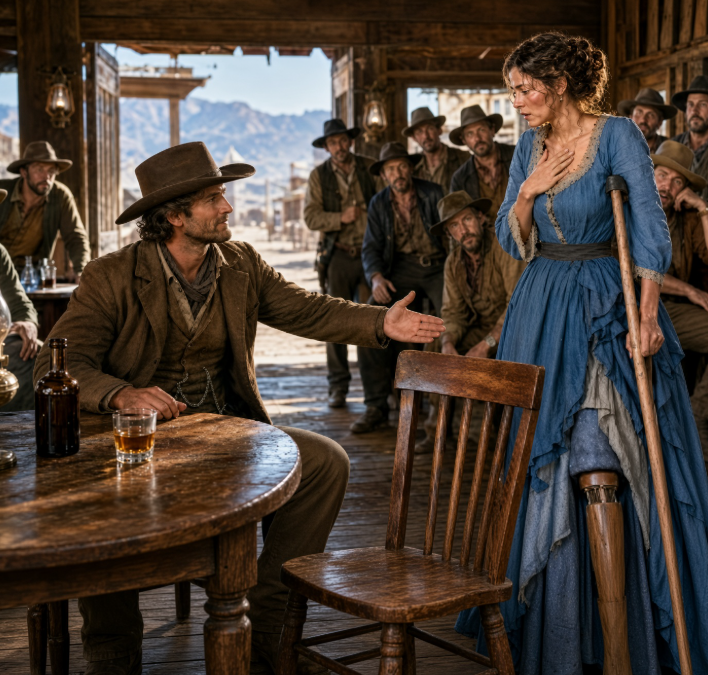
Charlotte stood just inside the doorway on a Thursday evening in October, her crutch tucked beneath one arm, the wooden peg under her skirt settling unevenly against the warped floorboards.
She had not come to play.
She told herself that before she entered.
She had come only to collect payment.
Silas Rourke’s coat had taken three evenings to mend properly. The right cuff had been nearly torn free. The lining beneath the collar had needed replacing. Two buttons had been matched from a small tin she kept at the back of her sewing table, where she saved anything too good to throw away because life had taught her that useful things often arrived disguised as scraps.
Silas stood at the bar, broad-backed, red-necked, and suddenly very interested in the rings his glass left on the wood.
Charlotte crossed the room slowly.
The first two steps were always the worst in a room that watched without admitting it.
Crutch forward.
Weight shift.
Peg settle.
Good foot.
Crutch.
Peg.
Good foot.
PART3:
She had practiced until the movement became functional. Not graceful. She had stopped asking her body for grace.
Functional was victory enough.
At the bar, she stopped beside Silas.
“Your coat is finished.”
He did not meet her eyes.
“Appreciate it.”
She held the folded coat out.
He took it too quickly, as though the transaction itself might become contagious if allowed to linger.
“Two dollars,” she said.
Silas dug in his pocket, brought out coins, and dropped them onto the bar.
Not into her palm.
Onto the bar.
They landed with three small hard clicks.
The way a man dropped coins for a beggar.
Not the way a man paid a debt to a woman who had done honest work.
Charlotte’s hand rose to her chest before she could stop it, an old habit of steadying breath that had gone shallow without permission.
She stared at the coins.
Nobody in the room said anything.
That was the skill Cottonwood Creek had developed over three years.
Silence that kept its hands clean.
She reached for the coins.
Before her fingers touched them, a chair scraped back in the far corner.
The sound cut through the room.
Not loud enough to be dramatic.
Loud enough to be intentional.
Several men turned.
Charlotte did too.
A cowboy she did not recognize stood at a corner table.
Dark curling hair beneath a weathered hat.
Trail dust still clinging to the hem of his duster coat.
Twenty-nine, maybe thirty.
Lean, but not the starved kind of lean. The working kind. The kind shaped by saddle hours, bad weather, and no particular desire to impress anyone.
He pulled the second chair out from his own table and looked at Charlotte as if she were simply a woman standing in a doorway.
Nothing more complicated than that.
“Sit with me,” he said.
The whole saloon went quiet in an entirely different way than before.
The first silence had been avoidance.
This one was attention.
Charlotte felt it settle across her shoulders.
Silas shifted beside the bar.
Someone coughed near the card table.
The bartender stopped wiping a glass.
Charlotte looked at the cowboy.
His face asked nothing of her.
Not gratitude.
Not embarrassment.
Not explanation.
He had not spoken loudly, but every person in the Golden Spur had heard him.
She should have refused.
That was her first thought.
Refusing would preserve something.
Pride, perhaps.
Distance.
The careful little wall she had built around herself since the town began treating her like a sad story walking upright.
But refusing would mean standing there longer with every eye in the room on her.
And his face did not carry pity.
That, more than anything, moved her.
So Charlotte picked up her coins from the bar, closed them in her hand, and crossed the room.
Crutch.
Peg.
Good foot.
The cowboy did not hurry to help.
Did not pull the chair too far.
Did not offer an arm she had not asked for.
He simply waited until she reached the table, then held the chair steady while she lowered herself into it.
The room exhaled in small, uncomfortable pieces.
The cowboy sat across from her.
“Jesse Calhoun,” he said. “Passing through with the Bar M herd. Four hundred head bound for the rail cars.”
“Charlotte Pierce.”
She waited.
Most people waited too, after hearing her name.
They waited for the next part.
The accident.
The leg.
The poor thing.
The question that came dressed as concern but smelled of curiosity.
Jesse Calhoun only nodded toward the bar.
“You always collect debts in saloons?”
Charlotte looked at the coins in her hand.
“Only from men too cowardly to hand them over properly.”
The words came out sharper than she expected.
More herself than she had sounded in a long while.
Something almost like a laugh crossed Jesse’s face.
“I’ll collect them for you next time if you’d like to see him flinch twice in one evening.”
“I can manage my own collecting, Mr. Calhoun.”
“Didn’t say you couldn’t. Said I’d enjoy watching.”
Charlotte looked at him then.
Really looked.
There was no performance in him. No polished gallantry. No show of noble kindness meant for the room’s approval. He was not smiling at the men around them as if to say, See what a decent man I am.
He was simply sitting there.
Across from her.
As if the obvious answer to a woman being left standing in a room full of chairs was to offer one.
For the first time that evening, Charlotte breathed fully.
Before the piano, there had been horses.
People in Cottonwood Creek had mostly forgotten that part.
They remembered the music because the music had belonged to them. It had filled their Saturday nights, softened their tempers, carried them through whiskey and loneliness and the long dust of cattle season.
But before Charlotte Pierce ever touched the Golden Spur’s piano, she had learned horses.
Her family had bred and broken mustangs on a spread west of town until Charlotte was twelve. Her father, Joseph Pierce, had a way with frightened animals that looked like sorcery to people who believed force solved everything. He never called it gentling. He simply said a creature in fear needed fewer surprises.
“Plant your feet,” he told Charlotte when she was seven and half hidden behind a fence post, watching him calm a trembling bay colt. “Lower your voice. Don’t lie with your hands. Horses know.”
Charlotte learned to speak low to spooked animals before she learned to play music.
She learned to stand still when everything inside her wanted to move.
She learned that fear looked different in every body but had the same sharp smell beneath it.
Then came the bad year.
Drought.
Sickness in the herd.
A buyer who promised payment and vanished.
Her father sold the horses first.
Then the land.
By thirteen, Charlotte was living in town with her mother in two rooms behind a seamstress shop, learning to make hems straight because survival had become smaller and more indoor than anything she had imagined as a child.
The piano came later.
There had been one in the Golden Spur long before Charlotte played it. An old upright brought west by a saloon owner’s wife who died before learning that Arizona dust did not respect polished wood. For years, men pounded on its keys late at night, producing more noise than music.
Charlotte was seventeen when she first played it properly.
She had gone into the saloon delivering a mended vest. Rain had trapped everyone inside. Someone dared her to play after hearing that she knew hymns from church.
She sat down because seventeen-year-old girls sometimes mistook fear for permission.
Her hands found the keys.
The room changed.
Not dramatically.
It was not that sort of story then.
But men stopped shouting over one another. Cards lowered. The bartender leaned his elbows on the counter. Someone near the door took off his hat without realizing it.
Charlotte played a hymn first.
Then a dance tune.
Then something she had heard once from a traveling fiddler and remembered imperfectly but beautifully enough that nobody complained.
By the next Saturday, three men asked if she would come back.
By the end of the month, she was playing twice a week.
By eighteen, she was part of the Golden Spur in the way the mirror, bar, and swinging doors were part of it.
Untrained but gifted, Charlotte could read a room’s mood and meet it before anyone knew they had asked.
If the room was restless, she played quick.
If sorrow sat heavy, she played something old enough to let men miss home without naming it.
If a fight began building between two men too drunk to remember their own good sense, she changed rhythm just enough to pull the room’s attention sideways.
For eight years, the Golden Spur was the one place in Cottonwood Creek where Charlotte felt entirely herself.
Then came the wagon.
The accident happened on a June afternoon three years before Jesse Calhoun rode into town.
Charlotte had been leaving the mercantile with a paper parcel beneath one arm when a freight wagon’s team spooked near the schoolhouse. A rattlesnake, someone said later. A loose trace, said someone else. Too much noise, too many flies, too little shade, said her father, who still knew horses even after losing his herd.
Whatever the cause, the team bolted.
Six-year-old Mary Kettleman stood frozen in the road, her slate in one hand, too terrified by the thunder of hooves to move.
People shouted.
No one reached her.
Charlotte did not think, though people later insisted she must have been very brave.
She only moved.
She shoved Mary clear with both hands.
The child rolled into the dust beside the school steps.
Charlotte was not fast enough to clear herself.
She remembered the sound first.
Wood.
Iron.
Horses screaming.
Then sky.
Then pain so enormous it became white.
The town was grateful while she nearly died.
They brought food.
Sat vigil.
Prayed.
Told her mother how brave Charlotte had been.
Said Cottonwood Creek would never forget.
In one sense, they were right.
They never forgot.
They simply grew tired of remembering correctly.
Gratitude did not survive the awkwardness of what remained.
The fever took weeks.
The surgeon came from Prescott. He saved her life, though there were mornings Charlotte wished he had asked before doing it.
The left leg was gone below the knee.
For months, she refused to look at the empty space beneath the sheet.
Her mother cried quietly in the kitchen.
Her father sat beside her bed and told her about horses she had known as a girl because neither of them could bear talking about the thing missing from the room.
When Charlotte finally returned to town, people were gentle.
Too gentle.
Voices softened before reaching her.
Conversations paused half a beat too long.
Women touched her arm carefully, as if kindness required a lowered tone.
Men stepped aside too fast or not fast enough.
Requests for songs dried up.
Nobody asked her to stop playing piano.
Nobody had to.
There was a difference between a room going silent out of respect and a room going silent out of relief that someone would soon leave it.
Charlotte learned the difference.
She took up sewing instead.
Private work.
Steady work.
Work behind a shop door.
Needle.
Thread.
Cloth.
Buttons.
Hems.
Things that could be repaired without anyone having to decide where to look.
That was the life Jesse Calhoun walked into without knowing any of it.
He had ridden into Cottonwood Creek four days earlier with a trail crew moving four hundred head north toward the rail depot. He knew nothing of Charlotte Pierce, nothing of the piano, nothing of Mary Kettleman, nothing of the accident, nothing of three years of practiced avoidance.
That ignorance made him dangerous to the town’s habits.
He saw only what stood before him.
A woman with nowhere to sit in a room full of empty chairs.
And he moved before thought finished forming.
They talked at the corner table for nearly an hour.
Not about her leg.
Not at first.
They spoke of cattle prices, late heat, trail dust, a green colt that had once dumped Jesse into a water trough his first week working with the Bar M, and a deputy in Tucson who claimed he could shoot a bottle off a fence post at fifty paces but had missed the post entirely.
Ordinary things.
Blessedly ordinary.
Charlotte had not realized how hungry she was for conversation that did not handle her like cracked china.
Jesse asked questions as if answers mattered.
When she made dry remarks, he laughed.
When she disagreed, he did not look surprised.
When silence came, he let it sit without rushing to fill it with comfort.
At one point, his gaze moved toward the dusty piano in the corner.
“You play?”
Charlotte’s hand tightened slightly around her cup.
“Used to.”
She left it there.
A closed door.
Jesse saw it.
“Shame,” he said simply.
Then he asked whether Arizona cattle were always this temperamental or whether the Bar M had purchased a special selection of ill-mannered beasts just to improve his character.
Charlotte stared at him.
Then laughed.
Not loudly.
But enough that two men near the bar looked over and then quickly away.
Jesse ignored them.
When she stood to leave, he stood too.
Correctly, he did not offer his arm.
He only stepped aside so she had room.
“Evening, Miss Pierce,” he said. “Hope Cottonwood Creek treats you kinder than tonight suggested.”
Charlotte walked home turning that sentence over and over.
Not because it was poetic.
It was not.
Because he had noticed the unkindness and said so plainly.
As if the town’s behavior were a fact about the town, not a problem with her that needed managing.
The Bar M needed extra hands through fall roundup, and Jesse took the work.
Cottonwood Creek should have lost him within the week.
It did not.
Three days after the night at the Golden Spur, he came to Charlotte’s shop with a torn shirt sleeve that did not strictly require her skill so much as it required an excuse.
Charlotte recognized the excuse.
She mended the sleeve anyway.
The shop sat on the quieter end of Main Street, two doors down from the mercantile and across from the blacksmith’s side yard. It smelled of starch, cotton, lavender sachets, and warmed dust. Bolts of cloth lined one wall. Finished orders hung behind a curtain. A small stove took the edge off the room on cold mornings.
Jesse stood near the counter while she examined the sleeve.
“That tear could be closed by a blind man with a fishhook.”
“Wouldn’t want to deprive you of the business.”
“You’re deeply generous.”
“I try to support local enterprise.”
She looked up.
“Do you always lie this badly?”
“Only when I’m hoping the person listening already knows the truth.”
Charlotte lowered her eyes to the fabric before he saw her smile.
He came again the next week.
Then again two days later.
Once with a torn glove.
Once with a vest button.
Once with nothing damaged at all, claiming he had come to ask whether the Golden Spur’s coffee was safe to drink or whether it was only served as punishment.
Charlotte told him the coffee was not safe and never had been.
He thanked her gravely for saving his life.
By the third week, he asked about the wooden leg.
Directly.
Not hushed.
Not grim.
Not with the awkward tilt of a head that warned pity was coming.
He asked as if checking whether a saddle sore had healed properly.
“Does it ache?”
Charlotte paused with her needle halfway through a cuff.
“Some days.”
Jesse nodded.
“Less than people expect,” she added. “More than I let on.”
“Fair enough.”
He did not ask how she lost the leg.
Did not say he was sorry.
Did not tell her she was brave.
Did not lean closer as though pain had made her fascinating.
Charlotte resumed sewing.
After a while, she said, “You’re not going to ask?”
Jesse leaned against the counter.
“Figured you’d tell me if you wanted to.”
“And if I don’t?”
“Then I won’t know.”
It was such a plain answer that she looked at him sharply.
He seemed to mean it.
That was Jesse’s way, she was learning.
He did not treat every unknown as something owed to him.
What Charlotte did not tell him was what the leg still cost her two years on.
Not the money, though that had been considerable.
The prosthetic had come eighteen months after the accident, made by a traveling limb maker from Prescott, one of the craftsmen who had learned the trade fitting Civil War veterans and carried it west by rail and wagon to mining towns, farms, and frontier settlements where machinery, horses, and bad luck took limbs with democratic indifference.
The leg was wood and leather, jointed and fitted carefully. It allowed her to walk without the crutch on smooth ground, though stairs, mud, gravel, and warped boards demanded caution.
It had cost more than three months of sewing work.
Borrowed against future orders.
Paid back slowly, one hemmed skirt at a time.
But the true cost was daily arithmetic.
Which floor was safe.
Which doorway too narrow.
Which invitation worth stairs.
Which rooms she would rather never enter again.
Where to sit so she could rise without help.
How long she could stand before pain made her temper short.
Whether a man offering an arm was kind, foolish, or waiting to feel noble.
That ledger never balanced.
She simply paid it every day and stopped expecting anyone to notice the bill.
Jesse noticed more than he said.
She discovered that slowly.
He never offered help when she did not need it.
He never pretended not to see when she did.
If the boardwalk ahead was uneven, he slowed his own pace before she had to ask. If a doorway was narrow, he entered first and held the door wide without looking back to see whether she appreciated it. If they crossed a muddy street, he chose the firmest path as if that had always been where he meant to walk.
It was not gallantry.
Gallantry announced itself.
Jesse’s care did not.
Perhaps that was why she began trusting it.
Jesse had his own missing pieces.
Charlotte learned this not from town gossip but from Jesse himself, one evening behind her shop where a split-rail fence overlooked the western edge of town. The Bradshaw Range sat in the distance, turning orange beneath the falling sun.
They had been speaking of nothing consequential when Charlotte asked why he kept moving from crew to crew.
The question had been in her mind for days.
He went quiet long enough that she nearly withdrew it.
Then he said, “My wife died three years ago.”
Charlotte’s breath caught.
He looked toward the mountains.
“Rachel. She was carrying our first child.”
The words were flat, not because they lacked feeling, but because feeling had worn them smooth.
“Wagon overturned crossing a swollen creek. Nobody’s fault. Weather and luck. Neither answers back when a man wants somewhere to put his anger.”
Charlotte did not offer a condolence quickly.
She knew too well how useless certain words could become.
Jesse continued.
“I buried her. Three weeks later, I put up a small marker for the child. Never got to name it.”
His jaw moved once.
“Then I rode out before the ground settled properly over either grave.”
“Because work was elsewhere?”
“That’s what I said.”
“And the truth?”
He looked at her then.
“The truth is, moving hurt less than sitting still.”
Charlotte understood that.
Not the particular grief.
But the motion.
After the accident, she had stayed physically in Cottonwood Creek, but inside herself she had moved away from every room that hurt too much to remain in.
The Golden Spur.
The piano.
The dances.
The friends who became careful strangers.
She had moved without leaving.
Jesse had left without stopping.
Both were ways of trying not to stand still with loss.
After that evening, something changed between them.
Not publicly.
Not in a way Cottonwood Creek could measure easily.
But in the quiet space between two people who have each offered one true thing and found it held carefully.
Naturally, the town noticed.
Cottonwood Creek had accepted Charlotte’s loneliness because it was familiar.
Her laughter made people uneasy.
Not all of them.
But enough.
Priscilla Hargrove noticed first and most severely.
Mrs. Hargrove ran the town social committee the way some men ran cattle empires. She had opinions about seating arrangements, flower placement, moral tone, hymn tempo, table linens, and whether the Founders Day dance should serve pie before or after the third waltz.
She had stronger opinions about Jesse Calhoun spending evenings at Charlotte Pierce’s shop.
At the mercantile one afternoon, Mrs. Hargrove delivered those opinions to the blacksmith’s wife in the flat, certain tone of a woman convinced her cruelty was actually civic duty.
“It’s simple practicality,” she said. “A man ought to know what he’s taking on before he takes it on. She can’t dance, can’t run a household the way a whole woman can. It’s mercy to say so plainly before feelings get further involved.”
Charlotte stood behind a display of bolt cloth, unseen.
The word mercy struck harder than any insult.
Mercy.
A word that dressed itself like kindness while doing cruelty’s exact work.
She left without buying the cloth.
That evening, she sat in her shop and did arithmetic she had sworn she would no longer do.
How much of Jesse’s attention was interest?
How much kindness?
How much pity?
Was she a woman to him, or only a broken thing a decent man had paused to feed, as he might feed a stray dog without intending to keep it?
When Jesse came by the next afternoon, she was distant.
He saw it immediately.
“Something happened?”
“Nothing happened.”
It was true in the narrowest sense.
False in every way that mattered.
Jesse did not push.
He had gone silent on someone once before and let silence make the decision for him. It had cost him nearly everything worth having. He was not eager to repeat the mistake.
But he also knew better than to force a door before it opened.
So he stayed a while longer than the visit required. He spoke of ordinary things. A stubborn horse. A foreman with a talent for sleeping upright. A steer that had decided the churchyard looked like better grazing than the range.
Charlotte answered little.
He let the quiet have somewhere to settle.
Two evenings later, he found her at the split-rail fence behind her shop.
The sun had nearly dropped behind the Bradshaws. The sky was deep orange, gentle in a way the day had not been.
“Somebody’s been telling you I’m here out of pity,” Jesse said.
Not a question.
Charlotte looked toward the ridge.
Her silence answered.
Jesse leaned his forearms on the fence.
“I buried a wife and a child that never got born three years back in a creek crossing that shouldn’t have killed anybody.”
Charlotte turned to him slowly.
“I spent every year since making sure I never had anywhere solid enough under me to lose again,” he said. “Told myself that was just how a drifter lives, like it was a philosophy instead of a way of hiding.”
The sun lowered.
“Then I sat across a table from a woman nobody in this town would look at. And for the first time in three years, I wanted to stay somewhere long enough to see what happened next.”
Charlotte’s throat tightened.
“That’s not pity,” Jesse said. “Pity doesn’t make a man want to build something. It only makes him feel better about walking away.”
She gripped the fence rail.
“You don’t know what people are saying.”
“I know exactly what they’re saying.”
She looked at him.
“My foreman already warned me,” Jesse said. “I came to this fence line instead of turning my horse around. If that answers the question you’re actually asking.”
The first stars appeared above the ridge.
Charlotte swallowed.
“Mrs. Hargrove is going to make the Founders Day dance difficult.”
“For you?”
“For both of us, if you’re seen with me there.”
“Then we’d better go anyway.”
She stared.
“Why?”
“Because I’d like to dance with you.”
Charlotte almost laughed, but there was no humor in it.
“I haven’t danced in three years.”
“Then I’d like to be there when that changes.”
“You are very sure of yourself.”
“No.” Jesse’s voice softened. “I’m sure I don’t intend to let a woman with strong opinions about mercy talk either of us out of living.”
She turned back toward the last of the light.
For a while, neither spoke.
Then she said, “It may go badly.”
“Most worthwhile things do at some point.”
“That is not reassuring.”
“I’m told I have other qualities.”
This time she did laugh.
Only once.
But Jesse smiled as if the sound had settled something in him.
The Founders Day dance was held in the depot warehouse, swept clean and hung with lanterns for the occasion.
Cottonwood Creek’s depot was more than a building. It was the reason the town had become anything more than dust, cattle, and stubbornness. Herds like the Bar M’s four hundred head came through every season on their way to rail cars and eastern markets. Farmers shipped what they could grow. Merchants received what they could sell. Letters arrived. People left. People came back. Sometimes.
For most families on outlying spreads, Founders Day was the one night of the year they dressed in their better clothes and danced under a roof.
The single evening set aside to remember there was more to living out there than work, distance, and weather.
Charlotte almost did not go.
The blue dress hung from the wardrobe door for an hour while she sat on the edge of her bed and imagined every possible humiliation.
The stairs.
The floorboards.
The stares.
The way people might smile too brightly.
The way Mrs. Hargrove might say something edged enough to cut but soft enough to deny.
Then Charlotte looked at the dress.
She had made it herself across three nights.
Deep blue.
Simple lines.
Enough room in the skirt for movement.
A clever alteration near the left side so the fall of fabric softened the outline of the prosthetic without hiding it entirely.
Not disguise.
Accommodation.
There was a difference.
She dressed.
Pinned her hair.
Took her crutch.
And when Jesse arrived, standing just outside her shop in a clean shirt and dark coat, his hat in one hand, he looked at her for a long moment.
“Miss Pierce,” he said, “that dress is going to make half the room regret having eyes they never properly used.”
She looked away before he saw how the words landed.
“That is nearly a compliment.”
“I can try again.”
“Please don’t.”
He smiled.
She took his arm.
The depot warehouse was already full when they arrived.
Lantern light warmed the walls.
A fiddler tuned near the front.
Women in good dresses gathered near long tables of pies, bread, and preserves. Men stood in clusters, pretending they had not spent extra care shaving. Children darted between legs until mothers caught them by collars and whispered threats.
Charlotte entered on Jesse’s arm and felt the room do what the Golden Spur had done.
Conversation closing quietly.
Eyes moving.
Judgments forming.
Only this time, Jesse’s arm stayed exactly where it was.
He did not grip her as if supporting a burden.
He did not loosen as if ashamed.
He simply walked beside her.
That steadiness did more for Charlotte than any speech could have.
Mrs. Hargrove found them within the first quarter hour.
She moved through the crowd with brisk purpose, smiling the way a woman smiles when she has rehearsed a line all week.
“How lovely you could join us, Miss Pierce,” she said, voice pitched for several nearby ears. “Though I do wonder whether the dance floor is quite suited to your circumstances. We wouldn’t want an accident.”
The word accident entered the air like a knife wrapped in lace.
Charlotte felt Jesse’s arm shift slightly under her hand.
Not pulling away.
Grounding.
“We wouldn’t,” Jesse said before Charlotte could answer. “Though I’ve noticed accidents mostly happen to people standing still, worrying too hard about who’s watching instead of paying attention to what’s actually in front of them.”
Mrs. Hargrove blinked.
Several nearby listeners became deeply interested in the punch bowl.
Jesse turned to Charlotte.
“Care to dance, Miss Pierce?”
The band had just begun a waltz.
Charlotte’s heart struck once, hard.
Every sensible part of her said no.
Too public.
Too risky.
Too much.
But Jesse’s eyes held no challenge.
Only invitation.
A chair pulled out again, in another form.
Charlotte placed her hand in his.
“Yes,” she said.
He led her onto the floor.
The room changed around them.
Charlotte felt it.
Every gaze.
Every breath held too long.
Every expectation of failure.
Jesse adjusted his stance without comment.
Shorter steps.
Weight steady through the turns.
Nothing apologetic.
Nothing exaggerated.
He did not dance around her difference, making a spectacle of care. He simply learned the rhythm her body required and met it half a beat before she needed him to.
For the first turn, Charlotte braced for pain.
For the second, she braced for imbalance.
For the third, she forgot to brace.
The music carried.
Her body remembered.
Not perfectly.
Not as before.
Never as before.
But memory did not require sameness.
It required permission.
Charlotte danced.
A murmur moved along the walls, then died.
Jesse’s hand remained steady at her waist.
“You all right?” he asked quietly.
“No.”
His eyes flicked to hers.
She smiled.
“I’m better than all right.”
For the length of that waltz, Cottonwood Creek watched a woman they had spent three years managing instead of knowing and found they did not quite have the vocabulary left to keep doing the former.
Mary Kettleman’s mother cried silently near the refreshment table.
Silas Rourke stared at his boots.
Mrs. Hargrove stood rigid beside the punch bowl, her mouth arranged into something that was not quite a smile and not quite surrender.
When the music ended, no one clapped at first.
Then one person did.
Henderson, the depot clerk.
Then another.
Then several more.
Charlotte did not know whether to hate it or accept it.
Jesse leaned close enough to speak only to her.
“That sounded like people catching up late.”
She looked at him.
“Yes,” she said. “It did.”
The trouble began with the fireworks.
They were meant to mark the evening’s close.
Three short bursts behind the depot, arranged by men who had more enthusiasm than caution. The first two went up with bright cracks that sent children cheering and adults turning toward the open doors.
The third misfired low.
Not dangerously near the building, but loud enough to startle the supply wagon team tied outside.
The horses were not ready for the noise.
One screamed.
The other lunged.
The hitching rail splintered.
Someone shouted.
The team bolted down Elm Street, traces dragging, wagon swaying wildly behind them.
Straight toward the schoolhouse steps, where three children too young to know better sat watching sparks fade from the sky.
For one terrible second, everyone saw what was happening and no one was close enough to stop it.
Men ran.
Too far.
Women screamed.
The children froze.
Charlotte moved.
Not like a woman with a wooden leg.
Not like a woman who had spent three years measuring floors and risks and exits.
Like a girl who had once stood in dust beside her father and learned that frightened animals needed fewer surprises.
She stepped into the street.
Jesse shouted her name.
She heard him as if from far away.
The team thundered toward her, eyes rolling, harness slapping, wagon wheels bouncing over ruts.
Charlotte planted herself in the road.
Her left leg threatened to buckle immediately.
She shifted weight hard onto the right, drove the peg down, set the crutch aside because it would make her shape wrong, and lifted both hands.
Low voice.
Feet planted.
No lie in the hands.
“Easy,” she said.
The lead horse came on, foam flecking its neck.
“Easy now.”
The horse saw her.
Not at first as a person.
As an obstruction, perhaps.
As another terror.
Charlotte lowered her voice until it settled beneath the panic.
“That’s it. Easy. You’re all right. You’re all right.”
Her father’s voice lived in hers.
Years gone, and still there.
The team slowed by inches that felt like prayers.
Her leg buckled once under the strain of holding ground against nine hundred pounds of frightened horse and all the force behind it.
Pain shot up through her hip.
She held.
Not because she was fearless.
Because she had been afraid for three years and had learned fear was survivable.
The lead horse tossed its head.
Charlotte reached, not fast, not grabbing, fingers finding the bridle with the certainty of a body remembering what the mind had stopped trusting.
“Easy,” she whispered. “There you are.”
The team stopped four feet from the children.
Jesse reached her half a second later, breathing hard.
He found her already stroking the horse’s foam-flecked neck, her hands as steady on the bridle as they had ever been on needle and thread.
The street had gone silent.
Behind her, one child began to cry.
Then another.
Mary Kettleman’s mother was the first to move.
That mattered.
Of all people, she was the first.
She crossed the street quickly, skirts lifted, face pale and open in a way Charlotte had not seen since before guilt made every interaction between them careful.
Without a word, Mrs. Kettleman took Charlotte’s arm.
Not delicately.
Not with pity.
Plainly.
The way one neighbor steadies another.
“You’re hurt,” she said.
Charlotte looked down.
Her left side trembled violently.
“I’m standing.”
“Yes,” Mrs. Kettleman said, voice breaking. “You are.”
Jesse moved to Charlotte’s other side.
He did not take over.
He waited until she looked at him.
Then he offered his arm.
This time, she accepted.
Mrs. Hargrove stood near the depot doors with nothing composed left in her expression.
For once, she had no sentence prepared.
No one in Cottonwood Creek mentioned mercy again within Charlotte’s hearing.
Mrs. Hargrove never properly apologized.
Some people are not built for the grace of admitting wrong aloud.
But she stopped.
In a woman like that, silence became its own admission.
The days after the dance changed Cottonwood Creek in small ways before they changed it in large ones.
Silas Rourke came to Charlotte’s shop with another coat and placed the coins directly into her palm.
His face turned red while doing it.
Charlotte accepted without comment.
The bartender at the Golden Spur asked whether she might look at the piano sometime, since it had gone badly out of tune and “some folks had mentioned missing music.”
Charlotte asked which folks.
He named three men who had not looked her in the eye for two years.
She said she would consider it.
Mary Kettleman, now nine, came by with a bunch of yellow wildflowers and stood in the doorway of the shop twisting her fingers.
“My mama says I never said thank you proper.”
Charlotte set down her needle.
“You were six.”
Mary looked at the floor.
“She says that don’t matter.”
Charlotte studied the child.
Mary had grown taller since the accident. Of course she had. Children did that without asking permission. But Charlotte still saw the frozen little girl in the road, slate in hand, wagon bearing down.
“You’re welcome,” Charlotte said.
Mary looked up.
“My mama says you saved me twice.”
“No,” Charlotte said softly. “Once was enough.”
Mary held out the flowers.
Charlotte took them.
After the girl left, Charlotte sat alone in the shop and cried for the first time in months.
Not because she was sad.
Because being properly thanked hurt in places neglect had made numb.
Jesse turned down the next cattle drive that came through.
He took a permanent position with the Bar M instead. Solid work. Local work. Work that meant waking under the same sky for more than a season.
The foreman looked at him when he asked.
“Thought you were the moving kind.”
“I was.”
“And now?”
Jesse looked toward town, where Charlotte’s shop window caught the morning sun.
“Now I’ve found something worth staying still for.”
That winter, Jesse wrote to Rachel’s mother.
It was the first letter he had sent since the funeral.
He sat at the table in the bunkhouse for nearly an hour before writing the first line.
Dear Mrs. Whitcomb,
He told her he was alive.
That was the easiest part.
He told her he was sorry for leaving without a proper goodbye.
That was harder.
He told her he had found work in Cottonwood Creek and expected to stay.
Harder still.
Then he wrote of Charlotte.
Not too much.
Enough.
He wrote that she was direct, gifted, stubborn, and braver than anyone he had known, though she disliked being called brave by people who used the word to avoid knowing what courage cost.
He wrote that he intended to build a life with her if she would have him.
He wrote, I think Rachel would have liked her.
He did not know if that was true.
He needed to say it anyway.
Some weights do not leave a man because he forgets them.
They leave because he finally sets them down somewhere honest.
Charlotte returned to the Golden Spur in January.
Not for a full evening.
Not at first.
She went in before opening, while the room smelled of stale beer, sawdust, and cold ash. Jesse came with her but waited near the bar, sensing this was not a thing he could stand too close to without changing it.
The piano sat in the corner.
Dust along the top.
One key sticking.
Two badly out of tune.
Charlotte lowered herself onto the bench.
Her hands hovered above the keys.
For three years, she had thought the piano belonged to the life before.
Before pain.
Before pity.
Before rooms rejecting her in silence.
Now she wondered whether the town had stolen it from her only because she had let their discomfort carry it away.
She pressed one key.
Sharp.
Wrong.
Alive.
She laughed once, through tears.
Jesse looked over.
“Bad?”
“Terrible.”
“Fixable?”
Charlotte touched another key.
“Yes.”
Within a month, she played again on Saturday nights.
Not every week.
Not because anyone pushed.
Because she chose to.
The first night, the Golden Spur treated her carefully.
That lasted one song.
Then someone requested “Red River Valley.”
Charlotte looked at the man who asked.
He met her eyes.
Properly.
She played.
More requests came.
Some voices shook at first, asking.
They improved.
Men are teachable under the right circumstances, Charlotte told Jesse later.
Jesse said that seemed optimistic.
She married him the following spring in the same depot warehouse where the town had watched them dance.
The day was windy and clear.
Arizona light came sharp through the open doors.
There were lanterns again, though no fireworks. The entire town agreed fireworks had been sufficiently explored.
Charlotte wore a cream dress with blue stitching along the cuffs. Jesse wore a dark suit borrowed from the foreman and boots polished to an ambition they had never known.
Mrs. Hargrove attended.
She brought a cake.
She did not apologize.
But the cake had taken considerable effort, and on top, in careful icing, were two small blue flowers that matched Charlotte’s dress.
Charlotte saw them.
Said nothing.
Accepted the cake.
Some apologies were not words.
Mary Kettleman stood near the front with her mother.
Silas Rourke cried during the vows and later denied it.
The bartender from the Golden Spur provided whiskey for the reception and insisted the first bottle was on the house because the piano had improved business by twenty percent and he was “a man who recognized investment.”
Jesse stood beside Charlotte before the preacher.
When asked if he took her, he said yes in a voice that carried to every corner.
When Charlotte was asked if she took him, she looked at the man who had once pulled out a chair in a room determined not to see her.
“I do,” she said.
Not softly.
No one in the room looked away.
Afterward, when the music began, Jesse held out his hand.
“Mrs. Calhoun?”
Charlotte looked at the dance floor.
Then at him.
“I hope you know what you’re taking on.”
He smiled.
“I’ve been warned.”
She took his hand.
They danced.
Not perfectly.
Not as if nothing had ever happened.
Better than that.
They danced as two people who knew exactly what had happened and refused to let it have the final word.
In the years that followed, the story would be told in Cottonwood Creek many ways.
Some told it as the story of the night Charlotte Pierce stopped a runaway team.
Some told it as the story of the dance.
Some told it as the story of Jesse Calhoun, the lonely cowboy who came through with the Bar M herd and somehow stayed.
But Charlotte knew where the story truly began.
Not with the horses.
Not with Mrs. Hargrove.
Not even with the first waltz.
It began with a chair.
A simple wooden chair scraped back across the floor of the Golden Spur Saloon.
A man who owed her nothing stood up in a room full of people who had spent three years practicing how not to see her.
He did not make a speech.
Did not shame them.
Did not ask for credit.
He only pulled out the chair and said, “Sit with me.”
That was all.
That was the whole thing, really.
Everything after was Cottonwood Creek slowly catching up to what Jesse saw in the first five seconds.
A woman standing in a doorway.
A room full of empty chairs.
And no reason in the world she should have to stand alone.

