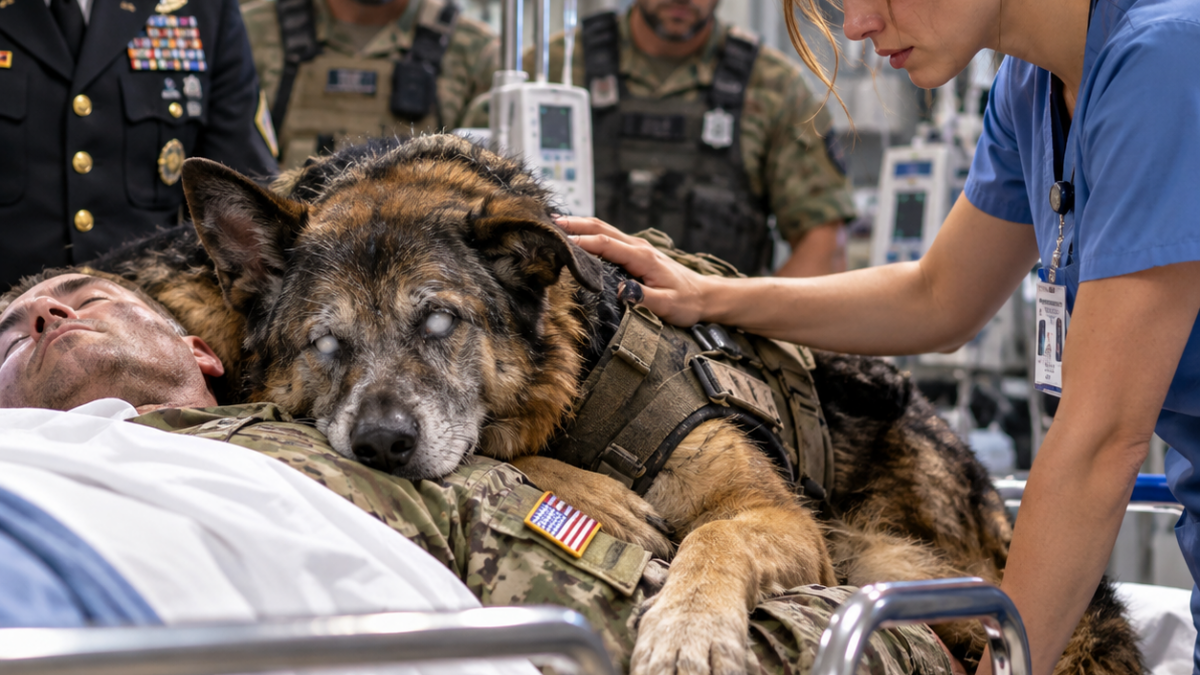
No One Could Move a Blind Military K9 From His Dead Handler’s Gurney—Then a Quiet Nurse Touched His Worn Harness in a Way That Made the Entire Room Stop.
PART3:
Not with Atlas lying across him, waiting for a heartbeat that would never return.
Mercer looked at the faded medical patch stitched beneath Atlas’s harness strap.
I had already read what was visible.
BLIND.
SENIOR.
AIRWAY INJURY.
“Sedation without his veterinary history could compromise his breathing,” I said. “Force will turn a controlled guard into a fight.”
“You’re asking me to delay an honor transfer based on body language.”
“No,” I said. “I’m asking you not to punish him for completing the duty he understands.”
The sentence landed harder than I intended.
Mercer studied Atlas.
Not me.
That mattered.
He had entered the bay prepared to solve a security problem. Now he was beginning to see what I saw.
A soldier without sight using pain, scent, and contact to keep faith with the man beneath him.
Mercer took the restraint pole from the staff member and placed it on the floor.
“Clear unnecessary personnel,” he ordered.
The room shifted immediately.
People backed away.
The overhead alarm was silenced.
The medication request was halted.
The restraint pole was removed.
Mercer looked at the senior tech. “No one touches Sergeant Hale until the military K9 team arrives.”
It was not trust in me.
Not yet.
It was a change in command built on what Atlas had already proven.
When the extra staff left, the trauma bay felt too large.
Too bright.
Too quiet.
Atlas lowered his muzzle onto Owen’s chest as if listening for something we all knew he would not hear.
The clock dropped to eight minutes.
Mercer closed the doors.
In doing so, he surrendered the easy option and the time it would have saved.
Then he turned to me.
“You stopped us from moving him.”
“Yes.”
“Now help me find a way that doesn’t break the dog.”
I looked at Owen’s still hand beside the frayed loop of Atlas’s harness.
Then at Atlas’s injured paw.
Then at the clock.
By stepping between Atlas and force, I had made his safety my responsibility.
If the honor detail left without Owen, that would belong to me too.
I lowered myself to the floor just beyond Atlas’s reach and began matching the rhythm of his breathing.
In.
Out.
Slow.
Steady.
What could eight minutes buy?
The answer came at 7:41.
The military K9 team entered without sirens, raised voices, or clattering equipment.
That told me Mercer had chosen well.
Two handlers stepped inside. The senior one was older, broad-shouldered, with the careful hands of someone who had been bitten before and learned something from it. He stopped far enough away that Atlas could map him without needing to defend.
Atlas lifted his head at the new scent.
His ears turned toward the handler’s boots.
Then toward Owen’s motionless chest.
Measuring.
Always measuring.
Mercer briefed the handler in clipped sentences.
Blind senior K9.
Deceased handler.
Guarding body.
Injured paw.
Airway history.
No sedation unless medically necessary.
No force unless life-threatening.
The handler listened without ego.
That helped.
Mercer looked at him.
“One controlled attempt. No restraint pull. No sedation. The moment he shows distress, you release.”
I shifted back.
Giving space.
Not surrendering attention.
The handler crouched outside Atlas’s reach and gave a formal heel command.
Atlas’s ear moved.
Nothing else did.
A second command followed, softer, the kind used for an injured service dog.
Atlas pressed his shoulder more firmly against Owen.
The handler clipped a lightweight lead to the rear ring of the worn harness, waited until Atlas registered the contact, then applied the slightest steady pressure.
Atlas rose halfway.
For one breath, it seemed training might carry him off the gurney.
Then Owen’s sleeve slid beneath his muzzle.
Atlas dropped his weight forward and planted his injured paw against the mattress to keep contact.
A dark stain spread through the field dressing.
His damaged airway tightened into a dry, rasping cough.
“Release,” Mercer ordered before I could speak.
The lead went slack immediately.
But the attempt had changed the problem.
Atlas no longer relaxed when the pressure disappeared. His chest moved too quickly. His nose traveled repeatedly from Owen’s hand to the air above the gurney.
I watched the sequence twice.
He was not searching for an exit.
He was not responding to the handler’s position.
Without sight, Atlas was rebuilding Owen from scent, contact, and the faint movement of air around the body.
“Everyone hold still,” I said.
Mercer raised one hand.
The room obeyed.
I did not approach Atlas directly.
I placed a folded towel on the floor and dragged it six inches toward myself, creating a soft sound low enough not to startle him.
Atlas’s left ear followed it.
Next, I opened a packet of sterile gauze away from the gurney, muffling the wrapper beneath the towel. His head turned toward the sound, but his muzzle stayed against Owen.
“He can map us,” I said. “But he won’t leave the scent he’s guarding. Let me reduce the pain before we ask him to choose anything.”
The handler passed me saline and gauze.
Not taking over.
Passing.
That small transfer placed the next risk in my hands.
I tapped the tile twice with one fingertip.
Atlas oriented toward the sound.
Only then did I move closer by the width of my palm.
Tap.
Wait.
Breathe.
Move.
Tap again.
No command.
No pull.
Each sound told the blind dog exactly where I was before my scent arrived.
When I reached the gurney, I held the damp gauze beneath his nose.
Atlas tested it.
Then returned to Owen.
I touched the back of his uninjured leg first and paused.
His breathing remained fast, but he did not brace.
Only after the tension left his shoulder did I move toward the injured paw.
The dressing was worse than it looked.
Old wrap.
Fresh bleeding.
A reopened pad.
Too much pressure where swelling had started.
I removed the soaked outer layer, rinsed the wound, and wrapped it loosely enough to protect without cutting circulation.
Atlas could have withdrawn.
He did not.
Instead, he shifted his injured paw into my palm.
The senior handler’s grip loosened on the lead.
Mercer looked at the clock.
The original window had fallen below five minutes, but Atlas had allowed something no one else had managed.
Care without abandoning Owen.
I rested two fingers against the frayed edge of his harness.
Atlas turned toward my voice and allowed contact.
But when I eased my hand one inch toward the rear ring, he lowered his body across Owen again.
Pain had been reduced.
The refusal remained.
Mercer keyed his radio.
“Hold the honor transport for twenty minutes. Record the delay under my authority.”
Then he placed the lead beside me rather than returning it to the handler.
“He has accepted one person,” Mercer said. “From this moment on, no one touches Sergeant Hale or that harness unless you direct it.”
The extended time saved Owen’s transfer.
It also removed my last chance to remain only an observer.
Atlas’s injured paw now rested against my knee, his body still covering the man he would not leave.
I closed my hand around the lead without pulling.
Twenty minutes had become mine.
So had whatever happened when they ran out.
“Fourteen minutes,” Mercer said, turning his watch toward me.
The lead lay untouched beside my knee.
Atlas kept his injured paw against me and the full weight of his body across Owen.
Every second gained now depended on whether I could turn limited acceptance into voluntary movement without taking away the contact the blind dog was protecting.
I did not pick up the lead.
“Unclip it,” I told the handler. “And place a folded transfer blanket along the open side of the gurney.”
The handler moved immediately.
“If he feels tension through the harness, he’ll resist whoever creates it,” I said. “He needs to know movement is his decision.”
Mercer nodded once.
The handler removed the lead.
Then waited.
That mattered too.
He waited for my direction rather than reaching for Atlas again.
I studied Atlas’s position.
His front legs were locked around Owen’s ribs, but his hindquarters were not braced. His nose remained near Owen’s hand. The harness had two old pressure points, one at the chest strap, another along the left shoulder.
I tapped two fingers lightly against the blanket.
Atlas’s ear turned.
I moved the sound six inches toward Owen’s feet.
Paused.
Waited until his breathing settled.
Then I placed one open palm beneath the chest strap.
Not lifting.
Not pulling.
Only giving him a fixed point in space.
Atlas shifted his uninjured paw toward the sound.
Small movement.
Deliberate.
I repeated the sequence, changing nothing except the position of my fingers.
Atlas moved again.
This time, his shoulder lifted away from Owen’s chest.
“Bring the blanket forward,” I told the handler.
He obeyed at once, advancing it only when I tapped.
No command had been given.
No force had been applied.
I was building a physical map Atlas could choose to follow while preserving the scent and contact that told him Owen was still under his protection.
Atlas rose fully.
His injured paw trembled inside the new dressing.
I stopped immediately.
No momentum.
No pressure.
No hurry.
My hand remained beneath the harness while he decided whether to retreat.
After one long breath, Atlas pivoted parallel to Owen and lowered himself onto the blanket.
One foreleg stayed across Owen’s wrist.
His muscle settled against the dead veteran’s sleeve.
He had surrendered the center of the gurney.
Not the man.
The cleared space allowed the handler to check the harness for hidden pressure and gave the hospital staff room to prepare Owen’s upper body for transfer.
It was the first practical progress anyone had made.
Atlas had made it voluntarily.
Mercer stepped toward the folded honor shroud.
Then stopped outside the distance I had established.
“Can they begin?”
I watched Atlas’s ears.
His jaw.
The tension along his back.
“One person,” I said. “Cloth only. No wheels and no metal near the bed.”
Mercer selected a staff member and personally held everyone else behind the marked line.
The cloth unfolded with a soft rush.
Atlas raised his head, but he did not reclaim his former position.
I kept one hand at his chest strap and continued the slow floor rhythm until the shroud covered Owen’s torso.
The senior handler placed his medical pouch beside me and sat beyond Atlas’s reach.
Not because of my title.
Because the dog had chosen my method.
Mercer revised the transfer plan.
I would direct every approach.
I would remain within contact range during preparation.
I would accompany Atlas if he moved.
There would be no second handler attempt unless I requested it.
The responsibility tightened around my ribs.
My touch had become part of the route out.
Then Atlas pressed his blind face into my wrist.
Not affection.
Orientation.
He had added my breathing, my scent, and my position to the small world he could still trust.
I resumed the rhythm.
Softer now.
Mercer lowered his voice.
“You’ve shown he can move.”
I watched Atlas keep one paw over Owen’s wrist despite the pain it caused him.
“Yes,” I said. “Now we have to give him a reason to let go.”
That was the part no technique could solve.
A dog can be guided through a room.
He cannot be tricked through grief without paying for it later.
We tried Owen’s glove.
I asked Mercer to remove it from the sealed tray of personal effects. The worn field glove stopped three feet from the trauma bay door, carrying Owen’s scent farther from the gurney than Atlas had allowed anything connected to him to go.
I knew the risk.
Using scent could help.
It could also become a lie.
“Keep the doorway clear,” I said. “No one calls him. No one touches the harness.”
Mercer moved the staff behind the marked line.
The senior handler folded the transfer blanket into a broad strip from the gurney to the glove, creating a continuous surface Atlas could read through his paws.
I knelt at its edge.
One tap near his front feet.
Another several inches farther along the blanket.
Atlas raised his head from Owen’s sleeve.
His clouded eyes faced nothing, but his nose worked through antiseptic, cloth, human grief, and sterile air until it found the glove.
I placed my palm beneath the frayed harness loop without applying pressure.
The contact gave him my location.
Not a command.
Atlas lifted his uninjured paw and set it on the blanket.
A second paw followed.
His injured leg shook when he stood, but I resisted the instinct to support his weight. If I carried him now, we would learn nothing about what he was choosing.
Atlas took one deliberate step toward the glove.
The senior handler lowered his eyes to the floor so he would not distract him.
Mercer remained beside Owen with one hand near the shroud, accepting that his role was no longer to make the dog obey but to protect the conditions under which Atlas could decide.
Another tap traveled down the blanket.
Atlas leaned toward my hand, drew in Owen’s scent from the doorway, and lifted his rear paw from the mattress.
For the first time, all four feet were beyond Owen’s body.
The path was working.
More importantly, Atlas was physically capable of leaving.
I could have shortened the distance by picking up the glove.
I could have tightened my grip.
I could have turned progress into success.
Instead, I let my hand fall open.
The choice cost precious seconds.
But forcing success would only hide the reason he had refused.
Behind Mercer, a staff member began positioning the mortuary trolley for transfer.
Its wheel turned without sound.
Then the locking mechanism settled with one hard metallic click.
Atlas stopped.
His ears snapped toward the gurney.
The scent at the doorway no longer mattered.
He turned away from me, crossed the blanket under his own power, and climbed back beside Owen.
No one reached for him.
He placed his muzzle over Owen’s covered forearm and pressed one paw against the edge of the honor shroud.
His breathing slowed almost immediately.
The return was controlled.
Purposeful.
Complete.
My hand remained suspended over the empty blanket.
I had gained proof and lost the easiest plan.
Atlas had not failed to understand the route.
Blindness had not trapped him.
Pain had not immobilized him.
Fear of the room had not driven him back.
He had followed Owen’s scent until the sound of transfer told him the body would be taken.
Then he chose his post again.
Mercer looked from the glove to Atlas.
“He knows we’re moving Sergeant Hale.”
“Yes.”
I retrieved the glove, but did not offer it again.
Using Owen’s scent a second time would turn reassurance into deception.
I handed it back.
Mercer’s voice was lower now.
“Then what is he waiting for?”
I looked at the harness loop where Owen’s hand had rested.
And suddenly, the answer hurt too much to say.
Military working dogs are trained not only to begin a task, but to recognize when that task has ended.
Atlas had received no ending.
Owen could no longer give him one.
The clock above the door slipped below nine minutes.
Mercer placed the glove back with Owen’s effects and ordered the trolley locked in place.
By protecting Atlas’s choice, he accepted the risk that the honor transport might leave without the soldier it had come to carry.
By refusing to deceive Atlas again, I gave up the last method that allowed me to remain emotionally outside the loss.
I lowered myself beside him, close enough for his nose to find my wrist.
This time, I did not resume tapping.
“A route won’t move him,” I said. “He’s waiting to be released from duty.”
Atlas tightened his paw over Owen’s arm.
Mercer turned to the senior handler.
“There has to be a release protocol.”
The handler opened the medical pouch resting beside me.
Beneath the veterinary card, he found a folded canine contingency sheet protected by clear plastic.
It contained no mission history.
Only medical restrictions.
Emergency contacts.
Handler instructions for a blind service dog.
Mercer read the first line silently.
Then his attention shifted to me.
“Secondary transition contact,” he said. “Evelyn Carter.”
The room seemed to tilt.
The senior handler looked toward me.
I did not look away from Atlas.
A shallow tremor had begun beneath his harness.
He could smell Owen.
He could locate me.
What he could not understand was why one remained motionless while the other kept asking him to leave.
Mercer continued.
“The sheet says you handled his rehabilitation after he lost his sight. Is that true?”
Answering would cost me the distance I had protected since Owen entered the trauma bay.
Refusing would leave Mercer without the information needed to move Atlas with dignity.
“Yes.”
The word changed the air.
Not everyone’s posture.
Not the urgency.
The air.
“Does he recognize a transition sequence from you?” Mercer asked.
“He used to.”
“Show us what it means before we ask him to obey it.”
That distinction made the decision possible.
I removed my hand from Atlas’s nose and placed two fingers against the side of his harness.
One touch at the shoulder.
Pause.
Two measured taps beneath the chest strap.
Then my open palm settled inside the frayed loop without pulling.
Atlas became completely still.
His breathing did not quicken as it had under leash pressure.
Instead, his head lifted from Owen’s arm and his ears turned toward me.
I shifted my knee six inches away.
Atlas followed the sound, not with his body, but with his muzzle.
I moved again.
His head tracked me precisely.
The response was not a trick.
Not simple obedience.
It was memory.
I had given him a familiar orientation sequence from the months when darkness first replaced sight, reminding him that a trusted person was prepared to carry the space he could no longer map alone.
“Stand by,” I whispered.
Atlas drew his paw back from the edge of the honor shroud.
For the first time since Owen’s death, he sat upright beside his handler instead of covering him.
He did not leave the gurney.
He did not release his attention from Owen.
But the guarding posture was gone.
The staff could now secure the lower half of the shroud without touching the dog.
Mercer did not waste the opening.
At my signal, he and the senior handler approached from opposite sides, moving only while Atlas remained oriented to my hand.
The cloth was secured.
The transfer straps were positioned beneath Owen.
Every step required me to stay inside Atlas’s shrinking circle of trust.
When preparation was complete, Mercer ordered everyone back.
Atlas remained seated.
The practical barrier had changed.
Owen was ready for transfer.
Atlas had acknowledged me as someone whose guidance belonged inside his duty.
The emotional barrier became heavier.
“You knew exactly how he would answer that sequence,” Mercer said.
There was no admiration in his voice.
Only responsibility being reassigned.
“I helped teach it after the blast,” I said.
Atlas leaned against my forearm.
“Owen taught him the rest.”
Mercer looked down at the contingency sheet.
A handwritten instruction sat beneath my name.
If visual orientation is lost, Carter may assume transition control. Final release remains verbal.
Owen’s handwriting pulled the air from my lungs more effectively than any accusation could have.
He had trusted me to guide Atlas through darkness.
But he had kept the last command for himself.
“Do you know the verbal release?” Mercer asked.
My thumb moved over the worn harness seam.
A repaired section my own hands remembered before my mind could stop them.
“Yes.”
Atlas lifted his face toward me.
Waiting.
Mercer folded the sheet and returned it to the pouch.
He did not ask for my former unit.
He did not ask about my connection to Owen.
He did not ask why my name was buried in the contingency plan of a dead staff sergeant and a blind military dog.
He changed the chain of action instead.
“Then you are no longer advising this transfer,” he said. “You are directing Atlas through it. I will answer for the delay.”
I finally looked at Owen.
Accepting that authority meant surrendering my anonymity where it mattered most.
But the deeper cost was not exposure.
It was agreeing to speak the word Owen had once used to bring all three of us back from impossible places.
I closed my hand inside the harness loop.
“Not yet,” I said.
Mercer waited.
“If I release him before he understands Owen is gone, he may follow the command and spend the rest of his life searching for the man who gave it.”
Mercer accepted that judgment without argument.
The clock reached 6:02.
The medication case remained open on the counter like an accusation.
“Close it,” Mercer ordered.
The senior handler secured the sedative and moved it out of the trauma bay.
The last option that could separate Atlas from Owen without the dog’s consent was gone.
Mercer keyed his radio and accepted full responsibility for holding the honor detail.
When the transmission ended, he placed the radio beside the gurney instead of keeping it in his hand.
“No more deadlines in this room,” he said. “Tell us what Atlas needs.”
I looked at the blind dog sitting beside Owen beneath the muted fluorescent light.
Atlas had accepted my orientation sequence, but his muzzle remained angled toward the body, waiting for a breath, a touch, or a final instruction that would never come.
Protecting the transfer schedule would mean speaking the release too soon.
Protecting Atlas meant making him face the loss while there was still a person willing to carry what came after.
“I need everyone behind him,” I said. “Once I begin, no one interrupts unless his breathing becomes unsafe.”
Mercer moved first.
The others followed.
The senior handler switched off his radio and knelt near the medical pouch, ready to assist without entering Atlas’s trusted space.
I opened the honor shroud only far enough to uncover Owen’s hand.
Then I guided that still hand through the frayed loop of Atlas’s harness, placing it where years of repetition had taught the dog to expect his handler’s touch.
Atlas leaned into it immediately.
His chest expanded.
His ears settled.
For one painful second, the old formation returned.
Owen’s hand in the loop.
Atlas beside him.
Me controlling the space they could not see.
A memory surfaced in the pressure of worn canvas against my fingers.
Not a mission.
Not a uniform.
Only Owen’s voice after Atlas lost his sight.
Never pull him through the dark, Evie. Give him someone worth following.
My throat tightened.
No one in that room had called me Evie in years.
I lifted Owen’s hand from the harness.
Atlas followed it with his nose until I placed it flat against the shroud.
Then I opened my own palm inside the empty loop.
The change was immediate.
Atlas searched first for Owen’s fingers.
Then for the warmth that was no longer there.
I did not distract him with taps.
I did not offer the glove.
I did not call him toward the door.
Instead, I brought his muzzle carefully to Owen’s wrist, then to the space near his chest, allowing scent and stillness to say what no command could explain.
Atlas waited.
His nose moved once.
Twice.
Then slowed.
He pressed closer, listening for the heartbeat his training had taught him to find through clothing, noise, chaos, and pain.
Nothing answered.
A faint sound left him.
Not a bark.
Not a cry.
A breath that seemed to collapse beneath its own weight.
My hand tightened inside the harness loop.
Every instinct told me to comfort him by pulling him away from the truth.
I stayed still.
Atlas had been denied sight.
I would not deny him understanding.
After several seconds, he lowered his head onto Owen’s hand.
The guarding tension left his shoulders.
Grief replaced it.
He was no longer holding a position against the room.
He was remaining beside someone he now knew could not rise.
That success carried a consequence no protocol could absorb.
If I released him and then disappeared, Atlas would lose both anchors in the same hour.
Mercer saw it.
He looked at the way Atlas kept his body against Owen while maintaining contact with my wrist.
“What happens after he leaves the gurney?” he asked.
The question narrowed every remaining choice.
The contingency sheet gave me transition authority.
Not custody.
The military K9 program could place Atlas in temporary care. Clean kennel. Capable handlers. Veterinary supervision. Proper procedures.
But unfamiliar hands, unfamiliar rooms, and Owen’s absence could turn obedience into endless searching.
I had spent years building a quiet civilian life where no one depended on the part of me Owen remembered.
Taking Atlas would bring that responsibility through my front door.
It would keep Owen’s loss beside me every morning.
Letting the system take him would preserve my distance at the cost of his only remaining trust.
Then Atlas moved his injured paw from Owen’s arm and set it over my shoe.
My breath caught.
I looked at Mercer.
“When he gets off this gurney,” I said, “he comes with me.”
Mercer did not praise the decision.
He asked whether I understood what it meant.
Emergency custody.
Documentation.
Veterinary follow-up.
Housing approval.
Permanent placement review.
Possible denial.
Possible appeal.
“Start the paperwork,” I said. “If they deny it, I’ll appeal. He will not spend tonight waiting for Owen in a kennel.”
Mercer retrieved the contingency sheet and signed as the authorizing officer for immediate transitional custody, putting his position behind my promise.
The senior handler unclipped the identification lead and handed it to me, transferring responsibility without touching Atlas.
I fastened it to the harness, but left it slack.
Owen was ready.
Atlas understood the loss.
The sedative was gone.
No institutional plan remained between me and the consequence of my choice.
With less than five minutes left, I rested my forehead briefly against Atlas’s head and let him memorize my breathing.
“I won’t leave you after this,” I whispered.
Atlas stayed beside Owen.
But his paw remained on my shoe.
I now held both the authority to release him and the obligation to become the place he would go.
All that remained was the one word I had spent years refusing to say.
“Clear the path,” Mercer said.
Every pair of boots moved away from the trauma bay doors.
I remained beside the gurney, the lead loose in one hand, my other palm resting inside Atlas’s frayed harness loop.
The blind dog kept his injured paw over my shoe, but his muzzle still touched Owen’s covered wrist.
Nothing blocked the route now.
No equipment waited to restrain him.
No medication could dull his choice.
The only barrier left was the word.
The one Owen had written into Atlas’s life and left inside mine.
Mercer stood beside the locked trolley, prepared to bear the delay, but unable to carry the decision for me.
“The honor team is ready when he is,” he said.
I nodded without looking up.
My promise to take Atlas had removed the cruelest uncertainty from what came next.
It had also changed the meaning of the command.
If I spoke it, I would not merely send him away from Owen.
I would ask him to follow me into a life where Owen would never open another door.
Atlas searched the still hand once more.
His nose moved over the knuckles.
Paused at the wrist.
Then returned to my palm inside the harness.
I felt the exact moment his weight shifted between the two contacts.
One belonged to the man he had guarded.
The other belonged to the person who had promised not to leave.
I released the lead and let it fall slack against the blanket.
I would not use tension to decide for him.
Then I placed Owen’s hand flat beneath the honor shroud and closed the fabric over it.
Not hiding him from Atlas.
Ending the formation that had kept the dog on duty.
Atlas leaned forward, searching for the familiar touch.
I did not replace it with my own.
I waited until his breathing settled into the rhythm I had matched on the floor, giving him time to understand that the absence was real.
The clock continued counting.
No one looked at it.
I slid my hand from the harness and rested it beneath Atlas’s muzzle.
His blind face lowered into my palm.
My composure broke only in the breath I drew before speaking.
“You kept him safe,” I whispered. “You stayed until he was ready. You did everything he asked.”
Atlas stood motionless beside Owen, listening to the voice that had once guided him through darkness without pulling.
My thumb moved along the scarred bridge of his nose.
Accepting him meant surrendering the quiet distance I had built around Owen’s memory.
It meant carrying the sound of this room into my home.
It meant waking beside the partner he had left behind.
It meant becoming responsible for every day Atlas spent waiting for a footstep that would never come.
I accepted that cost before I gave the command.
Bending close enough for Atlas to feel the warmth of my breath, I whispered, “Home.”
The word entered the room without force.
Atlas trembled from shoulder to paw.
For one long second, he remained turned toward Owen.
Then he drew his muzzle away from the shroud.
His injured paw lifted from my shoe and found the edge of the blanket.
The second paw followed.
I rose with him, keeping my hand open near the harness, refusing to pull.
Atlas stepped down from the gurney under his own power.
At the floor, he stopped and turned his head back toward Owen.
Mercer held the honor detail motionless.
No one rushed the farewell.
Atlas breathed in the fading scent of his handler.
Then he rotated toward me.
His nose found my wrist.
He pressed his shoulder against my leg and took another step.
This time, he did not turn back.
I gathered the slack lead without tightening it and walked at the pace of his injured paw.
The tapping path was no longer necessary.
Atlas followed my breathing, my scent, and the promise contained in the word he had chosen to obey.
When we crossed the trauma bay threshold, Mercer gave the signal.
The honor team moved to Owen’s gurney.
Not around Atlas.
Behind him.
The dog who had guarded the veteran led the final procession out.
I heard the trolley wheels begin to roll.
Grief bent my shoulders for the first time, but I kept walking.
Atlas had released Owen.
In doing so, he had transferred the last of his trust to me.
At the corridor doors, he paused until I placed my palm inside the old harness loop.
Then he moved forward again, carrying Owen’s dog tags against his chest while the flag-draped gurney followed.
No one needed to move Atlas anymore.
He had chosen where home would be.
I had accepted that I must become it.
The soft rattle of Owen’s dog tags marked each step toward the waiting transport.
Atlas walked beside me rather than pulling ahead, his shoulder brushing my leg whenever the corridor widened and the echoes made distance harder to judge.
Behind us, the flag-draped gurney rolled at the pace of his injured paw.
No one tried to pass him.
At the exterior doors, the senior K9 handler moved ahead and held one door fully open. Then he covered the metal latch with his palm so it could not repeat the sound that had sent Atlas back to Owen.
Mercer noticed and slowed the honor detail without being asked.
The cold night air carried engine exhaust, damp pavement, and the familiar scent of the transport crew.
Atlas stopped beneath the entrance canopy.
His head turned toward Owen’s gurney as it emerged behind him.
My hand tightened around the lead.
Then opened again.
I had promised him somewhere to go.
I would not make the first step of that promise through force.
The honor team waited.
Atlas listened as the wheels approached.
Then he shifted sideways until his body touched my knee.
Only then did he continue toward the vehicle.
At the rear doors, Mercer stepped toward the position normally reserved for the escorting officer.
He stopped.
Removed his hand from the rail.
And moved aside.
“Carter stays with him,” he told the team. “They go first.”
It was not ceremony.
It placed me where Atlas could hear my breathing while Owen was loaded and gave me authority to halt the movement if his distress returned.
Mercer had begun the night ordering me away from the gurney.
Now he surrendered his own place in the procession so I could carry the responsibility he had watched me accept.
I guided Atlas to the side of the loading platform and lowered myself beside him.
When the lift mechanism engaged, the senior handler knelt near the controls and covered the warning speaker before muting it.
He operated the lift in short stages, pausing each time Atlas raised his head.
Atlas did not return to a guarding posture.
He leaned into me while Owen’s gurney rose, following the fading vibration through the pavement until the wheels locked inside the transport.
Mercer approached with the temporary custody forms on a clipboard.
“I can authorize overnight placement with the K9 unit,” he said quietly. “That would give you time.”
Time had protected me for years.
It had allowed grief to become routine and memory to remain behind closed doors.
Atlas rested one paw across my shoe, the same contact he had chosen beside Owen.
I took the clipboard.
My hand paused above the signature line when the transport crew secured the rear doors.
Then I signed.
Evelyn Carter.
No title.
No explanation.
Mercer signed beneath me as the officer assuming responsibility for the emergency transfer.
The senior handler added the veterinary handoff information, then removed his own unit lead from the pouch and placed it back inside.
He did not keep a second line attached to Atlas just in case.
The dog would leave under my care.
Not divided between competing hands.
When the transport engine changed pitch, Atlas stood and faced the sound.
I did not call him away.
I stayed beside him until the vehicle began moving.
His muzzle followed it across the lot.
His paws stayed planted beside mine.
The dog tags against his harness gave one final metallic tap as the transport turned beyond the gate.
Atlas lowered his head.
My shoulders folded.
For several breaths, I could not lift them again.
Mercer took the clipboard from my trembling hand, but he did not touch the lead.
Instead, he stood on Atlas’s other side, sharing the silence without claiming the bond that had formed there.
The senior handler returned with a padded walking boot for Atlas’s injured paw.
He set it on the pavement within reach and waited for my signal before fitting it, applying the same patience I had demanded inside the trauma bay.
Atlas accepted the boot.
Then rose without being prompted.
At the staff exit, he paused between Mercer and me.
Mercer opened the door and stepped back, leaving the decision unobstructed.
Atlas turned toward my breathing and pressed his blind face into my palm.
I curled my fingers beneath his chin.
Not to direct him.
To answer.
Owen was gone.
The duty had ended.
Yet the trust left behind had already changed how every person around Atlas chose to act.
I walked through the doorway with him at my side.
Mercer carried the custody papers behind us.
For that night, it was enough.
Atlas was no longer guarding the dead.
And I no longer carried the living consequence alone.
Three weeks later, the custody clipboard returned with its temporary pages replaced by a permanent retirement order.
Morning light stretched across my front steps as Mercer stood outside in uniform, folder against his side. The senior K9 handler waited beside him with a small box of veterinary supplies.
Neither man crossed the threshold.
Atlas stood inside the doorway, his clouded eyes facing the yard. Owen’s dog tags were secured to the same worn harness loop that had once kept him beside a hospital gurney.
His injured paw had healed enough to bear weight without the boot, but he remained still when unfamiliar boots shifted on the porch.
Mercer started to extend the folder.
The senior handler touched his arm and quietly lowered it.
Instead of placing paperwork into my hands and expecting Atlas to adapt, the handler set the supply box on the porch, stepped back, and waited until Atlas had mapped both men by scent and sound.
Only when Atlas’s shoulders relaxed did he slide the folder across the threshold.
Mercer accepted the correction without embarrassment.
He crouched and opened the folder on the floor where Atlas could hear the paper move.
Beneath the retirement order was a second document.
A new transition policy.
The first instruction required handlers to preserve voluntary contact before moving any military dog separated from a fallen partner.
Restraint would no longer be treated as the automatic first response.
Sedation would require medical necessity.
A familiar person, scent, or orientation method would be identified before any transfer began.
Mercer had signed it.
The senior handler had added the field procedures, including clauses long enough for an animal to understand what human schedules usually rushed past.
Neither document carried my name as decoration.
My signature appeared only where responsibility mattered.
Permanent custodian for Atlas.
Civilian trauma care consultant for transition standards.
Mercer placed a pen beside the final line.
Then moved away so the choice remained mine.
I knelt without reaching for it.
Atlas approached the folder first, tested Owen’s tags against its edge, and rested his muzzle on my wrist.
During the week after the transport, he had slept near my front door every night.
I had slept on the floor beside him rather than close him out or force him farther inside.
The house had sheltered us.
Neither of us had fully claimed it.
The senior handler noticed the untouched travel bed still positioned near the entryway.
Without asking, he picked it up and carried it no farther than the living room doorway.
Then he set it down and stepped away, leaving Atlas to decide whether the distance was safe.
It was the same patience I had once demanded from him.
Now offered when I had given no instruction and expected no witness.
Atlas listened to the bed settle.
He crossed the entryway, found it with one paw, and remained there.
I signed the retirement order.
My hand paused over the consultant line.
Accepting it would let the base call on me again. It would bring the past closer. It would make the quiet life I had built less quiet.
But it would also mean the lesson Owen and Atlas had paid for would not end in one trauma bay.
I signed that line too.
Then handed the pen back to Mercer.
He closed the folder and took the veterinary box inside, sharing a burden I would once have carried alone.
No one saluted.
No one asked for the story behind my skill.
The senior handler removed Owen’s old identification lead from his pocket, placed it beside Atlas’s bed, and left without clipping it to the harness.
Mercer followed, carrying the completed papers.
At the open front door, I watched them go before turning toward the quiet room behind me.
Atlas stood between the porch and the bed, waiting for the voice he had chosen after Owen’s fell silent.
I did not kneel to guide him this time.
I walked into the living room and left my hand open at my side.
Atlas followed.
Crossed the threshold by himself.
Settled against my leg beneath the morning light.
I touched Owen’s tags once.
Then whispered, “Home.”
This time, the word did not release Atlas from someone he had lost.
It welcomed both of us into the life we had chosen to keep.


