Navy SEAL Chose One of Three Inseparable K9 Siblings for a Classified Mission—Then the Other Two Began Screaming Behind the Kennel Gate, and He Realized What His Decision Had Done.
PART3:
No electronic detection reliable enough in the conditions.
They needed a dog.
Commander Thomas Bradley delivered the order himself.
“You’re going to Pennsylvania,” Bradley said.
Alex stood in his office at Virginia Beach, hands behind his back, expression unreadable.
“No.”
Bradley looked up slowly.
It was not a word men said to him often.
“That wasn’t a request.”
“I’m not taking another dog.”
“You are.”
“Send Miller. He ran K9 support in Syria.”
“Miller is not leading Bravo Platoon into the Carpathians.”
Alex’s jaw tightened.
Bradley leaned back in his chair.
“I know what Bruno meant to you.”
“No, sir. You don’t.”
For a moment, neither man spoke.
Then Bradley’s voice softened by half a degree.
“You’re right. I don’t. But I know what happens when men go blind into enemy snow country because their chief is grieving too hard to take the asset that keeps them alive.”
Alex stared at the wall.
Bradley slid a file across the desk.
“Apex Tactical K9. Rural Pennsylvania. David Hensley runs it. Former CIA, best trainer on the East Coast, maybe the country. He says he has dogs that can work your insertion profile.”
Alex did not pick up the file.
Bradley’s voice hardened again.
“You leave tonight.”
Apex Tactical K9 sat deep in the Appalachian Mountains, hidden behind three locked gates, dense pine, and enough private acreage to stage a small war without neighbors hearing more than distant thunder.
The air smelled of wet asphalt and cedar when Alex’s battered Ford F-150 rolled up the gravel drive.
It was early morning.
Cold.
Gray.
The kind of Pennsylvania winter day that made every sound feel closer to the ground.
David Hensley met him at the gate holding a thick clipboard.
He was in his late fifties, lean, weathered, and sharp-eyed, with the flat calm of a man who had trained dangerous animals and more dangerous men.
“I know what you’re looking for, Caldwell,” David said, skipping any greeting. “You need a dog that can jump out of a C-17 at thirty thousand feet, track through pitch-black woods, and hit a hostile without making a sound.”
Alex shut the truck door.
“I need a dog that won’t get me killed.”
David almost smiled.
“Same thing, most days.”
They walked toward the reinforced concrete kennels.
The facility was not like a civilian dog-training school. There were no bright signs. No play yards with plastic tunnels. No cheerful photos of obedience graduates.
This place was built for discipline.
Concrete corridors.
Steel doors.
Gravel yards.
Obstacle courses.
Scent walls.
Bite fields.
Breaching simulators.
A fake village built from shipping containers and cinder block.
Dogs barked in the distance, but even the barking sounded controlled.
David led Alex to a heavy steel door at the end of the corridor.
Then stopped.
That hesitation caught Alex’s attention.
Men like David Hensley did not hesitate unless the thing behind the door had already changed the rules.
“I have something you need to see,” David said.
“Then open it.”
“I need to warn you first.”
Alex looked at him.
“This is an anomaly,” David said. “In thirty years of breeding and training, I have never seen anything like it.”
He unlatched the door.
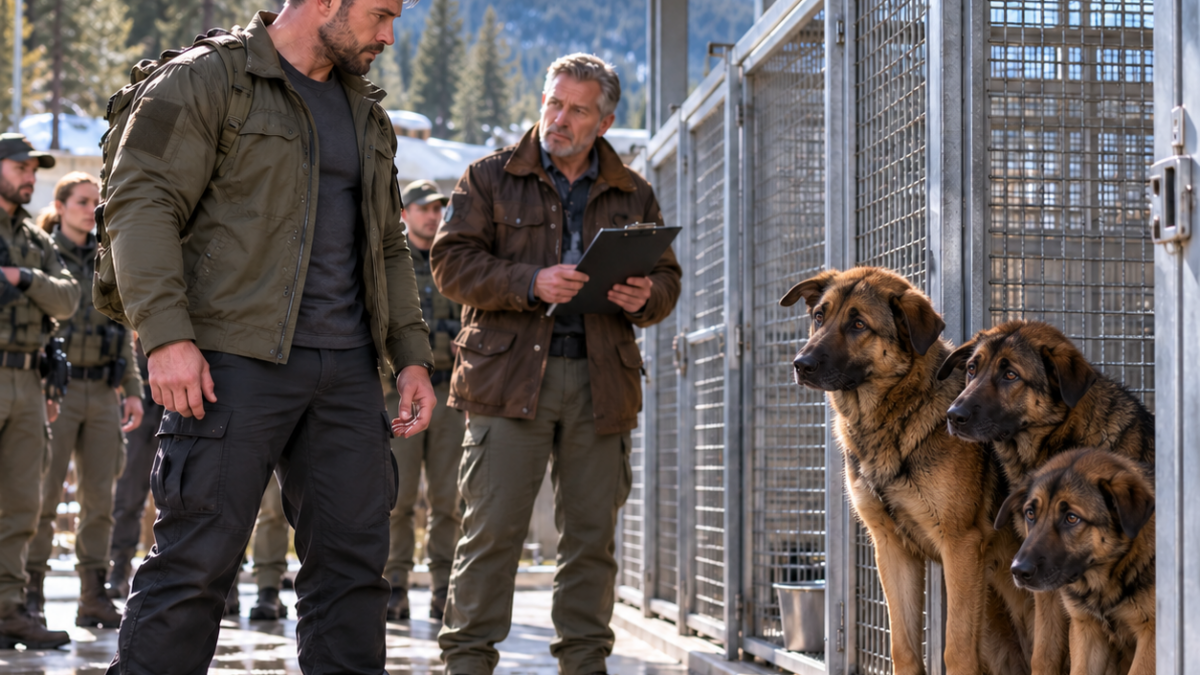
Inside the large outdoor-access enclosure stood three German Shepherds.
All sable-coated.
All massive.
All muscular, balanced, and alert.
Ten months old.
Littermates.
The kind of working-line shepherds that made even experienced handlers stop breathing for half a second.
They had thick dark muzzles, broad chests, clean structure, and piercing amber eyes.
But it was not their size or beauty that caught Alex’s attention.
It was their formation.
The moment the door opened, the three dogs did not rush the fence.
They moved as one.
The largest male stepped forward into point position.
The second male took the right flank, body coiled and ready.
The female took the left flank, her eyes locked onto Alex’s hands.
Not his face.
Not his boots.
His hands.
Alex felt the hairs rise along the back of his neck.
David stood beside him quietly.
“Meet the Triad,” he said. “Titan. Ruger. Roxy.”
Alex studied them.
“Which is which?”
“Titan is point. Ruger is right flank. Roxy is left.”
“I only need one dog.”
“That,” David said, “is the problem.”
Alex turned his head slightly.
David leaned against the chain link.
“They are inseparable. And I don’t mean they like each other. I mean they operate on a shared psychological baseline.”
Alex said nothing.
“If I feed Titan first, he won’t eat until Ruger and Roxy have bowls. If Roxy gets a thorn in her paw, Titan and Ruger stand guard over her and refuse to move until I remove it. They sleep in a pile. They wake together. They breathe in sync. When we try to separate them for individual training, they don’t just whine. They panic.”
Alex looked back at the dogs.
Titan stared at him with unsettling focus.
Not aggression.
Assessment.
The same look Bruno used to give him right before an ambush.
The look that said, I know something is coming before you do.
“So break the bond,” Alex said. “You’re the trainer.”
David’s expression darkened.
“I tried.”
Alex waited.
“Two months ago, I took Ruger to the north range for apprehension work. Left Titan and Roxy here. Roxy tore through steel mesh trying to get to him. Nearly ripped her jaw apart.”
The female’s ears flicked at her name.
“Titan paced until he rubbed the pads off his paws,” David continued. “Not nervous pacing. Survival pacing. Like his body was telling him one part of him had been cut out and he needed to go find it before he bled to death.”
Alex crossed his arms.
“They’re dogs.”
“They’re pack.”
“Every dog is pack.”
“Not like this.”
David’s voice hardened.
“In their minds, they are one organism. You sever one piece, the others bleed out.”
Alex looked at Titan.
The big male held eye contact for half a second, then deliberately looked away.
Not submission.
Control.
“My budget is for one,” Alex said.
“Naval Special Warfare won’t buy a three-dog circus. I need a single operator.”
“Then you will have to do something I could not.”
David turned away from the enclosure.
“You will have to play God.”
Alex did not answer.
David looked back at him.
“You will have to tear them apart.”
Over the next four days, Alex put the Triad through hell.
He told himself he needed data.
Metrics.
Performance under stress.
Scent discrimination.
Bite pressure.
Environmental stability.
Independent decision-making.
Recovery time after simulated blasts.
He needed to identify the strongest dog.
Or, if he was honest, he needed the decision to become easy.
It did not.
The first test was a simulated urban combat lane with blank gunfire, flashbangs, smoke, hidden decoys, and moving targets.
Most young dogs either overcharged, hesitated, or fixated on the loudest stimulus.
The Triad moved like a veteran team.
Roxy was the nose.
Sharp, fast, almost supernatural.
She found a sweat-scented cloth sealed inside a pipe junction under concrete dust and diesel fumes in under ninety seconds.
Ruger was power.
He hit bite-suit decoys with such force one trainer staggered backward despite bracing.
He was eighty-five pounds of muscle, momentum, and commitment.
But Titan was something else.
Titan was command presence in canine form.
During a building clearance drill, Alex watched through thermal cameras as the big male paused at a hallway intersection, read the space, and used body pressure to shift Roxy toward a blind corner while positioning Ruger near the opposite door.
No handler command.
No visible cue.
Titan anticipated the battlefield.
When the decoy broke cover, the three dogs collapsed the space with surgical precision.
Roxy flushed.
Ruger struck.
Titan controlled the exit.
Alex watched the playback three times.
David stood beside him.
“You see it.”
Alex said nothing.
“That is independent tactical reasoning,” David said. “One in ten thousand dogs, maybe. Maybe less.”
Alex’s throat tightened.
Bruno had been like that.
Not exactly.
No dog was exactly like Bruno.
But close enough to hurt.
On the morning of the fifth day, the sky over Pennsylvania turned a bruised gray.
A bitter wind cut across the gravel drive where Alex’s truck idled.
David stood beside him in the kennel corridor.
Alex held a heavy leather tracking leash.
The brass clip felt like a thousand pounds in his palm.
“It’s Titan,” Alex said.
David’s face went still.
“Are you sure?”
“No.”
David looked at him.
Alex’s jaw tightened.
“But he is the mission dog.”
“Once you put that leash on him and walk out that door,” David said, “you destroy their world.”
Alex looked toward the enclosure.
“I have a mission.”
The words came out cold.
Too cold.
He heard it and hated himself for it.
But cold was easier than grief.
“I can’t afford to care about canine family dynamics. Titan goes with me.”
David said nothing.
They approached the enclosure.
The three dogs were huddled together on their raised cot.
The moment Alex lifted the leash, the atmosphere changed.
They knew.
Not in the way humans know paperwork.
But dogs read intention better than people read words.
David’s sorrow.
Alex’s rigid posture.
The leash.
The truck engine outside.
The silence before separation.
Titan stood.
He did not cower.
He stepped forward, placing his body between Alex and his siblings.
Roxy immediately pressed her flank against Titan’s back leg.
Her ears pinned flat.
Ruger let out a low, vibrating rumble.
Not aggression.
A plea.
Alex stepped into the cage.
He kept his breathing steady, his posture calm.
Dominance.
Control.
That was what he told himself he was projecting.
What he was actually projecting was fear.
He did not want to feel this.
Not again.
“Titan. Here.”
Titan looked at Alex.
Then back at Roxy and Ruger.
Slowly, agonizingly, the massive German Shepherd walked forward and sat at Alex’s left heel.
Alex clipped the brass carabiner onto Titan’s tactical collar.
Click.
The sound echoed like a gunshot.
“Let’s go.”
Alex turned.
Titan followed two steps.
David shut the heavy gate behind them.
That was when Ruger lunged.
The massive dog slammed his entire body against the chain-link fence.
Bang.
Again.
Bang.
Then Roxy screamed.
It did not sound like a dog.
It was high, raw, vibrating, terrifyingly human.
The sound of a living thing being torn from itself.
She threw her head back and wailed so violently the concrete corridor seemed to shake around it.
Then she attacked the fence with her teeth.
Her gums split almost instantly.
Blood smeared the wire as she tried to chew through steel to reach her brother.
Titan stopped dead.
The leash went taut.
“Heel,” Alex commanded.
Titan did not move.
Ruger paced wildly now, throwing himself at the gate, barking with frantic desperation.
Roxy’s wail rose and broke and rose again.
David reached through the fence to grab her collar before she destroyed her mouth.
“Keep walking, Caldwell!” he shouted over the noise. “Don’t let him stall!”
Alex tugged the leash.
Titan dropped to his belly.
The elite dog bred for courage, conditioned for gunfire, flashbangs, aircraft, water, heights, and pain, dug his claws into the concrete and stared back at his brother and sister.
His amber eyes were wide with terror.
Not battlefield terror.
Worse.
Abandonment.
Alex pulled.
Titan did not fight him.
He simply refused to abandon his pack.
So Alex dragged him.
He physically slid the eighty-pound dog across the concrete floor while Roxy screamed and Ruger slammed the fence so hard the walls shook.
By the time Alex reached the truck, his hands were shaking.
He hoisted Titan into the back seat.
The big dog collapsed onto the floorboards, curled into a tight ball, and buried his snout beneath his paws.
Alex slammed the door.
He got behind the wheel and gripped it until his knuckles turned white.
Inside the kennel, the cries continued.
Muffled by concrete now.
But somehow worse.
He put the truck in drive and sped down the mountain road.
For the first hundred miles, Titan did not move.
He did not look out the window.
Did not drink.
Did not respond when Alex said his name.
By the time they reached Virginia Beach, Alex understood the truth.
He had not selected the best K9 for a mission.
He had broken a family.
And he had brought back the body of a dog whose spirit remained in Pennsylvania.
The Naval Special Warfare Training Center in Virginia Beach was usually a symphony of controlled violence.
Gunfire.
Commands.
Helicopter noise.
Barking military dogs.
Men running drills until their muscles failed.
But for Alex Caldwell and Titan, it became a silent purgatory.
Two weeks passed.
Fourteen days since Alex left Ruger and Roxy screaming against the chain-link fence.
In those fourteen days, the brilliant tactical prodigy David Hensley had described vanished.
Titan ate just enough to stay alive.
His sable coat dulled.
His ribs began to show.
On obstacle courses, he performed but did not engage.
A-frames.
Tunnels.
Jumps.
Ladders.
He completed them with mechanical apathy, head low, tail dead.
During bite drills, Titan would jog toward the decoy, clamp weakly onto the padded sleeve, and then stand there with his eyes drifting toward the tree line.
As if waiting for Ruger’s bark.
As if expecting Roxy’s footfalls to come from behind him.
As if every exercise confirmed the same impossible truth.
They were not coming.
Commander Bradley watched one pathetic bite drill from the catwalk above the kill-house simulator.
That afternoon, he called Alex into his office.
“I gave you an open checkbook,” Bradley said, throwing a training evaluation onto his desk. “I told you to get me a Tier One dog for Operation Winterfall.”
Alex stood rigidly at parade rest.
“What you brought me,” Bradley continued, “is a broken animal that will get you and Bravo Platoon killed.”
“He’s adjusting.”
“He failed the stress test.”
“He was part of a bonded litter.”
“He failed aggression metrics.”
“He is grieving separation.”
Bradley slammed a hand on the desk.
“I do not care if he is grieving a divorce, Chief. We jump into the Carpathian Mountains in eight days. We are hunting a warlord who has turned alpine snow into a graveyard. I need a dog that can find ambushes and stop threats in the dark.”
Alex’s jaw flexed.
“If this dog cannot work, I cut him from the roster and you go in blind.”
“Give me three days.”
Bradley stared at him.
Alex’s voice cracked just enough to make the room feel smaller.
“I will fix him.”
Bradley’s eyes narrowed.
“Three days. Then he goes back to Hensley.”
That night, rain battered the Eastern Seaboard.
Alex sat on the floor of his off-base apartment, a glass of cheap bourbon untouched beside him.
The place barely looked lived in.
Mattress in the corner.
Tactical crates.
A folding chair.
No photographs.
No softness.
No signs that anyone expected to stay.
Titan was curled by the front door, nose tucked beneath his tail, shivering despite the warmth.
Trying to become small.
Alex watched him for a long time.
Then he looked at the bourbon.
Then back at Titan.
The truth landed quietly.
He had been treating Titan exactly the way the Navy had treated him.
As a weapon.
A tool.
A government asset to be selected, transported, tested, deployed, and maintained.
But Titan was not a drone.
He was not a rifle.
He was a living creature with a family that had been torn from him because Alex needed a mission asset.
Alex set the glass aside.
Then he got on his hands and knees.
Slow.
Low.
Non-threatening.
He crawled across the hardwood floor and stopped a few feet from Titan.
The dog did not lift his head.
But his eyes moved.
“I know,” Alex whispered.
His voice sounded strange in the room.
Rough.
Human.
“I know what it feels like to leave a piece of your soul behind.”
Titan’s ears shifted.
Alex lowered himself flat to the floor, mirroring the dog’s posture.
He closed his eyes.
And for the first time since Helmand, he spoke Bruno’s name aloud.
He talked about the dust.
The blast.
The smell of burned metal.
The terrible weight of Bruno in his arms.
He talked about the way Bruno had tried to lift his head when Alex called him.
He talked about how the medics had worked even though everyone knew.
He talked about burying the dog who had saved his life and then standing at attention while someone said brave words that did nothing to stop his hands from shaking.
Tears came without permission.
Hot.
Silent.
Humiliating.
He let them come.
For an hour, Alex lay on the floor and bled grief into the quiet room.
No commands.
No corrections.
No mission.
Just truth.
Then he heard paws shift.
A wet nose touched his shoulder.
Alex opened his eyes.
Titan had uncurled himself.
The massive German Shepherd stepped forward, lowered his body, and lay directly against Alex’s chest.
He pressed his heavy head over the SEAL’s heart.
Then he let out one long, shuddering sigh.
Alex rested one hand on Titan’s neck.
“I can’t replace them,” he whispered. “I won’t try.”
Titan’s eyes half closed.
“But I can carry it with you.”
The transformation was not instant.
Healing never is.
But over the next three days, Titan began to wake.
When Alex lifted the harness, Titan no longer cowered.
He stood.
When they hit the obstacle course, Titan moved with purpose.
Not joy.
Not yet.
Purpose.
In the kill house, the intelligence David had promised returned with terrifying force.
Titan cleared corners before operators reached them.
He found hidden decoys through walls.
He identified scent traps and refused false trails.
During the final night raid simulation, Titan silently neutralized two decoys and alerted to a third before Bravo Platoon breached the threshold.
Commander Bradley watched the video feed in silence.
When it ended, he said only two words.
“He’s ready.”
Seventy-two hours later, the rear bay of a C-17 Globemaster opened into freezing darkness.
Thirty thousand feet above the jagged peaks of the Carpathian Mountains, wind screamed through the aircraft like something alive.
Alex stood at the ramp in full cold-weather tactical gear, oxygen mask strapped tight, parachute rig secured.
Titan was strapped to his chest in a custom thermal suit, specialized K9 goggles, and oxygen system.
The dog’s heartbeat thudded steady against Alex’s ribs.
Not calm because he had forgotten Roxy and Ruger.
Calm because Alex was there.
The green light flashed.
Alex stepped into the void.
They fell through black sky.
The cold hit like knives.
Below them, a fortified compound hid inside a snowy ravine surrounded by dense pine forest.
The parachute deployed with a violent jerk.
They glided into the tree line and landed waist-deep in powder.
Alex unclipped Titan.
The dog hit the snow running.
Bravo Platoon moved through freezing pines.
Their objective was a fortified cabin network serving as the operations center for a trafficking syndicate led by a warlord who had evaded three governments for five years.
Intel said twelve armed guards.
Maybe more.
Titan took point.
Nose working.
Paws silent on the icy crust.
Suddenly, he stopped.
Right paw lifted.
Ears swiveling.
He turned his head toward a snowbank on the left flank.
Alex raised a fist.
The platoon froze.
Titan nudged his snout toward the drift.
Alex brought up his rifle and scanned through thermal optics.
Hidden beneath white camouflage tarps thirty yards away were three enemy sentries with PKM machine guns.
Bravo had nearly walked into a fatal crossfire.
Alex signaled the snipers.
Three suppressed rounds snapped through the forest.
Three sentries dropped before they knew the Americans were there.
Alex looked down at Titan.
The dog’s eyes stayed forward.
Working.
Focused.
A soldier.
Ten minutes later, the stealth approach shattered.
An enemy guard rounded a corner and opened fire with an AK-47.
Flashbangs erupted.
Rifles roared.
Snow blew from rooftops in violent bursts.
“Clear the main house!” Alex shouted over comms. “Go, go, go!”
They stacked at the reinforced oak door of the central cabin.
A charge blew the door off its hinges.
Alex entered first, sweeping left.
Titan flowed beside him like a shadow.
A massive armored mercenary lunged from a dark hallway with a tactical shotgun.
The barrel came up toward Alex’s chest.
Too fast.
No angle.
No time.
Titan launched.
Eighty pounds of muscle and fury slammed into the mercenary midair. The shotgun blast tore into the ceiling as the man crashed backward through a table. Titan locked onto his forearm with crushing force.
But the room was not clear.
From a raised balcony, another shooter appeared.
Alex saw movement above.
Before he could track the target, a burst of enemy fire ripped down.
Pain exploded through his left shoulder and thigh.
The force spun him sideways.
He hit the blood-slick floor hard.
His rifle skidded half an inch from his hand, impossibly far.
His ears rang.
His left arm would not respond.
Above him, the shooter racked his weapon to finish the job.
Titan released the first mercenary.
The dog turned.
He saw Alex bleeding on the floor.
And something ancient snapped inside him.
This was his pack.
His pack was dying again.
Not Bruno.
Not Roxy.
Not Ruger.
Alex.
The roar that came from Titan did not sound like a dog.
It sounded like the mountain had grown teeth.
He bounded onto the overturned table, launched from the stone fireplace, and cleared ten impossible feet to the balcony.
The shooter did not have time to scream.
Titan hit him at the throat.
Both vanished over the railing.
Bravo Platoon flooded the room.
“Medic!”
“Caldwell hit!”
“Secure the balcony!”
“Get pressure on that leg!”
Petty Officer Miller dropped beside Alex, applying tourniquets and packing wounds.
Alex’s vision went gray.
Through the haze, he saw Titan leap down from the balcony.
The dog was covered in blood.
Enemy blood.
Titan crawled over shattered glass and splintered wood, ignoring shouting medics and gun smoke.
He pushed his head under Alex’s chin.
Whining softly.
Licking sweat from his face.
Alex’s fingers found the thick collar.
“Good boy,” he choked.
Then darkness took him.
When Alex woke, he was staring at a sterile white ceiling in Landstuhl, Germany.
His body felt filled with concrete.
Bandages wrapped his shoulder, thigh, and ribs. A dull chemical ache pulsed beneath the pain medication.
He tried to move and immediately regretted it.
A familiar weight rested across his uninjured legs.
Alex lifted his head weakly.
Titan slept at the foot of the hospital bed.
Curled tightly.
Touching him.
Commander Bradley sat in the corner reading a debriefing file.
He looked up.
For once, the scarred commander smiled.
“Welcome back, Caldwell.”
Alex swallowed against a throat dry as sand.
“How long?”
“Four days.”
“The target?”
“Eliminated. Mission accomplished.”
Alex closed his eyes briefly.
Bradley leaned forward.
“You took two through-and-throughs. Shoulder and thigh. You’re sidelined for six months, minimum. But you keep the arm and the leg.”
Alex’s fingers found Titan’s fur.
The dog woke instantly.
His tail thumped against the blanket.
Bradley glanced at him.
“Your dog,” he said quietly, “has generated the strangest after-action report I have ever signed.”
Alex looked at him.
“He found an ambush. Neutralized multiple hostiles. Saved Bravo Platoon. Saved you.”
Titan crawled up the bed carefully and rested his chin on Alex’s uninjured chest.
Alex closed his hand in the fur behind the dog’s ears.
Bradley sighed.
“But there is a problem.”
Alex’s eyes opened.
“He will not leave you,” Bradley said. “Nurses tried to take him out while you were in surgery. He tore a door off its hinges and sat outside the operating room. He paces if you sleep too long. He refuses food unless he can see you.”
Alex felt the tension under Titan’s skin.
“He thinks if he takes his eyes off you, you die,” Bradley said. “Veterinary psych says combat trauma, previous separation trauma, hyper-vigilance. His nervous system is overloaded.”
Alex stared at the dog.
Titan had fought like a demon to protect him.
But the cost was written beneath his skin.
Fear humming like electricity.
The fear of losing the only family he had left.
“When we get stateside,” Alex said, voice weak but firm, “I need authorization for a trip.”
Bradley raised an eyebrow.
“Official?”
“No.”
“Medical?”
“No.”
“Then what?”
Alex stroked Titan’s ears.
“Personal.”
Three weeks later, Alex walked with a heavy limp down a familiar dirt road in the Appalachian Mountains.
A cane supported his left side.
Titan walked at heel beside him, perfect but tense.
The air hinted at spring.
Cold still held the shaded places, but meltwater ran down the gravel shoulders.
David Hensley waited by the reinforced kennel gate.
He took one look at Alex’s cane, then Titan, then the bandages still visible beneath Alex’s jacket.
“I heard you went through hell.”
“We did.”
“How is he?”
Alex looked down at Titan.
“Not whole.”
David’s face tightened.
Alex looked toward the kennel.
“How are they?”
For the first time, David looked away.
“Not good.”
Alex waited.
“Roxy developed a pacing habit so bad she wore the pads off her feet. Ruger stopped doing bite work completely. He just sits in the corner.”
David’s voice lowered.
“They’re washed out, Alex. I cannot sell them to law enforcement, and I sure as hell cannot sell them to the military. They’re broken.”
Titan’s ears snapped forward.
A faint sound came from behind the steel door.
Not bark.
Not whine.
Recognition.
Alex’s throat tightened.
“Open it.”
David hesitated.
“Alex—”
“Open the door.”
The deadbolt slid back.
The hinges creaked.
For one suspended moment, the enclosure stayed silent.
Roxy and Ruger lay on the concrete.
Their coats were dull.
Their eyes listless.
Their bodies thinner than they should have been.
Titan froze.
Then he made a sound Alex had never heard before.
High.
Broken.
Full of every mile between them.
Inside, Roxy’s head snapped up.
She stood so fast she nearly fell.
Ruger rose a heartbeat later.
Alex unclipped Titan’s leash.
“Go.”
Titan exploded forward.
He did not run.
He flew.
He slammed into the gate just as Roxy and Ruger rushed the fence from inside.
David threw it open.
The three German Shepherds collided in a blur of sable fur, yelps, frantic whining, and raw joy.
It was not a greeting.
It was reunion after amputation.
Titan tackled Ruger to the ground and licked his face wildly.
Roxy jumped over both of them, buried her muzzle into Titan’s neck, and let out sharp joyful yips that echoed through the mountain pines.
They rolled together.
Checked each other’s ears.
Shoulders.
Faces.
Breathing in each other’s scent as if scent alone could stitch months back together.
David wiped at his face.
“Miracle to see,” he whispered.
Then he looked at Alex.
“But why did you bring him back? Are you returning him? After what he did for you?”
Alex leaned heavily on his cane.
For the first time in almost a year, a genuine smile broke through the hard lines of his face.
“I’m not returning him.”
David frowned.
“Then what?”
“I’m buying the other two.”
David stared.
“What?”
“You heard me.”
“Alex, you live in a barracks. You’re active duty. You cannot own three tactical working dogs.”
“I’m retiring.”
David went still.
“My shoulder is shredded. My knee is bone on bone. I’ve given the Navy fourteen years, and they’ve taken enough blood for it.”
Alex looked at the Triad racing in circles around the yard, alive again.
“I bought a cabin with twenty acres in Montana.”
Titan broke from the play and ran to Alex’s side, pressing against his injured leg to support his weight.
Roxy and Ruger stopped.
They looked at Titan.
Then at the scarred man leaning on a cane.
They did not growl.
Did not bark.
They saw the way their brother looked at Alex.
They saw the bond.
Slowly, cautiously, Roxy stepped forward and sniffed Alex’s outstretched hand.
Ruger followed, nudging Alex’s hip with his massive head.
Alex stood very still.
Three dogs.
One pack.
And somehow, impossibly, room for a fourth.
“They are not a circus,” Alex said softly. “They’re a family.”
David’s eyes shone.
“Took you long enough.”
Alex nodded.
“Yes, it did.”
Two months later, the Triad arrived in Montana.
The cabin sat against a line of pine trees beneath a sky so wide it seemed impossible to own.
Twenty acres.
A creek.
A barn.
A fenced training field Alex built slower than he wanted because his body no longer obeyed the way it used to.
Titan supervised every fence post.
Roxy inspected every corner.
Ruger carried tools he was not asked to carry and occasionally dropped them in the wrong places with great confidence.
Alex slept badly at first.
So did they.
Titan woke at every sound.
Roxy paced during storms.
Ruger blocked the bedroom door with his body.
Alex understood.
The first few weeks were not peace.
They were decompression.
The absence of mission felt like danger until all four of them learned otherwise.
Morning became their anchor.
Coffee on the porch.
Three dogs lying in the first light.
Training without pressure.
Runs through pine.
Scent games in the meadow.
No deployment clock.
No commander waiting for metrics.
No one asking which dog was strongest.
They were not assets anymore.
Not weapons.
Not inventory.
Titan remained brilliant.
Roxy remained sharp.
Ruger remained powerful.
But together, they became something Alex had not expected.
Gentle.
Roxy learned to rest her head in Alex’s lap when nerve pain kept him awake.
Ruger slept across the bedroom door, not because he feared attack, but because guarding was how he loved.
Titan never stopped watching Alex’s breathing, but slowly, over months, he learned he could close his eyes and trust the others to watch too.
That was the gift of a pack.
Fear did not have to belong to one body.
Neither did loyalty.
On the first anniversary of Bruno’s death, Alex hiked alone to the ridge above the cabin.
Not entirely alone.
No one was alone with the Triad.
Titan walked at his left.
Roxy ranged ahead.
Ruger followed behind, occasionally stopping to look back as if the past itself might try to sneak up on them.
At the top of the ridge, Alex took Bruno’s old collar from his jacket pocket.
He had carried it for a year.
Through missions.
Hospitals.
Flights.
Pain.
He sat on a flat stone and held it in both hands.
Titan pressed against his side.
Roxy lay at his feet.
Ruger sat behind him, warm and solid against his back.
Alex finally let himself cry.
Not the silent tears from the apartment floor.
Real grief.
The kind that bends a man forward.
The dogs did not panic.
They did not try to fix it.
They only stayed.
When the worst of it passed, Alex buried the collar beneath a pine and marked it with three stones.
One for Bruno.
One for the life before.
One for the life after.
Then he stood.
His knee hurt.
His shoulder ached.
His heart did too.
But when he started down the ridge, three German Shepherds moved with him.
Point.
Left flank.
Right flank.
Formation.
Family.
Years later, people would tell the story as if it began with a Navy SEAL choosing one of three dogs.
They would talk about Titan’s brilliance.
Roxy’s nose.
Ruger’s strength.
They would talk about the mission in the Carpathians and the dog who saved Bravo Platoon.
They would talk about the moment Alex returned to Pennsylvania and bought the other two.
All of that was true.
But it was not the whole truth.
The real story was about what war teaches people to ignore.
Pain.
Attachment.
Grief.
The living bonds that make fighters brave and then destroy them when those bonds are cut.
Alex Caldwell thought he needed a weapon.
He found a family.
He thought he could choose one dog and leave the others behind.
He learned that some bonds are not weaknesses to be managed.
They are the reason anyone survives at all.
Titan, Roxy, and Ruger were never meant to be separated.
Neither was Alex, though he had spent years pretending otherwise.
A man can survive alone for a long time.
He can function.
He can complete missions.
He can stand straight in hospital rooms and sign forms and pretend the dead do not follow him home.
But survival is not the same as living.
The Triad taught him that.
Three German Shepherds who cried when their family was torn apart.
Three dogs who came back to life when it was restored.
Three warriors who accepted a broken SEAL into their pack and showed him, day by day, that peace did not have to mean being alone with the ghosts.
On cold Montana mornings, when mist lifted from the creek and the pine trees turned gold with first light, Alex Caldwell would open the cabin door and watch the Triad burst into the field.
Titan first.
Roxy left.
Ruger right.
Then all three would turn back toward him.
Waiting.
Always waiting.
Not because he commanded them.
Because family does not move forward until everyone is coming.
And every time, Alex would step off the porch, lean briefly on his cane, and follow them into the light.


