My Sister Humiliated Me at Her Engagement Dinner Because She Thought I Was Just a Records Clerk, Until a Two-Star General Walked In and Said My Callsign
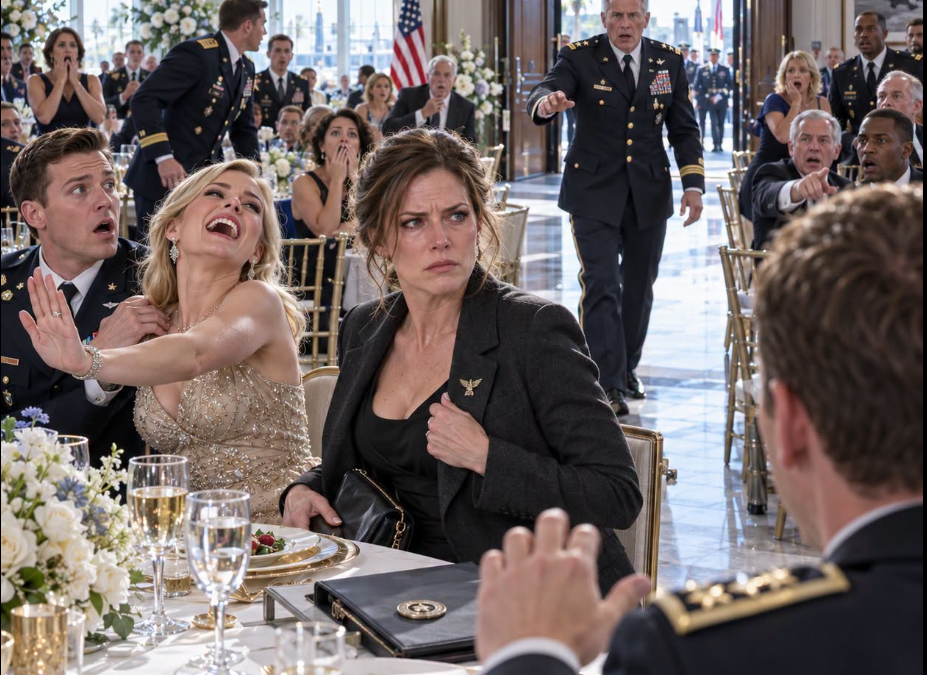
My Sister Humiliated Me at Her Engagement Dinner Because She Thought I Was Just a Records Clerk, Until a Two-Star General Walked In and Said My Callsign
My sister moved my seat beside the kitchen doors before dinner even began.
She told her fiancé not to let my “civilian hands” touch him.
Then the ballroom doors opened, a two-star general walked straight past her, and every person who had laughed suddenly realized I was the one person in that room they should never have underestimated.
The first thing Brooke did when I arrived at her engagement dinner was move my place card.
She didn’t hug me. She didn’t say hello. She didn’t even pretend to be happy that her older sister had flown in after three sleepless days of work.
She simply stood beside the seating chart in a cream-colored dress that shimmered under the chandeliers, picked up the ivory card marked MORGAN HALE, and carried it across the ballroom like she had found something embarrassing on the floor.
“This will be better,” she said.
She slid my card between an elderly cousin I barely recognized and the swinging kitchen doors where servers kept rushing in and out with trays of champagne.
I looked at the seat.
Then I looked back at her.
“Better for whom?”
Brooke smiled without warmth. “For everyone.”
The officer’s club was beautiful in the way military families know how to make a room beautiful. Dark polished wood. White roses. American flags beside a small stage. Brass lamps along the paneled walls. Portraits of former commanders watching over the evening like silent judges.
My sister belonged in rooms like that.
At least, she believed she did.
Brooke had spent her entire adult life collecting proximity to power. Commanders. Decorated officers. Political donors. Families with old military names and expensive traditions. And now she was marrying Captain Evan Mercer, son of retired Colonel Thomas Mercer, a man whose name seemed to make every young officer in the room stand a little straighter.
I wore a charcoal blazer, black slacks, and the dull brass pin hidden beneath my lapel.
My mother noticed the blazer immediately.
“Morgan,” she said, appearing beside Brooke with a champagne flute she had barely touched, “couldn’t you have worn something softer?”
“I like this.”
“You always like practical things.”
Her fingers brushed my lapel, and for half a second the fabric shifted. A thin edge of the brass pin caught the light.
I covered it naturally.
My mother frowned. “Brooke is marrying into a very traditional military family. Please don’t make tonight one of your strange little statements.”
I almost laughed.
For ten years, my family had believed I worked in a basement in Washington, filing government records for people who did more important things.
That misunderstanding had been useful.
It started because I had once said my job involved military records, coordination, and federal documentation. My mother heard “records.” Brooke heard “failure.” Neither of them asked enough questions to find out they were wrong.
The truth was harder to explain.
I worked in secure rooms where clocks showed five different time zones. I coordinated aircraft, personnel, intelligence updates, border movements, evacuations, and contingency plans that changed by the minute. I had slept sitting upright in windowless buildings, eaten meals I couldn’t remember tasting, and learned to identify bad news by the sound of a door opening.
But none of that belonged at Brooke’s engagement dinner.
So I let them keep their version of me.
Brooke enjoyed that version.
She needed me small.
PART2:
At dinner, from my seat near the kitchen, I watched her shine beneath the chandeliers. She laughed at every compliment, touched Evan’s sleeve whenever someone mentioned his career, and glanced at me often enough to make sure I understood my place.
Evan noticed.
I could tell by the way his jaw tightened each time Brooke made one of her little remarks.
“Morgan has always preferred the quiet side of life,” she told one guest.
“Morgan is very happy with paperwork,” she told another.
Then, during Colonel Mercer’s toast, she found her moment.
Thomas Mercer stood at the head table, one hand on his son’s shoulder, and spoke about duty, command, sacrifice, and leadership.
“Real leadership,” he said, “means standing where consequences are real. It means carrying weight instead of hiding behind paperwork while others take risks.”
Several people nodded.
Brooke turned toward me.
“Morgan has always preferred the paperwork side,” she said brightly.
Laughter moved through the nearest tables.
It wasn’t loud enough to be called cruel.
That was Brooke’s talent.
PART3:
She knew how to humiliate someone just gently enough that everyone else could pretend it was harmless.
I lifted my water glass and met her eyes.
What she didn’t notice was Evan.
He wasn’t laughing.
He was staring at the small strip of brass visible beneath my blazer.
Dessert had not arrived when I reached beneath my chair for the mahogany box I had brought with me. Inside was an old field compass mounted in dark velvet. It wasn’t expensive, but it had meaning. It had been given to me years earlier by an officer who once told me a leader should know where she was going before asking anyone to follow.
I thought Evan might appreciate it.
I stood and walked toward the head table.
Brooke saw me immediately.
Her smile disappeared. “Morgan?”
“I brought Evan something.”
“You can leave it on the gift table.”
“I’d rather hand it to him.”
She stepped into my path before I reached the front of the room. Conversations thinned around us. My mother froze near the bar. Evan pushed his chair back slightly.
“Brooke,” he said, “it’s fine.”
“No, it isn’t.” She looked at me with a tight smile that did not reach her eyes. “This isn’t a birthday party. Evan is speaking with senior officers tonight. You have nothing to contribute to that conversation.”
“I’m walking twenty feet to give your fiancé a gift.”
Her face flushed.
Maybe she realized people were listening. Maybe she liked it.
Either way, she raised her voice.
“You have spent your whole career buried in routine paperwork, Morgan. Evan has led soldiers under pressure. His father spent thirty years in command. You don’t get to walk up here and pretend you understand their world because you file things in the same city.”
The room went quiet.
A strange calm settled over me.
I had felt that calm before bad briefings, before dangerous decisions, before moments when several possible futures narrowed into one.
“Move, Brooke,” I said.
She laughed.
Then she reached for my wrist as I stepped around her. Her hand slapped mine away from Evan’s sleeve, sharp enough for the sound to carry.
“And don’t touch him with your civilian hands.”
The silence after that was complete.
Somewhere behind me, a fork slipped from a server’s tray and struck the floor.
Evan stood so fast his chair scraped against the wood.
“Brooke.”
She mistook the warning in his voice for support.
“I’m serious,” she said, turning slightly toward the audience she had created. “She’s spent years acting mysterious about the most boring job imaginable. You don’t get to stand beside elite officers because you organize their paperwork.”
I smoothed my sleeve.
The movement shifted my blazer.
The brass pin became fully visible.
Evan saw it.
His face changed.
Not a little.
Completely.
The color drained from his skin, and his eyes locked on the pin like he had just seen a ghost.
“Where did you get that?” he asked.
Brooke blinked. “Get what?”
I closed my blazer.
Evan took one step toward me, then stopped himself.
“Ma’am,” he said carefully, “where did you get that insignia?”
The word ma’am landed harder than a shout.
Brooke stared at him. “Why are you calling her that?”
I picked up the mahogany box from where it had nearly slipped from my hand. “Captain Mercer, this is your engagement dinner. Sit down.”
He didn’t.
Then the double doors at the far end of the ballroom opened.
Two uniformed aides entered first.
Behind them walked Major General Julian Cross.
Every active-duty officer in the room straightened at once.
Brooke’s entire face lit up.
She had met General Cross once at a charity reception and had mentioned it for months. Now she smoothed her dress, stepped directly into his path, and held out her hand.
“General Cross,” she said, glowing. “What an unbelievable honor. I’m Brooke Hale, Captain Mercer’s fiancée.”
General Cross walked past her.
Her hand remained suspended in the air.
He crossed the ballroom without looking at the flowers, the guests, the Mercers, or my mother.
He stopped in front of me and held out a sealed leather folder.
“Hale,” he said quietly.
I exhaled. “Sir.”
“Sorry to interrupt.”
“You’re early.”
“Transport changed.”
Thomas Mercer stepped closer, his confidence suddenly replaced by caution.
“General,” he said, “I believe there may be some confusion. Miss Hale is a civilian records employee.”
General Cross looked at him for two long seconds.
Then he said, “Captain Mercer.”
Evan snapped straighter. “Sir.”
“Why is Colonel Hale being discussed as a records clerk?”
Nobody moved.
My mother’s champagne glass tilted in her hand.
Brooke stared at me as if I had become a stranger in my own skin.
“Colonel?” she whispered.
“Yes,” General Cross said.
Brooke let out a nervous laugh. “You mean honorary?”
Evan answered before anyone else could.
“No.”
General Cross looked around the room, finally realizing he had walked into something personal. His expression tightened.
Then he turned back toward me.
“They know you by another designation,” he said.
I wished, for one impossible second, that I had never worn the pin.
Evan swallowed. “Yes, sir.”
Brooke’s voice cracked. “What designation?”
General Cross held my gaze.
“Callsign Phantom.”
The name moved through the officers like an electric current.
Most civilians in the room didn’t understand it. Brooke certainly didn’t. But several officers did. I saw recognition flash across their faces. A lieutenant inhaled sharply. An older major lowered his glass. Evan looked like someone had removed the ground beneath him.
Brooke shook her head. “What does that mean?”
General Cross chose his words carefully.
“Colonel Morgan Hale serves in a joint operational planning command. Her exact responsibilities are not dinner conversation.”
The ballroom became painfully still.
For ten years, my family had treated my silence as emptiness.
Now they were discovering it had been discipline.
My mother recovered first.
“Morgan,” she said, forcing a smile, “surely this is some kind of misunderstanding.”
“It isn’t.”
“But you told us you handled records.”
“I told you my work involved records.”
“That is not the same thing.”
“No,” I said. “It isn’t.”
Brooke’s face hardened, because confusion was easier for her than shame.
“You let us think you were nobody.”
That sentence did what the insults had not.
I looked at my sister and remembered every birthday I had flown home for after thirty hours without sleep. I remembered paying part of her college tuition quietly when our father’s business struggled. I remembered sitting beside her at two in the morning after her first fiancé left, letting her cry into my sweatshirt.
All those years, she hadn’t simply thought I was ordinary.
She had thought I was nobody.
“I let you believe I had an ordinary job,” I said. “Those are not the same thing.”
Evan’s voice was low when he spoke.
“Brooke told me you were jealous of the military.”
I looked at him.
“She said you tried to get into federal law enforcement after college and couldn’t pass selection. She said that was why you acted distant whenever my career came up.”
I turned to Brooke.
That was not a misunderstanding.
That was invention.
“Why?” I asked.
For once, she had no answer.
My mother stepped forward. “I’m sure Brooke was simplifying.”
“No,” Evan said. “She was specific.”
Brooke’s eyes filled with angry tears. “Because you made everything weird, Morgan. You disappeared for months. You missed holidays. You came home exhausted and refused to tell anyone where you’d been. What was I supposed to say?”
“The truth,” I said. “You could have said you didn’t know.”
“But I didn’t know!”
“You knew you didn’t know.”
That silenced her.
Thomas Mercer stepped toward me, face pale.
“Colonel Hale,” he said, “I owe you an apology.”
“You didn’t know who I was.”
“That should not have mattered.”
For the first time all night, I looked at him with respect.
He understood faster than my own family did.
The problem was never that they failed to recognize my rank.
The problem was that they believed rank was the only reason to show respect.
General Cross and I stepped into the library off the main ballroom so I could sign the reassignment papers he had brought. Through the door, I could hear muffled voices rising and falling.
“You all right?” he asked.
“I’ve had worse dinners.”
His mouth twitched. “I noticed.”
When I returned to the ballroom, everything had changed.
Guests stood in quiet clusters. Brooke was crying carefully near the windows, dabbing beneath her eyes to save her makeup. Evan stood several feet away from her, his expression exhausted. His parents had their coats.
Brooke saw me and pointed.
“This is your fault.”
“Which part?”
“All of it. You came here knowing exactly what would happen.”
“I expected dinner.”
“You wore that pin.”
“I wear it under my jacket often.”
“You brought a general.”
“Believe it or not, I do not summon generals to family events.”
A few people nearby looked down to hide their reactions.
Brooke’s voice broke. “Thomas thinks I lied to his family.”
“You did.”
“I simplified!”
“You invented a failed career for me.”
She looked away.
Evan stared at her. “My father asked me how many other things you invented.”
“And what did you say?” Brooke whispered.
“I said I didn’t know.”
That was the moment she understood.
Not when General Cross walked past her.
Not when Evan called me ma’am.
Not when the room learned my rank.
She understood only when her own lie became a threat to the life she wanted.
Thomas Mercer approached.
“My family is leaving,” he said.
Brooke went white. “But dessert hasn’t been served.”
No one answered.
The absurdity of the sentence seemed to reach her a second too late.
Evan removed the small engagement-photo pin Brooke had attached to his lapel earlier that night and set it on the table.
“I need time,” he said.
“How much?”
“I don’t know.”
“You can’t do this to me tonight.”
“I’m not doing anything to you.” His voice was quiet. “I’m trying to understand why humiliating your sister was part of celebrating our future.”
I should have felt victory.
I didn’t.
I felt tired.
I set the mahogany box beside Evan.
“This was for you.”
He looked at it but didn’t touch it. “Ma’am, I don’t deserve—”
“It’s a compass, Captain. Not absolution.”
His eyes lifted to mine.
“Figure out where you’re going.”
Then I walked out.
My mother caught me beneath the stone awning outside, where the night air cut through my blazer.
“Morgan, please,” she said, grabbing my wrist.
I looked at her fingers until she released me.
“Call Thomas tomorrow. Tell him Brooke was under stress. Tell him she didn’t understand what she was saying.”
“She understood exactly what she was saying.”
“Her entire future is at risk.”
“So her future was only safe when everyone believed I was beneath her?”
My mother’s face changed.
The valet pulled my car forward.
Before I opened the door, she whispered, “You could fix this with one phone call.”
For most of my life, I had fixed things for my family.
I had softened Brooke’s mistakes. Covered emotional debts. Accepted insults as insecurity. Let my silence protect people who used it against me.
Not that night.
“No,” I said.
And for the first time, I let my family face a consequence without stepping in front of it.
The next morning, Evan sent me a message.
Eight words.
“I think you need to know what she did.”
We met at a coffee shop near the river. He looked younger without his uniform, dark circles beneath his eyes, a paper folder in front of him.
Inside were screenshots.
Messages from Brooke.
Morgan won’t come unless Mom guilts her.
She gets weird around officers because she washed out of something federal.
Don’t ask about work. She’ll make up classified nonsense.
Seat her away from senior guests.
I closed the folder.
“You didn’t question any of this?”
“Not enough,” he said.
“Why?”
“Because she made it sound like she was protecting everyone from an uncomfortable situation.”
I understood then.
Brooke had not simply insulted me.
She had spent a year preparing people to distrust me.
That was smarter.
And worse.
“What are you going to do?” I asked.
“I ended the engagement this morning.”
I felt no triumph.
Only a dull sadness.
A wedding had collapsed, but it had not collapsed because of me. It collapsed because cruelty had been mistaken for charm, and the truth had finally entered the room wearing stars on its shoulders.
Before I left for my reassignment, Brooke came to my apartment.
Her eyes were swollen. Her hair was wet from the rain. She held the engagement ring in one hand.
“I lost everything because of you,” she said.
I stepped aside. “Then come in and tell me exactly what you think I took.”
For an hour, she cried, shouted, accused, and defended herself. Then, finally, the truth slipped out.
“You always made people curious,” she said. “You never explained yourself. There was always this blank space around you.”
“So you filled it with failure.”
She said nothing.
That silence hurt more than the shouting.
“Why did it matter so much?” I asked.
Brooke looked down at the ring.
“Because Dad trusted you,” she whispered. “Before he died, he told me I needed to become more like you. I had the job, the condo, the salary, the perfect life, and somehow you were still the responsible one.”
There it was.
Not an excuse.
But the wound beneath the weapon.
“I hated you for that,” she admitted.
For years, I had thought Brooke believed I was boring.
Now I understood she had feared I was not.
Before she left, she asked, “Do you forgive me?”
“Not tonight.”
She flinched.
“Maybe someday,” I said. “But forgiveness won’t mean going back to what we were.”
Eight months passed before I came home again.
Brooke sent emails.
The first was angry.
The second was defensive.
The third said, “I’m trying to understand what happened.”
The fourth was an apology.
I read them all.
I answered none.
My mother wrote too. Slowly, awkwardly, honestly. She admitted she had accepted Brooke’s version of me because it was easier than admitting she didn’t really know her own daughter.
That message, I answered.
“Thank you for saying that. I need time.”
A year after the engagement dinner, Brooke and I saw each other at our father’s grave.
There were no chandeliers. No officers. No audience. No white roses. Just wet leaves, cold wind, and two sisters standing beside the name of the man who had loved us both imperfectly.
Brooke looked different. Softer. Quieter.
“I’m not going to ask you to forgive me,” she said.
I said nothing.
“I used to think an apology was supposed to make the other person stop being angry,” she continued. “I understand now that it only admits the debt. It doesn’t erase it.”
That sounded nothing like the sister who had slapped my hand away in a ballroom.
“I read your letter,” I said.
Her eyes lowered. “Okay.”
“It was a good letter.”
She nodded, tears gathering.
“Do you hate me?” she asked.
“No.”
The answer came easily.
“But we’re not going back,” I added.
Pain moved across her face, but she nodded. “I know.”
I looked at our father’s grave.
“I spent a long time being useful to this family whenever someone was hurting. I fixed things. Paid for things. Covered for people. Made excuses because I thought love meant keeping everyone comfortable. I don’t want that relationship anymore.”
“I understand.”
“Maybe we build something different someday.”
She looked almost afraid to believe me.
“Maybe?”
“Maybe.”
It was all I could honestly offer.
And for once, she accepted it without demanding more.
Years earlier, people in secure rooms had given me the callsign Phantom because I could move through an operation without needing anyone to notice I was there.
My family had mistaken that same invisibility for insignificance.
They eventually learned the difference.
But by then, I no longer needed them to.

