My Neighbor Called the Police Because I Took My Blind 9-Year-Old Granddaughter on My Harley—Then the Officer Knelt Beside Her and Asked One Question
PART3:
And because she deserved truth, I said, “I don’t know, peanut.”
She squeezed my fingers.
“Will Mommy still look the same?”
I nearly broke.
“Yes.”
“How do you know?”
“Because people don’t disappear just because you see them differently.”
She thought about that.
Then she whispered, “Okay.”
Children do that.
They accept enormous truths with a simplicity adults spend years resisting.
People call Lily brave.
She is.
But I sometimes hate how adults say that word around disabled children.
Brave.
Like disability automatically turns a kid into a saint.
Like blindness removed everything messy and ordinary about her.
Lily is not a saint.
She cheats at Uno.
Badly.
She hides cards beneath her thigh and then acts offended when accused.
She hates peas with an intensity usually reserved for historical enemies.
She once informed our pastor that his sermon “needed at least one dinosaur.”
She laughs at burp noises.
She refuses to believe Brussels sprouts are naturally occurring.
She gets furious when people speak to Emily instead of her while asking questions about her.
She occasionally walks into the edge of a chair, says a word she is not allowed to say, then claims she was “quoting Grandpa.”
Usually she is.
And Lily loves my Harley.
Not likes it.
Loves it.
The first time I started the motorcycle after she came home from treatment, I almost shut it down immediately.
I assumed the engine would frighten her.
She was sitting on our front steps wearing dark glasses, her pink mobility cane across her knees.
Emily stood behind her.
I rolled the motorcycle into the driveway.
Turned the key.
Thumbed the starter.
The engine came alive.
Deep.
Low.
Steady.
Lily lifted her face.
It was the strangest thing.
Her entire expression changed.
Not slowly.
Instantly.
Like somebody had turned on a light inside her.
“Grandpa?”
“Yeah?”
“Do it again.”
“It’s already running.”
“No. Make it go rum-rum.”
I twisted the throttle lightly.
The engine answered.
Lily grinned.
“Again.”
Emily laughed.
I did it again.
Lily stood.
She followed the sound across the driveway with one hand extended.
Emily guided her the last step.
Lily rested her palm against the gas tank.
The engine vibrated beneath it.
She gasped.
Then she laughed.
It was not the polite laugh she gave nurses when they tried to cheer her up.
It was not the careful smile she used when adults looked at her like they were waiting for proof she was handling blindness well.
It was wild.
Unexpected.
Completely hers.
“Grandpa,” she said, “your motorcycle sounds like a lion purring.”
From that day forward, the Harley was the lion.
The exhaust pipes became the thunder straws.
The gas tank was the whale back.
The mirrors were “bad design because they’re useless to blind people.”
At first, she only sat on the bike while it was parked.
Then while it idled.
She learned where the controls were by touch.
She learned the shape of the fuel cap.
The stitching in the seat.
The warm spot near the engine she was forbidden to touch.
The ridges on my leather gloves.
Then one afternoon she asked the question we had all known was coming.
“Can I ride?”
Emily said no before Lily finished the word ride.
I said no half a second later.
Lily stood beside the motorcycle.
Her face fell.
“Why?”
“Because motorcycles can be dangerous,” Emily said.
“So can cars.”
“Yes.”
“And stairs.”
“Yes.”
“And bathtubs.”
Emily closed her eyes.
I nearly smiled.
Lily had inherited courtroom instincts from somebody, though God knows it wasn’t me.
“Mommy?”
“No.”
“Grandpa?”
I looked at Emily.
Emily looked at me.
I said, “Your mother said no.”
“You also said no.”
“Yes.”
“So you both said no separately.”
“That is generally how agreement works.”
Lily folded her arms.
“Can we talk about it?”
“No,” Emily said.
Lily went quiet.
That bothered me more than an argument would have.
The next few Sundays, she sat on the porch when I left.
She listened as the engine disappeared down the road.
When I came home, she never asked where I had gone.
She stopped sitting on the Harley.
Stopped asking questions about it.
Stopped calling it the lion.
A child who argues still believes the world can be negotiated with.
A child who goes quiet may be learning not to ask.
I knew enough about loss to recognize that.
So I began researching.
Not recklessly.
Not emotionally.
Carefully.
I spoke with a certified motorcycle safety instructor.
Then another.
I spoke with a pediatric physical therapist who worked with adaptive recreation programs.
We discussed balance.
Core stability.
Protective equipment.
Communication.
Emergency stopping.
The difference between securing a child safely and restricting them in a way that could create another hazard.
I upgraded the passenger backrest.
Bought proper protective gear.
Had the motorcycle inspected.
Then inspected again by a mechanic who told me if I brought it back a third time he was charging me for anxiety.
I bought Lily the smallest properly certified pink helmet I could find.
Emily objected to the color.
“Why?”
“She already owns too much pink.”
Lily heard her from the hallway.
“There is no such thing.”
I practiced slow riding in the empty church parking lot.
Over.
And over.
And over.
I loaded weight behind me to simulate a passenger.
Practiced stops.
Turns.
Emergency balance.
I became so good at going slowly that a squirrel passed me once and looked impatient.
Then I sat Emily down.
“No highways.”
“Obviously.”
“No traffic.”
“Neighborhood only.”
“No speed.”
“Walking pace.”
“If the road is wet?”
“No ride.”
“If the bike feels wrong?”
“No ride.”
“If Lily feels uncomfortable?”
“We stop immediately.”
“If you feel uncomfortable?”
“We stop.”
“If I feel uncomfortable?”
I sighed.
“We stop.”
Emily stared at me.
“Dad.”
“I know.”
“This isn’t about proving something.”
“I know.”
“You don’t get to turn her into your statement about disability.”
That hurt.
Mostly because Emily had every right to say it.
“I won’t.”
“She’s my daughter.”
“I know.”
“I already almost lost her once.”
There it was.
The truth underneath all the safety questions.
Emily began crying.
“I cannot survive being careless with her.”
I reached across the table.
“You aren’t being careless.”
“What if I say yes and something happens?”
“What if you say no to everything because something could happen?”
She covered her face.
I let the silence stay.
Then a voice came from the doorway.
“Mommy?”
Lily.
Emily wiped her eyes.
Lily walked in with her cane.
“I don’t want you scared.”
Emily’s face crumpled.
“Oh, baby.”
“I want one ride.”
“One?”
“Maybe more if the first one is good.”
Despite herself, Emily laughed.
Lily came closer.
“If I get scared, Grandpa stops.”
“Yes,” I said.
“If he doesn’t, you can sell the motorcycle.”
I stared at her.
“To who?”
Lily shrugged.
“A dentist.”
“Why a dentist?”
“I don’t know. Dentists have money.”
Emily laughed harder.
That was the beginning.
Our first ride lasted four minutes.
Lily wore her helmet, jacket, jeans, gloves, and sneakers.
I checked everything twice.
Emily checked everything three times.
Then Emily grabbed my shoulder.
“Eight miles an hour.”
“Yes.”
“I mean it.”
“Emily, bicyclists will be passing us.”
“Good.”
Lily sat behind me.
I started the Harley.
The lion purred.
Her arms tightened around me.
I eased out the clutch.
We rolled down Briar Lane.
I felt every movement she made.
At the corner I called, “You okay?”
No answer.
My stomach dropped.
“Lily?”
Then she screamed.
“FASTER!”
I nearly fell over laughing.
“No!”
“Ten!”
“Eight!”
“Nine!”
“Eight and a half!”
“Deal!”
By the time we came home, Emily was crying.
She tried to pretend she wasn’t.
I did too.
We were unsuccessful.
That became Sunday.
Weather permitting.
Helmet.
Jacket.
Gloves.
Boots.
Safety check.
Short route.
Slow speed.
Lily experienced the neighborhood in ways I had forgotten were possible.
“Someone cut grass!”
“Mr. Alvarez.”
“Barbecue.”
“It is ten in the morning.”
“He’s committed.”
“Flowers.”
“Mrs. Bell’s roses.”
“Dog.”
The Hendersons’ shepherd barked behind the fence.
“Bad breath,” Lily added.
“How can you smell his breath from the road?”
“He has powerful breath.”
Sometimes she laughed through the whole ride.
Sometimes she simply rested against me.
One Sunday she became quiet halfway home.
I asked, “Everything okay?”
“Yes.”
“You sure?”
“Grandpa?”
“Yeah?”
“When we’re moving, I can feel where I’m going.”
I still think about that sentence.
I had spent decades believing freedom was distance.
Miles.
Open road.
No schedule.
No dispatcher.
No boss.
Lily explained freedom better in ten words.
When we’re moving, I can feel where I’m going.
Dale Mercer lived next door.
He had moved to Briar Lane eleven years earlier.
Retired insurance adjuster.
Perfect lawn.
White SUV.
Flagpole centered exactly between two shrubs.
He washed his driveway.
Not the car.
The driveway.
That should tell you something.
His wife Linda was kind.
Quiet.
She remembered birthdays.
Brought casseroles.
When Lily was in treatment, Linda left food on our porch twice a week without ever ringing the bell because she knew Emily was exhausted.
Dale came with her occasionally.
He was polite.
But Dale had a way of speaking that made ordinary sentences sound like evaluations.
He did not ask what job you had.
He asked, “And what exactly do you do?”
He never said he disliked my biker friends.
He said Briar Lane was “changing in character.”
He did not say my motorcycle annoyed him.
He said, “Some people might question whether that level of noise is compatible with residential living.”
“Which people?” I asked once.
He looked irritated.
“People.”
There were no people.
There was Dale.
The motorcycle had irritated him for years.
Lily riding it made something worse.
At first, he watched from his porch.
Linda waved.
“Have fun, sweetheart!”
Lily shouted, “We will!”
Dale stared.
A few weeks later, he approached me while I cleaned the windshield.
“Frank.”
“Dale.”
“I’ve been meaning to mention something.”
“That sentence has never improved anybody’s afternoon.”
He ignored the joke.
“The rides.”
“What about them?”
He nodded toward the house.
“With Lily.”
“Yes?”
“You don’t think that’s a little irresponsible?”
I set down my cloth.
“No.”
“She’s blind.”
“I’m aware.”
“That was unnecessary.”
“So was mentioning it like I forgot.”
His jaw tightened.
“I’m talking about safety.”
“So am I.”
“She cannot see where she’s going.”
“I can.”
“She cannot anticipate hazards.”
“She is the passenger.”
“She cannot protect herself.”
“Which is why I protect her.”
Dale shook his head.
“What if something happens?”
I said, “What if something happens when she crosses a parking lot?”
“That’s different.”
“Why?”
He opened his mouth.
Nothing came.
Then he said something I never forgot.
“How would it look?”
Not would she be hurt.
Not is she frightened.
Not have you taken precautions.
How would it look?
There are people who care more about the appearance of risk than the reality of care.
Dale was one of them.
“It would look,” I said, “like a grandfather taking his granddaughter around one block at eight miles an hour.”
“It looks reckless.”
“To you.”
“To any reasonable person.”
“Then thank God this neighborhood has enough unreasonable people to balance you out.”
He did not laugh.
After that came the comments.
“Children with special needs require structure.”
“She has enough challenges.”
“Motorcycles attract attention.”
“Some people are talking.”
Nobody ever identified these mysterious people.
I began to suspect they all lived inside Dale’s head and attended committee meetings.
Linda apologized once.
“He worries.”
“No,” I said.
She looked at me.
“He manages.”
Her face changed.
Only slightly.
At the time I thought nothing of it.
Later I would remember.
The Sunday police came was beautiful.
Warm.
Clear.
Light breeze.
Lily had been ready since breakfast.
At 9:15 she came into the kitchen wearing her jacket.
“Our ride is after lunch.”
“I’m preparing.”
“It’s three hours away.”
“Prepared people survive.”
“Who taught you that?”
“Mom.”
“Of course.”
Her helmet was bubble-gum pink.
Her denim jacket had a sunflower patch Linda had given her years earlier.
She wore sparkly sneakers whose lights she could not see.
When Emily once asked why she insisted on light-up shoes, Lily said, “They’re for everybody else’s morale.”
We did the checks.
Helmet secure.
Jacket closed.
Gloves fitted.
Bike inspected.
Route clear.
Emily stood in the driveway holding her phone.
She sometimes recorded the rides.
Not for social media.
For Lily.
Later Lily listened to the recordings.
Engine.
Birds.
My voice.
Her laughter.
She called them sound pictures.
“You ready?” I asked.
Lily patted the tank.
“Lion ready.”
“The lion needs premium gas.”
“That means fancy.”
“That means expensive.”
I started the engine.
We rolled out.
“Grass!” Lily called.
“Alvarez?”
“Yes.”
“Dog!”
The Henderson dog barked.
“Bad breath?” I asked.
“Terrible.”
We turned the corner.
Thirty seconds later, I heard a siren.
Not full blast.
A sharp chirp.
Behind us.
Lily’s arms locked around me.
Her body went rigid.
“Grandpa?”
“It’s okay.”
Another chirp.
I checked the mirror.
Police cruiser.
Lights flashing.
My heart sank.
“I’m pulling over.”
“Did we do something?”
“No.”
“Are you sure?”
“I’ve got you.”
I guided the Harley to the curb.
Engine off.
Kickstand down.
The sudden silence seemed enormous.
Lily was breathing fast.
She could not see the flashing lights.
But she knew sirens.
Hospitals had taught her that.
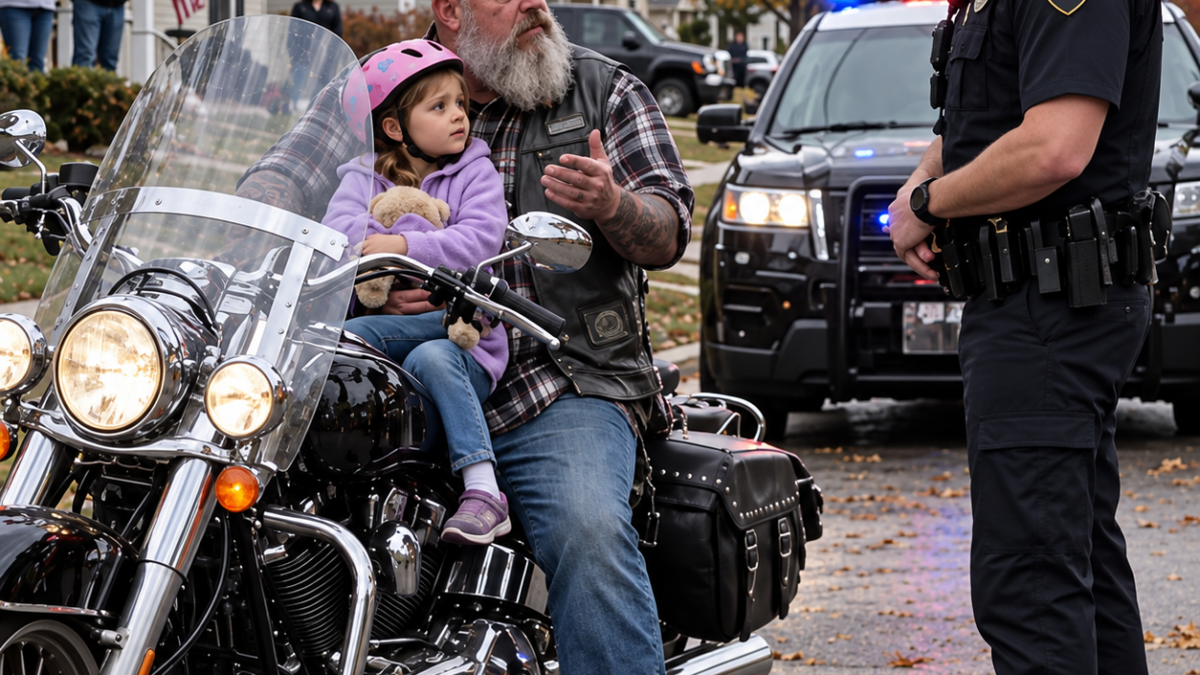
The officer stepped out.
Young man.
Early thirties.
Latino.
Clean uniform.
Calm movements.
His nameplate read MORALES.
He approached from the left.
“Sir, keep your hands visible, please.”
I placed them on the handlebars.
“Yes, officer.”
Lily whispered, “Grandpa?”
“I’m right here.”
Morales noticed her voice.
His expression changed.
“Sir, we received a report regarding possible child endangerment involving a motorcycle and a disabled minor.”
I did not need to ask who called.
Across the street, Dale Mercer stood on his porch.
Arms crossed.
Watching.
That hurt in a way I had not expected.
He had eaten cake at Lily’s birthday.
He had watched her learn the route from our porch to the mailbox after losing her sight.
He had heard her laugh every Sunday.
And he had called the police.
“She’s my granddaughter,” I said.
“Her name is Lily. She’s nine. We ride one controlled loop around the neighborhood.”
“License and registration?”
“Yes.”
I spoke loudly enough for Lily.
“I’m reaching into my jacket for my wallet.”
Morales nodded.
“Go ahead.”
I handed him everything.
He studied the motorcycle.
“Protective equipment?”
“Helmet, jacket, gloves, jeans, shoes.”
“Passenger supports?”
I showed him.
“Mother aware?”
“Yes.”
“Where is she?”
A woman’s voice came from behind us.
“Right here.”
Emily was speed-walking down the sidewalk with the expression of somebody heading toward either an emergency or a homicide.
Morales raised a hand.
“Ma’am, please stay there for a moment.”
Emily stopped.
Barely.
“I’m her mother.”
“I understand.”
“She has permission.”
“I understand.”
“Then why—”
“Emily,” I said.
She pressed her lips together.
Lily’s fingers were trembling.
Morales saw them.
Then something happened that none of us expected.
He moved around the motorcycle.
Crouched.
Not beside me.
Beside Lily.
Low enough that his voice came from her level instead of above her.
“Hi.”
Lily turned toward him.
“Hi.”
“My name is Officer Daniel Morales.”
“I’m Lily.”
“I know.”
She swallowed.
“Am I in trouble?”
“No.”
“You sure?”
“I’m sure.”
“Is Grandpa?”
Morales glanced at me.
“I’m still figuring that out.”
Lily’s head lifted.
“He goes eight.”
“Eight?”
“Miles an hour.”
“Sometimes eight and a half,” I admitted.
She turned toward me.
“Traitor.”
Morales almost smiled.
Then his expression became serious again.
“Lily, may I ask you something?”
“Yes.”
“Do you feel safe riding with your grandfather?”
“Yes.”
“Do you ever ride when you don’t want to?”
“No.”
“Does he stop if you ask?”
“Yes.”
“Are you frightened right now?”
Lily paused.
Her hands still shook.
“Yes.”
Emily sucked in a breath.
Morales asked, “What are you frightened of?”
“The police.”
He blinked.
“The motorcycle doesn’t scare you?”
“No.”
“The siren did?”
“Yes.”
He looked genuinely sorry.
“I apologize.”
“You didn’t know.”
“No.”
“You knew I was blind.”
“I was told.”
Lily adjusted her helmet.
“I’m blind, not made of glass.”
Behind us, somebody made a choking sound.
Probably Emily trying not to laugh.
Morales smiled.
“Fair point.”
Then came the question.
The one that changed everything.
“Why do you like riding?”
Nobody spoke.
Morales could have asked me.
He could have asked Emily.
Dale had already answered on Lily’s behalf without asking anybody.
But Officer Morales asked her.
Lily placed one gloved hand on the fuel tank.
“Because when Grandpa’s bike moves, I can feel where I’m going.”
Morales did not respond.
My throat closed.
Lily continued.
“I can hear houses.”
She pointed.
Not accurately.
It didn’t matter.
“I smell grass and flowers and barbecue.”
A pause.
“And bad dog breath.”
Somebody laughed from a nearby yard.
“The wind changes when we turn.”
She touched my jacket.
“I feel Grandpa lean.”
Then she said, “When I’m walking, I have to think about everything. Cane. Steps. Curbs. People. Doors. On the bike, Grandpa thinks about that stuff. I get to feel the world.”
Officer Morales looked down.
Then up.
Dale was still on his porch.
Morales stood.
He inspected everything again.
My license.
Registration.
Equipment.
Bike.
Emily explained the precautions.
Then Morales removed his notebook.
My stomach tightened.
Lily whispered, “Ticket?”
“I don’t know.”
Morales wrote something.
Tore out the page.
Folded it.
Handed it to me.
Not a ticket.
A phone number.
Underneath he had written:
If this becomes a recurring harassment issue, contact me through the department.
Then another line.
If your family is comfortable, I’d be honored to escort one Sunday ride someday.
No siren.
I looked up.
Morales said loudly enough for Dale to hear, “Mr. Mallory, based on what I have observed today, I see no indication that this child is being transported against her will or subjected to reckless operation.”
Dale stepped off the porch.
“Officer.”
Morales turned.
“With respect, you weren’t here before.”
“Were you the caller?”
“I was the concerned neighbor.”
Morales nodded.
“Did you witness excessive speed?”
“The speed isn’t the point.”
“Unsafe maneuvering?”
“She’s blind.”
“That was not my question.”
Dale stiffened.
“A blind child has no business on a motorcycle.”
Lily’s head turned toward his voice.
Emily said, “Dale, stop.”
He continued.
“If something happens, everyone will ask why nobody intervened.”
Morales looked at him.
“Are you aware that disability alone is not evidence of abuse or neglect?”
“I didn’t say it was.”
“You reported child endangerment.”
“I reported a vulnerable child being put at risk.”
Morales glanced at Lily.
“Have you asked her how she feels?”
Dale looked annoyed.
“She is nine.”
“So?”
“She can’t evaluate risk like an adult.”
Neither can most adults, I thought.
Morales’s voice remained polite.
“Concern is not illegal, Mr. Mercer.”
Dale nodded as though he had won.
Then Morales added, “But making repeated emergency reports because you disagree with a lawful activity may become a different issue.”
Dale’s face changed.
“I acted in good faith.”
“Then I recommend you speak directly with the family next time unless you witness an emergency.”
Dale looked at me.
“This family refuses to listen.”
Emily took one step forward.
“Because you don’t get a vote in raising my daughter.”
Lily raised her hand.
Everyone looked.
“What?” I asked.
“Can we finish our ride?”
Morales smiled.
“I think you can.”
He handed my license back.
Before leaving, he crouched again.
“Lily?”
“Yes?”
“I’m sorry about the siren.”
“That’s okay.”
“I’ll try not to use it next time.”
She considered.
“Do police cars purr?”
“No.”
“What do they do?”
Morales thought.
“Mostly complain.”
Lily smiled.
“I like lions better.”
“So do I.”
He drove away.
Dale remained outside.
I started the Harley.
Lily wrapped her arms around me.
We completed the final half of the loop.
She did not call out smells.
She did not laugh.
When we reached home, I parked but she stayed seated.
“Grandpa?”
“Yeah?”
“Did Mr. Dale call because I’m blind?”
There are moments when adults are tempted to protect children with lies.
That question was one.
I could have said he was only worried.
Could have softened it.
Could have given Dale the generosity he had denied Lily.
I chose truth.
“I think your blindness is part of why he called.”
She was quiet.
“Does he think blind kids shouldn’t do fun things?”
“I think he believes being afraid for somebody gives him the right to decide things for them.”
“That’s dumb.”
“Sometimes fear is dumb.”
“I was safe.”
“Yes.”
“I got scared.”
“I know.”
“From the police.”
“I know.”
She touched the tank.
“Can we ride next Sunday?”
“If you want.”
“I want.”
“Then we ride.”
That should have ended it.
It didn’t.
Monday morning, Briar Lane’s neighborhood Facebook group exploded.
Dale did not use my name.
Of course not.
Cowardice loves plausible deniability.
His post began:
CONCERNED ABOUT CHILD SAFETY IN OUR NEIGHBORHOOD.
He described “an elderly motorcyclist.”
A “severely disabled minor.”
“Repeated recreational risk.”
“A troubling pattern of adults prioritizing entertainment over vulnerable-child safety.”
Then he added that police had been required to intervene.
That was technically true.
The police had been required to intervene because he called them.
Within an hour, comments appeared.
Mrs. Bell:
I watched the whole thing. Frank drives that motorcycle slower than I walk after Thanksgiving dinner.
Mr. Alvarez:
The child wears more safety equipment than I do mowing my lawn.
His wife replied:
Which we need to discuss.
Others were less kind.
Motorcycles are dangerous.
Why would a parent allow that?
Blind children need extra protection.
Someone should call CPS.
That last comment sat on the screen like poison.
Emily read it at lunch.
By dinner she had printed everything.
Tuesday afternoon, her phone rang.
She answered.
Listened.
Then sat down.
I knew before she spoke.
“Child services.”
My stomach dropped.
The caseworker introduced herself as Rebecca Grant.
No relation to anyone we knew.
Her voice was calm.
Professional.
Tired.
“We received a referral involving transportation of a visually impaired minor on a motorcycle.”
Emily’s face drained of color.
I took the phone.
“This is Frank Mallory.”
“Mr. Mallory, I understand this may feel invasive.”
“Invasive is a good word.”
“We’re required to evaluate reports involving possible child endangerment.”
“I understand.”
And I did.
That was part of what made me so angry.
Someone had taken a system meant to protect children in real danger and pointed it at a family because he disliked a motorcycle.
Ms. Grant scheduled a home visit.
Thursday.
Those two days were miserable.
Emily began second-guessing everything.
Maybe we had been selfish.
Maybe the backrest wasn’t enough.
Maybe some caseworker would decide the rides were irresponsible.
Maybe Lily would be asked frightening questions.
Maybe our family would become a file.
“Mommy?”
Lily stood in the kitchen Wednesday evening.
Emily quickly closed her laptop.
“Yes?”
“Are you scared?”
Emily hesitated.
“Yes.”
“Because of me?”
“No.”
Lily walked closer.
“Because of the bike?”
“No.”
“Because somebody thinks you’re a bad mom?”
Emily’s face broke.
Lily reached for her.
“I don’t.”
Emily hugged her so hard Lily squeaked.
“Mom, ribs.”
“Sorry.”
Thursday, Rebecca Grant arrived at 3:10.
Forties.
Practical shoes.
No nonsense.
She had probably walked into homes containing things far worse than ours.
She inspected the motorcycle.
The helmet.
The protective clothing.
The passenger support.
She reviewed what professionals we had consulted.
Asked about the route.
Speed.
Frequency.
Weather limitations.
Then she interviewed Lily.
Privately, with Emily visible through the open doorway.
Twenty minutes later, Rebecca emerged biting the inside of her cheek.
Emily looked terrified.
“What?”
Rebecca sat.
“Your daughter is very articulate.”
From the bedroom Lily yelled, “I can hear you.”
Rebecca smiled.
“I am documenting the report as unfounded.”
Emily’s shoulders collapsed.
I gripped the table.
Rebecca continued.
“I do want to say something.”
My relief disappeared.
She looked at us.
“Families with disabled children often struggle to separate reasonable protection from overprotection.”
Emily nodded carefully.
Rebecca said, “I see evidence here that you have made considered efforts to include Lily in an activity she values while reducing risk.”
My eyes burned.
She closed the folder.
“I don’t see exploitation.”
Emily started crying.
Rebecca looked toward Lily’s room.
“And for what it’s worth, she informed me that stairs are also dangerous and nobody has reported your staircase.”
I laughed.
“She used that argument on you?”
“Several times.”
Then Rebecca’s face became serious.
“If the reports continue without new allegations, document everything.”
“Why?”
“Because repeated institutional reporting can become a form of harassment.”
I thought of Dale.
That evening, I crossed the lawn.
I should probably have stayed home.
Wisdom occasionally arrives at sixty-eight.
Unfortunately it often gets there five minutes after I need it.
Dale opened the door.
“I assume you’re here to threaten me.”
“No.”
He looked almost disappointed.
“I’m asking you to stop.”
“I have done nothing wrong.”
“You called the police.”
“I was concerned.”
“You posted online.”
“Free speech.”
“You called CPS.”
His eyes shifted.
“I did not.”
Too fast.
I noticed.
“You didn’t?”
“No.”
“Then who did?”
“How should I know?”
Linda appeared in the hallway.
Dale turned.
“Go upstairs.”
She stopped.
Not because the request was unusual.
Because his tone was.
I saw her flinch.
Tiny.
Immediate.
Dale stepped slightly between us.
I looked at Linda.
“You okay?”
His face hardened.
“She’s fine.”
I had not asked him.
Linda stared at me.
Then lowered her eyes.
Dale said, “This conversation is finished.”
The door closed.
I stood there feeling my anger rearrange itself.
Until that moment, Dale had been an irritating man trying to control us.
Suddenly I wondered how much controlling happened inside his own house.
At 11:17 that night, something struck my mailbox.
I looked through the window.
Nobody.
I went outside.
An envelope was inside.
No stamp.
My name handwritten.
Inside were printed emails.
Dale had been writing members of our voluntary neighborhood association for weeks.
He called my property a “persistent nuisance.”
He described my motorcycle friends as “gang-adjacent.”
One of those dangerous gang-adjacent men was seventy-three-year-old Walter Greene, a retired Army chaplain who crocheted scarves for premature babies.
Another was Big Mike, a Vietnam veteran who cried during dog-food commercials.
Dale called Lily “a severely compromised minor being used to justify antisocial conduct.”
I reread that sentence three times.
Used.
Like she was a prop.
Like her joy belonged to me.
Then came the proposal.
A neighborhood resolution prohibiting “motorized recreational activity involving cognitively or physically vulnerable minors.”
Cognitively.
Lily was blind.
Not cognitively impaired.
Dale either did not know the difference or did not care.
Beneath the emails was a handwritten note.
Frank,
I am sorry.
Dale called CPS.
I heard him.
He has been contacting people because he wants your motorcycle gone. He says it hurts property values and gives the neighborhood the wrong image.
I should have spoken before now.
Lily deserves her Sunday rides.
Please don’t tell him I gave you this until I can arrange somewhere to stay.
Linda.
I sat at our kitchen table for a long time.
That final sentence mattered more than everything above it.
Emily came downstairs.
Saw the papers.
Read them.
When she reached the phrase “severely compromised minor,” she stopped.
“He wrote this about her?”
“Yes.”
“He ate dinner here.”
“I know.”
“He brought her a Christmas present.”
“I know.”
“He called her exploited.”
“I know.”
She walked to the sink.
Gripped the counter.
Her breathing changed.
I recognized it.
The hospital breathing.
The breathing of a mother trying not to come apart because somebody might need her.
“She fought through cancer.”
Emily’s voice cracked.
“She woke up blind.”
I stood.
“She learned Braille. She learned a cane. She went back to school while children asked what was wrong with her eyes.”
I wrapped my arms around my daughter.
“She worked so hard to have a normal childhood.”
“I know.”
“And he turned her into a neighborhood problem.”
“I know.”
“What do we do?”
On the refrigerator, Officer Morales’s folded note sat beneath a magnet shaped like a taco.
I looked at it.
“We stop letting him tell the story.”
Sunday at two, Morales arrived.
Not in uniform.
Not in a cruiser.
On a bicycle.
Lily loved this immediately.
“Police have bicycles?”
“Yes.”
“Why?”
“Sometimes we need bicycles.”
“Can you arrest someone from one?”
Morales considered.
“I suppose.”
“Cool.”
He had cleared the visit with his supervisor.
Off duty.
No official escort.
Just a neighborhood safety observer.
Mrs. Bell came outside.
Then the Alvarezes.
Then Mrs. Patel from two streets over arrived carrying sunflower seeds and a folding chair because apparently injustice was entertainment if you brought snacks.
Emily set up her phone.
“Are we posting this?” I asked.
“Only if we need to.”
Lily came out wearing her pink helmet.
Dale stepped onto his porch.
Phone already recording.
Morales saw him.
“Good afternoon, Mr. Mercer.”
“Officer.”
“I’m off duty.”
“I see.”
“Just enjoying the neighborhood.”
Dale’s mouth tightened.
I helped Lily mount.
She patted the tank.
“Lion ready.”
“Lion ready.”
We began.
Slow.
Eight miles an hour.
Morales pedaled behind us.
The neighbors waved.
Lily called things out.
“Lemonade!”
“Mrs. Bell.”
“Sunscreen!”
“Probably Mrs. Patel.”
“Police bicycle chain!”
Morales laughed.
As we approached Dale’s house, Lily went silent.
I felt her grip tighten.
“You okay?”
“Yes.”
We passed.
Then Lily said loudly, “Mr. Dale’s porch smells like angry coffee.”
Mrs. Bell laughed so hard she bent at the waist.
Even Morales lost it.
Dale disappeared inside.
Emily posted thirty-eight seconds of the ride that evening.
No accusations.
No names.
Just Lily.
The equipment.
The route.
The neighbors.
Morales pedaling at bicycle speed.
Her caption said:
My daughter is blind, not breakable. Inclusion is not neglect. Joy is not endangerment. We will protect her while she lives, not protect her from living.
The video spread.
First locally.
Then farther.
Messages came from parents of disabled children.
Blind adults.
Adaptive-sports instructors.
Veterans.
Motorcyclists.
A local television reporter called.
Emily refused.
Called again.
Emily refused.
Then Lily heard.
“Why can’t I talk?”
Emily froze.
“It’s not that you can’t.”
“They’re talking about me.”
“Yes.”
“So I should talk.”
I hid my smile.
Emily saw.
“Don’t.”
“I said nothing.”
“Your face said plenty.”
The interview happened on our porch.
Lily refused the studio.
“Too many rooms I don’t know.”
The reporter asked what she liked about riding.
Lily explained wind.
Smell.
Engine vibration.
How she could feel a turn through my body before she knew the street had changed.
Then the reporter asked about the police call.
“Were you afraid?”
“Yes.”
“Of the motorcycle?”
“No.”
“Then what frightened you?”
Lily went quiet.
“When grown-ups talk about me instead of to me.”
The reporter lowered her notepad.
Lily continued.
“People do that a lot.”
Emily’s hand covered her mouth.
“If somebody worries about me, they can ask me.”
Lily paused.
“I know answers.”
That aired at six.
By seven, Dale’s Facebook post disappeared.
By seven-fifteen, screenshots replaced it.
By eight, his emails to association members had begun circulating.
By nine, Briar Lane’s quiet little neighborhood had become a war zone fought with reply-all.
The neighborhood association called an emergency meeting for Thursday.
I did not want Lily there.
She disagreed.
“People talked about me.”
“Yes.”
“I get to listen.”
“It might be ugly.”
“I’m blind, Grandpa. Not deaf.”
Emily closed her eyes.
“She’s going.”
“Traitor.”
“I gave birth to the traitor.”
Thursday night, the community center parking lot was full.
Half the neighborhood attended.
The other half had probably stayed home and waited for texts.
Dale wore a blazer.
That told me everything.
A man does not wear a blazer to a neighborhood association meeting unless he intends to say the words decorum or liability.
His wife was there too.
Linda sat three rows behind him.
Alone.
That mattered.
Marcy Chen chaired the association.
She was sixty, exhausted, and possessed the permanent expression of a woman who had spent too many years mediating disputes over trash cans.
“We are here,” she began, “to discuss recent conflicts involving neighborhood communication, emergency-service reports, proposed vehicle restrictions, and allegations of harassment.”
Dale stood.
“I object to harassment.”
Marcy looked at him over her glasses.
“I haven’t opened public comment.”
“I want the record to reflect—”
“The record currently reflects that you interrupted me.”
Someone snorted.
Dale sat.
Public comments began.
Mrs. Bell defended us.
Mr. Alvarez said the motorcycle was not a noise problem.
Another resident said he disliked motorcycles but disliked weaponizing police calls more.
Then Dale walked to the front.
Notes in hand.
“My actions have been deliberately misrepresented.”
Lily leaned toward me.
“Here we go.”
I nearly laughed.
Dale continued.
“This was never personal.”
Linda looked down.
“My sole concern was and remains the welfare of a vulnerable child.”
I felt Lily stiffen.
He continued.
“We seem to have forgotten that adults sometimes must make decisions children dislike.”
Reasonable enough.
Then he ruined it.
“The fact that this child enjoys an activity does not mean she has the capacity to fully understand its danger.”
I stood.
Emily grabbed my arm.
“Dad.”
“He just—”
“Wait.”
Dale continued.
“Her disability necessarily limits her awareness of environmental hazards.”
Lily stood.
No drama.
No announcement.
Just stood.
Her cane unfolded with three sharp clicks.
The room changed.
“Mom?”
Emily rose.
“You want to speak?”
“Yes.”
They walked forward together.
Lily’s pink sneakers blinked with every step.
At the microphone, Emily adjusted it downward.
Lily faced slightly left of the audience.
Nobody corrected her.
“My name is Lily Mallory.”
Her voice trembled.
She swallowed.
“I’m nine.”
Pause.
“And I’m blind.”
Another pause.
“I know that because I am blind every day.”
A few people laughed gently.
Lily did not.
“I know motorcycles can be dangerous.”
Dale shifted.
“I know cars can be dangerous.”
She held her cane.
“I know stairs are dangerous because I fell down three last year and Grandpa said a word I’m not allowed to repeat.”
The room laughed.
I sank lower.
“Sorry,” I whispered.
Lily smiled briefly.
Then became serious.
“Mr. Dale says I can’t understand danger because I can’t see.”
Dale opened his mouth.
Marcy raised one hand.
He stopped.
Lily continued.
“But he never asked me what I understand.”
Silence.
“My grandpa tells me what we’re doing.”
She touched her cane handle with her thumb.
“My mom checks my helmet.”
Emily started crying.
“If I say stop, Grandpa stops.”
Lily lifted her chin.
“I choose to ride.”
She breathed.
“When I lost my sight, lots of things changed.”
Her voice became smaller.
“I couldn’t ride my regular bike anymore.”
I looked at the floor.
“I stopped running around by myself.”
A pause.
“I got scared of places I already knew because they felt different.”
Nobody moved.
“People started saying careful all the time.”
Careful, Lily.
Watch out, Lily.
Slow down, Lily.
Wait, Lily.
Don’t touch that.
Don’t go there.
Let me help.
She did not say those words.
But every parent in the room heard them.
“Sometimes people help me.”
She continued.
“I need help sometimes.”
Then her voice strengthened.
“But sometimes people make my world smaller and call it helping.”
Linda closed her eyes.
Lily turned slightly toward Dale’s chair.
“Mr. Dale said he wanted to protect me.”
She gripped her cane.
“But he made the police stop me.”
Her voice trembled.
“He made somebody come to our house and ask my mom if she takes care of me.”
Emily wiped tears from her cheeks.
“He told people my grandpa uses me.”
Lily’s lower lip shook.
“And he never asked me one question.”
Nobody breathed.
“I already lost seeing.”
She said it slowly.
“I don’t want to lose wind too.”
Mrs. Bell stood.
Started clapping.
Marcy said, “Please—”
But then Mr. Alvarez stood.
Then Mrs. Patel.
Then families I barely knew.
Not everyone.
But enough.
Dale sat rigid.
Face white.
Lily returned to her chair.
I hugged her.
“You okay?”
“Yes.”
“You sure?”
“No.”
“Fair.”
She leaned into me.
The proposed restriction died fifteen minutes later.
Nobody seconded the motion.
That could have been the end.
Then Linda Mercer stood.
Dale turned.
His expression was not confused.
It was afraid.
“Linda.”
She walked toward the microphone.
“Sit down.”
Officer Morales was standing against the back wall in plain clothes.
He straightened.
So did I.
Linda stopped at the microphone.
Her hands shook.
“My husband did not report Frank because he was worried about Lily.”
The room froze.
Dale stood.
“That is a lie.”
Linda looked at him.
“No.”
“Linda.”
“You hated that motorcycle before Lily ever rode it.”
“Sit down.”
She flinched.
The whole room saw it.
Dale realized too late.
Linda continued.
“You said Frank’s friends made the neighborhood look trashy.”
Dale took one step forward.
Morales moved away from the wall.
“You said motorcycles lowered property values.”
“Enough.”
“You said a blind child gave you a reason people would finally listen.”
Gasps moved through the room.
Emily grabbed my hand.
Linda reached inside her bag.
Pulled out papers.
“I printed the emails.”
Dale’s face collapsed.
“Those are private.”
Marcy said sharply, “Do not approach her.”
Linda’s voice shook harder.
“I heard him call child services.”
Dale pointed.
“She’s lying because our marriage is having problems.”
Linda laughed.
One broken sound.
“Our marriage is having problems because I spent years pretending this was concern.”
He stared.
She continued.
“Concern about neighbors.”
“Concern about appearances.”
“Concern about what people might think.”
Her voice rose.
“It was always control.”
Dale stepped forward again.
Morales intercepted him.
“Sir.”
“This is my wife.”
“I know.”
“Move.”
“No.”
Dale looked around.
For the first time he seemed to understand what everyone else saw.
His wife was frightened of him.
Not dramatically.
Not visibly injured.
Not begging for help.
Just afraid of his reaction to disagreement.
Linda straightened.
“I gave Frank the emails.”
“You what?”
Dale’s face twisted.
Linda stepped backward.
Morales immediately moved between them.
That movement destroyed whatever defense Dale still had.
Linda began crying.
“I’m leaving tonight.”
Silence.
Dale stared at her.
“You’ll come crawling back.”
Linda wiped her cheeks.
Then something remarkable happened.
She smiled.
Small.
Tired.
Free.
“No.”
Dale looked around as if somebody should defend him.
Nobody did.
He left.
The door slammed hard enough to rattle the glass.
Nobody followed.
Linda remained at the microphone.
“I’m sorry.”
I stood.
She looked at me.
“I’m sorry I watched it happen.”
I shook my head.
“You spoke.”
“Too late.”
Lily’s voice came from beside me.
“Not too late.”
Linda covered her face.
That was the moment I cried.
Not when the police came.
Not when CPS cleared us.
Not when Lily spoke.
When my blind granddaughter told a frightened grown woman it was not too late to tell the truth.
The investigation into Dale’s complaints did not become some dramatic criminal prosecution.
Life is usually less theatrical than that.
But consequences came.
The police department documented the repeated complaint pattern.
Child services closed the case as unfounded and noted that subsequent duplicate allegations without new facts should receive supervisory review.
The neighborhood association formally rejected Dale’s proposed rule.
They also removed him from the safety committee after discovering he had presented his personal complaints as if they reflected board consensus.
Linda moved in with her sister.
A month later she filed for divorce.
I did not ask for details.
Some stories belong to the people who survived them.
Dale stayed in the house for another five months.
He stopped waving.
Stopped attending meetings.
Stopped posting online under his name.
People did not harass him.
I made that clear.
When one of my biker friends suggested lining fifty motorcycles along his curb at sunrise, I said absolutely not.
Big Mike looked disappointed.
“It would be peaceful.”
“Fifty Harleys?”
“Emotionally peaceful.”
“No.”
Justice is not becoming the person who hurt you.
We left Dale alone.
That seemed to bother him more.
Officer Morales kept his promise.
The Sunday after the meeting, he arrived in his patrol car.
On duty this time.
His supervisor had approved a brief community check.
No lights.
No siren.
Windows down.
Lily heard the engine.
“Complaining car!”
Morales called through the window.
“Good afternoon to you too.”
I helped Lily onto the Harley.
Morales followed one car length behind.
Eight miles an hour.
The whole street seemed to come outside.
Not because anyone had organized it.
They simply did.
Mrs. Bell waved.
Mr. Alvarez stood at his grill holding barbecue tongs like a salute.
Mrs. Patel threw sunflower seeds into her mouth.
The Henderson dog barked.
Lily yelled, “BRUSH YOUR TEETH!”
The street exploded with laughter.
We came home.
I killed the engine.
Lily removed her helmet.
Her hair stuck in every direction.
“You happy?”
“Yes.”
“Scared?”
“A little.”
I looked at her.
“From what?”
She smiled.
“The good kind.”
That answer stayed with me.
Weeks passed.
Our story traveled farther than Briar Lane.
Messages arrived.
Parents of blind children.
Parents of autistic children.
Parents whose children used wheelchairs.
Blind adults.
Veterans.
Motorcyclists.
Therapists.
Some praised us.
Some called us irresponsible.
That was fine.
Anybody expecting unanimous agreement from the internet has never met the internet.
One message came from Arizona.
A woman named Angela wrote:
I lost my sight when I was eleven.
My father owned a motorcycle.
Everyone convinced him riding with me would be too dangerous afterward.
He sold it.
I’m fifty-two now.
I still remember our last ride before I went blind.
Thank you for understanding that protecting disabled children should not mean removing every experience worth remembering.
Emily read it aloud.
Lily became quiet.
Then she said, “We should let other kids ride.”
I looked at Emily.
Emily looked at me.
“No.”
Lily sighed.
“Can we talk about it?”
I laughed so hard my ribs hurt.
Six months later we held the first Feel the Wind Day.
Not a public-road motorcycle event.
A controlled adaptive recreation day.
Closed parking lot.
Professional motorcycle-safety instructors.
Medical volunteers.
Parents.
Protective equipment.
Adaptive seating.
Low speeds.
Individual assessments.
The kind of preparation that required more paperwork than buying a house.
Nine children came.
One boy named Mateo had cerebral palsy and loved motorcycles.
When Big Mike started his Harley, Mateo began crying.
His mother panicked.
“Too loud?”
Mateo shook his head.
He was smiling.
“Again.”
Big Mike revved gently.
Mateo laughed.
I saw his mother cover her mouth.
I knew that face.
I had seen it on Emily years earlier.
The moment a parent realizes joy has found their child again.
Lily appointed herself official safety consultant.
Nobody appointed her.
She simply announced it.
Her responsibilities included checking helmet straps, interviewing riders, and telling adults when their instructions were boring.
Morales came with police stickers.
“Why do cops always have stickers?” I asked.
“Department secret.”
“Where do you keep them?”
“If I tell you, I lose the badge.”
Mateo asked Lily before his ride, “Is it scary?”
“Yes.”
His smile vanished.
She added, “But the good scary.”
“What’s that?”
Lily thought.
“Danger makes you want to get away.”
Then she smiled.
“Good scary makes you want to do it again.”
The boy considered.
“Okay.”
That afternoon, nine children felt engines beneath them.
Wind against helmets.
Movement.
Parents watched.
Nobody pretended motorcycles were perfectly safe.
Nothing is.
We managed risk.
We did not worship fear.
A year after the police call, Briar Lane threw Lily a birthday party.
Ten years old.
Mrs. Bell baked cupcakes.
Mr. Alvarez grilled ribs.
At noon this time.
“Personal growth,” he said.
Linda came.
She looked different.
Not dramatically.
Her hair was shorter.
Her shoulders seemed lower.
She laughed more easily.
She gave Lily a wind chime made from small metal motorcycle shapes.
“It’ll tell you when the wind comes.”
Lily hugged her.
Morales stopped after his shift.
Rebecca Grant from child services mailed a card.
My riding friends arrived together.
Engines low.
Slow.
Respectful.
Lily stood in the driveway wearing a plastic birthday crown above her dark glasses.
When the last Harley went silent, she grinned.
“That sounded like lions trying to be polite.”
Big Mike wiped his eyes.
“Nobody saw that.”
“I saw it,” I said.
“You saw nothing.”
That evening, after the guests left, Lily and I sat on the porch.
My Harley stood in the driveway.
The sky was turning orange.
Lily could not see it.
I had learned not to stop describing things because she could not see them.
“The clouds look pink.”
“Like my helmet?”
“Darker.”
“Watermelon?”
“Yeah. Watermelon.”
She leaned against my arm.
“Grandpa?”
“Yeah?”
“Was Mr. Dale a bad person?”
I thought carefully.
Children ask simple questions about complicated things.
Adults owe them better than simple lies.
“I think Dale let fear and pride become cruelty.”
“Is that bad?”
“Yes.”
“So he was bad.”
“He did bad things.”
She frowned.
“That’s not the same?”
“Not exactly.”
“Why?”
“Because if people are only good or bad, nobody has to think very hard about their own choices.”
She was quiet.
“Can fear make anybody mean?”
“Yes.”
“You?”
“Yes.”
“Mom?”
“Yes.”
“Officer Morales?”
“Probably.”
“Me?”
“Yes.”
She did not like that answer.
“How do I stop?”
I looked toward the Harley.
“When somebody tells you that you’re making their world smaller, listen.”
“What if I think I’m helping?”
“Listen harder.”
“And if I still don’t listen?”
I smiled.
“Hopefully somebody brave gets up in a room full of people and tells you the truth.”
She grinned.
“Like me?”
“Exactly like you.”
She reached for my hand.
“Can we ride tomorrow?”
“Tomorrow is Monday.”
“So?”
“You have school.”
“After.”
“The lion may need rest.”
“The lion is never tired.”
“The lion is older than some countries.”
“The lion needs premium gas.”
“That joke was funnier when you were nine.”
“I’m ten now. I improved it.”
She went inside.
I stayed on the porch.
Thought about everything one siren had started.
The police lights.
Lily’s shaking hands.
Dale standing across the street believing he had done something righteous.
Officer Morales crouching beside a child instead of discussing her over her head.
That was the difference.
Dale had called about Lily.
Morales had spoken to Lily.
Dale had decided what blindness meant.
Morales had asked.
Dale saw vulnerability and assumed incapacity.
Morales saw vulnerability and looked for a voice.
Never underestimate the difference between speaking for someone and making room for them to speak.
Years from now, Lily may hate motorcycles.
Children change.
She may become a lawyer.
Engineer.
Teacher.
Musician.
Scientist.
Comedian.
Given her personality, possibly benevolent dictator.
She may decide Grandpa’s old Harley was loud, uncomfortable, and smelled like gasoline.
She may remember our rides only as something we did when she was little.
Or maybe technology will change.
Maybe someday she will ride an adaptive motorcycle of her own.
Maybe she will terrify her mother.
I hope I am alive to watch.
But whatever happens, she will remember something more important than the motorcycle.
She will remember that when somebody tried to shrink her world, her family did not confuse fear with love.
She will remember an officer who knelt instead of towered.
A mother who questioned herself and still chose to trust her daughter.
A neighbor who eventually found courage to stand against her own husband.
A street that learned disability did not make a child public property.
And a grandfather who sometimes got things wrong but never again forgot to ask what she wanted.
I’m sixty-nine now.
My knees remain traitors.
The Harley leaks something my mechanic claims is “within the emotional range of normal for an old machine.”
Emily still threatens to sell it to a dentist.
Lily still calls it the lion.
Most Sundays, if the sky is clear, we prepare.
Helmet.
Jacket.
Gloves.
Check the tires.
Check the route.
Check with Mom.
Then Lily climbs on.
She pats the tank.
I start the engine.
The lion purrs.
We roll down Briar Lane.
Slow enough to be careful.
Fast enough to feel free.
Past Mrs. Bell’s roses.
Past Alvarez’s grill.
Past the Hendersons’ dog, whose breath has apparently not improved.
Past Dale’s old house, now occupied by a young couple with a toddler who runs to the window every Sunday to wave.
Lily leans into the wind.
She tells me what the world is doing.
“Laundry!”
“Rain coming!”
“Somebody burned toast!”
“Flowers!”
Then one Sunday she lifted her face and said something I will remember until I die.
“Grandpa?”
“Yeah?”
“The trees smell green today.”
I laughed.
“What does green smell like?”
“I don’t know.”
She squeezed my arm.
“But that.”
We kept moving.
And I thought about how many things she understood that I never could.
The officer’s note is still in my toolbox.
Folded twice.
Oil stain on one corner.
I have never needed to call the number.
But I keep it anyway.
Not because I expect trouble.
Because it reminds me of a day when everybody was discussing whether a blind little girl should be allowed to feel the wind.
And one man had enough sense to kneel down and ask her.
That is what changed everything.
Not the badge.
Not the police car.
Not the neighborhood meeting.
Not the Facebook post.
A question.
Do you feel safe?
Do you want this?
Why does it matter to you?
Questions are dangerous to people who prefer control.
Because once the person they are speaking for answers, the disguise sometimes falls apart.
Lily taught us that.
She was blind.
She was nine.
She was frightened.
But she was never voiceless.
And the next time somebody looked at our Harley and wondered whether she belonged there, my granddaughter did not wait for me, Emily, Morales, or anybody else to explain.
She lifted her chin into the wind.
Patted the old lion beneath her.
And said it herself.
“I’m blind.
Not breakable.”

