My Mom Makes $14 an Hour Cleaning Empty Offices—Then She Spent Almost a Week’s Pay on a Stray Cat Who Looked at Her
PART3:
“They belong to the daytime people.”
I told her once:
“Mom, you clean those kitchens.”
“I know.”
“Then use them.”
She shook her head.
“I like my car.”
There is no winning with Linda.
About five weeks ago, my phone rang at 11:30 at night.
I was already in bed.
When I saw her name, I sat up immediately.
My mother never calls during work.
Never.
If she texts, it is usually something like:
Do you know how to reset a printer?
Or:
Is this coupon fake?
A phone call at 11:30 meant something was wrong.
“Mom?”
She was breathing slightly fast.
“There’s a cat.”
I waited.
“What?”
“There’s a cat in the parking garage.”
I almost laughed from relief.
“You called me because there’s a cat?”
“His leg is broken.”
That changed everything.
“What do you mean broken?”
“He can’t walk on it.”
“Are you sure?”
“Yes.”
“How do you know?”
“Because it’s pointing wrong.”
I closed my eyes.
Of course.
“Where are you?”
“Building Two.”
“Is he friendly?”
“I don’t know.”
“Don’t grab him if he’s scared.”
“I know.”
“Mom.”
“I know.”
There was a pause.
Then:
“He’s very skinny.”
The way she said it told me the conversation was already over.
My mother has one fatal weakness.
Anything hungry.
Children.
Dogs.
Cats.
Birds.
Stray people.
If something looks like it hasn’t eaten, Linda becomes incapable of minding her own business.
“What are you doing?”
“I gave him my sandwich.”
“Of course you did.”
“He ate all of it.”
“Your whole sandwich?”
“Yes.”
“What are you going to eat?”
“I have an apple.”
I stared at the dark ceiling.
“Mom.”
“What?”
“You work until four.”
“I know.”
“You cannot live on one apple and coffee.”
“I’ve survived worse.”
That was probably true.
She sent me a photo.
I still have it.
Concrete floor.
A parked sedan.
Phone flashlight cutting through the darkness beneath it.
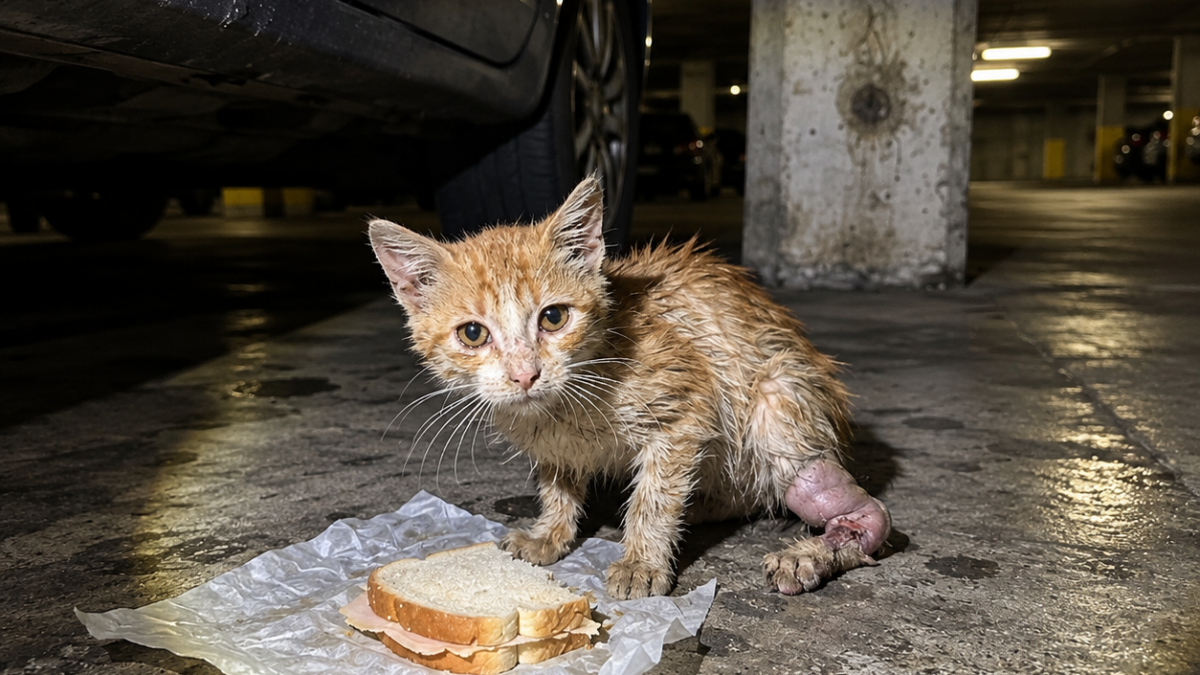
And there, crouched near the rear tire, was a small orange-and-white cat.
Maybe a year old.
Maybe younger.
Thin enough that his shoulders looked too sharp.
In front of him was half of my mother’s sandwich.
He was eating.
His left rear leg dragged behind him at an angle that made my stomach turn.
But the thing I noticed most was his face.
He was looking directly toward the camera.
Not afraid exactly.
Not relaxed either.
Just watching.
Eyes huge in the flashlight beam.
“That’s bad,” I said.
“I know.”
“He needs a vet.”
“I know.”
That was when I made the mistake of saying what made financial sense.
“Mom, you really can’t afford a vet right now.”
Silence.
I immediately regretted it.
Not because it wasn’t true.
It was completely true.
Her car had needed new brakes the month before.
Her electric bill had gone up.
She was still paying off dental work.
Fourteen dollars an hour does not create a lot of emergency room in a budget.
She sighed.
“I know.”
Then:
“But look at his leg.”
“I am.”
“He can’t even walk.”
“I know.”
Another pause.
“He looked at me.”
“What?”
“When he finished the sandwich.”
Her voice softened.
“He just looked up at me.”
I didn’t know what to say.
Apparently that was enough.
My mother went back to work.
She had bathrooms to clean.
Trash bags to replace.
Floors to mop.
At four in the morning, instead of driving home, she returned to the garage with a cardboard box and an old towel from her trunk.
The cat was still under the same car.
That part breaks my heart every time I think about it.
Four and a half hours.
Same concrete.
Same broken leg.
Waiting.
Maybe because he couldn’t leave.
Maybe because food had appeared there.
Maybe because one person had finally stopped.
My mother sat on the ground.
At sixty-one.
After seven hours of cleaning.
In a parking garage at four in the morning.
She put the towel inside the box.
Then reached beneath the car.
The cat didn’t scratch her.
Didn’t bite.
Didn’t run.
He let her pick him up.
She later told me:
“He was lighter than I expected.”
She said that very casually.
As if that wasn’t another thing to be sad about.
She drove to a twenty-four-hour veterinary clinic.
When she walked through the door, she was still wearing her cleaning uniform.
Black work pants.
Gray polo.
Old sneakers.
Her hair tied back.
One sleeve had bleach stains.
The cat was wrapped in the towel against her chest.
The veterinarian examined him.
X-rays.
Fracture of the left hind leg.
Not fresh.
Several days old.
Maybe longer.
The bone had begun healing in the wrong position.
There were two options.
Surgery.
Or amputation.
My mother asked:
“Which is better for him?”
The vet said surgery offered a good chance of saving normal use of the leg.
“How much?”
Four hundred dollars for the procedure, medications, and basic follow-up through the clinic’s rescue assistance rate.
My mother had around two hundred dollars available.
That’s it.
Not two hundred extra.
Two hundred she could access.
She used her debit card for half.
Then signed a payment plan for the rest.
At five in the morning.
She paid.
No fundraiser.
No rescue group lined up.
No guarantee anyone would reimburse her.
No idea whether the cat even belonged to somebody.
She just paid.
Then she drove home.
Slept four hours.
Got up.
Ran errands.
Did laundry.
And apparently decided none of this was worth mentioning to me.
A week later, I remembered.
I called.
“Whatever happened with the cat?”
“Oh.”
That was her response.
“Oh.”
“What do you mean ‘oh’?”
“He’s doing fine.”
“What did you do?”
“I had his leg fixed.”
I sat there.
“You did what?”
“The vet did surgery.”
“How much?”
Silence.
“Mom.”
“Four hundred.”
I genuinely thought I had misheard her.
“Four hundred dollars?”
“Yes.”
“You spent four hundred dollars on a stray cat?”
“He had a broken leg.”
“I understand that.”
“You don’t sound like you understand.”
I laughed because otherwise I might have cried.
“Mom, that’s almost a full week of your take-home pay.”
“I know.”
“You don’t have four hundred dollars.”
“I had two hundred.”
“And the other two?”
“Payments.”
I put my hand over my face.
“Why?”
She went quiet.
Not offended.
Actually confused by the question.
“What was I supposed to do?”
“I don’t know.”
“Leave him there?”
“No.”
“Then what?”
“There are rescues.”
“It was four in the morning.”
“You could’ve called later.”
“He was hurting then.”
That ended my argument.
Then she said it again.
“He looked at me.”
I smiled despite myself.
“You keep saying that like it’s a financial plan.”
“It was enough.”
That’s my mother.
She has never made decisions the way a spreadsheet would recommend.
That does not mean she’s irresponsible.
She’s painfully responsible.
She pays bills first.
Buys generic groceries.
Wears shoes until the soles separate.
Uses the same purse for ten years.
Drives a twelve-year-old car.
Cuts coupons.
Keeps plastic containers from takeout because buying storage containers is apparently morally offensive.
She will spend twenty minutes comparing detergent prices to save eighty cents.
But a hungry animal with a broken leg looks at her?
Four hundred dollars.
Immediately.
I asked:
“Where is he now?”
“With me.”
Of course.
“You kept him?”
“He needed somewhere while he healed.”
“Mom.”
“What?”
“You know what ‘while he heals’ means.”
“No.”
“It means you have a cat.”
“I do not have a cat.”
“What is he doing right now?”
She paused.
“Sleeping on my couch.”
“You have a cat.”
“He’s temporary.”
“What did you name him?”
Another pause.
“Garage.”
I laughed so hard I had to put the phone down.
“Garage?”
“I found him in a garage.”
“You couldn’t think of anything else?”
“Why make it complicated?”
There it was.
Pure Linda.
Garage.
Orange-and-white stray.
Broken leg.
Four-hundred-dollar surgery.
Named after the parking structure where she found him.
Simple.
I visited the following weekend.
Garage was wearing a little protective wrap around his hind leg.
He moved carefully.
My mother had placed a folded blanket on the couch for him.
There was a brand-new litter box in the bathroom.
Food bowls in the kitchen.
A scratching pad.
Cat toys.
“Temporary?”
She glared.
“Don’t start.”
Garage saw her walk into the room and immediately tried to follow.
Bad leg and all.
“Stop.”
She scooped him up.
He relaxed instantly.
That was when I understood something.
He had picked her too.
My mother sat down.
Garage curled against her stomach.
She started scratching under his chin.
He closed his eyes.
Purr.
Loud.
“You like him.”
“He’s okay.”
“Mom.”
“What?”
“You spent four hundred dollars on him.”
“That doesn’t mean I have to like him.”
Garage pushed his face into her arm.
She smiled.
There.
Tiny smile.
Caught.
“You’re keeping him.”
“We’ll see.”
Two weeks later, she bought him a collar.
Three weeks later, she installed a window perch.
Four weeks later, she sent me a picture labeled:
Your brother is being annoying.
Garage was sitting in her laundry basket.
Temporary.
Sure.
His leg healed beautifully.
The surgeon had aligned the fracture.
The first couple of weeks were rough.
Restricted movement.
Medication.
Follow-up visits.
Garage hated being confined.
He would yell from his recovery crate whenever my mother left the room.
She started sleeping on the couch because her bedroom was too far away and she worried she wouldn’t hear him.
This is the same woman who complained for six months that her back hurt because her mattress was too old.
Now she was sleeping on a sofa voluntarily because a cat might feel lonely.
I said:
“You understand how crazy this sounds?”
She answered:
“He can’t explain what he needs.”
As though that settled everything.
Maybe it did.
Eventually the bandage came off.
Then the restrictions eased.
Garage put weight on the leg.
First carefully.
Then confidently.
He kept a slight limp.
Probably always will.
But he runs.
He jumps.
He chases things that don’t exist.
He attacks shoelaces.
He sits in windows.
He waits outside the bathroom as if my mother has a history of disappearing through plumbing.
And every night around four in the morning, he waits behind the apartment door.
My mother says he knows her schedule.
I didn’t believe that until I stayed overnight once.
At 3:45, Garage woke.
He had been asleep near my feet.
Suddenly he stood.
Walked to the front door.
Sat.
At 4:03, keys rattled.
His entire body changed.
Tail up.
Ears forward.
The door opened.
My mother came in looking exhausted.
Hair flattened.
Shoulders sagging.
Cleaning bag in one hand.
Garage ran toward her with that little limp.
She put everything down.
“Hey, baby.”
Baby.
Not temporary.
Not Garage.
Baby.
She picked him up.
He pushed his face against her chin.
And my mother—the woman who had just spent seven hours cleaning offices nobody would ever thank her for cleaning—stood in the dark entryway and smiled like somebody had been waiting for her all night.
Because somebody had.
That’s when I understood why those four hundred dollars meant something different to her than they did to me.
I saw wages.
She saw a living creature.
I calculated forty-something hours of work.
She calculated one broken leg.
I saw the bathrooms she would have to scrub to repay the bill.
She saw the animal who would remain in pain if she walked away.
Neither calculation was imaginary.
But only one was standing in front of her.
Garage.
The sandwich ritual started accidentally.
The first night she found him, she gave him her entire sandwich.
Now she makes a slightly larger sandwich before work.
Cuts it.
Most goes into her lunch container.
A small portion goes into another container for Garage.
I found out when I opened her fridge.
“Why is there turkey in this tiny container?”
“That’s Garage’s.”
“You pack his lunch?”
“No.”
“What is this?”
“His sandwich.”
I stared.
“You literally pack your cat a sandwich.”
“He doesn’t get bread.”
“That’s somehow not the weird part.”
Before she leaves around eight fifteen, Garage sits beside the kitchen counter.
She gives him his piece of turkey.
Then eats part of her own sandwich later during work.
She says it’s tradition.
I say she has lost perspective.
She says:
“He started it.”
The cat did not start anything.
But I let her have that.
She is still paying the veterinary bill.
The remaining two hundred dollars comes out in small installments.
Every month she complains about it.
Not because she regrets Garage.
Because she hates monthly payments.
“I should’ve paid cash.”
“You didn’t have the cash.”
“I know.”
“That’s why payments exist.”
“I don’t like owing people.”
“Garage doesn’t care.”
Garage usually sits on her lap during these conversations.
Entirely unconcerned with consumer finance.
I once offered to pay the remaining balance.
My mother refused.
“You don’t have to prove anything.”
“I know.”
“Then let me pay it.”
“No.”
“Why?”
“I said I’d pay.”
“Mom.”
She looked at me.
“He was my decision.”
That sentence tells you everything about her.
Compassion, in her mind, is not something you transfer to another person after committing to it.
She stopped.
She picked him up.
She signed.
So the responsibility became hers.
I eventually convinced her to let me buy food occasionally.
I have to disguise it as visiting.
If I show up with a forty-pound bag she gets suspicious.
So I bring smaller bags.
“Garage likes this flavor.”
“He’ll eat anything.”
“Then let him eat free food.”
That argument works sometimes.
I wanted to tell her story because people talk constantly about kindness as though it belongs to those with extra resources.
Donate when you’re comfortable.
Help when you have time.
Give when you can afford it.
My mother didn’t have extra.
That’s the part I can’t stop thinking about.
Four hundred dollars mattered to her.
Really mattered.
It was gas.
Groceries.
Electricity.
A week’s labor in office buildings where nobody knew her name.
She didn’t give because the money was easy to lose.
She gave because the cat’s suffering was harder to ignore.
There’s a difference.
When I asked whether I could write about Garage, she frowned.
“Why?”
“Because it’s a good story.”
“What story?”
“You saved a cat.”
“I picked up a cat.”
“You spent four hundred dollars.”
“He needed surgery.”
“You make fourteen dollars an hour.”
“So?”
“That’s the point.”
She genuinely didn’t understand.
“I didn’t do anything special.”
That might be the most extraordinary thing about her.
She wasn’t performing goodness.
There was no audience under the car.
No camera except the photo she sent me because she didn’t know what to do.
Nobody would have known if she walked away.
The garage was empty.
It was almost midnight.
She still had hours left on her shift.
She could have placed the sandwich down and continued cleaning.
Maybe somebody else would have found him.
Maybe animal control would have arrived the next morning.
Maybe.
But my mother has never been good at trusting “somebody else” with things directly in front of her.
My father used to tease her about it.
He died nine years ago.
Heart attack.
Fast.
Unexpected.
He was fifty-nine.
After he died, my mother got quieter.
She had worked part-time before.
Then needed full-time income.
The cleaning job began because it was one of the few positions she could get quickly.
She never complained.
At least not to me.
Years later she told me the hardest part wasn’t money.
It was coming home.
“Your father always stayed up.”
“What do you mean?”
“When I worked evenings.”
“He’d be awake?”
“Yes.”
“Why?”
“So somebody was there.”
I remembered that the first time I saw Garage waiting at the door.
My mother won’t say that’s why she loves him.
I won’t ask.
Some explanations become smaller when spoken.
Now somebody waits.
Every night.
Four in the morning.
Little orange face behind the door.
Maybe she saved him from the garage.
Maybe he rescued one quiet part of her apartment too.
I don’t believe every rescue animal magically heals human grief.
That’s too neat.
Life isn’t a movie.
My mother still misses my father.
Garage doesn’t replace him.
A cat isn’t medicine.
But loneliness notices companionship.
That’s real enough.
One evening she called me.
Not upset.
Just talking.
Garage had knocked her coffee over.
I said:
“Return him.”
“No.”
“Temporary foster period expired.”
“He didn’t mean it.”
“He looked right at the cup before doing it.”
“He’s curious.”
“He’s a criminal.”
“He’s sweet.”
I laughed.
“Listen to yourself.”
“What?”
“Five weeks ago you didn’t have a cat.”
“I still don’t.”
I could hear Garage meowing in the background.
“Who is that?”
“No one.”
“Mom.”
“Good night.”
She hung up.
Garage gained weight.
His coat became glossy.
The hollow space near his hips filled in.
The old frightened look disappeared.
You can see it in the photographs.
First image:
Concrete.
Darkness.
Broken leg.
Half a sandwich.
Eyes looking upward.
Recent image:
Window.
Sunlight.
Orange fur.
One paw hanging over the sill.
Slightly crooked hind leg tucked beneath him.
Same eyes.
Different world.
Sometimes I compare them.
It makes me emotional in a way I don’t entirely understand.
Perhaps because the difference between those photographs began with something so ordinary.
A sandwich.
Not a grand rescue operation.
Not money from a foundation.
Not someone with unlimited resources.
A tired woman on her cleaning shift saw a hungry animal and put her dinner on the ground.
Then he looked at her.
That’s all.
People keep expecting moral decisions to arrive with clear signs.
Sometimes they arrive under a parked car at 11:30 at night.
One day I asked her:
“What if the bill had been eight hundred?”
She thought.
“Don’t ask me that.”
“Why?”
“Because I would’ve had a problem.”
“So four hundred was the limit?”
“No.”
“What was?”
She looked at Garage.
“I don’t know.”
That scared me slightly.
I told her she needed boundaries.
She told me I needed to stop worrying.
Both probably true.
Compassion without limits can destroy people.
But a life without moments of unreasonable compassion becomes something else.
My mother seems to understand the balance instinctively, even if her bank account would disagree.
She didn’t spend money because she wanted to feel like a good person.
In fact, she hates when I call her one.
She spent it because she was the person there.
That’s a different ethic.
Not:
Who is responsible?
But:
Who is present?
At 11:30 that night, she was present.
Garage was injured.
Everything else followed.
A coworker eventually found out.
Maria.
She cleans Building One.
She asked:
“Linda, is that the four-hundred-dollar cat?”
My mother said:
“He wasn’t four hundred dollars.”
Maria said:
“He absolutely was.”
Then Maria brought cat treats the next shift.
Another cleaner brought a used cat tree her daughter no longer needed.
A security guard from Building Two gave my mother a carrier.
The veterinary receptionist donated a bag of food.
Small things.
Garage accidentally created a community among people who mostly passed each other during night shifts.
That surprised me.
Most kindness spreads quietly.
Not through speeches.
Through imitation.
Someone helps.
Another person notices.
Then asks what they can do.
Garage’s story didn’t change the world.
It changed several evenings.
That’s enough.
I finally printed that first parking-garage photo for my mother.
She hated it.
“Why would you print that?”
“Because it’s where you found him.”
“He looks terrible.”
“I know.”
“I don’t want that on the wall.”
So we didn’t put it up.
Instead I printed a newer one.
Garage lying across her lap while she drinks coffee.
His healed leg stretched out.
One paw resting on her wrist.
My mother smiling without knowing the camera was there.
I framed that.
She put it beside my father’s photograph.
Didn’t comment.
Neither did I.
A month after surgery, Garage jumped onto the couch without hesitation for the first time.
My mother called me.
“He jumped.”
“Cats do that.”
“Not with his leg.”
“Okay.”
“He did it.”
She sounded like someone had won an Olympic medal.
“Did he limp?”
“A little.”
“That’s normal.”
“He ran afterward.”
“Good.”
“He’s fast.”
“Yes.”
“Too fast.”
“Now you’re complaining?”
“He knocked over the remote.”
I smiled.
“That four hundred dollars is really paying off.”
“Stop.”
But I could hear her laughing.
That’s what the money bought.
Not just repaired bone.
Running.
Jumping.
Waiting behind a door.
Stealing turkey.
Knocking down remotes.
A chance to become inconvenient.
That’s life.
Real life is inconvenient.
The animals we lose never get to become annoying again.
That makes ordinary irritation a privilege.
My mother understands that better than I do.
She says:
“He’s trouble.”
Then buys him treats.
She says:
“He sheds everywhere.”
Then brushes him.
She says:
“I didn’t plan for this.”
Then leaves a light on when working late.
Garage’s slight limp remains.
The veterinarian said it may improve further, but some gait difference could be permanent because the fracture had started healing incorrectly before surgery.
My mother worries.
Garage doesn’t.
He chases shadows.
Runs down the hallway.
Climbs furniture he shouldn’t.
A body can carry evidence of what happened without being defined by it.
That’s something animals seem better at than people.
They don’t sit around comparing themselves to the version they would’ve been if life had been kinder.
Garage has a crooked step.
So he runs crooked.
That’s it.
I wish humans could do that.
The last time I visited, my mother packed her work meal while we talked.
Bread.
Turkey.
Mustard.
Apple.
Coffee.
Garage sat on the kitchen floor.
Watching.
She cut a small piece of turkey.
Handed it down.
He ate.
Then looked up.
Same eyes.
I said:
“There.”
“What?”
“That look.”
She smiled.
“I told you.”
“You spent four hundred dollars because of that?”
She shrugged.
“You weren’t there.”
Maybe that’s true.
A photograph doesn’t capture it.
Neither does this story.
There is apparently something different about being the person an injured creature looks toward when no one else is around.
Maybe the look isn’t magical.
Maybe it doesn’t mean:
Save me.
Maybe Garage was simply waiting for more food.
That doesn’t matter.
My mother interpreted it as responsibility.
And sometimes the meaning of a moment comes from the person willing to answer it.
She packed the rest of her sandwich.
Closed the container.
Put the apple in her bag.
Then bent and kissed Garage between the ears.
“Be good.”
He immediately tried climbing onto the counter.
My mother pointed.
“No.”
He stopped.
Waited until she turned around.
Then jumped anyway.
She sighed.
“This cat.”
I laughed.
“You bought him.”
“I saved him.”
“Same thing at this point.”
She couldn’t argue.
At eight fifteen she left for work.
Same old car.
Same three office buildings.
Same fourteen dollars an hour.
Same cleaning cart.
Same empty hallways.
Nothing about her life became glamorous after Garage.
Nobody gave her an award.
Her employer didn’t raise her pay.
The veterinarian bill didn’t disappear.
She’s still paying the remaining balance.
The bathrooms still need cleaning tonight.
The trash still needs taking out.
At four in the morning, she’ll come home tired.
And Garage will be behind the door.
Maybe that’s the part I want people to understand.
Kindness doesn’t always change the giver’s circumstances.
My mother didn’t become wealthy because she did something compassionate.
She still has to budget.
Still worries about gas.
Still checks grocery prices.
Still works while most people sleep.
What changed was that one living thing is alive, healthy, warm, and waiting for her because she refused to say:
Someone else will handle it.
Four hundred dollars sounds small to some people.
To her, it was almost a week’s income.
That translates into hours.
Toilets scrubbed.
Trash cans emptied.
Floors mopped.
Vacuum cleaners pushed through silent hallways.
Hands sore from chemicals.
Coffee at midnight.
Meals eaten alone in a parked car.
That is what she spent.
Not abstract money.
Time from her own life.
And she doesn’t see it that way.
When I tried to explain this to her, she became impatient.
“He needed his leg fixed.”
“I know.”
“So I fixed it.”
“You didn’t fix it.”
“The vet fixed it.”
“You paid.”
“Same difference.”
“Mom, most people would’ve driven home.”
She looked offended.
“Then most people would’ve been wrong.”
There it is.
Linda’s entire philosophy.
No complicated speech.
No moral branding.
No hashtags.
No need to be praised.
A cat was hurt.
She could do something.
So she did.
I told her recently:
“You’re the best person I know.”
She rolled her eyes.
“No, I’m not.”
“You are.”
“I yell.”
“So?”
“I swear.”
“I know.”
“I once kept money a cashier accidentally gave me.”
“How much?”
“Five dollars.”
“When?”
“1998.”
I laughed.
“You’ve been carrying guilt over five dollars since 1998?”
“I realized after I got home.”
“Mom.”
“I’m not perfect.”
That’s exactly why this matters.
She’s not a saint.
She’s not rich.
She’s not fearless.
She’s not someone who spends every waking minute saving animals.
She’s just my mother.
A tired woman doing a physically exhausting job for fourteen dollars an hour.
And one night she happened to be the person standing between a broken animal and another lonely night on concrete.
She chose not to walk away.
That’s all.
Maybe kindness really is that simple sometimes.
Not easy.
Simple.
See suffering.
Decide it matters.
Do what you can.
Garage doesn’t know what fourteen dollars an hour means.
He doesn’t know what a payment plan is.
He doesn’t know that surgery cost almost a week of my mother’s labor.
He doesn’t know she ate only an apple that first night because he ate her sandwich.
He doesn’t know she slept four hours after the clinic because life did not stop simply because she had done something generous.
He knows one thing.
When he was hungry, she fed him.
When he couldn’t walk, she lifted him.
When he hurt, she took him somewhere that made the pain better.
And when he woke up afterward, she was still there.
Maybe that’s why he waits by the door now.
Not because she saved his life in some dramatic way.
Maybe because she became the first person who came back.
Every night.
Again and again.
Sometimes I think about what might have happened if she had kept walking.
I try not to.
There are too many maybes.
Instead I think about what did happen.
A parking garage.
A sandwich.
One broken leg.
One look.
Four hundred dollars.
A ridiculous name.
And a woman who still insists:
“I just picked up a cat.”
No, Mom.
You didn’t “just pick up a cat.”
You worked nearly an entire week to pay for the chance that he would run again.
You traded hours of your life for a life nobody had claimed.
You stopped when stopping was inconvenient.
You paid when paying hurt.
You brought him home when there was no guarantee he’d ever become yours.
And now, every morning before the sun rises, there is an orange-and-white cat with a slight limp sitting behind your door, waiting for the sound of your key.
He looked at you once.
You looked back.
And apparently, for both of you, that was enough.

