My Entitled Neighbors Took Over MY Private Beach, Kicked Out My Guests, and Even Ordered My Dog Off My Own Land—So I Revoked Their Access. Then Their Petty Revenge Left a Paper Trail They Never Expected.
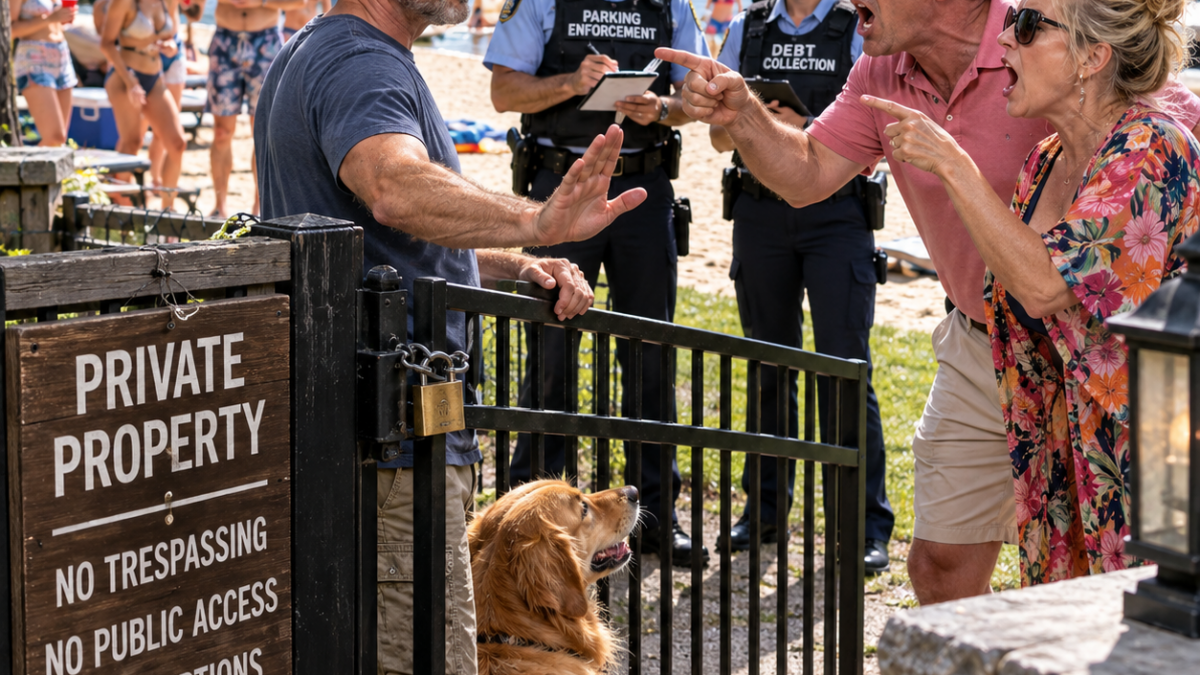
PART2:
The beach is mine.
Not emotionally.
Legally.
It’s on my deed.
It’s on the survey.
The property lines are clear.
There is no public right-of-way across my land.
No shared shoreline agreement.
No access easement.
No deeded path.
Nothing.
That fact became extremely important five years after a conversation I barely thought about at the time.
The neighbors moved in during late spring.
Robert and Felicia Barnes.
I called them Bob and Felicia then.
Much later, privately, I called them Bob and Female Bob because there is a point where two people become so spiritually identical that individual names feel unnecessary.
Bob was fifty-one.
Thick around the middle.
Always wore polo shirts tucked into cargo shorts.
Had one of those expensive watches that looked designed to survive a submarine explosion even though the most dangerous thing he did was sit behind a desk.
He supervised a collections department at a regional debt-recovery company about forty minutes away.
Felicia was forty-nine and worked for a private parking enforcement contractor.
Her company managed lots for apartment buildings, restaurants, office complexes, private marinas, and shopping centers.
Between the two of them, their professional lives revolved around telling strangers they owed money.
In hindsight, perhaps that should have been a warning.
At first, they were perfectly nice.
Their property bordered mine on the north side.
Beautiful house.
Renovated deck.
Fantastic lake view.
Terrible shoreline.
It dropped steeply through rocks into about eight feet of dark mud and weeds.
The first summer they lived there, I found Bob standing near the bottom of his hill looking at my beach.
I was carrying fishing gear back from the dock.
“Nice spot,” he said.
“It’s the reason I bought the place.”
He looked toward his shoreline.
“Previous owner didn’t mention ours was basically a swamp.”
I laughed.
He laughed.
Then I said the sentence that started everything.
“If you guys ever want to swim, just come down my side path.”
He looked at me.
“Seriously?”
“Sure.”
“You don’t mind?”
“No. I don’t use it every day.”
That was it.
No contract.
No lawyer.
No handshake ceremony.
Just one neighbor telling another:
You can use my beach sometimes.
For two years, it worked exactly the way normal people expect neighborly generosity to work.
Bob and Felicia came over occasionally.
Maybe Sunday afternoon.
Maybe after dinner on a hot weekday.
They brought towels.
Sat for an hour.
Swam.
Went home.
They always said hello if they saw me.
Felicia once brought brownies.
Very good brownies.
Buddy, my yellow Labrador, loved them.
Them, not the brownies.
Although probably both if given the opportunity.
Buddy was four when Bob and Felicia moved in.
Seventy pounds of happiness.
Never met a stranger.
His entire approach to home security was to greet intruders enthusiastically and assume they had arrived to throw a tennis ball.
One summer evening, Bob tossed sticks into the water for him for nearly an hour.
Everything was fine.
Then year three happened.
Not one big thing.
Drift.
That is how entitlement usually arrives.
Not with someone announcing:
I have decided your property belongs to me.
It arrives in inches.
A folding chair left beneath a tree.
Then two.
An umbrella because carrying it home is annoying.
Then another.
Some pool noodles.
A cheap plastic shovel.
Kids’ buckets.
A cracked boogie board, even though we didn’t have waves.
Then friends.
I came home one Saturday and found six people floating near my dock.
I knew Bob and Felicia.
Didn’t know the other four.
“Hey,” Bob called.
I lifted a hand.
Went inside.
I told myself it was fine.
They were guests.
My neighbors were there.
Nobody was breaking anything.
The next weekend, eight people.
The weekend after that, Felicia’s sister brought her kids.
Again, fine.
Then the stuff started staying.
A blue cooler.
A bag of children’s toys.
Two folding tables.
Then the masterpiece.
A large gray plastic deck box.
Not small.
The kind you assemble with instructions and profanity.
At least four feet wide.
Bob had dragged it down the path and placed it just inside my tree line.
I opened it one afternoon.
Towels.
Sunscreen.
Inflatables.
An electric air pump.
Plastic cups.
A folded canopy.
Bug spray.
A stack of paper plates.
It was not a forgotten item.
It was infrastructure.
I stood looking at it for a full minute.
Then closed the lid.
Because I am apparently the kind of person who can watch somebody establish a colonial outpost on his land and think:
I don’t want this to become awkward.
A few weeks later, I heard a car pull onto my grass.
Not their driveway.
Mine.
I looked out.
A minivan I didn’t recognize.
Two adults.
Three children.
Beach bags.
They unloaded.
Felicia came around from next door.
“Just park along the grass,” she told them.
Then she pointed down my path.
“Our beach is right there.”
Our beach.
I was standing behind my screen door.
I heard it clearly.
Our.
I felt something tighten in my jaw.
I stepped outside.
Then stopped.
What was I going to do?
Walk down there and say:
Excuse me, I heard your pronoun?
So I went inside.
Made a sandwich.
Sat at the kitchen counter.
And told myself it wasn’t worth a neighbor war.
That sentence became my favorite lie.
It’s not worth a neighbor war.
Chair?
Not worth it.
Umbrella?
Not worth it.
Deck box?
Not worth it.
Strangers?
Not worth it.
“Our beach”?
Still not worth it.
Until they started throwing my guests off my property.
My friends Mike and Laura came up from Philadelphia one Saturday in July.
Mike and I had known each other since college.
Laura was his wife.
Smart.
Blunt.
The kind of woman who can tell you you’re being an idiot with such precision that you end up thanking her.
We planned to grill steaks and spend the afternoon swimming.
I had to run into town first.
Hardware store.
Pharmacy.
Maybe ninety minutes.
“Go down to the beach,” I told them. “I’ll meet you there.”
When I got back, their car was still in my driveway.
But they were sitting on my porch.
Fully dressed.
Bags packed.
“What happened?”
Mike looked at Laura.
Laura looked at me.
“Your neighbors kicked us off your beach.”
I laughed.
Actually laughed.
Because it sounded too stupid to be true.
“They what?”
“Your neighbor came over.”
“Bob?”
“The wife.”
“Felicia?”
“She asked who we were.”
“Okay.”
“We told her.”
“And?”
“She said they were having a private family gathering.”
I stared.
Mike jumped in.
“She was polite.”
Laura turned to him.
“That’s not helping.”
“I’m explaining.”
“She told us,” Laura continued, “that the beach was reserved this afternoon.”
I looked down the hill.
Music floated through the trees.
“They said reserved?”
“Essentially.”
“That is my property.”
“We know.”
“So why did you leave?”
Laura folded her arms.
“Because I wasn’t going to start a screaming match with a woman I had never met while you were buying windshield wipers.”
I started walking.
Mike grabbed my shoulder.
“Daniel.”
“What?”
“Don’t go down there angry.”
“I’m not angry.”
Laura laughed.
“You look like you’re about to invade Poland.”
I stopped.
Took a breath.
Then another.
“Stay here.”
I walked down.
Nine people.
Two umbrellas.
Bluetooth speaker.
Coolers.
Kids in the water.
Felicia sat beneath the maple tree.
Bob was waist-deep in the lake.
When Felicia saw me, she smiled.
“Hey, Daniel.”
“Did you tell my friends to leave?”
Her smile faltered.
“I didn’t tell them to leave.”
“What did you tell them?”
“That we were having family over.”
“So?”
She looked genuinely confused.
“We had a lot of people today.”
I waited.
“And?”
“I thought they’d be more comfortable somewhere else.”
“There is no somewhere else.”
Bob heard us and walked out of the water.
“What’s going on?”
I looked at him.
“Your wife told my guests they couldn’t use my beach.”
Bob frowned.
“I’m sure that’s not what she meant.”
Felicia’s face tightened.
“I didn’t say they couldn’t use it.”
“You told them this was a private family gathering.”
“It is.”
“On my property.”
Pause.
One of their guests suddenly became fascinated by opening a bag of chips.
Felicia lowered her voice.
“Daniel, we’d already set everything up.”
I looked around.
That sentence told me everything.
Because they had put chairs on the sand first, they believed they had priority.
“You don’t reserve my beach by showing up before I do.”
Bob raised both hands.
“Okay.”
Reasonable-guy voice.
“Miscommunication.”
“No.”
“Daniel.”
“No. I’m being clear now.”
I pointed toward the path.
“My guests use this beach whenever I tell them they can.”
“Of course.”
“They do not need permission from you.”
“Fine.”
“And you don’t remove anyone from my property.”
Felicia rolled her eyes.
It was quick.
But I saw it.
“Fine.”
I walked back uphill.
Laura was standing at the porch railing.
“Well?”
“Misunderstanding.”
She stared at me.
“No.”
“What?”
“That woman did not misunderstand.”
I sighed.
“She knows now.”
Laura looked toward the lake.
“Daniel.”
“What?”
“She genuinely believes she has standing to remove people from your land.”
“She doesn’t.”
“You know that.”
“Yes.”
“Does she?”
I wish I had listened harder.
Two weeks later, Buddy ended my patience.
I had been grocery shopping.
Buddy came because the store had a pet supply place next door and he considered errands his constitutional right.
We pulled into the driveway around four.
I opened the truck.
Buddy jumped down.
I grabbed two grocery bags.
Music drifted from the beach.
Children yelling.
Splashing.
Buddy heard it.
His ears went up.
Then he trotted down the path.
His path.
The same path he had used for nine years.
I carried groceries toward the house.
Then heard Felicia scream:
“Get that dog out of here!”
I stopped.
Bob’s voice followed.
“Daniel! Call your dog!”
I set the bags down.
Walked toward the beach.
Buddy stood ankle-deep in water.
Tail wagging.
A little girl held a stick.
He was staring at it with religious devotion.
Around them:
Nine or ten people.
Two umbrellas.
Three coolers.
Portable speaker.
Toys.
Deck box open.
Folding canopy.
It looked like a small municipal recreation program had been installed on my property.
Felicia approached.
Arms folded.
“There are children down here.”
I looked at Buddy.
Then the children.
Then her.
“Yes.”
“You can’t just let him run loose.”
“He lives here.”
She blinked.
“If he knocks a child over, you could have a liability issue.”
I almost smiled.
“Liability.”
“Yes.”
“You’re concerned about my liability.”
“Of course.”
“While ten people I didn’t invite are on my property.”
Her face hardened.
“We’re your neighbors.”
“The other eight?”
“Our guests.”
“On whose land?”
“Daniel.”
“Whose land?”
She exhaled.
“This is ridiculous.”
Bob came out of the water.
“Come on, man.”
There it was.
The voice.
Calm.
Patient.
Like I was the difficult one.
“You’ve got the whole property.”
I looked at him.
“So?”
“Can’t you keep Buddy up by the house for a couple hours?”
I laughed.
Not because it was funny.
Because sometimes your brain chooses laughter when anger gets too close.
“You want me to lock my dog inside my house…”
“No one said lock him—”
“…because you have guests on my beach?”
Felicia interrupted.
“You know what I mean.”
“No.”
I looked directly at her.
“Tell me.”
She pointed around.
“We’re using it right now.”
That sentence did it.
Not our beach.
Not liability.
Not the guests.
“We’re using it right now.”
In her mind, use had become control.
Occupation had become authority.
My permission had quietly transformed into their rights.
I looked at Bob.
He knew something had changed.
“Daniel.”
I called Buddy.
“Come.”
Buddy abandoned the stick without protest.
Ran to me.
Soaked me from the knees down.
I clipped his leash on.
Felicia relaxed slightly.
Wrongly.
I looked around once more.
“Enjoy the afternoon.”
Bob smiled cautiously.
“Thanks.”
I walked uphill.
That evening I called Laura.
“You were right.”
“I’m going to need more information because I am right frequently.”
“They told me Buddy shouldn’t be on the beach.”
Silence.
“Your dog?”
“Yes.”
“Your beach?”
“Yes.”
“Daniel.”
“I know.”
“No, I don’t think you do.”
“I know.”
The next morning, I woke early.
Coffee.
Buddy.
Down the path.
At the top of the beach, I stopped.
There was a sign.
Metal.
Not cardboard.
Not handwritten.
An actual aluminum sign on a steel stake.
PRIVATE BEACH
RESIDENTS & GUESTS ONLY
I stared at it.
Buddy sniffed the post.
I laughed.
Then I got angry.
Not explosive.
Cold.
There is a kind of anger that burns.
There is another kind that organizes documents.
I preferred the second.
I took a photograph.
Then another from farther back showing the path.
Checked my property survey on my phone.
Yes.
The sign was eight feet inside my line.
I walked next door.
Bob answered holding coffee.
Barefoot.
“Morning.”
I pointed toward my property.
“What is that?”
“What?”
“The sign.”
He looked.
“Oh.”
As if he had forgotten.
“That.”
Felicia appeared behind him.
“We put it there yesterday.”
“I assumed it didn’t grow.”
She frowned.
“It’s to keep random people from coming down.”
“What random people?”
“People drive around looking for lake access.”
“They’d already have to enter my property to reach the sign.”
Bob gave a little laugh.
“Exactly.”
“No.”
He stopped.
“The sign says residents and guests.”
“Right.”
“Whose residents?”
“What?”
“You don’t live on my property.”
His smile disappeared.
Felicia crossed her arms.
“It’s just wording.”
“No.”
“It protects you.”
“No.”
“Daniel, why are you suddenly making everything difficult?”
There it was.
Suddenly.
Five years of increasing entitlement.
But I was suddenly difficult because I noticed.
“The sign comes down.”
Bob frowned.
“Okay.”
“The deck box too.”
“What?”
“Everything you’ve left there.”
Felicia stared.
“Why?”
“Because it’s my property.”
“Oh, come on.”
“Chairs. Umbrellas. Cooler. Toys. Box. All of it.”
Bob stepped outside.
“Daniel, none of that hurts anything.”
“That’s not the point.”
“You barely use that part of the property.”
I remember that sentence exactly.
Because it was so honest.
You barely use it.
Therefore we deserve it.
I looked at him.
“How often do you use your guest bedroom?”
“What?”
“Maybe I should store my tools there.”
He sighed.
“That’s different.”
“Why?”
“You’re being childish.”
“No. I’m explaining property.”
Felicia shook her head.
“We’ve used that beach for years.”
“With permission.”
“That creates expectations.”
“Not ownership.”
“You don’t know that.”
Bob stepped in.
“I deal with legal issues all day.”
“You collect debts.”
“I work with compliance and attorneys.”
“That doesn’t make you one.”
His face darkened.
“Daniel.”
I held up one hand.
“We can go back to the original arrangement.”
“What arrangement?”
“You ask occasionally.”
Felicia laughed.
“We have to ask every time?”
“Yes.”
“After five years?”
“Yes.”
“That’s ridiculous.”
“No.”
I looked at both of them.
“It was generous.”
Neither spoke.
“The fact you forgot that is why we’re having this conversation.”
I went home.
Pulled out my deed.
Survey.
Closing documents.
Title policy.
Read everything.
Then I called a real estate attorney.
Nathan Adler.
Local.
Sixty-two.
Office above a dentist.
Dry sense of humor.
I brought my documents.
He read for fifteen minutes.
Then said:
“You’re fine.”
“What does that mean?”
“No easement.”
“I know.”
“No recorded access.”
“I know.”
“No prescriptive easement issue from five years of permission.”
“That’s what I’m worried about.”
He looked at me over his glasses.
“Permission defeats adverse use.”
“English.”
“You allowed them.”
“Yes.”
“Therefore they weren’t using your property against your rights.”
“Okay.”
“You can revoke permission.”
“Any issue because I let them use it regularly?”
“No.”
“Bob said rights attach.”
Nathan smiled.
“What does Bob do?”
“Collections supervisor.”
“Ah.”
“What?”
“Nothing.”
“That smile means something.”
Nathan folded his hands.
“There is a dangerous species of man who works near lawyers long enough to believe legal knowledge passes through office ventilation.”
I laughed.
“What do I do?”
“Put it in writing.”
“That seems aggressive.”
“No. It seems clear.”
“Can I just tell them?”
“You already did.”
Fair.
“Give them reasonable time to remove property.”
“How long?”
“Fourteen days is generous.”
“And then?”
“Gate if you want.”
“Fence?”
“Your choice.”
“What if they come through?”
“Document it.”
“Police?”
“If necessary.”
“I don’t want this turning into a war.”
Nathan leaned back.
“It already became a conflict.”
He tapped my survey.
“You’re just the last person to notice.”
That hurt.
Because it was true.
We drafted one page.
No threats.
No dramatic lawyer language.
I delivered it by certified mail and put another copy in their mailbox.
Effective fourteen days from receipt:
Permission to enter my property for recreational access was withdrawn.
All personal belongings must be removed.
Future entry without express permission would be treated as trespass.
I even included:
I am available Saturday morning to help move the deck box.
They did not ask for help.
For twelve days, nothing moved.
Day thirteen:
Operation Passive Aggression.
Doors slammed.
Storage box dragged loudly uphill.
Bob carried chairs past my kitchen window one at a time despite being fully capable of carrying two.
Felicia sighed whenever she saw me.
A plastic bucket was thrown hard enough into their garage that I heard it.
I sat with coffee.
Watched.
Did not engage.
By sunset, everything was gone.
The next morning I installed a cedar gate across the path.
Not Fort Knox.
Waist high.
Simple latch.
PRIVATE PROPERTY
NO TRESPASSING
No lock.
Because normal people understand signs.
That evening Bob knocked.
“You can’t do this.”
I looked at the gate.
“I apparently can.”
“We’ve had established access.”
“Permission.”
“For years.”
“Permission.”
“Rights can attach.”
“Nathan says they don’t.”
“Who’s Nathan?”
“My attorney.”
His expression changed.
Small.
But I enjoyed it.
“You hired a lawyer?”
“I paid one for an hour.”
“That’s ridiculous.”
“Cheaper than guessing.”
Bob stepped closer.
“I deal with this kind of thing all day.”
“No.”
“What?”
“You deal with debts.”
“I deal with legal processes.”
“Then you understand written notice.”
His face reddened.
I closed the door.
For three weeks, peace.
Actual peace.
No one crossed the gate.
No confrontation.
Buddy ran the beach.
Mike and Laura came back.
Laura stood on the sand with both hands on her hips.
“Look at this.”
“What?”
“We are allowed to remain.”
“Very funny.”
She pointed at the gate.
“Took you long enough.”
I ignored her.
Life returned.
Then the wheel boot appeared.
Thursday afternoon.
I drove fifteen minutes to Lake Harmony Marina on a larger lake nearby.
Private complex.
Bait shop.
Restaurant.
Boat slips.
I needed shiners for fishing and wanted lunch.
Pulled in at 12:18.
Parking lot signs:
CUSTOMERS ONLY.
Unauthorized vehicles subject to immobilization or towing.
Fine.
I went into the bait shop.
Bought bait.
Coffee.
Receipt.
Then ate fish tacos at the restaurant patio.
Total time maybe thirty minutes.
I walked back.
Yellow wheel boot.
Front driver-side tire.
For three seconds, I honestly thought:
Wrong truck.
Then saw the notice beneath my windshield wiper.
VIOLATION: UNAUTHORIZED NON-CUSTOMER PARKING.
Fee: $325.
Boot removal upon payment.
I stood there.
Bait shop bag in one hand.
Restaurant receipt in the other.
Then I looked at the issuing employee.
F. BARNES.
I laughed.
Loudly.
A man loading a kayak nearby looked at me like he should call somebody.
I checked my dashcam app.
My truck has parking mode.
Time-stamped.
Front and rear.
I went inside the marina office.
Asked for manager.
Ron Ellsworth.
Fifty-ish.
Sunburned.
Reading glasses hanging from a cord.
“What can I do for you?”
I placed the ticket down.
“Your parking contractor booted me.”
He looked at it.
“Were you parked overnight?”
“Thirty minutes.”
“Customer?”
I placed bait receipt down.
Restaurant receipt.
He frowned.
“Wait here.”
We walked outside.
He checked the signs.
Then my truck.
“Who issued this?”
I showed him.
His expression changed slightly.
“You know her?”
“She’s my neighbor.”
He slowly looked at me.
“That sounds bad.”
“It gets better.”
I told him about the property dispute.
Not every detail.
Enough.
Ron rubbed his face.
“Come inside.”
He pulled camera footage.
12:18—my truck enters.
12:20—I enter bait shop.
12:26—I leave shop.
12:29—I sit on restaurant patio.
12:31—a marked parking enforcement vehicle enters.
The car does not patrol.
Does not inspect rows.
It turns directly toward my truck.
Stops.
Felicia exits.
Walks around my vehicle.
Checks license plate.
Returns to car.
Retrieves boot.
Installs it.
Eleven minutes after I arrived.
Ron rewound.
Watched again.
Then said:
“That’s not enforcement.”
I said nothing.
“That’s a beeline.”
He called the contractor.
His tone changed completely.
“This is Ron at Harmony Marina. I have one of your boots on a paying customer’s truck.”
Pause.
“No.”
Pause.
“I’m looking at receipts and video.”
Pause.
“I need it removed now.”
Twenty minutes later another parking employee arrived.
Young guy.
Embarrassed.
“Sorry, sir.”
“Not your fault.”
He removed the boot.
Felicia’s citation remained technically issued but flagged for dispute.
Ron printed copies of footage timestamps.
“I’m preserving this.”
“Thank you.”
“You may need it.”
“I think so.”
I called Nathan from the truck.
He listened.
Then said:
“Do nothing angry.”
“I’m not angry.”
“You sound delighted.”
“I am a little.”
“That worries me more.”
“What should I do?”
“Keep everything.”
“Already am.”
“Receipt.”
“Yes.”
“Citation.”
“Yes.”
“Dashcam.”
“Yes.”
“Video.”
“Manager has it.”
“Good.”
“Should we send a letter?”
“Not yet.”
“Why?”
Nathan paused.
“Let’s see if they’re stupid enough to continue.”
Nine days later, I opened my mailbox.
White envelope.
Return address:
Northeastern Account Recovery Services.
Bob’s employer.
I opened it at the kitchen counter.
OUTSTANDING BALANCE DUE.
$325 parking charge.
$47 administrative processing fee.
Total:
$372.
Prompt payment required.
Potential escalation if unresolved.
I read it once.
Twice.
Then a third time.
Felicia’s original parking ticket had clearly stated:
Thirty days to pay or dispute before referral.
I had disputed it the same day.
Nine days had passed.
Yet somehow it had already crossed from her company into Bob’s.
I called Nathan.
“I think my neighbors mailed us evidence.”
Silence.
Then:
“Please tell me you kept the envelope.”
“I’m holding it.”
“Postmark?”
“Yes.”
“Do not throw anything away.”
“I’m not an idiot.”
“You were letting people run a municipal beach on your property for years.”
“Fair.”
He told me to bring everything.
That afternoon we spread it across his conference table.
Deed.
Survey.
Written revocation of permission.
Parking citation.
Receipts.
Dashcam stills.
Ron’s preservation email.
Collection letter.
Envelope.
Timeline.
Nathan leaned back.
“I’ve represented some stupid people.”
“Good opening.”
“This is special.”
“What did they do?”
“Potentially?”
He held up the collection letter.
“They took a personal dispute and inserted it into two regulated corporate systems.”
“Meaning?”
“Meaning their employers may care significantly more than you do.”
“Can I sue?”
“You could explore it.”
“But?”
“Do you want money or do you want them to stop?”
“Stop.”
“Good.”
He pulled a legal pad toward himself.
“Then don’t start by threatening litigation.”
“What do we do?”
“Ask questions.”
That sounded too gentle.
Nathan smiled.
“Compliance departments hate questions with attachments.”
Three letters.
Calm.
Precise.
Devastating.
The first went to Felicia’s company compliance officer.
It said:
I am requesting review of a parking enforcement action issued by your employee, Felicia Barnes, at Lake Harmony Marina.
It documented:
I was a paying customer.
Attached receipts.
Dashcam timestamp.
Marina footage.
Her direct arrival eleven minutes after mine.
Our existing private property dispute.
Then one question:
What safeguards exist to prevent employees from using enforcement authority in personal disputes?
That was all.
Second letter went to Ron confirming the facts and thanking him.
Third went to Bob’s employer.
Nathan’s favorite.
Attached:
Original citation showing thirty-day dispute period.
Proof of same-day dispute.
Collection notice generated on day nine.
Postmark.
Relationship between Bob and Felicia.
Existing neighbor dispute.
Then:
Please explain how this disputed account entered collections before the stated referral period and whether Robert Barnes had any involvement in its intake, processing, or correspondence.
I asked Nathan:
“Should we mention beach?”
“Yes.”
“Why?”
“Context.”
“Won’t they think it sounds petty?”
He smiled.
“That’s the point.”
Two employees potentially abused company systems because their neighbor stopped letting them use his beach.
It sounded absurd.
That made it worse.
We sent everything certified.
Then waited.
Felicia stopped waving entirely.
Bob stared at my house.
Three days.
Five.
Seven.
Day eight:
Call from Felicia’s company.
Woman named Cynthia.
Director of compliance.
Professional.
Careful.
“Mr. Mercer, I’m calling regarding your complaint.”
“Okay.”
“We’ve reviewed the materials.”
“Yes.”
“We have also spoken with our client at Lake Harmony Marina.”
“Okay.”
“The citation has been permanently voided.”
“Good.”
“No fee is due.”
“Good.”
“The immobilization should not have occurred.”
I waited.
“Ms. Barnes will have no future involvement with the Lake Harmony account.”
Interesting wording.
“Is she still employed?”
“I cannot discuss personnel matters.”
“Understood.”
“We are reviewing internal access protocols.”
“What does that mean?”
Another carefully measured pause.
“It means we take concerns about misuse of client systems seriously.”
Good enough.
Two days later, Bob’s company called.
Compliance attorney.
Not manager.
Attorney.
“Mr. Mercer, the collection letter you received has been withdrawn.”
“Good.”
“No balance will be pursued.”
“Good.”
“No information regarding the account has been reported to any credit bureau.”
“Was it scheduled to be?”
“I’m not able to speculate.”
“Okay.”
“We have flagged your name and address so any future account involving you receives compliance review.”
That was interesting.
“Why would that be necessary?”
Pause.
“As a precaution.”
Translation:
Because Bob might try something again.
“What about Mr. Barnes?”
“I cannot discuss employees.”
“Did he handle the account?”
Long silence.
Then:
“I can tell you he will have no involvement in any current or future matter related to you.”
That answered enough.
I hung up.
Walked to the window.
Bob was outside moving his trash cans.
He looked toward my house.
I lifted one hand.
Small wave.
He stared.
Then waved back.
The slowest, stiffest neighbor wave I had ever seen.
Like a man greeting a state trooper while driving exactly fifty-five.
I should have been satisfied.
I was.
Mostly.
Then Ron called.
“You cost those people a contract review.”
“I did?”
“My owners are furious.”
“At me?”
“No.”
He laughed.
“At the parking company.”
“What happened?”
“Their employee targeted a paying customer because of a personal feud.”
He paused.
“You understand how bad that looks for us?”
“Yes.”
“What if somebody posted the video?”
“I didn’t.”
“I know. That’s why I’m calling.”
The marina renegotiated their contract.
Stricter controls.
Supervisor approval before booting during restaurant hours.
Employees prohibited from enforcement involving anyone with a disclosed personal relationship.
Ron thanked me.
“You probably saved us a bigger problem.”
“I just wanted bait.”
“I know.”
That line became funny later.
At the time, I was exhausted.
Because entitlement creates work.
That is the part people don’t talk about.
Bob and Felicia wanted my beach.
I had to read deeds.
They installed a sign.
I had to hire a lawyer.
They abused parking enforcement.
I had to preserve video.
They sent collections.
I had to document timelines.
Their arrogance became my administrative burden.
And then they had the nerve to act wounded.
Two weeks after the compliance calls, Felicia approached me at the mailbox.
“Are you happy?”
I looked at her.
“With what?”
“You know what.”
“No.”
She crossed her arms.
“You went after our jobs.”
That sentence almost impressed me.
“No.”
“Yes, you did.”
“I challenged a false ticket and a false collection letter.”
“You contacted our employers.”
“Because you used your employers.”
Her face reddened.
“It was a parking violation.”
“I was a customer.”
“That’s debatable.”
“No. I have receipts.”
“You didn’t need to involve compliance.”
“What should I have done?”
“Talked to us.”
I stared at her.
“About the ticket you issued to me?”
“Yes.”
“During our property dispute?”
She said nothing.
“And then the collection letter from Bob’s company?”
Her jaw tightened.
“You’re making assumptions.”
“Was Bob involved?”
“I’m not discussing his work.”
“Neither am I.”
I smiled slightly.
“His compliance department already did.”
She went pale.
That was the first moment I realized neither of them had expected me to follow the process.
They expected intimidation.
They expected inconvenience.
Maybe they expected me to pay $325 just to avoid trouble.
People who weaponize bureaucracy often assume everyone else fears paperwork.
They had picked the wrong profession.
I estimate commercial construction projects for a living.
My world is documentation.
Change orders.
Receipts.
Emails.
Dates.
Versions.
Proof.
I don’t fear paperwork.
I weaponize spreadsheets for money.
Felicia took one step toward me.
“You’ve been waiting for an excuse.”
“No.”
“You never liked us.”
“That isn’t true.”
“We used to be friends.”
“Neighbors.”
“Same thing.”
“No.”
Her eyes narrowed.
“You let us use that beach for years.”
“Yes.”
“And then suddenly you changed the rules.”
“No.”
“There were no rules.”
“That was the problem.”
She laughed bitterly.
“We didn’t hurt anything.”
I thought about Mike and Laura.
Buddy.
The sign.
“Our beach.”
“We’re using it right now.”
“You started treating permission like ownership.”
She rolled her eyes.
“It was sand.”
“No.”
I looked at her.
“It was respect.”
For the first time, she had no response.
Then she said:
“You embarrassed us.”
I almost laughed.
“You booted my truck.”
She looked away.
“You sent me to collections.”
Silence.
“And I embarrassed you?”
Her face hardened again.
“You could’ve handled this privately.”
“I tried.”
“When?”
“For five years.”
She walked away.
Bob came over the following weekend.
Different approach.
No anger.
He carried two beers.
I was trimming brush near the gate.
“Peace offering.”
“No thanks.”
He held one out.
I shook my head.
He put both down.
“We need to clear the air.”
I continued cutting.
“What air?”
“This.”
He gestured vaguely.
Beach.
Jobs.
Marriage.
Universe.
“I don’t want to fight with you for the next twenty years.”
“Neither do I.”
“Good.”
“So don’t come on my property.”
His jaw tightened.
“I’m trying to talk like adults.”
“So am I.”
He looked at the gate.
“Can we revisit this eventually?”
“The beach?”
“Yes.”
“No.”
Immediate.
He blinked.
“Ever?”
“No.”
“That seems extreme.”
“It wasn’t permanent until the parking ticket.”
“That was Felicia.”
“The collection letter was your company.”
His face changed.
“I didn’t generate that.”
“Then how did it happen?”
“I can’t discuss work.”
“Interesting.”
“I’m serious.”
“So am I.”
I turned off the trimmer.
“You need to understand something.”
He waited.
“The beach dispute ended when I withdrew permission.”
“No.”
His expression already disagreed.
“Yes.”
I continued.
“Everything after that was your choice.”
“The gate escalated things.”
“The gate is on my property.”
“You made it hostile.”
“The sign says private property.”
“Exactly.”
I laughed.
“Bob, that is what it is.”
He pointed toward the water.
“You know we bought this place partly because we thought we had access.”
My anger cooled.
That was new information.
“Who told you that?”
“Previous owner.”
“What exactly?”
“He said neighbors shared shoreline access.”
My mind shifted.
“Your seller?”
“Yes.”
“Did he say my beach?”
“He said people around here were informal.”
“That’s true.”
“So we assumed—”
“There.”
He stopped.
“Assumed.”
I set the trimmer down.
“Did your deed include access?”
“No.”
“Survey?”
“No.”
“Easement?”
“No.”
“But you told us we could use it.”
“Yes.”
“So from our perspective—”
“Stop.”
He looked annoyed.
“You are trying to turn kindness into a contract.”
“That’s not fair.”
“It is exactly fair.”
He picked up one beer.
“I think you always planned to pull it eventually.”
“No.”
“Then why now?”
“Because your wife removed my guests from my beach.”
He looked away.
“Because you told me to keep my dog off it.”
Silence.
“Because you installed a sign.”
Silence.
“Because when I asked you to remove your storage, you told me I barely used my own property.”
He sighed.
“Things were said.”
“Yes.”
“People get frustrated.”
“Yes.”
“And now our jobs are involved.”
“Because you involved them.”
He looked toward the lake.
“Felicia got suspended.”
I said nothing.
He laughed without humor.
“There. Happy?”
“No.”
“Three weeks.”
Still nothing.
“Final warning.”
I waited.
“She loses that job, we have a problem.”
I looked at him.
“You already have one.”
His face hardened.
“That a threat?”
“No.”
I pointed at the gate.
“That’s the problem.”
He stared.
“You still think this is about the beach.”
“It started there.”
“No.”
I shook my head.
“It started when you decided ‘no’ didn’t apply to you.”
That landed.
He left the beers.
I threw them away unopened.
Winter came.
The lake froze.
Snow covered the beach.
For months, none of it mattered.
Bob and Felicia stayed next door.
We waved occasionally.
No conversation.
Buddy turned ten.
Started moving slower.
Mike joked the beach was finally safe from hostile occupation.
Laura told him not to provoke me.
In March, I received a letter from the township.
Not enforcement.
Notice.
Someone had filed a complaint about my cedar gate.
Possible unpermitted structure within setback.
I laughed.
Then called zoning.
Gate did not require a permit.
Complaint closed.
Anonymous.
Of course.
Two weeks later:
Complaint about my dock.
Inspection.
Dock legal.
Existing permit.
Closed.
Then:
Complaint about outdoor lighting.
Closed.
Complaint about septic runoff.
That one made me angry.
Septic inspections are not jokes.
County health department came.
System passed.
Inspector stood with clipboard.
“Somebody doesn’t like you.”
“I have theories.”
“Anonymous complaints?”
“Can you tell me?”
“No.”
“Thought not.”
Nathan told me:
“Document.”
So I did.
Dates.
Agencies.
Outcomes.
Photographs.
Inspection reports.
Then one afternoon, I noticed a white SUV parked near Bob’s driveway.
Felicia walked toward it carrying a folder.
County logo.
I recognized the inspector from the septic visit.
They spoke.
Felicia pointed toward my property.
He looked uncomfortable.
She handed him something.
My dashcam caught part of it.
Not enough to prove a conspiracy.
Enough to annoy me.
I called the county.
Not to accuse.
To request records.
Pennsylvania’s Right-to-Know process is not exciting.
It is, however, beautiful when used correctly.
Complaints involving my property.
Dates.
Descriptions.
Where releasable, source information.
Some identities were redacted.
But patterns emerged.
Wording.
Specific phrases.
“Suspected unauthorized shoreline obstruction.”
“Potential zoning violation arising from newly installed barrier.”
“Possible sanitation concern affecting shared recreational shoreline.”
Shared recreational shoreline.
Nobody else would call my private beach that.
I forwarded the documents to Nathan.
He called.
“You want to send a cease-and-desist?”
“Yes.”
“You sure?”
“Yes.”
“Good.”
One page.
All non-emergency property concerns should be directed through counsel.
Repeated knowingly baseless complaints could support claims of harassment or abuse of process depending on circumstances.
Stop entering property.
Stop contacting me except emergencies.
Stop interfering with use.
That letter changed the temperature.
No more complaints.
No more visits.
No more beers.
No more conversation.
Peace returned.
Real peace.
Then Buddy got sick.
That part has nothing to do with property law.
But it changed how I saw everything.
He was ten and a half.
Cancer.
Hemangiosarcoma.
Aggressive.
Veterinarian said weeks.
Maybe two months.
I brought him home.
Stopped caring about work.
Stopped caring about Bob.
Stopped caring about signs.
Every evening Buddy and I walked to the beach.
Slowly.
He still wanted water.
Still chased sticks.
Then forgot halfway out why he was swimming.
I sat on the sand.
He lay beside me.
One July evening, Felicia appeared at the gate.
I saw her from below.
She didn’t open it.
Just stood.
I ignored her.
After a minute, she called:
“Daniel?”
I looked up.
“I heard about Buddy.”
I said nothing.
“I’m sorry.”
My anger did something unexpected.
Softened.
Not disappeared.
Just moved.
“Thanks.”
She remained behind the gate.
“Can I…”
She stopped.
“What?”
“Can I say goodbye?”
I looked at Buddy.
Tail thumped when he heard her voice.
He remembered.
Dogs don’t keep property disputes.
I walked uphill.
Opened the gate.
Felicia came through.
First time in almost a year.
She walked to the beach.
Sat beside Buddy.
He put his head on her knee.
She cried.
I did too.
For fifteen minutes, we were neighbors again.
Just people.
She scratched his ears.
“He used to steal my flip-flops.”
“Yes.”
“He buried one in our mulch.”
“I know.”
“I blamed Bob.”
“Reasonable.”
She laughed through tears.
When she left, she stopped at the gate.
“Thank you.”
“Sure.”
She looked at the sign.
Then me.
“I was wrong.”
I said nothing.
“About the beach.”
Still nothing.
“I’m not asking to use it.”
“Okay.”
“I just…”
She looked toward Buddy.
“We got carried away.”
That was an understatement.
But it was also the first genuine admission.
“I’m sorry.”
I believed her.
Not because her apology erased anything.
It didn’t.
But she said it without conditions.
No “if.”
No “but.”
No “we were frustrated.”
Just:
I’m sorry.
“That matters,” I said.
She nodded.
Then left.
Buddy died nine days later.
At home.
On a blanket beside the sliding door facing the lake.
Bob and Felicia sent a card.
No dramatic message.
Sorry about Buddy.
He was a good dog.
They included an old photo.
Buddy in their yard.
Probably from year one.
Holding one of Felicia’s flip-flops.
I laughed until I cried.
That autumn, something strange happened.
Bob sold their lake house.
I found out when a realtor sign appeared.
No goodbye.
No explanation.
A month later, movers came.
I stayed out of it.
The new owners were a young couple with two little girls.
Tyler and Megan.
First week, Tyler approached while I was stacking firewood.
“Hey, Daniel?”
“Yeah?”
He looked nervous.
“This might sound weird.”
I waited.
“The previous owners said there was some kind of beach access.”
Of course they did.
“What exactly did they say?”
“That historically they used the beach next door.”
I nodded.
“Historically they had permission.”
“Oh.”
“It was revoked.”
He looked embarrassed.
“Got it.”
I expected disappointment.
Instead:
“Thanks for telling me.”
That was all.
No rights attach.
No established use.
No “you barely use it.”
Just:
Got it.
Then he surprised me.
“If we ever wanted to swim over there, could we ask?”
I looked at him.
“Ask?”
“Yeah.”
What a concept.
“You have two kids?”
“Seven and four.”
“Do they like dogs?”
He laughed.
“We don’t have one.”
“Neither do I anymore.”
Something caught in my throat.
I looked toward the beach.
Then back at Tyler.
“Ask when you want.”
“You sure?”
“Yes.”
“Totally fine if not.”
“I know.”
The difference was astonishing.
Respect makes generosity easy.
Entitlement makes it impossible.
That summer, Tyler asked twice.
Both times I said yes.
His girls built castles.
They removed every toy when they left.
Megan texted thanks.
No deck box appeared.
No aluminum sign.
No declaration of “our beach.”
Just neighbors.
The way it should have been.
Months later, I ran into Ron at the marina.
I was buying bait again.
He laughed when he saw me.
“Check your tires.”
“Very funny.”
“How are your neighbors?”
“Moved.”
“Really?”
“Yes.”
He whistled.
“Beach war over.”
“Hopefully.”
“What happened to the parking woman?”
I looked at him.
“You know I can’t ask that.”
“I can tell you she doesn’t work our account.”
“Still with company?”
He shrugged.
“Last I heard, yes. Different role.”
“And husband?”
“No idea.”
Neither did I.
I never found out exactly what Bob’s company did internally.
I didn’t need to.
Consequences don’t have to be visible to matter.
The false balance disappeared.
The credit reporting threat disappeared.
Felicia lost the marina account and got disciplined.
Bob was blocked from any file involving me.
Their employers reviewed internal procedures.
The marina changed contract controls.
And eventually my neighbors stopped trying to turn my property into their entitlement test.
People online—if this story ever ends up online—will probably want a more explosive ending.
They’ll want Bob fired.
Felicia fired.
Maybe arrested.
Maybe losing their house because of poetic justice.
That isn’t what happened.
Real life is usually quieter.
They still had jobs.
Still had money.
Still lived next door for another year.
Then sold.
No courtroom speech.
No police dragging anyone away.
No judge slamming a gavel.
The justice was simpler.
They lost what they thought they were entitled to.
They lost access to the beach.
They lost the ability to intimidate me through their employers.
They lost the assumption that I would stay quiet to keep things comfortable.
And I got my property back.
That was enough.
More than enough.
Last Sunday I walked down to the beach just after sunrise.
Coffee.
No dog now.
That is still hard.
The cedar gate has weathered silver.
The PRIVATE PROPERTY sign faded at the corners.
I should probably replace it.
The sand was smooth.
A few leaves.
No plastic toys.
No umbrellas.
No speaker.
No gray deck box.
Tyler’s daughters had drawn something near the waterline the evening before.
A giant crooked heart.
Inside it:
THANK YOU MR DANIEL
I stood there smiling.
Then sat on the old log at the tree line.
For a long time, I listened.
Water.
Birds.
Wind.
Nothing else.
I thought about the day five years earlier when I told Bob:
“If you ever want to swim, come down my side.”
Would I say it again to a new neighbor?
Yes.
That surprised me.
For a while, after everything, I thought generosity was the mistake.
It wasn’t.
Generosity wasn’t the mistake.
The mistake was believing I had to keep giving after gratitude disappeared.
Those are different things.
You can be kind and still have boundaries.
You can help someone and later say no.
You can lend something and ask for it back.
You can share your property without surrendering it.
And when someone responds to a boundary by punishing you, manipulating systems, or trying to frighten you into restoring their privileges, that tells you the boundary was necessary.
I learned something else too.
People reveal themselves when access ends.
As long as Bob and Felicia got what they wanted, they were friendly.
Brownies.
Smiles.
Neighbor jokes.
The moment I said no, suddenly I was selfish.
Difficult.
Hostile.
Legally ignorant.
Worth targeting with a parking boot.
Worth sending to collections.
Their kindness depended on access.
Mine didn’t have to.
That realization cured the guilt.
For months, I had wondered whether I had overreacted.
Should I have ignored the deck box?
Should I have let them keep swimming?
Should I have laughed off “our beach”?
Should I have avoided the lawyer?
Should I have simply paid the $325?
Every one of those questions contained the same assumption:
What could I surrender to make unreasonable people reasonable?
The answer was nothing.
Because people who treat generosity as weakness do not become satisfied when you give more.
They update their expectations.
The chair becomes the umbrella.
The umbrella becomes the storage box.
The storage box becomes the guests.
The guests become priority.
Priority becomes control.
Control becomes retaliation when challenged.
That is how a favor turns into a claim.
Not legally.
Psychologically.
And maybe that was the whole story.
Not really a story about a beach.
A story about one word.
No.
For years I had trouble saying it.
No, you cannot leave that here.
No, your guests don’t outrank mine.
No, my dog does not need your permission.
No, you cannot install signs.
No, five years of kindness does not mean forever.
No, your job does not give you power over me.
No, I will not pay a debt you invented.
Once I finally said it clearly, everything that followed showed me why I should have said it sooner.
There is still one thing on the beach from Bob and Felicia’s years.
I found it after Buddy died.
A little red plastic crab mold buried near the maple roots.
Probably belonged to one of their nieces.
I almost threw it away.
Instead, I keep it on a shelf in my garage.
Not because I miss them.
Because it makes me laugh.
A five-dollar piece of plastic from the years when my private beach somehow acquired furniture, storage, guests, rules, and management without my approval.
Whenever somebody tells me I’m too patient, I point at that crab.
I never explain.
Some reminders don’t need explanations.
Sometimes they just need to sit there.
Like a cedar gate.
Like a property sign.
Like a file folder containing receipts, certified letters, photographs, parking records, and one spectacularly ill-advised collection notice.
Nathan still has the folder.
He calls it “The Beach War.”
I told him that sounded dramatic.
He said:
“You hired me over umbrellas.”
“Eventually.”
“You involved two corporate compliance departments.”
“They started it.”
“You requested government records.”
“I was curious.”
“You sent a cease-and-desist.”
“That was your idea.”
He smiled.
“Beach War.”
Fine.
Beach War.
But when I think back on it now, the moment I remember most isn’t the boot.
Or the collection letter.
Or even Felicia telling me my dog couldn’t be on my own shoreline.
It’s the first summer.
Bob standing at the bottom of his rocky property.
Me carrying fishing poles.
He looked over.
I said:
“Come down my side whenever.”
I meant it kindly.
And I still don’t regret saying it.
Because if the lesson I took from all of this was never help your neighbors, Bob and Felicia would have taken something more valuable than beach access.
They would have changed me.
I refuse to give them that.
So yes.
Tyler’s kids swim there sometimes.
Mike and Laura use it.
A neighbor across the lake once asked if his granddaughter could come build sandcastles.
I said yes.
People ask.
I usually say yes.
Sometimes I say no.
And nobody argues.
Because reasonable people understand the difference between a gift and a right.
That difference is everything.
A few weeks ago, Tyler helped me replace two rotted boards on the dock.
Wouldn’t take money.
Megan brought sandwiches.
Their girls played near the shore.
Before they left, the younger one came up carrying the red crab mold.
I didn’t know she had found it in the garage.
“Can we use this?”
I looked at it.
Then laughed.
“Sure.”
She ran to the sand.
An hour later, when Tyler gathered their things, she tried to leave it beside the tree.
He called:
“Emma.”
She turned.
“What?”
“Take your toy.”
She grabbed it.
That tiny moment hit me harder than it should have.
No speech.
No conflict.
Just a father teaching a child:
This isn’t ours.
Take what you brought.
Leave the place the way you found it.
Respect what belongs to someone else.
The entire five-year mess reduced to a lesson a four-year-old understood naturally.
I watched them climb the path.
Tyler closed the gate.
Then called down:
“Thanks, Daniel.”
“No problem.”
And I meant it.
After they left, I sat by the water.
Evening light moved across the lake.
No music.
No arguments.
No one telling me where my dog could stand.
No one calling my beach theirs.
Just quiet.
The exact thing I had bought the property for.
The exact thing I had nearly surrendered because I was afraid of seeming unfriendly.
People talk a lot about protecting what belongs to you.
Usually they mean locks.
Cameras.
Lawyers.
Signs.
Those help.
But most boundaries are protected much earlier than that.
With sentences.
Simple ones.
Please take your things home.
My guests are staying.
That’s my property.
No.
Had I said those sooner, maybe none of the rest happens.
Or maybe Bob and Felicia reveal themselves sooner.
Either way, I would have saved time.
So if there is anything satisfying about the ending, it isn’t that my neighbors got punished.
It’s that I finally stopped negotiating with people who treated every compromise as evidence they were entitled to the next one.
They wanted permanent access because I had once been generous.
They wanted control because I had avoided confrontation.
They wanted me to accept a bogus parking charge because they thought professional authority would scare me.
They wanted me to believe paperwork belonged to them.
Instead, paperwork ended them.
Not literally.
But it ended the game.
No shouting match could have done that.
No threat.
No revenge prank.
No touching their property.
Just documentation.
Dates.
Receipts.
Video.
Policies.
Their own letters.
Their own names.
The truth is, people like Bob and Felicia rarely expect calm resistance.
They understand anger.
They know how to dismiss it.
They understand insults.
They can return them.
They understand intimidation.
They practice it.
What they don’t know what to do with is someone who quietly says:
No.
Then documents what happens next.
That was the final lesson of the beach.
Kindness should be free.
Access should be conditional.
Respect should go both directions.
And if someone mistakes your patience for permission to own what is yours, you do not owe them another summer just because saying no might make the neighborhood awkward.
Sometimes the gate goes up.
Sometimes the sign stays.
Sometimes the people who complain the loudest about boundaries are exactly the reason the boundaries had to be built.
And sometimes the best revenge is not revenge at all.
It is sitting on your own quiet beach with a cup of coffee, while the people who once acted like they owned it drive past knowing they never will again.

