My Dying Cat Hadn’t Climbed the Stairs in Two Months—Then at 3 A.M., He Somehow Made It Up All 14 Steps to Die With His Paws Wrapped Around My Hand.
PART3:
That evening his breathing had become slow.
His eyes stayed half closed.
I dipped my finger in water and touched his lips.
He licked once.
Then stopped.
I knew.
Or thought I did.
The vet had told me three days earlier:
“When the bad hours outnumber the good ones, we need to talk about letting him go.”
I had made the appointment twice.
Canceled twice.
The first time Charlie ate half a bowl of chicken ten minutes after I hung up.
The second time he climbed into a patch of sunlight and rolled onto his back like an old man suddenly remembering summer.
Those moments felt like evidence.
See?
Not yet.
He still wants to be here.
But grief is very good at using exceptions as arguments.
That final evening, there were no exceptions left.
I sat on the floor beside him.
He opened his eyes when I touched his head.
“Hey, buddy.”
His tail moved once.
Barely.
I cried quietly because I did not want to disturb him, which makes no sense now.
He had listened to me cry for sixteen years.
Homesick crying.
Breakup crying.
Funeral crying.
Job-loss crying.
The kind where you make no sound because you are afraid if you start, something in you will never stop.
Charlie had heard all of it.
He never tried to fix me.
He never brought wisdom.
Never told me everything happened for a reason.
He simply came closer.
When I was twenty-one, he had done it for the first time.
I had just moved to Ohio for my first real job.
The apartment was tiny.
Thin walls.
Brown carpet somebody should have replaced in 1998.
A refrigerator that rattled so violently at night that I sometimes kicked it.
I owned one frying pan, two plates, a borrowed mattress, and a folding chair my father had used in the garage.
I knew nobody.
My coworkers were friendly enough between eight and five, but they all seemed to have spouses, roommates, families, or histories in town.
I had none of those things.
I ate standing over the sink because sitting alone at a table felt worse.
Three weeks after moving in, I went to a local shelter.
Not because I had planned to adopt.
I told myself I was “just looking.”
That phrase has financially ruined generations of pet owners.
Charlie was in the last cage.
Skinny.
Orange.
One torn ear.
One chipped tooth.
He sat in the rear with an expression suggesting humanity had disappointed him personally.
The shelter worker said:
“He’s been returned twice.”
“Why?”
“He hides.”
I looked into the cage.
Charlie looked away.
“What else?”
“That’s basically it.”
“People returned him because he hides?”
“First family said he wasn’t affectionate.”
“The second had young children and said he stayed under furniture.”
I crouched.
“How old?”
“Maybe a year and a half.”
Charlie did not come forward.
Did not sniff me.
Did not perform for adoption.
I understood that.
The woman said:
“He might need somebody patient.”
I said:
“I’m not patient.”
She smiled.
“Then maybe he’ll teach you.”
I took him home anyway.
For three days, he lived under my bed.
He came out only while I was at work.
Food disappeared.
Litter changed.
Occasionally something fell over.
Otherwise I owned a pair of glowing eyes beneath furniture.
On the fourth night, I called my mother.
I told her the job was fine.
The apartment was fine.
The town was fine.
Everything was fine.
She said:
“You sound miserable.”
Mothers are inconvenient that way.
I denied it for about twenty seconds.
Then I cried.
After the call, I sat on the bedroom floor with my back against the wall.
I remember saying aloud:
“I think I made a mistake.”
I meant moving.
The job.
Adulthood.
Everything.
Charlie crawled from beneath the bed.
Slowly.
Suspiciously.
He did not climb into my lap.
Did not lick me.
He sat beside my left leg.
Then leaned his warm body against it.
That was all.
That became the beginning of us.
Over sixteen years, Charlie was there for almost everything.
Three apartments.
One rented house.
Four jobs.
One promotion.
One layoff.
Two serious relationships.
One breakup that I believed would destroy me.
My mother’s cancer.
My mother’s death.
He sat inside moving boxes while I tried to tape them.
He slept on top of my winter coat during the year my furnace failed and I could not afford the repair immediately.
When I lost my job, he continued waking me at 6:15 every morning by tapping my cheek.
Unemployment, apparently, did not excuse breakfast.
When my seven-year relationship ended, I locked myself in the bathroom and cried until my eyes hurt.
Charlie scratched at the door.
Once.
Twice.
Then continuously for seventeen minutes.
I finally opened it.
He walked in.
Sat on the bath mat.
Looked at me like:
This room is terrible.
Why are we in here?
When Mom died, I came home from the funeral and found the house so quiet I could hear the refrigerator turn off.
Charlie jumped onto the bed.
Pressed his forehead against my chin.
Stayed until morning.
That was his gift.
Presence.
So on the final night, I sat beside him and stroked the narrow place between his eyes.
“I think tomorrow is the day.”
His ear twitched.
“I’m sorry.”
He breathed.
“I should have done it sooner.”
Another breath.
“Maybe I shouldn’t do it at all.”
I laughed through tears.
“You’ve made me insane.”
His paw shifted toward my knee.
I placed my fingers beneath it.
“Good night, buddy.”
I kissed the top of his head.
“Thank you for staying with me.”
Then I did something I regretted before I reached the top stair.
I went upstairs alone.
I did not want to.
But I had slept on the couch for nearly two months.
My back hurt constantly.
And some selfish, exhausted part of me wanted one night in my bed before I called the veterinarian in the morning and ended the life that had structured almost my entire adulthood.
I left a lamp on downstairs.
Water beside his bed.
My phone volume high.
I checked him twice from the staircase.
He did not move.
Then I went to bed.
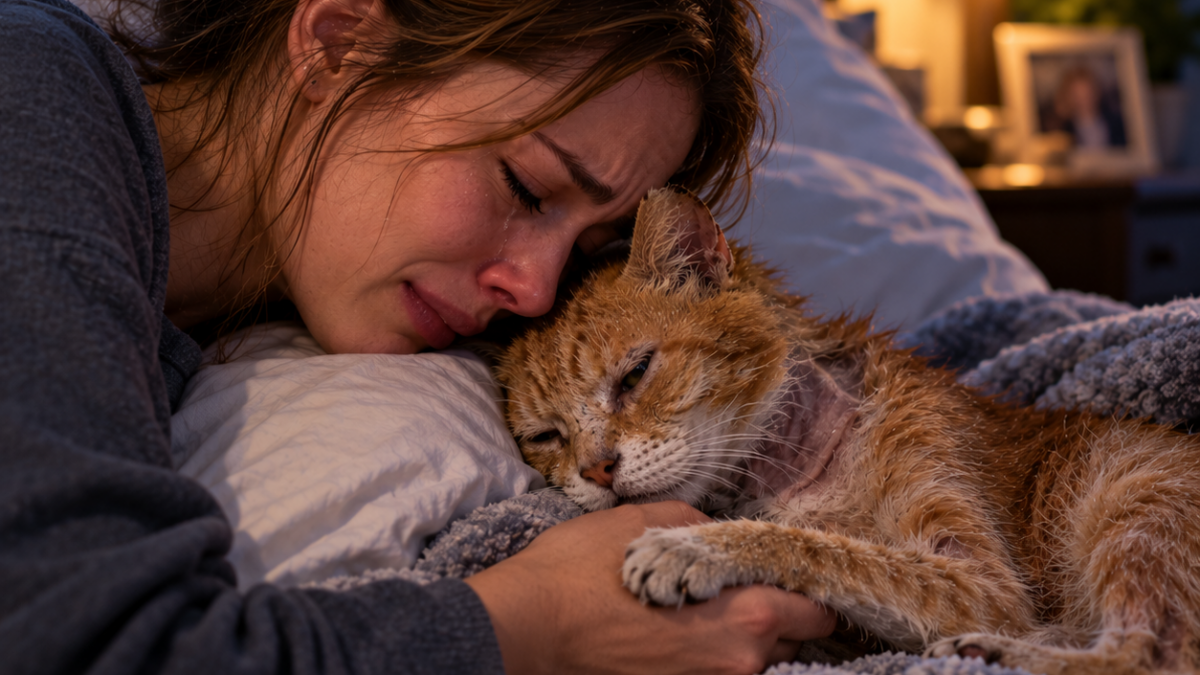
At 3:07, Charlie was beside my pillow.
His front legs trembled.
His back feet slipped slightly on the comforter.
His breathing was shallow.
I sat up too quickly.
“Charlie?”
He looked at me.
Those green eyes had become dull in the final weeks, but for one second they were his again.
Then his legs folded.
I caught him.
He settled beside my chest.
Pressed his forehead against mine.
I began crying immediately.
I did not reach for the lamp.
Did not reach for my phone.
I placed my hand between us.
Charlie wrapped both front paws around it.
Not tightly.
He did not have tight left.
But both paws closed around my fingers.
The clock beside the bed read 3:09.
His purr became uneven.
I knew the emergency veterinary clinic was seventeen minutes away at that hour.
I knew where the carrier was.
I knew my car had half a tank of gas.
I knew I could call.
I also knew Charlie hated the carrier.
He had hated it for sixteen years.
At the vet, he pressed himself into corners.
He hated stainless-steel tables.
Bright lights.
Strangers holding his legs.
The smell of antiseptic.
The car made him cry from the moment the engine started until the moment it stopped.
I looked at him against my hand.
At the body that had somehow climbed fourteen stairs.
And something inside me said:
No.
Not another trip.
Not another carrier.
Not another needle.
Not another room.
Not tonight.
I put my face against his.
“I’m here.”
Charlie breathed.
His purr became quieter.
Then softer still.
His paws stayed around my hand.
At 3:18, his breathing changed.
A long inhale.
Pause.
Another.
I knew enough to understand.
I was terrified.
I nearly reached for my phone.
Then Charlie pushed his forehead one fraction closer.
Maybe it was intentional.
Maybe not.
I have replayed that movement thousands of times.
His next breath came late.
Then another.
Then none.
I waited.
Whispered his name.
Waited again.
Placed my ear near his chest.
Nothing.
Charlie died with his forehead against mine and his paws around my hand.
For almost two hours, I did not move.
Gray light slowly replaced darkness.
Cars began passing outside.
A neighbor started a shower.
A garbage truck stopped three houses away.
Everything continued.
That offended me.
I had always imagined death as an event so large the world should notice.
Instead, the world ran on schedule.
At 5:17, I called my sister.
Rachel lived forty minutes away.
She answered on the second ring.
“Hello?”
“Charlie’s gone.”
Silence.
Then:
“What?”
“He died.”
“Oh God.”
I don’t remember the rest.
She must have asked if I was alone.
I must have said yes.
She arrived at 6:08 wearing sweatpants beneath a winter coat, hair pulled into a crooked knot.
She came upstairs without knocking.
Stopped in the bedroom doorway.
Saw us.
Charlie was still beside me.
His paws had loosened.
My hand remained where he had held it.
Rachel covered her mouth.
She had known Charlie nearly as long as I had.
Every Thanksgiving, he slept on her suitcase.
Not because he loved her.
Because he liked preventing people from leaving.
Rachel moved closer.
Then asked:
“Why didn’t you call someone?”
She did not say it cruelly.
That almost made it worse.
I looked at Charlie.
“There wasn’t time.”
“You said he climbed the stairs.”
“He did.”
“And he was alive when you woke?”
“Yes.”
“And then his breathing changed?”
“Yes.”
“Then there was time.”
Her voice shook.
Not anger.
Fear.
Rachel’s fear always sounded practical.
When Mom was dying, Rachel built spreadsheets.
Medication schedules.
Appointment folders.
Emergency numbers.
Oxygen readings.
Questions for doctors.
I sat with Mom and read books aloud.
Rachel managed everything that could still be managed.
I stayed beside what could not.
Neither of us was wrong.
But grief has a way of turning different kinds of love into accusations.
“I knew why he came,” I said.
Rachel stared.
“You can’t know that.”
“I did.”
“You were scared.”
“Yes.”
“You were alone.”
“Yes.”
“You made a decision while you were emotional.”
“What decision?”
She hesitated.
“To let him die there.”
The room changed.
I pulled the blanket higher over Charlie.
“I did not let him die.”
“You know what I mean.”
“No.”
“I don’t.”
“The vet told you to think about his comfort.”
“I was thinking about his comfort.”
“He may have been in pain.”
“He was purring.”
“Cats purr when they’re distressed too.”
I knew that.
The veterinarian had told me.
I had read it online during one of Charlie’s bad nights.
The sentence lodged inside me immediately.
Rachel sat on the edge of the bed.
Her eyes turned red.
“I just wish you had called.”
“And I’m glad I didn’t.”
The words came before kindness could stop them.
Rachel looked shocked.
“He hated the car.”
“I know.”
“He hated the carrier.”
“I know.”
“He hated the clinic.”
“I know.”
“He climbed fourteen stairs to get here.”
“I know.”
“I was not putting him in a plastic box and driving him across town while he was dying.”
Rachel stood.
Her grief changed shape.
“So that’s it?”
“What?”
“You decided home was kinder because home was what you wanted?”
“No.”
“Because I knew him.”
“You knew yourself too.”
That sentence cut cleanly.
Rachel knew the instant it left her mouth.
Her face changed.
“I’m sorry.”
Apologies are strange things.
People say words cannot be taken back.
That is true.
But apologies do not erase words.
They simply stand beside them and ask you to consider the speaker as more than their worst sentence.
I was not ready for that yet.
“Maybe you’re right.”
“I didn’t say that.”
“You did.”
“I said maybe you should have called.”
“And maybe I should have.”
That question followed me for six months.
Maybe I should have called.
Maybe I should have taken him downstairs.
Maybe the stairs were not a goodbye.
Maybe he was looking for help.
Maybe he climbed because his body was confused.
Maybe he was in pain.
Maybe I chose what was easier for me.
Maybe I waited too long.
Maybe I should have scheduled euthanasia the week before.
Maybe the day before.
Maybe I stole a peaceful ending from him because I was too afraid to choose it.
Rachel had not invented the doubt.
She only gave it a voice.
We wrapped Charlie in his blue blanket.
Worn thin in the center.
Covered in orange hair despite years of washing.
Rachel offered to carry him downstairs.
“No.”
I slid my arms beneath him.
He felt impossibly light.
Charlie had once weighed thirteen pounds and occupied a queen-size bed as if he had paid for it.
Now he felt like folded laundry.
That was the first thing that completely broke me.
At the top of the staircase, I stopped.
Fourteen.
I carried him down.
One.
Two.
I imagined his paws pulling him upward.
Three.
Four.
Had he stopped here?
Five.
Six.
Had he rested?
Seven.
Eight.
Had he slipped?
Nine.
Ten.
Had he been frightened?
Eleven.
Twelve.
Did he know I was upstairs?
Thirteen.
Fourteen.
His bed remained near the wall.
The untouched soft food beside it.
Rachel began gathering medical supplies.
Kidney food.
Fluid bags.
Needles.
Towels.
The handwritten medication schedule taped to the refrigerator.
I heard the kitchen trash lid.
“Don’t.”
She froze.
An open packet of food in her hand.
“What?”
“Don’t throw anything away.”
“It will spoil.”
“I don’t care.”
She put it back.
At nine, I called the veterinary office.
When the receptionist answered, I could not say Charlie’s name.
Rachel took the phone.
Explained.
Then asked about cremation.
“No.”
She covered the receiver.
“What?”
“I don’t want him burned.”
“What do you want?”
“I don’t know.”
That answer became the anthem of the next several months.
We took him to the clinic.
I refused the carrier.
Rachel drove while Charlie lay in my lap beneath the blue blanket.
At a red light, she touched the fabric.
“I am sorry.”
“I know.”
“I loved him too.”
“I know.”
“I was scared when I saw him.”
I looked at her.
She kept her eyes on the road.
“When Mom was dying, I kept thinking there had to be one more thing.”
I said nothing.
“One more doctor.”
“One more medication.”
“One more hospital night.”
“I knew she wanted to stay home.”
“I knew the doctors said we were out of treatments.”
“But doing something felt better than standing there.”
I looked down at Charlie.
“You didn’t do nothing.”
She swallowed.
“Neither did you.”
At the clinic, a veterinary assistant named Mara met us through a side entrance.
She had shown me how to give Charlie fluids eleven weeks earlier.
When she saw the blanket, her eyes filled.
“Oh, sweet boy.”
She took us into a quiet room.
No fluorescent lights.
One lamp.
Two chairs.
Mara explained the options.
Private cremation.
His ashes returned.
Communal cremation.
Home burial if local law and property ownership allowed it.
I said:
“I want to bury him.”
Rachel looked at me.
“Where?”
“Backyard.”
“You rent.”
“I know.”
“What happens if you move?”
“I’m not moving.”
“You don’t know that.”
I hated her for being reasonable.
The house had always been temporary.
One-year lease.
Crooked cabinets.
Muddy yard every spring.
Landlord three counties away.
But Charlie had lived there four years.
Longer than anywhere else in the final half of his life.
“This is his home.”
Rachel said gently:
“It’s your home.”
“It was his too.”
Mara offered private cremation.
“You could keep him with you if you move.”
I imagined Charlie in an urn.
A container on a shelf.
Something I would dust.
Something a visitor might mistake for decoration.
“That doesn’t feel like him.”
Rachel said:
“Nothing is going to feel like him.”
I looked at her.
She was right.
That was the cruelty.
No method of handling Charlie’s body could return Charlie.
Every option dealt only with the part of him that no longer contained the thing I loved.
I signed for private cremation anyway.
Mara asked if I wanted a clay paw print.
At first I almost said no.
Sixteen years reduced to a paw in clay felt insulting.
Then I imagined leaving without it.
“Yes.”
When Mara lifted Charlie from my arms, my hands remained curved.
I could still feel his shape.
The body remembers weight after the weight is gone.
“Wait.”
Mara stopped.
“I need him back.”
“You can hold him longer.”
“No.”
I reached for the blanket.
“I mean I’m taking him home.”
Rachel stared.
Mara nodded.
“You can change your mind.”
“I don’t know what I’m doing.”
“That’s okay.”
It was the kindest permission anyone gave me that week.
We drove home.
Rachel stayed until afternoon.
She made coffee.
Washed Charlie’s food bowl.
When I saw it upside down beside the sink, clean and empty, I cried.
“I’m sorry,” she said.
“It’s okay.”
It wasn’t.
Grieving people say that constantly.
Nothing is okay.
But language runs out before grief does.
At four, Rachel had to leave.
Her husband was picking up their daughter.
She stood in the living room in her coat.
Charlie was wrapped on the couch.
“You can’t keep him here.”
“I know.”
“You need to decide tonight.”
“I know.”
“Do you want me to come back?”
“No.”
“Are you sure?”
“No.”
She hugged me.
At first, I stayed stiff.
Then wrapped my arms around her.
“I wasn’t saying you failed him.”
“I know.”
“I just don’t understand how to accept that sometimes loving someone means not fixing what’s happening.”
Neither did I.
After she left, the house became unbearably quiet.
I called my landlord.
Dale answered after several rings.
He was almost seventy.
We had met twice.
Lease signing.
Furnace repair.
“I’m sorry,” he said when I told him. “Was he the orange cat who watched me work on the thermostat?”
“Yes.”
“He looked like he hated me.”
“He did.”
“I respected that.”
I almost laughed.
Then asked about burial.
Dale became quiet.
“I don’t think so.”
My entire body tightened.
“Why?”
“Rental property.”
“I checked city rules.”
“That’s not the only issue.”
“This was his home.”
“It was your home.”
“It was his too.”
“I understand.”
“No, you don’t.”
The words came too hard.
I immediately felt ashamed.
Dale had not killed Charlie.
He had not created rental law.
He was just an old man who owned a house I wanted to turn into something permanent because everything else felt temporary.
“I’m sorry.”
Dale sighed.
“I had a dog once.”
I waited.
“Jenny.”
“Black mutt.”
“Smartest thing in the family.”
“What happened?”
“She died when my boys were young.”
“We buried her behind our first house.”
I leaned against the kitchen counter.
“Then why won’t you let me?”
“Because we moved.”
I closed my eyes.
“The new owners built a shed where she was.”
“I always hated that.”
“So let me bury Charlie.”
“That’s why I’m saying no.”
He paused.
“You think this house is permanent today because you need something to be permanent.”
“It isn’t.”
“One day you may leave.”
“And then you’ll feel like you left him too.”
“What am I supposed to do?”
“I don’t know.”
I laughed bitterly.
“Everyone keeps saying that.”
“That’s because there isn’t a good answer.”
That was the first useful thing anyone said.
There was not a good answer.
Only different kinds of pain.
I found a pet cemetery nearly an hour away.
Beautiful website.
Tall trees.
Small stones.
Permanent care.
The total cost was more than a month’s rent.
I stared at the number.
Then hated myself for caring about money.
Charlie had given me sixteen years.
Shouldn’t I give him something permanent?
Then another voice answered:
You have already spent nearly three thousand dollars during his last eleven weeks.
Blood work.
Prescription food.
Fluids.
Medication.
Emergency visits.
Credit-card balance.
Money borrowed briefly from Rachel.
I would have spent everything if it could save him.
But Charlie was dead.
Was an expensive grave love?
Or proof?
I called Rachel.
“How much?” she asked.
I told her.
“No.”
The speed made me furious.
“You don’t get to decide.”
“I know.”
“Then don’t say no.”
“You cannot afford it.”
“You don’t know what I can afford.”
“I lent you money for the emergency visit.”
“I paid it back.”
“That isn’t the point.”
“It feels like it.”
Rachel became quiet.
Then:
“Charlie does not care where his body is.”
“You don’t know that.”
“He was a cat.”
“He was Charlie.”
“I know.”
“You keep saying that.”
“Because I do.”
“No.”
I paced the living room.
“You know what he was to you.”
“And you know what he was to you.”
I stopped.
Rachel continued.
“You built your adult life with him in it.”
“I did not build my entire life around a cat.”
“You rejected an apartment because it didn’t allow animals.”
“That was years ago.”
“You left Mark partly because he wanted you to give Charlie away.”
“That was not the only reason.”
“You worked from home during treatment.”
“My manager allowed it.”
“You stopped Sunday dinners because he needed fluids.”
“So?”
“I am not criticizing you.”
“It sounds like criticism.”
“I am saying this decision is not only about where his body goes.”
I sat.
“What else is it about?”
“You.”
I said nothing.
“What happens to you now?”
I hung up.
She called back.
I ignored it.
I spent the next hour on the floor.
Not thinking about burial.
Thinking about every ordinary sentence in my life.
We need groceries.
We are not answering the door.
We hate that commercial.
We need to clean this place.
We’re going to bed.
We’re home.
We.
For sixteen years, nearly every private thought had included another living creature.
Now there was no we.
At six, someone knocked.
My neighbor, Mr. Ellis.
Seventy-four.
Brick house across the street.
Flagpole.
Three bird feeders.
Swept his driveway even when it was already clean.
He held a casserole.
“I heard about your cat.”
“How?”
“Your sister told my wife.”
He raised the dish.
“Lasagna.”
I let him inside.
He saw the blue blanket.
“You still have him?”
“I’m deciding.”
Mr. Ellis looked at Charlie.
Then said:
“My wife kept our dog in the garage for three days after he died.”
I stared.
“What?”
“It was January.”
“Cold enough.”
“She couldn’t let animal control take him.”
“Couldn’t choose cremation.”
“Couldn’t bury him.”
“What did you do?”
“Told her she was making everything harder.”
I almost smiled.
“How did that go?”
“She told me to get out of the garage.”
“Smart woman.”
“Usually.”
He looked toward his house.
“Third day, I sat with her.”
“What changed?”
“Nothing.”
He shrugged.
“I realized I was trying to hurry her because her grief made me uncomfortable.”
That sentence stayed.
People like grief when it behaves.
A funeral.
A card.
Flowers.
Three days off.
A framed photograph.
Quiet sadness on anniversaries.
Grief becomes frightening when it takes up physical space.
An untouched bowl.
A blanket.
A body that has not left.
A person saying:
Not yet.
“How long is too long?” I asked.
Mr. Ellis shook his head.
“I don’t know.”
I laughed.
He smiled.
“It’s still true.”
Then he said:
“My brother has land.”
Twenty-five acres outside town.
Woods.
Two dogs buried there.
A horse.
“Would he let Charlie be buried there?”
“I’ll ask.”
It felt right immediately.
That frightened me too.
“What if he sells it?”
“He’s eighty-one.”
“That doesn’t mean forever.”
“No.”
Mr. Ellis looked at me.
“Nothing does.”
The next morning, we drove forty minutes.
Charlie rested inside a pine box Mr. Ellis had made in his garage.
Simple boards.
No stain.
No brass.
Six screws.
I lined it with the blue blanket.
Placed his toy mouse beside him.
A photograph of Mom holding him.
And his old ceramic food bowl.
Blue.
Faded fish around the rim.
Chip near one edge.
Rachel told me to keep it.
I refused.
“It’s his.”
“You might want it.”
“I don’t want to see it empty.”
“You could use it someday.”
“For what?”
She did not answer.
I put it beside Charlie.
Mr. Ellis’s brother Walter met us at the edge of the woods.
Eighty-one.
Canvas jacket.
Wooden cane.
He led us beneath two maple trees.
Three flat stones already rested near the tree line.
“Animals?”
“Sam.”
“Jenny.”
“The horse.”
He pointed.
“You can put your boy there.”
My boy.
The words nearly dropped me.
Walter had dug most of the grave.
Mr. Ellis and I finished.
I had never dug a grave.
Movies make it symbolic.
Mostly it was work.
Frozen soil.
Roots.
Blisters.
Back pain.
Breath visible in cold air.
When the hole was deep enough, we lowered the box.
“Wait.”
The men stepped away.
I knelt.
Put my hand on the lid.
Every apology I had ever invented came out.
“I’m sorry.”
For the disease.
The needles.
The times I got frustrated when he refused food.
The nights I slept too deeply.
Waiting too long.
Maybe not waiting long enough.
Not calling.
Thinking I should have called.
For not knowing.
Then I remembered what the veterinarian told me at the beginning.
“There may come a point when every choice feels wrong because every choice ends with losing him.”
I thought she meant euthanasia.
I finally understood.
Treatment could feel wrong.
Stopping could feel wrong.
A hospital could feel wrong.
Home could feel wrong.
Cremation.
Burial.
Keeping things.
Letting things go.
There was no perfect choice hiding somewhere waiting for me to become wise enough to discover it.
“You came to me,” I whispered.
“So I stayed.”
No sign appeared.
No warm breeze.
No certainty.
We filled the grave.
I helped until my shoulders hurt.
Walter placed a fieldstone over the center.
“You can bring a marker.”
“This is enough.”
“You sure?”
“No.”
He smiled.
“Usually means you’re telling the truth.”
I stayed away from work for a week.
My company’s bereavement policy covered spouses.
Children.
Parents.
Siblings.
Not cats.
My manager let me use vacation time.
I appreciated it.
I also hated the language.
Charlie had been part of my daily life longer than almost anybody I knew.
There was no box on the HR form for:
Animal who sat beside me after my mother died.
No box for:
Creature who knew every apartment I lived in.
No official category for sixteen years of ordinary companionship.
On day eight, I returned.
My coworkers had signed a card.
A rainbow.
A paw print.
Eleven condolences.
One person wrote:
You can always get another one.
She meant kindness.
I cried in a bathroom stall.
At lunch, my coworker Jenna found me sitting in my car.
She climbed into the passenger seat.
“I had a cat named Lou.”
I wiped my face.
“When?”
“He died nine years ago.”
“I’m sorry.”
“He was horrible.”
I almost laughed.
“He bit my ex-husband every Thursday.”
“Why Thursday?”
“That was the night my ex worked late.”
“Lou hated schedule changes.”
She stared through the windshield.
“When Lou died, I took one day off.”
“My supervisor told me I was dramatic.”
“What did you do?”
“Came back and made three mistakes before noon.”
Then she looked at me.
“Grief does not disappear because payroll does not recognize it.”
That changed something.
Not everything.
Something.
I began noticing how many people had stories.
Dogs.
Cats.
Birds.
A rabbit one man still missed after twenty years.
A horse my manager could not talk about without looking away.
The pain was common.
Only private.
Two weeks after Charlie died, Rachel arrived carrying a cardboard box.
“His things.”
I stared.
She had taken more than I realized.
Unopened food.
Brush.
Toys.
Two collars.
Fluid towels.
Orange hair clung to the brush.
One collar still held my phone number.
I touched it.
“Why did you take these?”
“You told me not to throw anything away.”
“I thought maybe seeing it all at once would hurt.”
“It did hurt.”
“I know.”
She sat.
Then said:
“I called the vet.”
My hand closed around the collar.
“You what?”
“I didn’t use your name.”
“That is not the point.”
“I needed to understand.”
“You wanted proof I was wrong.”
“No.”
“Yes.”
“I wanted proof that I should stop thinking you were.”
That stopped me.
“What did they say?”
Rachel breathed.
“The doctor said there is no way to know exactly what Charlie experienced in those final minutes.”
“Useful.”
“She said climbing the stairs would have taken enormous effort.”
“I know.”
“She said some animals isolate at the end.”
My stomach tightened.
“And others seek their person.”
I looked at her.
“She said there is no test that can tell us why Charlie climbed upstairs.”
“So nothing.”
“No.”
Rachel’s eyes filled.
“We learned there wasn’t one obvious right choice.”
“I already knew that.”
“I didn’t.”
She sat across from me.
“When Mom was dying, I wanted the hospital.”
“I remember.”
“You wanted home.”
“Yes.”
“I thought you were giving up.”
“I thought you were refusing to let her rest.”
Rachel nodded.
“We never said it.”
“No.”
“We said it every other way.”
That was true.
Mom had wanted to die at home.
Rachel accepted it with her head.
Not her body.
She checked oxygen.
Medications.
Temperature.
She watched for emergency signs.
I read aloud and held Mom’s hand.
Rachel had looked at my stillness and thought surrender.
I had looked at her activity and thought denial.
We were daughters failing in opposite directions.
“When I saw Charlie beside you,” she said, “I was back in Mom’s room.”
“You looked calm.”
“I was numb.”
“I know now.”
She wiped her cheek.
“I’m sorry I made his death about her.”
“I’m sorry I hung up.”
“You should be.”
I looked at her.
She smiled.
Then pulled a sealed envelope from the box.
“The clinic mailed this to my address by mistake.”
Inside:
Sympathy card.
Clay paw print.
Charlie.
Date.
The print was smaller than I expected.
Four toe marks.
Central pad.
One faint claw line.
I touched beside it.
Not across.
I was afraid I would wear it away.
The bowl could go with Charlie.
The blanket.
Toy.
But this mark had been made after he was gone.
It felt different.
Something left behind.
Rachel said:
“I’m glad you kept the bowl.”
“I buried it.”
Her mouth fell open.
“You what?”
“I told you.”
“I thought you’d change your mind.”
“No.”
“That bowl was from Mom.”
The room tilted.
“What?”
“She bought it.”
“No.”
“Yes.”
“I bought that bowl.”
“No.”
“Mom gave it to you when Charlie was young.”
“Blue ceramic.”
“Fish around the edge.”
I saw it underground.
Beside Charlie.
Under dirt.
“What are you talking about?”
“She bought it when she visited your first apartment.”
“You don’t remember?”
No.
I remembered unpacking it.
Washing it.
Charlie pushing it around the kitchen.
I did not remember Mom buying it.
“You never told me.”
“I thought you knew.”
I stood.
“I need to go get it.”
Rachel stared.
“What?”
“The bowl.”
“It’s buried.”
“I know.”
“Inside the box.”
“Yes.”
“That means opening Charlie’s grave.”
“I need it.”
“No.”
“You don’t get to decide.”
“I know.”
“Then move.”
Rachel stood in front of the door.
For the first time since Charlie died, I felt certainty.
Wild.
Desperate certainty.
I had made another irreversible mistake.
Buried the only object connecting Mom and Charlie.
“I need it back.”
Rachel said:
“It was Charlie’s.”
“It was Mom’s.”
“She bought it for him.”
“Why didn’t you tell me?”
“I didn’t know you didn’t know.”
“I buried it.”
“I know.”
“My mother bought that.”
“Our mother.”
“Move.”
“No.”
I grabbed my coat.
Rachel did not move.
“You are not driving forty minutes in this state to open his grave.”
“I am not asking permission.”
“Stop.”
“I have made the wrong choice every single time.”
Her expression changed.
I started crying.
“I should have called.”
“Maybe.”
“I should have scheduled euthanasia.”
“Maybe.”
“I should have cremated him.”
“Maybe.”
“I should have buried him here.”
“Maybe.”
“I should have kept the bowl.”
“Maybe.”
“Stop saying maybe!”
Rachel’s voice broke.
“You do not want certainty.”
“Yes, I do.”
“No.”
“You want a different ending.”
Everything in me stopped.
I sank onto the kitchen floor.
Rachel sat beside me.
I cried into her shoulder.
The box stayed open on the table.
Collar.
Brush.
Paw print.
Nothing could fix what happened.
Nothing could bring Charlie back.
Nothing could return Mom.
Nothing could transform my choices into perfect ones.
Rachel stayed.
Charlie would have understood that.
Months passed.
Winter became spring.
I visited Charlie every Sunday.
Sometimes Rachel came.
Sometimes Mr. Ellis.
Sometimes alone.
Walter never asked why I visited so often.
He waved from his porch.
In March, green shoots appeared.
April brought buds to the maples.
In May, I brought a wooden marker.
CHARLIE
MY HOME FOR SIXTEEN YEARS
Rachel read it.
“People will argue with that.”
“About?”
“Calling a cat your home.”
“I don’t care.”
“Some people think we make too much of pets.”
I touched the wood.
“Some people make too little of everything.”
Rachel smiled.
“That sounds like Mom.”
It did.
The first anniversary approached.
I became afraid of three in the morning.
Afraid I would wake exactly then.
More afraid I would sleep through it.
Rachel offered to stay.
“No.”
This time the word meant no.
I made tea.
Sat downstairs beside the staircase.
A metal water bowl remained near the bottom step.
Not Charlie’s bowl.
A new one.
Empty.
I had placed it there without thinking weeks after his death.
Then could not move it.
At 2:56, I heard scratching at the back door.
Every cell in my body believed for one impossible second that Charlie had returned.
I ran.
A small gray-and-white cat crouched beneath the porch light.
Thin.
Mud on her paws.
Scratches across her nose.
I opened the door.
She ran.
The next night, she returned.
Then the next.
I put food out.
For two weeks, she ate only after I went inside.
Mr. Ellis noticed.
“You have a customer.”
“She is not mine.”
“That’s probably what you said sixteen years ago.”
“I’m not adopting another cat.”
“Of course not.”
I meant it.
I could not do it again.
People talk about adoption like it is a transaction of joy.
They do not talk enough about the contract.
You promise to love something whose life will probably be shorter than yours.
You agree that someday you may have to make decisions no one can make without doubt.
You accept that the same animal who gives you companionship may eventually give you grief large enough to rearrange a house.
I had fulfilled that contract.
I didn’t want to sign another.
The gray cat kept coming.
I called her Porch Cat.
Rachel called her Daisy.
Mr. Ellis called her Barbara.
“Why Barbara?”
“She looks like a Barbara.”
“That explains nothing.”
“Some truths don’t require explanation.”
Then a thunderstorm came in June.
Hard rain.
Lightning.
At eleven, I checked the porch.
The gray cat was curled under a plastic chair.
Soaked.
Shaking.
I opened the door.
This time she did not run.
I put a towel inside the threshold.
Stepped back.
After several minutes, she walked in.
Four paws on the kitchen floor.
No farther.
She looked at the staircase.
Then me.
My chest tightened.
“No.”
The cat blinked.
“I cannot do this.”
She sat.
Not dramatic.
No instant purr.
No leap into my lap.
She simply sat near my leg.
Exactly the way Charlie had on the fourth night in my first apartment.
I laughed once.
Then started crying.
The cat remained.
By morning, she slept beneath the kitchen table.
I took her to the shelter.
No microchip.
No matching lost reports.
They posted her online.
Nobody claimed her.
The shelter was full.
“We can place her on a waiting list.”
I looked through the carrier.
The cat stared at me.
“I’ll keep her temporarily.”
The shelter worker smiled.
I hated that smile.
Rachel arrived with supplies.
Litter.
Food.
Toys.
And a ceramic bowl.
Blue.
Fish around the edge.
I stared.
“You did that on purpose.”
“Yes.”
“I’m not keeping her.”
“I know.”
“She could belong to someone.”
“No one has claimed her.”
“She may hate this house.”
“She slept on your sweater.”
“That means nothing.”
Rachel smiled.
“What are you naming her?”
“I’m not.”
“Daisy.”
“No.”
“Barbara.”
“Absolutely not.”
The cat walked into the kitchen.
Stopped beside the bowl.
Looked up.
I thought of Charlie’s dish beneath dirt.
For months I had imagined digging it back up.
I never did.
Not because it stopped mattering.
Because eventually I understood something.
Some objects become sacred through use.
Not ownership.
Mom bought the old bowl.
Charlie ate from it.
I buried it with him.
All three truths could exist together.
I poured food into the new bowl.
The gray cat stepped forward.
“June.”
Rachel frowned.
“What?”
“Her name is June.”
“Why?”
“It’s June.”
“That is deeply uncreative.”
“I’m not accepting feedback.”
June stayed.
At first I apologized to Charlie every time she did something familiar.
The first time she slept on my bed.
The first time she sat in his window.
The first time I came home from the vet and said:
“We’re home.”
The word stopped me.
We.
Then I started apologizing when June did things differently.
Charlie tapped my face for breakfast.
June pulled my hair.
Charlie hid from strangers.
June climbed into the lap of the cable technician before he put down his tool bag.
Charlie loved cardboard boxes.
June was terrified of them.
Charlie ignored every expensive bed I purchased.
June slept in one immediately.
She was not Charlie.
That became her greatest gift.
Loving June did not replace him.
It proved he had not taken my ability to love when he left.
A year after June arrived, Rachel and I visited Charlie’s grave.
White flowers had grown around the stone.
The marker was graying.
I sat in the grass.
“She steals socks.”
Rachel smiled.
“Charlie would hate her.”
“He’d train her.”
“He would hide upstairs.”
Rachel looked toward the marker.
“He climbed those stairs for you.”
The sentence no longer destroyed me.
That surprised me.
“I still don’t know if I should have called.”
Rachel picked at grass.
“I still don’t know if Mom should have gone to the hospital.”
“Do you think about it?”
“Not every day.”
“Me neither.”
She looked at me.
“That feels disloyal.”
“Yes.”
We sat quietly.
Then Rachel said:
“I think there are two kinds of guilt.”
“What kinds?”
“One that tells you you actually hurt someone.”
“And the other?”
“The kind that appears because you loved someone and couldn’t save them.”
I looked at Charlie’s name.
“How do you tell the difference?”
Rachel laughed softly.
“I don’t know.”
“Everyone says that.”
“It’s still true.”
I put my fingers against the marker.
No forgiveness arrived.
No certainty.
Something smaller did.
Enough.
Maybe Charlie had been in pain.
Maybe I should have called.
Maybe the clinic could have made those final minutes easier.
Maybe a car ride would have terrified him.
Maybe the stairs were a search for help.
Maybe they were a search for me.
There is no test that can answer it now.
But I stopped treating uncertainty as proof that I had failed.
That mattered.
For a long time, I believed love was proven by preventing loss.
Find another treatment.
Make another call.
Pay another bill.
Try another food.
Schedule another appointment.
Fight.
Fix.
Save.
Sometimes that is love.
Sometimes euthanasia is love.
Sometimes emergency care is love.
Sometimes bringing an animal into a clinic before suffering becomes severe is the kindest decision a person can make.
I know that.
I would never tell somebody else that Charlie’s death meant they should make my choice.
That would be cruel.
Every animal.
Every illness.
Every person.
Every final day is different.
But love is also sometimes staying when no repair remains.
Charlie never dragged me toward solutions when I broke.
He came closer.
When I cried at twenty-one, he leaned against my leg.
When Mom died, he pressed his forehead against my chin.
When a relationship ended, he waited on a bath mat.
He did not cure anything.
He stayed.
On the final night, I did the same.
I did not ask him to spend his last strength going somewhere else.
I put my hand between us.
He held it.
That is what happened.
The meaning is less certain.
And I finally learned to live with that.
June was waiting by the door when I returned from Charlie’s grave.
She yelled because dinner was six minutes late.
I picked her up.
She tolerated three seconds before pushing away.
“Your brother was much more patient.”
June bit my shirt collar.
Inside, I filled the blue bowl.
Then looked toward the staircase.
Fourteen steps.
For months after Charlie died, I counted them every time I passed.
One.
Two.
Three.
All the way to fourteen.
I imagined his thin body climbing.
His paws slipping.
His heart working too hard.
His final strength disappearing one stair at a time.
Eventually, I stopped counting.
Not because I forgot.
Because memory had finally become something other than evidence in a trial against myself.
Some nights I still stand at the bottom.
I still see him.
Skinny orange cat.
Chipped tooth.
Torn ear.
Pulling himself upward.
Not because I know exactly what he wanted.
I don’t.
Maybe he was confused.
Maybe he was frightened.
Maybe his body followed the oldest path it knew toward safety.
Maybe that path was me.
Maybe I tell myself that because I need it.
After all these years, I have learned that love and meaning do not have to survive a courtroom standard of proof.
Charlie climbed those stairs.
He found me.
I stayed.
He died holding my hand.
Everything after that—the accusations, the burial, the bowl, the guilt, June, the arguments about what I should have done—belonged to the living.
Charlie’s final act was simpler.
For sixteen years, whenever something in my life broke, he came close enough that I would not be alone with it.
And on the one night when the thing breaking was him, with almost nothing left in his body, he climbed fourteen stairs.
Maybe he came because he needed me.
Maybe he came because he knew I needed him.
Maybe there was never a difference.
All I know is that Charlie had spent his whole life staying beside me.
And before he left, he found enough strength to do it one last time.

