My Cat Had Been Missing for 437 Days—Then I Whistled Three Notes Beside a Road Six Miles From Home and a Filthy Orange Cat Came Running Into My Arms.
My Cat Had Been Missing for 437 Days—Then I Whistled Three Notes Beside a Road Six Miles From Home and a Filthy Orange Cat Came Running Into My Arms.
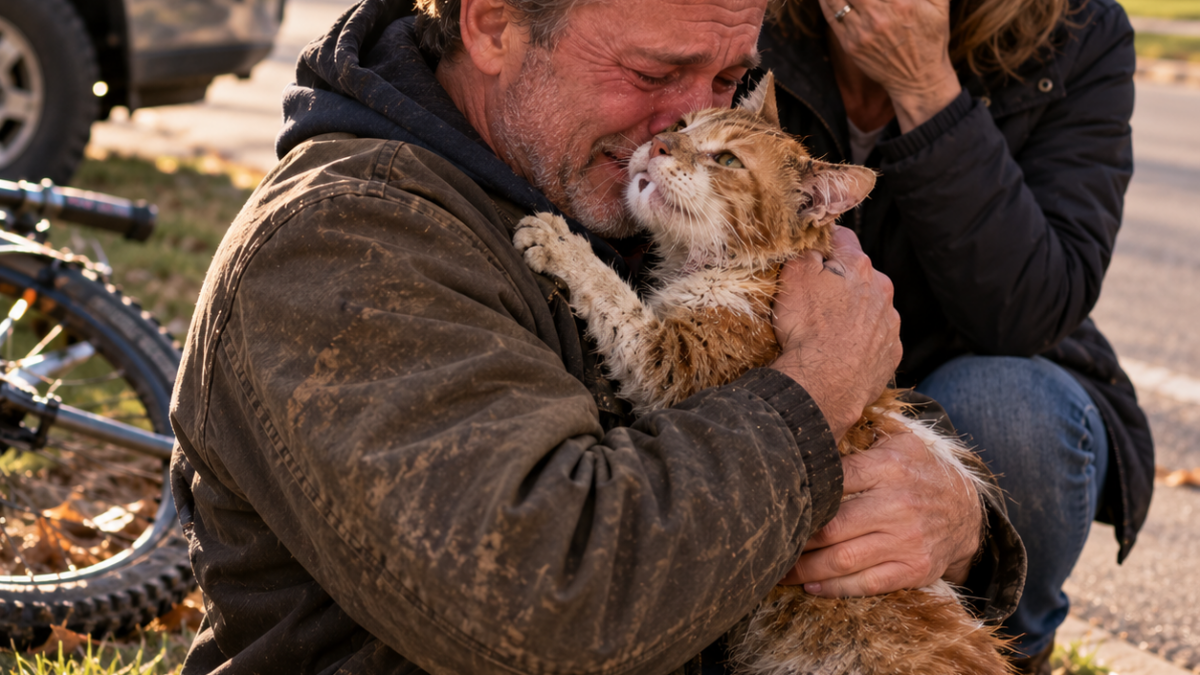
After 437 days of searching for my missing orange cat, I whistled the three notes he had known for nine years beside a road six miles from home, and the filthy animal under a pickup lifted his head and ran straight into my arms.
Three weeks later, a stranger appeared on my porch carrying sixty-three photographs that proved Otis had spent most of those missing months warm, fed, and sleeping in another man’s chair under another name.
I thought the cruelest thing would be discovering my cat had learned to love someone else, but the real betrayal came when strangers turned that second home into a public custody war—and I nearly punished the lonely widower who had kept Otis alive simply because I needed my grief to mean I belonged to him more.
For 437 days, I looked under parked cars.
That was the habit that stayed longest.
The flyers eventually came down.
The shelter calls became less frequent.
Neighbors stopped asking.
My wife stopped leaving a bowl of water beside the back door.
But every time I drove through Knoxville and saw a flash of orange beneath a porch, behind a dumpster, beside a mailbox, under a pickup truck, my foot came off the gas.
Just in case.
My name is Dean Holloway.
I was fifty-six when Otis disappeared.
My wife, Marla, was fifty-four.
We lived outside Knoxville, Tennessee, in a red-brick ranch house with a sloping backyard, a stubborn maple tree, and a screened porch I had spent three summers promising to repair properly.
Otis had lived with us for almost nine years.
He was orange and white.
Not fancy.
No dramatic breed.
No impressive pedigree.
One odd notch in the fur above his right eye made him look permanently skeptical.
Under his chin was a white spot shaped like a raindrop.
He had the confidence of an animal who believed everything inside our house had been purchased for his personal use.
Every afternoon he slept on the back cushion of the couch beside the front window.
Not on the seat.
On the narrow top edge.
I have no idea why.
Every evening when I came through the door, I whistled.
Two short notes.
One long.
It started by accident.
When he was young, I had whistled while opening a can of food.
Otis came running.
I did it again the next evening.
Then again.
Within two weeks, the whistle meant me.
It meant dinner.
Home.
Attention.
Whatever cats think when they hear the person who has spent nine years paying for their existence.
No matter where he was, I whistled and Otis appeared.
Then one Saturday in late spring, he didn’t.
PART2:
I had spent the afternoon moving old storage boxes from the spare room into the garage.
The back door opened twenty times.
Maybe thirty.
I carried Christmas decorations.
Old tax papers.
A floor lamp Marla hated.
Three boxes labeled KEEP that contained things neither of us remembered owning.
Around six, we ordered pizza.
At seven, Marla stood in the kitchen.
“Where’s Otis?”
I didn’t worry immediately.
“He’s around.”
“He wasn’t at dinner.”
“He’s probably asleep.”
She opened the pantry.
Nothing.
Checked our bedroom.
Nothing.
PART3:
Then she looked at me.
“Whistle.”
I did.
Two short.
One long.
Silence.
Again.
Nothing.
I walked into the garage.
“Otis?”
Behind boxes.
Under workbench.
No cat.
Backyard.
Porch.
Bushes.
Nothing.
Marla opened the can he liked most.
Usually the sound of that lid brought him from another dimension.
Nothing.
By midnight, we were walking the neighborhood with flashlights.
By one in the morning, I was crawling beneath hedges calling his name.
By sunrise, worry had become fear.
We printed flyers.
LOST ORANGE AND WHITE CAT.
OTIS.
MALE.
NEUTERED.
9 YEARS OLD.
WHITE MARK UNDER CHIN.
REWARD.
I taped them to utility poles.
Gas-station windows.
A laundromat.
The grocery store.
Two veterinary clinics.
Marla called the county shelter every morning for nearly a month.
We drove through nearby streets after dark.
We checked drainage pipes.
Sheds.
Vacant lots.
A woman three subdivisions away messaged us:
I think I found your cat.
I left work early.
Orange cat.
White chest.
Not Otis.
Two days later:
There’s one behind the Food City.
I drove there in the rain.
Not Otis.
One month in, a man sent a photograph.
The cat looked so much like him that Marla cried before I left the driveway.
I knew within two seconds.
Wrong chin.
No white raindrop.
I thanked the man anyway.
That became the rhythm.
Hope.
Keys.
Drive.
Wrong cat.
Apology to a stranger.
Drive home.
Marla would look at my face before I even came through the kitchen.
“No?”
“No.”
Weeks became months.
The worst part about a missing animal is that grief refuses to organize itself.
When something dies, there is horror.
But there is certainty.
You know what happened.
A missing pet gives you two stories.
In one, Otis was dead.
Maybe hit.
Maybe attacked.
Maybe sick somewhere I had never searched.
In the other, he was alive.
Hungry.
Calling.
Waiting beside a door I had not found.
Your mind switches between both stories until hope becomes another form of torture.
Around month four, Marla said:
“Maybe someone took him in.”
I almost snapped.
“What?”
“Maybe a family found him.”
“He has a collar.”
“He had a collar.”
“What does that mean?”
“It could come off.”
“Then they should check for a chip.”
The silence after that sentence was my fault.
Otis did not have a microchip.
I had meant to do it for years.
Every annual vet visit, somebody mentioned it.
Every year I thought:
He never leaves the house.
Then:
Next visit.
It was one of those tiny pieces of negligence that do not look like negligence until the exact day they matter.
Marla touched my arm.
“I’m not blaming you.”
“I know.”
But I was.
By Christmas, the flyers in our garage had curled at the corners.
People stopped asking.
I understood.
A person cannot carry somebody else’s missing cat forever.
Life continued.
Kids grew.
Jobs changed.
Neighbors moved.
Our niece had a baby.
A friend retired.
Marla’s sister had knee surgery.
People had their own lives.
Our house kept one empty place.
The couch.
Otis had slept on the top cushion by the window every afternoon.
After he disappeared, neither of us sat there.
We never discussed it.
We simply didn’t.
On the one-year anniversary, Marla picked up the water bowl beside the back door.
She stood over the sink for a long time.
Then:
“Dean.”
I was at the table.
“What?”
“I think we have to accept it.”
I knew what she meant.
I nodded.
Could not speak.
She washed the bowl.
Put it in a cabinet.
That hurt more than the flyers coming down.
Seventy-two days later, I pulled my old bicycle from the garage.
I hadn’t ridden much that year.
I told Marla I needed exercise.
The truth was I needed to get away from our house.
I rode without a plan.
Past subdivisions.
Churches.
A creek.
An older neighborhood with narrow roads and houses built farther apart.
About six and a half miles from home, I saw orange beneath a parked pickup.
I almost kept going.
By then orange cats hurt.
But something made me stop.
Maybe the shape.
Maybe the movement.
Maybe nothing.
The cat crawled out.
He was thin.
Too thin.
His coat dull and filthy.
One side of his face had rough fur from living outside.
I told myself:
Don’t.
Do not do this again.
The cat lifted his chin.
White raindrop.
My hands started shaking.
I got off the bicycle.
My legs barely worked.
The cat watched me from maybe twenty feet away.
I could have called:
Otis.
I didn’t.
I was too afraid.
Because if he didn’t respond, the white mark could still be coincidence.
I crouched beside the road.
Then did something I had not done in 437 days.
Two short whistles.
One long.
The cat froze.
His ears lifted.
My heart slammed against my ribs.
Again.
Two short.
One long.
He made a sound.
Not a normal meow.
A rusty little cry.
Then he ran.
Straight toward me.
“Otis?”
He hit my chest before I could stand.
I caught him.
He pushed his head beneath my chin.
His entire body vibrated with a purr so strong I could feel it through my shirt.
I sat in the grass beside the road.
And I cried.
I do not mean one dignified tear.
I cried like a fifty-six-year-old man who had been holding 437 days inside his chest and someone finally opened the door.
“Where were you?”
Otis purred.
“You absolute idiot.”
He head-butted my jaw.
“You’re alive.”
I called Marla.
She answered:
“Everything okay?”
“I need you to come here.”
“What happened?”
“I need you to come.”
“Dean, are you hurt?”
“No.”
“Then what—”
“Marla.”
My voice broke.
She became silent.
“Is it him?”
I could not answer.
She hung up.
Twenty minutes later, her car came too fast around the corner.
I was sitting on the grass.
Otis wrapped inside my jacket.
Marla got out.
Stopped.
Covered her mouth.
“Dean?”
Otis lifted his head.
For one horrible second, he did not move.
Fear crossed Marla’s face.
Then she whispered:
“Otis.”
He climbed from my lap.
Ran toward her.
Marla dropped to both knees.
He pushed into her chest.
She cried into his dirty fur.
After 437 days, we did not know whether our cat was alive.
He did not need 437 seconds to remember us.
The veterinarian checked him that afternoon.
Underweight.
Dehydrated.
Fleas.
Minor skin infection.
A cracked tooth.
Otherwise surprisingly healthy.
“Somebody may have been feeding him,” the vet said.
I remember shrugging.
“Maybe.”
At the time, I did not care.
I wanted him home.
That first night I put a folded blanket on the floor.
I thought he might be nervous.
Otis walked slowly around the living room.
Sniffed the coffee table.
Checked the kitchen.
Paused where his old food bowl had been.
Marla put it back.
He ate.
Then he walked toward the couch.
Jumped onto the back cushion beside the window.
Same place.
Turned around twice.
Curled up.
Marla looked at me.
“He remembers.”
“Yeah.”
I stood in the doorway.
“He remembers.”
Three weeks later, Rebecca Sloan knocked on our door.
She was forty-five.
Maybe forty-six.
Short brown hair.
Work boots.
Canvas bag.
Nervous enough that I almost felt sorry for her before she said anything.
“Are you Dean Holloway?”
“Yes.”
“My name is Rebecca.”
Her eyes moved past me through the screen.
“Is the orange cat here?”
Everything in me tightened.
“What about him?”
She took out her phone.
“I think he lived with my father.”
I stared.
“What?”
“For almost a year.”
She turned the screen toward me.
There was Otis.
Not skinny.
Not dirty.
Not lost.
He was lying across a faded brown recliner with his legs stretched in front of him.
White mark under chin.
Odd notch above the eye.
I knew him immediately.
Rebecca swiped.
Otis beside an older man at a kitchen table.
Another.
Otis asleep with one paw over his face.
Another.
Otis in a cardboard box.
Another.
Otis on a windowsill.
Another.
The old man holding him.
Otis looked relaxed.
Happy.
I felt cold.
“How many pictures?”
Rebecca hesitated.
“Sixty-three.”
Marla came from the kitchen.
“What’s going on?”
I handed her the phone.
She swiped through three images.
Then sat on the porch step.
Rebecca said:
“My dad called him Rusty.”
“No.”
My voice came sharper than I intended.
“His name is Otis.”
“I know.”
“He’s had that name nine years.”
“I’m not arguing.”
That somehow made me angrier.
Behind us, Otis appeared at the screen door.
Rebecca saw him.
Her whole face changed.
“Oh.”
She covered her mouth.
“Oh, there he is.”
Otis looked at her.
Rebecca did not reach.
Did not call him Rusty.
She turned away and started crying.
Quietly.
“I promised myself I wouldn’t.”
Marla asked:
“Who is your father?”
“Calvin Sloan.”
“Seventy-four.”
“Lives on Beckett Lane.”
I knew Beckett.
Less than two miles from where I had found Otis.
Rebecca sat beside Marla.
“He found your cat about five weeks after he disappeared.”
Five weeks.
That number changed everything.
We had searched for more than a year.
For almost all of it, Otis had been living six miles away.
Inside a house.
“Why didn’t he find us?”
Rebecca’s expression tightened.
“He tried.”
“How?”
“He called the county shelter.”
“He posted at a feed store.”
“A grocery.”
“Asked neighbors.”
“We had flyers everywhere.”
“Not on his road.”
I stopped.
Because she was right.
Our search had spread.
But not evenly.
Everywhere is a word people use when they really mean everywhere they thought to look.
Rebecca continued.
“He didn’t have a collar when Dad found him.”
Otis had disappeared wearing blue nylon with a metal tag.
So somewhere during those first five weeks, it came off.
“Was he scanned?”
“Yes.”
My stomach turned.
“No chip.”
I looked away.
Rebecca did not accuse me.
That almost made it worse.
“Dad waited several weeks before bringing him inside.”
“He fed him near the shed.”
“He posted notices.”
“No one answered.”
“How long did he keep looking?”
“A few months.”
“A few months?”
My tone changed.
Rebecca noticed.
“So after that he decided the cat was his?”
“No.”
“What do you call it?”
“Dean.”
Marla touched my arm.
Rebecca stood.
“I didn’t come here to fight.”
“Then why are you here?”
“My father needs to know he’s alive.”
“He thinks he lost him.”
I almost said:
So did we.
But that sentence no longer belonged only to me.
Marla asked:
“Does Calvin live alone?”
Rebecca nodded.
“My mom died four years ago.”
There it was.
A detail I did not want.
Grief becomes much easier when the other person is abstract.
Rebecca looked through the screen.
“Dad’s not very social.”
“He knows people.”
“I visit.”
“But Rusty…”
She stopped.
“Otis.”
“Yes.”
She swallowed.
“Otis changed the house.”
I understood that sentence instantly.
I hated that I understood.
Rebecca told us Calvin found him beneath an old storage shed.
Skinny.
Dirty.
Hungry.
He put food out.
Next morning, the cat was still there.
Third morning too.
After a week, Otis started sitting near Calvin while he drank coffee on the back steps.
Calvin talked.
Otis listened.
One afternoon Calvin opened the door.
Otis walked inside.
No plan.
No ceremony.
He simply moved in.
Within a month, Calvin bought a cat bed.
Otis never used it.
I laughed despite myself.
“That’s him.”
Rebecca smiled.
“He slept in Dad’s recliner.”
“Also him.”
“My father called it Rusty’s chair.”
I looked at our couch.
Otis had two chairs.
Two windows.
Two food bowls.
Two names.
Two men who had waited for him.
Rebecca gave us her number.
Then asked:
“Would you let Dad see him?”
I said nothing.
Marla answered:
“Yes.”
I looked at her.
She looked back.
Rebecca whispered:
“Thank you.”
When her car left, I shut the door.
“You shouldn’t have done that.”
Marla crossed her arms.
“Why?”
“We don’t know these people.”
“We know he kept Otis alive.”
“We know what she says.”
“She has sixty-three photographs.”
“That doesn’t mean—”
“What?”
I opened the refrigerator.
Nothing inside interested me.
Marla leaned against the counter.
“You’re scared.”
“No.”
“Yes.”
“Of what?”
She looked toward Otis.
“That he loves them.”
I shut the refrigerator hard.
“He’s our cat.”
“I know.”
“Nine years.”
“I know.”
“We searched 437 days.”
“I know, Dean.”
“Then why are we acting like we owe this man something?”
Marla was quiet.
Then:
“Because he looked for Otis too.”
I didn’t want fairness.
That was the truth.
I wanted my ending back.
I had spent 437 days imagining one miracle.
Find Otis.
Bring him home.
Story over.
I did not want an old widower appearing inside that miracle.
I did not want sixty-three photographs proving my cat had slept peacefully while I drove streets calling his name.
I did not want gratitude mixed with resentment.
And I definitely did not want to ask whether Otis had missed us the entire year.
Or only at first.
That night Otis slept near our feet.
Marla whispered:
“What are you thinking?”
I stared at the ceiling.
Then said the ugliest thing.
“What if he likes that man better?”
Marla found my hand.
“He ran to you.”
“Because of the whistle.”
“He ran to me.”
“You’re missing it.”
“No.”
She squeezed my fingers.
“I think that is exactly it.”
“What?”
“You want those months to have been empty for him.”
I turned.
“What?”
“You want him to have been miserable.”
“No.”
“You want proof nobody replaced us.”
“That is not the same.”
“It kind of is.”
I sat up.
“I wanted him safe.”
“I know.”
“And he was.”
“Apparently.”
“And now that you know he was, it hurts.”
I said nothing.
Marla’s voice softened.
“You wanted him alive.”
“But part of you wanted him to have spent every day looking for us.”
“That sounds horrible.”
“It sounds human.”
I lay back.
She was right.
Love can turn possessive when it has spent too much time mixed with loss.
Pain starts feeling like proof of ownership.
Three days later, Calvin came.
I nearly canceled twice.
Rebecca drove him.
He stepped out slowly.
Thin.
Slightly stooped.
White hair.
Old green shirt.
No carrier.
No food.
No toy.
Nothing suggesting he expected to take Otis.
That disappointed the part of me searching for a villain.
I opened the door.
“Mr. Sloan.”
“Calvin.”
“Dean.”
We shook hands.
His grip was surprisingly strong.
Marla invited him in.
He stepped inside.
Stopped.
Otis stood in the hallway.
Nobody moved.
Calvin’s mouth opened.
No sound.
Otis took one step.
Another.
Then Calvin whispered:
“Rusty.”
Otis ran.
Not walked.
Ran.
He crossed the living room.
Hit Calvin’s legs.
Calvin dropped to one knee.
Otis climbed halfway up his chest.
The sound that came out of the old man was half laugh, half sob.
“There you are.”
Otis shoved his head beneath Calvin’s chin.
“There you are, buddy.”
Calvin sat on our floor.
Otis crawled into his lap.
Purred.
Loud.
The same purr I had felt beside the road.
Something ugly moved through me.
Jealousy.
No nicer word.
I had wanted proof Otis remembered us.
Now I watched proof he remembered Calvin.
It felt like betrayal even though nobody had betrayed me.
Calvin scratched beneath the white mark.
“I was worried sick.”
I wanted to say:
We worried longer.
I did not.
Calvin looked at me.
“Thank you.”
“For what?”
“Finding him.”
“I stopped beside a pickup.”
“You stopped.”
“I almost kept riding.”
“But you didn’t.”
He looked at Otis.
“That counts.”
We drank coffee.
Compared stories.
Calvin said Otis stole chicken.
Same.
Hated bathroom doors.
Same.
Slept upside down.
Same.
Sat on newspapers.
Same.
Complained at an empty bowl even when food had fallen beside it.
Same.
“He just likes complaining.”
Calvin nodded.
“Never met a cat with more opinions.”
I laughed.
For the first time, I liked him.
That created a new problem.
Then he tapped twice on the arm of his chair.
Tap.
Tap.
Otis jumped down and walked straight to him.
“What was that?”
“Dinner.”
“What?”
“I used to tap his bowl twice.”
Calvin smiled.
“After a while, I could tap anything.”
Marla looked at me.
“You had a signal too.”
Calvin asked:
“What?”
I whistled.
Two short.
One long.
Otis spun toward me.
Calvin grinned.
“Well, look at that.”
He tapped twice.
Otis looked at him.
I whistled.
Otis looked at me.
Marla laughed.
Calvin laughed until he coughed.
Even I smiled.
Two grown men.
One orange cat.
Two ridiculous noises.
Otis in the middle looking offended by everyone.
Then Calvin said:
“I suppose he had two homes.”
The humor disappeared.
“He has one home.”
The words came immediately.
Marla looked at me.
Calvin did too.
He nodded.
“Of course.”
I regretted it before the room finished going quiet.
But pride kept me from correcting myself.
When Calvin left, Otis followed him to the door.
Calvin crouched.
“You stay here, Rusty.”
I said:
“Otis.”
He looked at me.
Then nodded.
“You stay here, Otis.”
He walked outside.
Otis tried to follow.
I caught him gently.
Calvin saw.
His face changed.
He turned away too quickly.
Rebecca opened the car door.
Calvin looked back once.
Raised a hand.
That evening, Otis sat beside the front door for twenty-three minutes.
I know because I watched the clock.
Marla sat beside me.
“I don’t think we should give him away.”
I looked at her.
“No?”
“No.”
Relief came so strong I hated myself for it.
“Then what?”
“I think Calvin should still be allowed to love him.”
“That is not a plan.”
“I know.”
“People don’t share cats.”
“People don’t usually lose the same cat twice.”
I rubbed my face.
Marla said:
“Calvin saved him.”
“We don’t know that.”
“Yes, we do.”
“He fed him.”
“So would anyone.”
“He took him inside.”
“Fine.”
“He cared for him almost a year.”
“I heard you.”
“And Otis loved him.”
I stood.
“That’s enough.”
She stared.
“Why?”
“Because I don’t need my wife telling me how much my cat loves another man.”
Silence.
Then:
“Listen to yourself.”
I did.
I didn’t like him.
The version of myself I heard.
A week later Rebecca called.
Calvin had started talking about moving closer to her.
“He never wanted to before.”
“Maybe that’s good.”
“I think losing Rusty changed things.”
She stopped.
“Otis.”
“I know.”
“What are you asking?”
“Nothing.”
“Rebecca.”
“I’m trying not to.”
“But?”
“Dad wants to see him again.”
I closed my eyes.
“When?”
“Whenever you’re comfortable.”
Comfortable.
Nothing about this was comfortable.
Before hanging up, she said:
“He would never take Otis.”
“He knows he was yours first.”
“Then why does this feel like a custody fight?”
Rebecca was quiet.
“Because you both missed him.”
That sentence followed me.
A few days later, I made the situation worse.
I posted an update in the same community group where we had announced Otis was home.
I thought people would enjoy it.
Our cat had apparently lived most of his missing year with another man nearby.
That man had cared for him.
They had reunited.
I wrote maybe six paragraphs.
No accusation.
No request for opinions.
People gave them anyway.
The first comments were kind.
What an amazing story.
So glad someone cared for him.
Poor older gentleman.
Then:
Calvin should keep him.
Nine years beats one year.
Let the cat choose.
Shared custody!
Sue the man for not finding you.
He stole your cat.
That one stopped me.
I replied:
He did not steal Otis.
A woman named Tricia Bell responded.
She ran a popular local lost-pet page.
I recognized her because during the search I had sent her pictures several times.
She wrote:
With respect, Dean, knowingly keeping a found animal without making a serious effort to locate an owner can legally and morally become theft.
I stared.
Then another:
Did Calvin ever take Otis to a vet?
Did the vet scan him?
Did he post beyond his immediate street?
Why did he rename him?
Why did he stop searching?
Someone wrote:
This old guy knew exactly what he was doing.
I felt an ugly flash of satisfaction.
That frightened me.
Because I knew almost nothing supporting that accusation.
But it made my hurt simple.
If Calvin had done something wrong, my jealousy became justice.
Marla found me in the garage.
“You shouldn’t read comments.”
“I know.”
“Then why are you?”
“Because apparently I’m stupid.”
“What are they saying?”
“That he stole Otis.”
“Do you believe that?”
I didn’t answer quickly enough.
Marla’s expression changed.
“Dean.”
“He stopped looking.”
“So did people looking for us.”
“We never stopped.”
“He didn’t know that.”
“He renamed him.”
“He thought he was a stray.”
“He let him live inside.”
“Which kept him alive.”
“Maybe.”
“Stop.”
I looked at her.
“You are looking for a reason to be angry at Calvin because being grateful to him hurts.”
That sentence ended the argument because it was too accurate.
The next morning, Tricia Bell posted screenshots of my update on her larger page.
FOUND CAT KEPT NEARLY A YEAR — WHERE IS THE LINE BETWEEN RESCUE AND OWNERSHIP?
She did not use Calvin’s full address.
But she used his first name.
His neighborhood.
A photo Rebecca had shared publicly months earlier of Calvin holding Otis.
By noon, strangers were arguing under his face.
One comment said:
Poor old man.
Another:
He had no right.
Another:
He should reimburse the original owners for emotional damages.
That wasn’t a thing.
Another:
They should take him to court.
Rebecca called.
Her voice shook.
“Did you give this woman Dad’s picture?”
“No.”
“Did Marla?”
“No.”
“He went to the grocery store this morning.”
“Somebody recognized him.”
My stomach dropped.
“What happened?”
“A woman called him a cat thief.”
I sat down.
“What?”
“She said it in front of people.”
“He left his groceries.”
“Rebecca—”
“He is seventy-four.”
Her anger sharpened.
“He tried to find you.”
“He has the shelter call record.”
“He has the vet record.”
“He has the old flyers.”
“And now people who know none of that are calling him a thief because you made a post about him.”
“I didn’t call him that.”
“No.”
“You gave them enough of the story to build their own version.”
The sentence was familiar because it was true.
“I’m sorry.”
“That doesn’t fix it.”
“No.”
“It doesn’t.”
For the first time, Calvin and I were not two men competing over a cat.
I had hurt him.
Not intentionally.
But intent does not erase effect.
I called Tricia.
She sounded defensive before I finished explaining.
“I never called him a thief.”
“Your headline asked whether keeping Otis was ownership.”
“That’s a legitimate question.”
“Using his photograph made it personal.”
“It was publicly available.”
“That does not make it right.”
“Dean, you posted the situation.”
“And I’m telling you now he did not steal my cat.”
“He stopped searching.”
“After months.”
“He could have done more.”
“So could I.”
Silence.
“We didn’t chip Otis.”
“We missed Calvin’s road.”
“We didn’t find his notices.”
“He didn’t find ours.”
“Everybody could have done more.”
Tricia said:
“You sound defensive of him.”
“I am.”
That surprised me.
But when I said it, I knew it was true.
“He kept my cat alive.”
“He loved him.”
“He was wrong about nobody searching.”
“I was wrong about things too.”
“Delete his picture.”
“I can remove the post.”
“Do it.”
She did.
Not immediately.
Within an hour.
But screenshots remained.
The internet keeps copies of mistakes long after people decide to improve them.
I drove to Calvin’s house that afternoon.
Rebecca’s car was there.
Calvin opened the door.
He looked tired.
“Dean.”
“I’m sorry.”
He stepped aside.
We sat at the kitchen table.
His house smelled like coffee and lemon cleaner.
Otis’s old food mat still sat near a cabinet.
Calvin saw me looking.
“I haven’t gotten around to removing it.”
I nodded.
“I made things worse.”
He rubbed his hands.
“I saw.”
“I never thought they’d do that.”
“No one ever does.”
“I should’ve kept it private.”
Calvin looked out the window.
“I probably should’ve looked farther for an owner.”
I stared.
“That does not make what they said okay.”
“No.”
He nodded.
“But both things can be true.”
I had been learning that sentence all year.
“I asked Tricia to remove it.”
“Rebecca told me.”
“Calvin.”
He looked at me.
“Did you really call the shelter?”
“Yes.”
“Do you have proof?”
He frowned.
“Why?”
“Because I want to clear this up.”
“I don’t want a trial.”
“Neither do I.”
“Then let it die.”
“I put it online.”
“I need to fix what I can.”
Calvin stared for a while.
Then stood.
From a drawer, he brought an envelope.
Inside:
Veterinary receipt dated five weeks after Otis disappeared.
FOUND MALE ORANGE/WHITE CAT.
NO MICROCHIP DETECTED.
Estimate age.
Minor dehydration.
Flea treatment.
Another sheet:
County shelter found-animal report.
Calvin’s name.
Phone.
Description.
Another:
Photocopy of an old flyer.
FOUND ORANGE CAT.
He had written:
Friendly.
White mark under chin.
No collar.
Maybe somebody’s pet.
Then a feed-store receipt for printing more.
I felt smaller with every page.
Not because Calvin had done everything perfectly.
He hadn’t.
He had stopped searching after a few months.
He admitted that.
But he had not hidden Otis.
Had not stolen him.
Had not found a collared animal and removed identification.
He had done what many ordinary people would do.
Not enough, maybe.
But not malicious.
The next day, I posted again.
This time I did not ask for opinions.
I wrote:
I created confusion by sharing an incomplete version of Otis’s missing year.
Calvin Sloan did not steal my cat.
When Otis appeared near his home without his collar, Calvin reported him to the county shelter, took him to a veterinary clinic to check for a microchip, placed notices locally, and asked neighbors.
Our searches did not connect.
That was unfortunate.
It was not theft.
Calvin cared for Otis for almost a year.
I am grateful he did.
Please stop contacting him or confronting him.
I should not have posted his story without understanding what public attention might do.
That responsibility is mine.
Marla read it before I hit post.
“You’re sure?”
“No.”
“Good enough.”
I posted.
People reacted.
Some apologized.
Some insisted Calvin still should have done more.
One person said I had been manipulated by an old man.
Tricia Bell posted her own correction.
That mattered.
She wrote:
We should have verified more before framing the situation publicly.
Then she listed practical advice:
Microchip pets.
Keep registrations current.
Report found animals widely.
Search beyond immediate neighborhoods.
Do not publicly accuse people without evidence.
I appreciated that.
So did Rebecca.
Calvin said nothing.
Justice did not look like a punishment.
Nobody was arrested.
Nobody “won.”
The correction mattered because the accusation had been wrong.
That was enough.
Three days later, Calvin came to our house again.
This time, I invited him.
Otis recognized his truck before I did.
He ran to the door.
Tail straight up.
The jealousy came back.
But weaker.
Calvin entered carrying an old blue blanket.
“This was his.”
I almost said:
We have blankets.
Instead I waited.
Calvin unfolded it.
Otis climbed onto it before it reached the floor.
Kneaded both front paws.
Turned twice.
Lay down.
Marla looked at me.
I sighed.
“Fine.”
Calvin smiled.
“He used to sleep on that while I watched television.”
We sat.
This time I asked about his months with Otis.
Not to compare.
To know.
The first week Calvin kept the back door slightly open each evening.
He thought if the cat belonged somewhere else, he should be allowed to leave.
Otis stayed.
Second week:
Same.
He stayed.
Eventually Calvin closed the door.
“I figured he’d made up his mind.”
Something in me tightened.
“What if he had an owner?”
“I wondered.”
“But you stopped wondering.”
Calvin did not become defensive.
“I did.”
That took the argument out of me.
“I should’ve expanded the search.”
He looked at Otis.
“I thought if somebody was looking, they’d find the shelter report.”
“I was wrong.”
I said:
“I should’ve chipped him.”
Calvin nodded.
No absolution.
No scorekeeping.
Two ordinary mistakes.
Open door.
No microchip.
Local searches that never touched.
A lost collar.
Six miles.
That was enough to rearrange three lives.
Before leaving, Calvin asked:
“Could I get one picture?”
“Of Otis?”
“Yes.”
“I deleted some after he disappeared.”
“Why?”
“Staring at them wasn’t helping.”
I understood.
Rebecca took the photo.
Calvin sat on our couch.
Otis climbed beside him.
Calvin smiled at the cat.
Not the camera.
After they left, Otis slept on the blue blanket.
Marla sat beside me.
“We need an actual plan.”
“That sentence makes this sound like a divorce.”
“Stop.”
“What plan?”
“Calvin needs to know what place he has.”
“He knows Otis lives here.”
“That is not what I mean.”
She pointed toward the door.
“Every time that man leaves, he looks like he loses Otis again.”
I hated that she was right.
“So what?”
“He visits.”
“How often?”
“I don’t know.”
“Every week?”
“Maybe.”
“Every month?”
“Maybe.”
“What happens when he wants more?”
“We talk.”
“This is insane.”
Marla asked:
“If Calvin had found Otis again instead of you, and then discovered us, what would you want?”
I did not answer.
“Dean.”
I pictured it.
Calvin finds Otis.
Keeps him.
Then learns there is a couple six miles away who loved that cat nine years.
Would I want one visit?
No.
Would I want photographs?
Yes.
Would I want to touch him again?
Yes.
Hear him purr?
Yes.
Would that be enough?
No.
“I’d want him back.”
“Me too.”
There.
The problem.
I had spent months thinking fairness meant deciding who deserved Otis more.
Maybe fairness was admitting both losses were real even if only one house became Otis’s permanent residence.
That night I sat with him on the couch.
“Who do you belong to?”
Otis climbed into my lap.
“That’s not an answer.”
Then I remembered something I had not thought about in years.
When we first found Otis, he was already a young adult.
Maybe a year.
Maybe two.
He had appeared behind a friend’s tool shed.
No collar.
We asked neighbors.
Waited.
Then brought him home.
What if there had been someone before us?
Someone who called a different name.
Someone who searched.
Someone who occasionally saw an orange cat and stopped.
The thought humbled me.
Maybe belonging had never been the straight line I wanted.
The next morning, I called Rebecca.
“Does Calvin still have the brown recliner?”
She laughed.
“Yes.”
“Good.”
“I want to bring Otis over.”
Silence.
“You mean visit?”
“Yes.”
“You sure?”
“No.”
Rebecca laughed again.
“Okay.”
The drive to Beckett Lane felt longer than six miles.
Otis complained from the carrier the whole way.
Some things never changed.
Calvin’s house was small.
White siding.
Green shutters.
Wide porch.
Nothing dramatic.
I opened the carrier outside.
Otis stepped onto the porch.
Froze.
His ears moved.
Calvin opened the front door.
“Rusty?”
Otis sprinted.
Straight through the doorway.
I stood holding an empty carrier.
It felt like being punched.
Marla touched my arm.
“You okay?”
“No.”
“Want to leave?”
“Yes.”
“You just said no.”
“I’m changing my answer.”
She did not move.
Neither did I.
Inside, Otis ran room to room.
Kitchen.
Hallway.
Bedroom.
Then the brown recliner.
He jumped up.
Turned twice.
Calvin sat.
Otis climbed into his lap.
For one second I felt like an intruder.
Then I understood what Calvin had felt in our house.
This was a reunion too.
Not theft.
Not betrayal.
A reunion.
The house had cat scratches on one couch corner.
A food mat still beside the cabinet.
Two toys beneath a chair.
Calvin had not moved them.
The house had been waiting.
Coffee.
Stories.
Calvin showed us where Otis slept.
Where he knocked over a lamp.
Where he watched breakfast being made.
On the kitchen wall was a photograph of Calvin and his late wife.
Younger.
Smiling.
Otis sat below it.
“My wife would’ve loved him.”
“She liked cats?”
“She liked anything that showed up hungry.”
We laughed.
Then Calvin said:
“I didn’t know how quiet this place had become until he came.”
No manipulation.
No request.
Just truth.
Loneliness is rarely cinematic.
Sometimes it is eating breakfast without speaking.
Watching television for another human voice.
Realizing at five in the afternoon you have not said a word aloud since yesterday.
Otis had changed that.
Dinner time.
Morning coffee.
A reason to say:
Good morning, buddy.
Then Otis disappeared.
Calvin’s house went quiet again.
“Can he stay for dinner?”
I almost said no.
Then:
“Okay.”
Calvin lifted the old bowl.
Tap.
Tap.
Otis came running.
I laughed.
“Still works.”
Calvin smiled.
“Some things stick.”
We took Otis home before dark.
He complained in the carrier.
At our house, I opened it.
He walked to our couch.
Jumped onto the back cushion.
Turned twice.
Slept.
Marla looked at me.
“So?”
“So what?”
“Did he choose?”
I stared.
She smiled.
“That’s what the internet wanted.”
“No.”
“What did he do?”
“He went home.”
“Which one?”
I looked at Otis.
“Exactly.”
After that, Calvin became part of our lives.
Slowly.
Awkwardly.
We had rules.
Otis lived with us.
Calvin called before visiting.
Sometimes we took Otis to his house for afternoons.
Never overnight.
That was my line.
Marla thought it was ridiculous.
Maybe it was.
Calvin never challenged it.
Visits became ordinary.
Twenty minutes.
Two hours.
Coffee.
Then conversations about things besides the cat.
Cars.
Baseball.
Home repairs.
Wives.
Getting older.
Knees.
Blood pressure.
How every person under thirty assumes a man over fifty can repair any engine because he remembers carburetors.
I started liking Calvin.
One afternoon we repaired a loose porch step.
Otis sat nearby supervising poorly.
Calvin said:
“You know I used to hate you.”
I stopped turning a screw.
“You didn’t know me.”
“Didn’t need to.”
He smiled.
“You had my cat.”
“Our cat.”
“There he is.”
“You started that.”
Calvin laughed.
Then became serious.
“When Rebecca showed me your reunion picture, I thought you had taken him.”
“What?”
“I knew he was gone.”
“Then suddenly there’s a picture of him in another house.”
“I thought maybe he’d been trying to come back to me and somebody grabbed him.”
I stared.
“That is almost exactly what I thought about you.”
“I figured.”
Otis yawned.
Calvin shook his head.
“All that anger.”
“Meanwhile he’d trade us both for turkey.”
“Absolutely.”
That was the first day Calvin called him Otis without thinking.
I noticed.
Said nothing.
Months passed.
Otis gained his weight back.
His coat shined.
His annoying habits returned.
He woke us early.
Sat on clean laundry.
Knocked mail onto the floor.
Tried to enter boxes before they were emptied.
Healing looked less like a miracle and more like irritation.
One Thursday, Rebecca called.
Calvin had gone to the hospital after getting dizzy.
Nothing catastrophic.
Observation overnight.
“Can you help?”
“Bring Otis?”
“No.”
I laughed.
“What?”
“His reading glasses are on the kitchen table.”
“Can you grab them?”
By then I had a key.
That fact stopped me in Calvin’s driveway.
A man I once saw as competition had given me access to his house.
Inside, it was too quiet.
I found the glasses.
Beside the brown recliner was a framed picture.
The one Rebecca took of Calvin and Otis on our couch.
I picked it up.
On the back, Calvin had written:
MY BUDDY CAME HOME.
Not Rusty.
Not my cat.
My buddy.
I sat in his chair.
For the first time, I understood that house after Otis disappeared.
I had treated grief like a contest.
If Calvin’s pain was real, mine had to shrink.
That wasn’t true.
Pain is not a pie.
Love isn’t either.
Calvin came home next day.
Tired.
Fine.
Annoyed at everyone fussing.
Rebecca brought him to our place before home.
Otis climbed onto his lap.
“There you are.”
Then Calvin looked at us.
“I’m adopting another cat.”
Marla smiled.
“That’s wonderful.”
I hesitated.
Calvin saw.
“I can’t keep waiting for this one to move back.”
He smiled.
Sad beneath it.
“Rebecca found a gray cat at the shelter.”
“Three years old.”
“Hides when anyone approaches.”
I nodded.
“Sounds charming.”
“I like a challenge.”
Two days later, Calvin adopted Murphy.
Murphy hated him.
At least for a week.
Stayed beneath the bed.
Ignored toys.
Ate while Calvin looked away.
Calvin called me nightly.
“This animal is broken.”
“He’s scared.”
“He watches me like I owe him money.”
“Give him time.”
“Your cat moved in immediately.”
“Otis has no respect for boundaries.”
“Fair.”
Day eleven:
Phone at seven in the morning.
Calvin whispering.
“You awake?”
“I am now.”
“He’s on the bed.”
“Who?”
“Murphy.”
“Don’t move.”
“I haven’t.”
“Then why call me?”
“I needed someone to know.”
I understood that.
Three weeks later, Murphy slept in Calvin’s chair.
Otis visited once.
The meeting went terribly.
No fight.
Just two deeply offended cats staring across the room.
Murphy hissed.
Otis hissed.
Calvin said:
“Thanksgiving’s going to be awkward.”
After that, Otis visited less.
Calvin came to us.
Without anybody formally deciding it, the problem began solving itself.
Not because Calvin stopped loving Otis.
He didn’t.
But love changed shape.
He no longer needed possession to prove it.
Neither did I.
Almost a year after Otis returned, Calvin visited with Murphy in a carrier because Rebecca was painting a room at his place.
Murphy stayed on a chair.
Otis on the couch.
Eventually both slept.
Four adults.
Two cats.
One impossible story.
Rebecca asked:
“If Dad had asked for Otis back that first day, what would you have done?”
The room went silent.
Calvin said:
“Rebecca.”
“What?”
“I’m curious.”
Marla looked at me.
I answered.
“I would’ve said no.”
Calvin nodded.
“So would I.”
I stared.
“You would’ve asked?”
“At the beginning?”
“Yes.”
“Probably.”
“Seriously?”
“He’d lived with me almost a year.”
“He lived with us nine.”
“I know.”
“You knew he remembered us.”
“After I saw him with you.”
“And you still would’ve asked?”
Calvin shrugged.
“I’m human.”
I laughed.
“Fair enough.”
Rebecca said:
“That’s why everyone online argued.”
Marla smiled.
“Because everyone thinks love makes them right.”
Calvin shook his head.
“No.”
We looked at him.
“Because everyone thinks there has to be a winner.”
That was it.
We like sides.
Who deserves more?
Who was wrong?
Who gets the cat?
Who loses?
Pick one.
Defend it.
Real life is not always built that way.
Sometimes two decent people want the same thing for understandable reasons.
Sometimes both people’s love is real.
Sometimes neither gets everything.
Sometimes justice is not deciding which person deserves to hurt.
Sometimes it is making room.
Otis stayed with us.
I will not pretend I would have accepted another ending easily.
Nine years mattered.
The whistle mattered.
The way he ran into my arms mattered.
But Calvin’s year mattered.
His recliner.
His bowl.
Two taps.
Morning coffee.
All of it.
Otis did not erase us when he loved Calvin.
He did not erase Calvin when he came home.
A year and three months after I found Otis, I took my bicycle out again.
Same route.
Without planning it, I ended up near the pickup where I found him.
Truck gone.
Grass cut.
Nothing special.
I stopped.
For 437 days, I had imagined Otis alone.
Cold.
Hungry.
Scared.
Waiting.
That story tortured me.
Then I learned what actually happened.
He had been fed.
He had slept in a chair.
Somebody had spoken to him every morning.
Somebody had noticed if he did not come into the kitchen.
Somebody had loved him when I could not reach him.
At first I thought knowing that should hurt more.
Eventually it brought peace.
Because none of us can be everywhere for those we love.
We cannot protect them from every open door.
Wrong turn.
Lost collar.
Unnoticed road.
Sometimes all we can hope is that when someone we love is beyond our reach, somebody decent notices.
Stops.
Offers food.
Opens a door.
Makes room in a chair.
Maybe that does not threaten our place.
Maybe it proves the world can occasionally be kinder than we fear.
A few weeks later, Calvin came for dinner.
Murphy stayed home.
Otis sat beneath Calvin’s chair waiting for food.
“You know I’m not feeding you,” Calvin said.
Otis stared.
Calvin dropped chicken.
“You’re weak.”
“Mind your business.”
After dinner, Calvin stood.
Otis followed him to the door.
Just like that first time.
Calvin scratched beneath his chin.
“See you next week, buddy.”
Otis leaned into his hand.
Calvin opened the door.
This time Otis did not try to follow.
He turned.
Walked into the living room.
Jumped onto the couch.
Same cushion.
Same window.
Calvin watched.
Then looked at me.
“You know what I finally figured out?”
“What?”
“He never had to choose.”
I smiled.
“No.”
“He really didn’t.”
Calvin left.
I closed the door.
Otis looked at me.
I whistled.
Two short.
One long.
His ears lifted.
He came running.
I picked him up.
He was heavier.
Healthy.
Warm.
Safe.
Mine.
Marla’s baby.
Calvin’s friend.
Murphy’s occasional enemy.
Whatever else a cat can become to all the people whose lives he passes through.
For more than a year, I thought the worst thing that could happen was Otis forgetting where he belonged.
I was wrong.
He remembered everything.
My whistle.
Calvin’s taps.
Our couch.
His chair.
Marla’s voice.
The kitchen six miles away where another lonely man once opened a door and made room.
Maybe animals understand something humans struggle to learn.
Loving one home does not require forgetting another.
Being grateful to someone who cared for you does not betray the person who loved you first.
And making room for another person’s place in a story does not erase your own.
I still whistle when I come home.
Two short notes.
One long.
Usually Otis comes running.
Usually.
He is still a cat.
Sometimes he looks directly at me and refuses.
Every few weeks, Calvin visits.
The moment Otis hears his truck, he goes to the window.
Calvin comes inside.
Sometimes he taps twice on the table.
Otis looks at him.
Then at me.
That used to hurt.
It doesn’t anymore.
Now it makes me smile.
For 437 days, I believed the only miracle I wanted was getting my cat back.
I was wrong about that too.
Otis came home carrying proof that while we could not reach him, someone else had loved him.
And instead of that love making our lives smaller, eventually it made them bigger.
There are still empty chairs.
Still people and animals who disappear from our routines.
Still calls we wish would come.
Doors we hope will open.
But I do not look at empty spaces the same way anymore.
Because somewhere between our house and Calvin’s, one stubborn orange cat taught me that belonging is not always about who gets to say:
“He’s mine.”
Sometimes love is mature enough to say something harder.
Something I never imagined I would be grateful to say.
“I’m glad you loved him when I couldn’t.”

