My Boyfriend Said, “It’s Me or Your Cats”—Then I Found My Late Mother’s Last Birthday Card and Read the One Sentence That Made the Choice Easy.
PART3:
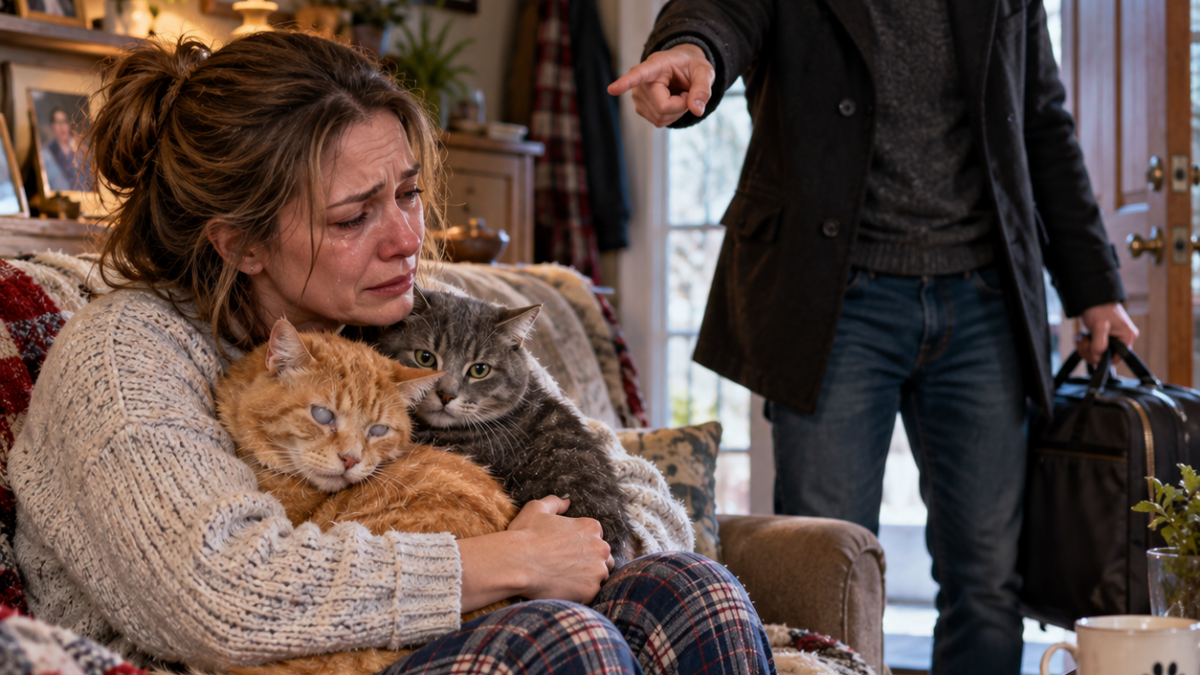
“They sleep in your bed.”
“Sometimes.”
“All the time when I’m not here.”
I folded my arms.
“How would you know?”
His face tightened.
“That’s exactly what I’m talking about.”
“What exactly?”
“It’s like they come first.”
I almost laughed.
But he was serious.
“Ethan.”
“I’m not asking you to kill them.”
The sentence shocked me.
“I didn’t say you were.”
“I’m saying rehome them.”
“Rehome them?”
“Yes.”
“To where?”
“I don’t know.”
“A rescue.”
“Someone else.”
“They’d adjust.”
Bean lifted his head at the sound of Ethan’s voice.
His eyes opened wide.
Bean did not like conflict.
He did not understand words, but he understood tone.
He had spent most of his life preparing to run from things other creatures considered harmless.
I lowered my voice instinctively.
“They’re not furniture.”
“I know that.”
“Then stop talking about them like they’re chairs I can donate.”
Ethan exhaled.
“I knew you’d do this.”
“Do what?”
“Make me the bad guy.”
“I haven’t called you anything.”
“You don’t have to.”
He walked toward the window.
Outside, November rain tapped the glass.
Our reflection hovered there together.
A couple without touching.
Behind us, two cats on the couch.
“I’ve tried, Claire.”
“I’ve tried to make this work.”
I felt something defensive rise in me.
Because he had tried.
That was the difficult part.
Ethan was not cruel every day.
If he had been, I would have left months earlier.
He brought me soup when I had the flu.
He once spent an entire Saturday fixing my porch railing because I mentioned it wobbled.
He called after my difficult workdays.
He remembered my mother’s birthday even though she had been dead six years.
He was funny.
He was dependable.
He held my hand at the movies.
He could make me laugh when I was determined not to.
He had also spent months slowly telling me that the life I had built before him was wrong.
At first, it came as jokes.
“You and your little roommates.”
Then:
“Does Tucker really need to be on the bed?”
Then:
“Bean’s kind of creepy, you know that?”
Then:
“Do you have to talk to them every time you come home?”
Then:
“You know most adults don’t organize their lives around pets like this.”
Each request sounded small.
So I bent.
I washed the sheets more often.
Bought a better vacuum.
Moved the food bowls farther from the kitchen table.
Kept blankets over the couch.
Put lint rollers in the car, bathroom, kitchen drawer, and my purse.
I closed the bedroom door some nights when Ethan stayed over.
Bean cried outside it.
Quietly.
Tucker scratched once or twice, then gave up.
I told myself compromise was what grown people did.
But compromise has a strange way of changing shape when only one person keeps moving.
The more space I made for Ethan, the smaller I felt inside my own home.
That night, I finally understood why.
Tucker woke.
He stretched one old orange leg.
Then another.
Slowly lowered himself from the couch.
His back legs were stiff now.
Arthritis.
Maybe age.
Maybe both.
He took three steps toward Ethan.
Tucker had always liked him.
That was another painful thing.
When Ethan first started visiting, Tucker would climb into his lap.
Ethan laughed.
Scratched his ears.
Took pictures.
Once Tucker fell asleep upside down with one fang showing, and Ethan said he looked like a retired bar fighter.
I laughed so hard I woke the cat.
That memory still existed.
The good things do not disappear just because something ends badly.
Tucker walked toward him.
Ethan stepped back.
His face twisted.
“God, they’re disgusting.”
There are words you do not understand are turning points until they leave someone’s mouth.
Disgusting.
Tucker stopped.
He looked up.
Cloudy-eyed.
Trusting.
Old.
He did not know.
He did not know the person he had once slept beside had decided his existence was offensive.
I felt something inside me become very quiet.
“Tucker is not disgusting.”
“You know what I mean.”
“No.”
“I don’t.”
Ethan rubbed his forehead.
“Claire, this is exactly why I can’t do this anymore.”
“Because I don’t want you insulting an old cat?”
“Because everything becomes emotional.”
I stared.
“Everything involving something I love usually has emotion attached.”
“There.”
He pointed at me.
“That.”
“That what?”
“You love them like people.”
“No.”
“I love them like cats.”
“That doesn’t make it less real.”
Tucker sat down.
Harder than usual.
I noticed.
A tiny collapse through his hips.
Then he adjusted.
I told myself it was his arthritis.
Bean watched from couch.
Ethan reached for his bag.
“So what is it?”
“What is what?”
“Me or them?”
He looked at me directly.
“I’m serious.”
“I can see that.”
“I want a life with you.”
“Not this life.”
“A normal life.”
The word cut deeper than he probably intended.
“Normal.”
“You know what I mean.”
Again.
That phrase.
You know what I mean.
The shelter for people who do not want responsibility for what they just said.
I looked at Tucker.
Then Bean.
Then at the man I had imagined marrying.
“I need a minute.”
Ethan’s shoulders loosened slightly.
He thought I was going to decide how to surrender them.
I went into the bedroom.
Bean slipped through before the door closed.
He immediately crawled beneath my bed.
I sat on the edge.
My hands shook.
I hated that.
I had handled my mother’s hospital decisions.
I had stood beside her bed while machines became quiet.
I had managed estate paperwork.
Sold her house.
Returned to work.
I had survived six Christmases without her.
And here I was shaking because a man wanted me to prove love through loss.
Under the bed, Bean began scratching at something.
“Bean.”
Scrape.
Scrape.
“Stop.”
He kept going.
I knelt.
Reached beneath.
My fingers touched cardboard.
An old shoebox.
I had forgotten it was there.
I pulled it out.
Dust covered the lid.
Inside were the things I could not throw away after Mom died.
Recipe cards stained with butter.
A grocery list written in her handwriting.
The silver brooch she wore to church.
Tucker’s first collar.
The shelter receipt.
A photograph of me the day I adopted him.
I barely recognized myself.
Thirty-six.
Eyes swollen.
Hair unwashed.
Holding an orange cat against my chest.
My smile looked like it hurt.
At the bottom of the box was the last birthday card Mom ever gave me.
I opened it.
The front had flowers.
Inside:
Claire,
You’ve always had a way of making room for everybody else. Just remember not to disappear while doing it.
Love you more than you know.
Mom.
Below that, almost as an afterthought:
Never shrink your life to fit inside someone else’s comfort.
I read the line twice.
Then again.
Bean crawled out from under the bed.
He sat beside my knee.
I started crying.
Not gracefully.
No single cinematic tear.
I folded over and cried into my hands.
Because suddenly the choice in the living room was not about cats.
It was not even really about Ethan.
It was about whether I was going to keep confusing being loved with being reduced.
Tucker had come into my life the day after Mom’s funeral.
I had not planned it.
After the burial, relatives filled my house.
Casseroles.
Paper plates.
Flowers that smelled too sweet.
People saying:
“She’s in a better place.”
“She’s not suffering.”
“You’re so strong.”
By the next morning, everyone left.
That was grief’s first betrayal.
The world expects death to be crowded.
Then suddenly you are alone with the dishes.
I drove because I could not stand my house.
No destination.
I ended up outside a county shelter.
I still do not know why I went inside.
Maybe I saw the sign.
Maybe I needed somewhere nobody knew my mother.
A volunteer walked me past cages.
Kittens.
Young cats.
A beautiful white cat with blue eyes.
Then an orange cat sitting alone in the back.
“He’s older,” the volunteer said.
“How old?”
“About eight.”
“He’s been returned twice.”
“Why?”
“He gets very attached.”
The phrase broke something open.
Too attached.
As if attachment were a behavioral defect.
She opened the kennel.
Tucker stepped into my arms.
No hesitation.
Pressed his face into my coat.
Purred.
I started crying.
The volunteer pretended not to notice.
I took him home that afternoon.
For months, he slept against my ribs.
When I cried in the kitchen, he sat by my feet.
When I forgot to eat, he screamed at me because his own dinner was late.
When I woke from dreams where Mom was still alive, Tucker was there when the room reminded me she was not.
Bean came two years later.
Cold rain.
Laundromat parking lot.
Gray body shaking under my car.
I spent twenty minutes lying on wet asphalt talking to him.
Finally wrapped him in my coat.
“One night.”
I told myself.
He hid behind my toilet for three days.
One night became five years.
He never completely stopped being afraid.
But he learned my voice.
My footsteps.
The sound of my key.
The safe spots.
My lap.
My bed.
Tucker taught him that I could be trusted.
Those cats had watched me become a person again.
Ethan thought I was choosing them over him.
What I was really choosing was the life they had helped hold together.
I wiped my face.
Picked up Mom’s card.
Went back to the living room.
Ethan looked up immediately.
“Well?”
Tucker had returned to the couch.
Bean followed me and sat against my ankle.
I looked at Ethan.
For the first time that evening, I did not feel afraid of what losing him might mean.
“I think you should go.”
His expression changed.
“What?”
“You heard me.”
He laughed once.
Disbelieving.
“You’re serious.”
“Yes.”
“You’re choosing cats.”
“I’m choosing my home.”
“That’s insane.”
“Maybe.”
“Claire.”
“I’m not giving them away.”
His jaw tightened.
“So that’s it?”
“You made it it.”
He stared at me.
I saw expectation draining out of him.
He had expected tears.
Negotiation.
One last concession.
Instead, I walked to the hallway and picked up his bag.
I held it out.
He took it.
“You’re going to regret this.”
“Maybe.”
“I had plans for us.”
“So did I.”
“I was going to propose.”
My heart reacted despite everything.
One painful thud.
He saw it.
For half a second, I hated him for using that.
Then I realized he had probably said it because he was hurt too.
People reach for weapons they do not always know they are holding.
“I’m sorry.”
I said.
He looked almost offended.
“Sorry?”
“Yes.”
“I’m sorry this is what we became.”
He muttered something.
Opened the door.
Then turned.
“I hope those cats are worth your future.”
The door closed.
The house became silent.
I stood there.
Waiting.
For panic.
For loneliness.
For the instinct to chase him.
It did not come.
Tucker grunted as he climbed into my lap.
Bean pressed against my side.
Orange fur on my black sweater.
Gray fur on my pants.
Scratches on the couch.
Two bowls by the wall.
The house did not look empty.
It looked alive.
For the first time in months, it also felt like mine.
The next morning, Ethan texted at 6:48.
I hope you’re happy choosing cats over your future.
I stared at the message while coffee brewed.
Tucker slept in the armchair.
Bean watched from beneath the table.
I put the phone down.
At work, I told myself nobody would know.
By ten, Marcy from payroll appeared beside my desk with two coffees.
Marcy was fifty-eight, divorced, loud when necessary, and frighteningly skilled at reading women who said “I’m fine.”
She handed me a cup.
“He finally said it?”
“What?”
“That thing men say when they want proof you love them.”
I stared.
She leaned on my cubicle.
“The ultimatum.”
My throat closed.
“He left.”
Marcy nodded.
“I’m sorry.”
“He said it was him or the cats.”
“And you picked the cats.”
I looked down.
“I picked my home.”
Her face softened.
“That’s different.”
By noon, Ethan’s version had traveled farther than mine.
His friend Nolan texted.
Ethan’s wrecked. You really ended a serious relationship over pets?
His sister:
I know he’s not perfect, but this seems extreme.
My cousin Angie:
Girl, I love animals too, but husbands are harder to find than cats.
That one hurt.
Not because it was true.
Because it revealed how they saw my life.
A husband as scarce resource.
A cat as replaceable.
A woman’s future measured by whether a man still wanted access to it.
I sat in my car at lunch reading messages.
Nobody asked:
What did he say?
What had you already compromised?
What did he call Tucker?
Did you feel safe?
Did you feel respected?
The word cats made the boundary sound ridiculous.
That was the first lesson after Ethan left.
People are much more comfortable with a woman saying:
He cheated.
He hit me.
He stole.
Than:
He kept asking me to become smaller.
The second kind is harder to photograph.
I got home after six.
Tucker met me in the hallway carrying Bean’s old toy mouse.
He had not played with it in years.
He dropped it at my shoes.
“Thank you, sir.”
I bent and scratched his head.
He blinked slowly.
Then I saw an envelope on the porch.
Ethan’s handwriting.
Inside:
My house key.
And a note.
I’m not the villain here. I wanted a life with you. You wanted a shrine to animals. Someday I hope you understand what you threw away.
For a second, shame came back.
Maybe I had been rigid.
Maybe there could have been another compromise.
Maybe separate bedrooms when he stayed.
Maybe cat-free spaces.
Maybe—
Tucker coughed.
I turned.
He stood halfway down the hall.
Head low.
His body looked wrong.
“Tuck?”
He took one step.
Then sat down hard.
Not stiff.
Collapsed.
I dropped the note.
His breathing was shallow.
His eyes unfocused.
Bean appeared from the bedroom and froze.
Within twenty minutes, Tucker was wrapped in the blue blanket Ethan had always complained was covered with orange hair.
I drove to the emergency veterinary clinic with one hand on the carrier.
The waiting room was full.
A teenage boy holding a rabbit.
An older man with a terrier wrapped inside his jacket.
A woman in medical scrubs crying quietly.
There is a strange equality in an emergency animal clinic.
Nobody asks whether the thing you love is important enough.
Everyone is already holding their answer.
Dr. Emily Calhoun examined Tucker.
Bloodwork.
X-rays.
Heart.
Kidneys.
Weight loss I had told myself was age.
She eventually led me into a small consultation room.
Two chairs.
Tissue box.
I hated it instantly.
“Tucker is very old.”
“I know.”
“He has several problems.”
She spoke carefully.
“His kidneys are failing.”
“He’s dehydrated.”
“There are changes in his heart.”
“Some things we can support.”
“Some we can’t reverse.”
“He was fine yesterday.”
Dr. Calhoun nodded.
“Cats are extremely good at hiding illness.”
“How long?”
She did not give me false precision.
“Weeks.”
“Possibly months.”
“Possibly less.”
I stared at her.
“What would you do?”
“I can’t decide for you.”
“But I can help you decide what is kind.”
Kind.
That word cut through everything.
Not economical.
Not reasonable.
Not practical.
Kind.
She explained hospitalization.
Additional diagnostics.
Comfort care.
And the final option.
I could not choose the last one that night.
Maybe that was selfish.
Maybe it was human.
Dr. Calhoun did not judge.
“We can send him home comfortably.”
she said.
“Watch quality of life.”
“We’ll make decisions based on him.”
While Tucker got fluids, I checked my phone.
Three messages.
Ethan:
Maybe now that people are reaching out, you understand how this looks.
His sister:
He bought a ring. He was going to propose this winter.
Marcy:
You owe nobody a defense. Call me if you need me.
I stared at the message about the ring.
I pictured it.
A box.
Maybe Christmas.
Maybe dinner.
Maybe Ethan nervous and smiling.
I mourned that version of him.
That is the problem with ending a relationship that contained real tenderness.
You do not only lose the person who hurt you.
You lose every good version of them too.
The man who fixed my porch.
The man who brought soup.
The man who once let Tucker sleep in his lap during a movie.
The man who apparently bought a ring.
He had not been cruel every day.
People rarely are.
That would make leaving too simple.
I called Marcy.
She answered immediately.
“Tell me.”
I told her about Tucker.
The vet.
The money.
The choices.
The ring.
When I finished, she said:
“You know what people will say.”
“Yes.”
“He’s old.”
“Yes.”
“Don’t spend thousands on a cat.”
“Yes.”
“You gave up a husband for an animal that might have weeks.”
My eyes filled.
“Yes.”
Marcy paused.
“People who say that think the value of love is how long they can keep it.”
“What do you think?”
“I think love is how you show up while it’s still here.”
I cried.
Quietly.
That night, I took Tucker home.
Bean waited at the front door.
He walked straight to the carrier.
Sniffed.
Tucker made one tiny sound.
Bean answered.
They slept beside each other.
For the next several days, time became smaller.
Medication.
Water.
Food.
Naps.
Good hours.
Bad hours.
Bean stopped sleeping under my bed and started sleeping beside Tucker.
Sometimes at three in the morning I would find them together beneath the hallway night-light.
Orange and gray.
Touching paws.
It looked like a tiny hospital room.
Ethan called Thursday.
Three times.
I finally answered.
“I heard about Tucker.”
“He’s home.”
“I’m sorry.”
Silence.
Then:
“I shouldn’t have called him disgusting.”
“No.”
“You shouldn’t have.”
“I’m not good with animals.”
“I know.”
“It’s not just that.”
I sat on the kitchen floor.
Tucker was asleep within sight.
Ethan’s voice changed.
“When I was a kid, my mother took in animals.”
I knew that much vaguely.
I did not know the rest.
“Dogs.”
“Cats.”
“Strays.”
“Anything.”
“Our house smelled all the time.”
“There was fur in the food.”
“One dog bit me.”
“My mom cared more about rescuing things than whether I felt safe.”
I closed my eyes.
“I’m sorry.”
“I hated coming home.”
“I hated never knowing what would be there.”
“And when I started staying at your place…”
He stopped.
“You felt like a kid again.”
“Sometimes.”
For the first time since the ultimatum, I felt compassion.
Not forgiveness.
Not desire.
Compassion.
Two truths can exist.
Ethan’s reaction had roots.
And he still had responsibility for what he did with those roots.
“I wish you had told me.”
“I didn’t know how.”
“But you knew how to tell me to get rid of them.”
Silence.
“That was wrong.”
“Yes.”
“I want to see you.”
“No.”
“Claire.”
“No.”
“I just want to talk.”
“We are talking.”
“In person.”
“Tucker is dying.”
His breath caught.
“I didn’t know.”
“You didn’t ask.”
“I’m sorry.”
“Thank you.”
Then he told me about the ring himself.
“I bought it because I loved you.”
I stared at the kitchen tiles.
“Did you buy it for me?”
“What?”
“Or for the version of me you thought you could eventually get?”
The silence went on so long I checked the screen to see if the call had dropped.
Then:
“I don’t know.”
That answer hurt because it was honest.
I ended the call.
The following morning, I wrote a short post online.
No names.
No details.
I was asked to choose between a future with someone and the animals who helped me survive my hardest years. I chose the home I could still breathe in. Love should make room for what made you whole.
I almost deleted it.
Instead, I posted.
By lunch, people were arguing.
Pets are family.
You’re going to die alone.
A partner should come first.
No good partner demands abandonment.
Cats are not children.
Boundaries matter.
One comment stopped me:
I wouldn’t sleep in a bed full of animals either. Does that automatically make me abusive?
No.
It did not.
That was uncomfortable.
Because life is easier when the other person is entirely wrong.
Ethan had the right not to want cats in his bed.
I had the right to want them there.
He had the right to want a quieter, cleaner, animal-free home.
I had the right not to live in one.
What made the relationship destructive was not difference.
It was the belief that my love should prove itself by surrender.
That Saturday, Tucker stopped eating.
Dr. Calhoun examined him again.
“The window is narrowing.”
she said.
“What window?”
“The time when we can choose peace before distress chooses for him.”
I took him home one more time.
That afternoon, Ethan came to my door.
Brown paper bag in his hands.
I opened the wooden door but left the screen locked.
“How is he?”
“Tired.”
“I brought treats.”
“You don’t know what treats he likes.”
“I asked Angie.”
I almost smiled.
“Can I come in?”
“No.”
He nodded.
“Okay.”
No argument.
That surprised me.
He placed the bag on the porch.
“I started seeing a counselor.”
I studied him.
“Once so far.”
he added.
“I know that doesn’t mean much yet.”
“It means you started.”
“I want another chance.”
There it was.
“What would that look like?”
“Slow.”
“Talking.”
“Maybe I come over.”
“And the cats?”
“They stay.”
“In my bed?”
He hesitated.
I almost laughed from sadness.
There was our entire relationship.
In one pause.
“I don’t know if I can sleep with them.”
“That’s fair.”
Hope appeared in his face.
“But I can.”
It vanished.
“Tucker is dying, Ethan.”
He looked through the screen.
The orange cat lay on the couch.
Thin now.
Small.
“I am not moving him off anything.”
I said.
“Not the bed.”
“Not the couch.”
“Not a clean sweater.”
“Not for you.”
“Not for anybody.”
Ethan’s eyes filled.
“I wish I had met you before them.”
I smiled sadly.
“You met me because of them.”
“What does that mean?”
“The woman you say you love was built partly by what they gave me.”
“You don’t get to remove the beams and keep the house.”
He looked at Tucker.
Then asked:
“Can I apologize to him?”
I stared.
A grown man apologizing to a cat.
Ridiculous.
Beautiful.
Too late.
Maybe necessary anyway.
I unlocked the door.
“Five minutes.”
“Don’t touch him unless he comes to you.”
Ethan stepped inside.
Bean vanished beneath the dining table.
Tucker stayed.
Ethan stopped in the exact spot where he had given the ultimatum.
Then he crouched.
“Tucker.”
The cat opened his eyes.
“I was mean to you.”
My throat tightened.
“You didn’t deserve it.”
“You were just living in your home.”
Tucker blinked.
Once.
Ethan stood.
“That’s all.”
He did not ask for anything.
At the door, he said:
“I know this doesn’t fix us.”
“No.”
“But I’m glad you did that.”
He left.
The next week became a world measured in teaspoons.
Medication.
Water.
Food.
Tucker reaching the sunny window.
Bean eating.
Tucker purring.
Tucker not purring.
Marcy came with soup and sat on my kitchen floor because Tucker had claimed the chair.
“I see who runs this place.”
“He always has.”
She did not tell me to be strong.
I loved her for that.
People often say be strong when what they really mean is please make your grief less frightening for me.
Marcy let it be frightening.
Angie came too.
The cousin who had told me husbands were harder to find than cats.
She brought casserole.
“I said the wrong thing.”
“Yes.”
“I thought I was helping.”
“I know.”
“I’m scared you’ll end up alone.”
“I might.”
Her eyes widened.
“And I need you to stop treating that like the worst possible thing.”
She sat down.
Then said something unexpectedly honest.
“I think I’m afraid of it because I’m afraid of it for myself.”
Angie had been married twenty-three years.
Her husband was not cruel.
Not especially kind either.
He was present.
Sometimes presence becomes its own argument.
“I don’t hate Ethan.”
I said.
“I know.”
“He isn’t evil.”
“No.”
“He just wanted a version of me with less in it.”
Angie looked at Tucker.
“And you already lost too much.”
That was the center.
After Mom died, grief had emptied rooms inside me.
Tucker and Bean did not fill them.
Nothing could.
They simply sat inside the emptiness with me until it stopped echoing so loudly.
Two Fridays after Ethan left, Tucker had his last good day.
I did not know.
That was mercy.
He ate half a bowl.
Walked to the window.
Stretched in the sunlight.
Bean sat beside him.
The window was open.
Cut grass.
Somebody grilling down the street.
Birds in the maple tree.
I took a picture of them.
Bean’s paw touching Tucker’s tail.
Not for social media.
For proof.
Proof that joy can stand inside the same room as sorrow.
Ethan texted:
Thinking of you both.
Both.
Not you and the cats.
Not you.
Both.
I wrote:
Thank you.
The next morning, Tucker could not get up.
I knew.
His eyes found mine.
Love has a language at the end.
It is not dramatic.
It is a look that says:
I stayed as long as I could.
I called Dr. Calhoun.
My voice was calm.
“I think it’s time.”
The sentence nearly killed me.
She told me to come when I was ready.
I was not ready.
I would never be ready.
I simply loved him enough not to require suffering as proof he wanted to stay.
I made the living room quiet.
Put the blue blanket in the carrier.
Bean approached Tucker.
Pressed his forehead against his.
Then stepped back.
I took Mom’s card from the shoebox and put it in my purse.
At the clinic, Dr. Calhoun used a room with soft lighting.
Tucker rested his head on my hand.
I told him every true thing I could.
“You were handsome.”
“You were difficult.”
“You stole chicken.”
“You screamed at four in the morning.”
“You saved me.”
“I’m sorry for every day I was too busy.”
“Bean will be okay.”
“I’ll try to be okay.”
“You can rest.”
Dr. Calhoun cried quietly.
I was grateful.
When Tucker died, I kept my hand on him.
I expected grief to scream.
It did not.
It became silence.
I drove home with the empty carrier.
No object in the world has ever looked sadder.
Bean was at the door.
He looked behind me.
At the carrier.
At me.
Then circled the carrier.
Sniffed Tucker’s blanket.
Climbed directly into my lap.
Bean had not done that in months.
He shook.
So did I.
“We’re still here.”
I whispered.
That night loneliness came.
Not because Ethan was gone.
Because Tucker was.
His absence occupied physical space.
Couch.
Food bowls.
Bed.
I found one orange hair on my sweater and cried for twenty minutes.
Three days passed.
Marcy left groceries.
Angie texted:
No need to answer. I loved him too.
Ethan stayed silent.
I appreciated it.
On the fourth day, he knocked.
He held a wooden frame.
“I should have called.”
“Yes.”
“I can leave this.”
“What is it?”
He turned it around.
The old picture.
Tucker upside down on the couch.
One fang showing.
The picture Ethan himself had taken.
Retired bar fighter.
I had forgotten that good memory.
Grief and anger are both editors.
They cut different scenes.
“I’m sorry he’s gone.”
Ethan said.
Then:
“I’m sorry I made any part of his last days about me.”
That apology was different.
It did not ask me to erase anything.
“Thank you.”
He turned to leave.
“Wait.”
He stopped.
“Do you want to sit on the porch for a minute?”
Hope appeared.
I raised one hand.
“Just the porch.”
“Just a minute.”
We sat on opposite ends of the steps.
He told me he had read Mom’s line.
Angie told him.
Never shrink your life to fit inside someone else’s comfort.
“I wish I’d met her.”
Ethan said.
“She would have liked you.”
I answered.
“At first.”
He laughed quietly.
“Terrifying.”
“She was.”
Then he said:
“I didn’t understand the difference between wanting to be chosen and needing to win.”
I looked at him.
“That is a big difference.”
“I know now.”
“I did choose you.”
I said.
“Sometimes.”
“I moved bowls.”
“I changed sheets.”
“I bought the vacuum.”
“I shut the bedroom door.”
“I made room.”
He closed his eyes.
“But every time I made room, you thought it proved you could ask for more.”
“Yes.”
“I did.”
“I don’t want that kind of love.”
“Neither do I.”
“You didn’t have to live under it.”
He opened his eyes.
“No.”
“I made it.”
That mattered.
It did not repair us.
But truth matters even when it arrives after the bridge has burned.
Three weeks later, I returned to the shelter where I had adopted Tucker.
I brought unopened food.
Blankets.
His carrier.
I told myself repeatedly:
I am not adopting another cat.
Then I heard the worst meow in Ohio.
A rusty squeak.
The volunteer smiled.
“That’s June Bug.”
June Bug was fourteen.
Maybe fifteen.
Brown tabby.
Cloudy eye.
Bent whiskers.
Tiny.
She looked like life had folded her wrong and forgotten to straighten her.
“How long?”
“Three months.”
“Owner went into assisted living.”
“Family couldn’t keep her.”
The sentence punched me.
Couldn’t keep her.
I knew sometimes that was true.
Still.
June Bug pressed her forehead against the cage.
I stepped backward.
“No.”
The volunteer laughed.
“I didn’t ask.”
“I’m talking to myself.”
I did not take her home.
Not that day.
I filled out a foster application.
Temporary.
Careful.
No promises.
A week later, she arrived in Tucker’s old carrier.
Bean hissed like I had brought home a bear.
June Bug hissed back with the power of a broken bicycle pump.
I laughed so hard I sat down.
It was not joy.
Not yet.
It was life.
That was enough.
A month after Tucker died, Ethan asked to meet for coffee.
Neutral diner.
I agreed.
He stood when I arrived.
That little courtesy hurt.
We sat.
“I heard about June Bug.”
“Temporary foster.”
“That name is terrible.”
“It suits her.”
He smiled.
Then:
“I’ve been thinking about what you said.”
“About wanting a version of you with less in it.”
I waited.
“You were right.”
The words made something inside me loosen.
“I didn’t know how to love a life that didn’t center me.”
“That’s honest.”
“It’s ugly.”
“Honesty sometimes is.”
He looked at his untouched coffee.
“I wanted normal.”
“Marriage.”
“Clean house.”
“Routine.”
“Someone who chose me.”
“None of that is wrong.”
“No.”
“But anything outside that picture started feeling like competition.”
“And Tucker and Bean were competition.”
“In my head.”
“Yes.”
He reached inside his coat.
For one second, my stomach dropped.
The ring.
But he brought out another key.
My spare.
“I found this in my desk.”
“I’m not keeping doors open that you closed.”
That may have been the kindest thing he ever said to me.
“Ethan.”
He looked up.
“I forgive you.”
His face moved.
“But I’m not coming back.”
He nodded.
“I know.”
“I loved you.”
“I know.”
“I still miss you sometimes.”
“Same.”
“But missing someone is not the same as being safe with them.”
“No.”
He wiped his eyes.
“I almost brought the ring today.”
“Why didn’t you?”
“Because a ring is not an apology.”
I looked at him for a long time.
He was changing.
I believed that.
Maybe someday another woman would meet the version of Ethan who understood what he had failed to understand with me.
That thought hurt.
But growth arriving late is still growth.
We hugged in the parking lot.
Carefully.
Briefly.
He said:
“Tell Bean I respect his boundaries.”
I laughed.
“And June Bug?”
“She sounds terrifying.”
“She respects no one.”
“Good for her.”
Then we walked to separate cars.
When I came home, June Bug was standing inside a flowerpot.
Bean screamed at me.
A water bowl was overturned.
A dish towel had somehow moved into the hallway.
Hair floated through sunlight.
The house looked terrible.
It looked perfect.
I hung Tucker’s photo on the wall beside Mom’s recipe cards.
Not a shrine.
A reminder.
Months later, June Bug stopped being a foster.
There was no ceremony.
The shelter coordinator called.
“You ready to make it official?”
June Bug was asleep on my clean laundry.
Bean was grooming her ear.
“I suppose.”
The woman laughed.
“You suppose?”
“She’s very annoying.”
“We’ll put that on the certificate.”
I adopted her.
That winter, snow came early.
Bean and June Bug watched it from the window.
I stood in the kitchen with coffee.
There were three bowls by the wall.
Bean’s.
June Bug’s.
And Tucker’s small orange bowl.
Empty.
I still had not put it away.
Angie came for Sunday lunch.
While we washed dishes, she asked:
“Do you regret Ethan?”
I thought.
“No.”
Then:
“That’s not entirely true.”
She waited.
“I regret we hurt each other.”
“I regret Tucker’s last days had any of that tension around them.”
“I regret that love became a test.”
“But I don’t regret choosing peace.”
Angie dried a plate.
“I think a lot of people choose being chosen instead.”
That sentence stayed.
Being chosen feels like proof.
Peace can be quiet.
Proof is exciting.
Peace looks boring.
But proof can be withdrawn.
Peace becomes the floor beneath your feet.
That spring, Ethan sent one final text.
Saw an orange cat in a window today. Thought of Tucker. Hope you’re doing well. No need to respond.
I wrote:
Thank you. We’re doing okay.
We.
Bean.
June Bug.
Me.
Tucker’s photograph.
Mom’s card.
The soft, imperfect life that had once seemed like something I needed to apologize for.
Years earlier, after Mom died, I treated my life like a waiting room.
As if the real thing would begin when grief ended.
Then when I met Ethan, I treated marriage like the next room.
As if being chosen by a man meant I had finally moved forward correctly.
Tucker never cared about any of that.
Bean certainly didn’t.
June Bug believed every surface existed specifically for her convenience.
Animals are not morally superior to people.
They are not little therapists.
They do not understand sacrifice the way humans do.
But loving them taught me something I had struggled to learn from people.
Presence matters.
Consistency matters.
Safety matters.
And affection that requires you to abandon what made you whole is not a prize.
A year after Tucker died, I went back to the emergency clinic.
Not because anyone was sick.
I brought Dr. Calhoun a framed photograph from Tucker’s last good day.
Orange cat in sunlight.
Bean’s gray paw touching his tail.
She hugged me.
“How are you?”
“Better.”
“Bean?”
“Needier.”
“June Bug?”
“Still alive out of spite.”
Dr. Calhoun laughed.
Before I left, I noticed a woman in the waiting room.
Maybe thirty.
Crying.
A small black dog wrapped in a blanket.
Same tissue-box room waiting somewhere behind those doors.
I wanted to tell her:
You will survive this.
But I did not.
Strangers should not promise things they cannot know.
Instead, I sat beside her for five minutes.
Did not speak.
She eventually said:
“He’s fourteen.”
I nodded.
“Tucker was old too.”
“Your dog?”
“Cat.”
She smiled faintly.
“Was he a good cat?”
“No.”
I said.
“He was terrible.”
Then we both laughed.
That was better than saying he was in a better place.
When I drove home, Bean was in the window.
June Bug was not.
That was suspicious.
I opened the door.
A bag of bread had been pulled from the counter.
June Bug sat beside it looking innocent.
“Criminal.”
She squeaked.
I cleaned up.
Made coffee.
Opened the window.
Life continued.
Not the life Ethan wanted.
Not the one I had expected.
Mine.
Sometimes people still tell me I chose cats over a relationship.
I no longer correct them every time.
There are stories people only understand at the depth they are willing to enter.
From far away, maybe that is what happened.
A woman.
A boyfriend.
Two cats.
An ultimatum.
She picked the cats.
Simple.
Except Tucker died soon afterward.
Bean changed.
Ethan changed.
I changed.
The ultimatum did not prove animals mattered more than people.
It proved love had become a contest inside a home where it should never have been one.
That was the real problem.
Ethan wanted to know if I would choose him.
I wanted to know why choosing him required betrayal.
Neither of us had language for that until it was too late.
My mother did.
Never shrink your life to fit inside someone else’s comfort.
I used to think that meant being fearless.
Taking big jobs.
Traveling.
Saying no.
Now I think it means something quieter.
Do not move the bowl again just because somebody hates seeing evidence that something else depends on you.
Do not shut the bedroom door every night if doing so makes your own home feel foreign.
Do not confuse someone’s discomfort with your wrongdoing.
Do not demand that they erase themselves either.
Let people have their boundaries.
Believe them.
Then decide whether your lives actually fit.
Not every breakup requires a villain.
Not every incompatibility can be compromised away.
And forgiveness does not require reunion.
That took me longer to understand.
Tucker taught Ethan something before he died.
But he taught me more.
He taught me that staying matters.
Then, at the end, he taught me that letting go can also be an act of staying faithful to love.
I could have kept him longer.
Maybe.
Another hospitalization.
More procedures.
More days.
But I did not need him to suffer so I could call myself devoted.
That realization changed how I saw Ethan too.
I did not need to keep a relationship alive past the point where it had become painful just to prove it had once been real.
Some things can be loved and still released.
That does not make the love false.
It makes the ending honest.
Bean is older now.
More confident.
He sleeps on my pillow.
Any future partner who cannot tolerate that is welcome to own a separate pillow in a separate house.
June Bug turned out to be closer to twelve than fifteen, according to a later vet who examined old records.
She may outlive us all.
Marcy says spite is medically protective.
Angie eventually started therapy herself.
Six months later, she told me she and her husband had begun speaking honestly for the first time in years.
They stayed married.
Not because staying is always strength.
Because once they stopped treating separation as the only alternative to silence, they found room to change.
Ethan moved to another city for work.
We exchange a Christmas message occasionally.
That is all.
I heard from Angie that he later adopted a senior dog.
The first time she told me, I laughed because I thought she was joking.
She was not.
Apparently the dog belonged to an elderly neighbor who died, and nobody in the family wanted him.
Ethan took him.
A beagle.
Twelve years old.
Terrible breath.
I stared at the message.
Then cried.
Not because I wanted Ethan back.
Because people can become better beyond the borders of our story with them.
We do not always get to live inside the lesson we helped cause.
Sometimes our role in someone’s life is to be the person they lose before they understand what losing means.
That is sad.
It can also be enough.
On the anniversary of Tucker’s death, I put his orange bowl away.
It took a year.
I washed it.
Dried it.
Held it longer than necessary.
Then placed it in the shoebox with his first collar and Mom’s card.
Bean watched.
June Bug sat inside the empty cabinet where the bowl had been.
Of course she did.
I laughed.
Then I closed the cabinet.
Not to erase him.
Because memory did not need the bowl anymore.
That night, I found Mom’s card again.
Never shrink your life to fit inside someone else’s comfort.
I turned it over.
On the back, in tiny handwriting, there was another line I had somehow overlooked for years.
You are allowed to build a life that feels like yours.
I sat on the bedroom floor for a long time.
Bean came first.
June Bug came later.
One on each side.
I thought about the night Ethan had stood in my living room with his coat already on.
“It’s me or them.”
Back then, I believed he was forcing me to choose between love and loneliness.
He wasn’t.
He was forcing a question neither of us understood yet.
What kind of life could I live without abandoning myself?
The answer was not:
A life with cats.
That was too small.
The answer was:
A life where love was welcome, but control was not.
A life where another person could have needs without making mine ridiculous.
A life where I could hear someone’s pain without volunteering to become the cure by disappearing.
A life where animals could be animals.
Where men could be flawed without becoming monsters.
Where endings could hurt without becoming mistakes.
Where forgiveness did not mean reopening the door.
Where peace counted even when nobody applauded it.
I wish Ethan and I had learned those things together.
We didn’t.
That is one of the griefs I carry.
But grief does not invalidate growth.
Tucker taught me that.
My mother did too.
Even death does not erase what something gave you.
Sometimes it makes the shape of the gift clearer.
The morning after I put Tucker’s bowl away, snow began falling.
Bean sat in the window.
June Bug slept on the couch.
I made one cup of coffee.
Not because nobody else was there.
Because one was all I needed.
The house was quiet.
Not empty.
Not bruised.
Quiet.
There is a difference.
Sunlight pushed through gray clouds.
Bean’s tail moved against the glass.
June Bug snored.
I stood in the room Ethan once said belonged too much to the cats.
Maybe he had been right about one thing.
It did belong to them.
And to me.
It belonged to Mom’s recipe cards.
To Tucker’s photograph.
To Bean’s fear.
To June Bug’s ridiculous squeak.
To every version of me that had cried there and healed there.
If someday someone else entered that home and stayed, there would be room.
But I would never again empty it first to prove they were welcome.
That was the lesson.
Not cats over men.
Not independence over love.
Not loneliness as virtue.
Room.
The right love makes room.
And when Tucker died, after spending the last years of his life in the home Ethan once called a shrine to animals, I finally understood why that old orange cat had mattered so much.
He had never once asked me to choose him.
He had simply stayed.
Through my mother’s death.
Through the quiet.
Through Bean’s arrival.
Through Ethan.
Through heartbreak.
Through the last good day by the window.
He stayed until he could not.
And by the time he left, he had taught me the difference between being chosen and being loved.
One asks you to prove your loyalty.
The other gives you somewhere safe to be yourself.
Tucker gave me that long before I knew how to ask for it.
And after he was gone, I finally learned how to give it to myself.

