My 6-Year-Old Gave a Thirsty Biker Her Water Bottle—Then at 9:47 PM He Called, Knew Our Names and Address, and Warned Me Someone Had Been Watching Her.
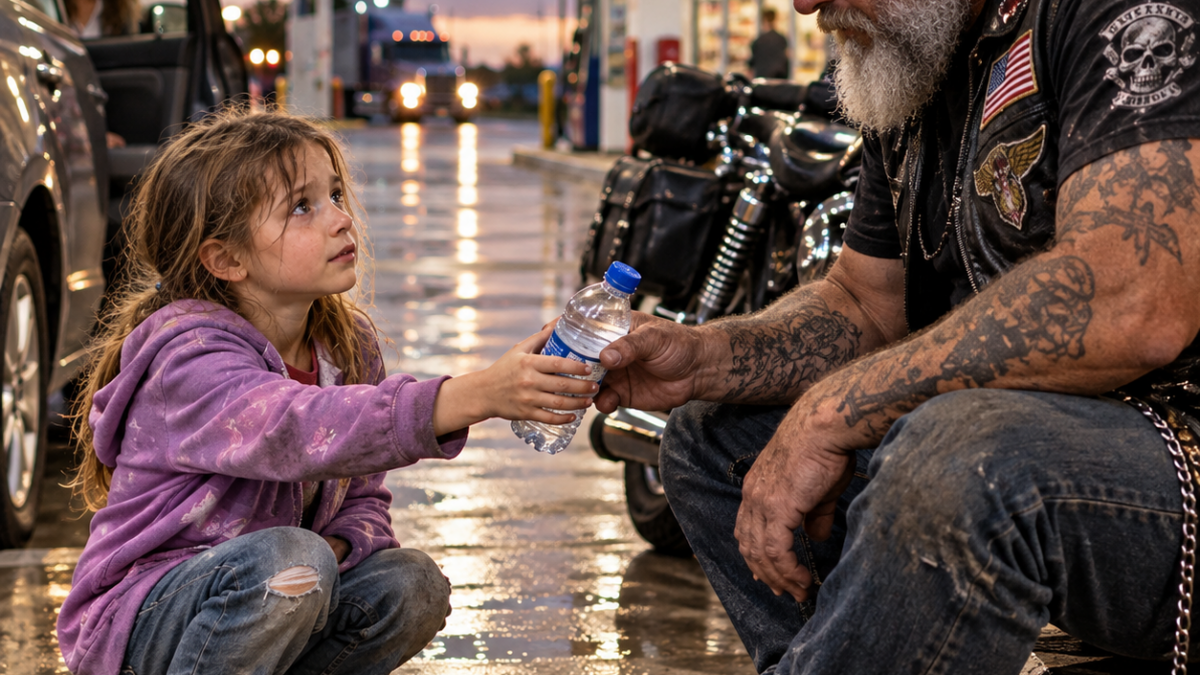
My 6-Year-Old Gave a Thirsty Biker Her Water Bottle—Then at 9:47 PM He Called, Knew Our Names and Address, and Warned Me Someone Had Been Watching Her.
I spent the entire drive home telling myself the gray-bearded biker at the gas station had only stared at my six-year-old because she reminded him of somebody, but at 9:47 that night he called my private number, said Emma’s full name, and told me a man in a gray Chevrolet had followed us almost all the way home.
Then he told me why he had taken only the tiniest sip from Emma’s bottle—his throat cancer had made swallowing almost impossible—and why a photograph of another six-year-old girl was sewn inside his leather jacket.
Thirty-one years earlier, someone had taken his daughter from a gas station and she had never come home, and now the dying biker believed the man watching Emma had been hired by the violent ex-husband I had crossed four hundred miles trying to escape.
We were never supposed to stop at that gas station.
If the air-conditioning at Emma’s elementary school hadn’t broken that afternoon, we would have gone straight home.
If the temperature hadn’t climbed past ninety-six degrees in September, I wouldn’t have picked her up early.
If I’d remembered to fill my travel mug that morning, I wouldn’t have needed coffee.
And if Emma had listened to me just once in her six years of life when I said, “Stay buckled until Mommy comes around,” she never would have walked up to Ray Kellerman with that half-empty purple water bottle.
For years afterward, those little ifs bothered me.
Not because I wished the afternoon had happened differently.
Because I understood how close we had come to never knowing we were in danger at all.
My name is Claire Halvorsen.
At the time, I was thirty-four years old, recently remarried, exhausted, and convinced I had finally outrun the worst chapter of my life.
My husband Marcus and I had moved into a rented ranch house outside a small northern Ohio town twenty-two days earlier.
Twenty-two.
I know because I counted afterward.
We had boxes stacked in the garage.
Two framed pictures still leaning against the living-room wall because Marcus couldn’t find the drill.
Emma’s room smelled like fresh paint.
Our mail still arrived with yellow forwarding labels.
I had not yet memorized the quickest route to the grocery store.
That was how new everything was.
And new was exactly what I wanted.
I had spent the previous two years learning that sometimes safety doesn’t feel peaceful at first.
Sometimes it feels unfamiliar.
The locks are different.
The neighbors don’t know you.
You don’t know which floorboard creaks.
You wake at two in the morning because a truck slows outside and your whole body remembers somebody who no longer lives with you.
My first husband, Brendan Foley, was Emma’s biological father.
I met him when I was twenty-four.
He was funny then.
At least that’s what I told myself later.
Funny.
Confident.
Protective.
The kind of man who always knew what restaurant to pick and which highway exit to take.
When you’re young, certainty can look a lot like strength.
PART2:
It took me years to understand the difference between a man who wants to protect you and a man who wants to control what you can reach without him.
The first year was good.
The second was complicated.
The third was frightening.
By the fifth, I had learned to measure evenings by Brendan’s footsteps.
If he dropped his keys hard on the table, don’t argue.
If he opened a beer before taking off his work boots, keep Emma upstairs.
If he started cleaning something that wasn’t dirty, he was angry.
The first wall he punched was beside my head.
He apologized afterward.
The second time, he blamed me.
By the final year, apologies had almost disappeared.
He never hit Emma.
People always ask that.
As though abuse becomes easier to classify if somebody can say the child wasn’t touched.
No.
He never hit her.
He didn’t need to.
Children can learn fear by listening through walls.
Emma learned to take her stuffed rabbit and sit inside her closet when voices got loud.
She called it “camping.”
That still destroys me.
PART3:
The night I finally left, Brendan put me on the kitchen floor.
I remember the cold tile against my cheek.
I remember Emma screaming from the hallway.
I remember thinking:
If I stay, someday she will believe this is what love looks like.
That thought got me up.
Not strength.
Not courage.
Motherhood mixed with terror.
I got Emma out.
We stayed with my mother.
I filed for a protective order.
Brendan violated it four times.
Once by leaving flowers.
Once by sending thirty-eight emails overnight.
Once by sitting outside Emma’s daycare.
And once by arriving at my mother’s house at two in the morning carrying a tire iron and insisting he only wanted to “talk.”
He served ninety days after that.
Ninety.
A judge extended the protective order and looked him directly in the face while explaining what would happen if he came near us again.
Brendan nodded.
Very respectfully.
That frightened me more than if he’d yelled.
After his release, Marcus convinced me to move.
Marcus wasn’t some rescuer who swept into my life while Brendan was hurting me.
I met him afterward through my cousin.
He worked commercial electrical maintenance.
Quiet.
Divorced.
No children.
The first time Emma spilled juice on his couch, she froze.
Marcus looked at her.
Then at juice.
Then said:
“Well, I was hoping to wash that cushion sometime this decade.”
Emma stared.
Then laughed.
That was the first reason I loved him.
He made mistakes feel like mistakes instead of crimes.
We married quietly.
Then moved.
Four hundred miles between us and Cincinnati.
Different county.
Different school.
Different address.
I changed my last name back to Halvorsen before marrying Marcus and kept it professionally because every time I saw Foley on paper I felt like somebody had opened a door I wanted locked.
We told very few people exactly where we were going.
My mother.
My sister.
Marcus’s brother.
Emma’s school.
Our attorneys.
The court.
That was supposed to be enough.
That Friday, Willow Ridge Elementary’s air-conditioning failed shortly after lunch.
The principal sent a mass message asking parents who could to pick up early.
When I got Emma at 2:40, her cheeks were pink.
Her curls stuck to her forehead.
She climbed into the back seat like a tiny exhausted politician after a failed campaign.
“Mom.”
“What?”
“School is illegal.”
I laughed.
“What happened?”
“It was hot.”
“Yes.”
“So hot.”
“I gathered that.”
“Mrs. Patel let us put wet paper towels on our necks.”
“Scandalous.”
“She said we were surviving.”
Emma’s purple bottle was still half full.
I told her to drink.
She did one reluctant sip.
“I want lemonade.”
“You have water.”
“Lemonade is wet.”
“So is the lake. We’re not drinking that either.”
She sighed with the patience of a child burdened by unreasonable authority.
I needed coffee.
We had a forty-minute drive because I’d been in town for a doctor’s appointment and picked Emma up from the temporary school building farther south.
A gas station off the interstate had a large canopy, clean-looking convenience store, and enough cars around that I didn’t feel isolated.
I pulled in.
Parked near entrance.
“Stay buckled.”
“Okay.”
“I’m getting coffee.”
“Can I get lemonade?”
“No.”
“Why?”
“Because you have water.”
“That wasn’t the question.”
I turned around.
“Emma.”
She smiled.
“Stay buckled.”
“I know.”
I was inside maybe four minutes.
Five at most.
That is another number I remember.
I got coffee.
A banana for Emma.
A packet of almonds.
I looked at the bottled lemonade and almost bought one.
Didn’t.
When I came out, Emma’s rear door was open.
Every organ in my body seemed to fall at once.
“Emma?”
Then I saw her.
Twenty feet away.
Walking toward a biker seated on the curb beside a black touring motorcycle.
My bag hit my leg as I ran.
Not full sprint.
But close.
He was a big man.
Late fifties, maybe early sixties.
Gray beard.
Dust on boots.
Leather jacket despite heat.
His shoulders looked broad even though the rest of him seemed strangely thin.
He sat with his elbows on his knees and head lowered.
Emma stopped in front of him.
She held out her bottle.
“You look thirsty, mister.”
The man raised his head.
And stared.
Too long.
That was the first thing that scared me.
Not the vest.
Not motorcycle.
The way he looked at her.
His face went completely still.
His eyes were pale gray-green.
Same strange color as Emma’s.
He looked from her face to the bottle and back again.
For one horrible second, I thought he might reach for her.
Instead he lifted both hands where she could see them.
Took the bottle gently.
“Thank you, sweetheart.”
His voice was rough.
Not smoker-rough.
Painful.
He unscrewed the cap slowly.
Raised bottle.
Took the smallest sip I had ever seen.
Barely touched water to his lips.
His throat moved and his face tightened.
Then he screwed cap back on.
Handed it to Emma.
“You keep the rest.”
She frowned.
“You didn’t drink.”
“I got enough.”
“You look really thirsty.”
He smiled.
It transformed him.
“I’m okay.”
Then he said something I remembered later.
“You’re gonna need it more than me tonight.”
At the time I thought it was strange.
Later it sounded prophetic.
I was ten feet away.
“Emma.”
She turned.
“Oh. Hi, Mom.”
Hi.
As if she had not just violated every stranger rule I’d drilled into her since preschool.
“Come here.”
She heard my tone.
Walked back.
The biker saw fear on my face.
He didn’t stand.
Didn’t approach.
Just nodded once.
“Sorry, ma’am.”
“She came over before I saw her.”
“Emma, car.”
“But—”
“Now.”
She climbed in.
I locked doors.
My hands were shaking when I put coffee in holder.
In mirror, biker still sat.
He looked toward another part of parking lot.
Not us.
I followed his gaze automatically.
Gray Chevrolet Malibu.
Three spaces beyond where we’d parked.
A man inside.
Ball cap.
Sunglasses.
Looking down at something.
I barely registered him.
I backed out.
As I did, the biker stood.
For a moment he looked unsteady.
He put one hand on motorcycle.
Emma waved.
He waved back.
Then I drove away.
I was angry for first ten minutes.
“What did Mommy say?”
“Stay buckled.”
“And what did you do?”
“Not that.”
“Correct.”
“He looked thirsty.”
“You cannot walk up to strangers.”
“He was sitting.”
“That doesn’t change anything.”
“He said thank you.”
“Emma.”
“What?”
“You don’t know him.”
She was quiet.
Then:
“He has a little girl on his jacket.”
That made me glance in mirror.
“What?”
“Inside.”
“Inside what?”
“His jacket.”
“He moved it and there was a picture.”
“Of a girl?”
“She had a red bike.”
I felt uneasy.
“Why were you looking inside his jacket?”
“I wasn’t.”
“It was sewn there.”
Emma drank water.
Then said:
“She looked like me.”
I tightened hands on wheel.
“No, she didn’t.”
“Yes.”
“How?”
“Her eyes.”
Pause.
“And her tooth was missing.”
“You haven’t lost your front tooth.”
“I know.”
“She was littler maybe.”
Then:
“His hands were scratchy.”
“Did he touch you?”
“No.”
Immediate.
“He only took bottle.”
Good.
“He had sad eyes.”
I didn’t answer.
A few minutes later Emma said:
“Mom?”
“What?”
“I think he was crying before I gave him water.”
I looked back.
She was watching fields.
That softened something in me.
Not enough to erase fear.
But enough that I stopped imagining him as immediate threat.
We got home at 4:21.
Marcus wouldn’t return until after nine.
He was covering an equipment failure at a warehouse.
I made pasta.
Emma watched cartoons.
She finished homework.
At seven she asked why people become bikers.
I said:
“People ride motorcycles for lots of reasons.”
“Are they bad?”
“Some people are bad.”
“Some are good.”
“Motorcycle doesn’t decide.”
That was answer I wanted her to learn.
Even though I had locked doors.
At eight-thirty, she bathed.
At nine-fifteen, I checked every downstairs window out of habit.
At 9:47, my phone rang.
Unknown number.
Ohio area code.
My first instinct was voicemail.
Then something stopped me.
I answered.
“Hello?”
Silence for half second.
Then:
“Mrs. Halvorsen?”
My body froze.
“Yes.”
“Claire Halvorsen?”
“Who is this?”
“Your daughter’s Emma Grace Halvorsen?”
I couldn’t breathe.
“What do you want?”
“My name is Ray Kellerman.”
Voice.
The biker.
I stood so quickly kitchen chair scraped.
“How did you get this number?”
“Ma’am, I’m not gonna hurt you.”
My free hand went cold.
“Do not call me again.”
“Please.”
“I need sixty seconds.”
“You know my daughter’s name.”
“Yes.”
“How?”
“Her water bottle.”
I looked upstairs.
“What?”
“There was a little school label on bottom.”
I remembered.
Vinyl sticker I’d ordered online.
EMMA HALVORSEN.
Below it:
IF FOUND CALL MOM.
My number.
I had added it because Emma lost three bottles last year.
I hated myself instantly.
Ray continued:
“I didn’t photograph anything.”
“I wrote number on gas receipt after you left.”
“Why?”
“Because there was a man watching her.”
Silence.
My knees weakened.
“What?”
“Gray Chevy Malibu.”
“Three spaces down.”
I saw it in memory.
“He wasn’t looking at me.”
“He wasn’t watching store.”
“He was watching your daughter.”
I sat on kitchen floor.
Tiles cold through jeans.
Upstairs, Emma sang while brushing teeth.
Ray’s voice lowered.
“When you came out, he slid down so you wouldn’t see him.”
“How do you know where I live?”
“Because he followed you.”
My stomach turned.
“What?”
“Two riders I was with saw him leave behind you.”
“They followed him.”
“From a distance.”
“He followed you almost thirty miles.”
“Then parked two streets over from your house for eleven minutes.”
I put hand over mouth.
Ray said:
“Mrs. Halvorsen?”
“I’m here.”
“I need you calm enough to listen.”
“Who is he?”
“We don’t know yet.”
“You said—”
“I know his name now because law enforcement ran his plate after we called.”
That corrected something important.
Ray and his friends hadn’t illegally accessed registration databases.
They had called a deputy they knew through a regional missing-person outreach group, reported suspected stalking, and provided the license plate.
Police had confirmed vehicle was associated with Dennis Waylon.
Ray said:
“An officer told me enough to know this isn’t nothing.”
“What does that mean?”
“He has prior stalking and assault cases.”
“Some old.”
“One more recent.”
“Mrs. Halvorsen, do you know Dennis Waylon?”
“No.”
I said it too fast.
Then stopped.
My mouth went dry.
Ray heard.
“You know why someone might be watching her?”
I closed my eyes.
Brendan.
Of course.
Not because I knew Dennis.
Because I knew Brendan.
“My ex-husband.”
Ray was quiet.
I whispered:
“Her father.”
“What about him?”
“He was abusive.”
“Protective order?”
“Yes.”
“Violations?”
“Yes.”
“Does he know this address?”
“He shouldn’t.”
“Does he know school?”
“No.”
“Maybe.”
I hated that word.
I told Ray enough.
Cincinnati.
Restraining order.
Tire iron.
Jail.
Move.
Twenty-two days.
Ray listened.
No interruption.
Then:
“Okay.”
It was the way somebody says okay before lifting something heavy.
“Do not go outside.”
“Lock doors.”
“Close blinds.”
“Do you have anybody else in house?”
“My daughter.”
“Husband?”
“Working.”
“When home?”
“Maybe twenty minutes.”
“Call him.”
“Tell him not to drive directly home until police advise.”
My heart hammered.
“Why?”
“Because if somebody’s watching your house, you don’t want another variable.”
I stood.
Locked back door though it already was.
“Ray.”
“Yes.”
“Why are you doing this?”
Silence.
Long enough I thought connection dropped.
Then:
“That bottle.”
“What about it?”
“I couldn’t really drink.”
“I saw.”
“I have throat cancer.”
The words stopped me.
“Stage four.”
“Radiation wrecked swallowing.”
“Most days I can handle crushed ice, broth, little water if I’m careful.”
“That sip hurt like hell.”
I leaned against counter.
“Why take it?”
Another silence.
“Because your daughter looked exactly like Rachel did the summer she disappeared.”
The kitchen disappeared around me.
“Who’s Rachel?”
“My girl.”
Ray breathed slowly.
“She was six.”
“Same age as Emma.”
“Thirty-one years ago.”
“I was a patrol cop then.”
“Off duty.”
“My wife stopped at a Sunoco outside Columbus.”
“She left Rachel in front seat.”
“Different times.”
“Windows cracked.”
“Six minutes.”
“When she came back…”
His voice failed.
I knew before he said.
“She was gone.”
I covered mouth.
“Ray.”
“We found her bicycle ribbon in parking lot.”
“Nothing else.”
“Never found her.”
“Never found whoever took her.”
“My wife blamed herself.”
“I blamed everybody.”
“Mostly me.”
He coughed.
A terrible dry sound.
“I quit department five years later.”
“I couldn’t keep seeing missing-kid reports without thinking every one was her.”
“Started riding.”
“The Watchmen are mostly veterans, former cops, mechanics, truckers.”
“We help with charity runs.”
“Missing persons.”
“Amber Alert searches when asked.”
“We watch places where people disappear.”
“Truck stops.”
“Rest areas.”
“Gas stations.”
I was crying quietly.
Ray said:
“Today is anniversary.”
“What?”
“Thirty-one years.”
I looked at clock.
9:53.
“She disappeared today?”
“Yes.”
“I wasn’t supposed to be at that station either.”
“My tank was almost empty.”
“My hands were shaking too bad to work card reader.”
“I sat down.”
“Thought I’d call Wallace to come get me.”
“Then your kid walked up carrying water.”
He laughed once, broken.
“I thought for half a second she was Rachel.”
“And then I saw that man watching her.”
His voice changed.
Harder.
“I know that look.”
“What look?”
“The one where somebody isn’t admiring a child.”
“They’re studying routine.”
“Who’s with her.”
“What car.”
“When door opens.”
My skin prickled.
“Tonight,” Ray said, “I got to notice early.”
The sentence destroyed me.
Not:
I can save Rachel.
He knew he couldn’t.
Early.
This time.
I asked:
“Where is Dennis now?”
“My friends lost him for twelve minutes near industrial park.”
“Police are looking.”
“That’s why I need you inside.”
“Two riders are near your neighborhood.”
“No one will come on property unless you request.”
“We’ve told police where they are.”
“Visible.”
“Not hiding.”
That mattered.
Ray wasn’t surrounding my home with a gang.
He was making sure every action could survive daylight.
“I’m sending our president, Wallace Berg, if police approve.”
“He’ll stand across street or porch.”
“Your choice.”
“You don’t open the door unless law enforcement confirms him.”
“Ray.”
“Yes?”
“Don’t send anybody until I talk to police.”
There was no offense in his voice.
“Good.”
“That’s exactly what you should say.”
Something shifted in me.
Dangerous people usually hate boundaries.
Ray approved mine.
I called 911.
Then Marcus.
Then my mother even though she was four hundred miles away and could do nothing except breathe with me.
Police arrived at 10:26.
Not 11:12.
I remember because I stared at clock.
Sergeant Natalie Cruz.
Officer Ben Larkin.
Detective Paul Harmon from county domestic violence unit joined by phone.
I gave them Brendan’s history.
Protective order.
Old reports.
Recent move.
Ray’s number.
Vehicle description.
Cruz called Ray herself.
Verified.
Then called dispatcher regarding Dennis.
His gray Malibu had been identified by patrol camera approximately six miles away.
Not proof of crime.
But combined with his history and stalking behavior, enough to take seriously.
Marcus waited in grocery parking lot until Cruz told him to come home.
He arrived 10:49.
Emma was asleep.
I had not told her.
She thought the biker called because he found her bottle sticker funny.
At 11:03, Sergeant Cruz said:
“There’s someone named Wallace Berg outside.”
I looked through curtain.
Silver-haired man in leather vest stood under porch light.
Hands visible.
No attempt to approach door.
Cruz went outside first.
Checked identification.
Spoke with him.
Returned.
“He’s who he says.”
“You want him here?”
I looked at Marcus.
He nodded.
I opened door.
Wallace removed hat.
“Ma’am.”
“Ray sent me.”
“I’m sorry to meet you like this.”
“Come in.”
He shook head.
“No.”
“I’ll stay outside.”
“Police know.”
“Two of our guys are parked near entrances to subdivision.”
“Not chasing anybody.”
“Not confronting.”
“If they see vehicle, they call Sergeant.”
Marcus stepped beside me.
“Thank you.”
His voice broke.
Wallace nodded like gratitude made him uncomfortable.
“Ray’s the one who saw.”
“We just finish what he starts.”
Then police found Dennis.
At 12:08 a.m., gray Malibu was located outside a budget motel nine miles away.
Patrol didn’t simply arrest him because a biker said he was suspicious.
They established grounds.
Officers approached regarding reported stalking and possible protective-order conspiracy.
Dennis initially denied knowing us.
Then consented to identify himself but refused search.
Police sought warrant after investigators connected his burner-phone communications to a number used repeatedly by Brendan through records obtained overnight under exigent circumstances and subsequent warrant process.
The details took days.
Not minutes.
Reality is slower than viral stories.
But by dawn, investigators had enough.
Dennis had photographed Emma entering school on three separate mornings.
My car.
My license plate.
Our street sign.
The gas station.
Our house from two blocks away.
On his burner phone were messages that investigators later attributed to Brendan.
Confirm school.
Confirm husband schedule.
Need leverage.
Do not contact yet.
One line made me vomit when detective eventually showed it to me:
THE KID IS HOW SHE LISTENS.
Brendan did not need to say “kidnap.”
He had learned to imply violence while maintaining deniability.
Dennis had not physically touched Emma.
We would never know what exact plan was.
That uncertainty bothered me for years.
But surveillance was real.
Conspiracy was real.
Protective-order violations were real.
Brendan had found us through a combination of mistakes.
A relative’s social media post showing Emma in school sweatshirt.
A background-search service.
A forwarded court filing that included our county.
From there he paid Dennis to narrow location.
It was less cinematic than somebody hacking a government database.
More frightening.
Because ordinary digital crumbs were enough.
At 6:31 Saturday morning, Cincinnati officers arrested Brendan on a warrant tied to stalking conspiracy and repeated protection-order violations while investigators built broader case.
Marcus and I did not sleep.
Neither did Wallace.
At 7:10 I looked outside.
He was still on porch step.
Coffee in paper cup.
Another biker across street in pickup.
Not motorcycles lined up threatening anyone.
Two tired men keeping watch with police awareness.
At 7:30 Wallace stood.
“Sun’s up.”
“I’m gonna go.”
I opened door.
“Come eat something.”
“No, ma’am.”
“Please.”
He looked exhausted.
“Ray wants to come by around nine if you allow.”
“Is he okay to ride?”
Wallace’s face tightened.
“Not really.”
“Then don’t let him.”
Wallace smiled sadly.
“Good luck telling Ray.”
At nine-sixteen, a black Road King rolled down our street.
Slow.
Ray parked.
Getting off took effort.
He swung one leg carefully.
Both hands on bars.
For first time I saw how sick he was.
At gas station, leather had hidden it.
Now morning light didn’t.
His jeans hung loose.
Cheeks hollow.
Skin gray.
Beard made face look bigger than it was.
He coughed into handkerchief before reaching walkway.
Emma saw through window.
“Mom!”
She ran.
“The thirsty man!”
Ray heard.
Smiled.
I opened door.
Emma stopped in front of him.
“You called my mom.”
“I did.”
“Why?”
Ray looked at me.
I nodded.
He crouched slowly.
Pain crossed his face.
“You remember your water?”
“Yes.”
“You didn’t drink enough.”
Ray laughed.
“That’s true.”
“My throat is sick.”
“Like a cold?”
“Bigger than cold.”
“Does it hurt?”
“Sometimes.”
Emma considered.
“I can get you ice.”
Ray’s eyes filled instantly.
He looked away.
“No, sweetheart.”
“I’m okay.”
He wasn’t.
I invited him inside.
This time he accepted.
Marcus had moved furniture so Ray could sit without navigating around boxes.
Emma sat cross-legged on rug.
Ray opened leather jacket.
Inside left panel was laminated photograph sewn into lining.
The girl Emma had seen.
Dark hair.
Gray-green eyes.
Red bicycle.
One missing front tooth.
Rachel.
Ray touched photo.
“This is my daughter.”
Emma leaned closer.
“She looks like me.”
“Little bit.”
“Is she grown up?”
The room became very quiet.
Ray looked at me.
I almost intervened.
He answered honestly.
“No.”
“Why?”
“She died when she was little.”
We didn’t actually know that legally, but after thirty-one years Ray had accepted it emotionally.
Emma’s face softened.
“How?”
“Someone took her away.”
I held breath.
Ray did not give more.
Children don’t need adult horror details.
Emma asked:
“Did you find her?”
“No.”
“Did you look?”
“Everywhere.”
“Were you sad?”
Ray smiled with tears.
“Still am.”
Emma got up.
Walked to him.
Placed her little hand on his knee.
“I’m sorry.”
Ray covered his mouth.
Could not speak.
Emma waited.
Then:
“Did Rachel like water?”
A sound came from him halfway between laugh and sob.
“Yeah.”
“She did.”
“She used to bring me cups when I came home from work.”
“Always too full.”
“She spilled half.”
Emma smiled.
“I spill too.”
“I bet you do.”
She walked to kitchen.
I almost stopped her.
Returned with a plastic cup containing ice chips.
“Here.”
Ray took it with both hands.
“Thank you.”
He let one chip melt slowly in mouth.
This time swallowing was easier.
Emma watched proudly.
Then Ray said:
“You know something?”
“What?”
“Yesterday you did something kind for somebody you didn’t know.”
Emma nodded.
“Your mom’s going to tell you you’re still not allowed to walk up to strangers.”
I pointed.
“Correct.”
Ray smiled.
“And she’s right.”
“But kindness matters too.”
“You can be kind safely.”
“Ask your mom first.”
“Bring her with you.”
Emma nodded solemnly.
Then Ray looked at me.
“She’s a good kid.”
I broke.
I sat beside him and cried.
Not delicate tears.
The ugly kind.
“I don’t know how to thank you.”
Ray shook head.
“Don’t.”
“You saw him.”
“You followed—”
“My brothers followed.”
“You called.”
“I had number.”
“You saved—”
Ray raised hand.
“No.”
“We noticed.”
“Police did their job.”
“You listened.”
“Marcus came home.”
“Everybody carried piece.”
He looked toward Emma.
Then:
“You get to save who you get to save.”
I never forgot it.
“I didn’t get Rachel.”
His eyes dropped.
“I got to help with Emma.”
That was enough for him.
Not for me.
I wanted to give him something.
Money.
Medical help.
A miracle.
Humans hate unequal debts.
Someone gives you your child’s safety and you cannot repay that with casserole.
Ray refused everything.
Marcus offered to drive him to oncology.
Already had rides.
I offered meals.
Could barely eat.
Emma offered drawings.
That he accepted.
Every Sunday she drew one.
At first:
Ray on motorcycle.
Emma with water.
Then she began including Rachel.
Two girls holding hands.
Red bicycle.
Purple water bottle.
One drawing said:
RACHEL CAN HAVE SOME OF MY WATER.
Ray called after receiving it.
He couldn’t speak for almost minute.
“Tell her I got it.”
“I will.”
“Tell her…”
He coughed.
“Tell her Rachel would’ve liked purple bottle.”
We became part of Ray’s last months almost by accident.
Not family exactly.
Something between gratitude and grief.
I learned his story in pieces.
He’d been twenty-seven when Rachel disappeared.
His wife, Susan, had never recovered.
Neither had he.
They stayed married nine more years.
Love remained.
Life together did not.
Susan moved to Indiana near her sister.
Died years later from aneurysm.
Ray blamed disappearance for everything until therapist finally told him:
“You are making one criminal responsible for every choice you’ve made afterward.”
He hated therapist.
Then returned next week.
Ray quit police work in 1996.
Joined Watchmen later.
The club was not a fantasy vigilante group.
That was important.
They rode charity escorts.
Supported missing-person searches when requested.
Some members were retired first responders.
Others veterans, truckers, mechanics.
They watched.
Reported.
They did not hunt suspects.
Ray had spent decades wanting to become man who found children.
Instead he became man who noticed patterns.
A car parked too long.
Adult watching family but not shopping.
A child looking wrong in passenger seat.
Most observations were nothing.
Some mattered.
Emma mattered.
Our criminal case unfolded over months.
Brendan’s attorney claimed messages were taken out of context.
Claimed he wanted information for custody petition.
Problem was Brendan had no active lawful custody claim and protective order prohibited indirect surveillance.
Dennis’s files included cash-transfer records.
Photographs.
A typed schedule.
My work pattern.
Marcus’s vehicle.
Emma’s pickup time.
Investigators found a small GPS tracker magnetically attached beneath rear bumper of my car.
That was when I stopped sleeping.
I had driven with it for perhaps eight days.
Every grocery run.
Every school pickup.
Every therapy appointment.
Marcus found me sitting in garage beside car.
I couldn’t stand.
“He knew.”
Marcus sat next to me.
“Yeah.”
“I checked.”
“Checked what?”
“Mirrors.”
“Cars.”
“Windows.”
“I changed routes.”
“He still knew.”
Marcus took my hand.
“This isn’t because you failed.”
I looked at him.
“You can’t promise that.”
“I can say tracker did job designed to do.”
“That is on person who put it there.”
Not me.
The detective later believed Dennis installed it at supermarket lot.
Security footage showed his Malibu nearby.
The case became stronger.
Brendan eventually accepted plea arrangement rather than trial.
Not eleven years because stories like round numbers.
The sentence was complex: felony stalking-related offenses, conspiracy, repeated protection-order violations, and associated counts, with prison time and post-release restrictions. The final term was substantial enough that Emma would be nearly an adult before any possibility of unsupervised contact.
Dennis also took plea on stalking, unlawful surveillance-related offenses, and conspiracy, receiving a significant sentence based partly on prior record.
I attended sentencing.
Ray couldn’t.
Too sick.
I read statement.
Not about myself.
Emma.
I said:
“My daughter offered water to a dying stranger and was almost punished for being visible in public.”
Then:
“What frightens me most isn’t that Brendan hated me.”
“It is that he decided Emma was a tool.”
“You don’t love a child when you use her fear to control another person.”
Brendan looked down.
I didn’t need him to.
Justice was not his facial expression.
Justice was paperwork that made boundaries enforceable.
Security plan.
New number.
School safeguards.
Digital privacy.
Counseling.
And time.
We did not move again.
That surprised everyone.
My first instinct was flee.
New state.
New house.
New names.
Detective Harmon asked:
“Would moving make you feel safer?”
“Yes.”
“Would it make you safe?”
I didn’t know.
Marcus said:
“I’ll go anywhere.”
Emma cried when she overheard.
“I don’t want new school again.”
That stopped me.
Brendan had already taken enough geography from us.
We stayed.
Changed routines.
Cameras.
Locks.
School release password.
No public social-media location.
Family learned never to post Emma’s uniforms, house exterior, addresses, or travel plans.
It felt paranoid at first.
Then became routine.
Ray declined quickly.
Four months after gas station, Wallace called.
“Claire.”
I knew from voice.
“Hospital?”
“Hospice.”
“Today?”
“Maybe.”
I picked Emma up.
Marcus drove.
Hospice outside Toledo.
Fourteen Watchmen in parking lot.
No theatrics.
No roaring engines.
Just men in worn leather standing around trying not to cry.
Wallace met us.
“He’s awake.”
Emma carried drawing.
Two little girls under yellow sun.
One labeled EMMA.
One RACHEL.
Between them:
purple bottle.
Ray looked impossibly small in bed.
No beard now.
They’d trimmed it because oxygen tubing.
His eyes still same.
Emma walked in.
“Hi.”
Ray smiled.
“My water girl.”
She climbed chair beside bed.
Not onto bed.
She had learned boundaries.
“I drew you this.”
Wallace helped hold it.
Ray studied.
His eyes filled.
“Who’s that?”
“Me.”
“And Rachel.”
“What are you doing?”
“Going to park.”
Ray laughed weakly.
“Good.”
“Rachel needs sunscreen.”
Emma nodded.
“I drew some in backpack.”
Of course.
Ray looked at me.
“What happened with Brendan?”
“Plea.”
“Good.”
“Dennis too.”
“Good.”
I stood beside bed.
“Ray.”
He shook head.
“No speeches.”
“I’m saying it anyway.”
“You changed our lives.”
“No.”
“Yes.”
He looked irritated.
Still Ray.
I continued:
“You told me you only got to save who you get to save.”
He nodded.
“You saved more than Emma.”
“You saved me from spending rest of life wondering if I was crazy for being afraid.”
His expression softened.
“Claire.”
“Fear isn’t crazy when somebody gave you reason.”
“But don’t let him own all future fear.”
That was last advice he gave me.
Ray died just after dawn next morning.
Emma wasn’t there.
I was grateful.
She remembered him awake.
Smiling.
Calling her water girl.
At funeral there was no fake legend.
No claim he solved hundreds of disappearances.
No Medal of Honor language.
Wallace spoke.
“Ray was not man who found his daughter.”
“He wanted that sentence to be different.”
“It never was.”
Silence.
“He spent thirty-one years learning how to live with an unanswered question.”
“And because he knew what it felt like when nobody saw danger early enough, he trained himself to see.”
Wallace looked toward Emma.
“She gave him water.”
“He gave her attention.”
“Both were small.”
“Both mattered.”
After funeral Wallace approached us carrying Ray’s jacket.
My breath caught.
Inside lining:
Rachel’s photograph.
“Ray left instructions.”
“He wants Emma to have photo patch.”
“Not whole vest.”
“Club keeps colors.”
That made sense.
Wallace had removed only small inside patch containing copy of Rachel’s photograph.
Original family photo went to Ray’s surviving sister.
The sewn copy came to Emma.
We framed it.
Not above her bed.
I couldn’t put image of deceased child where Emma slept.
We hung it downstairs beside one of Emma’s drawings.
Rachel on red bicycle.
Emma holding purple water bottle.
Underneath I wrote only:
THEY NOTICED EACH OTHER.
Years went by.
Emma forgot details children forget.
She remembered Ray’s beard.
Motorcycle.
Ice chips.
She did not remember my shaking hands on kitchen floor.
Good.
That belonged to me.
At ten, she asked:
“Was Ray scared when Rachel disappeared?”
“Yes.”
“Did he think it was his fault?”
“Yes.”
“Was it?”
“No.”
“Was it Rachel’s mom’s fault?”
“No.”
She considered.
“Then whose?”
“The person who took her.”
Simple.
Important.
Victims redistribute blame because mystery demands accounting.
I wanted Emma to learn responsibility belongs to person who commits harm.
At twelve, she did school project about missing-child safety.
I worried.
She insisted.
Not about Rachel specifically.
About what children can do safely in public.
Stay with adult.
Know parent’s phone.
Ask uniformed employee or parent with children if separated.
Emergency contacts.
No shame asking help.
She titled it:
KIND DOESN’T MEAN CARELESS.
Ray would have loved that.
At fourteen, Emma asked what messages Brendan sent.
I said no.
She became angry.
“He’s my father.”
“Biologically.”
“I deserve to know.”
“Yes.”
“But not necessarily today.”
Therapist helped us decide.
We told age-appropriate truth.
No lurid details.
He hired someone to watch.
Wanted information.
Used threats.
Broke law.
She sat silent.
Then asked:
“Did he want to take me?”
“I don’t know.”
That was hardest truth.
“We may never know.”
“Would he hurt me?”
“I don’t know.”
“Did he love me?”
I cried.
“I think he believed he did.”
Emma looked angry.
“What does that mean?”
“It means love isn’t only feeling.”
“It’s behavior.”
“If someone says they love you while using fear to control you, you judge behavior.”
She nodded slowly.
“Like Ray?”
“What about him?”
“He didn’t know me.”
“But he acted like I mattered.”
“Yes.”
Exactly.
At sixteen, Emma got driver’s license.
First solo stop for gas.
She texted:
THERE’S A BIKER HERE. DON’T PANIC.
I replied:
Very funny.
Then:
Stay aware.
She sent photo only of her coffee.
No strangers.
No license plates.
Good kid.
At eighteen, Emma graduated.
Wallace came.
Seventy-two now.
Still riding shorter distances.
He gave Emma small box.
Inside Ray’s old sobriety-style coin? No.
Ray wasn’t sober program.
Instead a police challenge coin from his department, dated year he left.
“He carried it after quitting.”
Wallace said.
“Why me?”
“He wrote your name on envelope.”
Emma turned coin.
“Why?”
Wallace smiled.
“Ray thought you reminded him he’s allowed to be more than worst day.”
Emma cried.
So did Wallace.
I watched and realized something.
For years I had framed gas station as day Ray saved Emma.
But Emma had interrupted Ray’s grief too.
Not cured.
Nothing cures losing child.
But on anniversary, at the exact kind of place where his life broke, a six-year-old walked toward him and offered what she had.
Half bottle of warm water.
It was almost nothing.
It was everything.
Ray could not swallow.
Still took tiny sip because rejecting kindness from a child felt crueler than pain.
That detail stayed with me more than criminal case.
At twenty-one, Emma studied nursing.
Not because of Ray, she said.
I didn’t believe her entirely.
During oncology rotation she met patients who couldn’t swallow.
She came home crying after one older man apologized because daughter kept trying to feed him.
Emma said:
“I thought about Ray pretending to drink.”
I nodded.
“He didn’t want you to feel rejected.”
“That tiny sip probably hurt.”
“Yes.”
She looked away.
“Why are adults like that?”
“Like what?”
“Protecting kids from sadness when they’re dying.”
I smiled sadly.
“Because sometimes that’s last thing they can still control.”
Emma eventually volunteered with domestic violence center.
Again:
Not because of our story, she claimed.
Maybe.
People like to draw straight lines between trauma and purpose.
Life is messier.
She liked nursing.
She liked kids.
She understood fear.
Enough.
Marcus remained her dad in every way that mattered.
When Brendan became eligible for limited correspondence years later, Emma was given choice.
She refused first.
Then at twenty-three agreed to receive one letter through attorney.
Brendan wrote twelve pages.
Apology.
Excuses.
Religion.
Therapy.
Regret.
Claims he’d wanted custody leverage, not kidnapping.
Emma read once.
Then asked me:
“Do you believe him?”
I said:
“What I believe doesn’t matter.”
“What do you?”
She thought.
“I believe he wanted to scare you.”
“Yes.”
“And he didn’t care if that scared me.”
I said nothing.
She folded letter.
“I don’t need more.”
She never responded.
That was her justice.
Not hatred.
Boundary.
By then Ray had been gone seventeen years.
Gas station had changed brands twice.
One summer Emma and I happened to pass.
She asked:
“Is this it?”
I recognized parking lot.
New signs.
Same curb.
“Yes.”
We pulled in.
Not ceremonially.
We needed gas.
Emma stood beside pump.
Looked toward curb.
“So he was there?”
“Right there.”
“And Dennis?”
“Three spaces over.”
She stared.
“That’s weird.”
“What?”
“How normal it looks.”
Exactly.
Danger rarely comes with lighting.
Neither does rescue.
I told her details she’d never heard.
How Ray stared too long.
How I nearly screamed.
How I locked doors.
Emma laughed.
“You thought Ray was going to kidnap me.”
“For about twelve seconds.”
“He would hate that.”
“He probably knew.”
Then I told her what he said:
You’re gonna need it more than me tonight.
Emma’s face changed.
“He really said that?”
“Yes.”
“Do you think he knew?”
“No.”
“Not future.”
“He saw Dennis.”
“He knew danger might follow.”
She touched old purple bottle she happened to carry? No, that would be too neat.
The original bottle had been kept by us for years, then cracked in dishwasher.
Life does not preserve every symbol.
We had photographs.
Enough.
Emma bought two waters.
Placed one on curb.
I looked at her.
“For Ray?”
She shook head.
“Someone will think it’s trash.”
She picked it up.
We laughed.
Instead she donated case of bottled water to local hospice that week.
Better memorial.
Useful.
At Ray’s twentieth death anniversary, Wallace invited us to Watchmen charity ride.
By then club’s membership had changed.
Some old men gone.
New riders.
They raised money for missing-child organizations and domestic violence shelters.
Emma spoke briefly.
Not a viral speech.
Three minutes.
She said:
“When I was six, I offered water to a man who couldn’t drink.”
“He could have smiled and sent me away.”
“Instead he noticed somebody watching me.”
“I’ve spent years thinking about that.”
“Attention is a kind of care.”
She paused.
“Not suspicion of everybody.”
“Not panic.”
“Attention.”
“Who is uncomfortable?”
“Who is following?”
“Who needs help?”
“Who has been taught nobody will believe them?”
Then:
“Ray didn’t save me because he was a biker.”
“He helped me because he paid attention.”
Wallace nodded.
That was right lesson.
Afterward one young rider asked Emma about Rachel.
“Do you think Ray ever forgave himself?”
Emma looked toward me.
Then answered herself.
“I think he stopped asking forgiveness for something he didn’t cause.”
I hoped so.
The criminal case became old record.
Brendan aged.
Dennis aged.
Sentences ended eventually because most sentences do.
Protective orders and safety planning continued.
We received notice before releases.
By then Emma adult.
Marcus and I older.
Fear returned briefly.
Not same.
We had systems.
Information.
Agency.
The difference between then and now wasn’t absence of danger.
It was no longer being alone with it.
That was Ray’s real gift.
At fifty-four, Marcus died unexpectedly from a heart attack.
That isn’t part of gas station story except life refuses to respect narrative boundaries.
Emma came home.
Held me.
We grieved.
One evening I found her staring at Rachel’s framed patch.
“What?”
“Nothing.”
Then:
“Mom, you know what scares me?”
“What?”
“That everyone who saves you leaves eventually.”
I understood.
Ray.
Marcus.
Grandparents.
People.
I said:
“They don’t save you forever.”
She looked.
“No one can.”
“Then what’s point?”
It was grief talking.
I answered:
“They carry you until you can carry yourself again.”
She cried.
So did I.
That was another evolution of lesson.
Ray carried us through one night.
Police carried investigation.
Marcus carried years.
Emma carried me after Marcus.
We carry each other in shifts.
No one gets entire route.
Years later, when Emma had a daughter of her own, she named her Rachel?
No.
That would have made Rachel’s memory into destiny and felt too heavy.
She named her Sophie.
Middle name Rae.
That was enough.
At six, Sophie looked disturbingly like Emma had.
Gray-green eyes.
Dark curls.
The first time Sophie offered bottle of water to a road worker on hot day, Emma froze.
Then laughed and cried simultaneously.
She took Sophie’s hand.
Walked over together.
“Would you like some water?”
The worker accepted sealed bottle.
Emma later called me.
“Mom.”
“I know.”
“You don’t know yet.”
“She offered water.”
I did know.
We both cried.
That night Emma told Sophie about Ray in simplest version.
“There was once a man who was very sick.”
“When Mommy was little, I gave him water.”
“And he helped Grandma keep me safe.”
Sophie asked:
“Was he superhero?”
Emma said:
“No.”
“What was he?”
“A person who noticed.”
Perfect.
I am old enough now that memory has become strange.
Some years blur.
I forget names of teachers.
Restaurants.
Passwords.
I remember 9:47 p.m.
I remember kitchen tile.
Ray’s voice:
Ma’am, I need you to listen very carefully.
I remember Emma upstairs singing.
That contrast still haunts me.
Your child can be safe enough to sing while danger is parked two streets away.
Parenthood is partly living with that fact without becoming insane.
You cannot watch everything.
Cannot control every stranger.
Cannot guarantee safety.
What you can do:
Teach.
Listen.
Believe patterns.
Take stalking seriously.
Use systems.
Ask for help.
And when someone notices what you missed, don’t let pride prevent you from hearing them.
I almost hung up on Ray.
He sounded exactly like the kind of call women are taught to fear.
Unknown man.
Knows your name.
Knows child’s name.
Knows address.
Every instinct screamed threat.
The only thing that kept me listening was tone.
Not magical intuition.
Specificity.
He told me how he got number.
What car.
Where it had parked.
What he had already reported.
He told me to verify everything with police.
He encouraged boundaries.
Predators isolate.
Helpers connect you to other helpers.
That became something I later taught Emma.
Anyone who says:
Don’t tell police.
Don’t tell Mom.
Don’t tell school.
Only trust me.
Be careful.
Ray said opposite.
Call police.
Lock door.
Verify my man.
Don’t open until confirmed.
That was why I trusted him.
Not vest.
Not tragedy.
Behavior.
It always comes back to behavior.
Rachel’s photograph still hangs in my house.
Not Emma’s now.
Mine.
When Emma moved out, she asked me to keep it until Sophie old enough to understand.
Then she decided it belonged with me.
“You knew him too.”
I did.
Sometimes I look at Rachel.
Six.
Missing tooth.
Red bicycle.
A life interrupted.
I refuse to reduce her to what happened.
Ray didn’t either.
He told me once she hated peas.
Loved swimming.
Cheated at Candy Land.
Had laugh that made strangers turn around.
She collected rocks.
Named every stuffed animal Susan.
Even boys.
“Why Susan?”
“No idea.”
Those details matter.
Missing children often become photographs frozen at disappearance age.
But Rachel had a personality before she became case.
Ray’s greatest fear was people only remembered tragedy.
So I remember Susan the stuffed bear.
Peas.
Water.
Red bike.
And I remember that a child thirty-one years later resembled her enough to make grieving father look twice.
That look saved us.
Not because Emma was Rachel.
Because she wasn’t.
She was Emma.
She got to grow up.
That difference broke Ray’s heart and healed some small piece at same time.
On final afternoon I saw him, in hospice, after Emma handed drawing, Ray said something I did not include in any retelling for years.
He looked at me after Emma left room with Wallace.
“Claire.”
“Yes?”
“I used to think if I saved enough kids, it’d balance.”
I sat beside bed.
“Did it?”
“No.”
“Nothing balances Rachel.”
He looked at ceiling.
“That was wrong math.”
I waited.
“You don’t help the next person to pay for the last one.”
“You help because they’re here.”
He turned his head.
“That took me thirty years.”
I started crying.
“I’m slow.”
He smiled.
Then:
“Don’t turn Emma into Rachel either.”
I stiffened.
“I wouldn’t.”
“I know.”
“But fear can do it without permission.”
He was right.
For months after incident I wanted to lock Emma down.
No sleepovers.
No walking to friend.
No gas station bathroom alone at twelve.
No normal growing.
Ray’s warning stayed.
Don’t turn Emma into Rachel.
Protection can become another cage.
I had escaped man who controlled through fear.
I could not raise daughter controlled by mine.
So I learned.
Slowly.
Age-appropriate freedom.
Check-ins.
Skills instead of panic.
Emma grew competent.
Not fearless.
That matters.
Fear is information.
Not commander.
When she got first apartment, I checked locks once.
Not seventeen times.
When she traveled abroad, I asked itinerary.
Didn’t demand hourly texts.
When Sophie was born, I gave advice only when asked.
Mostly.
Emma would dispute “mostly.”
Ray saved me from one more thing.
Becoming mother whose trauma suffocated daughter’s future.
That’s a quieter rescue.
Maybe bigger.
If you ask Emma today what she remembers about Ray, she does not begin with Dennis or Brendan.
She says:
“He was thirsty.”
Then:
“He was nice.”
Then:
“He had sad little-girl picture.”
Memory protects children by simplifying.
I’m glad.
My memory carries darker pieces.
That’s my job.
But ending I keep is simple too.
Gas station.
Hot day.
Gray-bearded biker sitting because cancer made riding difficult.
Six-year-old girl escaping seat belt because compassion moved faster than obedience.
Purple water bottle.
Tiny sip.
A man in gray Chevrolet believing nobody had noticed him.
He was wrong.
Ray noticed.
Two riders noticed Ray noticing.
Police listened.
I answered phone.
Marcus waited instead of charging home.
Wallace stood outside.
Investigators did work.
Courts acted.
A chain.
No one person saved us.
But every chain has first link.
Ours was a dying man on curb who had already lived through the worst thing a father could imagine and still had enough attention left for somebody else’s child.
He could not swallow the water Emma offered.
He accepted it anyway.
He could not bring Rachel home.
He protected Emma anyway.
He could not change what happened thirty-one years before.
He changed what happened next.
And for the rest of my life, whenever somebody tells me small kindness doesn’t matter, I think about that bottle.
Half full.
Warm from a six-year-old’s backpack.
A stranger took one painful sip.
Then looked past her shoulder and noticed a man who should not have been watching.
By 9:47 that night, my phone was ringing.
By sunrise, we knew who had found us.
By the following spring, the men responsible were facing consequences.
And years later, my daughter was still alive, grown, laughing, building a life a grieving father once feared she might lose.
Ray Kellerman used to say:
“You get to save who you get to save.”
I understand now he wasn’t really talking about rescue.
He was talking about time.
You don’t get every chance back.
You don’t get every person back.
You don’t get to repair the worst day by pretending it didn’t happen.
You get the person in front of you.
The moment in front of you.
The choice in front of you.
Rachel was gone.
Emma was there.
And on the thirty-first anniversary of the day Ray lost his little girl, another six-year-old walked across a gas-station parking lot, held out half a bottle of water, and gave him one more chance to choose what kind of man grief had made him.
He chose to notice.
That choice brought my daughter home before anyone had the chance to take her away.


