My 6-Year-Old Asked a Biker at the Diner to Be Her Dad Because Her Real One Just Left
PART2:
Not “long shift” tired, though I had plenty of those.
I was the kind of tired that comes when your whole life has been kicked open and you are still expected to pack lunches, pay rent, answer your child’s questions, and smile at nurses’ station small talk like you have not been lying awake every night wondering where your husband is sleeping.
Kevin had left two weeks earlier.
That was the word I had used because I did not know what else to call it.
Left.
He had not packed much. That should have been the first clue, but heartbreak makes you stupid in specific ways. He took two duffel bags, his old leather jacket, the laptop from the hall closet, and the blue cooler we used for beach trips. He said he needed space. He said things had gotten complicated. He said he loved me but could not breathe inside our life anymore.
Our life.
As if Lily’s drawings on the fridge were a weight.
As if my double shifts were a cage.
As if the school pickup schedule, the overdue electric bill, and the tiny apartment with peeling paint around the window were something we had done to him.
I begged at first.
I am not proud of that.
I asked what I had done wrong.
I promised to change things I could not name.
I told him Lily needed him.
He looked past me toward the parking lot and said, “I can’t do this right now, Rachel.”
Right now.
That phrase kept me alive for three days.
Right now sounded temporary.
Right now sounded like he might come back.
Right now let me tell Lily, “Daddy is figuring some things out.”
By the second week, I stopped believing myself.
Lily still believed me.
Children can hold hope longer than adults because they have not yet learned how often people use gentle words to hide cruel decisions.
That Saturday, I took her to Miller’s Diner because she had not eaten breakfast and because I needed one hour where the apartment did not hold us both hostage.
Miller’s was one of those old roadside places with red vinyl booths, chrome napkin holders, pies rotating in a glass case, and a bell on the door that sounded tired of ringing. Truckers ate there. Night-shift nurses ate there. Retired men drank coffee there for three hours and called it breakfast.
Lily ordered pancakes with a side of fries because grief had ruined our rules.
I ordered coffee and toast.
She drew on her placemat while I stared at my phone, willing Kevin to call and terrified he would.
That was when she saw the biker.
I caught her watching him once.
“Don’t stare, baby,” I said.
“He looks lonely,” she replied.
I glanced at him.
He did not look lonely to me.
He looked dangerous in the quiet, old-fashioned way of men who do not need to prove anything because something in life already did it for them.
“He’s reading,” I said.
“People can read lonely.”
I should have listened closer.
Instead, I reached for my coffee.
Two minutes later, she was gone.
She slid out of the booth before I could grab her and marched across the diner with the solemn purpose of a tiny social worker.
“Lily,” I hissed.
Too late.
She stopped at the biker’s booth.
He looked up from his book.
She lifted her chin.
“Excuse me,” she said. Loud. She was always loud when nervous. “My dad left us. Do you want to be my dad? I’m good. I don’t cry that much.”
Every sound in the diner seemed to pull back.
The waitress froze near the pie case.
An old man at the counter turned halfway on his stool.
I was already on my feet, heart in my throat.
“Lily Grace Halston.”
She did not turn around.
The biker did not answer immediately.
He closed his book with one finger holding his place and looked at my daughter for a long time.
Not annoyed.
Not amused.
Not with the uncomfortable pity adults often show children when children say something too honest.
He looked at her like he understood the question deserved respect.
“What’s your name?” he asked.
“Lily.”
“Lily what?”
“Lily Halston.”
His face changed.
Only slightly.
But I saw it.
A stillness.
A recognition.
Something shuttering behind his eyes.
I reached them then, already apologizing.
“I am so sorry. She’s been going through a lot. Lily, honey, you can’t ask strangers things like that.”
The biker looked up at me.
“You Rachel?”
I stopped.
My stomach dropped so fast I felt it in my knees.
“What?”
His voice stayed low.
“Your name Rachel?”
I took Lily’s hand.
“How do you know that?”
He did not answer in front of her.
Instead, he looked at Lily.
“You like fries?”
She nodded.
“I’ve got more than I can eat. You think your mama would let you sit right there and finish them while I talk to her by the pie case?”
I should have said no.
I did not know this man.
I was a woman alone with a six-year-old in a diner, standing in front of a biker who knew my name.
Every reasonable part of me should have pulled Lily into my arms and walked out.
But I was worn down to the bone.
And there was something in his face.
Not softness.
Something steadier than softness.
Lily looked at me with hopeful eyes.
“Can I, Mommy?”
I nodded.
“Stay where I can see you.”
“I will.”
She climbed into the booth across from him and immediately reached for a fry.
The biker slid out slowly, careful not to startle either of us.
He was taller than I expected. Broad through the shoulders. Older than me by at least twenty-five years. Maybe late sixties. His beard was mostly gray, cut short. His braid hung over one shoulder now. Up close, his vest smelled faintly of leather, cold air, and motor oil.
We stepped over by the pie case.
The hum of the refrigerated display is one of the things I remember most clearly.
Cherry.
Apple.
Chocolate cream.
A tiny motor working too hard to keep sweetness cold while my life changed shape beside it.
The biker kept his voice low.
“My name’s Denver,” he said.
I stared at him.
“That your real name?”
“Real enough. My wife calls me Daniel when I’m in trouble. Most folks call me Denver.”
“What do you want?”
“I need to ask you a question first. Your husband’s name Kevin?”
My hands went cold.
“Yes.”
“Do you live in the blue apartments off Route Nine?”
I almost grabbed Lily and ran.
“How do you know that?”
Denver reached into the inside pocket of his vest and pulled out a folded piece of paper.
“I’ve been trying to figure out how to find you for two days,” he said. “I was there Tuesday night. At the truck stop out past the county line.”
The pie case hummed.
My skin felt too tight.
“What are you talking about?”
He unfolded the paper halfway, then seemed to decide I needed the words before the evidence.
“Your husband didn’t just leave,” he said. “I watched him get into a minivan with a woman and two kids who called him Daddy.”
For a moment, I could not hear.
Not properly.
His mouth kept moving, or maybe it did not.
The diner blurred around the edges.
The waitress moved somewhere behind him.
Coffee cups clinked.
Lily laughed softly at something on her placemat.
My daughter laughed while a stranger told me her father had another family.
“Two kids,” I said.
It did not sound like my voice.
Denver nodded once.
“A boy and a girl. Older than yours. Maybe eight and ten.”
Ten.
Lily was six.
I held on to that number because if I looked at the whole thing, I would fall through the floor.
“How do you know it was him?”
“He had his wallet out at the counter. I was standing behind him. An insurance card fell out when he pulled cash. Your name and address were on it. Rachel Halston. Blue apartments, Route Nine.”
He unfolded the paper fully.
It was a truck stop receipt.
On the back, written in dark block letters, was a license plate number. Ohio plates. Under that, an address in a town I had never heard of, about three hours east.
“I followed them,” he said.
Simple as that.
Like he was telling me he had stopped for gas.
“You followed them?”
“I’ve got a granddaughter Lily’s age. I saw a man with a wedding ring get into a minivan with a different family, and I wanted to know where he thought he was going.”
I stared at him.
“Why didn’t you call the police?”
“And say what? A man may be a liar? Police don’t arrest a man for being a liar. Not without more.”
“Why didn’t you come to my apartment?”
“I thought about it. Then I thought about what it would look like. Old biker knocking on a woman’s door saying he followed her husband across state lines? That’s a fast way to get myself arrested or get you terrified. I figured I’d write a letter. Or maybe nothing. Maybe it wasn’t my business.”
He looked over at Lily.
She was dipping fries in ketchup and swinging her legs.
“But she came over,” he said. “And she asked me that. And I don’t believe in that kind of coincidence.”
I sat down on the little bench by the register.
I do not remember choosing to do it.
My legs just went.
Denver crouched in front of me the same way he had lowered himself to Lily’s level. His knees popped. His vest creaked. He kept enough distance that I did not feel cornered.
“My name’s Denver,” he said again. “I ride with a club out of Millerton. I’ve got a wife, three grown daughters, and a granddaughter who thinks glitter is a food group. I’m not a threat to you or that little girl. But you’re going to need help in about ten minutes when this sinks in, and I’d like to be the person who helps.”
I looked at him.
Really looked.
Blue eyes.
Lines around them from squinting into sun.
A scar under his chin that looked old.
Rough hands, but clean.
A man who had followed my husband not out of curiosity but because some part of him could not pass a lie that large and keep riding.
I do not know why I trusted him.
Maybe because I had nothing left to protect except Lily, and Lily had already chosen him out of the entire diner.
Maybe because he said ma’am and meant it.
Maybe because my whole life had become so strange that a biker with a receipt felt more honest than the man whose ring I still wore.
“I need a minute,” I said.
Denver nodded.
“I’ll sit with her.”
“Don’t tell her anything.”
“I wouldn’t.”
I went to the bathroom and threw up my coffee.
Then I gripped the sink and looked in the mirror.
I was thirty-two years old.
My hair was pulled into the same messy bun I wore to twelve-hour shifts.
There were dark circles under my eyes.
My scrubs from the day before were still in a pile on the bathroom floor at home because I had been too tired to start laundry.
And suddenly, staring at my own reflection under diner bathroom lights, I understood I had been lied to for at least ten years.
Because Denver had said the girl was ten.
Lily was six.
Kevin had started that other family before he even met me.
I splashed water on my face.
My hands shook so badly I had to grip the sink until the shaking moved up my arms and became something else.
Not sadness.
Not yet.
Rage needs a little time to become clean.
At first, it just feels like poison.
When I walked back out, Lily waved from Denver’s booth.
She had a milkshake now.
I had not ordered her a milkshake.
She was showing him the drawing on her placemat.
“That’s a horse,” she told him.
Denver leaned close.
“Looks like a dog with a long neck.”
“It is a dog with a long neck. That’s what a horse is.”
“Fair point.”
I slid into the booth across from them.
“Baby,” I said, “Mommy needs to talk to Denver for a few more minutes. Can you keep coloring?”
Lily nodded and stuck her tongue out the corner of her mouth, the way she did when concentrating.
Denver pushed the receipt toward me.
I put my hand over it but did not pick it up.
“What do you want me to do with this?”
“Whatever you want. Call the police. Call a lawyer. Drive out there and knock on the door. Throw it away and never think about it again.”
“What would you do?”
He sat back.
He did not answer quickly.
I appreciated that.
Quick answers are often about the person giving them, not the person who has to live with them.
“I’d want to know if his name is on their lease,” he said finally. “I’d want to know if he’s been paying two rents. I’d want to know whether he’s got another wife or if he’s just playing house. Because that changes what kind of trouble he’s in and what kind of trouble you’re in.”
“I’m a nurse,” I said. “I work twelve-hour shifts. I have a daughter. I don’t have time to drive to Ohio.”
“I’m retired,” he said. “I’ve got time.”
I looked up.
“I am not asking you to do that.”
“I know you’re not. I’m offering. My wife can come too if that makes it easier. She’s a paralegal. She’ll know what questions to ask.”
That was when I started crying.
Right there at the table.
Silent, ugly crying.
The kind where your face gets hot and your mouth pulls down and you cannot stop it no matter how hard you try.
Lily noticed.
Of course she noticed.
Children notice everything you try to hide and almost nothing you actually want them to find.
“Mommy?”
She climbed into my lap and pressed her forehead against mine.
“Mommy, don’t be sad. Denver said he can be our friend even if he can’t be our dad.”
I looked at him over the top of her head.
“He did, huh?”
Lily nodded.
“He said dads are complicated but friends are easy.”
Denver had the decency to look embarrassed.
“I may have oversimplified.”
For some reason, that made me cry harder.
He did not drive to Ohio that week.
His wife did.
Her name was Marlene, and she showed up at my apartment on Monday morning with a folder, a coffee cake, and the energy of a woman who had raised three daughters and negotiated with mechanics, doctors, school boards, and insurance companies until nothing in the world scared her except preventable foolishness.
She was short, broad-hipped, and wore red glasses on a chain around her neck.
When I opened the door, she held up the coffee cake.
“I bake when angry,” she said. “This one has cinnamon.”
I stepped aside.
She walked into my apartment and paused only half a second at the sight of the laundry basket on the couch, the stack of unpaid bills on the counter, and Lily’s crayons spread across the floor.
Then she set the cake down.
“Coffee?”
“I have instant.”
“I’ve had worse.”
She sat at my kitchen table and opened the folder.
In about two hours of public records searches, she had found more than I had managed to understand in ten years.
Kevin was on a lease in Ohio under a slightly different name.
Kevin M. Halston there.
Kevin Halston with no middle initial with me.
Same Social Security number.
Different bank account.
He had been married to the other woman for eleven years.
Legally.
On paper.
Which meant he was not legally married to me.
Which meant our marriage license—the one I had cried over, framed, and hung above the couch—was a piece of paper that meant nothing.
Marlene watched me process this.
She had brought tissues.
She had known.
“The good news,” she said gently, “is this is a crime. Bigamy. Fraud. He is on the hook for a lot.”
I stared at the folder.
“What’s the bad news?”
“The bad news is that legally, you and Lily are in a strange spot. But we can fix strange. Strange has paperwork. I know a family lawyer who owes me a favor.”
“Why are you doing this?”
The question came out sharper than I meant.
Marlene did not take offense.
She stirred her coffee and thought about it.
“Denver came home Tuesday night and couldn’t sleep,” she said. “He kept saying he’d seen something that was going to wreck a family and didn’t know how to warn them. At four in the morning, I found him at the kitchen table trying to write you a letter.”
She smiled slightly.
“It was terrible.”
Despite everything, I laughed.
“A bad letter?”
“Very. He had three versions. The first one sounded like a ransom note. The second one sounded like a police report. The third opened with Dear Ma’am, I regret to inform you your husband is a lowlife, which was accurate but lacked tact.”
I covered my face.
Marlene’s voice softened.
“Then Saturday he calls me from the diner and says the little girl walked right up to him. And I thought, well. That’s how you know.”
“Know what?”
“That you are supposed to help.”
I did not have an answer.
The next few weeks were the worst weeks of my life.
And somehow, not the loneliest.
Denver’s club was called the Iron Saints.
I looked them up because I was still a mother with a child to protect and because trust should not mean stupidity.
They did toy runs every Christmas.
They raised money for the children’s hospital.
They delivered groceries during snowstorms to elderly folks outside Millerton.
They had once escorted a woman out of a bad marriage in the next county because her husband kept threatening to take the kids.
They also looked like the sort of men who knew exactly how to stand in a parking lot so someone dangerous reconsidered his life choices.
Both things were true.
The lawyer Marlene knew was named Susan Patel.
She took my case for a flat fee that was less than one of my paychecks. She had silver hair, sharp cheekbones, and the calmest voice I had ever heard from someone describing how thoroughly my life had been legally set on fire.
“Kevin is going to lose most of what he thinks he has,” she said.
“I don’t want most of it.”
“I know.”
“I want to not have been lied to for a decade.”
Susan looked at me over her glasses.
“I can’t get you that. I can get you money for your daughter. I can get you legal recognition where possible. I can help secure support. I can help build a record strong enough that he does not get to rewrite this later.”
I looked at Lily coloring on the floor of Susan’s office.
She had drawn Denver with a beard down to his knees and a motorcycle with wings.
“I’ll take what I can get,” I said.
Kevin called exactly once during those early weeks.
From a number I did not recognize.
I was sitting on my bathroom floor because bathrooms had become the place I went when I did not want Lily to see me break.
“Rachel,” he said.
My body reacted before my heart did.
For a second, I loved him.
That was the part I hated most.
Not him.
Me.
Some stupid part of me still knew the exact shape of relief when I heard his voice.
Then he said, “I’m sorry.”
And relief turned to ash.
“Things got complicated,” he said.
I laughed.
It did not sound like laughter.
“You had another wife.”
Silence.
“You had two other children.”
“Rachel—”
“No. Say it.”
He breathed into the phone.
“I never meant to hurt anyone.”
“That is the kind of sentence people use when they hurt everyone.”
“I loved you both.”
Both.
As if women were houses.
As if children were schedules.
As if love were a thing he could split with a different bank account and a middle initial.
I stood up.
My legs shook, but I stood.
“I hope your other wife is a better lawyer than you think she is,” I said, “because she is about to take you apart too.”
Then I hung up.
I did not cry after.
That was the first day I did not cry.
Lily asked about her father every night for the first month.
Then every other night.
Then only sometimes.
I told her the truth in pieces she could hold.
I said Daddy had another family he had been hiding.
I said none of it was her fault.
I said adults can make terrible choices that children did not cause and cannot fix.
I said he loved her, because I could not bring myself to take that from her yet.
Maybe that was wrong.
Maybe it was mercy.
Parenting during betrayal is making decisions with a broken compass and praying you are walking north.
One night, Lily sat at the kitchen table and colored a purple sun.
“Does Daddy love his other kids more?”
I sat down across from her.
“No.”
She did not look up.
“Then why did he stay with them?”
I had no good answer.
So I gave her the truest one I could.
“I don’t think your dad knows how to love people the right way. That is a him problem. Not a Lily problem.”
She pressed hard with the purple crayon.
“So I didn’t do something wrong?”
“No, baby.”
“If I cried less, would he come back?”
That one almost killed me.
I moved around the table, knelt beside her chair, and turned her gently toward me.
“Listen to me. You could cry every day for a year. You could scream. You could be quiet. You could get straight A’s. You could spill milk. You could be the easiest child in the world or the hardest. None of that made him leave. None of that would bring him back. His choice belongs to him.”
She stared at me.
Then she whispered, “I don’t cry that much.”
“I know,” I said, and pulled her into my arms. “But you can if you need to.”
She cried then.
Not quietly.
Not politely.
She sobbed into my shoulder until my shirt was wet and my knees hurt from kneeling on the kitchen floor.
I cried too.
Denver started coming by on Sundays.
He did not ask.
He just showed up the first Sunday with a toolbox because I had mentioned my kitchen faucet leaked.
“I can call maintenance,” I said.
He looked around at the peeling paint, the hallway light that flickered, and the cabinet under the sink swollen from old water damage.
“Sure you can.”
He fixed the faucet in twenty minutes.
Then he sat on the porch and drank the lemonade Lily made him, which was mostly water, sugar, and one exhausted lemon.
“Best lemonade I’ve had,” he said.
Lily narrowed her eyes.
“Are you lying?”
“Yes,” he said.
She laughed so hard she spilled some on his boot.
The second Sunday, he brought Marlene and a lasagna.
The third Sunday, he brought his granddaughter, Ava, who was seven and immediately became Lily’s best friend by announcing, “My grandpa says your dad is an idiot but I’m not supposed to say that.”
Marlene closed her eyes.
Denver looked at the ceiling.
I laughed until my stomach hurt.
By the sixth Sunday, half the Iron Saints were parked outside my building.
They built Lily a little garden box on the balcony.
They replaced the busted porch light.
A man named Tank, who was actually skinny, taught Lily how to whistle with two fingers.
Another named Preacher, who swore he had not been inside a church since 1978, carried up a secondhand bookshelf because Lily’s picture books had outgrown the milk crate.
My neighbors thought I had lost my mind.
Mrs. Albright from 2B asked if I was “involved with motorcycle people now.”
I told her yes.
She asked whether that was wise.
I said, “Probably not, but they fix things.”
She looked at the repaired porch light.
Then she asked whether they did ceiling fans.
They did.
Life did not become easy.
There were court dates.
Calls with lawyers.
Documents I did not understand.
Forms asking me to prove a relationship I had thought was the foundation of my life.
Kevin’s other wife, Angela, called me once.
I expected anger.
I got silence at first.
Then a woman’s voice saying, “Did you know?”
“No,” I said.
She exhaled like she had been holding that breath for eleven years.
“I didn’t either.”
We did not become friends.
That would make the story too neat.
But we became something stranger.
Two women standing on opposite sides of the same wreckage, passing information across it.
She sent me copies of old tax filings.
I sent her account records Susan requested.
She told me her children’s names.
Miles and Sophie.
I told her Lily’s.
There was a long silence.
Then Angela said, “She’s little.”
“Yes.”
“I’m sorry.”
I sat on the edge of my bed with the phone pressed to my ear and cried because she had no reason to say it and every reason not to.
“I’m sorry too,” I said.
Six months after the diner, Lily’s school sent home a flyer.
Father-Daughter Dance.
Pink paper.
Glitter border.
Smiling cartoon girls holding hands with men in ties.
Lily placed it on the kitchen table without saying anything.
Then she went to her room.
I stood over that flyer for a long time.
I considered throwing it away.
I considered calling the school and asking if they could rename it.
I considered taking her myself.
Then I called Denver.
He picked up on the second ring.
“Everything all right?”
“I know this is a lot to ask.”
“Whatever it is, yes.”
For the first time in a while, I laughed.
“You don’t even know what it is.”
“Doesn’t matter.”
I told him about the dance.
There was a pause.
A long one.
Then he said, “I’ll need to buy a suit.”
“You don’t have to—”
“Rachel.”
I stopped.
“My youngest daughter’s wedding suit doesn’t fit anymore. I checked last month for a funeral. Thing made me look like a stuffed sausage. I’m buying a suit.”
The night of the dance, Denver showed up in a gray suit with a purple tie because purple was Lily’s favorite color. He had tucked his braid down the back of his jacket. He had shined his boots. Marlene had pinned a tiny white flower to his lapel and cried before he even knocked.
Lily came out of her bedroom in the purple dress we had picked out together.
She had a little clip in her hair.
She stopped when she saw him.
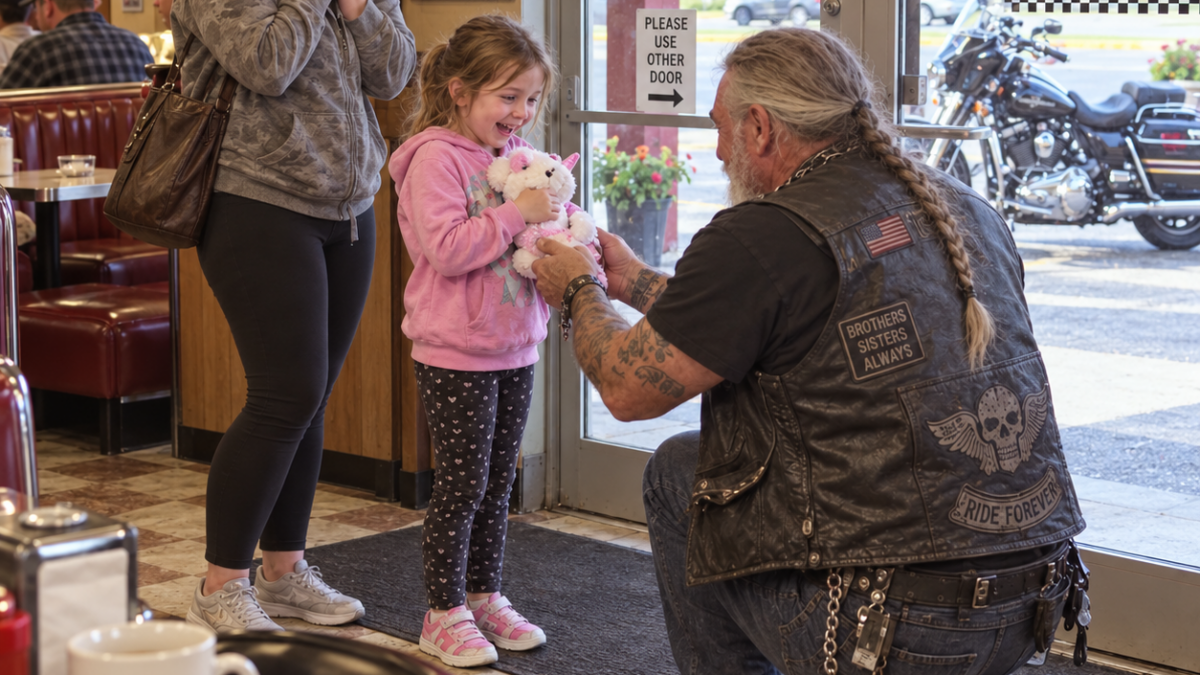
Denver knelt so his face was level with hers.
The same way he had done in the diner.
“You look beautiful, Lily Grace.”
She touched his tie.
“You look like a real dad.”
I saw his throat move.
“Tonight,” he said, “I am. For as long as you need.”
I took a picture on my phone.
It is framed on my dresser now.
At the dance, the other parents did not quite know what to make of him.
Some mothers whispered.
A few fathers stared.
Denver did not care.
He danced with Lily like she was royalty.
Slow spins.
Careful steps.
One hand holding hers, the other hovering respectfully at her shoulder, because he said a gentleman does not assume where a lady wants his hand.
Lily’s dress twirled.
Her face glowed.
For an hour, she did not look abandoned.
She looked chosen.
Then one of the dads made a comment.
He was the kind of man who wore boat shoes in February and looked like he voted for himself in his own head.
He said something loud enough for the table beside him to hear.
Something about how some kids will hang out with anybody.
Denver did not turn around at first.
He kept dancing.
The man tried again.
Something about bikers at school events now.
Denver stopped.
He looked down at Lily.
“Go get some punch, sweetheart.”
She did, skipping.
Then he walked over to the man.
I could not hear what Denver said.
He did not raise his voice.
He did not point.
He did not threaten in any way anyone could report.
The man’s face went white.
He picked up his coat and left.
I asked Denver later what he had said.
“I told him his daughter deserved better than a father who talks about other people’s kids like that. And I told him if I could hear him from across the room, his daughter probably could too.”
That was Denver.
A year later, Kevin took a plea deal.
Three years.
Felony record.
Loss of his nursing license, which was the thing he cared about most.
Angela divorced him and kept the house.
I received a settlement that let me put a down payment on a little house with a yard.
It was not a big house.
Two bedrooms.
Old kitchen.
A porch that sagged slightly to the left.
But it had a maple tree in the front yard and a patch of dirt out back where Lily immediately announced she would grow strawberries, tomatoes, and possibly a unicorn if the soil was good.
The Iron Saints helped us move.
Of course they did.
Denver drove the truck.
Marlene organized the kitchen.
Tank carried boxes labeled BOOKS and complained that Lily owned more literature than the county library.
Preacher installed shelves.
Ava and Lily claimed the backyard.
On the day we finished unpacking, I stood on the porch with an empty box in my arms and watched my daughter walk up to Denver in the driveway.
She had that look on her face.
The one from the diner.
Serious.
Six years older in her head than her body was.
“Denver,” she said. “Can I ask you something else weird?”
He crouched down.
Knees popping like always.
“Always.”
“Are you my grandpa now?”
The driveway went still.
Denver looked at her.
Then at me.
I could not speak.
Marlene stood by the truck with both hands pressed to her mouth.
Denver turned back to Lily.
“Do you want me to be?”
She nodded.
“Then yes.”
She hugged him around the neck and held on for a long time.
He held her back.
I saw his shoulders shake once.
Then he got himself together.
I stood there holding an empty box and thought about the diner.
About how I almost stopped her from getting out of the booth.
How close I came to grabbing her arm, pulling her back, apologizing to everyone, and never letting her ask that stranger the question that changed our lives.
I would have lost this.
All of this.
If I had been one second faster.
Sometimes the worst thing that ever happens to you rips open a door you did not know was there.
And on the other side is a family you never would have found on your own.
My six-year-old asked a biker at a diner to be her dad because her real one had just left.
She did not get a dad that day.
Not exactly.
She got something wider.
She got a friend.
Then a whole motorcycle club.
Then a grandfather who bought purple ties, fixed faucets, scared rude fathers without raising his voice, and showed up every Sunday like love was a habit, not a speech.
I got help.
I got witnesses.
I got the truth.
I got myself back piece by piece.
And I got to raise a daughter who is not afraid to walk up to someone and ask for what she needs.
Kevin sent Lily a birthday card from prison last year.
She read it once.
Then she placed it in the drawer with her old drawings and went outside to help Denver fix the swing set.
I watched from the kitchen window.
Denver handed her a wrench.
She said something that made him laugh.
The maple tree moved in the wind.
The swing set creaked.
My daughter stood in the yard of the house we fought for, beside the man she chose in a diner when her heart was broken and mine was too tired to stop her.
That is the ending.
That is where I leave it.
Because that is the part that matters.
Not the man who left.
The people who stayed.


