My 6-Year-Old Asked a Biker at the Diner to Be Her Dad Because Her Real One Just Left
PART3:
Broken dishwasher.
Friday movies.
Sunday grocery runs.
Christmas stockings stored in a plastic tub under the bed.
He said it like all of that had happened to him.
“I can’t breathe here anymore.”
I started begging.
That still humiliates me.
Not because love is humiliating.
Because I could hear myself offering to change things I had not caused.
“I’ll pick up fewer shifts.”
“We can move.”
“We can go to counseling.”
“I’ll stop asking about money.”
“We’ll figure it out.”
Then I said the one thing I thought mattered more than us.
“Lily needs you.”
Kevin looked past me toward the road.
“I can’t do this right now, Rachel.”
Right now.
I lived inside those words for three days.
Right now meant temporary.
Right now meant overwhelmed.
Right now meant maybe next Tuesday.
So when Lily asked where Daddy was, I said:
“He’s figuring some things out.”
By day fourteen, I no longer believed myself.
Lily still did.
Children can hold hope much longer than adults because they have not yet learned how often people hide permanent decisions inside temporary language.
That Saturday I took her to Miller’s because she had barely eaten breakfast all week.
And because our apartment felt haunted by all the normal objects Kevin had left behind.
His mug.
His slippers.
Half a bottle of shampoo.
A jacket he apparently did not like enough to pack.
Lily colored on a placemat while I stared at my phone.
No messages.
No calls.
Then she looked across the diner.
“Mommy.”
“Hmm?”
“That man looks lonely.”
I followed her eyes.
Corner booth.
Near the dead jukebox.
The man was in his late sixties.
Maybe older.
Gray beard.
Gray braid down the back of a black leather vest.
Heavy boots.
A faded patch over one shoulder:
IRON SAINTS MC.
At the time, I had no idea what that meant.
He was reading a paperback with cracked corners.
A plate of fries sat mostly untouched.
“He’s reading.”
I said.
Lily frowned.
“People can read lonely.”
I should have listened to that more carefully.
Instead I reached for coffee.
A few minutes later, my daughter was gone.
Not gone gone.
Gone from booth.
By the time I realized, she was halfway across the diner.
“Lily.”
She kept walking.
“Lily Grace.”
Too late.
She stopped beside the biker’s table.
He looked up.
My daughter held a purple crayon in one fist.
Ketchup on one sleeve.
Hair falling out of the ponytail I had redone twice that morning.
Then she said it.
Loudly.
Because Lily always got louder when nervous.
“Excuse me.”
The man closed his book.
“Yes, ma’am?”
“My dad left us.”
Every sound in the diner seemed to lower.
Lily continued.
“Do you want to be my dad?”
I was already standing.
Then:
“I’m good.”
My heart broke.
“I don’t cry that much.”
That sentence stopped me.
For two weeks, I had heard her cry every night.
Not dramatic crying.
She tried not to let me hear.
Into her pillow.
Into my shirt.
Into the stuffed rabbit Kevin bought her at the county fair the year before.
Quiet crying.
The kind children do when they believe their sadness might become one more problem for the exhausted adult trying to hold everything together.
And now she was offering a stranger the version of herself she thought would be easier to keep.
The biker did not laugh.
That mattered.
He did not exchange a look with the waitress.
Did not give Lily that bright, false pity adults use when a child says something uncomfortable.
He held his place in the book with one finger.
Then asked:
“What’s your name?”
“Lily.”
“Lily what?”
“Lily Halston.”
His face changed.
Small.
So small I almost missed it.
His eyes sharpened.
His shoulders became still.
I reached them.
“I am so sorry.”
I took Lily’s hand.
“She’s going through a lot.”
“Baby, you cannot ask strangers to be your father.”
The biker looked up at me.
“You Rachel?”
My stomach dropped.
“What?”
“Your name Rachel?”
I pulled Lily closer.
“How do you know my name?”
He looked at my daughter.
Then at me.
Then back.
“You like fries, Lily?”
She nodded.
“I got more than I can eat.”
He slid plate toward other side of booth.
“You think your mama would let you sit right there and finish some while she and I talk by the pie case?”
Every reasonable instinct inside me shouted no.
I did not know this man.
He knew my name.
He knew my daughter’s last name.
He wore a motorcycle-club vest.
And I was a woman alone with a six-year-old whose father had just vanished.
I should have grabbed Lily and walked out.
Instead I studied his face.
Not kind exactly.
Kind is easy to imitate.
He looked steady.
That was different.
“Stay where I can see you.”
I told Lily.
She climbed into booth.
“Okay.”
The biker rose.
He was taller than I expected.
Broad even at his age.
He moved slowly, like his knees hurt but he did not want anyone noticing.
We stopped near pie case.
He kept enough distance between us that I never felt cornered.
“My name’s Denver.”
“That your real name?”
“Real enough.”
“My wife calls me Daniel when I’m in trouble.”
I folded arms.
“What do you want?”
He took a breath.
“Your husband’s Kevin?”
“Yes.”
“You live in the blue apartments off Route Nine?”
My entire body went cold.
“How do you know where I live?”
Denver reached inside vest.
Slow enough that I could see his hand.
Pulled out folded truck-stop receipt.
“I’ve been trying to figure out how to contact you.”
“Why?”
“I saw your husband Tuesday night.”
I stared.
“Where?”
“Truck stop past county line.”
“You know Kevin?”
“No.”
“Then how do you know it was him?”
He unfolded receipt.
“I was behind him at register.”
“He pulled his wallet.”
“An insurance card fell out.”
“Rachel Halston.”
“Blue apartments.”
“He picked it up before I could say anything.”
I could hear compressor humming inside pie case.
Cherry.
Apple.
Chocolate cream.
Denver looked directly at me.
“Then he walked outside.”
“And?”
“He got into a minivan.”
I waited.
“With a woman.”
My mouth went dry.
“And two kids.”
I stopped breathing.
“They called him Daddy.”
The diner blurred.
The laughter behind me became distant.
I could hear Lily talking to herself while she colored.
My daughter was six feet away drawing while somebody explained that her father had another family.
“How old?”
“What?”
“The kids.”
Denver looked uncomfortable.
“Boy maybe ten.”
“Girl maybe eight.”
Ten.
I grabbed that number.
Lily was six.
Kevin had been with me eight years.
If this boy was his—
“No.”
I whispered.
Denver did not argue.
“How do you know they were his?”
“He kissed the woman.”
“Kissed both kids.”
“They called him Dad.”
“That could be—”
I stopped.
Even to me, the denial sounded desperate.
Denver handed receipt over.
Back had license number.
Ohio plate.
An address.
A town three hours east.
“I followed them.”
I looked up.
“You what?”
“I followed minivan.”
“Why?”
“I have granddaughter Lily’s age.”
He shrugged.
“I saw man wearing wedding ring get into van with another family after his insurance card showed different woman.”
“I wanted to know where he went.”
“That’s insane.”
“Probably.”
“Why didn’t you call police?”
“And say what?”
“Man might be cheating?”
“That isn’t police matter.”
“Why didn’t you come to my apartment?”
“Because I’m not stupid.”
He pointed lightly at his vest.
“I’m an old biker.”
“Knocking on stranger woman’s door to say I followed her husband across state lines is good way to terrify somebody.”
“So what were you going to do?”
“Write letter.”
He grimaced.
“Wife said letters were terrible.”
Despite myself:
“What did you write?”
“First sounded like ransom note.”
“Second sounded like police report.”
“Third started, ‘Dear Ma’am, I regret to inform you your husband is a lowlife.’”
A laugh escaped me.
Wrong.
Broken.
But a laugh.
Denver nodded toward Lily.
“I was still trying to decide if any of this was my business.”
“Then your little girl walked over.”
“And asked me to be her dad.”
He shook his head.
“I’m not religious enough to call everything a sign.”
“But that was close.”
My legs gave.
I sat on bench by register.
Denver crouched.
Knees cracked loudly.
“My name’s Denver.”
he said again.
“I got wife named Marlene.”
“Three grown daughters.”
“One granddaughter who thinks glitter is food.”
“I’m not trying to hurt you.”
I stared at receipt.
“I need a minute.”
“I’ll sit with Lily.”
“Do not tell her anything.”
“I wouldn’t.”
I went to bathroom.
Locked door.
Threw up my coffee.
Then I stood at sink.
Thirty-two years old.
Hair in messy bun.
Dark circles.
A nurse who could handle blood, death, difficult families, surgeons with egos, and twelve-hour shifts without blinking.
I gripped the sink because my hands would not stop shaking.
Ten.
The boy might be ten.
Kevin met me eight years earlier.
Which meant this did not begin after Lily.
It did not begin when our bills got worse.
It did not begin because marriage got hard.
If Denver was right, Kevin had been lying before the first time he kissed me.
Before our first Christmas.
Before I held a pregnancy test with both hands and cried.
Before he stood beside me during Lily’s birth and whispered:
“She’s perfect.”
Something inside me became very quiet.
Rage had not arrived yet.
Rage needs clarity.
At first betrayal is poison without direction.
I washed my face.
Went back.
Lily had a milkshake.
“I didn’t order that.”
Denver looked guilty.
“She negotiated aggressively.”
Lily held up placemat.
“Denver says my horse looks like dog with long neck.”
“That’s because horse is dog with long neck.”
she explained.
Denver nodded solemnly.
“Fair.”
I sat.
“Baby, color for a little bit.”
“Okay.”
Denver pushed receipt toward me.
“What do I do?”
He leaned back.
“I can tell you what I would want.”
“That’s different from telling you what to do.”
“What would you want?”
“I’d want to know whose name is on lease.”
“If he’s married legally.”
“Where money is going.”
“Whether he’s got debt.”
“Whether you’re legally exposed.”
I stared.
“I’m a nurse.”
“I work twelve-hour shifts.”
“I have a kid.”
“I can’t drive to Ohio spying on people.”
“I’m retired.”
he said.
“I have time.”
“I’m not asking you to do that.”
“I know.”
“My wife can help.”
“She’s a paralegal.”
“Has been thirty-five years.”
“She’ll know how to check public records without doing anything stupid.”
That was when I cried.
At the table.
Ugly.
Silent.
Lily noticed immediately.
She crawled into lap.
“Mommy?”
“I’m okay.”
“No.”
“I’m okay.”
She pressed forehead to mine.
“Don’t be sad.”
“Denver said he can be our friend even if he can’t be our dad.”
I looked over her hair at him.
“You said that?”
He cleared throat.
“I said dads are complicated.”
“Friends are easier.”
Lily nodded.
“He oversimplified.”
I said.
Denver looked embarrassed.
“I may have.”
That made me cry harder.
Marlene came Monday.
She arrived at nine in morning carrying coffee cake and a folder.
Short.
Red glasses on chain.
Gray hair cut to chin.
She looked like a woman who had spent decades forcing insurance companies to return calls.
When I opened door, she raised cake.
“I bake when angry.”
“This has cinnamon.”
I stepped aside.
She walked in.
Looked at laundry.
Bills.
Crayons.
Did not react.
“Coffee?”
“I have instant.”
“I’ve survived courthouse coffee.”
We sat.
Then she opened folder.
Public records.
Lease.
Marriage license.
Property searches.
Things that had apparently existed all along if somebody knew where to look.
Kevin Michael Halston.
Ohio.
Same Social Security number.
Different bank account.
Same date of birth.
Married to Angela Marie Halston.
Eleven years.
Eleven.
Not eight.
Not six.
Eleven.
“He was already married.”
I whispered.
“Yes.”
“To her.”
“Yes.”
“When he married me.”
Marlene’s eyes softened.
“Yes.”
“So I’m not…”
I could not finish.
“Your ceremony may not constitute valid legal marriage.”
she said gently.
“You need lawyer.”
I looked toward framed marriage license above sofa.
I had paid forty dollars to have it framed.
Kevin complained that was wasteful.
The irony almost made me laugh.
“Marlene.”
“Yeah?”
“Why are you doing this?”
She stirred coffee.
“Denver came home Tuesday and didn’t sleep.”
“He sat kitchen table until four trying to write you.”
“He kept saying, ‘If it were one of our girls, I’d want somebody to tell her.’”
She glanced toward hallway where Lily was playing.
“Then Saturday he called me from diner.”
“Said this little girl had walked right up.”
Marlene smiled.
“And I figured that settled it.”
“What?”
“That we were helping.”
The next month was worst month of my life.
And somehow not loneliest.
That distinction saved me.
Marlene connected me with attorney Susan Patel.
Family law.
Fraud.
Calm voice.
Silver hair.
She reviewed documents.
Asked precise questions.
Never once said:
I can’t believe this.
Because apparently lawyers believe almost anything after long enough.
Kevin’s legal marriage to Angela predated relationship with me.
Our supposed marriage created serious issues.
Financial.
Parentage records.
Property.
Support.
Fraud.
Possible criminal exposure.
Susan said:
“I cannot give you decade back.”
“I can protect your daughter.”
“I can document what happened.”
“I can make it harder for him to rewrite story later.”
That mattered.
Because Kevin always rewrote.
I had simply never recognized it.
That same week Denver’s motorcycle club appeared.
Iron Saints.
I researched them first.
I was grateful for help.
I was not reckless.
The club ran Christmas toy rides.
Hospital fundraisers.
Snowstorm grocery deliveries.
They had helped a domestic-abuse shelter move furniture into confidential housing.
They also looked terrifying in group.
Both things could be true.
Denver began coming Sundays.
First time with toolbox.
I had mentioned leaking faucet.
“I can call maintenance.”
“Sure.”
He fixed it in twenty minutes.
Then drank Lily’s terrible lemonade.
“Best lemonade I ever had.”
She narrowed eyes.
“Are you lying?”
“Yes.”
She burst out laughing.
Second Sunday:
Marlene.
Lasagna.
Third:
their granddaughter Ava.
Seven.
Ava announced within four minutes:
“My grandpa says your dad is idiot but I’m not supposed to say that.”
Marlene closed eyes.
Denver looked at ceiling.
I laughed until ribs hurt.
By sixth Sunday, motorcycles filled parking lot.
A thin man called Tank installed shelves.
A huge man called Tiny fixed porch railing.
Preacher, who said he had not attended church since 1978, carried grocery bags up three flights without being asked.
Lily got balcony garden box.
Tomatoes.
Basil.
Strawberries that died immediately.
Mrs. Albright from 2B asked:
“You involved with motorcycle people now?”
“Yes.”
“Is that wise?”
“Probably not.”
I pointed at new porch light.
“But they fix things.”
She studied light.
“Do they do ceiling fans?”
“Yes.”
The club became less mysterious once you saw them argue about lasagna recipes.
Life remained hard.
Kevin called once.
Unknown number.
I was on bathroom floor.
My hiding place.
“Rachel.”
For one second, my heart reacted like it had before.
Relief.
Love.
Recognition.
I hated myself for it.
Then:
“I’m sorry.”
“What exactly are you sorry for?”
“Things got complicated.”
I laughed.
“You have another wife.”
Silence.
“Two children.”
“Rachel—”
“Say it.”
“I never meant to hurt anybody.”
“That sentence is what people say after hurting everybody.”
“I loved you.”
“And Angela?”
Silence.
“I loved both of you.”
Both.
Like women were rental houses.
Like children were calendar blocks.
I stood.
“I hope Angela has good lawyer.”
“She does.”
I said.
“So do I.”
Then hung up.
I did not cry.
First day I didn’t.
Angela called later.
I expected anger.
Got silence.
Then:
“Did you know?”
“No.”
She exhaled.
“I didn’t either.”
We never became friends.
I’m glad.
Some stories force women into instant sisterhood because same man betrayed them.
Real life is stranger.
We were two women comparing wreckage.
That was enough.
She sent records.
I sent records.
She had two children.
Miles.
Ten.
Sophie.
Eight.
When I told her Lily was six, she was silent.
“She’s little.”
“Yes.”
“I’m sorry.”
I cried.
Because Angela owed me nothing.
And still said it.
I said:
“I’m sorry too.”
Kevin’s lies had placed us on opposite sides of a wall we did not build.
We refused to fight each other for him.
That became its own kind of victory.
Lily struggled differently.
At first she asked about Daddy nightly.
Then every few days.
Then only when something reminded her.
I told truth in pieces.
Daddy had another family he had hidden.
Daddy made choices adults were handling.
None of it was Lily’s fault.
One night she drew purple sun.
“Does Daddy love other kids more?”
“No.”
“Then why’d he stay with them?”
I had no clean answer.
“I don’t think Daddy knows how to love people the right way.”
She pressed crayon hard.
“That is a Daddy problem.”
“Not a Lily problem.”
She whispered:
“If I cried less, would he come back?”
I had been punched before.
I had broken my wrist once.
Nothing hurt like that.
I moved beside her.
“Listen.”
“You could cry every day.”
“You could yell.”
“You could spill milk.”
“You could be easiest child on Earth.”
“You could be hardest.”
“You could get all A’s or no A’s.”
“None of those things made Daddy leave.”
“His choice belongs to him.”
She stared.
Then:
“I don’t cry that much.”
The diner sentence.
I pulled her into arms.
“I know.”
“But you can.”
And finally she did.
Not quiet.
Not careful.
She screamed into my shoulder.
Sobbed until shirt was wet.
I cried too.
For first time she learned grief did not make her inconvenient.
Six months after Miller’s, school flyer came home.
FATHER-DAUGHTER DANCE.
Pink paper.
Glitter.
Lily left it on table.
Said nothing.
Went bedroom.
I stared at it for ten minutes.
Then called Denver.
“Everything okay?”
“I need a favor.”
“Okay.”
“You don’t know what.”
“Doesn’t matter.”
I laughed.
“School dance.”
Long pause.
“I need suit.”
“You do not have to do this.”
“My youngest daughter’s wedding suit makes me look like sausage.”
“I checked recently for funeral.”
“So yes.”
“I need suit.”
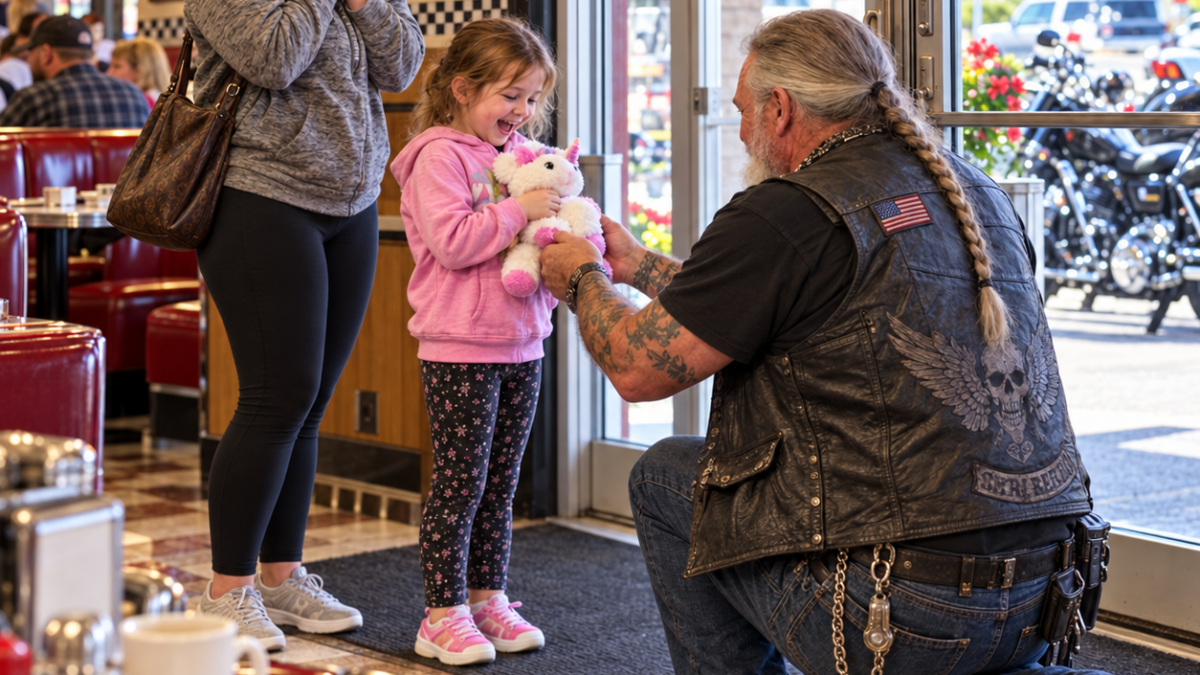
Night of dance, Denver arrived in gray suit.
Purple tie.
Lily’s favorite.
Boots polished.
Braid tucked behind jacket.
Marlene pinned white flower to lapel.
Then Lily walked out.
Purple dress.
Hair clip.
She stopped.
Denver knelt.
Same way as diner.
“You look beautiful, Lily Grace.”
She touched his tie.
“You look like a real dad.”
I saw Denver swallow.
“Tonight.”
he said.
“I am.”
“For as long as you need.”
I took picture.
Still have it.
At dance he did not know what to do with his hands.
Asked Lily before touching shoulder.
Spun her slowly.
Let her step on boots.
She laughed.
For one hour my daughter did not look abandoned.
She looked chosen.
A father at nearby table made a comment.
Something about bikers.
Something about kids hanging out with anybody.
Denver ignored first.
Then second.
He sent Lily for punch.
Walked over.
Did not raise voice.
Did not threaten.
Man left five minutes later.
I asked afterward:
“What did you say?”
“I told him his daughter deserves better than father who talks about somebody else’s child like that.”
“And if I could hear him, she probably could too.”
That was Denver.
A year after diner, Kevin accepted plea agreement related to fraud and bigamy-related conduct.
There were consequences.
Criminal record.
Professional licensing problems.
Financial losses.
Angela divorced him.
I obtained support and a civil settlement that finally gave Lily and me room to breathe.
It did not make us rich.
It made a down payment possible.
Two-bedroom house.
Old kitchen.
Crooked porch.
Maple tree.
Backyard dirt.
Lily announced plans:
Strawberries.
Tomatoes.
Maybe unicorn.
Iron Saints moved us.
Of course.
Denver drove truck.
Marlene organized kitchen.
Tank complained Lily owned too many books.
Preacher installed shelves.
Ava and Lily claimed backyard.
At end of day I stood on porch holding empty box.
Lily walked toward Denver.
She had diner face.
Serious.
“Denver.”
He crouched.
Knees cracked.
“Can I ask something weird?”
“Always.”
“Are you my grandpa now?”
Everything stopped.
Denver looked at her.
Then me.
I could not speak.
Marlene pressed both hands over mouth.
Denver asked:
“Do you want me to be?”
Lily nodded.
“Then yes.”
She wrapped arms around neck.
He hugged her.
His shoulders shook once.
Then he got himself together.
I stood there with empty box and remembered Miller’s Diner.
How I almost stopped her.
If I had been one second faster, I might have grabbed her hand.
Pulled her back into booth.
Apologized.
Paid check.
Walked out.
I would have lost all of this.
That thought haunted me in a good way.
Sometimes the worst thing that happens tears open a door you did not know existed.
On other side may not be replacement for what you lost.
Something different.
Wider.
Lily did not get father from Denver that morning.
She got a friend.
Then Marlene.
Then Ava.
Then twenty bikers who learned which Girl Scout cookies she liked.
Then a grandfather who bought purple ties, fixed faucets, sat through school plays, carried lawn chairs to soccer games, and showed up so consistently that eventually “showing up” became what she understood love to mean.
Kevin had said:
I love you.
Denver rarely did.
He just arrived.
Sunday.
Tuesday if sink leaked.
Thursday if Lily had recital.
Saturday if lawnmower would not start.
Rain.
Snow.
Headache.
Bad knee.
He came.
That taught me more about love than Kevin ever did.
Years passed.
Lily grew.
The stuffed rabbit ended up on shelf.
Then closet.
Father-daughter dance photo stayed dresser.
Kevin sent birthday cards from prison for a while.
Then after release.
Lily opened some.
Ignored others.
I never told her what to feel.
That was hers.
One year she read his card.
Placed it in drawer.
Then walked outside where Denver was repairing swing set.
I watched through kitchen window.
He handed her wrench.
She rolled eyes at something.
He laughed.
Maple branches moved.
Swing chain squeaked.
My daughter stood in yard beside a man she had chosen when she was six years old and hurting.
I thought about her first question.
Do you want to be my dad?
At the time, it sounded desperate.
Now it sounded brave.
She had asked directly for something adults spend entire lives pretending they do not need.
Stay.
Choose me.
Show up.
Denver had been wise enough not to promise what he could not offer.
He did not say:
Sure, I’ll be your dad.
He said:
I can be your friend.
Then he proved what that meant.
Again.
Again.
Again.
People later asked me whether I believed in fate.
I don’t know.
I believe in bad coffee.
Public records.
Good lawyers.
Children with no social filter.
Retired bikers who follow cheating husbands because something feels wrong.
Women like Marlene who bake when angry.
Motorcycle clubs that look frightening and build balcony garden boxes.
I believe in evidence more than destiny.
But I also know my daughter crossed one diner on exactly the morning a stranger who knew the truth happened to be sitting alone.
I cannot explain that.
I no longer need to.
For years I thought our story was about Kevin.
It wasn’t.
Kevin started it.
He did not deserve ending.
The ending belonged to people who stayed.
Marlene, who brought coffee cake and paperwork.
Susan, who told me what law could fix and what it never could.
Angela, who chose truth over competition.
Iron Saints, who turned a parking lot into something that felt protected without ever asking to be called heroes.
Denver, who told a six-year-old dads were complicated but friends were easy.
And Lily.
Especially Lily.
Because she taught me something I had forgotten.
After Kevin left, I spent weeks thinking survival meant making ourselves smaller.
Spend less.
Need less.
Cry less.
Ask less.
Do not inconvenience anybody.
Lily walked across diner and did opposite.
She asked for something enormous.
In front of everyone.
Without shame.
It did not arrive in form she expected.
It arrived better.
The man who betrayed us taught my daughter that some people leave even after promising forever.
The people who found us taught her forever is not always promise.
Sometimes it is habit.
A knock every Sunday.
Purple tie.
Toolbox.
Lasagna.
A motorcycle in driveway.
A wrench handed across swing set.
Someone saying:
I’m here.
Again.
Again.
Again.
That is why, when people ask what happened to man who left, I rarely tell whole thing.
Court.
Money.
Charges.
Professional consequences.
Those are facts.
Important facts.
But they are not the part I carry closest.
I carry a six-year-old girl with ketchup on her sleeve.
A purple crayon.
A gray-bearded biker closing his paperback.
And one impossible question.
“Do you want to be my dad?”
No.
Not exactly.
What she found was bigger than that.
She found people who stayed.

