I Warned HOA 3 Times “My Lake Has Alligators” — They Opened It Anyway, I Watched From My Porch
PART2:
And at least three dogs on retractable leashes long enough to let the animals make decisions their owners would regret.
My wife Jolene stepped through the screen door behind me.
“You see something?”
“Maybe.”
I reached for the binoculars.
The water remained smooth.
Then two eyes appeared.
Nothing else.
Just eyes.
Dark.
Level.
Patient.
Then the ridge of a snout.
Jolene set the coffee pot down.
“That him?”
“Yep.”
“Judge?”
“Judge.”
She took the binoculars from me.
Across the water, an eleven-foot American alligator floated motionless in the lake he had occupied longer than Palmetto Lake Estates had existed.
Longer than Vanessa Langford had lived in Florida.
Longer than half the people on that beach had been married.
Maybe longer than some of them had been alive.
Judge did not rush.
He never rushed.
That was one reason I gave him the name.
He had the slow, deliberate movement of something that had survived long enough to understand panic belonged to everybody else.
A woman on the dock noticed him first.
Her arm lifted.
Finger pointed.
For one second I watched her mouth open without hearing anything.
Then the scream crossed the lake.
High.
Sharp.
Immediate.
Every parent on the beach turned.
A man dropped a fishing pole.
One child ran toward another child.
A golden retriever in the shallows began barking.
Then the dock emptied in roughly ten seconds.
I know because my trail camera recorded it.
People later accused me of exaggerating.
I didn’t need to.
The facts were already funny enough.
A father grabbed two kids under the arms and carried both at once.
A woman abandoned a beach chair.
A man in red swim trunks stepped backward into the kayak rack, knocking two kayaks into the water.
The golden retriever did what golden retrievers have done since creation and decided the large reptile probably wanted to be friends.
It started swimming toward Judge.
Its owner screamed:
“BAILEY!”
Then waded waist-deep after it.
I stood so fast my rocking chair hit the porch wall.
“Don’t.”
Of course he could not hear me from two hundred yards away.
The owner reached the dog’s collar and pulled hard.
Judge still had not moved.
That did not make the situation safe.
That was the problem with alligators.
People imagined danger looked like aggression.
Open jaws.
Charging.
Thrashing.
Sometimes danger looks like two eyes staying exactly where they are.
A woman dialed 911.
Somebody else yelled for everyone to get out of the water.
Children cried.
Dogs barked.
The music kept playing.
“Hotel California” now.
Perfect.
Then Judge sank.
That made the panic worse.
People could no longer see him.
Jolene said:
“Now they understand.”
“No.”
I shook my head.
“Now they’re scared.”
“Understanding comes later.”
The crowd moved up the paved HOA path toward the subdivision.
Coolers left behind.
Towels.
Shoes.
A pink plastic shovel.
One kayak drifting sideways.
Vanessa Langford stood beside the dock in a coral sundress shouting instructions nobody was listening to.
She pointed toward the trail.
Then toward the water.
Then at her phone.
Her white Range Rover sat at the trailhead beyond my property line.
I could see her even without binoculars.
Vanessa had spent fourteen months telling me she understood Colton Lake better than I did.
Now she was looking at it like the water had betrayed her.
Judge surfaced again.
Closer.
He glided toward the dock.
Jolene poured herself coffee.
“You warned her.”
“Three times.”
“You begged her.”
“I did not beg.”
She looked at me.
I sighed.
“Once.”
“Twice.”
“Fine.”
Judge reached the dock.
His snout touched one support piling.
He paused.
Then moved along the side.
The fresh pine structure extended forty feet into the water.
The HOA had built it six days earlier.
They had not asked what kind of animals used that shoreline.
They had not asked where the deep channel ran.
They had not asked why the south bank remained mostly undisturbed on an eighty-acre working ranch.
They had looked at the water and seen an amenity.
Judge looked at the dock and apparently saw furniture.
He climbed onto it.
Slowly.
Front feet first.
Black claws against pale pine.
Then shoulders.
Body.
Hind legs.
Tail.
All eleven feet of him.
Close to five hundred pounds.
Dark olive hide almost black from the water.
Old scars along both flanks.
A deep notch missing from the left side of his tail.
He walked about six feet down the dock.
Turned slightly.
Then lowered his body onto the sun-warmed boards.
His mouth opened.
Not to attack.
To thermoregulate.
He looked comfortable.
Jolene stared.
“They spent sixty-two thousand dollars on that.”
“So they say.”
“On a gator bed.”
“Apparently.”
“That might be the most expensive reptile furniture in Polk County.”
I sat again.
The rocking chair creaked.
Judge stayed.
A sheriff’s deputy arrived first.
Then Florida wildlife officers.
By the time Captain Marcus Webb from the Florida Fish and Wildlife Conservation Commission reached my property, Judge had been on the dock for more than two hours.
Marcus had worked wildlife enforcement long enough to have the expression of a man almost impossible to surprise.
He stood beside me beneath the live oak.
Looked through binoculars.
Then lowered them.
“That’s a big animal.”
“Eleven feet, give or take.”
“How long?”
“I first logged him in 2006.”
“You keep records?”
“I keep cattle.”
He looked at me.
“That doesn’t answer the question.”
“Yes.”
“I keep records.”
I handed him a field notebook.
Judge.
Approximate length.
Basking locations.
Seasonal movement.
Female nesting areas.
Trail-camera dates.
I was not a wildlife biologist.
I did not pretend to be.
I was simply a man who had lived beside the same lake for fifty-eight years and understood that knowing your property included knowing what could eat your calves.
Marcus flipped through pages.
“You warned the HOA?”
I pointed toward the ranch house.
“I’ve got copies.”
“How many times?”
“Three formally.”
“More informally.”
Jolene called from the porch:
“He told her until I got tired of hearing him tell her.”
Marcus smiled.
“Mrs. Colton?”
“Jolene.”
“Jolene.”
He nodded toward the dock.
“They have permission from you?”
“No.”
“Easement?”
“No.”
“Lease?”
“No.”
“License agreement?”
“No.”
“Nothing?”
“Nothing.”
He looked across the water again.
“Then how did that get there?”
“That’s a longer story.”
It began sixty-three years earlier.
My grandfather Cecil Colton bought eighty acres in Polk County in 1961.
Cattle land.
Sandy loam over limestone.
Mostly pasture.
A few hardwood hammocks.
One spring-fed lake nearly fifteen acres across.
The original survey called it simply:
LAKE.
Nobody needed branding.
Nobody needed a lifestyle concept.
Water was water.
Cattle drank from controlled access points.
Bass lived in it.
Birds nested around it.
Alligators came and went.
Over time, people nearby began calling it Colton Lake.
Nothing official.
Just convenience.
Then in 1974, according to Jolene, some county clerk penciled “Colton Lake” beside the parcel description on an internal tax map.
The name stuck.
I was born on the property.
Literally.
Not at a hospital.
My mother went into labor during a thunderstorm.
The road flooded.
Dad’s truck refused to start.
Our neighbor had been a Navy corpsman.
He delivered me on the kitchen floor while lightning turned the windows white.
Dad told that story every birthday until he died.
“You came into the world the same way you live.”
“What way?”
“Loud.”
“I was a newborn.”
“Stubborn.”
“Again.”
“And refusing to leave the property.”
That part became true.
I married Jolene when we were twenty-four.
We rebuilt the ranch house after Hurricane Andrew tore enough roof away to make the original structure impractical.
Thirty-two years later, we were still there.
Jolene had spent twenty-four years working in the Polk County Clerk of Courts system before retirement.
That meant she trusted no document until she had checked the filing date, signature, recording number, and whether the person handing it to her understood what it actually said.
When people called her suspicious, she corrected them.
“I’m experienced.”
I ran cattle.
Maintained fencing.
Leased pasture occasionally.
Sold hay when the season allowed.
And lived with alligators.
My grandfather had one rule.
“You don’t own Florida water.”
That sounds poetic.
He did not mean it poetically.
He meant:
You hold title to land.
You pay taxes.
You maintain fences.
But the ecosystem is not impressed by your deed.
“You share it with whatever was here first.”
Then:
“And whatever was here first probably has more teeth.”
Colton Lake usually supported six to eight alligators.
Juveniles came and went.
Females nested along quieter sections.
Mature males changed territories occasionally.
Judge stayed.
The first time I noticed him, he was already large.
More than nine feet.
Dark.
Scarred.
Dominant.
Over the years, he grew.
I watched him take fish.
Turtles.
A raccoon once.
One white-tailed deer that made the mistake of drinking too close to an undercut bank.
Two calves over nearly twenty years.
Maybe more.
I kept cattle fenced well away from shoreline.
Sometimes storms or broken wire changed that.
Judge collected his tax.
I did not blame him.
He was doing exactly what an alligator does.
I adjusted my fencing.
That is how people survive wild places.
The land does not negotiate.
You adapt.
The Kimball property sat east of ours.
One hundred twenty acres.
Old cattle ground.
Roy Kimball held onto it until his knees got too bad.
His children lived out of state.
They sold to Meridian Communities in 2020.
Within eighteen months, pasture became Palmetto Lake Estates.
One hundred forty-four homes.
Tile roofs.
Three-car garages.
Community fitness center.
Walking trails.
Decorative entrance.
Monthly HOA dues high enough to make Jolene whistle.
The developer advertised:
FLORIDA LAKESIDE LIVING AT ITS FINEST.
The first billboard showed a sunset across my lake.
My lake.
Not theirs.
The photograph had been taken from a drone angle somewhere above the former Kimball property.
I called.
A marketing coordinator apologized.
“We’ll revise future materials.”
They did not.
The website showed kayaks.
Artist renderings showed a dock.
One rendering showed a smiling family fishing from a platform that did not exist.
Jolene stared at the laptop.
“They put imaginary people on your lake.”
“Apparently.”
“They should at least use realistic mosquitoes.”
The houses sold.
Most buyers were decent people.
Retirees.
Young families.
Transplants from Virginia.
Ohio.
New Jersey.
Georgia.
People who had seen Florida lakes on television and thought:
Sunset.
Bass.
Kayak.
They did not think:
Apex reptile.
That was not their fault.
The marketing did not teach them.
Then Vanessa Langford became HOA president.
Vanessa was forty-six.
Originally from Fairfax, Virginia.
Her husband Keith worked remotely as a defense contractor.
She had held a Virginia real-estate license at one point but, according to what we later learned, had not been actively practicing locally in the ordinary way people assumed.
She was organized.
Confident.
Persuasive.
And one of those people who believed resistance usually came from ignorance.
If someone disagreed, she educated.
If they still disagreed, she escalated.
Her first year as president produced rules about flowerpots, swing sets, exterior fixtures, flags, parking, garbage cans, and an approved community color palette so detailed Jolene once read it and asked:
“Do they regulate sunsets too?”
Vanessa’s attention eventually moved to Colton Lake.
The first letter came on cream cardstock.
PALMETTO LAKE ESTATES
COMMUNITY ENHANCEMENT PROPOSAL
LAKE ACCESS INITIATIVE
I read it standing beside the mailbox.
Forty-foot floating dock.
Sand beach.
Kayak launch.
Benches.
Fire pit.
Walking path.
The letter acknowledged that the lake sat on adjacent private property.
Then called it:
A shared natural resource contributing materially to community identity and value.
I read that sentence three times.
Shared natural resource.
Jolene took the letter.
“You sharing it?”
“No.”
“Then apparently they forgot to invite one of the sharers.”
I drove to the clubhouse.
Brought my deed.
Survey.
Property-tax records.
Old aerials.
I highlighted the boundary.
Vanessa sat across from me in a conference room smelling faintly of eucalyptus.
I put the documents down.
“This is private land.”
She smiled politely.
“We understand the lake is located within the Colton parcel.”
“No.”
I tapped the survey.
“You understand that sentence but not what it means.”
Her smile changed.
“We’re proposing a mutually beneficial agreement.”
“I’m not interested.”
“You haven’t heard the full proposal.”
“I’ve lived with the full lake.”
She leaned back.
“The community was marketed around the water.”
“That’s a problem between your homeowners and whoever marketed it.”
“Our residents were given a reasonable expectation—”
“Not by me.”
She stopped.
I continued.
“There is no easement.”
“No public access.”
“No HOA access.”
“No recreational agreement.”
“No littoral-rights issue connecting your lots to this water.”
“No deeded corridor.”
“No license.”
“You cannot build anything on my south shore.”
Vanessa folded her hands.
“Everything is negotiable.”
“Not everything.”
“That seems unnecessarily adversarial.”
“Ma’am.”
I took a breath.
“This is not the important part.”
“What is?”
“The lake has alligators.”
She blinked.
“Of course it has alligators.”
“No.”
“You don’t understand.”
“At least six adults I can confirm.”
“Probably more.”
“Large female near the south cypress.”
“Eight-foot male farther east.”
“And one dominant bull around eleven feet.”
“I have watched that animal take a deer off the bank.”
“If you build a dock on the south shore and start putting dogs, children, kayaks, and fish-cleaning activity there, you are putting recreation into established habitat.”
Vanessa held up one manicured hand.
“Mr. Colton, this is Florida.”
“I’m aware.”
“Alligators are common.”
“Yes.”
“Millions of people live around water safely.”
“Yes.”
“So a wildlife presence does not make responsible access impossible.”
“Correct.”
She looked satisfied.
I continued:
“But responsible access begins by accepting the landowner telling you no.”
Her smile vanished.
That was warning one.
Three months later, the board held a community meeting.
Agenda:
REALIZING OUR LAKEFRONT VISION.
Jolene came with me.
Not because I needed moral support.
Because she believed board minutes become more interesting when somebody in the room understands procedure.
One hundred six residents showed up.
Vanessa had a PowerPoint.
Aerial photos.
Dock renderings.
Property-value charts.
One slide estimated homes near “community lake access” could gain between eight and twelve percent.
Jolene leaned toward me.
“Source?”
“No idea.”
“Slide says market projections.”
“That means no idea with a tie.”
During public comment, I walked forward carrying photographs.
Judge.
Mama.
A six-footer captured on a trail camera crossing pasture.
I held up the picture of Judge basking.
People murmured.
“That animal is not an internet photo.”
“I took it.”
“He lives on the south bank.”
“He has lived there at least eighteen years.”
Someone in the second row said:
“He looks huge.”
“He is.”
Vanessa smiled toward the room.
“Alligators are a normal part of Florida ecosystems.”
“Yes.”
I nodded.
“So are lightning strikes.”
“Doesn’t mean I’d build a playground under a lightning rod.”
A few people laughed.
Vanessa did not.
I placed the next photograph down.
“This female nested seventy yards from where your proposed walking trail would run.”
“People with dogs should not be encouraged into that corridor.”
A resident asked:
“Couldn’t the gators just be relocated?”
“No.”
I answered carefully.
“You do not solve a functioning Florida lake by demanding every native animal be removed because somebody built houses nearby.”
Vanessa said:
“Wildlife agencies deal with nuisance alligators all the time.”
“Yes.”
“When individual animals meet nuisance criteria.”
“That does not create a right for your HOA to redesign my shoreline and then ask the state to remove resident wildlife so the brochure works.”
That line got silence.
I looked around.
“I am warning you again.”
“If you build recreational access on that bank, somebody could get hurt.”
“Even if nobody gets bitten, you are creating a predictable conflict between people and wildlife.”
“Don’t do it.”
Vanessa stood behind podium.
“Mr. Colton, our residents deserve access to the natural beauty they were promised.”
“The natural beauty includes Judge.”
Somebody clapped.
Then another.
Not for me.
For Vanessa.
That was the first moment I realized how badly the marketing had worked.
These homeowners were not villains.
They had paid hundreds of thousands of dollars for something advertised as lakeside life.
Many genuinely believed I was one stubborn rancher keeping them from a benefit they had purchased.
They had been sold expectation.
Vanessa used that expectation against me.
The board voted four to one to continue pursuing access.
Donna Hatch voted no.
Retired insurance adjuster.
Sixty-four.
Glasses low on her nose.
She caught me afterward.
“They’re not listening.”
“I noticed.”
“They keep saying liability can be managed.”
“It can.”
I shrugged.
“By not trespassing.”
Donna almost smiled.
“I asked who owns the shoreline.”
“Vanessa said ownership is being reviewed.”
“I gave her the survey.”
“I know.”
“She did not show it to us.”
That mattered.
I asked:
“What did she show?”
“A developer map.”
“Whose?”
“Meridian’s original concept map.”
The concept plan shaded part of my south bank as:
FUTURE PASSIVE RECREATION.
Future.
Concept.
Not owned.
Not permitted.
Not an easement.
Just a developer’s wish printed in color.
Donna sighed.
“They think a drawing is a right.”
That was warning two.
Warning three came by certified mail.
Fourteen pages.
Jolene helped.
I described ownership.
Survey boundaries.
No access rights.
Prior warnings.
Known alligator population.
Photographs.
Safety concerns.
A written demand that no structure be placed on my property and no residents be directed toward the lake.
I did not pretend to be a lawyer.
I had an actual lawyer review it.
Katherine Reeves.
Lakeland.
Property disputes.
Thirty years.
Sharp enough that even Jolene liked her, which was the highest available professional endorsement.
Katherine removed two paragraphs where I had gotten too creative.
“You can’t write that.”
“Why?”
“Because ‘when Judge eats your kayak you can invoice Vanessa’ is not useful legal language.”
“It’s memorable.”
“So is contempt.”
She replaced it with something boring and enforceable.
We sent copies individually to every board member.
Three signed the certified receipts.
Two notices came back unclaimed.
The final line said:
This is my third and final warning.
Jolene read it.
Removed her glasses.
“Clear.”
“Good.”
“Documented.”
“Good.”
“She’s going to ignore it.”
I stared.
“You could at least pretend optimism.”
“I spent twenty-four years around court filings.”
“Optimism was not a job requirement.”
Four weeks later, I heard diesel engines.
I was repairing fence near north pasture.
Heavy machinery has a sound cattle notice too.
Heads came up.
I drove south.
At the property line, four men were cutting my fence.
The fence my father installed in 1978.
Four strands of barbed wire.
Creosote posts.
Patched a hundred times.
A mini excavator sat unloaded beside a flatbed.
I got out.
“Stop.”
The foreman removed sunglasses.
“You Wade?”
“Yes.”
He handed me a work order.
PALMETTO LAKE ESTATES
COMMUNITY LAKEFRONT DEVELOPMENT — PHASE I
Authorization:
Vanessa Langford.
“Who told you this was HOA property?”
“Ms. Langford said there’s an access easement.”
“There is not.”
“She gave us the plans.”
“Plans do not create easements.”
He looked toward the lake.
Then at the work order.
“You got paperwork?”
I had my deed in the truck.
My survey.
The man called Vanessa.
I could hear her from six feet away.
Sharp.
Insistent.
The foreman listened.
Then:
“She says it’s authorized.”
“By who?”
“The board.”
“The board does not own this land.”
He looked uncomfortable.
That was good.
He was a contractor.
Not my enemy.
“I’m calling the sheriff.”
He nodded.
“Okay.”
They stopped.
The deputy arrived forty minutes later.
Reviewed my survey.
Looked at the cut fence.
Looked at contractor paperwork.
“This is a civil property dispute as far as ownership and easement claims go.”
Then to the crew:
“But until you can establish lawful authority to work on his property, you should not continue.”
They loaded equipment.
Left.
I went straight to Katherine’s office.
We prepared a trespass notice and emergency civil filing.
By the time I got home at 2:15 the next afternoon, a different crew had built the dock.
Different contractor.
Different trucks.
Early arrival.
Fast work.
Forty feet of new wood extending into Colton Lake.
White sand graded across the south bank.
Kayak rack.
Benches.
Paved connector to the subdivision trail.
A sign:
WELCOME TO PALMETTO LAKE COMMUNITY BEACH.
I stood beside my broken fence.
For a long time.
Jolene pulled up later.
She got out.
Walked beside me.
Looked.
Then said:
“That’s bold.”
“That’s one word.”
“Illegal?”
“Likely several words.”
The county confirmed no proper shoreline construction authorization they could identify.
Katherine started making calls.
The sheriff documented the renewed trespass.
We did not rip the dock out ourselves.
That surprises people.
Why not take chainsaws and remove it?
Because when you are already on the correct side of a property dispute, improvising destruction creates unnecessary complications.
Document.
Notify.
File.
Preserve.
Let the other side own the bad decision.
Then the HOA announced Community Lake Day.
Eight days later.
Kayaking.
Fishing.
Barbecue.
Family nature walk.
The flyer used the phrase:
A celebration of the lakeside lifestyle Palmetto Lake Estates was designed to provide.
No warning about alligators.
No disclosure that access was disputed.
No mention that the landowner had demanded they stay out.
Katherine said:
“You need to stop the event.”
“I’m trying.”
We sought emergency relief.
Timing was tight.
There were procedural delays.
Vanessa claimed the boundary was still disputed.
She insisted the board believed there was an access right.
Her counsel requested time.
The hearing would not occur before Saturday.
I asked the sheriff’s office what they would do if dozens of residents entered through the HOA path.
They could respond to trespass complaints.
But with families arriving under the apparent invitation of their own association, and ownership issues already in civil court, nobody was eager to turn the shoreline into mass arrests.
I understood.
That left me with choices.
Block the path physically.
Confront people.
Create chaos.
Or document.
Jolene asked Friday night:
“What are you going to do?”
“Watch.”
She studied me.
“That makes me nervous.”
“I’ll call if anyone goes outside the beach area.”
“You’re really going to sit there?”
“They’ve been warned.”
“And if Judge shows?”
“I call FWC.”
“You already know he’s going to show.”
“I know he lives there.”
“Different thing.”
Saturday morning, I moved one rocking chair to the south end of porch.
Then another.
Made coffee.
Set binoculars nearby.
Seventy-three people arrived.
For two hours, everything looked exactly like Vanessa’s brochure.
That was what made it so dangerous.
Sun.
Clear sky.
Kids.
Kayaks.
Fishing.
Cold drinks.
Music.
A golden retriever.
Vanessa smiling.
If Judge had stayed submerged all day, people would have gone home believing I was a paranoid old rancher inventing monsters.
Then 11:47 happened.
When FWC arrived, they did not treat Judge like an escaped zoo animal.
That mattered.
Captain Webb inspected.
Reviewed photos.
Walked property boundaries with Katherine, who had arrived carrying enough paper to kill grass wherever she set her briefcase.
He spoke with Vanessa later at clubhouse.
I went because the lake was mine and the structures were on my property.
Vanessa looked furious.
“That animal needs to be removed.”
Marcus said:
“Based on what behavior?”
“It came onto the dock.”
“Which is built inside its established habitat.”
“It terrified residents.”
“It was basking.”
“It could have killed somebody.”
Marcus nodded.
“Yes.”
“Which is why encouraging recreational activity in documented alligator habitat without a wildlife-management plan was a poor decision.”
Vanessa stared.
“Can you relocate it?”
“FWC has procedures for nuisance alligators.”
“An animal existing in its natural habitat does not automatically become nuisance wildlife because somebody puts a dock next to it.”
“What if it keeps coming back?”
Marcus looked toward me.
Then back at Vanessa.
“It probably will.”
Her mouth opened.
“What are we supposed to do?”
“Close access.”
“That’s unacceptable.”
“That is not a wildlife-management term.”
She asked for his supervisor.
Marcus gave her the regional office contact.
He did not make a snappy television speech.
He simply explained the process.
Later, wildlife personnel encouraged Judge away from the structure temporarily.
He slid into the water.
No struggle worth describing.
No battle.
He submerged.
Forty feet offshore, he surfaced again.
Looked back.
The next morning, he returned.
Then again.
Then again.
Within days, the dock became part of his routine.
Morning sun.
Fresh boards.
Wide platform.
Quiet because humans had stopped using it.
Perfect.
Mama began basking on the imported sand.
A smaller male used the slab near the kayak rack.
Palmetto Lake Community Beach became the least successful beach in central Florida.
Yellow caution tape crossed the trail.
The HOA installed temporary signs.
RESIDENT ACCESS CLOSED PENDING WILDLIFE REVIEW.
People were furious.
Not at Judge.
At the board.
That distinction arrived slowly.
First, residents demanded FWC remove alligators.
Then they learned that Florida did not operate by clearing native wildlife from every lake beside a subdivision.
Then they asked:
Why did the board build there?
Then:
Who approved it?
Then:
Did the HOA own the land?
Then:
Why weren’t we told the owner objected?
Those questions led somewhere Vanessa had not expected.
Donna Hatch requested association financial records.
As a board member, she was entitled to them.
Vanessa delayed.
Donna asked again.
Then formally.
The treasurer finally produced them.
Donna called Katherine.
Katherine called me.
Then the story changed.
Twelve homes had sold in Palmetto Lake Estates during the previous eighteen months.
All twelve listings handled by the same agent.
Brooke Chisholm.
Chisholm Premier Properties.
Every listing promoted:
PRIVATE COMMUNITY LAKE ACCESS.
BEACH.
DOCK.
KAYAK AMENITIES.
Several sales closed after construction began.
Homes closest to the lake sold at notable premiums compared with otherwise similar homes.
That alone was not fraud.
Amenities can increase value.
Except the amenity was not theirs.
Katherine pulled business records.
A company appeared.
Palmetto Premium Properties LLC.
Registered before Vanessa sent me the first lake-access proposal.
Registered agent:
Vanessa Langford.
Business relationship with Brooke Chisholm.
Jolene read the filing.
Then looked at me.
“Well.”
That was all she said.
Well.
The most dangerous word in a retired court clerk’s vocabulary.
The HOA had spent approximately ninety thousand dollars connected to the lakefront project and marketing work.
Dock.
Beach.
Trail.
Kayak area.
Consulting.
Some legitimate construction.
Some payments to Chisholm’s company.
Some contracts tied to the marketing operation.
Vanessa had promoted the project as a benefit to all homeowners while holding an undisclosed financial interest in business activity benefiting from the amenity.
That was the real problem.
Conflict.
Disclosure.
Authorization.
Accuracy of property representations.
Use of HOA funds.
The lake was never hers to sell.
The amenities were never legally secured.
Yet the listings represented access as if it were permanent community property.
Katherine said:
“Do not call this a half-million-dollar fraud.”
“Why?”
“Because increased sales prices are not the same as money personally stolen.”
“Fair.”
“We separate provable misappropriation, undisclosed conflict, listing misrepresentation, HOA expenditure, and potential buyer damages.”
She pointed at me.
“You want credibility?”
“Yes.”
“Then don’t inflate.”
That was good advice.
The next association meeting drew one hundred twenty-six residents.
No beachwear.
No kayaks.
No Jimmy Buffett.
Just anger.
Vanessa opened with a prepared statement.
“Temporary wildlife-management challenges.”
“Adaptive response.”
“Community resilience.”
“Proactive planning.”
Donna stood before she finished.
“Vanessa.”
The room changed.
The dissenting board member who had been dismissed for months was now the person everybody wanted to hear.
“Yes, Donna?”
“Can you explain your relationship with Palmetto Premium Properties?”
Silence.
Vanessa’s hand stopped over her notes.
“That is not on tonight’s agenda.”
“It is now.”
“This meeting has procedures.”
Donna held up a corporate filing.
“You are the registered agent.”
Vanessa’s jaw tightened.
“That is a dormant entity.”
“Was it dormant when Brooke Chisholm received HOA marketing payments?”
Murmurs.
“Those were approved vendor expenses.”
“Did the board know you had a business relationship with her?”
Vanessa glanced toward the other directors.
One looked confused.
Another looked down.
Donna continued:
“Did homeowners know the community-access listings were advertising structures built on property the HOA does not own?”
Vanessa hit the podium lightly with one hand.
“We have been advised there is a legitimate access dispute.”
I stood.
Someone behind me said:
“Let Wade talk.”
Vanessa saw me.
Her face hardened.
“He is not a member.”
More voices.
“Let him speak.”
“Let him talk.”
“Two minutes.”
She snapped.
I walked forward carrying a folder.
No speechwriter.
No dramatic revelation music.
Just paper.
“My name is Wade Colton.”
“Most of you know that.”
“My family has owned the land containing Colton Lake since 1961.”
I held up deed and survey.
“This is the recorded boundary.”
Then certified letters.
“I warned the board three times.”
“First in person.”
“Second at this meeting.”
“Third in writing.”
I held up receipts.
“These show delivery.”
Then photographs.
Judge.
Mama.
Trail camera.
“I did not hide the wildlife.”
A woman in fourth row stood.
Patricia Angle.
Owner of the golden retriever.
“What about the dog?”
Her voice shook.
“My daughter was down there.”
“Seven years old.”
“I let her go with two older children because Vanessa told us this was an approved amenity.”
She turned toward the board.
“You knew?”
Vanessa said:
“We knew alligators existed in the region.”
Patricia stared.
“No.”
“Did you know about that one?”
She pointed at Judge’s photograph.
Vanessa hesitated.
The whole room saw it.
“Yes.”
Patricia’s face changed.
“You knew an eleven-foot alligator lived where you built a beach?”
“We were advised wildlife risks could be managed.”
“By who?”
No answer.
Then I laid down the company record.
“Palmetto Premium Properties.”
Vanessa looked at me.
Katherine had told me not to speculate.
So I did not.
I stated records.
“Ms. Langford is listed as registered agent.”
“Association records show payments to Chisholm Premier Properties connected to community marketing.”
“Multiple home listings represented this dock and beach as community-access amenities.”
“I cannot tell you tonight what legal conclusion will ultimately follow.”
“That’s for lawyers, regulators, and courts.”
“But I can tell you one fact.”
I looked around.
“This dock was built on my property without my permission.”
Silence.
“And I warned the board before they spent your money.”
Donna called for an executive session and outside counsel.
Residents wanted something faster.
Removal vote.
Depending on governing documents and Florida HOA procedure, the immediate mechanism was not as simple as shouting a number in a room.
So Donna did something better.
She moved to suspend Vanessa’s operational authority pending independent investigation and to call a properly noticed recall/special meeting.
That passed.
Within days, the formal process removed Vanessa from the board.
Not 119-to-3 in one theatrical instant.
Reality takes longer.
It still ended the same way.
She was out.
Donna became interim president.
Her first act was to close every claimed lake-access amenity indefinitely.
Second:
Notify insurance carriers.
Third:
Hire independent HOA counsel.
Fourth:
Commission a forensic accounting review.
Fifth:
Send me a letter.
Dear Mr. Colton,
The Board acknowledges your prior warnings and the ongoing property dispute.
Pending full legal review, the Association will make no claim of recreational access to Colton Lake and will direct residents not to enter your property.
We apologize for the unauthorized construction and disruption.
Jolene read it twice.
“Frame it?”
“No.”
“Good.”
“I hate framed apologies.”
Then came consequences.
County code enforcement reviewed the dock, path, shoreline clearing, and permitting.
Several violations were cited.
The exact penalties went through administrative process and were not the astronomical instant numbers neighborhood gossip repeated.
FWC documented the wildlife concerns and required the association to stop encouraging recreational use without appropriate planning and lawful access.
My civil suit addressed trespass, fence damage, restoration, unauthorized improvements, and legal costs.
Insurance companies became involved.
That slowed everything.
As insurance companies do.
The dock came out.
Not immediately.
Removal needed coordination so crews did not create additional shoreline damage.
For four days, workers dismantled what had taken less than two days to build.
Judge watched from the water.
On day two, he climbed onto the remaining half of the dock while contractors were away for lunch.
They returned.
Saw him.
Waited another hour.
I laughed harder than professionalism required.
The imported sand came out.
The kayak rack disappeared.
The asphalt connector stopped at the property line.
The concrete slab beneath the old rack remained temporarily because tearing it out would cause more disturbance than leaving it.
Judge adopted it.
Of course he did.
By then the neighborhood kids had started calling him:
The Landlord.
I did not encourage that.
I also did not discourage it.
The HOA paid to rebuild my fence.
Not the cheapest new fence.
The same kind of four-strand cattle fence that had stood there before.
I insisted.
Their contractor asked:
“You sure you don’t want chain link?”
“No.”
“Chain link’s stronger.”
“My father put barbed wire here.”
He looked confused.
Jolene understood.
She always did.
The fraud investigation went deeper.
The Polk County Sheriff’s Office reviewed HOA financial records and the business relationships involving Vanessa and Brooke.
State real-estate regulators reviewed whether listing descriptions contained material misrepresentations and whether conflicts had been properly disclosed.
Buyers who had paid premiums believing permanent lake access came with their property retained counsel.
Some claims settled.
Some continued longer.
Brooke eventually surrendered her real-estate license rather than continue through disciplinary proceedings.
Palmetto Premium Properties was dissolved.
Vanessa faced criminal and civil consequences tied to unauthorized use of association funds and deceptive financial conduct.
She ultimately resolved the criminal case through a negotiated disposition requiring restitution and supervision.
The internet later claimed she went to prison for “feeding children to alligators.”
That did not happen.
No child was attacked.
Nobody was bitten.
Nobody died.
That matters.
The story is already serious without inventing blood.
What Vanessa actually did was enough.
She ignored documented safety warnings.
Used association funds to build facilities on land the association did not own.
Helped market a private lake as a community amenity.
Maintained undisclosed business interests connected to those sales.
Then tried to convert predictable consequences into a wildlife problem.
That was enough.
Keith and Vanessa eventually sold their home.
The listing did not mention lake access.
Jolene printed it.
Highlighted:
SERENE NATURAL VIEWS.
Then wrote beneath it:
FROM A SAFE DISTANCE.
She kept the paper on the refrigerator for three weeks.
Donna’s board changed several things.
Financial disclosure rules.
Vendor review.
Conflict-of-interest policies.
Outside legal review before any project involving property boundaries.
No marketing of amenities unless the HOA could actually prove it controlled them.
The annual budget meeting became far less glamorous.
Donna considered that success.
“You know what people forget?”
She told me one morning at the fence.
“What?”
“An HOA is supposed to maintain common areas.”
“Not invent a civilization.”
“I’ll put that on a mug.”
“Don’t.”
Residents changed too.
At first they were terrified of the lake.
Some wanted tall fencing.
Some wanted every alligator removed.
A few listed homes.
Most stayed.
We worked with wildlife officials and local educators to hold a legitimate Florida-living safety meeting.
No promises.
No beach.
No access.
Just information.
Never feed alligators.
Keep pets away from shorelines.
Avoid swimming where alligators may be present, particularly during higher-risk times.
Respect posted private property.
Call proper authorities for true nuisance animals.
Do not turn wildlife into entertainment.
A boy around nine asked:
“Is Judge evil?”
Captain Webb answered:
“No.”
“Is he dangerous?”
“Yes.”
The boy frowned.
“How can he be dangerous but not evil?”
Marcus thought.
Then said:
“Because danger isn’t morality.”
That was probably the best thing said during the entire affair.
Judge never hated Vanessa.
He never defended my property.
He did not know what an HOA was.
He was not karma.
He was an alligator.
People turned him into a symbol because humans do that.
Nature had done nothing except continue.
That is what made the story useful.
Vanessa looked at the lake and saw something that should become whatever made the subdivision more valuable.
Dock.
Beach.
Kayaks.
Listing photos.
Judge saw exactly what he had always seen.
Territory.
Warm shoreline.
Deep water.
Fish.
Season.
Nothing needed improvement.
The concrete slab remained.
After discussion with county staff and environmental professionals, leaving it temporarily proved less disruptive than tearing into the stabilized bank again.
Every morning, Judge climbed onto it.
Jolene noticed first.
“He likes that thing.”
“It’s warm.”
“Cost them enough.”
“Not his problem.”
“Nothing is his problem.”
“That’s probably why he looks relaxed.”
One morning, Donna came by.
Stopped at fence.
Watched him.
“Can I ask something?”
“Sure.”
“If Vanessa had listened the first time, what would you have said to a reasonable proposal?”
That was a good question.
I had spent months telling the story as:
No.
Private lake.
Stay out.
But what if they had approached differently?
No entitlement.
No false advertising.
No construction.
No assumption.
What if they said:
We bought homes beside your land.
Could we work together on a wildlife-viewing platform outside your boundary?
Educational signage?
Maybe a safe overlook from their side?
I thought.
“I might’ve talked.”
Donna looked surprised.
“You would?”
“Talked.”
“Not promised.”
“There’s a difference.”
She nodded.
“Vanessa always said you were impossible.”
“Vanessa started by calling my refusal unreasonable.”
“Before asking what would be reasonable.”
“That sounds like her.”
The new HOA built an observation area later.
On their property.
More than a hundred feet from water.
Elevated.
Fenced.
No direct shoreline access.
Educational signs about Florida wetlands.
A spotting scope.
One sign showed an alligator silhouette.
At bottom:
WILDLIFE IS BEST RESPECTED AT A DISTANCE.
The board asked if they could call the view:
Colton Lake Overlook.
I said:
“Why?”
Donna replied:
“Because that’s what the lake is called.”
Fair.
They did not call it Palmetto Community Lake.
That mattered more than I expected.
For the first time, their marketing reflected ownership rather than aspiration.
Homes could honestly advertise:
Views of privately owned Colton Lake.
Not access.
Views.
Truth is less exciting sometimes.
It is also cheaper than litigation.
One afternoon Patricia Angle brought Bailey, the golden retriever, to visit.
On leash.
Short leash.
Far from water.
Bailey had apparently learned nothing.
He stared toward lake wagging.
Patricia said:
“This dog would absolutely swim out there again.”
“Then the leash stays short.”
She laughed.
Her daughter, Emma, was with her.
Eight now.
She stood beside fence.
“Is Judge out?”
I pointed.
A dark shape lay on concrete slab.
“That’s him?”
“Yes.”
“He looks smaller from here.”
“That’s why here is a good place to be.”
She watched.
Then asked:
“Did he almost eat Bailey?”
“No.”
Her mother looked at me.
I continued:
“Judge never chased Bailey.”
“He probably knew Bailey was there.”
“But your dog was never close enough for us to know what would’ve happened.”
Emma nodded seriously.
“Mom said we were stupid.”
Patricia winced.
“I said I was stupid.”
“Same family.”
I smiled.
Emma asked:
“Do you hate the HOA lady?”
Children have no patience for subtle questions.
I looked at Judge.
“No.”
“Why?”
“Because hating somebody is a lot of work.”
“Was she bad?”
“She made some bad decisions.”
“A lot?”
“Yes.”
“That sounds bad.”
Her mother tried not to laugh.
I said:
“She believed wanting something gave her more rights than it did.”
Emma looked confused.
I pointed toward her dog.
“Bailey wants that lake.”
“Yes.”
“Does that mean Bailey owns it?”
“No.”
“Pretty similar.”
She accepted this instantly.
Kids sometimes understand property law better than adults.
Vanessa never returned to my ranch.
I saw her once afterward.
Hardware store in Lakeland.
Jolene was with me.
We were buying gate hinges.
Vanessa stood near paint samples.
No Range Rover outside.
No board folder.
She saw us.
For a second, nobody moved.
Then she said:
“Mr. Colton.”
“Vanessa.”
Jolene nodded.
Vanessa looked older.
Not dramatically.
Just less polished by certainty.
She said:
“I owe you an apology.”
I leaned against cart.
“Yes.”
That answer surprised her.
People expect:
You don’t have to.
I did not believe that.
She did have to.
Not because apologies erase consequences.
Because accurately naming harm matters.
“I should have listened.”
“Yes.”
“I thought you were trying to prevent the community from benefiting.”
“I was trying to prevent people from getting hurt.”
“I know that now.”
“You knew it then.”
Her face tightened.
That was the important difference.
“I told you about Judge.”
“I showed pictures.”
“I sent a certified warning.”
“You didn’t discover the risk afterward.”
“You discounted it.”
She stared at paint display.
“I thought you were exaggerating.”
“Why?”
No answer.
I knew.
Rancher.
Work boots.
Old truck.
Cattle smell.
She had put me into a category.
Local.
Backward.
Protective of his land.
Against progress.
The story she had about me was stronger than what I actually said.
“I thought I knew more than I did.”
There it was.
Better.
“I’m sorry.”
Jolene spoke for first time.
“Did you ever read Wade’s original letter?”
Vanessa looked at her.
“All of it?”
Pause.
“No.”
Jolene nodded.
“I knew it.”
Then pushed the cart away.
I followed.
That was Jolene’s version of closure.
On the drive home, I asked:
“You couldn’t let her have one dignified apology?”
“She ignored fourteen pages I proofread.”
“Fair.”
Life on Colton Ranch returned to normal.
Cattle.
Fence.
Hay.
Weather.
Water.
Judge.
The concrete pad became ordinary.
Mama nested farther east one year.
Another bull passed through and stayed several months before moving on.
Judge grew slower.
Maybe heavier.
I stopped guessing his exact length without professional measurement.
“Eleven feet” remained close enough for porch conversation.
One winter morning, I did not see him.
Then next.
Then a week.
Alligators change patterns in cooler weather.
So I waited.
Spring came.
He returned.
Jolene saw him first.
“Your tenant’s back.”
“Landlord.”
“Neighborhood kids changed it.”
“He doesn’t know.”
“Still.”
I watched him haul onto slab.
Old scars.
Tail notch.
Same deliberate movement.
Over time, he became less a symbol of Vanessa’s failure and more what he had always been.
A neighbor.
Not friendly.
Not tame.
Not mine.
Just there.
That was healthier.
I had no interest in turning Judge into a mascot.
Wild animals become dangerous when humans convert respect into familiarity.
People asked if I fed him.
Never.
Named him?
Yes.
That was the extent of our relationship.
He did not need me.
I needed to remember that.
The ranch changed too.
We installed clearer perimeter signs.
Cameras.
Improved south fence.
Not because I feared residents.
Because boundaries work better when visible.
Donna’s HOA contributed part of cost under settlement.
One sign read:
PRIVATE PROPERTY
NO LAKE ACCESS
ACTIVE WILDLIFE HABITAT
DO NOT FEED OR APPROACH ALLIGATORS
Someone added a small sticker below:
THE LANDLORD IS WATCHING.
I removed it.
Three days later, another appeared.
I removed that too.
Third time, I gave up.
Jolene said:
“Democracy.”
“Vandalism.”
“Community engagement.”
“Retirement made you dangerous.”
“I was dangerous before.”
True.
One year after the beach came out, Donna invited us to the annual HOA picnic.
Held at clubhouse pool.
Very far from lake.
I did not want to go.
Jolene did.
“Why?”
“Free barbecue.”
“We own cattle.”
“Doesn’t mean you know how to cook one.”
That insult required attendance.
Residents were normal.
That sounds obvious.
During the conflict, it was easy to think of Palmetto Lake Estates as Vanessa.
It wasn’t.
Most people had gone to work.
Raised kids.
Paid dues.
Assumed elected board members understood what they were doing.
Some had supported the beach.
Some had ignored the warnings.
Some had laughed when I talked about gators.
But most were not malicious.
They were trusting a structure designed to make them believe somebody else had verified things.
That became another lesson.
Authority often survives because ordinary decent people assume someone else checked.
The developer checked the boundary.
The HOA checked the deed.
The contractor checked the permit.
The president checked the wildlife issue.
The real-estate agent checked the listing.
The insurer checked liability.
Nobody asks:
Did they?
At the picnic, one man approached me.
I recognized him.
He had clapped when Vanessa said one animal should not hold a community hostage.
He looked embarrassed.
“Mr. Colton.”
“Wade.”
“I’m Brian.”
“I remember.”
He smiled weakly.
“Of course.”
His wife stood nearby.
He said:
“I owe you an apology.”
“Why?”
“At that meeting.”
“I thought you were trying to scare everybody.”
“You were trying to tell us.”
“Yes.”
“I didn’t listen.”
“No.”
He waited.
I said:
“Okay.”
“Okay?”
“You apologized.”
“What else should I do?”
He laughed.
“I don’t know.”
“Enjoy barbecue.”
His wife said:
“He has not stopped talking about that alligator for a year.”
“Healthy fear.”
“He bought three books.”
“That may be excessive.”
Brian grinned.
“I’m the alligator guy now.”
“No.”
“Absolutely not.”
His wife laughed.
Ordinary people change.
That matters too.
If every story ends with villains destroyed and heroes proven right, nobody learns how to become less wrong.
Vanessa’s choices required consequences.
Brian’s required humility.
Different conduct.
Different response.
Several years later, the concrete slab cracked.
Tree roots.
Heat.
Water.
Donna called.
“We can remove it now without shoreline damage.”
I looked at Judge lying on it.
“He likes it.”
“You want to keep the thing the HOA illegally poured on your property?”
“No.”
Pause.
“Maybe.”
Jolene laughed behind me.
Donna said:
“I’ll give you a week.”
We kept it.
Not because it had become sacred.
Because tearing up a perfectly stable slab to erase history seemed like more human need imposed on landscape.
I had enough of that.
So it stayed.
Judge continued using it.
Kids at the overlook sometimes spotted him.
Parents pointed.
Nobody went down.
That felt like progress.
One morning, years after the whole thing, Jolene and I sat on porch.
Coffee.
Fog over water.
Barred owl finishing last call.
Osprey circling.
Judge on slab.
Sun beginning to warm his back.
Jolene said:
“Do you ever think about what would’ve happened if he hadn’t shown up that day?”
I did.
“People would’ve believed Vanessa.”
“For longer.”
“Maybe.”
“The court case still would’ve happened.”
“Yes.”
“The fraud still would’ve come out.”
“Probably.”
“But slower.”
“Yes.”
She drank coffee.
“He saved you a lot of paperwork.”
I laughed.
“That’s giving him too much credit.”
“Everything gets credit except me.”
“You proofread liability.”
“Three times.”
“You corrected it three times.”
“You spelled it wrong three times.”
I looked across lake.
The truth was Judge had not solved anything.
The documents mattered.
Property lines.
Warnings.
Financial records.
Corporate filings.
Witnesses.
Permits.
Banking.
The alligator simply forced reality into view in a way no letter had managed.
He made abstract risk visible.
Vanessa could dismiss:
Potential habitat conflict.
Resident wildlife.
Private-property warning.
But an eleven-foot alligator lying on sixty-two thousand dollars of freshly built dock created clarity.
That is the difference between warnings and consequences.
Warnings ask imagination.
Consequences do not.
People tell this story now as:
HOA Karen ignored farmer.
Alligator took over beach.
Karma.
It is funny.
I laugh too.
But karma is too simple.
Judge did not punish Vanessa.
He occupied warm wood in his territory.
The county did not punish Vanessa because Judge looked dramatic.
It reviewed construction and property issues.
Buyers did not sue because an alligator was poetic.
They sued because representations about access mattered financially.
The HOA removed Vanessa because trust collapsed.
Regulators examined real-estate conduct because undisclosed relationships and representations matter.
The alligator got everybody’s attention.
The paperwork did the rest.
That is usually how accountability works.
Reality first.
Documentation second.
Time.
More time.
Then consequence.
My grandfather would have hated the whole thing.
Not because of litigation.
He distrusted lawyers but respected deeds.
He would have hated that anybody looked at the lake and thought:
What can we build here?
He believed water should remain useful.
Cattle.
Fish.
Wildlife.
Maybe a johnboat at north end.
Nothing fancy.
When I was ten, he caught me throwing rocks at a small gator.
Not hitting it.
Trying to scare it.
He grabbed my shoulder.
“What are you doing?”
“Making it leave.”
“Why?”
“It’s near the dock.”
“Whose lake?”
“Ours.”
“Wrong.”
I remember being confused.
He pointed at alligator.
“You got a deed?”
“No.”
“He doesn’t need one.”
That lesson sounded childish for years.
Then Vanessa arrived with a board resolution and discovered Grandpa’s point.
Ownership is real.
Boundaries matter.
Private property matters.
But even ownership does not make nature obedient.
I could own soil beneath lake.
Control access.
Fence bank.
Call wildlife officers when necessary.
I still could not make Judge stop being Judge.
Vanessa’s failure began because she thought every problem was organizational.
If land did not match plan, alter land.
If owner resisted, pressure owner.
If wildlife interfered, remove wildlife.
If rules did not grant enough power, rewrite rules.
If brochure promised access, create access.
She had spent long enough living inside human systems that she forgot some systems do not recognize committees.
Weather.
Water.
Predators.
Gravity.
The lake did not care about vote.
That is why, years later, the phrase from her first meeting still makes me smile.
“We’re not going to let one animal hold an entire community hostage.”
Judge never held anyone hostage.
A yellow strip of caution tape did.
Then legal ownership did.
Then consequences did.
Judge lay in the sun.
Every morning.
The HOA called the beach:
temporarily closed.
Then:
closed pending review.
Then:
decommissioned.
Judge called it nothing.
Maybe that was smartest name.
One afternoon a new family moved into Palmetto Lake Estates.
Their daughter was maybe six.
They visited the overlook.
I was repairing fence nearby.
The father waved.
“Mr. Colton?”
“Wade.”
“We just moved in.”
“Welcome.”
“My daughter wants to know if the big alligator is real.”
The child stood behind him.
Pink hat.
Binoculars too large for her face.
I pointed.
Judge was half submerged near cypress.
She found him.
Gasps.
“Whoa.”
Then:
“Can we go closer?”
Her father answered before I could.
“No.”
“Why?”
“Because that’s his home.”
I stopped working.
The girl looked at lake.
Then at her father.
“Isn’t it our lake?”
“No.”
He pointed at me.
“Mr. Colton owns the property.”
Then corrected himself.
“And the animals live there.”
She accepted this.
No argument.
No brochure.
No entitlement.
Just information.
I went back to fence.
Maybe that was the best ending.
Not Vanessa losing position.
Not dock demolition.
Not the fraud case.
A father telling his daughter:
That’s his home.
Simple.
Accurate.
Enough.
The next morning Jolene and I sat on porch.
Judge climbed onto slab.
Slow.
Front legs.
Body.
Tail.
Same as always.
She watched.
“You know they call him the landlord still?”
“I know.”
“You hate it?”
“A little.”
“You laugh every time.”
“Doesn’t mean I approve.”
She sipped coffee.
“Slow and right beats fast and wrong.”
“That’s not why I named him Judge.”
“You say that now.”
“I named him because of how he moves.”
“Slow.”
“Deliberate.”
“Judgmental.”
“He is not judgmental.”
“He looked at that dock pretty judgmentally.”
I smiled.
Sun rose.
Water shifted from black to bronze.
A heron lifted from cypress.
Judge opened his jaw to warm himself.
Nothing in the scene knew who had been HOA president.
Nothing knew what a listing premium was.
Nothing knew what a lawsuit was.
That was comforting.
Human beings love believing our disputes are central.
Then morning arrives.
Birds feed.
Fish move.
Cattle complain.
Water rises through limestone.
Alligators bask.
The world keeps its own records.
Vanessa looked across Colton Lake and saw an opportunity.
A developer had seen marketing footage.
A real-estate agent saw higher sales prices.
Residents saw kayaking.
I saw land my family had cared for since 1961.
Judge saw home.
In the end, his interpretation required the least paperwork.
I warned the HOA three times.
They had three chances to understand that.
They chose the brochure.
They chose the rendering.
They chose the dock.
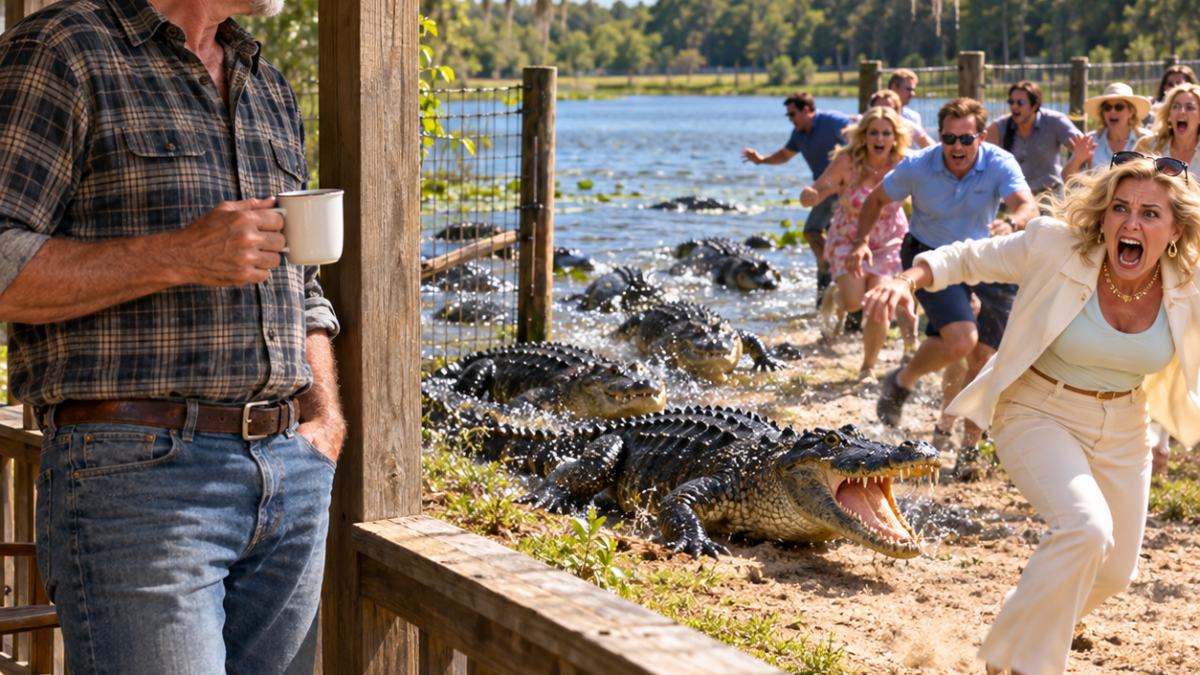
And eight days later, at 11:47 in the morning, while seventy-three people ran uphill and two yellow kayaks drifted away from the shore, the oldest resident in the neighborhood climbed onto sixty-two thousand dollars of fresh pine, opened his jaws in the sun, and showed everybody exactly whose lifestyle they had forgotten to include.

