I Shut Off the Water on My $72 Million Lake Ranch—Then the HOA President Called 911 and Exposed the Pipeline They’d Buried Under My Land
PART3:
That was my favorite hour.
Before engines.
Before phones.
Before anybody needed anything from me.
I set the mug on a fence post.
Fitted the wrench onto the valve.
The iron resisted.
Then groaned loose.
I turned it until the county intake closed completely.
No drama.
No sparks.
No great gesture.
Just metal turning against metal.
Done.
I wiped my hands on my jeans.
Picked up my coffee.
Took one sip.
Then I heard screaming.
At first I thought an animal was hurt.
The sound came from the south.
High.
Sharp.
Human.
I turned toward Whispering Oaks.
A figure burst through the rear doors of the nearest mansion.
Bare feet.
Silk robe.
Wet hair.
White shampoo foam streaking across her forehead.
Vanessa Cole.
Even at six in the morning, furious and half-dressed, she moved like somebody accustomed to people getting out of her way.
She ran across her lawn.
Past a dead sprinkler head.
Down the stone path.
Straight toward the iron fence dividing her subdivision from my ranch.
“You!”
I looked behind me.
Nobody.
She grabbed the bars.
“You son of a—”
“Morning, Vanessa.”
“You cut it!”
“Cut what?”
“Our water!”
I glanced toward the old valve.
Then back at her.
“I shut off my county intake.”
“My shower stopped.”
“That sounds inconvenient.”
“My whole house lost pressure.”
Behind her, several irrigation zones sputtered.
Sprinklers coughed twice.
Stopped.
Farther inside Whispering Oaks, the decorative fountain near the rear entrance weakened until water simply dribbled down its stone face.
Somewhere a pump wound down.
Vanessa pointed at me.
“You did this.”
“I turned off my water.”
“Our entire system is dead.”
“That shouldn’t be possible.”
Her face changed for half a second.
Tiny.
Most people would have missed it.
I spent decades in engine rooms reading men before they admitted equipment was failing.
I noticed.
“You know exactly what you did,” she said.
“No.”
“Don’t play stupid.”
“I don’t play much of anything before coffee.”
She dug a phone from her robe.
Her hands were shaking.
Not just anger.
Fear.
“You are interfering with essential infrastructure.”
Infrastructure.
That word caught me.
Not water.
Not my shower.
Not the sprinklers.
Infrastructure.
Very specific language for a woman standing barefoot with shampoo in her hair.
I said:
“What infrastructure?”
She was already dialing.
“You’ll explain it to the sheriff.”
“Explain what?”
She turned away slightly.
“911? Yes. I need deputies immediately.”
I took another drink.
“My neighbor has intentionally shut down critical water infrastructure serving an entire residential community.”
Neighbor.
Not landowner.
Not ranch.
Community infrastructure.
She gave the address.
Then said:
“He is refusing to restore service.”
I had refused nothing.
Nobody had asked a real question yet.
That became a pattern.
Twenty minutes later, three sheriff’s cruisers came down my gravel access road.
Dust rolled behind them.
Sheriff Daniel Brooks stepped out first.
Mid-fifties.
Big shoulders.
Old football injury in his left knee.
We had known each other casually for years.
Not friends exactly.
Small-county familiarity.
He had responded when cattle got onto the highway.
I had donated equipment during a flood rescue.
We respected each other.
That morning he did not smile.
“Morning, Caleb.”
“Daniel.”
Vanessa had changed nothing except her attitude.
Still wet.
Still in the robe.
Still furious.
She pointed.
“That’s him.”
Brooks looked at me.
“I’m aware.”
“He deliberately shut off the entire system.”
Brooks approached the valve.
Crouched.
Touched the housing.
Looked at the ground.
“What’d you do?”
“Closed my municipal intake.”
“Why?”
I handed him the folded drought order from my jacket pocket.
“County told me to reduce municipal usage.”
He read the first page.
“You shut anything else?”
“No.”
“Private lake pumps?”
“No.”
“Agricultural mains?”
“No.”
“Any HOA valves?”
“I don’t have HOA valves.”
Vanessa snapped:
“He knows we’re connected.”
Brooks slowly looked at her.
I did too.
Connected.
There it was.
Not possibly connected.
Not maybe your system affects ours.
Connected.
I asked:
“Connected how?”
Vanessa ignored me.
Brooks didn’t.
“Ma’am?”
“This development uses integrated community infrastructure.”
“What does that mean?”
She hesitated.
“Shared utility routing.”
“With his property?”
“Yes.”
I looked at Brooks.
“That is the first I’ve heard of it.”
Vanessa laughed.
“You own seventy-two million dollars of land and expect us to believe you don’t know how your own utilities work?”
“I know exactly how mine work.”
“Clearly not.”
Brooks lifted one hand.
“Enough.”
Then to Vanessa:
“You have an easement?”
“Of course.”
“Utility agreement?”
“Our HOA records—”
“Recorded easement.”
Her jaw tightened.
“I said we have documentation.”
Brooks turned toward one of the deputies.
“Call county utilities.”
Vanessa stepped forward.
“That isn’t necessary.”
Brooks looked at her.
“If three hundred houses lost water because Caleb shut one valve on his own ranch, I think it’s necessary.”
For the first time, she had nothing ready.
Twenty minutes later, Luis Ortega arrived in a county utilities truck.
Luis was one of those men who looked permanently unimpressed.
He had worked water systems for twenty-eight years.
He wore faded jeans, steel-toe boots, and a county shirt that had probably survived more emergencies than most politicians.
He opened the truck.
Pulled out a pressure kit.
Walked straight to the valve.
No greetings.
No opinions.
Tools first.
People second.
He attached a gauge.
“Zero downstream.”
“Meaning?” Brooks asked.
“Caleb’s side is closed like he says.”
Vanessa threw up both hands.
“Obviously it’s zero. That’s the problem.”
Luis ignored her.
He shifted the fitting.
Tested upstream.
“County main has pressure.”
Vanessa stopped.
Luis tested again.
“Normal pressure.”
Brooks frowned.
“The county system never went down?”
“No.”
“But Whispering Oaks did?”
A deputy checked his radio.
“Confirmed. Pressure loss subdivision-wide.”
Luis stared at the gauge.
Then at me.
“Touch anything else?”
“No.”
“You sure?”
“Luis.”
He nodded.
Fair enough.
He knew me.
He stood.
Walked toward the fence.
Looked at the nearest Whispering Oaks hydrant.
Then toward my lake.
Back to the valve.
“That’s not right.”
Vanessa said:
“I keep telling you he shut it off.”
Luis looked at her for the first time.
“No, ma’am.”
“What?”
“He shut his county connection.”
“Yes.”
“Your subdivision should not know he did that.”
“It does because we’re connected.”
“Connected to what?”
“Our utility system.”
Luis shook his head.
“County main is alive.”
He pointed at the gauge.
“If your neighborhood were being supplied through municipal infrastructure, you’d still have pressure.”
Vanessa folded her arms.
“You don’t understand the development design.”
Luis almost smiled.
“No offense, ma’am, but I understand pipes.”
A deputy laughed before pretending to cough.
Vanessa glared.
Brooks said:
“Luis, what would make their pressure drop the second Caleb closes this?”
Luis looked toward my lake again.
“One other source.”
Nobody spoke.
I felt the answer before anyone said it.
My stomach tightened.
Brooks followed Luis’s eyes.
“Caleb?”
“I have never authorized any water service to Whispering Oaks.”
Vanessa’s face went still.
Not angry.
Not confused.
Still.
That bothered me more.
Brooks said:
“Vanessa, is there another feed?”
“No.”
Too quick.
Luis asked:
“You sure?”
“The subdivision was built with integrated systems.”
He nodded.
“So you keep saying.”
Brooks looked at her.
“Show us.”
She inhaled.
“We don’t carry every utility document in my house.”
“You’re HOA president.”
“We use management storage.”
“Then call them.”
“I will.”
“When?”
She stared at him.
“As soon as offices open.”
Brooks looked at his watch.
“It’s 6:52.”
Vanessa turned toward me instead.
“He needs to restore service now.”
I said:
“No.”
“You are deliberately withholding water from families.”
“I am not supplying families.”
“You know children live there.”
“So?”
Her eyes widened.
“So?”
I stepped toward the fence.
“Vanessa, if those houses are receiving water from my land without my knowledge, I am not the person you should be angry at.”
She lowered her voice.
“You don’t understand what you’re doing.”
That sounded different.
Not accusation.
Warning.
Brooks heard it.
“So help us understand.”
She looked at him.
Then at me.
Then back toward Whispering Oaks.
“I need to make some calls.”
She walked away.
Barefoot.
Wet robe.
Hair still carrying shampoo.
But she was no longer panicked.
She was calculating.
Brooks watched her.
Then looked at me.
“For now, leave the valve off.”
“Gladly.”
“And don’t leave the property.”
That irritated me.
“Am I being detained?”
“No.”
“Then phrase that differently.”
He sighed.
“Caleb.”
“I haven’t broken any law.”
“I’m trying to figure out what happened.”
“So am I.”
“We got called for possible utility sabotage.”
“By the woman whose private system apparently collapses when I stop buying county water.”
He looked at the lake.
“I know.”
“Then say that.”
Brooks met my eyes.
“Stay available.”
Better.
“I’ll be home.”
He nodded.
By eight, Whispering Oaks was in full panic.
People do strange things when expensive houses stop behaving like expensive houses.
Residents drove toward my gate.
Black SUVs.
Mercedes.
A Bentley.
Three lifted pickups that had never seen actual work.
They gathered outside the fence.
Phones in hand.
One man in a golf shirt shouted:
“You going to turn it back on?”
“Turn what back on?”
“Our water.”
“I don’t supply your water.”
He laughed.
“Then explain why it stopped.”
“That is exactly what I’m trying to find out.”
A woman called:
“My children can’t shower.”
Another:
“My irrigation controller is showing zero pressure.”
Another:
“My pool system shut down.”
I looked at her.
“You have a lake-sized emergency.”
She didn’t appreciate that.
Voices rose.
Someone started filming.
A younger man said:
“This is extortion.”
I asked:
“What have I demanded?”
He had no answer.
Vanessa returned around nine.
Dry hair.
White slacks.
Navy blouse.
Designer sunglasses.
Her transition from screaming woman in a wet robe to polished HOA president took under three hours.
Impressive.
She raised both hands.
“Everybody, please.”
Residents quieted.
Leadership works partly because people desperately want someone to sound certain.
Vanessa did.
“This is a temporary infrastructure disruption.”
I leaned against the fence.
“We are working with county officials.”
False.
“Mr. Turner has chosen to shut down a shared feed during a drought emergency.”
False and clever.
“We are pursuing immediate restoration.”
One resident asked:
“Why would our water run through his ranch?”
Vanessa’s head turned slightly.
“It is part of the original development infrastructure.”
“Does he own it?”
“No.”
I straightened.
She looked at me.
I said:
“Careful.”
Her jaw tightened.
“Mr. Turner is aware that the system serves multiple properties.”
“No.”
“Caleb—”
“Show the easement.”
The crowd shifted.
She hated that.
“Those records are being retrieved.”
“Show one.”
“Our attorney is working on it.”
“Then stop telling three hundred homeowners you own something you can’t document.”
A man near the rear said:
“Vanessa, do we have an easement or not?”
She turned.
“Yes.”
“Then where is it?”
“We’re retrieving it.”
Another resident:
“Why isn’t it in the HOA portal?”
She ignored that.
Instead she looked at me.
“Restore the valve while we resolve the paperwork.”
“No.”
Angry murmurs.
She stepped closer.
“You understand you’re interfering with essential services?”
“I understand somebody built your essential services through my property.”
“Allegedly.”
“You just spent two hours insisting it was shared.”
Her face hardened.
Before she could answer, a county vehicle arrived.
Different department.
A man holding a clipboard walked to the gate.
“Caleb Turner?”
“Yes.”
He handed me a notice.
Municipal drought compliance review.
Potential impact on regional supply distribution.
I read it.
Carefully.
The language was broad.
Not an order to open anything.
A warning that my action might require review if it affected municipal distribution.
Vanessa watched me.
“Now will you restore it?”
I folded the paper.
“No.”
The crowd reacted.
She smiled.
Small.
Like she thought the county notice had made me look unreasonable.
I held it up.
“This does not order me to reconnect your subdivision.”
The county employee cleared his throat.
“He’s correct.”
Vanessa’s smile died.
“It requires review,” he added.
“Then review.”
She stared at me.
“You’re making this harder than it needs to be.”
“No.”
I put the notice in my pocket.
“Somebody made this hard years ago.”
That was the first moment I saw actual fear in her eyes.
Not panic.
Fear.
She turned away.
By ten, the crowd dispersed.
The subdivision remained dry.
Water trucks started arriving.
Temporary tanks.
Bottled-water deliveries.
The gate looked like a hurricane had hit a neighborhood where the weather was perfect.
I walked back to my house.
Placed the drought order on the kitchen table.
Then the county notice beside it.
Lined up the edges.
Old habit.
I had spent thirty-two years around industrial systems.
Marine plants.
Engine rooms.
Port utilities.
Emergency pumping.
Infrastructure failure investigations.
Most disasters look chaotic from the outside.
Inside, they usually begin with one simple thing somebody ignored.
A reading.
A vibration.
A missing document.
A valve that should not affect another valve.
I called Rachel Dunn.
Rachel had been my attorney for sixteen years.
Land use.
Water rights.
Development disputes.
Mean enough to be useful.
Ethical enough that I trusted her when she told me I was wrong.
She answered:
“What happened?”
“Why assume something happened?”
“You never call before lunch unless somebody is suing you or trespassing.”
“Maybe I miss you.”
“You don’t.”
Fair.
I explained.
Silence.
Then:
“Do not reopen that valve.”
“Wasn’t planning to.”
“Do not let anybody dig.”
“Okay.”
“Do not let the HOA onto your property.”
“Already not happening.”
“I’ll be there in an hour.”
Next I called Ethan Coley.
No relation to Vanessa.
Surveyor.
Subsurface mapping specialist.
Had worked with me during an irrigation redesign.
“Bring the ground scanner.”
He laughed.
“That kind of morning?”
“That kind of land.”
By noon, Rachel and Ethan stood with me near the southern boundary.
Rachel arrived in boots, not heels.
That alone made me trust her more than most attorneys.
She carried a legal pad and three pens.
“Start from the beginning.”
I did.
When I finished, she asked:
“Any recorded easement?”
“No.”
“Any water agreement?”
“No.”
“Historic license?”
“No.”
“Handshake deal your father might have made?”
“My father disliked developers more than I do.”
“Possible verbal permission?”
“No.”
“Utility corridor?”
“Not recorded.”
She nodded.
“Good.”
“Good?”
“If there is a lawful agreement, we need to find it before we accuse anyone.”
She pointed at Ethan.
“Find the pipe.”
Ethan started at the boundary valve.
Scanner slow over soil.
Nothing unusual.
He moved south.
Then stopped.
Beep.
Again.
He adjusted sensitivity.
Swept back.
Beep.
“That’s interesting.”
Rachel said:
“I dislike interesting.”
“So do insurance companies.”
He marked the spot.
Continued.
Another reading.
Straight line.
Modern metal.
Consistent depth.
Three feet.
Too shallow to be major county infrastructure.
Too precise to be random farm pipe.
“Which direction?” I asked.
He looked at the compass.
“South.”
Toward Whispering Oaks.
Rachel started writing.
We followed the reading.
Twenty feet.
Forty.
Sixty.
Then another parallel signature appeared.
Ethan stopped.
“There’s more.”
“How much more?”
“Give me a minute.”
He moved sideways.
Beep.
Again.
Another line.
Rachel looked at me.
“This isn’t a single unauthorized tap.”
“No.”
Ethan said:
“Looks like distribution.”
We reached a patch of ordinary ground thirty feet inside my property.
No obvious disturbance.
Grass.
Dry soil.
A few shallow roots.
The scanner screamed.
Ethan ran it from three directions.
“Something big here.”
“Tank?” Rachel asked.
“No.”
“Pipe cluster?”
“Maybe valve chamber.”
I looked down.
“Dig.”
Rachel raised a finger.
“Photograph before.”
Good point.
We documented everything.
Wide shots.
Boundary marker.
GPS coordinates.
Undisturbed surface.
Then Ethan dug.
Three minutes.
Shovel struck metal.
Clang.
Nobody spoke.
He cleared dirt.
Flat steel lid.
Industrial grade.
Bolted.
Not old.
Rachel crouched.
“No county marking.”
Ethan brushed more soil away.
“Recent hardware.”
“How recent?”
“Few years maybe. Definitely not your grandfather.”
He used a pry bar.
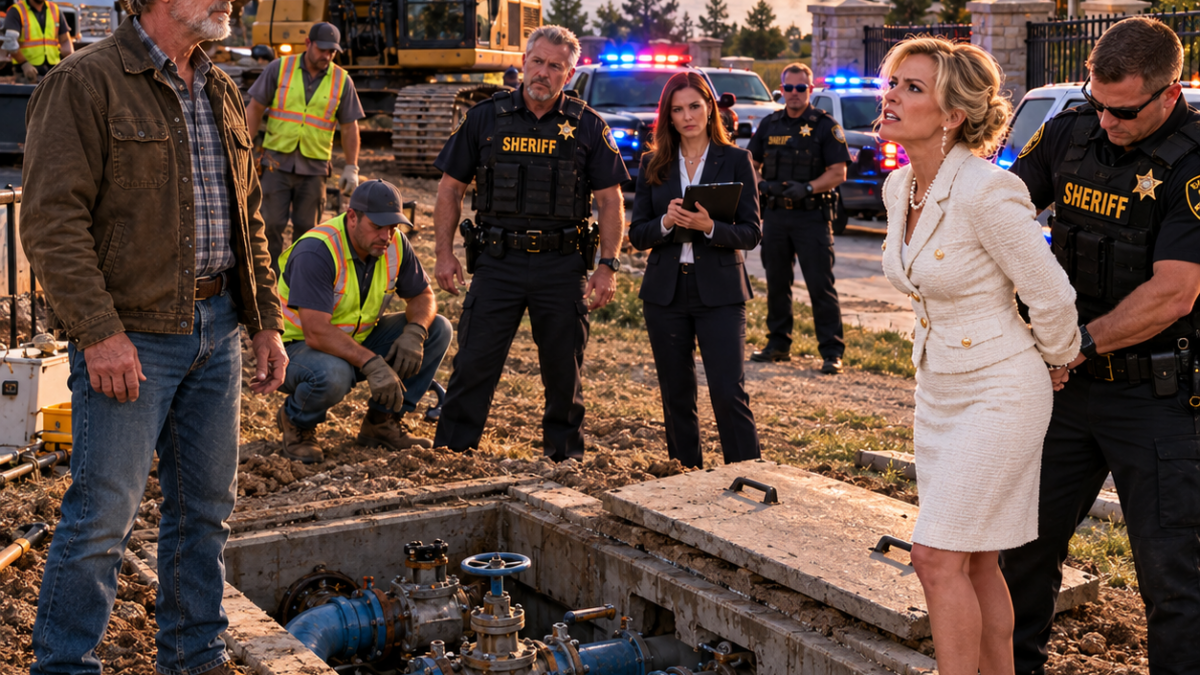
The lid opened.
I felt anger before I understood what I was seeing.
Pipes.
Pressure regulators.
Modern fittings.
Multiple valves.
Clean welds.
Maintained.
Active.
The kind of work that costs serious money.
Someone had excavated my property.
Installed a chamber.
Buried it.
Connected it to something.
Then returned often enough to keep it functional.
Rachel stared inside.
“Caleb.”
“I see it.”
“This is not accidental.”
“I know.”
Ethan climbed partially into the chamber.
Ran his hand along the main.
“Big feed.”
“How big?”
“Large enough that I would never call it residential backup.”
He followed it.
“Main comes from north.”
The lake.
“Splits south.”
Whispering Oaks.
Another branch west.
A third deeper.
Rachel stood slowly.
“If there is no easement…”
“There isn’t.”
“No license…”
“No.”
“No recorded utility agreement…”
“No.”
She looked at me.
“Then somebody stole your water.”
The word surprised me.
Stole.
I had been thinking unauthorized use.
Improper connection.
Encroachment.
Engineers like neutral language.
Attorneys sometimes prefer accurate language.
Theft.
Water.
For how long?
How much?
Who knew?
My lake was privately managed under historic water rights tied to the ranch.
We monitored level.
Agricultural withdrawal.
Recharge.
Drought conditions.
I had spent years paying for conservation work.
Shore stabilization.
Watershed management.
Habitat restoration.
All while three hundred million-dollar homes might have been drawing from the same source underground.
Ethan climbed out.
“This line is designed as primary supply.”
“Sure?”
“Yes.”
“Not emergency?”
“Too much capacity.”
Rachel asked:
“How did they hide usage?”
“Metering could be downstream.”
“Could they mask the draw?”
“If lake recharge is strong enough, you might notice only through long-term level changes.”
I thought about the last five summers.
We had blamed unusual decline on hotter weather.
Higher evaporation.
Drought.
I felt sick.
Rachel’s phone buzzed.
She checked.
“County records.”
“And?”
“No easement.”
“Utility filings?”
“None.”
“Right-of-way?”
“Nothing.”
Ethan whistled.
Rachel looked inside the chamber again.
“Now we have a problem.”
A white SUV came down the access road.
Fast.
Vanessa.
She stopped twenty yards away.
Exited before the engine fully died.
Her eyes went straight to the open chamber.
Not me.
Not Rachel.
The chamber.
And for one unguarded second, her face collapsed.
That one second told me more than three hours of yelling.
She knew.
Then the mask returned.
“What the hell are you doing?”
Rachel stepped forward.
“Standing on Mr. Turner’s property.”
“That is HOA infrastructure.”
Rachel smiled.
“Wonderful.”
Vanessa hesitated.
“Excuse me?”
“If you claim ownership, please state that again.”
Vanessa looked at the phone in Rachel’s hand.
“I said it’s community infrastructure.”
“Located thirty feet inside Caleb’s deeded boundary.”
“The boundary is disputed.”
“No.”
Rachel pulled a folded survey.
“It isn’t.”
Vanessa ignored her.
She looked at me.
“You should’ve restored service.”
I walked closer.
“To what?”
“Our system.”
“My lake?”
Her lips tightened.
“You don’t understand the legal structure.”
“Then explain it.”
“I don’t have to explain HOA infrastructure to you.”
“You do when it’s buried on my ranch.”
She lowered her voice.
“You are making a mistake.”
Rachel heard.
“So are you.”
Vanessa looked at her.
“Who are you?”
“Rachel Dunn.”
Recognition.
That pleased me.
Good lawyers should worry people who know they need lawyers.
Vanessa straightened.
“This is not over.”
Rachel said:
“I sincerely hope not.”
Vanessa walked back to her SUV.
Ethan watched her go.
“That woman knew exactly what was in that hole.”
“Yes.”
Rachel nodded.
“And she’s going to try to make it disappear.”
That sentence changed the day.
We documented faster.
Every fitting.
Every weld.
Every visible manufacturer label.
Coordinates.
Depth.
Direction.
Then Rachel filed an emergency property protection notice and sought a temporary restraining order preventing anyone from altering underground infrastructure on my parcel.
Ethan started a full line trace.
I installed two trail cameras.
Then four more.
By sunset, I had stopped thinking of the problem as water.
It was evidence.
At 7:42 that evening, three trucks came to the south ridge.
Private vehicles.
Dim headlights.
Men in reflective vests.
Tool bags.
Pipe clamps.
Portable pressure equipment.
Rachel was still at the house.
I watched from the shadows for thirty seconds.
Then approached.
“That’s far enough.”
One man looked up.
“Emergency infrastructure stabilization.”
“On whose authority?”
“HOA work order.”
“Show it.”
He didn’t.
Another man unloaded fittings.
I said:
“Get off my property.”
The first worker looked annoyed.
“You’re interfering with emergency repair.”
“Repair of what?”
He did not answer.
“Who hired you?”
Silence.
Then one of them used his phone.
Three minutes later, sirens.
Too fast.
Brooks arrived with two deputies.
The workers immediately stepped back.
I understood.
The call had been staged.
One worker pointed at me.
“He threatened us.”
Brooks looked at me.
“Caleb?”
“No.”
“He said he’d stop us if we touched the line.”
“I told them to leave my land.”
“He’s armed,” another said.
Brooks’s eyes went to my truck.
Rifle rack.
Hunting rifle.
Legal.
Unloaded.
Normal in our county.
But suddenly useful to someone trying to construct a story.
Brooks said:
“Keep your hands where I can see them.”
I did.
Slowly.
Not because I was afraid of Brooks.
Because I understood how fast stupid moments become permanent.
The workers stood behind him.
Watching.
Waiting.
Then Rachel’s car came down the road hard enough to spray gravel.
She stepped out holding her phone.
“Don’t detain anybody until you watch this.”
Brooks turned.
“Rachel—”
“Drone footage.”
That got everyone’s attention.
One of Ethan’s survey drones had remained on automated perimeter observation with permission.
Timestamped video.
The three trucks arriving.
Workers crossing the property.
No Caleb present.
Tools unloaded.
Chamber approached.
Audio from a separate trail camera:
“Reconnect the line before morning.”
Brooks watched once.
Then again.
He looked at the workers.
“You gentlemen want to revise anything?”
Nobody answered.
Rachel played another clip.
One voice:
“No delays. Vanessa wants pressure by breakfast.”
The worker closest to me closed his eyes.
Brooks handed the phone back.
“Hands where I can see them.”
This time he was speaking to them.
The shift happened instantly.
Deputies moved.
Cuffs.
Tool bags seized.
No violence.
No shouting.
One man muttered:
“We were told it was legal.”
Brooks opened a bag.
New couplings.
Pressure seals.
Regulators.
All sized for the underground main.
He looked at me.
“What did you find?”
“Something that shouldn’t exist.”
“How big?”
“Big enough to feed Whispering Oaks.”
He stared toward the subdivision.
Then back at the workers.
“Who hired you?”
The youngest one answered.
“Cole Development contractor.”
Rachel’s head turned.
“Cole?”
The man looked like he regretted speaking.
“That’s what the work order says.”
Vanessa Cole.
Cole Development.
Now we had another door.
By sunrise, my workshop had become an investigation room.
Rachel covered the workbench with records.
Ethan returned with full scans.
Luis came with pressure logs.
Brooks sent over copies of seized work orders under the evolving investigation.
Ethan spread a map flat.
“Main intake begins here.”
He pointed to my lake-side pumping infrastructure.
Then a line.
“Runs under your lower pasture.”
Junction.
“Splits.”
One branch directly into Whispering Oaks.
Another toward a decorative reservoir.
The third connected to an irrigation system serving common areas.
I stared.
“They took domestic water.”
“Yes.”
“Irrigation.”
“Yes.”
“Fountains?”
“Looks that way.”
“Pool systems?”
“Possibly.”
I laughed once.
No humor.
During drought summers I had reduced cattle irrigation to protect lake levels.
Whispering Oaks had watered decorative lawns using my private supply.
Rachel rotated her laptop.
“It gets worse.”
Naturally.
“Cole Development Holdings.”
Vanessa’s former husband.
Brad Cole.
They had divorced six years earlier but still held overlapping financial interests in several development entities.
Rachel pulled incorporation records.
Subsidiaries.
Shell companies.
Land acquisitions.
Then older county files.
“Twenty-three years ago.”
She showed me an attempted purchase.
My south ridge parcel.
Rejected by my father.
Another offer eleven years later.
Different company.
Same ownership network.
I remembered.
Aggressive.
Far above market.
I said no.
Third attempt.
Same target.
Then Rachel found a preliminary utility corridor proposal.
Never approved.
Never recorded.
The route matched Ethan’s underground trace almost exactly.
Ethan stared.
“They drew this before Whispering Oaks existed.”
“Yes.”
Rachel’s voice was quiet.
“They knew they needed your water before they built the development.”
That sentence changed everything.
Not HOA overreach.
Not a rogue connection.
Development strategy.
Build expensive homes around a resource they did not own.
Quietly connect.
Create dependency.
Then if discovered, argue necessity.
Shared infrastructure.
Implied easement.
Public interest.
Maybe eventually force legal access.
I sat back.
“They tried to buy the water.”
Rachel nodded.
“You said no.”
“So they built the houses anyway.”
“Yes.”
“And took it.”
“Yes.”
I looked through the window toward Whispering Oaks.
Three hundred families.
Most probably innocent.
Mortgages.
Children.
Retirement money.
People who had paid millions for houses represented as having lawful utilities.
Ethan said:
“If this becomes public…”
“It will,” Rachel said.
“Property values collapse.”
“Maybe.”
“Banks panic.”
“Yes.”
“Insurance.”
“Yes.”
He looked at me.
“You could shut the whole place down.”
I didn’t like that sentence.
“I shut my valve.”
“I know.”
“No.”
I looked at both of them.
“Understand me. I am not attacking those homeowners.”
Rachel nodded.
“Good.”
“They got lied to too.”
“Probably.”
“We prove the theft.”
“Yes.”
“We protect the ranch.”
“Yes.”
“But we don’t use three hundred families as leverage.”
Rachel gave me a long look.
“That matters.”
“It should.”
Vanessa would later claim I wanted to destroy Whispering Oaks.
That was never true.
I wanted my water back.
Different thing.
Around eight, Rachel’s phone started filling with notices.
Three homeowners had filed formal complaints against me.
Essential service interference.
Property damage.
Intentional utility disruption.
By ten, there were nine.
Same phrases.
Same structure.
Rachel printed them.
Placed them side by side.
“Template.”
“Vanessa?”
“Almost certainly.”
“She wants a paper trail.”
“Yes.”
“Showing I caused the crisis.”
“Exactly.”
I understood.
If they could make the shutdown the legal event rather than the illegal pipeline, they could negotiate from injury.
Caleb Turner deprived residents of water.
Caleb Turner caused damages.
Caleb Turner interfered with established utility reliance.
Then the original theft becomes historical complexity.
Rachel said:
“She needs you to reconnect.”
“Why?”
“Once service resumes, emergency pressure disappears.”
“And they can fight ownership later.”
“Yes.”
I looked at the closed valve.
“No.”
By midday, Whispering Oaks was unraveling.
Water trucks arrived.
Portable sanitation units.
Residents gathered at the clubhouse.
Landscaping crews stopped.
Pools closed.
One woman came to my gate alone.
No phone recording.
No shouting.
She introduced herself as Emily Carver.
“I owe you an apology.”
“For?”
“Yesterday.”
“I don’t remember.”
“I yelled that you were hurting children.”
“A lot of people yelled.”
She looked exhausted.
“I believed Vanessa.”
“You should believe whoever shows documents.”
“She didn’t show any.”
“No.”
Emily looked at the lake.
“Is our water really coming from there?”
“Evidence says yes.”
“Did you know?”
“No.”
“How long?”
“We’re investigating.”
She started crying.
Not dramatically.
Quiet tears.
“We bought our house three years ago.”
I waited.
“Four point six million.”
I did not react.
“My husband retired.”
She wiped her cheek.
“They told us utilities were private but fully permitted.”
“I imagine they did.”
“What happens to us?”
“I don’t know.”
“Will you turn it back on?”
That was the hardest question of the day.
I could have.
Physically.
Open valve.
Pressure returns.
Crisis gone.
But reopening without understanding the illegal system could create contamination risk, liability, and—most importantly—destroy the leverage investigators needed to inspect the unauthorized network untouched.
“I can’t.”
She closed her eyes.
“I understand.”
“I am sorry.”
She looked surprised.
“You are?”
“You didn’t bury the pipe.”
“No.”
“You just bought a house.”
She nodded.
That conversation shaped what I did later.
The homeowners were not the enemy.
Fraud had simply placed them on the other side of my fence.
Rachel filed the temporary injunction.
State water regulators flagged the case.
By midafternoon, federal water and infrastructure auditors were notified because the system appeared to involve unauthorized diversion, misrepresentation, and possible regulatory reporting violations.
Forty-eight hours.
That was the timeline.
Rachel said:
“They’ll be here in forty-eight hours.”
“Vanessa knows?”
“She will within an hour.”
I looked toward Whispering Oaks.
“Then tonight gets interesting.”
At 5:12, Vanessa appeared on her second-floor balcony.
Perfect clothes.
Glass of wine.
She looked toward my ranch.
For a long time.
Then raised the glass slightly.
Not friendly.
Not quite hostile.
Acknowledgment.
I told Rachel.
“She thinks she still has time.”
Rachel said:
“She might.”
At 11:03 p.m., floodlights appeared on the south ridge.
Excavator.
Two trucks.
Four workers.
And a man I had never met in person.
Brad Cole.
Sixty.
Silver hair.
Expensive field coat.
Stillness of someone accustomed to paying other people to move.
He stood just outside the light.
Watching.
The excavator boom moved toward the buried chamber.
I approached.
“What are you doing?”
Brad looked at me.
“Finishing what should’ve been done years ago.”
“What does that mean?”
“It means your little stunt has created an infrastructure emergency.”
“My stunt?”
“You turned off water to three hundred homes.”
“I turned off my water.”
He smiled.
“That distinction is going to become very expensive for you.”
The excavator arm lowered.
I said:
“Move that machine and you’re destroying evidence.”
Brad shrugged.
“Repairing infrastructure.”
“On my property.”
“Disputed.”
“No.”
“You’ve always had trouble understanding the future, Caleb.”
That interested me.
“You know me?”
“I know your family.”
“Then you know we say no.”
He smiled again.
“That is exactly the problem.”
Headlights appeared.
Sheriff Brooks.
Two cruisers.
Unmarked county truck.
Rachel behind them.
Brooks got out.
“Kill the engine!”
The operator hesitated.
“Now!”
Brad nodded slightly.
The engine shut down.
Brooks walked to him.
“You got authorization?”
Brad handed over a document.
Brooks read.
Then laughed once.
“This isn’t county authorization.”
“It’s legal emergency authority.”
“No seal.”
He turned the page.
“No judge.”
Another.
“No filing number.”
He handed it back.
“This isn’t worth the paper.”
Brad’s expression did not change.
“Time is short.”
Rachel stepped beside me.
“Because federal auditors arrive tomorrow?”
That got him.
Barely.
But I saw it.
One of the workers suddenly spoke.
“This isn’t what we were told.”
Brad turned.
“Be quiet.”
The worker looked at Brooks.
“We were told emergency repair.”
Brooks said:
“Keep talking.”
“Double pay.”
“For what?”
“To reconnect before morning.”
“Who said?”
The worker pointed.
“Him.”
Brad stared at the man.
No threat.
No words.
Some looks are enough to explain whole business cultures.
Rachel played audio captured from our perimeter camera.
Brad’s voice:
“Get pressure restored before audit. No delays.”
Brooks looked at him.
“Mr. Cole.”
Brad said nothing.
“I’m going to ask you to step away from the equipment.”
“This is absurd.”
“Step away.”
“Do you have any idea what interruption is costing?”
Brooks nodded toward my lake.
“I’m starting to.”
Deputies secured the excavator.
Seized paperwork.
Collected phones under warrant procedures that followed later.
Brad was not formally charged that exact second.
Real investigations take longer than television.
But he left in a patrol vehicle for questioning.
That mattered.
The next morning, the auditors arrived at 8:03.
Three dark SUVs.
No lights.
No drama.
People who do serious regulatory work rarely need theater.
Rachel met them.
Ethan provided maps.
Luis pressure logs.
Brooks evidence chain.
I provided property records and access.
They inspected the lake intake.
The underground main.
Valve chamber.
Subdivision distribution connection.
By noon, one auditor asked Vanessa to attend a meeting at the county emergency operations room.
She arrived dressed like she was presenting quarterly earnings.
Brad arrived later with counsel.
Residents’ representatives came.
County officials.
State water authority.
Sheriff.
Rachel.
Me.
The lead auditor stood in front of a large system diagram.
“This development is not presently connected to an adequate lawful municipal supply capable of supporting existing demand.”
Whispering Oaks representatives shifted.
He continued.
“Current domestic and common-area water supply originates substantially from a private source located on Turner Ranch.”
Vanessa interrupted.
“Shared source.”
The auditor looked at her.
“No.”
One word.
The room changed.
She sat straighter.
He continued.
“We found no recorded easement.”
Rachel slid documents forward.
“No license.”
Another.
“No water-right transfer.”
Another.
“No valid utility agreement.”
Another.
“No permitted corridor authorizing the buried infrastructure on Mr. Turner’s parcel.”
Brad’s attorney whispered to him.
Vanessa said:
“This was temporary.”
The auditor looked at the installation photos.
“Temporary systems are not built with buried permanent mains, distribution chambers, pressure regulators, and multi-year maintenance records.”
Silence.
Then:
“This is dependency.”
That word mattered.
Dependency meant Whispering Oaks was built around a water source it did not legally control.
It meant disclosure problems.
Utility representation problems.
Potential fraud.
Homeowner claims.
Lender claims.
Insurance claims.
Regulatory exposure.
Brad finally spoke.
“The original development expected a future access agreement.”
Rachel said:
“But never obtained one.”
He ignored her.
“We made substantial investment in reliance upon anticipated access.”
I almost admired the arrogance.
“You stole water because you hoped I’d eventually agree?”
His attorney touched his arm.
Too late.
Vanessa glared at me.
“You ruined everything.”
Every face turned.
I said:
“No.”
My voice stayed quiet.
“I turned off my water.”
Sheriff Brooks later told me that sentence ended up in three reports.
The formal investigation took weeks.
Not one afternoon.
Vanessa was not marched away theatrically in front of everyone after one meeting.
Reality is slower.
Better, sometimes, because slow evidence becomes hard to escape.
Search warrants followed.
Financial records.
HOA emails.
Developer communications.
Maintenance invoices.
Contractor testimony.
Then Brad’s old corporate files.
The picture became worse.
Years earlier, Cole Development had identified my lake as the cheapest long-term water option for the planned subdivision.
Buying the necessary rights would have cost millions.
Building independent utility infrastructure cost even more.
They tried to purchase part of the ranch.
My father rejected them.
They tried later through another company.
I rejected them.
So they proceeded with development plans that assumed future access.
At some point, assumption turned into theft.
A contractor installed the first underground connection during early site grading.
Records described it as “temporary construction water.”
Temporary became permanent.
Whispering Oaks grew.
More homes.
More demand.
Rather than disclose the dependency, Brad’s companies expanded the illegal system.
Vanessa became HOA president years later.
And she knew.
Not from the beginning.
That mattered.
Investigators reconstructed her role.
She learned during a drought six years earlier when a pressure problem exposed the source to a small group of board members.
She could have reported it.
She could have demanded legal correction.
Instead, she helped bury it.
Why?
Property values.
A lawful replacement system would have required enormous capital assessments.
Potentially six figures per homeowner.
Disclosing the illegal connection could trigger lending problems.
Lawsuits.
Development liability.
So Vanessa chose silence.
Then active concealment.
She authorized maintenance.
Approved payments through vague categories.
“Landscape infrastructure.”
“Emergency pressure stabilization.”
“Common-area mechanical services.”
One email became central.
Brad wrote:
If Turner ever isolates his municipal connection during drought, we need to be ready to maintain lake feed continuity before residents notice.
Vanessa replied:
He won’t. He doesn’t understand how integrated the system is.
I read that sentence twice.
Rachel watched me.
“You okay?”
“Integrated.”
“What?”
“She kept using that word the first morning.”
Rachel nodded.
“She was repeating the cover story.”
Another email.
Vanessa:
If residents learn the water source is not secured, values collapse overnight.
Brad:
Then they don’t learn.
Another.
Vanessa:
Can we formalize access retroactively?
Brad:
Not without Turner’s signature.
Vanessa:
He’ll never sign.
Brad:
Dependency creates leverage eventually.
There it was.
The long game.
Build dependency.
Wait.
Eventually, if discovered, argue that hundreds of families rely on the water.
Public necessity.
Emergency access.
Pressure me morally and politically.
Maybe force an easement.
They had not expected me to shut one valve early enough to reveal everything before they were ready.
That made me laugh.
Not because it was funny.
Because systems often collapse from stupid timing.
The homeowners’ anger changed direction gradually.
At first, many blamed me.
Then documents became public.
People read.
Especially wealthy people.
Never underestimate how fast people become investigative researchers when they realize someone may have damaged their investment.
An emergency HOA meeting was called.
I did not attend.
Emily Carver did.
She called me afterward.
“You should’ve seen it.”
“What happened?”
“Vanessa tried to control the room.”
“How’d that go?”
“Poorly.”
Apparently Vanessa opened with:
“We are navigating an unfortunate dispute with an adjacent landowner.”
Three hundred people started shouting.
One resident stood holding printed emails.
Another had county maps.
A retired judge who lived in the subdivision asked:
“Did you know the water source was unauthorized?”
Vanessa tried:
“It’s legally complex.”
He repeated:
“Did you know?”
She would not answer.
That was answer enough.
The HOA board suspended her authority that evening.
Two days later, the management company resigned.
Within a week, homeowners filed a class-action suit against Cole Development entities, multiple contractors, and former board leadership.
I was initially named in one emergency petition seeking temporary water access.
Rachel handled it.
I told her:
“I am willing to discuss temporary humanitarian supply under court supervision.”
She stared.
“You sure?”
“There are children there.”
“You don’t owe them.”
“I know.”
That was exactly why I could offer it.
Not because Vanessa had leverage.
Because she didn’t.
There is a difference between being forced and choosing.
We negotiated an interim plan.
Strictly temporary.
Metered.
Paid at actual cost.
No recognition of permanent rights.
No easement.
No waiver.
No expansion.
Emergency conservation rules.
Priority domestic use only.
No fountains.
No decorative irrigation.
No pool refills.
I agreed because innocent residents needed toilets, cooking water, basic sanitation.
Some people told me I was foolish.
I wasn’t.
Ownership does not require cruelty.
For the first time, Whispering Oaks residents saw how much water their development had actually been using.
Usage dropped sixty-eight percent overnight.
Amazing what happens when fountains and ornamental lawns stop pretending to be necessities.
Emily visited again.
She brought a bottle of bourbon.
“I don’t drink much.”
“Then save it.”
“For what?”
“When this is over.”
I kept it.
Brad Cole eventually cooperated.
Not out of conscience.
Leverage.
Prosecutors and regulators had too much.
He provided corporate records.
Named contractors.
Explained the shell-company structures.
The method extended beyond Whispering Oaks.
Other developments.
Different counties.
Private wells.
Unrecorded drainage easements.
Unauthorized utility crossings.
Find a resource.
Build around it.
Create dependence.
Negotiate later from a position of practical necessity.
It was not brilliant.
It was predatory.
Vanessa refused cooperation.
She insisted she had been protecting homeowners.
That was partly true.
Which is what made her more interesting than a cartoon villain.
She had convinced herself that hiding the illegal system was leadership.
If she told residents, values dropped.
If she challenged Brad, assessments exploded.
If she kept things quiet, everyone remained comfortable.
So she chose comfort over truth.
Then every year made confession more expensive.
Eventually protecting homeowners became protecting herself.
That transformation happens quietly.
One compromise.
Then another.
Soon you cannot admit the first lie without exposing all the ones built on top of it.
Her worst act was not knowing.
It was what she did after discovery.
False emergency filings.
Coordinated homeowner complaints.
Contractors sent at night.
Attempts to reconnect before auditors arrived.
That crossed lines prosecutors understood clearly.
Charges followed.
Fraud-related offenses.
Conspiracy.
Obstruction.
Unauthorized diversion.
Property crimes connected to the infrastructure.
The exact legal process stretched over a year.
Brad accepted a plea agreement.
Vanessa went to trial.
I testified one day.
That was enough.
Her attorney asked:
“Mr. Turner, isn’t it true you knew your action would deprive Whispering Oaks residents of water?”
“No.”
“You expected no effect?”
“Correct.”
“But once you learned the effect, you refused to reopen the valve.”
“Correct.”
“So you intentionally continued the deprivation.”
I looked at the jury.
Then back at him.
“No.”
“What would you call it?”
“Preserving an active unauthorized system for investigation.”
He frowned.
“You could have restored water.”
“I could also have erased the pressure relationship that proved the illegal connection.”
“You wanted leverage.”
“No.”
“Isn’t your ranch worth seventy-two million dollars?”
“Approximately.”
“And Whispering Oaks increases pressure on your property?”
“Everything around valuable land increases pressure.”
“You dislike the development.”
“I dislike theft.”
A few jurors shifted.
He tried again.
“You had conflicts with Ms. Cole before?”
“She complained about cattle smell.”
Laughter.
Judge silenced the room.
“She complained about my tractors.”
More smiles.
“She asked me to move agricultural equipment so it wouldn’t be visible from the subdivision.”
“And you refused.”
“Yes.”
“Why?”
“Because it’s a ranch.”
That line ended up in a newspaper.
I wish it hadn’t.
Vanessa was convicted on multiple counts.
The judge’s sentence reflected the documented conduct, not every accusation people had thrown around online.
That mattered to me.
Justice should be specific.
Brad’s cooperation reduced his consequences but destroyed his business reputation.
Cole Development Holdings collapsed under lawsuits.
Several entities entered bankruptcy.
Contractors settled.
Insurance carriers fought everyone.
Attorneys became rich.
The usual.
The hardest part was Whispering Oaks.
Three hundred families owned homes built on a lie.
If the solution simply cut them off forever, truth would become another weapon.
County emergency management, state regulators, homeowner representatives, and my team worked for months on a permanent replacement.
The cheapest legal option was a new municipal connection routed entirely outside my ranch.
Expensive.
Very expensive.
But possible.
The original developer should have built it from the start.
Construction took nine months.
Homeowners paid special assessments, though settlements and recovered developer assets covered a substantial portion.
Some sold.
Some stayed.
Property values dropped.
Then stabilized.
Banks adjusted.
Insurance renewed.
The subdivision survived.
That surprised people who wanted the dramatic ending where the entire luxury HOA became abandoned ruins.
Real life rarely offers such clean destruction.
Whispering Oaks did not disappear.
It changed.
The giant entrance fountain stayed dry permanently.
Residents voted not to spend money restoring it.
I liked that.
The HOA itself was dissolved and replaced temporarily by a court-supervised property association with narrower authority.
Later, residents formed a new governance board.
Emily became president.
When she told me, I laughed for almost a full minute.
“What’s funny?”
“You.”
“Why?”
“You came to my gate crying because you couldn’t shower.”
“My kids couldn’t shower.”
“Now you’re HOA president.”
“Don’t call me that.”
“What should I call you?”
“Board chair.”
“Sounds worse.”
She brought the bourbon.
We opened it on my porch.
The replacement municipal system activated the following spring.
Luis Ortega personally inspected the final connection.
He called me.
“You want the honor?”
“Of what?”
“Shutting the temporary Turner Ranch feed permanently.”
I smiled.
“I’ll be there.”
The ceremony consisted of five people.
No cameras.
No speeches.
Luis.
Rachel.
Ethan.
Emily.
Me.
The new municipal main was active.
Pressure stable.
Whispering Oaks independent.
I walked to the temporary emergency valve we had installed under court order.
Put my hand on it.
Emily said:
“Feels familiar?”
“Less shampoo this time.”
She groaned.
“I wasn’t the one in the robe.”
“Vanessa was.”
“Still.”
I turned the valve.
Closed.
Nothing happened in Whispering Oaks.
Sprinklers stayed on where permitted.
Kitchen taps continued running.
No fountains because residents had removed them.
Luis checked his gauge.
“Independent.”
That word felt good.
Rachel said:
“Congratulations.”
“To them or me?”
“Everybody.”
Ethan asked:
“What about the illegal pipes?”
I knew exactly what I wanted.
Remove them.
Not abandon.
Not leave them underground for some future argument.
Remove.
Every unauthorized section on my ranch came out.
We documented the excavation.
Steel.
Regulators.
Old fittings.
Control chambers.
I kept one valve.
Rachel asked why.
“Reminder.”
“Of Vanessa?”
“No.”
“Brad?”
“No.”
“Then what?”
“That invisible systems still exist.”
She shook her head.
“Engineers.”
The land was restored.
Pasture reseeded.
Lake infrastructure separated permanently.
County placed stronger protections around the private water system.
Updated surveys.
Recorded restrictions.
No ambiguity.
No future corridor claims.
The ranch returned to quiet.
Mostly.
For almost a year, reporters called.
Podcasts.
Television.
True-crime channels.
Property-rights groups.
Anti-HOA organizations.
Developers.
Environmental groups.
Everyone wanted the story to mean something different.
Some said it proved HOAs were corrupt.
Too simple.
Some said wealthy developers steal rural resources.
Sometimes true.
Not universal.
Some wanted me to become a symbol of property rights.
No thanks.
The truth was narrower and more useful.
A system existed.
Nobody checked.
People trusted documents they never saw.
Years passed.
The illegal became normal because water kept coming out of taps.
Then one valve closed.
Reality appeared.
That is what stuck with me.
Systems survive scrutiny only if they are real.
The value of the ranch rose after the scandal.
Ironically.
Protected water.
Verified rights.
Development restrictions.
Seventy-two million became a number people repeated as if I had done all this to protect an investment.
They missed the point.
My father used to say:
“Land doesn’t know what it’s worth.”
He was right.
The lake does not know.
Cattle do not know.
Oak trees do not know.
Numbers exist because people want comparisons.
What mattered was ownership paired with responsibility.
My family maintained that water for decades.
Protected the watershed.
Paid taxes.
Repaired dams.
Controlled erosion.
During droughts, we reduced use before anyone forced us.
Meanwhile, Whispering Oaks had been pulling water underground for private pools and entrance fountains.
That difference mattered.
One evening, months after the replacement system came online, Emily visited.
No bourbon.
Just herself.
We sat on the porch.
She looked toward the subdivision.
“People still blame you.”
“I know.”
“Some.”
“I know.”
“Not many.”
“Doesn’t matter.”
She smiled.
“That annoys them.”
“What?”
“That you don’t care.”
“I care.”
“Not about being liked.”
“No.”
She nodded.
Then:
“They keep asking one thing.”
“What?”
“Why you didn’t warn us before shutting it off.”
I stared at the lake.
“I didn’t know.”
“I tell them.”
“Do they believe you?”
“Some.”
“What do you think?”
She took time.
“I think people hate discovering that something they depended on was never guaranteed.”
I looked at her.
“That’s pretty good.”
“I’ve had a difficult year.”
“Builds character.”
“Don’t become inspirational.”
“Wouldn’t dream of it.”
Silence.
Then she said:
“Would you have let us use the lake if the developer had asked?”
That question had haunted me.
“Maybe.”
“Really?”
“Yes.”
“Why?”
“If they came before construction.”
“With engineering.”
“Conservation limits.”
“Payment.”
“Legal easement.”
“Capacity study.”
“Environmental protections.”
“And a real long-term plan.”
I shrugged.
“Maybe.”
She stared.
“You’re telling me this whole thing could’ve been avoided?”
“Most disasters can.”
“That’s depressing.”
“No.”
I looked toward the water.
“It’s educational.”
My father would have liked that answer.
He died before Whispering Oaks was built.
Sometimes I wondered what he would have done.
Probably something less patient.
He once chased a trespassing survey crew with a tractor.
Different generation.
Rachel eventually convinced me to create a conservation trust covering part of the lake watershed.
Not because the scandal scared me into locking everything away.
Because it reminded me that good systems outlive individuals.
The Turner Lake Conservation Trust created clear future rules.
Water rights.
Land restrictions.
Habitat protections.
Emergency access standards.
No secret agreements.
No handshake permissions.
No ambiguity.
Everything recorded.
Everything boring.
I love boring documents now.
Boring keeps people out of court.
Ethan designed a monitoring system that told me exactly where every gallon went.
Agricultural.
Domestic.
Habitat management.
Emergency reserve.
No mysteries.
Luis retired a year later.
At his retirement dinner, he came over holding a beer.
“You know what bothers me?”
“What?”
“I should’ve caught it.”
“The pipeline?”
“Somebody should have.”
“You weren’t monitoring private systems.”
“Still.”
“You found it in about thirty minutes.”
He nodded.
“Only because you closed the valve.”
“That’s how systems testing works.”
He smiled.
“You engineers always need everything to be a lesson.”
“Otherwise failures are just expensive.”
He raised his bottle.
“To expensive lessons.”
I clinked mine.
“To pressure gauges.”
Sheriff Brooks and I became closer after the case.
Not because we enjoyed it.
Because difficult situations reveal people.
A year after Vanessa’s trial, he came fishing at the lake.
He was terrible.
Absolutely terrible.
Spent more time untangling line than catching anything.
Around noon he said:
“I owe you an apology.”
“For your fishing?”
“That too.”
He looked across the water.
“The first morning.”
I knew.
“I treated you like the problem.”
“You responded to a 911 call.”
“I told you not to leave your own property.”
“That irritated me.”
“I noticed.”
“I wasn’t subtle.”
“No.”
He cast.
Immediately snagged a branch.
I laughed.
He continued.
“The call came in as intentional infrastructure sabotage.”
“Vanessa knew what words to use.”
“Yes.”
“I should’ve slowed down sooner.”
“You did.”
“Not soon enough.”
I considered.
“Daniel.”
He looked at me.
“You changed direction when evidence changed.”
“That’s your job.”
“Exactly.”
He nodded.
We never talked about it again.
That was enough.
Vanessa wrote me one letter from prison.
I almost threw it away.
Rachel said:
“Read it.”
“Why?”
“Because you’ll wonder if you don’t.”
Annoying when lawyers know you.
I opened it.
Six pages.
No apology.
At least not initially.
She explained.
How Brad had told her the water access was temporary.
How she discovered the truth later.
How homeowners would have lost millions if she exposed it.
How she believed time would allow a negotiated resolution.
How every year made disclosure harder.
Then, near the end:
You think I did this because I was greedy.
Maybe I was.
But I also knew exactly what would happen to people if the truth came out.
Look at what happened.
Homes lost value.
Families sued each other.
Retirees lost money.
Marriages ended.
You got to stand on your ranch and be right.
We had to live with the consequences.
That sentence angered me.
Then saddened me.
Because she still saw truth as the cause.
Not the theft.
Not the concealment.
Not the years of pretending.
The discovery.
I wrote no response.
For weeks, I thought about one sentence:
You got to be right.
Being right had never felt good.
I watched innocent homeowners panic.
Saw workers lose jobs when Cole Development collapsed.
Saw contractors fail because they depended on Brad’s projects.
Saw county employees investigated for approvals they had signed without knowing the hidden system existed.
Truth has collateral consequences.
That does not make lies merciful.
It makes lies debt.
Sooner or later somebody pays.
Usually people who did not borrow.
That became the final lesson.
The worst part of corruption is not that bad people benefit.
It is that they build innocent lives on top of unstable foundations.
Then exposure hurts everyone.
That is why early honesty matters.
Not because honesty is painless.
Because delay compounds pain.
Winter returned.
The lake cooled.
Fog settled low over water in the mornings.
One December day, I walked back to the old boundary valve.
The same one I had closed at six a.m.
It remained part of my system.
County connection available as backup.
Clearly isolated.
New tags.
Updated maps.
No Whispering Oaks dependency.
I carried coffee.
Same black mug.
The metal valve looked ordinary.
Hard to believe one turn had exposed millions of dollars in fraud.
Rachel came up behind me.
“You planning to shut something else off?”
“Thinking about it.”
“What?”
“My phone.”
“Best idea you’ve had.”
We stood there.
Across the fence, Whispering Oaks looked different.
Less theatrical.
The giant fountain gone.
Some lawns converted to drought-tolerant landscaping.
Residents had voted for water monitoring.
Actual meters.
Imagine that.
Emily had pushed through governance rules requiring independent audits of infrastructure agreements.
Every easement posted for homeowners.
Every major contract reviewable.
A community born from hidden dependency had become obsessive about paperwork.
Good.
Rachel said:
“They’re still talking about you.”
“Let them.”
“They ask the same question.”
“I know.”
“Why didn’t you warn them?”
I drank coffee.
Then said what I had come to understand.
“I didn’t take their water.”
Rachel waited.
“I stopped giving what was never theirs.”
She nodded.
The lake stayed quiet.
That would have been a clean ending.
But life rarely stops exactly where a story should.
Three years later, a drought worse than the first one hit the county.
Reservoirs dropped.
Municipal restrictions increased.
Whispering Oaks called me.
Not Vanessa.
Emily.
“Before you say no—”
“I haven’t said anything.”
“That’s because you’re enjoying this.”
“A little.”
She sighed.
“The county wants emergency access to your lake reserve.”
“For drinking water?”
“Yes.”
“Temporary?”
“Yes.”
“Documented?”
She laughed.
“Rachel already has forty-seven pages.”
“Then maybe.”
“You realize this is poetic.”
“No.”
“The neighborhood that stole your water now has to legally ask for it.”
I considered.
“That’s not poetic.”
“What is it?”
“Progress.”
We signed a short-term emergency agreement.
Metered.
Paid.
Environmentally limited.
Public.
Legal.
Every resident could read it.
The county used a small amount of Turner Lake reserve during peak drought weeks.
Nobody stole anything.
Nobody hid anything.
Nobody called 911.
The first day water flowed under that agreement, I stood beside the new meter with Emily.
She watched the numbers move.
“Feel weird?”
“No.”
“You’re lying.”
“A little.”
“Regret it?”
“No.”
“Why not?”
“Because this time you asked.”
That was all I had ever wanted.
Not submission.
Consent.
People confuse property disputes with greed.
Sometimes they are.
Other times the core issue is simpler.
Ask.
Tell the truth.
Put it in writing.
Respect no.
Negotiate honestly.
Those things are cheaper than lawsuits.
Cheaper than fraud.
Cheaper than prison.
Cheaper than rebuilding an entire subdivision’s utility system after somebody turns one valve.
The emergency agreement expired when drought conditions improved.
The county thanked us.
Whispering Oaks thanked us.
I reopened normal ranch operations.
Life moved on.
Vanessa eventually completed her sentence.
I heard she moved out of state.
Brad never returned to development work in our county.
Whispering Oaks recovered.
Home values eventually climbed again.
Not because everyone forgot.
Because infrastructure became real.
Banks trust boring systems.
So do buyers.
Emily remained board chair longer than she wanted.
I still called her HOA Karen occasionally.
She threatened to ban me from meetings.
I reminded her I never attended.
It became a tradition.
The old illegal valve sits in my workshop.
Rusting.
Heavy.
Useless.
Visitors ask what it is.
I usually say:
“Expensive plumbing.”
Only close friends get the story.
Sometimes school groups visit the conservation trust.
Kids ask why water rights matter.
I show them the lake.
Then the valve.
I explain that resources can look endless while quietly being overused.
That ownership creates duties.
That communities depend on systems most people never see.
Pipes.
Wires.
Drainage.
Contracts.
Easements.
People rarely think about infrastructure until it stops working.
Then suddenly everybody becomes interested.
One teenage boy asked:
“Did you shut the water off on purpose to catch them?”
“No.”
“Really?”
“Really.”
“That would be cooler.”
“I know.”
“Did the HOA lady actually come outside with shampoo in her hair?”
“Yes.”
He smiled.
“That’s pretty funny.”
“It was.”
Some details deserve to remain funny.
Age softened parts of the story.
Not the theft.
Not the attempted setup.
But the ridiculous image of Vanessa gripping the fence in a silk robe while foam ran down her forehead became difficult not to laugh at.
I suspect even she might someday laugh.
Maybe.
Probably not.
I am seventy now.
Still on the ranch.
Still drink coffee too black.
Still walk to the lake early.
The land is worth more than seventy-two million now.
People tell me constantly.
I care less every year.
Value is not what somebody offers.
Value is what losing something would cost you that money cannot replace.
My grandfather’s valve.
My father’s handwriting on old maps.
The cottonwood where my mother used to sit.
The lake at dawn.
Those things do not appear in appraisals.
Neither does peace.
One morning recently, I stood in the lower pasture around six.
Same hour.
Same fog.
Same quiet.
I heard sprinklers start across Whispering Oaks.
Legal municipal water.
Properly metered.
For a second, the sound made me tense.
Memory.
Then I laughed.
The new system worked.
Exactly how it should.
Water going where agreements said it could go.
Imagine that.
I looked down at the old boundary valve.
Placed one boot against the iron housing.
Thought about turning it.
Didn’t.
No reason.
That might be the real ending.
Not winning.
Not Vanessa losing.
Not Brad pleading.
Not newspapers printing my name.
A valve I no longer had to fear touching.
A neighboring community that no longer depended on something it did not own.
My ranch protected.
Their homes stable.
The truth recorded where nobody could bury it again.
My father used to tell me machinery gives warnings before failure.
He was almost always right.
Heat.
Noise.
Pressure.
Vibration.
Leaks.
People do too.
Vanessa gave warnings.
Her first scream.
The word infrastructure.
The hesitation when Brooks asked for an easement.
Her insistence that I reconnect before anyone investigated.
Every piece was there.
We just had to stop reacting long enough to see the pattern.
That lesson stayed with me.
When something makes no sense, do not rush to fix the symptom.
Ask why.
Why did their water stop?
Why did my valve control their pressure?
Why was Vanessa so certain we were connected?
Why was there no easement?
Why were contractors arriving at night?
Why did Brad need the line restored before auditors came?
Each why removed another layer.
Until what looked like an HOA fight became what it had always been.
A hidden system built on land somebody thought would never ask enough questions.
They were wrong.
Not because I was richer.
Not because I was tougher.
Not because I hated HOAs.
Because I closed one valve and refused to reopen it until somebody explained where the water had been going.
Sometimes that is all truth needs.
One closed valve.
One pressure gauge.
One person willing to say:
Show me the paperwork.
The rest eventually comes to the surface.
Even when somebody buried it three feet underground.

