I Locked My Own Gate for One Weekend—By Sunday, the HOA President Learned 80 Luxury Homes Had No Legal Road Out
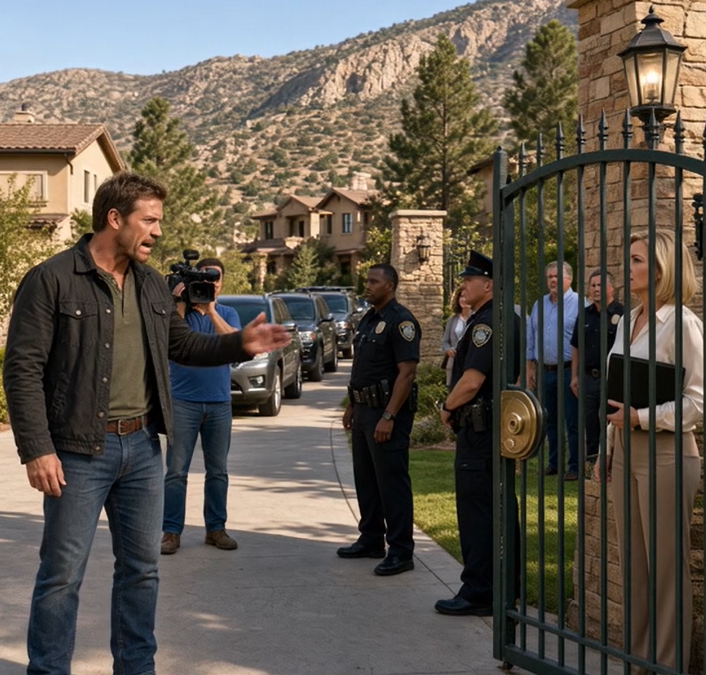
I Locked My Own Gate for One Weekend—By Sunday, the HOA President Learned 80 Luxury Homes Had No Legal Road Out.
For seven months, the HOA president fined me, reported my dogs, photographed my backyard, and treated the fifteen acres my grandfather left me like an ugly annex of her private kingdom—until a surveyor discovered the first two hundred yards of Crest View Estates’ only entrance road were actually on my deed.
I did not block anyone, threaten anyone, or demand a dollar; I simply locked the gate across my own land on Friday afternoon and left for a weekend fishing trip exactly as my grandfather had done for decades.
By the time I came home Sunday, three sheriff’s cruisers, a television crew, stranded delivery drivers, and eighty furious homeowners were waiting outside—and Carolyn Whitmore was about to learn that the road she had spent years calling “the HOA entrance” had never legally belonged to the HOA at all.
I locked the gate across my own property on a Friday afternoon, loaded two fishing rods and a cooler into my truck, whistled for my dogs, and drove into the mountains.
At the time, it felt like the least dramatic thing I had done all week.
Copper climbed into the passenger seat.
June took the back.
The gate closed behind us with a clean metallic clang.
I ran the chain through the steel posts, clicked the heavy padlock shut, checked it once, then drove north toward Eleven Mile Canyon where my phone usually lost service before the first decent fishing spot.
That was Friday at 3:42 p.m.
By Sunday evening, I came home to three sheriff’s cruisers, a Channel 8 news van, six abandoned grocery deliveries sitting in coolers along the shoulder, one Jeep buried axle-deep in a wet drainage swale, two angry tow-truck drivers, and Carolyn Whitmore gripping the bars of my new steel gate like she wanted to tear them out with her bare hands.
The moment she saw me walking out of the pines, she screamed:
“You!”
Fifty people turned.
The reporter near the county road spun toward me.
His cameraman lifted the lens.
Copper sat beside my boot.
June sniffed one of the orange survey stakes as though none of this had anything to do with us.
Carolyn pointed through the gate.
“Open this immediately!”
I stopped ten feet inside my property.
Her hair looked as though it had survived three days of combat.
“You have trapped eighty families!”
“No,” I said.
“I locked my property.”
That distinction eventually cost Crest View Estates more than a million dollars.
But the story started seven months earlier when my grandfather died and left me fifteen acres in the Colorado foothills.
My name is Daniel Porter.
I was thirty-eight when Walter Porter passed away at eighty-seven.
My grandfather was a Korean War veteran, retired telephone lineman, and lifelong enemy of unnecessary purchases.
He owned three coats.
One for work.
One for church and funerals.
PART2:
One “good winter coat” that was somehow different from the work coat even though they looked exactly the same to everyone else.
When my mother once bought him a fourth, he stared at it and said:
“What am I, a department store?”
Grandpa had a phrase for himself.
“Difficult to move.”
Other people called him stubborn.
Both were accurate.
He bought the property in 1974.
Back then, the valley was mostly ranch land.
Fences.
Cattle.
Pine.
Scrub oak.
One narrow county gravel road running along the western edge.
Grandpa built a cabin.
Then a barn.
Then spent nearly fifty years resisting every suggestion that the cabin needed modernization.
By the time I inherited it, the kitchen still had harvest-gold appliances.
The bathroom had avocado tile.
The original living-room carpet possessed a color I can only describe as tired tobacco.
None of that bothered me.
PART3:
I had spent fourteen years living in Denver apartments where silence apparently violated building codes.
My job selling environmental-monitoring equipment had gone remote.
I wanted trees.
Grandpa gave me trees.
The problem was that the trees were no longer alone.
Starting around 2011, a company called Apex Development Holdings bought land east of Grandpa.
Hundreds of acres.
They graded slopes.
Blasted rock.
Installed water and sewer.
Then built Crest View Estates.
Eighty expensive homes arranged along roads with names like Aspen Crest Lane, Summit Ridge Court, Alpine Vista Drive, and Timber Sky Way.
Every house looked as though the architect had been physically threatened if he used anything besides gray stone, beige stucco, black trim, and enough glass to heat a greenhouse.
Three-car garages.
Outdoor kitchens.
Heated driveways.
Perfect landscaping.
Mountain views.
Homes started around eight hundred thousand dollars.
Several sold for more than a million.
The marketing brochures used phrases like:
Private Mountain Living.
Secure Foothill Community.
Effortless Access to Colorado Springs.
That last one aged badly.
Apex went bankrupt in early 2018.
Bad leverage.
Two commercial failures.
A lawsuit.
Crest View’s common areas transferred to its homeowners association.
Roads.
Landscaping.
Gatehouse.
Entrance monument.
Drainage ponds.
Private utilities.
Maintenance obligations.
Residents assumed that included access.
Everyone assumed it.
The title company apparently assumed it.
The developer certainly behaved as though it were true.
My grandfather did not.
That came later.
When I first moved into the cabin in April 2023, I knew none of it.
I knew Grandpa had disliked the development.
That was not unusual.
He disliked subdivisions in general.
Also roundabouts.
Online banking.
People who said “circle back.”
And any coffee costing more than two dollars.
The first two weeks after I moved in were peaceful.
Then I met Carolyn Whitmore.
I came home from the hardware store one afternoon and found a laminated notice taped to my rural mailbox.
CREST VIEW ESTATES HOMEOWNERS ASSOCIATION
ARCHITECTURAL VIOLATION NOTICE
UNAPPROVED VEHICLE / VISUAL NUISANCE
FINE: $250.
I read it twice.
Then looked at the alleged violation.
My 1998 Ford F-150.
Blue.
Rust around the rear wheel wells.
Dent in the passenger door from an elk-related incident in Wyoming that I continued to maintain was the elk’s fault.
The truck sat in my driveway.
On my property.
Outside Crest View.
At the bottom, handwritten:
Vehicle must be removed from street-facing view within 72 hours.
C.W.
I walked down toward the development entrance.
Crest View’s gate could have protected a small embassy.
Stone columns.
Decorative iron fencing.
Electronic arms.
Security kiosk.
Landscaping with plants that appeared individually interviewed before installation.
Carolyn stood near the gatehouse holding a ruler against the grass.
That detail sounds like satire.
It is not.
Cream trousers.
Navy jacket.
Large sunglasses.
Leather clipboard.
“Carolyn Whitmore?”
She looked over the frames.
“Yes?”
I held up the notice.
“I think this belongs to one of your residents.”
She glanced.
“No.”
“That is your vehicle.”
“Yes.”
“That is the issue.”
“My house isn’t in Crest View.”
“It borders Crest View.”
“Still not in it.”
Carolyn adjusted the clipboard.
“Our governing documents permit enforcement action against adjacent nuisances that negatively affect community appearance and property values.”
I waited.
She seemed completely serious.
“I don’t think your bylaws can govern somebody else’s land.”
“You should read them.”
“I don’t need to read your HOA documents to know I didn’t join your HOA.”
She stiffened.
“Mr. Porter, correct?”
“Yes.”
“You inherited that parcel?”
“Yes.”
“That explains some things.”
I looked at her.
“What things?”
“Nothing.”
I placed the notice on her clipboard.
“I’m not paying this.”
“Then the matter escalates.”
“To whom?”
“County code enforcement.”
“Please call them.”
She smiled.
Not friendly.
“Crest View contains more than eighty million dollars in residential property.”
“Congratulations.”
“That truck is visible from our primary entrance.”
“It’s visible from my driveway.”
“It looks abandoned.”
“It started this morning.”
“That is not the standard.”
“What is?”
“Community appearance.”
I laughed.
Bad decision.
Carolyn heard disrespect the way some dogs hear whistles.
“You find this amusing?”
“I find a fake two-hundred-fifty-dollar fine amusing.”
“It is not fake.”
“I’m not paying it.”
She leaned forward.
“You may discover that being difficult with your neighbors has consequences.”
That sounded familiar.
Grandpa had once said almost the exact opposite.
Being easy to move has consequences.
I stepped back.
“Do not put anything on my mailbox again.”
Then went home.
I expected annoyance.
Carolyn chose campaign warfare.
First came animal control.
I owned two golden retrievers.
Copper was nine.
June six.
Copper had once spent fifteen minutes barking at a plastic lawn deer.
June was terrified of the vacuum cleaner.
Carolyn reported two “large uncontrolled dogs demonstrating aggressive behavior toward Crest View residents.”
Animal-control officer Melissa Harding arrived Wednesday.
Copper was asleep upside down on the porch.
June brought Melissa a tennis ball.
Melissa threw it.
June returned it.
This continued approximately twenty times.
Melissa looked at me.
“Which one is dangerous?”
“Apparently both.”
June dropped the ball on her shoe.
Melissa threw again.
Complaint closed.
Next came county fire prevention.
Improper firewood storage.
Potential wildfire hazard.
Colorado wildfire danger was real.
I took that seriously.
Inspector checked setbacks.
Defensible space.
Stack height.
Brush.
He pointed toward two dead branches near the barn.
“Remove those before July.”
“Done.”
“Otherwise, fine.”
Carolyn reported the barn.
Code enforcement visited.
Legal nonconforming agricultural structure.
Fine.
She reported my porch reconstruction.
Permit valid.
She complained about woodworking noise at three on Saturday afternoon.
A sheriff’s deputy drove out.
I was replacing porch boards.
He looked at my saw.
Looked toward Crest View.
“You know quiet hours don’t start until ten?”
“Yes.”
He nodded.
“Okay.”
Then left.
Carolyn had a trail camera installed on an HOA pine near my eastern boundary.
The camera was supposedly for wildlife.
It pointed into half my backyard.
I photographed it.
Sent a certified letter.
Requested reorientation.
Carolyn replied:
The camera monitors association property for trespass and wildlife activity.
It also monitored me drinking coffee in my bathrobe.
That was when I decided I wanted a fence.
Six-foot cedar along the most exposed boundary.
Steel access gate across the old west drive.
Privacy.
Not revenge.
At that point.
Before construction, I hired Thomas Abernathy to survey the parcel.
Thomas was fifty-nine.
Licensed professional land surveyor.
Former county survey technician.
He moved with the patient pace of a man who knew a misplaced property line could finance lawyers for a decade.
He arrived at 7:30 Tuesday.
GPS equipment.
Tripod.
Metal detector.
Old plats.
County GIS prints.
Aerial photographs.
I showed him where I believed the corners were.
He said:
“Belief is why you hired me.”
Then disappeared into the trees.
Four hours later, Thomas returned carrying a rolled preliminary sketch.
His expression worried me.
Not because he looked alarmed.
Because he looked entertained.
Professionals only look that amused when somebody else has made a very expensive mistake.
“Daniel.”
“What?”
“You have coffee?”
“That serious?”
“Potentially.”
We sat on my porch.
Thomas unrolled the drawing.
My fifteen acres formed a long irregular wedge.
County road on the west.
Creek to the south.
Crest View east.
He pointed.
“Here is your legal boundary.”
“Okay.”
“Here’s your driveway.”
I nodded.
“Here is Crest View’s entrance road.”
I nodded again.
Then noticed.
The entrance road did not begin where I thought.
On the drawing, the first section crossed my parcel.
“Why is that line there?”
Thomas looked at me.
“Because that road is on your property.”
I laughed.
He didn’t.
My laugh stopped.
“What?”
“The first roughly two hundred eighteen feet of Crest View Drive lies inside the Porter parcel.”
“No.”
“Yes.”
“There’s a gatehouse.”
“I saw it.”
“Stone pillars.”
“Also saw those.”
“They built all that on my land?”
“Some of it.”
I stared.
Thomas slid another sheet forward.
“Let’s be precise.”
I appreciated surveyors.
Even when ruining my afternoon.
“The roadway itself crosses your parcel here, curves northeast here, and exits onto the recorded Crest View common parcel approximately two hundred eighteen feet from county right-of-way.”
“What about an easement?”
“That was my first question.”
“And?”
“I haven’t found a recorded one.”
“Meaning?”
Thomas sat back.
“Meaning I searched county records this morning before saying anything.”
“No deeded access easement from Porter to Apex.”
“No roadway easement benefiting Crest View.”
“No dedication.”
“No quitclaim.”
“No recorded license.”
“No condemnation record.”
“Nothing.”
I stared toward the development entrance.
Cars moved through it every few minutes.
Residents.
Delivery truck.
Landscaping crew.
All crossing ground Thomas said was mine.
“There has to be something.”
“Maybe.”
“You just said there isn’t.”
“I said nothing is recorded in the documents I’ve found.”
He tapped the plat.
“There could have been an unrecorded agreement.”
“Prescriptive rights.”
“Estoppel issues.”
“Developer contracts.”
“Title matters.”
“Lawyer territory.”
“But survey territory?”
“The road is on your land.”
I sat quietly.
Then something occurred to me.
“Grandpa complained about Apex.”
Thomas looked up.
“What kind of complaints?”
“Fence lines.”
“Equipment.”
“Maybe road stuff.”
“You have letters?”
“Probably.”
“Find them.”
I went into the cabin.
Grandpa had kept paperwork the way some people keep grudges.
Forever.
Metal filing cabinet.
Bottom drawer.
LAND.
Inside:
Tax records.
Old well documents.
Fence receipts.
Utility maps.
Then a manila folder labeled:
APEX IDIOTS.
I smiled.
Inside were carbon copies.
Letters.
One:
Your grader crossed my western line again.
Another:
I have not agreed to relocate my fence.
Then:
I HAVE NOT SOLD YOU ROAD RIGHTS. DO NOT ASSUME OTHERWISE.
Thomas read it twice.
“Who did he send this to?”
“Apex project manager.”
“Certified?”
Stapled receipt behind it.
Thomas whistled.
“That helps.”
“How much?”
“I’m not your attorney.”
“But?”
“But your grandfather put them on written notice.”
We found another.
Dated September 2014.
Mr. Steven Marsh,
Your temporary construction entrance may remain open while you complete drainage improvements under the understanding that this permission is revocable and does not grant permanent ingress or egress rights.
Temporary.
Revocable.
No permanent ingress or egress.
Signed Walter Porter.
Certified receipt.
I looked at Thomas.
He looked at me.
“Oh.”
He nodded.
“Yeah.”
The picture became clearer.
Apex apparently needed temporary access during construction.
Grandpa allowed it.
Somewhere along the way, temporary became permanent.
Construction road became subdivision entrance.
And nobody bothered securing the legal right.
“Can they claim they’ve used it too long?”
Thomas answered carefully.
“That’s a lawyer question.”
I called one.
Her name was Rebecca Sloan.
Real-estate attorney.
Colorado Springs.
Fifty-one.
Short gray hair.
No patience for unnecessary adjectives.
Thomas recommended her.
She came out Thursday.
Reviewed the deed.
Plat.
Letters.
Bankruptcy transfer documents.
County records.
Apex filings.
Then drove Crest View.
Returned.
“Interesting.”
I hated how professionals kept saying things like that.
“Interesting good or interesting expensive?”
“For somebody, expensive.”
She spread documents across my kitchen table.
“The development has a problem.”
“How bad?”
“That depends on whether there is another lawful access route.”
“There’s a fire road on the north ridge.”
“Recorded?”
“I don’t know.”
She did.
“No.”
“It crosses federal-adjacent open space, then private ranch land.”
“So no?”
“Not without separate rights.”
“What about the south service track?”
“Drainage maintenance only.”
“Not approved for residential ingress.”
I stared.
“Eighty houses have no legal entrance?”
Rebecca raised a finger.
“Careful.”
“They have physical access.”
“The question is whether they have enforceable property rights across your parcel.”
“Do they?”
“Based on what I see right now, their position is very weak.”
“What should I do?”
“Nothing dramatic.”
That suited me.
“First, verify title.”
“Second, notify HOA.”
“Third, do not interfere with access while we investigate.”
I nodded.
Then:
“Can I still build my fence?”
“If the permit is valid and it stays on your parcel.”
“What about the gate?”
“Where?”
I showed her.
An existing old ranch gate had once crossed Grandpa’s driveway near the county road.
Mostly rotten now.
I wanted a steel replacement.
Rebecca studied the survey.
“That driveway is yours.”
“Yes.”
“You use it to access your cabin.”
“Yes.”
“If you install a normal gate for your own property, do not represent that you are intentionally blocking Crest View.”
“I’m not.”
“Good.”
“Do they cross that exact driveway?”
“Yes.”
Rebecca paused.
“That becomes delicate.”
“I can’t lock my own gate?”
“You can secure your property.”
She leaned closer.
“But once you have actual knowledge that eighty homes rely on it, you should act reasonably while rights are disputed.”
“What’s reasonable?”
“Notice.”
So we sent notice.
Certified.
HOA president.
HOA management company.
HOA counsel.
Insurance carrier.
County planning department.
The letter was boring.
Rebecca liked boring letters.
Survey indicates Crest View’s entrance improvements cross Parcel 17-442-03 owned by Daniel Porter.
No recorded access easement located.
Please provide any deed, easement, license, or agreement supporting current use within fifteen days.
Pending review, Mr. Porter reserves all rights.
Nothing more.
Carolyn responded personally before the HOA attorney did.
Email.
Subject:
FRIVOLOUS PROPERTY CLAIM.
Mr. Porter,
Your continuing campaign of harassment against Crest View residents has now crossed into deliberate interference with established community access.
The road has served Crest View for more than a decade and belongs to the Association.
Cease all threats concerning gate installation immediately.
Carolyn Whitmore
President
Crest View Estates HOA
Rebecca read it.
Then said:
“She shouldn’t write her own legal correspondence.”
“Why?”
“Because someday somebody like me gets to print it.”
The HOA lawyer called two days later.
Much calmer.
He requested documents.
Rebecca sent survey excerpts.
Grandpa’s letters.
County recording search.
Then nothing.
A week.
Two.
Carolyn continued behaving as though the dispute did not exist.
Except the harassment escalated.
A bright orange notice appeared on my new cedar fence.
UNAPPROVED STRUCTURE.
I took a photograph.
Sent it to Rebecca.
She replied:
Keep everything.
Carolyn emailed county planning claiming I intended to obstruct emergency access.
The county engineer visited.
He looked at the map.
Looked at Crest View’s gatehouse.
Looked back.
“Wow.”
I had begun to hate that reaction.
“Can I finish my gate?”
“Your permit is for an agricultural access gate across your private drive.”
“Yes.”
“I can’t advise on civil access rights.”
“Emergency access?”
“If this is the only route, blocking it creates practical concerns.”
“Even if it’s mine?”
“Practical and legal are not always the same thing.”
Reasonable.
I asked Rebecca.
She said:
“Install it.”
“Keep it open while negotiations continue.”
So I did.
Heavy galvanized steel.
Two swinging panels.
Locking center bar.
Enough width for fire equipment.
I left it open.
Every day.
For three weeks.
Meanwhile, Crest View’s HOA attorney requested an emergency board meeting.
Carolyn postponed it.
Why?
Annual landscape review.
I wish that were invented.
Then she sent me another violation notice.
This one demanded removal of the steel gate because it “conflicted with Crest View entry aesthetics.”
I walked into Rebecca’s office carrying the letter.
She read it.
Removed her glasses.
“Is she always like this?”
“Yes.”
Rebecca smiled.
“That helps.”
Finally, Crest View’s board agreed to meet.
Thursday evening.
Clubhouse.
I attended with Rebecca and Thomas.
Carolyn sat at the center of a long table.
Six board members.
HOA manager.
Attorney named Philip Granger.
About thirty homeowners behind us.
Carolyn began.
“Mr. Porter has recently made an unsupported claim that the association’s principal entry corridor crosses property he owns.”
Rebecca slid copies of the survey forward.
“Not unsupported.”
Carolyn ignored her.
“The association has used this road continuously since construction.”
Rebecca said:
“Use is not ownership.”
Philip Granger intervened.
“Let’s keep this productive.”
Thomas explained the survey.
Coordinates.
Monuments.
Historic plats.
County section lines.
Nobody interrupted him because surveyors speak with the confidence of people who know dirt has evidence.
Then Rebecca read Grandpa’s 2014 letter.
Temporary construction access.
Revocable.
No permanent ingress or egress rights.
A homeowner behind me whispered:
“Oh, shit.”
Carolyn heard.
Her face hardened.
“This is absurd.”
Philip looked at her.
“Carolyn.”
“Apex built the road.”
“Apparently.”
“Therefore Apex owned it.”
“No.”
He spoke carefully.
“Building an improvement does not automatically create property ownership.”
Carolyn looked around.
“Then we claim adverse possession.”
Rebecca almost laughed.
Philip closed his eyes briefly.
“Not exactly.”
“Why not?”
“Because access rights and adverse possession are different doctrines.”
“And because Mr. Porter’s predecessor granted permissive temporary use.”
Rebecca added.
“That tends to create problems for a claim based on hostile use.”
Carolyn snapped:
“His grandfather is dead.”
The room went quiet.
I looked at her.
“So are his letters?”
She ignored me.
One board member named Kenneth Shaw, retired accountant, asked Philip:
“What is our exposure?”
Philip hesitated.
“That depends on title insurance.”
Another board member:
“We have title insurance.”
“For individual homes.”
“What about HOA common property?”
HOA manager shuffled papers.
“We have a policy.”
Philip asked:
“Does it insure access?”
Nobody knew.
That was the moment the room changed.
Not anger.
Fear.
Because homeowners can tolerate almost any HOA drama while believing their house still has a road.
Someone behind us asked:
“If Daniel closes that gate, how do we get out?”
Carolyn turned.
“He cannot close it.”
Rebecca responded:
“We have not said that.”
“You’re threatening eighty families.”
“No.”
Rebecca’s voice stayed calm.
“We notified the association of a title defect.”
Carolyn looked at me.
“What do you want?”
First reasonable question she had asked in seven months.
I answered honestly.
“Peace.”
She laughed.
“I’m serious.”
“I want the surveillance camera moved.”
“I want fake violation notices to stop.”
“I want my property treated as my property.”
“And we need to resolve the road legally.”
“How much?”
“I didn’t say money.”
“You’re holding access hostage.”
“I have kept the gate open.”
A man in the back said:
“He has.”
Carolyn snapped toward him.
He shrugged.
“I drive through every day.”
Philip asked Rebecca:
“What resolution are you proposing?”
“Permanent recorded easement.”
“Fair compensation.”
“Maintenance responsibilities.”
“Insurance.”
“Indemnification.”
“Surveyed boundaries.”
“Emergency access standards.”
Carolyn said:
“Absolutely not.”
Philip looked at her.
“Carolyn.”
“We will not pay this man for a road we have used for twelve years.”
Rebecca gathered her papers.
“Then provide legal documentation supporting your right to use it.”
“We don’t need to.”
“You do.”
Meeting ended without agreement.
Friday morning, Rebecca called.
“I have news.”
“Good?”
“Depends.”
“The HOA title policy excludes access defects arising from developer failure to record off-site easements.”
I sat down.
“So insurance won’t cover them?”
“Likely not.”
“Individual homeowners?”
“Some policies may have coverage.”
“Which means?”
“Potentially eighty title claims.”
I stared through the window toward Crest View.
“That sounds bad.”
“It sounds expensive.”
Then she asked:
“You still fishing this weekend?”
I had planned the trip for weeks.
“Yes.”
“Good.”
“Why?”
“You need to stop thinking about this.”
“What about the gate?”
There was silence.
Then:
“Daniel, are you leaving your property unattended?”
“Yes.”
“Dogs with you?”
“Yes.”
“Any reason somebody needs to enter?”
“No.”
“Then securing your own driveway while you’re away is ordinary behavior.”
I understood the sentence.
“You’re telling me I can lock it.”
“I am telling you to behave normally.”
Rebecca added:
“Do not send Carolyn a message.”
“Do not make a public statement.”
“Do not put up a sign saying HOW DO YOU LIKE THE EASEMENT NOW.”
“I wasn’t planning—”
“You were thinking it.”
Maybe.
Friday at 3:42, I locked the gate.
There was another entrance into Crest View from the development side, but both flowed through the same two-hundred-foot corridor before county road.
Residents could drive internally.
They could not reach the county road without crossing my strip.
For twelve years nobody noticed because Grandpa never closed the old gate.
He lived there.
He used the same road.
Apex paved around everything.
The gate itself eventually rotted away.
Residents stopped thinking of the first two hundred feet as private land.
It simply became “the entrance.”
Until Friday.
The first person to encounter the locked gate was apparently a UPS driver at 4:11.
He called the listed resident.
Resident called the gatehouse.
Gatehouse called Carolyn.
Carolyn drove down.
Saw the chain.
And, according to three witnesses, screamed:
“He cannot do this.”
She called the sheriff.
Deputy arrived.
Examined survey markers.
Called his supervisor.
They contacted county dispatch.
The deputy refused to cut my lock.
Carolyn demanded arrest.
Deputy asked:
“For what?”
“False imprisonment.”
Of eighty homeowners.
By a gate.
Across land everyone remained free to walk across.
The deputy reportedly stared at her for several seconds.
Saturday morning became worse.
Residents leaving for soccer.
Work.
Airport.
Shopping.
Some parked near the interior end and walked around the gate to rideshare vehicles waiting on the county side.
Several families used bicycles.
One man decided his Jeep could bypass the gate through the drainage swale.
Colorado foothill mud corrected his confidence.
The Jeep sank.
Tow truck could not reach it easily.
By noon, social media discovered the situation.
POST:
Crazy neighbor barricades entire community.
Then:
HOA dispute traps 80 families.
Then:
Property owner says HOA built road illegally.
Channel 8 called Rebecca.
She declined comment.
Carolyn did not.
She stood in front of the gate and gave an interview describing me as:
“An unstable individual attempting to extort an entire neighborhood.”
That sentence became very useful later.
Saturday afternoon, residents held an emergency meeting.
I learned details afterward.
Carolyn wanted the HOA to cut the lock.
Philip Granger said absolutely not.
She suggested removing the gate with a truck.
Philip reportedly asked if she wanted him to continue serving as counsel.
She stopped.
A board member asked:
“Where is Porter?”
Fishing.
“Can we call him?”
No service.
“Who knew?”
Rebecca.
She did not disclose my location.
Emergency services established temporary procedures.
Pedestrian access remained unrestricted.
For actual emergency vehicles, sheriff’s department maintained a bolt-cutter authorization if life safety required entry.
Fire district reviewed alternate staging.
Nobody died.
Nobody was actually imprisoned.
But inconvenience does something remarkable to wealthy homeowners.
It focuses attention.
By Saturday evening, people who had ignored every HOA meeting for years suddenly wanted deeds.
Maps.
Minutes.
Developer files.
The retired accountant, Kenneth Shaw, found something in old HOA archives.
Apex correspondence from 2016.
Internal email.
SUBJECT:
PORTER ACCESS.
Project manager Steven Marsh wrote:
Walter continues refusing permanent easement. Proceed under temporary construction permission for now. We can clean up title before final phase.
They never cleaned it up.
Kenneth forwarded it to the board.
Then another email surfaced.
One year before bankruptcy.
LEGAL NEEDS RECORDED INGRESS ACROSS PORTER PARCEL BEFORE TURNOVER.
And handwritten beneath a printed copy:
Deferred — cash constraints.
That was it.
The smoking gun.
Apex knew.
By Saturday night, Carolyn’s position changed from:
Daniel fabricated this.
To:
Apex created the problem.
Which was true.
But did not undo twelve years of HOA use.
Nor seven months of Carolyn treating me like an unwanted shed beside her entrance.
Sunday morning, residents began turning on her.
Not because they suddenly loved me.
Because Carolyn had spent months telling them every rule mattered.
Fence color.
Trash-can placement.
Holiday-light dates.
Mailbox finish.
Vehicle visibility.
Then they discovered their own association had apparently never verified legal access to its property.
One homeowner reportedly asked her:
“You fined me four hundred dollars because my basketball hoop was visible from the street, but you never checked whether we owned the street?”
I wish I had been there.
By Sunday afternoon, Channel 8 arrived.
Then a second sheriff’s unit.
Not because of violence.
Crowd control.
People had gathered.
Residents.
Curious neighbors.
Delivery drivers.
One couple tried hiking groceries around the gate.
A refrigerated meal service left six boxes because nobody could coordinate delivery.
At 5:20 p.m., I returned.
Fishing had been good.
Two trout.
No cell service.
Copper smelled like lake water.
June had rolled in something she believed improved her personality.
I drove down a forest-service track that connected to the rear portion of my land.
That track did not connect Crest View.
Only my cabin.
I reached the property from the north.
Parked.
Walked toward the gate because I could hear people.
Then saw the circus.
Cruisers.
News van.
Crowd.
Carolyn.
“You!”
She screamed.
I stopped.
“Open this immediately!”
I looked around.
“What happened?”
The crowd reacted.
Apparently that was the wrong question.
“What happened?”
Carolyn nearly vibrated.
“You know exactly what happened.”
“I’ve been fishing.”
“You locked eighty families inside.”
“No.”
I said.
“I locked my property.”
Someone behind her shouted:
“That’s technically true!”
A few people laughed.
Carolyn spun.
“Whose side are you on?”
The man answered:
“The side with road access.”
Reporter approached the gate.
“Mr. Porter?”
I looked toward Rebecca.
She was there.
Of course.
Standing near one cruiser.
She shook her head slightly.
Do not talk.
I nodded.
Carolyn yelled:
“He is refusing to open it!”
Rebecca stepped forward.
“My client just arrived.”
“He needs to remove the gate.”
“No.”
“Rebecca.”
Carolyn knew her name now.
“Eighty homeowners cannot access a county road.”
Rebecca answered:
“Then the HOA needs to resolve its access defect.”
“This is extortion.”
“What demand has Daniel made?”
Carolyn opened her mouth.
Nothing.
Because I had not demanded money.
Had not sent a ransom note.
Had not threatened residents.
I had simply locked my own driveway before leaving town.
Sheriff’s sergeant approached.
“Mr. Porter.”
“Yes.”
“Can you confirm you own the gate?”
“Yes.”
“Do you have the key?”
“Yes.”
“Would you be willing to open it while civil counsel works this out?”
I looked at Rebecca.
She nodded.
Reasonable.
I unlocked the gate.
The reaction was almost embarrassing.
People applauded.
I wished they wouldn’t.
Cars started lining up immediately.
Carolyn tried to speak to the reporter.
Nobody cared anymore.
Because Channel 8 had obtained the 2016 Apex email.
The evening broadcast showed a graphic.
Crest View entrance.
Red property line.
Two hundred eighteen feet.
My name.
Then the words:
NO RECORDED EASEMENT FOUND.
By Monday morning, the story was everywhere locally.
My truck’s rusty fender appeared in one news shot.
Somebody online wrote:
THE $250 TRUCK THAT OWNS AN $80 MILLION NEIGHBORHOOD’S ROAD.
That one made me laugh.
Rebecca did not.
“Stop reading comments.”
“Some are funny.”
“Comments are where facts go to die.”
Monday afternoon, Crest View’s board removed Carolyn as sole negotiator.
Tuesday, they hired independent real-estate counsel.
Wednesday, twenty-three homeowners filed notice with their title insurers.
Friday, four mortgage lenders began asking questions.
That changed everything.
Because lenders do not care about Carolyn’s pride.
They care whether collateral has legal access.
Crest View homeowners had mortgages secured by homes whose ingress rights were suddenly uncertain.
Refinances paused.
One pending sale stalled.
Another buyer demanded title clarification.
A bank’s attorney sent an inquiry.
Then another.
The board entered emergency negotiations.
Carolyn continued fighting.
She sent residents an email titled:
DO NOT PANIC — PORTER CLAIM IS EXTORTION.
Philip Granger resigned as HOA counsel the next day.
His resignation letter became part of discovery months later.
He wrote:
I have repeatedly advised the Board against public accusations of criminal conduct where no demand or threat has been made.
Carolyn was furious.
The board voted four to two to suspend her presidential authority pending legal review.
She called the vote invalid.
It wasn’t.
For the first time since I met her, Carolyn Whitmore had no clipboard.
Negotiations became productive almost immediately.
Rebecca proposed:
Permanent nonexclusive access easement.
Defined width.
HOA responsible for road maintenance.
HOA responsible for snow removal.
Drainage.
Insurance.
Utility conflicts.
Emergency access.
Gate provisions.
No HOA authority over the rest of my parcel.
Privacy landscaping.
Relocation of surveillance equipment.
Legal costs.
Compensation.
The HOA’s new attorney asked:
“What compensation?”
Rebecca slid an appraisal across the table.
The easement occupied roughly half an acre when considering roadway, shoulders, drainage, gatehouse encroachment, and utility area.
But value was not simply acreage.
It was permanent access supporting eighty homes.
Appraisers argued.
Attorneys argued.
Title insurers argued.
Developers’ bankruptcy lawyers were contacted.
Apex was effectively dead.
Assets long distributed.
Former executives suddenly developed poor memories.
Then another problem appeared.
The gatehouse.
Part of it crossed my property line.
So did one stone entrance monument.
Decorative landscaping.
Underground electrical conduit.
A section of storm drainage.
The HOA had maintained them.
I owned the land under them.
Rebecca explained:
“We can resolve all of that in one instrument.”
The board agreed.
Carolyn did not.
She retained her own lawyer.
Then sent me a letter alleging harassment, emotional distress, property-value interference, and intentional obstruction of easement rights.
Rebecca read it.
“Do nothing.”
Carolyn filed suit anyway.
That was the worst decision she made.
Not because lawsuits automatically fail.
Because lawsuits require discovery.
Discovery required the HOA to produce emails.
Minutes.
Internal complaints.
Carolyn’s correspondence about me.
We found:
The fake truck fine.
Her direction to animal control.
Her request that the fire marshal “find leverage.”
Her email telling the management company:
Porter needs to understand that resisting us will become expensive.
Another:
If county agencies visit often enough, eventually he’ll get tired of fighting.
And one regarding the trail camera:
Angle it to capture activity near his yard. We need documentation.
Rebecca read that one twice.
Then looked at me.
“Now I’m angry.”
I said:
“You weren’t before?”
“I was professionally interested.”
“What’s the difference?”
“Billing rate.”
Carolyn’s suit collapsed quickly.
My counterclaims did not.
Privacy issues.
Abuse of process allegations.
Trespass relating to notices and camera placement.
Interference.
I did not want to spend years litigating.
Neither did Crest View.
The board eventually separated itself from Carolyn.
Their insurer entered negotiations.
By spring, we had a settlement framework.
Crest View Estates paid $610,000 for the permanent access easement and associated land rights.
Not eighty-home blackmail.
Appraised and negotiated compensation funded through HOA reserves, insurance contribution, lender pressure, and a special assessment.
The amount also covered improvements and legal expenses.
Separately, title insurers contributed hundreds of thousands toward legal resolution because several policies created exposure.
Drainage reconstruction added another $280,000.
Gatehouse relocation and utility corrections cost about $190,000.
Legal fees across all sides pushed total financial impact well beyond one million.
That was the million-dollar weekend.
Not because I collected a million.
I did not.
Because years of ignoring one old man’s property rights became a seven-figure correction.
The HOA assessment was painful.
Residents were furious.
Some at me.
Many at Apex.
Most eventually at Carolyn.
One morning I found an envelope in my mailbox.
No fine.
No HOA letterhead.
Handwritten note.
Mr. Porter,
I owe you an apology.
I believed Carolyn because she spoke with confidence and because I never imagined our own HOA could be wrong about something as basic as the road.
My husband and I complained about you during the gate weekend.
We were wrong.
Thank you for reopening it before lawyers forced anything.
— Lisa Merritt, 14 Aspen Crest
I kept that note.
Not because I needed vindication.
Because it was the first time somebody from Crest View treated me like a neighbor instead of an obstacle to property values.
Others followed.
Not everyone.
One man still blamed me because he missed a golf tee time Saturday.
I survived the guilt.
Kenneth Shaw visited one afternoon.
Retired accountant.
Board member.
He stood on my porch holding two beers.
“Peace offering.”
I let him in.
We sat.
He looked toward the gate.
“You could’ve destroyed us.”
“No.”
“You could’ve demanded anything.”
“Not legally.”
“You know what I mean.”
I did.
He took a drink.
“Why didn’t you?”
I thought about Grandpa.
His folder.
APEX IDIOTS.
His letters.
His refusal to sell rights.
“I didn’t want your houses.”
“Didn’t want revenge.”
“I wanted people to stop acting like my property belonged to them because theirs cost more.”
Kenneth nodded.
“That seems reasonable.”
“It was apparently controversial.”
He laughed.
Then became serious.
“Carolyn’s moving.”
I looked over.
“What?”
“House under contract.”
Months after losing the board presidency and settling her personal claims, Carolyn listed her home.
I felt less satisfaction than expected.
That surprised me.
For seven months I had imagined the moment she would finally lose.
Then it happened.
Mostly I felt tired.
A week before she moved, Carolyn came to my gate.
Alone.
No clipboard.
No sunglasses.
I was repairing a fence hinge.
She stood outside.
“Daniel.”
I looked up.
“Carolyn.”
“Can we talk?”
I wiped my hands.
Walked closer but did not open the gate.
She noticed.
Her mouth tightened.
Old Carolyn almost returned.
Then didn’t.
“I was wrong about the road.”
That may have been the most difficult sentence she had ever spoken.
I waited.
“And about some other things.”
Still waited.
She looked toward the cabin.
“The truck fine was inappropriate.”
“Yes.”
“The complaints…”
She hesitated.
“I believed enforcement would encourage cooperation.”
“You emailed people to find leverage.”
Her face changed.
“I know what I wrote.”
“So do I.”
Silence.
Then:
“I spent nine years protecting Crest View.”
“From what?”
She looked genuinely surprised.
“Decline.”
“Disorder.”
“People ignoring standards.”
I thought about it.
“And somewhere you started believing the boundary around Crest View included everything you could see.”
Carolyn looked toward the mountains.
Maybe that landed.
Maybe not.
She said:
“The gate weekend humiliated me.”
“I wasn’t there.”
“I know.”
“That was almost worse.”
I laughed despite myself.
She almost did too.
Then she looked at the steel gate.
“You really were fishing?”
“Yes.”
“For the entire weekend?”
“Yes.”
“Did you know what was happening?”
“No service.”
Carolyn stared.
Then, for the first time since I met her, she laughed.
Not pleasant.
Not bitter.
Just exhausted.
“That is unbelievable.”
“I caught two trout.”
She shook her head.
“I hate you a little.”
“Fair.”
Then she reached through the bars.
Not for a handshake.
She held out an envelope.
Inside was my original laminated truck violation notice.
The $250 one.
“I found it in old board files.”
I looked at it.
“You kept this?”
“Apparently.”
I folded it.
Put it in my pocket.
“You know I’m still not paying.”
Carolyn smiled.
Very slightly.
“I assumed.”
She moved two weeks later.
The family who bought her house had three children and a golden doodle named Pancake.
Pancake and June became immediate enemies over a tennis ball.
Then best friends.
Life returned to normal.
Mostly.
The road easement was recorded properly.
For the first time in Crest View’s history, residents had a legal right to cross my property.
The HOA installed a new entry configuration.
The decorative stone monument moved twenty-seven feet east.
Gatehouse relocated completely onto association land.
Road drainage rebuilt.
I retained my own gate farther inside my private driveway.
The Crest View access lane now curved around it.
Separate.
Clear.
Recorded.
Boring.
Perfect.
The trail camera disappeared.
No more notices.
No animal-control visits.
No noise complaints.
No county inspectors arriving because Carolyn discovered another subsection of something she hoped applied to me.
I restored the barn.
Built a woodworking shop inside.
Replaced the cabin’s harvest-gold stove.
Grandpa would have objected to the expense.
I kept one avocado bathroom tile framed above the toilet in his honor.
Copper died two years later.
Old age.
June slept beside his empty bed for almost a week.
Half of Crest View seemed to know.
Lisa Merritt brought flowers.
Kenneth brought a ridiculous dog-shaped sympathy card.
Even people I barely recognized stopped while driving past to say they were sorry.
That was when I realized something had changed.
Not legally.
Socially.
We had become neighbors.
Actual neighbors.
Not HOA and outsider.
People.
Winter storms did what lawsuits could not.
They forced cooperation.
One January, three feet of snow closed the county road.
I used my tractor to clear the lower approach.
Crest View’s maintenance contractor cleared the upper section.
Kenneth came down with coffee.
“Careful.”
I said.
“You’re benefiting from non-HOA equipment.”
He looked at the tractor.
“Is it architecturally approved?”
“Absolutely not.”
We laughed.
The first annual HOA meeting after settlement lasted twenty-three minutes.
Apparently Carolyn’s meetings had lasted three hours.
Kenneth became president temporarily.
His first policy change:
No violation letters outside HOA boundaries.
People applauded.
His second:
Legal review before threatening government complaints.
More applause.
His third:
Stop measuring decorative grass.
Standing ovation.
Rebecca eventually closed my file.
Almost.
She kept one photograph.
The Sunday evening image from Channel 8.
Carolyn gripping my gate.
Me inside.
Copper sitting.
June sniffing a survey stake.
Reporter between us.
Rebecca had it framed in her office.
Below it she placed a label:
READ THE DEED.
I found out when I visited about another matter.
“You’re exploiting my trauma.”
She said:
“It’s educational.”
Years later, law students from a local property clinic actually contacted her about the case.
Not because it created new law.
It did not.
Nothing dramatic reached appellate court.
That was the funny part.
People assume enormous real-estate disasters require obscure doctrines.
Often they require paperwork somebody forgot to read.
The lesson was embarrassingly simple.
A developer needed road access.
An old man refused permanent rights.
Developer used temporary permission.
Developer ran out of money.
Someone promised to fix title later.
Nobody did.
Homes sold.
HOA inherited infrastructure without verifying every underlying right.
For twelve years, asphalt created psychological ownership.
People drove it.
Maintained it.
Landscaped it.
Guarded it.
Named it.
So everyone believed it belonged to them.
But pavement is not a deed.
Stone columns are not a deed.
A gatehouse is not a deed.
Confidence is not a deed.
And expensive houses do not expand property lines.
Grandpa understood that intuitively.
I found another letter after everything settled.
I had missed it inside an old phone-company ledger.
Not addressed to Apex.
Just a note to himself.
Probably written after one of their crews moved his fence.
He wrote:
People get careless when they think the thing they need from you is too important for you to refuse.
Make them ask properly.
That sounded like him.
Difficult to move.
I framed it in the workshop.
One afternoon a new Crest View resident stopped by.
Young guy.
Tech job.
Had just bought one of the houses near Summit Ridge.
He pointed toward the framed note.
“That about the road?”
“Probably.”
He laughed.
“Seller told us the whole story.”
“What version?”
“That one old guy’s grandson trapped the HOA until they paid him six hundred grand.”
I sighed.
“Of course.”
“Not true?”
“I didn’t trap anybody.”
“I locked my gate.”
“Yeah, seller said you always say that.”
“Because it’s accurate.”
He looked outside toward the easement.
“So if you hadn’t locked it, how long until anyone noticed?”
That stopped me.
I had wondered the same thing.
Another year?
Ten?
Until a lender audit?
Until a fire?
Until somebody tried selling the common property?
Maybe never.
Physical habits are powerful.
If eighty families drive across the same strip every day, eventually it feels impossible that anyone else could own it.
That is how assumptions become architecture.
I told him:
“Probably until something made it impossible to ignore.”
He nodded toward the old laminated fine hanging beside Grandpa’s note.
“What’s that?”
“My first HOA violation.”
He read.
UNAPPROVED VEHICLE.
Then looked at my old F-150 parked near the barn.
Same truck.
More rust.
“You kept it?”
“It runs.”
“That thing?”
“Watch your tone.”
The truck eventually became a joke around Crest View.
Every year at the neighborhood picnic, someone asked whether it had received architectural approval.
One resident printed a fake permit.
CREST VIEW HISTORIC VEHICLE DESIGNATION.
I put it on the dashboard.
That picnic itself would have been unimaginable during Carolyn’s presidency.
Crest View used to hold events behind its gates.
Now they occasionally invited surrounding landowners.
Not because my gate taught everyone a moral lesson.
Life is not that tidy.
Some residents still disliked me.
I disliked a few of them.
One man ran a leaf blower at seven on Sunday morning and I considered declaring war.
But boundaries became healthier.
Literal and otherwise.
Their rules stopped at their parcel.
My choices stopped where they affected shared access.
The recorded easement created obligations for both sides.
If I needed work crossing the road, notice.
If HOA needed repairs inside the easement, notice.
Emergency access always preserved.
Snow removal standards.
Insurance certificates.
Drainage maintenance.
Everything defined.
The relationship improved because nobody had to rely on goodwill alone.
People romanticize handshakes.
Good documents preserve friendships better.
The funniest part came five years later.
Crest View decided to replace its entrance sign.
The design committee sent me a courtesy email because construction equipment would work near the easement boundary.
No demand.
No fake notice.
Just:
Mr. Porter,
Contractors will be working near the recorded access easement Monday through Wednesday. No work will occur outside association property. Please let us know if you observe any boundary issue.
Thank you.
I forwarded it to Rebecca.
Subject:
MIRACLES HAPPEN.
She replied:
Frame it.
I did.
Grandpa would probably have found the whole thing ridiculous.
He never trusted HOAs.
Or developers.
Or lawyers, though Rebecca said she would forgive that.
Sometimes I wish I could have asked him whether he knew exactly how serious the road problem was.
The letters suggest he understood enough.
Why didn’t he force resolution?
Maybe he thought Apex would eventually do the right thing.
Maybe he did not care while the road remained useful to him too.
Maybe at eighty he had more important things to think about.
Grandpa had survived Korea.
Buried his wife.
Raised two daughters.
Worked thirty-seven years climbing telephone poles.
I doubt a subdivision road ranked high among life’s existential crises.
Still, he preserved every letter.
Every certified receipt.
Every map.
That was his way.
Do not fight every battle.
Keep evidence.
One rainy evening, years after settlement, I sat on the porch with June.
Cars moved quietly along the legal easement.
Headlights through the trees.
No conflict.
No cameras.
No shouting.
The steel gate from that famous weekend stood farther up my private drive.
Open.
Most days I left it that way when I was home.
Closed when I wasn’t.
Ordinary.
A gate.
That was all it had ever been.
People online turned it into a weapon.
Carolyn called it imprisonment.
Reporters called it leverage.
Lawyers called it a fact pattern.
To me, it was still just the thing I locked before taking my dogs fishing.
And maybe that is why the story spread.
Because everybody expected some elaborate act of revenge.
A secret plan.
A trap.
A dramatic legal strategy.
There wasn’t one.
I did not buy Crest View’s road to extort them.
I did not discover the defect and immediately close access.
I did not demand a million dollars.
I did not sabotage the development.
I inherited fifteen acres from a stubborn old man.
Then one surveyor looked where everyone else had stopped looking.
That was enough.
The real failure happened years earlier.
Apex assumed it could solve title later.
The HOA assumed the developer had solved it.
Homeowners assumed the HOA knew.
Lenders assumed title work was clean.
Carolyn assumed expensive property carried authority beyond its lines.
Everyone assumed.
Except Grandpa.
Grandpa wrote:
I have not sold you road rights.
Do not assume otherwise.
Nobody listened.
Until a steel gate clicked shut on a Friday afternoon.
Sometimes the most expensive sound in real estate is not a judge’s gavel.
It is a padlock closing on land everyone forgot belonged to somebody else.
I learned something from the whole mess.
Property disputes are rarely only about land.
They are about power.
Expectation.
Who believes they get to decide.
Carolyn’s first mistake was not misunderstanding the road.
Apex created that problem.
Her mistake was believing my property became her business because she could see it from hers.
My truck.
My dogs.
My barn.
My fence.
My camera privacy.
Each complaint carried the same assumption:
Crest View mattered more.
Its homes were expensive.
Its entrance polished.
Its residents organized.
My cabin was old.
My truck rusty.
Therefore their preferences somehow outweighed my rights.
The road exposed how backwards that thinking was.
For years they had crossed my grandfather’s land every time they entered the community.
The entire subdivision’s connection to the outside world depended on a piece of property Carolyn considered an eyesore.
There was poetry in that.
Grandpa would have appreciated it.
Not publicly.
He disliked poetry.
But privately.
One autumn, after June was gone too, I walked the eastern boundary alone.
The privacy fence had weathered silver.
Pines taller.
Crest View houses partly hidden behind them.
Near the old camera tree, I found one of Thomas Abernathy’s original survey caps.
Orange flag long gone.
Small metal marker still firm.
I crouched.
Brushed dirt away.
Boundary.
A tiny thing.
Most boundaries are.
Lines on paper.
Pins in soil.
Descriptions nobody reads until somebody disagrees.
Yet entire neighborhoods depend on them.
Lives become calmer when we respect them before conflict.
That was true of land.
People too.
Carolyn had crossed mine repeatedly.
I had eventually drawn it in steel.
Years later, she sent me one Christmas card.
No return address I recognized.
Inside:
Daniel,
I hope the truck finally died.
— Carolyn
I laughed so hard I scared June’s replacement, a rescue mutt named Walter.
I wrote back through the forwarding address.
Carolyn,
Still runs.
— Daniel
Two weeks later she mailed a photograph of a new electric SUV.
On the back:
Some of us evolve.
I put it beside the fake historic-vehicle permit.
Maybe that was forgiveness.
Or maybe mature hostility.
Either way, it was better.
The old Ford finally died at 312,000 miles.
Transmission.
I considered fixing it.
Rebecca threatened an intervention.
Kenneth said Crest View should buy it as a monument.
We compromised.
I parked it inside the barn and bought a used Tacoma.
No rust.
At least initially.
The first time I drove it past the HOA entrance, Kenneth texted:
WHO APPROVED THAT COLOR?
I replied:
MY GRANDFATHER.
He had been dead nearly a decade.
Still useful.
The story eventually became one of those local legends exaggerated with every retelling.
Some versions said I welded the gate shut.
False.
Some said residents were trapped for a week.
False.
Forty-nine hours, and pedestrian access remained possible.
Some said Carolyn tried ramming the gate.
False.
She considered having it removed but counsel stopped her.
Some claimed I collected $1.4 million personally.
Absolutely false.
The overall correction cost exceeded a million.
My easement compensation was substantially less.
One version claimed Grandpa deliberately designed the parcel as a legal trap decades earlier.
He would have loved that.
But no.
The truth was less cinematic.
And better.
One old man refused to sign away something he owned.
One developer used it anyway.
One generation forgot.
The next generation checked.
That is all.
If there is one image I still remember most, it is not Carolyn screaming at the gate.
Not the television van.
Not the Jeep stuck in mud.
It is Thomas sitting at my porch table the day of the survey.
Coffee in hand.
Drawing unrolled.
Finger on a thin black line.
“The entrance road is yours.”
Everything after came from that.
A line everyone ignored.
I looked at the same survey recently.
The permanent easement is printed now.
Clean.
Recorded.
Legal description three pages long.
Crest View has unquestioned access.
My remaining land protected.
Everyone knows who maintains what.
No confusion.
The system finally says what the pavement had pretended for years.
And when I leave for fishing now, I still close my private gate.
I still lock it.
Nobody cares.
Because the road to Crest View no longer runs through it.
Sometimes new visitors ask about the second old steel gate visible among the pines.
Residents smile.
Someone inevitably says:
“That gate cost us a million dollars.”
Technically wrong.
But funny.
I usually correct them.
“The gate cost me three thousand eight hundred dollars.”
They laugh.
Then I point toward the legal access road curving beside it.
“That cost you a million.”
There is a difference.
Grandpa would insist on it.
So do I.
Because after everything that happened, that is what the entire fight was really about.
Differences.
Between use and ownership.
Between confidence and authority.
Between an HOA rule and a property right.
Between trapping people and securing your own land.
Between being a difficult neighbor and refusing to be moved.
Carolyn saw a rusty truck and thought she could regulate it.
Apex saw an old man’s dirt road and thought it could fix the paperwork later.
Eighty homeowners saw a beautiful entrance and assumed somebody had already asked permission.
Grandpa had been the only one who understood the simplest rule.
If you need something that belongs to another person, you ask.
And if they agree, you put it in writing.
Properly.
Before you build eighty houses behind it.
Because sometimes the owner’s grandson goes fishing.
And sometimes, before he leaves, he locks the gate.

