I Cuffed a Biker Carrying a Newborn Through a Montana Blizzard—Then Her 17-Year-Old Mother Handed Me the Truth
PART2:
“Mother says baby less than twenty-four hours old.”
I stared at the radio.
Less than twenty-four hours.
That changed the whole thing.
Newborn.
Blizzard.
Possible abduction.
I requested EMS stage near my position.
At 6:10, something moved in the snow.
At first I thought deer.
Then the shape stood too high.
Human.
Walking west along the closed eastbound lanes.
One step.
Pause.
Another.
The wind pushed him sideways.
I opened my door.
Cold hit like a slap.
I stepped out with one hand near my sidearm.
“State Patrol!”
The figure stopped.
Big man.
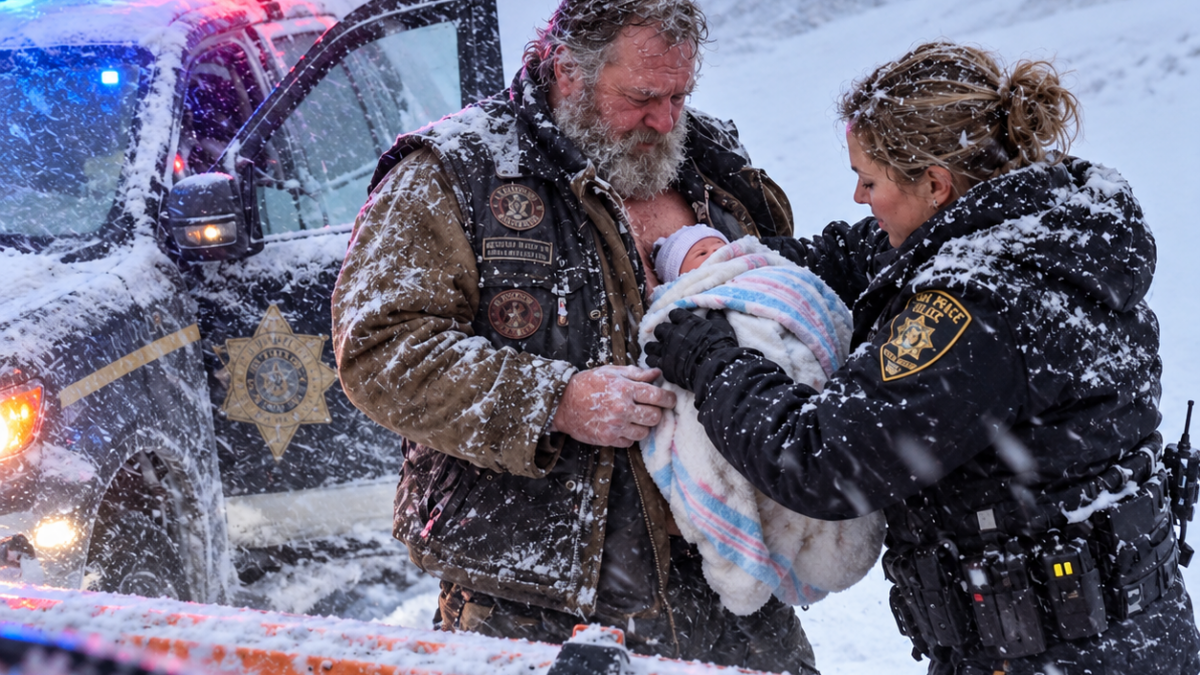
Leather vest over a brown canvas coat.
Jeans frozen nearly white from knees down.
No hat.
Gray beard crusted with ice.
He walked strangely.
Stiff.
Dragging one foot a little.
Both arms crossed tight over his chest.
I yelled:
“Show me your hands!”
He did not.
That raised every alarm I had.
“Hands where I can see them!”
He kept both arms folded.
Then said:
“Ma’am, don’t make me open this coat out here.”
His voice was rough.
Almost gone.
I moved closer.
“Show me your hands.”
“She’ll freeze.”
One word changed the scene.
“She?”
He nodded toward his own chest.
Then I heard it.
Tiny.
Barely audible beneath wind.
A cry.
Not from behind him.
Inside his jacket.
My hand left the holster.
I closed distance fast.
“Baby?”
“Yes.”
“Open your coat.”
“Inside the car.”
“Now.”
“Ma’am—”
“Inside the car!”
I grabbed one elbow and guided him toward cruiser.
His knees buckled once.
He caught himself.
When I got passenger door open, heat rolled out.
He climbed halfway in and unzipped the canvas coat.
Underneath, the leather vest was pulled closed.
Inside that, pressed directly against his thermal shirt, was a newborn baby wrapped in what looked like a gas-station sweatshirt and one of his own flannel layers.
Her face was dark pink.
Eyes closed.
Tiny mouth opening.
He had her upright against his chest.
Skin to skin.
Her cheek beneath his beard.
I remember staring because the image made no sense.
Big biker.
Frozen road.
Newborn.
He said:
“Take her.”
His hands came out.
That was when I saw them.
White.
Not pale.
White from fingers almost to wrists.
Waxy.
Swollen.
The kind of hands that tell you tissue is in trouble.
I took the infant.
She felt cold despite his body heat.
Too cold.
I climbed into driver side and cranked heater.
Radioed EMS.
“Infant located. Repeat, infant located alive. Possible hypothermia.”
The biker stood outside cruiser.
Wind hitting him.
I looked at the BOLO notes on screen.
Large male.
Gray beard.
Leather vest.
Baby taken by biker.
Everything matched.
I had a duty.
I stepped out.
“Turn around.”
He did.
“Hands behind your back.”
He looked at his fingers.
Then at me.
Did not argue.
That part has bothered me ever since.
Men who know they are innocent usually argue.
He did not.
Maybe he was too tired.
Maybe he knew something I did not yet know.
I guided him down to his knees behind cruiser.
Snow soaked his jeans immediately.
He winced when I brought arms back.
The skin around his wrists cracked.
Blood appeared.
He still did not complain.
I cuffed him.
Checked fit.
Double-locked.
“What’s your name?”
No answer.
“Sir, what is your name?”
He looked toward cruiser.
“Keep her against your skin.”
“What?”
“She’s been against mine since midnight.”
EMS arrived eight minutes later.
The medic, Julie, took baby into ambulance.
I followed.
The biker remained secured in rear of cruiser.
I told Julie what he had said.
“Skin to skin all night.”
She checked infant temperature.
Her expression changed.
“How old?”
“Less than a day.”
“Jesus.”
Baby’s core temp was dangerously low.
Breathing slow but present.
Blood sugar low.
They wrapped her.
Warm packs around but not directly against skin.
Oxygen.
Heated ambulance.
As doors closed, I looked back at cruiser.
The biker had twisted in seat to watch.
Not trying to escape.
Not yelling.
Watching the ambulance.
At station, he refused to answer questions.
Not name.
Not origin.
Not where he found baby.
Not where his motorcycle was.
Not why he had walked miles on a closed interstate.
Nothing.
He sat in interview room wrapped in an emergency blanket.
Hands getting worse.
Fingers beginning to darken.
I told him:
“If you found that child rather than took her, now is time to say so.”
Silence.
“You understand you’re being investigated for kidnapping?”
He nodded.
“Then talk.”
“How warm is she?”
“That isn’t the question.”
“It’s mine.”
I leaned back.
“Hospital is evaluating.”
“Was she crying?”
“Yes.”
He closed his eyes.
For first time I saw relief.
Then:
“That’s good.”
“Why?”
“Quiet scared me.”
“Where did you get her?”
No answer.
“What station?”
No answer.
“Was she alone?”
His jaw tightened.
No answer.
I had interviewed murder suspects more cooperative.
It made me angrier than it should have.
“Do you understand a seventeen-year-old mother reported you stole her baby?”
His eyes opened.
Something passed across his face.
Not surprise.
Not fear.
Sadness maybe.
Then gone.
“Did you hear me?”
“Yes, ma’am.”
“And?”
“How warm is she?”
I stood.
“I’m done.”
He nodded.
As if that was expected.
At 7:30, I got message:
The girl and father were coming in.
Her name was Kaylee Munson.
Seventeen.
The father, Ray Munson, owned acreage off Dry Creek Road.
Cattle.
Hay.
Old family name.
I knew the surname.
Everyone did.
Not personally.
Small communities contain families whose names enter rooms before they do.
Munsons had been around generations.
Feed store account.
Church donations.
4-H.
County fair.
Not saints.
Not criminals as far as I knew.
Just known.
Ray Munson entered station like a man who expected the world to move aside.
Late forties.
Thick shoulders.
Work coat.
Face red from cold and anger.
Kaylee followed.
She looked wrong.
That is what I remember.
Not just scared.
Physically wrong.
Gray skin.
Cracked lips.
Hair tied badly.
Oversized sweatshirt.
She stood bent slightly at waist.
Like straightening hurt.
Ray did all talking.
“Where is he?”
“Mr. Munson—”
“The man who took my granddaughter.”
“We’re investigating.”
“What’s to investigate? My daughter called you. He had the baby.”
“We need statements.”
“I want charges.”
“We’ll determine charges.”
He pointed down hallway.
“How does a man like that walk around free?”
He did not mean suspected kidnapper.
He meant biker.
I knew that even then.
Kaylee stood behind him.
Eyes on floor.
I said:
“Kaylee?”
She flinched.
Her father answered:
“She’s exhausted.”
“I asked her.”
Ray turned slightly.
Tiny movement.
She went even stiller.
My instincts shifted.
Not enough for certainty.
Enough for attention.
I led them toward interview room.
The biker sat at table.
Still cuffed.
Blanket around shoulders.
Ray entered first.
“You son of a bitch.”
The biker looked at him.
No fear.
No response.
“That’s my granddaughter.”
Silence.
“You stole a newborn from a seventeen-year-old girl.”
Still nothing.
“Look at me when I’m talking.”
The biker looked directly at him.
Then reached inside his canvas coat with cuffed hands.
I moved automatically.
“Slow.”
He nodded.
Pulled out folded paper towel.
Stiff from dried moisture.
Blue ink visible through layers.
He placed it on table.
Slid it toward Ray.
Ray stared.
The biker spoke for first time beyond asking about baby.
“Sir, before you say another word about me, you need to read what your daughter wrote.”
Ray did not move.
The biker continued:
“Because she didn’t abandon that baby.”
His voice was flat.
“She was hiding her from you.”
Nobody breathed.
Ray’s face hardened.
“What the hell are you talking about?”
The paper towel sat between them.
He would not touch it.
So I did.
Unfolded carefully.
Cheap brown dispenser towel from gas-station bathroom.
Blue ballpoint.
Handwriting shaky.
Words cramped.
Some letters smeared.
I read silently first.
Then again.
My stomach tightened.
I looked at Kaylee.
She had started crying without making a sound.
I do not know why I read it aloud.
Maybe because Ray needed to hear what his daughter had not been able to say in same room.
Maybe because I needed to hear how badly we had misunderstood the first call.
“To whoever finds her. Please don’t call the Munsons on Dry Creek Road. Please don’t take her there.”
Ray said:
“This is bullshit.”
I kept reading.
“My dad said if I had this baby he would take care of it the way he takes care of the barn cats.”
Ray’s face changed.
Not much.
Enough.
“I believe him.”
Kaylee pressed fist to mouth.
“I didn’t name her. I didn’t think I was allowed to.”
My voice nearly failed there.
“Please tell her I’m sorry.”
Then:
“Please keep her warm.”
Silence.
Ray reached.
“Give me that.”
I pulled it away.
“That’s evidence.”
His face went red.
“My daughter is seventeen years old. She’s been unstable since her mother left. She makes things up.”
Behind him:
“You told the school I had mono.”
So quiet I almost missed it.
Ray turned.
“Kaylee.”
She lifted her head.
First time.
Her eyes were swollen.
There was blood at corner of one cracked lip where she had bitten it.
“You pulled me out in October.”
“Enough.”
“You said I was sick.”
“Kaylee.”
“You took my phone.”
“Stop.”
“You told everybody I had mono because I was showing.”
His voice dropped.
Dangerous.
“Shut your mouth.”
She started shaking.
But kept speaking.
“You said when the baby came you’d put her in the stock tank.”
Ray moved.
One step toward her.
The biker stood.
Still cuffed.
Half frozen.
Hands destroyed.
He rose anyway and put his body between father and daughter.
Did not threaten.
Did not touch him.
Just stood.
Ray was a big man.
Biker was bigger.
Deputy Ortiz had entered room when voices rose.
I said:
“Mr. Munson, step back.”
“That’s my daughter.”
“She is a minor who just told two officers you threatened to kill her child.”
“She’s lying.”
“Step back.”
“Ask anybody in this county who I am.”
Ortiz moved beside me.
I said:
“Step back now or Deputy Ortiz will help you.”
Ray stepped back.
Men like Ray Munson often do.
They save fury for people with less power.
Ortiz escorted him out.
He demanded lawyer before reaching lobby.
Then it was me.
Kaylee.
And biker.
I guided Kaylee toward chair.
My hand touched upper arm.
She flinched so violently she nearly fell.
I caught her.
“I’m sorry.”
She shook her head quickly.
“No, I’m sorry.”
That response told me more.
People who are hurt often apologize for reacting to hurt.
I rolled her sleeve carefully.
Four finger-shaped bruises above elbow.
Fresh.
Dark.
One thumb mark underneath.
“What happened?”
“He heard me calling 911.”
“When?”
“About five.”
“What did he do?”
“Grabbed me.”
“Your father?”
She nodded.
“Asked what I’d done.”
Her eyes went toward hallway.
“He thought I’d called because of the baby.”
“And you had?”
“Yes.”
“What did you tell dispatcher?”
She looked at biker.
Then down.
“I said he took her.”
“Why?”
She started crying.
Not loud.
Broken.
“I didn’t know how to say I left her.”
I got water.
Blanket.
Called female medic.
Then turned to biker.
His hands rested on table.
Worse now.
Finger pads turning gray-black.
I unlocked cuffs.
Metal had cut wrists where swollen skin rubbed.
Blood.
He flexed what fingers would move.
Did not complain.
“What’s your name?”
“Harlan Kessler.”
Pause.
“People call me Dutch.”
“Dutch, why didn’t you tell me any of this on road?”
He looked almost sorry for me.
“Ma’am, I got a vest on my back and a record going to 1986.”
“Meaning?”
“You had a 911 call saying biker stole baby.”
He looked at my uniform.
“I had a baby inside my coat.”
Then:
“Nothing I said standing in snowbank was beating that.”
“You could have shown me note.”
“I could’ve.”
“Why didn’t you?”
He looked at Kaylee.
“I wanted to see who came for her.”
That bothered me.
“Why?”
“Because if whoever wrote that note was telling truth, handing it over to wrong person might get her hurt.”
He glanced toward lobby where Ray had gone.
“When he came in, I knew.”
“How?”
Dutch gave a tired laugh.
“I’ve met men like that.”
“Then why wait until he was in room?”
“I wanted to look at him when he read it.”
There was history in that sentence.
I did not ask yet.
Instead:
“How is baby?”
First time he had asked since station.
“She’s not your baby.”
He looked at me.
“She was for eight hours.”
I had no answer.
So I took him to hospital.
Road to Butte took ninety minutes behind plow.
Normally forty.
Dutch sat in rear of cruiser because rear vents ran hotter.
Same seat where I had transported him cuffed two hours earlier.
He watched snow.
Asked about baby three times.
Never asked about his hands.
Hospital nurse Patty Greer had worked ER longer than I had worked highway patrol.
She took one look at fingers.
“Jesus Christ.”
Dutch sat.
She touched hand.
He flinched.
“How long exposed?”
“They weren’t.”
She looked at me.
“What?”
Dutch said:
“Hands were on baby’s back.”
Patty stopped moving.
That was dramatic for Patty.
She was usually motion in scrubs.
I explained.
She checked chart.
“Baby came in at ninety-one degrees.”
Dutch stared.
“Core?”
“Yes.”
His face emptied.
“Is she—”
“Stable now.”
He lowered head.
Patty continued:
“Another hour out there and we’d be having different conversation.”
She looked at his hands.
“Whatever you did, you did right.”
Dutch’s eyes filled.
He turned toward wall.
Waited until it passed.
Doctors admitted him immediately.
Frostbite.
Hands.
Feet.
Exposure.
Mild hypothermia.
Dehydration.
He had walked miles.
I went looking for Kaylee.
She had been admitted too.
That shocked me.
Then doctor explained.
Seventeen years old.
Delivered a baby alone less than thirteen hours earlier.
No prenatal care after October.
Significant blood loss.
Possible retained tissue they were evaluating.
Dehydrated.
Exhausted.
Blood pressure unstable.
And nobody had looked at her until the arrest interview because the entire story had focused on stolen baby and biker.
That shame stays with me.
We had seen her as witness.
Caller.
Potential liar.
Daughter.
We had not seen patient.
I pulled chair beside hospital bed.
Kaylee stared at window.
Snow still moving sideways.
“Your dad isn’t here.”
She nodded.
“Deputy Ortiz is with him at station.”
Nothing.
“You’re safe to talk.”
Her laugh was tiny.
“I don’t know how.”
“So start anywhere.”
Long silence.
Then it came.
She had worked at Sinclair since June.
Register.
Evening shifts.
Sometimes opening.
Baby’s father was eighteen.
Name was Cody.
High school graduate.
Left for Williston oil work in August.
They had dated six months.
Neither mature enough for what happened.
She found out pregnant late.
Hid it.
Baggy hoodies.
Loose work shirt.
Stopped eating dinner with father so he would not watch body.
Her mother left family years earlier.
No contact.
Ray controlled house.
Farm.
Money.
Everything.
Kaylee had learned early which version of father came home based on way truck door closed.
“When did he find out?”
“October.”
“What happened?”
“He didn’t yell.”
She looked at me.
“That was worse.”
“How?”
“He gets quiet before bad things.”
Ray called school.
Said Kaylee had mononucleosis.
Withdrew her temporarily for home instruction.
Took phone.
Told neighbors she was sick.
Locked truck keys except one old farm pickup she sometimes used under supervision.
“What did he say about pregnancy?”
“That we were going to handle it.”
“How?”
“He wouldn’t tell me.”
“Then stock tank?”
She closed eyes.
“We have cats in barn.”
I already understood.
“Too many sometimes.”
I wished I didn’t.
“He doesn’t like paying to fix them.”
My throat tightened.
“He said if I was stupid enough to have baby, he’d take care of it same way.”
“Did you believe he would hurt newborn?”
She looked at me like question itself was stupid.
“You saw him.”
Fair.
Contractions started around eight previous night.
Storm already worsening.
Ray drank whiskey and fell asleep recliner.
Kaylee took hidden Sinclair key from old backpack.
Grabbed farm truck.
Drove to station because it was only place she knew should be empty but had heat.
Except power flickered.
Roads closing.
No one there.
She delivered baby on bathroom floor.
Alone.
Seventeen.
No training.
No phone because father had kept hers for months.
Station landline worked but she was terrified any ambulance response would notify father.
“I thought if cops came they’d bring me home.”
I said:
“They might have brought you hospital.”
“I didn’t know.”
She cried.
“I didn’t know anything.”
Umbilical cord.
She had no clamps.
Used hair elastic and clean towel.
Wrapped infant in her own hoodie.
Baby cried.
Good sign.
She sat bathroom floor holding newborn maybe an hour.
Then panic took over.
“What did you think?”
“That he’d wake up.”
“Your father?”
“Yes.”
“And look for you.”
“He always knows.”
Those words.
He always knows.
Control becomes supernatural in minds of people living under it.
Not because abuser literally knows everything.
Because punishment for unexpected things trains you to believe escape is impossible.
Kaylee knew Manny, morning manager, opened station at six.
She put baby in utility sink near back room, wrapped in towels, because first employee entering would see her.
Wrote note on paper towel.
Why sink?
“Off floor.”
Why not counter?
“Draft by doors.”
Why not call police?
Fear.
Shame.
Father.
Seventeen-year-old thinking with blood loss and labor shock.
Then she drove home.
“I thought Manny would come.”
“But interstate closed.”
“I didn’t know.”
“Manny couldn’t get there.”
“I know now.”
“What happened at five?”
“I couldn’t stand it.”
She had lain in bed listening wind.
Imagining infant.
Cold.
Crying.
Silent.
By five, took truck again.
Returned Sinclair.
Door had been forced.
Baby gone.
Under canopy:
Motorcycle buried in eight inches snow.
Black touring bike.
No rider.
Kaylee panicked.
Drove home.
Used father’s phone while he slept.
Called 911.
Dispatcher asked what happened.
Truth stuck.
“I thought they’d arrest me.”
“So you said biker took baby.”
She nodded.
“I saw motorcycle.”
“Did you see biker?”
“No.”
“You assumed.”
“Yes.”
Then father appeared doorway.
He heard final words.
“What did he do?”
“Grabbed me.”
Bruises.
“Then made me tell him.”
“What?”
“That baby was alive.”
She covered face.
“I thought he’d go find her before police.”
“Did he?”
“He made me get in truck and drove station, but cops were already there. Then he heard they found biker and made me come station.”
“Kaylee.”
She looked.
“You did not cause what happened to Dutch.”
“I lied.”
“You were terrified.”
“I got him arrested.”
“I arrested him.”
She stared.
“With information I had, I’d probably do same.”
Her face crumpled.
“That doesn’t make me feel better.”
“It shouldn’t.”
I leaned forward.
“But guilt belongs where choices belong.”
“Meaning?”
“You made choices.”
“So did your father.”
“So did Dutch.”
“So did I.”
“We each answer for ours.”
She looked toward hallway.
“Can I see him?”
I checked Patty.
Then wheeled Kaylee down.
Dutch’s hands wrapped like boxing gloves.
Feet wrapped.
IV.
He looked ten years older.
Kaylee could not meet eyes.
“I told them you took her.”
He nodded.
“I’m sorry.”
“I know.”
“I lied.”
“I know.”
“You lost fingers because of me.”
“Don’t know that yet.”
His voice gentle.
“I’m so sorry.”
Dutch shifted.
“You did one thing you could think of to get her away from him.”
Kaylee cried harder.
“Then you did one thing you could think of to get her back.”
She stared.
“I’d have lied to cops too.”
He glanced at me.
“Have, plenty times. For less.”
I almost laughed.
Kaylee did.
It turned into sob.
“What did you do with her?”
“Walked.”
“For eight hours?”
“Mostly.”
“Why?”
“Bike quit being useful.”
He began telling us.
Dutch had been returning from Spokane after visiting late wife’s brother.
Storm came earlier than forecast.
He pulled into Sinclair before closure worsened.
Power still on.
Door unlocked? Actually employee side entrance not fully latched.
He entered looking for phone, coffee, shelter.
He heard crying.
“Thought cat.”
Then again.
Found newborn in sink.
At first assumed mother nearby.
Searched bathrooms.
Storage.
Parking lot.
Nothing.
Found note.
Looked outside.
Road disappearing.
Called 911?
Here we can make plausible: station landline dead after power line? Source implies he didn’t. We’ll preserve maybe his cell no service and station line dead due storm.
Dutch said:
“Cell showed no service.”
“Landline?”
“Dead.”
“Why leave shelter?”
“Heat went.”
The station emergency power failed around midnight.
Temperature inside began dropping.
He wrapped baby.
Tried motorcycle.
Battery started but road impassable and snow intake? Better: bike stuck/drifted, not viable.
“I rode maybe quarter mile.”
“Then?”
“Went sideways.”
He laid bike down before worse.
Could not risk infant.
Moved back toward highway knowing closure troopers would be staged east/west.
“How far?”
“Don’t know.”
“Five miles minimum,” I said.
He shrugged.
“Felt longer.”
“What did you feed her?”
Nothing.
That was issue.
Newborn maybe hours can survive but hypoglycemia. He tried keep warm. He found small sealed honey? No honey unsafe; don’t mention. No food. He knew warmth first.
“Every time she got quiet, I rubbed back.”
Kaylee whispered:
“What did you say?”
“My bike.”
She almost smiled.
“My dog.”
“What else?”
“Your baby got strong opinions for somebody five hours old.”
Kaylee laughed.
“Did she cry a lot?”
“Enough.”
He looked down at wrapped hands.
“I told her squeaking was deal.”
“What deal?”
“She squeaks, I walk.”
Kaylee’s mouth trembled.
“And if she stopped?”
“I got louder.”
“Did you name her?”
Dutch shook head.
“Wasn’t mine.”
“Then what did you call her?”
He hesitated.
“Little Bit.”
“Bit?”
“Needed something to say.”
Kaylee looked like he had given her treasure.
“Do you have children?”
Dutch’s face changed.
“No.”
He said wife Marlene and he tried eleven years.
Nothing.
Eventually stopped.
Rode.
Travelled.
Had dogs.
Built life around what existed rather than what didn’t.
Marlene died two winters before.
Cancer.
Dutch was visiting her brother because grief had finally become something he could discuss without walking out.
“I was riding home.”
He looked at baby’s mother.
“Then your little girl hijacked schedule.”
Kaylee smiled through tears.
“I didn’t name her.”
Dutch nodded.
“Figured.”
“How?”
“Note.”
“I thought if I named her…”
She could barely speak.
“If he took her, it would hurt worse.”
Dutch closed eyes.
I said something no trooper should promise without knowing child-services status.
“You get to name her.”
Kaylee looked at me.
“You get to keep her.”
Patty raised eyebrow.
I ignored.
“That part we’re going to fight for.”
What followed was not simple.
Stories like this often turn one piece of truth into instant justice.
Real life involves paperwork.
Doctors.
Child Protective Services.
Judges.
Temporary orders.
Interviews.
Background checks.
Relatives.
Lawyers.
Ray Munson was not arrested because he was unpleasant.
He was arrested because Kaylee alleged threats against infant, because bruising supported recent physical intimidation, because he attempted to pressure her in station, and because investigators found corroborating evidence.
At Dry Creek house deputies found her confiscated phone locked in father’s desk.
School correspondence where Ray claimed mono.
Texts to sister Deb years earlier showing controlling behavior after Kaylee’s mother left.
Neighbor statements.
One ranch hand remembered Ray joking that “problem would handle itself” when pregnancy was rumored.
Nobody alone proved attempted murder.
Together they showed pattern.
Ray’s defense was predictable.
He had been ashamed.
Not homicidal.
He said stock-tank comment was metaphor.
Angry expression.
A father trying scare daughter straight.
He claimed bruises came from restraining hysterical Kaylee after 911 call.
He insisted he loved her.
I believe he believed that.
That is what made him dangerous.
People like Ray rarely wake thinking:
Today I will become villain.
They tell themselves:
I am protecting family.
Protecting reputation.
Teaching discipline.
Preventing shame.
Saving daughter from ruining life.
They turn control into care by naming it differently.
At booking, Ray told Ortiz:
“You think I wanted my girl to be the story this whole town tells at feed store?”
Ortiz later repeated it to me.
Not:
I was scared for Kaylee.
Not:
I was scared for baby.
The town.
Story.
Reputation.
That was center.
Ray took plea eventually.
Assault on minor.
Witness intimidation.
Other charges reduced because threats were hard to prove beyond reasonable doubt.
Two years at Deer Lodge.
Protective order.
Five hundred feet from Kaylee and baby upon release unless court changed it.
Enough?
No.
Law rarely gives emotional amount people want.
It gives what can be proved.
Kaylee’s immediate problem was where to go.
Her mother had vanished from family years earlier.
Domestic abuse history.
Untreated addiction maybe.
Not stable option.
But her mother had a sister.
Deborah—Deb—living in Missoula.
Ray had cut contact between sisters years earlier.
I spent two days finding her.
Not technically my assignment after case transferred.
I did it anyway.
Called numbers.
Old address.
Former employer.
Finally voicemail.
“This is Trooper Maggie Hale. I’m trying to reach Deb Carver regarding your niece Kaylee Munson. She is safe, but she needs family.”
Deb called nine minutes later.
“What hospital?”
No questions.
No hesitation.
“What happened?”
“I’ll explain when you arrive.”
“Is Kaylee alive?”
“Yes.”
“Baby?”
“Yes.”
Long silence.
“She had baby.”
“Yes.”
“Ray know?”
“Yes.”
Another silence.
Then:
“Tell me hospital.”
Four hours later, despite roads only partly open, Deb arrived with a brand-new infant car seat still carrying store tags.
She walked into Kaylee’s room.
Kaylee stared.
“Aunt Deb?”
Deb crossed room.
Held her.
No speeches.
Just:
“I should’ve come sooner.”
Kaylee said:
“He wouldn’t let you.”
Deb answered:
“I should’ve tried harder.”
That became another lesson for me.
Adults cut off from families often disappear slowly.
Calls unanswered.
Invitations rejected.
Holidays missed.
Eventually everyone says:
That’s their choice.
Sometimes it is.
Sometimes someone else is standing between.
Baby remained hospital eleven days.
Hypothermia.
Low blood sugar.
Monitoring.
But no lasting injury doctors could see.
Dutch’s outcome was worse physically.
Frostbite demarcates slowly.
At first doctors hoped.
Then tissue darkened.
He lost left ring finger.
Left pinky to second knuckle.
Three toes on right foot.
Skin damage elsewhere.
He spent weeks in rehab.
I visited.
Brought coffee.
He hated hospital coffee.
“Twenty-dollar room service and coffee tastes like radiator water.”
“You complain enough, they’ll discharge you.”
“Threat?”
“Promise.”
He looked at my uniform.
“Still arresting innocent men?”
“Only frozen idiots carrying undocumented babies.”
He laughed.
Then winced because foot hurt.
First few visits we did not talk about arrest.
Eventually I did.
“I’m sorry.”
Dutch stared at TV.
“For cuffs?”
“Yes.”
“For snow?”
“No.”
“For not listening?”
He looked.
“That.”
I nodded.
He leaned back.
“You had call.”
“I did.”
“Description.”
“Yes.”
“Baby.”
“Yes.”
“You did job.”
“That doesn’t mean I did it perfectly.”
“No such thing.”
“I put you on ground.”
“Was softer than some floors I’ve slept on.”
“Dutch.”
He sighed.
“What do you want me to say?”
“That you’re angry.”
“I ain’t.”
“That makes it worse.”
He smiled.
“Then maybe I am. Little.”
“Good.”
“But not at cuffs.”
“What then?”
“At world making note necessary.”
I did not speak.
“At girl thinking gas station sink safer than home.”
He looked at wrapped hand.
“At a man needing lose fingers because seventeen-year-old doesn’t know who to call.”
That was Dutch.
He had every right to center himself.
Wouldn’t.
Months later he learned clutch again.
Adapted grip.
Modified lever.
His motorcycle club helped.
First ride after injuries was ugly.
He stalled twice.
Almost tipped.
Called me afterward.
“Rode six miles.”
“That’s it?”
“Go to hell, trooper.”
I laughed.
“You proud?”
“No.”
“You’re lying.”
“Maybe.”
Kaylee moved to Missoula with Deb.
Finished high school.
Not easily.
Rumors followed.
Small-town cruelty travels faster than official facts.
Some people called her girl who abandoned baby.
Others father-abuse girl.
Some treated Dutch like folk hero.
She hated all versions.
“I just want to be Kaylee.”
She told me that once.
So Deb enrolled her in different school district.
Counseling.
Childcare program.
GED backup if regular graduation became impossible.
She stayed.
Graduated.
Wanted nursing.
Because Patty, she said.
Patty had been first medical adult who touched her after childbirth and did not make her feel stupid.
That mattered.
Naming baby became complicated.
Birth certificate delayed.
Kaylee asked me:
“What did Dutch’s wife’s name mean?”
“Marlene?”
“Yeah.”
“No clue.”
“Was she nice?”
“I never met her.”
“Dutch says she was bossy.”
“That means he loved her.”
Kaylee smiled.
Eleven days after rescue, she filled form.
Marlene Grace Munson.
She did not tell Dutch.
Everyone called baby Bit.
Kaylee said it started because Dutch had.
When Dutch finally came to Missoula, walking badly with cane, he found birth certificate on kitchen counter because Deb had placed it there intentionally.
He read once.
Then again.
Then a third time.
Deb told me he walked outside without coat.
She followed.
Found him behind garage crying.
“Why’d she do that?”
he asked.
Deb said:
“Ask her.”
He could not for an hour.
Finally Kaylee came outside holding Bit.
Dutch said:
“You didn’t have to.”
“I know.”
“Marlene would’ve hated fuss.”
“I know.”
“You never met her.”
“I know you.”
That broke him again.
He took baby.
Held her against chest.
Same spot.
This time warm.
Safe.
No storm.
Kaylee asked:
“Do you mind?”
Dutch whispered:
“No.”
At Bit’s first birthday, I drove to Missoula.
Did not know why I had been invited.
Kaylee called personally.
“You have to come.”
“I arrested the guest of honor.”
“Bit doesn’t know you.”
“She’s one.”
“Exactly. If you don’t come, she’ll never know.”
Logic of young mothers is terrifying.
Deb’s yard had nineteen motorcycles parked on grass.
Dutch’s club came from Laurel.
Big gray-bearded men standing around pink balloons and sheet cake like security detail.
One held bubble wand.
Another wore paper party hat too small for head.
Dutch sat on back steps.
Bit inside leather vest.
Zipped to chin.
Thermometer on porch said seventy-two.
“It’s July.”
Dutch looked up.
“Morning.”
“She doesn’t need to be inside your coat.”
“I know.”
“Then why?”
He looked down.
Bit had fist in beard.
Pulling toward mouth.
“Because that’s where she goes.”
I sat.
Bit looked at me.
No recognition.
Good.
She should not remember woman who removed her from man who kept her alive.
She returned to beard.
Dutch said:
“She bites now.”
“Deserved.”
“You still feel bad?”
“About?”
“You know.”
Cuffs.
I looked at hands.
Missing fingers.
“Sometimes.”
“Stop.”
“Not how brains work.”
“No.”
He adjusted Bit.
“But you can pick what you do with it.”
I knew he was right.
That is what everybody in this story eventually had to learn.
Kaylee could not undo gas station.
I could not undo arrest.
Dutch could not regrow fingers.
Deb could not recover years Ray cut her out.
Even Ray could not repair control by calling it protection.
We could only choose what came next.
At party, Kaylee wore blue summer dress.
Seventeen had become eighteen.
Then almost nineteen.
She looked different.
Not because fear disappeared.
Because she no longer folded herself smaller in rooms.
She told people no.
Asked questions.
Argued with Deb about curfew.
Beautiful ordinary conflict.
At one point Deb said:
“Kaylee, don’t leave bottle in sun.”
Kaylee rolled eyes.
“I know.”
Deb snapped:
“Then move it.”
Kaylee moved bottle and muttered.
I nearly smiled.
Safe families contain irritation.
People can be annoyed without danger.
Ray had made obedience equal survival.
Deb made rules equal rules.
Difference huge.
After cake, Kaylee handed Bit to Dutch.
He zipped baby inside vest.
I said:
“She’s going to think that’s normal.”
“She does.”
Kaylee laughed.
“Every time she sees leather, she reaches up.”
“Nineteen bikers are ruining child.”
Tiny woman from club named Angie said:
“She was born ruined.”
Everybody laughed.
Bit clapped.
I watched Dutch.
A man with record dating to 1986.
Bar fights.
Disorderly conduct.
One assault from youth.
DUI decades earlier.
Not saint.
He never claimed to be.
He had rough edges.
He had made bad choices.
Yet in worst weather I had seen in years, he spent eight hours making exactly the right ones for child nobody had entrusted to him.
That troubled my old assumptions in useful way.
We are trained to observe indicators.
Behavior.
Context.
Criminal history matters.
Appearance sometimes matters operationally.
But no category contains whole person.
Dutch was not good because biker.
Not good despite biker.
He was good in that moment because he acted well.
Ray Munson was not dangerous because rancher.
He was dangerous because he used fear and control against daughter.
Uniforms, vests, surnames, clean records—none replace facts.
The first snowfall next winter hit me harder than expected.
I was driving near mile marker 216.
Light snow.
Nothing like storm.
I suddenly saw him again.
Shape walking from white.
Arms folded.
Baby hidden.
I pulled over.
Not emergency.
Just stopped.
Sat.
Hands on wheel.
I thought about one detail I had not understood that morning.
His hands.
Why were they so much worse than rest?
Because he had kept them inside coat against baby.
Not moving.
Not generating blood flow properly.
Exposed intermittently whenever adjusting layers.
He sacrificed extremities for heat.
He did not announce that.
Did not say:
Look what I did.
He only said:
Keep her against your skin.
There is a difference between people who perform sacrifice and people who are too busy sacrificing to narrate it.
Dutch was second kind.
A few months later, I asked him:
“When did you know fingers were going?”
He shrugged.
“Maybe three.”
“Three a.m.?”
“Yeah.”
“You could feel?”
“Stopped feeling. That’s how you know.”
“Why didn’t you put gloves on?”
“Gloves were around baby.”
I stared.
He laughed.
“What?”
“You’re an idiot.”
“Been called worse.”
“You knew.”
“Baby smaller.”
As if that settled everything.
It did for him.
Kaylee eventually spoke to Cody, baby’s biological father.
That relationship did not become fairy tale.
He was nineteen by then.
Working oil fields.
Scared.
Angry she never told him.
Guilty.
His parents wanted involvement.
Lawyers were cautious.
Tests established paternity.
He began supervised visits.
Then regular.
He and Kaylee did not get back together.
Probably wise.
They learned co-parenting imperfectly.
Dutch stayed something else entirely.
Not father.
Not grandfather legally.
Family anyway.
Bit called him “Duh” before she could say Dutch.
Name stuck embarrassingly long.
When she was three, she called him Grandpa Dutch on own.
He cried privately.
Deb told everyone.
Dutch threatened to stop visiting.
Nobody believed him.
Ray Munson served his sentence.
Release became source of fear.
Protective order existed.
Paper is not wall.
Kaylee asked:
“What if he comes?”
Police developed safety plan.
Deb installed cameras.
Changed locks.
Dutch offered to camp outside.
I told him absolutely not.
He said:
“Sleeping bag works.”
“Wrong story, Dutch.”
He laughed.
When Ray was released, he did not approach immediately.
Sent letter through lawyer.
Said he wanted forgiveness.
Said prison taught him.
Said he had been trying protect daughter from public shame.
Said threats were misunderstood.
Kaylee read one page.
Stopped.
Returned through attorney.
No contact.
That was her choice.
People asked if she should forgive.
I hate that question.
Forgiveness is not parole requirement.
Not moral debt owed to person who frightened you.
Maybe someday.
Maybe never.
Healing can happen without reconciliation.
Ray violated no-contact once indirectly through family friend.
Court warned.
Then nothing.
He moved counties.
Kaylee kept living.
At community college, she studied nursing prerequisites.
Worked part time.
Bit started preschool.
Dutch rode slower.
I retired after twenty-three years.
At retirement dinner, my daughter Josie gave speech.
She was twenty by then.
Mentioned blizzard case.
I had kept details mostly private when she was younger.
Later told more.
She said:
“My mom always taught me cops need to listen for what isn’t being said.”
That embarrassed me because on first morning, I had not.
After dinner, Dutch handed me small box.
Inside was leather patch.
White letters:
ASK WHAT HAPPENED BEFORE.
I stared.
“Seriously?”
“Made it.”
“For what?”
“Vest.”
“I don’t have vest.”
“Then start.”
“I’m not becoming biker.”
He grinned.
“Already got attitude.”
I kept patch.
It hangs in office.
That sentence became summary of everything.
Ask what happened before.
Before BOLO, Kaylee had given birth alone.
Before lie to 911, she had been threatened.
Before biker walked in snow, he had found baby in sink.
Before father demanded charges, daughter had spent months hidden.
Before I cuffed man, he had spent hours keeping a stranger’s child alive.
The first visible moment is rarely first moment.
That is true in policing.
Families.
Arguments.
Trauma.
Everything.
Bit is older now.
Still small enough that Dutch can lift her, though he complains about back.
She knows story in pieces appropriate to age.
“Dutch found me in storm.”
That is version.
One day she will learn rest.
Paper towel.
Stock tank threat.
Mother’s fear.
Frozen fingers.
My cuffs.
She may feel many things.
I hope none includes obligation.
Children rescued by adults do not owe rescuers a life of gratitude.
They deserve ordinary childhood.
Bit likes dinosaurs.
Purple cereal.
Mud.
Hates socks.
Calls Dutch’s motorcycle “loud chair.”
At five she asked him:
“Did I really live in your jacket?”
“For a while.”
“Why?”
“Cold.”
“Was I cold?”
“Yes.”
“Were you?”
“Yes.”
“Did you cry?”
Dutch told me later.
He answered:
“Probably.”
Bit considered.
Then:
“I cry when I’m cold.”
“Reasonable.”
That was all.
No legend.
No heroic burden.
Just child.
Good.
People sometimes hear story and make Dutch symbol.
Rough-looking biker with heart of gold.
I understand appeal.
But phrase bothers me.
Heart of gold makes kindness sound hidden surprise beneath appearance.
As though leather and tattoos should predict cruelty.
They don’t.
Dutch was simply man who found newborn and chose responsibility.
Same as any decent person should.
Extraordinary part was duration.
Weather.
Cost.
Not identity.
Similarly, Ray’s cruelty did not come from looking respectable.
Respectable appearance just made it easier for people to assume safety.
That is why I tell recruits:
Look at behavior.
Listen to inconsistencies.
Separate people before interviews.
Ask the quiet person directly.
Verify relationships.
Do not let loudest adult define frightened minor.
And remember that a suspect can be victim in one fact and wrongdoer in another; witness can lie for understandable reasons; person with record can tell truth; terrified teenager can make false report and still need protection.
Reality does not organize itself into clean roles for our paperwork.
Kaylee lied.
Dutch had record.
I made lawful but painful arrest.
Ray claimed love.
All true.
Then deeper truths.
That complexity is where good police work starts.
Not where it ends.
Years after storm, I visited Sinclair.
Renovated.
New tile.
Same general layout.
Utility sink gone.
Bathroom remodeled.
Clerk young enough not to know story.
Bought coffee.
Stood near register.
I imagined seventeen-year-old girl bleeding, wrapping baby in hoodie, scribbling words on paper towel.
Please keep her warm.
That line.
Of everything, that one stays.
She could have written:
Call police.
Find my mom.
Punish my dad.
Save me.
She wrote about baby’s warmth.
Even in panic.
Even not naming her.
Love was already there.
Fear convinced Kaylee naming child would make loss worse.
But she still protected her.
That is contradiction people misunderstand.
A mother can leave newborn somewhere and still be trying to save her.
Context matters.
Sinclair became a site of abandonment on paper.
In truth, it was desperate refuge.
I once asked Kaylee if she regretted leaving Bit.
“Every day.”
Then:
“And I’d do it again if only choices were that or take her home.”
That sentence held everything.
Good decisions are not always available.
Sometimes people choose least terrible.
Dutch happened to arrive.
Chance.
Storm.
Timing.
Call it whatever.
If he had passed station.
If door locked.
If baby stopped crying sooner.
If he tried motorcycle longer.
If I arrived twenty minutes later.
Stories can become unbearable when you examine all hinges.
So I stopped.
Focus on what did happen.
He heard.
He entered.
He found note.
He kept child warm.
He walked.
I stopped him.
Baby survived.
Kaylee spoke.
Ray lost control.
Deb came.
Life continued.
At Bit’s seventh birthday, Dutch gave her tiny leather vest.
Deb objected.
Kaylee laughed.
Patch on back:
LITTLE BIT.
No club insignia.
No outlaw nonsense.
Bit put it on over princess dress.
Best outfit I have ever seen.
She climbed onto stationary motorcycle with helmet.
Dutch stood beside.
Missing fingers visible on handlebar.
I took photo.
Later he asked me send.
I did.
He texted:
Marlene woulda liked this.
First time in years he mentioned wife directly to me.
I replied:
I think so.
He sent:
She’d say helmet ugly.
I wrote:
She was right.
That became our relationship.
Not profound speeches.
Insults.
Coffee.
Occasional snow check-ins.
Every first major storm, I text him:
Jacket zipped?
He replies:
Hands inside.
One year:
Bit too big now.
Another:
Got gloves finally.
I keep screenshot.
Some friendships begin strangely.
Ours began with me pointing gun-adjacent posture at him in whiteout, pulling newborn from coat, then putting him on ground.
He says he has met people at bars under worse circumstances.
I believe him.
I once asked:
“Why didn’t you hate me?”
He answered:
“Because you warmed baby before cuffing me.”
I laughed.
“That’s bar?”
“Pretty low bar.”
“Apparently.”
Then he got serious.
“You put her first.”
So had he.
Maybe that is why.
Police officers are trained to control scenes.
Dutch’s whole night had been surrendering control to needs of something smaller.
When we met, our priorities overlapped before trust did.
Baby first.
Then everything else.
That saved us from worse mistakes.
Imagine if I cuffed him before removing child.
Made him open coat in wind.
Spent ten minutes interrogating.
Could have changed outcome.
I did some things right.
Some wrong.
Important to remember both.
The paper towel remains evidence archive, sealed.
Case closed but preserved.
I saw copy once.
Blue ink.
Smeared.
No literary elegance.
No perfect grammar.
That is what true desperation looks like.
Not viral quote.
Messy.
Short.
Specific.
Please don’t take her there.
Please keep her warm.
Every system should listen when frightened people tell you where not to send them.
Hospitals.
Schools.
Police.
Families.
Too often we ask:
Why didn’t she just say what happened?
Because sometimes person she fears is standing beside her.
Because shame.
Because previous adults did not listen.
Because she is seventeen.
Because telling truth can feel more dangerous than surviving lie.
Kaylee found voice eventually.
Not because I was brilliant.
Because Dutch placed note on table before Ray could control room.
Evidence created space for truth.
Then we separated father.
Then she spoke.
Safety often comes before disclosure.
Another thing recruits need to learn.
You cannot demand honesty from someone while threat remains in room.
Years later Kaylee became licensed practical nurse first, then kept studying toward RN.
She worked maternity floor for period.
I asked whether that was hard.
“Yes.”
“Why do it?”
“Because I remember nobody looking at me.”
That answer knocked wind out.
She said:
“Everyone cared where baby was.”
Pause.
“Nobody asked if I was bleeding.”
She was right.
Including me at first.
So she became nurse who asks mother too.
Full circle stories can sound sentimental.
This one was practical.
Pain identified gap.
She filled some of it.
Dutch says that is better legacy than any motorcycle ride.
Ray Munson remains alive.
I mention because villains do not always vanish.
He lives elsewhere.
He sends occasional legal requests about contact.
Kaylee decides through counsel.
Bit knows he exists as biological grandfather she does not see.
Maybe someday different.
Not my decision.
Consequences do not always look like dramatic collapse.
Sometimes consequence is exclusion.
You lose access to lives you tried to control.
You become person talked about in careful past tense.
Family builds without you.
There is justice in that.
Not complete.
Enough maybe.
At retirement, I drove Interstate 90 one last time during snow.
Not whiteout.
Gentle.
Near place I found Dutch, I pulled onto shoulder.
Walked a few steps.
Wind quiet.
No traffic nearby.
I stood where memory said he emerged.
Probably wrong exact spot.
Snow changes landscape.
I imagined those eight hours.
A newborn against chest.
Widower alone.
Motorcycle buried.
Dark.
Cold.
No guarantee anyone would appear.
I thought about line he told Bit later:
“She squeaks, I walk.”
That may be entire story.
He did not know destination.
Did not know outcome.
He only made deal with tiny life.
Give me one sign.
I take one more step.
Sometimes survival is exactly that.
Not courage for whole journey.
One squeak.
One step.
Repeat.
When I returned car, I cried.
Did not tell anyone.
Now you know.
I still get asked:
What was first thing Dutch said after charges disappeared?
Nothing memorable.
He wanted baby temperature.
That was consistent.
Kaylee named child Marlene.
People think that is emotional ending.
It is one.
But mine happened years later at Deb’s house.
Bit maybe three.
She ran outside.
Dutch arrived motorcycle.
She yelled:
“Duh!”
Arms up.
He crouched.
She ran into him.
He scooped with damaged hands.
Not smoothly.
Missing fingers made grip different.
But secure.
She tucked face under his beard.
He opened vest instinctively.
She crawled halfway inside even though day warm.
Same spot.
I laughed.
“She’s too big.”
Dutch said:
“Tell her.”
Bit glared at me from jacket.
I said:
“Never mind.”
He zipped halfway.
She settled.
No danger.
No storm.
No urgency.
Just habit born from night neither of them remembered same way.
For him, cold and terror.
For her, earliest possible body memory of warmth and heartbeat.
Maybe that is why she went there.
Maybe not.
Children like cozy places.
We do not need make everything mystical.
But I know what I saw.
A girl who should have died from cold laughing inside coat of man I once suspected of stealing her.
Her mother on porch studying nursing flashcards.
Aunt Deb bringing lemonade.
Nineteen motorcycles in yard.
And me, retired trooper, standing among family created by disaster and choices.
I thought about Ray Munson saying:
How does a man like that walk around free?
He meant leather.
Record.
Beard.
History.
Years later, better question is:
How does a man become safe?
Not by looking it.
By what he protects when nobody is applauding.
Dutch protected a newborn at cost of his body.
Deb protected niece by opening home.
Kaylee protected child with desperate imperfect decisions.
Patty protected patient by seeing a seventeen-year-old mother, not scandal.
Ortiz protected Kaylee by stepping between her and father.
I protected baby before I protected procedure.
Then had to learn to listen better.
Safety is behavior.
Not costume.
That lesson cost Dutch fingers.
I wish tuition had been cheaper.
If I could change one thing, maybe I would listen sooner.
Maybe take him into warm cruiser, uncuff until evidence clarified.
But hindsight gets all facts at once.
Real life gives them in bad order.
First:
BOLO.
Then:
Biker.
Then:
Baby.
Then:
Note.
Then:
Girl.
Then:
Father.
Then:
Bruises.
Then:
Truth.
Police work is making decisions between facts arriving.
Humility means remembering next fact may change meaning of previous ones.
That is what Dutch taught me.
That is what Kaylee taught me.
That is what Bit will never need to know she taught me simply by surviving.
Every winter, first hard snow still brings same image.
Shape moving through white.
No hat.
Beard frozen.
Arms crossed over chest.
Me yelling:
Show me your hands.
And him answering:
Don’t make me open this coat out here. She’ll freeze.
At time, I heard noncompliance.
Now I hear priority.
He did not refuse because he wanted control.
He refused because opening coat would endanger child.
Same action.
Different meaning.
Context.
Always context.
I eventually asked Dutch whether he remembers me pointing at him.
He said:
“Not really.”
“What do you remember?”
“Lights.”
“My cruiser?”
“Red and blue in snow.”
“What else?”
“Thinking I made it.”
That’s all.
Not cuffs.
Not suspicion.
Made it.
He saw patrol lights and knew baby had chance.
Everything after was inconvenience.
Even frostbite.
That perspective humbles me.
At Bit’s first birthday, sitting beside Dutch on back step, I asked:
“Do you ever think about what would’ve happened if I wasn’t there?”
He looked at baby chewing beard.
“No.”
“Why?”
“Nothing useful down that road.”
“Very philosophical.”
“Learned from losing wife.”
That shut me up.
He continued:
“You can kill yourself imagining version where you got there five minutes earlier.”
He looked at Bit.
“Or one where you didn’t.”
Then at me.
“Only got this one.”
Only got this one.
That may be second lesson.
We have this version.
Messy.
Wrong arrests.
Scared girls.
Frostbite.
Bad fathers.
Good nurses.
Aunts with car seats.
Bikers who walk.
Babies who squeak.
We do not get cleaner draft.
We get what happened and what we choose afterward.
Kaylee chose life beyond shame.
Dutch chose not to become bitter.
I chose to teach what I got wrong as openly as what I got right.
Deb chose to reopen family door.
Bit chose, eventually, dinosaurs and purple cereal and trying to eat a biker’s beard.
Ray had choices too.
His consequences belong to them.
If you ask me what that morning taught me after nineteen years with Montana Highway Patrol, I can put it simply now.
The person who looks guilty may be carrying evidence you have not read yet.
The person shouting victim may be someone another person fears.
A lie can come from terror instead of malice.
A criminal record does not erase a good act.
A respectable surname does not guarantee a safe home.
And sometimes the man you put in handcuffs is the only reason the child in your cruiser is still breathing.
I cuffed Harlan “Dutch” Kessler at 6:14 on a closed Montana highway.
His wrists bled.
His fingers froze.
The newborn inside his jacket survived.
I was the officer who arrested him.
I was also the officer who later drove him to the hospital, found Kaylee’s aunt, testified against her father, attended Bit’s birthday, and spent the rest of my career telling young troopers never to mistake the first story for the whole story.
Dutch lost two fingers and three toes.
Kaylee gained a daughter.
Deb gained family back.
Ray lost control he had mistaken for love.
And the little girl whose mother was too afraid to name her became Marlene Grace on paper and Little Bit to everyone who mattered.
Last July, I sat beside Dutch on Deb’s back steps again.
Bit was older.
Too big for jacket.
Tried anyway.
Dutch said:
“You remember first time you saw us?”
“Every snowstorm.”
“You looked mean.”
“I had gun.”
“Exactly.”
“You looked like kidnapper.”
“I am handsome man.”
“With baby hidden in jacket.”
“Fashion choice.”
Bit interrupted:
“Why was I in your jacket?”
Dutch looked at me.
Then at her.
“Because you were cold.”
“And you were warm?”
He thought.
“Warm enough.”
She accepted that.
Children often accept truth adults overcomplicate.
She ran inside.
Dutch watched.
Then said quietly:
“That’s all she needs for now.”
I nodded.
Someday she will know more.
Someday she may read note.
Learn mother feared grandfather enough to leave her in gas-station sink during blizzard.
Learn stranger found her.
Learn he walked until hands froze.
Learn trooper cuffed him.
Learn truth took hours to catch up.
When that day comes, I hope she understands nobody in that story was flawless.
Except maybe her.
She was only hours old.
The rest of us were frightened adults doing best or worst versions of ourselves.
Her mother lied because she was terrified.
I arrested because I had probable cause.
Dutch stayed silent because he wanted truth to confront right man.
Deb had stayed away too long.
Ray chose fear over love.
Each decision mattered.
But through all of it, one thing stayed simple.
A newborn needed warmth.
And a man who had already lost the woman he loved opened his coat, put that baby against his heart, wrapped his own hands around her, and kept walking through a storm until somebody found them.
Everything else came later.
The accusation.
The cuffs.
The paper towel.
The father.
The truth.
But first there was a crying baby in a dark gas station.
And one stranger who decided she would not freeze alone.
That is the part I remember when snow starts falling.
Not the man I arrested.
The man walking toward my lights with his arms locked around a life that was not his, losing pieces of himself with every mile and asking for exactly one thing when I finally stopped him:
“Keep her warm.”

