I Called Airport Security on the Biker I Thought Was Following My Sick Baby—Then I Woke Up 12 Hours Later and Found My Son Asleep on His Chest. What the Officer Told Me Shattered Me.
PART2:
Home meant the little cemetery outside Dayton where my grandparents were buried.
Home meant Beth sitting alone at Mom’s kitchen table deciding which dress our mother would be buried in because I was two time zones away with a baby who had started coughing the night before.
I called Noah’s pediatric clinic the next morning.
“He has congestion,” I told them. “A little cough. Temperature is one hundred point four.”
“Is he eating?”
“Mostly.”
“Wet diapers?”
“Yes.”
“Breathing okay?”
I looked at him.
He was breathing.
That was what breathing okay meant to me.
“He sounds stuffed up.”
“Any blue around his mouth?”
“No.”
“Any severe retractions?”
I didn’t know what that meant.
The nurse explained.
PART3:
Skin pulling hard between the ribs.
Nostrils flaring.
Struggling for air.
I lifted Noah’s shirt.
His belly moved faster than usual, but babies always seemed to breathe strangely to me. Sometimes fast. Sometimes slow. Sometimes with tiny little pauses that made every new mother put a hand on their chest.
“I don’t think so.”
She told me to use saline, suction his nose, keep him hydrated, and call again if the fever climbed.
“Can he fly?”
There was a pause.
“If he stays like this and you have no other option, probably. But if his breathing worsens, he needs to be evaluated.”
That was enough for me.
Probably became yes because I needed it to.
By three that afternoon, Noah and I were at Denver International Airport waiting for our connection.
By three-fifteen, the snow had swallowed the windows.
By three-thirty, the departure board looked like a wall of red.
CANCELED.
CANCELED.
CANCELED.
CANCELED.
People cursed.
Children cried.
Gate agents made announcements nobody wanted to hear.
The storm had closed roads, grounded aircraft, stranded crews, and turned one of the busiest airports in the country into a giant fluorescent shelter.
I had one bottle of ready-to-feed formula left.
Three diapers.
Half a package of wipes.
A phone at twenty-seven percent.
And a baby whose temperature was now 101.6.
That was when I noticed the biker again.
He was at the Starbucks across from gate B14.
Watching us.
At least, that was how it looked.
I picked up Noah and moved.
Not dramatically.
I told myself I needed somewhere quieter.
Gate B19 was less crowded.
I sat near the windows, put Noah against my shoulder, and rubbed his back.
He made a strange little sound.
A grunt.
Almost like he was annoyed.
I remember smiling tiredly.
“You sound like Grandpa Frank.”
My grandfather had made the same little sound when he got out of a chair.
I kissed Noah’s temple.
He was hot.
Ten minutes later I looked up.
The biker was standing thirty feet away.
My stomach tightened.
Maybe coincidence.
Airports were crowded.
Flights were canceled.
Everybody was wandering.
Then I went to the restroom.
I changed Noah on the fold-down table.
His chest looked strange when I took off his sleeper.
The skin beneath his ribs pulled inward.
Not dramatically.
Just enough that I stared at it.
Then he cried.
I dressed him quickly, put him in the carrier against my chest, washed one hand while supporting him with the other, and walked out.
The biker was standing outside.
Not beside the women’s restroom.
Across the concourse.
But looking directly at me.
He took a step forward.
“Ma’am.”
Every muscle in my body tightened.
I moved away.
“Ma’am, your baby—”
“Please don’t talk to us.”
He stopped.
I kept walking.
“Ma’am, I just—”
“I said don’t.”
People looked.
His face changed.
Not angry.
Something else.
Concerned, maybe.
But fear had already chosen what it wanted to see.
I walked faster.
He followed.
That was when I found Officer Daniel Reyes.
He was near a closed newsstand speaking to an airport employee.
Youngish, maybe thirty-five, dark hair, tired face, Denver police patch on his shoulder.
I went straight to him.
“Officer.”
He turned.
“Yes, ma’am?”
“That man is following me and my baby.”
I pointed.
I didn’t whisper.
The biker was close enough to hear me.
So were at least twenty other people.
I watched their faces turn toward him.
A mother pulled her daughter slightly closer.
A businessman looked up from his laptop.
A teenager lifted his phone.
The biker stopped walking.
For one second, something passed through his eyes that I would understand only much later.
Not anger.
Humiliation.
Officer Reyes looked between us.
“This man?”
“Yes.”
“How long?”
“Since security.”
The biker opened his mouth.
Then another man arrived.
He wore the dark blazer and radio of an airport security supervisor.
His name tag said MARTIN KEENE.
He was probably in his early fifties, clean-shaven, silver hair, expensive watch, the kind of posture that suggested he had never doubted his authority in any room.
“What’s happening?”
Reyes explained.
Keene looked at the biker.
“Sir, keep your hands where we can see them.”
The biker slowly raised both hands.
People were definitely recording now.
I felt embarrassed, but I also felt relieved.
I had done something.
Protected Noah.
That was what mothers were supposed to do.
Reyes approached the biker first.
They spoke quietly.
The biker reached toward his wallet.
Keene immediately snapped, “Slowly.”
The biker froze.
Then removed the wallet with two fingers.
He handed over a card.
Reyes read it.
His expression changed.
Keene read it too.
Then the biker said something and pointed toward me.
Toward Noah.
Keene glanced at us.
I couldn’t hear what was said.
A minute later Reyes came back.
“He’s not going to bother you, ma’am.”
That was it.
I stared at him.
“What does that mean?”
“It means you’re okay.”
“Why was he following me?”
Reyes hesitated.
Behind him, Keene was still talking to the biker.
“I’ve spoken with him.”
“That doesn’t answer my question.”
“No, ma’am.”
“So why was he following us?”
Before Reyes could answer, Keene walked over.
“He says he thought your child might be sick.”
I looked down at Noah.
“He has a cold.”
Keene gave a small shrug.
“There you go.”
Then he turned toward the biker.
“Sir, you’ve been asked to leave them alone. That means leave them alone.”
The biker’s jaw tightened.
“My name’s Walt.”
“Okay, Walt.”
“I’m telling you that kid is working too hard to breathe.”
My heart skipped.
Keene’s expression changed into the thin smile people use when they believe they are dealing with someone difficult.
“Are you currently practicing medicine?”
“No.”
“Then we’re done.”
Walt took one step closer.
Reyes moved between them.
Not aggressively.
Carefully.
Walt pointed toward Noah.
“Look under his ribs.”
Keene sighed.
“Sir.”
“He’s retracting.”
“I said we’re done.”
“I was a paramedic for thirty-one years.”
“And you’re not one now.”
Something in Walt’s face hardened.
“You don’t retire from knowing when a baby can’t breathe.”
The words hit me.
For half a second, they broke through the fear.
I looked at Noah.
He was asleep against me.
Breathing fast.
Grunting softly.
I asked Reyes, “Should somebody check him?”
“Yes,” Walt said immediately.
Keene talked over him.
“We can request medical when they’re available.”
“When will that be?”
Reyes touched his radio.
Keene caught his wrist.
It was subtle.
Maybe nobody else noticed.
I did.
“We already have two medical calls in progress,” Keene said. “There’s a cardiac incident in Terminal A and injuries from a shuttle collision on the access road. If the child is conscious and breathing, he’ll be lower priority.”
“He’s five months old,” Walt said.
Keene turned.
“And he’s not your child.”
The concourse went quiet.
Walt looked at me.
Not Keene.
Me.
“Ma’am, his breathing isn’t right.”
I held Noah tighter.
I should have listened.
Instead, shame and fear mixed together.
“I already asked you to leave us alone.”
Walt’s shoulders dropped.
“Yes, ma’am.”
He walked away.
Keene watched him go.
Then he looked at me as if the matter had been successfully handled.
“You did the right thing notifying us.”
Those words would haunt me almost as much as anything else.
You did the right thing.
The strange part is, I still believe I did.
Not because Walt was dangerous.
He wasn’t.
But because a frightened woman alone with a baby should be able to ask for help when a stranger is following her.
The failure wasn’t that I called security.
The failure was what happened after.
Somebody knew why Walt was following us.
Somebody knew exactly what he was trying to say.
And instead of getting Noah checked, they treated the warning like an inconvenience.
I went back to B14.
The snow kept falling.
By five o’clock, airport employees started distributing bottled water.
By six, restaurants were closing because workers couldn’t get home.
By seven, people were sleeping against walls.
I called Beth.
She answered on the first ring.
“Where are you?”
“Still Denver.”
“Oh, Em.”
“I’m trying.”
“I know.”
Noah coughed against my chest.
Beth heard it.
“He sounds bad.”
“He has a cold.”
“Did you take him to the doctor?”
“I called.”
“That’s not what I asked.”
I was too tired for judgment.
“Please don’t.”
“I’m not judging you.”
“It sounds like it.”
“Emily, Mom’s funeral can wait.”
That made me angry.
“You don’t mean that.”
“Yes, I do.”
“You already moved it once because of me.”
“Nobody cares.”
“I care.”
“Mom wouldn’t.”
That nearly broke me.
I turned toward the window so strangers wouldn’t see my face.
Outside, snow blasted sideways through the floodlights.
“I wasn’t there,” I whispered.
Beth’s voice softened.
“What?”
“When she died.”
“Em.”
“You were there.”
“Emily.”
“I was six states away.”
“You have a baby.”
“I told her I’d call Sunday.”
“Stop.”
“I didn’t call Sunday.”
“Stop.”
“The last text I sent her was a picture of Noah’s diaper exploding.”
Beth laughed through tears.
“So?”
“So that’s the last thing she got from me.”
“No, it isn’t.”
“Yes, it is.”
“No. The last thing Mom got from you was twenty-nine years of knowing exactly how much you loved her.”
I covered my mouth.
Noah stirred.
Beth waited until I could breathe again.
Then she said, “Come home when you can. Not before it’s safe.”
I promised.
I lied.
Because all I could think was that if the airport opened at midnight, I would get on whatever plane they gave me.
Across the concourse, Walt sat on the floor near a pillar.
Not staring at me.
Not obviously.
But every few minutes his eyes lifted.
Toward Noah.
I hated it.
I hated that I noticed.
I hated that part of me now wondered whether he had been right.
At 7:20, Noah finished the last of his formula.
At 7:40, he vomited half of it onto my sweater.
At 7:55, I went looking for an open store.
Nothing.
A grandmother named Dolores offered me two sealed formula bottles from her diaper bag.
Her granddaughter was eleven months old.
“Take them.”
“I can’t.”
“You can.”
“I’ll pay you.”
“You’ll do no such thing.”
I started crying again.
Apparently that was who I was that day.
A woman who cried over formula.
Dolores squeezed my shoulder.
“You look terrible.”
“Thank you.”
She laughed.
“Sleep.”
“I can’t.”
“Why?”
I glanced toward Walt without meaning to.
Dolores followed my eyes.
“That biker?”
I nodded.
“The police talked to him.”
“He’s still here.”
“So are eight thousand other people.”
“He followed me.”
Dolores studied him.
Then she studied me.
“You have good instincts?”
“Usually.”
“Then trust them.”
It was comforting advice.
It was also useless because my instincts were screaming contradictory things.
One instinct said stranger.
Another said look at your baby.
At 8:15, I tried calling the pediatric clinic again.
Closed.
The after-hours line put me on hold.
Twenty-three minutes.
The nurse finally answered while Noah was crying.
I described the cough.
The fever.
The grunting.
Then I said, “His stomach kind of pulls in when he breathes.”
Her entire tone changed.
“How much?”
“I don’t know.”
“Between the ribs?”
“Underneath.”
“Is his nose flaring?”
I looked.
A little.
“I think so.”
“How old?”
“Five months.”
“I want him evaluated now.”
My mouth went dry.
“I’m stuck at Denver airport.”
“Find airport medical.”
I stood.
Officer Reyes was gone.
Keene was near the information desk.
I walked toward him.
“Excuse me.”
He turned.
“You again.”
Not cruelly.
But not kindly either.
“The nurse says my baby needs to be checked.”
He looked at Noah.
“He looks okay.”
“She said because he’s pulling under his ribs.”
“Medical is still tied up.”
“Can you call them?”
“They know we’re here.”
“Can you call them?”
His mouth tightened.
Then he lifted his radio.
“Dispatch, B-concourse supervisor. Status on med response?”
Static.
A voice answered.
“Units still committed.”
Keene looked at me.
“There.”
“Can somebody else come?”
“Ma’am, we’re in a major weather emergency.”
“I understand.”
“Do you?”
The question stung.
“I have stranded passengers, disabled travelers, three fights, two diabetic emergencies, a heart attack, and a woman in labor in C concourse.”
“I’m asking about my baby.”
“And I’m telling you everybody is asking about somebody.”
That was when Walt appeared.
I hadn’t seen him approach.
“He’s worse.”
Keene closed his eyes.
“Oh, for God’s sake.”
Walt ignored him.
He looked at Noah.
“Can I see his chest?”
“No.”
He nodded immediately.
“Okay.”
No argument.
No offense.
“Then you look. Unzip his sleeper. Count breaths for thirty seconds.”
Keene stepped between us.
“You were instructed to stay away.”
“And she came looking for medical.”
“She didn’t come looking for you.”
“No. She came looking for somebody who’d listen.”
Keene’s face went red.
“Walk away.”
Walt stayed still.
“I’m asking you one more time.”
“You gonna arrest me for looking at a sick kid?”
“If necessary.”
I should have defended Walt then.
I didn’t.
I just stood there holding Noah while two men argued around us.
Finally Walt looked at me.
“Count his breaths.”
Then he walked away.
Keene muttered, “Professional pain in my ass.”
I unzipped Noah’s sleeper.
Counted.
One.
Two.
Three.
He was so fast I lost track.
I tried again.
Twenty-seven breaths in thirty seconds.
I doubled it.
Fifty-four.
Was that bad?
I didn’t know.
I Googled.
The airport Wi-Fi barely worked.
One website said babies could breathe thirty to sixty times per minute.
Fifty-four was under sixty.
I felt relieved.
What I didn’t understand was that the number wasn’t the whole story.
The effort mattered.
The grunt mattered.
The pulling beneath his ribs mattered.
His body was doing a job it could not keep doing forever.
At 8:50, I sat back down.
I remember deciding I would rest my eyes for five minutes.
That decision nearly destroyed me.
I put my suitcase against my left side.
The diaper bag against my right.
I sat with my back against the windows.
I zipped my coat around Noah and tucked him against my chest.
He felt warm.
Too warm.
I took one of the little blankets from my bag and wrapped it around his legs.
Dolores was ten feet away.
Walt was across the concourse.
I told myself there were police everywhere.
I told myself I was safe.
I told myself I would not sleep.
The last thing I remember was snow hitting the glass.
When I opened my eyes, sunlight was coming through the windows.
For one beautiful half-second, I forgot everything.
Then my arms moved.
Empty.
My coat was open.
Noah was gone.
I have no words for what happened inside me.
There is fear.
There is panic.
And then there is the animal terror of a mother reaching for her baby and finding nothing.
I screamed before I was fully awake.
“NOAH!”
People turned.
I scrambled onto my knees.
My vision blurred.
“NOAH!”
Someone grabbed my arm.
I ripped free.
Then I saw him.
Ten feet away.
Against the pillar.
Walt.
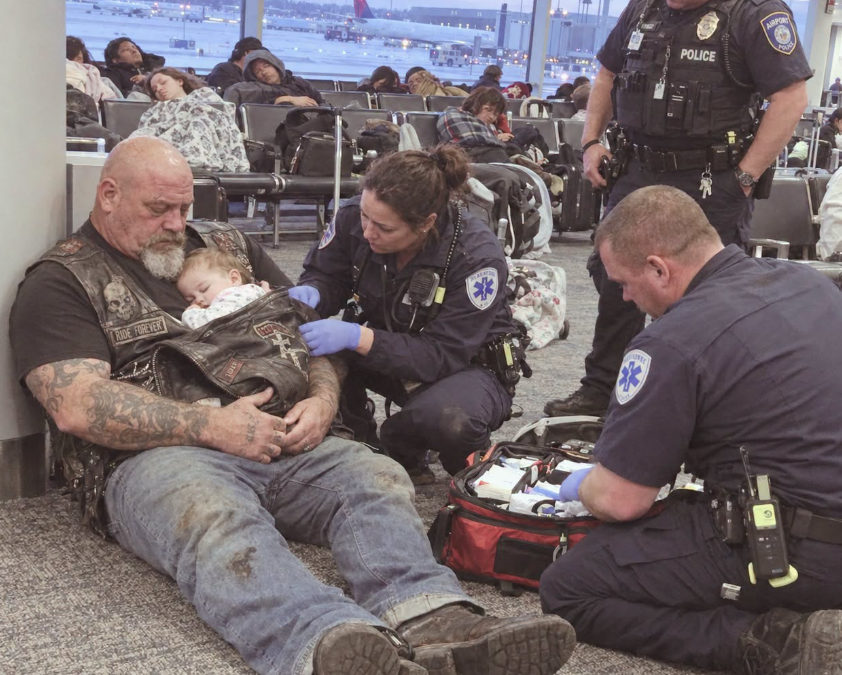
He was sitting on the floor with his legs stretched out stiffly in front of him.
His leather vest was no longer on his body.
It was wrapped around Noah.
My son was sleeping on Walt’s chest.
A clear oxygen tube ran beneath his tiny nose.
A pulse monitor glowed red around his foot.
Two paramedics knelt beside them.
Officer Reyes stood nearby.
His eyes were red.
I ran.
I don’t remember deciding to.
I remember seeing Walt’s tattooed hand on my child.
I remember rage.
I remember thinking he took him.
I think I was going to hit him.
Reyes caught me by both shoulders.
“Ma’am!”
“GET OFF ME!”
“Emily!”
“HE HAS MY BABY!”
“Emily, listen to me!”
I fought him.
I was screaming.
People were watching again.
Of course they were.
That airport had watched every terrible moment of my life for sixteen hours.
“HE TOOK HIM!”
“No!”
Reyes shook me once.
Not hard.
Enough to make my eyes focus.
“You passed out with Noah in your arms. He slid out of your coat.”
My body stopped.
“What?”
“That man caught him.”
I stared at Walt.
He looked exhausted.
More than exhausted.
Gray.
His beard was flattened on one side.
His eyes were bloodshot.
“He caught Noah before he hit the floor,” Reyes said.
I looked at the paramedics.
One was a woman with short dark hair.
Her badge read TASHA GREENE.
She stood.
“Mom?”
“What happened?”
“Your son is stable right now.”
Right now.
Two words no parent ever wants attached to their child.
“What happened?”
“He’s having respiratory distress. We strongly suspect RSV bronchiolitis.”
My knees weakened.
“What?”
“His oxygen saturation was low. He’s had two apnea episodes.”
I stared at her.
I knew every word individually.
Together, they meant nothing.
“What does that mean?”
Tasha’s voice softened.
“He stopped breathing.”
The world disappeared.
Not metaphorically.
It went white.
Sound vanished.
Reyes caught me under the arms.
I heard myself say something.
Maybe no.
Maybe please.
Tasha stepped closer.
“He’s breathing now.”
I looked at Noah.
His back rose.
Fell.
Rose.
Fell.
I counted like my life depended on it.
One.
Two.
Three.
“He’s breathing,” Tasha repeated.
“When?”
“Around two this morning was the first episode.”
I looked at the clock.
7:11.
“I was here.”
No one answered.
“I was right there.”
I pointed at the spot where I had slept.
Ten feet away.
“I was right there.”
Reyes nodded.
“We know.”
“Why didn’t you wake me up?”
“We tried.”
“No.”
“Emily.”
“No, I would have woken up.”
Tasha exchanged a look with Reyes.
“You have a fever of 102.3,” she said. “You’re severely dehydrated and exhausted. I checked you at two-thirty. You opened your eyes, said ‘Mom,’ and passed right back out.”
I didn’t remember.
“You should have made me wake up.”
“I considered it.”
“Why didn’t you?”
Tasha looked toward Walt.
“He asked us not to.”
My grief became anger instantly.
“He what?”
Walt’s voice came from the floor.
Barely above a rasp.
“You needed sleep.”
“You don’t get to decide that!”
“No, ma’am.”
“My baby stopped breathing!”
“Yes, ma’am.”
“And you let me sleep?”
“Yes.”
“Why?”
His enormous hand covered most of Noah’s back.
“He needed somebody awake more than he needed two people falling apart.”
I hated him for saying it.
Because some part of me knew he was right.
Tasha touched my shoulder.
“We were monitoring your son. Officer Reyes was here. I was in and out. Walt was awake the entire time.”
“The entire time?”
Nobody answered immediately.
Reyes looked down at the floor.
Then he said, “He hasn’t moved from that spot in almost twelve hours.”
I stared at him.
“That’s impossible.”
“No.”
“Why?”
Tasha knelt beside Noah.
“Every time we move your baby flat, his oxygen falls. When he’s upright against Walt’s chest, it improves.”
“That doesn’t make sense.”
“It does medically. Upright positioning can help some babies breathe more comfortably. But there’s another reason.”
She smiled faintly.
“He likes him.”
As if on cue, Noah made a tiny sound and tightened his fist in Walt’s T-shirt.
Something inside me cracked.
I knelt.
Not because I intended to.
My legs simply stopped holding me.
Walt looked at me.
“Morning, Mom.”
His voice was almost gone.
“He’s a tough little guy.”
I reached toward Noah.
Tasha stopped me gently.
“Give him a minute.”
“I want my baby.”
“I know.”
“I need to hold him.”
“You will. But right now he’s stable. Let us move him carefully.”
I looked at Walt.
His left hand trembled.
His legs looked strangely stiff.
“How long have you been sitting like that?”
He shrugged.
“Few minutes.”
Reyes actually laughed.
It sounded like a broken laugh.
“He sat down at eight-forty-seven last night.”
Walt shot him a look.
“Snitch.”
I looked at the clock again.
More than ten hours.
“But he was following me before that.”
“Since security,” Reyes said.
Tasha looked at him.
“Tell her.”
Reyes exhaled.
“He showed me a retired Denver Fire Department credential when you reported him.”
I looked at Walt.
“He was a firefighter?”
“Paramedic,” Reyes said. “Thirty-one years.”
Walt stared at Noah.
“That card was supposed to get me ten percent off pancakes. Never thought I’d need it again.”
Nobody laughed.
Reyes continued.
“He told us what he’d seen. The grunting. Retractions. Fever.”
“You knew?”
The accusation came out sharper than I meant.
Reyes looked ashamed.
“Yes.”
“Then why did you tell me he wouldn’t bother me?”
“Because Supervisor Keene took over the call.”
My skin went cold.
“Where is he?”
Nobody answered.
“Where is he?”
Reyes rubbed the back of his neck.
“He’s been relieved pending review.”
“Review of what?”
Tasha glanced at him.
Reyes said, “Later.”
“No. Now.”
“Emily—”
“My son stopped breathing twice while I was ten feet away. Tell me now.”
Reyes crouched so we were eye level.
“At 4:18 yesterday afternoon, Walt asked for medical response for Noah.”
My heart pounded.
“That early?”
“Yes.”
“Before I reported him?”
“Yes.”
I turned to Walt.
He did not look at me.
Reyes continued.
“After you reported him, he asked again. I radioed it.”
“I remember.”
“Keene reclassified the call.”
“What does that mean?”
“He logged it as a concerned bystander complaint involving a stable child.”
I stared.
“But Walt said Noah couldn’t breathe.”
“Yes.”
“Why would he do that?”
Reyes hesitated.
Tasha answered.
“Because a respiratory distress call for an infant would have forced medical escalation even during the storm.”
I felt sick.
“And a stable child?”
“Could wait.”
“How long?”
Nobody answered.
“How long?”
Reyes looked at his boots.
“Until somebody became available.”
I turned toward the crowd as if Keene might be standing there.
“He told me everybody was asking about somebody.”
“Yes.”
“He knew.”
“Yes.”
My hands started shaking.
Walt finally spoke.
“Emily.”
It was the first time he had used my name.
I looked at him.
“This part can wait.”
“No.”
“Yes.”
“No, it can’t.”
He looked down at Noah.
“Your boy’s alive. Start there.”
Something about the way he said alive silenced me.
Not safe.
Not fine.
Alive.
As if that word meant more to him than all the others.
Tasha checked the monitor.
“His oxygen is ninety-four.”
“Is that good?”
“With support, it’s acceptable.”
“Without support?”
Her silence answered.
A few minutes later Dolores appeared carrying a paper cup.
She looked as if she had been crying.
“Coffee,” she said.
I took it but couldn’t drink.
“I’m sorry,” she whispered.
“For what?”
“I fell asleep too.”
I stared at her.
She pointed at Walt.
“He didn’t.”
Then she told me what I had missed.
At 8:47, Noah had begun sliding out of my arms.
I had fallen asleep sitting upright.
My head had dropped sideways.
My grip had loosened.
Noah slipped through the open side of my coat.
Walt had been watching.
He crossed the distance fast enough to catch him inches above the tile.
I never woke.
People around us did.
A few started shouting.
Walt checked Noah.
He listened to his breathing.
Then he looked at Reyes and said, “It’s getting worse.”
That was when Reyes called medical again.
According to Dolores, Keene arrived and told Walt to return the baby to me.
Walt refused.
“He said, ‘She’s unconscious and he’s not protecting his airway lying like that.’”
I looked at Walt.
He shrugged.
“Sounded fancier at the time.”
Dolores continued.
Keene threatened to have him detained.
Walt sat down.
Right there on the floor.
He placed Noah upright against his chest.
Then he said, “You can arrest me here.”
Reyes refused to remove him.
That argument became the beginning of the investigation.
“Did people see this?”
Dolores looked around.
“About seventy people.”
Of course they did.
By nine-thirty, somebody had found formula.
Walt fed Noah without standing up.
He burped him.
Changed him once with Tasha’s help after she finally made it over from another medical call.
He hummed to him.
“Johnny Cash,” Dolores said.
Walt frowned.
“Merle Haggard.”
“Sounded the same after three hours.”
Despite everything, a laugh escaped me.
It came out almost like a sob.
Then I asked the question.
“What happened at two?”
The smiles disappeared.
Walt’s hand stopped rubbing Noah’s back.
He stared at the windows.
Snow still covered the runway.
“A baby sleeping on your chest is like a clock,” he said finally.
His voice changed.
Quieter.
Far away.
“You feel every tick.”
No one interrupted.
“Breath.”
His hand moved once on Noah’s back.
“Breath.”
Again.
“Breath.”
His fingers stopped.
“Around two, the clock stopped.”
My throat closed.
“What did you do?”
“Waited.”
“What?”
“Couple seconds.”
“Why?”
“Babies pause sometimes.”
He swallowed.
“Then I rubbed his back.”
Nothing.
He tapped Noah’s foot.
Nothing.
He called his name.
Nothing.
By then, Noah’s color was changing.
Gray around his mouth.
Walt turned him over along his forearm.
Reyes called Tasha.
She was in another concourse.
Walt gave two rescue breaths.
Tiny breaths.
Just enough to make Noah’s chest rise.
Then he stimulated him again.
After the second breath, Noah coughed.
Then screamed.
Walt smiled.
For the first time since I had met him, he smiled completely.
“Best sound I’d heard in a long time.”
“How long?”
“What?”
“Was he not breathing?”
“Not long.”
“How long?”
He looked at Tasha.
She answered.
“About twenty-two seconds that we can confirm.”
Twenty-two seconds.
Nothing.
A commercial.
A traffic light.
A microwave countdown.
Twenty-two seconds had almost divided my life into before and after.
“He did it again?” I asked.
Walt nodded.
“A little after four.”
“And you caught that one too?”
He shrugged.
“Monitor caught it.”
Tasha shook her head.
“Monitor sounded after he noticed.”
I looked at her.
She nodded toward Walt.
“He felt it first.”
Something in her expression made me look at him differently.
Not like a hero.
Not yet.
Like a man who knew something too well.
The ambulance arrived at 7:32 behind a snowplow so huge it looked like a yellow building moving through the storm.
Tasha prepared Noah for transport.
When she tried to lift him away from Walt, he screamed.
Not normal crying.
A weak, panicked cry.
The monitor dipped.
“Eighty-eight,” Tasha said.
She moved quickly.
“Keep him upright.”
She placed Noah against her shoulder.
He fought the oxygen cannula.
Walt tried to stand.
He couldn’t.
His body rose six inches and collapsed.
Reyes grabbed his arm.
Another paramedic caught the other side.
“What’s wrong?”
“Nothing.”
“Your legs don’t work.”
“They’ll come back.”
“How long have they been numb?”
Walt looked irritated.
“Midnight.”
“Jesus Christ.”
“They weren’t helping much.”
It took both men to lift him.
Once upright, he hung between them for several seconds.
He looked old then.
Not frightening.
Not huge.
Just old.
Sixty-five, I later learned.
His skin had gone pale.
His hands shook.
Tasha was halfway toward the doors when she called back.
“Sir, your vest.”
Noah was still wrapped in it.
Walt waved one hand.
“Keep him warm.”
“That vest looks older than I am.”
“It is.”
“You want us to leave it at the hospital?”
“I know where he’s going.”
He looked at me.
“So does his mom.”
In the ambulance, I sat beside Noah while Tasha monitored him.
I couldn’t hold him because of the equipment.
So I held Walt’s vest.
The leather smelled like smoke, winter air, machine oil, and something faintly like cedar.
There were patches all over the outside.
A fire department emblem.
An American flag.
A motorcycle club patch.
One that simply said DOC.
I ran my fingers along the inside lining.
That was when I saw the white patch.
Small.
Hand-stitched.
Blue thread.
DANIEL MICHAEL KOWALSKI
MARCH 9, 1989
JULY 22, 1989
I stared at the dates.
Counted.
Four months.
My breath caught.
Tasha saw me looking.
She said nothing at first.
Then she quietly adjusted Noah’s blanket.
“You know how many people I’ve worked with who could feel an infant stop breathing before a monitor alarmed?”
I looked at her.
“How many?”
“One.”
She glanced at the vest.
“And I’ve been doing this eighteen years.”
Noah spent five days at Children’s Hospital Colorado.
RSV.
Bronchiolitis.
Apnea.
Dehydration.
The pediatric pulmonologist explained everything I had not understood.
The grunting was not cute.
It was Noah trying to keep pressure inside his lungs.
The pulling beneath his ribs was called retraction.
His body had been using muscles it should not have needed just to breathe.
His fever increased his oxygen demand.
His congestion made everything harder.
“He looked like he had a cold two days ago,” the doctor said. “That can change quickly in an infant.”
I asked the question I dreaded.
“If he had stayed in my arms when I fell asleep…”
The doctor’s face became very still.
“If he had experienced the same apnea event while you were deeply asleep?”
“Yes.”
“You likely would not have known immediately.”
“How long before I would have known?”
“I can’t answer that.”
“Would he have died?”
She didn’t lie to me.
“He could have.”
I went into the hospital bathroom and threw up.
Then I sat on the floor and cried into a towel because I was ashamed to let Noah hear me.
Grief is strange.
I had gone to Denver believing the worst thing that had ever happened to me was losing my mother.
Two days later, I sat beside my son’s hospital crib understanding that grief had rooms I had never entered.
Beth called constantly.
The funeral was scheduled for Noah’s second hospital day.
“Postpone it,” I told her.
“We can.”
“No.”
“Emily—”
“No.”
“Mom would understand.”
“That’s why you’re going to do it.”
So Beth propped her phone on the end of a pew.
I watched my mother’s funeral on a five-inch screen.
The picture froze twice during the eulogy.
The sound cut out during the hymn she loved.
At the cemetery, wind shook Beth’s phone.
For a moment all I could see was gray sky.
Then the camera tilted down.
My mother’s casket.
Closed.
White roses.
The blue scarf she wore to church draped over the flowers.
I pressed my fingers against the screen.
Noah slept beside me with oxygen pushing gently through his nose.
My mother had never held him.
She would never know he had nearly died in an airport.
She would never know about Walt.
At least that was what I thought.
When the service ended, I whispered toward the frozen image of her casket.
“Somebody held him for you.”
Then I cried until a nurse came in and sat beside me without saying anything.
That afternoon, Walt appeared outside Noah’s room.
He didn’t knock.
He stood in the hallway wearing a red flannel shirt and jeans.
No leather.
No patches.
No armor.
He held a cheap stuffed bear with a gas station tag still attached.
I watched him through the glass for almost a minute.
He spoke to the nurse.
She pointed toward our door.
He shook his head.
Started to leave.
I opened the door.
“Walt.”
He froze.
Turned slowly.
“I just wanted to ask the desk if he was okay.”
“He is.”
“Good.”
He looked relieved.
“Good.”
Then he began walking away.
“Where are you going?”
“Home.”
“You came all the way here to ask a nurse?”
“That was the plan.”
“Come inside.”
He hesitated.
I understood immediately.
The last time he had approached me, I had called security.
“Please.”
He stepped in.
He looked smaller without the vest.
Still enormous.
But human.
He held the stuffed bear toward me.
“Saw this at a truck stop.”
I took it.
It was hideous.
One eye sat higher than the other.
“I think it’s supposed to be a bear.”
“I wasn’t sure either.”
I laughed.
The first real laugh since Mom died.
Then Walt saw his vest folded on the windowsill.
The white memorial patch faced upward.
He stopped.
“You saw Danny.”
It wasn’t a question.
“Yes.”
He pulled the visitor chair closer to the crib.
Sat.
For a long time he looked at Noah.
Noah was asleep.
Breathing.
I had become obsessed with watching that movement.
Up.
Down.
Up.
Down.
“Who was Daniel?” I asked.
Walt rubbed his palms together.
“My son.”
“How old?”
“You did the math.”
“Four months.”
“Four months, thirteen days.”
His voice did not break.
That somehow made it worse.
“What happened?”
He looked at me.
“You sure?”
“Yes.”
“No, I mean are you sure right now?”
I understood what he meant.
My mother.
Noah.
Everything.
“Yes.”
He nodded.
“In 1989, I was thirty years old. Two years into Denver Fire. Back then we ran twenty-four-hour shifts that became thirty-six because nobody had enough staffing.”
He smiled without humor.
“I thought being tired made me tough.”
His wife at the time was named Karen.
She was a nurse.
They worked opposite schedules because they were poor and childcare cost more than their rent.
One July morning, Walt came home after a double shift.
Karen left for work.
Danny had been fussy all night.
Walt fed him.
Changed him.
Rocked him.
Put him in the crib.
Then sat on the couch to take off his boots.
“That’s the last thing I remembered.”
He stared at his hands.
“I woke up four hours later.”
The room became very quiet.
“House was silent.”
I knew before he said it.
He walked into the nursery.
Danny was still.
Walt started CPR.
His neighbor called 911.
His own engine company arrived.
Men he had eaten breakfast with that morning took over compressions on his son.
They worked Danny for forty minutes.
Hospital continued.
Nothing.
“I had brought eleven people back that year,” Walt said.
He rubbed his jaw.
“Eleven.”
A drunk who overdosed.
A six-year-old who fell into a pool.
A man whose heart stopped in a grocery store.
A teenager after a car crash.
“People called me Doc because I was good.”
He looked at Noah.
“I couldn’t save my own boy.”
“That wasn’t your fault.”
“Maybe.”
“It wasn’t.”
“You sound like people did back then.”
“Because they were right.”
“Maybe.”
His wife never directly blamed him.
That was almost worse.
They stopped touching.
Stopped talking.
Stopped sleeping in the same room.
A year later, they divorced.
Walt bought a motorcycle because being inside a quiet house became unbearable.
“What kind?”
“Eighty-eight Harley Softail.”
“Was it loud?”
“Obnoxious.”
“Why?”
“Because silence scared me.”
That sentence stayed with me.
He stayed in emergency medicine another twenty-nine years.
Requested pediatric calls whenever possible.
Took classes.
Taught infant resuscitation.
Became the medic younger firefighters wanted on bad calls.
“I thought maybe there was a number.”
“A number?”
“Babies I could save before it balanced.”
“Did it?”
He shook his head.
“No.”
“Then why keep doing it?”
His eyes moved toward Noah.
“Because eventually I realized balance wasn’t the point.”
“What was?”
“Being there when the clock stopped.”
I started crying.
Quietly at first.
Then hard.
“I slept through it.”
Walt looked at me.
“No.”
“I did.”
“No, Emily.”
“My son stopped breathing and I slept ten feet away.”
“You were sick.”
“I’m his mother.”
“You’re human.”
“I should have known.”
“Known what?”
“That he was worse.”
“How?”
“The signs.”
“You’re not a paramedic.”
“You knew.”
“Because I spent thirty-one years learning.”
“You heard it immediately.”
“Because I spent thirty-one years listening.”
“I called security on you.”
“That was sensible.”
I stared at him.
“What?”
He leaned back.
“You were alone. Man twice your size kept appearing everywhere you went. You did exactly what I hope my daughter would do.”
“But you were trying to help.”
“You didn’t know that.”
“I wouldn’t let you finish a sentence.”
“That part was annoying.”
I laughed through tears.
Then he leaned forward.
“Don’t apologize for protecting your child.”
I looked down.
“But maybe,” he added, “next time let the ugly stranger finish five words before you call SWAT.”
I laughed again.
Noah stirred.
We both went silent.
His eyes opened.
He looked directly at Walt.
Then reached one tiny hand toward him.
Walt stopped breathing.
Not Noah.
Walt.
He extended one finger.
Noah wrapped his hand around it.
Walt’s face crumpled.
For the first time, I watched this giant, tattooed man cry.
No attempt to hide it.
No turning away.
Just tears moving through a gray beard.
“Hey, buddy,” he whispered.
I understood then that Noah had not simply been another baby to him.
Walt had known that sound.
The grunt.
The shallow breaths.
The tiny pauses.
Noah had sounded like Daniel.
Later that evening, Officer Reyes came to the hospital.
He was off duty.
He brought my phone charger.
I had left mine at the airport.
He also brought something else.
An incident report.
“I need to tell you something before you hear it from someone else.”
I looked at the paper.
“What?”
“Keene filed his report.”
“And?”
Reyes sat.
“He’s claiming you declined medical care.”
I stared at him.
“What?”
“He wrote that he offered medical response at approximately 4:30 and you refused.”
“That never happened.”
“I know.”
“He told me medical was busy.”
“I know.”
“Why would he write that?”
Reyes looked angry.
“To protect himself.”
The hospital had already notified a social worker because an infant had suffered two apnea episodes while his mother was unconscious in a public place.
That alone was routine.
But Keene’s report made it look different.
It said I had been informed that Noah appeared ill.
That I refused evaluation because I wanted to make my flight.
That I became incapacitated.
That an unrelated civilian took temporary custody.
Read coldly, on paper, it sounded like neglect.
My mother had been buried that morning.
My son was connected to oxygen.
Now some stranger’s lie was turning the worst night of my life into evidence against me.
I started shaking.
“He can’t do that.”
“I know.”
“He can’t write whatever he wants.”
“No.”
“What happens now?”
“The airport opened an internal review.”
“That doesn’t help me.”
“I know.”
“A social worker came by earlier.”
Reyes looked down.
“I’m sorry.”
“Sorry?”
I stood.
“You knew he changed the call.”
“Yes.”
“You knew Walt had asked for medical.”
“Yes.”
“You knew Keene threatened him.”
“Yes.”
“And you let him write this?”
His face tightened.
“I filed my own report.”
“After?”
“Yes.”
“Why didn’t you stop him in the airport?”
That hit.
He stood too.
“Because he was my supervisor on scene.”
“So?”
“So I made a bad choice.”
I stared at him.
He didn’t defend himself.
“I thought following the chain of command mattered.”
“My baby almost died.”
“I know.”
“You thought wrong.”
“Yes.”
The immediate answer took some of the anger out of me.
He reached into his coat and removed a small memory card.
“What’s that?”
“My body camera footage is already uploaded to the department server. This is not that.”
“What is it?”
“A passenger gave me a copy of his video.”
My stomach turned.
“Somebody recorded us?”
“A lot of people did.”
Of course.
He placed it on the table.
“This one recorded Keene telling Walt to leave you alone.”
“So?”
“It also recorded what happened before that.”
I looked at him.
“What happened before?”
Reyes met my eyes.
“Walt told Keene three times that Noah was in respiratory distress.”
My chest tightened.
“He said the words?”
“Exactly those words.”
“And Keene?”
“Keene said, ‘The mother says it’s a cold. Stay in your lane.’”
I sat down slowly.
“There’s more.”
I didn’t want more.
“There was a medic unit available at 5:06.”
I looked up.
“What?”
“Dispatch asked whether B concourse still needed them.”
“And?”
“Keene canceled the response.”
My mouth went dry.
“Why?”
“He said the situation was resolved.”
I stared at Noah.
Alive.
Breathing.
Then at Walt’s empty chair.
He had already gone home.
“What happens to Keene?”
“Investigation.”
“That’s not what I asked.”
“I don’t know yet.”
I held the report.
“He lied about me.”
“Yes.”
“He ignored Walt.”
“Yes.”
“He canceled medical.”
“Yes.”
“And now he gets an investigation?”
Reyes said nothing.
That night, I learned how quickly strangers can turn suffering into entertainment.
At 10:17, Beth called.
“Do not open Facebook.”
I opened Facebook.
A video had been viewed almost two million times.
The title was:
PARANOID MOM ACCUSES BIKER OF STALKING HER AT DENVER AIRPORT.
It showed me pointing at Walt.
“That man is following me and my baby.”
It showed Walt standing with his hands raised.
It showed Keene telling him to back away.
Then it ended.
No sick baby.
No rescue.
No night on the floor.
No Noah turning gray.
No Walt giving him breath.
Just me.
Accusing a stranger.
The comments were brutal.
“KAREN OF THE YEAR.”
“Imagine thinking every biker wants your baby.”
“She probably wanted attention.”
“He should sue her.”
“Look at her. She’s clearly unstable.”
Then somebody found my profile.
My mother’s obituary.
Pictures of Noah.
My workplace.
By midnight, strangers were messaging me.
Some defended me.
Most didn’t.
One called me a terrible mother.
Another said Noah would be better off in foster care.
Another wrote, “Your kid almost died because you cared more about a funeral than his health.”
That one broke me.
I threw the phone across the room.
A nurse picked it up.
“Want me to keep this at the desk?”
“Yes.”
She took it.
At 2:00 a.m., I stood over Noah’s crib.
Watched him breathe.
I thought about the person who had posted the video.
About Keene’s report.
About the clinic nurse who had said he could probably fly.
About myself.
There were so many people I could blame.
But blame was not the thing I wanted.
I wanted the night rewritten.
I wanted to go back to the security line.
I wanted Walt to say, “Ma’am, your baby.”
I wanted to turn.
I wanted him to finish.
Instead, at 2:13, there was a knock.
A hospital social worker entered.
Her name was Maria.
I immediately said, “I didn’t refuse medical care.”
She pulled up a chair.
“I know.”
I stared at her.
“You do?”
“We received an amended incident report.”
“From who?”
“Officer Reyes.”
She took out a notebook.
“And hospital staff have spoken with the paramedics.”
My knees weakened with relief.
Maria asked questions.
Hard questions.
Had I known Noah was sick?
Yes.
Had a clinician cleared him to travel?
By phone.
Did I understand the symptoms of respiratory distress?
No.
Why was I traveling?
My mother died.
How long had I been awake?
Almost forty hours.
Why did I fall asleep?
Because I was sick, grieving, dehydrated, and human.
Maria listened.
Then closed the notebook.
“Emily, I’m not opening a neglect case.”
I cried.
She waited.
“But I do need you to hear something.”
I nodded.
“You are going to be very tempted to turn this into a story where you are either a bad mother or a good mother.”
I stared at her.
“It’s not that simple.”
“No.”
“You made some mistakes.”
“Yes.”
“You also asked for help. You called the pediatric clinic. You alerted security when you felt unsafe. You approached the supervisor again when the nurse told you Noah needed evaluation.”
I wiped my face.
“You were failed too.”
That was the first time anyone said it.
Not excused.
Not absolved.
Failed.
It mattered.
Noah improved slowly.
Day three, he needed less oxygen.
Day four, he smiled.
Day five, the doctor said we could leave if he maintained his oxygen during sleep.
I barely breathed during that nap.
Noah did.
We went home with oxygen for another nine days.
Before we left Colorado, I called Walt.
“Where are you?”
“Spokane.”
“You made it?”
“Three days late.”
“You missed Christmas.”
“It moves around.”
“No, it doesn’t.”
“My daughter moved hers.”
I smiled.
“I have your vest.”
“I know.”
“I can mail it.”
“No.”
“You want me to keep it?”
“Until the kid doesn’t need oxygen.”
“Why?”
“Superstition.”
“You’re a paramedic.”
“Retired. Allowed to be stupid now.”
I kept it.
The investigation lasted six weeks.
During those six weeks, the incomplete airport video reached eleven million views.
Then another video appeared.
Officer Reyes’s bodycam footage had been released after a public records request from a local television station.
This time, people heard everything.
Walt saying, “That baby is retracting.”
Keene saying, “The mother says it’s a cold.”
Walt saying, “He needs medical.”
Keene saying, “You are not currently licensed through this airport response system.”
Walt answering, “Lungs don’t give a damn about jurisdiction.”
People heard me ask whether someone should examine Noah.
They heard Keene say resources were unavailable.
They heard him tell Walt to leave.
Then another passenger posted the later video.
Me asleep.
Noah slipping.
Walt lunging.
Catching him.
Sitting down.
Keene demanding the baby be returned.
Walt refusing.
“You can arrest me here.”
Then the worst clip.
2:03 a.m.
A shaky phone video from Dolores.
Walt suddenly sitting upright.
Looking down.
Calling, “Noah.”
Reyes moving.
People waking.
Walt rubbing Noah’s back.
Turning him.
Calling for oxygen.
You could not clearly see the rescue breaths because people blocked the camera.
But you could hear Noah cough.
Then cry.
You could hear seventy exhausted strangers start applauding.
The internet changed direction overnight.
People who had called me Karen apologized.
Some didn’t.
People called Walt a hero.
He hated it.
A television producer offered him ten thousand dollars for an exclusive interview.
He told her to donate it to the children’s hospital and stop calling him.
Motorcycle clubs across the country mailed patches.
Fire departments sent challenge coins.
Parents sent photographs of babies he had treated decades earlier.
One woman wrote that Walt had restarted her heart when she was eleven.
Another said he delivered her daughter on the side of Interstate 70 during a snowstorm in 1997.
His daughter, Rachel, called me.
“I’ve known my father my whole life,” she said, crying. “I didn’t know half of this.”
Then the official findings came.
Martin Keene had falsified the incident report.
He had downgraded a medically significant call without clinical authority.
He had canceled a requested medical response after dispatch identified a unit that could respond.
He had failed to document Walt’s repeated warnings.
And after Noah was hospitalized, he had written the report in a way investigators concluded was intended to shift responsibility onto me.
He was terminated.
His airport security credentials were revoked.
The contractor that employed him lost its supervisory agreement at two terminals pending retraining and review.
Airport leadership issued a written apology to me.
More importantly, they changed policy.
Any report of respiratory distress in an infant would require direct medical triage.
No security supervisor could downgrade it without a clinician.
Retired or off-duty medical professionals would be permitted to give observations directly to responding medical staff rather than having them filtered through security.
They named the training bulletin after Noah.
I didn’t ask them to.
Walt was furious.
“They named a policy after a kid who can’t even sit up.”
I laughed.
“It’s better than naming it after you.”
“Damn right.”
Officer Reyes received a written reprimand for not challenging Keene sooner.
He also received a departmental commendation for refusing to forcibly remove Noah from Walt once the situation worsened and for preserving evidence during the investigation.
He called me when it was over.
“I’m sorry,” he said again.
This time I knew what he meant.
“I know.”
“I should have listened.”
“Yes.”
He was quiet.
Then I said, “So should I.”
Neither of us needed to say more.
There was one person who never apologized.
Keene.
His lawyer released a statement saying he had acted during an unprecedented weather emergency with incomplete information.
Maybe that was true.
Partly.
The problem with cruelty is that it rarely sees itself clearly.
Keene probably did have too many emergencies.
He probably was overwhelmed.
He probably did think Walt was an interfering retired medic who needed to be controlled.
He probably told himself that my fear mattered more than Walt’s warning until it became convenient to claim I had refused help.
That was the lesson I carried longer than anger.
Most people who fail you do not wake up planning to be villains.
They decide your concern is less important than their authority.
They decide somebody else is exaggerating.
They decide listening can wait.
And sometimes twenty-two seconds is all the time waiting costs.
In January, when Noah was fully off oxygen, I flew to Ohio.
Beth met us at the airport.
She took Noah from my arms and held him for nearly ten minutes without speaking.
Then she slapped my shoulder.
“That’s for scaring me.”
“Ow.”
Then she hugged me.
“That’s for coming home.”
We drove to Mom’s cemetery the next morning.
Snow covered the grass.
Beth waited in the car.
I carried Noah to the grave.
Linda Marie Harper.
Beloved Mother.
Beloved Sister.
Forever Loved.
I brushed snow away from the stone.
Noah grabbed my scarf.
“Mom,” I said.
My voice broke immediately.
“I’m sorry you never got to hold him.”
Noah squealed.
I laughed.
“He’s loud.”
The wind moved through the trees.
“I know you would have told me not to fly.”
I wiped my face.
“And I know you would have been unbearable about being right.”
I sat in the snow.
Held Noah against my chest.
Then I told her everything.
The airport.
The biker.
The vest.
The floor.
The twenty-two seconds.
The patch.
Daniel.
When I finished, I touched the stone.
“A stranger held him when you couldn’t.”
For the first time since Mom died, grief felt different.
Still heavy.
But no longer empty.
Two weeks later, Walt came to Oregon for his vest.
He arrived on a Harley even though it was thirty-eight degrees and raining.
“You’re insane.”
“Correct.”
He stood in my doorway dripping water.
Noah saw him.
I swear he recognized him.
His whole body started kicking.
Walt froze.
“Well.”
I handed him Noah.
No hesitation this time.
No fear.
Walt sat on my living room floor with his back against the couch.
Exactly the way he had at the airport.
Noah settled against his chest.
For a few seconds neither of us spoke.
Then I brought out the vest.
Cleaned.
Conditioned.
Daniel’s patch repaired where one thread had come loose.
Walt ran his thumb across his son’s name.
“You did this?”
“Beth knows embroidery.”
He swallowed.
“Thank you.”
“Put it on.”
He shook his head.
“Why?”
He looked at Noah.
“Not yet.”
“Walt.”
“The kid had it last.”
“So?”
“I don’t know.”
He rubbed his beard.
“Feels like Danny’s been holding onto it too.”
My eyes filled.
I sat beside him.
“What happened after Danny?”
He looked at me.
“You told me about the divorce.”
“Oh.”
“You had Rachel later?”
“Eleven years later.”
“With your second wife?”
“Yeah.”
“Are you still married?”
“No.”
I raised an eyebrow.
“Common denominator seems suspicious.”
He laughed.
“Her name was Susan. Cancer. 2015.”
“I’m sorry.”
“She was mean as hell. Cancer was more afraid of her than she was of it.”
“Walt.”
“She’d laugh.”
We sat quietly.
Then he said something I hadn’t expected.
“I never talked about Danny with Rachel.”
“Never?”
“She knew he existed.”
“The patch.”
“Yeah.”
“Why?”
He stared at the floor.
“Thought grief was mine.”
“Was it?”
“No.”
That Christmas, Walt had finally told his daughter the whole story.
Not just that she had once had a brother.
He told her about the nursery.
The CPR.
The divorce.
The motorcycle.
The thirty-one years of baby calls.
“He said your son made him say Daniel’s name at a dinner table for the first time in thirty-seven years,” Rachel told me later.
“That might be the second life Noah saved.”
I never told Walt she said that.
Maybe he knew.
Life became normal again.
Which is an extraordinary thing when you’ve nearly lost it.
Noah learned to sit.
Then crawl.
Then walk.
He called dogs “gogs.”
He hated peas.
Loved bananas.
Slept with the ugly gas station bear Walt bought him.
Every cold terrified me.
Every cough sent me back to Denver.
For months, I woke at night and stood over Noah’s crib with my hand on his back.
Breath.
Breath.
Breath.
Sometimes I counted to one hundred.
Sometimes two hundred.
My doctor called it trauma.
Walt called it motherhood with bad memories.
He helped more than therapy at first.
I could call him at 2:00 a.m.
“He’s coughing.”
“Fever?”
“No.”
“Eating?”
“Yes.”
“Blue?”
“No.”
“Retracting?”
“No.”
“Then go back to bed.”
“What if—”
“Emily.”
“What?”
“Breathing isn’t supposed to sound silent when a kid has a cold.”
“Okay.”
“You’re listening too hard.”
“That’s rich coming from you.”
“Exactly.”
Eventually I stopped calling at two.
Then at midnight.
Then every time Noah sneezed.
The first anniversary of the airport night arrived with snow in Denver.
Walt came to our house.
December 14.
He drove his truck because Rachel had confiscated his motorcycle keys after checking the forecast.
He complained about it for two hours.
Noah, now seventeen months old, climbed onto him like a piece of playground equipment.
At dinner, I gave Walt a framed photograph.
He stared at it for a long time.
Officer Reyes had taken it around four in the morning at B14.
He said later he hadn’t known why.
Maybe because he needed proof for himself.
In the picture, the airport lights are dim.
Snow falls beyond the windows.
Walt sits against the pillar in a black T-shirt.
His head is tipped back.
His eyes are closed.
He isn’t sleeping.
One hand rests on Noah’s back.
My son is wrapped in the leather vest.
Oxygen tubing crosses his cheek.
Reyes had written the time on the back.
4:17 A.M.
Below it, one sentence.
HE NEVER LET GO.
Walt stared at the photograph.
“Ugly bastard.”
“You look terrible.”
“Kid looks good.”
“He was trying to die.”
“He was taking a break.”
I smiled.
Walt didn’t.
His eyes were wet.
I had another copy hanging on my refrigerator.
It is still there.
Noah is older now.
Old enough to ask questions.
Why is there a motorcycle vest in his baby box?
Why does Mr. Walt call him Clock?
Why does Officer Reyes send him a birthday card every year?
Why does his mother cry sometimes when snow hits airport windows on television?
One day I’ll tell him everything.
I’ll tell him about his grandmother Linda, who bought him Christmas presents she never lived long enough to give him.
I’ll tell him about his mother at twenty-nine, so tired and frightened that every stranger looked dangerous and every decision felt impossible.
I’ll tell him she saw a giant biker following her through an airport and pointed him out to a police officer.
I’ll tell him she was not wrong to ask for help.
But I’ll also tell him something I learned afterward.
Fear can protect you.
Fear can also make the world smaller than it really is.
Sometimes the person who frightens you is dangerous.
Sometimes he is simply carrying a history you cannot see.
Sometimes scars mean violence.
Sometimes they mean survival.
Sometimes leather and tattoos belong to a man who has spent three decades kneeling beside strangers on the worst day of their lives.
And sometimes the person with the clean uniform, calm voice, and official authority is the one you should have questioned harder.
I’ll tell Noah about Martin Keene.
Not because I want him to hate him.
Because I want Noah to understand that power without humility can be dangerous.
I’ll tell him about Officer Reyes.
About a good man who obeyed the wrong person for too long, admitted it, and learned that following orders never replaces judgment.
I’ll tell him about Tasha.
About Dolores.
About seventy stranded strangers who went quiet while a biker hummed Merle Haggard to a sick baby on an airport floor.
I’ll tell him about Daniel.
Especially Daniel.
A baby who lived only four months and thirteen days.
A baby Noah will never meet.
A baby whose death taught his father to listen so carefully that thirty-seven years later, across a crowded airport, he heard another child struggling to breathe.
I’ll tell Noah that Walt spent most of his life believing he had failed his son.
And that one terrible night in Denver did not erase Daniel’s death.
It did not balance anything.
That is not how grief works.
But grief can become something.
A warning.
A skill.
A hand reaching forward.
A man refusing to walk away.
I’ll tell Noah that when his breathing stopped, Walt knew.
Before the monitor.
Before the paramedics.
Before his own mother woke up.
Walt knew because he had spent thirty-seven years remembering the silence of another baby.
And then I’ll tell Noah the part I still cannot say without crying.
The part that matters most.
His mother looked at Walt Kowalski and saw a threat.
She accused him in front of strangers.
She had security stop him.
She refused to hear him.
And when the moment came when Walt had every reason in the world to decide she was no longer his problem, he did the opposite.
He stayed.
When Noah slipped from my arms, Walt caught him.
When Noah was hungry, Walt fed him.
When Noah cried, Walt hummed to him.
When Noah couldn’t breathe lying flat, Walt became the mattress.
When his legs went numb, he stayed.
When his back cramped, he stayed.
When airport security threatened him, he stayed.
When the little clock on his chest stopped ticking, Walt gave it breath.
And when it stopped again, he was still there.
Twelve hours on a cold airport floor.
No bed.
No sleep.
No gratitude.
No promise that anyone would ever understand why.
He simply stayed.
Years later, I finally asked him why.
Not why he noticed Noah.
Not why he knew what to do.
Why he stayed after I called security on him.
We were sitting on my porch.
Noah was chasing fireflies in the yard.
Walt was older.
His beard almost completely white.
His knees bothered him.
He had finally sold the Harley after Rachel threatened to dismantle it herself.
I said, “You could have walked away.”
He watched Noah run.
“I know.”
“You probably should have.”
“Probably.”
“I embarrassed you.”
“Yep.”
“I treated you like a criminal.”
“Pretty much.”
“Keene threatened you.”
“He was a prick.”
“Walt.”
“He was.”
“Why didn’t you leave?”
For a long time he said nothing.
Then Noah tripped in the grass.
Before I even reacted, Walt leaned forward.
Noah stood again.
Kept running.
Walt relaxed.
He looked at me.
“When Danny died, I spent years asking what kind of man sleeps while his baby dies ten feet away.”
My chest tightened.
“Walt—”
“Let me finish.”
I did.
“I hated that man.”
He looked down at his hands.
“Then one night in an airport, I saw you.”
I didn’t understand at first.
“Sick. Exhausted. Grieving. Trying harder than your body could manage.”
His voice softened.
“And when you fell asleep, I finally understood that man.”
Tears filled my eyes.
“He wasn’t careless.”
Walt shook his head.
“He was tired.”
The yard blurred.
“So when your boy slipped…”
He watched Noah.
“I wasn’t catching Noah.”
His voice broke.
“I was catching Danny.”
Neither of us spoke.
Fireflies blinked over the grass.
Noah laughed.
Finally Walt wiped his face with the heel of his hand.
“Guess I finally got there in time.”
I took his hand.
“Yes,” I said.
“You did.”
And maybe that is the truth I want Noah to carry when he is old enough to understand.
We do not get to go backward.
We do not get to save the people we lost by loving harder years later.
We do not get to unmake mistakes, recover missed phone calls, reopen closed caskets, or place babies back into the arms that never got to hold them.
But sometimes life puts another moment in front of us.
Not the same moment.
Never the same.
Just something that rhymes with the old pain.
And when it does, we get a choice.
We can become harder.
Or we can become useful.
Walt chose useful.
For thirty-seven years.
Until a snowstorm shut down an airport.
Until a frightened woman pointed at him.
Until a sick baby fell.
Until a tiny clock stopped.
And the man I thought I needed protection from became the reason my son lived long enough to learn his name.

