I Asked the VA to Let Me Sit Alone—Then My Military K9 Dragged Me to the Blind Nurse I Thought I’d Never Met
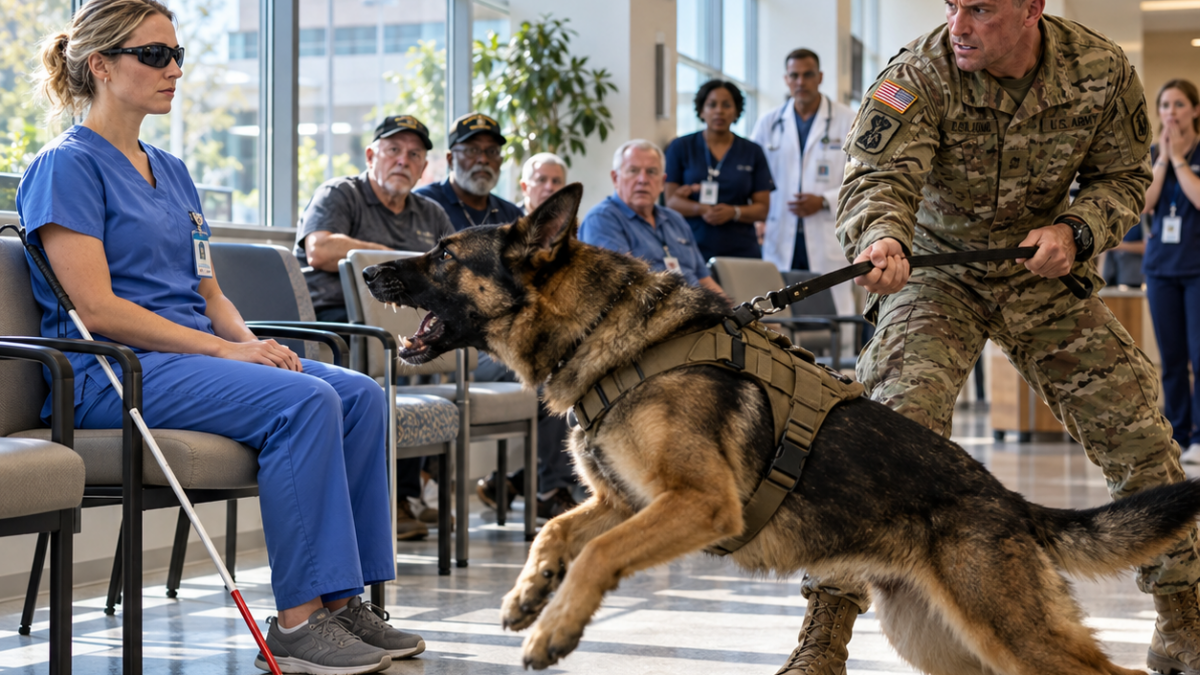
I Asked the VA to Let Me Sit Alone—Then My Military K9 Dragged Me to the Blind Nurse I Thought I’d Never Met.
I walked into the VA hospital asking for one thing—a chair in an empty corner where nobody would talk to me—but my military K9 planted his paws, ignored the command he had obeyed for six years, and pulled me across the waiting room toward a blind nurse sitting beside the window.
The moment she touched the scar behind his ear and whispered the name “Ranger,” my blood went cold, because that was the name my dog had carried before he became Atlas—and almost nobody alive was supposed to know it.
Then a colonel walked into the room, looked at the nurse everyone treated like a quiet woman who needed accommodations, and told me she was the reason my dog and I had survived a burning field hospital five years earlier—the same explosion that had taken her sight.
My name is Elias Mercer.
Most people used to call me Eli.
I don’t remember exactly when they stopped.
Maybe after the third surgery.
Maybe after I stopped answering my brother’s calls.
Maybe after the VA therapists learned that asking me about Afghanistan was a guaranteed way to turn a forty-five-minute appointment into thirty-nine minutes of silence.
At some point, Elias became easier.
Formal.
Distant.
The name on paperwork.
The man who came home wasn’t Eli anymore anyway.
At least that was what I believed.
The Tuesday I met Nora Vale for the second time, although I didn’t know it was the second time, it had been raining since before sunrise.
Cold rain.
Gray rain.
The kind that flattened everything.
The parking lot outside Northbridge VA Medical Center reflected the sky like dirty glass.
PART2:
I sat in my truck for eleven minutes with the engine off.
Atlas sat behind me.
He knew.
He always knew.
Six-year-old German Shepherd.
Ninety-two pounds.
Dark saddle.
Gray beginning along the muzzle earlier than it should have.
Black tactical harness.
DO NOT PET — WORKING DOG.
Most people read that and reached anyway.
Atlas had been assigned to me after I came home.
Officially, he was a psychiatric and mobility service dog.
Reality was more complicated.
He braced when my left leg weakened.
Interrupted nightmares.
Forced space around me in crowds.
Woke me before panic attacks became something uglier.
Positioned himself behind my chair if I couldn’t see the door.
Leaned his body against my leg when I started drifting somewhere I didn’t want to go.
He was trained for dozens of tasks.
The most useful thing he did was exist.
I hated admitting that.
Depending on anyone had become difficult.
Depending on a dog felt safer.
Dogs don’t ask why you don’t call people back.
Atlas was staring at me through the gap between the seats.
I looked at him.
PART3:
“Don’t.”
His ears moved.
“I know.”
Tail once.
“It’s an appointment.”
Nothing.
“We walk in.”
Nothing.
“Neurology.”
Nothing.
“Prosthetics.”
He blinked.
“And then we leave.”
Atlas rested his chin on the seat.
I opened the door.
“Exactly.”
The hospital waiting room was full.
That was the first problem.
Old veterans wearing unit caps.
Young veterans wearing earbuds.
A woman with an oxygen tank.
A man in a wheelchair arguing quietly with his wife about whether he had remembered his medication.
Television mounted near the ceiling.
News anchor talking with the volume almost muted.
Printer behind reception making a grinding noise every twelve seconds.
Phones ringing.
Shoes.
Coughs.
Rolling walkers.
Elevator bell.
Too much.
I counted exits immediately.
Main doors behind me.
Clinical hallway left.
Elevators right.
Stairwell near radiology.
Security desk.
Two officers.
One unarmed guard.
Atlas pressed into my left leg.
“I’m fine.”
He stayed there.
“Traitor.”
The receptionist looked up.
Forties.
Kind face.
Red glasses.
“Good morning.”
I walked to the desk.
“Mercer.”
“Elias?”
“Yes.”
She typed.
“Neurology at ten-thirty, prosthetics at eleven-fifteen.”
“Apparently.”
She glanced up.
Then at the cane clipped to my backpack.
Then Atlas.
Then the scar on my neck.
People tried not to stare.
Trying not to stare has its own look.
“You’re early.”
“I know.”
“We’re running about forty minutes behind.”
My jaw tightened.
Atlas leaned harder.
The receptionist noticed.
“Would you like to take a seat?”
“I need somewhere alone.”
Her fingers stopped.
“I’m sorry?”
“Empty room.”
“We don’t really have—”
“Hallway.”
“Mr. Mercer—”
“Corner.”
I could hear my breathing changing.
Controlled.
Measured.
Too measured.
She softened her voice.
“We don’t have private waiting areas unless there’s a clinical reason.”
“There is.”
“Has that been documented?”
“I don’t care.”
A man three seats away looked up.
I hated that.
Attention.
The receptionist looked nervous now.
“I can ask—”
“Don’t ask.”
“Sir.”
“I just need somewhere no one will sit beside me.”
A security guard noticed.
Of course he did.
Tall.
Mid-thirties.
Hands near his belt.
He approached slowly.
“Everything okay?”
I did not look at him.
“Fine.”
He looked at Atlas.
“Service animal?”
I pointed at the harness.
His hand stayed near his belt.
Something old woke inside me.
Not fear exactly.
Calculation.
Distance.
Angles.
Atlas shifted.
The guard noticed that too.
Bad loop.
Then a woman’s voice came from near the window.
“Put him by the west wall.”
Everyone looked.
I turned.
She sat beside a cart stacked with folded blankets.
Pale blue scrubs.
Dark brown hair pulled into a low bun.
Hospital badge on her chest.
NORA VAIL.
A pair of dark glasses covered her eyes.
White cane leaned beside her chair.
Maybe mid-thirties.
Still posture.
Not fragile.
That distinction became important later.
The receptionist said:
“Nora?”
“The heater rattles back there after ten.”
The nurse tilted her head slightly.
“People avoid those chairs.”
She had heard my breathing.
Of course.
Hospital people hear more than they look.
I nodded once.
“Fine.”
No thank you.
That was who I was then.
I stepped toward the wall.
Atlas didn’t.
The leash stopped.
I looked down.
His ears were forward.
Nose in the air.
“Atlas.”
He didn’t move.
“Heel.”
Nothing.
My stomach tightened.
Atlas did not ignore commands.
Not in public.
Not like that.
“Atlas.”
Sharper.
“Heel.”
He took one step.
Wrong direction.
Toward the nurse.
“No.”
Atlas pulled.
I tightened the leash.
The receptionist stood.
“Sir, is everything all right?”
“Yes.”
The dog pulled harder.
I nearly lost balance.
That made anger flash because my damaged leg had already taken enough dignity from me.
“Atlas. Heel.”
He looked back at me.
Then toward Nora.
Then pulled again.
The blind nurse had stopped moving.
Her right hand gripped the chair.
I felt it then.
Something wasn’t wrong.
Something was familiar.
Atlas crossed the room.
I followed because the alternative was falling.
People stared.
Security stepped closer.
“Sir.”
“Don’t.”
Atlas stopped directly in front of Nora.
The waiting room went quiet.
Not completely.
Hospitals never become completely quiet.
But human conversation vanished.
Atlas made a sound.
A low whine.
Broken.
I’ve heard him whine in dreams.
When pain hit my leg.
When thunder came too close after deployment.
Never like that.
Nora’s lips parted.
Her hand lifted slowly.
Not reaching.
Waiting.
Then she whispered:
“Ranger.”
Every hair along my arms rose.
I stepped backward.
“What did you say?”
Atlas moved closer.
Placed his head in her lap.
She touched his forehead.
Then one ear.
Her fingers found the little scar behind the left side.
She inhaled sharply.
“Oh my God.”
My mouth went dry.
“Who told you that name?”
Nora didn’t answer.
“His name is Atlas.”
Her fingers remained in his fur.
“It is now.”
I felt cold.
“No.”
She turned her face toward my voice.
“His name used to be Ranger.”
“No one knows that.”
“I do.”
“Who are you?”
The security guard said:
“Sir, maybe step back—”
Atlas lifted his head.
Not aggressive.
Warning.
I said:
“Don’t touch him.”
The guard stopped.
Nora’s hand found Atlas’s neck again.
She whispered:
“Easy, Ranger.”
He settled instantly.
My chest tightened.
The name Ranger appeared once in Atlas’s original transfer documentation.
Previous designation.
No details.
The trainer who paired us had said:
“Old name. Doesn’t matter.”
I believed him.
Six years later, a blind nurse in a VA waiting room said it like she had been waiting half a decade to say it again.
The receptionist came around the desk.
“Nora, do you know him?”
“I know the dog.”
I laughed once.
Not because anything was funny.
“You know my dog?”
Nora turned toward me.
“What is your name?”
I wanted to leave.
Every instinct screamed leave.
“Mercer.”
“First name.”
“Why?”
Her face changed.
Tiny.
Tension near the mouth.
“Please.”
I hated that word.
“Elias.”
She stopped breathing for half a second.
Atlas pushed closer to her knee.
Then Nora whispered:
“Eli Mercer.”
Nobody called me Eli.
Not anymore.
I stepped backward again.
“How do you know that?”
Her fingers tightened in Atlas’s coat.
“Outpost Calder.”
The room disappeared.
Not literally.
But there are words that become doors.
Calder was one.
Five years vanished.
Sand.
Rotor wash.
Metal.
Heat.
Radio static.
Somebody screaming for a medic.
Atlas wasn’t Atlas then.
Ranger.
Fire.
The smell of burned insulation.
A woman’s voice.
Don’t close your eyes.
I blinked.
Hospital.
Rain.
Blind nurse.
“No.”
Nora did not move.
“You were brought in after the convoy strike.”
“No.”
“Eli—”
“You don’t know anything about that.”
“I know the east wall collapsed at 0317.”
My vision narrowed.
“I know the generator ignited.”
Stop.
“I know your left leg was pinned beneath the rear axle of a medical transport.”
My hand tightened around Atlas’s leash.
“I know Ranger wouldn’t leave you.”
“Stop.”
“I know you kept asking for Sergeant Bell.”
My breath caught.
Bell.
Dead before we reached Calder.
I hadn’t known.
Not then.
“I know you apologized to Ranger because you thought the fire would take both of you.”
My throat closed.
Nobody knew that.
Nobody.
I had Ranger’s head against my chest.
Smoke.
Metal pressing my leg.
I kept saying:
“Sorry, boy.”
“I’m sorry.”
“I’m sorry.”
Because he could have escaped.
The leash was gone.
Door blown open.
He stayed.
The memory ended there.
Always.
Then morphine.
Aircraft.
Germany.
Surgeries.
Eventually Northbridge.
“What the hell are you?”
My voice sounded wrong.
Nora removed her hand from Atlas.
The dog stayed against her.
Before she could answer, a man’s voice cut across the room.
“What exactly is happening?”
A doctor stepped from the hallway.
Pressed white coat.
Silver hair.
Mid-fifties.
Expensive shoes.
Badge:
DR. GRAHAM WHITLOCK
DIRECTOR OF PATIENT SERVICES.
I knew the type immediately.
Every military system has a civilian version.
Men who confuse control with competence because nobody has interrupted them recently.
Whitlock looked from me to Atlas.
Then Nora.
“Nurse Vail?”
She straightened.
“Everything is under control.”
“Doesn’t appear that way.”
He looked at me.
“Sir, your service animal must remain under control at all times.”
“He is.”
“He pulled you through a crowded waiting area.”
“He had a reason.”
“That doesn’t change hospital policy.”
I felt my jaw tighten.
Nora said:
“Dr. Whitlock.”
He ignored her.
“If your dog cannot remain at heel, security may have to—”
“Don’t finish that sentence.”
He stopped.
Looked at me fully.
“Excuse me?”
“You heard me.”
Security moved a fraction closer.
Atlas looked back at me.
Then leaned against my leg.
Grounding.
Nora said my name.
Just:
“Eli.”
Something in the way she said it made me stop.
Whitlock noticed.
“Nurse Vail, are you familiar with this patient?”
“Yes.”
“How?”
She paused.
“Complicated.”
“That isn’t an answer.”
I said:
“She doesn’t owe you one.”
Whitlock turned.
“This is a hospital matter.”
“I am a patient in your hospital.”
“And presently causing a disturbance.”
“I asked for somewhere alone.”
“And your dog ignored you.”
Atlas looked at him.
Whitlock said:
“This is not a training yard.”
The old man in a Navy cap across the room slowly lowered his newspaper.
Nora reached for her cane.
“Doctor, I can take Mr. Mercer to a quieter area.”
Whitlock’s mouth tightened.
“With respect, Nurse Vail, your role here is supportive.”
She froze.
Not much.
I saw it.
He continued:
“You are here because this facility has made significant accommodations for your condition.”
Silence.
“Do not confuse accommodation with operational authority.”
The room changed.
Everybody heard it.
A blind nurse.
Her condition.
Accommodation.
Authority.
The old Navy veteran muttered:
“Oh, son.”
I looked at Whitlock.
“What did you just say?”
He turned.
“This doesn’t concern you.”
“It concerns everybody who heard it.”
His face reddened.
“Security.”
The guard didn’t move immediately.
Interesting.
Whitlock looked at him.
“I said security.”
Nora spoke.
“Please don’t escalate this.”
“I am not escalating anything.”
Her voice remained quiet.
“No.”
Then:
“You’re about to embarrass yourself.”
Somebody in the waiting room coughed to hide a laugh.
Whitlock stared at her.
“Excuse me?”
Nora turned her face toward him.
“Call Colonel Vance.”
Everything about Whitlock shifted.
Tiny.
But visible.
“Why?”
“Call him.”
“How do you know Colonel Vance?”
No answer.
Whitlock stepped closer.
“Nurse Vail.”
Atlas moved.
One step.
Between them.
No bark.
No growl.
Just ninety-two pounds of German Shepherd deciding the distance was close enough.
Whitlock looked down.
“Remove that animal.”
Security hesitated.
“He’s a service dog, sir.”
“He is interfering with staff.”
I said:
“Touch him and this becomes a different conversation.”
Nora snapped:
“Eli.”
I stopped.
Bad sentence.
Wrong direction.
I knew.
The old Navy veteran suddenly stood.
“Doctor.”
Whitlock turned irritably.
“What?”
The veteran pointed toward the clinical hallway.
Boots.
Several sets.
The doors opened.
Two military police entered.
Then a man in Army dress uniform.
Colonel.
Silver eagle.
Gray at the temples.
Shoulders square.
Face hard enough to stop arguments before they started.
Whitlock went pale.
“Colonel Vance.”
The colonel did not look at him.
He looked at Nora.
Then Atlas.
Then me.
For several seconds, nothing.
Finally:
“So it is you.”
Nora stood.
“Sir.”
Atlas left my leg.
Walked to Vance.
Pressed his head briefly into the colonel’s hand.
Then returned to Nora.
Vance whispered:
“Ranger.”
Again.
That name.
My heart hammered.
Whitlock tried:
“Colonel, I’m glad you’re here. We have a patient-care issue—”
Vance turned.
“What issue?”
“The service animal created a disruption.”
“Disruption?”
“And Nurse Vail inserted herself in a matter outside her assigned role.”
Vance stared at him.
Then at Nora’s cane.
Then back.
“Do you know who she is?”
Whitlock hesitated.
“She is one of our nurses.”
“No.”
Vance’s voice was calm.
“She’s the reason men from Outpost Calder came home alive.”
Nobody moved.
Nora’s head lowered.
“Colonel.”
He continued.
“Captain Nora Vail.”
My lungs stopped working.
Captain.
“Army combat trauma nurse.”
Nora gripped her cane.
“Forward surgical team.”
Vance’s eyes came to me.
“Attached during operations supporting airborne and special operations units.”
I stared at her.
The nurse.
The blind nurse by the window.
The woman Whitlock had just reminded needed accommodations.
Vance said:
“Staff Sergeant Elias Mercer.”
Nobody had called me Staff Sergeant in years.
“You are alive because she went back for you.”
“No.”
The word came automatically.
Nora’s face tightened.
Vance said:
“Your convoy was hit outside Calder.”
I knew.
“You were brought into the forward medical site with a crush injury to the left leg, burns, severe blood loss.”
I knew.
“During treatment, a second strike hit the compound.”
Fragments.
Fire.
“The medical bay caught.”
Smoke.
“Evacuation began.”
Screaming.
“Ranger was injured and trapped beside you.”
Atlas whined.
I looked at him.
“Captain Vail went back.”
I shook my head.
“They told me everyone got out.”
Vance’s jaw tightened.
“They told you what was considered clinically useful while you were recovering.”
“Nora.”
She said nothing.
Vance continued.
“She entered the bay after evacuation had already started.”
My chest hurt.
“She got Ranger clear first because he was blocking the stretcher team and refusing to leave your side.”
Atlas leaned harder against Nora.
“Then she went back for you.”
“No.”
I could hear my own voice breaking.
Nora whispered:
“Eli.”
Vance said:
“The oxygen storage area ruptured during the secondary blast.”
Nora’s right hand trembled.
“She was injured during the extraction.”
I looked at the dark glasses.
“No.”
Vance didn’t soften it.
“She lost her sight.”
Nobody breathed.
The waiting room became a vacuum.
My memory flashed.
Woman’s voice.
Don’t close your eyes.
Something dragging.
A dog’s bark.
Heat.
A hand under my jaw.
Stay with me.
I stared at Nora.
“They told me the second blast happened after evacuation.”
Vance said:
“The report you received was simplified.”
“Simplified?”
Anger came because anger is easier than grief.
“They lied.”
Nora said:
“No.”
I looked at her.
“What?”
“They didn’t tell you everything.”
“That’s lying.”
“Maybe.”
“You lost your eyes.”
“Sight.”
“What?”
“I lost my sight.”
Her voice firmed.
“Not my eyes.”
Whitlock shifted uncomfortably.
Wrong man in wrong moment.
He said:
“Colonel, this discussion may be inappropriate for a public—”
Vance turned.
“You humiliated her publicly.”
Whitlock stopped.
“We can correct the record publicly.”
The old Navy veteran nodded.
“Fair.”
I barely heard them.
Atlas sat with his head against Nora’s knee.
The dog remembered her.
Five years.
New name.
New handler.
New life.
He remembered her breathing.
Her smell.
Her voice.
Whatever dogs keep that we cannot measure.
I whispered:
“You were the voice.”
Nora’s lips trembled.
“What?”
“The fire.”
She turned toward me.
“You kept telling me not to close my eyes.”
Tears appeared beneath my eyes before I could stop them.
“You said Ranger was safe.”
Nora smiled sadly.
“I lied.”
A tear slipped beneath one dark lens.
“He wasn’t safe yet.”
I looked away.
No place to hide.
For five years, I had built my life around one equation.
Men died.
I lived.
Therefore I owed something impossible.
Bell died.
Two others died.
I lived.
My body remained damaged but alive.
I kept believing survival was evidence of theft.
Every therapist tried to tell me otherwise.
Survivor guilt.
Trauma.
Cognitive distortion.
Words.
I could defeat words.
Then the woman who had lost her sight pulling me from fire stood three feet away.
Whitlock cleared his throat.
“I was not aware of Nurse Vail’s full history.”
Vance looked at him.
“You didn’t ask.”
Whitlock stiffened.
“That information is private.”
“Respect isn’t.”
That line moved through the room.
Nora raised one hand.
“Please.”
Everybody stopped.
She faced Vance.
“I didn’t come here to be remembered.”
He softened.
“Nora—”
“No.”
She turned toward the room.
Toward us even though she could not see faces.
“I came here because veterans come home and sit in rooms like this pretending they don’t need anything.”
I swallowed.
“I know the way they count exits.”
My throat tightened.
“The way they choose chairs against walls.”
She turned slightly toward me.
“The way they ask to be alone because explaining why people feel dangerous is harder than simply leaving.”
Atlas remained against her.
“And I know what it sounds like when a dog remembers something before a human is ready to.”
My eyes burned.
“Atlas remembered me.”
She touched the dog’s head.
“That’s all.”
No.
It wasn’t all.
Whitlock tried to recover control.
“I apologize if my earlier remarks were misinterpreted.”
The Navy veteran barked a laugh.
“Oh, we interpreted them.”
A couple people murmured.
Nora did not smile.
She said:
“Dr. Whitlock.”
“Yes?”
“You once told me patients found my blindness comforting.”
His face changed.
“You said it made me seem harmless.”
Vance’s head turned slowly toward him.
Whitlock said nothing.
Nora stood straighter.
“You were wrong.”
Then the sentence I’ll remember until I die.
“I am not harmless.”
Pause.
“I am controlled.”
My skin prickled.
“There is a difference.”
Whitlock looked at the floor.
A nurse rushed from the hallway.
“Dr. Whitlock?”
Everyone turned.
“Exam room two.”
“What?”
“Mr. Alvarez is becoming confused and combative.”
Whitlock shifted into doctor mode.
“Dr. Mehta?”
“In procedure.”
“Rapid response?”
“Coming from fourth floor.”
Nora asked immediately:
“Age?”
The nurse looked at her.
“Seventy-two.”
“Diabetic?”
“Yes.”
“Insulin this morning?”
“Wife says yes.”
“Ate?”
“She doesn’t think so.”
“Check glucose now.”
Whitlock said:
“Nurse Vail, you’re not assigned to triage this morning.”
Nora turned toward him.
“Then assign me.”
Silence.
The young nurse looked desperate.
Vance said nothing.
I watched Whitlock make a decision.
Not medical.
Ego.
Everyone saw it.
Finally:
“Go.”
Nora was moving before the word finished.
Cane ahead.
One hand tracking wall briefly.
Young nurse beside her.
Atlas stood.
I said:
“Stay.”
He stayed.
For once.
I watched Nora disappear through the exam-room door.
Colonel Vance came beside me.
“She asked about you.”
I kept staring down the hallway.
“When?”
“After she woke.”
I turned.
“She had just lost her sight.”
“Yes.”
“And she asked about me?”
“And Ranger.”
Atlas’s ears moved at the old name.
“What did you tell her?”
“You both survived.”
My throat tightened.
“She didn’t want me to know.”
“No.”
“Why?”
Vance looked at me.
“She knew what kind of man you were.”
“What is that supposed to mean?”
“You would’ve blamed yourself.”
I said nothing.
“She specifically said not to tell you the extent of her injuries while you were unstable.”
“Why?”
“Because she said you’d turn her choice into another casualty on your conscience.”
I looked at Atlas.
He leaned against my leg.
She was right.
If they had told me five years ago that the woman who pulled me out had gone blind?
I would’ve made that mine too.
Another debt.
Another reason I shouldn’t have lived.
A nurse emerged.
“Glucose was thirty-eight.”
Someone gasped.
“Gel given. IV access. He’s responding.”
Vance nodded.
Nora came out a minute later.
Calm.
Whitlock waited.
“Nurse Vail.”
She stopped.
He inhaled.
“You handled that appropriately.”
The Navy veteran muttered:
“Mighty generous.”
Nora’s mouth twitched.
Whitlock looked embarrassed.
“I owe you an apology.”
“Yes.”
No fake modesty.
I almost smiled.
“What I said was inappropriate.”
“Yes.”
“Disrespectful.”
“Yes.”
“And inaccurate.”
Nora waited.
“Yes.”
He nodded.
“I will submit a written correction regarding your clinical role and responsibilities.”
Vance said:
“Sounds administrative.”
Whitlock looked at him.
“And a written apology.”
Nora nodded.
“Good.”
Then she turned toward me.
Something happened in the room.
People looked away.
Not all.
Enough.
They understood.
This next part belonged to us.
Nora stopped a few feet away.
“I wondered what happened to you.”
I laughed weakly.
“I happened to me.”
She nodded.
“That happens.”
“I don’t know what to say.”
“You don’t need to say anything.”
“I should thank you.”
“You don’t have to perform gratitude.”
“I didn’t know.”
“You were unconscious most of the important parts.”
That almost made me smile.
Then the guilt came.
Fast.
“You lost your sight because of me.”
Nora’s face changed.
Not soft.
Firm.
“No.”
“Nora.”
“No.”
She pointed her face directly at me.
“Listen carefully.”
I did.
“I lost my sight because an enemy round damaged an oxygen-storage area during an evacuation.”
Her voice never rose.
“I went back because I chose to.”
“Nora—”
“You did not take my sight.”
My hands started shaking.
“Ranger did not take my sight.”
Atlas looked at her.
“Survival is not theft, Eli.”
I stopped breathing.
Every therapist.
Every support group.
Every brochure.
Every coping strategy.
Nobody had gotten through.
She did it with four words.
Survival is not theft.
Because she was the person I could have used as proof of the opposite.
I stared at the floor.
For years, the dead had felt like creditors.
I was alive.
Therefore I owed.
Nora reached one hand toward me.
Stopped short.
Did not touch.
Waited.
Choice.
I stepped closer.
Her fingers found my forearm.
Burn scar near the wrist.
“You made it.”
My voice cracked.
“I don’t know how.”
“Neither did I.”
Atlas wedged between us.
Nora laughed through tears.
“He always hated emotional conversations.”
I looked down.
“You remember her?”
He stared at me as if I were stupid.
For the first time in months, a laugh came out.
Rusty.
Short.
But real.
Vance stepped away.
The waiting room resumed breathing.
Nora asked:
“What did you come here for today?”
“Neurology.”
“And?”
“Prosthetics.”
“And?”
“That’s it.”
She tilted her head.
“No.”
I hated that.
“My doctor wants me to see trauma services.”
“And?”
“I keep rescheduling.”
“How many times?”
“Six.”
Nora nodded.
“Impressive consistency.”
I almost smiled again.
“I came here to increase medication.”
“And leave?”
“Yes.”
She turned toward the west wall.
The corner I’d wanted.
“And now?”
I looked around.
Receptionist.
Security guard.
Navy veteran.
Colonel.
Blind nurse.
Dog.
People who had just watched pieces of me collapse in public.
Then:
“I think maybe I should stay.”
Nora’s face softened.
“For the appointment?”
I looked at Atlas.
Then her.
“For the help.”
Vance turned away.
Privacy.
Three hours later, I sat in a smaller consultation room.
Atlas under my chair.
Nora across from me.
Cup of coffee untouched.
She had finished her shift responsibility in that area but stayed because apparently neither of us had learned healthy boundaries yet.
I completed neurology.
Then prosthetics.
Then, for the first time in two years, I went upstairs and actually saw the trauma counselor on the same day instead of saying:
“Next time.”
Fifty-three minutes.
I hated forty-eight of them.
Progress.
When I came back downstairs, Nora was sitting by the window.
Atlas saw her.
Tail once.
“You stayed.”
She smiled.
“So did you.”
I sat.
For a while we listened to the rain.
Then I asked:
“Why didn’t you want me told?”
Nora took time.
“People make monuments out of survivors.”
I waited.
“I didn’t want to become yours.”
“What does that mean?”
“If you knew what happened to me, you would’ve built your guilt around it.”
I said nothing.
“You would’ve decided every difficult thing in my life after Calder belonged to you.”
She smiled faintly.
“I didn’t want to spend years being the reason you refused to live.”
“What did you want?”
“To know you were alive.”
“That’s it?”
“That was enough.”
I reached into my jacket.
Small cloth pouch.
I carried it everywhere.
Didn’t know why.
I unfolded it.
Metal tag.
Scorched at one edge.
RANGER.
Service designation beneath.
They gave it to me when Atlas formally transferred.
Previous equipment.
I kept it.
Nora heard the metal against the table.
“What is that?”
“His old tag.”
Her face changed.
I put it into her hand.
Her fingers traced the letters.
R.
A.
N.
G.
E.
R.
She stopped breathing.
For a second the nurse disappeared.
I could see it.
She was back there.
Smoke.
Fire.
A wounded dog.
My voice apologizing.
Then she returned.
“Thank you.”
“I want to hear it.”
“Hear what?”
“Calder.”
Her hand closed around the tag.
“All of it?”
“No.”
She waited.
“I don’t think I can do all of it.”
“Okay.”
“But more.”
Nora nodded.
So she told me.
Ranger had arrived with me.
Injured paw.
Laceration.
Burning debris.
I was semi-conscious.
Kept asking for Bell.
Nobody had told me Bell was dead.
When the secondary attack started, medics began evacuation.
Ranger refused to leave.
Three men tried to move him.
He fought them.
Not attacking.
Getting back to me.
Eventually he chewed through part of a damaged lead.
Fire spread.
Smoke dropped visibility.
Nora followed Ranger’s barking to find me after part of the structure collapsed.
“He found you before I did.”
She said.
“He kept barking.”
“I remember that.”
“He bit my sleeve.”
I looked at Atlas.
“He what?”
“Pulled.”
She smiled.
“Very rude dog.”
Atlas ignored us.
“I got him clear enough for the stretcher team.”
“And then?”
“I went back.”
“Why?”
“You were still inside.”
Like that answered everything.
Maybe for people like Nora, it did.
“The second blast?”
“After.”
“That’s when—”
“Yes.”
She touched the frame of her glasses.
“Last thing I saw was orange.”
Silence.
“I woke up three days later.”
“Did you know?”
“Immediately.”
I couldn’t speak.
She continued.
“I asked about you.”
Vance had told me.
“And Ranger.”
“Yes.”
“Why Ranger?”
“Because he was screaming.”
Dogs don’t scream the way humans do.
But I knew what she meant.
“You survived.”
“Ranger survived.”
“I had enough.”
I cried then.
Quietly.
No shame left.
Atlas climbed half onto my lap despite weighing nearly a hundred pounds.
“Atlas.”
He pushed harder.
Nora laughed.
“He used to do that too.”
“I thought this was new.”
“No.”
“Wonderful.”
I held the dog.
Nora held the old tag.
Something in me loosened.
Not healed.
That’s too clean.
Loosened.
Over the next few weeks, the VA changed.
Not because of me.
Because public embarrassment occasionally produces useful policy.
Whitlock submitted a written apology.
A real one, not “sorry you were offended.”
He also sat down with Nora privately.
She never told me everything.
Only that he listened more than he spoke.
The hospital reviewed how staff interacted with disabled employees and veterans in overstimulating spaces.
Then a sign appeared beneath the rattling heater near the west wall:
QUIET WAITING AREA
FOR VETERANS WHO NEED ADDITIONAL SPACE
SERVICE ANIMALS WELCOME
No one claimed credit.
Everyone knew.
The first time I came back, the receptionist smiled.
“Good morning, Mr. Mercer.”
I nodded.
“Morning.”
That alone surprised her.
I arrived ten minutes early.
On purpose.
Group therapy.
Yes.
Me.
Group.
Atlas beside me.
I looked toward the west wall.
Could’ve sat there.
Instead, Atlas lifted his nose.
Nora was near the window folding blankets.
He pulled.
Not hard.
I sighed.
“Every time?”
Nora smiled before we reached her.
“Good morning, Ranger.”
Atlas put his head in her lap.
I sat beside them.
Didn’t count exits.
Not immediately.
That was progress.
Nora and I became friends.
Slowly.
Neither of us was good at being rescued, which probably helped.
She had been blind for five years by then.
Independent.
Worked.
Traveled.
Cooked better than I did, which was an insult because I could see the stove and still burned eggs.
She had adapted in ways I did not understand.
Screen readers.
Cane routes.
Memorized layouts.
Audio labels.
Different techniques for medication administration and patient care.
Nothing magical.
Skill.
Training.
Practice.
The first time I tried to help her down a hallway without asking, she stopped.
“What are you doing?”
“Helping.”
“Did I ask?”
“No.”
“Then don’t.”
I almost laughed.
“You dragged me from a burning building.”
“Technically multiple people dragged you.”
“You went back.”
“Yes.”
“So I can’t guide you around a chair?”
“Correct.”
“That seems unfair.”
“Life is difficult.”
I liked her.
Atlas adored her.
That bothered me.
He followed her voice.
Whenever she visited during one of my appointments, he became Ranger again.
Not literally.
But something changed.
Older memory.
Nora said dogs don’t divide identity the way humans do.
“Atlas doesn’t think his life started when he met you.”
“I know.”
“He can love what came before without loving you less.”
That sentence reached farther than the dog.
I was still carrying Bell.
Cole.
Martinez.
Men from my team.
I had treated getting better like betrayal.
If I laughed too hard?
Guilt.
If I enjoyed food?
Guilt.
If a day passed without remembering the blast?
Guilt for forgetting.
Nora noticed.
One afternoon we sat outside.
Atlas sleeping.
I said:
“Do you ever feel guilty when you’re happy?”
“All the time.”
I looked at her.
That surprised me.
She continued.
“I lost sight.”
“Other people died.”
“Sometimes I feel guilty that I adapted.”
“That makes no sense.”
She smiled.
“Exactly.”
Fair.
“When I learned to navigate alone, I felt guilty.”
“Why?”
“Because some of the men I treated never learned anything after Calder.”
She turned her face toward the sun.
“They died.”
I understood.
“So what do you do?”
“Remember guilt isn’t instruction.”
That became another line I carried.
Guilt is not instruction.
Atlas’s history came together too.
Before he was Atlas, Ranger had been assigned to my unit for several deployments.
I had fragmented memories of him before Calder.
Not as mine.
Another handler.
Then his handler was injured.
The dog rotated.
After my medical evacuation, Ranger remained overseas briefly.
When he returned, behavioral staff noticed he reacted strongly to mobility aids and certain panic behaviors.
Somebody remembered me.
Eventually we were paired through a service-dog transition program.
The dog got a new working name during retraining.
Atlas.
I never realized how close our histories already were.
Maybe someone had.
Records were messy after deployments.
Maybe the pairing was deliberate.
Maybe chance.
Didn’t matter.
Atlas knew.
He had been waiting five years to solve a puzzle I didn’t even know existed.
Colonel Vance visited occasionally.
He and Nora had history too.
He had been operations officer connected to Calder.
Carried his own guilt.
The first time we talked privately, he apologized.
“For what?”
“The report.”
“You wrote it?”
“Part.”
“You hid Nora’s injury?”
“No.”
He paused.
“I agreed with the recommendation that you not be told details immediately.”
I stared.
“You were unstable.”
“So everyone decided what truth I could handle?”
“Yes.”
I hated that answer.
He continued.
“And if I had it to do over, I might make the same decision for the first seventy-two hours.”
I looked away.
“But not five years.”
That pulled me back.
“We should have followed up.”
“Nora asked you not to.”
“She did.”
“Then?”
“We hid behind that because it was easier.”
Honest.
I respected him more for that.
“I thought closing the file protected everyone.”
Vance sighed.
“Files don’t close people.”
No.
They don’t.
A month later, Dr. Whitlock asked to meet me.
I almost refused.
Nora said:
“Go.”
“Why?”
“Because you’re still using anger as cardio.”
“Efficient.”
“Go.”
Whitlock met me in a conference room.
No white coat.
Smart choice.
Atlas under the table.
He said:
“I was wrong.”
I waited.
“About Nurse Vail.”
“Yes.”
“And you.”
“Yes.”
His jaw tightened.
“You enjoy this.”
“A little.”
He almost smiled.
Then:
“I interpreted your request for isolation as entitlement.”
“It wasn’t.”
“I know.”
“My comment about Nora’s accommodations was unacceptable.”
“Yes.”
“I had begun thinking of accommodation as something the institution gives rather than something required for people to do their work.”
Nora had probably taught him that sentence.
Still useful.
He said:
“I am sorry.”
I nodded.
Did not forgive theatrically.
Did not need to.
Then I asked:
“Why are you telling me?”
“Because you heard me say it.”
Fair.
I said:
“Okay.”
That was enough.
Nora did not become some secret superhero around the hospital.
She hated that kind of attention.
People did learn her history.
Some.
Not all.
She refused interviews.
Declined an award ceremony.
Accepted a commendation only because Colonel Vance threatened to read it aloud in the cafeteria if she didn’t.
She told me:
“He’s manipulative.”
“So are you.”
“No.”
“You made a combat veteran attend group therapy.”
“Your dog did that.”
Atlas raised his head.
Traitor.
The biggest change happened inside me in increments so small I nearly missed them.
I started arriving at appointments instead of canceling.
Then group therapy.
Then physical therapy twice weekly.
Then a veterans’ woodworking program.
I hated woodworking.
Everyone there loved talking.
But I built a table.
Ugly table.
One leg slightly wrong.
Nora ran her fingers along the edge.
“It’s crooked.”
“You’re blind.”
“I can still feel.”
“That was offensive.”
“That table is offensive.”
Atlas rested under it anyway.
My brother called.
I answered.
First time in seven months.
He didn’t know what to say.
Neither did I.
We talked about football.
That was enough.
Then he visited.
His daughter met Atlas.
She was six.
She asked why I walked funny.
My brother went pale.
I said:
“Got hurt.”
She said:
“Does it still hurt?”
“Yes.”
“Every day?”
“Most.”
She thought.
“That’s dumb.”
I laughed.
Kids fix language adults complicate.
Nora became part of our strange orbit.
She and my niece got along immediately.
My niece asked:
“How do you watch TV?”
“With my ears.”
“That’s weird.”
“Yes.”
Then:
“Can you see dreams?”
Everybody froze.
Nora answered:
“Sometimes.”
My niece nodded.
Conversation over.
Adults could learn.
Atlas aged.
Gray spread over his face.
Arthritis.
We shortened walks.
His work changed too.
Less bracing.
More psychiatric support.
Veterinarian said we should prepare for retirement.
I hated the word.
Nora asked:
“Why?”
“Because he’s useful.”
“That wasn’t the question.”
I knew.
Without working status, who was Atlas?
Without Atlas working, who was I?
The answer scared me.
Nora said:
“You realize you’re repeating the same mistake.”
“What?”
“You think worth comes from usefulness.”
“I don’t.”
“You do.”
Silence.
“Atlas can stop working and still matter.”
I looked at him.
She added:
“So can you.”
I hated when she did that.
We retired Atlas formally the following year.
His harness came off.
No more DO NOT PET.
Though I still told strangers not to pet without asking because standards matter.
He became a dog.
Mostly.
He still woke me.
Still positioned himself near doors.
Still ignored squirrels unless Nora was around, at which point dignity vanished and he begged for crackers.
Ranger lived inside Atlas.
Atlas lived inside Ranger.
Names were human concerns.
He had simply accumulated people.
Then came the hardest day.
Atlas was twelve.
Cancer.
Spleen.
Too advanced.
Veterinarian gave us weeks.
Maybe months.
I called Nora first.
She came that evening.
Atlas was lying near the couch.
She sat on the floor.
He struggled up.
Walked to her.
Head in her lap.
She whispered:
“Hey, Ranger.”
His tail moved.
Once.
I sat across from them.
Couldn’t speak.
Nora said:
“He’s tired.”
“I know.”
“You don’t have to wait until he’s suffering badly.”
“I know.”
“You can choose before the worst day.”
I hated her.
Because she was right.
Three weeks later, Atlas stopped eating.
Then fell trying to stand.
I called the vet.
Home visit.
My brother came.
Vance.
Nora.
No ceremony.
No uniforms.
No speeches.
Atlas lay on a blanket.
His old Ranger tag beside him.
His Atlas harness folded nearby.
Two lives.
One dog.
Nora put her hand behind his ear.
I held his paw.
“I don’t know how to do this.”
She said:
“Neither does anyone.”
I looked at Atlas.
“Remember Calder?”
His ear moved.
“Of course you do.”
My voice broke.
“You remembered everything.”
Nora whispered:
“Maybe not everything.”
“Enough.”
I told him:
“You can stand down.”
Old military phrase.
Stupid.
Necessary.
His breathing slowed.
Then stopped.
The room changed.
Every room changes when something living leaves it.
I sat there holding his paw for a long time.
Nora stayed.
Nobody told me to move.
Later I asked:
“Did he save me?”
She thought.
“No.”
I looked at her.
“He made it harder for you to disappear.”
That was better.
We buried his ashes at two places.
Half with me.
Half in a memorial garden near the VA.
Under a small stone:
ATLAS
FORMERLY RANGER
HE REMEMBERED THE WAY HOME.
I almost rejected the wording.
Then kept it.
The quiet-waiting area at Northbridge expanded.
Not because of Atlas alone.
Veterans used it.
Noise-sensitive patients.
People with PTSD.
Traumatic brain injury.
Autism.
Migraine.
Anyone who needed less stimulation.
Simple chairs.
Lower lighting.
No television.
Nobody had to prove they deserved it.
Nora insisted on that.
Whitlock supported it.
Growth.
One afternoon I saw a young veteran come in.
Twenty-something.
Hood up.
Service dog.
He told reception:
“I need somewhere alone.”
My chest tightened.
The receptionist smiled.
“West wall.”
No drama.
No security.
No public explanation.
He sat.
The dog curled beneath him.
I stood near the elevator watching.
Nora came beside me.
“How do you know I’m here?”
“Your cane.”
“Stalker.”
“That kid is me.”
“No.”
I looked at her.
“Feels like it.”
“That’s different.”
“How?”
“He has a place because you didn’t.”
I thought about that.
Systems can learn.
Slowly.
Painfully.
But they can.
Nora eventually became coordinator for veteran crisis-support integration.
Whitlock recommended her.
When she told me, I laughed.
“Operational authority?”
“Apparently.”
“Your condition?”
She lifted her cane slightly.
“Still blind.”
We laughed.
Years passed.
My leg never became good.
It became mine.
The scar on my neck faded.
My sleep improved.
Not perfect.
Nothing is.
I stopped asking for more medication every time memory got loud.
Sometimes medication was necessary.
Sometimes conversation.
Sometimes walking.
Sometimes sitting where I could see the door.
Healing didn’t require proving I no longer had needs.
That lesson took the longest.
Nora and I remained friends.
People assumed romance.
No.
What we had was stranger.
She carried me from fire.
My dog remembered her.
She forced me back into life.
I annoyed her into taking vacations.
Family.
Different kind.
One October evening, we sat near the VA memorial garden.
Atlas’s stone between us.
Nora asked:
“Do you still count exits?”
“Yes.”
“How many?”
I looked around.
“Three.”
She smiled.
“Did you count before sitting?”
“No.”
Her face turned toward me.
“That sounds like progress.”
“Don’t get excited.”
“I am.”
I touched the stone.
The engraving had dirt in one letter.
I cleaned it.
“Do you remember pulling him out?”
“All the time.”
“What about me?”
She thought.
“Pieces.”
“Good pieces?”
“No.”
I laughed.
“Thanks.”
“You were extremely heavy.”
“Crush injury.”
“Excuses.”
Silence.
Then I said:
“I used to think surviving meant I owed everyone.”
Nora nodded.
“What do you think now?”
I looked at the hospital.
People entering.
Leaving.
Carrying canes.
Folders.
Dogs.
Scars.
“I think surviving means I got time.”
“That’s all?”
“Maybe.”
She smiled.
“That’s a lot.”
She was right.
The story people told later became cleaner than what happened.
Veteran asks to sit alone.
Military K9 disobeys.
Finds blind nurse.
Secret hero revealed.
Arrogant administrator humiliated.
Veteran heals.
Nice story.
Real life wasn’t that clean.
Whitlock apologized but didn’t become a saint.
I attended therapy and still had bad months.
Nora was brave and still got tired of being treated like inspiration.
Atlas remembered her but couldn’t explain anything.
Vance carried guilt too.
Healing remained work.
What mattered wasn’t that everyone discovered Nora had once been a captain.
The rank made people listen.
But the lesson was that Whitlock should have respected her before he knew.
Just like people should have respected my need for space before they knew why.
Just like Atlas didn’t need to prove he was a military dog before his behavior deserved attention.
We get this wrong constantly.
We want credentials before compassion.
Proof before dignity.
A dramatic backstory before we decide someone’s pain is legitimate.
Sometimes the person sitting quietly near the window has walked through fire.
Sometimes the angry veteran asking to be left alone is holding himself together with both hands.
Sometimes the old dog pulling against a leash isn’t disobeying.
He’s remembering.
That’s what Atlas did.
He remembered what I couldn’t.
The smell.
The breathing.
The woman who carried him through smoke.
The voice that told me to keep my eyes open.
He recognized her before my brain could survive recognizing her.
And because he refused one command—
heel—
I heard the truth I had spent five years avoiding.
Nora did not lose her sight because I lived.
Bell did not die because I lived.
Atlas did not carry me because I deserved survival more than anyone else.
Survival was not theft.
It was time.
Time I could waste.
Or use.
The first morning after Atlas died, I woke at 4:11.
No pressure against the bed.
No nails on the floor.
No breathing.
I panicked.
Actually panicked.
Then remembered.
I sat in the dark until sunrise.
At nine, I almost canceled therapy.
Phone in hand.
Then I heard Nora in my head.
Guilt is not instruction.
I went.
That may have been the bravest thing I did that week.
Not dramatic.
No medals.
Just showing up.
Years later, I sometimes sit near the west wall.
Not because I need isolation every time.
Because I remember the man who did.
A new sign replaced the old one recently.
QUIET SPACE
YOU DO NOT NEED TO EXPLAIN WHY YOU NEED IT.
I like that better.
Underneath, someone added a small metal plaque.
No names.
No ranks.
No mention of Atlas.
It says:
SOMETIMES THE FIRST STEP TOWARD HELP IS BEING GIVEN ENOUGH SPACE TO STAY.
Nora denies writing it.
I don’t believe her.
The receptionist who was there that first morning retired.
The security guard moved to another facility.
Whitlock eventually left administration.
Colonel Vance retired.
Northbridge changed directors.
People came and went.
Nora stayed.
So did I, in a different way.
Not as staff.
As someone who returned.
Appointments.
Veterans program.
Occasional peer-support work.
I tell new guys almost nothing about my service unless they ask.
Usually they don’t need war stories.
They need someone who understands why fluorescent lights can ruin an afternoon.
Why sitting with your back to a door feels impossible.
Why “calm down” is useless.
Why going inside at all can count as a win.
Every once in a while, someone asks:
“Were you the guy with the dog?”
I say:
“Yeah.”
“What was his name?”
I always pause.
“Atlas.”
Then:
“Before that, Ranger.”
Two names.
Two lives.
One dog who remembered both.
I still have the burned Ranger tag.
Nora returned it after Atlas died.
It sits in my desk.
Beside the Atlas service patch.
Two small objects.
Not monuments.
Evidence.
That he was there.
That I was there.
That Nora was there.
That all three of us made it through the same fire and then spent years believing we had done it alone.
We hadn’t.
That’s probably the part I understand best now.
People survive in pieces.
A medic.
A dog.
A stranger.
A nurse.
A therapist.
A brother who keeps calling.
A receptionist who finds a quieter chair.
A doctor who eventually learns to apologize.
A colonel who decides the truth has waited long enough.
Nobody saves you completely.
They hold one part until you can carry it again.
Atlas carried mine longer than anyone.
The last time Nora and I sat beside his stone, she placed one hand over the engraving.
“Ranger.”
I said:
“Atlas.”
She smiled.
“Ranger.”
“Atlas.”
“He knew me first.”
“He lived with me longer.”
“Competitive.”
“He was my dog.”
“He dragged you to me.”
“Temporary lapse in judgment.”
She laughed.
I did too.
Then quiet.
Not the old silence.
Not the silence I used to hide inside.
Comfortable.
Open.
Nora said:
“He did what good dogs do.”
“What?”
“Brought the lost person where he needed to go.”
I looked at her.
“You calling me lost?”
“Yes.”
“Rude.”
“You were.”
I couldn’t argue.
The rain started lightly.
Like the morning we met again.
Nora stood.
Tapped the ground with her cane.
I rose more slowly.
My left leg still hurt.
Probably always will.
We walked toward the hospital.
No Atlas between us.
Still felt like he was.
At the entrance, I stopped.
Automatic.
Doors.
People.
Noise.
Nora waited.
Not pushing.
I breathed.
Then walked inside.
I did not ask for an empty room.
I did not count every exit.
And for the first time, I understood what Atlas had been trying to tell me when he ignored me in that waiting room years earlier.
I had asked to sit alone because I thought isolation was the only place I could keep myself under control.
My dog knew better.
He pulled me toward the one person who remembered the version of me that existed before all the silence.
The woman I thought I had never met.
The nurse everyone else saw as quiet.
The soldier I had forgotten.
And when Atlas placed his head in her lap and answered to a name I thought had disappeared forever, he wasn’t simply recognizing Nora.
He was leading me back to the part of myself I had left burning at Outpost Calder.
It took me years to understand that.
Atlas understood it in seconds.

