I Asked the Shelter for the Oldest Cat Nobody Wanted—Then I Found a Hidden Note Behind 17-Year-Old Pie’s Kennel Card.
PART3:
“Usually people are just scared.”
“Of what?”
She stopped.
“Loss.”
Then kept walking.
At the very end was an enclosure large enough for a cat twice the size of the one inside it.
Pie.
That was his name.
Seventeen years old.
Small.
Orange and white once, I think, though age had faded the orange into something closer to dusty apricot.
His fur had lost its shine.
The white around his muzzle had spread almost to his eyes.
One ear tilted.
His shoulders looked narrow.
His paws looked too delicate.
His eyes were cloudy but alert.
He was not asleep.
He was sitting.
Straight.
Still.
Watching.
Not the door.
Us.
I crouched.
He did not move.
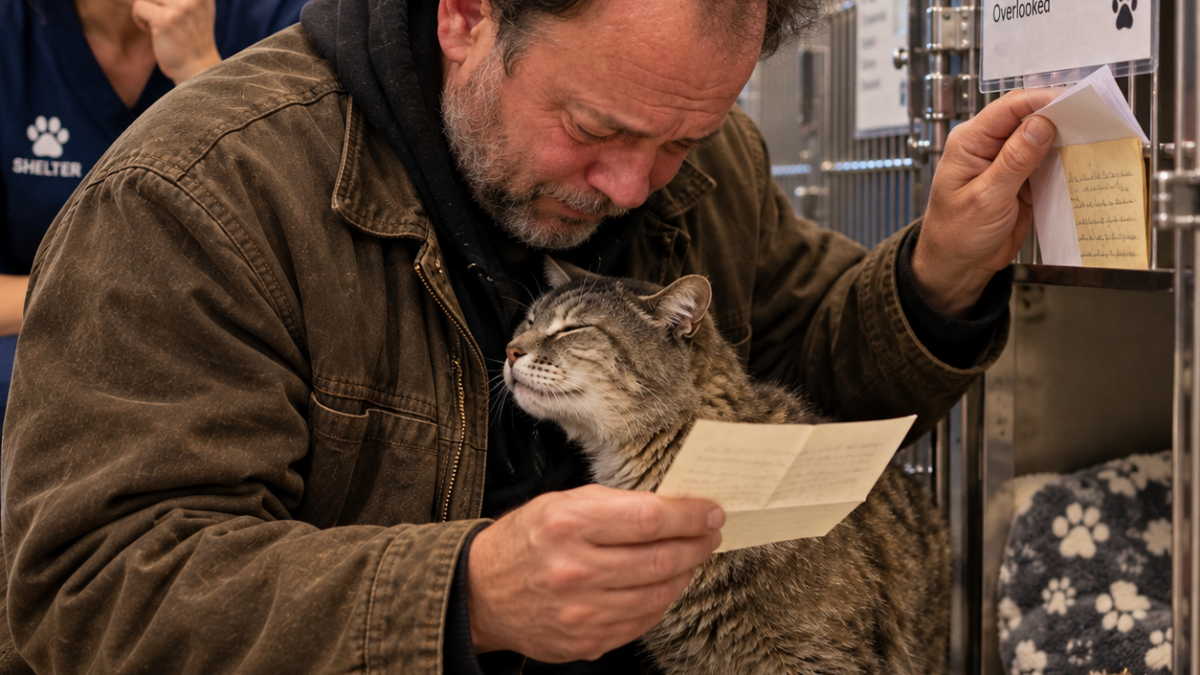
A laminated card hung from the enclosure.
PIE.
17 YEARS.
QUIET HOME PREFERRED.
SENIOR.
SOFT FOOD.
SLOW INTRODUCTIONS.
Then one word handwritten beneath the printed information.
OVERLOOKED.
I looked at Maya.
“Who wrote that?”
She shrugged.
“One of our volunteers.”
“That’s a rough word.”
“It’s accurate.”
“How long?”
“Four months here.”
“Before that?”
“We don’t know everything.”
Pie watched me through the bars.
I asked:
“Does he have health problems?”
“He’s seventeen.”
“That isn’t a diagnosis.”
Maya glanced at me.
“That’s usually enough for people.”
I understood what she meant.
Seventeen does something strange to people’s faces.
They see a cat.
Then the number.
Then suddenly they are calculating.
Vet bills.
Medication.
How long.
How soon.
How badly it will hurt.
They don’t mean to.
I had done it myself with older dogs belonging to friends.
You start with affection.
Then arithmetic.
Pie did not perform for me.
No meowing.
No rubbing against the gate.
No dramatic reaching paw.
He simply sat there like he had decided dignity was one thing nobody could take from him.
I said:
“Can I meet him?”
Maya unlocked the kennel.
Pie hesitated.
Then stepped out.
One paw.
Pause.
Another.
He moved like old animals move.
Economical.
Every step chosen.
He stopped about three feet from me.
Lifted his face.
Looked directly at me.
I expected him to sniff my fingers.
Instead, Pie let out a slow breath.
A sigh.
Not annoyed.
Not frightened.
Relief.
It was the strangest sound.
The kind a person makes after carrying groceries up too many stairs.
Something in my chest tightened.
I dropped to one knee.
Pie came closer.
Slowly.
Then pressed his forehead against my sternum.
No circling.
No rubbing.
He simply leaned.
Weight barely there.
But deliberate.
I put one hand on his back.
His bones were more obvious than I expected.
Maya cleared her throat.
“He does that.”
I looked at her.
“With everyone?”
She shook her head.
“Sometimes.”
“That’s not everyone.”
“No.”
Her voice was not steady anymore.
Pie stayed against me.
That was when I noticed the kennel card.
Something folded behind it.
A corner of paper.
“What is that?”
Maya followed my eyes.
Then looked away.
“Oh.”
“Oh?”
“It came in with him.”
“What is it?”
“A note.”
“From who?”
“We don’t know exactly.”
“Can I see it?”
She hesitated.
Then slipped the paper free.
The folds were soft from being opened repeatedly.
Handwriting shaky.
Only four lines.
If someone chooses him, please tell him he was a good cat.
He didn’t get left behind because he wasn’t lovable.
Life just ran out of room.
Please let him rest where he can be seen.
I read it twice.
Then a third time.
Pie remained pressed against my leg.
“Who wrote this?”
Maya shook her head.
“The person who brought him in didn’t say.”
“Was that his owner?”
“Family member.”
“Owner dead?”
“I can’t give you details.”
“Care facility?”
Her expression told me I had touched something close.
Then she said:
“We don’t share surrender information.”
Fair.
I looked at the note again.
Please tell him he was a good cat.
People write strange things when they are saying goodbye to animals.
Apologies.
Instructions.
Food schedules.
Nicknames.
Sometimes anger.
Sometimes lies that make the person leaving feel better.
This did not feel like any of those.
This felt like somebody who had lost control of a decision and was trying to save one sentence.
I folded it.
“Can I take it if I adopt him?”
Maya looked at me.
“You’re adopting him?”
“That depends.”
“On what?”
“Will you let me?”
Her mouth opened.
Closed.
Then she laughed once.
“Daniel.”
“Yes?”
“You’ve been here twelve minutes.”
“Long enough.”
“You haven’t asked adoption fee.”
“How much?”
“Waived for senior cats.”
“Great.”
“You haven’t asked about veterinary estimates.”
“We’ll do that.”
“You haven’t asked whether he uses the litter box reliably.”
“Does he?”
“Yes.”
“Great.”
“You don’t have other pets?”
“No.”
“Children?”
“Grown daughter. Lives in Denver.”
“Do you travel?”
“Some.”
“Who’s your vet?”
I gave her the name.
She stood there with her keys.
“Why him?”
I looked down.
Pie had now sat on my shoe.
“Because I came here for him.”
Maya’s eyes narrowed.
“You knew him?”
“No.”
“Then what do you mean?”
I had trouble explaining it.
For the past three years, my house had become quieter.
Not tragically.
Nothing cinematic.
My daughter, Lily, had moved west for work.
My mother died after a long illness.
I had divorced fifteen years earlier and remained friendly with my ex-wife, but we had separate lives.
My advertising job had gone remote.
Friends still existed.
Dinner invitations existed.
Weekends existed.
But home had become a place where I could walk from one end to the other without another living thing noticing.
At first I liked it.
Then I got used to it.
Then I stopped distinguishing those two things.
“I wanted someone old,” I said.
Maya frowned.
“Why?”
“Because everybody wants the easy years.”
Pie looked up.
“I figured maybe I could handle the hard ones.”
Maya’s expression changed.
“Don’t romanticize this.”
“I’m not.”
“You might get three years.”
“I know.”
“You might get three months.”
“I know.”
“You could spend a lot of money.”
“I know.”
“You could take him home and discover he doesn’t bond with you.”
“Okay.”
“You might lose him before you feel ready.”
I looked at Pie.
“At seventeen, I don’t think ready is part of the deal.”
Maya sighed.
“Fine.”
She held up one finger.
“Vet first.”
We did the paperwork.
Pie rode home in a carrier on the passenger seat.
At first.
Ten minutes into the drive, he began pawing weakly at the door.
I pulled over.
Opened it.
He stepped onto my lap.
I know.
Not safe.
Not recommended.
But I was parked.
I expected him to crawl toward the floor.
Instead, he curled against my stomach.
When I started driving again, very carefully, he stayed.
At a red light, I looked down.
Thin paws tucked under him.
Eyes half closed.
Engine humming.
He seemed less like a cat being transported somewhere new and more like an old man riding a route he remembered.
When we reached my house, I put the carrier down.
Opened it.
Waited.
Pie stepped out.
Looked around.
Living room.
Hallway.
Stairs.
Kitchen.
No other animals.
No voices.
No metal doors.
He stood still long enough that I began wondering whether he was confused.
Then he walked directly to my legs.
Leaned against my shin.
That was it.
No exploration.
No hiding under the couch.
No sniffing every corner.
Just contact.
It was then I understood how loud an empty house can be.
Pie was barely seven pounds.
But suddenly the place felt occupied.
I remembered the note.
Took it from my coat pocket.
Read it again.
If someone chooses him, please tell him he was a good cat.
I sat on the floor.
Pie stood beside me.
“You were a good cat.”
He blinked.
“Apparently.”
Another blink.
“And whoever wrote this wanted you to know.”
Pie walked toward the couch.
Made one careful jump.
Almost didn’t clear it.
I reached instinctively.
He pulled himself up.
Circled twice.
Lay down.
I sat beside him.
Rested my hand a few inches from his head.
He moved into it.
Closed his eyes.
That was the moment I realized I had not brought home a new pet.
I had brought home an ending.
But that did not make the ending worthless.
That first night, I left a lamp on.
For myself.
Not Pie.
I expected noise.
New cats create noise.
Scratching.
Exploring.
Things falling.
A 2:00 a.m. realization that you’ve made a terrible mistake.
Pie created none of that.
Around 2:17, I woke because I heard tapping.
Very soft.
Tap.
Pause.
Tap.
I went into the hallway.
Pie sat facing the baseboard.
One paw raised.
Tap.
Pause.
Tap.
“What are you doing?”
He turned slowly.
Walked to me.
Leaned against my ankle.
I sat on the floor.
He stayed there until my legs went numb.
The following night:
Same thing.
Not exactly 2:17.
Close.
Wall.
Paw.
Tap.
Tap.
Then he would search for me.
At first I thought cognitive decline.
The vet thought possible age-related behavior.
Maybe confusion.
Maybe old habit.
Maybe hearing something inside the wall.
But something about it felt specific.
He always chose the same location.
Always two taps.
Pause.
Then waited.
In the mornings, he sat at the front window.
Hours.
Not watching birds.
Barely reacted to squirrels.
He watched people.
Cars.
Mail truck.
Neighbor walking her Labrador.
Every movement toward the house.
Then every movement away.
I started noticing how often he looked toward the door while eating.
Three bites.
Look.
Three bites.
Look.
As long as I sat nearby, he continued.
If I went into another room, sometimes he stopped.
That discovery hurt more than I expected.
Pie was not afraid of food disappearing.
He was afraid the person would.
I took him to Dr. Naomi Singh, my veterinarian.
She had treated a Labrador I’d owned years earlier.
She examined Pie slowly.
Heart murmur.
Arthritis.
Kidney values not ideal.
Dental disease.
Weight low but not catastrophic.
No immediate crisis.
“He’s very old.”
“I know.”
“Seventeen is not a diagnosis.”
She smiled.
“You stole my line.”
“Maya said the opposite version.”
Naomi sat down.
“We can make him comfortable.”
“How long?”
She gave me the look every doctor gives when somebody asks for a number nobody owns.
“Could be months.”
“Could be longer?”
“Yes.”
“Shorter?”
“Yes.”
“What do I do?”
“Feed him.”
“Love him.”
“Watch his quality of life.”
“Treat what is reasonable.”
“And don’t turn every day into a countdown.”
That last one landed.
Because I already had.
Day three.
Day four.
Week one.
Every morning Pie woke up, I thought:
Still here.
Which meant I was already imagining:
Not always.
A few days later, I posted one picture online.
Nothing dramatic.
Pie on my couch.
Eyes half closed.
Caption:
He’s 17. He waited a long time. I couldn’t leave him there.
I had maybe eight hundred social-media contacts.
Most people I barely knew.
Within hours the post had traveled.
Friends shared it.
Then strangers.
At first:
Beautiful.
Thank you.
Senior cats deserve love.
Then the debates began.
“Why adopt something that old?”
“Plenty of kittens need homes.”
“You’re setting yourself up for heartbreak.”
“Hope you can afford the vet bills.”
Then:
“This is virtue signaling.”
And finally:
“You just want people to think you’re a hero.”
I sat on the couch reading that one.
Pie was asleep against my thigh.
Hero.
I looked down at him.
He had drooled on my jeans.
Some hero.
I began typing an angry response.
Deleted it.
Started again.
Deleted that too.
Finally wrote:
He’s not a symbol. He’s a cat. He’s tired. He wants to be held without being timed.
Then I turned off notifications.
Pie did not need me proving anything online.
He needed dinner.
The tapping continued.
Two nights later:
Tap.
Tap.
I pressed my ear against the wall.
Nothing.
Pie stared at the baseboard.
Then at me.
“Who are you waiting for?”
His ears moved.
I thought about Maya.
He sat looking at the shelter door for hours.
Something was unfinished.
I went back to the shelter.
Maya was behind the desk.
She saw me.
“Pie okay?”
“Yes.”
“Then why do you look like that?”
“I want to ask about the note.”
Her shoulders dropped.
“I can’t give you surrender details.”
“I know.”
“I mean it.”
“I know.”
I put the note on the desk.
“Tell me what you’re allowed to tell me.”
We went into a small office.
Maya sat.
Stared at the paper.
“I hate this note.”
“Why?”
“Because people think shelter work teaches you that some humans are awful.”
“Doesn’t it?”
“Sometimes.”
She rubbed her forehead.
“Mostly it teaches you that life can corner people.”
I waited.
“Pie came in with a blanket.”
“What kind?”
“Blue.”
“Old.”
“Washed thin.”
“Smelled like fabric softener.”
“Floral.”
“That matter?”
“Maybe.”
“Who brought him?”
Maya hesitated.
“Family.”
“Not his owner?”
Pause.
“No.”
I sat back.
“What happened to the owner?”
“I can’t tell you.”
“Dead?”
“No.”
That was more than she intended to say.
“Hospital?”
She looked irritated.
“Daniel.”
“Sorry.”
She sighed.
“I can tell you this.”
“The person who surrendered him could barely look at him.”
“Cold?”
“No.”
“Then why?”
“They were crying before they walked in.”
Maya stared at the desk.
“Not dramatic crying.”
“The kind where you’re trying very hard not to start.”
“They put the carrier down.”
“Filled out forms.”
“Kept looking straight ahead.”
“Pie didn’t make noise.”
“He just watched them.”
“When they left, he stared at the door for hours.”
My throat tightened.
“Did he try to follow?”
“No.”
“That somehow worse?”
“Yes.”
We sat quietly.
Then Maya said:
“People assume surrender means lack of love.”
“Sometimes it means lack of options.”
“That doesn’t make every surrender responsible.”
“But guilt isn’t evidence of cruelty.”
I put the note away.
“Who wrote it?”
“No signature.”
“The person surrendering?”
“Maybe.”
“Someone else?”
“Maybe.”
“You don’t know?”
“No.”
She gave me a look.
“And I’m not going to let you become a detective.”
“I wasn’t planning—”
“You absolutely were.”
Fair.
I went home.
Pie was at the window.
When I opened the door, he made the smallest sound.
Not a meow.
A chirp.
Then walked to me.
That evening I posted another photograph.
Not the note.
Just Pie.
People responded.
One comment appeared from an account I didn’t recognize.
Then disappeared.
A few minutes later, a private message arrived.
I think that might be my grandfather’s cat.
I stared at it.
Scams happen.
People claim animals.
People are strange.
I did not answer immediately.
Then:
What makes you think that?
Reply came fast.
His name is Pie but Grandpa calls him Professor when Pie sits and stares at him.
My stomach tightened.
I had never posted anything about Pie’s personality except age.
I wrote:
Tell me something else.
A pause.
Then:
He hates tuna but likes the water from the can.
He sleeps against the left side of someone, never the right.
If you tap twice on a bedroom door he taps back underneath it.
I stopped breathing for a second.
Tap.
Tap.
The hallway wall in my house was beside the guest-room door.
At night, Pie had been tapping where the bottom corner of that closed door met the baseboard.
Not confusion.
A ritual.
I typed:
Why is he in a shelter?
The stranger took ten minutes.
Then:
My grandfather fell at home.
Hospital.
Then rehab.
Then assisted care.
Doctors said he couldn’t live alone anymore.
Family cleared the house.
Nobody could take Pie long-term.
I live in an apartment with two dogs and a no-cat lease.
My aunt is allergic.
My mother already has three cats.
We thought the shelter would find him a home.
Grandpa thought Pie was staying with family.
Then:
He still asks for him.
Every week.
I felt anger.
Immediate.
Hot.
You lied to him?
Reply:
Yes.
Then:
I know.
Then:
I hate myself for it.
I put the phone down.
Walked around my kitchen.
Pie sat on a chair.
Watched.
I picked the phone up.
Why didn’t you tell him?
Because when he was in the hospital all he talked about was getting home to Pie.
Then they told us he couldn’t go home.
He stopped eating for a while.
My mother thought telling him about Pie would make it worse.
We kept saying Pie was “with family.”
Then the days became weeks.
We didn’t know how to undo it.
I stared.
A lie created because someone wanted to protect an old man.
Then maintained because admitting the truth became harder.
I wrote:
Who wrote the note?
Long pause.
My grandfather did.
I actually sat down.
How?
He wrote it in the hospital before the care placement.
He thought Pie would go to my aunt temporarily.
He told us if someone else ever had to take him, that note should go too.
Then:
Did the shelter keep it?
Yes.
My hands started shaking.
I asked:
Does your grandfather know someone adopted Pie?
No.
Then:
Can I tell him?
The reply took a minute.
Please.
I called Maya.
She listened.
Said nothing for a while.
Then:
“Do not give anyone your address.”
“I know.”
“Verify identity.”
“I know.”
“Call the facility yourself using a public number.”
“I know.”
“Ask whether they can facilitate.”
“I know.”
“And Daniel?”
“Yes?”
“If it’s real…”
Pause.
“Let them say goodbye.”
Not reunion.
Goodbye.
That word hurt.
I contacted the care facility.
Verified the grandfather’s name.
Arthur Bennett.
Eighty-four.
Former high-school history teacher.
The social worker spoke with his family.
Everything checked out.
They agreed to a visit.
Two days later, I put Pie into his carrier.
The drive took thirty-five minutes.
Pie stayed quiet.
Too quiet.
When we entered the facility, the smell hit me first.
Hand sanitizer.
Laundry.
Coffee.
Old magazines.
The strange warmth of institutional heating.
A woman in her thirties met me near reception.
Sarah.
Arthur’s granddaughter.
The person who had messaged me.
She looked exhausted.
Not villainous.
Not careless.
Just tired.
“Daniel?”
“Yes.”
She looked at the carrier.
Then her face collapsed.
“Oh.”
Pie looked back through the door.
Sarah crouched.
“Hi, Professor.”
Pie stood.
Immediately.
My chest tightened.
No hesitation.
He knew the word.
Sarah covered her mouth.
“I haven’t seen him since the surrender.”
“Why not?”
“I couldn’t.”
Honest.
She looked at me.
“I know how that sounds.”
I didn’t answer.
She stood.
“Grandpa doesn’t know we’re coming.”
“Is that okay?”
“The social worker thinks so.”
“Does he remember clearly?”
“Most days.”
Then:
“He remembers Pie every day.”
We walked down the hallway.
Arthur’s room was near the end.
He sat by a window.
Thin.
Blanket over his knees.
White hair.
Glasses.
He was looking outside.
Sarah stopped before entering.
“You should know something.”
“What?”
“My grandfather thinks he failed him.”
I looked at the carrier.
“He didn’t.”
“He thinks he did.”
We stepped inside.
“Grandpa?”
Arthur turned.
Slowly.
His eyes moved from Sarah.
To me.
To the carrier.
Everything in his face stopped.
“What is that?”
Sarah’s voice shook.
“Grandpa…”
He leaned forward.
“Is that him?”
“Yes.”
I put the carrier on the floor.
Opened it.
Pie stepped out.
For a second he froze.
Then Arthur said:
“Professor.”
Pie moved.
Not fast.
He couldn’t.
But every step suddenly had purpose.
Across the room.
Toward Arthur.
Arthur lowered one trembling hand.
Pie pressed his head into Arthur’s shin.
The old man made a sound I will hear until I die.
Half laugh.
Half sob.
“Oh, buddy.”
He bent over.
His hands went into Pie’s fur.
“Professor.”
Pie pushed closer.
Arthur repeated:
“My boy.”
Then:
“My good boy.”
Pie began purring.
Deep.
Louder than I had ever heard.
Arthur’s face folded.
“You were a good cat.”
Sarah turned away.
I stared at the floor.
Because suddenly I understood the note.
The sentence had not been meant as information.
It had been a message from a man afraid his cat would interpret separation as rejection.
Arthur whispered:
“I’m sorry.”
Again.
Again.
“I’m sorry.”
Pie stayed.
No judgment.
Animals can be brutal that way.
We build entire systems of guilt around ourselves.
They show up and ask whether your hand is still warm.
Arthur looked at Sarah.
“Why didn’t you bring him sooner?”
Sarah froze.
There it was.
The question.
She knelt.
“Grandpa.”
“You said he was with family.”
“He was at a shelter.”
Arthur closed his eyes.
Sarah began crying.
“We thought…”
“What?”
“We thought telling you would make everything worse.”
Arthur’s hand stayed on Pie.
“Worse than what?”
Sarah had no answer.
“I’m sorry.”
Arthur stared at his granddaughter.
She looked like a child.
Not a thirty-three-year-old woman.
A child who had made a decision for an adult and realized the protection had become betrayal.
Arthur looked back at Pie.
Then said quietly:
“Quick doesn’t mean kind.”
No anger.
That somehow hurt more.
Sarah wiped her face.
“I know.”
Arthur shook his head.
“No.”
Then looked at her.
“Now you know.”
Nobody won that conversation.
That matters.
Sarah was not a monster.
Arthur was not wrong.
Pie was not evidence for either side.
Just an old cat sitting between two people who loved him and had hurt each other trying to survive the same loss.
After a while Arthur asked me:
“You took him?”
“Yes.”
“For good?”
“Yes.”
“You know he’s old?”
“I noticed.”
Arthur laughed.
First time.
“He snores.”
“I know.”
“He hates tuna.”
“He likes the juice.”
Arthur smiled.
“You found that out.”
“He taught me.”
Pie climbed awkwardly onto Arthur’s lap.
I helped.
Arthur held him.
“Who are you?”
“Daniel.”
“Why’d you choose him?”
I looked at Pie.
“Because he was the oldest one.”
Arthur blinked.
“You went in asking for old?”
“Yes.”
“What kind of idiot does that?”
Sarah laughed through tears.
I laughed too.
“Apparently me.”
Arthur looked down at Pie.
Then said:
“Thank you.”
Simple.
No speech.
“Thank you for not making his age a reason to walk past him.”
We stayed almost two hours.
Arthur told me about Pie.
Found behind a diner sixteen years earlier.
Barely grown.
Arthur’s wife, Marjorie, had wanted a cat.
Arthur claimed he did not.
Within two days, Pie slept on his chest.
They called him Pie because Marjorie was baking apple pie when he first walked into the kitchen and tried to lick butter from the counter.
“Terrible name.”
“I like it.”
“It was supposed to be temporary.”
“Those are famous last words.”
Arthur smiled.
Marjorie died eight years later.
After that Pie began sleeping on Arthur’s bed.
Left side.
Never right.
Arthur said he would close the bedroom door sometimes while changing clothes.
Two taps from inside.
Pie would tap back from the hallway.
Two.
That was the ritual.
Every night.
Tap.
Tap.
Door opens.
Pie enters.
My hallway.
The baseboard.
2:17.
Pie had not been confused.
He had been knocking.
Waiting for a door that used to open.
That nearly broke me.
Arthur said:
“When I fell, I was on the floor almost six hours.”
“Pie stayed beside me.”
“Wouldn’t leave.”
“When paramedics came, he hid.”
“I kept telling them somebody had to feed him.”
“At the hospital, all I wanted was to go home.”
“But they told me I couldn’t.”
Arthur’s eyes shifted toward Sarah.
“I knew the house would go.”
“I didn’t know he would.”
Sarah started crying again.
Arthur reached for her hand.
That was the first time he touched her.
“I know you were trying.”
She nodded.
“I thought it would be kinder if you believed he was okay.”
Arthur looked at Pie.
“He wasn’t?”
Sarah said:
“He is now.”
Arthur nodded.
“Yes.”
Then looked at me.
“He is.”
When we left, Arthur kissed Pie’s head.
Not dramatic.
One small kiss.
Then whispered:
“Go home.”
Pie looked back from the carrier.
Arthur smiled.
“It’s okay, Professor.”
“Go home.”
The ride back was different.
Pie slept.
Deeply.
No restless shifting.
That night, he ate.
Three bites.
Looked toward me.
I was there.
Finished the bowl.
At 2:17, I woke automatically.
Silence.
I waited.
No tapping.
Got out of bed.
Pie was asleep on the couch.
I stood there like an idiot, staring.
He opened one eye.
Closed it.
No wall.
No waiting.
Something had resolved inside him.
Not magically.
He still searched the front window sometimes.
Still preferred contact.
Still woke confused occasionally.
But he stopped knocking.
I posted an update online.
No names.
No care-facility details.
No photograph of Arthur.
I wrote:
There was more to Pie’s surrender than I knew. His person is alive, elderly, and unable to care for him. They were able to see each other. Nobody in this story is as simple as the internet wants them to be.
Then:
Before you decide someone who surrendered an old pet must be heartless, remember that sometimes life runs out of room before love runs out.
Comments exploded.
Again.
Some people understood.
Others became furious.
“I would live in my car before surrendering my pet.”
Maybe.
“I would break every lease.”
Maybe.
“Family should have taken him.”
They tried.
“Care facilities should allow animals.”
Sometimes they do.
Sometimes they cannot.
“You’re making excuses.”
Maybe compassion sounds like excuses when you already have a villain.
Then people began sharing their own stories.
Cancer.
Eviction.
Domestic violence.
Military deployment.
Parents entering hospice.
Job loss.
A woman surrendered her two dogs after sleeping in her car for three months with them.
A man gave up his cat when his daughter developed a severe allergy and stopped breathing one night.
An elderly woman wrote that she had rehomed her dog after a stroke because she could no longer walk him safely.
Every story contained comments from strangers saying:
I would never.
I started hating those words.
Not because boundaries or responsibility do not matter.
They do.
People abandon animals casually sometimes.
People fail them.
People make selfish choices.
But “I would never” is often spoken by someone whose never has not been tested yet.
Arthur had never planned to fall.
Sarah had never planned to clear her grandfather’s home while deciding what to do with a seventeen-year-old cat.
Nobody plans the day life becomes smaller than the promise they made.
Pie did not need me judging any of them.
He needed arthritis medication.
Warm food.
A heated bed.
My presence.
So I stopped arguing.
I started living with him.
That winter became one of the best winters I can remember.
Nothing extraordinary happened.
That’s the point.
Pie learned the sound of my coffee maker.
Every morning he appeared before I poured the first cup.
He sat beside my left foot while I worked.
Always left.
Never right.
If I moved rooms, eventually he followed.
Not immediately.
He had dignity.
He would wait perhaps thirty seconds so neither of us could pretend he was following.
Then appear.
I bought three expensive beds.
He ignored all of them.
Preferred a folded fleece blanket near the radiator.
I bought premium senior-cat toys.
He liked the cardboard packaging.
I bought stairs so he could reach the couch.
He ignored them for a week.
Then used them when he believed I was not watching.
I began sending Arthur photographs through Sarah.
Pie asleep.
Pie looking angry.
Pie stealing chicken.
Pie sitting in sunlight.
Arthur sent messages back.
Professor still judging people.
Tell him I miss him.
Tell him not to eat plastic.
One afternoon Sarah called.
“Grandpa wants to know if you’ll bring Pie again.”
I did.
Then again a month later.
Those visits became part of our lives.
Arthur weakened.
Pie aged.
Both slower every time.
But when Arthur said “Professor,” Pie still lifted his head.
At the third visit, Arthur asked:
“Do you love him?”
The question caught me.
“Yes.”
Arthur nodded.
“Good.”
Then:
“I was worried.”
“About what?”
“That you’d be kind to him without loving him.”
I understood.
There is a difference.
Care can be duty.
Love is specific.
You begin knowing which ear folds strangely.
Which side he sleeps on.
How many bites before he looks up.
The exact sound of a cough that means nothing.
The sound that means call the vet.
Love makes detail important.
“I love him,” I said.
Arthur relaxed.
“Then I’m done worrying.”
That sentence scared me.
“What does that mean?”
Arthur smiled.
“I’m eighty-four.”
“Don’t turn it into a prophecy.”
He laughed.
“You sound like Sarah.”
Spring arrived.
Pie made it.
Then summer.
People who had commented “Why put yourself through this?” occasionally messaged asking how he was.
Still here, I wrote.
Still here.
Still here.
By then, I had stopped counting days.
Naomi had been right.
A countdown poisons the time it is supposed to measure.
Pie did not know he was seventeen.
Then eighteen.
He knew breakfast.
Sunlight.
My lap.
Arthur’s voice.
The mail slot.
Warm blankets.
That was enough.
One evening in August, Pie did not finish dinner.
The next morning he ate almost nothing.
By afternoon:
Vet.
Bloodwork.
Kidneys worse.
Weight down.
Naomi sat with me.
“We can adjust.”
“For how long?”
She shook her head.
“Daniel.”
“I know.”
We tried.
Fluids.
Medication.
Special food.
For a while he rallied.
Then declined again.
I called Sarah.
She was quiet.
“I’ll tell Grandpa.”
“Is he okay?”
“No.”
That answer was immediate.
My stomach tightened.
“What’s happening?”
“He’s declining too.”
Arthur had been hospitalized twice.
Heart failure.
Back at facility under hospice care.
Life has a cruel sense of symmetry.
I brought Pie one final time.
He was weaker.
So was Arthur.
When we entered, Arthur barely opened his eyes.
Sarah leaned toward him.
“Grandpa.”
No response.
Then I opened the carrier.
Pie made a small chirp.
Arthur’s eyes opened.
“Professor?”
Barely audible.
I put Pie on the bed beside his arm.
Pie settled.
Arthur’s fingers moved into his fur.
For twenty minutes, nobody spoke.
The room contained machines.
Breathing.
Soft traffic outside.
Then Arthur whispered:
“He looks old.”
I laughed.
“So do you.”
He smiled.
“Good.”
A few minutes later:
“Daniel?”
“Yes.”
“Don’t keep him because of me.”
I knew immediately what he meant.
“When it’s time.”
My throat closed.
“I know.”
“Promise.”
“I looked at Pie.”
“I promise.”
Arthur nodded.
“Being good to him doesn’t mean making him stay.”
That sentence stayed with me.
Arthur died four days later.
Sarah called.
I sat at my kitchen table with Pie asleep beside me.
“Was it peaceful?”
“Yes.”
“Did he ask about Pie?”
“The last afternoon.”
“What did he say?”
Sarah cried.
Then:
“He said, ‘Professor went home.’”
I couldn’t speak.
We arranged something small.
Sarah asked whether she could have a copy of Pie’s original note.
I gave her the original.
It belonged to Arthur.
I kept a photograph.
Two weeks after Arthur died, Pie stopped getting up for the window.
Then the radiator.
Then food.
Naomi came to the house.
I wanted that.
No carrier.
No fluorescent clinic.
Pie lay on his fleece blanket.
Left side against my leg.
I told him everything I could think of.
Arthur loved you.
You were a good cat.
You did nothing wrong.
You were not left because you were unlovable.
You were chosen.
You were seen.
You were home.
Maybe he understood none of it.
Maybe animals understand tone and touch and nothing more.
That was enough.
He died with my hand on his head.
Quietly.
At home.
Not in a metal enclosure.
Not waiting at a door.
Afterward, the house became unbearable.
Not because Pie had been loud.
He hadn’t.
Because presence has weight.
You do not notice it until it disappears.
His bowl.
Fleece blanket.
Little stairs.
Medication bottles.
Cardboard box.
The indentation on the couch.
I had known him less than a year.
That fact embarrassed me for about five minutes.
Then I stopped.
Time does not decide whether grief is legitimate.
Specificity does.
I missed him specifically.
His two taps.
His left-side sleeping.
His stare.
His slow breath.
His habit of looking up after three bites.
The way he leaned instead of rubbing.
The sound of his old purr.
A week after he died, Sarah came over.
She brought a box.
Inside:
Arthur’s old blue blanket.
The one Pie had surrendered with.
“I found it in storage.”
She said.
“I thought you should have it.”
I held it.
Faded.
Washed nearly transparent.
Floral smell long gone.
Sarah sat on the couch.
For a while neither of us talked.
Then she said:
“I still feel guilty.”
“For surrendering him?”
“Yes.”
“You should feel some guilt.”
She looked shocked.
I smiled sadly.
“I’m not going to tell you none of it mattered.”
She nodded.
“Thank you.”
“But guilt doesn’t have to be the only thing you keep.”
“What else?”
“You came back.”
She looked down.
“Too late.”
“For some things.”
“Yes.”
“But Arthur saw him.”
“Pie saw Arthur.”
“You told the truth.”
“Eventually.”
“Eventually is not nothing.”
Sarah cried quietly.
“My mother still won’t talk about it.”
“Maybe someday.”
“She keeps saying we did what we could.”
“Did you?”
Sarah thought.
“Not at first.”
That honesty mattered.
“We did what was easiest.”
Then:
“Later we tried to do what was kind.”
I nodded.
“That’s probably the most human sentence anyone has said in this whole mess.”
A month later, Maya called.
I almost didn’t answer.
“Daniel.”
“No.”
She laughed.
“You don’t know what I’m asking.”
“Yes I do.”
“You absolutely don’t.”
“You have an old cat.”
Silence.
Then:
“I hate you.”
“How old?”
“Fourteen.”
“No.”
“Why?”
“Too young.”
Maya burst out laughing.
I did too.
That was the first time laughter in the house did not feel wrong.
I did not adopt that cat.
Not that day.
I needed time.
That’s another lesson Pie taught me.
Love does not require replacing what died.
Grief is not an empty slot demanding immediate filling.
Months later, I returned to the shelter.
Same hallway.
Same bright rooms.
Kittens.
Friendly cats.
Hopeful noise.
Maya watched me from the desk.
“Don’t say it.”
“I haven’t said anything.”
“I know your face.”
We walked.
This time I knew the route.
At the end was a sixteen-year-old gray female named Bernice.
Tiny.
Angry.
One eye cloudy.
Missing three teeth.
When Maya opened the enclosure, Bernice hissed at me.
I smiled.
“Perfect.”
Maya groaned.
“You have become a problem.”
Bernice did not lean into my chest.
She bit my sleeve.
Different animal.
Different story.
That mattered too.
I did not adopt her because she was another Pie.
She wasn’t.
I adopted her because she was Bernice.
And old.
And waiting.
People sometimes ask whether I would do it again knowing how badly losing Pie hurt.
That question surprises me.
Because it assumes grief invalidates love.
As if the sadness afterward proves the joy before it was a mistake.
Would I rather have avoided the pain?
Sure.
Would I trade away Pie to avoid it?
Never.
That is the bargain we keep pretending we can negotiate.
Love without loss.
Aging without decline.
Attachment without fear.
Relationships without endings.
There is no contract like that.
Pie did not need me to rescue him from death.
Nobody could.
He needed someone to rescue his remaining days from invisibility.
There is a difference.
Death is biological.
Disappearing is social.
You disappear when people stop saying your name.
When nobody notices your habits.
When the final chapter happens under fluorescent light while strangers walk past.
Pie was never going to live forever.
Neither was Arthur.
Neither am I.
The victory was never duration.
It was witness.
Arthur got to say:
You were a good cat.
Pie got to hear his old nickname again.
Sarah got to stop hiding behind a lie.
I got to discover that my quiet house had not been peaceful.
Only empty.
Pie changed that with seven pounds of old bones and stubborn loyalty.
Sometimes I still wake near two in the morning.
I listen.
No tapping.
Bernice snores like a chainsaw from the couch.
I smile.
On my desk sits a framed copy of Arthur’s note.
Not because I enjoy sadness.
Because one line has become a rule for how I want to live.
Please let him rest where he can be seen.
Not just cats.
People too.
Old neighbors.
Parents.
Friends who stopped being entertaining.
Animals who no longer photograph well.
Anyone whose value has become less obvious because time changed their body.
We live in a culture that loves beginnings.
New relationships.
New houses.
New pets.
New babies.
New jobs.
Everything new arrives covered in possibility.
Old things arrive carrying evidence.
Scars.
Medical histories.
Loss.
Habits you did not create.
Shorter futures.
We call that baggage.
Pie taught me another word.
History.
History does not make something less worthy.
It makes your time with it more specific.
A kitten offers possibility.
A seventeen-year-old cat offers truth.
The truth is that there may not be much time.
The truth is that love may hurt soon.
The truth is you cannot pretend the ending is far away.
And maybe that is why senior animals frighten people.
They remove one of our favorite illusions.
Later.
We’ll love later.
We’ll visit later.
We’ll make time later.
We’ll say the important thing later.
Pie arrived already standing inside later.
There was no room for delay.
Feed him now.
Sit with him now.
Take the picture now.
Bring him to Arthur now.
Say he was good now.
That urgency did not make our relationship tragic.
It made it honest.
Months after Bernice came home, Maya sent me a photograph from the shelter.
A seventeen-year-old black cat had been adopted by a young couple.
Caption:
LOOK WHAT YOU STARTED.
I replied:
Not me.
Then thought about it.
Maybe Pie.
Maybe Arthur.
Maybe the note.
Maybe every person who shared a messy surrender story instead of hiding.
Kindness spreads strangely.
Not as clean inspiration.
More like permission.
Someone sees a person choose the old cat and thinks:
Maybe I can too.
Someone hears that surrender does not always equal cruelty and thinks:
Maybe I can tell the truth about what happened to me.
Someone realizes apology does not erase harm but can still matter.
Someone visits a parent.
Someone calls a shelter.
Someone sits beside something frightened instead of choosing the easier room.
Pie never knew any of that.
He was a cat.
He wanted food.
Warmth.
Contact.
Arthur.
Then me.
That simplicity is part of why his story mattered.
Humans turn love into philosophy.
Animals often reduce it to presence.
Are you here?
Yes.
Will you still be here when I look again?
Yes.
Can I sleep?
Yes.
That is most of what Pie ever asked.
The night before his final vet visit, I slept on the living-room floor beside him.
He woke around 2:00.
Lifted his head.
Looked toward the hallway.
For one terrifying second I expected him to stand.
Walk to that old tapping spot.
Wait for Arthur.
He didn’t.
He turned toward me.
Moved his paw.
Touched my hand.
Once.
Then rested.
No question left.
Sometimes I wonder what would have happened if I had entered the shelter and asked for a kitten.
Nothing bad.
Some kitten would have gotten a good home.
I would have loved it.
Life would have continued.
But I would never have met Pie.
Never met Arthur.
Never understood Sarah.
Never learned the difference between being abandoned and being caught in somebody else’s impossible decision.
Never learned that an ending can still contain a beginning for the person who stays.
People still ask why I choose senior cats now.
I usually give a joke.
“They’re less likely to climb curtains.”
Not always true.
Bernice once managed to knock over a lamp out of pure spite.
But the real answer is harder.
I choose them because they have already spent enough time being measured by what is left.
Years left.
Teeth left.
Kidney function left.
Energy left.
Marketability left.
I want, for however long I get them, to measure something else.
How warm is the sun today?
Did she eat breakfast?
Did he purr?
Did somebody say his name?
Did someone notice when he walked into the room?
Did he know where home was tonight?
That is enough.
More than enough.
I once thought adopting Pie meant I was volunteering for grief.
I was.
But grief was not the main thing I received.
I received ordinary mornings.
An old cat leaning against my leg.
A ridiculous tapping ritual.
A stranger’s trust.
Arthur laughing.
A care-facility room where three generations of people finally told the truth.
A quiet animal sleeping without watching the door.
Grief came at the end.
Love occupied everything before it.
That seems like a fair trade.
If you had shown me Pie’s final day before I adopted him, maybe I would have been scared.
If you had shown me the vet bills, the medication, the sleepless nights, the care-facility visit, Arthur dying, Pie weakening, maybe some practical part of me would have asked whether all of it was worth choosing on purpose.
But life does not usually show us the whole story before we say yes.
Thank God.
Because sometimes knowing the ending makes cowards out of people who would have been brave enough for the middle.
Pie deserved the middle.
He deserved the couch.
The radiator.
Arthur saying Professor.
My hand beside his food bowl.
The blue blanket.
The sunlight.
The final night.
He deserved to be more than seventeen.
More than senior.
More than overlooked.
More than a calculation.
He deserved to be Pie.
And in the end, that is what the note had really asked.
Not save him forever.
Not erase what happened.
Not make the world fair.
Just this:
See him.
Tell him he was good.
Let him rest somewhere that knows his name.
I did.
And somehow, while I was doing that for him, Pie did the same thing for me.

