I Abandoned My 6-Year-Old Daughter During Leukemia Treatment—Eight Months Later, I Found a Biker Had Visited Her Every Day and She Called Him Grandpa.
I Abandoned My 6-Year-Old Daughter During Leukemia Treatment—Eight Months Later, I Found a Biker Had Visited Her Every Day and She Called Him Grandpa.
I walked out of the hospital after promising my six-year-old daughter I was only going downstairs for ice cream, and for eight months I let her believe the person she trusted most in the world had simply chosen not to come back.
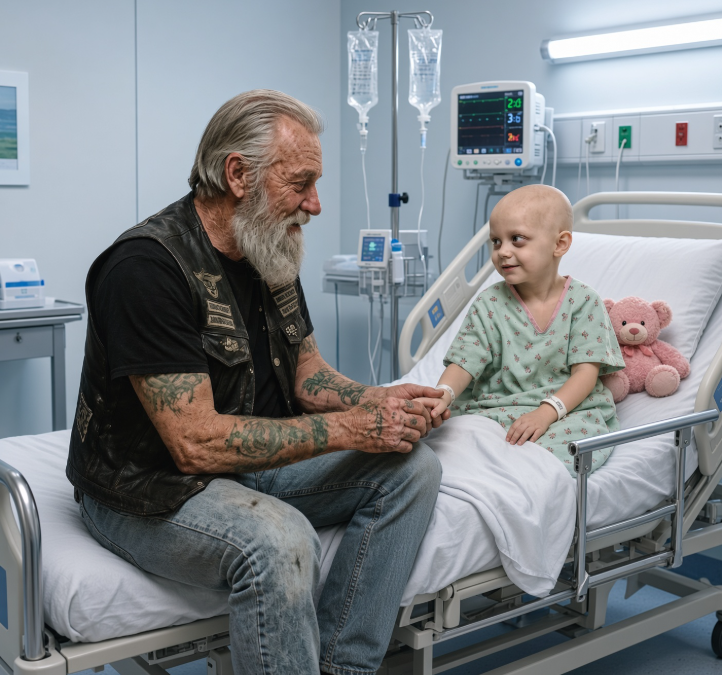
When I finally returned expecting to find an empty room—or a grave—I heard Lily laughing with a gray-bearded biker everyone on the pediatric floor called Grandpa Thomas, the stranger who had held her through every fever, every nightmare, and every night she cried for me.
Then I learned Thomas had once failed his own dying granddaughter in a way he could never repair, and he had spent seven months keeping my daughter alive because he refused to let another little girl die believing her family had abandoned her.
My name is Rebecca Hayes.
There are things a mother is supposed to say when she tells you her child had cancer.
I fought.
I stayed strong.
I never left her side.
I would have traded places with her if I could.
Some of those things are true about me.
One isn’t.
I left.
Not metaphorically.
Not emotionally.
Not because I had to go work for a few hours or sleep in another room.
I walked out of St. Catherine Children’s Hospital in Cleveland on a Wednesday night and did not come back for eight months.
My daughter Lily was six.
She had leukemia.
And the last thing I said to her before abandoning her was:
“Mommy’s going downstairs for ice cream. I’ll be right back.”
She smiled.
That smile is what followed me.
Not the cancer.
Not the hospital.
Not the chemo.
The smile.
Lily had a way of smiling with her entire face.
Big blue eyes.
Tiny dimple on the right side.
Two missing bottom teeth.
PART2:
At four years old, before leukemia, she smiled like every good thing in the world had personally introduced itself.
After chemotherapy, the smile became smaller.
More tired.
But it was still hers.
That night she wore a pink knit cap because most of her blond hair had fallen out.
A nurse had given her the cap.
There was a white pom-pom on top.
Lily hated it at first because she said it made her look like “a baby snowman.”
Then a boy down the hall told her it looked cool.
She never complained again.
“Chocolate,” she told me.
“What?”
“Ice cream.”
“Oh.”
“Chocolate.”
“You always pick strawberry.”
“I changed.”
“You’re six.”
“I can change.”
I smiled.
“Chocolate.”
“And sprinkles.”
“Bossy.”
She grinned.
“Mommy.”
“What?”
“Hurry back.”
Those were the words.
Hurry back.
I kissed her forehead.
Walked out.
Passed the nurses’ station.
Turned left.
PART3:
Took the elevator down four floors.
I remember every detail because guilt preserves things ordinary memory throws away.
There was a man in the elevator carrying balloons.
One said IT’S A BOY.
A woman in blue scrubs was eating crackers from a vending-machine package.
The elevator stopped on three.
Then two.
Then lobby.
I stepped out.
The hospital gift shop was closing.
The coffee kiosk still had two people in line.
Outside the sliding doors, snow had begun falling.
I stood there.
I should have turned toward the cafeteria.
Instead, I walked through the doors.
Cold hit my face.
I kept walking.
Across the parking lot.
Across East 93rd.
Past a pharmacy.
Past a bus shelter.
Every step should have been the one where I stopped.
None was.
At the bus station, I bought a ticket with forty-three dollars left in my checking account.
I did not choose the destination because it meant anything.
Pittsburgh.
That bus left first.
I sat in the back.
My phone rang eleven times before we reached the interstate.
Hospital.
Hospital.
Unknown number.
My sister Megan.
Hospital again.
Then a voicemail notification.
Then another.
I turned the phone off.
That is what I did.
I turned off the only device through which my six-year-old daughter could ask where I was.
People hear that part and want an explanation capable of transforming it into something less monstrous.
There isn’t one.
But there is a road that led there.
It began two years earlier.
Lily was four when she stopped wanting breakfast.
At first I thought she was being difficult.
She had always eaten pancakes.
Suddenly she pushed them away.
Then she started getting bruises.
Small ones on her knees.
Then arms.
One on her back that I couldn’t explain.
She was tired.
Not sleepy.
Different.
She would play for ten minutes and then lie down on the floor.
I took her to our pediatrician.
Blood work.
They called us back before we even reached home.
When the doctor said the word leukemia, I stared at his mouth.
I remember thinking his lips looked dry.
Isn’t that stupid?
Your child has cancer and you notice lip balm.
He kept talking.
Acute lymphoblastic leukemia.
Common childhood leukemia.
Treatment protocols.
High survival rates.
Chemotherapy.
Bone marrow.
Hospitalization.
Words.
So many words.
I understood one.
Cancer.
My husband, Aaron, was beside me.
He took my hand.
For two months, we functioned as a team.
Then Aaron started disappearing.
Not physically at first.
He stayed at work later.
Took longer drives.
Sat in the parking garage before coming upstairs.
One night I found him crying in the hospital stairwell.
I sat beside him.
He said:
“I can’t watch this.”
I told him:
“Neither can I.”
But there was a difference.
I watched anyway.
Aaron didn’t.
Four months after Lily’s diagnosis, he moved out.
He said he needed time.
I said our daughter didn’t have time.
He said I was cruel.
I told him to go to hell.
He went to Indianapolis.
A new job.
Eventually a new woman.
Support payments came inconsistently.
Calls to Lily came less.
Then stopped.
One abandonment should have taught me something.
Instead, eventually, I repeated it.
I worked mornings at a grocery distribution office and evenings cleaning rooms at a hotel.
Hospital bills accumulated anyway.
Insurance covered treatment.
Not life.
Parking.
Food.
Medication copays.
Utilities.
Rent when I missed shifts.
Everything outside the disease became another disease.
I sold my engagement ring.
Then television.
Then furniture.
Then car.
The landlord gave me three months before filing eviction.
I was grateful.
We lost the apartment while Lily was admitted for an infection.
I packed our lives into storage tubs and put them in Megan’s garage.
Lily asked:
“When I come home, where are we going?”
I said:
“Somewhere new.”
She thought it was an adventure.
Children will help you lie to yourself if you let them.
By then I slept in a chair beside her bed most nights.
I held the basin when she vomited.
Wiped her mouth.
Counted pills.
Learned central-line care.
Learned lab values.
Learned which beep meant a nurse would come running.
Learned how to smile when doctors entered.
Learned how to cry in bathrooms without making noise.
People called me strong.
I began hating the word.
Strong meant:
Keep going because no one else is coming.
Strong meant:
We know this is unbearable, but here are more forms.
Strong meant:
Your child needs you, therefore you are not allowed to collapse.
I collapsed anyway.
Quietly.
The week before I left, Lily developed another infection.
Fever.
Antibiotics.
Isolation precautions.
She cried because she wanted to see a therapy dog and couldn’t.
I hadn’t slept more than three hours at a time in months.
A hospital social worker named Diane came to see me.
She said:
“Rebecca, I’m worried about you.”
I laughed.
Not because it was funny.
“What are you going to do?”
“I want to talk about support.”
“I need money.”
“We can look at assistance.”
“I already did.”
“Respite care?”
“She’s in a hospital.”
“I mean for you.”
“I’m fine.”
“You’re not.”
That offended me.
Because she was right.
“I said I’m fine.”
Diane lowered her voice.
“You haven’t eaten today.”
“I’m not hungry.”
“You told the nurse you haven’t slept.”
“Parents don’t sleep here.”
“You had a panic attack yesterday.”
“I had trouble breathing.”
“That was a panic attack.”
I stood.
“I don’t have time to have a mental breakdown.”
Diane said something I hated for months afterward because it followed me.
“You don’t get to schedule one.”
I walked out.
Three days later, I left Lily.
I did not plan it.
That matters less than people think.
Impulsive cruelty still hurts.
I was supposed to buy ice cream.
Instead I found myself outside.
Then at bus station.
Then another state.
By the time the bus reached Pittsburgh, my phone battery had died.
I bought a cheap motel room.
Slept fourteen hours.
When I woke, sunlight filled the room.
For one beautiful second, I didn’t remember.
Then I did.
I vomited in the sink.
I should have called.
That moment.
That morning.
I should have.
Instead I became afraid of what the call would contain.
Police?
Hospital administration?
My sister screaming?
Lily crying?
The longer I waited, the harder calling became.
Shame behaves like debt.
It accrues interest.
One day becomes two.
Two becomes a week.
At one week, going back means admitting you stayed away a week.
At a month, it means admitting a month.
Eventually shame convinces you that returning would only cause more damage.
I traveled to Columbus.
Then Louisville.
Then ended up outside Nashville.
I got a waitressing job at a twenty-four-hour diner using an address from a women’s shelter.
The manager, Carla, asked no questions beyond what payroll required.
I rented a room from an older woman named Helen Price.
Helen knew I was running from something.
She thought boyfriend.
I let her.
Every night, I dreamed about Lily.
Sometimes she was still six.
Sometimes older.
Sometimes dead.
The worst dream was always ordinary.
I’d walk into her room.
She’d look at me.
Then turn her face toward the wall.
No screaming.
No forgiveness.
Nothing.
I started therapy because Helen threatened to throw me out if I didn’t stop crying in her kitchen at three in the morning.
Her wording was:
“You’re waking my cat.”
The therapist was Dr. Amara Lewis.
First session she asked:
“What happened?”
I told her:
“My daughter has cancer.”
Then:
“I left her.”
Amara stopped writing.
“How long ago?”
“Six weeks.”
“Where is she?”
“Hospital.”
“Who is caring for her?”
“Doctors.”
“Family?”
“My sister maybe.”
“Have you spoken to them?”
“No.”
“Rebecca.”
“I know.”
“You need to contact the hospital.”
“I can’t.”
“You can.”
“No.”
“What are you afraid they’ll say?”
“That she died.”
Amara’s face softened.
“And if she hasn’t?”
That question terrified me more.
If Lily had died, I would become the worst thing I already believed I was.
If she lived, I might have to face her.
I preferred punishment I could imagine over forgiveness I did not deserve.
Therapy did not magically make me brave.
I lied sometimes.
Skipped sessions.
Returned.
Saved money.
Stopped drinking after a two-week period when two glasses of wine each night became four.
Changed jobs to a breakfast restaurant with better tips.
Opened a savings account labeled LILY.
At first twenty dollars.
Then fifty.
Eventually nearly four thousand.
Absurd compared with medical debt.
But it was movement.
Eight months passed.
Then on a Tuesday in May, I woke and knew I had reached the point where not knowing was worse than knowing.
I sat on the edge of my bed at Helen’s house.
Dialed St. Catherine.
Hung up.
Dialed again.
Automated menu.
Pediatric oncology.
Transfer.
A nurse answered.
“Pediatric oncology, this is Maria.”
My mouth stopped working.
“Hello?”
“I’m…”
Nothing.
Maria waited.
“My daughter.”
“Yes?”
“Lily Hayes.”
There was a pause.
“What is your relationship to Lily?”
“I’m her mother.”
Another pause.
Longer.
Her voice changed.
Not cruel.
Guarded.
“Rebecca Hayes?”
“Yes.”
Silence.
Then:
“Can I place you on hold?”
I thought she was calling police.
Maybe social services.
Maybe everyone.
Instead she returned three minutes later.
“Lily is still a patient with us intermittently, but she’s doing very well.”
I did not understand.
“What?”
“She’s in remission.”
The room tilted.
I gripped mattress.
“Remission?”
“Yes.”
“Alive?”
The nurse inhaled.
“Yes, Ms. Hayes.”
I started sobbing.
Maria waited.
Then she said:
“You should know there have been major changes in Lily’s guardianship and care arrangements.”
My stomach turned.
“Is she in foster care?”
“Her medical team and social services have been involved.”
“Can I speak to her?”
“I can’t arrange that immediately.”
“Does she hate me?”
Maria went silent.
I regretted asking.
Then:
“She misses you.”
Present tense.
Misses.
I covered my mouth.
Maria continued:
“There’s someone else you should know about.”
“What?”
“A volunteer.”
“His name is Thomas Crawford.”
“Who?”
“He’s been visiting Lily almost every day for about seven months.”
“A volunteer?”
“Yes.”
“Why?”
Maria’s voice softened.
“Because she needed someone.”
That sentence landed exactly where it should.
I drove back to Ohio two days later.
I could have taken a bus.
I rented a small car because I needed the ability to pull over.
I did.
Four times.
At a rest area outside Lexington, I nearly turned around.
At Cincinnati, I cried so hard I missed the exit.
By the time Cleveland appeared, my hands hurt from gripping steering wheel.
St. Catherine looked exactly the same.
That offended me.
Buildings should change when your life does.
The parking garage smelled the same.
Elevator buttons.
Lobby.
Gift shop.
The ice cream counter.
Still there.
I stopped.
Eight months earlier, I had promised chocolate with sprinkles.
I bought one.
It melted in my hand while I rode the elevator.
Fourth floor.
The nurses’ station went quiet when I approached.
Not completely.
Hospitals never go completely quiet.
Phones.
Monitors.
Wheels.
But the woman at desk looked up.
Recognized my name after I gave it.
Her expression hardened.
“Rebecca Hayes?”
“Yes.”
She picked up phone.
Spoke quietly.
Then:
“Room 412.”
I swallowed.
“Can I…”
“What?”
“Is she alone?”
The nurse looked at me.
“Someone’s with her.”
Thomas.
I knew before she said it.
My legs trembled all the way down hall.
Door cracked.
I heard laughter.
Lily.
I had forgotten the exact sound.
That is one of the ugliest things I can admit.
Eight months is long enough for memory to blur even what you love most.
Her laugh stopped me.
Bright.
Breathless.
Alive.
I looked through opening.
A man sat beside bed.
Maybe sixty-one or sixty-two.
Long gray beard.
Broad shoulders.
Black T-shirt.
Worn leather vest over chair.
Blue jeans.
Boots.
His arms were tattooed.
One forearm bore faded military ink.
A motorcycle helmet sat on windowsill.
He was holding Lily’s hand.
Lily looked different.
Older.
Not by years.
By illness.
Hair growing back in blond fuzz.
Cheeks fuller than I expected.
Eyes still enormous.
Thomas asked:
“What do you call a bear with no teeth?”
Lily grinned.
“What?”
“A gummy bear.”
She laughed.
Snorted.
Covered her mouth.
“Grandpa Thomas!”
“What?”
“That’s stupid.”
“You laughed.”
“Because it’s stupid.”
“Still counts.”
She squeezed his hand.
He smiled.
His entire face changed.
The man looked intimidating until he smiled at her.
Then he looked exactly like what she called him.
Grandpa.
My knees nearly gave.
A nurse stepped beside me.
Maria.
I recognized voice.
“You came.”
I nodded.
Couldn’t speak.
Maria looked through door.
“That’s Thomas Crawford.”
“Who is he?”
“Retired mechanic.”
“Army veteran.”
“Volunteers through a pediatric support program.”
“Why her?”
Maria looked at me.
There are moments when somebody decides whether kindness means softening truth.
Maria did not.
“After you disappeared, Lily stopped eating.”
I closed my eyes.
“Don’t.”
“You came back.”
“So you need to know.”
I forced myself to look.
“She asked for you constantly.”
“Every elevator ding.”
“Every cart in hall.”
“She thought you were bringing ice cream.”
My stomach folded.
“She waited until almost midnight.”
“At first we told her maybe you had an emergency.”
“Then police couldn’t find you.”
“Your sister couldn’t take full guardianship because of her own family and health issues.”
“Social work stepped in.”
“Lily shut down.”
“What does that mean?”
“She stopped talking unless medically necessary.”
“She barely ate.”
“She refused play therapy.”
“Wouldn’t watch cartoons.”
“Wouldn’t talk to other children.”
“We were treating leukemia and watching grief make everything harder.”
I whispered:
“Oh God.”
“Thomas had already been volunteering on the floor.”
“He usually visited kids with no regular family.”
“Or families who needed breaks.”
“One afternoon he walked into Lily’s room.”
Maria looked through door.
“She spoke to him.”
“What did she say?”
“Asked if he was her grandpa.”
I cried.
Maria continued more gently.
“He came back next day.”
“And next.”
“Eventually every day he could.”
“Does she…”
I couldn’t finish.
Maria knew.
“She drew family picture last week.”
“Thomas was in it.”
“Was I?”
Maria looked at me.
“No.”
The word entered clean.
No cushion.
Good.
I deserved clean.
Inside, Thomas opened a book.
Lily settled.
“Don’t fall asleep.”
he said.
“We have six pages.”
“You said seven.”
“I was hoping you couldn’t count.”
“I’m six, not dumb.”
“My mistake.”
He read.
His voice was rough.
Gentle anyway.
Halfway through, Lily interrupted.
“Grandpa Thomas?”
“Hm?”
“You’ll be here tomorrow?”
“Yes.”
“Promise?”
“Promise.”
“You always promise.”
“And?”
“You always come.”
Something inside me tore.
Thomas looked down at her.
“I do my best.”
“You never leave.”
Lily went quiet.
Thomas knew where sentence was going.
So did I.
She whispered:
“Not like…”
Then stopped.
He placed one hand over hers.
“Hey.”
She looked up.
“Some people get scared.”
“Really scared.”
“And sometimes scared people do things they’re ashamed of.”
“Doesn’t always mean they stopped loving you.”
Lily’s eyes filled.
“Do you think Mommy is ashamed?”
Thomas’ expression changed.
I saw pain there.
Personal.
Old.
“I think your mommy thinks about you every day.”
“How do you know?”
“I don’t.”
“Then why say it?”
Thomas considered.
“Because I know something about messing up.”
Lily waited.
“And I know when people love somebody, mistakes don’t make love disappear.”
She whispered:
“What if she never comes back?”
Thomas inhaled.
“Then you’ve still got me.”
“For how long?”
“As long as you’ll have me.”
“Forever?”
He smiled.
“That’s a dangerous contract.”
“Forever.”
“Okay.”
Lily relaxed.
“I love you, Grandpa Thomas.”
Thomas looked away toward window.
His eyes shone.
“Love you too, princess.”
“How much?”
“More than all the motorcycles in Ohio.”
“That’s a lot.”
“Exactly.”
I made a sound.
Maybe sob.
Maybe breath.
Thomas looked toward door.
Our eyes met.
He knew.
Immediately.
No surprise.
No question.
Just recognition.
He closed the book.
Waited until Lily’s eyes shut.
Then carefully removed his hand.
He stood.
Walked into hall.
Pulled door almost closed.
Up close he was bigger.
Six-two maybe.
Gray beard.
Weathered face.
Eyes tired.
He looked at me.
“You’re Rebecca.”
Not accusation.
I nodded.
“She has your eyes.”
That kindness destroyed me.
“Why?”
Thomas leaned against wall.
“Why what?”
“Why did you stay?”
He said nothing.
“She’s not yours.”
The second it left my mouth, I hated it.
Thomas did not react.
“No.”
“Then why?”
He studied the floor.
“I had a granddaughter.”
My breath slowed.
“Emma.”
“Died three years ago.”
“Leukemia.”
I looked at him.
“Six?”
“Seven.”
“Diagnosed at five.”
His mouth tightened.
“Blond.”
“Blue eyes.”
“Loved terrible jokes.”
He smiled once.
Then it disappeared.
“My daughter, Claire, and I had problems before Emma got sick.”
“What kind?”
“Kind families collect over years.”
“I drank too much after my wife died.”
“Missed things.”
“Birthdays.”
“Promises.”
“Sobriety lasted.”
“Trust didn’t.”
“When Emma got sick, I tried to come back into their lives like illness erased history.”
“Claire didn’t want me there.”
Thomas swallowed.
“I got angry.”
“Made it about me.”
“Said things.”
“She told me not to come back.”
“I didn’t.”
“For how long?”
“Five months.”
He looked at me.
“Emma died during month five.”
My hand flew to my mouth.
“I wasn’t there.”
“Claire didn’t call until afterward.”
“She said Emma asked for me near end.”
His eyes filled.
“I missed funeral.”
“Claire didn’t want me there.”
“I respected that.”
“Too late to respect anything else.”
He rubbed one hand over beard.
“After that, I started volunteering.”
“At first because I thought suffering might be useful if I could sit beside somebody else.”
“Then I learned kids don’t care about your redemption story.”
“They want snacks.”
“Cards.”
“Someone to read same book nine times.”
He looked through door.
“Lily asked if I was her grandpa.”
“What did you say?”
“The truth.”
“No.”
“Then she asked if I could pretend.”
Thomas smiled.
“I said sure.”
“Thought it would be one afternoon.”
“It wasn’t.”
I whispered:
“Why did you tell her I loved her?”
Thomas looked at me sharply.
“Because she needed to hear it.”
“But you didn’t know.”
“No.”
“What if I didn’t?”
His voice changed.
Firm.
“Then I would’ve lied.”
I flinched.
Thomas continued:
“Six-year-old child fighting cancer doesn’t need to believe her mother disappeared because she wasn’t worth staying for.”
Tears blurred him.
“She cried every night.”
“I know.”
“No.”
His voice softened again.
“You don’t.”
“She would ask me what she did wrong.”
I covered my face.
Thomas let me cry.
Did not rescue me.
After a while I asked:
“What did you say?”
“That grown-ups can break.”
“That it isn’t children’s job to fix them.”
“That her mother’s choices were not her fault.”
“And when she asked if you loved her, I said yes.”
“Every time.”
“Why?”
“Because if you came back, I wanted there to be a bridge left.”
I stared.
“You thought I’d come back?”
“I hoped.”
“You didn’t hate me?”
Thomas gave a tired laugh.
“Oh, I hated you some days.”
That surprised me.
“The first month?”
“I would sit in my truck after visits wanting to find you.”
“Not to hurt you.”
“To yell.”
“To make you see her.”
“Then I remembered Claire.”
“Remembered all the years I kept thinking somebody else should make first move.”
He looked at me directly.
“Hate is easy when you don’t know what broke somebody.”
“That doesn’t excuse what you did.”
“I know.”
“It just means if you’re here now, maybe we do something with now.”
“How can she forgive me?”
Thomas shook his head.
“Wrong question.”
“What?”
“You’re asking for forgiveness before you’ve earned trust.”
That hurt.
Correctly.
“She might forgive you today.”
“She might be angry tomorrow.”
“She might cling to you for a week and then panic every time you go to bathroom.”
“You don’t get to decide what healing looks like because you finally showed up.”
I nodded through tears.
“What do I do?”
“Stay.”
“Then?”
“Stay again tomorrow.”
“And next day.”
“And when she tests you.”
“And when she says she hates you.”
“And when she asks for me instead.”
That last part hit.
Thomas saw.
“Especially then.”
I whispered:
“Does she want me?”
Thomas looked almost offended.
“Every night.”
“What?”
“Every night we pray.”
“I’m not particularly religious.”
“She decided we are.”
A tiny smile.
“She asks God to make Mommy safe and bring her back.”
He swallowed.
“Every night.”
My knees buckled.
Thomas caught my elbow.
Not affection.
Instinct.
I leaned against wall.
“She prayed for me?”
“Yes.”
“After I left?”
“Yes.”
“How?”
“Because she’s six.”
That was answer.
Children can keep loving people who do not deserve access to that love.
Their love is not evidence of our goodness.
It is evidence of theirs.
I looked toward room.
“I can’t go in.”
Thomas said:
“Yes, you can.”
“What if she doesn’t want me?”
“Then you leave room.”
“And come back when team says it’s appropriate.”
“What if she screams?”
“You take it.”
“What if she asks why?”
“You tell truth she can carry.”
“I’m a monster.”
Thomas’ face hardened.
“Don’t do that.”
“What?”
“Make this about calling yourself names.”
“But—”
“Monster is convenient.”
“It means nothing can be expected of you.”
“You’re her mother.”
“You did something terrible.”
“Now do something harder.”
“What?”
“Be accountable without disappearing into shame.”
That was the first time anyone had separated those things for me.
Shame had always felt like accountability.
It wasn’t.
Shame is often selfish.
It lets you stare at how awful you are instead of what the harmed person needs.
Thomas pushed door open.
“I’ll go with you.”
“Why?”
“That’s what grandpas do.”
We entered.
Lily slept.
I had imagined this moment hundreds of times.
In every version, music existed.
Some dramatic feeling.
Reality was hospital air.
A half-eaten gelatin cup.
Cartoon stickers.
IV pole.
My daughter.
I sat.
Took her hand.
So small.
Warmer than I remembered.
Her fingernails had purple glitter polish.
Thomas whispered:
“Nurse did that.”
I nodded.
“Lily.”
Nothing.
“Baby.”
Her eyelids moved.
I almost ran.
Then she opened them.
Looked at me.
Confusion.
Recognition did not arrive immediately.
That hurt more than anything.
Eight months.
My face had changed.
Hair shorter.
Weight lower.
Her brain had learned I belonged to absence.
Then her eyes widened.
“Mommy?”
My throat closed.
“I’m here.”
She stared.
Thomas stood behind me.
Lily looked at him.
Then me.
Then him again.
“Is this real?”
Thomas nodded.
“Real.”
She sat up so quickly the monitor cable tugged.
“Mommy?”
I reached.
Stopped before touching her.
“I’m so sorry.”
Lily launched herself at me.
Arms around neck.
I nearly fell.
“Mommy!”
She screamed it.
Not angry.
Not yet.
Just desperate.
I held her.
Her body shook.
Mine worse.
“I’m sorry.”
Over and over.
“I’m sorry.”
She pulled back.
Touched my face as if checking.
“You came back.”
“Yes.”
“Grandpa Thomas said.”
I looked at him.
He had turned away.
“Mommy.”
“What?”
“Where was my ice cream?”
It was such a child’s question.
Such a precise injury.
I broke completely.
“I didn’t get it.”
“You said chocolate.”
“I know.”
“And sprinkles.”
“I know.”
“Why?”
Thomas stayed silent.
I took breath.
Because this was where I could lie.
Emergency.
Confusion.
Sickness.
I chose enough truth.
“Mommy got very scared.”
“About me?”
“About everything.”
“And instead of asking for help, I ran away.”
Lily’s face changed.
“You left me?”
“Yes.”
The word nearly killed me.
“Because I was sick?”
“No.”
“Because I was bad?”
“No.”
“No, baby.”
“Never.”
“Because I was weak and scared and made a terrible choice.”
Her mouth trembled.
“You didn’t want me?”
I pulled her hand against my chest.
“I have always wanted you.”
“Then why did you go?”
There is no satisfying answer to that question.
I said:
“I thought you would be better without me.”
Lily frowned.
“That’s stupid.”
Thomas coughed to hide a laugh.
I cried and laughed.
“Yes.”
“It was very stupid.”
“You’re my mommy.”
“I know.”
“You’re supposed to stay.”
“I know.”
Tears rolled down her face.
“Grandpa Thomas stayed.”
“I know.”
She turned toward him.
Fear suddenly sharpened.
“Are you taking me away from him?”
“No.”
I answered instantly.
“No, baby.”
“You can’t.”
“I won’t.”
“He’s my grandpa.”
“I know.”
“He promised forever.”
I looked at Thomas.
“So did I.”
Thomas looked down.
I said:
“He’s family.”
Lily’s eyes widened.
“Really?”
“If he wants to be.”
Thomas wiped one eye.
“I suppose I can fit you people into my schedule.”
Lily laughed through tears.
“Come here!”
Thomas approached.
She grabbed his hand.
Then mine.
Placed them together over blanket.
Three hands.
Mine trembling.
His rough.
Hers tiny.
That did not make us a family.
Not yet.
It made us people in a room with work to do.
I learned quickly that returning was not the same as being restored.
The hospital did not simply hand Lily to me because she hugged me.
Social services had legal concerns.
I had abandoned a medically fragile child.
There was an investigation.
Meetings.
Evaluations.
Therapy.
Parenting plan.
Supervised visits.
Background checks.
Housing requirements.
Employment verification.
I deserved scrutiny.
Some days I resented it anyway.
That is another ugly truth.
It is difficult to accept consequences when you already hate yourself.
You want suffering to count as payment.
Systems do not work that way.
My suffering did not prove Lily was safe.
Consistency would.
Thomas attended the first family meeting only because Lily refused otherwise.
Social worker Diane sat across from me.
The same woman who had warned me eight months earlier.
She looked older.
Or I did.
“Rebecca.”
“Diane.”
“I’m glad you’re alive.”
I had not expected that.
“Thank you.”
She continued:
“I was angry.”
“I know.”
“We searched.”
“I know.”
“We contacted your sister.”
“I know.”
“Lily was devastated.”
“I know.”
Diane leaned forward.
“No.”
“You’re going to hear this because accountability matters.”
So I heard it.
Night one:
Lily waited for ice cream until nearly midnight.
At one-thirty, she began crying.
At two, she asked whether police could find me.
Next morning, she refused breakfast.
For days she asked every staff member if they had seen me.
Then stopped asking.
Stopped speaking much.
Her treatment compliance worsened.
She pulled away from nurses.
One day, Thomas entered.
He sat without questions.
Built a tower from tongue depressors.
Lily knocked it down.
He built another.
She knocked that down too.
Third time, she said:
“You’re bad at this.”
First spontaneous sentence in days.
Thomas replied:
“You’re welcome to file a complaint.”
That was beginning.
Diane told me everything.
I cried.
But I stayed in chair.
That was my first test.
Not running from pain I had caused.
After meeting, Thomas found me near vending machines.
“You okay?”
“No.”
“Good.”
I stared.
He handed me coffee.
“Okay is overrated.”
He sat.
I said:
“She likes you more.”
Thomas sighed.
“Do not do this.”
“It’s true.”
“She trusts me more.”
“That is different.”
“She should.”
“Yes.”
The bluntness stung.
He continued:
“You want me to say she doesn’t?”
“No.”
“Then stop asking questions when you only want comforting answers.”
I hated him for approximately thirty seconds.
Then understood why Lily loved him.
He did not confuse gentleness with dishonesty.
Supervised visits began daily.
First week was honeymoon.
Lily clung to me.
Wanted everything.
Stories.
Cuddles.
Songs.
Asked where I slept.
What I ate.
Whether I thought about her.
I answered.
Then came anger.
A Thursday afternoon.
I told her I needed to leave at six because my supervised time ended.
She panicked.
“No.”
“I have to.”
“No!”
“I’ll be back tomorrow.”
“You said that!”
The words stopped room.
Thomas was near window.
Nurse froze.
Lily screamed:
“You said you’d be right back!”
She threw a plastic cup.
“Lily—”
“You lie!”
“I’m not—”
“You lie!”
She hit me.
Tiny fists.
Chest.
Arm.
I did not stop her until nurse intervened gently.
Lily sobbed.
“I hate you!”
There it was.
The thing I had expected first day.
It came when she finally believed I might stay long enough to hear it.
I cried.
But I did not leave early.
I sat across room.
“I understand.”
“I hate you!”
“I know.”
“Go away!”
I looked at social worker.
She nodded.
I moved to hall.
Not building.
Hall.
Thomas came out twenty minutes later.
I stood by wall shaking.
“She hates me.”
“No.”
“She said—”
“She’s six.”
“She is angry.”
“She gets to be.”
“What do I do?”
“Come tomorrow.”
I laughed bitterly.
“That’s all you ever say.”
“Because it’s the answer.”
Next day I came at ten.
Lily refused to look at me for forty-three minutes.
I sat.
Colored by myself.
Eventually she said:
“You’re using blue wrong.”
I nearly smiled.
“How do you use blue wrong?”
“That’s ocean.”
“You made it purple.”
I handed crayon over.
She corrected it.
Trust rebuilt like that.
Not speeches.
Crayons.
Lunches.
Being where I said.
If I left at six, I told her at five-thirty.
Then five-fifty.
Then six.
Next morning, I arrived exactly when promised.
Thomas made me write promises carefully.
He said:
“Never promise what you cannot control.”
So instead of:
I’ll never leave you again.
I learned:
I will tell you where I’m going.
I will come back when I say if I can.
If something changes, I will call.
I will not disappear.
Specific promises.
Real ones.
I found an apartment in Cleveland.
Small.
One bedroom.
I slept on foldout couch because Lily needed room.
Thomas lived nine blocks away.
I did not plan that.
He claimed I did.
“Stalker.”
“I found what I could afford.”
“Convenient.”
“It has roaches.”
“Definitely affordable.”
He helped me move.
Motorcycle guys came too.
That was another surprise.
Thomas belonged to a veterans’ riding club.
Not criminal.
Not glamorous.
Mostly men with bad knees, gray beards, loud bikes, and alarming opinions about barbecue.
They arrived with pickups.
Moved furniture.
Fixed a cabinet.
Installed curtains in Lily’s room.
One named Roscoe assembled her bed backward.
Thomas made him redo it.
Roscoe blamed instructions.
There were no instructions.
For the first time in years, I experienced help that did not come with paperwork.
That scared me.
I kept asking what I owed.
Thomas said:
“Pizza.”
I bought six.
He said:
“Debt cleared.”
Lily remained hospitalized intermittently for another two months.
Then came the day Dr. Chen said:
“She can go home.”
I cried.
Lily cheered.
Thomas went quiet.
At first I thought he was sad about losing daily visits.
Then I realized he was terrified.
His purpose had existed inside hospital.
What happened now?
Lily answered.
“You’re coming home too.”
Thomas laughed.
“I have a house.”
“You come to our house.”
“Oh.”
“Every day.”
“That seems excessive.”
“Every day.”
He looked at me.
I shrugged.
“She’s boss.”
So Thomas came almost every day.
Not literally.
We built boundaries.
Therapy insisted.
He was not replacing me.
I was not outsourcing motherhood from guilt.
He was family without being savior.
That distinction took work.
At first, whenever Lily wanted Thomas instead of me, shame erupted.
One night she woke from nightmare calling:
“Grandpa!”
Not Mommy.
I cried in bathroom.
Then called my therapist.
Amara asked:
“What does Lily need?”
“Thomas.”
“Then?”
“I should call him.”
“So call.”
He arrived in sweatpants and leather jacket at 1:20 A.M.
Sat beside Lily.
She fell asleep.
I whispered:
“I’m jealous of you.”
Thomas nodded.
“Figured.”
“That doesn’t bother you?”
“No.”
“It bothers me.”
“Good thing feelings aren’t orders.”
He taught me that too.
You can feel jealous and still make generous choice.
Feel ashamed and still show up.
Feel terrified and still stay.
Feel angry and still speak gently.
For years, I had treated feelings as commands.
Fear said run.
I ran.
Now I learned otherwise.
Thomas had his own repair to make.
His daughter Claire still would not speak to him.
Lily discovered this by accident.
We were making pancakes.
She asked:
“Do I have cousins?”
Thomas said:
“Not really.”
“Do you have kids?”
He hesitated.
“One daughter.”
“Where?”
“Michigan.”
“Why doesn’t she visit?”
Thomas looked at me.
I did not rescue him.
He had taught me that.
“We’re not talking right now.”
“Why?”
“Because I hurt her.”
Lily frowned.
“Like Mommy hurt me?”
Thomas froze.
I did too.
Children have knives they don’t know are knives.
He nodded.
“Something like that.”
“Did you say sorry?”
“Many times.”
“Then why is she still mad?”
“Because sorry doesn’t make someone ready.”
Lily thought.
Then:
“You tell Mommy to keep trying.”
Thomas smiled sadly.
“I do.”
“So you should.”
He looked at her.
“You’re very annoying.”
“I’m six.”
“So I’ve heard.”
That night he found Claire’s number.
He had it memorized.
Always had.
He sent one message.
No demand.
No guilt.
No mention of illness.
Claire,
I’m still sorry for making your grief about my pain when Emma was sick. I’ve spent years telling myself you cut me off, when the truth is I gave you many reasons not to trust me before you finally did. I don’t expect a reply. I only want you to know I understand more now than I did then.
Dad
No reply.
A month.
Two.
Thomas kept living.
That mattered.
Then one Sunday, his phone rang during breakfast.
He looked at screen.
Turned white.
I knew.
“Answer.”
He couldn’t.
Lily grabbed phone.
“Hello?”
Thomas nearly died.
A woman’s voice through speaker:
“Who is this?”
Lily said:
“I’m Lily.”
Pause.
“Who is Lily?”
“Grandpa Thomas’s granddaughter.”
Thomas covered his face.
“Pretend granddaughter.”
Lily corrected.
“Who is this?”
Long silence.
Then:
“I’m Claire.”
Lily looked at Thomas.
“Your daughter?”
Thomas nodded helplessly.
Lily said:
“He cries about you.”
“Lily.”
“What?”
Claire laughed.
A tiny sound.
Thomas began crying immediately.
That phone call lasted eleven minutes.
Mostly awkward.
Some silence.
No miracle reconciliation.
Claire agreed to another call.
Then another.
Months later they met.
Without Lily.
Without me.
Their relationship rebuilt slowly.
Not to what it had never been.
To something new.
Thomas visited Emma’s grave with Claire for first time.
When he returned, he sat at my kitchen table for an hour before speaking.
Finally:
“She kept my letters.”
I touched his hand.
He cried.
Our family formed around imperfect repairs.
Not happy endings.
Repairs.
Lily’s remission held.
Every three-month oncology visit became a ritual.
Lab draw.
Doctor.
Then pancakes.
Thomas always ordered too much bacon.
Lily stole it.
At seven, her hair reached ears.
At eight, shoulders.
At nine, she decided short hair looked better and cut it again.
I nearly objected because part of me associated long hair with health.
Then stopped.
Her body belonged to her.
At ten, she asked for full story.
Not simplified version.
“Why did you leave?”
We had addressed pieces for years.
But now she wanted adult shape.
I told her.
Money.
Exhaustion.
Panic.
Depression.
Fear.
Shame.
Bus.
Eight months.
No excuses.
She listened.
Then asked:
“Did you think I’d die?”
“Yes.”
“And you left anyway?”
“Yes.”
Tears filled both our eyes.
She said:
“That’s really messed up.”
“I know.”
“Were you sick too?”
I thought.
“Yes.”
“Not leukemia.”
“No.”
“But sick.”
“Mentally, yes.”
“Does that mean it wasn’t your fault?”
I answered carefully.
“It explains why I did it.”
“It doesn’t erase what it did to you.”
She nodded.
Thomas had taught me language for that distinction.
Lily asked:
“Do you think I have to forgive you?”
My chest hurt.
“No.”
“You already have in many ways.”
“But you never owe me forgiveness.”
She stared at table.
“I think I do.”
“Why?”
“Because I don’t want to be mad forever.”
“That’s different.”
She smiled slightly.
“Grandpa says that.”
“He stole all my material.”
She rolled eyes.
Then:
“I still get scared when people leave.”
“I know.”
“Sometimes when you’re late, my stomach hurts.”
“I know.”
“Will it stop?”
“I don’t know.”
She nodded.
“Okay.”
That conversation mattered more than any hug in hospital.
Because reconciliation stopped being a story where child’s love absolved mother.
It became what it was.
A wound.
A scar.
A relationship strong enough to talk about both.
At twelve, Lily was declared five years cancer-free.
The hospital rang a brass bell.
Staff gathered.
Thomas wore his vest.
Claire came from Michigan.
So did her husband.
My sister Megan.
Diane.
Maria.
Dr. Chen.
Nurses who had known Lily bald and silent.
Lily stood in front of bell.
She looked at all of us.
Then at me.
“Mom.”
“What?”
“You ring it with me.”
I shook my head.
“It’s yours.”
She held out one hand.
Then toward Thomas with other.
“Both.”
Thomas looked overwhelmed.
“We didn’t do chemo.”
“You stayed.”
That sentence nearly brought him down.
We stood together.
Lily in middle.
Three hands on rope.
Bell rang.
Loud.
Once.
Twice.
Three times.
Thomas cried before I did.
Afterward, Lily handed him something.
A drawing.
Crayon style intentionally childish even though she could draw better now.
Three figures.
One woman.
One girl.
One giant gray-bearded man beside motorcycle.
At top:
MY FAMILY.
Thomas laughed.
“You made me too tall.”
“You’re huge.”
“I’m proportionate.”
“You look like a refrigerator.”
He framed it.
It hung in his living room beside Emma’s photograph.
Not instead of.
Beside.
That was important.
Lily never replaced Emma.
I never replaced Claire.
Thomas did not replace Aaron.
Families are not vacancies filled by convenient substitutes.
They expand.
They fracture.
They reconnect.
People occupy their own places.
Aaron resurfaced when Lily was thirteen.
He wrote me.
Said he had been sober two years.
His new marriage ended.
He wanted to see Lily.
My first instinct was rage.
How dare you return after years?
Then I heard Thomas in my head.
Feelings aren’t orders.
I told Lily.
She chose.
One supervised meeting.
Aaron cried.
Apologized.
Lily listened.
She did not call him Dad immediately.
She did not reject him either.
Their relationship became occasional.
Careful.
Imperfect.
Thomas never spoke badly of Aaron.
I asked why.
He said:
“Because Lily is made partly from him.”
“You insult a parent to a child long enough, sometimes they hear insult as half theirs.”
I hated how often he was right.
Thomas aged.
Motorcycle rides became shorter.
His knees worsened.
At seventy-two, he finally sold his Harley.
Lily was furious.
“You can’t.”
“I can.”
“That’s your whole personality.”
“Rude.”
“What are you going to do?”
He bought a blue Honda sedan.
Lily stared.
“You look like a dentist.”
Thomas said:
“I hate you.”
She kissed his cheek.
He kept the leather vest.
At seventy-five, he developed congestive heart failure.
Nothing catastrophic at first.
Medication.
Diet.
Less salt.
He cheated.
Lily policed him.
“You can’t eat that.”
“I fought in a war.”
“Salt doesn’t care.”
“You sound like your mother.”
“Which one?”
She said it casually.
Me.
Claire.
Thomas laughed.
All of us had become entangled enough that language stretched.
When Lily graduated high school, Thomas used a cane.
He still stood when her name was called.
Yelled louder than anyone.
“THAT’S MY GIRL!”
She covered her face from stage.
After ceremony, she hugged him.
“You embarrassed me.”
“Mission accomplished.”
College came.
Nursing.
Of course.
Pediatric oncology eventually.
I tried to talk her out of it once.
Not because I doubted.
Because I feared the floor would reopen old wounds.
Lily said:
“That hospital is where bad things happened.”
“It’s also where people kept me alive.”
She became a pediatric nurse.
Not at St. Catherine initially.
Later, yes.
Her first year, she called Thomas after a difficult shift.
“A kid’s mom didn’t come today.”
Thomas said nothing.
Lily continued:
“I got so mad.”
“Yeah.”
“Then I remembered you.”
“Why?”
“Because you told me adults can break.”
Thomas said:
“Broken adults still have responsibilities.”
“I know.”
“You can understand and still protect kid.”
“I know.”
“Then do both.”
She did.
Thomas died when Lily was twenty-four.
Not suddenly.
Hospice.
Heart failure.
Claire was there.
I was there.
Lily stayed beside his bed.
Same way he had stayed beside hers.
The symmetry was almost too cruel.
He hated hospital gowns.
So hospice let him wear black T-shirt.
Leather vest hung on chair.
Lily held his hand.
He was drifting in and out.
At one point he opened eyes.
“Princess.”
“I’m here.”
“Bad jokes?”
She cried.
“Always.”
He whispered:
“What do you call…”
Breath.
She leaned close.
“A sleeping bull?”
Lily laughed through tears.
“Bulldozer.”
Thomas smiled.
“Still got it.”
“You never had it.”
He looked at me.
“Rebecca.”
“I’m here.”
“Don’t run.”
Even dying, he could still hit exactly where it hurt.
“I won’t.”
His eyes softened.
“Good.”
Claire bent near.
“Dad.”
Thomas looked at her.
There was so much history between them no sentence could hold it.
He said:
“Thank you for letting me come back.”
Claire kissed his forehead.
“Thank you for coming back right.”
Then Lily.
Thomas squeezed her fingers.
“You saved me too.”
She shook her head.
“You saved me.”
“Both.”
He closed his eyes.
Those were nearly his last words.
Both.
He died that night.
At funeral, dozens of bikers came.
Veterans.
Hospital staff.
Former pediatric patients.
Parents.
People Thomas had visited over years.
Someone counted more than forty children he had supported.
Some grown now.
One man was thirty and said Thomas taught him card tricks during leukemia treatment at eleven.
A woman brought a photograph of Thomas wearing a princess tiara beside her daughter.
She said:
“He wore it four hours.”
I believed her.
Lily spoke at funeral.
She stood beside his vest.
Said:
“When I was six, my mother left me.”
People shifted.
I sat front row.
She looked at me.
“I’m allowed to say that because it’s true.”
Then:
“And my mother came back.”
She paused.
“That’s also true.”
She looked toward Claire.
“Grandpa Thomas taught both of us that coming back does not erase leaving.”
“It creates a chance to do the next thing differently.”
Her voice broke.
“He never called himself a hero.”
“He said heroes were people who knew what they were doing.”
“He usually didn’t.”
Laughter through tears.
“But he showed up.”
“Again.”
“Again.”
“Again.”
“When I asked whether he would be there tomorrow, he said yes.”
“Then tomorrow came.”
“And he was.”
Lily wiped her eyes.
“That is what saved me.”
Not motorcycle.
Not veteran status.
Not jokes.
Not grand speeches.
Reliability.
The ordinary miracle of somebody doing tomorrow what they promised today.
After funeral, Claire gave Lily Thomas’s vest.
Inside pocket was a folded piece of paper.
Thomas’ handwriting.
Lily,
If you’re reading this, somebody finally got me to stop talking.
Don’t let your life become a monument to what happened to you.
You beat cancer. Good.
Your mom came back. Good.
I stayed. Good.
Those are chapters, not the whole book.
Be a nurse if you want.
Ride motorcycles if your mother lets you.
She won’t.
Love people, but don’t confuse love with rescuing everybody.
Some folks need help.
Some need boundaries.
Sometimes both.
And remember this:
Family is not whoever never fails you.
If that were the rule, nobody would have family.
Family is the people who take responsibility for the damage they cause, make room for the truth, and keep choosing each other when choosing each other is still healthy.
You were never abandoned because you weren’t worth staying for.
Never let that lie grow back.
Love you more than all the motorcycles in the world.
Grandpa Thomas
P.S. The gummy bear joke is legally mine.
Lily read it aloud.
I made it until the line about worth.
Then cried.
Because that had always been the deepest damage.
Not that I left a hospital.
That my little girl could have believed my leaving measured her value.
Thomas spent seven months preventing that lie from becoming permanent.
I can never repay him.
I stopped trying.
Repayment is sometimes the wrong model for grace.
You cannot balance some ledgers.
You pass something forward.
Years later, Lily helped establish a volunteer program at St. Catherine pairing trained adults with pediatric patients experiencing long hospitalizations and inconsistent family support.
Not replacement parents.
Never that.
Consistent adults.
Readers.
Card players.
Homework helpers.
People who show up.
She named it Tomorrow People.
Because Thomas always came tomorrow.
I volunteered eventually.
That surprised everyone.
Especially me.
First child I sat with was eight.
Her father was incarcerated.
Mother worked nights.
She hated crafts.
Loved dinosaurs.
I did not tell her my story.
My guilt was not medicine.
I simply sat.
Read about velociraptors.
Returned Thursday.
Then Saturday.
Then Thursday again.
One afternoon she asked:
“You always come.”
I swallowed.
“I try.”
I understood Thomas differently then.
Showing up is not glamorous.
It is repetitive.
Sometimes boring.
Sometimes inconvenient.
You go when traffic is bad.
When you’re tired.
When the child is angry.
When no one thanks you.
Especially then.
My name is Rebecca Hayes.
I abandoned my six-year-old daughter in a hospital while she was fighting leukemia.
That sentence is true.
I came back eight months later.
True.
My daughter eventually forgave me.
True, though not once and forever.
Forgiveness changed shape over years.
A stranger became her grandfather.
True.
He became my family too.
True.
I spent years becoming someone who could be trusted again.
Still working on that.
Also true.
For a long time, I wanted a version of this story where my breakdown excused me.
Then a version where Lily’s hug absolved me.
Then one where Thomas’ understanding meant I wasn’t really bad.
None was honest.
The honest version is harder and kinder.
I failed catastrophically during the worst moment of my daughter’s life.
I was also deeply unwell.
Those truths coexist.
Lily suffered because of me.
She also loved me.
Those truths coexist.
Thomas saved her in ways I did not.
I remained her mother.
Those truths coexist.
He made mistakes with his own family that could not be undone.
He became an extraordinary grandfather to my daughter.
Both.
Always both.
Healing began when I stopped trying to force only one truth to survive.
Today Lily is twenty-nine.
Healthy.
Married.
Still a pediatric oncology nurse.
She has a daughter.
Emma Thomas Hayes Bennett.
Yes.
Thomas.
And Emma after Thomas’s granddaughter.
Claire cried when Lily told her.
I cried harder.
Little Emma is four.
She has blond hair.
Brown eyes.
She likes motorcycles in photographs and hates loud real ones.
On Sundays, we visit Thomas’s grave sometimes.
Not every week.
Life is not a memorial service.
We bring coffee.
Lily tells him hospital gossip.
I complain about my knees.
Emma picks dandelions.
There is a small motorcycle engraved on stone.
Under his name:
THOMAS EDWARD CRAWFORD
1949–2024
HE CAME BACK TOMORROW.
Lily chose that line.
One afternoon Emma asked:
“What does that mean?”
Lily sat beside stone.
“It means Grandpa Thomas was someone who kept promises.”
“Did you know him?”
“Yes.”
“When you were little?”
“Yes.”
“Was he your grandpa?”
Lily looked at me.
Then smiled.
“He became my grandpa.”
Emma accepted that easily.
Children understand becoming better than adults.
On the drive home, Lily asked me:
“Do you still think about that night?”
I knew which.
“Every day.”
“Still?”
“Yes.”
She was quiet.
Then:
“You know you don’t have to punish yourself forever.”
I looked through windshield.
“I know.”
“Do you?”
“Some days.”
She took my hand.
“I remember waiting.”
That hurt.
She continued:
“I remember being mad.”
“I remember Thomas.”
“I remember you coming back.”
“All of it is mine.”
“You don’t get to pick only worst part and call that whole story.”
Thomas would have loved that.
I smiled.
“You sound like him.”
“I know.”
Then she squeezed my hand.
“And you.”
That was harder to accept.
Maybe it always will be.
The night I left St. Catherine, I believed I had reached the end of what I could endure.
I mistook leaving pain for solving it.
I told myself Lily would be better without me because that story allowed me to run while pretending I was sacrificing.
I wasn’t.
I was disappearing.
Thomas understood disappearance.
That was why he recognized what Lily needed.
Not a perfect adult.
Not somebody who could cure leukemia.
A person whose chair would still be occupied tomorrow.
He sat in it.
Day after day.
Through chemo.
Fevers.
Tests.
Remission.
Nightmares.
Bad jokes.
Birthday balloons.
He held the hand I should have been holding.
And when I finally returned, he could have treated me as enemy.
Maybe many people would have.
Instead he protected Lily from one more loss.
He did not hand her back.
He made room.
There is an enormous difference.
He understood love does not have to shrink for someone else to enter.
Lily could love Grandpa Thomas and Mommy.
Thomas could love Emma’s memory and Lily.
Claire could forgive parts of her father without pretending childhood did not happen.
I could accept Thomas had become more trustworthy to my daughter than I was without treating him as competition.
There was enough room.
That room saved us.
People sometimes hear our story and say:
“You were lucky.”
Yes.
Luckier than I deserved.
But second chances are not prizes for deserving people.
Often they arrive unfairly.
What matters is what you do after one arrives.
I used mine.
Not perfectly.
But I stayed.
When Lily was sick again.
When she was angry.
When social workers questioned me.
When she chose Thomas.
When she tested promises.
When Aaron returned.
When Thomas died.
When life became ordinary.
Especially when life became ordinary.
Because ordinary is where promises prove themselves.
Anybody can swear forever during a crisis.
Forever is actually Wednesday morning.
School pickup.
Dentist appointments.
Laundry.
Showing up tired.
Answering phone.
Coming back after argument.
Sitting beside hospital bed when there is no dramatic speech left.
Thomas knew that.
He taught me.
The stranger biker who looked like someone I once would have crossed a street to avoid became the man who taught me how to be my daughter’s mother again.
Not by telling me I was good.
Not by erasing what I did.
By looking me in the eye and saying:
Stay.
Then tomorrow:
Stay again.
That was all.
That was everything.
And when I think back to Room 412 now, I no longer see myself standing outside first.
I see Lily.
Small body beneath hospital blanket.
Blond hair beginning to return.
One hand in Thomas’s.
Laughing at a terrible joke.
Alive.
She had survived leukemia.
She had survived me leaving.
She had survived believing for a while that she wasn’t worth coming back for.
Then a gray-bearded stranger walked into her room and sat down.
He built bad tongue-depressor towers.
Read books.
Told jokes.
Held her while she cried.
And every night when she asked whether her mother might return, he refused to let my worst decision become my daughter’s definition of herself.
He told her:
“You are loved.”
Before I was brave enough to say it myself.
That is why Thomas Crawford became family.
Not because he rode a motorcycle.
Not because he was a veteran.
Not because he looked intimidating but had a soft heart.
Because when a frightened six-year-old asked him:
“Will you be here tomorrow?”
He said yes.
And then he came back.


