Homeless Mom Returned A Hells Angel’s $50,000 Bag—And The Reward He Gave Her Left The Whole Clubhouse Silent
PART3:
Peter’s old toolbox, though Peter was not dead, only gone in a different way. Lily’s father had left when Lily was three, chasing work in Arizona first, then a woman in Nevada, then whatever story made him feel less responsible. He sent money twice in five years and birthday cards never.
Sarah sold her winter boots and kept the old sneakers because Lily needed new shoes more.
It still was not enough.
On the last night in the apartment, Lily slept on a mattress on the floor beneath the glow of a night-light shaped like a moon. Sarah sat beside her, stroking her hair, and listened to the apartment breathe around them.
The refrigerator hummed.
The heater clicked.
A neighbor’s television murmured through the wall.
Ordinary sounds.
Sounds people hated until they lost them.
Lily opened one eye. “Are we moving tomorrow?”
Sarah’s throat tightened. “Yes, baby.”
“To a new apartment?”
Sarah lied because the truth was too large for an eight-year-old at bedtime.
“We’re going on a little adventure first.”
Lily frowned. “Like camping?”
“Kind of.”
“Can Mr. Bunny come?”
Sarah looked at the stuffed rabbit tucked under Lily’s arm, gray from years of love, one button eye replaced with blue thread.
“Mr. Bunny is essential staff,” she said.
Lily smiled and fell asleep.
Sarah stayed awake until morning.
Their car was an old blue Honda with a dented passenger door and a heater that worked only when it felt respected. Sarah packed everything she could fit into the trunk and backseat. Clothes in trash bags. Lily’s backpack. Important documents in a plastic folder. A pot, two plates, two spoons, a blanket, a small bag of toiletries, and the yellow mug she could not bring herself to leave behind.
Everything else stayed.
The purple rug.
The thrift-store couch.
The drawings on the refrigerator, except one Sarah carefully removed and placed in Lily’s backpack.
It showed Sarah and Lily holding hands beneath a bright yellow sun.
Underneath, in crooked second-grade handwriting, Lily had written:
Mommy always does the right thing.
Sarah had stared at that drawing for a long time.
Then she folded it gently and saved it.
The first night in the car, Lily thought it was exciting.
The second night, less so.
By the fifth, she stopped asking when the adventure would end.
That broke Sarah more than questions would have.
They slept in the back corner of a grocery store parking lot because the lights stayed on and a security guard named Martin pretended not to see them as long as Sarah moved the car before sunrise. During the day, Sarah went to the library to apply for jobs while Lily went to school. She washed up in gas station bathrooms, brushed Lily’s hair in the car mirror, and packed lunches from peanut butter crackers, apples, and whatever she could get from the church pantry.
She became skilled at hiding disaster.
She learned which bathrooms had warm water.
Which restaurants threw away food still wrapped.
Which shelters had waiting lists.
Which people looked through you.
Which people looked at you too long.
At night, when Lily finally slept under a thin blanket in the backseat, Sarah sat behind the steering wheel and watched frost gather along the windshield.
She learned how quietly a mother could cry.
Not sobbing.
Sobbing woke children.
Sarah cried in a controlled way, silently, with her mouth closed and her breath shallow, one hand pressed against her chest as if she could hold the broken pieces in place until morning.
Every day, she told Lily, “I’m working on it.”
And she was.
But hope, like gas, ran low.
By the beginning of December, Sarah had twelve dollars, a quarter tank of gas, and a cough she could not afford to treat. Lily had outgrown her winter coat sleeves. The Honda made a grinding sound when turning left. Sarah had an interview scheduled for a motel housekeeping position, but it was three days away, and three days could be a long time when a child asked, “What’s for dinner?”
That was the morning she found the bag.
It was bitterly cold.
The kind of Ohio cold that seemed personal, pushing through coat seams, stiffening fingers, making every breath feel borrowed.
Sarah had dropped Lily at school early after letting her wash her face in the grocery store bathroom. Lily wore her backpack with Mr. Bunny tucked inside, one ear sticking out of the zipper.
“Are you eating breakfast?” Lily asked before getting out of the car.
Sarah smiled. “After I drop you off.”
That was not technically a lie.
She did plan to eat.
She simply had no food yet.
Lily hesitated, looking at her mother with eyes too old for eight.
“You promise?”
Sarah forced the smile wider. “Cross my heart.”
Lily leaned forward and kissed her cheek. “Okay.”
After Lily disappeared through the school doors, Sarah sat in the car and let the smile fall.
She had four dollars in her coat pocket.
She drove toward the industrial edge of town because several restaurants there threw away sealed food after morning prep. She hated doing it. She hated the way shame climbed up her neck when she opened dumpster lids and prayed no one saw.
But hunger was louder than pride.
Behind a closed barbecue place, she found half a bag of rolls still wrapped in plastic and two bruised apples in a box beside the trash. She put them in a grocery sack.
Then she kept walking.
The motorcycle repair shop sat at the end of the block, a low brick building with three garage bays, a faded American flag above the door, and a row of motorcycles parked along the side even in winter. A sign over the office read MERCER & SONS CUSTOM CYCLES, though everyone in town knew it was more than a repair shop.
It was the clubhouse for the River Saints Motorcycle Club.
Some people called them criminals.
Some called them veterans.
Some called them trouble.
Some called them the only men who showed up when a tornado hit the south side and half the town needed chainsaws before the county trucks arrived.
Sarah had seen them from a distance. Big men in leather vests. Tattoos. Beards. Boots heavy enough to sound like warnings. Their motorcycles rumbled through town like thunder with headlights.
She had never spoken to them.
She had no reason to.
That morning, the lot was empty except for two bikes near the garage and a black pickup truck by the side door.
Sarah was cutting through the alley behind the shop when she saw the bag.
Large.
Black.
Leather.
Sitting beside a wooden bench near the side entrance as if someone had set it down and forgotten the rest of the world existed.
She walked past it.
Three steps.
Four.
Then stopped.
A bag like that did not belong alone.
She looked around.
No one.
Steam drifted from a vent on the side of the building. Somewhere inside the shop, metal clanged. A radio played low. The street behind her was empty.
Sarah turned back.
“Hello?” she called.
No answer.
She approached slowly, every instinct awake.
The bag was heavy when she lifted it.
Too heavy for clothes.
Too heavy for tools, maybe.
The leather was cold beneath her cracked fingers. A brass zipper ran across the top. There was no tag, no name, no lock.
She should have carried it to the door immediately.
She knew that.
But hunger, fear, and curiosity are old enemies of wisdom.
Sarah unzipped the bag.
Inside were stacks of cash.
For a moment, her mind refused to understand what her eyes saw.
Bundles of hundred-dollar bills.
Neatly wrapped.
Tight bank bands.
So many that the inside of the bag looked unreal, like something from a movie where desperate people made decisions that ruined their lives.
Sarah’s ears rang.
She looked around again.
Still nobody.
She touched one bundle with shaking fingers.
Fifty thousand dollars.
She did not count it all.
She did not need to.
There were enough stacks for a new life.
A motel room that night.
A hot meal for Lily.
A real coat.
A mechanic for the Honda.
First month’s rent.
Security deposit.
Maybe even furniture.
A bed.
A door.
A door that locked.
Sarah closed the bag quickly, as if the money might speak if she looked too long.
Her heart pounded so hard she felt it in her throat.
She could take it.
The thought arrived before she could stop it.
Not because she was bad.
Because she was freezing.
Because her child was hungry.
Because the world had taken from her with both hands and never apologized properly.
No one had seen.
No one knew she was there.
The men inside that building probably had more money somewhere else. Men with motorcycles and leather vests and a repair shop could survive one lost bag. Couldn’t they?
Lily could sleep in a bed tonight.
Lily could eat pancakes and bacon and ask for seconds.
Lily could stop pretending the backseat was an adventure.
Sarah’s fingers tightened around the handle.
She imagined driving away.
She imagined getting cashiers’ checks, a room, groceries, new clothes, a haircut before interviews so she looked like someone worth hiring again.
Then she imagined Lily years from now asking, “Mom, how did we get back on our feet?”
And Sarah imagined herself lying.
Once you survive by lying, sometimes the lie moves in with you.
Her eyes burned.
She set the bag back on the bench and pressed both hands over her face.
“God,” she whispered. “Don’t do this to me.”
But God, or fate, or whatever listens when poor women stand in alleys with impossible choices, did not remove the test.
Sarah opened Lily’s backpack.
She had brought it from the car to repair a broken zipper pull while waiting for food pantries to open. Tucked inside the front pocket was the folded drawing from the refrigerator.
Mommy always does the right thing.
Sarah unfolded it with trembling hands.
The yellow sun smiled up at her.
The stick-figure version of Lily had purple shoes.
The stick-figure Sarah wore a red dress she had never owned.
Mommy always does the right thing.
Sarah laughed once, but it came out almost like a sob.
“You had to write always, didn’t you?” she whispered.
She folded the drawing, put it back, picked up the bag, and walked to the side door of the motorcycle shop before courage could leave her.
The clubhouse was warmer than she expected.
And quieter.
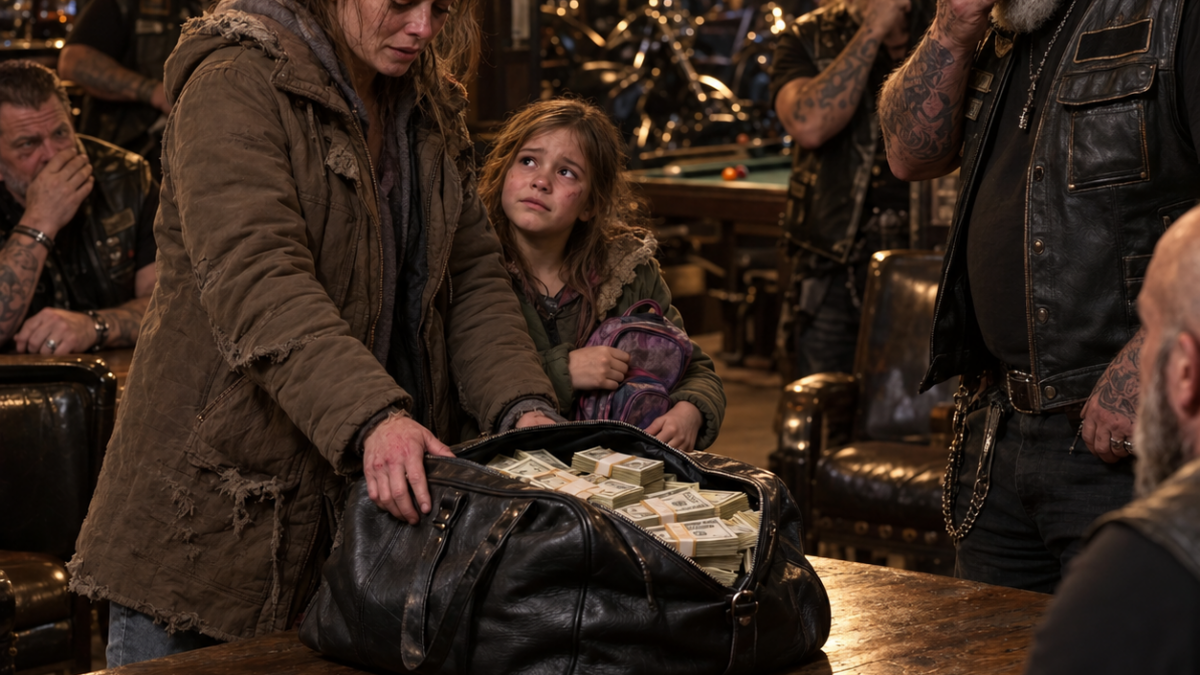
The door opened into a large room connected to the repair bays, with concrete floors, old wood-paneled walls, a pool table, a bar along one side, and framed photographs everywhere. Men in leather vests sat at tables drinking coffee from mugs that looked tiny in their hands. A television above the bar played morning news with the volume low. The air smelled like motor oil, coffee, tobacco, and cold leather.
Every conversation stopped when Sarah stepped inside.
It was not dramatic.
No one jumped up.
No one shouted.
That somehow made it more frightening.
Heads turned.
Eyes moved from her worn coat to her dirty sneakers to the black leather bag clutched against her chest.
Sarah suddenly became aware of everything about herself.
Her hair unwashed beneath a knit cap.
Her cracked lips.
The grocery sack of rescued rolls hanging from one wrist.
The smell of cold car upholstery in her clothes.
The humiliation of being visibly poor in a room full of men who did not have to ask where they would sleep.
A man near the bar stood.
He was broad-shouldered, gray-bearded, maybe in his late fifties, with a scar cutting through one eyebrow and a leather vest covered in patches. The name stitched over his chest read FRANK.
His eyes were not cruel.
But they were sharp.
“You lost, ma’am?” he asked.
Sarah swallowed.
Her voice almost failed.
“I found this outside.”
The room went even quieter.
Frank’s eyes dropped to the bag.
Behind him, another biker muttered, “No way.”
Sarah stepped forward because if she stopped, she might run.
“It was by the bench,” she said. “Outside the side door. I opened it because I thought maybe there was ID or something. I saw what was inside. I didn’t take anything.”
A younger man with a shaved head stood so fast his chair scraped backward.
“Where did you find that?”
Frank lifted one hand without looking at him.
The younger man shut his mouth.
Frank approached slowly.
Sarah placed the bag on the nearest table.
Her hands did not want to let go.
Not because she wanted the money now.
Because letting go meant admitting she was walking back into the cold with nothing but her conscience, and conscience did not buy dinner.
Frank unzipped the bag.
The cash showed under the clubhouse lights.
Several men stood.
Someone cursed under his breath.
Frank looked at the money for a long time.
Then he looked at Sarah.
“You open it outside?”
“Yes.”
“You count it?”
“Enough to know I needed to bring it in before I did something stupid.”
The honesty slipped out before she could make it sound better.
A few of the men exchanged glances.
Frank’s expression changed, but only slightly.
“What’s your name?”
“Sarah.”
“Sarah what?”
“Miller.”
“You from around here?”
She hesitated.
“I used to be.”
The answer was too revealing.
Frank heard it.
His eyes moved again over her coat, her red hands, the grocery sack.
“You know how much is in here?”
“I think fifty thousand.”
“It is.”
Sarah nodded once.
Her throat hurt.
Frank leaned both hands on the table.
“Why didn’t you keep it?”
The question landed hard because the answer was not simple.
Because I wanted to.
Because I almost did.
Because my daughter is hungry.
Because I am tired of being punished for doing my best.
Because there are nights when honest people wonder if honesty is just another luxury they can no longer afford.
Sarah looked down at her hands.
The skin around her knuckles was split from cold. There was a small cut near her thumb from digging through cardboard behind the grocery store. Her nails were short, uneven, rimmed with dirt she could not scrub away in gas station sinks.
“I have a daughter,” she said.
Nobody moved.
“She’s eight. Her name is Lily. And she thinks I’m…” Sarah’s voice cracked. She pressed her lips together and tried again. “She thinks I’m still the kind of person who does the right thing even when things are bad.”
A man near the pool table looked away.
Sarah continued, softer now.
“I needed that money more than I can explain to you without embarrassing myself. I could’ve made a hundred excuses. I found it. You lost it. Nobody saw me. My kid needs food. My car’s almost out of gas. We don’t have a place right now.”
The room shifted.
Frank’s gaze sharpened.
Sarah forced herself to finish.
“But if I kept it, I’d spend the rest of my life teaching her that desperation gets to decide who you are. And I can’t do that. I’ve lost a lot already. I can’t lose that too.”
The clubhouse went completely silent.
Not uncomfortable silent.
Reverent silent.
The kind of silence that falls when people realize they have just witnessed something stronger than anything they were prepared to respect.
Frank stared at Sarah as if the room had changed shape around her.
He had expected many things in his life.
Lies.
Theft.
Police.
Blood.
Betrayal.
Men who talked about honor until money appeared.
But he had not expected a homeless mother with frost-reddened hands to walk into his clubhouse carrying fifty thousand dollars she could have used to save herself.
He zipped the bag slowly.
“What happened to you?” he asked.
Sarah almost laughed.
Not because it was funny.
Because the question was too large.
“Life,” she said.
Frank studied her.
Then he pulled out a chair.
“Sit down.”
“I can’t stay.”
“You can sit.”
The younger man with the shaved head moved forward. “Prez—”
Frank turned his head.
One look.
The man stepped back.
Sarah remained standing. Pride was a thin blanket, but it was the only one she had left.
“I’m not asking for anything,” she said.
“I know.”
“I just wanted to return it.”
“I know that too.”
Frank pulled the chair out farther.
This time, Sarah sat.
Not because she wanted to.
Because her knees had begun to shake.
A biker with a long braid disappeared behind the bar and returned with coffee. Another set a plate in front of her with toast, eggs, and bacon from somewhere she could not see. Someone else quietly took the grocery sack from her wrist and placed it on the chair beside her, not like trash, but like something belonging to her.
Sarah stared at the plate.
Her stomach twisted painfully.
“I can’t pay for this,” she whispered.
Frank sat across from her.
“Nobody asked you to.”
That almost broke her.
Kindness is harder to accept when you have been surviving on scraps of dignity.
She picked up the fork and tried to take one normal bite. Then another. She could feel the men trying not to watch her eat too fast.
Frank waited until she had swallowed several mouthfuls.
“Where’s Lily now?”
“School.”
“Where are you staying?”
Sarah looked at him.
The question exposed too much.
“I’m working on something.”
Frank’s jaw tightened.
“In your car?”
She looked down.
That was answer enough.
The man with the braid cursed softly.
Frank leaned back.
“How long?”
“Six weeks.”
“Jesus.”
“I have an interview Friday.”
“For what?”
“Housekeeping at the Fairlane Motel.”
“You got work experience?”
“I waitressed eight years. Before that, office assistant at a plumbing company. I handled invoices, scheduling, payroll sometimes. Whatever they needed.”
“You ever steal from them?”
Sarah looked up sharply.
Frank did not soften the question.
“No.”
“Ever get fired for cause?”
“No.”
“Drugs?”
“No.”
“Drink?”
“No.”
“Record?”
“No.”
“People who can vouch for you?”
“My old boss, if you can find him. The diner closed.”
Frank nodded slowly.
Then he looked toward the back of the room.
“Bear.”
An older biker near the pool table lifted his chin. He was enormous, white-bearded, with hands like hammers.
“Yeah?”
“Call Phil Ramsey. He owned that diner on 8th.”
Bear pulled out his phone. “On it.”
Sarah stiffened. “Why?”
Frank turned back to her. “Because when someone walks in with fifty thousand dollars they didn’t take, I start thinking maybe I’m looking at the rarest thing in this town.”
“What’s that?”
“Someone I can trust.”
She stared at him, unable to process the words.
Trust.
It had been months since anyone treated her like that word could belong to her.
Before Frank could say more, the side door opened.
Cold air swept in.
A man in a black wool coat stepped inside, followed by two others.
The room changed instantly.
Not fear exactly.
Alertness.
The man in the coat had silver hair, expensive gloves, and the kind of face that smiled only when cameras were present. Sarah recognized him vaguely. Councilman Victor Hale. She had seen his campaign signs around town. He owned half the warehouses on the east side and had recently announced a charity redevelopment project with the River Saints.
His eyes went to the leather bag.
Then to Sarah.
Then to Frank.
“Tell me that’s intact,” Victor said.
Frank did not move. “It is.”
Victor exhaled loudly. “Do you have any idea what kind of morning I’ve had?”
The younger shaved-head biker muttered, “Probably one with breakfast.”
Victor ignored him.
Frank placed one hand on the bag. “Sarah found it outside and brought it in.”
Victor looked at her more closely.
His expression did not become grateful.
It became suspicious.
“She opened it?”
Sarah’s face warmed.
Frank’s eyes narrowed. “She returned it.”
“That wasn’t my question.”
The room chilled.
Sarah stood. “I only opened it to see if there was a name.”
Victor’s gaze moved over her coat, her shoes, her hair.
“And nothing is missing?”
Frank’s voice dropped. “Careful.”
Victor gave a short laugh. “I’m careful by nature. Fifty thousand dollars goes missing for twenty minutes and turns up in the hands of a woman who looks like she slept under a bridge. I think asking questions is reasonable.”
Sarah felt the words hit every bruise she had been hiding.
Slept under a bridge.
A few months earlier, she would have had an answer. A sharp one. Something with fire in it.
But poverty does something cruel to your voice.
It makes you afraid that any defense will sound like proof.
“I didn’t take anything,” she said quietly.
Victor looked at Frank. “Count it.”
Frank stood.
Slowly.
The clubhouse seemed to draw a breath.
“You want me to count it?”
“Yes.”
“In front of her?”
“Yes.”
“After she walked it in?”
Victor removed his gloves finger by finger. “Frank, don’t turn this into one of your honor speeches. That money is committed to the Eastside Winter Relief event. It was irresponsible enough that one of your men left it outside.”
The shaved-head biker flushed.
“But,” Victor continued, “I’m not going to risk donor funds because everyone here wants to feel inspired by a sob story.”
Sarah’s eyes burned.
She reached for Lily’s backpack.
“I should go.”
Frank’s hand came down on the table.
Not violently.
But hard enough that every glass in the room jumped.
“No.”
Sarah froze.
Frank looked at Victor.
“She stays.”
Victor smiled thinly. “You’re making this personal.”
“You made it personal when you insulted a woman who just did what half the men I’ve known wouldn’t.”
Victor’s face hardened.
“This is exactly why people are nervous about partnering with your club.”
Frank stepped closer to him.
The size difference was not enormous, but Frank carried something Victor did not. The dangerous calm of a man who had been underestimated by men in nicer coats and buried some of them metaphorically, maybe literally, in the past.
“You came to us because your charity event needed muscle, motorcycles, and the kind of blue-collar credibility your campaign ads keep failing to fake,” Frank said. “Don’t stand in my house and lecture me about partnership.”
Victor glanced around the room.
He realized no one was on his side.
Still, pride forced him forward.
“Count the money, Frank.”
Sarah whispered, “It’s okay.”
Frank looked at her.
“No,” he said. “It isn’t.”
He unzipped the bag, removed the bundles, and counted them in clean stacks.
One by one.
Every dollar was there.
Victor said nothing.
Frank pushed the final stack into place.
“Fifty thousand,” he said.
A heavy silence followed.
Victor gave Sarah a tight nod. “Then thank you for returning it.”
It was not gratitude.
It was a receipt.
Sarah picked up her backpack and grocery sack.
“You’re welcome,” she said.
Her voice was steady now.
She turned to Frank. “Thank you for breakfast.”
Then she left before anyone could stop her.
Outside, the cold hit her face.
She made it around the corner of the building before the tears came.
Not because Victor had insulted her.
She had been insulted by worse.
Not because she regretted returning the money.
She did not.
She cried because for ten minutes inside that clubhouse, she had been seen as honorable, and Victor had reminded her how quickly the world could drag a poor woman back down to suspicious.
She sat behind the repair shop beside the brick wall, covered her mouth with one hand, and cried until her ribs hurt.
Then she wiped her face, picked up the bag of rolls, and walked back to the Honda.
Lily needed dinner.
Life did not pause because someone had humiliated you.
Frank watched Sarah leave through the narrow clubhouse window.
He did not follow immediately.
If he had learned anything in sixty years, it was that pride was not something you chased down and cornered. Especially not the pride of someone who had only that left.
He turned to Victor.
“Get out.”
Victor blinked. “Excuse me?”
“You heard me.”
“We have a meeting.”
“Not anymore.”
Victor laughed. “Frank, don’t be stupid. The charity event is in four days. The press is coming. The mayor is coming. You walk away now, and your club looks unreliable.”
Frank’s voice stayed quiet. “If being reliable means letting you spit on the woman who saved your donor money, we’ll survive the bad press.”
Victor’s eyes flashed. “You don’t know who you’re talking to.”
Bear stood from the pool table.
“So tell us,” Bear said.
One by one, other bikers rose.
Not with drama.
With weight.
Victor looked around and finally understood he had miscalculated.
He put his gloves back on.
“This emotional nonsense will cost you.”
Frank picked up the leather bag and handed it to Bear.
“Lock it in my office.”
Bear took it.
Victor turned toward the door.
Frank spoke again.
“And Hale?”
Victor stopped.
“If I find out you use her name, her situation, or one second of this morning to make yourself look good, we’re going to have another conversation.”
Victor glanced back. “Is that a threat?”
Frank smiled without warmth.
“No. It’s a promise with manners.”
Victor left.
The door closed behind him.
For a moment, no one spoke.
Then the shaved-head biker, whose name was Tommy, sank into a chair and put both hands over his head.
“It was my fault,” he said. “I set the bag down when the delivery guy showed up. I swear it was just a minute.”
Frank looked at him.
Tommy’s face was pale.
“I almost got her accused because I was careless.”
“Yeah,” Frank said. “You did.”
Tommy swallowed.
“I’ll make it right.”
Frank stared at the door Sarah had walked through.
“Yes,” he said. “We all will.”
That afternoon, Frank learned everything he could without crossing lines that mattered.
He called Phil Ramsey, the old diner owner.
Phil answered from his brother’s house in Kentucky, where he had moved after bankruptcy took nearly everything.
“Sarah Miller?” Phil said. “Best waitress I ever had. Showed up early, stayed late, handled the register, trained new girls, never shorted a drawer by a penny. Why? She okay?”
Frank looked out his office window at the winter street.
“No,” he said. “But she might be.”
Phil went quiet.
“What happened?”
Frank told him enough.
Phil cursed.
“She didn’t deserve that,” he said. “She worked harder than any of us. Loved that little girl like the sun came up just to see her.”
“You know why she couldn’t find work?”
“Because this town loves saying help wanted until somebody actually needs help,” Phil said bitterly. “And because once you don’t have an address, every application turns into quicksand.”
Frank knew that was true.
He had seen men come back from war and lose apartments before benefits arrived. He had seen good mechanics fail background checks for mistakes made at nineteen. He had seen widows choose between medicine and heat. He had seen how fast respect disappeared when a person’s shoes wore out.
The River Saints were not saints in the church-window sense.
Frank never pretended otherwise.
They had histories.
Some had records.
Some had tempers.
Some had pasts they discussed only with engines running loud enough to cover ghosts.
But they had rules.
No stealing from working people.
No hurting kids.
No using the club to prey on the desperate.
And if someone came to their door with clean hands and a hard story, they did not turn away because polite society might have done it first.
Frank had become president because he understood the difference between fear and respect. Fear was easy. Any fool could grow a beard, buy a loud bike, and make people nervous. Respect took years. It took showing up when floods came, fixing veterans’ cars for free, escorting funeral processions, paying rent quietly for a mechanic whose wife had cancer, and never bragging about half of it.
Sarah Miller had walked into his clubhouse carrying more than money.
She had carried a mirror.
And Frank did not like what it showed.
By evening, he had a plan.
By morning, he had a convoy.
Sarah woke before sunrise in the backseat of the Honda with Lily curled against her side.
The car windows were fogged from their breath. Sarah’s hip ached from sleeping at an angle. Her feet were numb. Lily’s hair tickled her chin.
For one sweet second before memory arrived, Sarah thought they were home.
Then a truck started somewhere nearby.
The heater was off.
The grocery store parking lot lights buzzed overhead.
She closed her eyes.
“Okay,” she whispered to herself. “Get up.”
Lily stirred.
“Is it school time?”
“Almost, baby.”
“I dreamed we had pancakes.”
Sarah swallowed. “That’s a good dream.”
“With blueberries.”
“Fancy.”
“And whipped cream.”
“Very fancy.”
Lily opened her eyes. “Can we have that when we get our new place?”
Sarah brushed hair from her daughter’s face.
“Yes,” she said. “First morning.”
The lie hurt less because she wanted to make it true.
A low rumble entered the parking lot.
At first Sarah thought it was a truck.
Then another rumble joined it.
Then another.
Motorcycles.
Sarah sat up fast.
Three bikes and a black pickup rolled into the far side of the parking lot. Their headlights cut through the gray morning. Sarah’s stomach dropped when she recognized Frank.
“Oh no,” she whispered.
Lily sat up. “Mommy?”
“It’s okay.”
But Sarah did not know that.
Frank parked several spaces away, not blocking her in. The other bikers did the same. That detail mattered. People who want to intimidate corner you. Frank did not.
He stepped off his motorcycle carrying two paper bags.
Behind him, Bear got out of the pickup with blankets. Tommy climbed out holding a pink winter coat with tags still on it. Another biker carried a box of groceries.
Sarah opened the car door before they reached her.
“What are you doing here?”
Her voice came out sharper than intended.
Frank stopped a respectful distance away.
“Morning, Sarah.”
“How did you find us?”
“Security guard at the grocery store knows Bear. Said there was a mom and kid sleeping here. Didn’t give us anything else.”
Sarah glanced toward the store entrance. Martin, the security guard, stood inside the glass doors pretending to study a clipboard.
She was too tired to be angry with him.
Lily peered out from the backseat.
Frank’s face softened.
“You must be Lily.”
Lily looked at his beard, his leather vest, the motorcycles, then his paper bags.
“Are those pancakes?”
Frank blinked.
For the first time, Sarah saw him struggle for words.
“They can be.”
Lily’s eyes widened. “Really?”
Sarah said, “Lily—”
Frank held up one bag. “Diner down the road owed me a favor. Pancakes, eggs, bacon, orange juice, and something with blueberries I was told was important.”
Lily gasped.
Sarah closed her eyes.
She could handle insults.
She could handle cold.
She could handle hunger better than watching her daughter receive kindness she could not provide.
Frank seemed to understand. He did not push past her. He did not look inside the car too long.
“We brought breakfast,” he said. “And groceries. And blankets. And a coat for Lily. Tommy guessed the size, so blame him if it’s wrong.”
Tommy stepped forward, eyes lowered.
“I’m sorry,” he said.
Sarah frowned. “For what?”
“The bag. I’m the idiot who left it outside. You got put in a bad spot because of me. Then Hale treated you like…” He stopped, jaw tight. “Like you didn’t deserve respect. I’m sorry.”
Sarah did not know what to do with that.
Apologies had been rare lately.
Useful apologies, rarer.
Lily climbed out of the car, still wrapped in the thin blanket.
Her eyes fixed on the coat.
It was bright purple.
Her favorite color.
“Is that for me?” she whispered.
Tommy knelt, holding it out.
“If it fits.”
Lily looked at Sarah.
Sarah nodded once.
Lily took the coat and hugged it before putting it on.
That finished what little control Sarah had left.
She turned away, but Frank saw the tears anyway.
He spoke quietly.
“There’s more.”
“I can’t take money.”
“I didn’t offer money.”
“I’m not charity.”
“No,” Frank said. “You’re not.”
That made her look at him.
He reached into his vest and pulled out a small envelope.
Not thick.
Just business-sized.
Inside were keys.
Sarah stared at them without touching.
“What is that?”
“Apartment.”
She stepped back. “No.”
“Listen first.”
“No.”
“Sarah.”
“I said no.”
Lily froze.
Frank lowered his voice.
“Okay.”
That stopped her because he did not argue.
Sarah’s breath came fast.
“I can’t owe people like you.”
Bear’s eyebrows rose.
Tommy muttered, “People like us?”
Frank lifted a hand.
Sarah flushed. “I didn’t mean—”
“Yes, you did,” Frank said. Not cruelly. “And maybe you’re not wrong to be careful. But hear me.”
Sarah wrapped her arms around herself.
Frank held the envelope loosely, not pushing it toward her.
“The club owns a small apartment over the parts storage building behind the shop. It used to be for visiting members. It’s empty. It’s warm. It has two beds, a shower, a kitchen, and a lock. You can stay there ninety days, no rent.”
Sarah shook her head.
“No.”
“You also need work. Our office is a disaster. Inventory, invoices, vendor calls, payroll hours, event paperwork. We’ve needed someone for months.”
“I don’t know motorcycles.”
“You know numbers?”
“Yes.”
“You know how to answer phones?”
“Yes.”
“You know how to tell grown men they filled out forms wrong?”
Despite herself, Sarah almost smiled. “Yes.”
“Then you’re qualified.”
She looked at the keys as if they might burn her.
“What’s the catch?”
“No catch.”
“There’s always a catch.”
Frank’s face changed.
Something sad passed through it.
“Yeah,” he said. “Usually.”
He took a breath.
“The job pays twenty-two an hour to start, forty hours a week, health benefits after sixty days if it works out. You’ll answer to our shop manager, not me, so nobody says you owe the club president anything. The apartment is separate from the job. You take one, both, or neither. Your choice.”
Sarah could not speak.
Lily whispered, “Mommy?”
Sarah looked at her daughter in the purple coat, cheeks red from cold, hair tangled from sleeping in a car.
Pride rose in Sarah like a wall.
Then love climbed over it.
“What if I mess up?” she asked.
Frank’s answer came immediately.
“Then we handle it like people.”
“What if I can’t get back on my feet in ninety days?”
“Then we talk before day eighty-nine.”
“What if people think—”
“People already think whatever makes them feel taller,” Frank said. “Let them.”
Sarah pressed both hands to her mouth.
She wanted to say yes.
She was terrified to say yes.
Hope had become dangerous. Every time she reached for it, it moved. A job that did not call back. A landlord who would not wait. A pantry that ran out before her number. A shelter with no beds.
Frank seemed to know that too.
He placed the envelope on the hood of her car and stepped back.
“No answer right this second,” he said. “Eat first.”
Lily tugged Sarah’s sleeve.
“Mommy,” she whispered, “can we have pancakes somewhere warm?”
Sarah looked at the envelope.
Then at Frank.
Then at the men standing behind him, trying very hard to look less frightening while holding groceries, blankets, and a purple coat.
She picked up the keys.
Her knees nearly gave out.
Frank moved as if to help, then stopped himself.
Sarah appreciated that more than if he had caught her.
“I’ll work,” she said, voice shaking. “I’ll work hard. I won’t waste it.”
Frank nodded.
“I know.”
“You don’t know that.”
Frank looked toward the old Honda, the fogged windows, the grocery sack of rescued bread, the child in the purple coat, and the woman who had returned fifty thousand dollars she needed desperately.
“Yes,” he said. “I do.”
The apartment over the parts building was not fancy.
To Sarah, it looked like heaven.
Two small bedrooms. A living room with a faded brown couch. A kitchenette. A bathroom with a tub. Clean sheets folded on the beds. A space heater humming in the corner. A window overlooking the motorcycle shop yard.
Lily walked in and stood perfectly still.
“Is this ours?” she whispered.
“For now,” Sarah said.
“Can I sleep in the bed?”
“Yes.”
“With sheets?”
Sarah laughed and cried at the same time.
“Yes, baby.”
Lily ran to the smaller bedroom and threw herself on the bed like it was a palace.
Sarah stood in the doorway holding the envelope of keys.
Frank remained in the hall.
He did not enter until she invited him.
That mattered too.
“Groceries are downstairs,” he said. “Mrs. Alvarez from the church pantry heard about you and packed extra. Don’t ask me how she heard. That woman knows things before they happen.”
Sarah nodded.
“I don’t know how to thank you.”
“Show up Monday at eight.”
She turned. “That’s it?”
“That’s it.”
“Why?”
Frank looked tired then.
Older than he had in the clubhouse.
“Because when my wife was dying, strangers brought casseroles to my door for six months. Because Bear slept under a bridge after Vietnam until somebody gave him work. Because Tommy was nineteen when I kept him out of prison by giving him a wrench and a reason to get up. Because none of us are as self-made as we pretend.”
Sarah listened.
“And because,” Frank continued, “yesterday, you reminded my club that character doesn’t come from leather, patches, money, or reputation. It comes from what you do when nobody can stop you.”
Sarah’s eyes filled again.
Frank tapped the doorframe lightly.
“Eat. Rest. Lock the door. Office Monday.”
He turned to leave.
“Frank?”
He looked back.
“Was the money really for charity?”
His jaw tightened.
“Supposed to be.”
“Supposed to be?”
He was quiet for a moment.
Then he said, “That’s another story.”
But it was not another story for long.
Sarah started work Monday morning.
She wore the cleanest clothes she had, a blue sweater from the donation box and black pants that still smelled faintly of storage plastic. Lily went to school from the apartment with brushed hair, a packed lunch, and the purple coat zipped to her chin. When the school secretary saw the new address, she did not ask questions. Bless women who know when silence is kindness.
The office at Mercer & Sons Custom Cycles was exactly as Frank advertised.
A disaster.
Invoices stuffed in drawers.
Receipts in coffee cans.
Vendor catalogs stacked beside motorcycle parts.
A calendar three months out of date.
A computer password written on a sticky note hidden under the keyboard, which was the first thing Sarah changed.
The shop manager, a woman named Jo Mercer, was Frank’s niece. She was thirty-nine, tattooed, sharp-tongued, and had grease under her nails despite being better with spreadsheets than anyone in the building.
“You Sarah?” Jo asked.
“Yes.”
“Can you use QuickBooks?”
“Yes.”
“Can you tolerate men who think alphabetical order is a government conspiracy?”
Sarah glanced through the office window at Bear attempting to fix the printer by hitting it.
“Yes.”
Jo smiled. “You’ll do.”
Work saved Sarah in ways charity could not.
Charity filled the emergency.
Work rebuilt the person.
Every invoice entered, every phone call answered, every shelf labeled, every check deposited reminded Sarah that she was not merely a woman who had lost everything. She was capable. Useful. Sharp. Needed.
The bikers treated her with a careful respect that sometimes made her laugh.
They cursed less when Lily was upstairs.
They stopped leaving knives on desks.
They brought extra food but pretended it was accidental.
Bear taught Lily to play checkers and lost on purpose until Lily caught him, then she demanded “real games only.”
Tommy fixed the Honda’s left-turn grinding sound without asking and left the receipt on Sarah’s desk marked PAID: BAG IDIOT TAX.
Sarah kept it in a drawer.
Frank remained kind but not intrusive.
He did not ask personal questions unless necessary. He did not hover. He did not make grand speeches. He simply made sure the apartment heater worked, Lily had safe transportation to school when the Honda needed repairs, and Sarah’s paycheck arrived exactly on time.
But the more Sarah worked in the office, the more she noticed the Eastside Winter Relief event did not add up.
The fifty thousand dollars had been described as donor funds.
Yet no formal donation receipt existed for that exact amount.
Councilman Victor Hale’s office sent urgent emails asking for documents to be “routed through campaign channels.”
Vendor invoices looked inflated.
A warehouse rental charge appeared twice under two slightly different company names.
One company receiving payment for “community outreach logistics” had the same mailing address as Hale Development Group.
Sarah had handled invoices long enough to know when numbers smelled wrong.
At first, she told herself it was none of her business.
Then she thought of Victor looking at her like poverty was proof of theft.
She printed copies.
Not because she planned to fight.
Because women who had been accused learned to save proof.
Two weeks after Sarah started work, Frank walked into the office and found her surrounded by papers.
“You building a nest?”
She looked up.
“We need to talk.”
His expression changed.
She showed him the invoices.
The duplicate charges.
The shell company.
The missing donor receipt.
The emails.
Frank read silently.
His face hardened line by line.
When he finished, he said only one word.
“Hale.”
Sarah nodded.
Frank sat slowly.
“The fifty thousand in the bag,” she said. “Where did it come from?”
“Three donors. Cash contributions for the winter relief event. Coats, motel vouchers, food cards, medical clinic setup. Hale insisted his office would process final vendor payments for transparency.”
Sarah almost laughed. “He used the word transparency?”
“Yeah.”
“That’s usually where people hide things.”
Frank looked at her.
“How bad?”
“I don’t know yet. But if I had to guess, some of the charity money was being routed back through companies tied to him.”
Frank’s hands curled.
“That money was for people sleeping in cars.”
Sarah held his gaze.
“I know.”
Neither spoke.
The office sounds continued around them. A phone ringing in the shop. A wrench dropping. Bear yelling at the printer again. Lily upstairs singing to herself while doing homework.
Frank stood.
“Make copies of everything.”
“I already did.”
Something like pride flickered in his eyes.
“Of course you did.”
By Friday, the River Saints had enough documentation to take to a lawyer, then to a local investigative reporter Frank trusted because she had once exposed a veterans’ housing scam despite threats from people far more polished than Victor Hale.
The story broke ten days before Christmas.
Councilman’s Charity Partnership Under Review After Questions Over Donor Funds.
Victor denied everything.
Then more documents appeared.
Then a former assistant came forward.
Then the donors demanded an audit.
Then the mayor quietly canceled his appearance at the Eastside Winter Relief event.
Victor tried to blame Frank.
He tried to blame the club.
He even suggested “unqualified office staff” had misunderstood routine financial procedures.
That was a mistake.
Because by then, Sarah Miller was no longer invisible.
The reporter, Janice Rowe, asked to interview her.
Sarah almost refused.
She hated cameras.
She hated pity.
She hated that the worst season of her life had become connected to public curiosity.
But Frank said, “You don’t have to.”
Lily said, “Mommy, if he lied, maybe you should tell the truth.”
So Sarah did.
The interview took place inside the motorcycle shop office. Sarah wore her blue sweater. Her hair was clean. Her hands still showed cold cracks, but they were healing.
Janice asked, “Why did you return the bag?”
Sarah looked down for a moment.
Then she looked at the camera.
“Because I was poor, not dishonest.”
The clip spread across local news before dinner.
By morning, it was everywhere in town.
That sentence changed how people looked at her.
Sarah did not enjoy that.
She wished people had known it without needing a headline.
But if the world required proof, she had given it.
Victor Hale resigned from the city council in January after the audit revealed misused funds, falsified invoices, and payments routed to businesses connected to his development company. Criminal charges followed months later. Lawyers argued about intent. Victor claimed administrative confusion. Prosecutors called it fraud.
Sarah attended one hearing.
Victor saw her in the courthouse hallway.
For a second, they were back in the clubhouse, him in an expensive coat, her in a worn one.
Only now, she stood straight in a good black blazer Jo had bought her “because every woman needs one jacket that makes idiots nervous.”
Victor looked away first.
That was not justice by itself.
But it was something.
The winter relief event happened anyway.
Not with Victor.
Not with cameras lined up for politicians.
The River Saints held it in the repair shop parking lot on a gray Saturday two days before Christmas. Volunteers handed out coats, blankets, food boxes, motel vouchers, gas cards, and hygiene kits. A nurse from the free clinic checked blood pressure under a tent. A barber gave haircuts near the garage bay. Kids got toys from a table Lily helped organize.
Sarah worked registration.
She saw herself in too many faces.
A father who kept apologizing for needing help.
A teenager pretending not to be cold.
A grandmother asking if she could take only one blanket because others probably needed it more.
Then a woman approached with two children and a plastic folder of documents clutched to her chest. Her coat was too thin. Her eyes were exhausted.
“I’ve never done this before,” the woman whispered.
Sarah knew what she meant.
Not received help.
Been seen needing it.
Sarah leaned forward.
“First time is the hardest,” she said gently. “After that, you realize help is just a bridge. You still do the walking.”
The woman’s eyes filled.
Sarah handed her a motel voucher, food cards, and a toy for each child.
Lily watched from the toy table.
Later, she said, “Mommy, she looked like you used to.”
Sarah’s chest tightened.
“I know.”
“Did someone help us like that?”
Sarah looked across the parking lot at Frank, who was lifting boxes from the back of a truck while Bear argued with a volunteer dressed as Santa.
“Yes,” she said. “Someone did.”
At the end of the day, after the last box was handed out and the volunteers were cleaning up, Frank called everyone into the clubhouse.
The black leather bag sat on the main table.
Empty now.
The same bag Sarah had carried in weeks earlier.
People gathered around it: bikers, volunteers, shop workers, a few donors, Sarah, and Lily.
Frank stood at the head of the table.
“I’m not good at speeches,” he said.
Bear snorted.
Frank ignored him.
“A month ago, Tommy here left this bag outside because he’s an idiot.”
Tommy lifted both hands. “Accurate.”
A ripple of laughter moved through the room.
Frank continued.
“It had fifty thousand dollars in it. Money that was supposed to help people who had nowhere warm to sleep. Sarah found it.”
Every eye turned to her.
Sarah wanted to disappear.
Lily slipped her hand into hers.
Frank looked at Sarah, then at the room.
“She could have taken it. I wouldn’t have blamed her the way some of you think. If you knew where she was sleeping, if you knew what her kid needed, if you knew how cold that morning was, you’d understand that returning this bag wasn’t easy.”
The room grew quiet.
“But she brought it back. Every dollar. Then, after being insulted by a man who was stealing from the same charity fund, she came to work here and found the truth in our books.”
He placed one hand on the bag.
“This bag used to remind me to keep a better eye on money. Now it reminds me that integrity can walk into your life wearing worn-out shoes, carrying rescued bread, and asking for nothing.”
Sarah’s eyes blurred.
Frank reached into his vest and pulled out an envelope.
Sarah stiffened.
“No,” she whispered.
Frank smiled faintly. “Relax. It’s not cash.”
He handed it to her.
Her name was written on the front.
She opened it with shaking hands.
Inside was an employment contract.
Permanent office manager.
Higher salary.
Benefits.
Paid time off.
Tuition assistance if she wanted bookkeeping certification.
Attached behind it was a lease agreement for the apartment upstairs at a rent she could afford without fear, with the first six months waived.
Sarah could not read past the second page.
Her vision blurred too badly.
“There’s one more thing,” Frank said.
She looked up.
Of course there was.
Frank nodded to Jo, who brought forward a small wrapped box.
Lily bounced slightly beside Sarah. “Open it, Mommy.”
Sarah opened it.
Inside was a key.
Not to the apartment.
Not to the office.
A car key.
She stared at it.
Frank said, “The Honda served honorably, but it’s one pothole away from meeting Jesus. The club rebuilt a used Subaru from auction. Safe. Reliable. Good heater. In your name. Not a gift from me. From all of us.”
Sarah shook her head, tears spilling.
“I can’t—”
Frank’s voice softened.
“You can.”
“I don’t know how to take this.”
“Start by saying thank you. Then use it to drive your kid to school.”
The room was silent.
Completely silent.
Not because people did not feel anything.
Because they felt too much.
Sarah pressed the key to her chest.
For months, she had held herself together with fear, pride, and stubbornness. In that room, surrounded by people the world often misjudged, something inside her finally lowered its guard.
She cried the way she had not allowed herself to cry in the car.
Lily wrapped both arms around her waist.
Sarah held her daughter with one arm and the key with the other.
“Thank you,” she whispered.
Then louder.
“Thank you.”
Bear wiped his face and pretended his eyes were watering because of “dust from the damn vents.”
Tommy blew his nose into a napkin.
Jo rolled her eyes at all of them and cried anyway.
Frank looked down at the leather bag.
“Sometimes,” he said, “a person’s character is worth more than anything you can put in one of these.”
Years passed.
Life did not become perfect.
No honest second chance ever does.
Sarah still had bills.
She still worked hard.
She still woke some nights in a panic, listening for sounds from a parking lot that was no longer there. Lily still asked careful questions about money for a while, the way children do when insecurity has taught them the price of groceries too early.
But slowly, safety became real.
The apartment upstairs became home.
Lily put drawings on the refrigerator.
Sarah bought a new yellow mug.
On Lily’s ninth birthday, they made pancakes with blueberries and whipped cream, and Sarah cried into her coffee when Lily said, “First morning promise.”
Sarah completed a bookkeeping certification eighteen months later.
Jo promoted her twice.
The office became organized enough that vendors started asking if the shop had hired “corporate people,” which made Bear deeply suspicious.
The River Saints expanded the winter relief event into a year-round fund.
No politician controlled it.
Every dollar was tracked.
Every donor received receipts.
Every vendor was verified by Sarah personally.
People in town began referring struggling families to Sarah, and she always spoke to them the way she wished someone had spoken to her at the beginning.
Not with pity.
With respect.
Frank kept the black leather bag in his office on a shelf behind his desk.
Empty.
Cleaned.
A little scuffed near the handle from the morning Sarah had carried it through the cold.
Visitors asked about it sometimes.
Frank would lean back in his chair and say, “That bag once held fifty thousand dollars.”
They would usually whistle.
Then he would say, “But the most valuable thing it ever carried was a woman’s decision to return it.”
If Sarah heard him, she rolled her eyes.
But she never told him to stop.
On the third anniversary of the morning she found the bag, Sarah drove Lily to school in the rebuilt Subaru, now with a dent in the back bumper from a grocery cart and a glittery keychain Lily had made in art class.
Lily was eleven, taller now, with braces and strong opinions about music.
Before getting out, she paused.
“Mom?”
“Yes?”
“Do you ever wish you kept the money?”
Sarah looked through the windshield at the school doors.
The honest answer mattered.
“No,” she said.
Lily studied her.
“Not even a little?”
Sarah smiled sadly.
“For about thirty seconds that day, I wanted to more than I’ve ever wanted anything.”
Lily nodded, absorbing that.
“What stopped you?”
Sarah reached into the glove compartment and pulled out the old folded drawing.
The paper had softened at the edges. The yellow sun had faded. The crooked words were still clear.
Mommy always does the right thing.
Lily’s eyes widened. “You kept it?”
“Of course I kept it.”
“I spelled always wrong.”
“You were eight. I accepted the message.”
Lily touched the paper gently.
Sarah said, “I didn’t return the money because it was easy. I returned it because I needed to still be your mother afterward.”
Lily’s eyes filled.
“You were always my mother.”
“I know. But I needed to be able to look you in the eye.”
Lily hugged her across the console.
Teenagers were coming soon. Attitude was probably on the horizon. But that morning, she was still Sarah’s little girl for one more minute.
After Lily went inside, Sarah sat in the car and let herself remember.
The cold.
The bag.
The hunger.
The humiliation.
The clubhouse silence.
Frank’s keys on the hood of the Honda.
Hope arriving not as magic, but as people choosing to trust her at the exact moment she had almost forgotten how to trust herself.
Then she drove to work.
At the shop, Frank was already in his office, arguing with Bear about whether the coffee tasted burnt or “just assertive.”
Sarah hung her coat, turned on the computer, and checked the day’s schedule.
On her desk was a paper bag.
Inside were blueberry pancakes from the diner down the road.
A note in Frank’s handwriting said:
First morning promise. Don’t tell anyone I remembered.
Sarah laughed.
Then she cried a little.
Then she ate breakfast at her desk before the phones started ringing.
Because life had taken almost everything from her once.
But one honest decision, one returned bag, and one room full of unlikely witnesses had given her something far more valuable than money.
Not rescue.
Not charity.
Not a fairy tale.
A chance.
And sometimes, when a person has been sleeping in the cold too long, a chance is the first warm thing that makes them believe morning can come again.

