HOA Spent $200,000 Building a Bridge Over My Private Creek and Threatened to Take My Home—Then I Legally Rerouted the Water and Their New Park Flooded Instead.
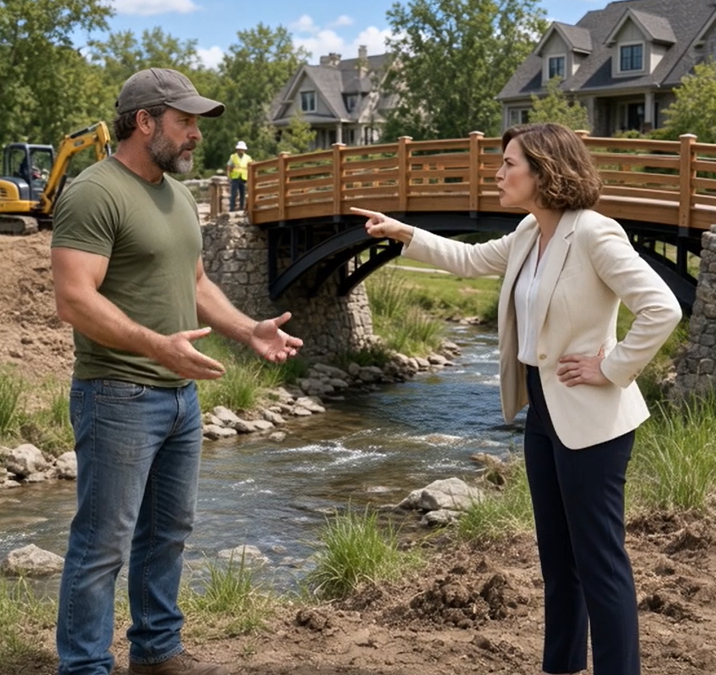
PART2:
It does not care whether a bridge has stone veneer, black iron railings, lanterns, and a brass plaque.
Water moves according to gravity, elevation, soil, capacity, resistance, and time.
People say floods are unpredictable.
Some are.
But often the water behaves exactly as the land tells it to behave.
Humans are the unpredictable part.
Millhaven Estates did not exist when Eleanor and I bought the house.
The surrounding property belonged to three families and a small dairy operation.
Then the Fosters sold.
Then the Hargroves.
Then a developer named Brighton Communities purchased almost two hundred acres around us.
By 2008, bulldozers had replaced pasture.
Millhaven Estates arrived in three phases.
Phase One:
eighty homes.
Phase Two:
another hundred and twelve.
Phase Three:
clubhouse, pool, walking paths, ornamental landscaping, and houses large enough that some garages had more square footage than my first apartment.
My property remained outside the HOA.
That point was never ambiguous.
Brighton tried to buy it twice.
The first offer was fair.
The second was extremely fair.
Eleanor refused both.
I would like to say I was equally principled.
I wasn’t.
The second number made me sit down.
Eleanor looked out the kitchen window at Cedar Run.
“No.”
“That’s a lot of money.”
“We have money.”
“We could have more.”
“For what?”
That was Eleanor.
A devastatingly efficient woman.
“For retirement.”
“You’re already planning retirement.”
“For travel.”
“We travel.”
“For…”
I ran out.
She smiled.
“You want to sell?”
I looked at the sycamores.
The creek.
The shed.
The little patch of daffodils she had planted beside the porch twenty years earlier.
“No.”
“Then stop letting a number argue with you.”
We kept the land.
Eleanor died in 2019.
Pancreatic cancer.
Fourteen months from diagnosis to funeral.
I had spent a career designing systems that moved millions of gallons of water exactly where they were supposed to go.
I could not design a way around that.
After she died, I considered selling.
For about two weeks.
Then one evening I sat beside Cedar Run in the place where Eleanor used to put her chair.
I could hear children laughing from Millhaven’s pool.
A dog barked somewhere behind the cedar fence.
Water moved over limestone.
And I thought:
She had chosen this place before either of us knew what it would cost to keep it.
I stayed.
For years, the subdivision and I got along.
Kids occasionally tossed sticks into the creek where it approached the public trail.
Neighbors waved.
Once or twice a resident knocked to ask whether they could retrieve a soccer ball.
Fine.
The HOA president then was a retired school superintendent named Alan Morris.
Alan knew where the boundary was.
That simple fact prevented almost every possible conflict.
Then Alan moved to Florida.
And Patricia Voss became president.
Patricia was fifty-two.
Former marketing executive.
Extremely organized.
Extremely articulate.
Extremely certain.
She drove a black Mercedes SUV and wore athletic clothing that somehow looked more expensive than most suits.
Her husband, Glen, rarely spoke.
When he did, he usually looked tired.
Patricia believed Millhaven had become “stagnant.”
Her campaign for HOA president centered around something called the Millhaven Renewal Plan.
The brochure used phrases like:
Reimagining Shared Space.
Unlocking Community Assets.
Activating Underutilized Natural Features.
I read those words and immediately disliked them.
Not because of grammar.
Because people only call land “underutilized” when they are thinking about using land that already belongs to somebody else.
The first project was harmless.
New pool furniture.
Then landscaping.
Then fitness stations along walking path.
Then a dog park.
Then Patricia announced something called Cedar Commons.
I learned about it from a glossy HOA newsletter somebody left in my mailbox by mistake.
The rendering showed a landscaped park.
Benches.
Native grasses.
Children on bicycles.
A gazebo.
And an arched pedestrian bridge over Cedar Run.
My creek.
I stared at the drawing.
The bridge location was unquestionably inside my property.
Not close.
Not debatable.
Inside by roughly forty feet.
I called Patricia.
She answered on second ring.
“Walter.”
“You know Cedar Commons is drawn on my land.”
Pause.
“The conceptual plan includes portions of the natural corridor.”
“The natural corridor is my property.”
“We understand there are legacy parcel complexities.”
“No.”
“There aren’t complexities.”
“Walter—”
“I have a survey.”
“As do we.”
“Then yours is wrong.”
She exhaled.
“This is an early-stage conceptual rendering.”
“Good.”
“Then concept can move.”
“We’ll discuss.”
“No.”
Another pause.
“What do you mean no?”
“I mean don’t build anything on my property.”
“We aren’t building anything tomorrow.”
“Excellent.”
I hung up thinking the matter was closed.
That was mistake number one.
Two weeks later, orange survey flags appeared beside Cedar Run.
Not mine.
I pulled one.
A small tag read:
MILLHAVEN CEDAR COMMONS — BRIDGE ALIGNMENT.
I photographed all.
Called the engineering company printed on flag.
A young project manager named Kyle Mercer answered.
“Who authorized you to survey my parcel?”
Silence.
“Can I have your address?”
I gave.
More silence.
“Mr. Greer, our client represented that the corridor was owned or controlled by Millhaven Estates.”
“It is not.”
“Do you have documentation?”
“Yes.”
“Would you send it?”
I did.
Deed.
Survey.
Plat.
Water-rights certification.
Kyle called twenty minutes later.
“We’re pausing any field work on your parcel until ownership is clarified.”
“Good.”
He sounded embarrassed.
“Sir, I apologize.”
“You did what your client told you.”
“Yes.”
“Now you know.”
I sent Patricia same documents.
Her response arrived four hours later.
Walter,
The Association does not concede your interpretation of the Cedar Run corridor. Millhaven has long maintained the adjoining drainage and has established community interests in the water feature. We will continue reviewing applicable rights.
Patricia Voss
President, Millhaven Estates HOA
I forwarded to my attorney.
His name was Samuel Lerner.
We had gone to college together before I switched from wanting to be an architect to understanding I had no artistic ability.
Sam practiced property law.
He called immediately.
“What does ‘community interests’ mean?”
“Patricia language for she wants it.”
“Any easement?”
“No.”
“Recorded?”
“No.”
“Utility?”
“No.”
“Drainage?”
“The subdivision has downstream stormwater easements on its own land.”
“Not yours.”
“Correct.”
“Historic trail?”
“No.”
“Maintenance?”
“I maintain creek.”
“Public access?”
“No.”
He laughed.
“So she has feelings.”
“Yes.”
“Feelings are not easements.”
That should be printed on county stationery.
Sam sent formal letter.
Ownership.
Boundary.
No consent.
No easement.
No license.
No construction.
No access.
No temporary staging.
No survey entry without permission.
Patricia acknowledged receipt.
Then hired another engineering company.
I discovered because three men appeared near creek one Monday morning.
I walked down.
“Can I help you?”
One looked up.
“We’re staking bridge.”
“Who hired you?”
“Millhaven HOA.”
“You’re on private property.”
He looked at other two.
“Mrs. Voss said HOA owns riparian corridor.”
“She is wrong.”
I showed deed copy from phone.
The crew left.
Patricia called an hour later.
“You embarrassed our contractors.”
“They were trespassing.”
“You could have contacted me.”
“I did.”
“You are creating unnecessary conflict.”
“I am standing still.”
“You keep sending people onto my land.”
“We have legitimate community infrastructure interests.”
“No.”
Her voice hardened.
“This creek serves Millhaven.”
“The creek predates Millhaven.”
“It drains Millhaven stormwater.”
“Partially.”
“Therefore the association has obligations.”
“Downstream obligations do not create ownership upstream.”
“We disagree.”
“You are free to disagree from your side of the boundary.”
She hung up.
Then things became absurd.
Millhaven’s attorney sent a letter claiming “implied drainage access.”
Sam responded:
Show recorded instrument.
None.
Then “prescriptive community use.”
Sam responded:
No public use history.
Then “maintenance necessity.”
Sam responded:
Owner has continuously maintained.
Then Patricia pivoted.
Environmental stewardship.
The HOA newsletter warned that privately managed Cedar Run presented “erosion and accessibility concerns.”
Photographs showed two muddy banks after storm.
Normal.
The board proposed “formalization of community stewardship.”
I read phrase aloud to Sam.
He said:
“She wants to steal your creek politely.”
I would not have phrased it that way professionally.
Privately?
Accurate.
Residents mostly did not know.
They saw renderings.
Cedar Commons looked nice.
Of course it did.
The bridge had stone piers.
A dark wood deck.
Native flowers.
Little signs about watersheds.
I was not opposed to parks.
I was opposed to parks on my land.
Important distinction.
One Millhaven resident, Carla Mendez, knocked on my door.
She had two children.
“Mr. Greer?”
“Yes.”
“I’m on landscape committee.”
“Okay.”
“Patricia says you’re blocking park because you don’t want children near creek.”
I stared.
“Did she?”
Carla looked uncomfortable.
“She said safety liability concerns.”
“I’m blocking park because the land is mine.”
Carla blinked.
“What?”
I brought survey.
Showed.
Her face changed.
“She said HOA owns twenty-foot corridor.”
“No.”
“But bridge…”
“Inside my parcel.”
“Does board know?”
“They’ve received documents.”
She looked genuinely upset.
“I voted for funding.”
“How much?”
She hesitated.
“Initial budget was eighty-five thousand.”
“Initial.”
Her expression worsened.
“It changed.”
“How much?”
“One hundred ninety-six thousand eight hundred.”
I put both hands on counter.
“For a pedestrian bridge?”
“And landscaping.”
“Gazebo?”
“Yes.”
“Path?”
“Yes.”
“On land they don’t own.”
She whispered:
“I didn’t know.”
That evening I attended HOA meeting.
Even though I was not a member.
Public comment invitation related Cedar Commons.
The clubhouse was full.
Patricia stood before rendering.
“Cedar Commons will create a connected pedestrian experience linking our north trail and retention pond.”
I waited.
Budget slide:
$198,400.
Bridge:
$112,000.
Paths:
$31,000.
Landscaping:
$24,000.
Gazebo and benches:
$19,000.
Engineering/misc:
$12,400.
Patricia said:
“Completion expected by late summer.”
I raised hand.
She saw.
Ignored.
I stood anyway.
“My name is Walter Greer.”
Room turned.
“I own Cedar Run where your bridge is proposed.”
Patricia’s expression did not move.
“This is not open debate.”
“You invited public comment.”
“After presentation.”
“Fine.”
I sat.
She continued.
Twenty-two minutes.
Then:
“Mr. Greer.”
I stood.
I held enlarged survey.
“The blue line is property boundary.”
I pointed.
“The creek bed here is inside my parcel.”
Then bridge.
“Your proposed bridge is forty-two feet inside my property at west abutment.”
A resident asked:
“I thought HOA owned creek.”
Patricia immediately:
“The association possesses longstanding drainage and community-use rights.”
Sam, sitting beside me, raised eyebrows.
I said:
“Please produce them.”
Patricia:
“Our legal counsel has reviewed.”
Sam stood.
“I’m Mr. Greer’s attorney.”
That changed room.
“There is no recorded easement.”
Patricia:
“That is your interpretation.”
“No.”
Sam’s voice remained calm.
“That is county recorder’s index.”
Murmuring.
A man asked:
“Can we build there or not?”
Patricia replied:
“The board believes yes.”
Sam:
“The owner says no.”
Patricia looked directly at me.
“You have benefited from Millhaven’s downstream drainage improvements for years.”
I almost laughed.
“The retention pond handles runoff generated by Millhaven rooftops and streets.”
“Yes.”
“That is not a benefit to me.”
“It stabilizes corridor.”
“The corridor was stable before subdivision.”
“This adversarial tone—”
“Patricia.”
I set survey down.
“You can build all the parks you want on property Millhaven owns.”
“You may not build on mine.”
She smiled thinly.
“We’ll proceed according to counsel.”
Meeting adjourned twenty minutes later.
Three days after, a backhoe arrived.
I called sheriff.
Not emergency.
Deputy came.
Contractor left.
Patricia filed civil action seeking declaratory judgment that HOA held implied access rights.
Good.
Finally a forum where PowerPoint mattered less.
Sam welcomed it.
We filed counterclaim.
Trespass threats.
Injunction.
Court issued temporary order:
No permanent construction on disputed portion pending survey.
Independent survey ordered.
Result?
My survey correct.
Creek and proposed bridge location inside my parcel.
I thought done.
Patricia did something cleverer.
She moved bridge east.
At least on paper.
The HOA owned narrow downstream strip where Cedar Run entered Millhaven drainage parcel.
There was room for a bridge entirely on HOA land.
Fine.
I had no objection.
But the park design still extended onto my lower meadow.
Patricia claimed that section was within a “drainage maintenance corridor.”
It wasn’t.
They began grading while lawsuit continued.
I called Sam.
He filed emergency motion.
By the time hearing scheduled, contractor had installed fill, path base, and two bridge foundations—some on HOA land, some encroaching.
Then court issued injunction.
Stop.
Survey pins installed.
Partially completed project sat there.
Patricia called me directly.
“You have cost residents thousands.”
“No.”
“You did.”
“You signed contract without title.”
“We relied on historic planning maps.”
“You were sent survey before signing.”
Silence.
“Walter, perhaps we can settle.”
“Remove everything on my parcel.”
“Not practical.”
“Then buy land.”
“We offered before.”
“Different developer.”
“Same concept.”
“No.”
“Name price.”
“No.”
“Everyone has price.”
“Apparently you don’t listen well.”
Her tone changed.
“Then understand that association intends to exercise every remedy.”
“Do that.”
She did.
Violation notices.
To me.
Even though my property outside HOA.
First:
Obstruction of Community Drainage Infrastructure.
$500 per day.
Second:
Interference with Approved Public Improvement.
Third:
Unauthorized Alteration of Water Feature.
I mailed each back.
NOT A MEMBER.
She recorded a “notice of association claim” against my property.
Not lien exactly.
Clouding title attempt.
Sam got it removed.
Then Patricia appeared in my backyard.
No appointment.
One August afternoon.
I was repairing a section of fence when her Mercedes stopped at roadside.
She walked down my lane.
No permission.
Pointed toward unfinished bridge.
“You see that?”
“Yes.”
“That is nearly two hundred thousand dollars of community infrastructure.”
“Built before ownership resolved.”
“It exists now.”
“That does not create rights.”
“It belongs to Millhaven.”
“Part on your land.”
“Yes.”
“Part of approach on mine.”
“We can compensate later.”
“No.”
She stared.
“You cannot interfere.”
“With what?”
“Cedar Run.”
I put fence tool down.
“The creek?”
“The water feature now serves community infrastructure.”
“That creek is named in my deed.”
“It flows into Millhaven.”
“So does rain.”
“If you alter flow and damage bridge or park, you will be liable.”
I actually smiled.
Not because funny.
Because she had finally walked into my professional field.
“Patricia.”
“What?”
“Have you read your engineer’s drainage report?”
She hesitated.
“Yes.”
“No.”
“I have reviewed relevant portions.”
“Have you read hydrology section?”
“Our consultants handle that.”
“Did you read floodplain appendix?”
Her face tightened.
“You are threatening to sabotage community property.”
“I asked whether you read a report.”
“Walter, if you interfere with public infrastructure, the HOA will pursue fines, a lien, and litigation.”
“Your fines mean nothing.”
“They will when court validates our authority.”
“You don’t have authority.”
“You are being difficult because you resent development.”
I stared at her.
“My wife chose this place thirty-one years ago.”
Her eyes moved.
She knew Eleanor had died.
For one second maybe humanity.
Then:
“Sentiment cannot stop progress.”
That sentence did it.
Not rage.
Decision.
“Get off my property.”
“I’m trying to resolve—”
“No.”
“Walter—”
“Leave.”
She did.
That night I opened every drainage drawing associated Millhaven.
Public records.
Development plans.
Stormwater reports.
Original topographic map.
Predevelopment contours.
Post-development drainage.
Retention pond calculations.
And one document Patricia either had not read or thought did not matter.
The original Cedar Run channel had not always followed the exact curve crossing my lower meadow.
Decades before we bought, a farmer had straightened part of it manually to improve pasture.
Legal.
Common at time.
Over years, erosion created secondary low channel along natural contour farther south.
When Millhaven was developed, engineers noted it as emergency overflow path.
The report specifically warned:
Do not place permanent recreational structures within secondary overbank conveyance zone.
Guess where Patricia built Cedar Commons?
Exactly there.
The planned park sat in the historical overflow path.
Worse:
Contractor had brought fill to raise walking path.
That fill formed a low berm.
In a major storm, water would be deflected.
Toward gazebo.
I called Kyle Mercer—the first engineer Patricia fired after he paused survey.
I asked:
“Did you prepare preliminary hydrology?”
“Yes.”
“Did you flag park?”
Long silence.
“Yes.”
“Why?”
“Flood risk.”
“What did Patricia say?”
“She wanted alternative design.”
“Did she use it?”
“I don’t know.”
“She hired another firm.”
“I know.”
“Can you send whatever you legally can?”
He said:
“I should speak to company counsel.”
Good answer.
Two days later through Sam, we obtained preliminary report in discovery.
Marked:
Option A — bridge only, no lower park.
Recommended.
Option B — raised park outside overflow.
More expensive.
Option C — creekside park within natural flood conveyance.
NOT RECOMMENDED.
Patricia had selected modified Option C.
Why?
View.
Cheaper landscaping.
Better connection to trail.
She also had one email.
Kyle:
The lower meadow functions as an overbank relief area. Any grading or fill may redirect floodwater onto park improvements.
Patricia:
We cannot design the entire amenity around a theoretical storm event. Please revise.
Theoretical.
I spent career hearing that word before predictable failures.
I showed Sam.
He leaned back.
“So what are you thinking?”
“Restore the historical channel.”
He stared.
“What does that mean?”
“Not revenge.”
“Good start.”
“The creek on my parcel has bank erosion.”
“Yes.”
“I have legal right to maintain.”
“Yes.”
“County has stream restoration program.”
“Yes.”
“The historical natural channel is more stable.”
“Walter.”
“I can submit restoration plan.”
“What happens to bridge?”
“If approved?”
“Yes.”
“The bridge remains.”
“Over?”
“Mostly dry channel during ordinary flow.”
Sam started laughing.
“You cannot do this for revenge.”
“I know.”
“Say it again.”
“I cannot do this for revenge.”
“Why are you doing it?”
“Bank stabilization.”
“Anything else?”
“Improve habitat.”
“Anything else?”
“Reduce erosion.”
“Walter.”
“Restore natural drainage function.”
“Anything else?”
I smiled.
“Water will choose lower path.”
He rubbed face.
“I hate engineers.”
The key was legality.
I did not wake up with shovel and “reroute a creek.”
That would be reckless.
Potentially illegal.
Downstream flooding.
Environmental damage.
Permits matter.
So I submitted county application.
Full hydraulic analysis.
Environmental review.
Erosion controls.
Wetland screening.
Downstream impact.
Historical mapping.
Neighbor notification.
Millhaven HOA objected.
Of course.
Patricia wrote thirteen pages claiming proposed restoration was “retaliatory hydrological manipulation.”
County engineer, Angela Ruiz, reviewed.
She had twenty-six years of experience and little patience.
Public hearing.
Patricia spoke first.
“This proposal is transparently designed to strand our bridge.”
Angela:
“Please address hydrologic impacts.”
“It would deprive Cedar Commons of intended water feature.”
“That is aesthetic impact.”
“It would affect investment.”
“Not hydrologic.”
“Water has flowed through present channel for decades.”
Angela:
“Mr. Greer’s application demonstrates original alignment is lower and more stable.”
“Because he designed it that way.”
Walter? I said:
“I mapped existing topography.”
Patricia:
“He is using engineering expertise to hurt residents.”
Angela looked at me.
“Mr. Greer, does proposal increase downstream peak discharge?”
“No.”
“Model?”
“Appendix C.”
“Does it alter total watershed runoff?”
“No.”
“Does it violate detention requirements?”
“No.”
“Does it transfer flood risk to properties previously outside flood conveyance?”
“No.”
“Purpose?”
“Stabilize eroding bank, reduce sediment, return low-flow channel toward historical alignment, improve overflow function.”
Patricia scoffed.
“Convenient.”
Angela turned.
“Mrs. Voss, do you have contrary stamped analysis?”
Silence.
“We have consultant concerns.”
“Stamped hydrologic model?”
“No.”
“Then submit before comment closes.”
They never did.
County approved conditionally.
State environmental authorization followed.
Not because I knew people.
Not because retired engineer.
Because design complied.
Contractors—not me with bulldozer—performed restoration.
Professionals.
Permits displayed.
Inspection.
Erosion mats.
Native plantings.
Temporary bypass.
Again, not a trap.
Not a flood weapon.
A lawful restoration.
Patricia sent cease-and-desist anyway.
Sam replied with permits.
She threatened $500 daily fines.
We filed harassment claim.
Judge warned HOA:
Property outside association jurisdiction cannot be fined.
Patricia still sent notices.
Board treasurer, Karen Bell—not that kind of Karen, genuinely decent—finally resigned.
Her resignation email leaked.
I cannot continue approving legal expenditures for disputes involving land the association does not own.
Residents began paying attention.
Special assessment had funded Cedar Commons.
$1,180 per household average.
People asked:
Why was bridge built before title resolved?
Why did board reject engineer warning?
Why are legal bills increasing?
Patricia blamed me.
“He has obstructed progress at every stage.”
Carla Mendez answered at meeting:
“Because it’s his land.”
That was turning point.
Not water.
Trust.
Then restoration completed.
By September, Cedar Run’s ordinary flow followed restored channel about sixty feet south of the new bridge.
Not all water.
During certain conditions old channel still carried overflow.
But most days?
The $112,000 bridge crossed damp stones and weeds.
You could stand on it and look down at approximately three inches of water after rain.
Sometimes none.
Residents were furious.
Patricia called it sabotage.
I called it county-approved stream restoration.
Local news loved.
HOA SPENDS $200K ON BRIDGE—CREEK MOVES.
Not technically accurate.
Creek did not “move” by itself.
But close enough for headline.
Patricia held press conference.
“He deliberately diverted water away from a community asset.”
Reporter:
“Was bridge on his land?”
Patricia:
“That issue remains contested.”
It did not.
Survey and injunction existed.
Another:
“Did county approve the project?”
“Yes, but—”
“Did your own preliminary engineer warn the park was in flood conveyance?”
Her eyes changed.
“We are investigating communications.”
Wrong answer.
Residents heard.
Then October rain came.
Not hurricane.
Not hundred-year event.
Just strong fall system.
Three inches overnight.
I knew by midnight Cedar Run would rise.
I also knew something Patricia did not seem to understand:
restoring low-flow alignment had not erased floodplain.
Water still occupied available space during high flows.
Millhaven’s new park sat in that space.
At 5:20 a.m., I put on boots.
Walked lower field.
Restored channel running strong.
Old channel under decorative bridge carried some overflow.
Bridge fine.
Stone piers fine.
Then I looked east.
Cedar Commons.
Water had spread into low park.
Three inches near benches.
Five around gazebo.
Six across new lawn.
Mulch floating.
Two trash cans on their sides.
Native plant beds submerged.
No houses.
No people.
No dangerous wall of water.
Just a floodplain doing floodplain things.
Exactly what report predicted.
I called county emergency drainage line anyway.
Angela arrived around seven.
So did Patricia.
Black Mercedes stopped at entrance.
She got out wearing raincoat.
Looked at water.
Then at me.
“You flooded our park.”
“No.”
“You knew this would happen.”
“Yes.”
That was truthful.
She stared.
“You admit it.”
“I knew park was in overflow zone.”
“You redirected creek.”
“Low-flow channel.”
“You changed hydraulics.”
“Within permitted model.”
She pointed at submerged gazebo.
“That was dry before.”
“Because you built it during summer.”
“Don’t play games.”
“I’m not.”
Angela approached.
“Mrs. Voss.”
Patricia turned.
“I want this documented as intentional damage.”
Angela looked over flooded park.
“It is documented as overbank flooding.”
“Caused by him.”
“Caused by rainfall moving through mapped conveyance.”
“He rerouted water toward us.”
“No.”
Angela’s voice calm.
“The approved restoration actually follows lower historic alignment and does not increase modeled downstream discharge.”
Patricia pointed toward bridge.
“The water was supposed to pass there.”
Angela looked.
“Your bridge crosses a channel.”
“Yes.”
“Some floodwater is passing beneath.”
“But main flow is south.”
“Yes.”
“Because he moved it.”
“Because your bridge was designed around a channel alignment on land you did not control.”
Patricia went silent.
Angela continued.
“And your park was constructed in an identified overflow area against preliminary design recommendations.”
“What?”
Angela opened tablet.
“County received documents during litigation.”
Patricia’s face drained.
The rain had mostly stopped.
Residents gathered behind temporary barricade.
Phones out.
Not angry mob.
Confused homeowners watching their $200,000 amenity become a shallow pond.
Harold? Different HOA. Here maybe resident named Michael Tran shouted:
“Patricia, did engineer warn you?”
She turned.
“This isn’t time.”
Carla:
“It’s exactly time.”
More people.
Board members arrived.
Glen, Patricia’s husband, stood near car and looked as if he wished weather could absorb him.
Someone asked:
“Is Walter going to pay?”
Angela answered before Patricia.
“County has no finding Mr. Greer violated permit.”
“Was this illegal?”
“No.”
“Did his project cause flooding?”
“His project altered low-flow distribution.”
She chose words carefully.
“The park itself is within mapped overbank conveyance and would be subject to flooding during sufficiently high events regardless.”
Patricia interrupted:
“Not like this.”
Angela:
“Your own preliminary report appears to anticipate similar depth.”
That sentence ended morning.
Not legally.
Politically.
Residents wanted report.
Board had never shown.
Within two days, copies circulated.
Option C — NOT RECOMMENDED.
Email.
Theoretical storm.
The special HOA meeting drew more than two hundred people.
Patricia sat at front.
Vice president Omar Hassan beside.
Treasurer seat empty because Karen Bell had resigned.
Outside counsel.
Engineers.
Me and Sam in back.
Patricia opened:
“We are here to address unprecedented interference with community infrastructure.”
Bad start.
A man shouted:
“YOU BUILT IT ON HIS LAND!”
Gavel.
“We will remain orderly.”
Carla stood.
“Point of order.”
“You don’t have point of order during—”
“Then call it a question.”
Laughter.
“Did board know consultant wrote NOT RECOMMENDED?”
Patricia:
“The report contained multiple conceptual alternatives.”
“Did you know?”
“We considered all factors.”
“That’s yes.”
Applause.
Omar Hassan leaned microphone.
“I was not given preliminary report.”
Patricia turned.
“What?”
Omar continued.
“The board packet contained final rendering and budget.”
“Not the earlier hydrology warning.”
Room exploded.
Outside counsel closed eyes.
Another board member:
“I never saw email either.”
Patricia:
“Those were consultant working documents.”
Carla:
“They said the park floods.”
Patricia:
“Every park can flood.”
A resident:
“Then why spend two hundred grand there?”
Another:
“Because it looked good from her house!”
That part was interesting.
Patricia’s home overlooked Cedar Commons.
Had paid premium for view.
I had never considered personal interest.
Later records showed she had pushed location hard.
Not criminal.
But undisclosed conflict arguably.
Her property listing after improvements highlighted direct view of planned park.
Residents noticed.
Omar requested independent audit.
Vote.
Board, under pressure, approved.
Patricia objected.
Lost 4–1.
Then outside counsel did something remarkable.
He corrected president publicly.
“There is also the matter of Mr. Greer’s property.”
Room quieted.
“Our firm’s title review confirms Millhaven Estates possesses no ownership interest in the Cedar Run bed located within Greer parcel.”
Patricia stared.
Counsel continued.
“Nor do we find a recorded pedestrian, recreational, or park easement across his property.”
She whispered:
“Why are you saying this now?”
“Because association must have accurate record.”
“You are our attorney.”
“Yes.”
Not servant.
Attorney.
Important distinction.
Sam nudged me.
I smiled.
Counsel:
“To the extent project improvements encroach, removal or negotiated settlement will be required.”
Someone asked:
“How much removal?”
No answer yet.
Audit eventually found total Cedar Commons cost not $198,400.
With change orders, engineering, legal, emergency repairs, and landscaping:
$243,700.
Almost a quarter million.
Residents had been told “under two hundred.”
Patricia defended change orders.
Some legitimate.
Bridge foundation conditions.
Material escalation.
Others related to redesign after survey conflicts.
In other words:
money spent because she refused to stop when ownership question first appeared.
That angered people more than flooding.
Not because park wet.
Because warned.
Again and again.
Kyle’s report.
My deed.
Survey.
Lawyer letters.
Court injunction.
She kept moving.
The board removed Patricia as president three weeks later.
She did not resign voluntarily.
Recall vote.
Eighty-one percent.
She remained homeowner.
Not board.
Omar became interim president.
First thing he did?
Knocked on my door.
No lawyer.
No clipboard.
“Mr. Greer.”
“Walter.”
“Walter.”
He looked tired.
“We screwed up.”
“Yes.”
He smiled faintly.
“Everyone says you’re direct.”
“Saves time.”
“I want settlement.”
“So do I.”
“What do you want?”
“Remove encroachments.”
“We can.”
“Restore lower meadow.”
“Yes.”
“Pay my legal fees related title/trespass.”
“We’ll negotiate.”
“Stop claiming rights you do not have.”
“Yes.”
“Record boundary acknowledgment.”
“Yes.”
He hesitated.
“Anything else?”
I looked toward bridge.
“What are you doing with it?”
Omar sighed.
“That’s the embarrassing part.”
“Go on.”
“It’s structurally fine.”
“I know.”
“Engineer says moving would cost more than replacement.”
“Probably.”
“Would you object if we keep it where it’s entirely on HOA land?”
“No.”
“Even though creek mostly not under?”
“Your bridge.”
He laughed.
“What the hell do we do with a bridge over almost nothing?”
“Call it sculpture.”
He laughed harder.
That was beginning of peace.
The HOA redesigned Cedar Commons.
Smaller.
Moved gazebo uphill.
Removed low paths.
Restored floodplain with native grasses.
Bridge remained as part of trail crossing seasonal overflow.
During storms, water sometimes ran beneath.
During summer, children crossed it over dry stones.
It looked odd.
Not useless.
A sign went up.
CEDAR RUN FLOODPLAIN RESTORATION AREA
PLEASE STAY ON MARKED PATHS.
No claim community owned creek.
Good.
Insurance covered some contractor errors.
HOA paid some.
Special assessment unavoidable.
Residents angry.
But Omar did something Patricia never had.
He told truth.
Newsletter:
The Association authorized improvements before property and floodplain issues were adequately resolved. This resulted in unnecessary legal and construction expenses. The Board accepts responsibility.
Plain.
No passive fog.
People can forgive expensive mistakes faster when leaders stop pretending nobody made them.
Patricia sued HOA over recall process.
Lost.
She later sold house.
Not immediately.
About fourteen months.
I saw moving truck.
No celebration.
Eleanor would have hated gloating.
She believed people eventually meet the consequences they keep scheduling for themselves.
Patricia scheduled plenty.
She did send one letter.
Short.
Walter,
I continue to believe Cedar Commons could have benefited the entire area, including your property. But I recognize that I allowed the perceived community value of the project to override boundaries I should have respected.
I also recognize that I treated your objections as opposition to progress rather than as a property owner asserting legitimate rights.
For that, I apologize.
Patricia
I read twice.
Did not reply.
Not everything needs epilogue conversation.
The creek changed less than everyone thought.
That is the irony.
Headlines:
MAN REROUTES CREEK.
HOA PARK FLOODS.
BRIDGE TO NOWHERE.
Reality subtler.
We restored a lower historic alignment.
Reduced erosion.
Improved channel stability.
Protected banks.
Allowed floodplain to work.
Cedar Run remained Cedar Run.
In high water, old route still activated.
The bridge was not defeated.
It was simply no longer the center of hydrology because Patricia wanted it to be.
Water does not recognize capital budgets.
That line became my favorite.
A local reporter asked:
“Did it feel good seeing park underwater?”
I answered:
“No.”
She looked disappointed.
“Really?”
“Residents paid.”
“Not Patricia alone.”
“Why would I enjoy their money damaged?”
“But you knew.”
“Yes.”
“You warned?”
“Yes.”
“Then?”
“I was frustrated.”
“Not satisfied?”
“Maybe vindicated.”
Better word.
She asked:
“Would you do restoration if HOA never built park?”
“Yes.”
That mattered.
I had erosion.
Historical channel lower.
Environmental benefits.
Maybe timing different.
But legitimate project.
If answer had been no, then revenge would be motive.
I did not want lie.
Did Patricia’s conduct motivate me to finally act?
Absolutely.
People are complicated.
A lawful project can solve real problem and carry emotional satisfaction.
Both true.
But I did not design flood.
I restored channel.
The park flooded because it was built where reports said water sometimes goes.
Important.
Residents eventually understood.
One man, Thomas Bell, came to property.
He had been one of loudest critics online.
“Mr. Greer.”
“Walter.”
“Can I ask something?”
“Yes.”
“Why didn’t you just sell that strip?”
“Because I didn’t want to.”
“That’s it?”
“Yes.”
“But they offered fair money?”
“Probably.”
Thomas looked frustrated.
“I paid assessment.”
“I know.”
“Now another.”
“I know.”
“If you sold, none.”
“Maybe.”
He stared creek.
“That feels selfish.”
Fair question.
I said:
“Do you have backyard?”
“Yes.”
“If I spend $50,000 building playground half on it without asking, do you owe me land because removing playground wastes money?”
“No.”
“Even if neighborhood kids love playground?”
“No.”
“Even if I offer fair money afterward?”
Thomas looked down.
“No.”
“Community benefit does not convert trespass into ownership.”
He nodded slowly.
“I get that.”
Then:
“I still hate assessment.”
“So do I.”
He laughed.
“Fair.”
We walked creek.
He asked engineering questions.
By time left, not friend.
But no enemy.
That mattered.
People need ways out of wrong position without humiliation.
Patricia had told homeowners story:
Greer hates community.
Greer is blocking access.
Greer will flood us.
If residents admit she lied, they also admit they funded something foolish.
Hard.
Easier if I treated them like fellow people, not accomplices.
Most were not.
They trusted board.
Again:
systems depend trust.
The audit revealed another important detail.
Patricia had no financial kickback.
No secret contractor cousin.
No embezzlement.
Some residents were disappointed.
They wanted corruption.
But actual failure was almost more useful:
ego.
confirmation bias.
sunk-cost thinking.
She wanted project.
Early resistance made her more committed.
Money spent made stopping feel harder.
Each new warning became threat to previous decisions.
So she doubled down.
That happens in corporations.
Government.
Families.
Anywhere.
By time $40,000 spent, admitting mistake embarrassing.
At $100,000, politically dangerous.
At $200,000, psychologically unbearable.
So instead of stopping, she redefined facts.
Survey became “interpretation.”
No easement became “historic rights.”
Flood report became “theoretical.”
My refusal became “anti-community.”
Permitted restoration became “sabotage.”
The deeper she went, the more reality had to be wrong.
Water eventually disagreed.
You can argue with surveyor.
Not gravity.
That is why image of submerged park traveled.
Not because flood huge.
Six inches.
Enough to float mulch and soak benches.
But visually undeniable.
Pretty rendering showed green lawn.
Reality showed brown water.
The bridge stood dry.
Almost comic.
People love physical metaphor.
I do too, reluctantly.
My former colleagues sent pictures.
One caption:
HYDRAULIC PEER REVIEW COMPLETE.
Engineers have terrible humor.
County later invited me to speak at stormwater workshop.
Topic:
Private Property, Development Interfaces, and Floodplain Governance.
Not revenge.
Important.
I showed Cedar Commons as case study.
No names.
Slide:
Mistake 1: Proceeding before title resolution.
Mistake 2: Treating drainage function as aesthetic feature.
Mistake 3: Ignoring preliminary floodplain recommendation.
Mistake 4: Allowing sunk cost to drive engineering decisions.
Mistake 5: Confusing downstream benefit with upstream property right.
Audience mostly engineers.
They nodded painfully.
We’ve all seen versions.
A young engineer asked:
“What should consultant do when client rejects warning?”
“Document.”
“And if they keep pushing?”
“Document more.”
“Withdraw?”
“If ethical or safety threshold crossed.”
“Did first consultant?”
“Yes.”
“Good.”
Kyle Mercer later told me project changed his career.
He became stricter about written assumptions.
“Client says ownership confirmed?”
“Show me.”
“Client says easement?”
“Record.”
Good.
Patricia accidentally educated many professionals.
Eleanor would have loved that irony.
Her name remained in this story more than I expected.
Because creek always tied to her.
After restoration I placed small bench near sycamore where she used to sit.
Not memorial plaque.
She hated plaques.
Just bench.
One evening Omar Hassan walked down with permission.
Important.
He asked.
“Can I see?”
“Yes.”
He sat.
Creek ran through new alignment.
“What would your wife think?”
I smiled.
“She’d say I spent too much money proving obvious.”
Omar laughed.
“What else?”
“She’d like native plants.”
“She’d hate bridge.”
“Why?”
“She thought decorative bridges were silly.”
“Seriously?”
“She said if water shallow enough to step across, bridge is showing off.”
He looked toward Millhaven.
“We spent one hundred twelve thousand showing off.”
“Yes.”
He laughed until he coughed.
Then quieter:
“I wish board had met her.”
“You would have lost arguments faster.”
We became friends eventually.
Not close.
But real neighbors.
He invited me to Millhaven picnic.
I went once.
Used front entrance.
No creek shortcut.
Residents joked:
“Careful, Walter, don’t move pond.”
I replied:
“Only with permit.”
Laughter.
That is how you know conflict became story, not ongoing wound.
The HOA later purchased separate parcel for park expansion.
Title first.
Imagine.
Survey.
Recorded.
Flood study.
No structures in low conveyance.
Progress.
I reviewed plans unofficially because Omar asked.
I said:
“Move pavilion twelve feet uphill.”
They did.
Years later major storm.
Park dry.
Omar texted:
YOU’RE INSUFFERABLE.
I replied:
AND DRY.
Eleanor would approve.
Cedar Run itself improved.
Less bank erosion.
More native sedge.
Frogs.
Kingfisher once.
The old channel beneath bridge became seasonal swale.
After storms, water returned.
During dry spells, kids looked down at rocks.
Millhaven eventually embraced odd bridge.
They planted signs:
SEASONAL WATER CROSSING.
Cedar Commons became decent.
Not original grand park.
But usable.
The gazebo moved higher.
Benches anchored.
Flood-tolerant plants.
Nobody died from not having lawn at waterline.
Nature and recreation can coexist when designers respect function.
That was lesson.
One annual meeting invited Angela Ruiz.
County engineer.
Residents asked:
“Could original park ever have been floodproof?”
“Yes.”
“How?”
“Elevation.”
“Walls?”
“Maybe.”
“More drainage?”
“Possibly.”
“Cost?”
“Significant.”
“Would you recommend?”
“No.”
“Why?”
“Because cheaper to not place vulnerable amenities in flood conveyance.”
Simple.
Often best infrastructure is not building where water wants to go.
That sentence should be tattooed on developers.
Not literally.
Maybe.
Patricia’s $500 daily fines disappeared.
Because she never had jurisdiction.
Sam obtained injunction permanently barring Millhaven from assessing my property without contractual basis.
Title acknowledgment recorded.
No easement.
No park right.
No public access.
Drainage rights only where actually recorded downstream.
Clean.
I paid some legal cost upfront.
Settlement reimbursed substantial.
Not everything.
People ask if I sued for $200,000.
No.
That money belonged HOA residents and contractors.
My damages:
trespass.
restoration.
legal fees.
Encroachment removal.
Title cloud.
We settled.
I did not own their bad bridge decision.
They did.
Another important distinction.
One homeowner wrote online:
“Walter made us waste $243,000.”
Carla replied:
“No. Board spent before owning land.”
I appreciated.
Not because defended.
Because accurate.
Responsibility follows decision.
This story gets retold as clever engineer moves creek to destroy HOA park.
That version annoys.
It makes me sound like villain with bulldozer waiting for rain.
Reality:
HOA tried building on private property.
Engineer warning ignored.
County-approved stream restoration happened.
Park placed in floodplain flooded.
Less sexy.
More useful.
Do not manipulate drainage to harm people.
Do not obstruct channels.
Do not create hazards.
Get permits.
Respect downstream impacts.
Most “revenge” ideas around water are dangerous and illegal.
My satisfaction came from doing everything openly.
No midnight excavator.
No secret dam.
No hidden pipe.
Plans filed.
Public hearing.
Modeling.
Inspection.
Patricia had every opportunity to object technically.
She had no technical case.
Only expectation water should remain under bridge because money spent.
That is not hydrology.
I told reporter:
“Gravity does not recognize sunk costs.”
That became quote.
Better than headline.
A decade later, I retired fully.
Civil engineering license inactive.
Still read plans for fun.
Sad, I know.
Cedar Run remains.
I am seventy-one now.
The bench beside sycamore weathered.
I replaced slat twice.
Millhaven trees matured.
Some houses sold three times.
Children who once rode bicycles across bridge now bring children.
They call it Dry Bridge sometimes.
HOA hates nickname officially.
Everyone uses.
During spring storms it isn’t dry.
Then nickname less accurate.
No one cares.
One little boy asked me:
“Did you steal the river?”
I laughed.
“Who told you?”
“My dad.”
“What exactly?”
“You moved river so bad lady’s park flooded.”
Children receive compressed history.
I crouched.
“The creek used to have two paths.”
“Okay.”
“We repaired one.”
“Why?”
“The other was washing dirt away.”
“Did park flood?”
“Yes.”
“Was lady bad?”
I thought.
“No.”
His father looked surprised.
“She made bad decisions.”
Different.
“She didn’t steal?”
“She tried to use land that wasn’t hers.”
“That’s stealing.”
Children again.
Efficient.
I said:
“She was wrong.”
He nodded.
“Is bridge yours?”
“No.”
“Creek?”
“The part on my property.”
“Water?”
“No.”
He frowned.
“That’s confusing.”
“Yes.”
Property law in one conversation.
He ran away.
Good.
Years taught me avoid turning Patricia into monster.
She was smart.
Capable.
Probably did good things as president.
Pool improvement.
Landscaping.
Vendor negotiation.
The Cedar Commons failure came because competence plus certainty can be dangerous when nobody can force pause.
Boards need friction.
Independent review.
Votes.
Disclosure.
Title.
Engineers who say no.
Residents asking.
Patricia treated friction as obstruction.
That was her central mistake.
I used to design detention basins.
They are deliberate friction.
Slow water.
Give somewhere to spread.
Prevent destructive rush.
Governance needs same.
Review slows project.
Survey delays.
Legal opinion.
Environmental permit.
Public comment.
Annoying.
Necessary.
When leaders bypass friction for efficiency, pressure goes somewhere.
Eventually failure.
Again water metaphor too easy.
But accurate.
Millhaven bylaws changed after.
Capital project above $50,000 requires:
Independent title verification if near external property.
Two competitive engineering reviews.
Published board packet.
Thirty-day resident comment.
Recorded vote.
Conflict disclosure.
Floodplain screening.
No construction before permits and easements finalized.
Wonderful.
Boring.
Expensive upfront.
Cheap compared $243,700.
Omar used phrase:
“Walter Tax.”
I objected.
“That makes it sound like I charged.”
“Walter Rule?”
“No.”
“Common Sense Rule?”
“Fine.”
They called Common Sense Rule.
I preferred.
Patricia once wrote board after leaving, according Omar.
She said reforms excessive.
Maybe.
Systems often overcorrect.
But time adjusts.
At least next president cannot spend six figures because rendering pretty.
The last physical encroachment removed from my land was twenty-foot crushed-stone path.
Contractor scraped.
Regraded.
Seeded.
For months you could see lighter grass.
Then not.
Land heals visually faster than trust.
But both.
I reinstalled small fence markers.
Not tall.
Survey pins.
NO PUBLIC ACCESS at lower meadow.
People respected.
A few kids asked.
I sometimes allow supervised creek exploration for school ecology days.
Yes.
Irony.
Patricia wanted public nature access.
I later allowed some.
Difference:
permission.
Control over timing.
Liability agreement.
No permanent taking.
Generosity remains generosity only if voluntary.
If forced, it becomes entitlement.
That theme appears in many disputes.
People say:
“But community would benefit.”
Maybe.
Community benefit is argument for negotiation.
Not confiscation.
Eminent domain belongs government under procedures and compensation, not HOA president with rendering.
Patricia acted as if collective desire created right.
It does not.
Residents eventually learned.
One woman said at meeting:
“I thought because we voted to spend money, that meant land issue solved.”
Powerful.
No.
Voting inside your organization cannot grant rights over outsider property.
Ten people cannot vote to use neighbor’s driveway and create easement.
A hundred cannot.
Eight hundred cannot.
That seems obvious stated plainly.
Less obvious when hidden behind “community project.”
Language matters.
I kept first Cedar Commons newsletter.
Framed?
No.
Drawer.
Unlike Marcus in tractor story? This is separate fictional universe. Keep.
I sometimes pull.
Rendering.
Bridge over sparkling creek.
Families.
Gazebo.
Everything green.
No mud.
No flood.
No property line.
That last omission says everything.
Marketing drawings remove boundaries because boundaries are visually inconvenient.
Engineering drawings put boundaries first.
Maybe difference between Patricia and me.
She saw experience.
I saw constraints.
Neither alone sufficient.
Good project needs both.
If we had collaborated honestly?
Could have built something excellent.
A bridge on their land.
Park uphill.
Maybe negotiated viewing access.
Maybe native buffer.
But once she said:
“It belongs to community now because we invested.”
Cooperation ended.
Spending without permission does not create equity.
That line became Sam’s favorite.
He used in CLE presentation.
“Unilateral improvement is not acquisition.”
Lawyers have less poetic phrasing.
He retired.
We still fish? Cedar Run too small. We drink coffee.
He once said:
“You realize if Patricia had offered you $50,000 for easement after first meeting, you might have taken.”
“Maybe.”
“So $243,000 mess over refusing to negotiate properly.”
“Yes.”
He shook head.
“People.”
“Your business model.”
“Fair.”
I did not become wealthy.
No secret settlement millions.
I kept home.
Legal fees mostly reimbursed.
Property restored.
Creek healthier.
That is win.
People expect justice = opponent ruined.
No.
Justice can be boundaries respected and system repaired.
Patricia sold house for profit.
Moved to Colorado according neighborhood rumor.
Fine.
I hope she enjoys streams from correct side of survey.
The funniest moment came years later when Millhaven wanted replace bridge decking.
Omar called.
“Walter.”
“Yes.”
“You’re going to love this.”
“What?”
“We need county drainage signoff.”
“Why me?”
“They require adjacent channel owner notice.”
I laughed.
“How much?”
“No money.”
“I mean bridge.”
“Thirty-four thousand.”
“For decking?”
“Inflation.”
“Do you own land?”
“Yes.”
“Title verified?”
“Yes.”
“Floodplain?”
“Yes.”
“Engineer?”
“Yes.”
“Permit?”
“Yes.”
“Then why calling?”
“To hear you say yes.”
“You don’t need my yes.”
“I know.”
“That may be growth.”
“Exactly.”
I signed acknowledgment of notice.
Not permission.
Proper distinction.
Bridge remains.
Actually looks good.
I walk near property line sometimes.
Never cross unless invited.
Boundaries work both ways.
Another lesson.
You cannot demand respect while ignoring others.
Millhaven’s park is theirs.
I do not wander because history.
I ask.
Omar teases.
“Walter, you know gate code.”
“Still ask.”
Good.
Community works.
At seventy-one I think more about Eleanor than Patricia.
The conflict felt huge when happening.
Now memory folded.
Eleanor saying:
“We should buy because water.”
She had no idea.
Or maybe did.
She liked problems that gave me something to obsess over.
When Cedar Run restoration finished, I placed a small stone near bench.
No plaque.
Just fieldstone from old channel.
Sometimes I think she would say:
“You moved creek.”
I would answer:
“Restored historical alignment.”
She would roll eyes.
“You moved creek.”
Engineers and wives.
She always won phrasing.
When heavy rain comes, I still wake.
Habit.
Walk to window.
Listen.
Creek louder.
I sometimes go down with flashlight.
Not fear.
Professional curiosity.
Water takes restored route.
Then spreads.
Crosses seasonal swale.
Under bridge.
Into retention pond.
System working.
Millhaven park designed now to accept temporary inundation.
Flood-tolerant plants bend.
Water recedes.
No ruined mulch.
No soaked gazebo.
That is good design.
Same water.
Different respect.
Nothing supernatural.
Nothing vindictive.
Just room.
That may be ultimate lesson.
Give water room.
Give neighbors boundaries.
Give boards limits.
Give experts permission to say inconvenient things.
Give yourself enough humility to stop before sunk costs become identity.
Patricia did none initially.
Millhaven eventually did all.
So when somebody tells me:
“You got perfect revenge.”
I correct.
“No.”
“What do you call it?”
“Drainage.”
They laugh.
I don’t.
Mostly.
Because revenge was never sustainable goal.
You cannot design watershed around spite.
You design for recurrence interval, capacity, soil, slope, conveyance, storage, safety.
Human motivations come later.
Cedar Run did not know Patricia.
It did not know me.
It did not know bridge cost.
On the morning Cedar Commons flooded, water simply occupied low ground.
The most expensive mistake in story was assuming it wouldn’t.
The second most expensive was assuming spending $200,000 could turn someone else’s property into yours.
If you want a simple ending, here it is.
Patricia stood in my backyard and told me Cedar Run belonged to the community because the HOA had built a bridge over it.
She said investment created obligation.
She said I would pay $500 a day if I interfered.
She threatened liens.
Lawsuits.
She called the bridge public infrastructure.
I did not cut it.
Damage it.
Block it.
I filed paperwork.
I submitted engineering.
I obtained permits.
I restored a lawful channel on land I owned.
The bridge remained exactly where Millhaven chose to build it.
The creek followed gravity.
The park sat where a report had warned not to put it.
Then the rain came.
By sunrise, Patricia’s bridge was standing perfectly intact over a channel carrying almost no ordinary flow, while muddy water spread six inches deep across the new park that was never supposed to occupy the floodplain in the first place.
Nothing had malfunctioned.
Not the bridge.
Not the creek.
Not the county-approved restoration.
The only thing that failed was the assumption that nature, property law, and gravity would rearrange themselves around an HOA president’s rendering.
They didn’t.
They never do.



