HOA Sent 9 Cement Mixers Through My Pasture Every Morning—So I Dug a Canal Across Their Illegal Shortcut
PART2:
“So you’re saying every time it rains, the water goes exactly where your drawing tells it to?”
“Generally.”
She looked out the window at the flooded playground.
“Your drawing should apologize.”
I married her three years later.
Sarah laughed with her whole body.
Not just her mouth.
Shoulders.
Eyes.
Hands.
Everything.
She hated my Atlanta apartment.
The first time she walked in, she stood in the middle of the living room and turned slowly.
“What?”
I asked.
“Everything is gray.”
“It’s modern.”
“No.”
She touched the steel lamp beside my sofa.
“This is depression with brushed nickel.”
Within six months, there were plants on every windowsill.
Color appeared.
Pillows appeared.
A yellow teapot I had never agreed to appeared.
Then Ellie came along.
We built a house on part of the family farm after Dad died.
Sarah planted dogwoods along the fence line.
She painted the barn doors green because she said every red barn in America was already competing for attention.
She found an old porch swing at a flea market in Dahlonega and made me drive forty miles with half of it sticking out of the truck bed.
She taught Ellie to bottle-feed a calf before the girl could ride a bicycle.
Our life was not perfect.
Nobody’s is.
But it was ours.
Then Sarah got pancreatic cancer.
Eleven weeks.
That was the distance between diagnosis and funeral.
Not eleven months.
Not years of treatment.
Eleven weeks.
The oncologist used words like aggressive and advanced.
I remember almost none of the medical explanation.
I remember Sarah squeezing my hand.
I remember driving home with both hands on the steering wheel because if I let go of anything, I thought the entire world might fall apart.
She died in August.
Ellie was eight.
I was forty-one.
People say things after somebody dies because silence frightens them.
She’s in a better place.
At least she isn’t suffering.
Be strong for your daughter.
Time heals.
Sarah would want you to move forward.
Maybe.
Maybe not.
Mostly I remember wanting everyone to stop telling me what my dead wife wanted.
I lasted three years commuting back and forth to Atlanta.
I could still do the work.
That was almost worse.
I could calculate runoff coefficients while grief sat beside me.
I could review channel geometry.
Attend meetings.
Approve designs.
Answer emails.
Then drive home and find one of Sarah’s old coffee mugs behind another dish and lose thirty minutes standing in the kitchen.
Eventually I quit.
Not because engineering stopped mattering.
Because Ellie did.
And because the farm did.
She was eleven by then.
Old enough to understand that I was physically present and mentally somewhere else.
So I came home full-time.
Cattle.
Hay.
Fence.
School pickup.
Dinner.
Homework.
Repeat.
At first I worried the quiet would make grief worse.
It did the opposite.
Morning fog softened everything.
Cattle chewed.
Birds worked the fence lines.
At night, the porch swing Sarah picked out creaked when the wind moved it.
That sound hurt.
Then hurt less.
Then became something I wanted to hear.
For a while, life settled.
Then Stonebridge Estates happened.
A developer named Wade Pruitt bought two hundred acres of old cotton ground directly east of my property.
Townhouses.
Detached houses.
Clubhouse.
Pool.
Decorative entrance monuments.
The usual language:
LUXURY LIVING.
NATURAL BEAUTY.
COMMUNITY.
CONVENIENCE.
Phase One went up quickly.
Too quickly.
Wade had connections in Pickens County.
Permits moved.
Variance requests moved.
Inspections rarely seemed to slow him.
Within a year, families were moving in.
Then the homeowners association formed.
That’s when I met Shelby Hargrove.
Some people arrive in a room.
Shelby made an entrance.
Honey-blonde hair curled as if she’d left a salon ten minutes earlier.
Cream-colored midi dress.
High heels on gravel.
Cheekbones sharp enough to check elevation with.
A smile so white and perfect you forgot for half a second that she had not said anything friendly.
She introduced herself as president of the Stonebridge Estates HOA.
Not newly elected president.
Just president.
She had apparently held the title since before enough residents existed to conduct a meaningful election.
Nobody questioned her.
That’s the thing about authority.
Sometimes people receive it officially.
Sometimes they simply behave as if they already have it until everyone gets tired of asking.
We met at a community mixer that one of my newer neighbors persuaded me to attend.
Shelby asked what I did.
“Cattle.”
Her nose moved slightly.
“Full-time?”
“Now.”
“What before?”
“Hydraulic engineer.”
She nodded politely.
But I could tell the word cattle had already placed me into whatever category she carried around in her head.
Farmer.
Mud.
Smell.
Old.
Inconvenient.
A few weeks later, Phase Two construction started.
Another two hundred units.
Wade’s approved truck route approached from the east.
Public road.
County access.
Perfectly usable.
But slower.
The loop added about eleven minutes to each delivery cycle because trucks had to go around a ridge and enter from the permitted construction entrance.
Eleven minutes does not sound like much until you multiply it across dozens of loads.
Fuel.
Drivers.
Batch timing.
Concrete workability.
Wade wanted those eleven minutes back.
My south pasture offered a shortcut.
Enter through my east gate.
Cross approximately half a mile of grazing ground.
Exit near Stonebridge Phase Two.
Fast.
Flat.
Private.
That last word should have ended the discussion.
Instead, Shelby held a board meeting I was not invited to.
She, Vice President Denise Caldwell, and three other members voted unanimously to grant Wade’s construction crews “temporary access” across my pasture.
Nobody called me.
Nobody asked.
Nobody checked whether an easement existed.
Because there wasn’t one.
The first I knew anything had happened was a Tuesday morning when I walked toward the south pasture and heard engines.
Heavy engines.
Then I saw the first cement mixer.
Blue Mack.
Loaded.
Drum turning.
It came through my gate and rolled directly across the grass.
Behind it came another.
Then another.
Nine total.
For several seconds, I stood there trying to invent an explanation that was less insane than the one in front of me.
Emergency work?
Wrong turn?
Utility repair?
Then the lead truck dropped into a wet section and carved ruts six inches deep through grass my father had planted.
Two heifers bolted.
One hit a gate.
Red clay sprayed.
Diesel smoke mixed with wet morning air.
The trucks did not slow.
They acted like they belonged there.
That was what angered me most.
Not confusion.
Confidence.
Ellie came out onto the porch dressed for school.
Backpack half zipped.
She stared.
That pasture was the last place Sarah had walked outside before she became too sick to leave the house.
Ellie knew that.
I knew she knew.
She said nothing.
She did not need to.
I called Stonebridge.
Shelby answered on the second ring.
“Stonebridge Estates, Shelby speaking.”
“This is Garrett Calloway.”
“Oh, Garrett.”
“There are nine concrete mixers driving across my pasture.”
“Yes.”
That one word stopped me.
“You know?”
“Of course.”
“Why are they there?”
“The board approved temporary access.”
“The board approved access across my property?”
“Yes.”
“You don’t have that authority.”
She laughed.
Not openly cruel.
Worse.
Amused.
Like I had misunderstood something obvious.
“Garrett, honey, it’s just a little dirt.”
I looked at the first truck climbing out of a rut.
“Neighborly cooperation.”
“Neighborly cooperation involves asking the neighbor.”
“The development benefits the whole area.”
“Stop the trucks.”
Pause.
“I beg your pardon?”
“No more trucks on my land.”
“The board voted.”
“I don’t care.”
Her voice cooled.
“We can discuss this at the next HOA meeting.”
“My farm isn’t in your HOA.”
“Garrett—”
“Stop the trucks.”
She hung up.
I went to the meeting anyway.
Second Thursday of the month.
Stonebridge clubhouse.
Forty residents in folding chairs.
Empty water dispenser.
Framed photograph of the grand opening making the development look greener than it actually was.
Shelby stood behind a little podium wearing a fitted navy blazer and white linen pants.
Gold pin on her lapel:
PRESIDENT.
Her lipstick was almost exactly the shade of a stop sign.
That felt appropriate.
During open comments, I raised my hand.
She smiled.
“Go ahead, Garrett.”
“Nine cement mixers are crossing my property every morning.”
Some people looked toward me.
Others looked down.
“There is no recorded easement.”
Shelby tilted her head.
“The board reviewed the access issue thoroughly.”
“You reviewed my land without asking me.”
“The route is necessary for community growth.”
“My farm is not your community.”
“We’re all making sacrifices.”
“I didn’t sacrifice anything.”
I looked directly at her.
“You took it.”
The room went very still.
Vice President Denise Caldwell leaned toward her microphone.
“Perhaps we can table this issue until next month.”
Table it.
I learned quickly what that meant.
Delay until the person complaining becomes exhausted.
They voted.
Tabled.
Three days later, I found a violation notice taped to my farm gate.
Not mailed.
Not emailed.
Packing tape.
Cardstock.
My cattle fence allegedly exceeded Stonebridge’s maximum aesthetic height by four inches.
Fine:
Five hundred dollars per day.
I read it twice.
Then downloaded Stonebridge’s CC&Rs.
No agricultural fence rule.
No authority over adjacent farms.
The covenants applied only to recorded residential lots inside Stonebridge.
My farm predated the subdivision by decades.
I photographed the notice.
Timestamped it.
Opened a manila folder.
Wrote HARGROVE across the tab.
Dropped it in.
Two more notices came that week.
Barn aesthetically inconsistent with community standards.
Stock pond classified as potential mosquito hazard.
Drain within thirty days.
The pond had been there since 1973.
It had survived drought.
Flood.
My mother’s unsuccessful attempt to stock it with catfish.
It was not part of Stonebridge.
Neither was the barn.
Neither was I.
Every notice came from Shelby’s personal Gmail address rather than the HOA’s official management system.
She was so certain nobody could challenge her that she did not even bother building a proper paper trail.
She just invented rules.
Printed them.
Taped them to my gate.
I did not respond.
That part confused her.
I photographed everything.
Filed everything.
Went back to work.
By the end of the first month, the Hargrove folder contained eleven violation notices.
Eleven.
Ellie saw it on the kitchen counter one evening.
“What’s that?”
“Insurance.”
She looked at me.
“Against what?”
“People who like paper.”
She gave me the same look Sarah used whenever she suspected I had a plan.
The trucks kept coming.
Nine.
Every morning.
Six days a week.
Grass disappeared in a strip nearly forty feet wide.
Ruts deepened.
Rain collected inside them.
Mud spread.
Sediment washed downslope.
The little creek feeding my stock pond turned brown by afternoon.
The next logical step was government.
File complaint.
Document trespass.
Let the system work.
That is what you’re told to do.
So I went to the Pickens County Planning Commission office.
Beige brick.
Fluorescent lights.
Plastic chairs.
A magazine rack containing two-year-old copies of Southern Living.
I filled out the complaint by hand.
Unauthorized access.
No recorded easement.
Agricultural property damage.
Fence damage.
Waterway impact.
Attached photographs.
Deed.
Plat.
Truck logs.
The woman behind the counter wore reading glasses on a beaded chain.
She flipped through the packet.
Stopped.
“Stonebridge Estates?”
“Yes.”
She looked at me over the glasses.
“You know who approved this project?”
“I’m starting to get the picture.”
She stamped the complaint.
Handed me a receipt.
Then lowered her voice.
“Mr. Calloway, I’m going to be honest.”
I waited.
“This file is probably going to sit on someone’s desk for a while.”
She was right.
Three weeks.
Pending.
Fourth week.
Internally referred.
No inspection.
No hearing.
No answer.
So I filed a public records request for the Stonebridge development approvals.
When the records arrived, I spread them across my kitchen table next to Ellie’s algebra homework.
There it was.
Vernon Hargrove.
Vice Chair.
Pickens County Planning Commission.
His signature appeared repeatedly.
Phase approvals.
Variance decisions.
Permit recommendations.
Hargrove.
I pulled up Stonebridge’s board roster.
HOA President:
Shelby Hargrove.
I leaned back.
Husband and wife.
The man helping push county approvals was married to the woman authorizing construction traffic over my land.
The same county structure that should review my complaint included her husband.
I stopped waiting for the system to rescue me.
I started documenting it.
Composition notebook.
Date.
Time.
Truck number.
Plate.
Direction.
Damage.
Every morning between 6:15 and 6:40.
Nine trucks.
Six days a week.
I photographed the pasture weekly from fixed positions.
That matters if you’re documenting progressive damage.
Same angle.
Same reference point.
Same lens.
The ruts reached a foot deep in places.
Then July came.
Georgia heat.
Ninety-three degrees.
One cement mixer drifted off the usual path because the rut had become too deep.
Its rear wheels crossed directly over an underground water line.
The pipe fed my main stock tank.
I did not see the damage immediately.
I heard it.
Low.
Wet.
The ground making a sound like it was exhaling.
By the time I found the break, the line had been crushed flat.
Repair estimate:
Twelve thousand dollars.
The stock tank went dry.
Forty-seven Angus cattle.
July.
No reliable water.
I spent the weekend carrying five-gallon buckets and filling a portable trough borrowed from my neighbor Dutch Meacham.
Dutch was sixty-three.
Thin.
Strong.
Weathered.
A man who had been farming Pickens County long enough that people used him as a reference point.
“You know the Meacham place?”
Everyone knew.
He helped carry water without asking why.
Then set down two buckets and said one word.
“Hargrove.”
I nodded.
“Hargrove.”
That was enough.
I called the HOA office.
Left Shelby a voicemail.
Explained the crushed water line.
Cost.
Cattle.
Requested a call within twenty-four hours.
She called twelve hours later.
Not to apologize.
Not to offer repair money.
Not even to admit the trucks caused anything.
She had a suggestion.
“Honestly, Garrett, wouldn’t it be easier to sell?”
I said nothing.
“Wade is still willing to make a fair offer.”
“My farm isn’t for sale.”
“You could relocate the herd.”
“No.”
“Get Ellie into a better school district.”
I looked toward Ellie’s room.
“She’s fine where she is.”
“You could start fresh.”
“I already did.”
Shelby paused.
“I just hate to see you struggle.”
That sentence nearly made me laugh.
“I am not struggling.”
“Garrett, clearly you’re overwhelmed.”
No.
I was being pressured.
There is a difference.
Then I heard a man’s voice in the background.
Not Vernon.
Deeper.
Casual.
“Tell him the number again. He’ll come around.”
Wade Pruitt.
On the phone with Shelby.
Discussing my property like they were negotiating over a stubborn appliance.
Shelby quickly ended the call.
I set my phone on the kitchen counter.
Beside it sat one of the creek-water jars I had collected.
Rust-colored.
Sediment swirling.
Next to that was Ellie’s school permission slip for a field trip to Amicalola Falls.
Sarah had taken her there when she was six.
They ate peanut-butter sandwiches on a rock above the valley.
Ellie still remembered every detail.
I held the brown water toward the kitchen light.
That creek had run clear for as long as I could remember.
Now Wade’s development was sending red-clay sediment through it every afternoon.
No.
I was not selling.
That night, after Ellie went to bed, I opened my laptop.
Three words:
Georgia watershed protection.
Then I started reading.
Not Facebook.
Not opinion sites.
Regulations.
Permit requirements.
State guidance.
Public records.
What interested me was not rage.
It was missing paperwork.
So I requested three specific documents.
First:
The recorded easement supposedly giving Wade’s trucks access across my farm.
The clerk searched.
Twice.
Nothing.
No easement.
No license.
No temporary agreement.
No instrument recorded against my parcel.
Shelby’s “access route” existed only because she had said it enough times for people to stop asking whether it was real.
Second:
Vernon Hargrove’s conflict-of-interest disclosure relating to Stonebridge.
Nothing.
Third:
Stonebridge Phase Two’s approved erosion and sediment-control documentation.
Nothing matching active construction scope.
No properly recorded plan in the county file I received.
Three holes.
Access.
Conflict.
Environmental compliance.
I sat under an old lamp Sarah had bought at a yard sale in Blue Ridge.
Wrens painted around the shade.
She liked wrens.
Small birds.
Loud voices.
“Fight above their weight class,” she’d say.
I looked at the paperwork.
For the first time in months, I knew exactly where the pressure points were.
I slept well.
Saturday morning, I walked the south pasture with a survey wheel.
Orange marking paint.
Notebook.
The trucks always followed the same line.
East gate.
Diagonal across the lower pasture.
Exit toward Stonebridge.
Fastest route.
They liked the bottom because it was flat.
But the bottom was flat for a reason.
Natural drainage basin.
Rainwater collected there before moving southwest toward the creek.
To the drivers, it was convenient ground.
To me, it was hydraulic geometry.
I did not need a trap.
I needed drainage.
The south pasture genuinely had a growing water-management problem because truck ruts had redirected runoff.
So I designed an agricultural drainage channel.
Legal.
Documented.
Functional.
Across my own land.
I made sure its location and construction were appropriate for drainage, not a concealed hazard.
I consulted my attorney before doing anything else.
Otis Kendrick.
Land-use lawyer out of Gainesville.
Thirty years dealing with developers.
I explained everything.
Truck logs.
No easement.
County conflict.
Environmental records.
Water-line damage.
Violation notices.
Proposed drainage.
Otis listened.
When I finished, he said:
“Don’t design revenge.”
“I know.”
“Design what the farm actually needs.”
“That’s what I’m doing.”
“Good.”
He paused.
“And Garrett?”
“Yeah?”
“Mark it.”
I knew what he meant.
“No surprises.”
“Exactly.”
That mattered.
I had no intention of injuring drivers.
I wanted the illegal route physically unusable.
Not dangerous.
So I built a proper drainage canal with visible barricades and reflective warning posts at both approaches.
Eight feet wide.
Approximately four feet deep at its deepest section.
Stable side slopes.
Erosion protection.
Safe for the flow conditions I expected.
Then I placed heavy farm gates and concrete barriers before the crossing point.
No vehicle could legally or safely continue.
That was the real design.
Not a hidden ditch.
A visible statement:
THIS ROUTE IS CLOSED.
PRIVATE PROPERTY.
I rented an excavator in Ellijay.
The rental clerk asked:
“What are you digging?”
“Drainage.”
He looked at the machine.
“That’s some drainage.”
“You have no idea.”
For three days I worked.
Red clay came out heavy and wet.
Metal tracks compressed the ground.
The smell of iron and rain followed me everywhere.
I used excavated soil to stabilize the north side and improve the flow path.
Installed culvert protection at the lower outlet.
Then warning posts.
Reflective boards.
PRIVATE FARM.
NO CONSTRUCTION ACCESS.
AUTHORIZED AGRICULTURAL TRAFFIC ONLY.
I photographed the entire construction process.
Before.
During.
After.
Engineer habit.
While the excavator was still there, I made calls.
Georgia Environmental Protection Division.
Formal citizen complaint.
Sediment discharge.
Photos.
Water samples.
Dates.
Phase Two.
An inspector named Faye Whitfield was assigned.
Then Dutch.
Would he sign an affidavit about truck traffic and dust impacts?
“Yes.”
He knew two more farmers.
Travis Langford.
Cal Whitmore.
Both had issues with Pruitt’s construction traffic.
Suddenly one irritated farmer became four documented landowners.
The following Wednesday, a drone appeared over my pasture.
White DJI Phantom.
It hovered above the canal.
Circled.
Returned toward Stonebridge.
Two days later, Shelby sent another cease-and-desist letter.
Unauthorized land alteration adjacent to community property.
I read it on the porch.
Out loud.
My dog listened for a while and then went to sleep.
Shelby cited three statutes.
One was from Florida.
One had been repealed years earlier.
One applied to commercial development inside incorporated city limits.
Otis almost choked when I told him.
“She cited Florida law?”
“Yes.”
“Please save that.”
“Already filed.”
“Good.”
“Respond?”
“No.”
“Nothing?”
“Nothing.”
“Why?”
“Because every letter she sends without competent counsel becomes another exhibit.”
I liked Otis.
Shelby did not stop.
Saturday night, one of my cameras sent an alert.
11:31 p.m.
Flatbed truck.
Small loader.
Two men.
They approached the channel and began dumping construction debris against the barricade and into the drainage area.
Broken concrete.
Gravel.
Fill dirt.
The camera caught everything.
License plate.
Faces.
Equipment.
At 12:15, one man answered his phone.
“Yeah, we’re almost done.”
Pause.
“Tell her it’ll be flat by morning.”
Tell her.
I saved forty-seven minutes of footage.
Called Otis.
“They’re filling it.”
He was silent.
Then:
“Do not confront them.”
“I haven’t.”
“Save the original files.”
“Done.”
“Backups?”
“Cloud and hard drive.”
“Good.”
“Then?”
“Sheriff.”
I filed the report Monday.
Sheriff Reggie Tillman watched the video beside his cruiser.
When the worker said, “Tell her it’ll be flat by morning,” Reggie paused it.
“You know who ‘her’ is?”
“I have a theory.”
“So do I.”
He opened a file.
The debris stayed temporarily as evidence until deputies documented it.
Then I hired a licensed excavation crew to remove the illegal dumping and restore the drainage channel.
Not alone.
Not secretly.
Paper trail.
Invoices.
Photographs.
Everything.
Two days later, Wade Pruitt arrived at my barn.
Black Silverado.
Sport coat over company polo.
No appointment.
I was replacing a hinge on the feed-room door.
“Calloway.”
“Pruitt.”
He looked toward the drainage barriers.
“That canal is costing me one hundred sixty thousand dollars in delays.”
“Then use your approved road.”
“That adds forty minutes to each round now that county traffic controls changed.”
“Sounds inconvenient.”
He stepped closer.
“I have two hundred units that need foundations.”
“I have forty-seven cattle that needed water after your truck crushed my line.”
“We can compensate you.”
“You could’ve done that months ago.”
He stared.
“I’ve talked to the county about a corridor designation.”
“For what?”
“Public access.”
I actually stopped working.
“To your private construction site.”
“Stonebridge is a major residential project.”
“Still private.”
“The county has options.”
He said eminent domain.
That told me either he was bluffing or somebody had promised him something foolish.
Maybe both.
I told him my attorney would respond.
Wade pulled out his phone.
Checked a message.
Then made the kind of mistake arrogant people make when they believe the outcome has already been decided.
“Vernon said the corridor designation would go through by the fifteenth.”
He glanced at the screen.
“We just need her to keep the board quiet until then.”
Then he realized what he had said.
Vernon.
Her.
Board.
Deadline.
His face tightened.
“I think we’re done.”
He left.
I had recorded the conversation.
Legally, on my property, after starting the recording as he approached.
That evening, I played it for Otis.
Silence.
Then:
“Email that to me.”
“Now?”
“Now.”
I did.
“What happens?”
“We stop improvising.”
“I haven’t been improvising.”
“You’re an engineer.”
“Fair.”
“Let them keep believing they control the schedule.”
The nine mixers continued trying to use my entrance even after the canal and barriers were installed.
But now they could not cross.
Drivers stopped at the gate.
Photographed signs.
Called dispatch.
Turned around.
Phase Two delays grew.
Wade switched some deliveries to the legal public route.
Costs rose.
Shelby started sending increasingly frantic notices.
Then something changed.
One morning, the barriers had been moved.
Not by me.
Camera footage showed a Stonebridge contractor towing one aside shortly before dawn.
That was the line.
Sheriff’s report.
Trespass.
Interference with agricultural infrastructure.
Otis sought emergency injunctive relief.
And this time we had enough documentation that nobody could dismiss the pattern as a misunderstanding.
The court ordered Stonebridge contractors not to enter or alter my property without authorization while ownership and access claims were reviewed.
That should have stopped everything.
It did not.
Shelby apparently believed a board vote outranked a judge.
Two days later, nine loaded cement mixers arrived again.
6:22 a.m.
Same blue Mack in front.
Same line.
But this time deputies were already on the way because one of my gate cameras had alerted me.
The trucks entered the first section of pasture through the gate where the barrier had again been moved overnight.
The lead driver followed the old ruts.
Then saw the channel and remaining barricades ahead.
Brake lights.
He stopped.
The second truck stopped.
Third.
Fourth.
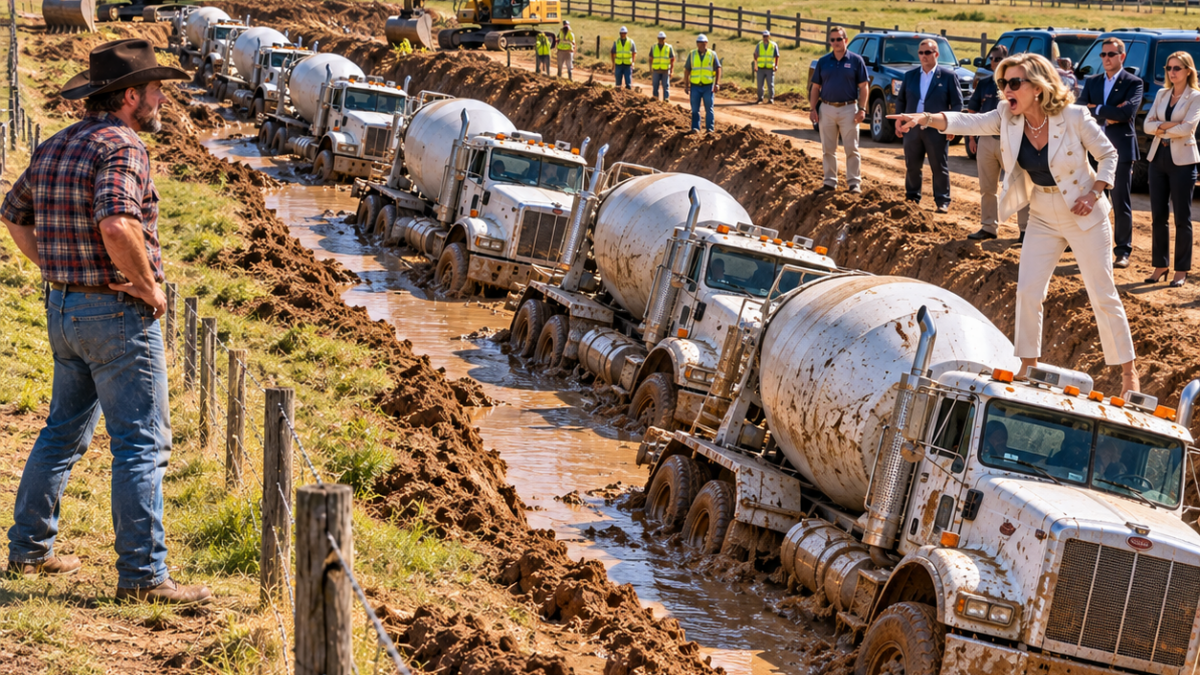
Nine loaded mixers now sat nose-to-tail inside my pasture with no legal path forward and very little space to turn around without driving across soft ground.
One driver tried.
His rear wheels sank into saturated Georgia clay.
Another moved to avoid him.
Sank too.
Then another.
Not because I had concealed a hazard.
Because weeks of unauthorized heavy traffic had already destroyed the soil structure and recent rain had finished the job.
By the time Sheriff Tillman arrived, nine cement mixers were effectively stranded.
Some stuck.
Others blocked by the ones ahead.
Loaded concrete inside the drums.
Drivers angry.
Dispatch screaming over radios.
And every minute mattered.
Concrete has a working window.
You cannot leave a loaded mixer spinning forever.
Wade arrived next.
Then Shelby.
White Escalade.
She parked half on the shoulder and marched across the pasture in cream-colored clothes and red-soled heels.
Georgia clay swallowed the heels almost immediately.
“This is sabotage!”
I stood near the barn with coffee.
Reggie stepped between us.
Shelby pointed toward the trucks.
“He trapped them!”
Reggie looked at me.
Then at the clearly marked channel.
The signs.
The moved barrier.
The trucks on my deeded property.
He said:
“Ma’am, these vehicles are on Mr. Calloway’s farm.”
“We authorized access.”
“Show me the easement.”
“The HOA voted.”
“That isn’t what I asked.”
Her face went rigid.
Wade arrived, pale.
“Sheriff, those loads are going to be ruined.”
Reggie shrugged.
“Then you should move your trucks off property you don’t have documented permission to use.”
“We can’t turn them.”
“That sounds like a logistics issue.”
I almost smiled.
Then Faye Whitfield from Georgia EPD arrived.
Sample case.
Boots.
Clipboard.
She went straight to the creek.
Shelby noticed.
“Who is that?”
“State environmental inspector.”
Her expression changed.
Faye spent forty minutes documenting runoff.
Phase Two grading.
Sediment.
Water conditions.
Then walked back.
“Who is responsible for the active construction site east of this property?”
Wade stepped forward.
“I am.”
“I need to see your approved erosion and sediment-control documentation.”
He said something about the county.
She asked again.
He did not have it.
Shelby turned toward Vernon as if he might magically appear.
He didn’t.
Then the newspaper arrived.
Colton Reeves from the Pickens County Register.
Photographer with him.
I had not called them that morning.
Dutch had.
Later he admitted it proudly.
The photograph that ran the next day showed nine cement mixers lined across my torn pasture, two sunk into red clay, Sheriff Tillman writing a report, Faye holding water samples, and Shelby Hargrove standing in ruined red-soled heels pointing at everybody.
Headline:
PRIVATE FARM DISPUTE HALTS STONEBRIDGE CONCRETE CONVOY; COUNTY AND STATE REVIEWS OPENED.
That photograph changed everything.
Not because it proved more than my paperwork.
Paperwork already proved plenty.
But photographs make abstract abuse understandable.
Residents saw the trucks.
Saw my pasture.
Saw the mud.
Saw Shelby.
Questions spread through Stonebridge.
Why were HOA resources being used for construction access?
Where was the easement?
Why was Vernon’s name on development approvals?
Why had Shelby issued violation notices against land outside the HOA?
Why was Phase Two being investigated?
Why had residents never been told any of this?
The nine trucks stayed for hours while recovery crews figured out how to remove them without creating more damage.
Several concrete loads were lost.
Not entire trucks full of hardened concrete forever, despite rumors that later spread around the county.
The truth did not need embellishment.
The financial hit was already enormous.
Tow equipment.
Disposal.
Missed pours.
Labor delays.
Site shutdown.
Lost concrete.
Damaged trucks.
And a state environmental investigation arriving at exactly the worst possible moment.
Within twenty-four hours, Pickens County placed Vernon Hargrove’s involvement in Stonebridge matters under review.
Phase Two permits were reexamined.
EPD opened a formal enforcement file.
Otis filed for damages.
The HOA called an emergency meeting.
I did not attend.
Dutch did.
He came to my house the next morning carrying coffee and looking happier than a man his age should look before seven.
“You missed something.”
“What?”
“Shelby.”
“What about her?”
“She came in dressed like she was addressing Congress.”
I poured coffee.
“And?”
“Started talking about community resilience.”
“Of course.”
“Used ‘property values’ eleven times.”
“You counted?”
“I had nothing better to do.”
He grinned.
“Then Harlan Boyce stood up.”
Harlan had been on the Stonebridge board for years.
Quiet.
Never challenged Shelby publicly.
“He asked for a vote of no confidence.”
I stopped pouring.
“Seriously?”
“Denise seconded it.”
“Denise Caldwell?”
“Your girl’s own vice president.”
Shelby had apparently stared at Denise like she had been slapped.
The vote expanded from the board to a packed membership meeting under Stonebridge procedures.
Final count:
Overwhelming.
Shelby lost.
The woman who had spent years acting like Stonebridge existed because she permitted it was removed as president in the same clubhouse where she had voted to send trucks across my land.
Three days later, Vernon Hargrove resigned from the planning commission.
His resignation letter was two sentences.
County attorneys began reviewing his Stonebridge votes.
I never learned every detail of the internal investigation.
Some matters became personnel issues.
Some moved through ethics procedures.
But his influence was finished.
Wade moved faster.
Developers understand risk when lenders start asking questions.
Within sixty days, Pruitt Development entered settlement negotiations.
Not only with me.
Dutch.
Travis Langford.
Cal Whitmore.
Four farms.
Different damage.
Same project.
Dust.
Runoff.
Unauthorized access pressure.
Lost productivity.
Property repair.
Legal expenses.
Settlement total:
$340,000.
My share covered the water line.
Pasture restoration.
Fence repairs.
Lost grazing.
Professional costs.
Attorney fees.
Wade also had to construct a proper legal access road to Phase Two.
The road he had tried to avoid building in the first place.
It cost more than settling with us.
That was not revenge.
That was arithmetic catching up.
EPD assessed penalties related to erosion and sediment-control failures and required corrective work.
The creek cleared slowly.
Water does not care about legal victories.
It responds only to what happens on the ground.
We stabilized the banks.
Repaired disturbed areas.
Revegetated slopes.
Installed proper sediment controls along affected drainage.
Months later, I could see stones at the bottom again.
Ellie noticed first.
We were checking fence.
She stopped near the creek.
“Dad.”
“What?”
She pointed.
“It’s clear.”
I looked.
She was right.
Not perfect.
But clear.
I sat on the bank.
For some reason, that was the moment I almost cried.
Not when Shelby lost.
Not when Vernon resigned.
Not when Wade signed settlement papers.
The creek.
Sarah loved that creek.
She used to take Ellie there with a jar and let her collect tiny fish she always had to release before dinner.
I put my hand into the water.
Cold.
Clean.
Flowing.
Ellie sat beside me.
“Mom would’ve been mad.”
“At them?”
“Yeah.”
I smiled.
“She would’ve been terrifying.”
Ellie laughed.
“She was tiny.”
“So are wasps.”
That night I thought about what to do with the settlement money.
I could have replaced equipment.
Paid debt.
Expanded cattle.
All reasonable.
Instead, I kept thinking about Dutch.
Travis.
Cal.
The Hendersons and other people who had been pushed around because developers or associations assumed one rural landowner could not afford to fight back.
So we created the Sarah Calloway Agricultural Preservation Fund.
Not huge.
Not some national foundation.
A local legal-assistance trust.
Purpose:
Help small North Georgia landowners dealing with forced-sale pressure, unlawful access claims, development encroachment, and HOA overreach onto agricultural property.
Otis agreed to advise pro bono on qualifying cases.
Dutch joined the board.
Travis and Cal contributed.
I named it after Sarah because she had always believed people with specialized knowledge owed something to the people who did not have it.
The ribbon cutting happened on our porch in October.
Around forty people.
Farmers.
Neighbors.
A few county officials who suddenly became very interested in farmland protection once cameras were gone.
Ellie cut the ribbon.
She used kitchen scissors Sarah had bought at the same Dahlonega flea market where she found the porch swing.
Ellie looked at the sign.
SARAH CALLOWAY AGRICULTURAL PRESERVATION FUND.
Then said quietly:
“Mom would’ve liked this.”
No speech.
No dramatic music.
Just that.
She was right.
The farm healed.
Slowly.
We regraded the worst truck ruts.
Reseeded pasture.
Repaired the water line.
Rebuilt fence.
The drainage canal stayed.
Not as a weapon.
As actual drainage.
Because by then the damage had changed how water moved across the south field.
I redesigned the channel properly for long-term use.
Stone check structures.
Vegetative protection.
Safe crossing for farm equipment farther upslope.
It worked.
That pleased me more than the court orders.
Engineers like when things work.
The mockingbird came back the next spring.
Same bird?
I have no idea.
I decided yes.
Ellie found it perched on the fence post where one of the cameras used to be.
“Look.”
“I see him.”
“You think it’s the same one?”
“Absolutely.”
“You don’t know that.”
“Don’t ruin this.”
She smiled.
Stonebridge changed too.
The new board rescinded every violation notice Shelby had issued against my land.
All eleven.
They mailed me a formal letter.
I framed one page.
Not because I needed vindication.
Because Ellie thought it was funny.
The new president, Harlan Boyce, came to the farm.
No golf cart.
No blazer.
No official pin.
He stood on the porch holding a folder.
“I owe you an apology.”
“You personally?”
“I sat on that board.”
“You vote for the truck route?”
He looked down.
“Yes.”
“Then yes.”
That surprised him.
I wasn’t going to pretend otherwise.
He nodded.
“Fair.”
We sat.
Coffee.
He explained that Shelby had presented the access as already legally cleared.
Wade had supposedly obtained whatever rights were needed.
Board members assumed.
Nobody checked.
I asked:
“Why?”
“Because she always had paperwork.”
“Paperwork doesn’t mean authority.”
“I know that now.”
He looked toward my pasture.
“We should’ve known it then.”
That was enough.
Not forgiveness.
Not friendship.
Accountability.
Stonebridge residents were not all villains.
That took me longer to accept.
Many had signed petitions because Shelby told them runoff from my cows was poisoning water.
Most had never visited the farm.
Some believed her.
Some were afraid of opposing her.
Some simply did not care enough to investigate.
That’s not noble.
But it’s different from conspiracy.
The new board opened its records.
Hired independent management.
Created conflict-of-interest rules.
Required legal review before making claims against non-HOA property.
Boring reforms.
Useful ones.
HOA meetings became dull.
That is what governance should be.
If your HOA meeting feels like a royal court, you have a problem.
Shelby and Vernon stayed in Stonebridge for several months.
Then listed.
I saw the listing online.
Beautiful house.
White kitchen.
Pool.
Private yoga room.
I recognized the heated floor invoice from the audit.
That audit uncovered additional problems.
Some HOA expenditures had gone toward work associated with Shelby’s private property.
The amounts were not enough to destroy Stonebridge financially.
Enough to destroy trust.
Residents were furious.
Shelby stopped attending social events.
Vernon disappeared from county meetings.
Eventually the house sold.
Less than they wanted.
Then they moved.
I never spoke with Shelby again.
That surprised people.
They expected a final confrontation.
A courtroom hallway.
One last speech.
Nothing.
She left.
Life continued.
Wade finished Phase Two using the proper access road.
Yes, Stonebridge continued growing.
That’s another thing people dislike about real stories.
The bad developer does not always vanish in bankruptcy.
Sometimes he pays.
Corrects.
Finishes.
Moves on.
Pruitt Development survived.
But the project cost more.
The permits received more scrutiny.
Erosion controls improved.
Trucks stayed off farms.
That counted.
Years later, Wade and I were in the same hardware store.
We saw each other.
He nodded.
I nodded.
That was all.
I no longer needed him to remember losing.
I needed him to remember boundaries.
There is a difference.
The nine cement mixers became local legend.
Naturally, the story got better every time somebody repeated it.
I supposedly dug a secret canyon overnight.
False.
I supposedly covered it with hay.
False.
All nine trucks supposedly drove into the canal like train cars.
Definitely false.
One guy at the feed store swore the concrete hardened inside all nine drums and they had to bury the trucks.
I asked where he heard that.
“Buddy of mine.”
“Your buddy is lying.”
He looked disappointed.
Reality was simpler.
A legally built, visibly marked drainage channel and barriers eliminated an illegal shortcut.
Stonebridge contractors interfered with those barriers.
Loaded trucks entered anyway.
Wet ground and their own months of damage stranded the convoy.
Law enforcement arrived.
State inspectors arrived.
Cameras arrived.
And once everybody was looking at the same facts, Shelby’s version of reality could no longer survive.
That’s important.
I did not win because I built a more dangerous trap.
I won because I built evidence.
Truck logs.
Photographs.
Water samples.
Public records.
Emails.
Videos.
Deeds.
Invoices.
County complaints.
Engineering assessments.
Lawyer letters.
One recording of Wade saying more than he should have.
The canal was only the visible part.
The paperwork was the structure underneath.
Engineers understand that.
People admire the deck of a bridge.
They rarely think about the footings.
The footings decide whether it stays standing.
My case against Stonebridge had footings.
Shelby’s had lipstick.
For a while, I hated her.
I should admit that.
When somebody walks through your grief and calls it dirt, hatred comes easily.
She knew Sarah was dead.
She knew Ellie lived with me.
She knew the farm mattered.
Still, when the trucks broke my water line, Shelby’s solution was:
Sell.
Start over.
Move Ellie.
As if attachment to land were a character defect.
As if memory were just poor financial planning.
I hated that.
Then something changed.
The fund started taking calls.
First case involved an older couple whose access road was being used by a developer without clear permission.
Second involved a family farm receiving threatening letters from an association they were not part of.
Third was just a misunderstanding resolved with one survey and one competent attorney.
I realized anger had done its job.
It got me moving.
But it did not need permanent employment.
Sarah would not have wanted me building my life around Shelby Hargrove.
So I stopped.
Not all at once.
But gradually.
One morning I opened the old Hargrove folder.
Eleven violation notices.
Copies of cease-and-desist letters.
Photographs.
I almost threw them out.
Otis told me to retain records.
So I boxed them.
Put them in storage.
Out of the kitchen.
That mattered more than I expected.
The kitchen belonged to Ellie and me again.
Not Shelby.
Ellie grew.
Middle school.
High school.
She became good at science.
Terrible at keeping her room clean.
Sarah’s daughter in both respects.
When she was sixteen, she asked:
“Did you really know the trucks were going to get stuck?”
I was fixing a gate.
“Some probably.”
“How?”
“The soil was destroyed.”
“So you planned it.”
“I planned to stop them crossing.”
“Same thing.”
“No.”
She smiled.
“You’re such an engineer.”
“That is not an insult.”
“It wasn’t.”
Then she asked:
“Were you scared?”
That stopped me.
“Of Shelby?”
“Everything.”
I set down the wrench.
“Yes.”
She looked surprised.
“You didn’t look scared.”
“Adults get good at looking like things.”
“What were you scared of?”
“Losing money.”
“Losing cattle.”
“Losing the farm.”
“The county siding with them.”
“Doing something stupid because I was angry.”
She nodded.
“Mom would’ve stopped you.”
“Yes.”
“She was good at that.”
“Very.”
Ellie went quiet.
Then:
“Do you think that’s why you made the fund?”
“What?”
“So you could do what Mom would’ve done.”
I looked toward the dogwoods Sarah planted.
Maybe.
I told Ellie:
“Partly.”
She accepted that.
A few years later, the Sarah Calloway Fund helped stop the forced sale of a small orchard after a developer claimed access rights it could not prove.
The orchard owner sent me a box of peaches.
Best payment I ever received.
I put one on Sarah’s grave.
Silly.
I know.
Still did it.
My mother used to say land remembers how you treat it.
Not literally.
She wasn’t mystical.
She meant you see the consequences.
Compact soil and next year’s grass tells you.
Cut trees and next summer’s heat tells you.
Ignore erosion and the creek tells you.
Abuse people and communities tell you too.
Stonebridge eventually became an ordinary subdivision.
Children rode bicycles.
People walked dogs.
The pool still closed after September.
Some residents bought beef from me.
One woman who had signed Shelby’s water petition became a regular customer.
First time she came, she looked embarrassed.
“I owe you an apology.”
“You already apologized at the meeting.”
“I signed that petition.”
“Yes.”
“I believed her.”
“I know.”
“I never even looked at the creek.”
“I know.”
She winced.
“You don’t make this easy.”
“Would lying help?”
She laughed.
“No.”
Then bought twenty pounds of beef.
People can change.
Systems can too.
That does not erase damage.
It just keeps damage from being the last thing.
The county changed procedures after Vernon.
Conflict disclosures tightened.
Stonebridge approvals were reviewed.
Nobody admitted the previous system had been corrupt.
Government rarely uses dramatic words about itself.
They called it “process improvement.”
Fine.
Call it whatever you want if the next landowner gets a fair hearing.
Sheriff Tillman retired.
At his retirement dinner he came to my table.
“Still digging ditches?”
“Canals.”
He smiled.
“Right.”
“Important distinction.”
“I remember.”
He sat.
“Want to know something?”
“Sure.”
“When you brought me that midnight dumping video, I thought, finally.”
“Finally what?”
“Finally somebody kept receipts.”
That stayed with me.
Most abusive systems depend on exhaustion.
People complain verbally.
Get angry.
Give up.
Sell.
Move.
Stop answering.
The powerful person then says:
See? There was never a problem.
Receipts are memory that cannot be intimidated.
Photographs.
Dates.
Files.
Logs.
Documents.
Engineers file everything because structures fail slowly.
So do institutions.
If you document the cracks, eventually nobody can say the collapse came from nowhere.
I still have Sarah’s wren lamp.
It sits on the kitchen counter.
Wrong place for a lamp.
I don’t care.
Sometimes at night, I work under it.
Fund cases.
Farm records.
Ellie’s college forms when she was younger.
The painted birds are faded.
One has a chip.
Still works.
Sarah used to say wrens reminded her of people who fought above their weight class.
For years I thought the lesson was fight harder.
Now I think it was different.
Small does not mean powerless.
Quiet does not mean consent.
And you do not need to become bigger than your opponent.
You need leverage.
Mine was knowledge.
Shelby had a board.
Vernon had a commission seat.
Wade had money.
I had a deed.
An engineering license.
A camera.
A notebook.
A lawyer.
And enough patience to let them keep creating evidence.
That was enough.
The south pasture looks normal now.
You would never know nine cement mixers once crossed it six days a week.
Grass returned.
The worst compacted sections took longer.
We aerated.
Reseeded.
Adjusted drainage.
The canal softened with vegetation.
It became part of the landscape instead of a wound.
Cattle cross it at a reinforced farm crossing I built farther north.
The creek runs clear most days.
After storms, it clouds the way Georgia creeks always do.
Natural sediment.
Not construction soup.
The mockingbird still nests near the fence.
Maybe not the same bird.
I no longer argue with Ellie about that.
The water line is newer.
Better.
Buried deeper.
Sleeved at the farm crossing.
Once bitten.
Engineer twice cautious.
Sometimes I stand where the trucks used to enter.
You can still see the old gate posts.
I never replaced one because Sarah painted a small green stripe on it years ago while painting the barn.
Nobody else would notice.
I do.
That’s what Shelby never understood.
She saw acreage.
Route.
Efficiency.
Wade saw eleven minutes.
I saw my father planting grass.
Sarah walking.
Ellie learning.
That does not mean development is evil.
It doesn’t.
People need houses.
Roads.
Schools.
Infrastructure.
I spent my career building things.
But development without consent is not progress.
It is taking.
There is a difference.
If Wade had knocked on my door first and offered a fair temporary easement with protections, insurance, road mats, restoration guarantees, water-line protection, and compensation?
Would I have agreed?
Maybe.
That’s the irony.
Maybe.
I was not opposed to Stonebridge existing.
I was opposed to being treated as if my consent were unnecessary.
Shelby never understood that.
She thought asking created the possibility of hearing no.
So she skipped asking.
That’s how people turn a negotiable problem into war.
Years after everything ended, I found a voicemail Sarah had left me while I was working in Birmingham.
Old phone backup.
Her voice.
“Hey, engineer.”
Pause.
“You left your coffee on the roof of the truck again.”
She laughed.
“I put it in the fridge because apparently that’s where coffee lives now.”
Then:
“Come home safe.”
Nine seconds.
Maybe ten.
I listened three times.
Then once more.
Come home safe.
That phrase changed something in me.
For years after she died, keeping the farm had felt like protecting the past.
Maybe it wasn’t.
Maybe it was protecting the place where Ellie and I learned how to continue.
There’s a difference.
Shelby told me to start fresh.
She assumed fresh meant somewhere else.
Sometimes fresh means staying and changing what staying means.
The Sarah Calloway Fund is still operating.
Small.
Local.
Effective.
We do not advertise revenge against HOAs.
That would be childish.
We help with surveys.
Title review.
Legal consultation.
Access disputes.
Agricultural zoning.
Environmental documentation.
Sometimes the answer is:
You’re right.
Sometimes:
You’re wrong.
That’s important too.
Not every angry landowner is legally correct.
Facts matter even when they disappoint you.
Otis taught me that.
“Never hire me to agree with you,” he said once.
“Hire me to tell you where the ground actually is.”
Engineers and lawyers have that in common at their best.
Find the real ground.
Build from there.
Shelby built authority on assumption.
It failed.
Vernon built influence on undisclosed relationships.
It failed.
Wade built his schedule on somebody else’s property.
It failed.
I built my response on documentation.
That held.
People still ask about the morning the nine mixers were stranded.
They want a cinematic story.
Engines roaring.
Mud flying.
Shelby screaming.
Red heels sinking.
Yes.
All of that happened.
And yes, I enjoyed watching Sheriff Tillman ask her for the easement she could not produce.
I’m not going to pretend I achieved spiritual enlightenment before breakfast.
But the most important moment happened earlier.
One in the morning.
Kitchen table.
Sarah’s wren lamp.
Three missing documents in front of me.
No easement.
No conflict disclosure.
No adequate erosion-plan record.
That was the real turning point.
Not the canal.
Knowledge.
The moment I stopped reacting to Shelby and started understanding the structure around her.
That’s when fear changed shape.
Before, I felt trapped.
After, I had a plan.
Grief taught me something similar.
You cannot always control what enters your life.
Cancer did not ask.
Loss did not ask.
Neither did nine cement mixers.
But after the impact, there are still decisions.
Document.
Repair.
Reroute.
Protect what remains.
Build differently.
Water finds another path.
So do people.
On the fifth anniversary of the fund, Ellie came home from college.
Environmental engineering.
Yes.
I know.
I pretended not to be unbearably proud.
We walked the pasture.
She stopped beside the drainage canal.
“This is smaller than I remember.”
“You were eleven.”
“Everything was bigger.”
“True.”
She looked toward Stonebridge.
“Do people still tell the story wrong?”
“All the time.”
“What version?”
“That I dug a giant hidden trench and nine trucks drove into it.”
She laughed.
“That would be incredibly illegal.”
“Thank you.”
“You’d be sued into the ground.”
“Exactly.”
“Also someone could’ve gotten killed.”
“Yes.”
She shook her head.
“People like drama.”
“Apparently.”
She walked along the bank.
“What really happened is better.”
“Is it?”
“You made them stop.”
“Eventually.”
“You used the thing you already knew.”
“Hydraulics?”
“Systems.”
I looked at her.
She continued.
“Mom always said you solve everything like a drainage problem.”
“She did?”
“Yeah.”
“When?”
“When you weren’t listening.”
That sounded like Sarah.
Ellie crouched and touched the grass.
“Pressure builds.”
“Find the outlet.”
I smiled.
“That’s not bad.”
“I know.”
Then she looked toward the barn.
“Come on.”
“Where?”
“I want to see the Hargrove folder.”
“No.”
“Why?”
“Because you will steal things for presentations.”
“I call it archival research.”
“You sound like your mother.”
“Thank you.”
She did eventually see the folder.
We laughed at the Florida statute.
Some things improve with age.
The last thing I kept from the whole dispute was the original first violation notice.
FENCE EXCEEDS MAXIMUM AESTHETIC HEIGHT BY FOUR INCHES.
Five hundred dollars per day.
I put it in a simple frame in the fund office.
Underneath, a small brass plate:
VERIFY AUTHORITY BEFORE FEARING LETTERHEAD.
People smile.
That’s the point.
Fear often arrives formatted professionally.
Logos.
Titles.
Bold fonts.
Legal language.
That does not make it valid.
Check.
Ask.
Read.
Call the actual agency.
Pull the actual deed.
Look for the actual easement.
Paper can intimidate.
Paper can also free you.
Depends who reads it more carefully.
I never became anti-HOA.
That surprises people too.
A homeowners association is a tool.
Tools reflect whoever holds them.
Used well, they maintain common assets.
Roads.
Pools.
Drainage.
Insurance.
Landscaping.
Used badly, they become little governments operated by people who confuse procedure with sovereignty.
Stonebridge became better after Shelby.
Not perfect.
Nothing is.
But boring.
And boring is good.
Minutes.
Budgets.
Elections.
Open records.
Real lawyers when needed.
No one measuring the visual offensiveness of my cows.
One year, Stonebridge invited local farms to a fall festival.
My cattle were part of the hayride route.
I stood near the same fence where Shelby had once taped violation notices.
Kids waved.
Parents bought pumpkins from Dutch.
Harlan came over.
“You ever think we’d be doing this?”
“No.”
“Me either.”
He looked at my truck.
Still dirty.
“You know, Shelby was right about one thing.”
I stared.
“What?”
“That truck is aggressively unwashed.”
I laughed so hard I had to lean against the fence.
Sarah would have liked Harlan.
Probably.
That’s another sign the fight was over.
I could laugh at the insult.
For a long time, I thought victory meant Shelby losing.
Then I thought it meant the settlement.
Then the fund.
Now I think it was the morning Ellie and I stood beside clear water and neither of us looked toward Stonebridge.
We were watching minnows.
That was victory.
A person who harms you occupies space.
First in your property.
Then your schedule.
Then your mind.
The final boundary is getting them out of the last one.
Shelby crossed my pasture before she ever entered my thoughts.
It took longer to remove her from the second place.
Eventually I did.
The pasture recovered.
So did I.
Not completely.
Nobody recovers from losing a spouse by returning to who they were.
You become someone else.
Hopefully not smaller.
Sarah is still everywhere.
Dogwoods.
Porch swing.
Wren lamp.
Ellie.
Fund.
The green barn doors fade and I repaint them the same color.
Not because I’m trapped in memory.
Because I like the color now.
She was right.
Red would’ve been too obvious.
Every July, I inspect the water line.
Check the drainage channel.
Walk the creek after storms.
Engineering habits.
Sometimes I catch myself explaining things aloud.
“Flow is good here.”
“Need stone on that bank.”
“Vegetation’s holding.”
No one listening.
Maybe Sarah.
Maybe cattle.
Mostly me.
That’s okay.
The nine cement mixers taught me something I wish I had learned without needing them.
Property rights are not abstract until somebody assumes yours are optional.
Documentation is not boring when somebody lies.
Expertise is not just how you earn a salary.
Sometimes it is how you defend your life.
And restraint is not weakness.
That one mattered most.
I wanted to block the trucks immediately.
Wanted to tear down every sign.
Wanted to scream at Shelby.
Wanted to park equipment across the gate.
Wanted to make the conflict physical because physical conflict feels satisfying when paperwork feels slow.
Otis stopped me.
Engineering stopped me.
Sarah’s voice in my head probably stopped me too.
Measure first.
Understand the load.
Know where failure will occur.
Then act.
Shelby thought silence meant surrender.
It didn’t.
It meant I was collecting data.
She thought politeness meant fear.
It didn’t.
It meant I did not want my anger used against me.
She thought an HOA vote created an easement.
It didn’t.
She thought her husband’s position made missing paperwork irrelevant.
It didn’t.
She thought Wade’s money meant I would sell.
I didn’t.
She thought nine cement mixers would keep coming forever because they had come yesterday.
They didn’t.
And when the route finally closed, it was not because I attacked anybody.
It was because private land eventually behaved like private land again.
That distinction matters.
The old south-pasture gate still stands.
A little bent from the first week of truck traffic.
I considered replacing it many times.
Never did.
On one post is a faint streak of green paint.
Sarah.
She had been painting the barn and leaned the brush there.
Another accident I once intended to fix.
Now I hope it never disappears.
Some scars deserve repair.
Some marks deserve remembering.
Knowing the difference is part of getting older.
If you drove past today, you would see cattle.
Grass.
A green barn.
Dogwoods.
Creek.
No concrete convoy.
No reporters.
No sheriff.
No Shelby.
Nothing dramatic.
That’s how I like it.
The loudest conflicts in your life should eventually become quiet enough that strangers cannot tell where they happened.
The land does not need to perform its history.
Neither do I.
Still, every once in a while, a young farmer comes to the fund office carrying an official-looking letter.
HOA.
Developer.
Utility company.
County.
Their hands shake slightly.
They say:
“I don’t know what this means.”
I never tell them to fight.
Not first.
I say:
“Sit down.”
Then:
“Let’s read it.”
Every line.
Every citation.
Every signature.
Every parcel number.
Because sometimes the terrifying document is legitimate.
Sometimes it isn’t.
Sometimes the road crossing your land has an easement.
Sometimes it doesn’t.
Sometimes you lose.
Sometimes you win.
But knowing is always better than fear.
And if there is one thing Shelby Hargrove gave me, unwillingly, it was a permanent respect for checking.
The entire fight changed because I checked.
The deed.
The records.
The creek.
The approvals.
The emails.
The law.
The flow path through one low stretch of Georgia clay.
Engineers always check.
That was the mistake Shelby made.
She thought she was fighting a farmer.
She was.
She just never bothered to ask what the farmer had been before grief brought him home.
By the time she learned I knew how to move water, read plans, document failure, and wait for pressure to expose weak joints, her whole little kingdom had already developed cracks.
I did not have to break it.
I just stopped holding it together for her.
Years later, when people ask Ellie about the story, she tells it better than I do.
Someone once asked her:
“Did your dad really trap nine cement trucks?”
She said:
“No.”
Then smiled.
“He gave them every chance to stop trespassing.”
Pause.
“They just kept driving.”
That’s exactly right.
And maybe that’s the whole story.
I asked.
I documented.
I waited.
I built what my farm needed.
They kept crossing lines.
Physical ones.
Legal ones.
Ethical ones.
Eventually they reached a line that would not move for them.
A drainage canal.
A court order.
An environmental investigation.
A sheriff asking for an easement that never existed.
The most powerful people in Pickens County suddenly had to answer the simplest question in property law:
Who gave you permission?
They had no answer.
The cattle came back to the south pasture that fall.
One evening I sat on Sarah’s porch swing and watched them graze.
Ellie was inside doing homework.
The creek ran clear below the trees.
A mockingbird landed on the old fence post.
Across the property line, Stonebridge lights came on one house at a time.
Families eating dinner.
Kids getting ready for school.
Normal life.
No war.
No trucks.
I listened to the swing creak.
For years, that sound meant Sarah was gone.
That evening it sounded different.
Not absence.
Memory.
There is a difference.
I looked across the pasture where nine cement mixers had once torn through every morning and realized the land was quiet again.
Not because somebody had given me peace.
Because I had protected the conditions that allowed peace to return.
Sometimes that’s all winning is.
Not destroying the person who tried to take something from you.
Just making sure they fail.
The grass grew back.
The creek cleared.
The cattle settled.
My daughter stayed home.
My wife’s trees kept blooming.
And the road Wade Pruitt should have built from the beginning carried every cement mixer after that.
Exactly where it belonged.
Off my land.

