HOA Paved 80 Acres of My Texas Ranch Into an Illegal Runway and Landed 11 Private Jets—Then the FAA Grounded Every Plane and Asked Who Authorized the Strip.
PART2:
A temporary operations trailer sat beside the strip with antennas on the roof and a diesel generator rumbling nearby.
Someone had even installed a windsock.
A red-and-white windsock.
On my land.
My grandfather’s farmhouse was still there beyond it.
Small.
White.
Old.
Almost insulting in how normal it looked behind something that resembled a regional airport.
I turned off the truck.
Sat there.
Blinking.
Then I opened the door.
The heat hit me.
I walked toward the fence.
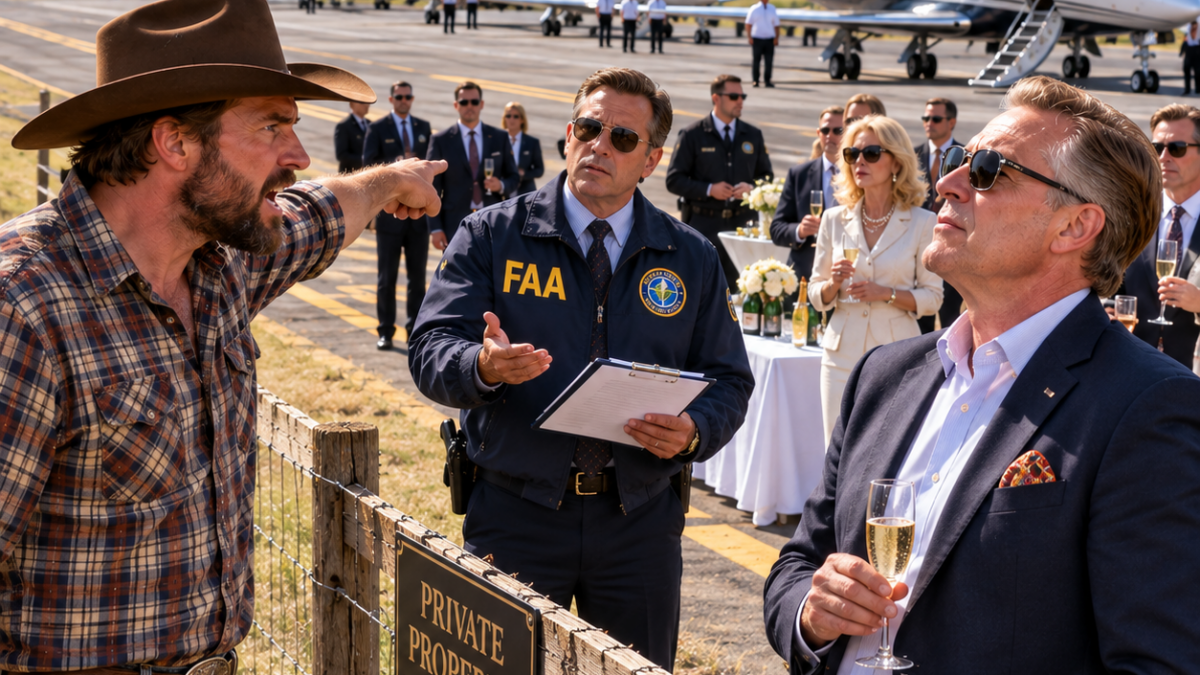
There was a sign zip-tied to it.
SUMMIT RIDGE EXECUTIVE AVIATION EVENT
AUTHORIZED PERSONNEL ONLY
PRIVATE FACILITY
NO TRESPASSING
I read it three times.
Then I started laughing.
Not because anything was funny.
It was the kind of laugh that comes when anger hasn’t found another way out yet.
I looked down at my boots.
Then through the fence.
Then back at the sign.
“No trespassing.”
I said it out loud.
On my own property.
That was when the anger landed.
Not hot anger.
Not yelling.
Something colder.
I got back into my truck and drove straight to Summit Ridge Estates.
If you have never seen Summit Ridge, imagine a luxury resort built by people who hated the idea that nature might occur without prior approval.
The neighborhood sat along my southern boundary.
When my grandfather bought the Cole property, there had been nothing there but cedar scrub, cattle pasture, and two dirt roads.
By the time I inherited our 120 acres, Austin had crawled outward until subdivisions started appearing like mushrooms after rain.
Summit Ridge was the biggest.
And richest.
Homes started around four million dollars.
Some went past ten.
Stone gates.
Man-made lakes.
Private fitness center.
Tennis courts.
A clubhouse that looked more like a Four Seasons than an HOA facility.
There were golf carts with leather seats.
Imported palms that had no business being in central Texas.
A valet stand outside the clubhouse on weekends.
And residents who liked being able to say they lived “in the country” while complaining if a real cow made a real smell within a mile of their kitchen.
The HOA had been irritating me for years.
They had sent letters about my barn.
Not because it violated anything.
I wasn’t part of their association.
They simply didn’t like the faded galvanized roof.
One notice called it “visually inconsistent with the curated southern horizon.”
I burned that letter in my wood stove.
They complained about my tractor being visible.
About dust.
About lights from my equipment shed.
Once, they sent an architectural review request suggesting I paint my hundred-year-old cattle barn “Hill Country Limestone.”
I mailed the form back blank.
Their president was Gregory Patterson.
Gregory was sixty-three.
Former hedge-fund manager.
Former, because by his own telling he had “retired before fifty with enough money to never work for idiots again.”
He had silver hair that always looked professionally trimmed, expensive sunglasses, and the permanent expression of a man who expected restaurant managers to know who he was before he sat down.
For four years Gregory had been trying to buy my land.
The first offer was fair enough.
I said no.
The second was lower.
I said no.
The third came with a handwritten note:
Harrison, this acreage is clearly no longer suitable for productive agricultural use. Let’s create something beneficial for everyone.
I called him.
“Gregory.”
“Harrison.”
“Don’t tell me whether my land is productive.”
“I meant economically.”
“I know what you meant.”
He laughed.
“You’re emotionally attached.”
“That’s usually what happens when three generations work the same dirt.”
“You’re leaving money on the table.”
“Then I guess it’ll stay there.”
His tone changed.
“What exactly are you going to do with 120 acres when development surrounds you?”
“Own it.”
He didn’t like that answer.
I drove through Summit Ridge’s front gate that morning so fast the guard barely had time to raise the barrier.
He stepped outside his booth waving both arms.
“Sir!”
I kept going.
Normally I am not dramatic.
That morning I made an exception.
I parked sideways across three spaces outside the clubhouse.
Walked in.
A receptionist stood.
“Can I help—”
“Where’s Gregory?”
She took one look at my face.
“Conference room.”
I pushed open the double doors.
Gregory sat at the end of a mahogany table.
Beside him was Beatrice Montgomery, the HOA vice president.
Beatrice was fifty-eight, owned several boutique real-estate firms, and spoke in the clipped tone of somebody who regarded normal conversation as a board meeting that had gotten out of control.
Two other board members sat with them.
Catering menus were spread across the table.
Champagne packages.
Linen samples.
Parking assignments.
Gregory looked up.
Smiled.
“Harrison.”
“You paved my field.”
Beatrice sighed as if I had interrupted over a hedge complaint.
Gregory stood.
“You’re back earlier than expected.”
That sentence stopped me.
Not hello.
Not what do you mean.
Not surprise.
You’re back earlier than expected.
“You knew when I was coming home?”
He realized the mistake.
Too late.
I walked to the table.
“What did you do?”
Gregory adjusted his cuffs.
“We made a temporary improvement.”
“Temporary?”
“It can be removed.”
“You paved eighty acres.”
“Closer to sixty-eight of actual hardened surface.”
I stared at him.
“You know the acreage?”
Beatrice jumped in.
“Harrison, there is no reason to become emotional.”
I looked at her.
“My family’s pasture is an airport.”
“Airstrip.”
“What?”
“Technically, it is a temporary private airstrip.”
I laughed.
“Thank God you clarified.”
Gregory spread his hands.
“We’re hosting an executive aviation event.”
“On my property.”
“Adjacent to Summit Ridge.”
“On my deed.”
“We secured legal access.”
“No, you didn’t.”
Gregory reached into a leather folder.
Pulled out a document.
Slid it toward me.
I didn’t touch it.
“What is that?”
“Temporary municipal nuisance-abatement and utility easement.”
I stared at him.
“For my pasture?”
“You left the property effectively unattended for six months.”
“I went to Alaska for work.”
“Weeds reached dangerous levels.”
“They’re called grass.”
“Vegetation along our border exceeded municipal fire standards.”
“No it didn’t.”
“You failed to respond to notices.”
“I wasn’t here.”
“Not our responsibility.”
I picked up the document.
There it was.
County seal.
Case number.
Signature of Judge Richard Wallace.
The order claimed my southern acreage had become a nuisance and granted Summit Ridge temporary access to conduct “abatement, grading, safety improvements, and temporary utility works.”
Nothing in it said runway.
Nothing in it said airplanes.
Nothing in it authorized paving eighty acres.
I looked at Gregory.
“This doesn’t let you build an airport.”
“It gave us access for improvements.”
“You think an aviation facility is landscaping?”
“Temporary infrastructure.”
“I’m giving you twenty-four hours.”
Beatrice laughed.
I turned toward her.
“Something funny?”
“You genuinely believe seventy-two hours before our event we’re going to excavate an entire runway because you’re upset?”
“I’m not upset.”
I put the paper down.
“I’m telling you.”
Gregory’s smile vanished.
“Harrison, stop performing.”
I stepped closer.
“You entered my property while I was gone.”
“We had authority.”
“You destroyed native pasture.”
“We improved unusable acreage.”
“You removed my fence.”
“It interfered with the safety zone.”
“You poured asphalt.”
“Yes.”
“You painted runway markings.”
“Yes.”
“You installed lights.”
“Yes.”
“And you scheduled aircraft to land.”
He smiled again.
“Eleven.”
My stomach tightened.
“What?”
“Eleven aircraft.”
He picked up one of the catering pages.
“Some impressive people are attending.”
“I don’t care.”
“You should.”
His tone became smug.
“A senator.”
He named one.
“Two Fortune 500 CEOs.”
Another name.
“Several venture-capital partners. Private-equity principals. Real-estate investors. People whose involvement could be very useful to this region.”
“Useful to you.”
“Useful to everyone.”
I looked at the map spread across the table.
There it was.
SUMMIT RIDGE EXECUTIVE FLY-IN.
Taxiway.
Parking zone.
Hospitality tent.
VIP entrance.
My farmhouse was shown as a tiny unlabeled rectangle.
I felt something inside me go very still.
“When do they land?”
“Friday.”
Three days.
Gregory sat.
“So you understand the problem with your deadline.”
“No.”
I folded the easement order.
“The problem is yours.”
“Harrison.”
“I want the runway gone.”
“Not happening.”
“Then the event isn’t happening.”
His eyes narrowed.
“And how exactly do you intend to stop aircraft from landing?”
“I’ll figure it out.”
“Don’t do anything stupid.”
He pointed at me.
“We have licensed private security.”
I laughed.
“Are you threatening me on my property?”
“The easement creates a five-hundred-foot safety zone around the runway.”
“No.”
“It does.”
“Your piece of paper says nothing about that.”
“We have supplemental orders.”
“Show me.”
“I don’t have them in front of me.”
“Because they don’t exist.”
Beatrice leaned forward.
“If you cross the secured aviation area during operations, security has authority to remove you.”
I stared at her.
“From my land.”
“Temporarily.”
I nodded.
That was the moment they both decided I had accepted defeat.
You could see it.
Their shoulders relaxed.
Gregory returned to his chair.
Beatrice picked up a catering sheet.
They thought the local contractor had finally understood how expensive resistance could become.
I had spent twenty-seven years in commercial construction.
Gregory knew that.
What he did not know was that construction taught you more than how to pour concrete.
You learn permits.
Inspectors.
Jurisdiction.
Environmental review.
Airspace clearances.
Liability.
You learn that local approval is only one layer of law.
And an airstrip is not a gazebo.
I turned toward the door.
Gregory called after me.
“Harrison.”
I stopped.
“Don’t embarrass yourself Friday.”
I looked back.
“I was about to tell you the same thing.”
Then I left.
My attorney, David Campbell, did not laugh when I showed him the runway.
David was fifty-one, had handled land-use disputes for most of his career, and used profanity sparingly enough that you knew when a situation had crossed a line.
He stood at my fence that afternoon staring at the asphalt.
Then he said:
“Holy shit.”
“Exactly.”
He walked the boundary with a copy of my survey.
Took photographs.
Checked coordinates.
Called the title company.
Called the county clerk.
Then we sat in my kitchen.
“First thing.”
He tapped the judge’s order.
“This is garbage.”
“Can we kill it?”
“Yes.”
“How fast?”
He made a face.
“Not by Friday.”
I expected that.
“Temporary injunction?”
“We can file tomorrow. Emergency hearing maybe Monday.”
“Jets land Friday.”
“I know.”
“Can I block the runway?”
“No.”
“It’s mine.”
“And they’ve got an order.”
“A fake order.”
“Until another judge says otherwise, it’s still an order.”
“So they steal my land and I’m the one who gets arrested?”
“Welcome to litigation.”
I stood.
“What about aviation law?”
David stopped.
“What about it?”
“I’ve built hangars.”
He looked toward the field.
Slowly.
“You thinking FAA?”
“I am.”
He leaned back.
“That’s outside my specialty.”
“But?”
“But airports don’t just appear.”
“Exactly.”
He smiled for the first time.
“That could get interesting.”
I spent the next three days doing something Gregory Patterson had never expected me to do.
I became patient.
I did not drive a bulldozer onto the tarmac.
Did not cut their fence.
Did not confront security.
Did not sabotage runway lights.
Every reckless thing I wanted to do, David told me not to do.
Instead, I documented.
I launched my drone from my northern pasture where there was no question about access.
Recorded the entire site.
Runway markings.
Lighting.
Portable fuel storage.
Operations trailer.
Vehicles.
The temporary radio mast.
Drainage channels they had cut straight through sections where bluebonnets returned every spring.
I photographed the piles of excavated topsoil shoved behind the old mesquite line.
They had even bulldozed the stone watering trough my grandfather built in 1968.
That hurt more than it should have.
Dad used to wash my hands there when I was a boy.
I found pieces of it beneath gravel.
Took photographs.
Then I started making calls.
The first federal office passed me to another.
That office passed me again.
Eventually I reached someone who understood exactly what I was describing.
“Are aircraft already operating?”
“Not yet.”
“When?”
“Friday.”
“Coordinates?”
I gave them.
Pause.
“Repeat that.”
I did.
Keyboard clicking.
Another pause.
“Sir, there is no registered airport development notice at those coordinates.”
“That’s what I thought.”
“How long is the runway?”
“About four thousand feet.”
“Surface?”
“Fresh asphalt.”
“Lighting?”
“Yes.”
“Tower?”
“Temporary trailer with radio equipment.”
“Who built it?”
“My neighboring HOA.”
Silence.
“The homeowners association?”
“Yes.”
“Do you own the property?”
“All of it.”
“Did you authorize aviation use?”
“No.”
“Can you send documentation?”
“I have drone footage.”
“What else?”
“Deed. Survey. Judge’s order they claim gave them access.”
Another pause.
“I’m giving you an email.”
By Wednesday evening, I had sent almost three gigabytes of material.
On Thursday morning, Director Thomas Granger called me.
His title was longer than I remember exactly, but he worked in FAA enforcement and airport compliance.
His voice reminded me of a superintendent I had worked for years ago.
Calm.
Direct.
No wasted words.
“Mr. Cole.”
“Yes.”
“I reviewed your materials.”
“And?”
“How many aircraft are expected?”
“Eleven.”
“Turbine?”
“Most.”
“Passenger event?”
“Yes.”
“Fueling?”
“Looks like it.”
“Temporary traffic control?”
“They have a trailer.”
“Do not interfere with flight operations.”
“I wasn’t planning to.”
“Do not place vehicles on the runway.”
“Understood.”
“Do not shut off lights if aircraft are approaching.”
“Understood.”
“Do not confront pilots.”
“Okay.”
I waited.
“Are you coming?”
He paused.
“Have your ownership documents available Friday.”
Then hung up.
That was all.
Friday morning arrived hot and perfectly clear.
Gregory had chosen a beautiful day for his crime.
By eight, Summit Ridge’s event crews were everywhere.
White tents.
Catering trucks.
Black SUVs.
Portable air-conditioning units.
Floral arrangements.
Yes.
Floral arrangements beside a runway.
Security guards stood along the perimeter.
One spotted me on my porch and raised binoculars.
I waved.
At 8:52, I heard the first jet.
There is something different about hearing turbine engines when you know they are descending toward land that was pasture a week earlier.
The sound rolled over my roof.
My windows rattled.
Then a white Gulfstream appeared low above the north field.
Gear down.
It passed directly over my house.
For one insane moment, I could see the underside clearly enough to read markings.
Then tires hit asphalt.
Smoke puffed.
The aircraft slowed.
Turned near the far end.
Taxied toward the hospitality area.
Gregory stood near the tent wearing an aviator jacket.
He clapped.
Actually clapped.
The second aircraft arrived twenty minutes later.
Then a Cessna Citation.
Then a Pilatus.
Then another Gulfstream.
A Learjet.
A Challenger.
By noon, eleven aircraft sat in a gleaming line where my cattle once grazed.
Combined value?
I couldn’t guess.
Hundreds of millions, easily.
Guests emerged.
Men in custom jackets.
Women in designer sunglasses.
Pilots wearing spotless uniforms.
Golf carts ferried them from planes to the clubhouse path.
Champagne appeared.
Music.
Catering.
Gregory shook hands like he had personally invented flight.
Beatrice wore a cream dress and a wide hat that looked like she was attending a Kentucky Derby sponsored by tax fraud.
I sat on my porch.
Drank black coffee.
Waited.
At 12:40, Gregory sent two security guards to my house.
They stopped outside my fence.
One called:
“Mr. Cole?”
“Yes.”
“Mr. Patterson requests that you remain within the residential portion of your property during operations.”
I looked around.
“My residential portion.”
“Five-hundred-foot safety buffer.”
“Show me where I agreed to that.”
The guard shifted.
“We’ve been instructed—”
“I don’t care.”
He looked uncomfortable.
The other guard said:
“We don’t want trouble.”
“Neither do I.”
I raised my coffee.
“That makes three of us.”
They left.
At 1:12, my phone rang.
Granger.
“We’re close.”
I stood.
“How close?”
The line disconnected.
Two minutes later, four black Chevrolet Suburbans turned off the county road.
Gregory’s front gate guards tried to stop them.
The Suburbans never entered Summit Ridge.
Instead, they continued past the entrance.
Turned onto the county utility shoulder.
Crossed through an access point identified in my property documents.
Then drove directly onto my northern pasture.
My land.
Authorized by me.
Dust rolled behind them.
Every head beneath the catering tent turned.
The vehicles stopped beside the runway.
Doors opened.
Men and women stepped out.
Some wore navy FAA jackets.
Others had federal credentials clipped to belts.
One carried a camera.
Another had a tablet.
Granger exited the lead SUV.
Tall.
Late fifties.
Gray hair cut close.
Sunglasses.
He looked at the eleven aircraft.
Then looked at the runway.
Then looked at Gregory.
The music stopped.
I walked down from my porch.
One security guard moved toward me.
Granger called across the asphalt.
“Mr. Cole?”
“Yes, sir.”
“Come here.”
The guard stopped.
That felt good.
Gregory rushed toward Granger.
“Excuse me.”
Granger held up one hand.
“Sir, identify yourself.”
Gregory straightened.
“Gregory Patterson. President of Summit Ridge Estates.”
“Are you the individual responsible for operation of this facility?”
“Facility?”
“The runway.”
Gregory smiled.
“Yes. In conjunction with our association board.”
Granger looked at his tablet.
“Name of airport?”
Gregory hesitated.
“It is not an airport.”
Granger looked up.
“What is it?”
“A temporary private landing strip.”
“Name?”
“Summit Ridge Executive Strip.”
“FAA site identifier?”
Gregory frowned.
“Private facilities don’t require—”
Granger interrupted.
“Airport construction notification filing?”
“We received county authorization.”
“That was not my question.”
Gregory’s face changed slightly.
Beatrice came closer.
“We have all relevant permits.”
Granger looked at her.
“Your name?”
“Beatrice Montgomery. Vice president.”
“Did you submit notice of proposed construction or alteration of an airport?”
Beatrice looked at Gregory.
He said:
“We were advised this fell under temporary private use.”
“By whom?”
“Our legal counsel.”
Granger tapped his screen.
“Radio authorization?”
Gregory said nothing.
“Published operating procedures?”
Nothing.
“Obstacle analysis?”
Nothing.
“Emergency response plan?”
Beatrice finally said:
“The county approved the site.”
Granger looked at her.
“Ma’am, the county does not administer the National Airspace System.”
That was the first moment Gregory looked truly worried.
He recovered quickly.
“This is private aviation.”
“Private aviation still occurs in federal airspace.”
Granger glanced toward the runway.
“Did the landowner authorize construction?”
Gregory smiled.
“Absolutely.”
Every muscle in my body tightened.
He pointed at me.
“Mr. Cole’s property was subject to a court-authorized temporary improvement easement.”
Granger turned.
Everyone else did too.
Eleven aircraft crews.
Guests.
Catering staff.
Security.
Beatrice.
Gregory.
All looking at me.
Granger said:
“Mr. Cole.”
“Yes.”
“Did you authorize construction of this runway?”
“No.”
Gregory’s face twitched.
Granger continued.
“Did you authorize any aircraft operations from your property?”
“No.”
“Did you sign an aviation lease?”
“No.”
“Did you grant Summit Ridge Estates permission to pave this land?”
“No.”
Gregory stepped forward.
“The court order—”
I raised the copy in my hand.
“The order says vegetation abatement and temporary utility access.”
I looked directly at him.
“It does not say airport.”
One of the pilots swore quietly.
Granger took the order.
Read it.
He handed it to another investigator.
Then asked me:
“Were you served before this order was entered?”
“I was working in Alaska.”
“Were you notified?”
“According to the file, papers were sent to an address I had temporarily vacated during the project.”
“Did Summit Ridge know you were out of state?”
I looked at Gregory.
“He told me Tuesday I came back earlier than expected.”
A sound moved through the crowd.
Not quite a gasp.
Close.
Gregory went pale.
Beatrice looked at him.
“You said what?”
He ignored her.
Granger stared at him.
“Mr. Patterson, who prepared the aviation documents provided to these pilots?”
Gregory looked confused.
“What documents?”
One pilot stepped forward.
“Approach package.”
He was maybe forty-five, wearing a crisp uniform.
“You emailed our flight department a PDF package.”
Gregory looked at him.
“Captain—”
“You told us this was a certified private-use facility.”
Beatrice whispered:
“Gregory.”
Another pilot joined.
“We were given coordinates, runway dimensions, field elevation, and communications information.”
Granger’s eyes sharpened.
“May I see that?”
The pilot handed over his phone.
Granger scrolled.
His expression did not change.
That was worse than anger.
He looked at Gregory.
“Who produced this?”
Gregory said:
“Our aviation consultant.”
Beatrice suddenly spoke.
“We hired a graphic designer.”
Every head turned.
Gregory looked at her with murder in his eyes.
She realized too late.
Granger asked:
“A graphic designer produced aviation approach information represented to pilots as official?”
Beatrice stammered.
“I mean—the presentation materials.”
The first pilot stared at her.
“You forged the approach plates?”
“No.”
Gregory snapped:
“Stop talking.”
That sentence said everything.
Granger handed the phone to another inspector.
“Preserve that file.”
Gregory stepped toward him.
“Director, this is spiraling because of a property disagreement.”
Granger turned.
“No, sir.”
His voice remained calm.
“This stopped being a property disagreement when aircraft landed.”
He pointed toward the runway.
“Effective immediately, no additional operations occur from this site.”
Gregory blinked.
“What does that mean?”
“It means no departures until we determine whether these aircraft can safely and lawfully move.”
The CEO beside the Challenger stepped forward.
Tall.
White hair.
Expensive clothes.
I later learned he was Arthur Bradley, chief executive of a national telecommunications company.
“You cannot ground my aircraft because these idiots mishandled paperwork.”
His pilot quietly said:
“Sir.”
Arthur ignored him.
“I need to be in Chicago tonight.”
Granger looked at him.
“Then I recommend ground transportation to Austin-Bergstrom.”
Arthur stared.
“My jet is right there.”
“Yes.”
“I own it.”
“Yes.”
“I am leaving.”
“No.”
Arthur looked as if nobody had said that word to him in years.
His pilot touched his arm.
“Sir, don’t.”
That may have saved the moment.
Arthur turned on Gregory.
“You told us this strip was cleared.”
“It is.”
Gregory sounded desperate now.
“This is a misunderstanding.”
Arthur pointed toward Granger.
“Does he look confused?”
Gregory lowered his voice.
“My attorneys are contacting the county.”
Granger said:
“Your county attorney cannot authorize takeoff from a site under federal enforcement review.”
Beatrice took out her phone.
Her hands shook.
Around us, the party disintegrated.
Pilots called dispatch.
Executives called attorneys.
One woman demanded a helicopter.
Somebody else asked whether limousines could come onto the runway.
Security personnel began disappearing toward their vehicles as if the word FAA were contagious.
I stood at the edge of the tarmac watching sixty acres of arrogance collapse into panic.
Gregory came toward me.
“Harrison.”
I turned.
“We need to talk.”
“No.”
“This affects both of us.”
“It affects you.”
“They’re going to tie up your property.”
I laughed.
“You paved my property.”
“I can compensate you.”
“You should’ve thought of that before.”
His voice dropped.
“Two million.”
I stared.
“For what?”
“The southern eighty acres.”
“Not for sale.”
“Two million cash-equivalent closing.”
“No.”
“Three.”
I almost laughed.
“Gregory.”
“Three million. We retroactively restructure this as a land lease. You acknowledge the strip was authorized. We resolve the county issues.”
I looked past him.
Granger was photographing runway lights.
An inspector stood beside one of the aircraft recording the tail number.
“You think I’m signing something now?”
“Think rationally.”
“You bribed a judge.”
He froze.
I hadn’t known that.
Not yet.
I was guessing.
His face told me I was right.
That moment remains one of the clearest memories of my life.
Gregory Patterson’s expression changed for less than a second.
Enough.
“Interesting.”
He stepped closer.
“You don’t know what you’re talking about.”
“I do now.”
His jaw tightened.
“What do you want?”
“My land back.”
“You’ll get it.”
“Restored.”
“We can negotiate.”
“To exactly what it was.”
“That’s impossible.”
“Then you shouldn’t have paved it.”
He glanced around.
“Five million.”
I shook my head.
“Ten?”
I actually smiled.
He thought the number was the issue.
That everything had a price.
That was who Gregory was.
“Get off my porch.”
We weren’t on my porch.
He looked confused.
I pointed toward my farmhouse.
“And stay off the rest of my property too.”
“Harrison—”
“Before I ask them to add trespassing to your afternoon.”
He left.
By three o’clock, the hospitality tent was half empty.
Luxury cars and black SUVs began arriving from Austin.
People dragged luggage through grass because the FAA had restricted vehicle movement around the aircraft.
Designer shoes sank into dirt.
One man worth more than my entire county stepped into a patch of mud and cursed loud enough to scare birds out of the cedars.
I sat on my porch.
Not because I wanted to humiliate anyone.
At least that is what I told myself.
David Campbell arrived around four.
He took one look at the aircraft.
Then me.
“You enjoying this?”
“No.”
He looked at my lawn chair.
The binoculars.
Coffee.
“Liar.”
I handed him a cup.
“How bad?”
He watched Granger speaking with investigators.
“For them?”
“Yes.”
“Potentially catastrophic.”
“For me?”
“Complicated.”
My smile disappeared.
“What?”
“The runway is evidence.”
“I want it gone.”
“I know.”
“They can’t leave it here.”
“I didn’t say forever.”
“How long?”
David shrugged.
“Federal investigation? Civil litigation? Environmental review?”
I stared at the jets.
“No.”
“Harrison.”
“No.”
“You wanted federal involvement.”
“I wanted them to stop the event.”
“Well.”
He raised his coffee.
“They stopped it.”
The eleven aircraft remained overnight.
Then another.
Then a week.
The FAA allowed maintenance access under controlled conditions but no departures while documentation, site safety, and the suspected falsification of aviation materials were reviewed.
The sight became surreal.
Private jets worth tens of millions parked on my family land while cows grazed less than a quarter mile away.
Pilots came and went.
Mechanics drove in with federal permission.
One Gulfstream needed engine covers.
Another had avionics issues in the heat.
Arthur Bradley’s company sent attorneys.
A lot of attorneys.
So did the other owners.
And all of them had one question.
Who had told them the runway was legal?
The answer kept pointing toward Gregory.
Then things got worse.
An FAA inspector found improperly stored aviation fuel.
The temporary fueling contractor had placed tanks beside agricultural drainage without containment berms meeting applicable standards.
Small leaks had stained the soil.
Hydraulic residue appeared near two parking areas.
I called David.
“They contaminated my field.”
“I know.”
“You sound too calm.”
“Because I’m billing by the hour.”
“You’re a terrible person.”
“Probably.”
Environmental regulators arrived the following week.
Soil samples.
Water samples.
Drainage review.
Everything Gregory had rushed to finish his luxury fly-in became another document.
Another violation.
Another expert.
Another cost.
But the real turn came from Judge Richard Wallace.
The judge who had signed the nuisance order.
Federal investigators requested his communications concerning Summit Ridge.
Then somebody tipped off the county prosecutor.
Then a state investigator got involved.
Then the FBI.
People later acted like Gregory’s bribery scheme was some sophisticated conspiracy.
It wasn’t.
It was embarrassingly simple.
Gregory had known Wallace for years.
Golf.
Charity events.
Political fundraisers.
When I left for Alaska, Gregory began laying groundwork to use my southern acreage.
Not necessarily for the runway at first.
According to emails discovered later, the HOA wanted to create a “temporary executive-access corridor” for major investors attending Summit Ridge events.
Somebody suggested helicopters.
Then Gregory decided jets were more impressive.
They needed land.
Mine was flat.
Close.
Perfect.
I had rejected every sale offer.
So they manufactured a nuisance case.
Photographs of tall grass.
Claims of fire hazard.
Drainage concerns.
They sent notices to my empty Texas address even though Gregory knew I was in Alaska.
Then Wallace signed the temporary order after Gregory’s charitable foundation paid for a “leadership retreat” that included first-class travel and a golf trip to Scotland.
Six people.
Luxury accommodations.
More than fifty thousand dollars.
Gregory called it a donation.
Investigators called it bribery.
Wallace was indicted before Thanksgiving.
The morning that news broke, my phone rang at six twenty.
David.
“Turn on local news.”
I did.
There was Judge Wallace.
Old file photo.
Then Gregory.
Then Summit Ridge.
I watched in silence.
David said:
“You awake?”
“I am now.”
“They’re going after Patterson next.”
“How do you know?”
“Because Beatrice has hired her own criminal attorney.”
I smiled.
“That’s not a good sign.”
“For Gregory? Excellent sign.”
Beatrice folded fast.
That did not surprise me.
People like Gregory often confuse loyalty with proximity.
They assume everyone standing beside them believes what they believe.
Most don’t.
Some are simply waiting to see which direction the wind shifts.
Beatrice told investigators everything.
The fake approach package.
The legal strategy.
The judge.
The board votes Gregory had manipulated.
The off-books aviation consultant.
The fact that multiple HOA directors had raised concerns and been told the county had “fully blessed” the project.
Most importantly, she produced emails.
One from Gregory read:
Cole will be in Alaska through November. If we move now, by the time he gets an injunction the fly-in will be finished and the board will have demonstrated the economic value of the strip.
Another:
Once he sees what this does for surrounding property values, he’ll sell.
And another:
Wallace says notice requirements are technically satisfied. Do not send anything to Alaska.
That email hung his entire defense.
Gregory was arrested during an HOA board meeting.
No champagne that day.
Federal agents entered the Summit Ridge clubhouse at 9:14 on a Wednesday morning.
A resident recorded it.
Gregory walked out in handcuffs wearing a navy blazer and no tie.
Even then, he tried to smile.
Tried to look inconvenienced instead of ruined.
The video showed him saying:
“This is a political misunderstanding.”
I watched it twice.
Then I went outside and worked cattle.
By December, Summit Ridge was facing three different wars.
Federal enforcement.
Aircraft-owner lawsuits.
Me.
David filed my civil case the same week Gregory was arrested.
Trespass.
Property destruction.
Fraud.
Interference with use and enjoyment.
Environmental damage.
Restoration costs.
Lost agricultural use.
Punitive damages.
The HOA’s insurance carrier immediately reserved its rights.
Then denied major portions of coverage once criminal conduct became established.
That was when residents truly understood what Gregory had done.
The HOA didn’t have unlimited money.
It had their money.
People who had nothing to do with the runway faced assessments.
Legal expenses.
Federal penalties.
Defense costs.
Residents rebelled.
An emergency meeting lasted six hours.
Security had to escort two people out after a shouting match.
I did not attend.
Tom Weaver did.
Tom was one of the few Summit Ridge residents I liked.
Retired orthopedic surgeon.
Owned a house near my east fence.
He came over the next morning.
“Coffee?”
“Sure.”
We sat on my porch looking at eleven jets.
The aircraft were still there.
Weeks now.
“You know,” Tom said, “when we bought in Summit Ridge, my wife thought the HOA would protect property values.”
“Going well?”
He laughed bitterly.
“Gregory has turned my neighborhood into a defendant.”
“That’s a unique amenity.”
He looked toward the runway.
“We didn’t know.”
“Somebody knew.”
“The board knew parts.”
“Did you vote for Gregory?”
“Yes.”
“At least twice?”
“Three times.”
I raised an eyebrow.
He sighed.
“I deserve that.”
“No.”
I looked at him.
“You deserve to answer for what you did, not what he did.”
“That sounds almost forgiving.”
“Don’t get excited.”
He smiled.
Then became serious.
“People are talking bankruptcy.”
“I’ve heard.”
“Would you settle?”
“For what?”
“If the HOA pays restoration.”
“And damages.”
“Harrison.”
“They paved my grandfather’s land.”
“I know.”
“They removed topsoil.”
“I know.”
“They contaminated drainage.”
“I know.”
“They bribed a judge.”
“That wasn’t the HOA membership.”
“No.”
I looked at him.
“But the HOA signed contracts.”
Tom nodded.
“I’m not asking you to eat the loss.”
“What are you asking?”
“I don’t know.”
He stared at the jets.
“I think I’m asking whether there’s any version of this where innocent homeowners don’t lose everything.”
That question stayed with me.
Revenge is easy when the enemy is one person.
Harder when consequences spread.
Summit Ridge had more than three hundred homes.
Retirees.
Families.
Doctors.
Business owners.
Yes, many wealthy.
Some extremely wealthy.
That did not make them guilty of Gregory’s crimes.
David hated when I said that.
“Your job isn’t to protect the defendant from damages.”
“The defendant is an HOA.”
“The HOA harmed you.”
“Gregory harmed me through the HOA.”
“Harrison.”
“What?”
“You’re trying to be philosophically fair while staring at a runway on your ranch.”
He had a point.
But I did not want to become Gregory from the other direction.
I wanted my land restored.
I wanted every dollar needed to repair it.
I wanted accountability.
I did not want three hundred families ruined merely because I could ask for a number big enough to punish them.
So we structured the claim around actual restoration, environmental remediation, documented loss, legal costs, and punitive damages aimed primarily at responsible actors where possible.
It was still enormous.
Removing an aviation-grade surface is not like tearing out a driveway.
Layers.
Asphalt.
Base material.
Compacted subgrade.
Drainage.
Electrical conduit.
Lighting.
Fuel systems.
Contaminated soil.
Then reconstruction of agricultural soil.
Topsoil.
Native seed.
Water flow.
The experts estimated millions.
The aircraft owners added their own claims.
Missed flights.
Maintenance.
Contract costs.
Pilot legal expenses.
Repositioning.
One owner claimed a corporate transaction had been delayed because his aircraft was unavailable.
I didn’t know whether that was true.
I knew his lawyers believed it was worth a lot of money.
By January, Summit Ridge’s financial structure collapsed.
The association had taken on huge liabilities before the event even occurred.
Gregory had authorized contracts using reserve funds.
They had borrowed against future dues.
Special assessments triggered revolt.
Dozens of residents challenged the board.
Their lender froze a credit line.
Creditors lined up.
Eventually the association entered court-supervised insolvency proceedings.
People online later turned that into a simple story:
HOA went bankrupt.
Reality was uglier.
Committees dissolved.
Landscaping stopped.
Security contractors left.
The clubhouse closed.
Pool maintenance suspended.
Employees lost jobs.
Residents who had believed they bought permanent luxury discovered how quickly luxury disappears when nobody pays invoices.
I felt satisfaction when Gregory was charged.
I did not feel satisfaction watching a groundskeeper named Luis lose the job he had held twelve years.
Justice is rarely clean.
Then came the aircraft.
The investigation around their arrival took months.
Eventually the FAA allowed each aircraft to depart under tightly controlled procedures once the agency and operators completed required safety and documentation steps.
The first left in February.
I stood near the barn.
Engines started.
The aircraft rolled.
Accelerated.
Lifted.
For a moment I hated the sight.
Then it was gone.
One by one, over the following weeks, all eleven left.
The last was the Gulfstream that had first landed.
The pilot asked if he could speak to me before departure.
His name was James Porter.
He looked exhausted.
“I owe you an apology.”
“You didn’t build the runway.”
“No.”
“You believed documents.”
“I should’ve verified more carefully.”
“That’s between you and the FAA.”
He nodded.
Then looked toward my farmhouse.
“We flew right over your roof.”
“Yes.”
“I didn’t know it was yours.”
“I know.”
He held out his hand.
“I’m sorry.”
I shook it.
“Fly safe.”
He smiled weakly.
“That phrase feels heavier than it used to.”
His aircraft left at 3:17.
When the sound disappeared, my land was quiet for the first time in almost six months.
Except for the runway.
That stayed another four months.
By then, every time I looked at it, I hated it less.
Not because I accepted it.
Because I knew its days were numbered.
The restoration contract went out for bid.
I won part of it.
That surprised everyone.
David stared at me when I told him.
“You want your own company to remove it?”
“Yes.”
“You’re going to bill the defendants?”
“Yes.”
“Conflict?”
“My company is qualified. Independent engineers set the scope. Court approves the bid.”
He laughed.
“You really want to tear up that runway yourself.”
“Yes.”
“Why?”
I looked at him.
“You have to ask?”
We mobilized in March.
Excavators.
Milling machines.
Dump trucks.
Loaders.
Survey crews.
Environmental consultants.
The first morning, I climbed into a Caterpillar excavator.
My foreman, Luis Mendoza, stood beside it.
Different Luis from Summit Ridge.
Luis had worked for me seventeen years.
He handed me a hard hat.
“You know I can do this faster.”
“I know.”
“You own the company. You’re supposed to point.”
“I know.”
“You’re emotional.”
“Absolutely.”
He laughed.
“Go ahead.”
I started the machine.
Tracked onto the tarmac.
Positioned the bucket above the threshold marking.
The same place where the first Gulfstream touched down.
Then I drove the teeth into the asphalt.
It cracked.
Lifted.
Folded.
Black pavement split and exposed pale base material beneath.
I cannot adequately explain what that felt like.
Not victory.
Something quieter.
Like removing a splinter that had been under your skin too long.
Luis keyed his radio.
“You done making your point?”
“One more.”
I tore out another section.
Then climbed down.
“Your turn.”
“Thank God.”
The demolition took weeks.
Restoration took longer.
Contaminated soil removed.
Clean soil imported.
Drainage reconstructed.
Compaction broken.
Organic matter worked back into the earth.
The old watering trough couldn’t be saved.
That hurt.
A mason used the original stones to rebuild it.
Not identical.
Close.
I stood beside him when he finished.
He said:
“You like it?”
I ran one hand across the limestone.
“My grandfather would’ve complained.”
The mason smiled.
“That means good?”
“Very.”
Native seed went down last.
Little bluestem.
Sideoats grama.
Texas wintergrass.
Wildflower mix.
Bluebonnets.
Especially bluebonnets.
We spread more than necessary.
David asked why.
“Spite.”
He laughed.
“Finally, an honest legal objective.”
The following spring, blue appeared across the field.
Not fully.
Land takes time.
But patches.
Bluebonnets pushing through soil that had carried jet tires a year earlier.
I sat on the porch before sunrise and watched them.
That was the first morning I felt the whole thing might actually be over.
Then my phone rang.
Auction day.
Because Summit Ridge’s shared assets had entered liquidation, several properties were being sold.
Maintenance buildings.
Vehicles.
Equipment.
And the clubhouse.
That clubhouse had always represented everything about Summit Ridge I disliked.
Mahogany.
Spa.
Huge ballroom.
Commercial kitchen.
Pool.
Underground wine storage.
Private conference suites.
Luxury gym.
The original build reportedly cost almost ten million.
At auction, developers circled it.
One planned luxury event space.
Another wanted a rehabilitation resort.
I went mostly out of curiosity.
Then David whispered:
“You should buy it.”
I stared.
“Why?”
“Your commercial office lease expires.”
“That is the dumbest idea you’ve ever had.”
“You need equipment storage.”
“It has a ballroom.”
“High ceiling.”
“It’s inside Summit Ridge.”
“Road access goes public after liquidation.”
I looked at him.
“You’ve researched this.”
“I get bored.”
The bidding started.
Higher than I expected.
Lower than the clubhouse had cost.
I joined.
David laughed.
“You’re actually doing it.”
“Shut up.”
A developer bid.
I raised.
He raised.
I raised.
Eventually he stopped.
The auctioneer pointed at me.
“Sold.”
I sat there.
David whispered:
“What have you done?”
“This was your idea.”
“I give terrible advice.”
I bought the Summit Ridge clubhouse.
Not with some cartoon plan to torment residents.
I had practical uses.
My construction company had outgrown its yard.
The clubhouse sat near main roads.
Large parking lot.
Commercial power.
Storage.
Kitchen.
Office rooms.
The tennis facility could hold materials.
The service road could accommodate trucks after permitting.
I spent money converting it properly.
Noise controls.
Traffic planning.
County approvals.
Every legal step Gregory had ignored.
That mattered to me.
The old ballroom became our dispatch and project-management center.
The commercial kitchen became an employee cafeteria.
The fitness rooms stayed.
My crews deserved somewhere better than a portable trailer.
We turned one tennis structure into enclosed materials storage.
Parking areas were reinforced for heavy vehicles where allowed.
The spa?
David never stopped joking about it.
“Mechanic break room.”
“No.”
“Executive welding lounge.”
“No.”
“Diesel meditation center.”
“Stop.”
Eventually we donated some of the spa equipment to a veterans’ rehabilitation nonprofit.
That felt better.
The neighborhood entrance gates came down after the private road system transferred to public management.
Not because I tore them down out of spite.
Because the legal arrangement supporting them no longer existed.
Still, watching an excavator remove the stone gatehouse felt poetic.
Tom Weaver stood beside me.
“You’re enjoying this.”
“A little.”
“Admit it.”
“A moderate amount.”
He laughed.
Summit Ridge did not become a slum.
That part of the dramatic internet version is wrong.
Homes remained expensive.
People still lived there.
Grass still got cut.
Families still had birthday parties.
Kids rode bikes.
What changed was the illusion that the neighborhood existed outside normal society.
No private guards deciding who belonged.
No Gregory issuing decrees.
No board president using legal threats like a private army.
The new neighborhood association that eventually formed was voluntary for some services and far more limited in power.
Open budgets.
Independent audits.
Recorded votes.
Residents had learned expensive lessons.
So had I.
Gregory pleaded guilty.
Bribery-related charges.
Fraud.
False statements.
Aviation-safety-related conduct.
I attended sentencing.
I had debated going.
David said I didn’t need to.
I went anyway.
Gregory looked older.
Gray.
Thinner.
No aviator jacket.
No sunglasses.
No room full of people waiting for him to speak.
His attorney described him as a man who had made “catastrophic errors in judgment while pursuing perceived community economic development.”
That phrase almost made me laugh.
Catastrophic errors in judgment.
He paved another man’s land.
Falsified authority.
Helped bribe a judge.
Created fake aviation materials.
Lured eleven aircraft into an unauthorized facility.
Then tried to buy my silence.
Errors in judgment was doing heroic work in that sentence.
Gregory spoke before sentencing.
He apologized to the court.
To Summit Ridge residents.
To the pilots.
To the aircraft owners.
To his family.
I noticed who came last.
“And to Mr. Cole.”
He looked at me.
“I convinced myself that his property represented an obstacle to progress.”
The courtroom was silent.
“I believed if the project succeeded, he would eventually understand its value.”
I stared back.
He continued:
“I was wrong.”
That was it.
No dramatic exchange.
No shout.
No final insult.
Just a man finally saying the smallest true sentence available.
I was wrong.
The judge sentenced him.
Not forever.
Not the maximum punishment people online demanded.
Enough to change his life.
Judge Wallace received his own sentence.
Beatrice avoided incarceration through cooperation but paid fines, restitution, and lost her professional standing in several ways.
I never spoke to her again.
Arthur Bradley settled his civil claims with the remaining estate.
So did most aircraft owners.
The huge dollar numbers everyone threw around at the beginning eventually became negotiated amounts, insurance disputes, recoveries, and court-approved settlements.
That’s how real legal catastrophes end.
Not one giant check.
Years of lawyers.
Spreadsheets.
Compromises.
Nobody walks away feeling whole.
Except maybe the lawyers.
David bought a boat.
I remind him why.
The Cole property recovered.
That mattered most.
Three years later, if you stand where the runway once began, you can still tell something happened.
The grass is different.
Soil color shifts slightly.
The rebuilt drainage swale isn’t exactly where my grandfather dug the old one.
The bluebonnets grow unevenly.
Nature remembers disturbance.
So does land.
But it heals if you let it.
I repaired the old fence.
Not chain-link.
Cedar posts.
Barbed wire where cattle needed it.
A simple steel farm gate.
On the gate I hung a sign.
PRIVATE PROPERTY
COLE FAMILY RANCH
NO AIRPORT
Tom laughed so hard when he saw it he took a photograph.
Someone posted it online.
That picture went farther than the original runway story.
People mailed me model airplanes.
For months.
I still have boxes.
One Christmas David gave me a windsock.
I threw it at him.
My contracting company now operates out of the former Summit Ridge clubhouse.
That sentence still makes me smile.
Not because I conquered their kingdom.
Because buildings are just buildings.
The ballroom Gregory once used for wine tastings now has project schedules on the wall.
Estimators sit where donors once drank champagne.
Foremen eat breakfast in a kitchen that used to cater charity galas.
Outside, yellow equipment starts before sunrise.
Not obnoxiously early.
We follow county noise ordinances.
I insist on it.
Rules matter more after you’ve watched someone abuse them.
One morning, a young project manager complained that a permit process was taking too long.
“Can’t we just start excavation and fix the paperwork later?”
I looked at him.
“No.”
“We know approval is coming.”
“No.”
“Why?”
I pointed through the window toward my restored pasture.
He knew the story.
“Oh.”
“Exactly.”
Gregory taught me many things by being wrong.
The first was that wealth can make smart people stupid if everyone around them is paid to say yes.
The second was that legal documents are not magic spells.
A signature does not transform theft into ownership.
The third was that federal jurisdiction tends to arrive slowly until the moment it does not.
And the fourth?
Never send pilots fake paperwork.
Pilots get extremely angry when their licenses are threatened.
Years later, James Porter came back.
The Gulfstream captain.
He emailed first.
Said he would be near Austin.
Asked if he could visit.
I agreed.
He arrived in a pickup.
No jet.
I appreciated that.
We walked across the restored pasture.
Bluebonnets up to our boots.
He stopped near where the threshold markings used to be.
“This was it?”
“Right here.”
He looked toward my farmhouse.
“I can’t believe we landed here.”
“I can.”
“You still angry?”
I thought.
“At you?”
“At all of us.”
“No.”
“Patterson?”
I looked toward Summit Ridge.
“No.”
James seemed surprised.
“Really?”
“Anger gets expensive to maintain.”
He nodded.
“Fair.”
We kept walking.
He crouched and touched one of the bluebonnets.
“My daughter saw the news story.”
“Yeah?”
“She asked why we didn’t just look out the window and know it wasn’t an airport.”
I laughed.
“Smart kid.”
“I told her airports come in a lot of forms.”
“What did she say?”
He smiled.
“She said, ‘Doesn’t the owner usually know?’”
I laughed harder.
“She is smarter than all of us.”
James became serious.
“I trusted paperwork because it looked right.”
“That happens.”
“I teach young pilots now.”
I looked at him.
“One of the things I tell them is never let somebody else’s confidence substitute for your verification.”
That sentence hit me.
“That applies to more than flying.”
“I figured you’d understand.”
We shook hands before he left.
No grudges.
No lawsuit talk.
Just two men who had once been caught on different sides of someone else’s arrogance.
My mother died before any of this happened.
Dad died years earlier.
Sometimes I wonder what my grandfather would have thought.
He hated airplanes.
Not flying.
Airplanes themselves.
Called them “loud aluminum mosquitoes.”
When commercial jets started passing higher over the ranch in the 1980s, he would stop whatever he was doing and glare upward like he had been personally insulted.
A private runway across his pasture might have killed him.
Or entertained him.
Hard to know.
I do know what he’d care about.
The soil.
He would kneel.
Push his fingers into it.
Ask whether earthworms had come back.
Whether rain infiltrated.
Whether buffalo grass was rooting.
He would not care about Gregory’s sentence.
Or federal headlines.
Or billionaires.
He would care whether the ground lived.
That’s why the day I found the first earthworm in the restored section mattered more to me than winning the civil case.
I was checking soil moisture after rain.
Moved a clump.
There it was.
Small.
Pink.
Ordinary.
I actually called David.
“You need a hobby,” he said.
“Earthworms mean soil biology.”
“You called your attorney about a worm.”
“You wanted updates.”
“On litigation.”
“Litigation is finished.”
“Exactly.”
I hung up.
Then took a photograph anyway.
The pasture is better now.
Not identical.
Better in some ways.
We added native grasses we had lost over decades.
Improved water management.
Restored a seasonal wet spot my grandfather used to complain about.
The cattle returned to part of the acreage.
The rest I keep as native meadow.
Every April, families from nearby schools visit.
Kids walk through bluebonnets.
Teachers explain pollinators.
Soil.
Water.
Agriculture.
Occasionally one child has heard the airplane story.
“Did eleven jets really land here?”
“Yes.”
“Were they huge?”
“Some.”
“Did the FBI come?”
“Eventually.”
“Did the FAA arrest everybody?”
“No.”
“Did the HOA explode?”
“No.”
They look disappointed.
So I tell them the truth.
“Real life is slower than YouTube.”
One boy once asked:
“What’s an HOA?”
His teacher started answering.
I interrupted.
“Ask your parents.”
Probably safer.
The question adults ask most is different.
“How could they possibly think they’d get away with it?”
That’s what everyone wants to know.
The answer isn’t that Gregory was stupid.
He wasn’t.
He was extremely intelligent.
That was part of the problem.
He had spent years in rooms where intelligence and money solved obstacles.
Need approval?
Hire someone.
Need a permit?
Find an expert.
Need a relationship?
Make a donation.
Need somebody to sell?
Raise the number.
Need legal language?
Pay a lawyer.
Over time, he stopped believing no was an answer.
No became the first stage of negotiation.
My refusal to sell wasn’t a boundary.
It was bad price discovery.
The nuisance order wasn’t supposed to determine ownership.
It was a lever.
The airstrip wasn’t theft to him.
It was a demonstration project.
Once people landed.
Once investors celebrated.
Once surrounding values rose.
He thought I would look at the numbers and surrender to inevitability.
That’s what arrogance does.
It transforms other people’s rights into temporary inconveniences.
Gregory’s fatal mistake wasn’t building the runway.
That was merely the largest symptom.
His real mistake happened much earlier.
The first time I said no and he decided I didn’t understand my own interests.
Everything after that was escalation.
Offers.
Pressure.
Notices.
Judge.
Asphalt.
Jets.
And finally an FAA director asking:
“Did the landowner authorize this?”
Such a simple question.
No.
One syllable.
It unraveled months of planning.
Hundreds of thousands in construction.
Millions in exposure.
A federal investigation.
Careers.
Reputations.
Because beneath all the paperwork, cocktails, money, influence, and confidence, ownership still mattered.
Consent still mattered.
Law still mattered.
The flashy part of the story is eleven private jets sitting on stolen pasture.
The important part is how they got there.
A group of adults kept telling one another that because they could accomplish something, they were entitled to do it.
Nobody stopped.
Nobody asked the obvious question loudly enough.
Does Harrison agree?
No.
Then don’t build it.
That was all it ever required.
Years after Gregory’s sentencing, Summit Ridge held its first neighborhood picnic under the new resident council.
Tom invited me.
I laughed.
“No.”
“Why?”
“I have a reputation.”
“Harrison.”
“I am not attending an HOA picnic.”
“We don’t call it an HOA anymore.”
“What do you call it?”
“Neighborhood association.”
“Same disease, updated name.”
He laughed.
“Come eat barbecue.”
I eventually went.
Not because I had softened completely.
Because Tom promised brisket.
Families were everywhere.
Kids swimming.
Older residents talking.
No champagne tent.
No private jets.
No Gregory.
A woman I vaguely recognized approached.
“You’re Harrison.”
“Yes.”
“I was on the old landscape committee.”
“My condolences.”
She laughed.
Then her expression changed.
“I voted for the runway project.”
I did not know what to say.
She continued.
“They told us you had agreed.”
“I hadn’t.”
“I know.”
“They told us the strip would only be used four weekends a year.”
“It lasted longer than that.”
She smiled weakly.
“I wanted to apologize.”
“You already did.”
“No. I haven’t.”
“You just did.”
She looked surprised.
I shrugged.
“What else do you want?”
“I don’t know.”
“Then we’re good.”
She looked toward my land.
“The flowers look beautiful.”
“Bluebonnets.”
“I know.”
“Gregory called them weeds in one email.”
Her face fell.
“Of course he did.”
We both laughed.
Later Tom stood beside me holding a beer.
“Never thought I’d see you here.”
“Don’t get used to it.”
“You realize people like you now.”
“Terrible judgment.”
He pointed toward the clubhouse across the former private drive.
My company sign hung on it.
COLE COMMERCIAL CONSTRUCTION.
“That still hurts.”
I smiled.
“You invited me.”
“Yeah.”
He took a drink.
“Fair.”
At sunset I walked home.
Did not drive.
Walked.
From Summit Ridge through the public road and back onto my property.
The same route security once threatened to arrest me for crossing.
No guard stopped me.
No gate.
No temporary aviation fence.
I reached the pasture just as the sky turned orange.
Bluebonnets moved in the breeze.
Crickets started.
A hawk circled above.
Quiet.
Actual quiet.
Not the curated kind people pay millions to imitate.
I stood where eleven aircraft once parked.
Nothing remained.
No tire marks.
No asphalt.
No yellow lines.
If you did not know the story, you would never guess a runway had been there.
That pleased me.
Some people wanted me to preserve a piece.
A section of runway.
A marker.
Historical plaque.
I said no.
My pasture did not need a monument to Gregory Patterson.
The absence was the monument.
Grass where asphalt used to be.
That’s enough.
I still kept one thing.
A small piece of black pavement from the first section we removed.
About the size of my hand.
It sits on the bookshelf in my office at the old Summit Ridge clubhouse.
Not because I miss it.
Because whenever a client, developer, or executive starts talking like regulations are suggestions and property rights are obstacles, I pick it up.
Sometimes they ask:
“What’s that?”
I say:
“A very expensive lesson.”
They usually laugh.
Then I don’t.
And they stop laughing too.
The FAA inspector’s question has stayed with me all these years.
Did you authorize this?
People hear the story and think that question was powerful because it came from the federal government.
I think it was powerful because it cut through everything Gregory had built around the truth.
His money.
His title.
His HOA.
The judge.
The documents.
The security.
The party.
The aircraft.
All the status in the world reduced to one basic fact.
Whose land is it?
Mine.
Did I say yes?
No.
Then why is there a runway here?
Gregory never had a good answer.
He had explanations.
Justifications.
Strategies.
Economic projections.
Legal theories.
No answer.
My grandfather used to say land will outlive every argument people have over it.
He was right.
Gregory is gone.
The judge is gone.
Beatrice moved to Florida.
Most of the original board either sold or stepped away.
Some of the aircraft have probably been replaced by newer ones.
People who once drank champagne on my stolen runway may not even remember the afternoon.
But the land is here.
So am I.
And every spring, bluebonnets bloom across the exact strip where Gregory Patterson once stood in an aviator jacket telling billionaires he had built them a private airport.
Sometimes I sit on my porch with coffee and watch the flowers move.
No turbofans.
No temporary tower.
No security guards.
Just wind.
Cattle.
Texas sky.
And, from across the property line, the occasional low rumble of one of my excavators starting up outside what used to be Gregory’s ten-million-dollar clubhouse.
I will admit something.
I enjoy that sound.
Not because it means I won.
Winning stopped mattering years ago.
I enjoy it because it sounds ordinary.
Work.
People earning paychecks.
Equipment being used for something legal.
Useful.
Real.
That’s what Gregory never understood.
He wanted my land because he saw potential measured only in prestige and money.
I wanted it because it was already something.
A place.
A history.
A responsibility.
He saw an empty field.
I saw my grandfather.
He saw an airstrip.
I saw spring flowers.
He saw eighty acres that had not been monetized aggressively enough.
I saw home.
And in the end, that difference mattered more than all his money.
Because he could pave my pasture.
He could falsify papers.
He could convince a judge.
He could invite eleven private jets.
He could put guards at the fence.
He could pour champagne.
He could stand in front of CEOs and pretend the future had already been decided.
But he could never make the land his simply by behaving as though it was.
The FAA only had to ask.
I only had to answer.
“No, sir.”
And after that, the entire runway started coming apart.

