HOA Karen Used My Montana Pasture as Her Daily Shortcut—So I Dug a Legal Ditch and She Hit It at Full Speed
PART2:
“I get to be angry,” she told me once while sitting on the bathroom floor after chemotherapy. “Cancer doesn’t get extra credit just because I don’t smile at it.”
That was Nora.
Even near the end.
The spring before she died, she planted wildflowers along the path between our porch and the calving barn.
Lupines.
Indian paintbrush.
Blue flax.
Some yarrow.
She was already weak then.
I offered to dig.
She refused.
“You dig like an engineer.”
“What does that mean?”
“Everything ends up straight.”
“Straight is good.”
“Nature disagrees.”
So she dug.
Crooked.
Messy.
Beautiful.
When she was gone, I kept watering them.
Every morning.
Her gardening gloves still hung beside the back door.
They still do.
Then Stone Ridge Meadows arrived.
A developer named Steve Harwell bought six hundred acres directly south of me in 2019.
Retired hay ground.
Flat enough to build quickly.
Close enough to Bozeman to sell expensively.
Within two years, the field became 120 houses.
Three-car garages.
Vinyl fencing.
Clubhouse.
Pool.
Matching mailboxes.
Decorative streetlamps.
People moved to Montana because they loved open land, then immediately started paying someone to make the open land behave.
Steve’s wife, Brenda, became HOA president.
Nobody ran against her.
The first time I met Brenda Harwell, she arrived at my house carrying a bottle of Prosecco.
White sundress.
Leather sandals.
Huge sunglasses.
She walked up my gravel driveway and looked around as though someone had booked her the wrong vacation rental.
Barn.
Stock trailer.
Mud.
Diesel tank.
Boots.
Then she smiled.
“Oh.”
I waited.
“It’s rustic.”
“That’s one word.”
She held up the bottle.
“Welcome gift.”
“For me?”
“Well, neighbor gift.”
I invited her onto the porch.
She glanced through the screen door.
“I don’t really do porches.”
I looked at my porch.
“Doesn’t seem to mind.”
She laughed.
I didn’t.
That should have been my warning.
Three weeks later, I saw her Escalade cross my pasture for the first time.
White Cadillac.
Pearl paint.
Huge wheels.
It entered through the wire gate I kept open for stock trailers.
Cut diagonally across the south pasture.
Then exited through the equipment lane that met County Road 14.
The whole crossing saved maybe twelve minutes compared to driving around through Stone Ridge’s proper entrance.
It left two deep ruts.
The second rut went through Nora’s flowers.
I stood there looking at tire marks pressed through blue flax she had planted with hands that could barely grip a trowel.
Something inside me went very quiet.
The next morning, I waited.
At 7:11, the Escalade appeared.
Brenda drove toward the gate.
I stepped in front of it.
She stopped.
Lowered the window.
Perfume rolled out.
“Morning.”
“Morning.”
“You crossed my field yesterday.”
She smiled.
“Shortcut.”
“No.”
Her smile stayed.
“No?”
“This is private pasture.”
“Caleb, it’s grass.”
“Yes.”
“Nobody is using it.”
I looked over my shoulder.
Eighty-five cattle.
“Other than the cattle.”
She laughed.
“You know what I mean.”
“I do.”
“And?”
“And stop driving through.”
She pushed her sunglasses onto her hair.
“Sweetie.”
I hated that word immediately.
“Stone Ridge backs up to this side of your property. County Road Fourteen is right there.”
“Yes.”
“We’re talking about four hundred yards.”
“Of my land.”
“It saves me twelve minutes.”
“That’s unfortunate.”
She stared.
“You’re serious?”
“Yes.”
She looked at my truck parked near the barn.
1996 Ford.
Still ran beautifully.
Then at my muddy boots.
Then back at me.
“You know, I pay more in HOA dues every year than this field probably makes.”
I felt my jaw tighten.
“This field isn’t for sale.”
“I didn’t ask to buy it.”
“Then don’t use it.”
She smiled.
“Fence it.”
“It is fenced.”
“The gate is open.”
“For farm equipment.”
“Then close it.”
“I shouldn’t have to redesign my operation because you don’t like the road your husband built.”
Her expression changed.
Small.
Sharp.
There was the real Brenda.
She rolled the window up.
Then drove around me.
Fast enough that dust coated my jeans.
Right through Nora’s flowers again.
That afternoon, I went to Bozeman.
Bought four reflective signs.
PRIVATE PROPERTY.
NO TRESPASSING.
I installed them on steel posts at fifty-yard intervals facing Stone Ridge.
Then mounted a trail camera.
I had used it for coyotes.
Now I aimed it at a Cadillac.
Two days later, every sign was gone.
I found two in the dumpster behind Stone Ridge’s clubhouse.
Bent.
Scratched.
The camera showed the rest.
7:14 a.m.
Brenda stopped beside the first sign.
Got out.
White jeans.
Wedge heels.
Coffee.
She pulled the sign off.
Then took a selfie with one foot on it.
I stared at the image.
Then did something stupid.
I checked Facebook.
There she was.
Same photograph.
Caption:
WHEN THE NEIGHBOR THINKS HE CAN CLOSE A PUBLIC PATH. NICE TRY, COWBOY.
Laughing emoji.
#STONERIDGESTRONG
Forty-three likes.
Someone commented:
Queen behavior.
Another:
Someone tell him this isn’t 1880.
Then Claire Atkins commented:
Brenda, are you sure that’s not private land?
Brenda replied:
Claire, honey, I checked. It’s fine.
She hadn’t checked anything.
That became the pattern.
Brenda never needed facts if confidence was available.
I called the sheriff’s department.
Deputy Tom Sutter came out.
Decent man.
Walked the tracks with me.
Looked at the missing signposts.
Reviewed the trail camera.
Then scratched his neck.
“Mr. Dawson, without a locked gate this can get messy.”
“It isn’t messy.”
“Well—”
“I posted it.”
“I understand.”
“She removed the signs.”
“Yes.”
“On camera.”
“Yes.”
“She entered anyway.”
“I know.”
“So what’s messy?”
Tom sighed.
“Open rangeland complaints sometimes turn into civil disputes.”
“This isn’t open public range. It’s deeded private land.”
“I know.”
“Then cite her.”
He looked uncomfortable.
That told me something.
Not necessarily corruption.
Sometimes officials simply don’t want to make enemies with people who have attorneys on retainer and a community Facebook page.
He took the report.
Left.
I watched his cruiser disappear.
Then went inside.
Washed my hands.
Pulled an old Corps binder from the bottom cabinet in my office.
Drainage.
Easements.
Rights-of-way.
Surface water.
I hadn’t opened it since leaving federal service.
I did that night.
The next morning Claire Atkins emailed me.
Subject:
YOU NEED TO SEE THIS.
Attached was a message Brenda sent to the entire Stone Ridge community.
GREAT NEWS — NEW SCENIC SHORTCUT NOW OPEN.
She had drawn a red dotted line across my property.
My pasture.
She described it as an “adjacent open field.”
Invited 120 households to use it.
Saved twelve minutes.
You’re welcome, Stone Ridge family.
Heart emoji.
Within a week, the Escalade wasn’t the problem anymore.
Traffic was.
SUVs.
Teslas.
Jeeps.
Delivery vehicles.
People followed her map.
Some drove slow.
Some didn’t.
A Tesla got stuck after rain and tore thirty feet of sod trying to escape.
A Suburban accelerated through my herd like cattle were cones in a parking lot.
My cows stopped grazing the southern section.
Animals aren’t stupid.
They learned the sound of engines meant danger.
They crowded north.
That changed my rotation schedule.
Compacted soil.
Damaged forage.
Created stress.
Then somebody almost hit a calf.
I was in the calving barn when I heard brakes.
Hard.
Screeching.
I ran.
Black Suburban.
Stopped crooked in the grass.
A man stood outside.
White face.
Three feet from his bumper, one of my calves lay trembling.
Four months old.
Sixty-two pounds.
Alive.
Not injured.
Too scared to stand.
“I didn’t hit her,” the driver said.
I crouched.
Put my hand on the calf.
Heart hammering.
“Brenda said this was a road.”
I looked up.
“It isn’t.”
He opened his mouth.
Nothing came.
I spent twenty minutes calming the calf.
Then carried her.
All sixty-two pounds.
Pressed against my chest.
She trembled the whole way.
That evening I drove to Brenda’s house.
Steve answered.
Polo shirt.
Khaki shorts.
Cocktail.
I told him what happened.
He took a sip.
“It’s a cow.”
I stared.
He shrugged.
“Move them to another field.”
Brenda appeared behind him.
Rosé.
Perfect hair.
“Caleb.”
She sighed.
“Maybe if you stopped running livestock across the route—”
“The route?”
“You know what I mean.”
“No, Brenda.”
I stepped closer.
“Say it.”
She frowned.
“Say what?”
“Tell me my private pasture is your road.”
“Don’t be dramatic.”
“Say it.”
Steve raised one hand.
“Okay, cowboy. That’s enough.”
I looked at him.
“Your people almost killed my calf.”
“No one hit anything.”
“That’s your defense?”
Brenda said:
“You have three hundred acres.”
“Three hundred twenty.”
“Fine. Move the cattle.”
The door closed in my face.
I stood there.
For a moment I imagined punching Steve.
I imagined towing Brenda’s Escalade.
Blocking their gate with a stock trailer.
All the satisfying stupid things people do when anger starts driving.
Then I heard Earl Pemberton’s voice in my head.
Earl owned a ranch two miles east.
Seventy-four.
Had known my grandfather.
He had stopped by days earlier.
Looked at my bunching cattle.
Looked at the ruts.
Said:
“Don’t make it a shouting match, son.”
“Why?”
“People like her live in shouting matches.”
He spat into the dirt.
“You want to win, be quieter.”
So I got back into my truck.
Called Patricia Gibbs.
Patricia was my attorney.
Fourth-generation Montanan.
Land-use specialist.
Kept Muck boots in her trunk.
She listened.
Then said:
“Do you have video?”
“A lot.”
“Good.”
“Can we stop this?”
“Yes.”
“How fast?”
“Not as fast as you’re going to like.”
She sent a cease-and-desist.
Certified.
Two pages.
No emotion.
No insults.
No threats.
Stop entering.
Stop directing others.
Preserve evidence.
Liability notice.
Brenda’s response was to hire Craig Weston.
Billings attorney.
Developer specialist.
Four hundred dollars an hour.
Then she filed for a prescriptive easement.
When Patricia told me, I thought she was joking.
“She wants ownership rights to the path.”
“She wants access rights.”
“Based on what?”
“Continuous use.”
“For fourteen months?”
“She claims seven years.”
I stopped breathing for a moment.
“What?”
Patricia sent me the declaration.
Signed by Brenda.
Sworn.
Under penalty of perjury.
It said the route had been openly and continuously used by Stone Ridge residents for more than seven years.
Stone Ridge Meadows wasn’t seven years old.
Not even close.
Construction began in 2019.
The first residents moved in months after that.
I read the statement three times.
Then sat at my kitchen table.
Nora’s empty chair across from me.
My hands were shaking.
Not because I thought Brenda would win.
Because there is something uniquely enraging about watching a person turn a lie into official paper and count on everyone being too exhausted to challenge it.
I called Patricia.
“She lied under oath.”
“Yes.”
“Can we use that?”
“Absolutely.”
“Can she be charged?”
“Potentially.”
“What do we need?”
“Proof.”
I had proof.
Construction dates.
County occupancy records.
Trail cameras.
Emails.
Her own Facebook posts.
But I wanted more.
The next morning I went to the Gallatin County Records Office.
Diane at the counter knew my grandfather.
She brought me two boxes containing Stone Ridge’s development file.
Three hundred pages.
Site plans.
Grading.
Drainage.
Fire review.
Utilities.
I started reading.
Engineering training changes how you look at plans.
You don’t just see what exists.
You notice what vanished.
Page forty-seven.
Original plan.
Two access roads.
Main entrance west.
Secondary emergency route southeast connecting to County Road 14.
I flipped ahead.
Final approved plan.
One road.
The second had disappeared.
Next to the revision was a note.
REMOVE SECONDARY ACCESS PER REVISED BUDGET.
ESTIMATED SAVINGS: $220,000.
Steve Harwell.
I stared.
One hundred twenty homes.
One road.
Montana summers.
Dry grass.
Wind.
Fire.
I pulled the county fire requirements.
Large developments required independent secondary emergency access.
Stone Ridge didn’t have one.
Then I understood.
Brenda’s shortcut had never only been about twelve minutes.
My pasture had become their unofficial second exit.
Maybe not in their approved paperwork.
But in practice.
If somebody questioned safety, Brenda could point toward the ranch.
People already used it.
They had normalized it.
Make the trespass permanent and Steve’s missing $220,000 road suddenly becomes somebody else’s problem.
Mine.
I photographed everything.
Sent it to Patricia.
Then sat in my truck outside the records office for ten minutes.
For the first time, I wasn’t angry.
I had structure.
Facts.
Angles.
I drove home.
Spread my grandfather’s 1961 survey beside the modern survey.
Then traced Brenda’s path.
It crossed a natural drainage depression.
Water already collected there after snowmelt.
Vehicle traffic had made it worse.
Ruts trapped water.
Compacted soil.
I knew exactly what the land needed.
A drainage ditch.
Not a trap.
Not a barricade.
A legitimate drainage project.
Two hundred yards.
Four feet wide.
Three feet deep.
Gentle side slopes.
Native stabilization.
Gravel base.
Directing excess surface water toward the existing seasonal channel.
And, purely as an incidental fact, it would cross Brenda’s shortcut at ninety degrees.
No bridge.
I designed it carefully.
Filed a county permit.
Included soil data.
Topographic map.
Photographs of water damage caused by vehicle ruts.
Three days later:
APPROVED.
Permit DR-2024-0293.
I rented a Kubota excavator.
Started at 5:30 before sunrise.
I hadn’t operated one regularly in years.
Hands remembered.
Bucket in.
Curl.
Lift.
Swing.
Dump.
Montana earth came up black and heavy.
By late afternoon, the ditch was finished.
Straight.
Clean.
Legal.
I added gravel.
Seeded the edges.
Then mounted three cameras.
Finally I mailed the drainage permit and copies of Stone Ridge’s plans to the county fire marshal.
I didn’t accuse.
I asked a question.
Does this subdivision comply with secondary access requirements?
Then I waited.
Brenda arrived the following Thursday.
I heard her engine before seeing her.
She stopped twenty yards from the ditch.
Got out.
Cream ankle boots.
Champagne-colored jacket.
Sunglasses.
She stared.
I walked toward her.
“What is this?”
“Drainage.”
“You dug a moat.”
“No.”
“You intentionally blocked the community road.”
“Not a community road.”
Her jaw tightened.
“This will be filled by Friday.”
“My permit says otherwise.”
“I don’t care about your permit.”
“You should.”
She smiled.
Not friendly.
“This isn’t over.”
“It could be.”
“Meaning?”
“Use your own road.”
She climbed back into the Escalade.
Reversed.
Tore another arc through my grass.
Left.
That afternoon, her HOA filed a complaint against my permit.
Denied.
Then another.
Denied.
The county response was simple.
Valid agricultural drainage project.
Private property.
No basis for revocation.
Brenda could not legally force me to remove it.
So she tried illegally.
At 2:14 Thursday morning, my trail cameras recorded a blue pickup pulling a dump trailer.
Two men got out.
They filled the ditch.
Shovel after shovel.
Packed soil.
Worked under headlights.
And fifty yards away sat Brenda’s white Escalade.
She never touched a shovel.
Didn’t need to.
Camera captured her face through the windshield.
Phone glowing.
Watching.
By sunrise, the ditch was gone.
I drank coffee.
Watched the footage.
Saved five copies.
Sent it to Patricia.
Sent it to Deputy Sutter.
Then drove back to the equipment yard.
The rental manager looked at me.
“Again?”
“Again.”
“How deep this time?”
“Four feet.”
He laughed.
“Problem getting worse?”
“No.”
I took the key.
“Documentation is getting better.”
The second ditch was five feet wide.
Four feet deep.
Stone-lined.
Five cameras.
Brenda responded by mailing every Stone Ridge homeowner an “urgent safety alert.”
Cream cardstock.
Embossed logo.
My ditch was described as a dangerous hazard threatening children and blocking emergency access.
Emergency HOA meeting.
Saturday.
She presented fourteen PowerPoint slides.
I know because Claire sent me photographs.
Slide one:
DAWSON RANCH — COMMUNITY SAFETY HAZARD.
Slide four quoted the wrong state’s fire code.
Slide eight showed a stock photograph of a child falling into a construction trench.
Slide twelve estimated lawsuit costs at $45,000.
The HOA voted.
Eighty-nine yes.
Fourteen no.
Claire stood.
Asked one question.
“Has anyone verified the ranch path is actually a public right-of-way?”
Brenda dismissed her.
Vote passed.
What Brenda didn’t know was that County Fire Marshal Linda Chen had already opened a compliance investigation.
I got Linda’s email that evening.
Stone Ridge Meadows.
Case opened.
Original plans under review.
I sat on the porch in Nora’s old rocking chair.
Read it twice.
Then closed the laptop.
For months I had wanted Brenda stopped.
That night, for the first time, I understood I didn’t need to stop her.
I needed to let her keep moving long enough for the evidence to catch up.
Tuesday morning.
7:22.
I was unloading hay when I heard the Escalade.
Fast.
Not normal speed.
Thirty.
Maybe thirty-five.
It came through the south gate.
No hesitation.
Brenda either forgot the ditch.
Assumed she’d had it filled again.
Or believed I had surrendered.
I set down the hay hook.
Watched.
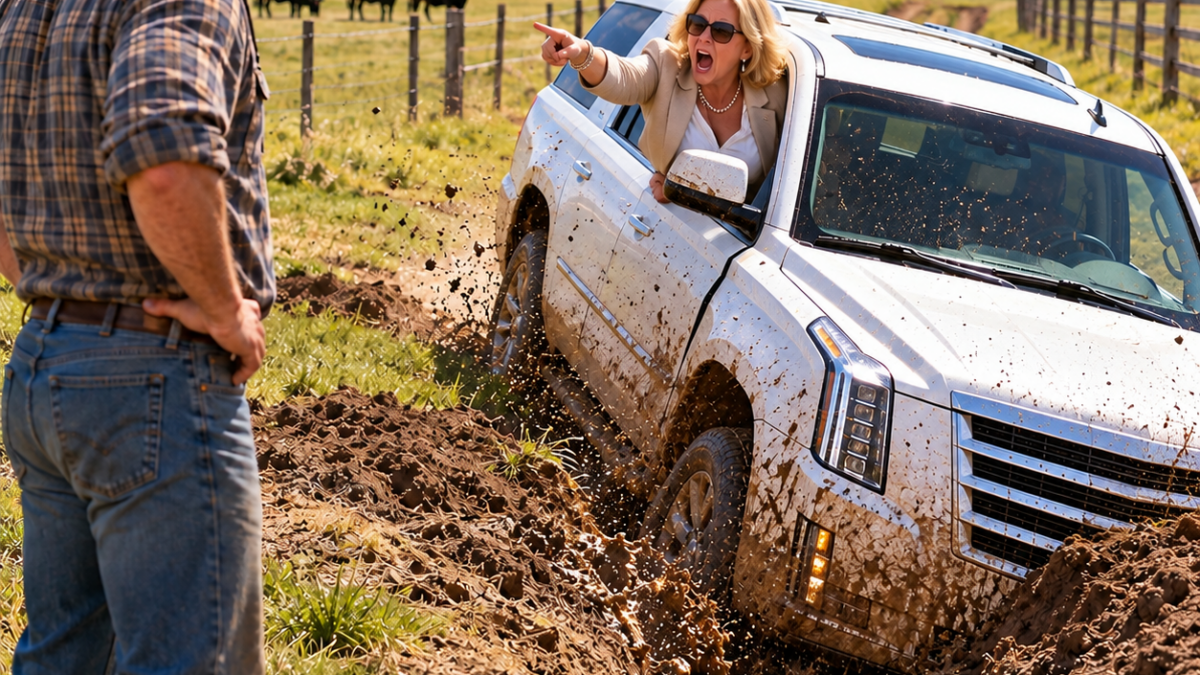
The Escalade crossed the pasture at speed.
Straight along the ruts.
Straight toward the drainage channel.
There are moments when time slows because your brain understands what’s coming before your body does.
I could have shouted.
At half a mile?
Wouldn’t matter.
Could have waved.
She wasn’t looking at me.
Could have driven something into the path.
Impossible.
So I stood.
The Cadillac hit the ditch around thirty-five miles an hour.
Front wheels dropped.
The nose pitched violently.
The undercarriage slammed the opposite lip.
The sound carried across the field.
Metal.
Deep.
Hard.
Both front tires blew.
The vehicle slid forward on its belly.
Stopped.
Steam rose.
I started running.
Not because Brenda deserved help.
Because crashes can kill people.
For ten seconds, the driver’s door didn’t move.
Then it opened.
Brenda climbed sideways.
Alive.
Walking.
I slowed.
One heel snapped in the mud.
The other shoe disappeared.
White pants black from the knee down.
Hair falling.
Mascara running.
Her handbag had launched into the ditch and landed in mud and coolant.
Three cows stood nearby watching her.
Calmly chewing.
Brenda raised her phone.
Called somebody.
I heard:
“He set a trap.”
Then:
“Entrapment.”
Then:
“I’ll own this ranch.”
I reached her.
“Are you hurt?”
She stared.
“You did this.”
“Are you hurt?”
“You knew I drive here.”
“Yes.”
“You built this where I drive.”
“I built permitted drainage where water collects.”
“You tried to kill me.”
“No.”
“You’re insane.”
“You’re trespassing.”
Her face changed.
“You knew.”
“Yes.”
“You knew I’d come through.”
“I knew you had been told not to.”
She slapped mud off her sleeve.
“I am suing you for everything.”
“Call whoever you need.”
She did.
Deputy Tom Sutter arrived fourteen minutes later.
He stepped out.
Looked at the Cadillac.
Looked at the ditch.
Looked at Brenda standing in one shoe.
Then looked at me.
“Permit?”
I handed him a copy.
He read.
Walked the ditch.
Looked at warning signs.
Because after rebuilding it, I had installed new signs.
Private property.
No trespassing.
Drainage improvement.
Trail cameras watched all approaches.
Tom returned to Brenda.
“Ma’am.”
She started immediately.
“He dug a trap.”
Tom raised a hand.
“It’s a permitted drainage structure.”
“He knew I use this route.”
“He has repeatedly instructed you not to.”
“He blocked emergency access.”
“This is not recorded emergency access.”
“My attorney—”
Tom pulled out his citation pad.
“You entered posted private agricultural property without permission.”
Brenda stared.
“You’re citing me?”
“Yes.”
“Me?”
“Yes.”
“Do you know who I am?”
Tom looked at her.
“Yes.”
That was the most beautiful answer he could have given.
The tow truck came forty minutes later.
The Escalade was destroyed.
Front axle.
Radiator.
Suspension.
Undercarriage.
Nearly twenty thousand in initial damage.
It made horrible scraping noises coming out.
Brenda watched silently.
For once.
No speech.
No Facebook post.
No smile.
But the Cadillac was the smallest thing that broke that morning.
At 9:18, Linda Chen’s office issued an emergency compliance order.
Stone Ridge had ninety days to build a code-compliant second access road.
Estimated cost:
$380,000.
Divided among 120 households.
More than three thousand dollars each.
The letter specifically stated that informal access across private property did not satisfy the requirement.
My ranch had never been their emergency road.
Their missing road was their responsibility.
Then came the perjury referral.
Brenda had sworn to seven years of use.
County records proved Stone Ridge hadn’t existed that long.
Trail cameras showed when traffic increased.
Her own emails documented when she declared the shortcut “open.”
Patricia forwarded everything to prosecutors.
Steve’s development permits came under review.
Inspectors found more problems.
Stormwater.
Retaining wall documentation.
Utility easement recording.
The county suspended his ability to move forward on a new development while the review continued.
Brenda resigned eleven days after the crash.
“Personal reasons.”
That was the phrase.
Everybody knew better.
Her Facebook page went silent.
Stone Ridge Strong disappeared.
The crown emojis stopped.
For the first time since meeting her, Brenda wasn’t telling everybody what reality was.
Claire Atkins became interim HOA president.
She called me.
“Caleb.”
“Claire.”
“I want to fix this.”
I waited.
“The right way.”
“Come over.”
We met at my kitchen table.
Claire.
Two board members.
Patricia.
Me.
No embossed paper.
No PowerPoint.
Coffee.
County map.
The actual problem was obvious.
Stone Ridge needed a legal secondary road.
I did not want traffic through my pasture.
Both could be solved.
There was a southwest corner of my property that could accommodate a narrow easement without crossing grazing rotation or Nora’s flowers.
Independent appraiser valued it.
Forty-five thousand dollars.
The HOA agreed.
Real survey.
Recorded deed.
Legal easement.
Proper engineering.
Fire apparatus width.
Drainage culverts.
Turnaround.
Built in sixty-three days.
The cost still fell on homeowners.
Some were furious.
I understood.
They had been lied to.
But the road should have existed from the beginning.
And for the first time, every family in Stone Ridge had two legal ways out if wildfire ever came down from the hills.
Three months after completion, smoke appeared northwest of Bozeman.
Grass fire.
Wind-driven.
Didn’t reach Stone Ridge.
But county crews staged near their new secondary access.
Claire called me afterward.
“That road matters.”
“Yes.”
“I wish it hadn’t taken all this.”
“So do I.”
The civil settlement came later.
Brenda’s insurance handled part of the property damage.
The landscaping company involved in filling the ditch paid too.
I received compensation for damaged pasture.
Signs.
Drainage repair.
Fencing.
Wildflowers.
That last item sounded absurd on paper.
Wildflowers.
But to me it mattered more than the Escalade.
Nora’s strip had been almost destroyed.
Tire after tire.
Compacted ground.
Crushed roots.
I spent weeks restoring it.
Loosened soil.
Reseeded.
Watered.
Waited.
The following spring, purple appeared.
One lupine.
Then another.
Blue flax.
Indian paintbrush.
Not exactly where Nora put them.
Nature doesn’t care about sentimental geometry.
But they came back.
I knelt in the dirt.
Touched the first flower.
And cried.
Not dramatically.
No one there.
Just me.
Three years after losing her, I had gotten used to grief appearing at strange times.
A song.
A mug.
A jacket.
A flower growing in tire damage.
I sat in the grass for a while.
Then looked toward the ditch.
Still there.
Working.
Snowmelt moving through it exactly as designed.
The thing Brenda called a trap had become ordinary.
Grass grew along its sides.
Cattle learned to walk around it.
Water moved.
No drama.
Just infrastructure.
That’s what I wanted all along.
My land doing what land does.
Not becoming a battlefield every morning.
I used some settlement money and the easement payment to start something Patricia initially called an emotional overreaction.
The Montana Ranchers Legal Defense Fund.
Small.
Operated through her office.
Initial consultations.
Survey review.
Filing support.
Help for agricultural landowners facing boundary disputes, easement pressure, illegal access claims, or development encroachment.
Earl Pemberton made the first donation.
Five hundred dollars.
He handed me the check while leaning on my fence.
“Your granddad would approve.”
“Of the fund?”
“Maybe.”
He took a sip from his thermos.
“He’d definitely approve of the ditch.”
I laughed.
“He said you’d have dug it deeper.”
“He would have.”
“You all are dangerous.”
“That’s why women outlive us.”
The fund helped eleven families its first year.
One elderly couple whose developer neighbor tried moving a fence line.
A widow whose driveway easement was being misrepresented.
A fourth-generation sheep rancher being pressured into allowing construction traffic.
None of the cases involved a Cadillac in a ditch.
Probably for the best.
People online eventually heard the story.
Not from me.
Somebody posted Brenda’s crash pictures.
Then the trail camera footage.
Then fragments of the HOA dispute.
The internet simplified everything.
HOA KAREN TRESPASSES DAILY — RANCHER BUILDS DITCH — KARMA!
Millions of views.
People laughed at the broken Escalade.
Celebrated.
Called me a genius.
Called Brenda names I won’t repeat.
Then others accused me of trying to kill her.
That’s when I understood how little people care about the middle.
The permit.
The surveys.
The months of warnings.
The stolen signs.
The cease-and-desist.
The nighttime destruction.
The county complaints.
The rebuilt ditch.
The fact that she drove onto posted land at speed.
People want one frame.
Car in ditch.
Good guy.
Bad guy.
The truth was longer.
Brenda was wrong.
Repeatedly.
Deliberately.
But I never wanted her injured.
When I heard that impact, I ran toward her.
That’s the part nobody shares.
Because revenge stories are cleaner if nobody admits that consequences can become scary once metal starts bending.
She could have broken her neck.
I know that.
It still bothers me.
Would I dig the ditch again?
Yes.
Would I build it legally?
Yes.
Would I post it?
Yes.
Would I document everything?
Absolutely.
Would I wish she’d hit it at thirty-five miles an hour?
No.
I would wish she’d stopped the first morning I told her the field wasn’t a road.
That would have been enough.
Months after her resignation, Brenda came to the ranch.
No Escalade.
Different SUV.
She parked on the county road.
Walked to the gate.
I saw her from the barn.
She didn’t enter.
That mattered.
I walked over.
She looked different.
Not physically.
Still polished.
Still expensive clothes.
But quieter.
“Caleb.”
“Brenda.”
“I wanted to talk.”
“Okay.”
“I’m selling.”
“Your house?”
“Yes.”
I nodded.
She looked toward Nora’s flowers.
“They came back.”
“Some.”
Silence.
Then:
“I didn’t know they were your wife’s.”
“You never asked.”
She nodded.
“I know.”
I waited.
“I thought you hated us.”
“The whole subdivision?”
“Yes.”
“No.”
“You certainly acted like it.”
I laughed once.
“You drove across my cattle pasture.”
“We thought—”
“No.”
She stopped.
I continued.
“You thought you were entitled to it.”
She looked down.
“Yes.”
That surprised me.
No excuse.
No legal theory.
Yes.
She continued.
“I thought you had so much land it didn’t matter.”
“There it is.”
“What?”
“The part people never understand.”
I leaned against the gate.
“Amount doesn’t determine ownership.”
“I know that.”
“Now.”
She looked toward the ranch.
“You had three hundred acres. We needed four hundred yards.”
“You needed a road your husband removed from the plan to save money.”
Her face tightened.
“Steve made decisions I wasn’t part of.”
“But you made the shortcut.”
“Yes.”
“You took signs.”
“Yes.”
“You lied in the easement filing.”
Silence.
She looked at me.
“Yes.”
That was as close to confession as I expected.
“Why?”
Her eyes moved toward Stone Ridge.
“Because by then I couldn’t be wrong.”
I didn’t expect that answer.
She continued.
“The first time you told me no, I thought you were being difficult.”
“Probably was.”
“The second time, I’d already told people the path was legitimate.”
I nodded.
“And then?”
“Every time you pushed back, admitting you were right meant admitting I’d lied before.”
She looked embarrassed.
“So I kept making the lie bigger.”
That was the most honest thing Brenda Harwell ever said to me.
I thought about Patricia’s advice.
Earl.
Nora.
All the months.
Then asked:
“Are you apologizing?”
“Yes.”
“Why?”
She seemed confused.
“Because I was wrong.”
“No.”
I shook my head.
“Why now?”
She looked at the wildflowers.
“Because nobody is watching.”
That answer mattered.
There was no Facebook audience.
No board.
No attorney.
No county.
Just us.
I nodded.
“Thank you.”
She looked surprised.
“You forgive me?”
“I didn’t say that.”
Her mouth tightened.
Then, unexpectedly, she laughed.
“Still difficult.”
“Absolutely.”
She held out her hand.
I looked at it.
Then shook.
She walked back to her vehicle.
Stopped.
Turned.
“Caleb.”
“Yes?”
“I really did hate that ditch.”
“I know.”
She smiled faintly.
Then left.
I never saw her again.
Steve stayed longer.
His next development died during permit review.
The missing secondary road became a major problem for his reputation with lenders and county staff.
He eventually sold most of his remaining development interests.
Stone Ridge survived.
Better, actually.
Claire ran the board for two years.
Budgets published.
Votes open.
Attorneys used less.
Power limited.
The HOA still enforced normal things.
Pool rules.
Common areas.
Snow plowing.
People sometimes complained.
That’s normal.
An association is not evil because it exists.
It becomes dangerous when convenience starts masquerading as authority.
Stone Ridge learned that.
So did I.
For years afterward, vehicles occasionally slowed near my south gate.
People remembered the shortcut.
GPS apps remembered it longer.
Some mapping service had incorporated the route based on usage data.
Twice, delivery drivers tried.
I installed a proper locked stock gate.
Not because Brenda had been right.
Because Earl had been.
My granddad would have put one in eventually.
Signs stayed.
Nobody stole them.
The drainage ditch runs two hundred yards.
Grass-covered now.
Four feet deep at the center.
After spring thaw, water moves through it beautifully.
I take satisfaction in that.
Not because a Cadillac died there.
Because the engineering works.
One afternoon, a young couple from Stone Ridge stopped while I was checking fence.
They had moved in after everything happened.
The husband pointed.
“Is that the famous ditch?”
I sighed.
“Unfortunately.”
His wife laughed.
“We heard someone drove into it.”
“Yes.”
“HOA president?”
“Former.”
“Did you really dig it just to stop her?”
I thought.
“No.”
They looked disappointed.
“I dug it because the pasture needed drainage.”
The husband smiled.
“And it happened to be across her shortcut?”
“Exactly.”
“That’s even better.”
They walked away laughing.
I shook my head.
Earl died the following winter.
Seventy-eight.
Heart failure.
I attended the funeral.
His son gave me the old thermos Earl carried everywhere.
Metal.
Dented.
Coffee stain permanently embedded inside.
I keep it in the ranch truck.
Sometimes I can still hear him.
Don’t shout.
Be smarter.
He was right.
The most important thing I did was not dig a ditch.
It was refuse to let Brenda choose the battlefield.
She wanted Facebook.
I used records.
She wanted community outrage.
I used surveys.
She wanted a lawsuit built on seven fictional years.
I used dates.
She wanted me angry enough to do something stupid.
I got a permit.
That is the lesson people miss.
Anger is useful.
It tells you a boundary was crossed.
But anger is a terrible engineer.
It digs the wrong place.
Too deep.
Too fast.
Without checking what comes next.
Nora used to say almost the same thing about science.
“Feel whatever you feel.”
Then she’d tap her notebook.
“But measure before you conclude.”
I miss that woman every day.
Sometimes I wonder what she’d think about the whole mess.
She would have hated Brenda.
Not because of the trespassing.
Because Brenda crushed flowers.
Nora tolerated almost anything better than botanical disrespect.
I can hear her:
“She drove over lupines?”
“Yes.”
“On purpose?”
“Twice.”
Then she would have marched across the field herself, cancer or no cancer.
Maybe it was safer that I handled it.
The wildflowers are thicker now than before.
Not because of any miracle.
I improved the soil.
Protected them.
Added seed.
Watered.
The blue flax has spread toward the calving barn.
Paintbrush comes later.
Lupines first.
Every spring I stand there and think about how easy it is to destroy something growing slowly.
A tire can crush in one second what took months to establish.
Restoration is the opposite.
Quiet.
Repetitive.
Water.
Wait.
Protect.
Wait.
That describes land.
Grief.
Trust.
Maybe communities too.
Stone Ridge took years to become something I no longer resented seeing beyond the fence.
Claire invited me to a neighborhood fire-safety meeting after the second road opened.
I went.
Only because the county fire marshal asked.
Linda Chen stood before residents.
Maps on the wall.
Evacuation zones.
Wildfire behavior.
Secondary routes.
Nobody argued.
At the end, one homeowner stood.
Middle-aged man.
I recognized him from Brenda’s original Facebook comments.
He had written:
Someone needs to tell the cowboy this isn’t the 1800s.
He approached me.
“Mr. Dawson.”
I looked at him.
“I owe you an apology.”
“Probably.”
His face reddened.
“I signed the petition.”
“I know.”
“You know?”
“Public record.”
“Oh.”
He looked toward the map.
“I believed Brenda.”
“A lot of people did.”
“I never checked.”
“No.”
“My wife asked me why.”
“And?”
“I didn’t have an answer.”
I nodded.
He looked embarrassed.
“I think I believed her because certainty is easier than research.”
That was better than most apologies.
I held out my hand.
He shook it.
We moved on.
Years later, the Montana Ranchers Legal Defense Fund handled a case involving an elderly farmer named Walter Mills.
Developer claimed an informal access road across his land had become public.
Sound familiar.
Walter called Patricia.
She reviewed the file.
Then called me.
“You created a monster.”
“What?”
“She says everybody asks whether they should dig a ditch.”
I laughed.
“Tell them no.”
“I do.”
The fund’s first training handout now includes, in bold:
DO NOT ALTER TERRAIN TO BLOCK ACCESS WITHOUT REVIEWING PERMITS, SAFETY, AND LEGAL OBLIGATIONS.
Patricia says that sentence exists because of me.
I consider it a contribution to legal education.
The ranch is quieter now.
Eighty-five cattle became seventy-two after I adjusted operations.
Less strain.
More grass.
Better margins.
I hired a young ranch hand named Eli.
Twenty-four.
Wants his own place someday.
He asks too many questions.
Good questions.
One morning we were checking water troughs near the ditch.
He said:
“Mr. Dawson?”
“Caleb.”
“Caleb.”
He pointed.
“This where the Escalade wrecked?”
“Yes.”
He stared at the ditch.
“Doesn’t look that big.”
“Cars don’t like sudden four-foot elevation changes.”
He nodded thoughtfully.
“Did you laugh?”
“No.”
“Not even a little?”
I looked at him.
“A little later.”
He grinned.
Then his expression turned serious.
“Weren’t you worried she’d sue?”
“Yes.”
“Then why build it?”
“Because I needed drainage.”
He rolled his eyes.
“I’ve heard the official answer.”
I smiled.
“What do you want?”
“The real one.”
I leaned on the fence.
“The real answer is she had spent fourteen months teaching me that words weren’t going to stop her.”
“So you built something.”
“I built what the land legally needed.”
“Where she drove.”
“Yes.”
He smiled.
“Grandpa-level move.”
“You never met my grandfather.”
“I’ve heard enough.”
He wasn’t wrong.
My grandfather believed the best solutions accomplished two things.
A fence should hold cattle and tell neighbors where the line is.
A pond should water livestock and catch runoff.
A shelterbelt should block wind and give birds cover.
A ditch?
Carry water.
And sometimes remind a Cadillac that a pasture is not a road.
Nora would’ve rolled her eyes at that sentence.
Then laughed.
The last time I heard from Claire, she sent me a photograph of Stone Ridge’s annual budget meeting.
The new president had printed the entire financial report.
Every homeowner got a copy.
Claire wrote:
LOOK WHAT YOU STARTED.
I replied:
TRANSPARENCY?
She answered:
PAPER CUTS.
Progress.
The southern emergency road still works.
Kids ride bicycles along the neighborhood side.
Fire engines test it twice a year.
It does not cross my grazing pasture except for the narrow legally defined corridor.
No wandering.
No shortcuts.
No red dotted community map.
The easement is recorded.
Everyone knows where it begins.
Where it ends.
That clarity is worth more than forty-five thousand dollars.
Boundaries don’t ruin communities.
Unclear boundaries do.
Brenda believed saying “community” made her claim more moral.
It didn’t.
A hundred people wanting something doesn’t automatically create a right to one person’s property.
At the same time, I learned something too.
My initial instinct had been absolute.
Stay off everything.
Forever.
But once Stone Ridge’s legitimate safety problem came into focus, I sold a legal easement.
Not because Brenda had been right.
Because the residents needed a second emergency road.
Same landowner.
Same property rights.
Different process.
Permission.
Fair value.
Engineering.
Recorded terms.
Respect.
That’s all Brenda had needed from the beginning.
Ask.
Maybe I would have said no to her shortcut.
Probably.
But a proper emergency corridor?
We could have discussed it.
Instead, she chose entitlement.
When people ask me now whether the story was about revenge, I say no.
It felt like revenge for about five minutes while a tow truck dragged an $82,000 Escalade out of a ditch.
I’ll admit that.
But revenge is too small.
The real story is about process.
A woman believed rules were tools to use against other people.
Then she encountered someone who knew how to use rules correctly.
She removed signs.
I saved video.
She lied publicly.
I saved screenshots.
She filed a false statement.
I pulled dates.
She invoked emergency access.
I pulled the fire plans.
She destroyed a permitted ditch.
I rebuilt it with better documentation.
She drove across private land.
I didn’t chase her.
I let the camera record.
In the end, I didn’t need to be louder.
The evidence was.
One autumn evening, long after everything ended, I sat on the porch.
Nora’s chair beside me.
Earl’s thermos on the railing.
Sunset lighting the Bridgers pink.
Cattle settling.
Stone Ridge lights coming on one by one beyond the south fence.
For years those lights made me angry.
That evening they looked ordinary.
People living.
Cooking dinner.
Putting children to bed.
Walking dogs.
Most of them had never wanted a war with a rancher.
They wanted twelve minutes.
Brenda turned twelve minutes into fourteen months of conflict because she could not accept that convenience is not ownership.
I thought about calling that tragic.
Then decided it was mostly stupid.
A meadowlark landed on the fence.
The ditch was dark in the grass.
Nora’s flowers moved in the wind.
I poured the last coffee from Earl’s thermos.
It tasted terrible.
He always made it too strong.
I smiled.
The gardening gloves still hung beside the door.
I had considered moving them once.
Couldn’t.
Maybe someday.
Maybe not.
There are things we preserve because they remind us what belongs to us in a way deeds cannot measure.
A fence line can be surveyed.
A title recorded.
An easement priced.
But no county clerk can understand why twelve feet of wildflowers matter.
Nora put them there.
That was enough.
Brenda saw empty field.
That’s why she never understood me.
She thought my anger came from having my land crossed.
Partly.
Mostly it came from being told the things I loved didn’t matter because someone wealthier found them inconvenient.
The flowers.
The cows.
The quiet.
The ownership.
The years.
The memory.
All reduced to:
It’s just a field.
No.
It was never just a field.
And once Brenda learned that lesson, Stone Ridge did too.
The next morning, I watered the wildflowers.
Checked the herd.
Walked the south fence.
When I reached the ditch, rainwater from the previous night was moving cleanly along the gravel bottom into the seasonal creek.
Exactly what the permit said it would do.
No Cadillac.
No cameras flashing.
No lawyers.
No HOA emails.
Just water following grade.
I stood there for a minute.
Then laughed.
My grandfather used to say land remembers everything you do to it.
The good.
The stupid.
The permanent.
The temporary.
I believe him.
The tire ruts are gone.
The flowers returned.
The calf that nearly got hit grew into one of my best cows.
Stone Ridge finally built its legal second exit.
The lawsuit ended.
Brenda left.
The ditch stayed.
And every spring, when the snow melts off the Bridgers and runoff begins moving through that channel, I am reminded of the simplest lesson fourteen months of nonsense taught me.
You can ignore a sign.
You can laugh at a letter.
You can lie on Facebook.
You can even sign your name under a false statement and convince a room full of people that confidence makes something true.
But sooner or later, reality becomes physical.
A property line.
A recorded deed.
A missing road.
A drainage permit.
A four-foot drop in the ground.
Brenda Harwell spent fourteen months pretending my boundary didn’t exist.
Then she hit it at thirty-five miles an hour.

