HOA Karen Trespassed Onto My 140-Acre Farm for an “Inspection” and Grabbed My Cattle Vaccine—Then I Opened My FBI Credentials and Her Livestream Went Silent.
PART2:
People imagine federal agents become useful when the worst thing happens.
Sometimes you become a man sitting inside a vehicle, listening to somebody you love die while every procedure in your training arrives three seconds behind reality.
By the time we reached Ray, there was nothing I could do.
I remember kneeling on asphalt.
I remember somebody pulling me backward.
I remember Ray’s wedding ring.
I remember thinking his wife would ask whether he had been alone.
He had not.
That answer still felt useless.
Afterward, I stopped sleeping.
Not completely.
Enough to function.
Not enough to recover.
My wife Megan finally put an end to the pretending.
Megan is a nurse at Carilion in Roanoke.
Five foot six.
Brown hair.
Calm under pressure.
And somehow capable of telling a man who has interviewed cartel accountants, corrupt executives, and armed suspects exactly what he is going to do without ever raising her voice.
We were sitting at the kitchen table in Richmond after I had gone three nights on maybe five hours of sleep.
She watched me stir coffee I was not drinking.
Then she said:
“We’re going to the farm.”
I looked up.
“What?”
PART3:
“We’re moving back.”
“Megan—”
“No.”
“I’m not asking if you think it’s convenient.”
“My father needs help.”
“You need somewhere that doesn’t smell like Ray’s funeral.”
“Cole needs his grandfather.”
“And I need you to stop pretending that if you keep showing up to work, nobody will notice you’re bleeding internally.”
I stared at her.
She reached across the table.
“You don’t have to quit tomorrow.”
“Transfer.”
“Take leave.”
“Work financial cases out of Richmond.”
“Retire when you’re ready.”
“But we are going home.”
That was Megan.
Not dramatic.
Final.
A week later, our sixteen-year-old son Cole climbed into the passenger seat of the truck with headphones around his neck and asked:
“Is Grandpa going to make me wake up at five?”
“Yes.”
“That violates child-labor law.”
“You’re sixteen.”
“Exactly.”
Megan drove.
My hands had not stopped shaking consistently enough to trust myself on Route 460.
Neither of us mentioned that.
The farm sat in Franklin County, Virginia, along the eastern shoulder of the Blue Ridge.
One hundred forty acres.
Red clay under dark topsoil.
Fescue pasture.
Black Angus.
Stillwater Creek cutting three-quarters of a mile across the lower draw.
Two barns.
A machine shed.
An apple orchard planted before I was born.
My grandfather, Walter Garrison, bought the place in 1953.
He came home from Korea with a VA loan, eleven hundred dollars he had saved from sawmill work, and the kind of confidence young men sometimes acquire after surviving situations that make ordinary risk look insulting.
The banker told him one hundred forty acres was too much for one man.
Grandpa answered:
“I don’t plan on staying one man forever.”
He married Ruth Delroy two years later.
By 1960, they were running sixty head of black Angus on ground Walter had cleared with a chainsaw, a borrowed tractor, and labor he traded with neighbors.
Grandma Ruth planted the orchard in 1971.
Forty trees.
Winesap.
Stayman.
Arkansas Black.
She spaced them wide.
People told her she was wasting land.
She said:
“Trees need room to think.”
That sentence was repeated in our family for fifty years.
Nobody knew exactly what it meant.
It sounded like Ruth.
That was enough.
The orchard became part of every childhood memory I had.
Apples for cider.
Apples for school harvest festivals.
Apples stored in the cellar.
Arkansas Blacks that came off the tree nearly hard enough to break a tooth.
Grandma loved those best.
“They don’t taste like anything yet.”
she would say in October.
“You have to forget about them until January.”
Then, somehow, after months in storage, they softened.
Sweetened.
Changed.
“Good things don’t always announce when they’re ready.”
Ruth died in 2014.
My father found an apple in the pocket of her housecoat while folding her things.
He placed it on the windowsill above the kitchen sink.
Left it there until the skin shrank tight and brown.
Megan eventually asked whether he wanted us to throw it away.
Dad looked at her as though she had suggested burning the barn.
The apple stayed.
My father, Hank Garrison, was eighty when we moved back.
Everything about him remained stubborn except his hands.
Rheumatoid arthritis had been taking them piece by piece for seven years.
He could walk a fence line at six every morning.
Could spot a cow nearing labor from a quarter mile.
Could tell whether rain would hold off from the smell of the pasture.
But buttoning a shirt?
Opening a jar?
Holding coffee with one hand?
Gone.
He hated help.
Megan understood how to give it without making him feel helped.
That was a talent.
She changed jar lids.
Bought shirts with hidden magnetic closures.
Put larger handles on tools.
Moved paperwork without ever saying:
“You can’t do this anymore.”
Cole adapted fastest.
Within a month, he was riding Dad’s restored ATV.
Feeding cattle before school.
Checking fences.
Learning ear tags.
He had Megan’s emotional spine and Hank’s square hands.
Hands that still did whatever he asked of them.
I took a transfer arrangement that kept me with the Bureau while reducing field exposure.
Financial investigations.
Remote analysis.
Richmond contact.
Periodic travel.
It was not retirement.
Not yet.
But for the first time since Ray died, I could breathe without hearing the surveillance van in every quiet room.
We were not healed.
We were healing.
There is a difference.
Then Meadow Crest Estates appeared across my north fence.
The Langford farm had bordered ours for decades.
Billy Langford ran Herefords there.
Good man.
Bad jokes.
Then his wife got sick.
Medical bills.
Farm income.
You can do that math.
A developer called Hess Callaway Development bought all one hundred ten acres.
Fourteen months later:
Forty-two luxury homes.
Stone facades.
Three-car garages.
Clubhouse.
Pool.
Fitness center.
Decorative entrance sign cut from imported slate.
MEADOW CREST ESTATES.
WHERE THE COUNTRY COMES HOME.
A subdivision built by bulldozing a cattle farm marketed itself as “the country.”
I found that funny.
Megan found it offensive.
Most of the residents were fine.
Some waved.
Some asked whether our cattle bothered us at night, which told me how little time they had spent around cattle.
One family brought cookies after moving in.
Another bought eggs from our neighbor.
No war.
No feud.
Then Pamela Drayton Hess appointed herself Director of Community Aesthetics.
That title did not exist in the bylaws.
I know because later I read every page.
Pamela invented it.
Then printed business cards.
Linen stock.
Gold edges.
Watercolor mountain logo.
DIRECTOR OF COMMUNITY AESTHETICS.
She was thirty-three.
Honey-blonde hair.
Tall.
Beautiful.
And dangerous in the way certain charming people become dangerous when nobody has ever forced them to distinguish influence from authority.
She had fifty-three thousand followers online.
Her account was called:
Pamela at the Meadow.
Community visionary.
Dog mom.
Skin care.
Her dog was a golden doodle named Chardonnay.
Of course it was.
Every Saturday, Pamela conducted what she called a “community wellness walk.”
Matching athleisure.
Coffee.
Chardonnay trotting beside her.
Phone recording.
The route happened to pass every property line she disliked.
She would film tractors.
Hay wagons.
Fences.
Old sheds.
Then explain to followers why those things threatened “the visual integrity of the corridor.”
Her husband, Kirk Hess, was fifty-six.
Managing partner at Hess Callaway Development.
Quarter-zip pullover.
Expensive watch.
Perfect teeth.
He used phrases like “value proposition” and “land optimization” in regular conversation.
The first time he visited our farm, he looked past me at the pasture.
Not like scenery.
Like inventory.
Pamela’s first letter arrived two months after we moved back.
Cream envelope.
Embossed crest.
Scented paper.
Our cattle operation was “visually inconsistent with the pastoral character of the Meadow Crest corridor.”
I read that sentence twice.
They had built Meadow Crest where cattle used to stand.
Now my cattle were inconsistent with the pastoral character.
We were ordered to submit a screening plan within forty-five days.
Failure would result in daily fines.
Megan read it.
“She’s fining us for being a farm.”
“Apparently.”
“From a neighborhood built on a farm.”
“Yes.”
“She knows that?”
“I assume.”
I wrote one paragraph.
Professional.
My property was not part of Meadow Crest.
No recorded covenants bound it.
No HOA jurisdiction existed.
Please correct your records.
Pamela replied four days later.
Same paper.
Same perfume.
“We appreciate your perspective.”
That phrase should make everyone nervous.
“However, community aesthetic standards extend to the full visual corridor.”
Compliance is not optional.
Smiley face after her signature.
An adult woman sending jurisdictional threats with a smiley face.
I almost admired the commitment to brand consistency.
I wrote again.
Explained how restrictive covenants actually work.
They attach because an owner records or accepts them.
Nobody in the Garrison family had.
My grandfather had not.
My father had not.
I had not.
Land does not become part of an HOA because a developer can see it from the clubhouse.
Pamela did not respond.
Then April twelfth happened.
Spring vaccinations.
I was behind the barn with calves moving through the chute.
Cole worked the gate.
Dad sat on the tailgate recording ear-tag numbers.
His hands could no longer control equipment, but his eyesight remained insultingly good.
Megan was inside making lunch.
Camera one recorded the Escalade at 10:15.
White Cadillac.
Vanity plate:
MCRST1.
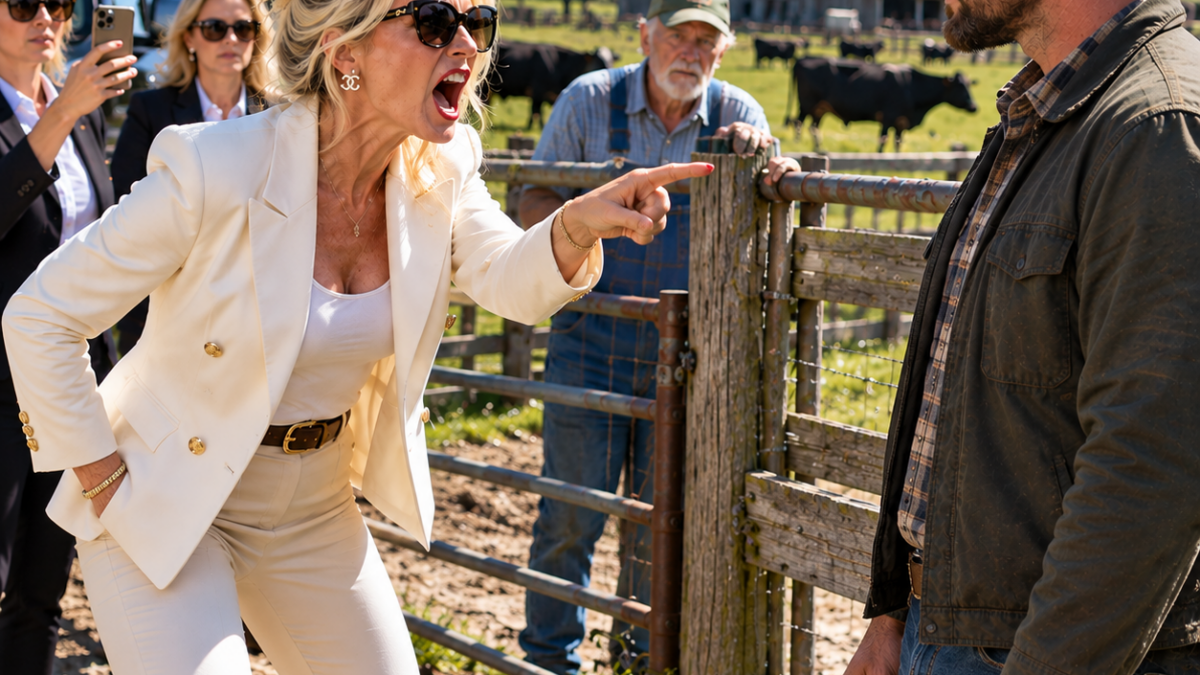
Pamela stepped out wearing white leather pants.
Cream cropped blazer.
Four-inch ankle boots.
On a cattle farm.
In April.
Virginia red clay.
She opened my gate.
A latched gate.
With a sign bolted beside it.
NO TRESPASSING.
ACTIVE LIVESTOCK OPERATION.
AUTHORIZED PERSONS ONLY.
She walked past it.
Phone held vertically.
Ring light clipped to the case.
Livestreaming.
“Good morning, loves.”
Her voice carried before she reached us.
“So this is the property I’ve been telling you about.”
Camera panned across my barn.
Cattle.
Hay ring.
Compost pile.
“The one that’s been absolutely destroying values throughout the corridor.”
She wrinkled her nose.
“And yes, that smell is real.”
I stepped away from the chute.
“Ma’am.”
She kept filming.
“That manure is literally sitting in the open where children can see it.”
“Pamela.”
She turned the phone toward me.
I had a little blood on my fingers from an ear tag.
Her camera zoomed.
Her expression changed into a professionally polished version of disgust.
“Ma’am, you’re on private property.”
“You need to leave.”
“I’m conducting a community aesthetics review.”
“No.”
“You were notified.”
“I responded.”
“My farm isn’t in your association.”
Pamela lowered the phone slightly.
Looked at me.
Work boots.
Jeans.
Three days of stubble.
Blood on my hand.
She made a decision about who I was.
I watched it happen.
“Sweetheart.”
The smile arrived.
Slow.
Gentle.
The kind of smile a dentist gives you before pain.
“The corridor standard covers everything between the ridge and the road.”
“That includes…this.”
She moved one manicured hand toward one hundred forty acres.
“This situation.”
I looked at Cole.
He had stopped moving calves.
Dad was watching.
I kept my voice low.
“There is no corridor standard recorded against this property.”
“Your paperwork is irrelevant to community impact.”
That sentence told me more than she understood.
Then she reached over the chute rail.
Picked up a vaccination syringe.
Seven-way clostridial vaccine.
Standard livestock medicine.
She held it toward the phone between two fingers.
“Can somebody tell me whether this is even legal?”
She turned it.
“What exactly is he injecting into these animals?”
“Is anyone checking this?”
My anger changed temperature.
“Put that down.”
She smiled toward the camera.
“I’ll put it down when I’m ready, hun.”
“Pamela.”
“You’ve contaminated a sterile veterinary syringe.”
“It’s a syringe on a dirty farm.”
“No.”
“It was sterile until you grabbed it.”
“Put it down.”
She raised her eyebrows.
“So hostile.”
I reached into my jacket.
Left inside pocket.
Credential case.
Blue leather.
Badge.
ID.
Federal Bureau of Investigation.
I opened it.
Pamela looked.
First at my photograph.
Then badge.
Then words.
Then me.
Back to photograph.
Her brain was trying to reconcile the clean-shaven man in a suit with the farmer standing in front of her covered in dust.
Then it connected.
Her mouth opened.
Closed.
Opened again.
Nothing.
For the first time since she came through the gate, the livestream had no narration.
I stepped closer.
Not threatening.
Clear.
“You entered posted private property after written notice that you had no authority here.”
“You interfered with a livestock operation.”
“You touched veterinary material after being instructed not to.”
“I am telling you now to put it down and leave.”
She swallowed.
“Are you threatening me with federal charges?”
“No.”
“I’m telling you who you decided to trespass against before you understood anything about him.”
Her eyes flicked to Cole.
Dad.
Then back.
I continued:
“The badge is not what makes this private property.”
“The deed does.”
“The sign does.”
“My telling you to leave does.”
“Put the syringe down.”
She dropped it onto the rail.
The ring light slipped from her phone.
Fell directly into the mud.
She stared at it.
Left it.
Then walked.
Fast.
Four-inch heels sank into red clay.
The controlled stride became an awkward stuttering motion.
Past the sign.
Through the gate.
Into the Escalade.
Gravel sprayed when she left.
Dad looked up from his clipboard.
“Who was that?”
“Nobody.”
“It’s handled.”
Megan came out wiping her hands.
Saw the ring light in the mud.
Saw the Escalade disappearing.
Then looked at my badge still in my hand.
“It’s not handled.”
Cole nodded.
“She’ll be back.”
He was sixteen.
He understood Pamela faster than I did.
That night, her edited video went online.
Ninety seconds.
Barn.
Cattle.
Manure.
Syringe.
My bloody fingers.
The word injection appeared three times.
Children twice.
Literally unsafe four times.
My badge?
Gone.
The thirty seconds where she discovered she had no authority?
Gone.
Instead:
Piano music.
Golden filter.
Caption:
I DO THIS WORK BECAUSE SOMEONE HAS TO.
NOT EVERYONE IS GRATEFUL.
THAT’S OKAY.
Fourteen thousand likes.
Comments demanding investigation.
Someone tagged animal control.
Someone tagged the governor.
Someone called me an unlicensed livestock injector.
Six days later, Franklin County sent an inspector.
Keith Mullins.
Young.
Tired.
iPad.
He looked like he had spent his morning arguing about septic setbacks.
“Mr. Garrison?”
“Yes.”
“I have four complaints.”
“Of course you do.”
Livestock odor.
Equipment noise before seven.
Unpermitted agricultural structure.
Animal welfare.
The animal-welfare complaint referenced “suspected improper injection practices by an unlicensed individual.”
Keith walked the entire property.
Cattle calm.
Water.
Feed.
Pasture.
Vaccination records.
Veterinary relationship.
Barn permit card from 1961 still stapled inside the doorframe.
He sat on my tailgate afterward.
“Mr. Garrison.”
“Yes?”
“I’ve had seventeen complaints from this road since September.”
“How many properties?”
“Seven.”
“Violations?”
“None.”
Something clicked.
“Same complainant?”
“I can’t answer that informally.”
“Public record?”
He looked at me.
“FOIA it.”
That was the first thread.
I filed the request that afternoon.
Then Pamela’s fines arrived.
Two hundred dollars per day.
Backdated to January.
Visual noncompliance.
Unapproved agricultural structure.
Community corridor degradation.
First invoice:
$11,400.
Signed:
Pamela Drayton Hess.
Director of Community Aesthetics.
Below it, in script:
Building Something Beautiful Together.
Megan received a separate letter.
Pamela suggested the “female household member” might benefit from a free webinar on rural-home presentation for modern communities.
Megan framed it.
Hung it above the downstairs toilet.
“Appropriate.”
she said.
Pamela escalated online.
Series:
CORRIDOR WATCH.
Weekly.
She walked the public road with Chardonnay and filmed our property.
Water trough:
“Stagnant breeding ground.”
Hay ring:
“Rusting industrial equipment.”
Cattle resting under shade:
“These animals appear depressed.”
Then:
“I’m not a veterinarian.”
The disclaimer arrived after the diagnosis.
Followers loved it.
Why hasn’t the county shut him down?
Those cows look traumatized.
You’re doing God’s work.
God’s work apparently included pointing an iPhone at livestock from a paved road while wearing designer athleisure.
Then the lien arrived.
That changed everything.
Letters can be ridiculous.
A lien is not.
Pamela’s “association” recorded debt against our deed.
Refinancing equipment?
Blocked.
Using land equity?
Complicated.
Future credit?
Affected.
The claim itself was nonsense.
The filing was real.
Then Stillwater Creek stopped running.
Not dry.
Stopped.
June.
Three cows standing at the usual crossing staring at wet rocks.
I walked upstream.
North boundary.
There it was.
A six-foot earthen dam.
Concrete block reinforcement.
Drainage pipe redirecting most of the creek into a newly graded basin on the Meadow Crest side.
Decorative boulders.
LED uplighting.
A wooden sign:
MEADOW CREST SERENITY POND.
A PAMELA DRAYTON HESS COMMUNITY VISION.
She put her name on it.
I stood there almost laughing.
Some criminals hide.
Pamela branded evidence.
The pond was attractive.
I will give her that.
Also completely unauthorized.
Stillwater Creek had flowed through our valley longer than the Commonwealth of Virginia had existed.
Pamela had redirected it because a mood board needed water.
I photographed everything.
Coordinates.
Flow.
Pipe diameter.
Dam dimensions.
Called an environmental lawyer.
Then three weeks later, the fence failed.
5:45 a.m.
Phone rang.
Franklin County Sheriff’s Office.
Cattle on Route 640.
Cole and I were out the door before Megan finished speaking.
Three sections of barbed wire.
Not broken.
Cut.
Clean.
Pliers.
Fifteen Angus on roadway.
A milk-truck driver had called dispatch.
School bus stopped a quarter mile back.
Fourteen cattle recovered.
Number 2247 did not.
Four-year-old cow.
Second calf.
Feed truck hit her at highway speed.
Cole found her.
She lay in the ditch.
Calf still inside.
I arrived thirty seconds later.
Cole sat on the truck’s running board.
Hands hanging between his knees.
No tears.
No words.
Sixteen-year-old boys often mistake silence for the only acceptable shape of grief.
I sat beside him.
After a while, he said:
“She didn’t do anything.”
“No.”
“She was just standing there.”
“Yes.”
“Who cut the fence?”
“I don’t know yet.”
He stood.
“We should check the others.”
That sentence nearly broke me.
He had become a farmer in the worst way.
By continuing the work while something he cared about lay dead beside the road.
Three days later, Pamela sent a demand for twenty-two thousand dollars.
Emergency safety remediation.
Resident trauma support.
Legal review.
The incident report described:
GARRISON LIVESTOCK INCURSION.
FORESEEABLE CONSEQUENCE OF SUBSTANDARD AGRICULTURAL PRACTICES.
Then Pamela posted a photograph of the cut fence.
She cropped the image so the clean wire ends were not visible.
Caption:
THIS IS WHAT HAPPENS WHEN FARMING DOESN’T HAVE ACCOUNTABILITY.
Poll:
Should farms near residential communities require safety certification?
Eighty-one percent:
YES.
She sent the poll to a county supervisor with a handwritten note:
The people have spoken.
That evening, the FOIA records arrived.
Banker’s box.
Nearly four hundred pages.
I spread everything across the kitchen table.
Then stopped being a farmer for six hours.
And became an FBI fraud investigator again.
People imagine fraud as fake signatures.
Sometimes.
Mostly fraud is structure.
Who benefits?
Where does money move?
What document created authority?
Who drafted it?
Who relied on it?
What happens repeatedly?
Pattern.
Always pattern.
The Meadow Crest covenant was first.
It supposedly covered forty-two subdivision homes.
Except the legal description covered seventeen tax parcels totaling nine hundred ten acres.
That included working farms south of Stony Creek Road.
Jess Kelley’s cattle farm.
Bradock hay ground.
Earl Vaughn’s Christmas-tree operation.
Doy Cranford’s property.
My farm.
Properties whose owners had never signed anything.
The covenant had been recorded as though those parcels were subject.
The preparer metadata:
Hess Callaway Development.
Managing partner:
Kirk Hess.
Second thread:
Enforcement revenue.
Three years.
$187,000.
Fines collected from homeowners and farmers.
Money did not stay in an HOA enforcement account.
It flowed through payments to:
Drayton Aesthetic Advisory LLC.
Registered agent:
Pamela Drayton Hess.
Principal office:
Her house.
Pamela had invented the position.
Invented standards.
Then paid herself almost $187,000 through a company bearing her name.
Third thread:
Meadow Crest Phase Two.
One hundred twenty additional homes.
Boutique retail village.
Farm-to-table event center.
That phrase made Megan laugh bitterly.
“They’re going to destroy farms to build a farm-to-table restaurant?”
“Yes.”
“That should be illegal just for irony.”
Phase Two required roughly six hundred acres of currently agricultural land.
The same farms suddenly receiving fines.
The same farmers suddenly told their properties created corridor problems.
Fourth thread:
County supervisor Dale Eubanks.
Payments linked to Hess Callaway.
$35,000.
Structured across multiple transactions below reporting thresholds.
I sat back.
There it was.
Not proof of every crime.
Enough to justify real questions.
An HOA that reached far beyond its lawful membership.
A private consulting company receiving enforcement money.
A developer planning expansion across targeted farms.
A local official receiving money connected to that developer.
Megan came downstairs in scrubs at 2:00 a.m.
She had a six o’clock shift.
Read over my shoulder.
Then pointed.
“Doy Cranford.”
“What?”
“She got a mailbox fine.”
“Yes.”
“Doy does not have a mailbox.”
I looked again.
APRIL — MAILBOX NONCOMPLIANCE — $200.
Doy had used a P.O. box since 1998.
The fine was impossible.
And she had paid it.
Because official paper scared her.
Megan tapped the page.
“Build the case.”
“I can’t.”
“You can.”
“I’m involved.”
She looked at me.
“So?”
“I’m a victim.”
“I can’t investigate a federal case where my own family is a target.”
She understood.
“Recuse.”
Exactly.
At 6:15, I called my ASAC in Richmond.
Assistant Special Agent in Charge.
Explained enough.
He was quiet.
Then:
“Nate.”
“Yes?”
“You just handed away a career case.”
“I handed it to somebody whose name defense counsel can’t turn into Exhibit A.”
“You sure?”
“No.”
“Good answer.”
He assigned Special Agent Elena Diaz.
Financial crimes.
Clean chain.
No personal conflict.
I provided records as a complainant and witness.
Then stepped away from the federal side.
That was harder than I expected.
For twenty-two years, when I found fraud, I followed it.
Now I had to trust somebody else.
But recusal mattered.
Rules matter most when breaking them would help you.
I focused on the parts I was legally entitled to pursue personally.
First:
Property attorney.
Margaret Hale.
Rocky Mount.
She recorded an affidavit of non-membership.
Demanded lien release.
Notified the HOA’s law firm of potential slander-of-title liability.
The firm withdrew as Meadow Crest counsel within two weeks.
Lawyers sometimes understand smoke before everyone else sees fire.
Second:
Stillwater Creek.
Virginia Tech hydrologist.
Eighty-three percent reduction in downstream flow.
DEQ complaint.
Army Corps.
No Section 404 permit.
No lawful authorization to redirect stream flow into a decorative pond.
Third:
Fence.
Metallurgist confirmed tool cuts.
Not livestock pressure.
Not weather.
Then camera footage.
Camera three caught movement at 2:47 a.m.
Too dark for clear face.
Vehicle departed 2:52.
Plate visible.
Registered to Drayton Aesthetic Advisory LLC.
Pamela’s company.
Not definitive proof of who cut the wire.
Very important distinction.
But another fact in a growing pattern.
Fourth:
The other farms.
I rented the Stony Creek Volunteer Fire Station meeting room.
Put folding chairs out.
Expected maybe five people.
Seven came.
Jess Kelley.
Bradocks.
Earl Vaughn.
Doy Cranford.
Two Meadow Crest residents.
An older couple I did not know.
I taped the recorded covenant map to the wall.
Then watched people find their land inside an “association” none of them had joined.
Doy raised her hand.
Eighty-three.
Blue cardigan.
Small voice.
“Am I going to get in trouble?”
“No, ma’am.”
“But somebody sent me bills.”
“I know.”
“I paid them.”
“I know.”
“I thought they could take the house.”
My throat tightened.
“No one is taking your house.”
“You sure?”
“Yes.”
“Because Pamela said—”
“Pamela does not own your deed.”
Doy stared at the map.
“I paid twenty-four hundred dollars.”
“We’ll document it.”
Earl Vaughn spoke next.
Seventy-one.
Vietnam veteran.
Forty-acre Christmas-tree farm.
Pamela had declared his trees a fire hazard.
Sent a crew to mark some for cutting.
Earl had started sleeping in a lawn chair near the tree line.
“I guarded perimeter in Vietnam.”
he said.
“Didn’t think I’d be doing it again at seventy-one.”
Nobody laughed.
Then:
“I thought I was the only one.”
So did Jess.
So did the Bradocks.
That was part of the scheme.
Isolation.
Every target believing the conflict was personal.
Every farmer privately embarrassed.
Every homeowner thinking:
Maybe I misunderstood.
Fraud loves loneliness.
Fifth:
Cameras.
Six cellular trail cameras.
Cloud upload.
Timestamped.
Sixth:
Pamela’s own social media.
Every post.
Every story.
Every livestream.
Every caption.
Every sponsored collagen advertisement buried beside potentially relevant admissions.
People like Pamela edit reality constantly.
So I preserved everything.
The boring person saving files is the influencer’s natural predator.
Within forty-eight hours, Pamela learned about the fire-station meeting.
Her response came October twentieth.
I was at the VA hospital in Salem with Dad.
Rheumatology.
Two hours from home.
Cole called at 11:15.
He should have been in school.
“Dad.”
Chainsaws behind him.
My stomach dropped.
“What?”
“They’re cutting Grandma Ruth’s trees.”
I stood.
“Cole.”
“Do not touch anybody.”
“Don’t block equipment.”
“Film.”
“I already am.”
“Call sheriff.”
“Already did.”
“What company?”
“I don’t know.”
“Pam is here.”
Of course she was.
I drove 106 miles home with Dad beside me.
He stared straight ahead.
Hands gripping his knees as tightly as arthritis allowed.
Neither of us spoke.
We arrived at 12:35.
Twenty-seven trees down.
Twenty-seven.
Of forty.
Green leaves still attached.
Fresh-cut wood bright against dark grass.
Branches tangled.
Apples scattered.
The crew foreman approached.
Confused.
Almost defensive.
“Mr. Garrison?”
“Yes.”
He handed me a work order.
PEST AND FIRE HAZARD REMEDIATION.
ORCHARD REMOVAL FOR COMMUNITY SAFETY CORRIDOR.
Authorized by Pamela Drayton Hess.
He looked at the leaves.
“These were represented as diseased.”
“They were alive this morning.”
His face changed.
He pulled his crew immediately.
That mattered.
He had been lied to too.
Pamela had left four minutes before we arrived.
Cole’s video showed the Escalade leaving.
Phone mounted.
Still recording.
Content gathered from destruction.
Dad walked into the orchard that evening.
Megan beside him.
One hand near his elbow.
Not holding.
Ready.
He stopped at Ruth’s first Arkansas Black.
The anchor tree.
Largest in the orchard.
Cut.
Stump waist high.
My father had proposed to Megan’s—no, to my mother? No. Ruth was my grandmother. Dad had once told us Grandpa proposed to Ruth under that tree? The tree was planted after their marriage. So instead, this tree had been Ruth’s favorite and where she taught Dad pruning. We can keep source’s slightly conflicting detail? Better fix: first tree she planted with Dad as boy. Need preserve emotional direction, not exact impossible detail. We’ll say Grandpa carved initials nearby maybe. Let’s continue.
Dad placed his palm against the stump.
His fingers could not curl.
They rested flat on the growth rings.
He said nothing.
That hurt worse.
When we were children, Ruth made Dad help plant that first row.
He had complained.
She told him:
“A tree is a promise you make to people you may never meet.”
Now twenty-seven of those promises lay on the ground.
That night Pamela posted a golden-hour photograph of the cleared orchard.
Warm filter.
Mountains in background.
Caption:
SOMETIMES PROTECTING A COMMUNITY MEANS MAKING HARD CHOICES.
LOVE THIS VALLEY.
SELF-CARE ISN’T SELFISH.
Twelve hundred likes.
Sponsored collagen link in comments.
Megan found me on the porch at midnight.
Cold coffee in my hand.
She stood beside me.
Did not say:
It’s okay.
Nothing was okay.
Cole came to doorway.
“How many are left?”
“Thirteen.”
He nodded.
“Thirteen’s enough.”
I looked at him.
“For what?”
“To start again.”
Sixteen years old.
Better sense than both his parents.
The federal investigation continued quietly.
I knew almost nothing beyond what I was entitled to know.
That was deliberate.
Special Agent Diaz did her work.
Margaret handled civil issues.
DEQ and Army Corps handled water violations.
Sheriff handled property damage.
I built records.
Then Pamela organized the event that ended her.
A “Community Conversation About Our Rural Future.”
Second Tuesday in November.
Meadow Crest clubhouse.
Sixty seats.
Projector.
Custom microphone.
Ring light large enough to interrogate aircraft.
She invited the county supervisor.
Local paper.
Homeowners.
She expected thirty supporters and a controlled narrative.
One hundred sixty-two people came.
Farmers.
Residents.
Reporters.
Older people carrying folders.
Younger people carrying phones.
Doy Cranford arrived with a shoebox.
Dad wore a gray blazer Megan had pressed.
Hands folded in his lap so nobody saw how much they shook.
Cole stood at back recording.
Megan sat beside Dad.
Pamela entered at 6:48.
White Chanel jacket.
Heels.
Hair perfect.
Ring light.
She adjusted everything.
Except her understanding of the room.
Her presentation lasted almost thirty minutes.
Shared values.
Growth.
Safety.
Partnership.
Community.
Beautiful words.
Flexible words.
The slides showed my barn.
Manure.
Cattle.
Fence gap.
But not cut-wire closeups.
She said “certain longtime landowners” had resisted reasonable dialogue.
Then:
“Some people simply aren’t equipped for the kind of community we are building.”
She looked directly at Megan.
Megan smiled.
A nurse smile.
The kind you get right before a medical professional explains the scan you did not want explained.
Public comment opened.
Jess Kelley went first.
Held up the covenant.
“I didn’t sign this.”
Bradocks next.
Same.
Then Doy Cranford.
Blue cardigan.
Shoebox.
She stood behind the microphone.
“I’m eighty-three.”
“My husband died in 2021.”
“This lady sent me bills.”
She pointed at Pamela.
“I paid because I thought I had to.”
Doy opened the shoebox.
Canceled checks.
Eighteen months.
“I was never in your association.”
Her voice cracked.
“Not one day.”
She looked at Pamela.
“I would like my money back, please.”
The room erupted.
Not applause exactly.
Anger.
Questions.
Movement.
Doy stood there blinking.
As if the possibility that people believed her had not occurred to her.
My name was called at 7:22.
I walked forward.
Folder.
Flash drive.
No badge.
The badge had never been the point.
“Nate Garrison.”
“One hundred forty acres on Stony Creek Road.”
“Garrison family ownership since 1953.”
Then I laid it out.
Not performance.
Evidence.
Recorded covenant.
Parcel list.
No joinders.
No signatures.
$187,000 routed to Drayton Aesthetic Advisory LLC.
Stillwater Creek dam.
Hydrology report.
Fence-cut analysis.
Vehicle record.
Phase Two plans.
Six hundred acres.
Supervisor payment records.
Then orchard.
“On October twentieth, a crew operating under a written work order authorized by Pamela Drayton Hess cut down twenty-seven apple trees planted by my grandmother beginning in 1971.”
I played Cole’s video.
Chainsaws.
Healthy green branches.
Pamela’s Escalade.
Pamela filming.
Trees falling.
Eight seconds of silence after the clip.
I know because I counted.
Then I placed a brown paper bag on the podium.
Opened it.
Arkansas Black apples.
“These came from the thirteen trees still standing.”
“My grandmother planted this orchard fifty-five years ago.”
“She used to say these apples don’t taste like anything until you forget about them.”
I looked at the room.
“I’m not asking anybody here to believe me because I have a badge.”
“I’m not asking anybody to believe me because I worked federal cases.”
“Every fact I’ve described is supported by records held by county, state, banking, corporate, or regulatory offices.”
“Read them.”
Then I looked at Pamela.
“Do not take my word for it.”
“Read.”
That was all.
Pamela stood halfway.
“This is a distortion.”
Clara Dunlap, aide to the county supervisor, spoke from side table.
“Ms. Hess.”
Pamela turned.
“Your time was during the presentation.”
“This is public comment.”
Pamela sat.
She reached for her phone.
Her hand shook.
First time I had ever seen it.
Then the clubhouse doors opened.
Special Agent Elena Diaz entered.
Dark blazer.
Credential lanyard.
Another agent beside her.
They walked straight toward Kirk Hess.
The entire room watched.
Diaz leaned down.
Said something quietly.
Kirk froze.
Then stood.
Buttoned his quarter-zip.
A nervous habit.
He followed them.
Pamela reached for his arm.
He did not stop.
Did not look at her.
Did not explain.
Her hand closed around air.
That was the image everybody remembered.
Not handcuffs.
Not shouting.
Pamela standing beside a ring light while the husband whose development empire had depended on her public performance walked out without looking back.
She turned toward the room.
One hundred sixty-two people.
Nobody yelling.
That was worse.
They were watching.
The audience she had controlled for years had become witnesses.
Pamela reached for microphone.
Nothing.
The volunteer at AV table had muted it minutes earlier.
She tapped it.
No sound.
Clara Dunlap said:
“I believe we can adjourn.”
Everyone stood.
Almost together.
Pamela packed her ring light while the room emptied around her.
No speech could have beaten that.
By nine next morning, her social account was private.
By Friday, gone.
Fifty-three thousand followers erased.
But screenshots remained.
Videos remained.
Downloads remained.
Records remained.
Deleting an account is not deleting evidence.
Federal and state cases developed over months.
I retired before they finished.
That was intentional.
I had spent enough life inside investigations.
Pamela was charged under state law for fraudulent instruments, obtaining money by false pretenses, conspiracy-related conduct, and destruction connected to the orchard matter.
Her attorney emphasized her community leadership.
Philanthropy.
Public profile.
The judge denied the requested special consideration.
Pamela ultimately accepted a plea.
Sixty days in regional jail.
Five years probation.
Four hundred hours legitimate community service.
Full restitution obligations.
The booking photograph spread online.
No ring light.
No filters.
No controlled background.
People were cruel about it.
I disliked that.
Not because Pamela deserved protection from consequence.
Because humiliation is addictive.
People who hated the way she publicly humiliated others began doing the same thing back.
Justice does not improve when cruelty changes teams.
I never shared the mugshot.
Cole did not either.
Megan said:
“We already won.”
“We don’t need to become her.”
That was right.
Forty of Pamela’s community-service hours were assigned to roadside cleanup along Route 640.
Earl Vaughn volunteered with the supervising crew.
He later told me:
“I didn’t say one word to her.”
“What did you do?”
“Gave her a trash bag.”
“Pointed at the ditch.”
“That’s all?”
“That’s enough.”
Kirk’s case went federal.
Wire fraud.
Conspiracy.
Bribery of a public official.
Supervisor Dale Eubanks resigned.
Cooperated.
Received reduced sentence.
Hess Callaway Development dissolved.
Meadow Crest Phase Two died.
The boutique retail village.
Farm-to-table event center.
One hundred twenty homes.
All remained renderings on a dead website.
Kirk filed for divorce eight weeks after the clubhouse forum.
I did not celebrate that either.
Marriages are not court exhibits.
Whatever they were privately belonged to them.
Pamela kept the Escalade.
Someone later told Cole the vanity plate had been spotted at an apartment complex in Christiansburg.
He found that deeply funny.
I found it irrelevant.
Thirty-nine of forty-two Meadow Crest households voted Pamela out.
Two abstained.
One voted no.
New board president:
Helen Prior.
Retired math teacher.
Sixty-four.
Gray hair.
New Balance sneakers.
Legal pad.
No social media brand.
Her first official act was calling me.
“Mr. Garrison.”
“Nate.”
“Nate.”
“I need you to explain something.”
“What?”
“What exactly can an HOA covenant do?”
I smiled.
“When do you have time?”
She came to the farm.
Megan made coffee.
Helen filled nine pages.
Questions.
Recorded declarations.
Membership.
Annexation.
Lien authority.
Due process.
At the end, she looked up.
“So Pamela could never lawfully fine those outside farms.”
“Correct.”
“And neither can we.”
“Correct.”
“Even if we can see them.”
“Especially then.”
She nodded.
“That seems obvious.”
“It is now.”
The civil settlement totaled approximately $580,000 across affected parties.
Lien released.
Farmers repaid.
Homeowners reimbursed.
Doy Cranford called me.
“Nate.”
“Yes, ma’am?”
“They sent me a check.”
“Good.”
“I think I’m going to frame it.”
“Cash it first.”
“I know.”
“But I want to look at it awhile.”
She did.
Three weeks.
Then deposited it.
The Serenity Pond came down in August.
Army Corps enforcement.
Heavy equipment cut the earthen dam.
The water drained in forty minutes.
Decorative boulders sat in mud.
LED lights shorted.
Stillwater Creek returned to its channel.
By Thursday, water ran two feet deep through our draw.
I took Dad down in the truck.
He stood near the crossing.
Watched cattle step into moving water.
Said:
“Looks better.”
That was his whole environmental review.
April brought the orchard.
Cole organized it.
Not me.
He sent messages.
Called neighbors.
Spoke to a nursery in Albemarle County that still carried old apple varieties.
First Saturday of April, thirty-four people came up our driveway with shovels.
Jess Kelley.
Bradocks.
Two Meadow Crest families.
Earl Vaughn.
Helen Prior.
Doy Cranford.
Children.
Megan.
Cole.
We planted forty bare-root trees around the thirteen survivors.
Winesap.
Stayman.
Arkansas Black.
Most of us would be old before they looked like Ruth’s orchard.
Some people planting them might never see mature fruit.
Everybody dug anyway.
Someone made a wooden sign.
RUTH’S ORCHARD.
Dad pretended it embarrassed him.
He walked down alone twice that week to read it.
We used one hundred thousand dollars from our portion of the settlement to start the Stony Creek Farm Defense Fund.
Not glamorous.
First Saturday each month.
Fire station.
Volunteer lawyer.
Property-record help.
Covenant review.
Lien review.
Nine people in first year discovered they had been paying an association that had no legal claim to their land.
We also created a scholarship for a Franklin County student studying agriculture or land stewardship at Virginia Tech.
Cole applied.
Then told me:
“Don’t pull strings.”
“I don’t have strings.”
“You have an FBI badge.”
“That is not how scholarships work.”
“I’m watching you.”
He got it without my help.
That pleased him more than the money.
Pamela moved to another state.
Eventually somebody sent me a link.
Online course.
REBUILDING YOUR BRAND AFTER PUBLIC ADVERSITY.
$299.
Professional sales page.
Ring light in background.
One testimonial said:
Pamela taught me your reputation is your greatest asset.
Megan read it aloud while making dinner.
Then closed the laptop.
“Some people fall down and learn to walk.”
she said.
“Some people fall down and sell a course on falling.”
I married above my weight class.
I put in retirement papers in June.
Twenty-two years.
The Bureau let me keep retired credentials according to policy.
Dad asked me to keep them where he could see them.
They ended up in a drawer beside his reading glasses and a photograph of Ruth holding an Arkansas Black apple toward the light.
People ask whether showing Pamela the badge was the moment everything changed.
No.
It was satisfying.
I admit that.
She had entered the farm convinced appearance told her everything.
Dirty jeans.
Cattle blood.
Work boots.
Old barn.
She saw someone beneath her.
Then a federal credential forced her to reconsider.
But the badge was not what protected our farm.
That matters.
My deed protected the farm.
The law protected the farm.
Documents.
Neighbors.
Cameras.
Regulators.
Courts.
People willing to speak.
The badge only interrupted Pamela’s assumptions for thirty seconds.
If I had been a plumber?
She still had no right to enter.
If I had been unemployed?
Still no right.
If I had never graduated high school?
Still no right.
Authority does not become illegitimate only when the victim secretly has more impressive authority.
Pamela was wrong before she saw the badge.
That is the lesson.
I told Cole that one evening.
He was seventeen by then.
We were repairing a gate.
“You know everybody tells the story wrong.”
“What story?”
“Pamela.”
“How?”
“They say she messed with the wrong guy because you were FBI.”
I tightened a bolt.
“She messed with the wrong guy because she was wrong.”
Cole thought.
“That’s less cool.”
“Truth often is.”
“What if you weren’t FBI?”
“I’d still own the farm.”
“She might’ve gotten away with more.”
“Probably.”
“That’s not fair.”
“No.”
He looked toward Meadow Crest.
“Then the badge mattered.”
“It helped.”
“That’s different from being the reason.”
“Yes.”
He nodded.
“Okay.”
Good kid.
Dad declined slowly.
Rheumatoid arthritis kept moving.
Then heart issues.
Then age itself.
But he stayed on the farm.
Eighty-one.
Eighty-two.
He stopped walking the full fence line.
Cole drove him.
He stopped reading ear tags at thirty feet.
Read them from ten.
Still insisted he could tell cows near calving before anybody else.
Usually right.
The first October after replanting, we harvested from the thirteen old survivors.
Dad came out with a cane.
Could not pick.
Hands would not close around an apple.
Cole climbed ladder.
Picked one by one.
Passed them down.
Dad held a bushel basket against his body using both forearms.
Megan carried another.
Pretended it was heavier than his so he would not feel watched.
That tiny kindness still makes me emotional.
When baskets were full, Cole picked one last Arkansas Black.
Dark red.
Almost purple.
Hard.
He handed it to Dad.
Dad turned it in the light.
His fingers barely moved.
“Still here.”
he said.
That was all.
Still here.
Grandma gone.
Twenty-seven trees gone.
Pamela gone.
Kirk’s development gone.
Farm still here.
Thirteen old trees still here.
Forty new trees growing.
Us.
Still here.
I thought about Ray.
Also gone.
For years, his death made me believe survival was something passive.
You remain because somebody else did not.
That creates guilt.
Eventually the farm taught me another definition.
Survival can be active.
Replanting.
Repairing.
Documenting.
Showing up.
Helping the next person.
The Stony Creek Farm Defense Fund grew slowly.
No gala.
No fancy office.
No “visioning session.”
Folding tables at fire station.
Bad coffee.
Copies.
People bringing folders in grocery bags.
One Saturday, a man named Leonard drove fifty miles with a notice claiming his family’s hayfield had become subject to architectural standards.
We pulled the deed.
It had.
His father voluntarily annexed part of the parcel in 1997.
Leonard had never known.
He owed some assessments.
Not all.
The association had overreached but was not entirely wrong.
Leonard was disappointed.
“So they’re not crooks?”
“Not from what we can see.”
“I drove here hoping you’d tell me they were crooks.”
“Facts don’t care what would be more satisfying.”
That became our rule.
We did not exist to prove HOAs wrong.
We existed to determine what authority actually existed.
Sometimes the owner was right.
Sometimes association was.
Sometimes both had made mistakes.
Truth is less entertaining than outrage.
It is also more useful.
Meadow Crest changed under Helen.
Board meetings became boring.
Budget.
Pool pump.
Insurance.
Drainage.
Trees.
No mood boards of Tuscany.
No corridor patrol.
No ring lights.
One day Helen called.
“We have a complaint about your tractor noise.”
“What time?”
“Six forty-five.”
“That’s early.”
“Can you start after seven near north field?”
“Usually.”
“I’m not ordering you.”
“I know.”
“I’m asking.”
That difference mattered.
“Sure.”
Problem solved.
No lawsuit.
No scented envelope.
No Instagram video.
Ordinary neighbors can resolve ordinary conflict when nobody needs the disagreement to become a brand.
Stillwater Creek recovered quickly.
The Serenity Pond area did not.
Graded basin.
Compacted soil.
We worked with DEQ recommendations.
Native plants.
Erosion control.
Within two years, frogs returned to the low area.
Megan said:
“Pamela wanted serenity.”
“She got wetland.”
Nature has its own sense of humor.
The orchard took longer.
Young trees are humbling.
They look fragile.
Ridiculous against old survivors.
You plant something two feet tall beside a tree older than your marriage and are asked to imagine equivalence decades later.
Grandma understood that.
Trees need room to think.
She was always planning beyond herself.
That line came back to me constantly.
Maybe that is what farms teach better than agencies.
You make decisions for people not in the room.
Soil you may not work.
Trees you may not harvest.
Children who may leave and return.
When Pamela saw the valley, she saw underdeveloped land.
Kirk saw six hundred acres needed for Phase Two.
Ruth saw orchard.
Walter saw pasture.
Hank saw cattle.
Cole sees something different already.
That is okay.
Land is not valuable because one generation freezes it.
It is valuable because each generation gets a chance to decide responsibly.
The crime was never that Kirk wanted to develop.
Development is not automatically evil.
The problem was forcing people to sell by creating fake authority.
Fines.
Fear.
Liens.
Harassment.
Cut fences.
Manipulated regulation.
That is not negotiation.
It is coercion wearing an HOA logo.
I testified later about financial structures.
Not as case agent.
As witness.
That distinction mattered to me.
Diaz did excellent work.
Better because she had distance.
After one hearing, she caught me outside.
“You miss it?”
“What?”
“The job.”
“Yes.”
“You want back in?”
“No.”
She laughed.
“That’s how you know retirement is working.”
Then:
“You did the right thing recusing.”
“I know.”
“You sound disappointed.”
“I am.”
“Why?”
“Because doing the right thing is inconvenient.”
She smiled.
“That’s usually how you know.”
Ray would have liked Diaz.
That thought hurt less than it once would have.
Time did not heal Ray’s death.
Time moved the pain farther from the center.
Maybe that is healing.
Dad died two years after the orchard replanting.
At home.
Morning.
Megan was there.
Cole was away at Virginia Tech by then.
He drove home before sunset.
We buried Dad beside Mom at the church cemetery.
Afterward, Cole and I walked Ruth’s orchard.
New trees still small.
Old trees flowering.
He said:
“Grandpa got to see them come back.”
“Yes.”
“Think that mattered?”
“Yes.”
“How do you know?”
“Because he walked down here every week pretending he wasn’t checking.”
Cole smiled.
At the largest surviving Arkansas Black, he stopped.
“Do we keep all of this?”
“What?”
“The farm.”
“Someday?”
“Yes.”
I looked around.
“One hundred forty acres is a lot to inherit.”
“That isn’t an answer.”
“No.”
“It isn’t.”
“What if I don’t want cattle?”
“Then don’t raise cattle.”
“What if I want orchard?”
“Plant orchard.”
“What if I sell some?”
I thought of Ruth.
Walter.
Dad.
Then Pamela.
Choice.
Always choice.
“If it’s yours.”
I said.
“You decide.”
Cole looked surprised.
“Grandpa would haunt me.”
“Probably.”
“You?”
“I’ll be dead.”
“Very helpful.”
I laughed.
Then:
“Just don’t let somebody else decide because they frightened you.”
“That I can promise.”
Good enough.
Years passed.
Pamela’s online course apparently continued.
I stopped accepting links.
I genuinely did not care.
That may be the most complete victory available over a person who once dominated your attention.
Indifference.
Not hatred.
Hatred still allocates space.
The Meadow Crest sign faded.
Someone replaced the slate after a storm.
The slogan remained:
WHERE THE COUNTRY COMES HOME.
I still find it funny.
But less bitter.
Some Meadow Crest families became friends.
Their children came to pick apples.
One little girl asked Megan why Ruth’s Orchard sign had two kinds of trees.
“It has old ones and young ones.”
Megan explained.
“Why?”
“Because somebody cut some down.”
The girl frowned.
“Why?”
Megan glanced toward me.
“Because sometimes adults make very bad decisions.”
The girl nodded seriously.
“Did they say sorry?”
“No.”
“Then how do the trees know?”
Megan crouched.
“They don’t.”
“We plant them anyway.”
Children ask dangerous questions.
The new trees began fruiting.
Small crops at first.
First Arkansas Black from a replacement tree arrived seven years after replanting.
Exactly the kind of timing Ruth would have enjoyed.
Cole was home.
Megan placed the apple on the kitchen counter.
Nobody ate it.
For three days.
Then Cole said:
“We are being weird.”
“Yes.”
“Grandma would tell us to eat the apple.”
“Probably.”
We cut it.
Four slices.
One for Megan.
One Cole.
One me.
One empty plate.
Dad.
Ridiculous.
Sentimental.
Perfect.
It tasted terrible.
Too early.
Cole chewed.
“This is awful.”
I started laughing.
Megan nearly choked.
Ruth had won from the grave.
We stored the rest.
January:
sweet.
Worth waiting for.
Just like she promised.
I keep my retired credential case in Dad’s old nightstand now.
Sometimes visitors ask to see it after hearing the Pamela story.
Usually I say no.
Not because it is secret.
Because the badge gets too much credit.
People like a reveal.
They like Pamela’s face going silent.
The influencer discovering the farmer was FBI.
It is satisfying.
But I think about Doy Cranford.
She did not have a badge.
Earl Vaughn did not.
Jess Kelley did not.
The Bradocks did not.
They deserved exactly the same respect before I showed up.
That is the moral worth preserving.
Rights do not activate when the victim turns out to have impressive credentials.
Pamela did not owe me respect because I was federal law enforcement.
She owed respect because I told her:
This is my property.
Leave.
Everything after that merely proved how many times she had heard ordinary people say no and decided ordinary people did not count.
That was her real failure.
She understood hierarchy.
Not boundaries.
She saw the world as ranks.
Followers.
Status.
Money.
Homes.
Clothes.
Titles.
She behaved differently when the badge appeared because suddenly I ranked higher in the system inside her head.
But law is supposed to protect people precisely when they do not outrank the person bullying them.
That is why the case mattered beyond us.
Why the fund mattered.
Why Helen’s boring nine pages of notes mattered.
Why Doy’s shoebox mattered.
Because justice cannot depend on every farmer secretly having an FBI badge in his jacket.
It has to work for the eighty-three-year-old widow holding canceled checks.
The Christmas-tree farmer sleeping in a lawn chair.
The family that cannot afford an attorney.
The person who sees cream stationery with gold letters and assumes the sender must know what she is talking about.
That is where systems prove themselves.
Not with me.
I knew where to look.
They did not.
I tell younger agents that whenever I speak at training now.
Yes.
I occasionally return.
Financial fraud lectures.
Public corruption indicators.
Document preservation.
I use Meadow Crest as a sanitized case study.
No Pamela photographs.
No jokes about lashes.
Just structure.
Unauthorized covenant.
False revenue stream.
Conflict of interest.
Development motive.
Public-official payments.
Retaliatory pressure.
Someone usually asks:
“What broke the case?”
They expect:
Badge.
Informant.
Search warrant.
Wiretap.
I answer:
“A mailbox that did not exist.”
Doy Cranford.
$200.
Mailbox noncompliance.
She used a P.O. box.
That impossible fine exposed automation—or fabrication—inside the enforcement process.
Fraud hates impossible details.
One impossible detail can force you to question every plausible one.
Then the pattern comes apart.
The orchard is almost whole again.
Not old.
Whole.
Different thing.
Thirteen survivors stand tall.
Replacement trees fill spaces.
From the road, gaps are harder to see.
Ruth’s sign has weathered.
Cole repainted the lettering once.
Dad’s ashes are not there.
He asked for church cemetery beside my mother.
But sometimes I think of the orchard as his memorial more than the stone.
Because he kept walking down to check it.
Quietly.
No speech.
That was Dad.
One October afternoon, I found his old clipboard in the barn.
Ear-tag sheets.
Vaccination notes.
Fence repairs.
On the back of one page, in his handwriting:
13 left. Enough to begin again.
I had forgotten.
He must have written it after Pamela’s crew cut the trees.
Cole had said almost the same thing.
Thirteen’s enough.
Three generations.
Same instinct.
I framed that page.
Not Pamela’s letters.
Not my badge.
That.
13 left. Enough to begin again.
Because that is the part I want remembered.
Not the woman in white leather.
Not the Escalade.
Not the ring light in mud.
Not even the arrests.
The rebuilding.
The cattle returning to Stillwater Creek after the dam came down.
Doy cashing her check.
Earl taking down his lawn chair.
Helen filling nine pages with questions because she wanted to govern correctly.
Kids planting apple trees they may bring their own children to harvest.
Cole choosing agriculture because he loved it rather than because fear forced him to protect it.
Megan hanging Pamela’s ridiculous webinar letter over the toilet.
Life after the spectacle.
That is where victory lives.
Pamela once told her followers the farm was destroying the value of the corridor.
Today, Meadow Crest houses sell for more than they did then.
Our cattle still graze.
Barn still stands.
Tractors still start before breakfast sometimes.
The sky did not fall because rural Virginia remained rural.
That is another thing people like Pamela misunderstand.
Property value is not a religion.
Communities exist for people.
Not the other way around.
Beauty is not uniformity.
A pasture beside a subdivision does not diminish civilization.
A rusty hay ring does not threaten a child.
A cow does not need to appear emotionally fulfilled on Instagram.
An old orchard does not need a brand strategy.
Some things are allowed to exist without performing value for an audience.
I had forgotten that during my FBI years.
Every case became evidence.
Every person a source.
Every financial record a trail.
Then Ray died.
I came home.
The farm taught me some things do not need investigation.
Rain.
Grass.
Apples.
A father struggling to hold a coffee mug.
A wife who knows how to help without humiliating him.
A sixteen-year-old sitting beside a dead cow and getting back up because fourteen others still need to be found.
Those moments matter without documentation.
Pamela documented everything because she believed visibility created truth.
If it was filmed, captioned, posted, branded, it existed.
If she cropped something out, maybe it did not.
The Bureau taught me the opposite.
Truth exists whether the camera likes it.
Sometimes especially then.
She cropped out my badge.
Did not matter.
Deleted the account.
Did not matter.
Called cut fences poor farm management.
The metal remembered pliers.
Called the dam a serenity pond.
Water remembered where it used to run.
Called Ruth’s trees hazards.
The green leaves on the ground told another story.
Called fake fines community standards.
The deeds remembered who signed what.
That is the thing about reality.
It keeps its own records.
I am sixty now.
Older than Ray ever got to be.
That realization comes some mornings without warning.
Megan still works part-time.
Cole is finishing graduate work in agricultural systems.
He says he may come back full time.
I do not push.
Dad taught me one thing through Pamela without ever saying it directly:
You cannot defend freedom by turning inheritance into obligation.
The farm belongs to me now.
Someday maybe Cole.
What he does with it should be his choice.
Not mine.
Not an HOA’s.
Not a developer’s.
Choice is the whole point.
Last fall, we harvested Arkansas Blacks from both old and new trees.
Megan organized baskets.
Cole climbed ladders.
I carried.
We donated Staymans to Rocky Mount Elementary’s harvest festival the way Ruth used to.
One teacher asked for the story behind the orchard.
I told a short version.
No arrests.
No fraud.
Just:
“My grandmother planted it in 1971.”
“Some trees were lost.”
“We replanted.”
She smiled.
“That’s nice.”
Yes.
It was.
Not every story needs the villain every time.
Sometimes the orchard gets to belong to Ruth again.
That evening, Megan and I sat on the porch.
Stillwater Creek audible in the draw.
Cattle shifting.
Meadow Crest lights beyond the north fence.
She asked:
“Do you ever think about that first day?”
“Pamela?”
“The inspection.”
“Sometimes.”
“You scared her.”
“She scared herself.”
“You enjoyed it.”
“A little.”
“A lot.”
“A professionally appropriate amount.”
She laughed.
Then:
“What if you hadn’t had the badge?”
I looked toward the pasture.
“She still would’ve been wrong.”
“That isn’t what I asked.”
I knew.
“What would you have done?”
I thought.
“Probably the same thing slower.”
“Lawyer.”
“Records.”
“Cameras.”
“Neighbors.”
“Build the case.”
Megan nodded.
“Good.”
“Why?”
“Because I never want you believing the badge is why you deserve to be heard.”
There it was.
My wife.
Again.
Funnier than me.
Smarter too.
Pamela walked onto my farm because she believed authority was something you could manufacture from confidence, stationery, followers, and an audience.
For a while, it worked.
People paid.
People stayed quiet.
People guarded their own trees at night.
People wrote checks for mailboxes they did not own.
Then she walked through the wrong gate.
Not because an FBI agent lived behind it.
Because behind that gate was somebody who knew one important rule better than she did.
Authority leaves a paper trail.
Real authority.
Fake authority.
Money.
Ownership.
Jurisdiction.
If somebody says they can fine you, ask where the power comes from.
If they say you joined, ask for your signature.
If they say the money belongs to the community, follow the account.
If they say the rule protects everyone, ask who profits.
If they tell you resistance is selfish, look very carefully at what they are asking you to surrender.
Pamela wanted the valley to believe she was improving it.
Kirk wanted six hundred acres.
The fake HOA structure was simply the tool between those two desires.
My badge did not expose that.
Questions did.
Documents did.
Doy’s shoebox did.
Cole’s video did.
A plate number at 2:52 in the morning did.
A stream that stopped flowing did.
Twenty-seven fresh stumps did.
One impossible mailbox fine did.
And eventually, one hundred sixty-two people standing in a clubhouse decided to stop letting a beautifully presented lie do their thinking for them.
That was the moment Meadow Crest changed.
Not when Agent Diaz entered.
By then the case was already built.
The real turning point was when ordinary people looked at the document on the wall and said:
I didn’t sign this.
That sentence is stronger than most people realize.
I did not agree.
I did not authorize.
I do not consent.
You do not own this.
Simple boundaries.
Pamela spent three years teaching people to be embarrassed to say them.
Then one night, they all started at once.
Today, the gate she walked through is still there.
Same steel posts.
New latch.
The NO TRESPASSING sign faded, so Cole replaced it.
He added a second sign beneath it.
WORKING FARM.
PLEASE CLOSE GATE.
Nothing about FBI.
No warning about cameras.
No legal language.
Because the gate does not need my résumé.
It is a boundary whether I am standing beside it or not.
Sometimes, when I pass the chute where Pamela picked up that syringe, I remember the way her face changed when she saw my credentials.
People love that moment.
I understand why.
A bully discovering she misjudged someone is emotionally satisfying.
But the older I get, the less I think about her silence.
I think about Dad holding the last Arkansas Black between hands that no longer worked the way he wanted.
Still here.
That is the ending.
Not Pamela’s jail sentence.
Not Kirk’s plea.
Not the dissolved development company.
Not the deleted Instagram account.
Still here.
Farm.
Creek.
Cattle.
Orchard.
Family.
Thirteen old trees.
Forty young ones.
A boy becoming a man.
A widow’s canceled checks turned into restitution.
A Christmas-tree farmer no longer sleeping beside his fence.
A creek moving where it moved before anyone tried to brand it.
The people who tried to control the valley are gone.
The valley is still here.
And whenever somebody asks me what Pamela saw when I opened that credential case, I tell them the truth.
She saw an FBI badge.
But what finally destroyed her scheme was something far less dramatic.
She discovered the people she had been treating like scenery had started keeping records.

