HOA Karen Stole Peaches From My Dead Wife’s Orchard for 14 Months—Then One Bite Made Her Scream
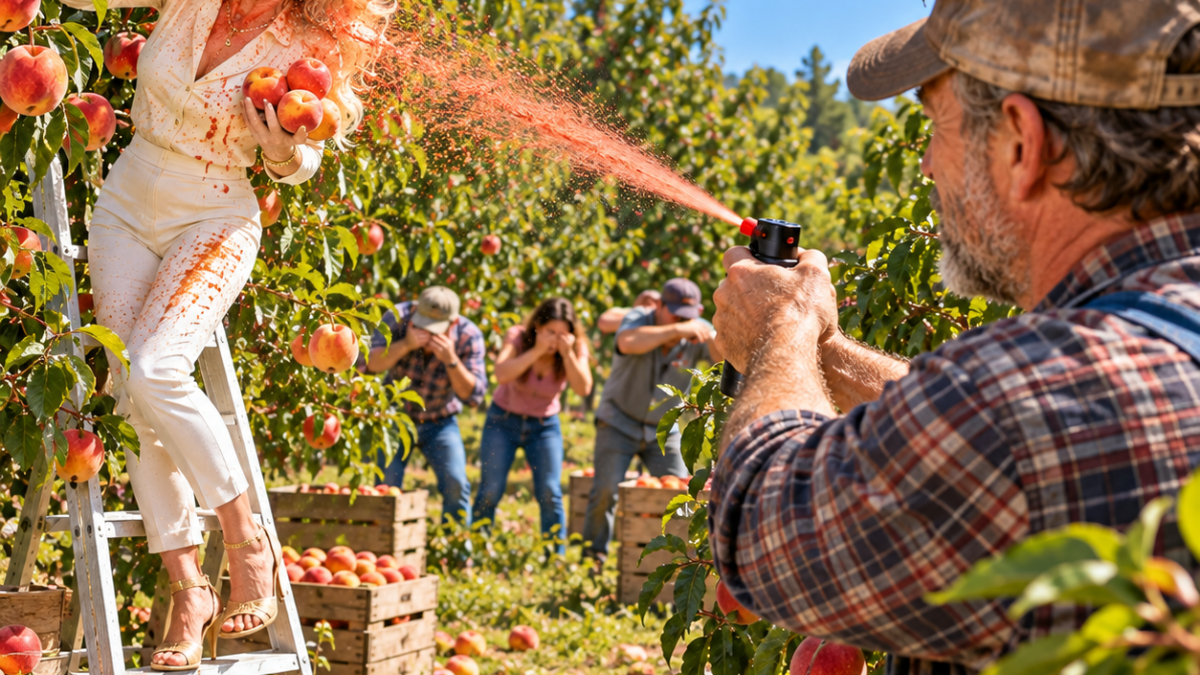
HOA Karen Stole Peaches From My Dead Wife’s Orchard for 14 Months—Then One Bite Made Her Scream.
For fourteen months, my HOA president climbed over my fence before sunrise, stripped peaches from the orchard my late wife had planted by hand, and then fined me every time I tried to stop her.
I thought she was simply an entitled thief until I discovered she had built an entire farmers-market business around my wife’s fruit, selling stolen peaches under her own name while using HOA rules to erase the evidence.
Then one Tuesday morning she bit into a peach from my fence, screamed so loudly half the neighborhood came outside, and the 911 call she made afterward became the first crack in a kingdom she had spent six years building.
My name is Mark Callahan.
I’m fifty-four years old.
For thirty years, I served with the Savannah Fire Department.
The last nine of those years, I was a battalion chief.
I’ve made decisions in burning buildings with less than a minute of information and somebody’s life depending on whether I guessed correctly.
I’ve crawled through smoke thick enough that I couldn’t see my glove touching my face mask.
I’ve stood beside parents while crews searched upstairs bedrooms.
I’ve carried children.
I’ve carried firefighters.
I’ve made death notifications.
I’ve watched good men retire because one call stayed in their heads longer than their bodies could keep carrying it.
I say that for one reason.
I am not an impulsive man.
When something goes wrong, I don’t start shouting.
I look.
I assess.
I figure out what is actually happening.
Then I act.
My wife used to hate that about me.
She also loved it.
“Elena, the dishwasher’s leaking.”
“You’ve been staring underneath it for twenty minutes.”
“Diagnosing.”
“You’re emotionally unavailable to household appliances.”
Then she’d hand me a wrench.
That was Elena.
Twenty-four years as a horticulturist with the University of Georgia Cooperative Extension Service.
Doctorate-level knowledge without the doctorate-level ego.
She could tell bacterial spot on a peach leaf from across a yard.
PART2:
She could smell whether fruit was ready before I could see the color.
She knew soil.
Fungus.
Pruning.
Pollination.
Root systems.
Chill hours.
Weather patterns.
Everything living seemed to make sense to her.
People sometimes didn’t.
Plants always did.
We bought our home in Magnolia Ridge Estates in 2013.
Twenty minutes west of Savannah.
Two hundred twelve houses.
Old live oaks.
Spanish moss.
Neatly edged lawns.
White fences.
A clubhouse nobody used enough to justify what we paid for it.
The kind of neighborhood where the welcome packet included a bottle of wine, a map of the walking trails, and three pages explaining exactly where garbage cans could be visible on Tuesdays.
I knew what we were buying into.
Elena did too.
She read every page of the covenants before closing.
PART3:
Twice.
She highlighted things.
“Mark.”
“What?”
“We can’t have chickens.”
“You don’t want chickens.”
“I don’t like being told I can’t have chickens.”
“You’ve never wanted a chicken in your life.”
“That’s not the point.”
She bought the house anyway.
Half-acre corner lot.
Our southern property line ran beside one of the neighborhood walking paths.
A low stone wall marked the boundary.
The first afternoon we had keys, Elena stood beside that wall for almost an hour.
I asked:
“What are you doing?”
“Thinking.”
“About?”
“Peaches.”
That was how the orchard started.
Sixteen trees.
Eight Elbertas.
Four Georgia Belles.
Two Redhavens.
Two Contenders.
She planned them with the seriousness most people reserve for retirement accounts.
She measured spacing.
Tested drainage.
Tracked sun.
Mapped wind.
Pulled historical temperature data from the county extension office even though she worked there and could probably have recited it from memory.
She drove metal stakes into the yard.
Moved them.
Moved them again.
Then made me move them six inches because apparently six inches is the difference between agricultural competence and shame.
We planted the first Elberta in March 2014.
I held the trunk.
She crouched by the roots.
“Straight.”
“It is straight.”
“No.”
“Elena.”
“Mark.”
“It is objectively vertical.”
“Your fireman eyes are crooked.”
I adjusted it.
She smiled.
“Perfect.”
By 2017, those trees were producing fruit that could stop conversations.
I’m not exaggerating.
People walking the neighborhood could smell the peaches.
Elena never sold them.
Neighbors offered money.
She refused.
She bought brown paper bags instead.
Every morning during harvest, she filled several.
On each bag she wrote:
Variety.
Pick date.
Best use.
Sometimes a note.
Georgia Belle — June 26 — Eat over sink unless wearing clothes you hate.
Or:
Elberta — July 12 — Cobbler. Do not waste this one on smoothies.
People loved her.
Children came to the porch.
Retired neighbors.
Delivery drivers.
Once a UPS man knocked at seven p.m. because he had been thinking about a peach she gave him during his route.
Elena gave him six.
She called it the peach honor system.
“You take what you’ll eat.”
“That isn’t an honor system.”
“It is if people have honor.”
“Then we are doomed.”
She threw a peach pit at me.
Then she got sick.
Pancreatic cancer.
Late 2019.
Treatment.
Surgery attempts.
More treatment.
Scans.
Numbers.
Hope.
Bad news.
New hope.
Worse news.
If you knew Elena, you know she attacked cancer like a research project.
Spreadsheets.
Clinical trials.
Medication schedules.
Questions for oncologists.
Color-coded folders.
She never surrendered intellectually.
Her body eventually did.
She still tended the orchard.
I would wake before sunrise and find her outside wearing a robe and knit cap, adjusting drip lines.
“Elena.”
“The Contenders aren’t getting enough pressure.”
“You had chemotherapy yesterday.”
“The trees didn’t.”
“Come inside.”
“Five minutes.”
“You said that twenty minutes ago.”
She would look at me.
“The trees don’t know I’m sick, Mark.”
Then quieter:
“I’d like to keep it that way.”
She died in April 2022.
Three weeks before the first fruit started turning.
The morning she died was quiet.
Too quiet.
Hospitals are never actually quiet, but your memory edits sound afterward.
I remember her hand.
Light through blinds.
The oxygen machine.
Her thumb moving once against my palm.
Then nothing.
I came home alone that night.
Walked into our kitchen.
Saw her pruning gloves on the counter.
I did not move them for seven months.
The first peach ripened in June.
Elberta.
Golden skin.
Red blush.
I picked it alone.
Held it in both hands.
For twenty minutes, I couldn’t eat it.
Because eating it meant she would never eat another one.
Grief does stupid things to logic.
Eventually I bit.
Juice ran down my wrist.
It was perfect.
I started crying so hard I had to sit in the grass.
After that, the orchard became my clock.
February pruning.
March bloom.
April thinning.
June harvest.
July harvest.
Dormancy.
Again.
I followed Elena’s notes.
I kept her irrigation schedule.
Used her pruning angles.
Her spacing.
Her methods.
I talked to her there.
At first only in my head.
Eventually aloud.
“Your Redhaven is showing off again.”
“Georgia Belles are early.”
“Your irrigation timer is older than some firefighters I supervised, but I’m not changing it.”
Some people go to cemeteries.
I went to the south fence.
Those sixteen trees were the last living system Elena built.
They mattered.
That is important.
Because otherwise what happened next sounds like a ridiculous argument over fruit.
It wasn’t.
It was about someone taking the last thing my wife had left growing.
Her name was Diane Prescott.
Diane had lived in Magnolia Ridge since 2018.
HOA president since 2019.
Unopposed.
People later asked why nobody stopped her earlier.
The answer is boring.
Most people don’t want to run an HOA.
They have jobs.
Kids.
Aging parents.
Mortgage problems.
Soccer practice.
Dinner.
They don’t want to spend Wednesday nights arguing about pool furniture.
Diane did.
Very much.
She treated the HOA like elected office, private club, fashion brand, and minor monarchy all at once.
Every newsletter had her photograph.
Every formal notice had her signature.
Every meeting began with what she called “President’s Community Vision.”
Nobody had asked for a vision.
We mostly wanted the pool gate repaired.
Diane was probably in her late forties.
Maybe fifty.
Hard to tell.
Everything about her was polished.
Honey-blonde hair.
Makeup at hours when nobody should be wearing makeup.
Perfect nails.
Silk blouses.
Designer handbags.
Huge sunglasses.
At five-thirty in the morning she somehow looked ready for a charity luncheon.
She enforced rules selectively and dramatically.
Eighty-year-old Mrs. Patterson had a porch swing installed before Magnolia Ridge even had an HOA.
Diane fined her four hundred dollars because it was an “unapproved suspended exterior furnishing.”
Mrs. Patterson said:
“My husband built that swing.”
Diane smiled.
“Bless your heart, but nostalgia isn’t an exemption.”
A twelve-year-old girl opened a lemonade stand.
Diane sent her parents a formal cease-and-desist because “unlicensed food-service activity creates an appearance of economic instability.”
Economic instability.
Lemonade.
One dollar.
A retired Marine had an American flag that exceeded some decorative-banner guideline by three inches.
Diane called county code enforcement.
The officer came.
Looked at the flag.
Looked at the retired Marine.
Then apparently said:
“Sir, I’m going to leave now.”
That was Diane.
For years I kept my distance.
Then she discovered Elena’s peaches.
The first time was July.
5:20 a.m.
I was making coffee.
Movement outside the kitchen window.
Diane.
Cream linen blouse.
White pants.
Gold sandals.
Gucci sunglasses.
At dawn.
She reached across my wall.
Twisted an Elberta from a branch.
Dropped it into her handbag.
Then another.
Four total.
Walked away.
I said nothing.
Maybe she believed the tree was common landscaping.
Maybe she thought fruit hanging near the path was free.
People make mistakes.
Elena always gave people room to correct themselves.
Three mornings later, Diane returned.
This time with a monogrammed canvas tote.
She filled it.
A week later she brought Cynthia, another HOA board member.
They picked peaches for fifteen minutes.
Chatting.
Laughing.
Cynthia said:
“These are amazing.”
Diane replied:
“I know. This year’s crop is beautiful.”
This year’s crop.
Like she’d planted them.
I went outside.
“Morning.”
Cynthia startled.
Diane didn’t.
She lowered her sunglasses.
“Good morning, Mark.”
“Those are my peaches.”
She looked at the peach in her hand.
Then at me.
“Yes?”
“I’d appreciate it if you stopped picking them.”
She smiled.
Not embarrassed.
Not apologetic.
Amused.
“Mark, the fruit overhangs a community pathway.”
“No, it doesn’t.”
“The board has discretion over vegetation affecting shared common areas.”
“No, it doesn’t.”
Her smile tightened.
“I’m actually handling a nuisance issue for you.”
“What nuisance?”
“Fallen fruit.”
“I clean it.”
“Insects.”
“I manage them.”
“Wildlife.”
“We live in Georgia.”
Cynthia laughed.
Diane didn’t.
I said:
“The trees are entirely on my lot.”
“That’s not really the point.”
“It is exactly the point.”
Diane put the peach into her bag.
“Bless your heart.”
That phrase from her was never kind.
“I updated the guidelines last quarter.”
I knew that was false.
Elena and I had read the documents too many times.
I checked anyway.
No amendment.
No vegetation rule.
No fruit authority.
No harvesting provision.
Nothing.
I installed four professional NO TRESPASSING signs on the wall.
Not ugly.
Not threatening.
Nine days later, all four disappeared.
An HOA letter appeared in my mailbox.
UNAUTHORIZED SIGNAGE REMOVED.
Section 7.4.
I looked it up.
Section 7.4 concerned oversized inflatable holiday decorations.
I laughed.
Then got angry.
I replaced the signs.
Removed again.
Third time, I anchored them.
Diane fined me three hundred dollars for “unauthorized structural modifications.”
She signed the letter:
Warmly,
Diane Prescott
Warmly.
She stole fruit.
Removed signs telling her not to steal fruit.
Then fined me for reinstalling signs telling her not to steal fruit.
I created a folder.
DIANE PRESCOTT CORRESPONDENCE.
Former battalion chiefs love folders.
Then cameras.
Three small weatherproof units.
Motion activated.
Clear view of the orchard and wall.
For two weeks, I documented.
Twenty-eight incidents.
Twenty-eight.
Diane picking.
Diane with Cynthia.
Diane with other friends.
Bags.
Baskets.
One morning she stood under an Elberta, bit into a peach, closed her eyes, and smiled.
I watched the footage.
It felt invasive in reverse.
Like someone had turned my grief into a grocery store.
I attended the next board meeting.
Forty-six homeowners.
Record attendance because neighbors had heard I planned to challenge Diane.
I waited through budget reports.
Pool towel debate.
Gate repair.
Then open forum.
I stood.
“I have security footage showing our HOA president trespassing onto my lot and taking fruit repeatedly.”
Silence.
Diane sat at the center of the board table.
White blazer.
Gold buttons.
Pearls.
She leaned toward the microphone.
“Mark, open forum is for community matters, not personal grievances.”
“The president repeatedly stealing from a resident seems like a community matter.”
Murmurs.
“I’d like to show the footage.”
She smiled.
“I don’t think we need to indulge theatrics.”
A man behind me said:
“Show it.”
Someone else:
“Yeah.”
Diane looked around.
Refusing would look worse.
She gestured.
“Two minutes.”
I connected my laptop.
First clip.
5:23 a.m.
Diane climbing partly over my wall.
Picking.
Second.
Cynthia holding tote.
Third.
Diane removing fruit.
Fourth.
Diane taking one bite and smiling like she was filming an advertisement.
Someone whispered:
“Oh my God.”
I stopped the video.
“I’ve estimated about $2,700 in fruit taken based on local specialty-market prices.”
Diane dabbed her lips with a linen napkin.
She brought her own napkins to meetings.
Then:
“Those trees remain an ongoing nuisance.”
People groaned.
She continued.
“Fruit drop creates a slip hazard.”
“No branches reach the pathway.”
“Wildlife.”
“I maintain the property.”
“Visual clutter.”
“Peaches are visual clutter?”
“Mr. Callahan, this attitude is exactly why collaborative governance becomes difficult.”
I stared at her.
She continued.
“The board’s recommendation is removal.”
“Removal of what?”
“The trees.”
My chest tightened.
“No.”
Diane turned to Cynthia and two other board allies.
“All in favor of requiring removal of the nuisance orchard?”
Three hands rose.
Diane raised hers.
“Motion carries.”
A man in the audience said:
“You’ve got to be kidding.”
Older woman:
“This is disgraceful.”
Diane smiled at me.
“You’ll receive formal notice.”
I stood there looking at her.
Not thinking about peaches anymore.
Thinking about Elena in her robe.
Chemo cap.
Adjusting irrigation.
The trees don’t know I’m sick, Mark.
And Diane wanted to destroy them because I had caught her stealing.
That was when Ray Gutierrez said something afterward that turned out to be prophecy.
He leaned against his pickup.
“That woman is going to bury herself.”
“I hope so.”
“Don’t help.”
“What?”
“Give her a shovel.”
Four days later, Ray knocked on my door.
Phone in hand.
“You need to see this.”
His daughter Camilla had visited Savannah City Market.
Photograph.
Booth.
Hand-lettered sign:
DIANE’S SOUTHERN GOLD
FARM-FRESH GEORGIA PEACHES & ARTISAN PRESERVES
I stared.
Wooden crates.
Gingham.
Mason jars.
Peaches.
My peaches.
Elbertas.
Georgia Belles.
I knew the shape.
Color.
I knew Elena’s fruit.
Diane stood behind the table wearing a straw hat and embroidered apron.
Smiling.
Ray scrolled.
Instagram.
Diane’s Southern Gold.
Bio:
Southern Living | Peach Grower | Farm-to-Table Artisan.
Posts.
“Nothing beats the first bite of a Georgia Belle you grow yourself.”
“Harvest morning.”
“Grateful for these hands and this land.”
#grownwithlove.
#farmgirl.
I laughed.
A hard, joyless laugh.
Her yard contained artificial turf and a heated pool.
She did not own a fruit tree.
Camilla had checked the vendor directory.
Business active twenty months.
Twenty months.
Longer than I had been catching her.
I sat on the porch.
Ray waited.
It suddenly made sense.
The quantities.
The bags.
The early hours.
The tree-removal vote.
She was not eating stolen peaches.
She was running a business.
On Elena’s orchard.
And once the trees were removed, she could erase the easiest proof of origin.
That night I collected every screenshot.
Website.
Vendor profile.
Prices.
Photos.
Captions.
Then called Sandra Reyes.
Property attorney.
Recommended by a retired fire captain.
Sandra had a voice so calm it made everybody else’s voice sound nervous.
I laid everything out.
Camera footage.
Letters.
Fines.
CC&Rs.
Meeting minutes.
Market photographs.
Instagram.
Sandra read.
Watched.
Read more.
Ninety minutes later:
“This is not a neighbor dispute.”
“No.”
“She is taking private property.”
“Yes.”
“Commercializing it.”
“Yes.”
“Using HOA authority against you while personally benefiting.”
“Yes.”
“And she voted to destroy the source after you exposed the taking.”
“Yes.”
Sandra leaned back.
“That is exceptionally stupid.”
First thing we did was survey.
Licensed surveyor.
Every tree.
Every branch.
Every wall.
Nearest branch to community path:
More than five feet inside.
No encroachment.
No overhang.
Diane’s main justification disappeared.
Second:
Sandra reviewed the tree-removal vote.
Improper notice.
No hearing.
No appeal.
Authority questionable under both governing documents and applicable law.
Cease-and-desist sent.
Third:
Formal theft and trespass complaint with Chatham County.
I brought video.
Deputy watched.
Paused.
Replayed.
Then looked at me.
“Is she wearing Gucci sunglasses?”
“Yes.”
“At five-thirty?”
“Yes.”
He shook his head.
“Okay.”
Case number.
Fourth:
Challenges to the fines and governance abuses through appropriate legal channels.
Sandra warned me:
“No retaliation.”
“I know.”
“No physical confrontation.”
“I know.”
“Do not do anything designed to hurt her.”
That mattered.
I asked:
“Can I still treat my orchard for wildlife?”
“Of course, if you use lawful products exactly as intended and post any appropriate warnings.”
There are pests in Georgia orchards.
Birds.
Squirrels.
Raccoons.
Insects.
Elena had used several kinds of deterrents over the years.
One product I bought was a commercially sold capsaicin-based animal repellent.
Unpleasant.
Legal for its labeled agricultural use.
Not a poison.
I applied it according to directions to fruit along the vulnerable fence row as part of the orchard’s normal pest control and posted visible notice on my side of the wall that treated produce should be washed before eating.
It had an additional benefit.
Anybody who ignored my property line, the cameras, the trespass warnings, the cease-and-desist, and common sense would discover that stealing unwashed treated fruit carried consequences.
I did not need to touch Diane.
I did not need to confront her.
I just needed her to stop helping herself to things that were not hers.
The next morning my phone buzzed.
5:22.
Motion alert.
Diane.
Lavender silk blouse.
White pants.
Gold sandals.
Huge sunglasses.
Hermes bag.
I stood in my kitchen.
Coffee in hand.
She walked directly past the posted notice.
Reached over.
Picked two Elbertas.
Then three Georgia Belles.
Redhaven.
Into the bag.
No hesitation.
No fear.
No concern that she had been filmed twenty-eight times.
That is what unchecked power does.
It makes consequences feel theoretical.
Then she took a Georgia Belle from her bag.
Elena’s favorite.
She rubbed it once against her blouse.
Not washed.
Bit.
Two seconds.
Her face changed.
Eyes widened.
Mouth opened.
Then the scream.
It tore through Magnolia Ridge at 5:26 a.m.
Birds lifted from the oak across the street.
Ray’s dog started barking.
Diane dropped the peach.
Then the bag.
Fruit rolled everywhere.
She coughed.
Spat.
Tears came instantly.
Not subtle.
Real.
Her sunglasses fell.
She stumbled backward and went down on one knee.
Then both.
White linen on wet pavement.
She grabbed a water bottle from her bag.
Rinsed her mouth.
More coughing.
Her composure disappeared.
Not because humiliation is justice.
It isn’t.
But because for the first time, Diane had done something she could not solve with a letterhead.
Neighbors’ lights came on.
Doors opened.
Diane grabbed her phone.
Called 911.
“He poisoned me!”
I could hear her from my kitchen.
“I need police and ambulance.”
Pause.
“He deliberately contaminated fruit.”
Pause.
“No, I don’t know what chemical.”
Pause.
“My throat is burning.”
I walked outside with the product container, receipt, legal paperwork, and the sheriff’s case number.
Not because I was trying to make a point.
Because after thirty years in emergency services, I know responders need information.
Paramedics arrived.
Then deputies.
Diane sat on the curb.
Mascara running.
Face red.
Sunglasses cracked.
Paramedic assessed her.
Airway clear.
No serious allergic reaction.
Severe irritation.
Painful.
Temporary.
The deputy approached me.
“Mr. Callahan?”
“Yes.”
“What happened?”
“I use an agricultural pest deterrent in my orchard.”
I handed him the container.
“It was applied according to the product directions.”
“Your fruit?”
“Yes.”
“Your property?”
“Yes.”
“Did you give her a peach?”
“No.”
He looked toward Diane.
“Did she have permission to take one?”
“No.”
I showed him the active report.
Then the camera clips.
The deputy stared at the orchard.
Then Diane.
Then the warning.
He walked over.
“Ms. Prescott.”
“He poisoned me.”
“Were you taking fruit from Mr. Callahan’s property?”
“I was removing a nuisance.”
“That wasn’t my question.”
She said nothing.
“Did he give you permission?”
“This vegetation affects the community path.”
“Ma’am.”
Pause.
“No.”
“Did you know there was a trespass complaint?”
“He has been harassing me.”
The deputy sighed.
“Taking somebody else’s fruit after being told repeatedly not to is not an HOA enforcement tool.”
Diane pointed at me.
“Arrest him.”
“For what?”
“He knew I’d eat it.”
I said nothing.
The deputy looked at the legal product again.
Then the signs.
Then:
“Ma’am, I’m documenting this incident, but right now what I have is you entering private property and removing property after prior notice.”
Her face darkened.
“Do you know who I am?”
That sentence never helps.
The deputy answered:
“Yes, ma’am.”
He nodded toward my case paperwork.
“Your name is already in the report.”
Formal trespass warning.
Paramedics recommended care.
Diane refused transport after they determined she was stable.
Before leaving, she pointed at me.
“This isn’t over.”
I believed her.
Two days later:
Emergency HOA bulletin.
TOXIC CHEMICAL THREAT NEAR COMMUNITY PATH.
Diane claimed I had created danger to pets and children.
Petition.
Health-department complaint.
Facebook.
The post was titled:
PROTECT OUR FAMILIES — TOXIC TREES ON MAGNOLIA RIDGE DRIVE.
She wrote that she had been “collecting fallen fruit as a neighborly courtesy.”
Then made the mistake Sandra had been waiting for.
I have picked up fallen fruit along this path for over two years.
Two years.
Public admission.
Real name.
Timestamp.
Sandra texted:
She just gave us Exhibit J.
The health inspector came.
Read product information.
Inspected orchard.
Checked application records.
Closed complaint.
No public hazard under the documented use.
Meanwhile, Sandra filed civil claims.
Trespass.
Theft.
Improper fines.
Defamation.
Governance abuses.
Conflict of interest.
Then she subpoenaed records tied to Diane’s Southern Gold.
That destroyed the last possible explanation.
Twenty months.
$13,611 in documented sales through card and payment platforms.
Market vendor application:
HOMEGROWN GEORGIA PEACHES.
Diane owned no orchard.
No trees.
No farm property.
Her product photos matched fruit varieties in my orchard.
Then other homeowners came forward.
Mrs. Anand.
Retired school teacher.
Elberta tree.
Fruit missing every summer.
She had complained to Diane.
Diane sent her an HOA letter explaining wildlife loss was a natural consequence of residential fruit trees.
Diane had answered a complaint about her own theft.
Ray showed me the letter.
I stared.
“That might be the most Diane thing I’ve ever seen.”
Couple on Wisteria Lane.
Fig tree stripped every August.
They blamed squirrels.
Ring footage showed Diane.
An elderly man on Sycamore Court.
Muscadine grapes.
He confronted Diane once.
She told him she was removing overgrowth to prevent wasps.
He thanked her.
Then learned she had sold jars called:
Diane’s Scuppernong Reserve.
Nine dollars each.
One homeowner had satsumas go missing.
Another had herbs cut from a side garden.
Not enough evidence to prove everything commercially, but enough to establish a pattern of entitlement that shocked the community.
People began withdrawing petition signatures.
Then demanding Diane resign.
She refused.
Emergency meeting.
One hundred fifty-three residents.
Standing room.
Sandra attended at my request.
She presented chronology.
Not theatrics.
Dates.
Documents.
Survey.
CC&R provisions.
Fines.
Camera footage.
Market registration.
Sales records.
Diane’s public admission.
Other Ring videos.
At one point Sandra placed two images side by side.
Left:
Diane’s Instagram photograph.
Basket of Georgia Belles.
Caption:
Grown with love.
Right:
Security footage from three hours earlier.
Diane taking Georgia Belles from my tree.
Nobody spoke.
Diane sat in the third row.
Navy blazer.
Pearls.
No microphone.
No head table.
For the first time since I’d known her, she looked small.
Not physically.
Institutionally.
The power had left the room before she had.
Mrs. Anand stood.
The schoolteacher whose peaches were stolen.
She faced Diane.
“Do you remember my letter?”
Diane stared.
“I asked why my fruit disappeared.”
No response.
“You told me it was squirrels.”
Someone muttered:
“Jesus.”
Mrs. Anand’s voice shook.
“I bought motion sprinklers because you told me to.”
A few people laughed bitterly.
She didn’t.
“I stood in my yard trying to scare animals away while the woman who wrote the warning was stealing the fruit.”
Diane said:
“I reject that characterization.”
Mrs. Anand laughed once.
“Oh, honey.”
The whole room went silent.
“I watched the video.”
Vote.
Remove Diane as president.
147 to 6.
Same six people who seemed to vote with her on nearly everything.
Her board allies resigned.
Clubhouse key surrendered.
HOA email credentials changed.
Website control transferred.
Social accounts locked.
It turned out many of Diane’s powers existed because nobody had ever demanded the passwords.
That night, she drove away from the clubhouse without speaking to me.
I thought I’d feel victorious.
I didn’t.
I felt tired.
Very tired.
The criminal case moved separately.
Sheriff’s evidence.
My original report.
Video.
Diane’s Facebook statement.
Additional property owners.
Market sales.
Prosecutors ultimately charged offenses supported by the evidence, including trespass and theft-related conduct.
The false emergency allegations became part of the broader record, though not every allegation resulted in a conviction.
Eventually Diane entered a plea resolving the case.
Probation.
Community service.
Restitution obligations.
No-contact provisions.
The irony of her community service was not lost on Ray.
He called.
“You know where they assigned her?”
“No.”
“Roadside cleanup.”
I said nothing.
“She’ll finally pick something up that actually belongs to the public.”
“Ray.”
“What?”
“That’s pretty good.”
“I’ve been saving it.”
The civil case settled months later.
Fifty-one thousand two hundred dollars.
Value of stolen fruit.
Improper costs.
Security.
Survey.
Legal fees.
Other damages.
Every fine she issued against me was rescinded.
Tree-removal order voided.
The new board issued a public apology.
Diane’s farmers-market registration was revoked.
Her online business disappeared.
Instagram private.
Then gone.
The craziest part?
The money never mattered much to me.
I would have traded every dollar to rewind time and simply have her never touch Elena’s trees.
What mattered was the orchard survived.
The following July was one of the best harvests we’d ever had.
Elbertas heavy.
Branches bending.
Georgia Belles almost white inside.
Redhavens sweet enough that I understood why Diane kept stealing them.
Not that I forgave it.
I harvested at dawn.
Same time she used to arrive.
Twist gently.
Support branch.
Don’t scar the stem.
Elena’s voice.
I donated three hundred forty pounds to Second Harvest Food Bank of Coastal Georgia.
The intake coordinator asked:
“What name should we put on the donation?”
I almost said Callahan.
Then:
“Elena’s Orchard.”
She typed it.
I looked away.
That name has gone on every donation since.
The new HOA president was Mrs. Anand.
The retired teacher.
She hated meetings.
Perfect qualification.
First thing she did was review every rule Diane claimed authority under.
A shocking number were imaginary.
Others were badly interpreted.
Some had been valid but selectively enforced.
The new board rescinded dozens of fines.
Created an appeals process.
Published meeting minutes.
Required conflicts of interest disclosed.
Normal governance.
Boring.
Wonderful.
They also adopted a resolution affirming that fruit and landscaping entirely on private lots belonged to the property owner.
They called it the Callahan Amendment.
I objected.
Nobody cared.
That fall, neighbors started asking me about peach trees.
“How does Elena get them that sweet?”
“Sun.”
“What fertilizer?”
“Depends.”
“Which variety?”
“How much work do you want?”
“Not much.”
“Then don’t plant peaches.”
I helped anyway.
Four trees.
Then eight.
Eventually twenty-eight peach trees appeared across Magnolia Ridge.
Children watched.
Parents asked permission before picking.
Always.
That mattered.
“Mr. Callahan?”
“Yes?”
“Can I have one?”
“If your mom says yes.”
“She does.”
“Which variety?”
“Peach.”
“We need to work on your education.”
Ray planted three.
Texted me questions at midnight.
How far apart?
When prune?
How much thin?
I sent photographs of Elena’s notes.
He became obsessive.
“She said six inches between fruit?”
“Yes.”
“That seems excessive.”
“She was particular.”
“You say that like you’re not.”
Fair.
The HOA newsletter changed too.
Plain paper.
No gold embossing.
No president glamour shot.
Mrs. Anand started a column:
ORCHARD NOTES.
Tips from Elena’s old extension bulletins.
Always credited.
Elena Callahan, University of Georgia Cooperative Extension.
The first time I saw her name, I had to put the newsletter down.
Then pick it back up.
She was teaching people again.
In a strange way.
I mounted a brass plate on the first Elberta we planted.
ELENA’S ORCHARD
PLANTED WITH LOVE.
PROTECTED WITH PATIENCE.
I considered adding:
AND SECURITY CAMERAS.
Decided against it.
Seven months after the settlement, Diane sold her house.
Moved to Jacksonville, someone said.
Condo.
No orchard.
No HOA authority as far as I knew.
The last time I saw her was at Kroger.
Produce section.
Of course.
I was buying onions.
She stood near the peaches.
Hair still perfect.
Expensive clothes.
More subdued somehow.
Not defeated.
Just less certain that every room belonged to her.
She reached toward a bag of peaches.
Then saw me.
Stopped.
Hand hovered.
For one absurd second, we stared at each other over supermarket fruit.
Then she pulled her hand back.
Turned.
Walked away.
Left the cart.
I did not laugh until I reached my truck.
That evening I made Elena’s peach cobbler.
Her recipe card is still taped inside the spice cabinet.
Her handwriting.
1/2 tsp cinnamon.
Not more. Mark always adds too much.
She was right.
I followed directions.
For once.
The cobbler was excellent.
I ate a piece on the porch.
Then another.
I looked toward the orchard.
Sun going down.
Leaves moving.
Fruit hanging quietly.
For fourteen months, I thought the fight was about stopping one woman from picking peaches.
It wasn’t.
It was about what happens when somebody convinces themselves that authority creates ownership.
Diane believed if she could cite a rule, she could take.
If the rule didn’t exist, she could invent it.
If someone resisted, fine them.
If evidence appeared, redefine the problem.
If the source of evidence remained, destroy it.
She built a system where every objection became proof that the objector was unreasonable.
That is dangerous.
Not only in HOAs.
Everywhere.
Authority without accountability always starts sounding the same.
I’m doing this for everyone.
You don’t understand.
It’s for safety.
It’s for standards.
It’s for the community.
People who say those things may be telling the truth.
Sometimes.
The question is whether they can show their work.
Where is the rule?
Who adopted it?
What authority does it give you?
Who benefits?
What happens if somebody says no?
Those questions would have exposed Diane years earlier.
Magnolia Ridge learned.
So did I.
For years after retiring from the fire department, I thought calm meant not getting angry.
Wrong.
Calm means anger does not get to drive.
I was furious when she touched Elena’s trees.
I wanted to confront her.
Humiliate her.
Make her feel what I felt.
That would have created a moment.
Documentation created an outcome.
Camera dates.
Letters.
Surveys.
Receipts.
Records.
Witnesses.
Nothing exciting.
Everything useful.
Firefighting taught me the same lesson.
Smoke is dramatic.
Heat is dramatic.
Flames are dramatic.
But survival often depends on boring things.
Exit maps.
Door positions.
Sprinkler pressure.
Radio discipline.
Accountability tags.
Preparation.
Truth is like that.
Most people lose because they arrive with anger and the other side arrives with paperwork.
So I kept paperwork.
I never forgot Elena’s voice either.
She hated waste.
Especially fruit.
The year after Diane left, we harvested more than six hundred pounds across all sixteen trees.
Too much for one man.
Too much for neighbors.
Food bank took most.
A senior center took some.
Fire Station 12 took three crates.
One young firefighter bit a Georgia Belle and closed his eyes.
I smiled.
There it is.
He looked at me.
“What?”
“Elena used to say the goal was growing a peach so good it makes a grown man close his eyes.”
He swallowed.
“Well.”
He looked at the fruit.
“She nailed it.”
“Yes.”
“She your wife?”
“Was.”
He nodded.
“Sorry, Chief.”
“Thanks.”
Then he took another peach.
I think Elena would’ve considered that an acceptable memorial.
Years passed.
Ray’s trees started producing.
Mrs. Anand’s too.
One summer, six families set baskets outside.
Free fruit.
Notes.
Variety.
Pick date.
Serving suggestion.
Elena’s old honor system.
I walked past one porch and saw:
GEORGIA BELLE — EAT OVER SINK.
I stood there laughing.
The homeowner came outside.
“What?”
“Nothing.”
“Wrong?”
“No.”
“Mark?”
“My wife used to write exactly that.”
He looked at the bag.
“I got it from the Orchard Notes article.”
Of course.
Things survive in strange ways.
Not people.
Things they teach.
Habits.
Recipes.
Spacing formulas.
Notes on paper bags.
The right way to twist a peach so the branch doesn’t scar.
Sometimes that’s enough.
People still ask about the morning Diane screamed.
They make that the headline.
HOA Karen stole peaches.
Hot peach.
Scream.
Funny.
And yes, parts of it were funny.
The sunglasses.
The designer bag spilling fruit.
Ray watching from his window.
The deputy staring at her after learning she had taken fruit despite cameras.
But I don’t think about the scream much.
I think about what happened afterward.
Neighbors coming forward.
Mrs. Anand learning the woman who blamed squirrels was the thief.
People realizing they had been too intimidated to compare notes.
The board changing.
The orchard surviving.
Elena’s name appearing in the newsletter.
Fruit going to people who needed food instead of somebody’s fake farm brand.
That’s the part worth remembering.
Diane’s punishment was never really the irritation from one peach.
That lasted maybe an hour.
Her real consequence was being seen clearly.
No gold stationery.
No microphone.
No title.
No careful lighting.
Just evidence.
Once people saw the difference between what she said and what she did, the rest happened fast.
Power built on image requires people to keep looking at the image.
Truth changes the angle.
A few years after everything, a new family moved in near our south path.
Young couple.
Two boys.
The oldest maybe seven.
The first summer he stopped beside the wall.
Looked at the peaches.
Then at me.
“Can I take one?”
I was pruning nearby.
“Did your parents say yes?”
“My dad’s right there.”
His father raised a hand.
I nodded.
“Take a Georgia Belle.”
“Which one?”
I walked over.
Picked one.
Handed it to him.
“Soft, not mushy.”
He smelled it.
“Do I have to pay?”
“No.”
“Why?”
I smiled.
“Because you asked.”
The father looked at me.
He knew the story.
Most residents did.
The boy didn’t.
Good.
He bit the peach.
Juice ran down his chin.
His eyes closed.
I laughed.
“What?”
“Nothing.”
He took another bite.
“This is really good.”
“I know.”
“Did you grow it?”
I looked at the tree.
“No.”
He frowned.
“Who did?”
“My wife started it.”
“Where is she?”
Kids don’t soften questions.
“She died.”
“Oh.”
Then:
“Does she know it’s good?”
I swallowed.
“I think she knew.”
He nodded like that settled everything.
Ran back to his father.
I stayed beside the tree.
Hand on the bark.
For a while.
Some mornings I still talk to Elena.
“Ray overpruned again.”
“Mrs. Anand planted one too close to the oak.”
“Kids ate half the Georgia Belles yesterday.”
“The newsletter spelled Prunus persica wrong.”
I can practically hear her correcting everyone.
That is grief after enough years.
Not constant pain.
Conversation without answers.
I keep the original Diane file in a cabinet.
Security footage.
Letters.
Market photos.
Settlement papers.
I rarely open it.
Next to it is Elena’s orchard notebook.
That one I use constantly.
One is a record of what somebody tried to take.
The other is a record of what survived.
I know which matters more.
Diane wanted the trees removed because they proved where her “farm” really was.
Instead, Magnolia Ridge has more peach trees now than when she started stealing.
Twenty-eight last I counted.
Probably more.
The food-bank donation grows each year.
Children know Elena’s name.
Neighbors know how to prune.
Parents say:
“Ask first.”
And they do.
That may be the most satisfying ending possible.
Not that Diane screamed.
Not that she paid.
Not that she lost her title.
That the thing she tried to erase multiplied.
Last July I stood beside the first Elberta.
The tree Elena and I planted together.
It is old now by orchard standards.
One major limb had to come off.
Another season or two and I may have to replace it.
That thought bothered me more than I expected.
Ray came over.
Saw me staring.
“Tree’s tired.”
“Yeah.”
“You’ll plant another.”
“Not the same.”
“No.”
He leaned against the wall.
“Nothing is.”
I looked at him.
He shrugged.
“But that never stopped Elena, did it?”
Ray knew her well enough to say that.
No.
It wouldn’t have.
The next February, I propagated replacement stock and planted a young tree nearby.
Not to pretend the old one could live forever.
Nothing does.
To continue.
That’s what orchards are.
You prune.
You lose branches.
You replace trees.
You keep what can still grow.
Maybe families are like that.
Communities too.
Magnolia Ridge lost years to Diane’s version of leadership.
Then people learned.
New board.
New rules.
More transparency.
Less fear.
Someone occasionally proposes something stupid.
People question it now.
Good.
At the last annual meeting, a new member suggested standardized mailbox flower colors.
Mrs. Anand said:
“No.”
He asked:
“Shouldn’t we vote?”
She said:
“We can vote on whether we want to waste forty minutes discussing mailbox flowers.”
Motion died.
Progress.
I sat in the back laughing.
Afterward she walked over.
“You’re enjoying this.”
“Deeply.”
“Remember when you hated HOAs?”
“I still do.”
“I am the HOA.”
“I like you personally.”
“Good enough.”
On the way home, I walked past the orchard.
No one picking.
No hidden bags.
No cameras alerting.
Just fruit.
That quiet means more than people realize.
Peace is not the absence of conflict.
It is what remains when boundaries are finally respected.
My wife understood boundaries better than anyone.
She knew where to prune.
Where to leave growth alone.
How close trees could stand before competing.
How much fruit a limb could hold before breaking.
Growth needs limits.
So does power.
Diane never learned that until other people imposed limits on her.
By then it cost her almost everything she valued.
Title.
Status.
Business.
Money.
Control.
But Magnolia Ridge became healthier afterward.
The orchard did too.
And every summer, when the first Georgia Belle ripens, I pick it myself.
No visitors.
No neighbors.
No food-bank boxes yet.
Just me.
I hold it the way Elena did.
Check color.
Smell.
Press gently near the stem.
Then I take one bite.
Usually juice gets everywhere.
Usually I close my eyes.
And every year I say the same thing.
“You were right.”
About the peaches.
About patience.
About being particular.
About giving fruit away.
About nearly everything, if I’m being fair.
Then I open my eyes.
The trees are still there.
And after everything Diane Prescott tried to steal, sell, fine, regulate, rename, and destroy—
that is the consequence that matters most.

