HOA Karen Stole $4,200 of Electricity From My Outdoor Outlet for 3 Years—So I Rebuilt My Septic System Beside It and Let Her Summer Party Discover the Problem.
HOA Karen Stole $4,200 of Electricity From My Outdoor Outlet for 3 Years—So I Rebuilt My Septic System Beside It and Let Her Summer Party Discover the Problem.
Tammy Vickers stole electricity from the outdoor outlet on my Georgia property for years, cut through a locked cover after the sheriff warned her to stop, and even told contractors my father’s receptacle was “community infrastructure” because she believed a plumber in dirty boots would never have the money, patience, or paperwork to fight back.
Then her false septic complaint forced me to inspect the property closely enough to discover the HOA had also been dumping pool backwash and stormwater through hidden pipes onto my land—and the same woman calling my business a neighborhood biohazard had been quietly using my soil as her own drainage system for years.
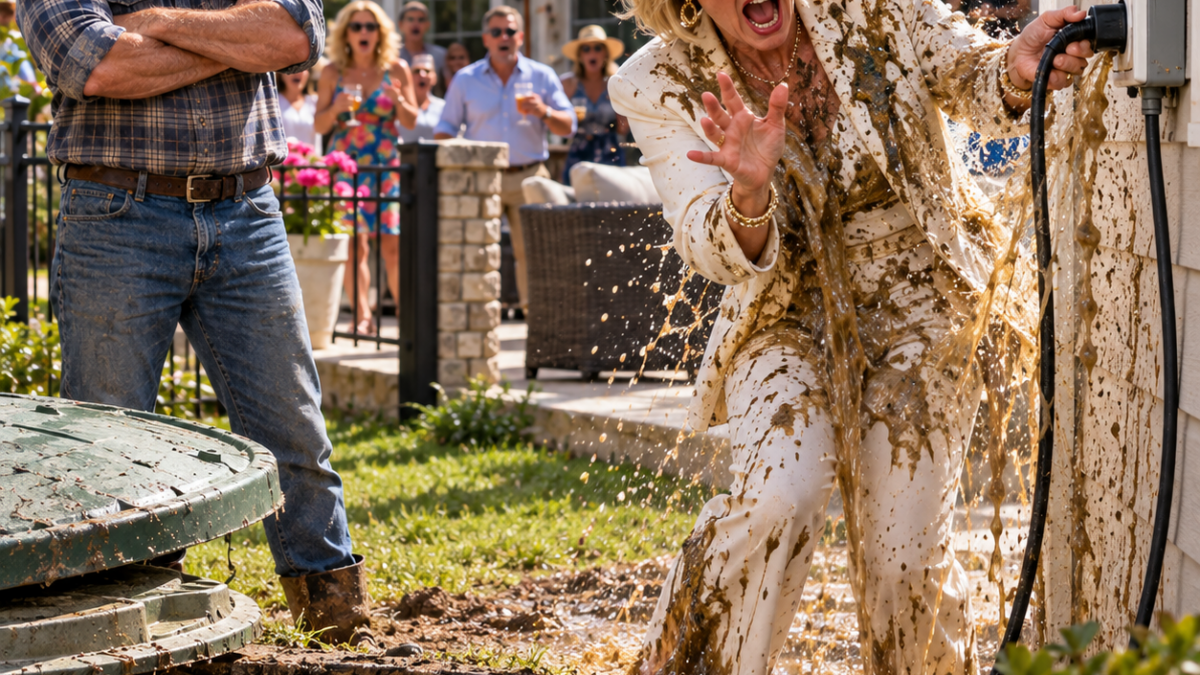
So when I rebuilt my aging septic system legally, with county approval and every inspection signed, I placed the new vent where the site plan legitimately required it—right beside the stretch of wall Tammy kept trespassing across to reach my electricity—and at her annual summer party, fifty guests finally learned what happened when their HOA president ignored three years of warnings and plugged into something that was never hers.
The first thing Tammy Vickers ever stole from me cost twelve cents.
Maybe fifteen.
I never calculated the exact amount.
It was one evening in October, a string of white patio lights glowing across her backyard after dark.
I saw them through the pine branches while I was carrying a toolbox from my truck.
Pretty lights.
Warm.
Tasteful.
The kind that made an ordinary patio look like a restaurant where they charge nineteen dollars for a hamburger because the bun is brioche.
I did not know they were running on my electricity.
At the time, I barely knew Tammy.
She lived on the other side of the six-foot privacy fence south of my house.
White Cadillac Escalade.
Blond bob cut so precisely you could probably check a carpenter’s square against it.
Designer sunglasses.
Three outdoor seating areas despite only two people living in the house.
She was president of the Brierwood Crossing Homeowners Association.
I did not live in Brierwood Crossing.
That point became important.
My name is Nathan Callaway.
I was forty-four when this happened.
Licensed master plumber.
Septic installer.
Owner of Callaway Plumbing & Septic Services.
My father started the business in 1986 with one rusty Chevy service truck, a Ridgid pipe wrench, two milk crates full of fittings, and enough optimism to qualify as a medical condition.
He bought our property two years later.
One-point-two acres in what was then mostly rural Sweetwater County, Georgia.
Red clay.
Wiregrass.
Longleaf pine.
One ranch house.
Detached shop.
Equipment yard.
No subdivision.
No HOA.
No ornamental entrance fountain.
PART2:
No architectural committee debating whether beige siding was the correct emotional tone for a mailbox.
Dad built the house himself.
Not alone.
Men always say that.
“My father built this house.”
What they mean is:
My father built this house with six friends, three cousins, one electrician who accepted payment in barbecue, and an uncle who appeared only when free beer was available.
Still, Dad laid much of the block himself.
Ran water lines.
Installed the septic.
Built the workshop.
Poured the original equipment pad.
And in 1997, he mounted a weatherproof outlet on the south exterior wall because he was tired of running extension cords from the garage whenever he used power tools in the side yard.
That outlet sat about fifteen feet from what later became Tammy Vickers’s backyard fence.
When Dad installed it, there was no Tammy.
No Brierwood Crossing.
No houses south of us.
Just soybeans.
Dad died in 2019.
Mom had gone five years earlier.
PART3:
They are buried behind the pine stand at the west end of the property.
Nothing fancy.
Two granite stones.
A bench.
Dad’s reads:
WILLIAM CALLAWAY
HUSBAND
FATHER
PLUMBER
HE COULD FIX IT
My mother chose that line before she died.
Dad complained it made him sound like an appliance repairman.
Then asked that nobody change it.
I moved back into the house after my divorce.
My son Eli was eight then.
Twelve when this story happened.
Eli lived with me most weeks and his mother every other weekend.
We ate dinner on the porch.
Hot dogs in winter because my son believed seasonal food rules were oppression.
Grilled chicken in summer.
Waffle House Fridays.
His grandfather had started that tradition after Eli was born.
Some traditions survive because they are meaningful.
Others survive because hash browns exist.
Our land had been zoned agricultural since Dad bought it.
The plumbing business predated every house in Brierwood Crossing by more than twenty years.
The shop was permitted.
The septic was permitted.
The equipment yard was legal.
And our deed contained no declaration, annexation clause, reciprocal covenant, or other mechanism binding us to Brierwood Crossing.
In plain English:
Their HOA rules stopped at their property line.
Tammy did not like property lines.
She liked influence.
There is a difference.
Brierwood Crossing had been built beginning in 2009 on sixty acres of former soybean field.
One hundred sixteen houses.
Community pool.
Walking paths.
Clubhouse.
Dog park.
Solar lights.
Decorative brick entrance.
Homes around four hundred to five hundred fifty thousand dollars by the time Tammy became president.
Nice place.
Good people, mostly.
Teachers.
Salespeople.
Nurses.
Retirees.
Young families.
People who wanted neighborhood amenities and were willing to pay for them.
Then Tammy got elected.
Forty-nine.
Former marketing executive, according to her biography.
Her husband Dale worked in pharmaceutical sales and traveled constantly.
Tammy treated neighborhood governance with the seriousness most people reserve for national security.
She chaired the architectural board.
Landscape standards committee.
Beautification task force.
And something she invented called the Perimeter Integrity Council.
The Perimeter Integrity Council consisted mostly of Tammy walking along the edge of Brierwood Crossing with a leather portfolio and photographing my property.
My work trucks offended her.
My pipe racks offended her.
My workshop offended her.
One evening, while talking to a neighbor within easy earshot, she said:
“It was prettier back here before the plumber moved in.”
The plumber.
Not Nathan.
Not Mr. Callaway.
The plumber.
Like raccoon.
Or mildew.
I should tell you something before I continue.
I am proud of being a plumber.
Not defensively proud.
Not:
I make more money than you think.
I mean genuinely proud.
People call plumbers when life has stopped working in a very immediate way.
No water.
Too much water.
No toilet.
Too much toilet.
Kitchen sink full of things that should no longer be recognizable.
Septic alarm screaming at two in the morning before thirty relatives arrive for Thanksgiving.
A plumber walks into somebody’s worst-smelling hour and fixes enough of it that normal life can restart.
I like that.
Dad liked that.
So Tammy saying “the plumber” never embarrassed me.
What irritated me was hearing exactly what she meant by it.
Lower class.
Dirty.
Useful, maybe.
But not equal.
That attitude cost her far more than the electricity ever did.
The electric bills started climbing in October 2021.
Normal bill:
About $145.
October:
$218.
November:
$241.
December:
$312.
January:
$289.
At first I blamed the water heater.
Then colder weather.
Then Eli leaving lights on because apparently twelve-year-old boys believe electricity regenerates if you ignore it long enough.
But the numbers were too high.
I know systems.
Water.
Pumps.
Electrical loads around equipment.
Consumption patterns.
Something was running.
One Saturday afternoon, I checked circuits.
Breaker by breaker.
Circuit 14.
Exterior outlet.
Drawing power.
I walked outside.
There it was.
Orange extension cord.
Heavy gauge.
Plugged into Dad’s outlet.
Crossing my side yard.
Passing under a loose board in the privacy fence.
I crouched.
Looked through the gap.
The cord reached a six-outlet strip on Tammy’s patio.
From there:
String lights.
Outdoor speakers.
Heated birdbath.
Patio heater.
A fifteen-hundred-watt patio heater was glowing red beneath an empty pergola.
No one was outside.
Tammy was heating Georgia.
I unplugged the cord.
Coiled it neatly.
Set it on my side.
Three hours later, my doorbell rang.
Tammy stood there.
Black leggings.
Cream quilted vest.
Perfect hair.
Expression of someone whose hotel room thermostat had stopped working.
“Something is wrong with your outlet.”
Not:
Hello.
Not:
Sorry.
Not:
Was that your electricity I’ve apparently been using for several months?
Something is wrong with your outlet.
I said:
“No.”
“It’s fine.”
“The patio lost power.”
“I unplugged your cord.”
She stared.
“You unplugged it?”
“Yes.”
“Why?”
“Because it was plugged into my house.”
She tilted her head.
“That outlet faces our side.”
“It faces south.”
“It’s adjacent to the community perimeter.”
“It’s fifteen feet inside my property.”
She smiled.
“Nathan.”
That tone.
My name used as a diagnosis.
“The outlet isn’t being used by you.”
“That’s irrelevant.”
“It’s a small amount of electricity.”
“My bill went up almost two hundred dollars.”
“Oh, please.”
She laughed.
“Not because of my lights.”
“Lights.”
“Heater.”
“Speaker.”
“Birdbath.”
“You’ve been powering half your backyard.”
Her expression changed slightly.
Not embarrassment.
Annoyance that I had noticed.
“We entertain.”
“Pay Georgia Power.”
“I am sure your electricity costs are part of running a business.”
“The business has separate service at the shop.”
“Nathan, don’t be cheap.”
Cheap.
A woman stealing electricity called the owner cheap for wanting to stop paying for her theft.
That was Tammy.
She turned away.
At bottom of the porch steps, she looked back.
“I’ve got a neighborhood cocktail party Saturday.”
“I need those lights.”
“That sounds like your problem.”
Her jaw tightened.
“We all benefit from maintaining the character of this area.”
“I’m not in your HOA.”
“You live adjacent.”
“Still not in it.”
She walked away.
That night, the cord was back.
I unplugged it.
Next evening:
Back.
Tuesday:
I unplugged.
Wednesday:
Back.
Thursday:
I secured the weather cover.
Friday:
Tammy cut the zip ties.
Then taped a note to outlet.
Pink stationery.
Monogrammed T.
PLEASE LEAVE CONNECTED — COMMUNITY EVENT SATURDAY.
THANK YOU!
T
I showed Eli.
He stared.
“Did she just say thank you for stealing our electricity?”
“Apparently.”
“That’s weird.”
“Yes.”
“Can we unplug her during party?”
“No.”
“Why?”
“Because revenge is expensive.”
Dad used to say that.
Anger is an expensive emotion.
You buy things you do not need.
Break things you have to replace.
Say things lawyers print later.
I bought a proper lockable weatherproof outlet cover.
Installed it.
Padlocked it.
Then went to work Monday.
I returned that afternoon and found the metal cover hanging crooked.
Lock still attached.
The mounting screws had been removed.
A flat screwdriver lay in grass.
Orange price sticker.
Carter’s Hardware.
$6.99.
The cord was plugged in.
Music drifted over the fence.
Queen.
“We Are the Champions.”
I stood there for a while.
Then laughed.
Not because it was funny.
Because the alternative was anger, and Dad’s voice was in my head reminding me anger sends invoices.
Inside, Eli was doing math.
I sat at kitchen table.
Pulled bills.
Calculated overage.
At least $672 during four months.
Probably more.
Eli looked up.
“Are we paying for her Christmas decorations too?”
“Yes.”
“The giant Santa?”
“Probably.”
He thought.
“That feels illegal.”
“Excellent legal analysis.”
I drove to sheriff’s office.
Deputy Kyle Estes took my report.
Good officer.
Patient.
Looked at photos.
Bills.
Cord.
Damaged cover.
Screwdriver.
He said:
“This can fall under theft of services.”
“Will she be arrested?”
“Probably not off this one report.”
I nodded.
That was reasonable.
Neighbor disputes do not become felony raids because of string lights.
Kyle continued:
“I’ll talk to her.”
“Tell her to stop.”
“I will.”
He did.
Tammy told him the outlet was shared infrastructure.
False.
She said we had an agreement.
False.
She said the power usage was temporary.
False.
She said I had never objected until a “personal disagreement.”
Also false.
Kyle explained plainly that she did not have permission.
He left.
The cord was reconnected before dark.
That changed my strategy.
Not revenge.
Documentation.
I mounted two cameras.
One facing outlet.
One facing fence gap.
Motion detection.
Time stamps.
Cloud storage.
Forty dollars apiece.
Worth every cent.
Over the next six weeks, the cameras built Tammy’s case better than I could.
Dale plugged in their electric vehicle using a portable charging setup.
Not daily.
Enough to matter.
A twelve-foot inflatable Santa appeared before Christmas.
Powered from my outlet.
Landscapers ran tools from it.
A pressure washer.
Hedge trimmers.
Battery chargers.
One worker later told me:
“Lady said it was community power.”
Community power.
My father’s outlet.
My meter.
My bill.
Community.
She had repeated the lie so often that contractors believed it.
That is one reason documentation matters.
People do not always break rules because they are malicious.
Sometimes someone authoritative tells them the rule does not exist.
By February, I had footage.
Still frames.
Utility comparisons.
Dates.
Estimated usage.
I filed another report.
Kyle watched several clips.
“She is persistent.”
“That’s one word.”
He forwarded the package.
I also hired a lawyer.
Roscoe Kilpatrick.
We went to trade school together before he decided sewage was less appealing than law school.
I never understood that decision.
Roscoe practiced real-estate and small-business litigation from a converted farmhouse outside Monroe.
He wore boots to court until a judge once suggested loafers might better serve the dignity of the profession.
Roscoe replied:
“Your Honor, these are polished.”
Judge let it go.
He read my file.
“Stop unplugging her yourself unless necessary for safety.”
“Why?”
“Because I want cameras to document her conduct.”
“I should let her steal power?”
“Kill the circuit if you do not need it.”
“That’s obvious.”
“Good.”
“Have an electrician disconnect or modify it safely.”
“I can handle basic wiring.”
“You are a plumber.”
“I know electricity.”
“That sentence has killed many plumbers.”
Fair.
I hired an electrician.
We disconnected that receptacle from ordinary use temporarily while preserving the box and cameras.
Tammy noticed.
Three days later, I received my first HOA letter.
CREAM CARDSTOCK.
GOLD CREST.
Brierwood Crossing.
AESTHETIC NONCOMPLIANCE.
My commercial vehicles allegedly harmed neighborhood character.
Second letter:
Exterior pipe storage.
Third:
Workshop.
Fourth:
Commercial activity.
I brought them to Roscoe.
He lined them up.
“Congratulations.”
“For what?”
“She is writing your lawsuit.”
“I’d rather she stopped.”
“So would every lawyer.”
He tapped one.
“You are not subject to these covenants.”
“She knows.”
“She may not.”
“I told her.”
“People hear what benefits them.”
He wrote one response.
Polite.
Attached deed.
Survey.
Zoning confirmation.
Requested that future notices cease.
They did not.
Tammy switched agencies.
County code complaint.
My septic system allegedly leaking raw sewage toward Brierwood.
That accusation irritated me personally.
You can insult my truck.
My boots.
My yard.
Do not accuse me of running a bad septic system.
Dad installed ours in 1999.
Conventional gravity system.
Thousand-gallon tank.
Drain field laid correctly.
Pumped on schedule.
I had maintained it professionally for years.
County inspector Gerald Purvis arrived.
Tall.
Mustache.
Boots permanently stained red by Georgia soil.
I knew him from permit jobs.
“Nathan.”
“Gerald.”
“You report yourself?”
“No.”
He looked toward Brierwood.
“Oh.”
“Yep.”
He inspected.
Tank.
Distribution.
Field.
Soil.
No surfacing effluent.
No failure.
No odor beyond ordinary venting.
No issue.
“System’s old.”
“I know.”
“But working.”
“I know.”
“You planning replacement someday?”
“Probably.”
He wrote:
Complaint unfounded.
Two weeks later:
Noise complaint.
My “diesel commercial vehicle” started too early.
Truck was gasoline.
Start time legal.
Dismissed.
Then zoning petition.
Denied.
Tammy lost every individual complaint.
But winning each one still cost time.
That was the point.
Roscoe recognized it.
“She isn’t trying to win.”
“What?”
“She’s trying to make being there expensive.”
Paperwork.
Inspections.
Lost work hours.
Lawyer time.
Stress.
Every false complaint extracted something.
That is how petty power becomes real power.
It does not need to be legally correct.
It only needs to consume more of your life than resisting feels worth.
Then she built the fence.
April 14.
New cedar privacy fence.
Beautiful.
Walnut stain.
Lattice top.
Perfect post alignment.
Running eighty-four feet.
Three feet inside my property.
I stood beside survey pin.
Looked at fence.
Looked at pin.
Back to fence.
Called surveyor.
Certified result:
Approximately thirty-seven inches over boundary.
Roscoe almost sounded pleased.
Not happy.
Lawyer pleased.
Evidence pleased.
“Do not touch it.”
“It is on my land.”
“Exactly.”
“Can I remove it?”
“Eventually.”
“Why not now?”
“Because she just installed a nine-thousand-dollar exhibit.”
I photographed everything.
Then something Tammy did accidentally helped me.
Her septic complaint had made me inspect ground conditions more carefully.
One Saturday, Eli followed me along south boundary.
I was showing him how soil color and moisture patterns can tell you more than most homeowners realize.
Near Tammy’s side, ground was wrong.
Saturated.
Not from rain.
Three separate wet zones.
We dug carefully after utility locate and proper checks.
Found PVC discharge lines crossing under boundary.
Three.
Two carried sump-pump discharge from homes.
One traced toward Brierwood’s pool equipment area.
I stopped.
“Dad?”
Eli looked at pipe.
“What is it?”
“Something expensive.”
That was understatement.
The HOA had been using my property as an informal drainage outlet.
The pool backwash line concerned me most.
Pool systems discharge significant volumes depending on operation.
Chemically treated water should not simply be routed wherever convenient.
We sampled.
Used accredited lab.
Documented chain of custody.
The results showed chemistry consistent with pool backwash.
Roscoe read lab report.
Then leaned backward in chair.
“Nathan.”
“Yes?”
“Go home.”
“What?”
“Sit on porch.”
“Why?”
“Because you are angry.”
“I sound calm.”
“You get quieter when angry.”
“That’s unfortunate.”
“We now have electricity theft allegations, trespass, fence encroachment, retaliatory complaints, and unpermitted drainage concerns.”
He tapped report.
“You do not need clever.”
“You need boring.”
“Boring?”
“Permits.”
“Experts.”
“Agencies.”
“Documents.”
“Boring wins.”
Dad would have liked Roscoe.
We reported drainage through appropriate county and environmental channels.
Then I did something I had planned anyway.
Replaced my septic system.
The old one still worked.
But twenty-plus years is twenty-plus years.
I had wanted a modern system before future soil or capacity problems forced emergency work.
Gerald had even mentioned it.
I hired an independent designer rather than signing off on my own preferred layout.
That matters.
If Tammy later challenged it, I wanted no argument that I had designed a system just to annoy her.
Soil testing.
Site evaluation.
Setbacks.
Elevation.
County health department.
Everything.
The approved location placed several system components on the south side.
Not because Tammy lived there.
Because topography, soil, existing structures, well setbacks, driveway location, and field area made it the sensible site.
The septic vent needed lawful placement on my property.
My electrician separately rebuilt the outdoor power point.
Dedicated weatherproof box.
Proper GFCI protection.
Tamper-resistant locking cover.
No homemade device.
No intentionally tripping circuitry.
No mixing sewage and electricity.
That would be dangerous, illegal, and stupid.
But the approved septic vent ended up near the same stretch of south wall Tammy had repeatedly crossed to reach my property.
Not touching the receptacle.
Not sharing electrical infrastructure.
Simply close enough that anyone reaching onto my land to use the outlet would also be standing near a perfectly legal septic vent.
Roscoe reviewed the plan.
Then stared at me.
“You did not move the vent to annoy her?”
“No.”
“Engineer picked location?”
“Yes.”
“Health department approval?”
“Yes.”
“Electrician installed outlet separately?”
“Yes.”
“Inspection?”
“Scheduled.”
He smiled.
“What?”
“Nothing.”
“Roscoe.”
“You are an unpleasantly patient man.”
Three days of installation.
Tammy watched from patio.
Rosé.
Large sunglasses.
One afternoon she called over fence:
“I hope whatever you’re digging smells better than your trucks.”
My excavator operator Marcus looked at me.
“Say something.”
“No.”
“I’ll say something.”
“No.”
He muttered:
“You’re no fun.”
Inspector Gerald returned.
Checked tank.
Pump.
Field.
Vent.
Setbacks.
Electrical sign-off from licensed electrician.
Everything passed.
He handed me paperwork.
“Clean installation.”
“Thank you.”
Then he glanced toward Brierwood.
“This because of complaint?”
“Complaint reminded me system was old.”
He laughed.
“Best thing she did for you?”
“Maybe.”
That evening, I tested normal operation.
No tricks.
No intentional power failures.
No engineered nuisance.
The outlet worked.
The septic worked.
The vent vented.
Exactly as designed.
The next morning, Tammy’s extension cord appeared.
She had pushed it beneath the fence.
Reached through.
Opened the weather cover.
Plugged in.
I watched camera footage from kitchen.
Eli ate cereal.
“You gonna stop her?”
“Not yet.”
“Why?”
“Because your grandfather would say never interrupt somebody documenting their own mistake.”
“He said that?”
“No.”
“Sounds smart.”
The patio lights came on.
Speaker.
A small fountain.
Nothing happened for almost an hour.
Then normal septic operation sent air through the vent.
Not raw sewage.
Not liquid.
Just the unmistakable odor a properly functioning septic vent can occasionally release depending on wind and pressure.
The breeze went south.
Through fence gap.
Tammy appeared on camera three minutes later.
She stood near cord.
Looked around.
Sniffed.
Made a face.
Then went inside.
Next day:
Same.
Her cord.
Her lights.
Normal venting.
She began approaching outlet more cautiously.
One morning she wrapped her hand in paper towel before touching the cord, as though smell could enter through fingers.
Eli watched one clip.
“Why doesn’t she just use her own outlet?”
I stared at my son.
“Eli.”
“What?”
“You have just identified the entire case.”
Tammy called health department.
Reported sewage leak.
Inspector came.
Checked system.
No leak.
No surfacing effluent.
No contamination from my system.
Vent legal.
Installation approved.
She complained about odor.
Inspector explained outdoor wastewater systems sometimes produce odors around lawful vent terminations, particularly depending on atmospheric conditions.
He did not laugh.
I admired him.
I would have.
Then county code.
Gerald again.
“Nathan.”
“Gerald.”
“I’m starting to think you miss me.”
“She called.”
“I know.”
He inspected his own prior inspection.
Nothing changed.
“You’re compliant.”
“Thank you.”
He looked toward extension cord.
Tammy had left it running through fence.
“What’s that?”
“Evidence.”
He stared.
Then:
“I did not see that.”
“You absolutely saw that.”
“I mean I’m not giving legal opinions about that.”
“Smart.”
Tammy finally confronted me directly.
She waited beside fence one evening.
“Nathan!”
I walked over but stayed my side.
“What?”
“You need to move that vent.”
“No.”
“It smells.”
“Sometimes.”
“It is making my backyard unusable.”
“Then stop standing near my wall.”
“The odor crosses the property line.”
“The county inspected.”
“This is retaliation.”
“No.”
“You put it there because of me.”
“Independent site design.”
“I don’t care.”
“I do.”
She pointed through fence.
“And that outlet needs to stay reliable.”
I stared.
There it was.
After police warnings.
Cameras.
Lawyer letters.
Locked covers.
She still believed the outlet owed her reliability.
“My outlet?”
“It services our events.”
“No.”
“It has for years.”
“Because you stole electricity for years.”
“That is ridiculous.”
“Camera says otherwise.”
Her face changed.
“You’re filming me?”
“My property.”
“You cannot surveil my backyard.”
“The camera sees my outlet and fence.”
“You are harassing me.”
“Tammy.”
I lowered my voice.
“Listen carefully.”
“You do not have permission to enter, reach into, alter, plug into, attach to, modify, or use any electrical fixture, pipe, fence, equipment, or utility on my land.”
“I’ve told you.”
“The deputy told you.”
“My attorney told you.”
“Do not use the outlet.”
She looked me up and down.
Work boots.
Company shirt.
Pipe dope on one sleeve.
Then she smiled.
“You’re a plumber, Nathan.”
“I know.”
“You dig through other people’s filth for a living.”
“Sometimes.”
“This community is worth millions.”
“You’re standing behind my fence asking for free electricity.”
Her smile disappeared.
I continued:
“You keep confusing money with ownership.”
“And they are not the same thing.”
She stepped closer.
“I run this neighborhood.”
“You do not run my property.”
“You think because you got a septic permit you’re clever?”
“No.”
“I think because I own this land, pay for this power, and follow county code, I get to decide who uses my utilities.”
She said:
“You’re weak.”
I almost laughed.
“Maybe.”
“You always have been.”
“We’re done.”
I turned.
She called after me:
“Don’t come crying when the HOA takes action.”
I kept walking.
The HOA sent six more letters.
Roscoe answered once.
Then demanded communications go through counsel.
He included statutory notice.
Tammy did not appreciate that.
Meanwhile, the environmental complaint gained traction.
Investigators inspected the hidden discharge pipes.
Pool contractor admitted the line existed before his company took service contract.
No one could produce a permit allowing discharge onto my parcel.
The sump lines were also unauthorized.
The HOA board claimed ignorance.
That became a problem for Tammy because several maintenance emails carried her name.
One message from years earlier mentioned:
South discharge working again after clog.
Another:
Nathan’s side wet but should drain.
My side.
Not easement.
Not drainage swale.
Nathan’s side.
They knew.
Roscoe nearly hugged the email.
I stopped him.
By July, the whole situation was moving through three lanes.
Criminal complaint over repeated unauthorized electricity use.
Civil dispute over trespass, encroachment, and harassment.
Environmental enforcement over discharges.
Tammy still acted like none of it mattered.
Then came the Summer Spectacular.
Every July, Tammy hosted Brierwood Crossing’s largest neighborhood social event in her backyard.
Barbecue.
DJ.
Bounce house.
Dessert tables.
String lights.
Frozen-drink machines.
Fifty or more people.
The HOA newsletter arrived at my house despite Roscoe’s cease-contact letter.
SUMMER SPECTACULAR
JULY 19
4:00–10:00 PM
HOSTED BY HOA PRESIDENT TAMMY VICKERS
Eli read it.
“You think she’ll use our outlet?”
“Yes.”
“How sure?”
“Very.”
“Can we leave?”
“Why?”
“So she can’t blame us for doing something.”
My twelve-year-old son had learned litigation strategy.
I was both proud and concerned.
Roscoe called the morning of party.
“Do nothing.”
“I know.”
“No breaker games.”
“I know.”
“No water hoses.”
“Roscoe.”
“No clever plumbing.”
“The septic operates automatically.”
“Good.”
“Let it.”
“Exactly.”
“Cameras?”
“Running.”
“Then barbecue your own dinner and stay boring.”
At 3:46 p.m., Tammy’s extension cords came through fence.
Three this time.
One connected to outlet.
Then power strip network on her side.
The electrician had rated my receptacle and breaker for normal safe use, not to supply a neighborhood festival.
I did not want overload.
So I called Roscoe.
Then electrician.
We documented.
The electrician advised maximum safe load and noted her setup appeared excessive.
At Roscoe’s direction, we notified Tammy in writing that she did not have permission and that using my outlet for event loads was prohibited.
Message delivered electronically.
She ignored it.
At 4:12, music started.
4:30, bounce house inflated using her system.
5:00, frozen drink machine.
Lights prepared for sunset.
I sat on porch with Eli.
Not the south side.
Front porch.
We ate grilled chicken.
“What if everything works fine?”
Eli asked.
“Then everything works fine.”
“That’s boring.”
“Boring is good.”
“Grandpa really messed you up.”
“Yes.”
At around five-twenty, normal household use increased.
Dishwasher.
Laundry.
Showers from earlier.
Septic pump entered a routine cycle.
Nothing dramatic happened electrically because my system was installed correctly.
The outlet remained safe.
But outdoor venting coincided with a light southward breeze.
Tammy’s backyard received an unmistakable septic odor.
Eli smelled it from porch.
His eyes widened.
“Oh.”
“Yep.”
“That’s bad.”
“That’s normal.”
“Normal can be bad.”
“Excellent.”
The party did not collapse instantly.
This is where reality was better than the original fantasy.
At first, people pretended nothing was wrong.
Humans are polite.
Especially around food.
A woman lifted napkin.
A man moved chair.
Two children said:
“Eww.”
Somebody blamed dog.
Then wind shifted stronger.
Tammy walked toward fence.
Camera caught her crouching near outlet.
She reset nothing because nothing had failed.
She simply stared at vent twenty-something inches away on same general exterior service area, then at cord, then at party.
She unplugged.
The lights and devices using my circuit went off.
Some equipment on her own house remained on.
The DJ’s battery backup continued.
Bounce house began softening because its blower had been one of loads connected through her cords.
Kids yelled.
Not terror.
Disappointment.
Tammy immediately plugged back in.
The smell remained.
She stood.
Smoothed dress.
Walked back.
A few minutes later, the wind sent another wave through patio.
One guest gagged.
Another moved barbecue plate.
Dale approached Tammy.
Camera audio barely captured him.
“We need to move people inside.”
“No.”
“Tammy.”
“No.”
“The smell—”
“It’s him.”
“Nathan?”
“He did this.”
Dale looked toward fence.
“How?”
“He moved septic.”
“It passed inspection.”
“Don’t start.”
That told me something important about Dale.
He knew.
Maybe not everything.
But enough.
The party struggled another forty minutes.
Guests migrated toward front yard.
The bounce house was moved to outlet on Tammy’s own house.
DJ relocated.
String lights stayed dark because extension arrangement changed.
By six-thirty, backyard was mostly empty.
Nobody fell in sewage.
No raw waste flooded party.
No dangerous electrical trap.
No margarita down expensive dress.
Reality does not always supply slapstick.
What it supplied was better.
Witnesses.
Fifty people watched their HOA president choose, repeatedly, to reach through a fence and use electricity she had been explicitly told was not hers.
Several recorded it.
One guest asked:
“Tammy, why are your cords going through Nathan’s fence?”
She answered:
“It’s shared utility access.”
Another resident, Beverly, said:
“I thought he wasn’t in the HOA.”
Tammy ignored her.
Beverly later became one of the strongest witnesses.
The party mattered because it transformed the dispute from:
Nathan says.
Tammy says.
Into:
Everybody saw.
The environmental report landed four days later.
Brierwood Crossing was cited over unpermitted discharge onto my parcel and ordered to correct the drainage.
The exact costs took time to determine.
Not instant $185,000 punishment.
Engineers had to design a lawful solution.
Pipes had to be rerouted.
Contaminated areas evaluated.
Pool backwash redirected into an approved system.
Sump discharge kept within subdivision infrastructure.
The final remediation and engineering bills were substantial.
The HOA’s insurance carrier disputed portions.
Homeowners demanded answers.
Then they demanded records.
That changed everything.
Tammy had told the neighborhood:
Nathan’s failing septic is contaminating Brierwood.
The investigation showed the opposite.
Brierwood had been discharging onto Nathan’s property.
The plumber she had described as dirty and irresponsible had a compliant system.
The HOA president who claimed to protect property values had overseen unapproved drainage infrastructure crossing someone else’s land.
People notice hypocrisy.
Especially when it increases assessments.
The electricity case also moved.
Not because of one extension cord.
Because of repetition.
Camera footage after police warning.
Damaged outlet cover.
Repeated re-entry.
Contractors told falsely it was community power.
Utility records.
Written notices.
Her own statements.
The case ultimately resolved through a misdemeanor theft-of-services disposition and restitution.
Not a dramatic felony conviction.
Not prison.
Restitution mattered.
Court order mattered.
Formal no-contact provisions involving my utilities mattered.
Most importantly:
The argument that she believed she had permission became difficult to maintain after multiple explicit notices saying the opposite.
The judge asked:
“Ms. Vickers, were you told to stop using Mr. Callaway’s outlet?”
Her attorney answered:
“She was.”
“More than once?”
“Yes, Your Honor.”
“By law enforcement?”
“Yes.”
“Yet use continued?”
Pause.
“Yes.”
The judge looked at her.
“Why?”
Tammy started:
“Because the outlet had historically been used for—”
The judge raised one hand.
“Whose meter paid for it?”
Silence.
“Mr. Callaway’s.”
“Whose property contains it?”
“His.”
“Was there a recorded easement or utility agreement?”
“No.”
“Then history is not permission.”
That line spread through Brierwood before I returned home.
People love dry judges.
Roscoe called me from courthouse parking lot.
“You realize you’re going to hear that sentence for five years.”
“I know.”
“History is not permission.”
“I heard him.”
“I might put it on letterhead.”
“Don’t.”
The civil case became broader.
Fence encroachment.
Property restoration.
Unlawful drainage.
Harassment.
Costs from repeated unfounded complaints.
Utility use.
Not every allegation survived exactly as Roscoe first imagined.
That is litigation.
Some claims stronger.
Some weaker.
Insurance carrier negotiated.
HOA counsel reviewed board conduct.
Tammy’s personal counsel separated from HOA counsel.
That usually means everybody has discovered “we” is becoming “you.”
The fence came down.
I watched contractors remove every cedar panel.
I did not cheer.
That fence was beautiful.
It had simply been in wrong place.
A worker asked:
“You want any boards?”
“No.”
“They’re good cedar.”
I thought about it.
“Actually, yes.”
I kept six.
Built raised garden beds for Eli’s mother.
She still uses them.
Tammy’s fence became tomatoes.
I like that better than revenge.
Brierwood held a special board meeting.
Standing room only.
I did not attend.
Not my HOA.
Wallace King, a neighbor from two houses down inside Brierwood, came to my porch afterward with beer.
“You missed something.”
“What?”
“Tammy got destroyed.”
“I’m not sure I like that phrasing.”
“She got removed.”
“That I like.”
Vote:
Overwhelming.
Not unanimous.
Dale supported her.
Several committee members did too.
Beverly, retired schoolteacher, apparently stood during public comment and said:
“You spent years harassing a plumber over an outlet and now every family here is paying for drainage remediation, legal fees, and insurance deductibles.”
Then:
“I hope the string lights were worth it.”
Wallace told that line three times.
It improved every telling.
Tammy lost presidency.
Perimeter Integrity Council dissolved.
I had not known how much I wanted that phrase gone from world until Wallace said it.
The new president was a CPA named Marlene Foster.
Fifty-eight.
Short hair.
Practical shoes.
No monogrammed stationery.
Her first letter to me arrived on plain white paper.
Mr. Callaway,
The Brierwood Crossing HOA acknowledges that your property is not subject to our governing covenants and that prior enforcement correspondence sent to you was improper.
The Association will cease all such notices.
We are also reviewing drainage infrastructure and will coordinate through counsel regarding restoration.
We apologize.
I handed it to Eli.
“What do you think?”
“No gold logo.”
“Exactly.”
Marlene visited a week later.
Stood at front porch.
Did not enter yard until I invited her.
That tiny gesture told me more than apology.
“May I?”
“Yes.”
She stepped up.
“I want to start over.”
“You and me?”
“HOA and you.”
“I’m not joining.”
She smiled.
“I wasn’t going to ask.”
Good.
We walked south property line.
She saw old wet areas.
Removed fence footprint.
My new septic field.
Outlet.
Vent.
She said:
“So that’s the famous outlet.”
“Unfortunately.”
“It looks normal.”
“It is normal.”
“And vent?”
“Also normal.”
She laughed.
“I expected some kind of machine.”
“What kind?”
“I don’t know.”
“After hearing stories, maybe something with warning lights.”
“Neighborhood imagination gets bored.”
She stopped.
“I need to ask.”
“Okay.”
“Did you place the septic there to punish Tammy?”
“No.”
“Independent design based on site conditions.”
“Can I see plans?”
“Through attorney.”
She nodded.
“Fair.”
Then:
“Did you enjoy the fact she hated it?”
I looked at vent.
Then at her.
“Yes.”
Marlene laughed.
“Thank you for honesty.”
We got along after that.
Not friends exactly.
Functional neighbors.
That is underrated.
Environmental remediation took months.
Brierwood had to repair drainage infrastructure correctly.
Assessments increased.
Residents were angry.
But something useful happened.
For the first time, homeowners started reading budgets.
Vendor contracts.
Meeting minutes.
They asked questions.
Who approved?
Who verified?
What property does HOA actually own?
What easements exist?
Can we see permit?
Marlene joked that Tammy created “the most legally literate HOA in Georgia.”
People who once voted without reading now arrived with binders.
Governance became slower.
Good.
Fast governance is wonderful until the fast person is wrong.
Tammy and Dale listed house.
Not immediately.
Several months later.
Whether legal disclosures affected sale depended on actual seller requirements and material conditions—not every neighborhood dispute automatically appears on a home disclosure.
But prospective buyers noticed construction work.
New drainage.
Fence changes.
And, yes, depending on wind, the lawful septic vent from my side occasionally produced a smell.
One couple touring backyard asked listing agent:
“What’s that?”
Agent answered:
“Neighbor’s permitted septic system.”
Technically correct.
They left.
Not because sewage was pouring anywhere.
Because suburban buyers spending half a million dollars have surprisingly delicate relationships with rural infrastructure.
House eventually sold.
Below original asking price.
New owner was Howard Bell.
Retired electrician.
Sixty-three.
Gray beard.
First week, he walked to property line carrying six-pack.
Stopped before crossing.
“Can I come over?”
That question alone almost guaranteed friendship.
“Yes.”
He held up beer.
“I brought my own power.”
I laughed.
“Good start.”
He had heard outlet story.
Everyone had.
“Is it true she unscrewed your cover?”
“Yes.”
“After padlock?”
“Yes.”
“Is it true she charged Tesla off it?”
“Once or twice that I documented.”
“Is it true you wired outlet to septic so every time pump ran it shocked her lights off?”
“No.”
He looked disappointed.
“That’s what Wallace told me.”
“Wallace lies recreationally.”
“So what happened?”
“I rebuilt septic legally.”
“Vent ended up nearby.”
“Her theft became unpleasant.”
Howard thought.
“That’s less exciting.”
“Reality usually is.”
“Still funny.”
“Yes.”
Howard replaced Tammy’s patio string lights with solar ones.
The first evening, he called over fence:
“Look, Nathan.”
I walked out.
Lights glowing.
“No extension cord.”
“Beautiful.”
“Free sun.”
“Don’t tell HOA.”
He became best neighbor I ever had.
Our sons—well, his grandson and Eli—played basketball.
Howard helped me install generator transfer equipment.
I replaced his garbage disposal.
Trades work that way.
Nobody invoices every favor.
One Saturday, we sat between properties.
Howard asked:
“Why didn’t you just shut off outlet permanently?”
“I needed it.”
“For work?”
“Sometimes.”
“Could’ve moved it.”
“Why should I move something on my property because somebody else steals it?”
He nodded.
“That’s the real issue.”
Yes.
That was always the issue.
Not electricity.
Not smell.
Not HOA.
Ownership.
Boundaries.
Tammy’s worldview said unused things were available.
Outlet unused?
Community.
Three feet beside fence?
Good place for fence.
Neighbor’s soil lower elevation?
Convenient drainage.
Adjacent business ugly?
Regulate it.
If she could benefit from something and nobody stopped her immediately, she slowly reclassified it as hers.
People like that rarely announce:
I am taking what belongs to you.
They say:
This makes sense.
This benefits everyone.
You weren’t using it.
It’s basically shared.
It’s only temporary.
Don’t be difficult.
Those phrases are how boundaries get softened before being crossed.
Dad understood boundaries better.
Pipes teach you.
Water goes where pressure sends it.
Waste follows gravity.
If you fail to contain something, it moves until another structure stops it.
Humans are similar.
Tammy moved until she met documentation.
Sheriff report.
Camera.
Survey.
County inspection.
Permit.
Lab report.
Lawyer letter.
Court order.
Boundary after boundary.
The irony is I originally thought patience meant tolerating her.
It didn’t.
Dad had not taught passivity.
He taught controlled response.
Anger breaks more than it fixes.
That does not mean let people steal.
It means when you respond, build something stronger than anger.
I told Eli that.
He was thirteen by then.
Sitting beside me in workshop.
He said:
“So instead of yelling, sue?”
“No.”
“That sounds like what happened.”
“No.”
“What did happen?”
“Document first.”
“Then ask them to stop.”
“Then use right process.”
“And if all that fails?”
“Then Roscoe sends bills.”
He smiled.
“That’s basically sue.”
Children are exhausting.
The environmental cleanup eventually finished.
New drainage stayed on Brierwood property.
Pool backwash routed appropriately.
Soil along boundary recovered.
Grass returned.
My septic system worked exactly as designed.
No magical revenge.
No perpetual stink cloud.
Most days, nothing.
Some days wind sent faint odor south.
Howard never complained.
One afternoon he called:
“Your septic says hello.”
I yelled:
“Close your mouth.”
He laughed.
Eli’s favorite part of entire story became not party.
Not court.
Not Tammy’s removal.
Howard’s solar lights.
Because every time they turned on at sunset, he would yell across fence:
“Still free!”
The criminal restitution eventually came.
Check.
$4,200.
I did not buy anything special.
Deposited it.
Paid utility account.
Put remainder toward Eli’s braces.
That felt right.
Tammy’s stolen electricity helped straighten my son’s teeth.
Nature did not decide that.
Orthodontics did.
Still, I enjoyed symmetry.
I saw Tammy once after she moved.
Gas station.
I was fueling service truck.
She parked two pumps over.
Different SUV.
Dark blue.
No vanity plate.
She saw me.
For several seconds, both pretended not to.
Then she walked over.
“Nathan.”
“Tammy.”
She looked thinner.
Not sick.
Just less armored.
No HOA portfolio.
No entourage.
“I owe you an apology.”
I did not rescue her from discomfort.
“Yes.”
She swallowed.
“For the electricity.”
“The letters.”
“The fence.”
She hesitated.
“The complaints.”
“And drainage?”
“I didn’t know about those pipes when they were installed.”
“I believe that.”
She looked surprised.
“But you knew before this ended.”
“Yes.”
“And defended it anyway.”
“Yes.”
We stood beside gas pumps.
Ordinary traffic.
An advertisement for energy drinks blinking above trash can.
She said:
“I thought you hated me.”
“I did for a while.”
“Do you now?”
“No.”
“Why?”
I looked at service truck.
“I’m busy.”
That made her smile unexpectedly.
Small.
Real.
Then:
“I really did think the outlet was no big deal.”
“I know.”
“Because you weren’t using it.”
“I know.”
“That sounds stupid now.”
“It sounded stupid then.”
She laughed once.
Fair.
“I’m sorry.”
I nodded.
“I believe you.”
“Does that mean you forgive me?”
I thought.
“I don’t know.”
She looked disappointed but accepted it.
Good.
Forgiveness is not receipt.
Not required because someone finally arrives at correct sentence.
She turned away.
I said:
“Tammy.”
She looked back.
“What?”
“Next time something isn’t yours…”
She almost smiled.
“I know.”
“Good.”
We drove opposite directions.
That was last conversation.
Brierwood changed under Marlene.
Not dramatically.
Clubhouse still existed.
Pool.
Dog park.
Standards.
People still argued about parking.
One man wanted purple shed.
Architectural committee said no.
He painted interior purple out of spite.
Civilization survived.
Most importantly, board stopped pretending my property belonged to them.
No letters.
No committees.
No inspectors.
No “community perimeter standards.”
I became simply neighbor outside subdivision.
Exactly what I had always been.
Marlene occasionally called if tree fell or drainage issue crossed boundary.
She asked.
I answered.
Amazing what consent can accomplish.
Years later, outlet is still there.
Not same physical receptacle.
They wear out.
Weather.
Use.
I replaced it once with electrician.
Lockable cover.
Camera nearby, mostly because cameras are useful for equipment yard.
Septic vent remains where permitted.
Howard’s solar lights still glow.
Eli is older.
Almost grown.
Callaway Plumbing & Septic has four trucks now.
Three employees besides me.
Workshop expanded west, away from Brierwood because growth was easier that direction.
I kept Dad’s original sign over door.
CALLAWAY PLUMBING & SEPTIC
HONEST WORK. FAIR PRICE.
Paint peeling.
Howard offered new sign.
“No.”
“Looks terrible.”
“My dad painted it.”
“So?”
“So it stays.”
“You sound like HOA.”
I stared.
He grinned.
“Too soon?”
“Always.”
Some evenings I sit on porch.
Look south.
Where soybean field used to be.
Roofs beyond trees.
Brierwood houses.
Streetlights.
Solar path lamps.
Howard’s yard.
No Tammy.
Then west.
Pine stand.
Dad’s grave.
Mom’s.
Dad would have loved story.
Not because Tammy lost.
Because permits won.
He loved permits.
People imagine tradesmen hate inspectors.
Bad tradesmen do.
Dad believed a good inspector was a second set of eyes making sure the thing you built would not hurt somebody.
“Code is written in blood.”
He said often.
Meaning most safety rules exist because somebody somewhere got injured before everyone agreed a better rule was necessary.
That is why I refuse the internet version of this story.
The viral version says:
Plumber wires neighbor’s stolen outlet to septic.
Party gets electrocuted by sewage karma.
Funny headline.
Unsafe nonsense.
What I actually did was less reckless and more satisfying.
I did not booby-trap anything.
I did not send sewage through electrical box.
I did not make outlet shock people.
I did not intentionally create a dangerous failure.
I replaced old septic system under permit.
Licensed professionals reviewed electrical work.
County inspected it.
Every component stayed on my land.
Tammy then ignored repeated warnings and continued reaching onto my property to use utility she did not own.
What she encountered there was not trap.
It was reality.
My house had infrastructure.
Some of that infrastructure smelled like what it was.
If she had stopped stealing power, she would never have stood next to vent.
That is why Eli calls it:
“The consequences outlet.”
Not septic outlet.
Consequences outlet.
I like that.
At fourteen, he painted small wooden sign for workshop.
THE CONSEQUENCES OUTLET
ASK BEFORE USING
I did not mount it outside.
That could look antagonistic.
It hangs inside shop.
Roscoe saw it.
“You teaching son to become litigator?”
“No.”
“He has talent.”
“Absolutely not.”
“He argues.”
“He’s fourteen.”
“Exactly.”
Roscoe still practices.
We joke my case financed new conference table.
He denies it.
I do not believe him.
Gerald Purvis retired from county.
At retirement cookout, somebody asked strangest complaint he ever investigated.
He looked directly at me.
I pointed:
“Don’t.”
He said:
“Had one woman call three times about same legal septic system.”
Everyone laughed.
I said:
“There were circumstances.”
He answered:
“There usually are.”
That is another lesson.
People outside dispute see comedy.
People inside feel exhaustion.
For months, every truck near house made me wonder if inspector.
Every certified letter raised blood pressure.
Every HOA envelope cost me an hour.
Tammy never physically threatened me.
Never screamed obscenities.
Never damaged septic.
She weaponized inconvenience.
That kind of harassment is easy to dismiss until you live inside it.
One complaint.
No big deal.
Another.
Another.
Letter.
Inspection.
Fence.
Electric bill.
Attorney.
Meeting.
Report.
The pressure is cumulative.
That is why people surrender to petty authority.
Not because authority is legitimate.
Because life is finite.
You have work.
Children.
Parents.
Bills.
Health.
Nobody wants to spend Tuesday proving their mailbox is allowed.
Tammy understood that intuitively.
What she miscalculated was my profession.
Plumbing trains patience.
You cannot intimidate a clogged sewer into opening.
You diagnose.
Locate blockage.
Choose tool.
Work from accessible point.
Verify flow.
Clean up.
Move on.
That became my response to Tammy.
Diagnose.
Document.
Use right tool.
Survey for fence.
Cameras for outlet.
County for zoning.
Health department for septic.
Environmental agency for discharge.
Lawyer for harassment.
Court for restitution.
Homeowners for board accountability.
Not one tool for every problem.
Tammy used HOA like hammer.
Everything became nail.
That was why she lost.
I once explained that to Marlene.
She said:
“So governance is plumbing?”
“Everything is plumbing if you think hard enough.”
“That sounds like something a plumber would say.”
Correct.
The old cedar boards from Tammy’s fence became more useful over time.
I built garden beds.
A small bench.
Shelf in workshop.
One remaining board sits behind Dad’s old workbench.
There is a screw hole where fence bracket used to be.
Whenever somebody asks why I kept it, I say:
“Good wood.”
That annoys storytellers.
They want symbol.
Maybe it is.
Maybe not.
Dad never wasted good material.
He would have kept it too.
A year after settlement, I found old pink note in file.
PLEASE LEAVE CONNECTED — COMMUNITY EVENT SATURDAY.
THANK YOU!
T
I had saved it as evidence.
Case over.
No reason.
I almost threw it away.
Then framed it.
Roscoe saw.
“Thought you didn’t like revenge trophies.”
“It isn’t revenge.”
“What is it?”
“Reminder.”
“Of?”
I thought.
“How entitlement sounds when it thinks it’s polite.”
He stared.
“That is annoyingly good.”
“Thank you.”
Note hangs in office now.
Clients sometimes ask.
I tell abbreviated story.
They laugh.
But I point at word:
PLEASE.
Then:
THANK YOU.
She had made theft look courteous.
That is useful reminder in business.
Not every person taking advantage of you shouts.
Some use stationery.
Some smile.
Some say community.
Some say standard practice.
Some say everybody does it.
Some say it isn’t costing you much.
Boundary violation can arrive wearing manners.
One evening Howard came over.
Carried six-pack.
Eli home from school.
We sat porch.
Sunset.
Brierwood lights coming on.
Howard said:
“Tammy ever contact you again?”
“No.”
“You miss excitement?”
“No.”
“Sure?”
“No.”
Eli said:
“Dad loved it.”
I stared.
“I absolutely did not.”
“You watched cameras constantly.”
“That was evidence.”
“You laughed when she smelled vent.”
Howard began laughing.
“That proves nothing.”
Eli continued:
“You called Uncle Roscoe and said ‘nature remains undefeated.’”
“That was private.”
“Not anymore.”
Traitor.
Howard wiped eyes.
“Nature remains undefeated.”
“Both of you leave.”
They stayed.
That became normal.
Not conflict.
Neighbor beer.
Son teasing.
Quiet property.
The best consequence Tammy ever received was not fine.
Not restitution.
Not losing HOA presidency.
It was absence.
She left my daily life.
That is what people actually want when conflict ends.
Not endless victory.
Peace.
You cannot eat revenge for dinner every night.
Eventually you want grilled chicken.
A porch.
Your kid complaining about homework.
A neighbor who brings own extension cord.
One night, years after everything, storm knocked power out.
Brierwood went dark.
Our house too.
Howard walked over carrying flashlight.
“You got generator?”
“Yes.”
“Need help?”
“No.”
He helped anyway.
We started portable generator at equipment area.
Proper transfer setup.
Ran essential circuits.
Refrigerator.
Well pump.
A few lights.
Howard’s house had its own generator.
He looked south at darkness.
“You know what Tammy would do?”
“What?”
“Run cord through fence.”
We both laughed.
Then stood listening to rain.
My father used to love storms.
Said plumbing failures announced themselves honestly in storms.
Roof leaks.
Drainage.
Sump pumps.
Septic saturation.
Everything weak gets tested.
People too, I think.
Tammy’s problem was not she wanted lights.
Everybody wants comfort.
Her problem was belief that if she wanted something and could reach it, she had right to it.
Outlet.
Land.
Drainage.
Authority.
The HOA presidency did not create that belief.
It amplified it.
Power rarely changes people as much as gives existing habits larger tools.
That is why boards need limits.
Why contracts matter.
Why property lines matter.
Why oversight matters.
Why minutes and budgets and competitive bids matter.
Boring paperwork keeps personality from becoming policy.
Marlene understood.
Donna in other stories understands.
People who read documents often save communities from people who enjoy microphones.
The south boundary now has clear markers.
Not giant hostile signs.
Just survey pins and respectful fencing.
Howard knows.
Marlene knows.
Pool drainage knows.
Everybody knows.
No confusion.
No “basically community.”
No interpretation.
That clarity improved relationships.
People think boundaries create distance.
Sometimes they create trust.
If I know exactly where your property ends, I can stand beside you without wondering whether you are taking mine.
If you ask before borrowing, I am more likely to lend.
If you return it, I lend again.
Dad taught that with tools.
Neighbor Odell once borrowed pipe threader.
Returned clean.
Oiled.
With six-pack.
Dad said:
“Man can borrow anything I own.”
Another neighbor borrowed shovel.
Never returned.
Dad bought another.
Twenty years later still complained.
Memory is boundary enforcement.
The famous outlet never became community property.
Never became weapon.
Never belonged to Tammy.
It was always an outlet.
That might be why whole story feels absurd when simplified.
An adult woman risked criminal charges, civil liability, HOA upheaval, and thousands in costs because she could not accept one small word.
No.
No, you cannot use my electricity.
No, you cannot regulate my land.
No, you cannot build fence here.
No, you cannot dump water here.
No.
A healthy person hears no and adjusts.
An entitled person hears no and searches for leverage.
Tammy searched until leverage became evidence.
That is what defeated her.
Not smell.
Not septic.
Her own persistence.
Every time she came back, camera recorded.
Every letter became exhibit.
Every false complaint generated report proving system compliant.
Every agency she called created independent record.
Every effort to make me look irresponsible made my documentation stronger.
Roscoe once called it:
“Self-authenticating harassment.”
Probably not legal term.
Sounded good.
The title people use now is:
HOA Karen Kept Plugging Into My Outlet — I Connected It Directly to Septic and Let Nature Decide.
I correct them.
“No.”
“You didn’t?”
“Not like that.”
“What happened?”
“I rebuilt septic legally.”
“Vent was near outlet.”
“She kept trespassing.”
“Wind handled rest.”
They look disappointed.
Then laugh anyway.
Truth does not need illegal engineering to be satisfying.
Sometimes best revenge is boring compliance.
Everything permitted.
Everything inspected.
Everything recorded.
Then you watch other person discover rules apply equally.
That is far more durable than prank.
Pranks end.
Court orders do paperwork.
I still have Dad’s old pipe wrench.
Twenty-four-inch aluminum.
Teeth worn.
Handle scratched.
CALLAWAY stamped near jaw with crooked steel letters.
It hangs in shop.
I rarely use it.
Modern tools are better.
But sometimes I take it down.
Heavy.
Balanced.
Dad’s hand polished one section smooth over decades.
He taught me:
“Right tool.”
Not biggest tool.
Not angriest.
Right one.
Tammy used HOA for electricity dispute.
Wrong tool.
Code enforcement for personal resentment.
Wrong tool.
Fence for control.
Wrong tool.
False septic complaint.
Wrong tool.
I used camera for theft.
Survey for boundary.
Environmental complaint for discharge.
Permit for septic.
Attorney for harassment.
Right tools.
That was difference.
The final summer before Eli left for college, we ate dinner on porch.
Hot dogs.
August.
Humid.
Cicadas loud.
Howard’s solar lights glowing.
Eli asked:
“You going to give me company someday?”
“What company?”
“Callaway Plumbing.”
“You want it?”
“No.”
“Then why ask?”
“Just wondering.”
I laughed.
“You don’t inherit work you don’t want.”
“Grandpa gave it to you.”
“I wanted it.”
“Mostly.”
“Mostly counts.”
He looked toward workshop.
“You think Grandpa would be proud?”
“Of you?”
“Of all this.”
I knew what he meant.
House.
Business.
Property.
Fight.
Life after divorce.
I said:
“Yes.”
“Even septic revenge?”
“It wasn’t revenge.”
He stared.
“Dad.”
“Fine.”
“A little.”
He smiled.
Then:
“You know what I remember most?”
“What?”
“The pink note.”
“Why?”
“Because she said please.”
I looked at him.
He continued:
“She thought saying please made stealing okay.”
My thirteen-year-old had seen same lesson.
Now eighteen.
Still remembered.
“That’s why I framed it.”
“I thought you framed it because it was funny.”
“Two reasons can exist.”
We ate.
A breeze came from south.
No smell.
Just cut grass and pine.
That felt like closing circle.
People expect ending where septic keeps punishing Tammy forever.
No.
She moved.
System works.
New neighbor respects boundary.
No one suffers.
That is better ending.
A punishment that never stops becomes cruelty.
A boundary that keeps working becomes peace.
Dad’s outlet still powers tools sometimes.
Pressure washer.
Saw.
Christmas lights on our side.
Howard once asked permission to borrow it when his outdoor circuit failed.
I said yes.
He plugged in.
Used for an hour.
Unplugged.
Brought me beer.
That simple transaction proved problem was never outlet.
It was consent.
Ask.
Receive answer.
Respect answer.
Everything else came from one person deciding she did not need that step.
If Tammy had knocked first day:
“Nathan, we’re hosting a party. Could I run one set of lights for a few hours?”
I probably would have said:
“Sure.”
Might have run cord myself.
Might have refused heater.
Maybe asked twenty dollars if heavy load.
Who knows?
But she did not ask.
Then when told no, she escalated.
That distinction should matter.
Otherwise stories teach wrong lesson:
Never help neighbors.
No.
Help neighbors.
Borrow tools.
Share power in emergency.
Watch kids.
Bring food.
Loan generator.
But generosity is voluntary.
Forced generosity is taking.
Community without consent is control.
That is what Tammy never understood.
Brierwood became better after she left.
Not because HOAs are evil.
They are organizations.
Tools.
Like pipe wrench.
Can tighten fitting.
Can crack pipe if idiot uses wrong.
Marlene used board for pool maintenance.
Insurance.
Road landscaping.
Budget.
Actual common property.
Boring work.
She never created Perimeter Integrity Council.
Bless her.
The decorative oak-and-golf-club crest remained for a few years.
Then residents voted to simplify it.
No golf clubs.
Subdivision had no golf course.
Howard said this was greatest reform.
I disagreed.
No gold stationery.
We still debate.
Once a year, around Summer Spectacular anniversary, Wallace texts me:
NATURE REMAINS UNDEFEATED.
He thinks he invented line.
He did not.
I never correct him.
Some victories are not worth litigating.
This morning I walked south side.
Checked outlet cover.
Clean.
Locked.
Vent cap intact.
Grass healthy.
No hidden pipes.
Survey marker visible.
Howard waved.
“Morning.”
“Morning.”
His solar lights were off because sun had risen.
Truck waited.
First call:
Restaurant grease trap.
Then a septic alarm.
Ordinary day.
Before leaving, I stopped near Dad’s grave.
Not every morning.
Sometimes.
I told him:
“Place is good.”
That is what he cared about.
Take care of place.
Do honest work.
Don’t let anyone push you around on your own property.
He never said:
Destroy them.
Humiliate them.
Outsmart everybody.
Just:
Don’t let them push you around.
There is dignity in that middle ground.
Not passive.
Not vengeful.
Steady.
People like Tammy often expect two responses.
Submission.
Explosion.
They are prepared for both.
Submit, and they push farther.
Explode, and they call you dangerous.
The response they hate is method.
Calm letter.
Photograph.
Timestamp.
Survey.
Permit.
Inspector.
Receipt.
Witness.
Method denies drama.
Gives them nowhere to hide except facts.
Tammy’s facts became ugly.
Mine stayed boring.
That is why mine won.
So yes.
There was an outlet.
Yes, Tammy stole power.
Yes, she ignored sheriff.
Yes, her HOA sent letters it had no authority to send.
Yes, they built fence across line.
Yes, hidden drainage pipes were found.
Yes, I replaced my septic system.
And yes, the legal vent ended up close enough to the area Tammy kept trespassing into that using my outlet became a profoundly unpleasant experience whenever wind chose south.
I did not connect sewage to electricity.
I did something far worse for someone like Tammy.
I followed every rule.
I pulled permits.
I passed inspections.
I installed my systems on my land.
Then I stopped rescuing her from consequences of entering places she had been repeatedly told not to enter.
Nature did not decide whether Tammy was guilty.
Evidence did.
Nature did not remove her from HOA.
Her neighbors did.
Nature did not award restitution.
The court did.
Nature did not reroute illegal drainage.
Engineers and environmental regulators did.
But nature did contribute one honest breeze at exactly right kind of party.
I am human enough to admit I enjoyed that.
Dad probably would too.
Then he would tell me to stop smiling and get back to work.
And he would be right.
Because best part of this story is not Tammy’s party ending early.
It is what came afterward.
Silence.
No extension cord.
No pink note.
No HOA letter.
No hidden pipe.
No stranger’s fence.
Just my father’s house.
My son.
My business.
My outlet.
My septic system.
My land.
Everything exactly where it belongs.
And sometimes, after years of someone trying to convince you that what is yours is somehow theirs—
that is the most satisfying ending there is.

