HOA Karen Sold My Ranch as Her Private Trail—Then the Sheriff Read My Father’s Deed at the Gate
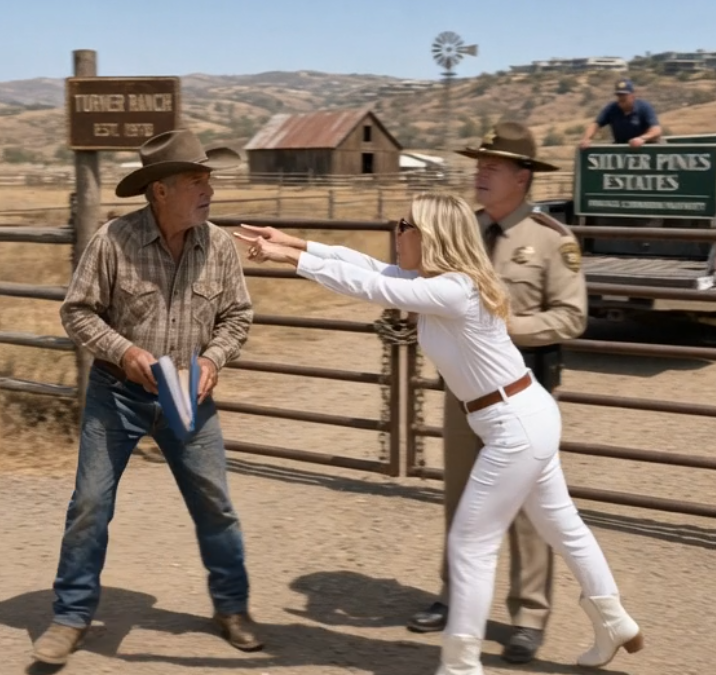
PART2:
I did not grab the cut chain and throw it at her polished white shoes.
I walked to my truck, opened the passenger door, and pulled out the blue folder my father would have wanted me to carry.
Inside was the original ranch deed.
The county plat.
The survey record.
The tax map.
The photos.
The emails.
The screenshots.
The assessment packet.
The altered HOA map.
Everything Patricia thought a man in muddy boots would never be organized enough to keep.
I handed the deed to Sheriff Reeves.
He read it once.
Then he looked at Patricia’s map.
Then he looked back at the deed.
After a long silence, he asked the one question she had not prepared for.
“Mrs. Wells, who removed the property line from this?”
That was when I realized Patricia had not just trespassed on Turner Ranch.
She had sold my land to her neighborhood without owning a single foot of it.
My name is Caleb Turner.
I was fifty-eight years old when Silver Pines Estates decided my family’s ranch belonged to them.
Turner Ranch had been in my family since 1978. My father, Raymond Turner, bought the first piece of it with a bank loan, two patched work shirts, and a stubborn belief that a man could still build something honest if he knew where his boundaries were.
He was not rich.
He did not belong to country clubs.
He did not drive anything newer than ten years old.
PART3:
He wore boots until the soles gave out, kept receipts in coffee cans, and believed a handshake mattered only after the paperwork was right.
When Dad bought land, he made sure every boundary was written, recorded, and clean.
That was how Turner Ranch became ours.
It started as one hundred sixty acres of scrub pasture, limestone, cedar, and stubborn clay. Over the years, Dad added more parcels when neighboring families sold. He bought slowly, never more than he could pay for, never trusting a developer’s promise, never signing anything he had not read under a kitchen light with a ruler, pencil, and cup of black coffee beside him.
By the time he was done, the ranch covered three hundred twenty acres.
It included the gravel access road, the south pasture, the old well, the barn, the equipment shed, the hay field, and a long strip of ridge land along what later became Silver Pines Estates.
That ridge was the piece Patricia wanted.
At first, it did not look valuable.
It was just pasture.
A few oak trees.
A dry creek bed most of the year.
Cedar shadows.
Rocks that tore up mower blades.
Grass that browned before August if the rain forgot us.
But in October, when the sun dropped low, the ridge turned gold. You could see deer moving through the cedars. You could hear the windmill creak behind the barn. If you stood there long enough, the whole world felt quiet in a way that did not ask anything from you.
My father called it the edge of our world.
When I was twelve, he taught me to mend fence there.
When I was seventeen, he let me drive the tractor along that ridge for the first time.
When I came home from the Army not ready to be around too many people, I walked that ridge every morning until my hands stopped shaking.
When my wife Ellen got sick, I drove her up there in the truck with a blanket around her shoulders so she could watch the sun sink behind the cedars.
So, no, it was not just land to me.
It was family.
It was memory.
It was survival.
And it was recorded in my father’s deed.
Silver Pines Estates did not exist when Dad bought that land.
Back then, the property next door belonged to the Harrow family. Old Mr. Harrow ran cattle and complained about rain whether we had too much or not enough. After he died, his kids sold the pasture to a developer out of Dallas. Within two years, the cattle were gone.
In their place came curved roads, stone mailboxes, view houses, fake ponds, private landscaping, and a polished sign at the entrance.
Silver Pines Estates.
Elevated Country Living.
At first, I had no problem with it.
People can buy land.
People can build houses.
That is their right.
But I noticed something about Silver Pines pretty quickly.
They did not really want to live in the country.
They wanted the country to look nice from behind their windows.
They liked sunsets.
They liked horses in the distance.
They liked the words rustic charm in a sales brochure.
But they did not like cattle dust.
They did not like old tractors.
They did not like barbed wire.
They did not like coyotes crying after midnight.
And they did not like seeing a man in muddy boots driving a twenty-year-old pickup past their imported landscaping.
For the first year, most of them were polite.
A few waved.
Some brought their kids to the fence to look at my cows.
One retired teacher, Mrs. Delgado, used to bring apples for my old gelding Jasper. She had kind eyes, thick gray hair, and the good sense to ask permission before stepping through a gate. Jasper liked her better than he liked most people, which said something.
Then Patricia Wells moved in.
Patricia bought the biggest house at the end of Pinecrest Loop.
White brick.
Black shutters.
Four garage doors.
A driveway so clean it looked like no tire had ever touched it.
Her husband, Mark Wells, ran a luxury real estate brokerage that specialized in “estate lifestyle properties,” which seemed to mean houses with large kitchens, outdoor fireplaces, and promotional language about land somebody else had cared for before the subdivision arrived.
Patricia herself did not work in real estate officially, but she had the posture of a person who believed every room had been waiting for her to organize it.
In six months, she was on the HOA board.
Within a year, she was president.
And within a week of becoming president, she sent me my first letter.
It was printed on heavy cream paper.
The Silver Pines logo sat at the top.
The title said Notice of External Visual Impact.
I remember standing in my kitchen, staring at that phrase.
External visual impact.
The letter said my ranch fence was inconsistent with community character. It said my barn was a visible deterioration concern. It said my tractor equipment near the south pasture created negative property value pressure.
At the bottom, Patricia had signed her name in blue ink.
After that, she wrote, We hope you will join us in maintaining the standards of this community.
I laughed when I read it.
Not because it was funny.
Because Turner Ranch was not in her community.
Silver Pines had an HOA.
Turner Ranch did not.
My father had never signed any covenants.
I had never joined any association.
They had no authority over my land.
Not my fence.
Not my barn.
Not my tractor.
Not my cattle.
Not my road.
And not my ridge.
So I wrote back politely.
One page.
I told Patricia that Turner Ranch was private property outside Silver Pines Estates. I included my tax parcel number. I included the county plat reference. I included the boundary description from the recorded deed. I told her future communications about Turner Ranch should be sent to me directly and should not imply HOA jurisdiction where none existed.
I thought that would end it.
It did not.
The second letter did not complain about my fence.
It renamed my pasture.
Patricia called the south ridge a shared environmental corridor.
Then in her next email, she used a different phrase.
Community buffer.
That sounded official.
It was not.
Community buffer was not a county designation.
It was not on my deed.
It was not on the recorded plat.
It was not in any easement.
It was a phrase Patricia’s board had invented and printed until people started believing it.
That was the first time I understood what she was doing.
She was not just complaining about the view.
She was trying to rename my land until people forgot who owned it.
The small trespasses came next.
Silver Pines landscapers mowed a strip along my fence without permission. I stopped them and told them they were on private property. They apologized and left.
A week later, survey flags appeared twenty feet inside my boundary. I pulled them up and kept them in a bucket.
Then came the first sign.
It was small, green, and professionally printed.
Future Silver Pines Nature Walk.
They had installed it on my side of the fence line.
It faced the HOA road like my land was already one of their amenities.
I took a photo.
Then I removed the sign and put it in my barn.
After that, I sent Patricia another email.
I kept it short.
Mrs. Wells, Silver Pines has placed signage on Turner Ranch property without permission. Do not enter or install anything on my land again.
Her reply came forty minutes later.
Mr. Turner, your understanding of the boundary is outdated. The HOA has documentation confirming community access rights.
That sentence told me two things.
First, she was lying.
Second, she had convinced herself the lie was official because she had put it in writing.
My father used to say, “When a fool starts writing things down, let him.”
So I started a file.
I printed every email.
I photographed every sign.
I saved the survey flags.
I installed two more trail cameras facing the south gate and the ridge.
I put a dash camera in my truck.
Every time something happened, I wrote it down.
The date.
The time.
The weather.
The names.
Exactly what was said.
At that point, I still thought Patricia wanted control.
I was wrong.
She wanted a selling point.
I found that out at a Silver Pines HOA meeting.
I did not want to go.
I was not a member.
I did not owe them an explanation.
But Mrs. Delgado called me one evening. Her voice was low, almost embarrassed.
“Caleb,” she said, “I think you need to hear what they’re saying.”
So I went.
The meeting was held in the Silver Pines clubhouse, a stone building with a fake fireplace, polished floors, and framed photos of the development back when it was still empty dirt. The room smelled like lemon cleaner and expensive candles. People sat in rows of padded chairs with bottled water in cup holders, looking up at Patricia Wells as if she had brought them good news.
Patricia stood at the front with a microphone and a slideshow.
The title on the screen said South Buffer Restoration and Community Trail Access.
Then she clicked to the next slide.
It showed an aerial image of Silver Pines and Turner Ranch.
Except my land was not labeled Turner Ranch.
It was shaded green, and the label said Common Buffer Area.
I felt my stomach go cold.
Patricia spoke in the smooth voice people use when they want theft to sound like planning.
“For years,” she said, “an adjacent land occupant has interfered with Silver Pines’ intended community access and emergency corridor. The board has been patient, but the time has come to restore appropriate use.”
Adjacent land occupant.
That was me.
Not owner.
Not neighbor.
Not Mr. Turner.
Occupant.
A man in the second row raised his hand.
“Is that land actually ours?”
Patricia did not blink.
“The board has reviewed development documents,” she said. “We are confident in our position.”
Then she clicked to another slide.
A walking trail.
A horse path.
A scenic overlook.
All drawn across my ridge.
The same ridge where my father taught me to mend fence.
I stood up.
“My name is Caleb Turner,” I said. “That land is deeded property. Silver Pines has no access rights across it.”
Patricia smiled like she had been waiting for me.
“Mr. Turner,” she said, “as you are not a member of this association, you have no standing in this meeting.”
A few people turned to look at me. Some looked embarrassed. Others looked annoyed, like I was delaying the part where their property values went up.
I held up my folder.
“I have the deed and survey record right here.”
Patricia tapped the microphone.
“This is not the proper forum for emotional claims.”
That was when I saw the trick.
She was taking paper and calling it emotion.
She was taking ownership and calling it obstruction.
She was taking a ranch my father paid for and turning it into a community feature on a slideshow.
I could have argued.
I did not.
I looked around the room and said, “Anyone who wants the truth can check the county records.”
Then I left.
The next morning, Patricia sent a formal notice by certified mail.
Final Demand to Cease Obstruction of Community Buffer Access.
It accused me of blocking emergency routes.
That was another lie.
The county road already provided emergency access to Silver Pines. Ambulances did not need my pasture. Fire trucks did not need my ridge. Patricia needed my land for the trail brochure.
The notice also said I was interfering with HOA land use, creating safety risks, and refusing reasonable cooperation.
At the bottom, there was a threat.
If I did not remove my fence and open the south gate within ten days, Silver Pines would pursue all available remedies.
That phrase made me smile.
All available remedies.
People like Patricia love phrases like that. They sound serious without saying anything specific.
I took the letter into town that same day.
The county records office sits in a red brick building beside the courthouse. I had been there before for taxes and livestock permits, but that day I went in the way my father would have wanted me to.
Calm.
Prepared.
Done with guessing.
The clerk behind the counter was Elaine Porter. She had worked there long enough to remember my father. She remembered him coming in with a thermos of coffee and questions written on yellow paper.
When I told her what was happening, she sighed.
“Silver Pines again.”
That one word told me Patricia had not been quiet.
Elaine pulled the parcel index.
“They’ve been asking strange questions about that boundary for months.”
That was the first new piece of information.
Patricia had not misunderstood the boundary.
She had been trying to find a way around it.
Elaine printed everything.
The 1978 deed.
The 1986 supplemental parcel.
The 1991 access road record.
The Harrow sale plat.
The Silver Pines development plat.
The recorded easements.
The tax maps.
The assessor record.
Then she laid them side by side.
There it was, plain as daylight.
The south ridge belonged to Turner Ranch.
The access road belonged to Turner Ranch.
The fence line belonged to Turner Ranch.
The strip Patricia called common buffer belonged to Turner Ranch.
Not one foot had been sold to Silver Pines.
Not one easement crossed that ridge.
The only easement near it was a utility maintenance easement from 1991, and that ran along the county road.
Not through my pasture.
Elaine tapped the deed with her fingernail.
“Your father kept this clean,” she said. “Very clean.”
Then she printed a certified copy and stamped it.
I paid the fee, put everything in the blue folder, and drove home.
On the way back, I passed the entrance to Silver Pines.
Their sign had a new banner under it.
Coming Soon.
Private Nature Trail for Residents.
I pulled over and took a picture.
The deed was clean.
The boundary was clear.
So why was Silver Pines still advertising a trail?
Two days later, I got the answer.
Mrs. Delgado drove up to my gate with a packet in her hand and anger in her eyes.
“Did you know they’re charging us for your ridge?” she asked.
Every Silver Pines homeowner had been billed twelve hundred dollars.
The charge was for South Buffer Trail Preparation and Emergency Access Improvements.
The packet included a map.
That map showed my ridge as HOA-controlled land.
But this map was different from the official county plat.
Someone had removed the parcel boundary line.
Not mislabeled it.
Not shifted it.
Removed it.
I stared at the page for a long moment.
That was when I stopped thinking this was an HOA mistake.
Somebody was making money.
I added the packet to my file.
Then I called a licensed surveyor named Earl Bennett.
Earl had surveyed half the rural property in the county. He was old, blunt, and had no patience for nonsense. He came out two days later with equipment and a thermos of black coffee. We walked the boundary together.
He found the original iron pins.
Some were buried under grass.
Some were near cedar roots.
One had been covered with fresh mulch from Silver Pines landscapers.
Earl uncovered it, looked toward the HOA road, and spat into the dirt.
“Well,” he said, “they’re not mistaken.”
I looked at him.
“They’re ambitious.”
He marked the property line with bright orange flags. He prepared a formal boundary confirmation. He included photographs, coordinates, and a plain-language summary because Earl knew judges were not always surveyors and surveyors were not always good storytellers.
The next morning, three of the flags were gone.
My trail camera caught the person who removed them.
Patricia’s security guard.
His name was Brian Cole.
At 6:12 in the morning, he walked along my fence, pulled the flags, folded them, and put them in his truck.
I saved the footage.
Then I called the sheriff’s office and filed a report for trespass and interference with survey markers.
A deputy took the report.
Nothing much happened yet.
That is how these things often go at first.
Trespass looks small until someone sees the pattern.
Patricia was about to create the pattern herself.
The final straw came on a Saturday morning.
I was in the barn rebuilding a carburetor on an old tractor when my phone buzzed.
Motion alert.
South Gate Camera.
I opened the feed.
Patricia’s white Lexus was stopped outside my gate. Behind it were two HOA trucks, a black security SUV, and a small trailer loaded with metal posts and green signs.
I watched Brian Cole step out with bolt cutters.
He looked around once.
Then he cut my chain.
There is a strange feeling that comes over you when you watch someone violate your land in real time.
It is not anger at first.
It is disbelief.
Not because you did not know people could be that arrogant.
Because some part of you still expects adults to stop before the line.
Brian did not stop.
He opened the gate.
Patricia drove in first.
The others followed.
I set my phone down.
I turned off the tractor.
I walked outside.
By the time I reached the gate, one HOA agent was unloading signs. Another was placing posts along the pasture. Patricia stood in the dust with her clipboard under one arm.
She looked satisfied.
I stopped about fifteen feet from her.
“You need to leave,” I said.
She turned slowly, like I had interrupted an important ceremony.
“Mr. Turner,” she said, “this has gone far enough.”
“You cut my chain.”
“We restored access to HOA property.”
“This is my ranch.”
That was when she said it.
“This isn’t your land anymore.”
The words hung in the morning heat.
I looked at the cut chain on the ground.
The fallen No Trespassing sign.
The green posts.
The private security guard standing there like he was protecting her from me.
Then Patricia pulled out her phone.
“I am calling the sheriff,” she said.
“Please do.”
She narrowed her eyes.
“You are making a mistake.”
“No,” I said. “You already made it.”
She called anyway.
She lied before the call had even settled.
“A man is blocking HOA access,” she told dispatch. “He’s agitated. He may be dangerous. We need an officer.”
Dangerous.
That is one of the words people like Patricia use when they want a working man treated like a threat.
I did not move toward her.
I did not raise my voice.
I stepped back into view of my gate camera, and I waited.
Deputy Mason arrived first.
He was young, maybe early thirties, polite and cautious. Patricia walked toward him before his boots had fully hit the ground.
“Deputy, thank God you’re here,” she said. “This man has been obstructing HOA access for months. We have documentation.”
She handed him a folder.
Not the county record.
Her folder.
The fake map.
The HOA notices.
The special assessment language.
The slideshow printout.
Deputy Mason looked at the papers.
Then he looked at me.
“Sir, can you tell me what’s going on?”
“My name is Caleb Turner,” I said. “This is Turner Ranch. They cut my chain and entered my property without permission.”
Patricia gave a soft laugh.
“That is not accurate.”
I looked at Deputy Mason.
“Before anybody makes a decision, I’d like you to read the deed.”
Patricia rolled her eyes.
“Deputy, this is a civil matter. He keeps waving around outdated family papers.”
That was the first time Deputy Mason looked at her differently.
Outdated family papers.
I walked to my truck.
I opened the passenger door and took out the blue folder. I laid the certified deed on the hood. Then the county plat. Then Earl Bennett’s boundary confirmation. Then the tax parcel record. Then Mrs. Delgado’s assessment packet with the altered HOA map.
Deputy Mason leaned over the documents.
Patricia kept talking.
“Silver Pines has relied on established community planning documents for years. Mr. Turner has refused to cooperate with reasonable access expectations.”
The deputy did not answer her.
He was reading.
A minute later, he called his supervisor.
Patricia’s smile started to fade.
While we waited, one of the HOA agents stopped hammering posts. Brian Cole stepped away from the cut chain. The dust settled. The only sound was the old windmill creaking in the pasture.
Then Sheriff Daniel Reeves arrived.
Sheriff Reeves had been in office for fourteen years. Before that, he had known my father. He was not a man who hurried, but when he got out of his truck that morning, his face was hard.
He looked at me first.
“Caleb.”
“Sheriff.”
Then he looked at Patricia.
“Mrs. Wells.”
She brightened.
She thought real authority had finally arrived on her side.
“Sheriff, I’m glad you’re here,” she said. “We have a very difficult situation with this adjacent occupant.”
The sheriff’s eyes moved to the cut chain.
Then to the fallen sign.
Then to the green posts.
Then to the folder on my hood.
“Adjacent occupant,” he said.
Patricia did not hear the warning in his voice.
“Mr. Turner has been obstructing community access to the south buffer.”
Sheriff Reeves walked to my truck and picked up the deed.
He read it in silence.
Nobody moved.
Then he read the legal description out loud.
“Beginning at the northwest corner of the Harrow tract, running south along the old fence line…”
He paused and looked toward the pasture.
Then he continued.
“Including all access rights, ridge pasture, and improvements west of the marked boundary.”
He set the deed down and picked up the county plat.
Then he picked up Patricia’s map.
He placed them side by side for the first time.
All morning, Patricia had been full of words.
Now she had none.
Sheriff Reeves tapped the official county plat.
“This is the recorded boundary.”
Then he tapped her HOA map.
“This one is missing the parcel line.”
Patricia swallowed.
“That map was prepared by our planning committee.”
“Who removed the parcel line?” he asked.
“I didn’t know that anyone removed—”
“Mrs. Wells,” the sheriff said, “you are standing on private property. These signs are on private property. That cut chain is private property. And unless you have a recorded easement I have not seen, you had no legal right to enter.”
One of the HOA agents whispered, “Oh my God.”
Patricia’s face turned red.
“This is a misunderstanding.”
“No,” I said quietly. “It has a file.”
Everyone looked at me.
I opened the back of the folder.
Then I took out the photos.
The first unauthorized sign.
The survey flags.
The missing markers.
The special assessment packet.
The banner advertising the private nature trail.
The gate-camera still of Brian cutting the chain.
The video of him removing Earl’s flags.
The email where Patricia wrote, Your understanding of the boundary is outdated.
Sheriff Reeves looked through all of it.
The longer he looked, the quieter Patricia became.
Then he asked the question that broke her performance.
“Mrs. Wells, did Silver Pines collect money from residents for improvements on Mr. Turner’s land?”
Her mouth opened.
No sound came out.
By then, Mrs. Delgado had arrived near the road. Two other homeowners were with her. They must have followed the sheriff lights.
One of them looked at Patricia.
“Patricia, is this what the assessment was for?”
Patricia turned sharply.
“This is not the time.”
Sheriff Reeves looked at Deputy Mason.
“Document everything.”
Deputy Mason started photographing the chain, the signs, the posts, the vehicles, and the spot where my No Trespassing sign had been thrown down.
Brian Cole tried to step back toward his SUV.
Sheriff Reeves stopped him.
“Sir. Stay where you are.”
Brian froze.
Patricia found her voice again.
“Sheriff, surely we can resolve this without making it dramatic.”
He looked at her.
“You called us and reported Mr. Turner as a dangerous trespasser on land he owns.”
“That was based on our understanding.”
“You cut his chain.”
“Our security contractor—”
“You entered posted private property.”
“We believed—”
“You installed signs.”
“We were restoring—”
“You collected assessments.”
That one landed hard.
Patricia’s expression changed.
It was not embarrassment.
It was calculation.
She was trying to figure out who to blame.
Sheriff Reeves closed the folder and handed it back to me.
Then he turned to everyone.
“I know Caleb Turner. I knew his father too. But that is not why I am making this call.”
He tapped the certified deed.
“I am making it because this deed and this plat are recorded.”
Then he looked at Patricia.
“All Silver Pines personnel are leaving Turner Ranch now. Mr. Turner has the right to pursue charges for trespass, property damage, and any other claims supported by evidence.”
Patricia stepped forward.
“You cannot deny an HOA emergency access.”
Sheriff Reeves pointed toward the county road.
“Emergency access is there.”
“Not through his pasture.”
“But our development plan—”
“Does not override his deed.”
That sentence changed everything.
Patricia had built her whole performance on the idea that her documents were heavier than mine.
The sheriff did not care how nice her folder looked.
He cared what was recorded.
The HOA agents began loading the posts back onto the trailer.
Brian picked up the cut chain like he could undo what he had done.
The sheriff said, “Brian.”
Brian dropped it.
Patricia walked toward her Lexus, but Sheriff Reeves stopped her before she reached the door.
“Mrs. Wells, you are being formally warned not to enter Turner Ranch again without permission or lawful authority. Do you understand?”
“This is absurd.”
“Do you understand?”
She looked at Deputy Mason’s body camera.
She looked at the neighbors watching from the road.
Then she looked at me.
“Yes,” she said.
For a while, it looked like that was the beginning of the end for her.
Mrs. Delgado called me that evening. Her voice was shaking.
“People are asking questions,” she said. “Patricia told us the trail was already approved.”
“She lied.”
“I know,” Mrs. Delgado said. “But it’s worse. The assessment packet said the HOA had secured access rights.”
I asked her to send me everything.
By evening, I had copies of the packet from five different homeowners. Each one said the same thing.
South Buffer Trail Access Secured.
That phrase mattered.
It was not a promise.
It was a claim.
A false claim tied to money.
On Monday morning, I filed a formal complaint with the county attorney’s office.
I included everything.
The deed.
The maps.
The altered HOA map.
The assessment packet.
The gate footage.
The sheriff report.
The photos.
The emails.
The surveyor statement.
Earl Bennett filed his own statement about the missing boundary flags.
Elaine Porter from county records confirmed that no easement existed.
Mrs. Delgado and several Silver Pines residents submitted their assessment bills.
Within two weeks, Silver Pines was under investigation.
The county was looking at misrepresentation, trespass, property damage, and possible fraud tied to the trail assessment.
Patricia tried to control the story.
Of course she did.
She sent an email to all residents claiming there had been confusion caused by outdated rural documentation.
That email lasted about nine minutes.
Then someone replied to everyone with a screenshot.
It showed Sheriff Reeves standing at my gate holding the deed.
Another homeowner replied, Why were we charged $1,200 for land we don’t own?
Then another.
Who altered the map?
Then another.
Where did the trail money go?
By sunset, the HOA message board was on fire.
Three board members resigned within forty-eight hours.
Not because they suddenly found a conscience.
Because they did not want to be holding the bag when the county started asking questions.
Patricia refused to step down.
She scheduled an emergency HOA meeting.
The title was Clarification of Boundary Concerns.
I went this time.
I did not come alone.
Sheriff Reeves was there at the request of several residents.
So was Earl Bennett.
So was a county investigator named Mara Jenkins.
The clubhouse was packed. People stood along the walls. Some held assessment packets. Some held copies of the altered map. Mrs. Delgado sat in the front row with her arms crossed.
Patricia stood at the microphone.
She looked pale, but still polished.
She began with the kind of apology that is really an accusation.
“Unfortunately,” she said, “certain parties have chosen to inflame what should have been a cooperative planning matter.”
Nobody reacted.
She continued.
“The board acted in good faith based on available documents.”
That was when Earl Bennett stood up.
He held the official county plat in one hand.
He held the HOA version in the other.
“I am a licensed surveyor,” he said. “These two maps are not the same.”
Patricia tried to interrupt.
Earl raised his voice just enough.
“The official map shows Turner Ranch owns the ridge. The HOA version removes that line. Parcel boundaries do not disappear by accident.”
The room went silent.
Then Mara Jenkins walked to the projector.
She did not raise her voice.
She did not need to.
She placed the official county plat on the screen first.
The boundary line was clear.
Turner Ranch owned the ridge.
Then she placed Patricia’s HOA map beside it.
The boundary line was gone.
People started whispering.
Then Mara placed a third document on the screen.
It was a glossy sales packet from Mark Wells Brokerage.
Patricia’s husband.
At the top, in polished print, it said Exclusive Access to Private Ranchland Trail System.
Private ranchland.
Those two words changed the room.
Mrs. Delgado stood up slowly.
“Private ranchland,” she said. “So you knew it was private.”
Patricia gripped the podium.
“That language was aspirational.”
A man in the third row stood.
“I bought my house because your husband’s packet said that trail was guaranteed.”
A woman near the aisle raised her assessment notice.
“You charged us for access you didn’t have.”
Another man said, “My closing packet said the trail was secured.”
Then Mara placed one more page on the projector.
It was an invoice.
South Buffer Trail Preparation.
Paid to a landscaping contractor owned by Patricia’s brother-in-law.
The room erupted.
Patricia tried to speak over them.
“This is being twisted.”
Mara looked at her.
“Mrs. Wells, the county will be requesting all financial records related to the South Buffer assessment, all planning committee communications, and the source file for the altered map.”
Patricia stared at her.
“You can’t just demand HOA records.”
Mara gave a small smile.
“Assessment money was collected based on a potentially false representation of property access. Yes, we can ask.”
Then Sheriff Reeves stood.
He did not make a speech.
He just read from his report.
“On Saturday, May fourteenth, Silver Pines HOA personnel entered posted private property belonging to Caleb Turner. Entry was made after a chain was cut at the south gate. Personnel attempted to install signage identifying Turner Ranch land as Silver Pines community trail property. No recorded easement was produced.”
He looked up.
“Mr. Turner was not trespassing. HOA personnel were.”
Someone in the back said, “Then why did Patricia tell us he was blocking our land?”
No one answered.
Then Mrs. Delgado faced the board.
“I move that Patricia Wells be suspended from all board duties pending the county investigation.”
For a moment, nobody moved.
Then one board member raised his hand.
Then another.
Then the room followed.
Patricia stood behind the podium, still holding the microphone, but nobody was listening to her anymore.
That was the moment she stopped being an HOA president explaining a mistake.
She became the person in the room everyone knew had sold them a lie.
The county investigation took months.
I will not pretend it was fast.
I will not pretend it was easy.
There were interviews.
Records requests.
Attorney letters.
Insurance claims.
Angry residents.
More lies.
More half-truths.
Patricia blamed the planning committee.
The committee blamed her.
The property manager blamed legacy documents.
Mark Wells claimed the trail language in the real estate packets was only aspirational.
That word made me laugh harder than external visual impact.
Aspirational.
Apparently, when rich people advertise what they do not own, it is aspirational.
When working people defend what they do own, it is obstruction.
Still, documents are patient.
They do not get tired.
They do not care how expensive your shoes are.
They just sit there waiting for someone honest to read them.
The altered map was traced back to a file sent from Patricia’s personal email.
The assessment money had been paid to the landscaping contractor owned by her brother-in-law.
The trail-preparation invoice included brush clearing that never happened because the landowner, meaning me, had never allowed access.
Brian Cole admitted he cut the chain under Patricia’s instruction.
Two board members admitted they had never seen a recorded easement.
Mark Wells’ marketing packet had used the phrase that nobody could explain away.
Private ranchland trail system.
Private ranchland.
They knew exactly what it was.
In the end, Patricia resigned before the HOA could remove her permanently. Mark’s brokerage license came under review. Silver Pines had to refund every dollar of the trail assessment, plus interest. The HOA paid for my gate, my survey, my attorney, the damaged signs, and the corrected boundary filing. Their insurance carrier refused to cover intentional trespass and misrepresentation.
Brian Cole lost his security contract.
The altered signs were removed.
The trail was stripped from every brochure, website, and closing packet.
Patricia was barred from serving on the board again.
Every homeowner received a recorded boundary notice that said the same thing in plain language.
Turner Ranch is private land. Silver Pines has no access rights at the entrance to the south ridge.
At the entrance to the south ridge, I installed a new sign.
Nothing fancy.
Just cedar, steel bolts, and letters burned deep enough to last.
Turner Ranch.
Private Land.
No Access.
Boundary Recorded With County.
Some people asked why I did not sue for everything I could get.
The truth is I could have gone harder.
My attorney said the case was strong.
Trespass.
Property damage.
Misrepresentation.
Maybe more.
But after the refunds, the resignations, the public record correction, and the settlement for my damages and legal costs, I had what I needed.
The ridge was safe.
The deed was clear.
Patricia Wells no longer had the power to point at my land and rename it.
That mattered more than dragging the whole neighborhood through years of court.
Because not everyone in Silver Pines was Patricia.
Some of them were decent people who had been lied to.
Mrs. Delgado brought apples for Jasper until the old horse passed.
A young couple named Ben and Rachel came by one Saturday and apologized for believing the trail brochure.
A retired firefighter helped me rebuild the south gate properly.
Even the man who had asked, “Is that land actually ours?” came over with a post-hole digger.
He looked embarrassed.
Then he said, “I should have pushed harder.”
That was around the time I started thinking about Ellen again.
My wife loved that ridge.
After she got sick, I used to drive her there in the truck. She would sit with a blanket around her shoulders, the window rolled down, and talk about the old barn.
She wanted to turn it into a workshop for veterans.
Not charity.
That was her phrase.
Not charity.
She told me a place with men who forgot they were useful could help them remember.
So I did what Ellen would have wanted.
I used part of the settlement money to clean out the old barn. Then I put in workbenches. A lift. Tool racks. A welding table. A compressor. Shelves full of parts. A coffee pot that was never clean but always full.
Months after Patricia told me I did not own my land, Turner Ranch opened its first Saturday workshop for veterans.
No cameras.
No press.
No speeches.
Just eight men, two women, three broken lawn tractors, an old Ford engine, and a place where nobody had to explain why they needed quiet.
Mrs. Delgado baked cinnamon rolls.
Ben and Rachel donated safety glasses.
The retired firefighter taught basic first aid.
I hung Ellen’s photo by the office door.
Under it, I put a small brass plate.
A Place to Remember You Are Useful.
The first project we finished was my father’s old tractor.
The same one I had been fixing the morning Patricia cut my chain.
When the engine finally turned over, every person in that barn cheered like we had won a championship.
Maybe we had.
That should have been the ending.
Patricia humiliated.
The land protected.
The ridge saved.
The veterans’ workshop alive.
Silver Pines forced to admit the truth.
The sheriff reading the deed.
The county map beating the fake one.
Clean.
Complete.
Satisfying.
But Patricia Wells was not finished.
A woman like her does not stop wanting control just because one room finally sees her clearly.
She only learns where the first plan failed.
At first, she stayed quiet.
Too quiet.
For almost a year, she did not attend public HOA meetings. She did not post in neighborhood groups. She did not send me a letter. She did not drive past the south gate when she knew I was outside.
Then Mrs. Delgado came to my house with a flyer in her hand and anger in her eyes.
At the top was a picture of the south ridge in golden October light.
My ridge.
Under it were the words Preserve the Ridge. Protect the Community.
I read it once.
Then again.
Patricia’s name was at the bottom.
Founder and Chair, Silver Pines Emergency and Conservation Coalition.
Mrs. Delgado said, “She can’t do this again.”
“She can,” I said. “Not the same way.”
“What does that mean?”
“It means this time she won’t claim she owns it.”
She didn’t.
That was what made the second fight harder.
Patricia had learned the lesson.
Not the moral one.
The practical one.
She stopped calling Turner Ranch HOA land. She stopped saying the board had access rights. She stopped printing maps with the boundary removed.
Instead, she started talking about fire safety, conservation, wildlife corridors, environmental preservation, emergency evacuation, and responsible regional planning.
The ridge, she said at a county meeting, was too important to be controlled by one private landowner.
That sentence got applause.
Not from everyone.
But enough.
I was sitting in the back row of the county planning room when she said it. I had the deed in my folder. The same deed Sheriff Reeves read at the gate.
This time, it did not help in the same way.
Because Patricia was not saying I did not own the ridge.
She was saying my ownership was the problem.
She spoke gently.
Calmly.
Humbly.
She admitted “past mistakes in process.” She said the prior dispute had taught everyone a painful lesson about transparency. She said Silver Pines had learned to respect recorded boundaries.
Then she pivoted.
“But respect for ownership does not eliminate public need.”
That was the sentence that made my attorney close her pen and look at me.
Patricia continued.
“The south ridge is a natural firebreak. It is a wildlife corridor. It is the most direct emergency pedestrian route between Silver Pines and county land. It is a scenic asset. It is an ecological asset. And we should preserve it legally, transparently, and permanently.”
Legally.
Transparently.
Permanently.
Every word chosen to erase the memory of the bolt cutters.
She had lost the first war because she tried to take the ridge through fake HOA authority.
Now she wanted the county to help her take it honestly.
Not the whole ranch.
Not the barn.
Not the house.
Just the ridge.
A conservation easement.
A trail corridor.
Emergency access.
Limited public use.
No motor vehicles.
No HOA ownership.
County-managed.
That was what the proposal said.
It looked reasonable on paper.
That was the worst part.
There was a wildfire report.
A drainage study.
A wildlife map.
A letter from three Silver Pines residents who said evacuation options were limited.
A letter from a nature group Patricia had suddenly learned to fundraise with.
A petition with six hundred signatures, most from people who had never set foot on Turner Ranch.
They wanted my ridge preserved.
They wanted it protected.
They wanted a trail where Patricia’s fake trail had failed.
They wanted the same land for better words.
I fought it.
Hard.
I brought the deed.
The sheriff’s report.
The altered map.
The assessment records.
The invoice.
The emails.
The photographs.
The gate footage.
The report showing Patricia’s map had removed the parcel line.
I reminded the county what had happened when this same woman claimed community access before. I told them the ridge was not abandoned land. It was working ranch property. It had cattle gates, water lines, a repair path, a dry creek crossing, old fence lines, and memories that no map could measure.
I told them my wife’s veteran workshop used the ridge for quiet walks because some men needed open sky more than fluorescent rooms.
I told them a public trail would bring dogs, bikes, trash, liability, conflict, noise, and constant pressure.
I told them this was Patricia’s old scheme wearing county clothes.
They listened.
They nodded.
They thanked me.
Then they asked the fire marshal about emergency access.
He said an additional evacuation route could improve safety.
Improve.
That word again.
Not require.
Not necessary.
Improve.
Government loves that word.
It allows almost anything to become reasonable.
The conservation director said a corridor could protect habitat.
A transportation planner said a trail link would reduce roadside pedestrian hazards.
The county attorney said a properly compensated conservation and access easement could be lawful if approved through due process.
Due process.
Another clean phrase.
Another way to make the same ridge less mine than it had been before.
For five months, the hearings continued.
Patricia attended every one.
She never raised her voice.
She never insulted my boots.
She never called me an adjacent occupant again.
She brought widows, parents, firefighters, birdwatchers, and children holding handmade signs.
Save the Ridge.
Protect Our Homes.
Preserve Open Space.
I brought records.
She brought emotion.
And for a while, I thought emotion was going to win.
Then my attorney, Grace Hollis, asked me a question that changed everything.
“Caleb,” she said, “did Ellen ever put her veterans’ workshop idea in writing?”
We were sitting at my kitchen table surrounded by binders. I had barely slept. My coffee was cold. My hands hurt from opening old folders.
“Yes,” I said. “She had notebooks.”
“Where are they?”
“In the cedar chest.”
Grace looked toward the hallway.
“Get them.”
I opened the cedar chest in my bedroom for the first time in months. Ellen’s notebooks were wrapped in an old quilt. She had written in blue ink, always neat, even when the cancer made her hand tired.
The first notebook was full of ideas.
Workshop layout.
Tool inventory.
Volunteer schedule.
Partner organizations.
Safety forms.
The second notebook held sketches of the barn.
The third held names of veterans from the county she wanted to invite.
The fourth had a page folded in half.
At the top, Ellen had written:
Turner Ranch Quiet Use and Veterans Recovery Covenant.
My breath caught.
I carried the notebook back to the kitchen.
Grace read the page slowly.
Then she looked up.
“Did she file anything?”
“I don’t know.”
“Did your father ever agree to anything with her?”
“My father was already gone.”
“Did you?”
I stared at the page.
Then I remembered.
One winter afternoon, when Ellen was still strong enough to argue with me about practical things, she had made me drive her to Elaine Porter’s office. She wanted to record “the intention,” she said. I thought it was symbolic. A promise to ourselves. A document nobody would ever care about.
I remembered signing something.
I remembered Ellen smiling through tears when Elaine stamped it.
I had forgotten because grief makes some memories too heavy to hold.
Grace was already reaching for her phone.
“Call Elaine.”
Elaine Porter found it in twenty minutes.
Recorded eleven years earlier.
A private conservation and therapeutic-use covenant across the south ridge and barn approach, executed by Caleb Turner and Ellen Turner, restricting public recreational access, commercial trail use, and third-party pedestrian easements without unanimous consent of the owner and the named beneficiary trust.
The named beneficiary trust was the Turner Veterans Workshop Trust.
It had never been funded while Ellen was alive.
But it had been recorded.
And after I opened the workshop, my attorney had formalized the trust without realizing the old covenant existed.
Grace read the covenant twice.
Then she smiled for the first time in weeks.
“Patricia picked the wrong ridge,” she said.
At the final county hearing, Patricia came prepared to win.
She wore a green jacket instead of white. No sunglasses. No clipboard. Her hair was softer. Her voice was warmer. She had learned to look less like a woman taking something and more like a woman asking for something noble.
The room was packed.
Silver Pines residents.
Reporters.
County staff.
Veterans from my workshop.
Mrs. Delgado.
Sheriff Reeves.
Elaine Porter.
Earl Bennett.
Patricia spoke first.
“This project is not about ownership,” she said. “It is about stewardship. It is about safety. It is about ensuring land serves more than one person’s private preference.”
Private preference.
That was what she called the place where my wife used to watch sunsets while trying not to let me see her pain.
When it was my turn, I walked to the podium with the blue folder.
I set it down.
Then I set Ellen’s notebook beside it.
“I have spent months proving the ridge is mine,” I said. “But today I need to prove something else.”
The room quieted.
“This land was never empty.”
I opened the notebook.
“My wife Ellen loved that ridge. Before she died, she planned a veterans’ workshop on Turner Ranch. Not charity. Those were her words. Not charity. A place where men and women who forgot they were useful could remember.”
Behind me, one of the veterans cleared his throat.
I kept reading.
“She knew the ridge mattered because quiet matters. Privacy matters. A place where people can walk without being watched matters.”
Patricia looked uneasy now.
She did not know where I was going.
I pulled out the recorded covenant.
“Eleven years ago, Ellen and I recorded a covenant protecting the south ridge for private conservation and therapeutic ranch use connected to what is now the Turner Veterans Workshop Trust.”
Grace stepped forward and handed copies to the county attorney, planning chair, and clerk.
“This covenant predates Patricia Wells’ trail proposal. It predates the fake assessment. It predates the altered map. It predates every attempt Silver Pines made to turn my ridge into an amenity.”
The county attorney began reading.
His face changed.
Patricia stood.
“This is last-minute obstruction.”
Sheriff Reeves, sitting near the aisle, turned his head slowly toward her.
She sat down.
The county attorney whispered with the planning chair.
Grace spoke next.
“The proposed county easement conflicts with a previously recorded private covenant established for conservation and therapeutic use. The county may not simply ignore a recorded restriction because a later coalition prefers a different use. At minimum, this requires a separate legal proceeding, beneficiary trust review, environmental compatibility analysis, and compensation analysis beyond what has been noticed.”
A commissioner asked, “Who is the beneficiary?”
Grace looked toward the back row.
“The Turner Veterans Workshop Trust.”
Eight veterans stood.
Not because anyone told them to.
Because they understood what was being weighed.
One of them was named Marcus Hill. He had been coming to the workshop for six months. He barely spoke most Saturdays. He fixed small engines with headphones on and left before lunch. That day, he stepped to the microphone.
“My wife says I sleep better on Saturdays,” he said.
The room went still.
“I don’t know anything about easements. I know Mr. Turner lets me walk that ridge when my head gets loud. I know I can stand there and not talk and nobody asks me what’s wrong. I know there aren’t many places like that left.”
He looked at Patricia.
“I’m not against trails. I’m against pretending every quiet place has to belong to everyone before it matters.”
Then he sat down.
No one applauded.
It would have felt wrong.
Mrs. Delgado spoke after him.
“I live in Silver Pines,” she said. “I signed the first petition before I knew the history. Then I learned. Then I watched Patricia bring us back to the same ridge with better words. We were lied to once. We should not let embarrassment make us participate in another taking.”
The fire marshal spoke again.
This time, under questioning from Grace, he admitted the ridge route was beneficial but not required. Existing emergency routes met code. Improvements were possible through Silver Pines’ own land. The “need” Patricia had built her campaign around became something smaller under oath.
Useful.
Not necessary.
Preferred.
Not required.
The county attorney requested a recess.
Twenty-seven minutes later, the board returned.
The planning chair adjusted his glasses.
“The county will not proceed with the proposed public trail easement across Turner Ranch at this time. The recorded covenant, trust interest, lack of demonstrated necessity, and unresolved concerns regarding the origin of this proposal require withdrawal of the application.”
Patricia stood.
“You are letting one man block public safety.”
The chair looked tired.
“No, Mrs. Wells. We are declining to cure a private development dispute by burdening land already restricted for another recorded purpose.”
He paused.
“And given the prior history involving altered maps and false access claims, this board is referring the application record to the county attorney for review of whether any materially misleading statements were submitted.”
Patricia’s face went white.
Not pale.
White.
For the second time, she had walked into a room expecting to rename my land.
For the second time, the record answered before I had to.
The aftermath was different this time.
There were no flatbed trailers.
No cut chains.
No sheriff lights at my gate.
But the consequences cut deeper.
Patricia’s coalition collapsed within a week. Donors asked for refunds. The nature group distanced itself from her. Silver Pines residents who had backed her publicly began deleting posts and issuing careful apologies about incomplete information.
Then the county attorney found something in the application file.
The wildfire map Patricia’s coalition had submitted had been edited.
Not as obviously as the HOA map.
Not with a missing boundary line.
This time, the edited map exaggerated the dead-end evacuation concern by omitting an existing secondary outlet road within Silver Pines. That road was private, gated, and unpopular with residents because opening it would require widening, grading, and removing a decorative stone wall near three expensive homes.
One of those homes belonged to Patricia.
The ridge was not the only option.
It was the option that cost her nothing.
That discovery ended what remained of her credibility.
Mark Wells’ brokerage review reopened. The brother-in-law’s landscaping contract became part of a civil complaint. Silver Pines sued Patricia for the second round of legal expenses connected to her unauthorized advocacy using old HOA materials. The county barred her coalition from submitting future land-use applications without certified source documentation.
This time, Patricia did not resign from anything.
There was nothing left to resign from.
She sold the white brick house at the end of Pinecrest Loop the following spring.
The listing did not mention ranchland trails.
It did not mention common buffers.
It did not mention elevated country living.
It said: Quiet cul-de-sac home with hillside views.
That was close enough to the truth to be new for her.
The day the moving truck came, I was at the barn with Marcus and two other veterans rebuilding a mower engine. Mrs. Delgado drove up with a paper bag of apples even though Jasper was gone by then.
“For the cows,” she said.
“They don’t need apples.”
“Neither did Jasper.”
She stood beside me at the fence, watching the moving truck disappear down the Silver Pines road.
“She really thought she could take it,” Mrs. Delgado said.
“Yes.”
“Twice.”
“Yes.”
She looked at the ridge.
“What stops the next one?”
I thought about my father.
His deed.
His coffee cans.
His fences.
I thought about Ellen.
Her notebook.
Her covenant.
Her quiet stubborn love.
Then I said, “Paperwork, witnesses, and people who stop being polite when someone starts lying.”
Mrs. Delgado smiled.
“That sounds like something your father would have said.”
“No,” I said. “Dad would have used fewer words.”
The ranch grew quiet again after that.
Not empty quiet.
Protected quiet.
The kind my father earned.
The kind Ellen loved.
The kind no HOA board can manufacture in a brochure.
The Turner Veterans Workshop grew slowly. No signs at the highway. No press. No ribbon cutting. Just people arriving on Saturdays with old machines, bad backs, heavy memories, and hands that needed something real to do.
We rebuilt lawn tractors, fence gates, a hay rake, three carburetors, two porch swings, and a 1972 Ford pickup that made everyone in the barn cheer when it finally started.
Sometimes, after work, the veterans walked the ridge.
Not as tourists.
Not as residents claiming access.
As guests.
Invited.
That word matters.
One evening in October, Marcus and I stood on the south ridge after everyone else had gone. The grass was gold. The cedars were black against the sunset. The old windmill turned slowly behind the barn.
Marcus looked out over Silver Pines.
“Hard to believe somebody wanted to turn this into a neighborhood trail.”
“They still might,” I said. “Someday. Different name. Different reason.”
“You worried?”
“I’m ready.”
He nodded.
Then he said, “Your wife knew what she was doing.”
I looked at Ellen’s ridge.
“Yes,” I said. “She did.”
The new south gate still stands.
Stronger chain.
Better lock.
Two cameras.
A cedar sign with burned letters.
Turner Ranch.
Private Land.
No Access.
Boundary Recorded With County.
And underneath, on a smaller brass plate, I added one more line.
Quiet Is Also Worth Protecting.
People slow down to read it sometimes.
Most drive on.
A few wave.
Silver Pines changed too. Not all at once. Places heal slowly after being lied to. Mrs. Delgado joined the board and made them adopt a rule requiring county-record verification before any HOA packet could describe land, access, easements, trails, buffers, or shared facilities. Every map had to include parcel boundaries. Every assessment had to cite the document authorizing it. Every homeowner could request the source file.
A boring rule.
The best kind.
Boring rules are what keep dramatic people from becoming expensive.
Sheriff Reeves came by one Saturday about a year after Patricia moved away. He brought the cut chain with him. Evidence had finally been released.
“You want this back?” he asked.
I held it for a moment.
The cut was clean.
Ugly, but clean.
I thought about throwing it away.
Instead, I hung it in the barn beside Ellen’s photo and my father’s old fence pliers.
Not as a trophy.
As a reminder.
A deed is only as strong as the person willing to stand behind it.
A fence is only as respected as the community willing to honor it.
And a lie, if polished enough, can look like a plan until someone asks who removed the line.
Patricia Wells stood inside my gate and told me, “This isn’t your land anymore.”
She was wrong.
The deed proved it.
The sheriff proved it.
The county map proved it.
My father’s recordkeeping proved it.
And, in the end, Ellen’s forgotten covenant protected what even the deed alone could not.
The ranch is still mine.
The ridge is still in the deed.
The boundary pins are still under the grass.
The windmill still creaks behind the barn.
The old road still catches dust in summer.
The sunset still turns the south ridge gold every October.
And when strangers slow down near the Silver Pines fence, looking for a trail that never opened, they find only a locked gate, a cedar sign, and a piece of truth burned deep into wood.
Private land does not become public because someone wealthy puts it in a brochure.
A map does not become legal because the ink is glossy.
An HOA does not become an owner because its president says community three times into a microphone.
And a rancher in muddy boots is not defenseless just because he chooses to stay calm.
Patricia wanted my ridge as a selling point.
She wanted my father’s land to become her amenity, her campaign, her plaque, her proof that enough confidence could turn theft into leadership.
Instead, she got her name in county records for altered maps, false assessments, trespass, and two failed attempts to take what was never hers.
My father once told me land stays yours because you record it, mark it, pay taxes on it, and remember where the line is when someone else decides to forget.
He was right.
But Ellen taught me the part he left out.
Sometimes you also have to record what the land is for.
Not just who owns it.
Because some people will lose at the gate, lose in the clubhouse, lose on the county map, and still come back with better words.
That is why I keep the blue folder in my truck.
That is why the deed stays copied, certified, and close.
That is why the chain hangs in the barn.
And that is why every Saturday, when the veterans gather under that old roof with coffee, grease, tools, and quiet, I look toward the south ridge and remember the morning Patricia Wells tried to sell my land out from under me.
She thought the ranch was just dirt.
She thought the deed was just paper.
She thought the man standing at the gate was just an obstacle.
Then Sheriff Reeves read my father’s deed out loud.
And for the first time since she moved into Silver Pines, Patricia Wells had to stand on somebody else’s land and listen to the truth.

