HOA Karen Sent Her Nephew to Seize My Ranch Road—He Zip-Tied Eight Workers and Cut One Fiber Cable. Seconds Later, the Regional 911 Network Went Dark… He Had No Idea Who I Really Was.
PART3:
Then Victoria Halstead became association president.
Victoria was fifty-four.
Former commercial real-estate attorney.
Polished.
Controlled.
The kind of woman who never raised her voice until she believed everyone had run out of options.
Her husband made money in private equity.
Her brother, Adrian Vale, made money developing land.
A lot of it.
Their family treated real estate the way some people treat chessboards.
Every parcel had a future use.
Every holdout was a problem.
And every problem, in their experience, had a price.
Fourteen months before the cable was cut, Adrian Vale bought 1,100 acres behind the western ridge bordering my ranch.
The project was called Vale Summit.
Five hundred luxury homes.
Retail center.
Private athletic complex.
Two hotels.
All illustrated in renderings featuring suspiciously attractive people drinking wine beside fountains.
The development had one serious problem.
Access.
The ridge separated the property from the main county highway.
Building a road around it would require nearly nine additional miles, two creek crossings, and a permit process involving protected woodland.
Building through it would require blasting.
Very expensive.
But a natural corridor already existed.
My ranch.
Specifically, a mile-and-a-half stretch running from the highway on my eastern boundary straight through a low gap in the ridge.
Adrian came to see me personally.
He arrived in a black Range Rover.
Not alone.
Two attorneys.
One project manager.
He wore expensive boots that had never met mud.
I met them outside the equipment barn.
Adrian looked past me toward the valley.
“Beautiful piece of ground.”
“It is.”
“You’ve had it a while?”
“Nineteen years.”
He smiled.
“Then you’ve done well.”
That was how men like Adrian talked about property.
As if owning land long enough to watch trees mature meant you had simply held an investment until somebody richer arrived.
He unfolded a site plan across the hood of his Range Rover.
“We need a transportation corridor here.”
“I know.”
He tapped a line running through my east pasture.
“Eighty-foot right-of-way.”
“No.”
His attorney cleared her throat.
“We haven’t discussed compensation.”
“Doesn’t matter.”
Adrian smiled again.
“Everything has a number.”
“Not everything.”
“You’re telling me you wouldn’t sell that strip for five million dollars?”
“Yes.”
“Six?”
“No.”
“Ten?”
Luis, standing twenty feet away, looked at me.
Even he raised an eyebrow at ten.
I said, “No.”
Adrian studied me.
“Why?”
“Because it divides the ranch.”
“We’d install cattle crossings.”
“No.”
“Noise barriers.”
“No.”
“Drainage.”
“No.”
He folded his arms.
“You haven’t even heard the engineering package.”
“I’ve heard enough.”
The corridor would cut through pasture, a creek restoration area, and a grove Claire and I planted after our daughter was born.
Claire had died six years earlier from ovarian cancer.
The ranch was not a memorial.
I hated people using grief to turn land into sacred mythology.
But some places are more than their market value.
I did not owe Adrian an essay explaining that.
He looked toward the western ridge.
“You realize development is coming whether you participate or not.”
“I realize your development is not my problem.”
One attorney shifted.
Adrian’s smile disappeared.
“You’re making an emotional decision.”
“No.”
I rolled up the plan.
“I’m making a property decision.”
He took the papers from me.
“We’ll revisit.”
“No, we won’t.”
He did.
Six times.
Higher offers.
Different terms.
One proposal involved a ninety-nine-year easement.
Another offered me equity in the development.
A third tried to disguise the access road as an “emergency and agricultural service corridor.”
I refused them all.
Then Victoria Halstead became interested.
At first, she approached politely.
She invited me to the Ashford Crest clubhouse.
I went because I believed refusing a conversation often costs more than hearing one.
Twenty-three residents sat in a room designed to look like a resort lobby.
Victoria stood at the front beside a digital map.
“Daniel, thank you for coming.”
I nodded.
She addressed the room.
“As many of you know, Ashford Crest is experiencing increasing congestion at our eastern entrance.”
It wasn’t.
I had checked county traffic counts.
But nobody else in that room had.
Victoria continued.
“The planned Vale Summit development creates an opportunity for a secondary emergency egress route benefiting both communities.”
There it was.
Emergency.
People become more willing to take your property if you attach an ambulance to the argument.
She highlighted my ranch lane.
“This existing road could provide fire and evacuation access.”
I raised my hand.
Victoria smiled tightly.
“Yes?”
“That road is private.”
“We understand.”
“No easement exists.”
“We’re evaluating historical access rights.”
“There aren’t any.”
One board member, a retired accountant named Meredith Cho, looked uncomfortable.
Victoria said, “Our counsel has identified evidence that the lane may have served as a public utility and agricultural corridor before current parcel boundaries were finalized.”
“No.”
“Daniel—”
“My title survey goes back to 1938.”
A murmur.
“I had it re-certified when I bought the property. No public access. No HOA access. No emergency roadway easement.”
Victoria looked at me for two seconds too long.
Then smiled.
“That’s your interpretation.”
“No. That’s a recorded survey.”
A few residents laughed.
Victoria did not.
After the meeting, she approached me near the door.
“You embarrassed me.”
“I corrected a map.”
“You knew what you were doing.”
“Yes.”
That answer surprised her.
I continued.
“You presented residents with a legal conclusion you knew was disputed.”
“I presented possibilities.”
“You labeled the road proposed emergency egress.”
“It could become one.”
“If I agree.”
She looked directly at me.
“Or if access already exists.”
There it was.
The first warning.
I said, “Be careful.”
Her eyebrows lifted.
“Is that a threat?”
“No.”
I took my coat.
“Professional courtesy.”
That became the phrase she later quoted out of context.
Professional courtesy.
She told people a federal officer had threatened her.
Never mentioned what came before.
Within a month, Ashford Crest’s HOA attorney sent me a notice asserting “historic community access” across my ranch.
My attorney, Rachel Kim, responded with seventy-three pages of survey documents, deeds, county maps, and affidavits.
The HOA withdrew nothing.
Instead, it fined me.
That was almost funny.
An HOA where I did not live attempted to assess me $500 a day for “obstructing shared emergency infrastructure.”
Rachel called me.
“Do you want the professional response or the one I’m thinking?”
“Professional.”
“Shame.”
We sent a demand letter.
They ignored it.
Then orange survey stakes appeared inside my fence.
Luis found them at dawn.
“Nobody here put these.”
I walked the line.
They traced the exact proposed road.
I checked cameras.
Two men in reflective vests entered overnight from Ashford Crest.
No permission.
No county vehicle.
Private surveying firm.
We filed trespass reports.
The sheriff’s department took them.
Nothing happened.
That bothered me.
Not because I expected arrests.
Trespass disputes involving surveyors often end in paperwork.
But the deputy who responded, Greg Malloy, seemed unusually interested in explaining Victoria’s position.
“She says there’s an old access agreement.”
“There isn’t.”
“I’m just telling you what she says.”
“Did she show it?”
“Her attorney has something.”
“Something isn’t an easement.”
Greg sighed.
“This is probably civil.”
“The surveyors climbed a locked fence.”
“Still probably civil.”
I looked at him.
“Who does your brother work for?”
His face changed.
Most people would not have known.
I did.
Greg’s brother owned an excavation company.
Vale Development had recently awarded it a seven-figure contract.
Greg said, “That’s irrelevant.”
“Maybe.”
I smiled.
“But you see why I’m asking.”
He left angry.
Two days later, the sheriff reassigned the matter.
Small victory.
Then things escalated.
We found drone flights over the ranch.
Anonymous complaints to environmental regulators.
A claim that our cattle were contaminating a creek.
False.
A code complaint about a barn that had been permitted in 2009.
A fire-safety complaint.
A labor complaint.
An accusation that seasonal workers were living illegally on-site.
They weren’t.
Each agency came.
Each inspected.
Each left.
Victoria understood bureaucracy.
She knew harassment didn’t need to win.
It only needed to consume time.
I continued working.
Luis handled the ranch.
Rachel handled civil filings.
I refused to perform anger for Victoria.
That bothered her more than shouting would have.
Then she sent her nephew.
Camden Halstead was thirty-one.
Former private security contractor.
At least that’s how he described himself.
His actual record was less impressive.
Two years as a corrections officer.
Resigned after an internal complaint.
Worked event security.
Then founded Redline Community Compliance Services.
The name should have been warning enough.
Redline contracted with HOAs to handle parking enforcement, covenant inspections, private patrol, towing coordination, and “access compliance.”
Whatever that meant.
Their uniforms resembled police uniforms from fifty yards away.
Dark gray.
Shoulder patches.
Badges that said COMPLIANCE.
Vehicles with amber light bars.
No law-enforcement authority.
No arrest power.
No right to enter my ranch.
Camden treated those distinctions as technicalities.
The first time I met him, he parked across my gate.
I was on horseback.
He stepped out.
Sunglasses.
Body camera.
Utility belt.
No firearm visible.
“Mr. Mercer?”
“Yes.”
“I need to serve you.”
“Mail it.”
He held out a document.
“Notice of access enforcement.”
“That’s not a thing.”
His jaw tightened.
“Your obstruction of a recognized emergency easement violates state property law.”
“No recognized easement exists.”
“We have counsel.”
“So do I.”
“I’ve been authorized to mark the corridor.”
“By who?”
“Ashford Crest.”
“They don’t own it.”
He smiled.
“We’ll see.”
I looked at the two Redline employees behind him.
“Listen carefully.”
Camden’s smile remained.
“You’re intimidating my staff.”
“No.”
I pointed toward the gate.
“You are not permitted beyond that fence. Neither are they. Any entry is trespass. Any touching of ranch employees is assault. Any interference with utilities is potentially criminal.”
He removed his sunglasses.
“You throw the federal badge around with everybody?”
“I haven’t shown you a badge.”
That shut him up.
I continued.
“I’m speaking as the property owner.”
He looked toward my cameras.
“You record audio?”
“Yes.”
Another pause.
Then he left.
From that day forward, Camden hated me personally.
That is dangerous in mediocre men with borrowed authority.
The cable existed because of geography.
Years before Ashford Crest, the state built a regional emergency communications loop connecting four counties.
Most people think 911 exists as one simple phone line.
It doesn’t.
Modern emergency communications depend on layered networks.
Fiber.
Microwave.
Cellular routes.
Redundant switching.
Backup data links.
Computer-aided dispatch.
Radio backhaul.
Interoperability systems.
One of the redundant fiber routes crossed my ranch underground.
It did not belong to me.
It was protected by a recorded utility easement granted by the ranch’s previous owner in 1998.
Different from road access.
Completely separate.
The line entered a secure cabinet near my eastern service lane, then continued under pasture toward a state communications tower west of the ridge.
Over time, additional services were added.
Regional 911 redundancy.
Sheriff radio backhaul.
Fire dispatch.
Emergency management.
Certain protected government circuits that I was not free to discuss publicly.
The cabinet looked boring.
That was intentional.
No giant sign saying CUT THIS AND FOUR COUNTIES HAVE A TERRIBLE MORNING.
It had security markings.
Utility identification.
Warning labels.
Locked access.
Anyone authorized to work around infrastructure knew what it was.
Camden did not.
Or didn’t care.
Three weeks before the incident, Ashford Crest’s attorney produced what they claimed was an “emergency corridor map” from 2003.
The map showed a dashed line crossing my ranch.
Rachel looked at it for thirty seconds.
“Fake.”
“Strong word.”
“Correct word.”
The county seal used on the corner did not exist in 2003.
It was redesigned in 2011.
Font wrong.
Parcel number format wrong.
And the map showed a barn built six years after the alleged date.
Somebody had created it recently.
That changed the situation.
A bad easement claim is civil.
Fabricated government records can be criminal.
Rachel notified the county attorney.
I notified nobody at work.
Not initially.
My job and my land remained separate unless there was a legal federal nexus.
Then a copy of the forged map appeared in a filing submitted to a federal infrastructure office because the proposed road crossed the protected communications easement.
That created the nexus.
An inspector general contact became involved.
Then the FBI public corruption squad took interest after learning one county planning employee may have accessed restricted mapping systems without authorization.
I gave them everything.
And then I stepped back.
That was important.
I wasn’t investigating my own dispute.
I was a witness.
Property owner.
Potential victim.
Not case agent.
Federal law enforcement teaches another habit.
Know when your authority ends.
Victoria did not share that philosophy.
On Monday evening, one day before the cable cut, Meredith Cho called me.
I barely knew her.
She had been the uncomfortable board member at the clubhouse meeting.
“Daniel?”
“Yes.”
“I need to tell you something.”
Her voice shook.
“Can you talk?”
“I can.”
“Not on the phone.”
We met at a grocery-store coffee shop twenty miles away.
Meredith arrived carrying a laptop bag.
She kept looking behind her.
I said, “If you think you’re in danger, we call somebody now.”
“No.”
She swallowed.
“I think I’m in trouble. Different thing.”
“Tell me.”
She opened her laptop.
Ashford Crest board emails.
Dozens.
Some ordinary.
Pool budgets.
Landscaping.
Gate repairs.
Then messages between Victoria and Adrian.
Adrian:
WE NEED CONTROL OF MERCER CORRIDOR BEFORE COUNTY ACCESS REVIEW.
Victoria:
HE WON’T AGREE.
Adrian:
AGREEMENT IS NO LONGER THE PLAN.
Another.
Victoria:
CAMDEN CAN CREATE A TEMPORARY SAFETY CLOSURE. ONCE OUR CREW IS INSIDE, WE MARK AND GRADE ENOUGH TO ESTABLISH USE.
I read that twice.
Establish use.
A deliberate attempt to manufacture facts on the ground.
Meredith whispered, “There’s more.”
Camden:
WHAT ABOUT CAMERAS?
Victoria:
DISCONNECT LOCAL COMMS AT UTILITY BOX. HE RUNS SECURITY THROUGH THE RANCH NETWORK.
He didn’t.
But that explained the cable.
Adrian:
TEN MINUTES IS ALL WE NEED. ONCE THE EAST GATE IS OPEN AND EQUIPMENT IS THROUGH, GET DRONE FOOTAGE OF ACTIVE CORRIDOR.
I felt something inside me go cold.
This was no longer aggressive HOA behavior.
This was conspiracy.
Unlawful entry.
Potential destruction of infrastructure.
Possible false evidence creation.
“What happens tomorrow?” I asked.
Meredith whispered, “Eight a.m.”
I called the FBI case agent from the parking lot.
Special Agent Leah Morrison answered.
I sent the emails through proper channels.
By midnight, warrants were being drafted.
But prosecutors wanted more.
Intent was there.
The operation had not occurred yet.
They could intervene early.
Prevent harm.
That was the obvious move.
Then came the complication.
The emergency fiber.
The state network operator had already been notified about possible tampering.
They remotely monitored the cabinet.
A technician confirmed cutting even one line could cause a failover event.
“Could 911 go down?”
“Primary services should reroute.”
Should.
Emergency infrastructure engineers use should the way bomb technicians use probably.
Nobody liked it.
The plan became simple.
Local sheriff, state investigators, and federal agents would intercept Redline before they entered.
I would remain away from the ranch.
No confrontation.
No badge.
No cowboy nonsense.
At 6:30 Tuesday morning, I left in an unmarked SUV with Leah and two other agents.
We were headed to a staging location, not the ranch.
The problem was information leaked.
At 7:42, Camden moved early.
Luis called me.
“Three Redline trucks at east gate.”
“How many?”
“Eleven people.”
“Stay inside. Do not engage.”
“They’re cutting the chain.”
My stomach dropped.
I called Leah.
She was already speaking into her radio.
“Units move.”
Security cameras came live on the SUV monitor.
7:44.
Camden’s crew entered.
They wore body cameras.
Some carried zip ties.
That told me preparation.
Not improvisation.
Luis confronted them near the service barn.
No weapon.
Hands visible.
Camden pointed at papers.
Audio feed caught him.
“Emergency association authority. Stand aside.”
Luis said, “You have no authority here.”
“Obstruction will result in detention.”
Luis laughed once.
“Detention by who?”
Camden gestured.
Four Redline men moved.
My heart rate changed.
Training takes over strangely when you’re watching violence happen remotely.
You stop feeling.
Start cataloging.
Four suspects.
Luis resisting only by stepping backward.
Nate approaching from left.
Emma filming.
Miguel calling someone.
Then Camden shouted:
“Secure them.”
Secure.
Not assault.
Not restrain.
People choose language to make their actions feel legal.
Redline workers grabbed Luis.
One twisted his arm.
Another zip-tied wrists.
Nate shouted.
Two workers forced him against a fence.
Emma yelled, “You can’t do this.”
A Redline employee took her phone.
That would become robbery evidence later.
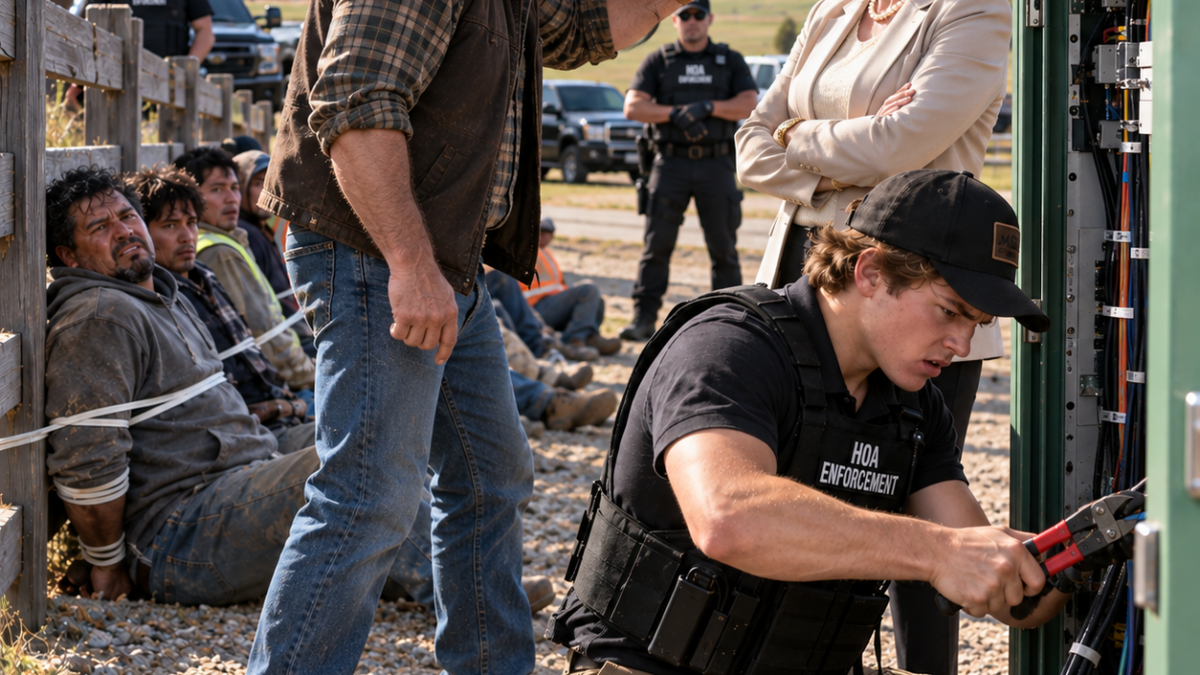
By 7:49, eight ranch workers were restrained along the east fence.
One seasonal worker, Tomas, was sixty-two and diabetic.
They zip-tied him anyway.
Camden’s crew opened the service gate.
A skid steer entered.
Survey stakes followed.
Then Camden walked toward the utility cabinet.
I watched from twelve miles away.
Leah said, “State units are six minutes.”
I said, “Too long.”
She looked at me.
“Daniel.”
“He’s at the cabinet.”
“We see him.”
Camden had bolt cutters.
Insulated handles.
He opened the outer enclosure with a pry bar.
Alarm triggered immediately.
Inside our SUV, Leah’s radio erupted.
State network control:
“Unauthorized cabinet intrusion, node 17-B.”
Another voice:
“Fiber protection alarm.”
I called Luis through his earpiece.
No answer.
His hands were tied.
Camden removed a black cable from a guide channel.
He held it up.
One Redline worker asked, “This the camera feed?”
Camden said, “Aunt said black trunk.”
Then cut it.
8:17:06.
The blade closed.
For half a second, nothing happened.
Then alarms.
Everywhere.
The state emergency network rerouted traffic.
One backup switch failed authentication.
A dispatch center in Cedar Ridge lost CAD synchronization.
Another county lost radio console connectivity for twenty-three seconds.
Two 911 centers switched to degraded mode.
A hospital emergency coordination circuit dropped.
A wildfire command repeater farther west disappeared from network status.
The system did not go completely dark.
But it started going dark in pieces.
Enough.
Network control shouted over radio.
“Major fiber fault on emergency trunk. Multiple PSAP degradation events.”
Leah looked at me.
“That’s it.”
Our driver accelerated.
At the ranch, Camden stared at the cable.
One crew member said, “What the hell did you cut?”
Camden looked at the dead cabinet.
Then his radio stopped working.
Not because the line fed his radio.
Coincidence.
But fear doesn’t understand engineering.
He whispered, “Get the grader through.”
That was the moment proving intent became undeniable.
He knew something serious had happened.
He continued.
A Redline supervisor named Shane Fuller hesitated.
“Camden, alarms are going off.”
“Move.”
“That’s not ranch internet.”
“I said move.”
“What if it’s emergency?”
Camden turned.
“My aunt said ten minutes.”
That sentence survived on three body cameras.
At 8:19, the first sheriff units reached the east gate.
Not Greg Malloy.
The sheriff himself had personally selected deputies outside the conflict.
Camden ordered his crew to block entry.
Imagine that.
Private HOA compliance employees attempting to block marked sheriff vehicles from entering a property they had illegally occupied.
The first deputy got out.
“Everybody step away from the workers.”
Camden held up the fake emergency access order.
“We have lawful authority.”
The deputy didn’t take it.
“Hands where I can see them.”
“We are acting under association—”
“Hands.”
Then our federal convoy arrived.
Three unmarked SUVs.
One state communications truck.
FBI.
State investigators.
A DOJ inspector general agent.
I remained in the second vehicle until Leah told me.
“You stay back.”
“I know.”
I watched her step out.
Federal raid scenes in movies are loud.
Reality is often quieter.
Commands.
Hands.
Positions.
Repetition.
People realizing authority has shifted.
Camden looked at the FBI identification.
Then at the state officers.
Then at the sheriff.
His face changed.
“You can’t arrest us for an HOA dispute.”
Leah said, “Nobody’s arresting you for an HOA dispute.”
She pointed toward the cut fiber.
“That is not HOA property.”
Camden swallowed.
“My aunt told me it was private security infrastructure.”
Leah said nothing.
Silence is useful in interviews and confrontations.
People fill it.
Camden did.
“We were told Mercer was illegally blocking emergency access.”
More silence.
“We have documents.”
Leah looked toward eight workers zip-tied to my fence.
“So do we.”
Agents freed Luis first.
His wrists were bleeding where the plastic cut skin.
He immediately said, “Tomas.”
Even after being restrained, his first concern was an older worker.
That was Luis.
Tomas was pale and sweating.
Paramedics treated him for low blood sugar.
Emma’s phone was recovered from a Redline employee’s pocket.
Nate had a shoulder injury.
Miguel’s lip was split.
None life-threatening.
I wanted to go to them.
Leah stopped me.
“Not yet.”
I hated that.
But she was right.
Victim-witness integrity.
Scene control.
I stayed by the SUV.
Then Victoria arrived.
Of course she did.
White Mercedes.
Expensive sunglasses.
She got out before a deputy reached her.
“What is happening?”
Nobody answered fast enough.
She walked toward Camden.
“Victoria Halstead,” a state investigator said, “stop there.”
“This is HOA-authorized access enforcement.”
The investigator almost smiled.
“HOAs can’t authorize kidnapping.”
Her face changed.
“They were temporarily detained for interfering with emergency work.”
Luis, twenty yards away, laughed.
Not loudly.
Enough.
Victoria saw me.
That changed everything.
“You.”
I said nothing.
She pointed.
“This is retaliation.”
Still nothing.
“You’re using federal resources in a private property dispute.”
Leah stepped between us.
“Mr. Mercer is not directing this investigation.”
Victoria looked at her.
“Who are you?”
“Special Agent Leah Morrison, FBI.”
That took some air out of the morning.
Victoria recovered quickly.
“My attorney will explain the easement.”
Leah said, “Your attorney might be busy explaining the forged map.”
That did it.
Victoria’s mouth opened.
Then closed.
Adrian Vale was arrested forty-five minutes later at his development office.
His phone contained enough evidence to end several careers.
The emergency fiber was repaired in three hours.
The regional 911 system experienced degraded service but, by extraordinary luck, no emergency call was lost with a fatal result.
Two calls rerouted manually.
One fire dispatch experienced a delay of ninety-one seconds.
One domestic violence caller had to be transferred to an alternate center.
The state took that ninety-one seconds more seriously than Victoria had taken nineteen years of my property rights.
As they should.
Critical infrastructure doesn’t need to fail completely to become dangerous.
Ninety-one seconds can be a lifetime.
The local news arrived before noon.
Helicopter.
Cameras.
Reporters outside my gate.
By evening, the story was everywhere.
PRIVATE HOA CREW DETAINED RANCH EMPLOYEES BEFORE REGIONAL 911 OUTAGE.
Then:
FEDERAL AGENTS INVESTIGATING ALLEGED FORGED ACCESS DOCUMENTS.
Then:
DEVELOPER, HOA PRESIDENT LINKED TO RANCH RAID.
Victoria’s first public statement blamed me.
Naturally.
Her attorney wrote:
“Mrs. Halstead acted in good faith based upon legal advice and longstanding emergency-access concerns. Any damage to communications infrastructure was accidental and occurred during what all involved parties believed was a lawful property-access operation.”
Good faith.
I read it at my kitchen table.
Luis had bandages around both wrists.
He laughed.
“She had us tied to a fence in good faith.”
Emma said, “Maybe the zip ties were community-building.”
I almost smiled.
Then I looked at Tomas.
He had gone home.
His wife was furious.
Not at me.
At everyone.
She said, “My husband came to America thirty years ago, worked his whole life, and some rich woman thought she could tie him up because she wanted a road.”
That sentence traveled.
A reporter interviewed her.
The clip went viral.
Victoria’s carefully polished language never recovered from it.
The HOA board scheduled an emergency meeting Thursday night.
Victoria planned to control it.
She had underestimated Meredith.
The clubhouse was packed.
Residents filled every chair.
People stood against walls.
Cameras outside.
I did not attend initially.
Rachel advised against it.
Then Ashford Crest residents themselves asked me.
Not Victoria.
The residents.
I went.
No uniform.
No badge.
Jeans.
Work shirt.
Luis came.
Not as prop.
Because residents asked him too.
Victoria sat at the front table with two attorneys.
Meredith sat three chairs away.
Three board members had already resigned.
Victoria called the meeting to order.
“Before misinformation takes over—”
A resident shouted, “Eight people were tied up.”
Victoria raised her hand.
“We will maintain order.”
Another voice:
“Your nephew shut down 911!”
“It was a temporary network disruption.”
A man in the second row stood.
“My wife called 911 that morning.”
The room quieted.
Victoria said, “Sir—”
“She was having chest pain.”
He pointed at her.
“She got transferred twice.”
Nobody moved.
“She survived.”
His voice shook.
“But don’t you call it temporary like that makes it small.”
Victoria looked toward her attorney.
Wrong move.
People saw it.
Meredith requested the floor.
Victoria resisted.
The room demanded.
Meredith stood.
She placed a stack of printed emails on the table.
“I provided these to investigators.”
Victoria went pale.
Meredith continued.
“For six months, this board was told negotiations with Mr. Mercer were lawful.”
She looked at residents.
“They were not.”
Victoria said, “Meredith, you are violating privilege.”
“No.”
She looked at Victoria.
“I am exposing what you did outside privilege.”
The crowd murmured.
Meredith read aloud:
AGREEMENT IS NO LONGER THE PLAN.
Then:
TEN MINUTES IS ALL WE NEED.
Then:
DISCONNECT LOCAL COMMS AT UTILITY BOX.
Victoria slammed one hand on the table.
“These are taken out of context.”
Meredith looked at her.
“What context makes zip-tying ranch workers legal?”
Applause erupted.
Victoria stood.
“This board authorized emergency corridor enforcement.”
Meredith turned to other board members.
“I didn’t.”
One shook his head.
“Neither did I.”
Another:
“I voted for legal review, not entry.”
Victoria looked trapped.
Then did what arrogant people often do when control disappears.
She stopped pretending.
She looked directly at me.
“You could have prevented all of this.”
The room went quiet.
I stayed seated.
“How?”
“By selling one strip of land.”
There it was.
No more emergency access.
No more public safety.
No more historical easement.
A road.
Money.
Control.
I stood.
“Victoria, your brother wanted my ranch because going around the ridge cost more money.”
She said, “That development benefits this region.”
“Maybe.”
“You blocked jobs.”
“No.”
“You blocked infrastructure.”
“No.”
“You used sentimentality over rational planning.”
I almost laughed.
“My property didn’t become irrational because Adrian wanted it.”
She pointed.
“You were offered ten million dollars.”
Gasps.
I said, “Yes.”
“Who refuses ten million dollars for an easement?”
“An owner.”
That landed.
Not a federal officer.
Not a Marshal.
An owner.
I continued.
“You could have gone around.”
“Ridiculous cost.”
“You could have blasted through the ridge.”
“Environmental damage.”
“You could have redesigned.”
“Years of delay.”
“Those were Adrian’s problems.”
I looked around the room.
“They were never permission to make them mine.”
Victoria’s face hardened.
“Your ranch is one parcel standing in the way of hundreds of families.”
“No.”
I pointed toward the western wall where Vale Summit renderings once hung.
“My ranch is one parcel your brother did not own.”
Silence.
“That distinction is the entire issue.”
Luis stood beside me.
Victoria looked at him.
He said, “You didn’t ask us to move Tuesday.”
Her expression changed.
“You had strangers hold eight people against a fence.”
Her attorney whispered something.
Victoria ignored him.
Luis continued.
“I’m fifty-three years old.”
His voice stayed calm.
“I served sixteen years in uniform.”
He pointed toward his bandaged wrist.
“I’ve been detained legally.”
A few people looked at him.
“I know what it feels like.”
He looked at Victoria.
“What your people did wasn’t law.”
Pause.
“It was rich people pretending nobody would stop them.”
That line hit harder than anything I said.
The board voted.
Victoria Halstead removed as president.
Unanimous among remaining eligible members.
Then the residents voted to terminate Redline’s contract.
Overwhelmingly.
Victoria left through a side door.
Cameras caught it.
No sunglasses now.
No control.
Just a woman walking quickly toward a waiting car while residents shouted questions.
But public humiliation was not justice.
The criminal case mattered more.
Federal prosecutors moved carefully.
Nobody was charged with “cutting 911.”
There isn’t a magical statute named after dramatic headlines.
Charges came from actual conduct.
Conspiracy.
Destruction of protected communications infrastructure.
Interference with emergency communications.
Wire fraud related to falsified filings.
Forgery under state law.
Burglary and criminal trespass.
Unlawful restraint.
Assault.
Theft related to Emma’s phone.
Obstruction.
For Camden, evidence tampering.
Because after cutting the line, he tried to delete his body-camera footage.
Unfortunately for him, Redline’s system automatically uploaded to cloud storage.
There are few things more satisfying than a criminal conspiracy being betrayed by its own subscription plan.
The forgery investigation led to Calvin Ross.
Assistant county planning director.
Forty-eight.
Quiet.
Respected.
Twenty-two years in county government.
Calvin had created the fake map.
Why?
$85,000 in consulting payments routed through an LLC owned by his wife.
Adrian paid him.
Calvin gave investigators access to old map templates and internal GIS files.
He changed dates.
Added easement language.
Inserted a seal.
Made one mistake.
The barn.
Digital map layer from 2010.
Placed on a document dated 2003.
Rachel had spotted it immediately.
Calvin pleaded guilty.
Then cooperated.
He testified that Victoria knew.
Not suspected.
Knew.
He described a dinner at Adrian’s home.
Victoria said:
“If Mercer won’t recognize the easement, we create enough history that a judge has to decide.”
Calvin asked whether that was legal.
Adrian replied:
“Legal is what survives challenge.”
That sentence became the prosecution’s theme.
Legal is what survives challenge.
It told you everything about them.
Not what is lawful.
What can we get away with long enough to make it expensive for someone else to resist?
Camden’s case was uglier.
He tried to claim his workers acted under citizen’s arrest authority.
For what crime?
“Interfering with emergency access.”
The prosecutor asked:
“Emergency access to what emergency?”
Camden had no answer.
Because there was no emergency.
No wildfire.
No flood.
No evacuation.
No ambulance.
Just a skid steer and survey stakes.
One of his own employees, Shane Fuller, cooperated.
He had hesitated after the cable cut.
The body camera caught it.
Shane testified that Camden briefed them that morning.
“He said Mr. Mercer was a bully hiding behind government connections.”
“What were you told about workers?”
“That they’d interfere.”
“What instructions did you receive?”
“To secure obstructive persons.”
“What did you understand that to mean?”
“Zip ties.”
“Did you believe you were police?”
“No.”
“Did you have arrest authority?”
“No.”
“Why did you do it?”
Shane looked at the jury.
“Because Camden acted like we did.”
That sentence should be taught in every institution with uniforms.
Authority is partly theater.
Badge shape.
Tone.
Vehicle lights.
Words like secure.
Enforce.
Detain.
Compliance.
People can be persuaded to cross moral lines when language disguises what their hands are actually doing.
Shane continued.
“I knew it felt wrong.”
“Why didn’t you stop?”
He swallowed.
“I wanted the job.”
Simple.
Embarrassing.
Human.
The trial against Victoria and Adrian lasted seven weeks.
The defense strategy was predictable.
Daniel Mercer is a powerful federal officer who weaponized government against private citizens.
They emphasized my career.
My contacts.
The convoy.
The FBI.
My access to information.
Their attorney asked me on cross-examination:
“You expect this jury to believe you had no influence over how aggressively authorities responded?”
“I expect the jury to consider the evidence.”
“That’s not my question.”
“My answer remains.”
“You are a supervisory deputy United States Marshal.”
“Yes.”
“You knew federal agents involved.”
“Yes.”
“You contacted them.”
“After receiving evidence of a potential federal crime.”
“You benefited from their intervention.”
“My workers benefited from being untied.”
The prosecutor objected.
Sustained.
The defense attorney tried again.
“You wanted Mrs. Halstead punished.”
I looked at Victoria.
Then back at him.
“I wanted her stopped.”
“What’s the difference?”
“Punishment is the court’s job.”
That answer ended up in every newspaper.
The defense then made a mistake.
They played the security footage.
They hoped to show I had surveillance prepared because I had “anticipated confrontation.”
Instead the jury watched Tomas, sixty-two, pushed against a fence.
Emma’s phone taken.
Luis forced down.
Camden cutting the cable.
Shane asking if it might be emergency infrastructure.
Camden saying:
“My aunt said ten minutes.”
Then:
“Move.”
The courtroom changed.
Trials are often won not by the most dramatic evidence but by the moment jurors stop seeing an argument and start seeing conduct.
Victoria stared straight ahead.
Adrian took notes.
Camden was being tried separately, but his voice filled the room.
The prosecutor froze the frame just before the cut.
One black cable.
One set of insulated cutters.
Then showed network logs.
8:17:06 — fiber loss.
8:17:07 — automatic reroute.
8:17:08 — CAD sync degradation.
8:17:11 — dispatch console fault.
8:17:24 — secondary failover error.
8:17:39 — two PSAPs operating degraded.
Seconds.
The prosecutor asked the state network engineer:
“If the redundant route had failed completely, what would have happened?”
“Emergency calls would still have had additional contingencies, but dispatch capability could have been significantly impaired.”
“How significantly?”
“We train for exactly this because seconds matter.”
The man whose wife suffered chest pain testified.
He did not exaggerate.
That made him powerful.
“My wife lived.”
Pause.
“I’m grateful.”
He looked toward Victoria.
“But when I called 911, I wasn’t thinking about somebody’s land development.”
The jury did not look at Victoria.
They didn’t need to.
Then Meredith testified.
Victoria stared at her throughout.
Meredith never looked back.
The emails were admitted.
One message Victoria had sent after I rejected the ten-million-dollar offer:
HE THINKS OWNERSHIP MAKES HIM UNTOUCHABLE.
Adrian replied:
EVERY OWNER TOUCHES A ROAD EVENTUALLY.
Another:
MEREDITH IS GETTING NERVOUS. KEEP HER OUT OF ENFORCEMENT DISCUSSIONS.
That was why Meredith turned.
Not because she suddenly became brave.
Because she realized they had deliberately excluded her from decisions while later telling residents the board had approved them.
She had been used as legitimacy.
That offended something deep in her.
During cross-examination, Victoria’s attorney asked:
“Mrs. Cho, isn’t it true you personally disliked Mrs. Halstead?”
Meredith thought.
“No.”
“You expect the jury to believe that?”
“I admired her.”
That surprised everyone.
Meredith continued.
“That is why it took me too long to understand what she was doing.”
Silence.
“Admiration delayed me.”
She looked at Victoria for the first time.
“I won’t let it silence me too.”
After that, the defense had little left.
Adrian took a plea before the jury finished deliberating.
Victoria did not.
She believed she could still win.
People who mistake control for intelligence often do.
The verdict came on Friday.
Guilty on conspiracy.
Guilty on wire fraud.
Guilty on obstruction.
Several state counts remained separate.
Victoria’s face barely changed.
Then the clerk read the final guilty count.
Her shoulders dropped.
Half an inch.
That was all.
Adrian’s development company collapsed within months.
Vale Summit never broke ground.
Lenders withdrew.
Civil suits arrived.
Environmental permits expired.
The land eventually sold to another developer who redesigned access entirely around the ridge.
Expensive.
Legal.
Funny how impossible solutions become possible once theft stops being an option.
Camden pleaded guilty before his trial.
He received prison time.
Longer than he expected.
At sentencing, his attorney called him “a young businessman who made an error in judgment while attempting to serve his community.”
Luis attended.
Afterward he said:
“Eight zip ties is a lot of judgment errors.”
Camden apologized to the workers.
Reading from paper.
Tomas accepted the apology.
Luis did not.
Emma said, “Maybe someday.”
People asked whether forgiveness mattered.
I didn’t think it was anyone else’s business.
The workers filed civil claims.
The HOA’s insurer fought.
Then security footage made continued fighting expensive.
Settlements came.
Luis used part of his to pay off his daughter’s student loans.
Emma bought twenty acres of her own.
Miguel and Javier opened a small irrigation company while still working seasonally with us.
Tomas retired.
His wife told me she had been trying to convince him for four years.
“She says getting tied to your fence finally fixed his stubbornness.”
Tomas protested.
Nobody believed him.
The Ashford Crest HOA nearly collapsed financially.
Residents were furious.
Some wanted to dissolve it.
Others argued residents who had no knowledge shouldn’t lose shared services because of one president.
Meredith became interim president.
She did something Victoria never had.
Asked questions.
Published contracts.
Opened meetings.
Posted legal bills.
Terminated private enforcement.
Required resident votes for litigation above a threshold.
Boring governance.
The best kind.
One evening she visited the ranch.
No attorneys.
No board.
Just Meredith.
She brought a pie.
I looked at it.
“What’s this?”
“Peace offering.”
“We aren’t at war.”
“Then dessert.”
Luis walked by.
“What kind?”
“Apple.”
He took it.
Meredith laughed.
She looked toward the east pasture.
“I’m sorry.”
“You helped stop it.”
“Late.”
“Still.”
She looked toward the repaired utility cabinet.
“I keep thinking about how close it came.”
“So do I.”
“What if the network had failed worse?”
“It didn’t.”
“That doesn’t answer it.”
“No.”
I looked at her.
“But you can spend your life building alternate endings if you want.”
She smiled sadly.
“Federal wisdom?”
“Widower wisdom.”
Claire used to tell me I rehearsed disasters long after they were over.
What if.
What if.
What if.
Eventually you have to live in the version that happened.
In our version, the 911 system held.
Mostly.
Workers survived.
Evidence existed.
People were stopped.
That was enough truth to carry.
The county sheriff’s department also changed.
Deputy Greg Malloy resigned after an internal investigation found he had shared complaint information with his brother, whose excavation company worked for Adrian.
No proof Greg knew about the ranch raid.
But he had repeatedly discouraged reports.
His brother’s company lost Vale contracts anyway when the development collapsed.
Sheriff Dean Wallace called me.
“I should’ve seen it earlier.”
“Yes.”
Silence.
“I expected you to say no.”
“You want comfort or accuracy?”
He laughed bitterly.
“Accuracy.”
“Then yes.”
He accepted that.
Good leaders sometimes have to.
The department implemented conflict disclosures for deputies responding to property disputes involving major contractors.
Again, boring.
Useful.
Rachel eventually handed me a binder.
“What?”
“Closure.”
Three inches thick.
Deeds.
Maps.
Court orders.
Settlement agreements.
Criminal judgments.
Engineering reports.
I flipped through.
“What do you expect me to do with this?”
“People like you keep things.”
“People like me?”
“People who think documents are emotional support animals.”
I laughed.
She pointed at the ranch office.
“Put it somewhere dry.”
I did.
Then forgot about it.
The land remained.
That was the oddest part.
After years of litigation, police, fiber repairs, news coverage, trials, and federal agents, the east pasture looked almost exactly the same.
Cattle.
Oak trees.
Dust.
Fence.
The service lane.
The utility cabinet.
A scar in the soil where Redline’s skid steer had pushed through.
Grass eventually covered it.
Physical land heals faster than reputations.
Ashford Crest changed too.
People waved again.
Kids returned for fall farm day.
The first year after the trial, attendance was low.
Awkward.
Second year, more families came.
Third year, nobody mentioned Victoria.
That was healthy.
Communities should remember lessons without preserving villains as mascots.
Victoria served prison time.
Not decades.
Enough.
She appealed.
Lost.
After release, she moved away.
Some reporter asked me whether I was satisfied.
No.
Satisfied is not the word.
Justice is not pleasure.
I had watched people I cared about tied to a fence.
Watched emergency infrastructure fail because someone wanted a road.
Watched neighbors spend savings repairing an HOA’s financial damage.
There was nothing satisfying about needing justice.
But consequences mattered.
Truth mattered.
Records mattered.
And the ranch remained ours.
Years later, when I retired from the Marshals Service, the local paper wanted a profile.
They expected fugitive stories.
Task forces.
Court security.
Witness operations.
Instead the reporter spent half the interview asking about the HOA case.
“You were in federal law enforcement for more than thirty years.”
“Yes.”
“And your most famous story is a property dispute.”
“Apparently.”
“Does that bother you?”
“No.”
“Why?”
I looked toward the east pasture.
“Because the lesson isn’t about me.”
“What is it?”
“Authority.”
She waited.
“Real authority has limits.”
I said.
“A property owner has limits.”
“A deputy has limits.”
“A federal agent has limits.”
“A board president has limits.”
“A developer has limits.”
“A security contractor has limits.”
I looked back at her.
“The people who caused this believed limits were for whoever had less money.”
She wrote.
“That was their mistake.”
The reporter asked, “Was cutting the cable their biggest mistake?”
“No.”
“What was?”
“Believing no one would make them answer for everything before it.”
The cable made noise.
Alarms.
911 faults.
Federal attention.
Headlines.
But the crime did not begin with cutters.
It began when they decided refusal was illegitimate.
That ownership mattered only until a richer person wanted something.
That paperwork could be manufactured.
That authority could be imitated.
That employees could be restrained.
That systems could be manipulated.
That ten minutes of illegal control would become permanent reality.
The cable simply revealed the scale of their arrogance.
One cut.
That was all.
Camden thought he was disabling ranch cameras.
Instead he touched something connected to thousands of people he would never meet.
Dispatchers.
Firefighters.
Deputies.
Paramedics.
Callers.
Hospitals.
Families.
That’s how infrastructure works.
Invisible relationships.
One line under one pasture carrying consequences far beyond the fence.
People are like that too.
Luis wasn’t “a ranch worker.”
He was a father.
Veteran.
Grandfather.
Manager.
Friend.
Tomas wasn’t “labor.”
He was somebody’s husband.
Emma wasn’t “staff.”
She was a woman building a career.
Victoria saw categories.
Obstacles.
Landowner.
Workers.
Cable.
Road.
Votes.
Everything reduced to function.
That made it easier to hurt people.
I had seen the same thing in law enforcement.
Fugitive.
Defendant.
Witness.
Inmate.
Deputy.
Labels help systems operate.
They become dangerous when you forget there is a person underneath.
On the fifth anniversary of the incident, Luis and I stood near the east fence.
He had finally decided to retire.
Maybe.
He had announced retirement three times.
Each lasted less than a month.
“You actually leaving?”
“Yes.”
“You said that last year.”
“This time my wife changed the gate code.”
“Smart woman.”
He rubbed his wrists unconsciously.
The scars were faint.
Still visible.
“You ever think about that morning?”
“Sometimes.”
“What part?”
He pointed toward the utility cabinet.
“That idiot.”
I laughed.
“He had insulated cutters.”
“As if that made him qualified.”
“He probably thought it did.”
Luis shook his head.
“That’s the whole story.”
“What?”
“Having a tool doesn’t mean you understand what it’s connected to.”
I looked at him.
“That sounds annoyingly profound.”
“I practiced.”
We stood quietly.
Then Luis asked:
“You would’ve sold for twenty million?”
“No.”
“Thirty?”
“No.”
“Fifty?”
I looked at him.
He grinned.
“Claire would haunt you.”
“That is probably true.”
The grove Claire and I planted still stands.
The road never crossed it.
Not because I was a heroic holdout.
Because it was mine.
Sometimes people want a grand moral explanation for boundaries.
They don’t always need one.
No is a complete property negotiation when the other person does not possess a legal right.
That was another lesson Victoria never learned.
She thought every no meant:
Increase pressure.
Increase price.
Find leverage.
Invent leverage.
Her world had taught her persistence wins.
Sometimes persistence becomes coercion.
The line is consent.
The last time I saw Camden was not in court.
It was years later.
Gas station.
I almost didn’t recognize him.
Thinner.
Older.
No uniform.
He saw me first.
We stood two pumps apart.
He looked away.
Then back.
“Mr. Mercer.”
“Camden.”
He seemed surprised I answered.
“How’s the ranch?”
“Fine.”
He nodded.
A long silence.
Then:
“I didn’t know what that cable was.”
“I know.”
He looked relieved.
I continued.
“That wasn’t the problem.”
Relief disappeared.
“What?”
“You didn’t know what anything was.”
He frowned.
I pointed toward him.
“You didn’t know the workers.”
“The infrastructure.”
“The law.”
“The easement.”
“The limits of your authority.”
Pause.
“You knew what your aunt wanted.”
He looked down.
“That was enough for you.”
Camden swallowed.
“I paid for it.”
“Yes.”
“I’m trying to move on.”
“Good.”
He waited.
Maybe for forgiveness.
Maybe permission.
I wasn’t going to perform either.
I said, “Then move differently.”
His eyes lifted.
I got into my truck.
That was it.
No cinematic confrontation.
No threats.
People sometimes assume strength means delivering the perfect final speech.
Usually it means knowing when nothing else is owed.
Today, Ashford Crest still exists.
Vale Summit exists too, under a different name and different developer.
The road reaches it from the north.
Nine extra miles.
Two bridges.
Exactly the route Adrian claimed was economically impossible.
People drive it every day.
The hotels were never built.
The athletic complex became a public park after the county negotiated land preservation.
Funny outcome.
The emergency fiber under my ranch was eventually upgraded.
New armored conduit.
Better intrusion sensors.
Additional redundancy.
There is now a bright warning marker near the cabinet.
Luis jokes that it should say:
DEAR HOA: DO NOT CUT.
The state declined his wording.
Cowards.
My daughter, Sarah, manages more of the ranch now.
She’s thirty-four.
Claire would have liked that.
Sarah grew up thinking she would never come back.
Then adulthood did what it does.
Changed the meaning of home.
One morning, she asked why I never sold the access corridor.
She expected me to say her mother.
Trees.
Memory.
Instead I said:
“Because I didn’t want a highway through the ranch.”
She laughed.
“That’s it?”
“That’s enough.”
And it is.
People are allowed simple reasons.
A boundary does not become weaker because the explanation isn’t dramatic.
The most dangerous people in the story were not dangerous because they wanted land.
Development happens.
Negotiation happens.
Eminent domain exists when governments follow law.
Easements are created every day.
The danger came when Victoria, Adrian, and Camden decided process was an obstacle rather than the point.
Law feels slow when you are certain you deserve the outcome.
Consent feels inefficient when somebody keeps saying no.
Evidence feels annoying when your story is already complete.
That’s exactly why those things exist.
To slow down people who are sure.
At 8:17 on a Tuesday morning, Camden Halstead closed a pair of insulated cutters around one black fiber cable.
In his mind, he was solving a problem.
Disable cameras.
Open gate.
Move equipment.
Film road.
Create facts.
Ten minutes.
That was the plan.
Instead, a screen inside a regional dispatch center turned red.
Then another.
Then another.
A state network engineer saw routes disappear.
A 911 supervisor heard alarms.
A hospital connection failed.
Federal agents accelerated toward a ranch where eight restrained workers were beginning to understand that the people holding them had made a mistake far larger than trespassing.
Camden stood beside the open cabinet staring at two severed ends of cable.
He would later say that was the moment he knew.
Not what he had cut.
What kind of situation he had entered.
Because far away, systems he did not know existed reacted immediately.
Alarms.
Logs.
Failovers.
Radios.
Dispatchers.
Agents.
Evidence.
Consequences.
He had spent years working around people who believed power meant making other people respond.
That morning he learned something different.
Real systems respond whether you believe in them or not.
Property records respond.
Network logs respond.
Body cameras respond.
Courts respond.
Witnesses respond.
People respond.
Sometimes slowly.
Sometimes imperfectly.
But eventually, one cut reaches everything it was connected to.
Victoria wanted a road.
Adrian wanted profit.
Camden wanted approval.
Calvin wanted money.
Greg wanted to protect family.
Shane wanted his job.
Every one of them found a reason to take one more step.
Then another.
Then another.
Until a pair of cutters closed.
And suddenly everybody could see the path that led there.
That’s why I still keep the damaged cable.
A six-inch section.
The state engineer gave it to me after evidence release.
Rachel thinks that’s proof I collect documents like emotional support animals.
Maybe.
It sits in a drawer beside Claire’s old gardening gloves.
Black outer jacket.
Glass fibers inside.
Looks ordinary.
That’s the point.
Most important things do.
A deed looks like paper.
A promise sounds like words.
A boundary looks like a fence.
A fiber line looks like cable.
A worker looks like somebody wearing dusty boots.
A no looks like an inconvenience.
Until you discover what each is connected to.
That cable connected four counties.
My fence connected to property law.
Those workers connected to families.
Meredith’s email connected to evidence.
One fake map connected to corruption.
One arrogant decision connected to prison.
And my ranch?
It connected me to the one place Claire had been right about.
The place where I could stop looking over my shoulder.
Eventually.
Not that Tuesday.
But eventually.
The grass grew back.
The fence was repaired.
The cameras stayed.
The emergency line stayed.
The oaks stayed.
The road never came.
And on quiet mornings, when the valley smells like wet soil and hay and the sun comes over the ridge, there is nothing there to tell you that a regional 911 network once started going dark because one man mistook permission from his aunt for permission from the law.
Nothing except a slightly newer utility cabinet.
And one old black piece of cable in my desk.
Cut clean through.
A reminder that the most expensive mistake Victoria Halstead ever made wasn’t underestimating a federal officer.
It was simpler than that.
She underestimated the word no.

