HOA Karen Sent a Backhoe Into My Hayfield and Dug Three Trenches Without Permission—Then One Engineer Started Measuring Where the Water Was Really Coming From.
PART3:
If it wasn’t written down, I treated it like it had never happened.
That habit saved me years later.
The other thing that saved me was Ellie.
I met her when I was twenty-seven.
Second-grade teacher.
Dark hair.
Green eyes.
Laughed with her whole face.
The first time she came to the farm she stepped in cow manure in white sneakers, looked down, then looked at me.
I thought the date was over.
She said:
“Well, now they’re farm shoes.”
We got married beneath the black walnut tree on the west ridge.
Thirty-eight people.
Folding chairs.
Barbecue.
My neighbor Ray Puckett played guitar badly.
Ellie danced anyway.
We built a life inside that old farmhouse.
She sanded the hardwood floors herself because she said paying someone else to remove history from old wood felt wrong.
She painted the kitchen pale yellow.
Planted rosemary below the window.
Bought porch furniture we absolutely could not afford.
Then slowly made the place feel like it had always been waiting for her.
She drew plans for a new barn on the back of a seed catalog.
Red siding.
White trim.
Double doors facing east.
“Morning light down the center aisle,” she said.
“What center aisle?”
“The barn you’re eventually building me.”
“I thought it was my barn.”
She smiled.
“That’s adorable.”
We never built it.
Not together.
Ellie died of pancreatic cancer eighteen months before Brenda Caldwell sent the backhoe onto my farm.
Thirty-nine.
Seven months from diagnosis to funeral.
Cancer is obscene in the way it turns a person into timelines.
Six months.
Eight weeks.
Maybe Christmas.
Probably not spring.
At the end Ellie was more worried about me than herself.
Typical.
Three days before she died, she grabbed my wrist.
“You’re going to keep farming.”
“Don’t.”
“Garrett.”
“Don’t talk like that.”
“Promise.”
I couldn’t.
She squeezed harder.
“Promise.”
So I did.
After the funeral, I kept farming because stopping would’ve meant admitting the world had changed.
Cattle still needed water.
Hay still needed cutting.
Calves were born without checking whether I was grieving.
I started waking before sunrise because the house was hardest when it was quiet.
By six, I’d usually be outside.
By evening, too tired to think.
That was how I survived the first year.
Then Cedar Bluff Estates became a problem.
The subdivision itself had existed five years by then.
One hundred sixty houses on what had been tobacco land south of my property.
Dale Caldwell developed it.
Local contractor.
Big company.
Bigger personality.
He’d spent thirty years putting up subdivisions around Raleigh and Durham and had recently started pushing farther north where land was cheaper.
His wife Brenda became HOA president before the ink on half the closing documents was dry.
Brenda was difficult to describe without sounding unfair.
So I’ll just describe what I saw.
Platinum-blonde hair.
Salon perfect.
French nails.
Designer dresses.
Pearls at meetings.
Prada sunglasses.
Birkin bag placed beside her like a second elected official.
White Cadillac Escalade with cream interior.
She parked diagonally across two spaces at the community center.
Every time.
Nobody knew why.
Maybe lines felt restrictive.
The first time I met her, she walked to my fence wearing heels.
Not boots pretending to be heels.
Actual Jimmy Choos.
They sank into pasture mud.
She ignored it.
“Are you Mr. Sullivan?”
“Yes.”
“Your cattle are very close to our property.”
I looked toward the cows.
Then the subdivision fence.
“How close should they be?”
“Farther.”
“That is not a measurement.”
She removed her sunglasses.
“I can smell them from my kitchen.”
“Then your kitchen is near a cattle farm.”
Her mouth tightened.
“This isn’t funny.”
“I agree.”
“I think you should relocate them.”
I looked behind me at 120 acres.
“Where?”
“Somewhere not visible.”
The farm had existed decades before Cedar Bluff.
I told her that.
She said:
“The subdivision exists now.”
That sentence explained everything that followed.
In Brenda’s mind, what came later mattered more because it cost more.
My farm was history.
Cedar Bluff was investment.
Therefore history should move.
The complaints started within a month.
Dust.
Tractor noise.
Flies.
Cattle smell.
Mud.
Fence condition.
Visual blight.
Certified letters.
Gold seal.
HOA letterhead.
Every one carefully filed.
Drawer three.
CEDAR BLUFF.
Ellie would’ve laughed at the size of the folder.
I didn’t respond unless necessary.
Then Cedar Bluff started flooding.
Heavy rain had always turned parts of Granville County wet.
But this was different.
One-inch rain?
Water in yards.
Two inches?
Driveways under water.
Thunderstorm?
Garages.
Basements.
Homeowners posted photographs online.
Children standing on porches while brown water covered streets.
Cars parked uphill.
People running sump pumps.
Brenda blamed me.
Specifically my lower field.
She claimed runoff crossed my property and overwhelmed Cedar Bluff’s stormwater network.
That made no sense.
I knew the slope.
My lower field drained east toward the creek.
Cedar Bluff sat south.
Water doesn’t read HOA letters.
It goes downhill.
I told her.
She dismissed me.
One Tuesday she came to the farm.
I met her near the gate.
“Ma’am, I need to talk to you about the drainage claims.”
She looked at my boots.
Mud.
Then at the sidewalk leading toward her Escalade.
“Please stop tracking manure near my vehicle.”
“I’m standing on my farm.”
“Then stand farther away.”
“The flooding isn’t coming from here.”
“Your property is the problem.”
“No.”
“Your cows.”
“No.”
“Your dust.”
“No.”
“Your smell.”
I almost laughed.
She stepped closer.
“You are a dirt farmer on a dying piece of land.”
I stared.
“You don’t talk to me,” she said.
“You listen.”
For one second I could hear Ellie’s voice in my head.
Don’t say what you’re thinking.
I didn’t.
Brenda continued.
“The flooding has damaged six homes this year.”
“Then you need to find the source.”
“I have.”
“You haven’t.”
She put her sunglasses on.
“I will fix it myself.”
“Do not enter my property.”
She smiled.
“And when I’m done, you’ll wish you’d sold when Dale offered.”
I stopped.
“What offer?”
A tiny pause.
Then:
“Good afternoon, Mr. Sullivan.”
She walked away.
I remembered that sentence.
At the time I didn’t know why.
Two days later I did.
I was at a livestock auction in Oxford.
Ray Puckett called.
Ray was seventy-three.
Owned forty acres east of mine.
He never called unless something was wrong.
I stepped outside.
“Ray?”
“Garrett, there’s a backhoe in your lower field.”
Everything inside me went still.
“Mine?”
“Yours.”
“Who?”
“Two men.”
“Doing what?”
“Digging.”
I started walking toward the truck.
“Who sent them?”
Ray paused.
“White Escalade’s parked near the south line.”
That was enough.
I drove home too fast.
When I turned through the gate, diesel smoke hung over the lower pasture.
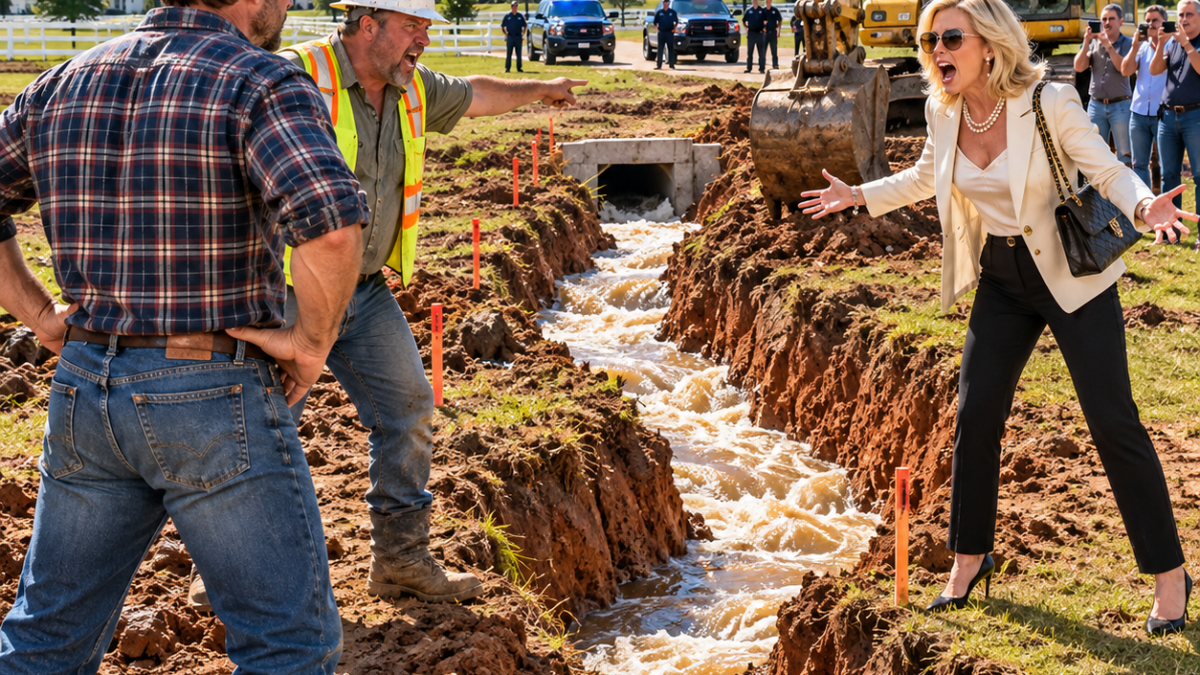
Three trenches.
Each roughly forty feet long.
Four feet deep.
Fresh timothy ripped open.
Topsoil piled in muddy ridges.
Water sprayed from broken irrigation lines.
The pipe system I’d installed myself two summers earlier had been shattered in four places.
Fence posts uprooted.
Equipment tracks gouged through the access lane.
A section of hay I had spent four months growing looked like somebody had dragged artillery through it.
The backhoe crew had already gone.
Brenda too.
Ray stood at the edge.
“Sorry, Garrett.”
I didn’t answer.
Not because I was angry with him.
Because I was trying to keep my head clear.
Ellie and I had stood in that lower field the year before she got sick.
She had talked about how good the timothy looked.
Now red clay lay on top of it.
“What did she say?” I finally asked.
Ray removed his cap.
“That the HOA had a drainage easement.”
“There is no drainage easement.”
“I know.”
“She say where?”
“Founding documents.”
I walked to the nearest trench.
Broken PVC hissed.
Water turning clay orange.
I shut the irrigation main.
Then called Brenda.
She answered quickly.
Dinner sounds in background.
Glasses.
Music.
Laughter.
“Mr. Sullivan.”
“What did you do?”
A pause.
Then:
“The board authorized emergency drainage remediation.”
“On my farm.”
“Adjacent agricultural parcel.”
“My farm.”
“Section 14.7 of our community governance charter permits emergency drainage intervention.”
“Your charter governs your neighborhood.”
“The runoff originates on your land.”
“No, it doesn’t.”
“Our consultants disagree.”
“Send me the easement.”
“We’ve already reviewed the documents.”
“Send me the recorded drainage easement.”
Silence.
Then the sound of someone laughing at her dinner table.
Brenda covered the phone for a second.
Returned.
“Mr. Sullivan, I strongly recommend cooperation.”
“Do not send another piece of equipment onto my property.”
“We’re prepared to involve the county.”
“You already destroyed my irrigation.”
“The board acted lawfully.”
“Send the easement.”
“My attorney will contact you.”
She hung up.
The next morning, I went to the Granville County Register of Deeds.
Three hours.
Original plats.
Developer agreements.
HOA covenants.
Easements.
Utility maps.
Drainage records.
Nothing.
No drainage easement on my land.
No stormwater easement.
No right of access.
No emergency remediation authority.
Nothing even close.
I copied everything.
Page numbers.
Book.
Instrument numbers.
Filed it.
Then measured the field.
Every trench.
Length.
Depth.
Width.
Broken line.
Fence damage.
Crop loss area.
GPS coordinates.
Photographs from six angles.
Notebook.
Date.
Weather.
Time.
Ray statement.
I did not scream.
Didn’t drive to Brenda’s house.
Didn’t put anything online.
People think restraint means weakness because they confuse volume with action.
I was acting.
Two weeks later I mailed Brenda a certified demand.
No drama.
No insult.
No threats.
No easement exists.
Work unauthorized.
Restore property within thirty days.
Repair irrigation.
Repair fencing.
Compensate crop loss.
Stop entry.
Attached county records.
Photos.
She signed the green return card herself.
Three days later, county code enforcement appeared at my driveway.
7:15 a.m.
Complaint:
Livestock nuisance.
Odor.
Dust.
Insects.
Potential groundwater contamination.
I almost admired the timing.
“Come on,” I told the inspector.
We walked two hours.
Cattle.
Pastures.
Water.
Manure management.
Buffers.
Well tests.
Everything.
Clean.
No citations.
The inspector left.
Next morning, Caldwell Construction returned.
Before sunrise.
Track loader.
Box blade.
Instead of repairing what they’d done, they extended a graded channel toward my south fence.
Then cut through the fence.
Two places.
Five strands.
Wide openings.
At 6:30, I heard a car horn.
Not beep.
Sustained.
Panic.
I dropped a wrench in the barn and ran.
Two Angus heifers were standing on the county road.
A woman in a blue Honda had stopped twenty feet short.
Her little girl sat in back holding a juice box.
One heifer, Darla, limped badly.
I got both off the road.
The driver stepped out shaking.
“I’m sorry.”
“You didn’t do anything.”
“I almost hit them.”
“I know.”
Her daughter lowered the window.
“Why is the cow sad?”
I looked at Darla.
Blood near one hoof.
“She hurt her leg.”
Vet later diagnosed sprained fetlock.
No fracture.
But she lost her breeding season.
Money.
Time.
Pain.
I called the sheriff.
Deputy arrived.
Young.
Looked at fence.
Then track marks.
Then the graded path.
“Probably civil.”
I looked at him.
“Cutting private fence?”
“Could be criminal if intent—”
I held up my phone.
“Want to see intent?”
Trail camera.
5:47 a.m.
Caldwell Construction loader.
Fence.
Wire folding.
And behind the loader:
White Escalade.
Parked at the tree line.
Engine on.
Someone inside.
Deputy watched twice.
“Send me that.”
I did.
Two weeks.
No arrest.
Brenda circulated another petition.
Thirty-four signatures.
Agricultural zoning review.
Farm incompatible with residential character.
County rejected it.
North Carolina’s agricultural protections were clear enough that the planning director sounded annoyed.
Brenda wasn’t.
She changed direction again.
Environmental complaint.
This time to the North Carolina Department of Environmental Quality.
Livestock waste.
Contaminated stormwater.
Dangerous runoff.
Fifteen homeowner statements.
Photographs of standing water.
Inspector:
Diane Cho.
Rubber boots.
State truck.
No nonsense.
She walked the farm three hours.
Soil.
Creek buffer.
Manure storage.
Drainage.
Grass.
Slope.
Everything clean.
Then we stood at the southern boundary.
Cedar Bluff yards beyond.
Saturated.
Water standing between houses.
Diane stared for a while.
“Garrett.”
“Yeah?”
“This isn’t coming from you.”
“I know.”
“Your drainage goes east.”
“I know.”
She looked toward Cedar Bluff.
“They have an internal stormwater problem.”
“How sure?”
“Very.”
“What kind?”
“Can’t say without seeing engineering.”
She pointed.
“Their system either isn’t handling design volume…”
Pause.
“…or parts of it were never built.”
That was the thread.
I pulled it.
County planning office.
Approved stormwater plan for Cedar Bluff Estates.
Sixty-two pages.
I read every one.
Page thirty-eight.
Two-acre retention pond.
South parcel.
Designed to collect runoff from the entire subdivision.
Control release.
Prevent flooding.
Then construction certification.
Blank.
No engineer signature.
No final inspection.
No completion stamp.
I drove to the parcel.
No pond.
Flat grass.
Real-estate sign:
FUTURE PHASE THREE
CALDWELL DEVELOPMENT GROUP
I sat in my truck twenty minutes.
The missing pond wasn’t hidden.
That’s the crazy part.
It simply wasn’t there.
For five years, one hundred sixty families had flooded while the two acres meant to protect them sat empty because Dale Caldwell wanted more houses.
And whenever residents complained, Brenda pointed north.
At me.
Dirt farmer.
Cows.
Runoff.
Easy villain.
I went home.
Opened the cabinet.
Spread four months of records across Ellie’s kitchen table.
The old yellow paint she chose still framed the window.
Evening light came through.
Letters.
Trenches.
Fence.
Trail-camera footage.
County rejection.
DEQ report.
Approved stormwater plan.
Blank certification.
Missing pond.
Then the thought:
Where did the stormwater money go?
I didn’t know yet.
But I knew who could tell me what the water itself was doing.
Rebecca Torres.
Professional engineer.
Stormwater specialist.
Fifteen years.
I found her through the state licensing board.
Called at eight next morning.
Explained four minutes.
She interrupted twice.
“How long have the trenches existed?”
“About eleven weeks.”
“Have they been filled?”
“No.”
“You have the approved subdivision plan?”
“Yes.”
“I can be there Thursday.”
I spent two days building her binder.
Deed.
Survey.
Farm exemption.
Stormwater plan.
Photos.
Irrigation map.
Trail-camera footage.
Certified letters.
DEQ report.
Sheriff record.
Planning decision.
Rebecca arrived in a white F-250.
Forty-one.
Hair under a cap.
Work boots.
Survey equipment in the bed.
I handed her binder.
She flipped through.
“This is unusually organized.”
“Bad cattle deal.”
“What?”
“Long story.”
She spent all day measuring.
Not guessing.
Measuring.
GPS elevations.
Trench slopes.
Soil compaction.
Natural drainage.
Irrigation damage.
Fence.
Cedar Bluff grading.
By noon she had confirmed the basic truth.
My farm drained east.
Cedar Bluff’s water was moving north and east because its planned storage didn’t exist.
Their flooding was coming from them.
Then Rebecca drove to the missing pond parcel.
Measured.
Photographed.
Compared plans.
Same dimensions.
No pond.
No outlet structure.
No control riser.
No storage basin.
Nothing.
Back at my lower field around two, she stopped near the creek.
Looked at vegetation.
Then at maps.
Then at the trench.
“Garrett.”
“Yeah?”
“Has anyone evaluated this area for wetland jurisdiction?”
I laughed.
“I call it the wet meadow.”
“That’s not an answer.”
“It stays wet until summer.”
She walked carefully.
Reed grass.
Soft ground.
Shallow standing water.
Willows.
One of Brenda’s trenches cut directly through it.
Rebecca crouched.
Touched soil.
Then stood.
“This needs regulatory review.”
“How bad?”
“Potentially very bad.”
She showed me mapping.
Federal wetland inventory indicators.
Potential Section 404 issues.
Mechanical disturbance.
No permit visible.
No delineation.
No engineered plan.
A backhoe had carved four feet down through the wettest portion of the field because Brenda wanted somewhere to send water.
Rebecca looked at me.
“Do not alter this trench.”
“I wasn’t planning to.”
“Photograph it every day.”
“Already am.”
She smiled slightly.
“Of course you are.”
By 4:30, she sat at my kitchen table drinking coffee from Ellie’s blue mug.
I almost told her to use another.
Didn’t.
Something about seeing an engineer with mud on her boots holding Ellie’s mug felt right.
Rebecca summarized.
“No drainage easement.”
“Correct.”
“Unauthorized trenching.”
“Yes.”
“Natural drainage contradicts HOA claims.”
“Yes.”
“Required retention pond missing.”
“Yes.”
“Possible unpermitted wetland disturbance.”
“Yes.”
Then:
“I want financial records.”
“I don’t have them.”
“Homeowners probably do.”
“For what?”
“Stormwater fees.”
That question opened the next door.
I found an annual HOA budget posted online.
Stormwater assessment.
Thirty-two dollars per household each quarter.
One hundred sixty homes.
Five years.
Roughly $102,400 collected.
I called Rebecca.
She went quiet.
Then:
“Send me that.”
Next morning her report arrived.
Forty-seven pages.
PE seal.
Maps.
Photos.
Measurements.
Findings.
The trenches were unauthorized.
They redirected subdivision runoff toward my farm.
The retention pond required by approved plans had not been built.
The subdivision was operating without its full approved stormwater system.
Homeowners had paid more than a hundred thousand dollars in stormwater assessments.
And the trench through my low field required immediate wetland review.
One engineer.
One day.
Five years of lies suddenly had measurements.
Rebecca recommended notifications.
County.
DEQ.
Federal regulators concerning wetland impacts.
“Before they alter anything,” she said.
That sentence came just in time.
Three nights later, trail camera alert.
11:15 p.m.
Caldwell Construction loader entering my lower field.
They had returned.
Not digging.
Filling.
Red clay pushed into the trench.
Smoothing.
Covering.
White Escalade at tree line.
Again.
I stood in the farmhouse watching live camera footage.
My hands shook.
Not fear.
Rage.
They knew.
Somebody had realized the trench was evidence.
They were trying to erase it.
I almost drove down.
Almost confronted them.
Then remembered:
Write it down.
Camera one recorded.
Camera two recorded.
Camera three recorded.
Cloud backup.
I called sheriff’s dispatch.
Reported active trespass.
Then Rebecca.
“They’re filling it.”
“Do not approach the equipment.”
“I know.”
“Record everything.”
“I am.”
“They’re making it worse.”
“What do you mean?”
“If the area is jurisdictional, adding fill can create additional violations.”
I sat at the kitchen table.
Watched bucket after bucket.
People assume cover-ups require intelligence.
Mostly they require panic.
They worked until two.
Returned next night.
Dump truck.
More clay.
Every minute timestamped.
I sent Rebecca’s report.
County building inspector.
DEQ.
Then the relevant federal district office.
Hand-delivered the wetland section and supporting evidence.
After that, I requested time at the Cedar Bluff HOA meeting.
Fifteen minutes allowed under their grievance policy.
Brenda tried to stop it.
Emergency board session.
Proposed rule:
Sixty-day notice.
Presentation materials preapproved by president.
Their own attorney told her she couldn’t retroactively change rules to block a pending request.
She tried anyway.
He put his objection in writing.
That document later became interesting.
Meeting night.
Thursday.
Community center.
Usually forty people.
That evening:
112 homeowners.
People had heard:
Farmer coming to explain flooding.
Five years of wet basements will create attendance.
Brenda sat at the front.
Cream blazer.
Pearls.
Montblanc pen.
Birkin bag on the chair beside her.
Four other board members.
I set up a folding table.
Binder.
Copies.
Projector.
Rebecca sat second row.
Brenda opened.
“This is an unusual accommodation to an adjacent non-member.”
Dan Martinez in the audience said:
“Just let him speak.”
She glared.
I stood.
“My name is Garrett Sullivan.”
Some people knew.
Most didn’t.
“I own the farm north of Cedar Bluff.”
I looked around.
“Some of you have been told for years that my farm causes your flooding.”
Several nodded.
“Tonight I’m going to show you what the county documents and an independent engineer found.”
No speech.
Evidence.
Approved stormwater plan.
Page thirty-eight.
Retention pond.
Two acres.
I enlarged the drawing.
Then showed current photograph.
Flat field.
Phase Three sign.
People whispered.
I showed construction certification.
Blank.
No signature.
No final inspection.
A man raised his hand.
“Are you saying it was never built?”
“Yes.”
Brenda interrupted.
“Mr. Sullivan is not qualified to interpret civil plans.”
I nodded.
“Correct.”
Then:
“Rebecca Torres is.”
Rebecca stood.
Gave license number.
Experience.
She explained.
Simple.
The pond was not optional landscaping.
It was part of the design basis.
Without it, runoff storage was missing.
She showed elevation data.
My farm drains east.
Not south into Cedar Bluff.
Then:
Trench photos.
Backhoe.
Broken irrigation.
Fence.
Track loader.
White Escalade.
Nobody spoke.
Then stormwater assessments.
$32 quarterly.
$102,400 approximate total.
A woman in the third row stood.
“Where did that money go?”
I looked at Brenda.
“That’s not my account.”
Every face turned toward her.
Brenda picked up her pen.
“The stormwater assessment supports broader community infrastructure functions.”
“What functions?”
A man near the aisle asked.
Brenda:
“Drainage maintenance.”
“What drainage?”
Another voice.
The room shifted.
I showed Rebecca’s report.
Wetland.
Trench.
Unpermitted disturbance concern.
Then nighttime footage.
Loader returning.
Filling the trench.
Timestamp.
Caldwell Construction logo.
White Escalade.
Silence.
Projector fan humming.
Brenda’s pen stopped.
One resident whispered:
“They tried to bury it.”
Then the room exploded.
Not violence.
Questions.
Five years of anger.
A woman named Teresa Bell stood.
“My basement flooded eleven times.”
Her voice shook.
“My son’s bedroom smelled like mold for three months.”
Another:
“My insurer dropped me.”
Another:
“We replaced drywall twice.”
Another:
“Brenda told us the farmer wouldn’t cooperate.”
That last one hurt.
The woman looked at me.
“I signed the petition against you.”
“Okay.”
“I’m sorry.”
I nodded.
She started crying.
Brenda finally spoke.
“Everyone needs to calm down.”
That was the wrong sentence.
A hundred people got louder.
One man shouted:
“Where is our money?”
Brenda hit the table.
“Order.”
Nobody cared.
Then board member Sharon Mills stood.
Social committee.
She looked at Brenda.
“I didn’t know the pond wasn’t built.”
Brenda:
“Sharon, sit down.”
“I didn’t know.”
“Sit down.”
Sharon picked up her purse.
“I resign.”
She walked toward the door.
At the threshold:
“Effective immediately.”
The door closed.
One empty chair.
Next board member:
Thomas Hicks.
Retired insurance adjuster.
He didn’t resign that night.
He left without speaking.
Email next morning:
I resign effective immediately and will retain independent counsel regarding my personal exposure.
Second chair.
Third:
Dr. Howard Pruitt.
Retired dentist.
He looked at the screen.
Nighttime loader.
Then Brenda.
Then audience.
He pushed his chair back.
“I resign.”
Walked out.
Third chair.
Fourth:
Connor Walsh.
Thirty-three.
IT professional.
Joined six months earlier because nobody else volunteered.
He remained through the meeting.
By noon next day:
resignation email.
That left Brenda.
One woman.
Head table.
Four empty chairs.
Birkin bag had fallen onto the floor sometime during the chaos.
She didn’t pick it up.
Her legal pad remained almost blank.
At the top:
Motion to table non-member grievances.
The motion never happened.
I packed the projector.
Rebecca helped.
People surrounded us.
Questions.
Flooding.
Insurance.
Fees.
Wetland.
County.
One older man grabbed my hand.
“I’m sorry.”
“For what?”
“I believed her.”
“You didn’t have my documents.”
“I should’ve asked.”
Maybe.
But blame is easy after revelation.
I drove home.
Farm dark.
Cattle quiet.
I sat beneath the black walnut tree where Ellie and I married.
For the first time since finding the trenches, I cried.
Not over Brenda.
Not the field.
Ellie.
Because she would have loved the whole ridiculous thing.
Not the damage.
The binder.
The engineer.
The moment Brenda’s expensive pen stopped moving.
I could almost hear her:
You always said filing cabinets were romantic.
I had never said that.
She would’ve claimed I did.
The consequences came fast after the meeting.
County stop-work orders on Caldwell Development projects.
Phase Three frozen.
DEQ investigation.
Federal wetland review.
The wet meadow was confirmed as regulated enough to require formal restoration measures for the disturbance.
The trenches couldn’t just be covered.
They had to be assessed and restored under agency oversight.
Cedar Bluff’s board minutes became evidence because Brenda had signed authorizations.
Every board member who approved the work suddenly wanted individual counsel.
Then financial records.
Homeowners organized.
Forty-seven joined a lawsuit against the HOA leadership.
Subpoenas.
Bank statements.
Invoices.
The stormwater money had been deposited into the general operating account.
Brenda was principal signatory.
Where had it gone?
Landscaping.
Decorations.
Entrance improvements.
Meeting catering.
Management expenses.
An HOA weekend retreat.
And one item that made even Rebecca curse:
$1,200 floral expense tied to Brenda Caldwell’s daughter’s wedding.
Stormwater money.
Flowers.
Meanwhile Teresa Bell’s son slept on a couch because his bedroom smelled like mold.
That fact destroyed any sympathy Brenda had left.
My lawsuit was simpler.
Trespass.
Property damage.
Agricultural interference.
Irrigation.
Fence.
Crop loss.
Darla’s veterinary bills.
Lost breeding revenue.
Restoration.
Attorney’s fees where recoverable.
Initial damages exceeded $114,000.
Brenda resigned Friday afternoon.
Four-sentence letter.
Miscommunication.
Development partners.
Community challenges.
Best wishes.
No apology.
Dale’s construction company entered restructuring not long after multiple projects froze and lenders began asking questions.
The Phase Three sign disappeared.
The missing retention pond finally became unavoidable.
Court-supervised and county-reviewed work began the following spring.
Licensed engineer.
Real grading plan.
Real inspections.
The two-acre parcel Dale had saved for more houses became what it was always supposed to be.
A stormwater basin.
Excavation.
Outlet structure.
Native vegetation.
Controlled storage.
The first heavy storm after completion came in June.
Thunder.
Two inches fast.
I drove to the south fence.
Not because I needed proof.
Because five years of conflict makes you curious.
Water moved through Cedar Bluff streets.
Entered drainage.
Reached pond.
Pond filled.
Held.
Released slowly.
Yards remained mostly clear.
No flooded garages.
No basements.
Teresa called the new HOA president and cried.
She later told me:
“I didn’t know rain could sound normal again.”
My field restoration took longer.
Rebecca designed it.
Remove contaminated fill.
Reconstruct trench areas.
Compact clean soil in lifts.
Restore original contours.
Replace irrigation with heavier PVC.
Rebuild fence.
Wetland remediation.
Native reeds.
Monitoring stakes.
Two years.
The scars looked ugly first season.
Then grass returned.
Timothy came back thicker in places.
Land is generous when you stop fighting what it wants to do.
Civil cases settled.
My claim:
$131,000.
Homeowner action:
$460,000.
Regulatory action included restoration, monitoring, and civil penalties.
Money sounded dramatic.
It wasn’t the part I cared about most.
I cared about this:
Darla healed.
Fence stood.
Irrigation worked.
Hay grew.
Water stayed where engineering said it should.
And Cedar Bluff stopped flooding.
A few months after the settlement, Sophia and Daniel Martinez drove to my house.
New HOA leadership.
No Escalade.
Pickup truck.
Sophia brought banana bread.
Daniel brought a binder.
I laughed when I saw it.
“What?”
He held it up.
“We’re trying something new.”
“Paperwork?”
“Transparency.”
They sat at the kitchen table.
The same table.
Ellie’s window.
Sophia said:
“We owe you an apology.”
“You personally didn’t trench my field.”
“We signed the petition.”
“Okay.”
“We believed the flooding story.”
“A lot of people did.”
Daniel looked at me.
“We want to start over.”
I thought.
Then nodded.
“Start with drainage.”
He laughed.
They hired an independent management company.
Infrastructure audit.
Reserve study.
Financial controls requiring multiple signatures.
Engineering review.
Actual stormwater inspections.
Their monthly meetings became boring.
That’s how you know governance is improving.
No Birkin bags falling.
No mass resignations.
Just budgets.
Contracts.
Minutes.
Boring is underrated.
After the field was stable, I built Ellie’s barn.
Exactly where she’d drawn it.
South pasture.
Red.
White trim.
Double doors facing east.
Morning sun runs down the center aisle just like she said.
Her seed-catalog sketch hangs inside beside the light switch.
Original pencil.
A little coffee stain near one corner.
People ask why I waited.
Money partly.
Grief mostly.
Building it before the fight would’ve felt like admitting she wasn’t coming back to see it.
Building it after everything felt different.
Completion.
Not replacement.
On the first morning after it was finished, I opened both doors before sunrise.
Light came through.
Dust floating gold.
I stood alone.
“Okay, Ellie.”
Voice cracked.
“You were right about the doors.”
Cattle don’t care about emotional moments.
One cow immediately knocked over a bucket.
Life continued.
Ray Puckett visited later.
Walked through.
“Nice.”
“That’s all?”
“What do you want?”
“Enthusiasm.”
He touched a stall door.
“Your wife had good sense.”
“I know.”
Then:
“You ever think about what would’ve happened if you didn’t keep records?”
“Yes.”
“What?”
“I’d have looked like an angry farmer complaining about a ditch.”
Ray nodded.
“That’s probably what Brenda counted on.”
Exactly.
She expected imbalance.
Her:
HOA letterhead.
Developer husband.
Lawyers.
Community votes.
Money.
Me:
Mud.
Cattle.
Old farmhouse.
No wife.
No board.
What she didn’t understand was that evidence changes hierarchy.
A photograph doesn’t care what somebody wore.
A survey doesn’t care who drives the Escalade.
A PE seal doesn’t care which handbag sits at the board table.
Water definitely doesn’t care.
It goes downhill.
That simple physical fact destroyed five years of narrative.
Years passed.
Brenda sold.
Moved somewhere near Cary.
I heard she became involved in another HOA.
I hope the drainage works.
Dale disappeared from development circles around Granville County.
The Caldwells became a story people told cautiously because lawsuits teach caution.
Cedar Bluff became better.
Not perfect.
Neighborhoods never are.
But when residents complained about drainage now, engineers looked at drainage.
Nobody blamed cattle by reflex.
They invited me to the annual community picnic one year.
I almost declined.
Sophia said:
“Please come.”
“Why?”
“Because half the neighborhood has never actually met you.”
“They met me at the disaster meeting.”
“That wasn’t meeting.”
Fair.
I went.
Children played.
Food trucks.
Cornhole.
No flooding.
One man approached holding two beers.
“Garrett?”
“Yes.”
“I’m Mike Donnelly.”
“Okay.”
“I signed every petition Brenda circulated.”
He handed me a beer.
“That’s a lot of petitions.”
“I know.”
“Why?”
He looked embarrassed.
“She sounded certain.”
That answer interested me.
Not because it excused him.
Because it was honest.
“She had documents.”
“HOA documents.”
“Yeah.”
“Charts?”
“Charts.”
“Those get people.”
He smiled.
Then looked toward my farm.
“I never walked over there.”
“No.”
“I never looked at elevation.”
“No.”
“I never checked county plans.”
“No.”
“I’m an accountant.”
“That explains the charts.”
He laughed.
Then:
“I’m sorry.”
“Accepted.”
Simple.
One apology.
No collapse.
Nobody lost rank.
Funny how easy it can be.
The fireproof cabinet is still in my farmhouse.
Drawer three holds Cedar Bluff.
More than a foot thick.
Brenda’s first letter.
Last letter.
Photos.
Engineer report.
Settlement.
Restoration certificates.
I keep wondering if I should throw some away.
Never do.
Habit.
Rebecca became a friend.
We worked together later on a streambank project.
She’d tease:
“Do you have documentation?”
I’d say:
“Do you have a license?”
Same joke.
Every time.
One afternoon she stood in the restored wet meadow.
Reeds.
Blackbirds.
Soft soil.
No trench.
“You know,” she said, “this is why engineers hate unplanned drainage.”
“Because of lawsuits?”
“Because water remembers.”
I liked that.
“What does that mean?”
“You can bulldoze a path and tell yourself where water should go.”
She looked toward the creek.
“Water still follows topography.”
“Unless someone builds the right system.”
“Exactly.”
Cedar Bluff had tried to solve engineering with politics.
That never works for long.
The missing pond was the truth.
Everything else was blame management.
When homeowners got wet, Brenda needed somewhere to point.
My farm was convenient.
Old.
Messy to suburban eyes.
No formal communications department.
No management company.
Just me.
The irony?
If Dale had built the pond in the first place, none of us would’ve fought.
Two acres.
Part of an approved plan.
He probably could have made plenty of money anyway.
But greed often isn’t about needing more.
It’s about resenting any square foot that doesn’t generate profit.
Those two acres looked to him like future houses.
Until rain proved they had another job.
That’s land.
Every acre does something.
Drainage.
Habitat.
Grazing.
Storage.
Floodplain.
People get into trouble when they value only what they can sell.
I learned that from Ellie too.
She loved the wet meadow.
Said it was ugly in winter and beautiful in spring.
I once suggested draining part of it.
She said:
“Why?”
“More hay.”
“You have hay.”
“More is better.”
She looked at me.
“For cows.”
“Yes.”
“What is the wet meadow for?”
“Being wet.”
“Then it’s already productive.”
I laughed at her.
She was right.
Years later, Brenda’s trench through that same meadow brought federal regulators to her door.
Ellie would’ve enjoyed the irony immensely.
I eventually placed a small bench near the black walnut tree.
Not a memorial plaque.
Ellie would’ve hated that.
Just a bench.
Sometimes I sit after supper.
Watch cattle.
Listen to Cedar Bluff in distance.
Lawn mowers.
Kids.
Dogs.
Ordinary life.
Water no longer flowing through garages.
That’s the ending I like.
Not Brenda losing her board.
Not Dale’s company collapsing.
Not settlements.
A subdivision dry after rain.
A farm producing.
A creek clean.
Systems working.
Conflict stories often end with somebody destroyed.
Real justice is better when something gets repaired.
That doesn’t mean consequences shouldn’t happen.
They should.
Brenda authorized work on land she didn’t own.
She weaponized agencies.
Helped hide a drainage failure.
Tried to bury evidence.
Mismanaged money.
Consequences followed.
But if the only outcome had been her humiliation while Cedar Bluff kept flooding, we would’ve failed.
The pond mattered more than the resignation.
The restoration mattered more than the check.
The truth mattered because it changed something physical.
That’s why I keep Rebecca’s report.
Forty-seven pages.
Blue cover.
PE seal.
Page thirty-one has an elevation profile showing exactly where runoff goes.
I show it sometimes when young farmers ask what happened.
They expect drama.
I point at the slope.
“Here.”
They stare.
“That’s it?”
“That’s it.”
“The whole HOA board quit because of a line on a graph?”
“Partly.”
“That seems boring.”
“Boring wins.”
I tell them the same rule Dad taught me.
If it isn’t written down, it didn’t happen.
Then add my own:
If someone claims water is coming from your land, measure the land.
Don’t fight adjectives.
Measure.
Don’t argue about “community impact.”
Pull the plat.
Don’t debate whether somebody had “authority.”
Ask for the easement.
Don’t respond to a false accusation with a bigger accusation.
Get the inspection.
Get the report.
Facts aren’t always faster than lies.
That’s the frustrating part.
Brenda moved faster.
Letter.
Petition.
Backhoe.
Complaint.
She could create a story in one afternoon.
It took me weeks to dismantle it.
But speed and durability are different.
Her story vanished once people saw the records.
The engineer’s measurements remained.
The pond remains.
The restored wetland remains.
That is what truth does when somebody bothers to document it properly.
A few years after the fight, a huge storm came through.
Worse than the one that had flooded Cedar Bluff repeatedly.
Weather service warnings.
Lightning.
Three inches.
I stood at my kitchen window.
Ellie’s window.
Rain hammered glass.
Old instincts.
I drove toward the south fence.
Not wise.
Did it anyway.
Cedar Bluff’s pond was almost full.
Exactly as designed.
Water entered.
Spread.
Rose.
Then slowly discharged.
No cars floating.
No brown water entering garages.
No people carrying furniture upstairs.
Just a retention pond doing a boring job extremely well.
Sophia called.
“Garrett.”
“Yeah?”
“You watching?”
“Yes.”
“We’re dry.”
I smiled.
“That’s what the pond is for.”
She laughed.
“I know.”
Then her voice broke slightly.
“We’re dry.”
I understood.
Five years of storms had taught them fear.
Infrastructure gave them something more valuable than convenience.
Normalcy.
Next morning, blue sky.
I walked the lower field.
Wet.
But not destroyed.
Creek high.
Wet meadow full of birds.
The restored contour held.
No artificial trench dragging subdivision water across my hay.
I stood there.
Thought about Ellie.
Thought about the day Brenda said I was a dirt farmer on dying land.
The land didn’t look dead.
Green.
Wet.
Alive.
Some insults say more about the speaker than the target.
A farmer works with dirt.
That isn’t shame.
Dirt is where food starts.
Where water moves.
Where mistakes show up.
Where engineers take measurements.
Where people in heels sometimes learn expensive lessons.
I never saw Brenda again after she moved.
That’s fine.
I don’t need a final confrontation.
Don’t need her to stand at my gate and apologize.
Some stories end without the person who caused the harm ever understanding it fully.
That’s frustrating.
Also real.
What I got instead was better.
Proof.
Repair.
Peace.
One day a new Cedar Bluff resident stopped near my mailbox.
Young couple.
Small child in back.
They had just bought one of the houses.
The man rolled down the window.
“Are you Garrett?”
“Depends.”
He laughed.
“Daniel said we should introduce ourselves.”
“Okay.”
“We moved into Cedar Bluff.”
“Welcome.”
He pointed toward my pasture.
“My daughter loves cows.”
“That’s fortunate.”
“Can we bring her sometime?”
“Sure.”
He hesitated.
“We heard there was some history.”
“There usually is.”
“With the neighborhood.”
“Yes.”
“Anything we should know?”
I thought.
Then pointed toward the subdivision.
“Your retention pond is important.”
He laughed.
“I know.”
“Good.”
“Anything else?”
“Don’t dig trenches on my farm.”
His wife burst out laughing.
“Fair.”
They drove away.
That is how a boundary should work.
Simple.
Clear.
No war.
No gold seal.
No community governance charter pretending to be a deed.
Just:
This is mine.
That is yours.
Ask before crossing.
When Ellie drew the barn, she wrote one note under the double doors.
EAST.
I never knew why she emphasized it.
Until I built it.
Morning light.
She knew.
Of course.
Her sketch hangs inside.
Some mornings I open the doors before sunrise.
Light fills the center aisle.
Dust floats.
Red siding warms.
Cattle move in the distance.
If rain fell overnight, I can hear water slipping through the creek where it belongs.
Cedar Bluff roofs beyond trees.
The retention pond hidden from view but doing its work.
The wet meadow restored.
No trenches.
No loaders.
No Escalade.
Just land.
I still miss Ellie every day.
The grief changed.
That’s all.
It used to feel like a trench somebody had cut straight through the middle of my life.
Deep.
Raw.
Everything interrupted.
I spent years trying to fill it quickly.
Work.
Routine.
Anger.
Then eventually learned some things aren’t repaired by pushing dirt back into the hole.
You restore contours slowly.
Layer by layer.
Let water find its path.
Let grass return.
Rebecca would probably tell me that’s a terrible engineering metaphor.
I don’t care.
It fits.
Brenda Caldwell dug three trenches through my field because she thought destroying part of my livelihood was easier than admitting her husband failed to build a pond.
She believed the farmer next door was an easy place to dump both water and blame.
For a while, she was right about one thing.
I was quiet.
She mistook that for helpless.
What she didn’t see was the filing cabinet.
The camera.
The county records.
The environmental report.
The engineer.
Every time she escalated, I documented.
Every time she lied, I found the page beneath it.
Every time she tried to make the problem look emotional, I measured something.
And in the end, the thing that destroyed her story wasn’t my anger.
It was elevation.
A professional engineer measured the land and proved the water did not flow the way Brenda said it did.
From there, everything followed downhill.
The missing pond.
The unused certification.
The stormwater fees.
The unpermitted trenches.
The wetland.
The nighttime fill.
The board minutes.
The financial records.
Five years of buried decisions exposed by one simple question:
Where is the water supposed to go?
Once 112 homeowners knew the answer, Brenda couldn’t point at me anymore.
She couldn’t call me the problem.
She couldn’t hide behind the board.
The board itself disappeared around her.
One chair.
Then another.
Then another.
Until she sat alone beneath fluorescent lights with an expensive pen drying in her hand and nobody left willing to defend the story she’d sold them.
People later called that meeting her downfall.
I don’t.
Her downfall happened earlier.
The moment she decided it was easier to trench another man’s field than to admit the pond didn’t exist.
The meeting was just when everyone else found out.
Today my lower field produces hay again.
Darla gave me two healthy calves after her leg healed.
The irrigation lines are stronger than before.
The fence is new.
The wetland vegetation came back.
Red-winged blackbirds returned.
Cedar Bluff’s basements stay dry through storms that once flooded them.
And Ellie’s red barn stands exactly where she drew it, white doors facing east.
That’s enough for me.
I never wanted to destroy a board.
I wanted people off my land.
I wanted my field repaired.
I wanted the flooding blamed on the thing that actually caused it.
I wanted somebody to build the pond.
Eventually, that’s what happened.
Brenda once looked at my muddy boots and told me I was a dirt farmer who needed to listen.
She was right about one word.
Dirt.
That’s where I learned almost everything worth knowing.
Walk it.
Measure it.
Respect where water wants to go.
And when someone powerful tells you the land is lying, don’t argue.
Call an engineer.

