HOA Karen Said My Late Wife’s Dream Home “Violated Community Standards”—Then She Sent Bulldozers While I Was 80 Miles Away and Flattened It Without a Court Order
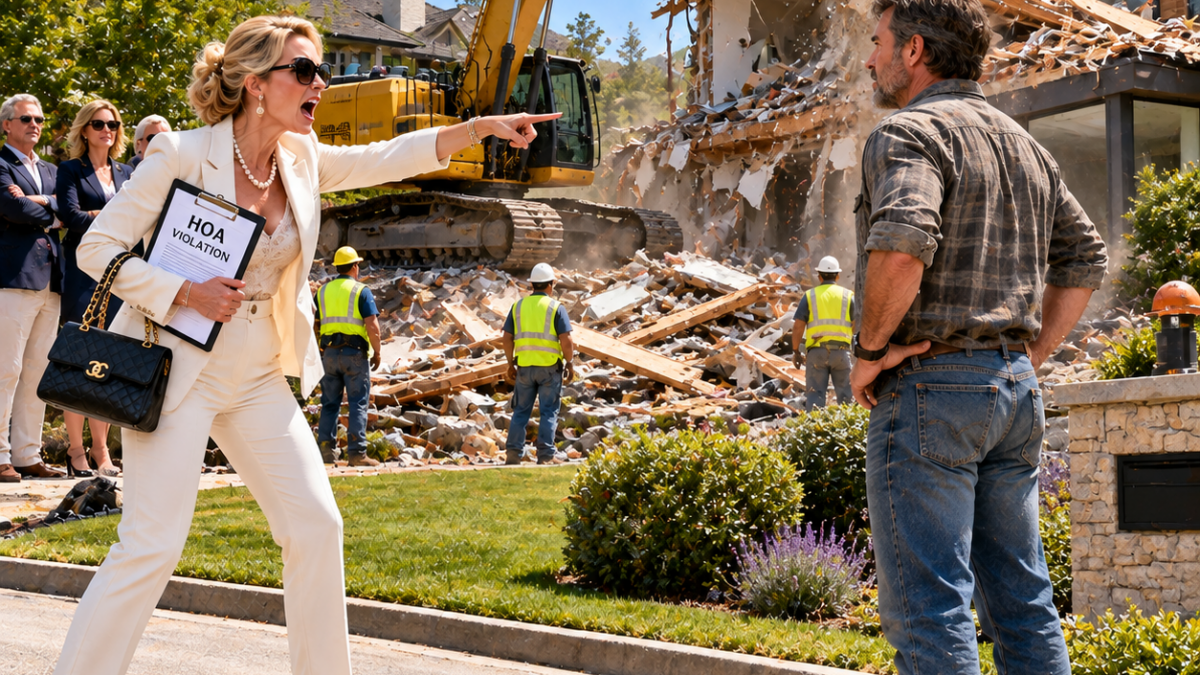
HOA Karen Said My Late Wife’s Dream Home “Violated Community Standards”—Then She Sent Bulldozers While I Was 80 Miles Away and Flattened It Without a Court Order.
Victoria Ashford spent eight months fining me for the copper roof, the floor-to-ceiling windows, and the lavender garden my dying wife had designed from a hospital bed—then she sent bulldozers to my property while my daughter and I were eighty miles away.
She thought flattening my house would finally force me off the last parcel her husband needed for a forty-million-dollar development deal, but she had no idea six cameras were recording every command, every forged document, and every arrogant smile as the walls came down.
Four months later, when a judge looked across a silent Atlanta courtroom and announced a twelve-million-dollar judgment, Victoria finally learned that the rules she had spent years inventing for everyone else could not protect her from the one set of rules she had never controlled—the law.
My wife designed our house three weeks before she died.
That is where this story actually begins.
Not with an HOA.
Not with a bulldozer.
Not with twelve million dollars.
With Elena.
A Tuesday afternoon in March.
Emory University Hospital.
Room 617.
Rain tapping against the window.
A morphine pump beside the bed.
And my wife leaning over a drafting table I had carried through two hospital corridors while a nurse followed behind telling me there was absolutely no way administration had approved it.
Elena smiled at her.
“They haven’t.”
The nurse looked at me.
I shrugged.
“She outranks me.”
Elena had been that way before cancer.
She never believed a rule should survive simply because nobody had asked why it existed.
Maybe that’s why she would have hated Victoria Ashford even more than I eventually did.
Elena studied architecture when we were young.
Never finished the degree.
Life interrupted.
Marriage.
Bills.
Then Claire.
Then Will.
She became a mother, ran a small design business from home, volunteered at the elementary school, remodeled our first kitchen three separate times without admitting the second version had been a mistake, and continued sketching buildings on anything that could hold pencil.
Restaurant napkins.
Hotel stationery.
Grocery receipts.
Church bulletins.
Margins of novels.
I used to tease her.
“Elena, normal people write grocery lists on grocery lists.”
“Normal people are why strip malls look like strip malls.”
Then she would draw something else.
After the diagnosis, the sketches slowed.
Pancreatic cancer does not negotiate politely with the body.
PART2:
By the time the doctors stopped saying “treatment” and started saying “comfort,” Elena was forty-six.
Claire was twelve.
Will was nine.
I was fifty-two.
I had spent thirty years as a structural engineer believing nearly every problem had a load path, a failure point, and a solution.
Cancer taught me there are problems engineering cannot solve.
When the oncologist told us she likely had weeks, I expected Elena to ask for the beach.
Or Italy.
Or one last Christmas early.
Instead she looked at me and said:
“Bring my drafting table.”
I thought medication was confusing her.
“What?”
“The folding one from the studio.”
“Elena.”
“Tom.”
Her voice was weak.
Still dangerous.
“I have something to finish.”
So I brought it.
For nine days, whenever she had enough strength, she drew.
A house.
Not large.
Not ridiculous.
Different.
Copper roof panels.
Warm timber.
Stone.
Clean modern lines.
Tall windows facing west.
A central living room built around the view instead of a television.
A small courtyard filled with lavender.
A second-floor reading ledge for Claire.
A workshop entrance where Will could come inside covered in mud without crossing the living room.
Every part had a reason.
I asked why so much glass.
Elena ran one finger along the elevation drawing.
“A house should breathe, Tom.”
“It’ll be expensive.”
“We’re dying only once.”
“We?”
She smiled.
“You’ll complain enough for both of us.”
She wanted the copper roof because she knew what time would do to it.
“It’ll change.”
“Oxidize.”
“Don’t engineer my poetry.”
“It’ll oxidize.”
“It’ll turn green.”
“Eventually.”
“And you’ll get older with it.”
That stopped me.
She knew she would never see the green.
I looked down at the drawings.
She touched my hand.
“Build it somewhere with sky.”
She completed the final blueprint on Thursday.
She died Sunday morning.
At 4:17.
Claire held one hand.
I held the other.
Will slept against my shoulder because he had tried to stay awake all night and lost.
The last thing Elena said clearly to me was not about the house.
It was:
“Don’t let the kids think joy is betrayal.”
I didn’t understand then.
I do now.
For almost a year, I did nothing with the drawings.
They stayed in a tube beside my desk.
Then one evening I found Claire looking through them.
She had spread them across the floor.
“Mom really made all this?”
“Yes.”
“Were you going to build it?”
I looked at my twelve-year-old daughter.
“I don’t know.”
“She wanted you to.”
There are moments when children say the sentence adults have spent months avoiding.
That was one.
So I started looking for land.
I found a lot in Ridgewood Estates.
Northwest of Atlanta.
Old neighborhood.
Large parcels.
Mature trees.
Quiet streets.
Most houses traditional red brick.
White trim.
Colonial revival.
Three-car garages.
Neat hedges.
The lot had been empty for years because an older house had burned and the owners never rebuilt.
The deed included HOA membership.
I knew that.
I was not opposed to HOAs in principle.
At their best, they maintain common property, coordinate expenses, solve problems nobody wants to solve individually.
At their worst, they give petty people a gavel.
At closing, I read every covenant.
Twice.
Nothing prohibited modern architecture.
Nothing prohibited copper.
Nothing imposed a minimum brick percentage.
Architectural review applied to certain exterior modifications, but new construction with county approval required only submission of plans and a reasonable design review under the recorded standards.
I submitted everything.
No response within the stated deadline.
My attorney advised that under the governing process, the application was deemed approved.
County permits followed.
Foundation.
Framing.
Electrical.
Mechanical.
Plumbing.
All approved.
I built slowly.
Not because I had to.
Because every decision felt like touching Elena again.
I poured the foundation on the first anniversary of her death.
Claire came with me.
She wrote MOM beneath the future living-room slab before the concrete crew finished.
I pretended not to see.
When we hung the first copper roof panel, Will held the chalk line.
The lavender went in during early spring.
Elena always said lavender should feel the last frost before it blooms properly.
Maybe she invented that.
I never checked.
Some things do not need fact-checking when your dead wife said them often enough.
Two years after she died, we moved in.
The first night, Claire ran from room to room touching walls.
Will sat at the west window watching sunset turn the glass orange.
I placed Elena’s photograph on the mantel.
White dress.
Bare feet.
Laughing.
Then I stood in the living room she designed and cried so quietly my children pretended not to notice.
For the first time since Elena died, I felt I had kept one promise.
Then Victoria Ashford drove up.
Pearl-white Range Rover.
Vanity plate:
HOA PREZ.
I should have understood everything from that license plate.
She parked at the curb.
Stepped out in nude Louboutin heels, cream linen blazer, silk camisole, and sunglasses that probably cost more than my first drafting computer.
Late thirties.
Perfect hair.
Perfect nails.
Perfect posture.
Beautiful in the same way certain knives are beautiful.
She stopped halfway up the walkway.
Removed her sunglasses slowly.
Looked at my house.
“This is… interesting.”
The pause before interesting did all the work.
I stepped outside.
“Can I help you?”
“You’re Thomas Garrett?”
“Yes.”
“Victoria Ashford.”
She waited.
I waited.
“HOA president.”
“Nice to meet you.”
Her expression suggested I had failed to respond appropriately to royalty.
She looked at the roof.
Then the windows.
Then the lavender.
Finally:
“I’m afraid your house violates our rules.”
That sentence followed me for the next eight months.
“What rules?”
“Our community design standards.”
“I submitted plans.”
“Not to me.”
“To the architectural committee address listed in the covenants.”
“That committee hasn’t functioned properly in years.”
“Then perhaps the HOA should update its records.”
She smiled.
Thin.
“The copper is unacceptable.”
“Why?”
“Reflective material.”
“It’ll patina.”
“The window ratio is excessive.”
“Which recorded covenant says that?”
She looked at me.
“We maintain standards beyond the bare minimum.”
“I understand.”
“Good.”
“Which recorded standard?”
Her eyes cooled.
“You’ll receive notice.”
She turned.
Walked back to the Range Rover.
I watched those red soles cross my lawn.
That night I told Claire.
She stared at me.
“Can they make us leave?”
“No.”
“Can they change Mom’s house?”
“No.”
I believed that.
I should have added:
Not legally.
Because legality and behavior are separate subjects.
The first notice arrived Tuesday.
Heavy cream paper.
Embossed gold monogram.
Victoria’s personal stationery, not normal HOA forms.
Roof material: copper.
Violation: excessive reflected light creating visual disruption.
Fine:
$200.
I laughed.
Then I paid it.
That was my first mistake.
I wanted peace.
Two children.
New house.
New school.
I had spent years fighting hospitals, insurance companies, grief, probate paperwork, contractors, and my own exhaustion.
Two hundred dollars felt cheaper than war.
A week later:
Front facade glazing exceeds forty percent wall coverage.
Fine:
$350.
Then:
Unauthorized landscaping species.
Lavandula angustifolia.
Lavender.
Fine:
$500 per day until removed.
I stared at that notice for a very long time.
The flowers outside our house were not merely landscaping.
Claire had helped plant them.
Will watered them.
They came from Elena’s plan.
That one I did not pay.
Two days later, Victoria appeared with a rose-gold tape measure.
She walked onto my property without knocking.
Pressed the tape against my windows.
Wrote measurements in a leather notebook.
I watched from inside.
Claire stood beside me.
“Is she allowed to do that?”
“No.”
“Why aren’t you stopping her?”
I looked at my daughter.
“Because I want to see what she does when nobody interrupts.”
Victoria measured three windows.
Photographed the roof.
Walked away.
That night, I finally did what I should have done before paying the first fine.
I read every page of the governing documents.
Then again.
There was no copper rule.
No glazing ratio.
No prohibited lavender.
No authority supporting half the restrictions Victoria cited.
Then I found the source.
A thirty-two-page document titled:
RIDGEWOOD ESTATES COMMUNITY DESIGN GUIDELINES — REVISED.
Author:
Victoria Ashford.
Signature:
Victoria Ashford.
No board resolution.
No member vote.
No adoption certificate.
No date showing proper amendment procedure.
She had written her own design code.
Then treated it as binding law.
I requested records from Doris, the HOA secretary.
Doris was maybe sixty.
Nervous eyes.
Soft voice.
The kind of woman who apologized when somebody else stepped on her foot.
“Ratification records for the revised design guidelines.”
Her hands stopped typing.
“You’d have to ask Mrs. Ashford.”
“I’m asking the association.”
“She handles those.”
“Was there a membership vote?”
Doris looked toward Victoria’s closed office.
“I don’t know.”
“Board vote?”
“I don’t know.”
“Resolution number?”
“She said the guidelines were self-explanatory.”
I stared.
“Self-explanatory documents still require legal adoption.”
Doris whispered:
“I know.”
That was the first time I realized Victoria frightened people.
Not just irritated them.
I requested five years of violation records.
Doris gave me what she legally could.
Every citation I reviewed referenced Victoria’s private addendum.
Every one.
Gold ink.
Same signature.
Same invented authority.
I started a folder.
ASHFORD.
Placed it in the filing cabinet beside Elena’s blueprints.
Then came Craig Donovan.
Independent structural assessment specialist.
At least that was Victoria’s title for him.
He arrived in a silver BMW.
No county markings.
No engineering vehicle.
Khakis.
Golf polo.
Clipboard with a bank-chain pen.
He walked around my home tapping siding with his knuckles.
Photographed structural connections he clearly did not understand.
Made no measurements.
Used no level.
No laser.
No moisture meter.
Nothing.
I watched from the kitchen.
Claire asked:
“Who’s that?”
“Apparently an expert.”
“Does he know what he’s doing?”
“No.”
“How can you tell?”
“He’s studying a decorative header like it holds the second floor.”
Three days later, I received forty pages.
CRITICAL STRUCTURAL INTEGRITY ASSESSMENT.
The report was almost funny.
One beam identified as load-bearing was decorative.
Foundation tilt allegedly 2.3 degrees.
At that slope, marbles would have rolled across every floor in the house.
Craig never measured anything.
Soil-bearing analysis mixed incompatible units.
Photographs were mislabeled.
A stock image of cracked concrete appeared on the title page.
Not my concrete.
Not even remotely.
I could have destroyed the report professionally in fifteen minutes.
Victoria used it before I could.
Email to the entire subdivision:
URGENT SAFETY CONCERN AT 412 RIDGEWOOD LANE.
Independent assessment.
Critical structural failures.
Danger to children.
Possible impact on neighboring property.
She used the phrase “children’s safety” repeatedly.
It worked.
A neighbor began crossing the street instead of walking past our house.
At Will’s soccer game, another father lowered his voice and asked:
“Is it true your place is unstable?”
“No.”
“My wife got the email.”
“The report is fraudulent.”
He nodded.
But I could see doubt.
Then Will came home angry.
Not crying.
Worse.
“Ethan’s mom says he can’t come over.”
I put down my coffee.
“Why?”
“She says our house might collapse.”
He looked at me.
“Dad, is Mom’s house bad?”
That was when Victoria stopped being annoying.
I called Ray Patterson.
Fulton County building inspector.
Nineteen years.
Actual license.
Actual equipment.
He spent four hours inspecting.
Foundation scans.
Laser levels.
Moisture readings.
Structural connections.
Roof.
Shear walls.
Everything.
Two-page report.
Zero deficiencies.
Structure exceeded code in multiple categories.
Ray stood beside his truck.
“Mr. Garrett.”
“Tom.”
“Tom.”
He looked back at the house.
“This is the third time I’ve seen something like this from Mrs. Ashford.”
My attention sharpened.
“What do you mean?”
“Two prior owners.”
“She got private reports claiming problems.”
“And?”
“They sold before county review finished.”
“Who bought?”
He shook his head.
“Don’t know.”
Then:
“You’re the first one who stayed long enough for me to put an official inspection beside hers.”
That sentence bothered me.
I started digging.
Before I got far, Victoria called an emergency HOA meeting.
Monday.
Seven p.m.
Community center.
Attendance strongly encouraged.
Dress code:
Smart casual minimum.
Dress code.
For condemning my house.
I wore work boots.
Victoria had staged the room.
New curtains.
Podium.
Presentation screen.
Even her chair behind the board table sat higher than everyone else’s.
Two inches.
I noticed.
Structural engineers notice elevations.
She entered last.
White blazer.
Cream trousers.
Birkin bag.
Gavel.
Opened with concern.
Community standards.
Safety.
Children.
Property values.
Craig’s fake report projected large behind her.
Photos of my house chosen to make it look alien beside surrounding brick.
Then a graph.
No axis labels.
No data source.
Just a red zone titled:
DANGER.
I almost admired the audacity.
She proposed emergency condemnation and mandatory demolition within thirty days.
When she opened public comment, I stood.
Held Ray’s county report.
“This house received a complete Fulton County inspection six days ago.”
I handed copies forward.
“Zero deficiencies.”
Murmurs.
“It exceeds code in several structural categories.”
Victoria tilted her head.
“I appreciate the county’s efforts.”
That phrase.
County’s efforts.
As if inspectors were children bringing her macaroni art.
“But Ridgewood standards exceed minimum government requirements.”
“The issue here is structural safety.”
“It is also community compatibility.”
“So now it’s not unsafe?”
She smiled.
“You’re deliberately oversimplifying.”
“No.”
I held Craig’s report.
“I am a licensed structural engineer.”
The room shifted.
Most people knew I was an engineer.
Not everyone knew my specialty.
I continued.
“Mr. Donovan identified a decorative kitchen header as a primary structural beam.”
Victoria interrupted.
“This is not a technical seminar.”
“He reported foundation slope without measuring it.”
“Mr. Garrett—”
“He used inconsistent soil units.”
“Sit down.”
“Does Craig Donovan hold a professional engineering license?”
Silence.
Victoria looked at Craig.
Craig looked at the table.
That should have ended the meeting.
It didn’t.
Seven votes supported condemnation.
Two opposed.
I counted.
Four yes votes were proxies.
Addresses:
355 Ridgewood Lane.
I knew those houses.
Former families.
All sold.
I wrote the ownership entities.
Ashford Properties LLC.
Ridge Partners LLC.
Peachtree Holdings Inc.
Then looked at the proxy signatures.
Craig Donovan.
Something cold moved through me.
After the meeting, Victoria stopped beside my chair.
Perfume.
Gold bracelet.
Satisfaction.
“I tried to be reasonable, Thomas.”
“You gave me thirty days?”
“Yes.”
She smiled.
“Rules are rules.”
Then walked away.
I went home.
Put the kids to bed.
Then sat beneath Elena’s pendant light until two in the morning.
For the first time, I wasn’t looking at an HOA dispute.
I was looking at a pattern.
Public records confirmed it.
Glenn Ashford—Victoria’s husband—controlled all three companies.
Nine years.
Fourteen Ridgewood properties.
Each purchased sixty to ninety days after the previous owners faced aggressive HOA enforcement.
Most thirty to forty percent below market.
Families exhausted.
Fines accumulating.
Threats.
Structural complaints.
Legal bills.
Then Glenn arrived with an offer.
I found former owner Sandra Kemp.
Her voice changed when I said Victoria’s name.
“We thought we were alone.”
“What happened?”
“Fines.”
“For?”
“Driveway width. Shutters. Drainage.”
“Then?”
“She said our foundation was failing.”
“Craig Donovan?”
Silence.
“Yes.”
They spent seventeen thousand dollars fighting.
Eventually sold.
Buyer:
Ridge Partners LLC.
Glenn.
Sandra said:
“Victoria told the neighborhood we were difficult.”
I closed my eyes.
“Would you testify?”
Long pause.
“Yes.”
Three other families agreed.
Same sequence.
Then came the development record.
Meridian Development Group.
Proposed project:
Ridgewood Luxury Residences.
Two hundred high-end condominium units.
Projected value:
forty million dollars.
Condition:
Developer must secure clear title to all Block Seven parcels.
My block.
I spread the map across the kitchen table.
Fourteen parcels already controlled by Glenn.
One missing.
Mine.
The modern house.
Copper roof.
Lavender.
Windows.
The “danger.”
It had never been about design.
My lot was the final piece.
Then the financial records got worse.
Payments from HOA operating accounts.
Ashford Consulting Services.
Large amounts.
Repeated.
No such registered company in the state database.
More requests.
More records.
Eventually bank discovery showed money leaving HOA accounts and entering accounts connected to Victoria and Glenn.
Hundreds of thousands over years.
Luxury purchases.
Travel.
Spa bills.
Designer clothing.
One eighteen-thousand-five-hundred-dollar purchase at a Buckhead luxury retailer.
I had seen the purchase.
Victoria carried it to every meeting.
Her Birkin.
Homeowners’ dues had bought the bag sitting beside the gavel she used to enforce fake rules.
At two in the morning, surrounded by paper, I stopped feeling angry.
Anger is hot.
This was cold.
Structural.
Like realizing a building does not have one cracked beam.
The entire frame has been compromised.
I called Harrison Wells.
Harry.
Property-rights attorney.
Midtown Atlanta.
Gray suits.
Reading glasses on a chain.
Never raised his voice because he never needed to.
He spent forty-five minutes reading my file.
No interruption.
Then removed his glasses.
“Tom.”
“Yes.”
“This isn’t an HOA dispute.”
“I know.”
“You potentially have civil fraud, breach of fiduciary duty, conspiracy, improper property interference, conversion of association funds, and a pattern affecting multiple families.”
“Yes.”
“And they’re trying to force you to sell the final parcel for a development deal.”
“Yes.”
He looked at Elena’s blueprints I had brought.
“What do you want?”
That question surprised me.
“To keep my house.”
“Good.”
“Expose them.”
“Also good.”
“And help the families they pushed out if we can.”
He nodded.
“Then we build evidence.”
We did.
Cameras first.
Six.
High-definition.
Front.
Sides.
Driveway.
Backyard.
Lavender garden.
Every camera backed up to a recorder stored in my neighbor Nate Brooks’s detached garage.
If someone entered my house and destroyed electronics, footage survived.
Documents.
Three full copies.
Harry’s office.
Safe-deposit box.
Nate’s attic.
Witnesses.
Sandra.
The Hendersons.
Taylors.
Bartons.
All willing.
Financial discovery.
Records preserved.
Emails requested.
Corporate filings.
Timeline.
Harry said:
“The most important thing now is patience.”
“I don’t feel patient.”
“I didn’t ask what you feel.”
That was Harry.
Then he said something I hated.
“If she has no valid judicial demolition order, she cannot lawfully bulldoze your house just because her board passed a resolution.”
“I know.”
“If she attempts it, call authorities.”
“Obviously.”
“Do not confront heavy equipment.”
“I wasn’t planning to.”
“And if she acts anyway, every minute becomes evidence.”
I looked at him.
“I am not sacrificing my house for a lawsuit.”
“Good.”
He leaned forward.
“Your goal is to stop her.”
That mattered.
The original fear in me had been that fighting effectively required letting Victoria destroy what Elena built.
No.
We filed objections.
Demanded legal basis.
Notified the HOA’s insurer.
Notified county officials that no demolition permit had been issued.
Sent Victoria and the board a letter expressly stating they had no authority to enter or damage the property.
Certified mail.
Every possible warning.
Harry wanted no ambiguity.
The thirty-day deadline passed.
Nothing.
Another week.
Nothing.
Victoria sent emails.
“Final opportunity.”
“Last warning.”
“Community enforcement imminent.”
But no court order.
No lawful demolition permit.
No county condemnation.
Then Claire qualified for the Georgia State Piano Championship in Savannah.
She played Chopin.
A piece Elena used to hum while drawing.
Claire came second.
When she finished, the room stayed still two seconds before applause.
I cried.
Did not hide it.
We took photographs in the lobby.
Claire held the trophy with both hands.
“You think Mom heard?”
“Yes.”
“You don’t know that.”
“No.”
“But yes?”
“Yes.”
We drove home.
I did not check my phone until we were on the highway.
Four missed calls.
Nate.
One text.
Tom. Come home now. I’m sorry.
My hands went cold.
I called Harry first.
“Something happened.”
“What?”
“I don’t know yet.”
“Call 911 if there’s active danger.”
I called Nate.
He answered immediately.
“Tom.”
“What happened?”
Silence.
Then:
“She tore it down.”
Everything inside the car became quiet.
Claire was half asleep.
I stared at the road.
“My house?”
“All of it.”
“Kids weren’t there?”
“No.”
“Nobody hurt?”
“No.”
That should have been relief.
It was.
But relief can exist beside devastation.
“Police?”
“Here now.”
“Don’t touch anything.”
“I won’t.”
“Recorder?”
“Safe.”
Good.
The engineer in me took over because the husband inside me couldn’t function yet.
“Preserve footage.”
“Already did.”
“Back it up.”
“Doing it.”
Then Claire woke.
“Dad?”
I kept driving.
“What happened?”
I could not lie.
“Something happened at home.”
“What?”
“We’ll talk when we get there.”
She knew.
Children hear truth in silence.
We turned onto Ridgewood Lane after sunset.
I saw the empty space before the debris.
That’s what people never tell you about demolition.
A house leaves a shape behind.
Not the rubble.
The absence.
Between 410 and 414 was sky.
Where Elena’s house had been.
Where Claire’s room had been.
Where Will’s muddy side entrance had been.
Nothing.
Then debris.
Copper panels twisted at the curb.
Glass.
Timber.
Drywall.
Broken stone.
Lavender churned into Georgia clay.
I stopped the truck.
Claire stared.
Her piano trophy slid off her lap.
Hit the console.
Cracked at the base.
She did not notice.
Will stood beside Nate.
He had been at a friend’s house when demolition started.
His face was white.
He held half of a ceramic vase.
Elena had made it during treatment.
Lavender painted by hand.
I got out.
Walked through debris.
Police tape had been placed around the lot after crews left.
Officer approached.
“Mr. Garrett?”
“Yes.”
“We’ve documented the scene.”
“Who authorized demolition?”
“We’re still determining that.”
“County didn’t.”
“No.”
“Court order?”
“None we’ve seen.”
I looked toward Nate.
He nodded.
Then I saw the roof.
Copper.
Bent ninety degrees.
Edges beginning to green exactly as Elena predicted.
I picked up one section.
Could barely lift it.
Claire stood behind me.
“Dad.”
I turned.
She was crying silently.
“Why?”
There are questions fathers should be able to answer.
I had nothing.
Nate told me what happened.
9:03 a.m.
Victoria arrived.
White Range Rover.
White suit.
Three demolition vehicles.
Contractor asked where to start.
Victoria pointed.
“Tear it down. All of it. I want it flat by lunch.”
Nate started filming.
Told her I was away.
Told her she had no permit.
She claimed emergency HOA authority.
One contractor hesitated.
Victoria produced paperwork.
The crew continued.
Later investigation would show the contractor had been given false representations that the home was lawfully condemned and that proper authorization had been secured.
They should have independently verified.
They did not.
That became part of litigation too.
Nate filmed.
Victoria saw him.
Smiled.
“This is authorized community action, Nathan.”
Then:
“You’re welcome to film.”
She actually encouraged it.
My six cameras captured everything from different angles.
Walls falling.
Windows bursting.
Crew entering.
Furniture crushed.
Victoria directing.
At one point she stood beside Elena’s lavender garden and told an operator:
“Take all of it. I don’t want anything left.”
The machine drove through.
I could not watch that part twice.
At 1:07 p.m., the house was gone.
Victoria walked the edge.
Looked at dust on her white shoes.
Got into the Range Rover.
Adjusted the mirror.
Reapplied lipstick.
Left.
That night my children slept at Nate’s house.
Claire stared at the ceiling.
Will held the broken vase.
I sat between the beds.
Around midnight Claire whispered:
“Where are Mom’s paintings?”
I closed my eyes.
Somewhere in dumpsters.
Crushed.
Torn.
Mixed with concrete.
“I don’t know.”
“Are they gone?”
“I think so.”
She rolled toward the wall.
I said:
“Claire.”
Nothing.
“I’m going to fix what I can.”
She turned back.
“You can’t fix Mom’s stuff.”
No.
“I know.”
That was the night the lawsuit stopped being about property.
The next morning, I stood at the curb drinking coffee.
Raw earth smell.
Broken concrete.
Victoria returned.
Of course she did.
People who crave power do not merely want victory.
They want witnesses to their victory.
She parked.
Walked across what had been my front yard.
Birkin.
Sunglasses.
Louboutins.
Stopped ten feet away.
“I tried to warn you, Thomas.”
I said nothing.
“Your house violated our rules.”
Nothing.
“I hope your next home is more appropriate.”
She glanced at Claire sitting on Nate’s porch.
No reaction.
Then back at me.
She was waiting.
She wanted anger.
Threats.
A scene.
I took out my phone.
Called Harry.
“It’s done.”
His voice sharpened.
“The house?”
“Yes.”
“Police report?”
“Yes.”
“Footage?”
“Every camera.”
“Do not say another word to her.”
“Understood.”
I ended the call.
Victoria smiled.
“Calling the police?”
Silence.
“They’ll tell you this was authorized.”
I let her talk.
“The board voted.”
Silence.
“Rules are rules, Mr. Garrett.”
Then she left.
That phrase became important later.
Harry filed the civil action the next morning.
Not a small complaint.
Victoria.
Glenn.
The relevant Ashford entities.
HOA.
Contractors where evidence supported liability.
Claims connected to property destruction, fraud, conspiracy, improper enforcement, financial misconduct, emotional damages, and the broader scheme.
At the same time, law enforcement and prosecutors began separate investigations.
Harry warned me constantly:
“Civil case and criminal case are different animals.”
“I know.”
“Then stop asking when she’s getting arrested.”
Fair.
Discovery changed everything.
Victoria’s emails.
Board records.
Texts.
Financial transfers.
Corporate documents.
One message to Glenn:
The engineer’s house is the last one. Once we flatten it, the deal closes.
Another:
He’ll cave after demolition. Nobody rebuilds when they can cash out.
Another:
Donovan says he can justify the safety angle.
Craig Donovan.
The fake inspector.
Not licensed as an engineer.
Managed Glenn’s shell-company properties.
Golfed with him.
Had signed proxy votes on properties controlled by Glenn.
The pattern became impossible to explain as coincidence.
Former families testified.
Sandra Kemp sat across from me before deposition.
Hands shaking.
“I haven’t been inside Ridgewood in four years.”
“You don’t have to go back.”
“Yes, I do.”
“Why?”
She looked at me.
“Because my daughter still thinks we lost the house because I wasn’t strong enough.”
That hurt.
At deposition, Sandra described Victoria’s harassment.
Fines.
Public humiliation.
Fake safety allegations.
Financial exhaustion.
Then a conveniently low purchase offer from an LLC she did not know belonged to Glenn.
The Hendersons had the same pattern.
Taylors.
Bartons.
Four families.
Then more contacted Harry.
The scheme expanded.
Financial discovery showed HOA money moving through questionable consulting payments.
Victoria’s personal spending overlapped in ways investigators considered highly significant.
The Birkin became symbolic, though Harry warned me not to obsess.
“A handbag isn’t the case.”
“No.”
“The money trail is.”
“I know.”
Still.
There was something grotesque about Victoria placing that bag beside her gavel while issuing fines to retired teachers.
The HOA insurer refused to defend several intentional acts.
Board members began turning on Victoria.
Doris, the secretary, finally testified that no lawful membership vote had ever adopted Victoria’s private design guidelines.
Two former board members admitted they signed documents without reading them.
One cried.
“I thought Victoria knew what she was doing.”
That sentence might be the motto of every abuse of petty authority.
I thought somebody else knew.
The criminal investigation moved separately.
Forgery questions.
Financial conduct.
Property destruction.
Conspiracy allegations.
I stayed out of it except when subpoenaed.
My job was my children.
And rebuilding something resembling a life.
Insurance placed us in temporary housing.
Claire hated it.
Will stopped drawing.
That scared me.
He had always drawn.
Trucks.
Robots.
Treehouses.
For two months, nothing.
Then one night I found him at the kitchen table sketching our old living-room window.
I sat beside him.
“What is that?”
“Mom’s window.”
“You remember it pretty well.”
“I remember everything.”
Children shouldn’t have to say sentences like that.
Claire practiced piano at Nate’s house because our rental had terrible acoustics and a small keyboard.
Her repaired trophy sat on her dresser.
Crack visible.
I offered to replace it.
“No.”
“Why?”
“It’s mine.”
“It’s broken.”
“So?”
I looked at her.
She shrugged.
“It means something happened.”
Elena would have liked that.
Four months after the demolition, the civil trial began in Fulton County Superior Court.
Judge Catherine Moore presiding.
The courtroom number was 412.
Same as our address.
Harry noticed.
“Don’t make anything of it.”
“I wasn’t.”
“You were thinking it.”
“Yes.”
Victoria arrived in cream Valentino.
Pearls.
Perfect hair.
Glenn beside her.
Navy suit.
He had stopped smiling by then.
Reporters waited outside.
Inside, no theatrics.
Judge Moore ran a tight courtroom.
Harry opened with the simplest fact.
The house was lawful.
He introduced the county inspection.
Zero deficiencies.
Issued before demolition.
Then the recorded covenants.
Then Victoria’s unratified design addendum.
Doris testified.
No proper adoption.
No membership vote.
No lawful basis for the fines she created from those rules.
Then Craig Donovan.
Harry approached slowly.
“Mr. Donovan, are you a licensed professional engineer in Georgia?”
“No.”
“Were you when you issued this document?”
“No.”
“Licensed architect?”
“No.”
“Building official?”
“No.”
“Certified structural inspector authorized by Fulton County?”
“No.”
“What exactly qualified you to conclude Mr. Garrett’s house was structurally unsafe?”
Craig began explaining his construction-management background.
Harry let him speak.
That was worse.
Then:
“How did you measure the alleged 2.3-degree foundation tilt?”
Craig hesitated.
“I conducted visual assessment.”
“With what instrument?”
“I don’t recall.”
“You documented a numerical angle.”
“Yes.”
“What instrument produced the number?”
Silence.
“Did you measure it at all?”
Craig’s lawyer objected.
Judge overruled.
Craig swallowed.
“I estimated.”
One juror wrote something.
Harry moved to the decorative header.
“Is this member load-bearing?”
Craig stared at the photograph.
“At the time I believed—”
“Yes or no?”
“No.”
“Yet your report called it the primary load-bearing member.”
“Yes.”
“No further questions.”
Then Ray Patterson testified.
Licensed.
County employee.
Nineteen years.
His inspection methods.
Equipment.
Results.
House exceeded code.
Simple.
Credible.
Devastating.
Then the demolition footage.
Harry did not play hours.
Twelve minutes.
Enough.
Victoria arriving.
Pointing.
Operator asking a question.
Her voice:
“Tear it down. All of it. I want it flat by lunch.”
Wall collapsing.
Glass.
Copper roof.
Lavender.
Then Nate’s handheld footage.
He told her he was recording.
She smiled.
“This is authorized community action, Nathan.”
Then:
“In fact, I encourage it.”
I watched jurors stop looking at the screen and start looking at Victoria.
She kept staring forward.
Then came motive.
The Meridian development contract.
Forty-million-dollar projected value.
Block Seven.
Clear-title requirement.
Property map.
Glenn’s fourteen parcels.
My parcel in the center.
Harry projected the purchase timeline.
Former owner.
Enforcement campaign.
Sale below market.
Purchase by Glenn entity.
Again.
Again.
Again.
Fourteen times.
Then the text.
Victoria to Glenn:
The engineer’s house is the last one. Once we flatten it, the deal closes.
Her face changed.
Just slightly.
But everyone saw.
Harry did not need to raise his voice.
He read it again.
Then financial records.
HOA money.
Consulting payments.
Unregistered entities.
Transfers.
Personal expenditures.
Harry held up a photo from a board meeting.
Victoria seated behind her gavel.
Birkin beside her.
“Mrs. Ashford.”
She was on the stand by then.
“Yes.”
“Is that your bag?”
“Yes.”
“How much did it cost?”
Her attorney objected to relevance.
Harry explained the matching transfer.
Judge allowed the line within limits.
Victoria stared at him.
“I don’t remember.”
Harry showed the receipt.
$18,500.
Then the HOA transfer made days earlier in the same amount to the questionable consulting account.
No dramatic accusation.
Just records.
Sandra testified.
Her voice shook.
She told the jury about her family.
Her daughter.
Legal bills.
Selling under pressure.
Learning later that the buyer belonged to Victoria’s husband.
Then she looked directly at Victoria.
“You told everyone I was the problem.”
Victoria looked away.
That might have been the most powerful moment of the trial.
Not money.
Not bulldozers.
One woman finally being believed.
My turn came last.
Harry asked about Elena.
I did not want to perform grief for strangers.
He knew that.
So he asked simple questions.
“Who designed the house?”
“My wife.”
“Why?”
“It was the home she wanted our children to have.”
“When did she finish the drawings?”
“Three days before she died.”
The room became very quiet.
He showed Elena’s final blueprint.
I explained copper.
Windows.
Lavender.
Will’s mud entrance.
Claire’s reading ledge.
Then photographs of the house before.
Then after.
Debris.
Broken vase.
Twisted copper.
I kept my voice level until Harry showed one photograph.
The living-room wall after the first bulldozer pass.
Elena’s portrait still hanging crookedly for a moment before the wall went down.
I stopped.
Judge Moore gave me time.
Harry said:
“No further questions.”
Victoria’s attorney tried to frame me as stubborn.
“You refused HOA compromise?”
“I asked for lawful rules.”
“You refused to alter the roof.”
“My roof was approved.”
“You refused to reduce glazing.”
“No recorded rule required it.”
“You refused to remove lavender.”
“Yes.”
“Despite repeated community objections.”
“Victoria objected.”
“She was elected president.”
“She wasn’t elected owner of my property.”
A juror looked down to hide a smile.
Then:
“You knew demolition was threatened.”
“Yes.”
“And you left town anyway.”
That angered me.
“My daughter had a state piano competition.”
“But you knew.”
“I had notified the HOA in writing that they had no authority to demolish.”
“Could you have stayed?”
“Yes.”
“And physically stopped the demolition?”
I looked at him.
“You’re asking whether I should have placed myself between my home and heavy machinery because the HOA president refused to obey the law?”
Silence.
“No further questions.”
The jury deliberated one hour and forty-seven minutes.
I remember because Claire texted me at exactly forty minutes.
You okay?
I replied:
No idea.
She sent:
Mom would hate the carpet in that courtroom.
I laughed for the first time that day.
Elena absolutely would have.
The jury returned.
We stood.
Liability findings came first.
Then damages.
Property and associated losses.
Emotional harm and irreplaceable personal effects.
Punitive damages tied to the intentional fraud and destruction the jury found.
The numbers accumulated.
When the total reached twelve million dollars, I did not understand it immediately.
Twelve.
Million.
Judge Moore reviewed the verdict.
The courtroom remained silent.
Victoria sat rigid.
Her face no longer looked perfect.
Not because makeup had changed.
Because certainty had.
The judge looked over her glasses.
“Mrs. Ashford, this case is what happens when private governance is mistaken for private sovereignty.”
Victoria’s hands tightened.
Judge Moore continued.
“You repeatedly told residents that rules were rules.”
Pause.
“You were correct.”
Nobody moved.
“The law is a rule too.”
Another pause.
“And no association vote, title, personal preference, or financial interest placed you above it.”
I looked down.
Not at Victoria.
At my hands.
Twelve million dollars could not restore Elena’s paintings.
Could not give Will back the months he stopped drawing.
Could not erase the look on Claire’s face when she saw empty sky where home had been.
But for the first time, an institution with actual authority had said what happened to us was real.
Wrong.
Not a misunderstanding.
Not community governance.
Not an unfortunate conflict between neighbors.
Wrong.
That mattered.
Outside the civil courtroom, reporters crowded the hallway.
I refused interviews.
The criminal investigation had also advanced by then.
Separate warrants and charges related to financial misconduct and the demolition scheme were being pursued by state authorities.
Victoria and Glenn eventually faced that process on its own schedule.
There was no magical moment where a civil judgment instantly turned into handcuffs because real law does not work like television.
What happened was slower.
And worse for them.
Accounts scrutinized.
Assets frozen where courts authorized it.
Properties sold.
Corporate records seized.
Former board members cooperating.
Glenn’s development arrangement collapsed.
Meridian distanced itself and later produced records under subpoena.
The condominium project died.
Craig Donovan lost the consulting work that had made him useful to the Ashfords.
The Ridgewood board dissolved under pressure from residents.
A new election was held.
Actual homeowners.
Actual votes.
No shell-company proxies.
Geneva Price, a retired middle-school principal who had spent nine years avoiding HOA meetings, became president because everybody trusted her and nobody else wanted the job.
Her first statement:
“If I ever show up with a monogrammed gavel, remove me.”
I liked her.
The new board adopted a rule requiring independent legal review and a valid court order before the association could take any enforcement step threatening destruction or dispossession of private property.
Residents jokingly called it the Ashford Rule.
Victoria would have hated that.
My attorneys spent months untangling the judgment.
Appeals.
Insurance questions.
Asset tracing.
Settlements.
The number on paper was one thing.
Collection was another.
Harry explained:
“Never spend a judgment in your head.”
“I wasn’t.”
“You already bought a hypothetical yacht.”
“I hate boats.”
“Good.”
Ultimately, through assets, settlements, insurance where applicable, and enforcement against defendants found liable, substantial recovery came.
Enough.
More than enough.
I set aside one million dollars.
Not for Claire.
Not for Will.
Not for the new house.
I created the Elena Garrett Community Legal Defense Fund.
Free and reduced-cost legal assistance for Georgia homeowners facing fraudulent HOA enforcement, invalid fines, coercive liens, and governance abuse.
Sandra Kemp joined the advisory board.
At our first meeting she cried.
“Why?”
I asked.
“Because for five years I thought what happened to us disappeared when we moved.”
“It didn’t.”
“No.”
She smiled.
“Now it might help somebody.”
The fund’s first case involved a seventy-four-year-old widow being fined for a wheelchair ramp.
We won.
Elena would have liked that.
Then we rebuilt.
Same lot.
Same plans.
I considered changing things.
Claire stopped me.
“No.”
“What?”
“Same house.”
“Exactly?”
“Mom drew it.”
So we built again.
Same copper roof.
Same west windows.
Same lavender.
The neighbors helped.
Nate arrived first Saturday with a ladder.
Sandra drove from Marietta with lavender starts.
Families I barely knew brought food.
Even people who had believed Victoria’s safety emails came.
One man stood beside me holding a box of electrical fixtures.
“I owe you an apology.”
“For?”
“I wouldn’t let my son go to your house.”
“I remember.”
“I believed her.”
“You believed what appeared to be an official safety warning.”
“I should’ve asked.”
“Yes.”
He looked surprised.
I smiled.
“But you’re asking now.”
He stayed all day.
Will began drawing again.
He designed a small shelf near the new fireplace.
For what remained of Elena’s vase.
Claire glued her piano trophy back together.
Placed it on the mantel.
The crack remained.
I offered professional repair.
She refused.
“It means something happened.”
During cleanup, a worker named Luis found a folded piece of graph paper trapped between broken foundation fragments we had saved for documentation.
Dirty.
Creased.
One corner torn.
Elena’s handwriting.
Lavender garden plan.
Bed spacing.
Planting notes.
A small arrow:
Morning sun here.
Every line intact.
I sat on a five-gallon bucket holding it for twenty minutes.
Then had it professionally conserved.
Framed.
It hangs in the new living room beneath the west window.
The copper started turning green last year.
Just a little at the seams.
Claire noticed first.
“Dad.”
“What?”
“Look.”
We stood in the yard.
Green.
Soft.
Exactly as Elena promised.
I laughed.
Then cried.
Both at once.
Will came outside.
“What’s wrong?”
“Nothing.”
He looked at the roof.
“Mom was right?”
“Unfortunately.”
He smiled.
I still live at 412 Ridgewood Lane.
The address no longer feels haunted.
Victoria’s old house changed owners after the Ashford assets were liquidated.
A family with three kids lives there now.
Their bicycles stay in the driveway.
One has a basketball hoop that technically violates an old aesthetic provision.
Nobody cares.
The HOA meetings last forty-five minutes.
Sometimes less.
Geneva uses a folding table.
No elevated chair.
No gavel.
At the first meeting after we moved back, she asked me to speak.
I said no.
She asked again.
I said:
“I’ve had enough HOA attention for one lifetime.”
Fair.
Then she said:
“Could you at least explain the copper roof?”
So I did.
“Elena wanted something that changed instead of pretending not to age.”
People listened.
“It was bright when installed.”
“Now it’s changing.”
“Eventually it’ll be green.”
I looked around.
“Buildings aren’t supposed to remain frozen.”
“Neither are neighborhoods.”
Nobody clapped.
Thank God.
They just understood.
That was better.
Claire is older now.
College.
Architecture.
Of course.
When she told me her major, I laughed.
“What?”
“Nothing.”
“Dad.”
“Your mother won.”
“She usually did.”
She uses Elena’s drafting tools.
Not the hospital table.
I kept that.
Will studies mechanical engineering.
He says structures are boring.
We have agreed not to discuss his poor judgment.
Sometimes people online repeat the story wrong.
They say I tricked Victoria into demolishing the house so I could sue.
False.
We warned her repeatedly.
We challenged every claimed authority.
Notified insurers.
Preserved evidence.
Tried to stop it through lawful channels.
She acted anyway.
Others say the judge personally handed me twelve million dollars.
Not how judgments work.
There were defendants.
Collections.
Legal proceedings.
Appeals.
Asset issues.
Reality is less tidy.
But the heart of the story remains true.
A person believed power meant permission.
She was wrong.
The house mattered because Elena made it.
The judgment mattered because accountability matters.
But the deepest lesson came from the people before me.
Sandra.
The Hendersons.
Taylors.
Bartons.
Families Victoria had convinced they were isolated problems.
That is how abuse survives.
One person at a time.
Make each target feel uniquely difficult.
Embarrassing.
Unreasonable.
Then they leave quietly.
No pattern exists if nobody compares notes.
When we compared notes, Victoria’s entire system became visible.
Same language.
Same consultant.
Same fines.
Same shell companies.
Same outcome.
Pattern.
Structural engineers learn that one crack may be cosmetic.
Repeated cracks along the same load path are information.
People are no different.
Years later, I ran into Ray Patterson at a hardware store.
County inspector.
He was retiring.
“You rebuilt it.”
“Had to.”
He smiled.
“Looks good.”
“Thank you.”
“Still too much glass.”
I stared.
Then he laughed.
We talked awhile.
Before leaving he said:
“You know what I remember?”
“What?”
“That first inspection.”
“Why?”
“You looked exhausted.”
“I was.”
“But not scared.”
I thought about that.
“I was terrified.”
“Didn’t show.”
“Elena hated performative panic.”
He nodded.
Then:
“She would’ve liked the rebuild?”
I looked toward the parking lot.
“She’d complain about the kitchen hardware.”
“Why?”
“She originally wanted brass.”
“Isn’t it brass?”
“Wrong brass.”
Ray laughed.
Grief changes.
At first, everything reminds you that someone is gone.
Eventually some things remind you that they were here.
That’s different.
The house is full of that now.
Elena’s sketch.
Claire’s cracked trophy.
Will’s vase fragment.
Wedding photo we recovered from rubble.
The copper.
Lavender.
Every scar has a place.
I used to wish the demolition never happened.
I still do.
No lesson makes that loss worthwhile.
But I no longer wish the evidence disappeared.
Because evidence gave other families language.
Sandra once told me:
“The worst thing Victoria did wasn’t take our house.”
“What was?”
“She convinced me I deserved it.”
That stayed with me.
Abusive authority often works that way.
Not simply:
I can punish you.
But:
Your punishment proves you’re the problem.
Enough repetition and people begin cooperating with their own humiliation.
That is why documentation matters.
Not revenge.
Reality.
Save the letter.
Read the rule.
Check the vote.
Ask who benefits.
Compare stories.
Demand the actual authority.
Sometimes the strongest sentence in the world is:
Show me where it says that.
Victoria hated that sentence.
Because most of the time, there was nothing to show.
Only Victoria.
The woman who had spent years saying:
My neighborhood.
My standards.
My rules.
In the end, none of those phrases mattered.
The neighborhood belonged to everyone who lived there.
The standards required lawful adoption.
The rules applied to her too.
And Elena’s house?
That belonged to us.
Still does.
Last spring, lavender bloomed stronger than it ever had before.
Claire came home from college.
We sat on the porch.
Copper above us.
Green beginning to spread across the seams.
She looked toward the garden.
“Mom said lavender likes a hard frost.”
“She did.”
“Is that actually true?”
I smiled.
“No idea.”
“You never checked?”
“Some claims are better left uninvestigated.”
She laughed.
Then she became quiet.
“Do you ever think about Victoria?”
“Sometimes.”
“Hate her?”
I thought.
“No.”
Claire looked surprised.
“You did.”
“Yes.”
“What changed?”
“Hatred keeps somebody on your property after they’ve already been removed.”
She considered that.
“So you forgive her?”
“No.”
“That’s different.”
“Very.”
Accountability happened.
Consequences happened.
Forgiveness was not required for healing.
Neither was permanent rage.
Claire rested her head against the chair.
“I miss Mom.”
“Me too.”
Then the sun dropped.
Light came through Elena’s tall windows and filled the living room with gold.
Exactly what she intended.
A house should breathe, Tom.
I could hear her.
Maybe memory.
Maybe imagination.
Did not matter.
The house breathed.
So did we.
Victoria Ashford once stood on my front lawn and told me:
“Your house violates our rules.”
Months later she flattened it.
Years later, that sentence has become almost funny.
Because she never understood the most important thing about rules.
Real rules are not whatever the most powerful person in the room wants them to be.
Real rules create limits.
Especially for power.
A deed limits an HOA.
A vote limits a president.
Professional licensing limits fake experts.
A permit limits demolition.
A fiduciary duty limits what someone can do with other people’s money.
A court limits everybody.
Victoria loved rules only when she wrote them.
The day she met a rule she could not rewrite was the day her world changed.
Mine already had.
Mine changed when Elena drew a roof she would never see.
When my daughter glued a cracked trophy instead of replacing it.
When my son protected half a broken vase.
When strangers showed up carrying lavender.
When families who thought they had disappeared returned to testify.
And when a dirty piece of graph paper emerged from rubble with every line still visible.
That sketch hangs beneath the window now.
Sometimes at night, after Claire and Will are gone and the house is quiet, I stand there.
Outside, lavender moves in the dark.
The copper roof ticks as it cools.
I look at Elena’s drawing.
Smudged.
Creased.
Almost destroyed.
Still legible.
And I think maybe Claire was right about the trophy.
The crack means something happened.
It doesn’t mean the thing stopped being worth keeping.
Our house was destroyed.
We rebuilt it.
Our family was hurt.
We healed differently.
Other families were silenced.
They spoke.
A neighborhood was manipulated.
It learned to ask questions.
And a woman who believed authority meant ownership eventually heard a judge tell her what nobody around her had been brave enough to say for years.
Rules are rules.
But they were never hers alone.
The lavender is still growing.
And after everything Victoria tried to erase, that may be the part Elena would have loved most.

