HOA Karen Rented My Private Field to 10 Charter Buses and 500 Guests Without Permission—So I Waited Until Every One of Them Was Inside Before I Closed the Gate.
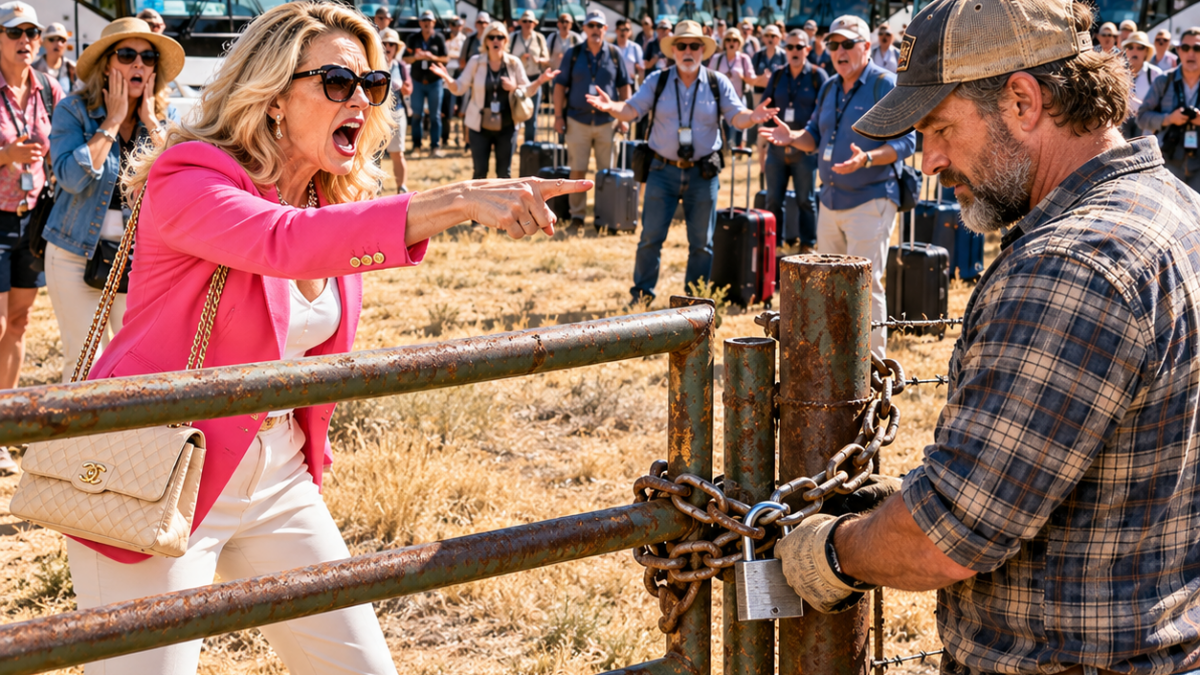
PART3:
They meant well.
Grief makes everyone around you desperate for a solution.
There isn’t one.
I stayed because selling Meadow Bend would have felt like erasing Claire from the map.
So I repaired the fence.
Cleared mesquite.
Brought in twelve Herefords.
Fixed the trough.
Put Levi in a school ten minutes away.
Worked contract grading jobs when I could.
Raised cattle badly enough to learn quickly and well enough that the animals survived my education.
Levi and I built something that was not the life we planned.
But it was a life.
Some evenings we’d sit on the porch while the sun turned the field copper.
Claire used to say Arizona sunsets looked fake.
“Too much saturation.”
I’d say:
“Nature needs editing?”
“Arizona does.”
Levi remembered that.
Every once in a while he’d look west and say:
“Mom would’ve turned the saturation down.”
Those were good evenings.
Then Crestview Meadows appeared.
The subdivision itself wasn’t new when Claire died.
It had gone up eight years earlier on acreage directly east of ours.
Two hundred homes.
Terracotta roofs.
Stone entrance monument.
Clubhouse.
Pool.
Walking trails.
HOA.
The subdivision fence ran along my eastern line, but our parcels had never been connected legally.
No shared easement.
No covenant.
No annexation.
Nothing.
My property predated Crestview.
The deed was clean.
The land was agricultural.
I paid county taxes.
I owned every foot between my survey pins.
Most Crestview residents understood that.
Some waved when I rode the fence.
Kids liked the cattle.
A retired couple named the biggest Hereford “Mr. Pickles” without asking me.
That was fine.
Brenda Kessler was different.
She became HOA president two years after moving into Crestview.
Salon blonde.
Tailored blazers.
Silk blouses.
White Mercedes-Benz GLE.
Fifty-one years old and somehow always dressed as if a photographer might jump out of a mesquite bush and demand an executive portrait.
Brenda did not walk through places.
She arrived.
She had opinions about everything.
Trash cans.
Door colors.
Fence stains.
Basketball hoops.
Children’s bicycles.
Wind chimes.
One newsletter included a three-paragraph statement explaining why visible garden hoses undermined neighborhood excellence.
She called herself a “community steward.”
Ray, my neighbor to the south, called her “the governor of nowhere.”
I tried to stay out of it.
Then Brenda noticed Meadow Bend.
The field was flat.
Accessible from the county road through one steel cattle gate.
Wide enough for vehicles to turn.
Close to the trailhead tourists used to reach a scenic overlook west of the subdivision.
To me it was grazing land.
To Brenda it looked like a parking lot that had forgotten to charge admission.
The first time I caught her on my property was a Saturday in April.
I was checking the south trough when I saw three women walking across the center of the field.
Brenda.
Cynthia Marsh from the HOA board.
And somebody carrying a clipboard.
They were pointing.
Measuring with their eyes.
I drove over on the four-wheeler.
Stopped twenty feet away.
“Morning.”
Brenda lowered her sunglasses.
“Garrett.”
I had never introduced myself to her.
Apparently she had done homework.
“What are you doing?”
“We’re evaluating the land.”
“For?”
“Community use.”
I turned off the four-wheeler.
“This isn’t community land.”
She smiled.
“It is adjacent to Crestview.”
“So is the county highway.”
“Don’t be difficult.”
“I asked you a question.”
The clipboard woman looked uncomfortable.
Brenda did not.
“This acreage is underutilized.”
“I run cattle.”
“Twelve animals on thirty-eight acres.”
“Correct.”
“That’s not efficient.”
I looked at her.
“Are you a rancher?”
“No.”
“Then efficiency probably isn’t your problem.”
Her smile hardened.
“We’re considering ways the space might benefit everyone.”
“It already benefits me.”
“Garrett.”
She said my name softly.
Condescendingly.
As if we were negotiating and I had not realized it.
“You’ve had a difficult few years.”
That got my attention.
She glanced toward the house.
“I understand your wife passed.”
I said nothing.
“Sometimes people hold onto things because of grief.”
The clipboard woman stared at the ground.
Brenda continued.
“Property should serve a purpose.”
“It does.”
“Beyond sentiment.”
I stepped off the four-wheeler.
“Leave.”
She blinked.
“What?”
“Get off my property.”
Her eyes changed.
She wasn’t used to direct answers.
“We’re discussing community planning.”
“No.”
“You don’t get to—”
“I do.”
I pointed toward the east fence.
“Your subdivision is that way.”
For a few seconds, nobody moved.
Then Brenda put her sunglasses back on.
“We’ll see.”
She walked away.
That should have been warning enough.
Two weeks later, I found tire tracks.
Not pickup tracks.
Heavy.
Wide.
The grass in the center of Meadow Bend had been flattened into a rectangle.
Cigarette butts.
Plastic water bottles.
A torn paper ticket.
Diesel smell.
I drove toward the gate.
My lock was gone.
In its place:
Shiny combination padlock.
New.
A laminated sign hung inside.
CRESTVIEW MEADOWS OVERFLOW PARKING
AUTHORIZED VEHICLES ONLY
Gold HOA logo.
I stood there for a long time.
It’s strange what makes anger feel real.
Not tire tracks.
Not the lock.
The word authorized.
Someone else had put a sign on my gate authorizing people to enter my land.
I cut the lock with thirty-six-inch bolt cutters.
Replaced it.
Photographed everything.
Then drove to Brenda’s house.
White Mercedes.
Perfect driveway.
Landscaping so precise it looked computer generated.
She answered holding a glass of wine.
Two in the afternoon.
Silk wrap top.
Cream pants.
“Garrett.”
“Someone cut my lock.”
She sipped.
“And put an HOA parking sign on my gate.”
“Yes.”
I waited.
“The community required overflow parking.”
“On my property?”
“The field isn’t being used.”
“It has cattle.”
“Not in the center.”
“That’s not how ownership works.”
She leaned against the doorway.
“Tour operators bring people to the overlook.”
“So?”
“The road shoulder has become unsafe.”
“Then talk to the county.”
“We found a practical solution.”
“You rented my field.”
“I arranged access.”
“Without asking me.”
“You would have said no.”
I stared.
She actually believed that helped.
“Yes.”
She smiled.
“Exactly.”
I felt heat in my chest.
Kept my voice level.
“Do not use my property again.”
“Garrett, you should be grateful.”
That word.
Grateful.
“For?”
“I’ve created value from acreage you’ve allowed to become an eyesore.”
I looked past her at the white Mercedes.
Then back.
“You cut a lock off land that doesn’t belong to you.”
“It benefits Crestview.”
“You don’t have authority outside Crestview.”
Her smile disappeared.
“I’ve spoken with county contacts.”
“About what?”
“Blight designation.”
I almost laughed.
“Cattle pasture is blight?”
“If land isn’t maintained appropriately, there are remedies.”
“Good luck.”
She stepped closer.
“Don’t test me.”
“I’m not.”
“I know people.”
“Congratulations.”
“I understand how things work.”
I nodded toward the field in the distance.
“So do I.”
I left.
The next morning, two portable toilets appeared in Meadow Bend.
Blue plastic.
Right beside the subdivision fence.
Desert Comfort Rentals.
I called.
Dispatcher checked the order.
“Brenda Kessler.”
“That’s what I assumed.”
“She listed the location as Crestview Meadows community parking.”
“It isn’t.”
Pause.
“Sir, we’ll need authorization from the renter to cancel.”
“She’s renting property she doesn’t own.”
Another pause.
“I need a supervisor.”
Three days later, the toilets remained.
Then came the buses.
I arrived home one Wednesday to find Levi standing near the fence.
“Dad.”
“What?”
“Whose buses are those?”
Four charter coaches sat in the middle of Meadow Bend.
Engines idling.
Tourists pouring out.
Sun hats.
Water bottles.
Cameras.
Guides directing them toward the overlook trail.
One woman had a walking stick that cost more than my first saddle.
The buses had crushed grass into broad ruts.
I started filming.
“Go inside, buddy.”
“Why?”
“Because I need to deal with something.”
“Is it the HOA lady?”
“Yes.”
He made a face.
He was twelve by then.
Old enough to recognize problems.
I called the sheriff.
By the time a deputy arrived the following morning, buses were gone.
He looked at the tire tracks.
My deed.
The gate.
“You can file trespassing complaints.”
“Can you stop them?”
“If we catch them here.”
“So they can trespass repeatedly until timing works?”
He sighed.
“I understand your frustration.”
“Do you?”
“Yes.”
He looked toward Crestview.
“But right now, without an active incident, much of this becomes civil.”
“Fine.”
I pointed at the ruts.
“Document it.”
He did.
I took twenty-three photographs after he left.
Trash.
Tracks.
Flattened grass.
Gate.
Lock.
Everything went into a folder.
KESSLER TRESPASS — ONGOING.
Claire’s old oak desk had a deep lower drawer.
That’s where I kept it.
Then Brenda mailed me a letter.
Not a request.
A declaration.
According to the Crestview Meadows HOA board, parcel 401-26-038 had been “incorporated into the Crestview community area plan.”
Effective immediately.
I was expected to maintain the property according to HOA standards.
Submit modifications.
Pay quarterly assessments of $475.
I read the letter twice.
Levi sat at the kitchen table doing homework.
“Bad?”
“Funny.”
“What?”
“Someone thinks she’s the governor of Arizona.”
“Blonde lady?”
“Yes.”
I called the assessor’s office.
Parcel number.
Ownership.
Zoning.
Any transfer?
No.
HOA annexation?
No.
Recorded covenant?
No.
Change in legal description?
No.
The clerk said:
“An HOA cannot vote to take someone’s property.”
“I know.”
“I’m just telling you because apparently someone needs to hear it.”
“Can you note that I called?”
“Yes.”
Then I called Paul Wakefield.
Property attorney in Prescott.
Ray gave me the number.
“Mean?”
I asked.
Ray said:
“No.”
“Good?”
“Much worse.”
Paul’s office smelled like old paper and coffee.
No fancy art.
Arizona statutes stacked on shelves.
He read my folder for twenty minutes.
Then:
“How long has she rented the land?”
“I don’t know.”
“Money?”
“I assume.”
“Proof?”
“Not yet.”
“Any county filings?”
“Assessor says no change.”
“We’ll check recorder.”
He tapped Brenda’s letter.
“This has no effect.”
“I figured.”
“But it’s useful.”
“Why?”
“It shows she is asserting authority.”
He placed it back.
“Let her keep writing.”
I did not like that advice at first.
Then I learned why lawyers love written arrogance.
Brenda escalated.
Noise complaint about cattle.
Constant bellowing.
Public-health hazard.
Fecal contamination.
Shared waterways.
County inspector came.
Counted twelve cattle on thirty-eight acres.
Walked the wash.
No shared drainage.
No health issue.
He said:
“Whoever filed this has never actually met a cow.”
Closed.
Into the folder.
Then a bulldozer appeared.
Ray called.
“Garrett.”
“What?”
“Cat D5 in Meadow Bend.”
My heart dropped.
“Brenda?”
“White blazer. Clipboard.”
“Don’t confront them.”
I drove home.
Caterpillar D5 parked in the field.
Blade down.
Eighty-foot strip of grass scraped clean.
Topsoil pushed aside.
Dump truck loaded with crushed gravel.
Brenda near the gate.
White blazer.
Wedge sandals.
Construction site.
I got out slowly.
“What is this?”
She smiled.
“Improvement.”
“To what?”
“The parking area.”
“There is no parking area.”
“Tour companies need a stable surface.”
“You are grading my land.”
“Community-adjacent land.”
“That means nothing.”
“The board approved it.”
“The board does not own it.”
Contractor looked between us.
“Ma’am?”
Brenda ignored him.
I walked closer.
“This is parcel 401-26-038.”
The contractor removed his hard hat.
“I was told HOA common area.”
“It isn’t.”
I pulled my phone.
Displayed assessor map.
Deed.
He looked at Brenda.
“Lady.”
“It is under community control.”
“No.”
I handed him the parcel record.
He read.
Then:
“I’m loading out.”
Brenda’s head snapped toward him.
“I authorized this.”
“I’m not getting sued over your HOA.”
“You’ve already been paid.”
“Keep it.”
He walked toward the dozer.
I almost respected him immediately.
Brenda looked at me.
“You’re obstructing community infrastructure.”
“No.”
“Eventually the county will condemn this.”
“Then the county can tell me.”
“You think because your wife’s name is on some old deed—”
I stopped breathing.
“What?”
She realized too late.
Then committed.
“This sentimental attachment doesn’t make you above community needs.”
I stepped closer.
Not threatening.
Just enough that she stopped smiling.
“Do not use my wife again.”
For once, Brenda said nothing.
The contractor loaded the dozer.
Dump truck left.
Sheriff’s deputy came later.
Older woman.
She photographed damage.
Took statement.
Explained formal trespass notice.
“Once she’s been clearly notified, future entry is different.”
I filed.
That evening, Levi and I sat on the porch.
Raw strip visible across the field.
“Dad?”
“Yeah?”
“Is she going to take Meadow Bend?”
“No.”
“Promise?”
I looked at him.
Kids know when adults use the word probably.
So I didn’t.
“I promise.”
That night I wrote every detail.
Time.
Weather.
Names.
Contractor company.
Deputy.
Damage.
Then Paul called two days later.
“Come in.”
His voice told me.
I drove to Prescott.
A thick envelope sat on his desk.
County recorder records.
Three documents.
First:
“Community Area Designation.”
No such legitimate property mechanism for what Brenda claimed.
It stated my parcel had voluntarily joined Crestview’s common-area plan.
Signed by Brenda.
Second:
Planning request seeking recreational-commercial use based on established community parking.
Third:
Affidavit.
That one mattered.
Brenda swore she was the authorized representative of parcel 401-26-038.
Claimed the property had been transferred to community management by mutual agreement.
Notarized.
Paul tapped the signature.
“She swore this.”
“I never authorized anything.”
“I know.”
“She knows.”
“Yes.”
“Then what?”
He sat back.
“This is no longer a woman misunderstanding an HOA boundary.”
“What is it?”
“Potential false instrument.”
He looked at me.
“Potential fraud.”
Then he slid another file forward.
Bus records.
Paul had contacted tour operators whose information appeared on trash, tickets, and camera footage.
Three responded.
Brenda charged two hundred dollars per bus per visit.
Peak season:
Four to five days weekly.
Some days six or seven buses.
Winter reduced schedule.
Estimated two-year revenue:
$140,000 to $170,000.
My field.
Her money.
I stared at the number.
“She makes more parking buses on my land than I make grazing it.”
Paul nodded.
“Not reported to HOA from what we can tell.”
“Personal?”
“Operators say they paid her.”
I laughed once.
Hard.
“Does Crestview know?”
“Probably not.”
“She isn’t doing this for community benefit.”
“No.”
“What do we do?”
“Build.”
That was Paul’s word.
Build.
“Not confront.”
“Build.”
So we built.
Cameras.
Four trail units.
Gate.
Center field.
Infrared.
Timestamped.
Within a week:
Buses.
Passengers.
Brenda’s Mercedes.
Cash envelopes.
Parking passes.
One frame showed her counting twenties through the driver’s window.
Next:
Survey.
Licensed.
Every boundary.
No ambiguity.
My gate.
My access.
My field.
Nearest HOA common property more than two hundred feet away.
Next:
Formal cease-and-desist.
Certified.
No trespass.
No rentals.
No parking.
No representations of ownership.
Stop use immediately.
Brenda signed for it.
We had the green card.
Next:
Sheriff’s complaint supplemented.
Deed.
Survey.
Cameras.
County filings.
Next:
Tour companies notified.
Five.
Three immediately suspended Meadow Bend use.
One, Copper Canyon Tours, provided full payment history.
$31,400.
Eighteen months.
They were angry.
Not at me.
They thought they had rented authorized parking.
Next:
Tax and licensing issues reported through appropriate channels.
Paul handled what needed handling.
I stayed focused on land.
Then I bought chain.
Twenty feet.
Grade 70.
Heavy transport chain.
Medeco padlock.
Not because I wanted drama.
Because normal locks had already disappeared.
I hung the chain across the gate.
Bolted a metal sign beside it:
PRIVATE PROPERTY
PARCEL 401-26-038
NOT HOA LAND
NO HOA JURISDICTION
NO TRESPASSING
I stood in the road at sunset.
For the first time in months, Meadow Bend felt quiet.
Mine.
Brenda responded with a $2,500 HOA fine.
Failure to maintain community-adjacent property.
Obstruction of community access.
Threatened lien.
Paul read it.
Then laughed.
“She can’t fine you.”
“I know.”
“You are not in the HOA.”
“I know.”
“She might as well send you a parking ticket for Mars.”
“What if she files the lien?”
“We remove it.”
He looked serious again.
“But desperation is increasing.”
It did.
She gathered eighty-four signatures asking the county to condemn my field as a nuisance.
Claims:
Vermin.
Runoff.
Unsafe agricultural use.
Neglect.
Ray told me most signatures came from a wine-and-cheese gathering at Brenda’s house.
“Chardonnay and outrage.”
He said.
Then she approached me at Levi’s school.
Pickup line.
Public place.
She knocked on my window.
Tap.
Tap.
Tap.
I rolled it down.
“I received your lawyer’s letter.”
“Good.”
“You’re making a mistake.”
“I’m picking up my son.”
“My niece is here.”
“Then pick her up.”
She leaned closer.
“You cannot block community access forever.”
“There is no community access.”
“We have eighty-four signatures.”
“Signatures don’t transfer title.”
“I have county contacts.”
“You filed an affidavit claiming you represented my property.”
Her expression changed.
Just a fraction.
Paul had not told her we found it yet.
“I don’t know what you’re talking about.”
“Yes, you do.”
“You’d better be careful accusing me.”
“I didn’t accuse you.”
I looked directly at her.
“I read your signature.”
Her jaw tightened.
“You let that field rot while you played cowboy.”
Played cowboy.
I had twelve cattle.
Fence repairs.
Feed bills.
Water problems.
Veterinary bills.
And a son I was raising alone.
She looked at all of it and saw costume.
“It’s not your field.”
“That remains to be seen.”
“No.”
I rolled up the window.
“This part has already been seen.”
She stepped back as the glass closed.
That night I checked cameras.
Her Mercedes had driven past four times in twelve days.
Slow.
Watching.
Paul said:
“She’ll do something bigger.”
“How do you know?”
“Because she doesn’t believe your no is legitimate.”
That sentence stayed with me.
People who respect boundaries adjust after a no.
People who believe they’re entitled treat no as an obstacle.
Friday night, 9:47 p.m.
My phone buzzed.
Motion.
Camera two.
Gate.
I opened the app.
Sparks.
At first I couldn’t understand the image.
Then zoomed.
Brenda.
Black Lululemon jacket.
Sneakers.
Battery-powered angle grinder.
Cutting through my chain.
White Mercedes parked with headlights off.
I stood in the kitchen.
Levi working on a history project.
“Dad?”
“Nothing.”
He looked up.
“Brenda?”
“Yeah.”
“What is she doing?”
I hesitated.
Then:
“Making a very bad decision.”
My first instinct was drive out.
Stop her.
Paul’s advice came back.
Preserve evidence.
Call law enforcement.
Do not create a confrontation.
I watched the camera sequence.
Sparks.
Chain dropping.
Gate opening.
Mercedes entering.
Brenda standing in my field making a phone call.
I saved every image.
Called Paul.
“She cut the chain.”
“Video?”
“Images and clip.”
“Do not approach.”
“She is inside now.”
“Call sheriff. Preserve everything.”
I did.
By the time a patrol passed, she had left.
But now we had entry after formal notice.
Damage to the lock and chain.
Evidence.
The following week Ray brought me a flyer.
Crestview Meadows Community Discovery Day.
Saturday.
8 a.m. to 4 p.m.
Ten charter buses.
Taco truck.
Kettle corn.
Portable bathrooms.
Bounce house.
Scenic walking access.
Open-space celebration.
Location:
Meadow Bend.
My field.
Ray stared at me.
“She has lost her mind.”
I called Paul.
“She is holding a festival.”
“How many buses?”
“Ten.”
“People?”
“Could be five hundred.”
Silence.
“Paul?”
“Send flyer.”
I did.
He called back.
“We need law enforcement aware before anyone arrives.”
That changed the strategy from the source of Brenda’s fantasy to something safer and cleaner.
I did not want five hundred people trapped with no plan.
Those passengers were innocent.
The drivers were innocent.
Vendors had been lied to.
So we notified the sheriff’s office in advance.
Provided the flyer.
The deed.
Survey.
Prior trespass notice.
Cut-chain footage.
Paul arranged to have an officer contact a supervisor.
The sheriff’s office decided deputies would stage nearby Saturday morning.
Their instruction to me was simple.
Do not confront crowds.
Do not create a dangerous vehicle obstruction.
Secure my property only when it could be done safely.
Document.
Call immediately if Brenda proceeded.
Saturday came.
Clear.
Hot.
Blue sky without mercy.
I woke at five.
Moved the cattle to the north section behind secondary fencing.
Checked water.
Made coffee.
Drove to the gate.
The chain Brenda cut was still gone.
Gate open.
I parked fifty yards east.
Waited.
At 7:39, the first bus appeared.
Copper Canyon Tours.
Driver slowed at gate.
Brenda stood inside waving him through.
Coral sundress.
White Valentino sandals.
Bullhorn.
Of course she had a bullhorn.
The bus entered.
Forty-six passengers.
Second.
Third.
By 8:15:
Five.
By 8:45:
Eight.
At nine:
Ten full coaches.
More than five hundred people.
Taco truck.
Kettle-corn canopy.
Bathroom trailer.
Bounce house inflating near my east fence.
Families.
Tourists.
Crestview residents.
Brenda walked among them with the glow of someone admiring her own event.
I watched.
Not triumphant.
Sick.
Claire’s Meadow Bend looked like a county fair somebody had dropped from the sky.
I called the sheriff.
“They’re all here.”
“Deputies moving.”
I waited until bus traffic stopped and no vehicle was approaching the gate.
Then I drove over.
I carried the replacement chain.
But instead of trapping people without warning, I closed the gate and looped the chain loosely while keeping the padlock in my hand until deputies arrived less than ten minutes later.
That distinction mattered.
My goal wasn’t frightening families.
It was ending Brenda’s use.
Two cruisers.
Then another.
Sergeant Maria Ortega.
Three deputies.
I handed her the folder.
She already had copies, but I brought originals.
She checked the parcel.
Survey.
Cease-and-desist receipt.
Cut-chain footage.
Flyer.
False affidavit.
Then looked into the field.
“This is all yours?”
“Every acre.”
“No event permission?”
“No.”
“No parking agreement?”
“No.”
She nodded.
“Lock the gate, but keep an emergency opening available until we get buses moving.”
I clicked the padlock.
The sound was small.
It felt enormous.
One bus driver noticed first.
Walked toward us.
“What’s happening?”
Sergeant Ortega said:
“Sir, we’ll explain in a moment. Your vehicle isn’t being seized. We’re going to coordinate an orderly departure.”
He looked at me.
“You own this?”
“Yes.”
His face changed.
“We paid for this.”
“To whom?”
He pointed.
Brenda.
A second driver arrived.
Then tour guide.
People saw deputies.
Phones appeared.
Whispers spread.
Brenda spotted us.
She came across the field fast.
Bullhorn at her side.
Dust kicking around white sandals.
“Officers.”
Sergeant Ortega turned.
“Ms. Kessler?”
“Yes.”
“This event is authorized.”
“By whom?”
“The Crestview board.”
“The property owner says otherwise.”
“Garrett is not authorized to obstruct community use.”
I almost admired consistency.
Sergeant Ortega held up the survey.
“This parcel belongs to Mr. Hollis.”
Brenda laughed.
“He’s disputed that.”
“No.”
I said it quietly.
She glared.
“The board incorporated it.”
Sergeant Ortega looked at her.
“An HOA board cannot vote itself ownership of neighboring property.”
Brenda’s face reddened.
“You don’t understand the arrangement.”
“Show me.”
She held a clipboard.
Passed a document.
Sergeant read.
“This is your HOA resolution.”
“Yes.”
“This doesn’t transfer title.”
“It establishes community control.”
“No.”
Brenda looked at me.
“You planned this.”
“I warned you.”
“You invited all these police here to humiliate me.”
“No.”
“I sent a cease-and-desist.”
“You ignored it.”
“You cut my chain.”
Her eyes flashed.
“You can’t prove that.”
I lifted my phone.
Trail-camera image.
Sparks.
Black jacket.
Her face visible.
She stopped.
The Copper Canyon driver had been listening.
Gray mustache.
Stocky.
He stepped closer.
“You told us HOA owned this.”
Brenda turned.
“It does.”
The sergeant said:
“No, ma’am.”
Driver’s face darkened.
“We paid you thirty-one thousand dollars.”
Brenda said:
“Those were community-access fees.”
“Paid to you.”
“That money supported operations.”
The driver looked at Sergeant Ortega.
“We have receipts.”
Another tour manager joined.
“So do we.”
Then another.
People started understanding.
Not stranded.
Scammed.
That distinction changed the mood.
A woman carrying tacos lowered her plate.
“What do you mean she doesn’t own this?”
A Crestview resident said:
“Brenda?”
Brenda raised the bullhorn.
Sergeant Ortega put one hand up.
“Do not use that right now.”
Brenda froze.
For perhaps the first time in her tenure as HOA president, a louder object was taken away from her before she could use it.
Sergeant said:
“We’re going to clear this property safely.”
She spoke to the bus drivers.
“One at a time.”
Then to me.
“Can the gate accommodate outbound buses if chain is removed temporarily?”
“Yes.”
I unlocked it under deputy supervision.
Bus one backed carefully.
Then turned.
People reboarded.
No panic.
A lot of confusion.
Some anger.
Many phones recording.
The bounce house continued inflating for another two minutes until the vendor realized nobody wanted a bounce house at an active trespass investigation.
He unplugged it.
It slowly collapsed behind Brenda while she argued with a deputy.
Ray later said no metaphor in history had ever worked harder.
I wish Claire had seen it.
Maybe not.
She was kinder than me.
Brenda kept insisting.
“The field was unused.”
Not relevant.
“I improved it.”
Not relevant.
“Tourism benefits the county.”
Not relevant.
“Garrett never objected until recently.”
False.
“I have community support.”
Not ownership.
Finally Sergeant Ortega asked:
“Ms. Kessler, did you receive a certified cease-and-desist?”
Brenda said nothing.
“Did you sign for it?”
Silence.
“Did you enter this parcel after that notice?”
“I was performing association duties.”
“Did you cut his chain?”
No answer.
The sergeant nodded toward a deputy.
“Please step over here.”
Brenda’s complexion changed.
Pink.
Red.
Then pale.
Not a dramatic movie arrest.
No tackle.
No screaming.
She received a formal criminal-trespass citation related to the documented conduct and was advised the matter would be referred for investigation along with the false filings.
Her confidence did not collapse all at once.
It leaked.
You could see her trying different tools.
Authority.
Charm.
Threat.
Technical language.
Community interest.
Nothing worked because every tool depended on everyone accepting her premise.
That she had rights to my field.
She didn’t.
By 11:30, the last bus was leaving.
The taco truck packed.
Kettle corn gone.
Bathroom trailer scheduled for pickup.
Deflated bounce house rolled like a dead sea creature near the fence.
Brenda stood beside her Mercedes talking furiously into her phone.
Levi came out with Ray.
He had watched most of it from a safe distance.
“Dad.”
“Yeah?”
“Did we win?”
I looked across Meadow Bend.
Tire tracks.
Trash.
Deputies.
Tourists still boarding.
Brenda.
“No.”
He frowned.
“But she’s leaving.”
“Yes.”
“So?”
I put one hand on his shoulder.
“Winning comes later.”
He thought.
“Lawyer answer.”
“Unfortunately.”
The legal process did take time.
Weeks.
Months.
Not forty-five cinematic minutes.
The county attorney reviewed the false affidavit.
The planning documents.
Trespass history.
Lock cutting.
Money.
Tour companies.
Brenda’s own records.
Charges followed.
Not every theory Paul originally suspected became a charge.
That is how real cases work.
Evidence has to match specific statutes.
But false filings carried weight.
Fraud-related conduct.
Trespass.
Money obtained through misrepresentation.
Property damage.
Her attorney worked aggressively.
Brenda kept saying publicly that the case was a political misunderstanding.
Then financial records appeared.
That ended much of the sympathy.
The tour companies sued.
Three first.
Then others.
Copper Canyon wanted $31,400 back.
Total documented claims from operators exceeded one hundred thousand dollars.
The Arizona Department of Revenue became interested in the commercial activity.
Tax authorities asked questions.
I did not follow every detail.
Paul told me:
“Never celebrate an audit.”
“Why?”
“Because eventually they remember you exist too.”
Fair.
Crestview held an emergency meeting three days after the criminal filing became public.
I did not attend initially.
Ray called.
“You need to come.”
“Why?”
“They’re voting.”
“On Brenda?”
“Yes.”
“I don’t live there.”
“Exactly why you should see it.”
I went.
Stood in the back.
More than a hundred residents.
Brenda sat at the front.
Navy blazer.
Pearls.
No bullhorn.
Board member David Singh read a summary of legal documents.
Deed.
Survey.
Cease-and-desist.
False land representations.
Parking receipts.
Tour-company complaints.
Then:
“Did the general membership authorize a commercial parking operation on the Hollis parcel?”
No.
“Did the board?”
Members looked around.
Several said no.
Brenda leaned toward the microphone.
“As president, I had operational discretion.”
David said:
“You do not have operational discretion over Garrett’s property.”
Applause.
Brenda’s eyes hardened.
“This community has benefited from that field for years.”
A woman stood.
“We didn’t know you were charging people.”
Another:
“Where did the money go?”
Brenda said:
“Operational expenses.”
Treasurer spoke.
“Not through HOA accounts.”
Silence.
That did it.
Money almost always does.
A retired man stood.
“You told us Garrett donated the field.”
Brenda said:
“I said community access had been established.”
“That’s not what you said.”
Another voice:
“You told me his wife transferred it before she died.”
My blood went cold.
I stood.
“What?”
The room quieted.
The woman turned.
“You didn’t know?”
“No.”
She looked at Brenda.
“She told several of us Claire had agreed to community use and you were refusing to honor it because of grief.”
I could not move for a second.
Brenda looked down.
That hurt worse than buses.
Locks.
Money.
She had used Claire’s death as documentation she never had.
I walked toward the front.
Paul’s voice existed in my head.
Do not lose control.
I stopped several rows away.
“Did you tell people my wife authorized you?”
Brenda said:
“This isn’t the forum.”
“Did you?”
Her attorney whispered.
She did not answer.
I nodded.
That was enough.
The removal vote was not close.
Eleven to one among the governing board structure authorized to act.
Her own vote was the one.
When the result was announced, nobody cheered loudly.
Mostly relief.
The new board issued me a written apology.
Plain white paper.
No gold foil.
They disclaimed Brenda’s authority.
Confirmed Meadow Bend was not HOA land.
Agreed to cooperate with investigators.
Then they audited her presidency.
I learned later the parking operation was not the only questionable thing.
But that was Crestview’s fight.
Mine remained Meadow Bend.
The court eventually issued a long-term no-trespass order.
Brenda could not enter parcel 401-26-038.
The day Paul called, I was fixing fence near the wash.
“She’s barred.”
“How long?”
“Ten years under the order.”
I looked at Claire’s field.
“And the criminal case?”
“Plea discussions.”
“Jail?”
“Don’t assume.”
“I didn’t.”
“Probation and restitution are possible.”
“Fine.”
“You sound disappointed.”
“No.”
I meant it.
I did not need Brenda in prison to know I owned my land.
I needed her stopped.
That had happened.
Her Mercedes eventually disappeared from Crestview.
Rumor said tax issues and restitution forced major asset sales.
I never confirmed.
I stopped caring.
The tour companies settled their claims.
Some recovered money.
Some absorbed losses.
One driver, Frank Mercer from Copper Canyon, came by personally.
He brought a case of beer.
“I don’t drink much.”
“Then give it to Ray.”
“Gladly.”
He stared at Meadow Bend.
“We had no idea.”
“I know.”
“She showed us documents.”
“I know.”
“She had parking passes.”
“I know.”
He shook his head.
“She looked legitimate.”
That sentence.
Again.
Legitimate.
Official logo.
Printed sign.
Nice car.
Confident voice.
People underestimate the power of presentation.
“I’m sorry about the field.”
“Not your fault.”
“Our buses tore it up.”
“You were lied to.”
“We should’ve checked ownership.”
“Yes.”
He looked surprised.
I smiled.
“Both can be true.”
He helped pay for restoration through company settlement.
That mattered more than apology.
Monsoon season came.
Rain hit hard.
The scraped dozer strip softened.
Grass started returning.
Buffalo grass.
Desert marigold.
Tire ruts filled.
By October, Meadow Bend looked less wounded.
One evening Levi and I walked the field.
He was taller.
Teenagers do that suddenly.
He kicked a stone.
“Mom named it here?”
“Pretty much.”
“Why Meadow Bend?”
“The grass curves along the wash.”
He looked.
“That’s not very creative.”
“Tell her.”
He smiled.
Then:
“What are we going to do with the south corner?”
I knew what he meant.
The area most damaged by buses.
“I’ve been thinking.”
“Cows?”
“No.”
“Barn?”
“Eventually.”
“Parking lot?”
I stared at him.
He laughed.
“Too soon?”
“Yes.”
The idea came from Claire, indirectly.
She had always wanted something planted there.
Not commercial.
Useful.
Community garden.
Not HOA property.
Not surrender.
Invitation.
There is a difference between somebody taking and you choosing to give.
That difference had become important to me.
I rented a tiller.
Built sixteen raised cedar beds.
Compost.
Irrigation.
Ray helped.
Levi complained until Ray told him working builds character.
Levi said:
“That’s what old people say when they want free labor.”
Ray replied:
“Correct.”
We put up a small sign.
MEADOW BEND COMMUNITY GARDEN
ESTABLISHED BY THE HOLLIS FAMILY
Then below:
THIS LAND BELONGS TO THE PEOPLE WHO TAKE CARE OF IT.
The wording was not legally precise.
Paul hated it.
“People could misread that.”
“It is philosophy, not a deed.”
“You’re a difficult client.”
“So I’ve heard.”
Families from Crestview asked for beds.
I said yes.
Not the HOA.
Families.
Mrs. Wynn planted tomatoes.
Retired couple from Pinyon Lane planted basil, rosemary, and peppers.
Ray’s granddaughter planted sunflowers.
Levi took the east bed.
Watermelons.
Claire loved watermelon.
Not store watermelon.
Homegrown.
She said store watermelon tastes like “pink water with ambition.”
The first watermelon Levi harvested weighed fourteen pounds.
He put it on the porch.
We cut it at sunset.
Too many seeds.
Uneven sweetness.
Perfect anyway.
Levi took a bite.
“Mom would complain.”
“She’d say we watered inconsistently.”
“Did we?”
“Yes.”
He laughed.
The community garden changed relationships.
Not magically.
Some Crestview residents still avoided me.
Some had signed Brenda’s petition.
A few believed I embarrassed the subdivision publicly.
That’s fine.
People do not have to like you to respect your boundary.
But many came.
Talked.
Asked.
That’s the word I noticed most.
Asked.
“Can we bring compost?”
“Yes.”
“Could we plant another bed?”
“Let’s measure.”
“Can the kids pick sunflowers?”
“Ask Ray’s granddaughter.”
Nobody assumed.
Nobody arrived with a board resolution.
Nobody cut a lock.
The gate stayed mine.
Keys:
Me.
Levi.
Ray for emergencies.
The HOA board had no key.
That was intentional.
Crestview’s new president was David Singh.
Quiet.
Retired dentist.
Did not seem to enjoy authority.
Excellent qualification.
He visited one afternoon.
“Garrett.”
“David.”
“I want to discuss the garden.”
My eyebrows went up.
He laughed.
“Relax.”
“Bad opening.”
“No HOA control.”
“Good.”
“Actually the opposite.”
“What?”
“We’d like to contribute to water costs.”
I stared.
“Voluntarily?”
“Yes.”
“Without claiming jurisdiction?”
“Yes.”
“Written that way?”
“Paul already reviewed the draft.”
That surprised me.
“You talked to Paul?”
“He scares me.”
“He should.”
Crestview funded a small portion of irrigation expenses under a revocable written license.
No property interest.
No easement.
No control.
People sometimes thought this meant I had softened.
I had.
But softness after a boundary is respected is not weakness.
It’s what boundaries are for.
They let relationships exist without constant fear of being consumed.
Brenda never understood that.
Everything she saw became something she could use.
Empty field?
Parking.
Fence?
Obstacle.
Gate?
Lock to cut.
Widower?
Someone too tired to fight.
Dead wife?
Convenient story.
HOA title?
Authority everywhere.
The problem wasn’t ambition.
It was the absence of edges.
Everything belonged to Brenda until somebody with more authority said otherwise.
I think about the ten buses sometimes.
People tell the story dramatically.
I chained five hundred people inside.
They panicked.
Karen got arrested.
Reality was messier.
And better.
We coordinated with deputies.
People exited safely.
Most passengers were confused, not terrified.
Drivers were victims too.
Brenda’s collapse happened through evidence, not spectacle.
That matters to me.
Because the point isn’t revenge.
The point is that I didn’t have to become Brenda to stop Brenda.
I didn’t seize her property.
Didn’t destroy her Mercedes.
Didn’t threaten her family.
Didn’t invent fines.
Didn’t forge documents.
I documented.
I warned.
I hired a lawyer.
I surveyed.
I called law enforcement.
I let facts become heavier than her confidence.
That’s a slower kind of satisfaction.
It also lasts.
The field is still here.
Her authority isn’t.
Levi is fifteen now.
Six feet tall.
No idea where that came from.
Claire was five-three.
I’m five-eleven.
He claims milk.
I blame mutation.
He talks about studying environmental science.
Maybe ranch management.
Maybe engineering.
Changes weekly.
I don’t push.
One evening he asked:
“If Mom was alive, would she have let Crestview use the field?”
I took time.
“She might’ve let people park for a fundraiser.”
“Really?”
“Yes.”
“Even Brenda?”
“Probably once.”
“Why?”
“Your mother was generous.”
He looked toward the garden.
“Then why did you fight so hard?”
I looked at him.
“Because generosity only exists if you can say no.”
He frowned.
I explained.
“If someone takes your wallet and gives the money to charity, that isn’t generosity.”
“Oh.”
“If Brenda had asked, maybe we negotiate something.”
“But she didn’t.”
“No.”
“She acted like asking was beneath her.”
“Yes.”
Levi nodded.
“That makes sense.”
Then:
“I still would’ve said no.”
“Your mother’s side would’ve been disappointed in you.”
“Your side wouldn’t.”
“Correct.”
Ray’s granddaughter painted a new sign for the garden last spring.
Flowers along the border.
A little cow.
Levi complained the cow looked like a dog.
She told him:
“Then paint your own.”
He didn’t.
Every Saturday morning, people show up.
Coffee.
Gloves.
Kids.
Dirt.
The same field where buses once idled now smells like basil and wet soil.
No porta-potties unless we actually arrange them for garden events.
And when we do, I place the order myself.
The Desert Comfort dispatcher remembered my name the first time.
“Please tell me Brenda isn’t involved.”
“No.”
“Thank God.”
We laughed.
The legal file remains in Claire’s desk.
Thick.
False affidavit.
Photos.
Letters.
Chain receipt.
Camera stills.
Tour-company statements.
Court order.
I keep the cut section of Brenda’s chain too.
Not as trophy.
Reminder.
Metal is simple.
Locked.
Unlocked.
Cut.
Human boundaries are harder.
A few months after everything ended, I drove Route 89 past the intersection where Claire died.
For years I slowed there.
Could not help it.
Looked at the stop sign.
Imagined white pickup.
Imagined different timing.
One second.
Two.
Maybe she lives.
Grief loves alternate engineering.
Change one variable.
Rebuild the outcome.
But life doesn’t allow redesign after impact.
That day, I did not slow.
Not because I forgot.
Because I finally understood staying on the land wasn’t the same as staying inside the worst day of my life.
Meadow Bend didn’t belong to Claire because she died.
It belonged to our family because she lived.
Difference.
A big one.
That evening I sat by the garden.
Levi carried a watermelon toward the porch.
Ray yelled:
“Don’t drop it.”
Levi yelled back:
“I know.”
Then dropped it.
Cracked open in the dirt.
We ate it anyway.
Claire would’ve laughed until she cried.
I did.
Years ago, Brenda told me:
“You’re nobody.”
A broke rancher.
Widower.
Old deed nobody reads.
She had said things like that enough times that I think she believed identity came from title.
HOA president.
Mercedes.
Board.
Connections.
A person who could make others move.
She mistook visibility for power.
My deed sat in a county database nobody photographed.
My survey stakes were pieces of iron in dirt.
My chain was hardware.
My evidence lived in a plain folder.
Nothing glamorous.
But real power is often boring.
Ownership records.
Signatures.
Boundaries.
Receipts.
Witnesses.
The truth does not need gold embossing.
It just needs to survive long enough to be read.
Brenda’s mistake was believing nobody would read.
Paul did.
Sheriff did.
County attorney did.
Tour companies did.
Crestview residents did.
Eventually even Brenda had to.
The last time I saw her was at a courthouse hallway after one of the property-related proceedings.
She looked different.
Still blonde.
Still expensive clothes.
But no performance.
No clipboard.
No board members around her.
She saw me.
Stopped.
I expected something.
Anger.
Blame.
Maybe apology.
Instead:
“You ruined my life.”
I stood there.
“No.”
Her jaw tightened.
“You could’ve just let us use the field.”
There it was.
Still.
Even after everything.
“You could’ve asked.”
“I shouldn’t have had to.”
I almost laughed.
Instead:
“That’s why we’re here.”
Her attorney touched her arm.
She left.
I watched her go.
Did not feel victorious.
Mostly sad.
Some people lose everything and still protect the belief that cost them everything.
Maybe admitting you were wrong hurts more than consequences.
I don’t know.
Not my problem anymore.
Meadow Bend is my problem.
My responsibility.
Cattle.
Fence.
Water.
Garden.
Levi.
The sunflowers got too tall last summer.
Ray’s granddaughter refused to cut them.
Said bees needed them.
She was right.
A family from Crestview asked if they could hold a small memorial picnic in the garden for their father.
They asked.
I said yes.
Another family wanted to use the field for a school astronomy night.
They asked.
I said yes.
Twenty cars.
Not buses.
We agreed where to park.
No damage.
Everyone left by ten.
People sometimes think the ending is ironic because I now let the community use parts of Meadow Bend.
They miss the point.
Brenda thought my resistance meant I wanted to keep everyone out.
No.
I wanted the choice to remain mine.
Consent is invisible when everyone has it.
You notice it only when someone takes it away.
One autumn morning, a tour bus actually stopped near the gate.
I walked over.
Driver rolled down the window.
“Is this the overlook parking?”
For one second I thought history had become lazy.
“No.”
He checked his tablet.
“Sorry.”
Then:
“Wait. Are you the guy?”
“What guy?”
“The ten-bus thing?”
I sighed.
“Maybe.”
He laughed.
“Don’t worry. I’m not entering.”
“Smart.”
“Where should I go?”
I gave him directions to the legal county lot.
He thanked me.
Drove away.
The gate remained closed.
No drama.
That felt better than the famous day.
Boundaries working without conflict.
That’s success.
Claire’s name remains on the deed.
Paul once asked if I wanted to update ownership records.
Eventually I will for estate planning.
But I wasn’t ready then.
Her signature appears on the original purchase documents.
I like seeing it.
Claire Hollis.
She wanted this land.
She named Meadow Bend.
She imagined cattle.
The well.
Barn.
Garden.
We haven’t built the proper barn with the stone foundation yet.
Levi keeps reminding me.
“Mom put it on the plan.”
“I know.”
“So?”
“Stone is expensive.”
“You sound cheap.”
“I am cheap.”
We may build it next year.
Not because a dead woman told us to.
Because the living people she loved still have plans.
That’s what she would want.
One evening after a rain, the grass bent exactly along the wash the way it had the day she named it.
Dark green curve through gold field.
I stood at the gate.
The newer chain hung there.
Heavy.
Secure.
A small garden sign visible beyond it.
People who take care of the land were working inside.
Mrs. Wynn tying tomatoes.
Ray’s granddaughter cutting sunflowers.
Levi carrying irrigation hose.
Nobody had authority because they claimed it.
They were there because I invited them.
They respected the gate.
They asked before changing things.
They cleaned up.
They took care.
That is community.
Not a board resolution.
Not a logo.
Not a woman with a bullhorn.
People respecting what belongs to someone else and being trusted because of it.
Brenda never understood the difference between community and control.
I do now.
And every time I lock Meadow Bend at sunset, I remember the morning ten buses rolled through that gate because one woman believed my silence meant surrender.
She was wrong.
I had not been surrendering.
I had been documenting.
Waiting.
Building.
The same way you build anything meant to survive Arizona weather.
One careful layer at a time.
And when the moment finally came, I did not need to scream.
I did not need a bullhorn.
I did not need two hundred HOA homes behind me.
I needed one deed.
One survey.
One chain.
And the truth.
Turns out that was enough.

