HOA Karen Poured $84,000 of Concrete 42 Feet Onto My Ranch and Said, “Too Late”—She Didn’t Know I Demolish Concrete for a Living.
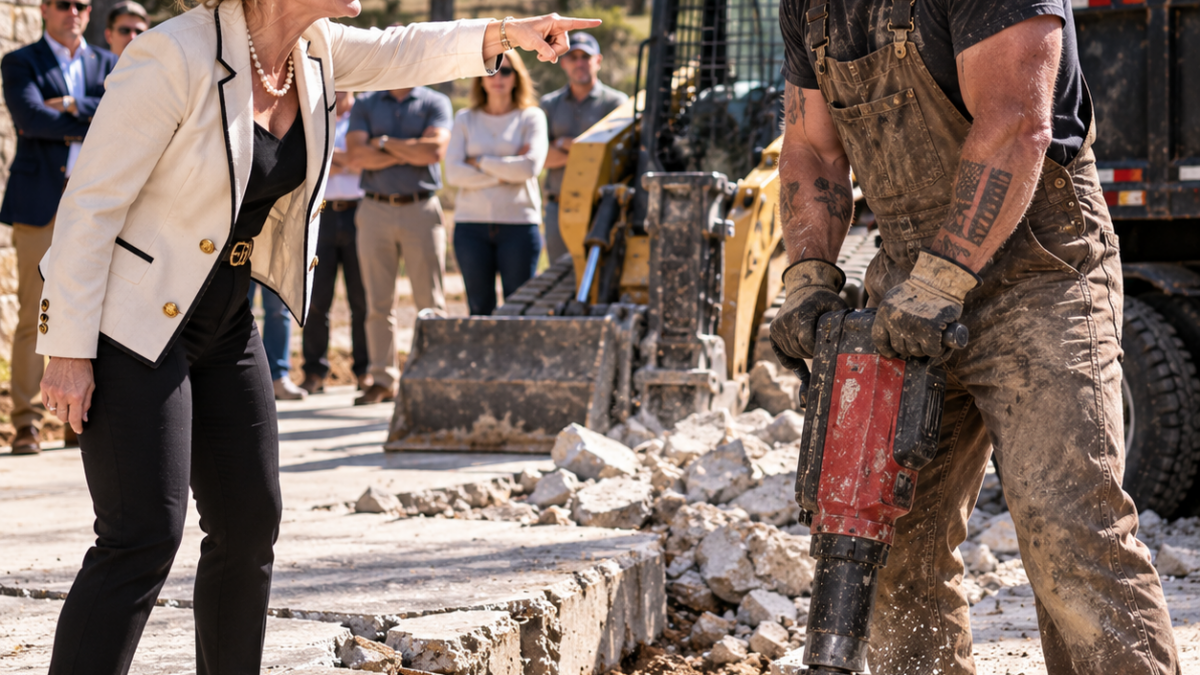
PART2:
Improved the creek-bottom grass.
Dug a stock tank with a rented dozer.
Set fences.
Repaired fences.
Repaired the same fences again after cattle proved fences were suggestions.
My father, Dean, grew up there.
So did I.
When Dad took over in 1999, he expanded the cattle operation and started cutting coastal hay commercially.
He built a sixty-by-forty steel equipment barn with a concrete floor he poured himself over three weekends.
I remember watching him float that slab.
I was fourteen.
He handed me a broom and said:
“Concrete remembers every mistake.”
I thought he meant finishing work.
Years later, I learned he meant more than that.
My father died in 2017.
Aortic aneurysm.
Fifty-nine years old.
He collapsed in the equipment barn.
The same barn he had built.
I was thirty-two.
I had already spent four years in the Marine Corps working heavy equipment with a combat engineer battalion.
Afghanistan.
Iraq.
Armored dozers.
Hydraulic breakers.
Road clearance.
PART3:
Earthmoving machines heavy enough to make the ground feel alive beneath you.
When I came home, I started Dunbar Demolition and Site Prep.
I tore out foundations.
Parking lots.
Warehouse slabs.
Driveways.
Failed retaining structures.
Commercial pads poured in the wrong place.
If a contractor needed concrete returned to gravel and dust, I was usually the phone call.
I owned jackhammers.
Compressors.
A Bobcat T870 with a hydraulic breaker.
A dump truck.
Flatbed.
And enough scars on my hands to tell you that concrete does not care how confident you were when you poured it.
My wife, Meg, ran the part of my life machinery could not.
Margaret Ann Kepler Dunbar.
Five foot four.
Daughter of a farrier.
Could shoe a horse before she could legally drive.
Could back a thirty-foot stock trailer through a gate narrower than some men’s egos.
Could look at a hay contract for six seconds and find the decimal you wished she had missed.
We married in 2015.
When Dad died, she helped me keep the ranch alive while I tried to keep the demolition company alive.
That first year after his death, I was gone before daylight more often than I was home for breakfast.
Meg handled cattle.
Invoices.
Vets.
Hay buyers.
Insurance.
Everything.
Whenever I left for a demolition job, she stood on the porch holding coffee and said:
“Break something expensive, baby.”
It became our thing.
She never imagined the most expensive thing I would eventually break would be sitting forty-two feet inside our own property line.
The trouble began years before Vivian Ashcroft ever appeared.
In 2014, the Kramer family sold the cattle ranch bordering our eastern fence.
A development company from Austin bought it.
One hundred thirty acres.
They rezoned it.
Surveyed it.
Cut roads.
Installed utilities.
Built seventy-eight homes on half-acre lots.
They named the subdivision Cedar Bluff Estates.
There were stone entrance columns.
Decorative lighting.
Wrought iron gates that remained open most of the time.
A community pavilion.
A little pond with koi.
Landscape boulders that had been placed so carefully they looked less natural than fake rocks at a theme park.
The houses sold to people who wanted Hill Country views without Hill Country responsibilities.
That sounds insulting.
It is not meant to be.
Most of those families were good neighbors.
They waved.
They bought hay for backyard goats they did not know how to manage.
Their children watched our cattle.
Some families moved there specifically because they liked being beside working ranch land.
The original HOA president, Gary Putnam, understood that.
Gary was a civil engineer.
Quiet.
Reasonable.
The first summer after the subdivision opened, one resident complained because hay dust drifted over the fence during cutting.
Gary posted a message on the HOA board.
WEST WIND TODAY. THAT’S DUNBAR RANCH HAY DUST. CLOSE YOUR WINDOWS IF IT BOTHERS YOU AND REMEMBER YOU BOUGHT A HOUSE BESIDE A WORKING RANCH. THAT’S A FEATURE, NOT A DEFECT.
Meg printed it and stuck it to our refrigerator.
Gary and I got along fine.
Then he moved to Corpus Christi in 2021.
The HOA presidency went vacant.
Two months later, Vivian Ashcroft stepped into it.
I did not dislike Vivian when I first met her.
That matters.
It would be easier to tell this story if she had walked into the neighborhood wearing a sign that said I AM GOING TO POUR CONCRETE ON YOUR LAND.
She did not.
She was polished.
Organized.
Confident.
Fifty-two.
Always dressed as though somebody might photograph her.
She had worked in corporate event planning for more than twenty years.
She knew how to run meetings.
She knew how to make ordinary things sound urgent.
She knew how to say community standards in a tone that made it sound like federal law.
Her husband, Phil, worked for an oil-services company and spent much of his week in Houston.
Vivian had time.
Energy.
A need for control.
That combination became expensive.
Within months, HOA dues increased.
New rules appeared.
Mailbox standards.
Fence-color approvals.
Garbage-can deadlines.
Holiday-decoration applications.
One family received a violation because a basketball remained in a driveway overnight.
Another got a warning because a planter exceeded the approved height.
A retired firefighter named Carl Jensen owned an English bulldog with a face that looked as though somebody had left him folded in a suitcase.
Vivian wrote that the dog’s appearance was “inconsistent with the neighborhood’s visual character.”
Carl framed the letter.
Hung it in his garage.
Under it, he wrote:
DOG STILL UGLY. PROPERTY VALUES SURVIVED.
Vivian fined him for something unrelated the next week.
Most of this was Cedar Bluff’s problem.
Not mine.
Our ranch was not inside the HOA.
Not one square inch.
That distinction seemed obvious to everybody except Vivian.
She began complaining about our equipment barn.
Then our hay bales.
Then the sight of my dump truck from one corner of her backyard.
Once, she sent me an email asking whether I would consider replacing sections of barbed-wire fence visible from the subdivision with “architecturally harmonious black metal fencing.”
I replied:
No.
She sent back:
Please reconsider in the interest of neighborhood cohesion.
I replied:
Still no.
Meg told me I lacked diplomacy.
I told her diplomacy had been achieved because I did not type anything else.
For almost a year, Vivian stayed on her side of the fence.
Then she decided Cedar Bluff needed a community terrace.
The subdivision already had a pavilion near the southeastern corner of its common area.
There was a barbecue pit.
Tables.
Grass.
Vivian wanted something larger.
A professional concrete patio.
Outdoor movies.
Farmers markets.
Music.
Lights.
Planters.
A place that would photograph well.
The problem was geometry.
There was not enough HOA-owned land behind the pavilion for the terrace she wanted.
Forty feet, roughly.
Her plan needed much more.
The legal boundary ran exactly where our old barbed-wire fence ran.
The same line recorded decades earlier.
The same line marked by orange-capped iron survey pins.
Vivian had a professional survey conducted.
That fact later mattered more than almost anything.
The surveyor’s written report was clear.
The common area stopped at the existing fence line.
Land beyond the fence was privately owned.
Any improvement extending past that line required express written permission from the landowner.
Vivian initialed the survey.
Every page.
She knew.
She simply decided knowing was inconvenient.
In September 2022, I took a two-week demolition job in San Antonio.
Parking structure.
Ugly work.
Long days.
Meg called me on a Friday morning.
I heard diesel engines behind her.
“What’s going on?”
“Three concrete trucks just turned onto Heritage Oak.”
“HOA project?”
“I think so.”
Then her voice changed.
“Cal.”
“What?”
“They’re setting forms past our fence.”
I stopped walking.
“How far?”
“I’m looking at our survey pins inside their forms.”
“Take pictures.”
“I already am.”
“Everything.”
“Trucks.”
“Crew.”
“Pins.”
“Fence.”
“Vivian.”
“You know me.”
“I do.”
“Stay on our side.”
“I am.”
“Don’t touch anything.”
“Cal.”
“Yes?”
“She’s standing on our side.”
I closed my eyes.
“Photograph that too.”
Meg later told me exactly what happened.
She walked toward the project in work boots, jeans, hay in her ponytail.
Vivian stood beside the pavilion in a cream pantsuit with sunglasses and a binder.
Six concrete workers were setting forms.
One section extended deeply into our pasture.
Meg pointed.
“That’s Dunbar property.”
Vivian looked at her.
“The boundary has been reviewed.”
“I’m looking at our survey pins.”
“Those markers are old.”
“They’re recorded.”
“We had a professional survey.”
“So did we.”
Vivian smiled.
“Sweetheart, this project has already been approved.”
Meg hates being called sweetheart by strangers.
I know this because I once did it during an argument and nearly became a statistic.
She kept her voice calm.
“Approved by who?”
“The HOA board.”
“The HOA board doesn’t own my pasture.”
“The common area boundary is broader than you think.”
“No.”
Meg pointed at the orange cap in the dirt.
“It isn’t.”
Vivian lowered her sunglasses.
“Why don’t you go back to your cows and let the professionals handle the neighborhood?”
Meg stared at her.
Then raised her phone and took another photograph.
Vivian noticed.
Her expression changed slightly.
“You don’t have my permission to photograph me.”
“You’re standing on my property.”
That was my wife.
Vivian turned away.
Meg called me.
“You want me to stop the trucks?”
“No.”
“Why not?”
“Because six men with a concrete schedule aren’t the people deciding this.”
“I can stand in the forms.”
“No.”
“Cal.”
“Take photos.”
“Let them make their mistake.”
“How are you going to handle it?”
I looked at the hydraulic breaker attached to the excavator beside me.
“The same way I handle concrete that’s where it shouldn’t be.”
There was a pause.
Then Meg laughed once.
“Come home soon.”
They poured that day.
Three trucks.
Approximately 4,200 square feet.
Part on HOA land.
A substantial section on ours.
Four inches thick.
High-strength mix.
Finished smooth.
Expansion joints.
Professional work.
The contractor was Clint Brewer.
I knew of him.
Good reputation.
Medium-sized company.
Six-man crew.
What I did not know yet was that Clint had questioned the property line before the pour.
He had seen our fence.
Seen the pins.
Asked Vivian whether they had written permission.
She told him the HOA owned the land.
When his foreman objected again, Vivian sent the message that eventually destroyed her entire story.
POUR IT ANYWAY. HE’LL NEVER KNOW.
At the time, I knew none of that.
I only knew they poured concrete where cattle had grazed the week before.
When I came home, Meg met me on the porch.
No hug.
No explanation.
She pointed east.
We drove the ranch truck to the boundary.
The terrace stretched past the fence line.
The old posts in that section had been removed.
My survey pins were gone beneath the slab.
A decorative sign stood near the center:
THE VIVIAN ASHCROFT COMMUNITY TERRACE INITIATIVE.
Meg folded her arms.
“She named it after herself.”
“Apparently.”
“She told me to go back to my cows.”
“I heard.”
“I want you to remember that part.”
“I have remembered it every twelve minutes since Friday.”
We stood there.
I expected rage.
I felt something quieter.
I spend my working life looking at concrete.
You learn not to be intimidated by finished surfaces.
A slab looks permanent because people see the top.
Smooth.
Hard.
Final.
I see thickness.
Joints.
Subgrade.
Access.
Tool choice.
Disposal.
To me, concrete is not permanent.
It is material.
Meg touched my arm.
“What are you thinking?”
“It comes out.”
“All of it?”
“Every inch on our side.”
“When?”
“I’ll give them a chance first.”
She smiled.
“That almost sounds responsible.”
“Don’t get used to it.”
The next HOA meeting was Tuesday.
Thirty residents.
Folding chairs.
Vivian sat at the front table with board members and a binder.
I walked in wearing work clothes.
Boots.
Concrete dust still in my hair.
Vivian saw me.
Smiled.
“Mr. Dunbar.”
“Glad you could join us.”
“I usually don’t attend HOA meetings because I’m not in your HOA.”
A couple of people laughed.
Vivian did not.
“Public comment is later.”
“I’ll wait.”
So I waited.
They discussed landscaping.
Holiday decorations.
Some drainage issue.
Then public comment.
I stood.
Unfolded my certified survey.
“Mrs. Ashcroft, your terrace is forty-two feet inside my property line at its deepest point.”
The room went silent.
Vivian barely looked at the map.
“Our project was professionally reviewed.”
“So was this boundary.”
“You appear confused about where your property ends.”
“I’m not.”
“Our survey markers were under your forms.”
She removed her glasses.
“We already poured it.”
“Yes.”
“It’s done.”
“Yes.”
“Then I don’t understand what outcome you expect.”
“Removal.”
A few people shifted.
Vivian smiled.
“It’s too late.”
There it was.
Too late.
Not:
Let’s check.
Not:
We may have a dispute.
Not:
We’ll call the surveyor.
Too late.
She continued.
“That area was weeds and fire ants.”
“We improved it.”
“You should be thanking the association.”
“That land has been in my family since 1961.”
“And now part of it is a beautiful terrace.”
I stared.
“Are you saying pouring concrete changes ownership?”
“I’m saying sometimes community improvement requires reasonable accommodation.”
“From the community?”
“From everyone.”
“I’m not in your community association.”
“You benefit from the neighborhood.”
“I benefit from owning my land.”
Her face hardened.
“Your wife was equally difficult.”
The room became very still.
“What did you say to my wife?”
Vivian leaned back.
“She came over acting hysterical.”
Meg had shown me the video.
She had been calmer than I was now.
“I told her to return to her ranching responsibilities and stop interfering with professional contractors.”
Someone in the second row whispered:
“That’s not what she said.”
Vivian’s eyes snapped toward him.
I folded the survey.
“I own a demolition company.”
She blinked.
“I tear concrete out for a living.”
A few faces changed.
I continued.
“You have thirty days to remove every inch of your slab that sits on Dunbar property and restore the ground.”
“And if we don’t?”
“I remove it.”
“And I send you the bill.”
Vivian laughed.
Actually laughed.
“If you bring demolition equipment onto HOA community property, I’ll have you arrested.”
“It isn’t HOA property.”
“It’s mine.”
She put her glasses back on.
“Threats won’t change established facts.”
I looked around the room.
“Everybody heard me.”
Then I looked at Vivian.
“A jackhammer doesn’t care how late you think it is.”
I left.
Her certified letter arrived two days later.
Heavy paper.
Embossed logo.
Approximately seven hundred words.
No deed.
No survey citation.
No county record.
Just authority-shaped language.
It warned me against removing “community improvements.”
Then another letter arrived.
Apparently my equipment barn had become a visual nuisance.
My dump truck could be seen from certain homes.
The HOA requested that I install an approved vegetative screen.
Meg read that one twice.
“She wants trees planted so she doesn’t have to see the truck that’s going to haul away her concrete.”
I laughed.
So did she.
Then I called Deacon Marsh.
Deacon was seventy-one.
Property lawyer.
Forty-four years practicing in Comal County.
His office looked as though technology had stopped advancing around 1994 and nobody had felt urgency about restarting it.
File cabinets.
Paper.
Old maps.
A secretary named Doris who could locate a thirty-year-old deed faster than most people could find a downloaded PDF.
Deacon had handled Dunbar property issues since my grandfather was alive.
I placed everything on his desk.
Survey.
Pictures.
Letters.
Meg’s videos.
“Tell me I can break it.”
Deacon leaned back.
“No.”
I stared.
“No?”
“Not yet.”
“It’s on my land.”
“I know.”
“They buried my pins.”
“I know.”
“She called Meg hysterical.”
“That’s not the legally strongest fact, but I understand why you keep mentioning it.”
“So what do I do?”
“Nothing.”
I started to argue.
He raised one finger.
“Cal.”
“Let her keep writing.”
“Let her file complaints.”
“Let her make statements.”
“Right now she thinks she is building pressure.”
“She is building your case.”
That was difficult advice for a demolition contractor.
My professional instinct is to solve visible problems with equipment.
Deacon wanted paper first.
So I waited.
Vivian did not.
She filed a county complaint against our equipment.
Dismissed.
Then one claiming cattle runoff was polluting the HOA koi pond.
That one was physically impossible because the drainage went another direction.
Dismissed.
Then she asked the county to reconsider the property boundary.
As though survey lines worked like restaurant reservations.
Dismissed.
She hired an Austin attorney named Craig Webber.
He sent a polished letter suggesting the HOA had obtained a prescriptive easement.
Deacon read it.
He laughed.
“How long has the slab existed?”
“Six weeks.”
“And how long does he claim is needed for prescription?”
“He doesn’t say.”
“Because if he says ten years, the letter becomes funny.”
Deacon folded it.
“Let her keep going.”
Then Deacon subpoenaed Clint Brewer’s project records.
That was when Vivian’s problem stopped being a boundary argument and became something much worse.
Clint cooperated immediately.
His attorney called Deacon.
Messages.
Site plans.
Invoices.
Internal notes.
Everything.
The first text showed Vivian wanted the pour completed before I returned from San Antonio.
The second showed Clint warning her the terrace extended more than forty feet beyond the property line.
He asked for written owner consent.
Vivian answered:
POUR IT ANYWAY. HE’LL NEVER KNOW.
The third message came on pour day.
Clint documented that his crew removed fence posts and covered survey markers according to her instruction.
Meg read the texts over my shoulder at our kitchen table.
“She knew.”
Deacon nodded.
“She knew exactly.”
I felt anger then.
Real anger.
Not about the concrete.
About Meg.
Vivian had stood on our land and talked down to my wife while carrying a survey she had initialed proving Meg was right.
That was not confusion.
That was contempt with paperwork.
Deacon continued.
“No permits.”
“What?”
“None.”
The project required county approvals.
Nothing filed.
No proper site approval.
No storm-water review.
Then HOA minutes.
No recorded board vote authorizing eighty-four thousand dollars.
There was only a handwritten margin note:
Terrace approved by consensus. VA.
Meg stared.
“She spent eighty-four grand of everyone’s money based on a note she wrote to herself?”
Deacon nodded.
Meg leaned back.
“That’s not governance.”
“That’s shoplifting with better stationery.”
Even Deacon laughed.
We filed.
Trespass complaint.
County enforcement notice.
Civil petition seeking removal, restoration, survey-marker replacement, costs, and legal fees.
The sheriff’s deputy came out.
Surveyed the situation.
Looked at the certified plat.
Looked at the slab.
Looked at the old fence alignment.
He asked:
“She poured all this knowing the line?”
“That’s what the texts say.”
He whistled.
County inspector Hector Garza arrived next.
He had eighteen years in code enforcement.
He looked at the unpermitted terrace.
Then at the pavilion.
Then at me.
“How many permits?”
“Apparently zero.”
He slowly removed his sunglasses.
“That is ambitious.”
A violation notice followed.
Vivian responded by calling an emergency community meeting.
Sixty-three homeowners attended.
Meg wanted to come.
I told her she did not have to.
She said:
“I’ve been waiting months to watch somebody ask that woman a question she can’t answer.”
So we sat in the back.
Vivian wore a navy blazer.
Pearl earrings.
Perfectly controlled.
She talked about community value.
Property values.
Amenities.
The terrace.
She never said my land.
Then she proposed a resolution opposing removal.
Before the vote, Walt Kemper raised his hand.
Retired surveyor.
Quiet man.
I knew him only from waving at the fence.
“Vivian.”
“Yes, Walt?”
“Did you have permits before you poured?”
She smiled.
“The administrative process is being handled.”
“That isn’t my question.”
Silence.
“Were permits issued before construction?”
Vivian’s smile tightened.
“No.”
Walt nodded.
“Did the board formally vote to spend eighty-four thousand?”
“Consensus was established.”
“Was there a motion?”
“We had discussion.”
“A second?”
“We had consensus.”
“Recorded vote?”
Vivian looked toward the other board members.
Nobody helped her.
The room changed.
People were no longer watching a dispute between an HOA president and a rancher.
They were looking at their own money.
A woman stood.
“My dues paid for this?”
Vivian answered:
“Community funds paid for a community asset.”
“On somebody else’s property?”
“That is disputed.”
I raised my certified plat.
“No.”
Walt looked at Vivian.
“You signed the survey, didn’t you?”
She went still.
That information had become known through legal filings.
Vivian shifted from confidence to offense.
“This meeting is becoming hostile.”
Carl Jensen, owner of the allegedly architecturally inconsistent bulldog, said:
“No, it’s becoming informative.”
The resolution failed.
Forty-one to twenty-two.
Vivian packed her binder.
Walked out.
For the first time since I met her, nobody followed.
The court ruling came in January.
Judge Maria Elena Fuentes.
Nine pages.
Clear.
The encroachment was unlawful.
The HOA had no ownership interest in the land.
The survey had given unmistakable notice.
The text messages demonstrated willful disregard.
The HOA was ordered to remove the concrete from our property within thirty days.
Restore the land.
Replace damaged survey monuments.
Pay our reasonable legal costs.
The survey-marker issue was referred separately.
Meg read the order at the kitchen table.
“So now they remove it.”
“That’s the idea.”
She looked at me.
“You sound disappointed.”
“I own very nice equipment.”
“Cal.”
“I’m joking.”
“You’re only partly joking.”
She knew me too well.
Day one passed.
No contractor.
Day ten.
Nothing.
Day twenty.
Nothing.
Deacon sent formal notice.
Nothing.
Day twenty-eight, I saw Vivian at the terrace directing somebody to move planters.
I stopped the truck.
“Removal scheduled?”
She looked at me as though I had interrupted a wedding.
“Our counsel is reviewing options.”
“The order expires in two days.”
“We’re aware.”
“Good.”
“Cal.”
It was the first time she used my first name.
“You do understand tearing this out will hurt the neighborhood?”
“No.”
“It will cost homeowners.”
“You spent their money.”
“You’re choosing to punish them.”
“No.”
“I gave you thirty days before court.”
“The judge gave another thirty.”
“You had every chance.”
She stepped closer.
“Why do you care so much about an unused patch of dirt?”
That question told me she still did not understand anything.
“My grandfather bought it.”
“So?”
“My father worked it.”
“So?”
“My wife was standing on it when you told her she didn’t belong there.”
Vivian’s face tightened.
“This is emotional for you.”
“It’s property.”
“And history.”
“Those aren’t mutually exclusive.”
She sighed.
“You cannot stop progress forever.”
I looked at the slab.
“Watch me stop this part.”
Day thirty ended.
No removal.
The next morning, I called Deacon.
“Can I?”
He sighed.
“You have the order.”
“The deadline passed.”
“I have confirmation from the clerk.”
“Stay strictly on your side.”
“Document everything.”
“Do not touch their portion.”
“Do not argue with residents.”
“And Cal?”
“Yes?”
“Try not to enjoy it too much.”
“No promises.”
Saturday, February 11.
5:00 a.m.
Coffee.
Cattle.
At 7:30, I loaded the Bobcat.
Hydraulic breaker.
Air compressor.
Handheld jackhammers.
Hoses.
Cones.
Survey gear.
Flatbed.
Dump truck.
Meg packed lunch.
On top of the cooler she left a note.
BREAK SOMETHING EXPENSIVE, BABY.
Ray Holt showed up at eight.
Seventy-two.
Worked for my grandfather once.
He looked at the equipment.
“You sure?”
“She had thirty days.”
“Judge sure?”
“Judge sure.”
He grinned.
“Then let’s go.”
I placed copies of the court order and survey in clear plastic on the dashboard.
We entered through our pasture.
Never crossed onto HOA property.
Set cones.
Established the legal line.
Measured twice.
Recorded video.
At 8:49, I climbed into the Bobcat.
The concrete looked perfect.
Smooth.
Gray.
Decorative joints.
A little plaque still bearing Vivian’s name.
I lowered the hydraulic breaker.
Paused.
Not for drama.
Because professionals pause before destroying anything.
You confirm.
Boundary.
Tool.
Position.
Risk.
Then you commit.
The breaker struck.
The first fracture appeared almost immediately.
A clean line.
A second strike widened it.
Concrete that had looked permanent ten seconds earlier became broken aggregate.
Ray laughed.
“Too late?”
I smiled.
“Apparently not.”
By 9:15, people were gathering behind the HOA fence.
Coffee cups.
Phones.
Bathrobes.
Children.
Someone had apparently posted online that demolition had begun.
I worked only the section inside our property.
Nothing else.
Every break documented.
Every load separated.
Meg arrived around ten and sat on the tailgate.
She handed Ray coffee.
Then held one up toward me.
I shook my head.
Could not stop yet.
At 11:12, a white Escalade appeared.
Vivian.
Of course.
She came down the community path in a camel coat and heeled boots.
She stopped at the boundary.
Started shouting.
I could not hear her over the machine.
I pointed toward the court order visible inside my truck.
She continued.
I continued too.
Meg waved.
Vivian did not.
When I shut the machine down to reposition, her voice reached me.
“You stop this immediately!”
“No.”
“I am calling the sheriff.”
“Please do.”
“This is destruction of association property.”
“The judge disagrees.”
“You’re enjoying humiliating me.”
That stopped me.
I stepped down.
“No.”
She laughed bitterly.
“You expect me to believe that?”
“I’m enjoying getting my land back.”
“There’s a difference.”
“You made this personal.”
“You named stolen concrete after yourself.”
“I built something beautiful.”
“On property you knew wasn’t yours.”
“For seventy-eight families.”
“Without asking those families to vote.”
Her eyes flicked toward the growing crowd.
“Do you know what these homeowners are going to pay because of you?”
I looked at them.
Then at her.
“Tell them why.”
She went quiet.
That was the last conversation we had.
I climbed back in.
By noon, we reached the old survey markers.
One orange cap appeared beneath fractured concrete.
Then another.
Six total.
Scuffed.
Dirty.
Still there.
I pulled them from the rubble by hand.
Set them on the tailgate.
Meg touched the first one with her finger.
“Your granddad put these in?”
“Some of them.”
“Your dad reset two after the flood.”
She nodded.
We lined them up.
Six pieces of metal.
Nothing beautiful.
Nothing expensive.
Worth more to me than the terrace.
At 2:15, the final illegal section came up.
Five hours and change.
Multiple rubble loads.
Bare Texas soil exposed.
Limestone.
Red clay.
A few roots.
The slab on HOA land remained untouched.
Clean cut.
Measured line.
Professional removal.
I shut down the compressor.
The silence afterward felt enormous.
Ray handed me a bottle of water.
Meg slipped her arm through mine.
I looked at the dirt.
It was ugly.
Uneven.
Scarred.
Perfect.
Ray looked at the place where Vivian’s terrace had been.
“Well.”
he said.
“That’s what too late looks like.”
The legal and financial consequences came afterward.
County construction fines.
Negotiated penalties.
Demolition costs.
Attorney fees.
Survey restoration.
Special assessment to homeowners.
People were angry.
Some at Vivian.
Some at the board.
Some at me.
One man emailed me:
Congratulations. You protected dirt and cost seventy-eight families hundreds of dollars.
I almost responded angrily.
Instead I wrote:
The association was ordered to restore land it knowingly built on without permission. I did not authorize the expenditure, construction, or refusal to comply with the court order.
He never answered.
A week later, he sent another message.
I read the texts.
I apologize.
That mattered.
Vivian faced a separate case over the survey monuments.
She eventually entered a plea on two counts.
Probation.
Community service.
Restitution.
No dramatic prison sentence.
No movie-style handcuffs at the clubhouse.
Real consequences are usually less theatrical.
Paperwork.
Court dates.
Checks.
Loss of authority.
Saturday mornings doing work somebody else assigns you.
Sometimes that is enough.
The HOA held a new election.
Vivian did not run.
Nobody nominated her.
Walt Kemper became president.
His first act was not to write another twenty-page rulebook.
He came to my ranch.
Sat on the porch.
Meg brought drinks.
Walt looked toward the damaged east pasture.
“I want to apologize.”
“You didn’t pour it.”
“I voted for the budget that funded projects generally.”
“You didn’t know.”
“I should have asked more questions.”
That was different.
Accountability without performance.
He handed me a proposed good-neighbor agreement.
Formal recognition of the boundary.
Acknowledgment that the Dunbar Ranch was not subject to HOA restrictions.
Recognition of our existing agricultural operation.
Process for resolving future issues.
No nonsense.
Deacon reviewed it.
We signed.
Recorded it.
The fence went back up.
Cedar posts.
Five strands.
Survey pins reset professionally.
I added cameras.
Not because I expected another invasion.
Because trust and documentation can coexist.
The bare ground recovered faster than I expected.
Buffalo grass first.
Wildflowers.
Prickly pear.
By spring, the scar was already softening.
One evening Meg and I stood by the fence.
She pointed.
“You can barely tell.”
“I can.”
“You know where to look.”
“Yes.”
She leaned against me.
“That’s true about a lot of scars.”
I kissed the top of her head.
She said:
“Don’t get emotional.”
“I’m not.”
“You’re doing that jaw thing.”
“What jaw thing?”
“The one where Marines pretend feelings are dental problems.”
I laughed.
The contractor, Clint Brewer, sent me a handwritten letter.
No excuses.
He admitted he saw the pins.
Admitted he knew the authorization was questionable.
Said the contract was large.
His company was stretched.
His wife was pregnant.
He believed Vivian when she insisted the HOA owned the land.
But he also knew he should have stopped when his foreman objected.
He wrote:
I let pressure make a decision I knew I shouldn’t make.
That line mattered.
Months later, I needed a concrete pad for a new equipment shed.
Meg asked:
“You’re not seriously considering Clint.”
“I am.”
“He poured the terrace.”
“He also preserved the texts.”
“After doing the wrong thing.”
“Yes.”
She considered.
“Why hire him?”
“Because he admitted what he did.”
“That clears it?”
“No.”
“It gives him a chance not to do it again.”
Clint got the job.
Before a form touched the ground, he pulled permits.
Marked every property line.
Flagged survey pins.
Walked the layout with me.
When the trucks arrived, I heard him tell the crew:
“Inside the markers.”
“Not one inch beyond.”
I said nothing.
He saw me.
Nodded.
Some mistakes deserve consequences.
Some people deserve a chance to prove the consequence taught them something.
Those ideas can exist together.
Vivian’s marriage did not survive the fallout.
I do not know every reason.
Nor is it my business.
Phil reportedly had serious concerns about financial decisions made without his knowledge.
The Escalade disappeared from Cedar Bluff before Vivian did.
She moved to San Antonio.
Someone later told Meg she served on a landscaping committee at her new condo complex.
Meg laughed for five straight minutes.
“Some people don’t change.”
I said.
“No.”
she answered.
“Sometimes they just get a smaller clipboard.”
Life on the ranch went on.
That is the least dramatic and most important part.
Cattle did not care about court orders.
Hay still needed cutting.
Water lines broke.
Calves got through fences.
Engines failed.
Invoices arrived.
My demolition company kept growing.
Every once in a while, a client recognized my name.
“You the guy who jackhammered the HOA patio?”
“Part of it.”
“Was it really eighty-four thousand dollars?”
“That was the project cost.”
“Did she really say too late?”
“Yes.”
They usually laughed.
I did too.
But over time, the story became less funny to me.
Not because I regretted anything.
Because I realized the jackhammer was not the important part.
It was just the satisfying part.
The important part happened earlier.
Meg taking photographs instead of getting into a shouting match.
Clint keeping the texts.
Deacon telling me not to touch the slab before I had legal authority.
Hector checking permits.
Walt asking two plain questions at a meeting.
A judge reading evidence.
Sixty-three homeowners learning that confidence is not documentation.
The jackhammer was the ending everybody remembers because noise is memorable.
But quiet things won.
Surveys.
Texts.
Minutes.
Photographs.
Deeds.
Patience.
That lesson would have pleased my father.
Dad never trusted anyone who needed to tell you repeatedly how important he was.
He trusted work.
Measurements.
Receipts.
He used to say:
“Land doesn’t care about your argument.”
“Survey it.”
“Fence it.”
“Maintain it.”
“Then shut up.”
Grandpa was even simpler.
“If it’s yours, take care of it.”
People often hear the phrase property rights and imagine politics.
To me, it was never abstract.
It was my grandfather’s spring.
My father’s barn.
Meg feeding cattle.
The porch where three generations drank coffee.
A line of iron pins beneath dirt.
What bothered me most about Vivian was not that she wanted a terrace.
The terrace was a good idea.
People used the remaining portion for events.
Children played there.
Families watched movies.
The problem was that she believed wanting something beautiful gave her permission to ignore who already owned the ground beneath it.
She saw weeds.
I saw pasture.
She saw unused space.
I saw family history.
She saw a border she thought she could move because no one important would object.
That phrase still bothers me.
Unused.
People use it to justify taking all kinds of things.
Empty lot.
Unused room.
Quiet person.
Old building.
Abandoned-looking field.
But absence of visible activity is not absence of value.
Some land is valuable because nobody poured anything on it.
A few years after the case, Cedar Bluff held an anniversary picnic.
Walt invited us.
I almost declined.
Meg said:
“We should go.”
“Why?”
“Because normal neighbors don’t stay enemies forever.”
“I’m not enemies with them.”
“Exactly.”
We went.
The legal portion of the terrace remained.
Smaller.
Still nice.
String lights.
Tables.
Kids with popsicles.
Carl Jensen brought the bulldog.
The dog remained architecturally disastrous.
I told him so.
He said:
“Property values are still hanging on.”
A little boy kicked a soccer ball toward the fence.
It rolled against one of our new posts.
He ran to get it.
Stopped before crossing.
Looked at me.
“Can I get my ball?”
I smiled.
“Absolutely.”
He ducked through the gate opening with his father’s permission.
Picked up the ball.
Ran back.
That little moment almost made me laugh.
Not because anyone needed to ask permission to retrieve a soccer ball.
Because asking had been all Vivian needed to do.
Not for a ball.
For the land.
Could the HOA lease a small strip?
Would we sell?
Could the terrace be redesigned?
Could they use another area?
Maybe I would have said no.
Maybe we could have reached an agreement.
She never gave us the dignity of the question.
That was the first wrong.
Everything afterward grew from it.
Years later, the east pasture looks like pasture again.
You would not know four thousand-plus square feet of concrete once sat there unless I showed you where.
Wild grass covered the disturbed soil.
Indian blanket returned.
Prickly pear.
Live oak shade.
The spring still runs below the ridge.
Cattle move through every morning.
Sometimes I park my grandfather’s old 1979 Ford near the fence.
It still runs.
Mostly.
Meg says calling what it does “running” is generous.
We sit on the tailgate.
Look across the ranch.
Beyond the fence are seventy-eight homes.
Not enemies.
Neighbors.
Different lives beside the same horizon.
Every so often somebody asks me whether I kept a piece of the terrace.
I did.
One chunk.
About the size of a football.
Still has part of the decorative edge.
I keep it in the equipment barn.
Not as a trophy.
Mostly because Meg refused to let me throw it away.
She wrote TOO LATE on it with a black paint marker.
Underneath, smaller:
APPARENTLY NOT.
It sits on a shelf beside one of Dad’s old levels.
I see it almost every morning.
The older I get, the less I think the story is about concrete.
Concrete is just what made the conflict visible.
The real problem was certainty without permission.
Vivian believed finishing the act would make the act irreversible.
Pour it.
Harden it.
Spend the money.
Name it.
Photograph it.
Then tell the person whose rights you ignored that changing it would be too inconvenient.
People do that constantly.
They make a decision without you.
Move the line.
Spend the money.
Use your property.
Speak for you.
Then say:
Well, it’s done now.
Too late.
As if inconvenience after wrongdoing becomes a legal defense.
It does not.
Sometimes correcting something is expensive.
Sometimes embarrassing.
Sometimes seventy-eight innocent homeowners end up furious because one leader spent their money recklessly.
That part bothered me.
It still does.
I wish there had been a way to make Vivian personally absorb every dollar.
There wasn’t.
An HOA is an organization.
Organizations spread damage.
That is why governance matters before the mistake.
Walt understood that.
Under him, Cedar Bluff changed.
Budgets required recorded votes.
Construction required permit confirmation before checks were released.
Boundary projects required legal review.
Residents could see expenditures online.
The absurd aesthetic rules were trimmed.
Mailbox flags survived.
Bulldogs survived.
Society continued.
The HOA did not collapse because its president stopped measuring flowerpots.
Imagine that.
Meg joined exactly one joint neighborhood committee.
Water and wildfire preparedness.
She told me:
“This is different.”
“How?”
“We discuss useful things.”
“Dangerous concept.”
She became friends with two women from Cedar Bluff.
One was the pediatric nurse whose son had once been fined over his basketball.
The boy grew into a teenager and eventually worked summers on our ranch.
First morning, Meg handed him gloves.
He asked:
“Am I allowed to leave these outside overnight?”
She nearly choked laughing.
I taught him equipment maintenance.
Later, he asked about the terrace.
“Did you hate everybody over there?”
“No.”
“Did everybody support Vivian?”
“No.”
“Then why didn’t they stop her sooner?”
That was a better question than I expected from a sixteen-year-old.
“Because most bad leadership doesn’t look dangerous at first.”
He waited.
“It looks efficient.”
“Confident.”
“Convenient.”
“People are busy.”
“They let someone else handle things.”
“Then the person handling things starts believing that responsibility is ownership.”
He nodded.
“Like the land.”
“Exactly.”
“And by the time people notice, there’s concrete.”
I smiled.
“There’s always concrete eventually.”
He laughed.
But I meant it metaphorically.
Rules.
Debt.
Contracts.
Habits.
Things hardening while people assume someone else checked the forms.
That may be the biggest lesson Vivian left Cedar Bluff.
Not:
Never elect a stylish HOA president.
Not:
Ranchers with jackhammers are dangerous.
The lesson was simpler.
Ask.
What authority?
What vote?
What survey?
What permit?
Whose property?
Questions are cheaper before concrete cures.
One spring, Deacon Marsh retired.
He called me to his office.
Same old bungalow.
Doris was retiring too.
He handed me a file.
DUNBAR RANCH — EAST BOUNDARY MATTER.
The file was thick.
“You keep it.”
“I have copies.”
“Keep the paper anyway.”
I flipped through.
Photographs.
Texts.
Court order.
Survey.
“One hell of a folder.”
Deacon smiled.
“One hell of a woman.”
“Meg?”
“I meant Vivian.”
“Oh.”
“She paid for my final fishing boat.”
I laughed.
He leaned back.
“You know the best part of that case?”
“The court order?”
“No.”
“The texts?”
“No.”
“What?”
“You listened when I told you not to break the concrete.”
“I hated every second.”
“I know.”
“If you’d torn it up the first weekend, you probably still would have been legally right about the boundary.”
“But?”
“But she would have made the story about an angry rancher destroying an HOA improvement.”
“Instead she gave us six weeks of documents showing she knew exactly what she was doing.”
He tapped the folder.
“People destroy themselves when arrogance convinces them evidence is just another person’s opinion.”
I thought about that all the way home.
He was right.
The most satisfying move I made was the jackhammer.
The smartest move was waiting.
Those are not always the same thing.
Dad would have appreciated that too.
Maybe.
He was not famous for patience.
When Meg and I eventually remodeled the old house, the contractor wanted to replace part of Grandpa’s porch.
Rot.
Settling.
Time.
I resisted.
“That cedar is original.”
Meg looked at the sagging corner.
“That cedar is becoming compost.”
“We can reinforce it.”
“We can rebuild it.”
“It won’t be the same.”
She put her hand on my arm.
“Cal.”
“What?”
“You cannot preserve something by refusing to let it change.”
That hit harder than expected.
I looked at the porch.
For years, the entire Vivian fight had taught me to hold the line.
Protect what is yours.
Do not let people take what came before you.
But Meg was reminding me of the other half.
Protection is not freezing time.
We rebuilt the damaged section.
Used cedar.
Kept the stone.
Saved two original beams.
The porch remained Grandpa’s in the ways that mattered.
And became ours in new ways.
That is what ownership should mean.
Stewardship.
Not domination.
Maybe that was the difference Vivian never understood.
She saw the terrace as evidence of control.
I saw the ranch as something entrusted to me.
I do not own my grandfather’s labor.
I inherited responsibility for what it built.
Someday somebody else will stand on that ridge.
Maybe a child of ours.
Maybe a niece.
Maybe someone who buys it after every Dunbar is gone.
Nothing is permanent.
Not even deeds, eventually.
But while something is in your care, you owe it honesty.
Boundaries matter because people matter.
Permission matters because people matter.
The dirt itself cannot be offended.
Meg could.
I could.
Seventy-eight homeowners could.
Clint could.
Even Vivian, in the end, deserved a legal process rather than revenge.
That is why I waited for the order.
That is why I touched only our portion.
That is why I documented every strike.
It was not restraint because she deserved special treatment.
It was restraint because I wanted to remain the kind of man who did not need to break rules to enforce a boundary.
That is harder than smashing concrete.
A few years after everything, I saw Vivian once.
San Antonio.
Supply store.
I was buying hydraulic hoses.
She was near checkout holding landscaping samples.
For a second, neither of us moved.
She looked older.
So did I.
No designer battlefield.
No HOA table.
No crowd.
Just two people in a store.
She spoke first.
“Cal.”
“Vivian.”
Silence.
Then:
“I heard Cedar Bluff kept part of the terrace.”
“They did.”
“It’s still used?”
“Yes.”
She nodded.
“I always said it was a good idea.”
“It was.”
That surprised her.
“The location was the problem.”
“And the permits.”
“And the money.”
“And the survey pins.”
She almost smiled.
“Still thorough.”
“Occupational hazard.”
Then something happened I did not expect.
She said:
“I should have stopped when the contractor questioned the line.”
No excuse.
No speech.
Just that.
I studied her.
“Yes.”
She nodded.
“I know.”
Then we walked away.
I did not forgive her dramatically.
I had already stopped carrying enough anger to require a ceremony.
Accountability does not always end with reconciliation.
Sometimes a truthful sentence years late is just a truthful sentence.
Enough to leave where it is.
That evening I told Meg.
“She apologized?”
“Not exactly.”
“What did she say?”
I told her.
Meg considered.
“That’s more than I expected.”
“Same.”
“Did you tell her I’m still with the cows?”
I laughed.
“No.”
“You wasted the opportunity.”
The ranch remains.
That is the final answer.
Not the court order.
Not Vivian’s probation.
Not the HOA election.
Not even the jackhammer.
The ranch remains.
Grandpa’s spring still bubbles from limestone.
Dad’s equipment barn still stands.
The new concrete pad Clint poured is exactly where it belongs.
Meg still runs the ranch better than I do.
The old Ford still starts if you ask politely and threaten it with replacement parts.
The eastern fence is straight.
Survey pins are visible.
Wildflowers grow over the place where Vivian’s terrace crossed the line.
Nothing about the land looks victorious.
Land does not perform victory.
It simply continues.
I like that.
Sometimes Meg and I stop on the ridge in the evening.
Below us:
cattle.
Oak.
Limestone.
The subdivision lights beyond the fence.
Two kinds of Texas occupying the same view.
One evening she asked:
“You ever wish you’d just sold them the strip?”
“No.”
“You answered fast.”
“Do you?”
“No.”
Then:
“But if they’d asked before pouring?”
I thought.
“Maybe.”
She smiled.
“That’s what makes the whole thing stupid.”
“Yes.”
Eighty-four thousand dollars of concrete.
Months of litigation.
Fines.
Legal fees.
Special assessments.
Probation.
A destroyed presidency.
All because one person believed asking permission made her smaller.
That may be the saddest part.
People who abuse power usually think power means never having to ask.
It is almost the opposite.
The more responsibility you carry, the more carefully you should ask what belongs to you.
What authority you actually have.
Whose voice is missing.
Who pays if you are wrong.
Vivian had a survey in her binder telling her exactly where her authority ended.
She initialed every page.
Then crossed the line anyway.
Physically.
Legally.
Morally.
And when I pointed it out, she said:
Too late.
I have heard those words many times since.
Not always about property.
A contractor pours wrong footing.
Too late.
A company signs bad contract.
Too late.
A family ignores warning signs.
Too late.
A person stays silent too long.
Too late.
Sometimes it really is too late to restore something exactly as it was.
Dad is gone.
Grandpa is gone.
Some trust, once broken, never returns in the same shape.
But “too late” is also one of the favorite phrases of people hoping consequences will feel more inconvenient than surrender.
Concrete can come out.
Records can be corrected.
Boards can be replaced.
Fences can be rebuilt.
People can admit fault.
Grass can grow back.
Some things take work.
Some things take money.
Some things take a court order and a hydraulic breaker.
That does not make them impossible.
I still have Vivian’s chunk of terrace in the equipment barn.
TOO LATE.
APPARENTLY NOT.
Every now and then one of my employees asks about it.
New hires usually think it is some demolition-company slogan.
I tell them the story.
Not all of it.
Just enough.
Then I tell them what Dad told me when I was fourteen, standing on wet concrete in that same barn.
Concrete remembers every mistake.
Back then, I thought he meant finishing marks.
Now I know better.
A mistake poured in concrete does not become less wrong when it hardens.
It only becomes more expensive to correct.
And that morning, when I stood on my family’s land with a jackhammer in my hands and the first crack ran across eighty-four thousand dollars of someone else’s arrogance, I understood something my grandfather had known long before there were subdivisions, HOAs, attorneys, or women telling ranchers they were too late to own their own ground.
You do not protect what is yours by shouting the loudest.
You protect it by knowing exactly where the line is.
By documenting it.
By standing behind it.
By giving the other person every reasonable opportunity to step back across it.
And if they pour concrete over that line anyway, hand you a smile, and tell you the damage is permanent—
sometimes you wait for the judge.
Sometimes you load the compressor.
And sometimes, very carefully, very legally, and one square foot at a time, you remind them that “too late” was never theirs to decide.

