HOA Karen Paid a Landscaper $10,000 to Poison My Fishing Lake—Then Tests Found the Same Chemicals in the Drinking Well Serving All 80 of Her Neighborhood’s Homes.
PART3:
“But I caught it.”
“And you’ll catch him again when he’s worth catching.”
That was Dad.
Nothing wasted.
Nothing rushed.
He understood water before I had words for what he knew.
When I left for college and studied hydrology, people assumed I had chosen something technical.
I hadn’t.
I was studying home.
Water movement.
Bedrock.
Recharge.
Spring chemistry.
Aquifers.
Everything that had fascinated me since I could walk.
I spent the next twenty-five years looking at other people’s water.
Then Dad died.
November.
Cold morning.
He had gone down to dock with coffee like he did almost every day.
I found him in chair facing water.
Cup still warm.
Heart.
Fast.
Quiet.
I buried him on ridge beside my mother, Ruth, who had died in 2011.
He left property to me.
And one instruction.
Keep it open.
He didn’t mean gate to house.
He meant fishing.
Dad started letting families fish free in 1993.
No tickets.
No fees.
No reservations.
You came on Saturday or Sunday.
You respected land.
You cleaned up.
You didn’t get drunk and act foolish.
And if you caught more than you needed, Dad would look at your cooler until guilt did rest.
Families came from three counties.
Some people had been coming twenty years.
Charlie Boggs came every Saturday.
Forty-five-minute drive from Sweetwater.
Old Ford pickup.
Two folding chairs.
One for him.
One for thermos.
Charlie caught more largemouth bass from that lake than anyone I know.
Released every one.
I asked why once.
He said:
“If I take them home, I don’t have a reason to come back.”
The Hendersons came Sundays after church.
Jason.
Melissa.
Three kids.
The youngest, Eli, couldn’t cast to save his life.
He’d sit at dock edge and talk to bluegill.
His mother once told me:
“This is the only two hours all week nobody asks for a screen.”
That was lake.
Not business.
Not attraction.
A place where people slowed down.
Then Ridgecrest Estates arrived.
Two hundred acres east of our ridge.
Eighty luxury homes.
Stone facades.
Three-car garages.
Decorative lanterns.
Community pool.
Private clubhouse.
HOA dues big enough to finance small government.
Advertisements promised:
COUNTRY LIVING WITH MODERN LUXURY.
Which is usually code for:
We like rural scenery as long as rural people behave like landscaping.
Diane Mercer moved into largest house.
Four thousand square feet.
High on ridge.
Back deck directly facing my lake.
Forty-six years old.
Tall.
Blonde.
Green eyes.
Always dressed as though photographer might arrive.
White linen in summer.
Cashmere in winter.
Pearls.
Perfect nails.
The kind of confidence people often mistake for competence because it arrives well packaged.
She became HOA president within a year.
Then decided my lake was problem.
The first letter came six weeks after election.
Ridgecrest letterhead.
Gold crest.
PROPERTY OWNER.
Not Tom.
Not Mr. Callaway.
PROPERTY OWNER.
It stated:
UNSUPERVISED RECREATIONAL WATER BODY CREATES LIABILITY RISK TO ADJACENT COMMUNITY.
Requested fencing or drainage within sixty days.
I read it twice.
Put it in folder.
No response.
Second letter:
unauthorized public gatherings.
Noise.
Traffic.
Environmental degradation.
Included photographs of fishing families taken with telephoto lens from her deck.
A red circle around a child’s bicycle.
SAFETY HAZARD written beside it.
I filed that too.
Third.
Fourth.
Fifth.
Truck traffic.
Sunscreen smell.
Weekend parking.
Children laughing.
I am not exaggerating last one.
She filed noise complaint because children were too loud on Sunday.
County deputy came.
He stood on bank listening to kids catch bluegill.
Then looked at me.
“I don’t know what she wants me to cite.”
“Joy?”
He laughed.
Complaint closed.
Diane appealed everything.
Zoning.
Health department.
Road access.
Environmental claims.
Every agency cleared me.
The county health inspector tested lake and told me it was one of cleanest private water bodies he’d seen.
Diane called his supervisor.
She tried to reclassify Callaway Road as private Ridgecrest access.
Problem:
Callaway Road was county road established before subdivision existed.
Denied.
Then she began confronting fishermen directly.
She’d come down hill in heels.
Walk onto my property.
Tell families lake was contaminated.
Tell parents they could be fined.
Tell old people their fish weren’t safe to eat.
She approached Charlie.
“Do you have fishing license?”
Charlie said:
“Ma’am, this is private water.”
“We’ll see.”
He told me later:
“I felt sorry for grass.”
“What?”
“Those heels.”
That was Charlie.
The Hendersons were less amused.
Diane told Jason lake was under investigation.
Eli heard.
Asked on ride home:
“Are we going to jail?”
Jason called me furious.
Not at me.
At her.
That was point I stopped treating Diane as irritating neighbor.
She was deliberately frightening people to reduce use of property she didn’t own.
I documented.
Letters.
Complaints.
Dates.
Photos.
Witness statements.
Twenty-five years government work teaches you one thing:
Paper remembers better than people.
Then fake warning signs appeared.
Bright yellow.
Metal posts.
Along my shoreline.
CONTAMINATED WATER
DO NOT SWIM, FISH, OR CONSUME
BY ORDER OF RIDGECREST ESTATES HOA
There was no contamination.
No order.
No authority.
And signs were on my property.
I photographed.
GPS.
Removed.
Called print shop named on invoice code.
They wouldn’t release buyer information to me but confirmed commercial order.
Later HOA records showed Diane charged them to association credit card.
That weekend fishing attendance dropped from fourteen families to three.
Someone had photographed signs before removal.
Social media did rest.
By Saturday afternoon half county thought lake was poisoned.
That’s the thing about lies.
They don’t need authority if they travel faster than corrections.
Following week, fence contractor showed up.
Truck.
Panels.
Post driver.
Two workers.
I asked:
“Who hired you?”
One handed work order.
DIANE MERCER
PROPERTY MANAGER — LAKE PARCEL.
I stared.
“She told you she manages this land?”
“Yes, sir.”
I went inside.
Brought deed.
Survey.
They read.
Loaded everything back.
Left.
I got notarized statement from company confirming who placed order and how ownership was represented.
Then filed trespass complaint.
Deputy Marcus Hale investigated.
Talked to Diane.
Issued warning.
I thought response too mild.
But added report to folder.
By then folder had become binder.
Then two binders.
Then Diane tried politics.
She proposed “watershed protection overlay district” before county planning commission.
Sounded responsible.
Wasn’t.
Her draft would have allowed the nearest HOA to regulate privately owned water within thousand feet of residential subdivision.
Meaning Ridgecrest could dictate fencing.
Access.
Testing.
Even drainage.
She cited statutes that did not apply.
Navigable-water provisions.
Municipal stormwater guidance.
Everything formatted beautifully.
None of it legally supported what she wanted.
I brought deed.
Geological data.
Twenty-three years water testing.
Statutes.
Commission voted unanimously against her.
Chairman even noted proposal appeared targeted at one private property owner.
Diane walked out.
No scene.
No yelling.
Heels clicking.
Then she went quiet.
That should have scared me.
It didn’t.
I was tired.
Eighteen months of arguing with someone who treated every boundary as invitation to escalate.
September came.
I fixed dock railing.
Fished.
Sat in Dad’s old chair.
For first time in more than year, property felt peaceful.
Then Thursday morning.
The bass.
I set coffee down.
Walked shoreline.
Second fish.
Third.
Bluegill.
Channel cat.
A flathead near dock.
Old Henry.
Kids had named him maybe fifteen years earlier.
Nobody knew if same fish, but mythology doesn’t need tagging data.
He was huge.
Survived droughts.
Ice.
Storms.
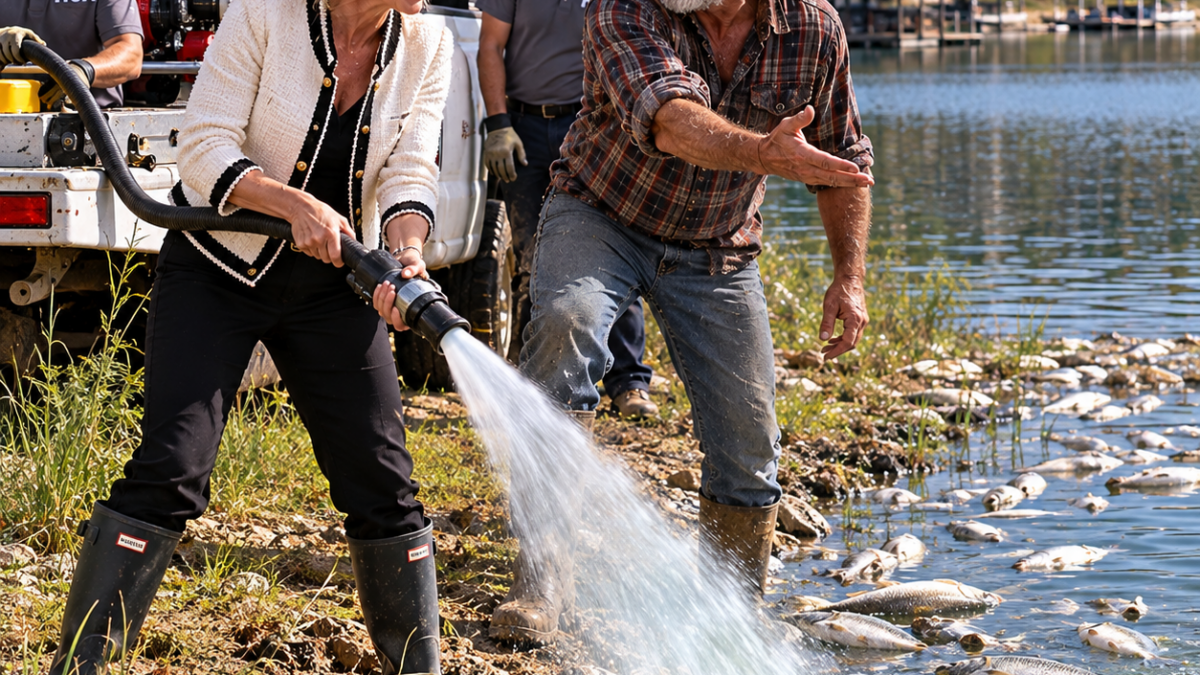
Then floated there belly up.
By fifty yards I counted forty-seven.
By time I finished loop:
eighty-three.
I knelt near water.
There was faint metallic sheen near main spring inlet.
I took field kit from truck.
pH.
Dissolved oxygen.
Conductivity.
Temperature.
Then samples.
Six locations.
Sterile bottles.
GPS.
Time.
Chain-of-custody labels.
I didn’t need former government credentials to know natural fish kills can happen.
Low oxygen.
Temperature turnover.
Algae crash.
Disease.
But this pattern was wrong.
Concentration worst near spring.
The gill damage.
Abrupt pH shift.
Localized sheen.
I walked upstream.
Main spring emerged through limestone shelf about thirty yards above lake.
Soft clay along channel showed drag marks.
Boot prints.
Heavy tire ruts up fire road.
I followed.
Behind fallen oak were empty industrial chemical containers.
Commercial labels.
Batch information.
Not homeowner products.
I photographed.
Did not touch barehanded.
Called TDEC.
Called sheriff.
Then independent lab.
By noon state environmental response was underway.
By evening I was back at kitchen table with county geology maps.
That’s where story changed.
Not when fish died.
When I traced water.
Eastern Tennessee is karst country.
Limestone fractured like broken concrete underground.
Caves.
Solution channels.
Sinkholes.
Springs.
Water doesn’t respect property lines.
Surface and groundwater can be connected over surprising distances.
Sometimes fast.
Sometimes slow.
But connected.
The three springs feeding my lake belonged to larger groundwater system beneath Eastern Ridge.
I had worked on regional hydrogeology years earlier.
Then I remembered Ridgecrest’s environmental assessment.
The subdivision wasn’t on municipal water.
It had community well.
Two hundred sixty feet.
Same carbonate formation.
Same aquifer zone.
I found old development report online.
There it was.
Hydrogeologic cross-section.
Recharge area extended beneath spring ridge.
Flow direction east-southeast under Ridgecrest.
I stared.
My stomach dropped.
Whoever poisoned spring had not just contaminated my lake.
They might have contaminated shared aquifer.
The same water Ridgecrest residents cooked with.
Bathe in.
Filled children’s cups with.
The same woman who spent eighteen months accusing my lake of being dangerous might have created actual drinking-water emergency.
I did not celebrate.
That’s important.
I felt sick.
Because Diane wasn’t only person drinking it.
Eighty families.
Babies.
Older residents.
People who had never written me one bad letter.
The next morning, under proper coordination, samples were taken from Ridgecrest well system through authorized access with utility personnel and investigators.
Not me sneaking through unlocked port.
I may have been angry, but chain of custody matters more than drama.
Samples went expedited to certified lab in Knoxville.
Monday morning results came.
Lake contamination severe.
Copper elevated far beyond aquatic-life thresholds in inlet zone.
Commercial aquatic herbicide residues present.
pH heavily depressed near source.
Fish kill consistent with acute chemical exposure.
Then well.
Copper significantly elevated above drinking-water action criteria.
Herbicide traces detected.
Not enough yet to establish every possible health impact, but absolutely enough to trigger emergency response and shut-down evaluation.
The contamination profile was consistent with migration through fractured karst groundwater.
I called Dr. Sarah Chen at TDEC.
Former colleague.
She said:
“Tom.”
“Yes.”
“This is serious.”
“I know.”
“We are issuing no-consume advisory.”
I closed eyes.
“How many homes?”
“Eighty.”
“Any alternate supply?”
“Not immediate.”
“Municipal connection?”
“Three weeks minimum.”
“Jesus.”
“Yeah.”
Then she asked:
“Do you know who?”
“I know who I suspect.”
“That isn’t same.”
“No.”
“We need paper.”
“I know.”
That’s when old training took over.
Do not accuse first.
Trace.
Industrial chemicals have records.
Lot numbers.
Distributor.
Purchase orders.
Signatures.
Investigators subpoenaed sales records.
The product lots traced to regional supplier.
Buyer:
Ridgecrest Property Services LLC.
The HOA landscaping contractor.
Signed by Gerald Dunn.
Gerald maintained Ridgecrest common grounds.
Flowers.
Entry beds.
Shrubs.
I had seen his truck dozens times.
Detective Rita Vasquez interviewed him.
Gerald folded immediately.
Maybe guilt.
Maybe fear.
Maybe both.
He gave them everything.
Diane had contacted him.
Told him lake was environmental hazard county refused to address.
She wanted it “treated” so recreation would stop.
She directed where.
She wanted work done at night.
She specified spring inlet.
She authorized HOA money.
Ten thousand dollars.
Gerald insisted payment be by check.
That decision might have saved him from much worse.
Memo:
LAKE ENVIRONMENTAL REMEDIATION.
There are moments when arrogance becomes almost impossible to distinguish from self-documentation.
Then the texts.
Forty-three.
Directions.
Timing.
Questions.
Confirmation.
Investigators had no need to infer much.
One exchange became central.
Diane:
IS IT DONE?
Gerald:
YES.
Diane:
GOOD. NOW WE WAIT.
That line followed her everywhere afterward.
She thought she was waiting for fishermen to disappear.
Instead everybody was waiting for water results.
Tuesday TDEC emergency team came.
Wednesday deputies served warrants.
Thursday federal environmental officials joined because drinking-water system had been compromised.
Not every detail became federal criminal case the way rumors later claimed, but state and federal environmental authorities were involved immediately.
Emergency notices went on Ridgecrest mailboxes.
DO NOT CONSUME WATER.
Within an hour neighborhood was chaos.
Parents.
Coolers.
Cars.
People calling pediatricians.
Grocery stores sold out bottled water.
County established distribution point.
State emergency management brought pallets.
I went.
Some people were surprised to see me.
I didn’t care.
I carried cases.
Loaded trunks.
Helped elderly couple.
One woman stood beside SUV crying.
“My grandson drank formula with that water yesterday.”
I didn’t know what to say.
“No one knew.”
She looked toward ridge.
“She did.”
That was worse.
Not because Diane knew about aquifer connection.
Evidence suggested she didn’t.
But she knew she was intentionally putting chemicals into water.
You don’t need hydrology degree to understand water moves.
The municipal emergency connection took weeks.
Lawns browned.
Pools closed.
Laundry became problem.
People showered at relatives.
HOA dues became irrelevant beside actual infrastructure.
Engineers determined community well could not safely return to service without major remediation and uncertainty remained about long-term groundwater pathways.
Eventually system was decommissioned and Ridgecrest connected to municipal supply.
The total cost ran into millions.
Some through grants and public emergency programs.
Some through association assessments.
Some through litigation and restitution later.
The simplistic rumor that every family immediately owed exactly $33,000 was not how final financing worked, but the financial hit was devastating.
The social hit was immediate.
Ridgecrest Facebook group had spent year reposting Diane’s warnings about my lake.
Now residents posted screenshots of her texts.
Her own board members claimed they knew nothing.
Some probably didn’t.
HOA attorney resigned.
His letter said leadership had made material misrepresentations.
Insurance carrier disputed coverage for intentional acts.
Board held emergency meeting without Diane.
Seventy-nine of eighty households voted to remove her from leadership.
The one vote against?
Diane herself.
I almost laughed when I heard.
Almost.
Then I remembered elderly woman carrying bottled water.
Nothing was funny anymore.
Diane made one public statement through attorney.
She said she had authorized legitimate environmental treatment and Gerald exceeded instructions.
Problem:
texts.
Check.
Map.
His testimony.
Purchase records.
Fake contamination signs months earlier.
Fence attempt.
Overlay proposal.
Eighteen months of documented intent to eliminate fishing use.
One isolated mistake can be explained.
Pattern is harder.
A prosecutor once told me:
“Intent is often just history lined up in order.”
My binders became history.
Every letter mattered now.
Every fake warning.
Every complaint.
Every attempt to label lake hazardous.
Every effort to gain control.
What had felt like obsessive paperwork became motive evidence.
Detective Vasquez looked at binders on conference table.
“You kept all this?”
“Yes.”
“Why?”
“Government job.”
She smiled.
“My father says people like you are why filing cabinets never die.”
“He’s right.”
Charges came months later after full investigation.
Environmental contamination.
Property damage.
Water-supply endangerment.
False reporting connected to earlier fabricated claims.
Trespass-related offenses.
The exact statutory counts changed through indictment and pretrial motions, but central allegation didn’t.
She intentionally arranged contamination of private spring-fed lake and created foreseeable risk to connected groundwater users.
Diane hired Nashville defense attorney.
Expensive.
Experienced.
He tried to separate lake from well.
Argued she never knew aquifer connection.
Prosecutor answered:
Knowledge of exact underground flow wasn’t required to establish deliberate act against lake.
The well contamination increased consequence.
Not intent.
He argued Gerald acted independently.
Texts made that nearly impossible.
He argued she believed lake already hazardous.
Twenty-three years of clean water records undermined that.
He argued I held personal grudge.
I agreed I disliked her.
That surprised him.
On cross-examination:
“Mr. Callaway, you and Ms. Mercer had a contentious history, correct?”
“Yes.”
“You resented her.”
“Yes.”
“You wanted her removed as HOA president.”
“Eventually.”
“You had motive to blame her.”
“I also had lab results, purchase records, photographs, text messages, contractor statement, and eighteen months of dated complaints.”
Courtroom went quiet.
He looked down.
I added:
“You don’t have to trust me.”
“Trust evidence.”
Melissa—my lawyer by then—nearly smiled.
The prosecution called Gerald.
He testified hours.
No dramatics.
He looked tired.
Ashamed.
He admitted what he did.
Explained Diane told him county refused to address dangerous lake.
He knew pouring concentrated chemicals at spring was wrong.
He did it anyway.
That mattered.
He wasn’t innocent employee.
He cooperated, but cooperation did not erase conduct.
He had texts.
Check.
Instructions.
Then Dr. Chen explained hydrology.
Karst.
Fractures.
Groundwater pathways.
Spring capture zones.
Community well.
No sensational language.
Just diagrams.
Water moves.
Chemical introduced here.
Detected here.
Same signatures.
Same timing.
Same geological connection.
The jury understood.
Then I testified about lake.
Not sentimental first.
Baseline chemistry.
Years of testing.
Fish health.
Spring conditions.
Samples.
Chain of custody.
Then prosecutor asked:
“What did that lake mean to you?”
Defense objected.
Relevance.
Judge allowed limited.
I looked toward jury.
“My father built it.”
“Families have fished there free since 1993.”
“That doesn’t change chemistry.”
“But it explains why somebody wanting to stop those families had reason to target water.”
That was enough.
Diane took stand against lawyer’s advice.
I could tell because attorney looked like man watching train arrive after warning someone not to stand on tracks.
She was composed.
Navy suit.
Pearls.
Hair shorter.
She said she cared deeply about environment.
She said lake was unmanaged.
She said Gerald misunderstood.
Prosecutor displayed:
BY FALL THAT WATER WON’T EXIST. COUNT ON IT.
A message she had sent a neighbor months earlier.
Then:
GOOD. NOW WE WAIT.
Then fake contamination sign invoice.
Then check.
Then texts directing timing.
Diane kept explaining.
Each explanation required another explanation.
That is how lying collapses.
Not always with one contradiction.
With weight.
Eventually jury stopped looking at her.
That is bad sign for witness.
Verdict came after less than four hours.
Guilty on major counts.
Sentencing later.
Judge William Harmon spoke before imposing sentence.
He said environmental crimes are often caused by negligence.
This one was deliberate.
He talked about eighty households.
Children.
Elderly.
A private citizen’s property.
Public trust.
The fact Diane’s own community suffered from conduct she claimed was intended to protect it.
Sentence was substantial.
Years in custody with parole eligibility later, restitution orders, probation terms, and court restrictions preventing future service in HOA or similar community governance roles for an extended period.
People online later exaggerated it to “lifetime ban from every HOA in America.”
Not true.
The real order was state-specific and tied to sentencing conditions.
Reality was enough.
She lost position.
House.
Savings.
Reputation.
And freedom for a time.
I didn’t celebrate sentencing.
Charlie sat beside me.
Quiet.
Like lake.
After hearing he said:
“Want coffee?”
“Yes.”
That was all.
The civil cases were messier.
Residents sued Diane.
Some sued contractor.
Some claims against HOA.
Insurance disputes.
Health claims required proof.
Not everybody who reported headaches could show contamination caused them.
That matters.
Courts separated fear from medically documented injury.
Some settlements.
Some dismissals.
Some restitution.
HOA itself eventually dissolved after residents voted overwhelmingly to end it.
Common assets transferred through legal process.
Pool and clubhouse eventually sold into private management rather than literally disappearing overnight.
The decorative entrance crest did go to auction.
Someone joked it sold for less than fishing boat.
I never confirmed.
Didn’t care.
The well was decommissioned.
Sealed.
Municipal line connected.
That was the real monument to Diane.
A steel-capped well nobody could trust anymore.
My lake took longer.
TDEC supervised remediation.
Contaminated sediment removed near inlet.
Spring channel flushed.
Monitoring.
Monthly testing.
Then quarterly.
pH recovered first.
Aquatic vegetation slower.
Fish population had been devastated.
We restocked carefully.
Not all at once.
Bluegill first.
Then bass after forage base.
Catfish returned naturally through connected overflow systems and stocking from upstream neighbors.
The first summer looked empty.
No weekend fishing.
Gate closed.
That hurt almost more than dead fish.
Every Saturday morning I woke expecting trucks.
Nothing.
No Charlie.
No Henderson kids.
No folding chairs.
The lake survived chemically before I did emotionally.
I would sit on Dad’s dock and think:
You told me keep it open.
I’m trying.
The cedar posts were still original.
Deck boards needed replacing.
I left them.
Couldn’t fix everything at once.
Three months after contamination, Charlie came anyway.
Gate closed.
He parked outside.
Walked in.
No rod.
Just thermos and two chairs.
He set them on dock.
Sat.
I stared.
“What are you doing?”
“Saturday.”
“Can’t fish.”
“I know.”
“Then why come?”
He poured coffee.
“If I only came for fish, I’d be bad friend.”
I cried then.
First time.
Not when Old Henry died.
Not when lab called.
Not when Diane arrested.
That morning.
Two chairs.
No rods.
Charlie looking at dead quiet water.
I sat.
We drank.
Didn’t talk much.
The Hendersons came next Sunday.
Kids drew fish on rocks and lined them beside dock.
Eli, older now, asked:
“Will they come back?”
“Yes.”
“How long?”
“Couple years.”
“That’s forever.”
“To you.”
He frowned.
Then:
“I’ll be eleven.”
“Probably.”
“Can I still fish when I’m eleven?”
“Absolutely.”
He seemed relieved.
That gave me goal.
Restore enough for Eli at eleven.
State biologists replanted pondweed and coontail.
Protected shallow zones.
Monitored macroinvertebrates.
When mayflies returned, I nearly threw party.
People don’t appreciate insects until missing.
Bluegill spawned first spring.
Tiny fry in shallows.
I stood there twenty minutes.
The Hendersons happened to arrive.
Eli pointed.
“Babies?”
“Yes.”
“Fish babies?”
“Yes.”
He whispered:
“They came back.”
That phrase traveled through me.
The bass took longer.
Second summer, Charlie hooked first decent largemouth after reopening.
Two pounds.
Maybe a little more.
He reeled gently.
Held up.
I said:
“Keep?”
He looked offended.
“Absolutely not.”
He released.
Watched fish disappear.
Then sat.
“Now I have reason to come back.”
Same line.
Twenty years later.
I rebuilt dock after that.
Kept original cedar posts.
Replaced boards.
Same honey stain Dad used.
The reopening Saturday brought forty families.
Not because fishing was spectacular.
Because community wanted lake alive.
Some brought coffee.
Lemonade.
Donuts.
Kids ran.
Parents set chairs.
I stood at gate.
A woman I didn’t know shook hand.
“Thank you for not giving up.”
I almost said:
“Wasn’t mine to give up.”
But it was.
Dad was gone.
Responsibility had passed.
I looked across water.
People.
Noise.
Old trucks.
Coolers.
Everything Diane hated.
It looked perfect.
Then new owners moved into Diane’s old house.
Her property had been sold through legal proceedings after financial collapse.
Young couple from Knoxville.
Their names were Aaron and Beth Miller.
Two kids.
The first Saturday after moving, Beth walked down hill.
No heels.
Running shoes.
She stopped at gate.
“Mr. Callaway?”
“Tom.”
“Tom.”
She smiled.
“We heard fishing is open.”
“It is.”
“Can kids come?”
“That’s who it’s for.”
She hesitated.
“Even us?”
I understood.
“Especially you.”
Next week their son caught bluegill.
From lake Diane tried to erase because view didn’t match lifestyle.
That was justice I cared about.
Not prison.
A child from her old house sitting on my dock.
Fishing.
Years passed.
Water tests returned clean.
Aquifer monitoring continued longer.
Municipal water made Ridgecrest independent of compromised well.
Trust took longer than infrastructure.
People were suspicious of everything.
Chemical smell that wasn’t there.
Cloudy tap after pipe work.
Dead squirrel.
Algae.
Fear lingers.
I started holding annual water meeting.
Not HOA.
Anyone.
I explained geology.
Where water comes from.
Why karst systems are vulnerable.
How private wells should be tested.
What baseline data means.
People showed up.
Even those who once shared Diane’s posts.
One man apologized.
“Tom.”
“Yeah?”
“I reposted contaminated-lake thing.”
“I know.”
“You knew?”
“I saved screenshots.”
He looked horrified.
I smiled.
“Government habit.”
“I’m sorry.”
“Don’t repeat it.”
“I won’t.”
That was enough.
I didn’t want permanent enemies.
Diane created enough of those.
One former board member, Sharon Price, asked if I hated everyone in Ridgecrest.
“No.”
“Why not?”
“You’re eighty houses.”
“Diane was one person.”
“Some of us backed her.”
“Yes.”
“We believed things.”
“Yes.”
“You aren’t angry?”
“I was.”
“What changed?”
I pointed at water.
“It came back.”
Holding anger after ecosystem recovered felt like volunteering for second contamination.
I didn’t need it.
But forgiveness and access are different.
I never gave Ridgecrest control over lake.
Never signed shared governance.
Fishing stayed under Callaway land rules.
Open weekends.
No fee.
No HOA authority.
The county and state regulate environmental matters.
That’s enough.
One morning I found old gold Ridgecrest warning sign in shed.
I’d kept as evidence.
CONTAMINATED WATER.
Fake then.
Prophetic later.
I stared.
Thought about framing.
Instead threw away.
Evidence period was over.
Dad would have approved.
He hated clutter.
At seventy, I still test lake monthly.
Old habit.
Maybe obsession.
I know pH.
Temperature.
Conductivity.
Dissolved oxygen.
After rain I sample springs.
Not because afraid Diane returns.
Because contamination taught me how quickly trust can be destroyed.
Water looks simple.
It isn’t.
Everything connected.
That’s what story is really about.
People repeat title:
HOA Karen Poisoned My Fishing Lake Out of Spite—Then She Poisoned Her Own Drinking Water and Didn’t Know.
It sounds like cosmic revenge.
I understand appeal.
She poisoned water.
Water came back to her.
But water wasn’t punishing anyone.
It didn’t know Diane.
Didn’t know me.
Didn’t know HOA.
It followed fractures.
Gravity.
Pressure.
Chemistry.
That’s what made outcome so devastating.
Nature doesn’t care about intention.
You can’t tell groundwater:
Only hurt him.
You can’t pour something into spring and attach property-line instructions.
Water moves.
That is why environmental work requires humility.
What you do here may appear there.
What you dump today may emerge next month.
What you call private can become public downstream.
Diane’s greatest mistake wasn’t merely spite.
It was believing boundaries on paper controlled physical systems.
She could see my fence.
My deed.
Her HOA map.
She assumed water respected them.
It didn’t.
The aquifer beneath us connected people who didn’t like each other.
That was true before fight.
True during.
True afterward.
We were sharing vulnerability even when pretending separate.
Funny thing is, Diane once accused my fishermen of being threat to Ridgecrest.
Old trucks.
Coolers.
Children.
Lawn chairs.
They never threatened her water.
She did.
Charlie once spilled half thermos coffee near dock.
That’s worst contamination he caused.
The people she looked down on helped distribute bottled water to her neighbors after shutdown.
Jason Henderson used work van to carry cases.
Charlie loaded trunks.
I did too.
We didn’t ask who voted for Diane.
Didn’t matter.
Need was now.
I remember elderly woman named Mrs. Carver.
Seventy-eight.
Couldn’t lift case.
I put in trunk.
She grabbed wrist.
“I signed her petition.”
“Okay.”
“Against your lake.”
“I know.”
“How?”
“Your name was public.”
She started crying.
“I’m sorry.”
I said:
“Go home.”
“What?”
“It’s hot.”
“Drink bottled water.”
“That conversation can wait.”
Two weeks later she brought pie.
Apple.
Very good.
We became friends.
That’s what aftermath looked like.
Not everybody choosing sides forever.
Some people embarrassed.
Some defensive.
Some angry.
Most just wanted clean water and ordinary life.
People can recover from manipulation if given room.
Diane never understood community.
She understood audience.
Community is what happens after audience leaves.
Who carries water.
Who watches kids.
Who lends shower.
Who checks elderly neighbor.
Who apologizes.
Who stays.
Ridgecrest became more of community after HOA collapsed than before.
No president policing mulch.
Residents formed simple road association only for shared maintenance.
Three-page agreement.
One treasurer.
Annual meeting lasted forty minutes.
Sharon told me:
“You’d love it.”
“Why?”
“Nobody wants office.”
“Healthy sign.”
They invited me once.
I declined.
Enough governance for lifetime.
My father’s grave overlooks lake.
I go up on anniversary.
Take coffee.
Sit.
I tell him things.
Probably because grief makes rituals.
The year lake reopened fully, I said:
“Kept it open.”
Wind through hickory.
Nothing mystical happened.
No sign.
But I felt lighter.
His instruction had seemed about gate.
It wasn’t.
Keep it open meant keep something generous alive.
Not merely water.
Opportunity.
A kid with cane pole.
Old man with thermos.
Family without boat.
Place where no money required.
Diane couldn’t understand value because it didn’t increase exclusivity.
In her worldview, beautiful things were valuable because few people could access them.
Dad believed beautiful things sometimes became valuable by being shared.
That’s why he opened gate.
That’s why I kept it open.
The lake survived one person who saw openness as flaw.
That is worth more than sentencing record.
Eli Henderson did turn eleven.
He became good caster.
Finally.
One Saturday he caught four-pound largemouth near north bank.
Maybe descendant of fish I found dead.
He held it up.
“Can I keep it?”
I almost heard Dad.
“Too small.”
Eli stared.
“It’s huge!”
“Not enough.”
He laughed because knew joke.
Then released.
Fish kicked once.
Gone.
That moment was ending for me.
Not courtroom.
Not Diane’s house sold.
Not well sealed.
A boy releasing fish into clean water.
Future moving under surface.
I still have lab report from first contamination.
Thick.
Numbers.
Charts.
Signatures.
I keep because memory can soften facts.
Next to it is most recent test.
Normal.
pH stable.
Copper background.
No herbicide residues.
Dissolved oxygen healthy.
I like putting two beside each other.
One says what happened.
Other says it didn’t get final word.
People ask whether lake ever became “same.”
No.
Nothing returns exactly.
Old Henry is gone.
Some vegetation patterns changed.
A few fish classes missing years.
Dad’s original dock boards replaced.
Charlie died three winters ago.
His grandson brings his old thermos now.
He sits in same chair.
Lake isn’t same.
Neither am I.
Recovery is not rewind.
It’s rebuilding enough life around loss that loss stops occupying every room.
Water taught me that too.
Diane once said:
“By fall, that water won’t exist.”
She was wrong.
For a while, it looked like she might be right.
Fish dead.
Gate closed.
Shore empty.
Then springs kept flowing.
Clean groundwater after contaminated pulse passed and remediation succeeded.
Plants returned.
Insects.
Bluegill.
Bass.
Families.
Water won by continuing.
Not because universe delivered justice.
Because systems can recover when people stop harming them and do repair.
That’s less satisfying than revenge.
More useful.
I don’t know what Diane thinks now.
I haven’t spoken to her since trial.
I hope she understands.
Not for me.
For herself.
Maybe consequences taught what boundaries didn’t.
Maybe not.
Her redemption isn’t my responsibility.
My lake is.
Every Saturday gate opens at seven.
Sign:
CALLAWAY FAMILY LAKE
FISHING SATURDAY & SUNDAY
NO FEE
PACK OUT YOUR TRASH
KIDS ALWAYS WELCOME
Underneath, Charlie’s grandson added smaller sign without asking:
HOA PRESIDENTS MUST BRING THEIR OWN WATER.
I made him take it down.
Eventually.
It was funny.
But I don’t want lake organized around Diane’s memory.
She had enough influence.
The property existed before her.
Will exist after.
That’s point.
Some mornings fog hangs over water and Ridgecrest houses disappear behind it.
For an hour, no development.
No litigation.
No headlines.
Only springs.
Trees.
Dock.
Then sun rises.
Houses return.
So do people.
Neighbors.
Not enemies.
Just people sharing same ridge and, whether they know it or not, same geology.
That knowledge changed me.
Before contamination, I thought ownership meant responsibility ended at fence.
Afterward, I understood systems ignore that comfort.
If chemical from my land can reach their well, I have obligation too.
So I established conservation easement around spring recharge zone.
No future development.
No chemical storage.
No septic expansion near inlet.
I worked with county to map protection area.
Ridgecrest voluntarily adopted groundwater safeguards on their side.
No HOA needed.
Just agreement.
Shared vulnerability became shared responsibility.
That’s best thing to come out of worst thing.
Not that Diane suffered.
That everybody else learned connection.
My father saw springs and saw lake.
I studied lake and saw aquifer.
Diane saw lake and saw obstruction.
Same water.
Different imagination.
Which one you carry determines what you do next.
She tried to erase something because it annoyed her.
Dad built something because he believed it could nourish people.
Both choices traveled farther than intended.
His gave generations of families a place to fish.
Hers endangered eighty homes.
That’s the lesson I hold.
Actions flow.
Like water.
You rarely control exactly where they end.
So be careful what you pour into world.
Literally and otherwise.
The morning eighty-three fish died, I thought story was about destruction.
It wasn’t.
It became story about connection.
A spring on my land.
An aquifer under ridge.
A well in subdivision.
A glass in Diane’s kitchen.
Families lined for bottled water.
Friends sitting beside dead lake.
Children returning when water healed.
Everything connected.
Diane Mercer spent eighteen months trying to prove my lake did not belong beside her community.
Then, in the cruelest possible way, the water showed her the truth.
It had been connected to her community the entire time.
She just never bothered to understand how.
Water didn’t care about her HOA title.
It didn’t care about my deed.
It didn’t care about her view, her property values, her polished speeches, or the line between our parcels.
It followed limestone.
It carried evidence.
And eventually, it told the truth.




