HOA Karen Ordered Me to Remove My 17-Year-Old Cow for “Hurting Property Values”—She Had No Idea Why the USDA Already Had Bonnie’s DNA on File.
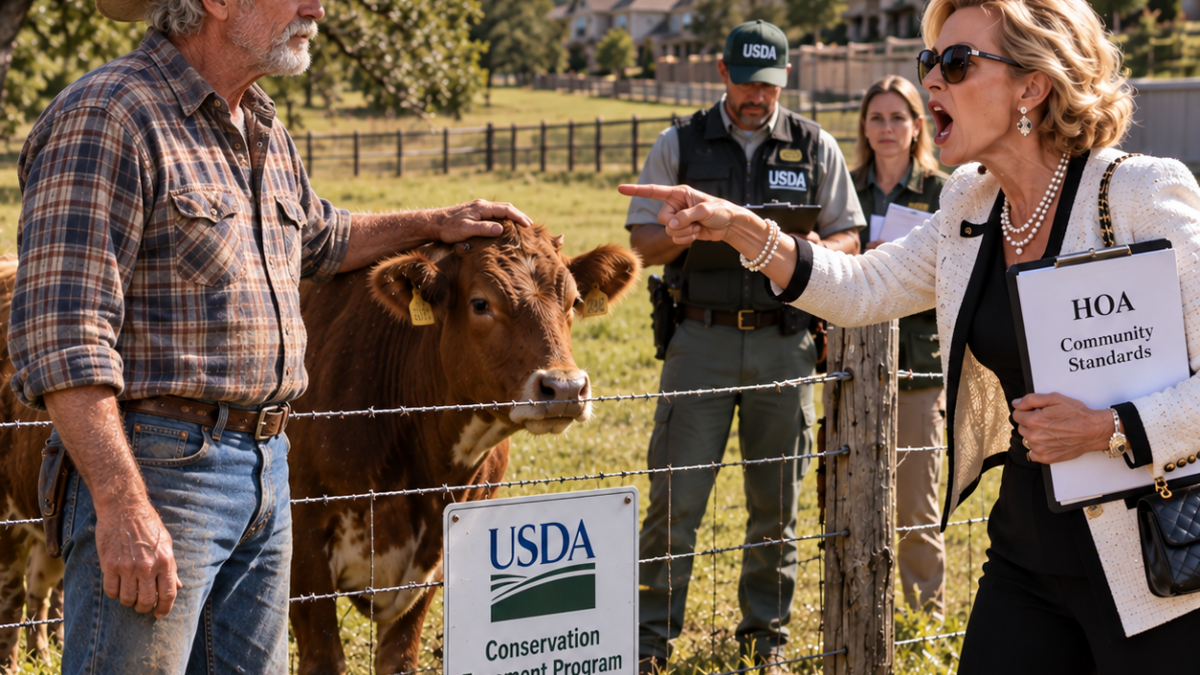
HOA Karen Ordered Me to Remove My 17-Year-Old Cow for “Hurting Property Values”—She Had No Idea Why the USDA Already Had Bonnie’s DNA on File.
Shelby Prescott stood at my fence, pointed at my seventeen-year-old Pineywoods cow like she was identifying a criminal, and told me I had until Friday to remove the “eyesore” before she used every resource her HOA had to make me regret saying no.
What she didn’t know was that Bonnie wasn’t just an old cow grazing beside a live oak—her bloodline had been cataloged in a federal livestock-conservation program, and the ninety-four acres Shelby wanted rezoned for luxury homes were bound by a conservation agreement her developer husband could not simply wish away.
By the time Shelby marched into court expecting a judge to shut down my ranch, her false animal-welfare reports, midnight fence sabotage, hidden land option, and seventy-one-million-dollar development plan were sitting in four folders on my attorney’s table—and one of those folders had the words UNITED STATES DEPARTMENT OF AGRICULTURE across the top.
My name is Colton Briggs.
My family has been raising cattle at the end of Briggs Road in Hays County, Texas, since 1961.
Long before the stone entrance to Copper Ridge Estates appeared.
Long before anyone paid six hundred thousand dollars for a house because the brochure promised “authentic Hill Country living.”
Long before a homeowners association decided the most offensive thing about authentic Hill Country living was seeing an actual cow.
My grandfather, Wallace Briggs, bought the place with money earned one hard week at a time.
He had spent most of his adult life working ranches that belonged to somebody else.
Fixing other men’s fences.
Doctoring other men’s cattle.
Sleeping in bunkhouses.
Saving whatever remained after groceries, boots, and sending a little money home to his mother.
When he was forty-eight, he had enough.
Ninety-four acres.
Live oak.
Cedar.
Elm.
Native bluestem.
A seasonal creek.
Rocky soil in places.
Good black earth in others.
Not glamorous.
Not easy.
His.
Grandpa Wallace built the original house himself.
Three bedrooms.
Thick limestone walls.
Tin roof.
Covered porch.
He welded the cattle pens from salvaged oilfield pipe because buying new steel offended him on principle.
His first cattle were Herefords.
Then mixed commercial cows.
Then, in 1983, he made the decision that shaped everything that came after.
He bought eight Pineywoods cattle from an old East Texas breeder named Leon Barlow.
Grandpa came home with them in a rattling stock trailer and my father, Earl, thought he’d lost his mind.
“Those things look skinny,” Dad told him.
Grandpa answered:
“They’re not skinny. They’re built for surviving.”
He was right.
Pineywoods cattle are old Gulf Coast cattle.
The kind of livestock that lived for generations in heat, humidity, brush, storms, insects, and poor forage because nobody had designed them for feedlots or glossy catalog photos.
They were shaped by the country.
Tough feet.
Heat tolerance.
Strong mothers.
Good survival instincts.
Different families preserved different strains.
PART2:
Grandpa became obsessed with keeping ours pure.
He kept handwritten breeding records.
Every cow.
Every bull.
Every calf.
Birth date.
Dam.
Sire.
Markings.
Temperament.
Calving history.
My father continued it.
Then I did.
We weren’t running a huge operation.
Thirty-four head when Shelby first came after us.
But rarity isn’t measured in herd size.
Sometimes a small herd matters precisely because there aren’t many left.
Bonnie was the oldest.
Brindled brown.
Dark face.
One horn slightly shorter than the other from an accident when she was young.
Seventeen years old.
Ancient for a working cow.
My father delivered her first calf.
Then her second.
Then most of the calves after that.
She was never aggressive.
Never flighty.
She’d walk toward you if you carried feed and ignore you if you didn’t.
Maisie could scratch behind her ears.
Bonnie would lower her head and close her eyes like an oversized dog.
My father loved that cow.
Not in the sentimental way people imagine ranchers loving livestock.
He understood she was an animal.
An agricultural animal.
But some animals become chapters in a family’s history.
Bonnie was one.
In 2016, a heritage-livestock conservation project working with federal agricultural researchers collected genetic samples from several of our animals.
Bonnie’s DNA was among those cataloged.
The purpose was long-term preservation.
Genetic diversity.
Rare livestock lines.
A biological backup of something generations of ranchers had almost allowed to disappear.
Dad acted like it was no big deal.
Then kept the documentation in a plastic sleeve inside the fireproof safe.
That was Dad.
Proud enough to preserve the proof.
Too stubborn to admit he cared.
He died in November 2019.
Heart attack.
Front porch.
Coffee beside him.
Bonnie grazing in the South pasture.
Maisie was seven.
I was forty-two.
My divorce had become final earlier that year.
My ex-wife, Natalie, and I had tried to save the marriage.
Counseling.
Vacations.
Promises.
None of it fixed the simple truth that we’d spent too many years becoming tired versions of ourselves.
She took a nursing position in Austin.
I moved fully back to the ranch.
We shared custody of Maisie.
It wasn’t the family plan I’d imagined.
But life doesn’t ask whether the revised version fits your original blueprint.
Maisie handled it better than I did.
At the ranch, she fed bottle calves.
Named everything.
Kept a purple notebook of births.
She once named a bull calf Mr. Pancake.
I objected.
She won.
She told her fourth-grade class:
“My family protects important American cows.”
Her teacher wrote me an email asking what she meant.
I sent photographs of Bonnie and the herd records.
The teacher apologized for assuming Maisie was exaggerating.
Maisie never let her forget it.
The ranch itself had been agricultural for decades.
Zoning reflected that.
Its use predated every nearby subdivision.
We also participated in conservation programs that rewarded keeping the acreage in agricultural production and protecting soil, water, forage, and heritage livestock practices.
The conservation agreement mattered most.
It placed permanent restrictions on converting the protected acreage into a typical residential subdivision.
Dad had signed willingly.
So had I when the documents transferred.
Some people see restrictions and think lost opportunity.
Dad saw insulation.
“Developers can’t tempt you with stupid money if you already promised the land what it’s going to remain,” he told me.
At twenty-eight, I thought that sounded dramatic.
At forty-four, I understood.
Copper Ridge Estates began south of us in 2017.
A developer named Trent Prescott bought former soybean acreage.
One hundred twelve homes.
Clubhouse.
Pool.
Walking trails.
Decorative stone entrance.
Copper lettering:
COPPER RIDGE ESTATES
WHERE TEXAS COMES HOME
I laughed the first time I saw it.
They bulldozed a working farm, planted identical landscaping, built houses in twelve approved shades of beige, then marketed themselves as authentic Texas.
Still, I didn’t care.
Their land.
Their buyers.
Their choices.
Most residents were decent.
Some waved.
Some bought eggs from a neighbor.
Kids liked seeing calves through the fence.
Problems started when Trent’s wife became HOA president.
Shelby Prescott.
Forty-six.
Honey-blonde hair.
Perfect skin.
Perfect teeth.
Range Rover.
Designer activewear.
Leather portfolio with a copper-colored HOA crest stamped into it.
Shelby could turn walking from a parking lot into an entrance.
She had the posture of someone who assumed doors opened because architecture respected her.
She ran three HOA committees.
Architectural standards.
Community aesthetics.
Perimeter quality.
Nobody knew what the last one was until Shelby started standing near our fence photographing cattle.
She once fined a Copper Ridge homeowner forty dollars because his grass exceeded the HOA’s four-inch maximum by a quarter inch.
He showed me the photograph.
Shelby had included a ruler.
Actual ruler.
Placed against grass.
I asked:
“You paid?”
He shrugged.
“Cheaper than fighting.”
That phrase explains how people like Shelby gain power.
Cheaper than fighting.
Easier than arguing.
Not worth the trouble.
One small surrender at a time.
Shelby’s first complaint about us involved noise.
Cattle vocalization.
Then odor.
Then flies.
Then dust.
Then “visual inconsistency.”
I ignored what didn’t require response.
Answered county agencies when necessary.
Kept records.
Then a cream-colored envelope arrived.
Copper Ridge crest.
Addressed:
PROPERTY OWNER — BRIGGS ROAD.
Not even my name.
The letter demanded that I relocate all livestock not visible from Copper Ridge homes within thirty days.
It cited one of their HOA covenants.
I read it twice.
Then checked my deed just because arrogance this confident can briefly make a sane person question reality.
Nope.
Still my ranch.
Still outside Copper Ridge.
I called Hank Dillard.
Hank was seventy-three.
Retired rancher.
Widower.
Three miles north.
Spent retirement watching old westerns and reading Texas land-use decisions because his hobbies had become increasingly strange after his wife died.
I read the letter.
He laughed.
“Colton.”
“Yeah?”
“That has the legal authority of a cocktail napkin.”
“So ignore it?”
“File it.”
“Why?”
“Because people who start with fake authority usually escalate to real paperwork.”
“You think she’ll keep going?”
“Son, women like that don’t buy monogrammed portfolios because they enjoy hearing no.”
He was right.
Two weeks later, twenty-six Copper Ridge residents signed a noise complaint.
One described cattle sounds as “psychologically destabilizing.”
I framed that sentence mentally.
Then came an odor petition.
Thirty-one signatures.
Then a request for county review of livestock proximity.
The county planning clerk pulled my parcel up.
A1 agricultural.
Longstanding use.
No issue.
I drove home.
Shelby was waiting at the front gate.
White pants.
Champagne blouse.
Gucci sunglasses.
Pearl-white Range Rover behind her.
Bonnie grazed about a hundred twenty feet away.
Shelby didn’t say hello.
“I’ve sent three letters.”
“I received them.”
“You haven’t responded.”
“I don’t belong to your HOA.”
“This isn’t about membership.”
“What is it about?”
“Standards.”
I looked past her.
At the gate.
Cedar posts.
Wire.
Pasture.
“Whose?”
She pointed.
“That animal.”
Bonnie lifted her head.
Chewed.
Shelby spoke like she was selecting a suspect from a lineup.
“The brown one.”
“Bonnie.”
“I don’t care what it’s called.”
“She.”
Shelby removed her sunglasses.
“Fine. She stands there every afternoon looking into Copper Ridge yards.”
I waited.
“That is the complaint?”
“It smells.”
“All cattle smell.”
“Exactly.”
I almost laughed.
Shelby continued.
“She’s unsightly.”
“She’s a cow.”
“My residents paid substantial money for their views.”
“They bought houses next to a ranch.”
“They bought into a community with standards.”
“Your standards stop at your property line.”
Her lips tightened.
“Mr. Briggs, I have one hundred twelve homeowners paying three hundred forty dollars a month for quality-of-life protections.”
“Then protect their quality of life on your hundred twelve lots.”
“You’re being deliberately difficult.”
“No.”
I nodded toward Bonnie.
“She’s been here longer than Copper Ridge.”
“And?”
“And you moved next to her.”
Shelby looked at my house.
The old stone exterior.
Window units.
Gravel road.
Equipment barn.
Then back at me.
Something in her expression changed.
She knew details.
“You’re raising your daughter alone.”
My body went cold.
“What?”
“You have a struggling cattle operation, old equipment, no central air, and land worth far more as development property than pasture.”
“Why are you researching my daughter?”
“I research anything affecting the community.”
I stepped toward the gate.
“Do not mention my daughter again.”
She smiled.
Tiny.
Satisfied.
She had found a nerve.
“I am giving you an opportunity to cooperate before this becomes expensive.”
“Expensive?”
“You cannot afford the kind of legal fight you’re inviting.”
“Move the cattle?”
“Out of sight.”
“All of them?”
“At minimum the South pasture.”
“That removes a third of my rotational grazing.”
“Then adapt.”
I stared.
Shelby lowered her voice.
“I always get what I want, Mr. Briggs.”
Then she stepped closer.
“If I decide that ranch needs to go, I will make keeping it so miserable that selling feels like mercy.”
She turned.
Walked away.
Range Rover dust rolling behind her.
I stood at the gate.
Bonnie approached.
I scratched behind her ear.
“Well, girl.”
She chewed.
“I think we just met our problem.”
The first official inspection came two weeks later.
Animal control.
Officer Darren Lusk.
Complaint:
Malnutrition.
Inadequate shelter.
Visible distress.
I opened every gate.
“Inspect everything.”
He did.
Stock tanks.
Clean.
Loafing sheds.
Good.
Pasture condition.
Good.
Body condition scores.
Good.
Vaccinations.
Records.
Minerals.
Hay.
He stopped at Bonnie.
Looked at her ear tag.
Then at me.
“Pineywoods?”
“Yes.”
He smiled.
“I did my A&M thesis on heritage cattle.”
“Seriously?”
“Rare-breed management.”
He walked around Bonnie like someone inspecting a classic truck.
“How old?”
“Seventeen.”
“No kidding.”
“She’s our old lady.”
Darren looked at the rest.
“Whoever filed this either knows nothing about cattle or wants an inspection for another reason.”
“Can you put that in the report?”
He looked at me.
“Professionally.”
“Professional is fine.”
He did.
Complaint unfounded.
Herd healthy.
Second complaint:
Environmental contamination.
Shelby alleged manure runoff was entering Copper Ridge drainage.
Texas environmental inspector Sandra Vela came.
Soil samples.
Creek sample.
Water.
Drainage.
Berms.
Pasture.
She walked for three hours.
Dad had built runoff berms in 1998.
Maintained ever since.
Results came later.
Normal.
No hazardous discharge.
No contamination.
Sandra met me at the fence.
“Off the record?”
“Sure.”
“Your place is cleaner than some hobby ranches with five cows.”
“Thank you?”
“It isn’t a compliment. It’s an observation.”
She glanced toward Copper Ridge.
“Their pool backwash system needs attention.”
I smiled.
“Will that be in writing?”
She smiled back.
“Professionally.”
Another report.
Another tab in my binder.
Shelby hadn’t spent a dollar.
That was the brilliance of her strategy.
Use government agencies.
Force me to answer.
Lose half a day.
Gather records.
Meet inspectors.
Absorb stress.
Repeat.
Even innocent inspections cost the target time.
That’s how harassment works when dressed as process.
Then I saw the petition.
Copper Ridge clubhouse.
Folding table.
Banner:
PROTECT OUR COMMUNITY.
Shelby sat behind it in a cream blazer.
Candy bowl.
Clipboards.
The petition demanded a five-hundred-foot livestock exclusion zone around residential boundaries.
That would eliminate a huge portion of my South pasture.
Maisie had been at a birthday party inside Copper Ridge.
When I picked her up, she climbed into the truck holding a pink favor bag.
“Emma got a trampoline.”
“Nice.”
“Her mom says it’s ugly.”
“Then maybe Emma’s mom shouldn’t have purchased a trampoline.”
Maisie laughed.
Then saw me watching the petition table.
“What’s that?”
“Neighborhood paperwork.”
“About our cows?”
I looked at her.
“How’d you know?”
“Lily’s mom said Bonnie spreads diseases.”
That hit me harder than Shelby mentioning my divorce.
“Who is Lily?”
“Girl in my class.”
“What did you say?”
“That Bonnie gets more shots than her dog.”
I smiled.
“Good answer.”
Maisie looked at the petition.
“Are they going to take Bonnie?”
“No.”
“You promise?”
Parents should be careful with promises.
But some moments require one.
“Yes.”
She studied my face.
“Okay.”
Then went back to talking about trampoline tricks.
I sat there another minute.
Sixty-seven signatures.
Five hundred feet.
I drove away.
County hearing was April 18.
Shelby arrived prepared for television.
Ivory blazer.
Pearls.
Presentation boards.
Property-value charts.
Photos of Bonnie.
Resident testimonials.
One said:
“I cannot enjoy breakfast while being watched by a large livestock animal.”
I read that twice.
Bonnie.
The same cow who regularly walked into fence posts because she was distracted by hay.
Psychological menace.
Shelby spoke fourteen minutes.
Called the ranch incompatible with modern residential character.
Called cattle proximity unreasonable.
Called agricultural operations an “anachronistic use.”
Then displayed a slide:
THE FUTURE OF HAYS COUNTY.
Luxury homes.
Sunset.
Perfect landscaping.
She said:
“We cannot allow the past to prevent responsible progress.”
Commissioner Linda Greer looked at me.
Fourth-generation ranching family.
“Mr. Briggs?”
I stood.
Best jeans.
Pressed shirt.
Dad’s Lucchese boots.
Carried one manila folder.
“My grandfather bought our land in 1961.”
I placed the deed summary down.
“My family has maintained agricultural operations continuously since.”
Next:
zoning.
Next:
conservation agreement.
Next:
stewardship program.
Then the herd documentation.
I explained Pineywoods cattle.
Bonnie’s genetic samples.
Federal agricultural conservation interest.
The county attorney reviewed the materials.
Whispered with commissioners.
Then said:
“The requested rezoning and exclusion proposal appears incompatible with existing agricultural protections and the conservation restrictions.”
Vote.
Five to zero.
Denied.
No applause.
No dramatic speech.
Just paperwork beating performance.
Outside, Shelby waited near my truck.
She should have left.
She didn’t.
“Enjoy your little victory.”
“I plan to.”
“I’ve lost votes before.”
“Okay.”
“I’ve never lost a war.”
I unlocked the truck.
She stepped closer.
“Your ranch is temporary.”
“No.”
“Everything is temporary.”
“That includes HOA presidents.”
Her eyes narrowed.
“Cute.”
She pointed toward my boots.
“Your dirt, your cows, that house you’re raising your daughter in—they disappear the second someone with enough money decides the land matters more than you do.”
That sentence gave me something her previous threats hadn’t.
A question.
Why?
Why fight this hard over Bonnie?
A cow.
Why spend political capital?
Why gather petitions?
Why attempt rezoning?
Why make me sell?
Two nights later, Hank answered.
His kitchen.
Coffee.
Old western playing silently.
He listened.
Then said:
“Pull the real-estate filings.”
“For what?”
“Your land.”
“Why?”
“People don’t spend this much energy on an eyesore unless the eyesore is standing on money.”
Saturday morning, I went to county records.
Parcel history.
Development filings.
Corporate records.
Then found it.
Conditional purchase option.
Buyer:
Copper Ridge Estates LLC.
Connected to Trent Prescott’s development company.
Property:
Briggs Ranch.
Ninety-four acres.
Date:
January 2021.
Fourteen months before Shelby’s first letter.
Purchase conditional upon:
Residential rezoning.
Release or modification of conservation restrictions.
Purchase price:
$610,000.
I stared.
Our land was worth more than that for ordinary agricultural market purposes.
Much more with development potential.
Then the attached pro forma.
COPPER RIDGE PHASE II.
One hundred twenty premium homes.
Projected sale prices:
$520,000 to $680,000.
Projected gross revenue:
approximately $71 million.
There it was.
Not smell.
Not noise.
Not standards.
Seventy-one million dollars.
I called Hank from the parking lot.
“Hank.”
“You found something.”
“How do you know?”
“You don’t call me before lunch unless somebody died or got greedy.”
“Seventy-one million.”
He went quiet.
Then:
“Well.”
“They have a purchase option.”
“On your land?”
“Yes.”
“Signed by who?”
“Developer entity. It’s conditional.”
“You never agreed?”
“No.”
“Then it’s an option dependent on them creating conditions, not a contract with you.”
“Correct.”
Hank sighed.
“They did it to the McCreedys.”
“What?”
“Miller Road.”
I knew the property.
New subdivision now.
“Four years of complaints.”
Hank continued.
“Drainage. Fences. Equipment noise. Weeds. Eventually Jim got exhausted.”
“How much did he sell for?”
“Not enough.”
I sat in my truck.
“It isn’t personal.”
“No.”
“It’s a model.”
“Yes.”
“Harass farmers until they sell.”
“Yes.”
Hank’s voice softened.
“Colton, you’re not fighting a woman who hates cows.”
“What am I fighting?”
“A spreadsheet.”
That night, after Maisie slept, I spread everything across Dad’s kitchen table.
Shelby’s letters.
Agency reports.
Rezoning petition.
Development option.
Pro forma.
Seventy-one million.
I looked toward the porch.
Dad’s rocking chair was still there.
I had never moved it.
In my mind, I could hear him.
Hope is expensive.
So I stopped hoping Shelby would quit.
I hired Wendell Pike.
Agricultural attorney.
Austin.
Six-foot-four.
Bald.
Wire glasses.
Voice quiet enough that people leaned in.
I brought three boxes.
He read two hours.
Then held up the conservation agreement.
“This is the part they should be afraid of.”
“Why?”
“Because they’re not just pressuring a private landowner.”
He tapped the document.
“They’re attempting to alter the use of land in which a federal agricultural conservation program has a documented interest.”
“Does that make it federal?”
“It makes federal agencies interested.”
“Same thing?”
“No.”
He smiled.
“But sometimes more uncomfortable.”
Then the development plan.
“There’s motive.”
“And the false complaints?”
“Pattern.”
“What do we do?”
“Nothing stupid.”
That became the phrase every lawyer in my life seemed required to say.
Wendell contacted conservation officials.
Farm Bureau.
Agricultural program representatives.
We documented every complaint.
Every finding.
Every expense.
Every missed work hour.
I installed trail cameras along the fence.
Backed files up.
Cloud.
External drive.
Fireproof safe.
Then kept ranching.
That’s the strange part of legal fights over farms.
Cows don’t care.
At 5:30 the next morning, they still needed feed.
Fence still broke.
Water still needed checking.
A lawsuit doesn’t stop calves from being born.
May 6, three workers appeared along my southern boundary.
Cedar privacy fence.
Six feet tall.
Dark stain.
Decorative caps.
They were digging posts.
I walked down.
“Morning.”
The foreman looked up.
“Morning.”
“Who hired you?”
“Copper Ridge HOA.”
“This post is on my land.”
He looked uncomfortable.
“We were given survey marks.”
“Show me.”
He did.
Wrong.
Several feet inside my property.
He called Shelby.
Speakerphone.
“Mrs. Prescott, property owner says we’re over the line.”
Her voice:
“Finish it.”
“He says—”
“I don’t care what he says.”
The foreman looked at me.
Shelby continued:
“If he wants to complain, he can sue.”
I said loudly:
“Shelby.”
Silence.
“I’m recording.”
Another silence.
Then:
“Do whatever you think you need to do.”
She hung up.
The foreman stared.
“Mr. Briggs, I don’t want trouble.”
“I know.”
“You want us to leave?”
I thought about Wendell.
Evidence.
“I’m informing you that you do not have permission.”
He nodded.
“And that line is disputed.”
“Yes.”
“What you do after that is between you and whoever pays your invoices.”
He called his boss.
They kept working.
Eighty-six feet.
I had a certified surveyor out the next morning.
Every post measured.
Average encroachment almost four feet.
Wendell laughed.
“She built you a twelve-thousand-dollar exhibit.”
“Can I tear it down?”
“No.”
“Why?”
“Because I enjoy evidence.”
Two weeks later, Shelby made the mistake that changed everything.
5:15 a.m.
Bonnie bellowing.
Not normal.
Pain.
I ran.
Fence cut.
Three strands.
Two locations.
Clean diagonal cuts.
Bonnie and two yearlings had wandered onto the Copper Ridge walking path.
One yearling was panicking.
Bonnie limped.
Maisie came running in pajamas.
“Dad!”
“Get the feed bucket.”
She did.
We got the cattle back.
Bonnie had a gash above the hoof.
Blood.
Not catastrophic.
Enough.
Vet came.
Cleaned.
Bandaged.
Antibiotics.
Then cameras.
2:47 a.m.
A man.
Dark clothes.
Copper Ridge maintenance polo.
Bolt cutters.
Cut first section.
Walked forty feet.
Cut second.
Returned toward subdivision.
I knew him.
Cody Rains.
Maintenance supervisor.
Worked for Trent Prescott’s management company.
Deputy Ray Calhoun came.
Handlebar mustache.
Old-school calm.
Watched video twice.
Then Bonnie.
Then the cut wire.
“This isn’t random.”
“No.”
“You know him?”
“Yes.”
“I’m going to talk to him.”
“Okay.”
Ray paused.
“Whoever told him to do this just turned your property dispute into something much uglier.”
Maisie helped repair fence that afternoon.
She handed staples.
Bonnie stood nearby, hoof wrapped.
“Dad?”
“Yeah?”
“Why would somebody hurt her?”
I hammered a staple.
“They probably weren’t trying to hurt Bonnie.”
“They cut the fence.”
“They wanted cattle out.”
“Why?”
“To create a problem.”
Maisie stared at Copper Ridge.
“So they hurt her because they wanted people to think she was dangerous?”
I stopped.
Children sometimes reduce strategy to morality better than adults.
“Something like that.”
She looked at Bonnie.
“That’s stupid.”
“Yes.”
“Is Shelby stupid?”
I smiled despite myself.
“Don’t say that at school.”
“That’s not an answer.”
“No.”
“What is she?”
I thought.
“Desperate.”
June brought the health complaint.
Livestock pathogens.
Danger to families.
Emergency removal requested.
Completely fabricated.
Our herd testing was current.
No outbreak.
No known issue.
Then flyers appeared across Copper Ridge.
Photo of Bonnie.
Red headline:
YOUR FAMILY IS AT RISK.
Disease.
Parasites.
Contaminated runoff.
At bottom:
SHELBY PRESCOTT
FIGHTING FOR YOUR FAMILY.
Then a social-media group.
Hundreds joined.
Posts became personal.
The farmer values cows more than children.
The farmer refuses compromise.
The farmer has no real career.
The farmer’s failed marriage proves instability.
That one made me stop.
She had dragged Natalie into it.
Maisie.
Our family.
I called Natalie.
She answered from the hospital.
“You saw it?”
“Yes.”
“I’m sorry.”
“For what?”
“She shouldn’t be using our divorce.”
Natalie was quiet.
Then:
“Want me to respond?”
“No.”
“You sure?”
“Yes.”
“Because I have things I could say about people who use Botox as a personality.”
I laughed unexpectedly.
“Please don’t.”
“I’m serious.”
“That’s why I’m saying no.”
Natalie softened.
“Maisie okay?”
“Yeah.”
“Keep her away from the comments.”
“I will.”
Then:
“Colton.”
“Yeah?”
“Don’t let them make you ashamed that we didn’t work out.”
That landed.
“I’m not.”
“Good.”
She paused.
“And for the record, you have a real career.”
“Thank you.”
“You’re annoying, but employable.”
“That’s going on my résumé.”
For the first time in years, we ended a call laughing.
Shelby’s smear campaign accidentally healed one tiny fracture she hadn’t intended to touch.
Then she hired Brock Callan.
Austin litigator.
Expensive.
Filed for temporary restraining order.
She wanted a judge to suspend cattle operations near Copper Ridge.
Health.
Safety.
Property damage.
Nuisance.
Wendell read the petition.
He smiled.
“What?”
“She asked a state judge to restrict an agricultural conservation operation without dealing meaningfully with the easement.”
“So?”
“So we answer completely.”
He drafted.
Texas agricultural protections.
Zoning.
Operational history.
Federal conservation documents.
Heritage herd records.
Agency findings clearing every complaint.
Then Dr. Louisa Sandoval provided a letter confirming the conservation and genetic significance of our Pineywoods herd.
Then another letter arrived.
USDA counsel had taken notice of the pattern of complaints affecting the protected operation and referred relevant information for review.
Not an indictment.
Not a conviction.
A referral.
Still enough to change the temperature.
July 11.
Courtroom 3B.
Judge Patricia Harwell.
Maisie sat beside Hank.
Hank wore a bolo tie.
He told her:
“When your dad wins, barbecue.”
I heard him.
“Don’t promise outcomes.”
Hank said:
“When this concludes in a manner favorable to your father, barbecue.”
Wendell laughed.
Shelby arrived with Trent.
Cream designer blazer.
Pearls.
Perfect nails.
Perfect posture.
Brock Callan spoke first.
Reasonableness.
Public health.
Property values.
Residential expectations.
Twenty-two minutes.
Then Wendell stood.
He carried four folders.
No slideshow.
No dramatic voice.
“Your Honor, this case begins with chronology.”
First folder.
Ranch established 1961.
Agricultural use continuous.
Current zoning.
State agricultural protections.
Second.
Conservation agreement.
Federal agricultural interest.
Stewardship enrollment.
Third.
Heritage cattle.
Pineywoods records.
Genetic conservation documentation.
Bonnie.
Wendell pointed toward a photograph.
“The animal repeatedly identified by plaintiff as an eyesore is seventeen-year-old Bonnie, a Pineywoods cow whose genetics have been cataloged as part of rare-livestock preservation efforts.”
Shelby’s hand moved.
Small.
Her confidence didn’t disappear yet.
Then folder four.
USDA correspondence.
Pattern of false or unsupported complaints.
Animal welfare.
Environmental.
Public health.
Fence sabotage resulting in injury.
Referral for review.
The courtroom went still.
Wendell didn’t exaggerate.
That made it worse for Shelby.
He never said:
Federal agents are coming.
He said:
“Government programs have taken notice because this is no longer simply a complaint about a neighbor’s cow.”
Then the motive.
Conditional purchase option.
Copper Ridge Phase II.
$71 million projected gross revenue.
Shelby’s face finally changed.
Not much.
Enough.
Wendell said:
“The requested removal of these cattle would materially assist a proposed residential expansion controlled by entities associated with the plaintiff’s husband.”
Brock stood.
“Objection to characterization.”
Judge Harwell:
“Overruled as to the document. Counsel may argue inference.”
Wendell nodded.
“Then let the document speak.”
Next:
trail-camera video.
2:47 a.m.
Cody.
Bolt cutters.
Fence.
Bonnie injured.
Judge Harwell watched.
Replay.
Then:
“Who employs this individual?”
Brock whispered with Trent.
“Property management affiliate.”
“And the plaintiff?”
“HOA president.”
“Relationship to developer?”
“Married to Mr. Prescott.”
Judge Harwell looked at Shelby.
Not angry.
Worse.
Interested.
“Ms. Prescott, your counsel alleges immediate danger caused by Mr. Briggs’s cattle, while evidence before this court indicates someone employed by a company associated with your husband’s development enterprise deliberately cut the fence containing those cattle.”
Brock stood.
“Your Honor, my client denies any knowledge.”
Judge:
“I’m certain we will hear about that elsewhere.”
Then the false complaints.
Animal control report.
Unfounded.
Environmental report.
No violation.
Health claim.
Unsupported.
Zoning petition.
Denied.
Wendell stacked them.
“One accusation might be error.”
He looked toward the judge.
“Four months of escalating allegations, each unsupported, combined with a development option dependent upon changing this land’s use, merits considerably more scrutiny than plaintiff’s petition provides.”
Brock leaned toward Shelby.
Whispering.
She didn’t answer.
He whispered again.
Finally he stood.
“Your Honor, plaintiff withdraws the request for temporary relief.”
Judge Harwell didn’t smile.
“Withdrawal noted.”
She looked at the fence footage.
“I am forwarding the materials relating to the fence-cutting incident and potentially false governmental filings to appropriate county authorities for whatever action they deem proper.”
Gavel.
Done.
In the hallway, Shelby finally cracked.
Not in front of me.
In front of Trent.
“You told me the federal documents didn’t matter.”
People stopped.
Trent whispered:
“Lower your voice.”
“You said we’d have the land by August.”
There.
Out loud.
Hank looked at me.
I looked at Wendell.
Wendell murmured:
“Never interrupt.”
Shelby’s voice rose.
“You said once we got the cattle restricted, he’d have to sell.”
Trent grabbed her elbow.
She pulled away.
“I did everything you told me.”
That sentence mattered.
Later.
Not because hallway arguments are automatically evidence.
But because several people heard it.
And because Cody talked.
Deputy Calhoun interviewed him.
At first:
Didn’t remember.
Then:
Routine fence maintenance.
Then investigators showed the video.
His attorney entered.
Story changed.
Cody admitted Shelby had told him the fence needed to be opened so cattle would reach Copper Ridge property.
Why?
Create a documented livestock incursion.
Then county action.
Then impoundment pressure.
He claimed she offered a bonus.
That transformed her problem.
County prosecutors filed charges related to false reports and the fence sabotage.
Exact counts shifted through plea negotiations.
Cody cooperated.
Shelby’s lawyer negotiated.
No dramatic federal raid.
No black SUVs surrounding Copper Ridge at dawn.
Real investigations are less cinematic and often more frightening.
Letters.
Subpoenas.
Interviews.
Audits.
Records requests.
Trent’s company had to explain the purchase option.
Development plans.
Communications with Shelby.
Any relationship between HOA expenditures and Phase II planning.
The conservation easement made financing Phase II far harder than their projections implied.
Once lenders understood that releasing or modifying the restriction was uncertain at best, enthusiasm disappeared.
The $71 million project began dying quietly.
First investor delayed.
Then lender review.
Then option deadline.
Then expiration.
Hank called me the morning it expired.
“You drinking?”
“Coffee.”
“Add something.”
“It’s nine thirty.”
“Historic occasion.”
I walked to the pasture.
Bonnie stood beneath the live oak.
Hoof healed.
Maisie had tied a blue ribbon loosely around her halter because children believe important days require decoration.
I scratched Bonnie.
“Seventy-one million dollars, girl.”
She burped.
“That’s your comment?”
Chewed.
“Fair.”
The HOA held an emergency meeting.
Copper Ridge clubhouse.
Packed.
I didn’t attend.
It wasn’t my HOA.
Hank went because somebody invited him.
Nobody knows who.
He called afterward.
“Eighty-nine to six.”
“What?”
“Removed Shelby.”
“President?”
“Former president.”
“Did she speak?”
“Tried.”
“And?”
“Residents were not in a listening mood.”
Later I saw video.
Roy Dunlap, HOA treasurer.
Quiet insurance agent.
Stood.
“This board was used to advance a private development agenda.”
Shelby objected.
Called procedure.
Called misinformation.
Called personal attacks.
Then residents voted.
Hands.
One after another.
Eighty-nine.
Against six.
The gavel she had used for years sat in front of her.
After the vote, Roy moved it.
Small gesture.
Symbolic.
Shelby sat in the back row for the rest.
Portfolio closed.
No speech.
No authority.
Maisie asked me later:
“Are you happy?”
“About what?”
“Shelby losing.”
I thought.
“A little.”
“Only little?”
“Maybe medium.”
She smiled.
“Is she going to jail?”
“Don’t know.”
“Should she?”
I looked at my ten-year-old daughter.
“That’s for courts.”
“But what do you think?”
“I think people should face consequences for things they choose.”
She considered.
“Even if they’re sorry?”
“Yes.”
“Can they still be forgiven?”
That was harder.
“I think consequences and forgiveness can happen at the same time.”
“Did you forgive Shelby?”
“No.”
Maisie nodded.
“Okay.”
Children appreciate honest answers more than impressive ones.
The state cases resolved over time.
Some charges reduced.
Restitution.
Probationary terms.
Community service.
Fines.
Cody accepted responsibility and lost his maintenance job.
Shelby faced the public humiliation of criminal proceedings and the collapse of the position she had used as identity.
Trent faced something he cared about even more.
The development deal died.
Banks don’t fund dreams against land that isn’t actually available.
The federal conservation agreement remained.
The ranch remained.
The cows remained.
The false narrative did not.
But winning didn’t instantly make everything good.
I need to say that.
For months, every unfamiliar vehicle made me look toward the fence.
Every cattle call before dawn made me wonder if wire had been cut.
Maisie asked more questions about whether people could take land.
She started checking gates with me.
A ten-year-old shouldn’t feel responsible for legal boundaries.
I realized that one night when I found her at the kitchen table drawing the ranch.
Fence lines.
Pastures.
House.
Bonnie under the live oak.
Then around the whole drawing she’d written:
OURS.
I sat beside her.
“Why’d you write that?”
“So nobody forgets.”
My throat tightened.
“Maisie.”
She looked up.
“You don’t have to protect the ranch.”
“I know.”
“That’s my job.”
“Grandpa protected it.”
“Yes.”
“You protect it.”
“Yes.”
“So later I protect it.”
Maybe.
But I didn’t want inheritance to become fear.
“The point of having something isn’t spending your whole life terrified somebody will take it.”
She thought.
“What’s the point?”
“Taking care of it.”
She erased OURS.
Then wrote:
BRIGGS RANCH.
Better.
Federal conservation staff visited later that year.
Dr. Louisa Sandoval drove out.
Practical boots.
Sun hat.
No designer portfolio.
She spent an hour looking at herd records.
Then Bonnie.
“This is her?”
“Yes.”
“Seventeen?”
“Yes.”
Dr. Sandoval shook her head.
“Tough old girl.”
Maisie corrected:
“National treasure.”
Louisa laughed.
“I stand corrected.”
She explained genetic diversity to Maisie.
Why old livestock breeds matter.
Disease resilience.
Environmental adaptation.
Traits that modern agriculture may someday need.
Not because Pineywoods were museum pieces.
Because genetic options matter.
Maisie listened like somebody had handed her a superhero origin story.
She spent the rest of the week telling everyone Bonnie was “a genetic time capsule.”
The Livestock Conservancy later featured our ranch in a heritage-breed article.
Maisie printed the page.
Laminated it.
Taped it to the refrigerator.
“Dad.”
“What?”
“They called us stewards.”
“Yes.”
“That sounds important.”
“It sounds like a person who cleans water troughs.”
She rolled her eyes.
Then:
“Can my class come?”
“Here?”
“To see Bonnie.”
I hesitated.
Then said yes.
Twelve fourth graders arrived in September.
Three from Copper Ridge.
Maisie gave the tour.
She had index cards.
Actual index cards.
I did not know she had prepared.
“This is Bonnie.”
Kids crowded the fence.
“She’s seventeen.”
Gasps.
“She is a Pineywoods cow.”
A boy asked:
“Is she endangered?”
Maisie thought.
“Not exactly like a tiger, but there aren’t many.”
Good answer.
Then Lily Prescott stepped forward.
Shelby’s daughter.
Nine.
Same honey-blonde hair.
Same cheekbones.
But shy.
Soft voice.
She stared at Bonnie.
“My mom says cows are ugly.”
Silence.
Teacher looked horrified.
Maisie didn’t.
She reached through the fence and scratched Bonnie.
“She’s not ugly.”
Lily looked.
“She’s rare.”
Then Maisie added:
“There’s a difference.”
Lily nodded.
Stroked Bonnie.
Bonnie continued chewing.
No politics.
No grudge.
Just two children and an old cow.
That moment mattered more to me than the courtroom.
Because bitterness is another kind of inheritance.
I didn’t want Maisie inheriting mine.
After the tour, Lily stayed back.
“Mr. Briggs?”
“Yes?”
“Is my mom bad?”
There are questions no adult wants from someone else’s child.
I crouched.
“Your mom made some bad choices.”
Lily stared at dirt.
“People say she’s bad.”
“People say a lot of things.”
“Are you mad at her?”
“Yes.”
Lily looked up.
I continued.
“But being mad at somebody doesn’t mean I get to tell you how to love your mother.”
Her eyes filled.
“You love who you love.”
She nodded.
Then ran toward the bus.
I stood there a long time.
Natalie called that evening.
Maisie had told her.
“You handled that well.”
“I wanted to disappear.”
“That would’ve been awkward.”
“Very.”
Natalie was quiet.
Then:
“You’re a good dad.”
We hadn’t said things like that much after divorce.
“Thanks.”
“You’re still stubborn.”
“There it is.”
“Balance.”
The Farm Bureau invited me to speak.
I refused first.
Then Clayton Nance said:
“This isn’t about making you famous.”
“Good.”
“It is about showing other ranchers what documentation can do.”
That changed my mind.
I spoke to thirty farmers.
No dramatic story.
I showed them binder tabs.
Agency reports.
Photos.
Survey.
Conservation paperwork.
Trail-camera backups.
One rancher raised his hand.
“So your advice is paperwork?”
“Yes.”
He looked disappointed.
“No shotgun at the gate?”
“No.”
“No bulldozer?”
“No.”
“No locking the HOA lady in a cattle trailer?”
“Absolutely no.”
Laughter.
Then I said:
“Look, people expect standing your ground to feel dramatic.”
The room settled.
“Usually it looks like answering emails, keeping receipts, reading deeds, showing up to hearings, and refusing to make the mistake the other side is waiting for.”
An older rancher nodded.
That became the part people remembered.
Shelby eventually sold her Copper Ridge house.
Not immediately.
Almost a year later.
Trent and Shelby’s marriage reportedly became strained.
I don’t know the details.
Don’t need them.
One afternoon, before they moved, Shelby drove to my gate.
Alone.
No portfolio.
No Range Rover.
A gray sedan.
I almost didn’t recognize her.
She got out.
Jeans.
Sunglasses.
No obvious jewelry.
I walked down.
“Shelby.”
“Colton.”
Silence.
Bonnie grazed behind me.
Shelby’s eyes found her.
“She’s still alive.”
“Apparently she didn’t receive your Friday deadline.”
Shelby almost smiled.
Didn’t.
“I came to say something.”
I waited.
“I was wrong.”
That is harder for some people than prison.
She looked toward Copper Ridge.
“Trent told me the conservation restrictions could be dealt with.”
“Maybe he believed that.”
“He said if the ranch became economically difficult enough, you’d sell voluntarily.”
“Voluntarily.”
“I know how that sounds.”
“How does it sound?”
“Like coercion.”
I nodded.
She swallowed.
“I convinced myself the neighborhood needed expansion.”
“Did it?”
“No.”
That surprised me.
“Then why?”
She looked down Briggs Road.
“Because Phase II made us rich.”
“Richer.”
“Yes.”
Honest.
Finally.
“Trent had investors.”
“I saw the pro forma.”
“He was under pressure.”
“So you filed fake complaints.”
“At first, I didn’t think of them as fake.”
“Shelby.”
“I know.”
She exhaled.
“I told myself the cattle really did affect property values.”
“Did they?”
“Probably not enough to matter.”
“And animal abuse?”
She looked away.
“That was wrong.”
“Water contamination?”
“Wrong.”
“Health emergency?”
“Wrong.”
“Fence?”
Her eyes filled.
“I told Cody opening it would force animal control to act.”
“Bonnie was injured.”
“I know.”
“My daughter found her bleeding.”
Shelby’s face tightened.
“I know.”
“No.”
I stepped closer.
“You know as a sentence.”
She met my eyes.
“Maisie knows as a memory.”
Tears appeared.
I didn’t feel triumphant.
She whispered:
“I’m sorry.”
I believed she meant it.
That didn’t erase anything.
“Why now?”
She looked toward the old live oak.
“Because Lily asked why I hated a cow.”
I said nothing.
“I didn’t know what to tell her.”
“So tell her the truth.”
“What truth?”
“That you never hated Bonnie.”
Shelby frowned.
I continued.
“You wanted what was under her feet.”
That landed.
She nodded.
“Yes.”
“She was just easier to blame than seventy-one million dollars.”
“Yes.”
Wind moved through grass.
Bonnie flicked her tail.
Shelby wiped one cheek.
“I used to think you were stubborn because you didn’t understand money.”
“I understand money.”
“I know.”
“You just didn’t understand why it wasn’t enough.”
She nodded.
“I understand now.”
“Good.”
She turned.
Then stopped.
“Colton?”
“Yeah?”
“Lily loved the ranch visit.”
“She’s welcome back.”
Shelby stared.
“After everything?”
“Lily didn’t cut my fence.”
That broke something in her face.
She left.
I never saw her again.
Years passed.
Bonnie grew older.
At nineteen, her knees stiffened.
At twenty, she couldn’t hold weight the way she once had.
Maisie was thirteen.
Tall.
Horse-crazy now in addition to cow-crazy.
One winter morning, I found Bonnie lying beneath the live oak.
She tried to stand.
Couldn’t.
Vet came.
We both knew.
Maisie knelt beside her.
“Can we fix it?”
Dr. Flores looked at me.
Then Maisie.
“She has lived a very long life.”
“That doesn’t answer me.”
My daughter had inherited my father’s intolerance for evasive language.
Dr. Flores softened.
“No, sweetheart.”
Maisie pressed her face into Bonnie’s neck.
I looked away.
We made the decision that afternoon.
Not because Bonnie was famous.
Not because her genetics existed in a repository.
Not because federal researchers had paperwork.
Because she hurt.
And stewardship includes knowing when keeping something alive is for you rather than for it.
We stayed.
Maisie talked to her.
Told Bonnie the names of calves she had produced.
Told her Grandpa Earl would be waiting.
Then corrected herself because:
“I don’t actually know if cows go to heaven.”
I said:
“If there’s grass, she’ll find it.”
Maisie cried and laughed at the same time.
Bonnie went quietly.
We buried her near the live oak.
I kept her ear tag.
Maisie kept the blue ribbon from the day the development option expired.
The genetic program still had samples.
Her daughters remained.
Granddaughters.
Great-granddaughters.
The line continued.
That is the thing Shelby never understood when she said:
“I’ll be here long after she’s gone.”
She was right about one part.
Bonnie eventually died.
Everything does.
But Shelby left first.
The ranch remained.
The herd remained.
The bloodline remained.
Her plan depended on confusing permanence with dominance.
She believed because she had money now, authority now, influence now, she could decide what deserved to exist later.
Land teaches different arithmetic.
Grandpa Wallace died.
Dad died.
Bonnie died.
Someday I will.
The ranch doesn’t need any of us forever.
It needs each of us long enough to hand it forward in better condition than we received it.
Maisie eventually studied animal science at Texas A&M.
Of course she did.
Her application essay opened:
When I was ten years old, a homeowners association tried to remove my family’s oldest cow because she was considered ugly.
I told her that sounded made up.
She replied:
“It happened.”
Fair.
She wrote about genetic conservation.
Agriculture.
Development pressure.
Rural land fragmentation.
Bonnie.
Then one paragraph about Lily Prescott.
Not Shelby.
Lily.
A child learning that rare and ugly were not the same word.
Maisie wrote:
Conservation fails when we teach people only to protect what looks impressive.
That sentence made me cry.
I did not tell her.
She graduated.
Came back to Briggs Ranch.
Not full time at first.
Worked in livestock genetics.
Helped small heritage breeders with record systems.
Eventually she started a program bringing school groups onto the ranch.
We built a small education barn.
Permitted.
Simple.
Photos.
Breed history.
Grandpa’s handwritten ledgers.
Dad’s vaccination notebooks.
Bonnie’s genetic-conservation certificate.
And one photograph of Bonnie under the live oak.
No Shelby.
No Copper Ridge fight.
At the bottom:
BONNIE
2005–2025
BRIGGS PINEYWOODS FOUNDATION COW
HER LINE CONTINUES.
Visitors ask:
“Was she famous?”
Maisie says:
“No.”
Then thinks.
“Actually, sort of.”
Copper Ridge changed too.
New board.
New president.
They stopped photographing cattle.
Their residents eventually helped fund native-grass restoration along the shared boundary.
Funny.
The same fence line once used to divide us became a cooperative habitat project.
Roy Dunlap, the insurance guy who led Shelby’s removal, came to my porch with plans.
“We’d like to replace some ornamental shrubs with native species.”
“Why are you asking me?”
“They border your pasture.”
I smiled.
“Look at you.”
“What?”
“Learning.”
He laughed.
The HOA invited me to one meeting.
I refused.
Maisie went.
She came home carrying the old Copper Ridge portfolio.
Copper crest.
Crossed ranch fences.
I stared.
“What is that doing here?”
“They gave it to me.”
“Why?”
“Roy said the board was replacing all the old branding.”
“What are you going to do with it?”
She smiled.
“I thought we could keep cattle records in it.”
Perfect.
Shelby’s symbol of authority now holds breeding charts.
Life occasionally writes endings nobody could improve.
Hank Dillard died at eighty-one.
Peacefully.
His daughter gave me one of his bolo ties.
The one he wore in court.
I keep it near Dad’s boots.
Wendell retired.
Not really.
Attorneys use retirement the way ranchers do.
Meaning they stop accepting boring cases.
Every Christmas he sends a card.
One year:
HOW ARE THE FEDERAL COWS?
I wrote back:
UNIMPRESSED BY GOVERNMENT.
Dr. Sandoval laughed when I told her.
The conservation agreement continued.
Twenty more years.
Then renewed again with updated terms.
Not because I was afraid of another Shelby.
Because development pressure never disappears.
Austin expands.
San Marcos expands.
Roads improve.
Land values rise.
Farm taxes shift.
Families get offers.
Some sell.
I don’t judge them.
Sometimes selling is the responsible thing.
Sometimes children don’t want the farm.
Sometimes medical bills are real.
Sometimes debt wins.
My point was never that land must never change.
My point was choice.
Honest choice.
Not exhaustion engineered by someone who profits from your surrender.
That was the real crime in the Copper Ridge strategy.
Not that Trent wanted to buy my land.
He was allowed to want it.
He could have knocked on my door.
Offered market value.
Shown the plan.
Asked.
I would’ve said no.
He would’ve been disappointed.
That should have been the end.
Instead they tried to manufacture consent through pain.
That is something else entirely.
One evening, years after Bonnie died, I sat on the porch with Maisie.
She was twenty-three.
Dad’s rocking chair creaked beside me.
Maisie held coffee.
Bonnie’s descendants grazed South pasture.
Copper Ridge roofs beyond them.
“Dad.”
“Yeah?”
“Would Grandpa Earl recognize this place?”
I looked.
New barn.
Updated water system.
Education center.
Old stone house still there.
Live oak still there.
“I think so.”
“Grandpa?”
“My dad?”
“Yes.”
“He’d complain.”
“About?”
“Solar panels.”
She laughed.
“He’d secretly love them.”
“Absolutely.”
We sat.
Then she said:
“You know what’s weird?”
“What?”
“Shelby was kind of right.”
I turned slowly.
“Careful.”
“She said she’d be here after Bonnie was gone.”
I stared.
Maisie smiled.
“She wasn’t.”
“Exactly.”
“The ranch was.”
I nodded.
“And Bonnie still kind of is.”
She pointed toward a brindled heifer near the fence.
Bonnie’s line.
Same dark face.
Same curious posture.
I smiled.
“Yeah.”
That is conservation in the end.
Not freezing something in time.
Continuation.
A breed continuing.
A ranch continuing.
Knowledge continuing.
A daughter understanding why the old records mattered.
A child from a subdivision learning to touch a cow instead of fear it.
A pasture staying pasture because someone chose it knowingly.
People often ask what defeated Shelby.
They expect me to say:
The USDA.
The judge.
The trail camera.
The $71 million plan.
All mattered.
But Shelby defeated herself the moment she decided the truth was less useful than pressure.
Every false complaint gave me another clean report.
Every inspection she triggered created another independent witness.
Every petition created dates.
Every photograph proved fixation.
Every threat clarified intent.
The rezoning request forced us to present the federal conservation documents publicly.
The purchase option supplied motive.
The fence sabotage supplied criminal evidence.
The lawsuit put everything in front of a judge.
She kept thinking she was tightening a rope around me.
She was tying her own evidence together.
I only had to keep records.
That was Dad’s legacy too.
Not just cattle.
Paper.
“Hope is expensive.”
He said it about plumbing.
Turns out it applies to almost everything.
Don’t hope people remember the property line.
Survey it.
Don’t hope a verbal agreement survives.
Write it.
Don’t hope agencies know your history.
Keep records.
Don’t hope bullies become reasonable because you’re polite.
Be polite anyway.
Then document.
The day Shelby stood at my gate and pointed at Bonnie, she saw an ugly old cow.
She did not see 1961.
She did not see Grandpa Wallace saving ranch wages.
She did not see my father delivering calves at two in the morning.
She did not see genetic diversity.
She did not see federal conservation agreements.
She did not see my daughter naming calves.
She did not see generations.
She saw an obstacle to property value.
That’s why she lost.
She was measuring the wrong thing.
Money can measure development revenue.
It can measure acreage.
Sales price.
HOA dues.
Home values.
Legal bills.
It cannot fully measure what a place means to the people who have given their lives to it.
That doesn’t automatically make us legally right.
Sentiment is not a deed.
But in our case, we had both.
Meaning.
And documents.
That combination is hard to push around.
I still walk South pasture most evenings.
The live oak remains.
Dad’s old tire swing finally broke during a storm.
Maisie replaced it when she was nineteen.
She used heavier rope.
The new one hangs slightly crooked.
Dad would have fixed it.
I leave it.
Sometimes kids from Copper Ridge come for ranch visits.
They lean on the fence.
Ask questions.
“Do cows bite?”
“Why does that one have horns?”
“Can they swim?”
“Do they know their names?”
The best question came from a seven-year-old boy.
He pointed toward one of Bonnie’s great-granddaughters.
“Does she violate community standards?”
Maisie nearly choked laughing.
I asked:
“Who taught you that phrase?”
“My grandpa.”
Of course.
I crouched.
“No.”
He looked serious.
“What standards does she follow?”
I looked at the cow.
“Cow standards.”
“What are those?”
“Eat grass.”
“Anything else?”
“Raise good calves.”
“Anything else?”
“Stay on your side of the fence.”
He nodded.
“Those are good standards.”
“Yes.”
They are.
Simple.
Practical.
Clear.
The kind people could learn from.
There is a copy of Judge Harwell’s dismissal order in my safe.
Beside the conservation agreement.
Beside Bonnie’s records.
Beside Grandpa’s original deed.
Not framed.
No need.
The ranch itself is proof.
When I stand on the porch at sunset, I can still see Copper Ridge.
Beige houses.
Perfect lawns.
Mailboxes exactly the approved height.
Their pool still has that absurd waterfall.
The ranch is on the other side.
Dust.
Cattle.
Old barn.
Native grass.
Two worlds.
Neither has to erase the other.
That was always the answer.
Copper Ridge didn’t need my ranch gone to be a good neighborhood.
Shelby needed my ranch gone because someone had attached seventy-one million dollars to its disappearance.
Once that truth came out, all her talk about community standards became what it had always been.
Camouflage.
Bonnie never knew any of it.
She didn’t know about hearings.
Or petitions.
Or federal programs.
Or property values.
Or genetic repositories.
She knew grass.
Water.
Shade.
Calves.
Maisie.
My hand behind her ear.
Maybe that is why I think about her when people ask whether the fight was worth it.
Bonnie didn’t need to know what she represented for it to matter.
Neither does land.
A creek doesn’t understand an easement.
A pasture doesn’t understand zoning.
A rare breed doesn’t understand conservation policy.
Those are human tools.
We build them because the things worth protecting cannot file their own paperwork.
So we do.
That became the lesson I eventually wrote on a small wooden plaque inside the education barn:
THE THINGS THAT CANNOT SPEAK STILL NEED SOMEONE TO KEEP THE RECORD.
Maisie says it’s too serious.
She’s probably right.
Dad would have liked it.
Sometimes, late in the afternoon, one of Bonnie’s descendants stands beneath the same live oak.
From Copper Ridge, somebody can probably see her from a breakfast nook.
Nobody has complained in years.
Maybe people changed.
Maybe leadership changed.
Maybe everyone simply learned that cattle existed before their patio furniture.
Whatever the reason, the fence is quiet.
That’s peace.
Not everybody agreeing.
Everybody knowing where their authority ends.
Shelby once promised she would make selling feel like mercy.
Instead, she taught me exactly why the ranch needed stronger protection.
She told me she always got what she wanted.
What she wanted was ninety-four acres.
Phase II.
One hundred twenty more homes.
Seventy-one million dollars.
What she got was an investigation.
A lost presidency.
A dead development plan.
Legal consequences.
And the knowledge that every false report she filed had created another document proving the ranch was exactly what I said it was.
Healthy.
Legal.
Protected.
Still here.
As for Bonnie, the old cow Shelby called an eyesore?
Her DNA remains preserved.
Her daughters carried the line.
Her great-granddaughters still graze Briggs Ranch.
And every time one of them stands along that southern fence, looking toward Copper Ridge with the same calm expression Bonnie had all those years ago, I can’t help smiling.
Because Shelby had been wrong about the most important thing.
Bonnie was never standing in the way of the future.
She was part of a future worth keeping.

