HOA Karen Ordered Guards to Arrest My Ranch Workers—She Didn’t Know Their Boss Was a U.S. Marshal
PART3:
They were family.
Hector Salinas had worked for my father before he worked for me.
Fifty-five years old.
Sun-browned face.
Leather hands.
A voice so calm I once watched him settle a panicked twelve-hundred-pound bull by speaking softer.
He had been at Mesquite Creek twenty-two years.
When the freeze of 2021 burst a water line, Hector came in at midnight without being called.
Stayed until every trough had water.
Tomas Guerrero built fence.
Quiet man.
Broad shoulders.
Could set three hundred steel posts in heat that made younger men quit.
Miguel Fuentes was nineteen.
First real job after high school.
Wanted to become a large-animal veterinarian.
Saved almost every paycheck.
His mother worked at H-E-B.
His father drove propane.
Miguel called me sir no matter how many times I told him not to.
Those were the men Vivian Caldwell eventually put on their knees.
But when I first met her, the argument was about appearance.
Summit Ridge Estates went up east of us in 2019.
The old Harlow goat ranch had been sold to a Houston developer.
Two hundred acres became 140 Mediterranean-style houses.
Same stone veneer.
Same stucco tones.
Same three-car garages.
Same landscaped entrances.
An HOA with monthly dues large enough to make some rural mortgages look reasonable.
I did not care.
People can live how they want.
What bothered me was when people who arrived yesterday decided the land next door was an unfinished part of their neighborhood.
Vivian Caldwell bought one of the first houses.
Within months she became HOA president.
Forty-four.
Honey-blonde hair.
Expensive clothes.
Pearl-white Porsche Cayenne.
A leather portfolio under one arm at all times.
She wrote notes about everything.
Mailbox heights.
Fence stains.
Holiday decorations.
Wind chimes.
Trash cans.
She had the polished manner of someone who thought sounding official was nearly the same thing as being official.
Three weeks after Summit Ridge opened, Vivian arrived at my gate.
No appointment.
No call.
Silk blouse.
Tailored blazer.
Heels on gravel.
“Mr. Reed?”
“Yes.”
“I’m Vivian Caldwell.”
“I know.”
That surprised her slightly.
“President of Summit Ridge Estates.”
“Congratulations.”
She smiled without warmth.
“I wanted to discuss the visual impact of your operation.”
I looked around.
“My operation?”
“The ranch.”
“What part?”
“Cattle trucks at dawn.”
“Dust.”
“Feed trailers.”
“Fence material stored along the eastern side.”
She gestured toward my property as though she had found structural defects.
“It’s inconsistent with the aesthetic our community has established.”
I looked past her.
Rows of beige houses.
Fresh sod.
Stone entry.
Then toward the live oaks my grandfather had planted in 1965.
“Ma’am.”
“Yes?”
“This ranch has been here about sixty years.”
“I’m aware.”
“Your neighborhood has been here three weeks.”
Her smile disappeared.
She wrote something in the portfolio.
Then turned and left.
That should have told me what kind of trouble she would become.
The first certified letter came the following March.
SUMMIT RIDGE ESTATES HOA.
OFFICE OF THE PRESIDENT.
Heavy paper.
Embossed logo.
Formal language.
It ordered all commercial ranch traffic to stop using the road running through Summit Ridge within fourteen days.
It threatened vehicle impoundment.
Trespass complaints.
Civil penalties up to ten thousand dollars per incident.
I read it over coffee.
Elena looked across the table.
“Problem?”
“The HOA thinks it owns Granddad’s road.”
“Does it?”
“No.”
“What are you going to do?”
I drove to the Hays County clerk.
Got a certified copy of the 1974 easement.
Then mailed Vivian one page.
Your road crosses a permanent Reed Ranch ingress/egress easement recorded September 14, 1974, Book 47, Page 312.
Please direct future questions to the attached record.
Have a good day.
That was all.
Two weeks passed.
I thought maybe she had spoken to an actual lawyer.
Then Hector called at 6:15 one Monday.
“Boss.”
His voice was tight.
“Yeah?”
“Two men at the east gate.”
“What men?”
“Security.”
I drove out.
Two men stood beside a black Tahoe.
Black tactical pants.
Black polos.
SECURITY printed across the chest.
Duty belts.
Pepper spray.
Zip ties.
Large flashlights.
One thick-necked and sunburned.
The other taller, mirrored glasses.
The Tahoe said:
SUMMIT RIDGE SECURITY.
The shorter man stepped forward.
“This road is closed to commercial traffic.”
“No.”
He frowned.
“No?”
“It’s a recorded easement.”
“Ms. Caldwell says it’s HOA property.”
“Ms. Caldwell is wrong.”
He glanced at his partner.
“Nobody goes through without a pass.”
I pointed at Hector’s truck.
“That truck is going through.”
The man rested his hand near the pepper spray.
Maybe he thought that looked intimidating.
It mostly looked rehearsed.
“You need to leave.”
I said:
“What’s your name?”
“Kyle.”
“Last?”
“Brandt.”
“Yours?”
The second man hesitated.
“Dustin Farley.”
“Good.”
I took out my phone.
Photographed the Tahoe.
Plate.
Uniforms.
Their faces.
Then said:
“I have the easement deed in my truck.”
Neither cared.
After four minutes of radio chatter, they moved.
Hector drove through.
He tipped his hat to Kyle.
That was Hector’s version of a middle finger.
I never showed the badge.
Never mentioned the Marshals Service.
This was personal property.
Not federal business.
That line mattered to me.
I went home.
Opened a cheap blue spiral notebook.
Wrote:
March 18.
6:27 a.m.
East access road.
Kyle Brandt.
Dustin Farley.
Black Tahoe.
Blocked ingress approximately four minutes.
Claimed Summit Ridge ownership.
I documented everything.
Then went to work.
Three days later, Tomas called before sunrise.
“Boss.”
“Yeah?”
“They chained the gate.”
I was dressed in five minutes.
A heavy logging chain wrapped around the pipe gate.
Three loops.
Commercial padlock.
Laminated sign:
ROAD CLOSED.
NO COMMERCIAL TRAFFIC.
BY ORDER OF SUMMIT RIDGE HOA BOARD.
VIOLATORS WILL BE TOWED AND PROSECUTED.
Elena arrived behind me in a sweatshirt.
She stared.
“She laminated it.”
“That is somehow the part bothering me too.”
Thirty cattle in the north pasture needed feed and water.
Tomas had two hundred pounds of supplement in the truck.
Cattle do not care about HOA disputes.
I photographed the chain.
Padlock.
Sign.
Gate damage.
Then cut it.
Bagged the pieces.
Let Tomas through.
Vivian called the sheriff.
Reported vandalism.
Destruction of HOA security infrastructure.
Deputy Reyes came.
Fifteen years with Hays County.
He read the easement.
Looked at the chain.
Then at me.
“This your gate?”
“Yes.”
“This your recorded access?”
“Yes.”
“Did HOA have permission to lock it?”
“No.”
He sighed.
“The chain was the violation.”
“Not you cutting it.”
“Yes.”
He drove to Summit Ridge.
Peace lasted nine days.
Then Vivian changed tactics.
She stopped attacking the road.
She started attacking the men using it.
Sheriff dispatch received a report about “suspicious individuals.”
My ranch crew.
Another report:
“Unknown men operating work vehicles.”
Tomas hauling cedar posts.
Third:
“Unidentified males entering neighborhood perimeter at unusual hours.”
My crew going to work at 5:30.
Fourth:
“Suspicious truck carrying equipment.”
Fence tools.
Every call got documented.
Every call got cleared.
No crime.
No trespass.
No threat.
Deputy Reyes called after number four.
“Dalton.”
“Yes?”
“I know what she’s doing.”
“So do I.”
“She’s weaponizing dispatch.”
“I know.”
“Every complaint still requires response.”
“Keep responding.”
He paused.
“You want reports?”
“Every one.”
“You building something?”
“Not yet.”
I was.
I just had not written the word case on top of the notebook.
That happened on April 14.
I was at the federal courthouse in San Antonio.
Waiting to testify.
Phone buzzed.
Hector.
I stepped into hallway.
“Boss.”
Something in his voice changed my breathing.
“What happened?”
“They took Miguel.”
I went still.
“Who?”
“Kyle and Dustin.”
“Where is he?”
“East road.”
“What do you mean took?”
“They tied him.”
My hand tightened around the phone.
“Law enforcement there?”
“No.”
“Did they call sheriff?”
“No.”
“What exactly happened?”
Hector explained.
Miguel had driven a flatbed toward the north pasture.
Kyle’s Tahoe blocked him.
They ordered him out.
Demanded ID.
Miguel said:
“Mr. Reed told me this road is a recorded easement. I have permission.”
They grabbed him.
Turned him around.
Zip-tied his wrists behind his back.
Took the keys.
Made him sit on the dirt.
Forty-five minutes.
No police.
No legal authority.
No crime.
Vivian arrived while he was still restrained.
Looked at him.
Asked Kyle whether “the trespasser” had been secured.
Kyle said yes.
Vivian responded:
“Good.”
Then left.
I told the courthouse deputy I had an emergency.
Drove west.
When I arrived, Miguel was sitting beside Hector’s truck.
Zip ties still on.
Kyle and Dustin were gone.
Hector had chased them away but refused to cut the restraints before I arrived because he wanted the condition documented.
Smart.
Painfully smart.
Miguel’s hands shook.
His wrists were swollen.
Deep red grooves.
I photographed first.
Then cut them.
“You hurt anywhere else?”
“No, sir.”
“Did you resist?”
“No.”
“Did you threaten them?”
“No.”
“Did they tell you you were under arrest?”
“They said detained.”
“Did they say why?”
“Trespassing.”
“Anything else?”
He looked embarrassed.
“They asked if I was legal.”
That sentence changed something in me.
Miguel was born in Texas.
It should not have mattered.
But the question told me exactly what kind of authority those men thought they were exercising.
His mother Rosa arrived soon after.
She looked at his wrists.
Then at me.
“Who did this to my son?”
“I know.”
Her face tightened.
“What are you going to do?”
I made her one promise.
“I’m going to make sure nobody gets to pretend this was legal.”
That night I sat in my truck for ten minutes before going inside.
Then opened the safe.
Took out the blue notebook.
Turned to a fresh page.
At top:
CASE.
I began the way I had been trained.
Not anger.
Elements.
Evidence.
Witnesses.
Authority.
First:
the easement.
I hired Ray Castillo.
Licensed surveyor.
Thirty years working Hill Country boundaries.
He retraced the 1974 filing.
Original monumentation.
County record.
Current road.
The result matched within inches.
He documented where Summit Ridge’s security vehicles had blocked the corridor.
Where chains scarred the gate.
Where three steel posts had recently been started along the northern edge as if somebody intended to fence the road.
Second:
cameras.
Four trail cameras on Reed property.
Motion activated.
Cloud backup.
No hidden audio nonsense.
Just images and video of what happened on my land.
Within two days:
Kyle and Dustin patrolled the easement eleven times.
They inspected the gate.
Took notes.
Stopped ranch vehicles.
One camera caught Kyle pointing at the road while apparently instructing Dustin where to stand.
Third:
the security company.
Lone Star Protective Services.
That was the name on Tahoe.
I checked public Texas licensing records.
No company license.
No registration matching what they represented.
Kyle Brandt was not licensed to operate as the commissioned security officer he appeared to be.
Neither was Dustin.
I did not touch federal databases.
No badge.
No privileged access.
Everything from sources any attorney or citizen could lawfully obtain.
The deeper I looked, the worse it got.
Kyle’s mother was Diane Brandt.
Maiden name:
Caldwell.
Vivian’s sister.
Kyle was Vivian’s nephew.
She had not merely hired an incompetent security operation.
She had assembled one around family.
Fourth:
the sheriff reports.
Public records request.
Four complaints.
All initiated from Vivian or HOA channels.
All describing my ranch workers.
All cleared.
The wording stayed technically polished.
Suspicious.
Unknown.
Unfamiliar.
Potential threat.
No explicit slur.
None needed.
I had worked enough cases to know prejudice often learns bureaucratic vocabulary before it learns restraint.
Fifth:
Miguel.
Photographs.
Medical evaluation.
Statement.
Hector’s statement.
Phone logs.
Camera data.
Then I drove to San Marcos and met Assistant District Attorney Patricia Molina.
Late forties.
Sharp.
Patient.
Photograph of Thurgood Marshall on the wall.
I laid the file out.
Property record.
Survey.
Sheriff reports.
Security licensing searches.
Photographs.
Miguel’s statement.
Video.
Patricia watched the clip of Vivian arriving.
Miguel restrained.
Vivian looking at him.
“Good.”
Then leaving.
Patricia removed her glasses.
“Does she know you’re a marshal?”
“No.”
“Why not?”
“Because this isn’t a Marshal Service case.”
“You’ve never told her?”
“No reason.”
Patricia leaned back.
“Does she know you’ve built this?”
“No.”
“What do you want?”
“The conduct stopped.”
“That can happen several ways.”
“I want the lawful one.”
She studied me.
“You think she’ll do it again.”
“Yes.”
“Why?”
“Because every time she’s told no, she escalates.”
Patricia nodded slowly.
“If she does, call.”
A month passed.
Vivian did not stop.
Another letter.
More patrols.
One steel post appeared near the easement.
Then a second.
I could have sought immediate injunctive relief and probably ended the access dispute.
But the criminal restraint investigation was still moving.
Patricia had enough on Miguel’s incident to act.
Yet she wanted cleaner proof of Vivian’s direct involvement.
Vivian provided it herself.
May 6.
Tuesday.
Heavy ranch traffic.
Feed delivery.
Vet visit.
Fence repair.
I did not create fake business.
I simply did not reroute anything for her convenience.
My crew had lawful work.
We briefed at kitchen table the night before.
Elena made coffee.
Hector sat across from me.
Tomas beside him.
Miguel at end.
The bruising had faded.
Not entirely.
I laid out the rules.
“You do not provoke.”
“No threats.”
“No touching guards.”
“No arguing beyond stating the easement.”
“If they order you out, you decide whether you feel safe complying.”
“If they restrain you, do not resist.”
Miguel looked at me.
“What if they tie me again?”
The room went quiet.
I hated asking him to go back.
So I said:
“You don’t have to.”
He answered immediately.
“Yes, I do.”
“No.”
“You don’t.”
He looked at Hector.
Then me.
“I need to.”
I understood.
He was nineteen.
He had been humiliated on a road he used every week.
Going back mattered.
So I changed one thing.
“You ride with Hector.”
“Yes, sir.”
“I’ll be close.”
He nodded.
5:30 the next morning.
Three trucks.
Hector driving the white Dodge dually.
Cattle trailer behind.
Miguel passenger.
Tomas behind with fence material.
I parked a quarter mile away.
Plain truck.
No tactical vest.
No federal backup.
This was Hays County.
Deputy Reyes and other deputies were staged nearby with Patricia aware.
My phone showed the camera feeds.
5:42.
Black Tahoe.
It rolled sideways across the road.
Kyle got out.
Dustin followed.
Same uniforms.
This time Kyle wore a silver badge on his belt.
Eagle top.
Cheap.
Impressive enough in low light.
That is what mattered.
Hector pulled to stop.
Kyle walked to driver window.
“Turn around.”
Hector rested one arm on window.
“Morning.”
“Road’s closed.”
“No, son.”
“I said turn around.”
“I heard you.”
“You’re trespassing.”
Hector pointed down.
“This road’s been open to Reed Ranch since 1974.”
“Get out.”
“You don’t have authority.”
Kyle raised his voice.
“Get out of the truck.”
Hector looked through windshield.
Then deliberately placed his hat on dashboard.
Opened door.
Stepped down.
Hands visible.
Kyle grabbed his wrist.
Hector did not resist.
A zip tie tightened.
Then another.
Dustin moved toward Tomas.
Ordered him out.
Tomas complied.
Bound.
Miguel stayed in passenger seat until Dustin opened his door.
“You too.”
Miguel raised both hands.
Climbed down.
I watched the camera feed.
My jaw locked.
Dustin turned Miguel.
Pulled his wrists behind him.
The same wrists.
Same kid.
Plastic tightened.
Three men.
Restrained.
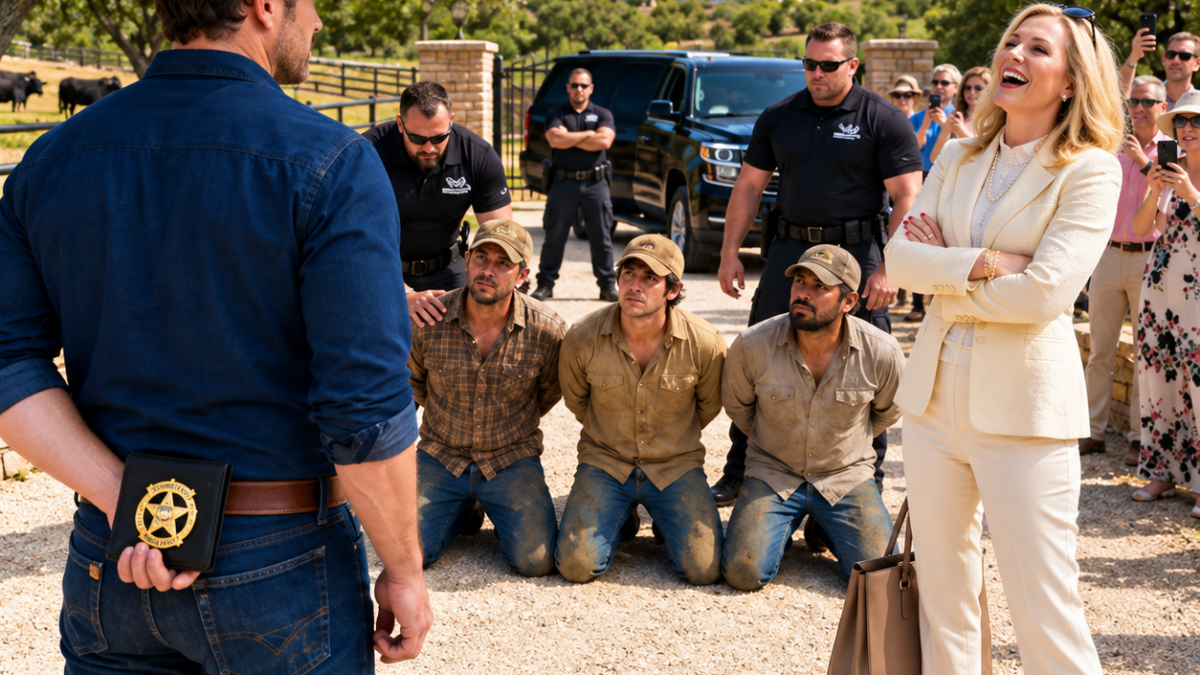
Then ordered down.
Hector knelt first because Kyle told him to.
Tomas followed.
Miguel last.
Dust on their jeans.
Caliche around their boots.
No law enforcement.
No probable cause.
No actual trespass.
Just two men acting under orders.
At 5:58, Vivian’s Porsche appeared.
Pearl white.
She parked.
Stepped out wearing a cream blazer.
Leather portfolio.
Sunglasses on head.
Walked toward the scene.
No surprise.
No concern.
She inspected.
That is the only word that fits.
She looked at Hector.
Then Tomas.
Then Miguel.
Kyle said:
“All of them, ma’am.”
Vivian nodded.
“Good.”
The camera caught it clearly.
Then she pulled out her phone.
“Call the real police this time.”
She looked at Hector.
“Tell them we have three trespassers detained.”
That was enough.
I called Reyes.
“Now.”
Then started my truck.
The road curved.
Dust lifted behind me.
I drove slowly.
No siren.
No lights.
Just the ranch pickup Vivian had seen before.
I parked ten feet away.
Stepped out.
Jeans.
Boots.
Pearl-snap shirt.
Straw hat.
Vivian turned.
Her expression said inconvenience.
“Mr. Reed.”
“Vivian.”
“Your workers have been detained for trespassing.”
“I can see.”
“I’ve instructed security to hold them until law enforcement arrives.”
“Good.”
She blinked.
“Excuse me?”
“You called law enforcement?”
“I’m doing it now.”
“Excellent.”
She frowned.
“Your attitude isn’t helping this situation.”
I nodded.
“Funny.”
“What?”
“I was about to say same.”
She looked past me.
No cruisers yet.
Then back.
“You need to tell your employees to comply with community security.”
I said:
“They complied.”
“Yes.”
“Look at them.”
I did.
Hector kneeling.
Hands bound in front.
Tomas beside him.
Miguel with hands behind.
I looked back at Vivian.
“You ordered this?”
She did not hesitate.
“Yes.”
“Anyone entering through that gate without Summit Ridge authorization is detained.”
“Kyle and Dustin acting on your instructions?”
“They work for the HOA.”
“You authorized them to restrain people?”
“They have security authority.”
I nodded.
“Thank you.”
“For what?”
“Answering clearly.”
For the first time, uncertainty crossed her face.
I reached slowly toward my back pocket.
Kyle shifted.
“Hands where I can see them.”
That almost made me laugh.
I stopped.
Looked at him.
“My wallet.”
“Slow.”
“Very.”
I pulled out the black leather credential case.
Opened it.
Held it toward Vivian.
Gold star.
Department of Justice seal.
United States Marshals Service.
My commission card.
The morning went strangely still.
Vivian stared.
At first she did not understand.
Then she read.
Her eyes moved from badge to my face.
Back to badge.
“You’re…”
“My name is Dalton Reed.”
I kept my voice level.
“Deputy United States Marshal.”
“Western District of Texas.”
Kyle took one step backward.
Dustin looked toward Tahoe.
I continued.
“I am also the owner of Mesquite Creek Ranch.”
I pointed toward the three men.
“And those are my ranch employees.”
Then toward the road.
“And this is a permanent Reed Ranch access easement recorded with Hays County since 1974.”
Vivian’s leather portfolio slipped.
Hit the gravel.
She did not pick it up.
“You can’t…”
She stopped.
I waited.
“You can’t be a marshal.”
I almost felt sorry for her.
Not because of what was coming.
Because of what that sentence revealed.
In Vivian’s world, a rancher was one kind of person.
A federal officer another.
Hector belonged in dust.
She belonged in silk.
Authority looked like her.
Workers looked like them.
The idea that categories could overlap broke something.
I said:
“Ma’am, I’m both.”
That was when the cruisers appeared.
Two Hays County units.
Then another.
No emergency rush.
They had been close.
Deputy Reyes stepped out.
His eyes went first to the kneeling men.
Then Kyle.
Dustin.
Vivian.
Then me.
I closed credential case.
This was his arrest scene.
Not mine.
Reyes approached Kyle.
“Turn around.”
Kyle stammered.
“Officer, we’re Summit Ridge security.”
“Turn around.”
“We detained trespassers.”
“Turn around.”
Real handcuffs clicked.
Steel.
Not zip ties.
Dustin went next.
Then Reyes walked toward Vivian.
She found her voice.
“This is outrageous.”
“Ms. Caldwell.”
“They’re trespassing.”
“No, ma’am.”
“That easement is disputed.”
“No, ma’am.”
“My attorneys—”
“You are being placed under arrest.”
Her mouth opened.
Reyes continued.
“You have the right to remain silent.”
For once, she did.
Another deputy cut Hector free.
I went to Miguel.
His hands were behind him.
I cut the plastic carefully.
Deep marks again.
He flexed fingers.
Looked toward Vivian being cuffed.
Then at me.
“Sir?”
“Yeah?”
“Is it over?”
I wanted to say yes.
I had learned not to promise outcomes I did not control.
So I said:
“This part is.”
He nodded.
Hector stood.
Rubbed his wrists.
Looked at Kyle in cuffs.
Then at me.
“You could’ve told us you were going to do the badge thing.”
Tomas actually laughed.
I said:
“I didn’t know there was going to be a badge thing.”
Hector looked unconvinced.
“Boss.”
“Fine.”
“Maybe a little.”
Elena arrived later.
Saw Miguel’s wrists.
Her nurse face appeared.
The one that makes grown men confess symptoms.
She took him into ranch house.
Ice.
Photographs.
Medical documentation.
Food.
Sophia came downstairs and asked why there were sheriff vehicles outside.
We told her enough.
Not everything.
The arrests became news by afternoon.
That is when I stopped talking publicly.
No interviews.
No victory lap.
No “federal marshal destroys HOA Karen.”
Despite what social media wanted, I had no interest in becoming the headline.
The criminal process mattered more.
Kyle and Dustin faced unlawful restraint charges and licensing-related violations.
The fake security operation came apart quickly.
No proper license.
No lawful arrest authority.
Uniforms designed to imply more power than existed.
The silver badge was photographed and seized.
Later one investigator found the exact model sold online as a costume-style security badge.
That detail got laughs.
I did not find it funny.
Miguel had looked at that badge while being restrained.
Something does not need to be real to frighten a nineteen-year-old if it is being used by somebody willing to hurt him.
Vivian’s case became harder because of her own words.
First incident.
She had arrived after Miguel was restrained.
Approved.
Second incident.
She admitted in front of me that she authorized detention.
The cameras recorded her saying:
“Good.”
And:
“Call the real police.”
That phrasing mattered.
The real police.
Even she knew Kyle and Dustin were not.
The sheriff reports mattered.
Repeated unfounded complaints.
The easement mattered.
The chain.
The survey.
The security patrols.
The family relationship with Kyle.
Everything became one picture.
Not one misunderstanding.
A pattern.
Vivian hired an expensive Austin defense attorney.
Good lawyer.
He did what good lawyers do.
Tested every weakness.
First argument:
Vivian believed the easement did not allow commercial ranch traffic.
The certified deed and survey disagreed.
Second:
She believed Kyle and Dustin were properly licensed.
Records showed otherwise.
Third:
The restraints were temporary citizen detentions for suspected trespassing.
Problem:
no trespassing.
No reasonable confusion left after multiple sheriff responses, certified easement records, and explicit notices.
Fourth:
Vivian had not personally applied the zip ties.
That was true.
But she had directed the operation.
Approved the detentions.
Kept the system going after first unlawful restraint.
The case eventually went before a jury.
I testified.
Not as federal marshal speaking for U.S. government.
As property owner.
Witness.
Employer.
Victim of easement obstruction.
That distinction mattered.
Vivian sat at defense table.
No sunglasses.
No leather portfolio.
Still composed.
When ADA Molina played the video, the courtroom went quiet.
Hector kneeling.
Tomas kneeling.
Miguel kneeling.
Vivian walking through frame.
Cream blazer.
Looking.
Kyle:
“All of them, ma’am.”
Vivian:
“Good.”
Then:
“Call the real police.”
One word can carry enormous weight after enough context.
Good.
The jury deliberated a little over two hours.
Guilty.
The final criminal outcome was not the cinematic prison sentence people online demanded.
Real life is rarely that clean.
Vivian received probation, substantial community-service requirements, restitution, and restrictions tied to the conduct.
Kyle and Dustin entered negotiated pleas involving custody, probation, and permanent consequences for security work.
The exact legal labels and sentences became less important to me than what happened next.
The civil case.
Miguel’s family sued.
Hector.
Tomas.
False imprisonment.
Emotional distress.
Interference.
The HOA’s insurer eventually settled after reviewing the footage and criminal findings.
Vivian contributed personally beyond insurance limits.
Miguel received enough to change his plans.
Not to make him rich.
To give him room.
He enrolled in pre-veterinary studies at Texas State.
Still worked weekends.
I asked him once:
“Why keep coming back?”
He looked offended.
“This is my job.”
“You don’t have to prove anything.”
“I’m not.”
“Then why?”
He looked toward north pasture.
“Because I like cows.”
That was Miguel.
Hector refused to take even one full week off.
I told him:
“You can.”
“I know.”
“Paid.”
“I know.”
“Counseling?”
“Maybe.”
“Raise?”
He considered.
“That.”
I laughed.
“Finally.”
Summit Ridge held an emergency election.
Vivian was out.
Several homeowners who had quietly opposed her ran.
The new board hired actual counsel.
First significant act:
formally recognize the 1974 Reed Ranch easement in updated HOA records.
Not create it.
Recognize it.
Important difference.
Second:
terminate the fake security arrangement.
Hire a properly licensed company.
Third:
send written apology to my ranch.
Not just me.
My workers.
Each man received his own.
Hector’s letter sat unopened on his toolbox for two weeks.
I asked why.
“What’s it say?”
“I don’t know.”
“You going to read it?”
“Eventually.”
“What are you waiting for?”
“Need apology to age.”
He smiled.
Finally read it.
Folded it.
Put it in truck visor.
I never asked why.
The gate changed too.
New county survey markers.
Steel caps.
Clear boundary.
The road became almost aggressively documented.
Nobody could pretend not to know again.
Summit Ridge residents started waving at the ranch trucks.
At first awkwardly.
Then normally.
Some apologized.
One man came to fence while Tomas repaired wire.
“I’m sorry.”
Tomas looked up.
“For?”
“I believed what Vivian said.”
“What’d she say?”
“That you guys were using neighborhood road without permission.”
Tomas nodded toward orange survey marker.
“You can read.”
The man laughed uneasily.
“Yeah.”
“That’s what those are for.”
Then Tomas went back to fencing.
Not everybody wanted reconciliation.
Miguel avoided Summit Ridge residents for months.
That was his right.
I told him nobody gets to set schedule for someone else’s trust.
Elena planted Mexican honeysuckle along eastern boundary.
Orange-red flowers.
Butterflies loved it.
I asked:
“Pretty.”
She said:
“Boundary.”
I looked.
She smiled.
“Living one.”
Sophia got two horses out of whole mess.
I still don’t understand how.
Apparently trauma in family negotiations can result in ponies.
One afternoon, months after trial, Sophia asked:
“Dad?”
“Yeah?”
“Why didn’t you tell the lady you were a marshal at beginning?”
Good question.
I thought.
“Because I shouldn’t need a federal badge to make someone respect our deed.”
She considered.
“But it worked.”
“Yes.”
“Then why not use it sooner?”
“Because power should solve the problem it belongs to.”
She frowned.
I tried again.
“If someone parks in our driveway, I don’t call in a fugitive task force.”
She laughed.
“That would be funny.”
“Probably.”
“But wrong.”
“Exactly.”
My badge did not make the easement valid.
Granddad’s deed did.
My badge did not make the guards unlicensed.
Texas records did.
My badge did not make the restraint unlawful.
Their actions did.
The reveal only changed Vivian’s understanding of who she had been dismissing.
That was satisfying.
I admit it.
But it was not the legal foundation.
I wanted Sophia to understand that.
The court did not say:
Do not mess with a U.S. Marshal.
The law said:
Do not unlawfully restrain people.
Do not impersonate authority.
Do not obstruct recorded property rights.
Those rules protected Hector, Tomas, and Miguel whether their boss was a federal officer or a dishwasher.
That matters.
If the story means only “Karen picked the wrong man,” then we learned the wrong lesson.
She picked the wrong behavior.
The men she put in dirt deserved protection because they were people.
Not because I happened to carry a gold star.
That took me longer to articulate than it should have.
Miguel understood before I did.
A year after the incident, Texas State invited him to speak in a student panel about first-generation college students and work.
He did not mention Vivian by name.
He said:
“I learned that authority should be able to explain itself.”
That sentence hit me.
He continued:
“If somebody orders you around and you don’t understand why, ask what gives them the right.”
“Sometimes the answer is legitimate.”
“Sometimes it isn’t.”
“Being scared doesn’t mean you have to stop thinking.”
Nineteen when it happened.
Twenty-one when he said that.
I was proud.
He eventually got into veterinary school.
The day the acceptance email came, he was helping deliver a backwards calf.
Hector called.
“Boss.”
“What?”
“Doctor got in.”
“What doctor?”
“The boy.”
I drove north.
Miguel stood in pasture.
Blood on sleeves.
Grinning.
“What?”
He held phone up.
I read email.
I hugged him.
He said:
“Sir, there’s placenta on you.”
“I’ve had worse.”
Hector stood six feet away pretending not to wipe his eyes.
Years passed.
Vivian sold her house.
Not because court ordered it.
She said she wanted privacy.
Summit Ridge changed presidents twice.
The new boards were boring.
That is praise.
Minutes.
Budgets.
Drainage.
Pool repairs.
No private police forces.
No ten-thousand-dollar threats.
No laminated gate edicts.
Boring governance is one of civilization’s underrated achievements.
Deputy Reyes retired.
At his party he walked up to me holding a cheap silver badge.
Same style Kyle wore.
“Gift.”
I laughed.
“Where did you get that?”
“Online.”
“Eleven ninety-nine?”
“On sale.”
I pinned it to his retirement cake.
His wife nearly killed us both.
ADA Molina became a district judge.
At investiture, she saw me.
“Still dealing with HOA?”
“No.”
“Disappointing.”
“You want more work?”
“No.”
“Then why disappointed?”
“Good stories.”
I told her:
“They’re only good when you’re not living them.”
She agreed.
Hector retired at sixty-three.
That lasted nine days.
On day ten he arrived at 5:15 a.m.
I found him checking a water trough.
“What are you doing?”
“Retired.”
“You are standing in my pasture.”
“Visiting.”
“You brought tools.”
“Social visit.”
He still comes three mornings a week.
We stopped arguing.
Tomas eventually started his own fencing company.
I gave him his first large contract.
He underbid.
I made him revise upward.
“Boss.”
“You’re not working for ranch-hand wages anymore.”
“I know.”
“Then bid like business owner.”
He did.
Successful.
Miguel came back every summer between semesters.
Then veterinary rotations.
Eventually Dr. Miguel Fuentes opened a mixed-animal practice twenty minutes away.
First animal he treated on Mesquite Creek Ranch was a heifer with calving injury.
He sent invoice.
I called.
“This price wrong.”
“No.”
“You discounted.”
“Family rate.”
I said:
“I will report you to yourself.”
He laughed.
Then doubled it next time.
Good.
Elena still works pediatric nursing part-time.
Sophia is in high school now.
Drives too fast on ranch roads.
Claims five miles over is not speeding on private property.
I tell her federal law says otherwise.
She asks me to cite statute.
I blame Elena.
The eastern easement looks the same as it did before Summit Ridge.
Caliche.
Dust.
Live oak shade.
Orange survey caps.
Honeysuckle.
Trucks at dawn.
Some things survived.
That is the real victory.
Not Vivian’s arrest.
Not badge reveal.
Not restitution.
Continuity.
Hector still drove that road next morning after everything.
5:30 a.m.
White Dodge.
Feed.
Same gate.
No dramatic ceremony.
That meant more to him than courtroom.
He had been told:
You do not belong here.
Then he simply returned to work.
There is dignity in ordinary repetition after humiliation.
Vivian had tried to make the road feel unsafe.
Hector reclaimed it by using it.
So did Tomas.
So did Miguel.
Again.
Again.
Again.
I think about that morning often.
Three men kneeling.
Vivian standing.
For social-media audiences, climax is badge.
Gold star.
“You can’t be a marshal.”
“I’m both.”
Good line.
True line.
But if I could freeze one frame, it would not be me holding credentials.
It would be Miguel after the zip ties came off.
Looking at his wrists.
Then standing.
That was the moment authority returned to right place.
His body.
His freedom.
His road to work.
I spent career arresting dangerous people.
Some deserved every second of custody.
Even then we documented.
Warrant.
Identity.
Probable cause.
Search.
Transport.
Property.
Rights.
Because restraint is serious.
Taking away someone’s freedom, even temporarily, is among the most consequential powers government has.
Watching two civilians treat that power like an HOA amenity made me angrier than I expected.
They thought zip ties were tools of convenience.
They were not.
They are restraints.
Every click matters.
Every minute matters.
Miguel taught me that too.
After first detention, he said:
“The worst part wasn’t pain.”
“What was?”
“Not knowing when they’d let me go.”
That stayed.
People who have never been restrained imagine it as physical.
Wrists.
Position.
Pain.
It is also uncertainty.
You are no longer deciding where your body goes next.
Somebody else is.
That is why law treats it seriously.
Vivian never understood until she sat in back of cruiser.
I do not celebrate that irony.
Much.
Maybe a little.
One evening years later, a woman knocked at ranch house.
I recognized her from Summit Ridge.
Her name was Marlene Cho.
She had lived there during Vivian years.
“Mr. Reed?”
“Dalton.”
“I wanted to ask you something.”
“Sure.”
“Did you know from beginning it would end that way?”
“No.”
“You seemed so calm.”
“I was angry.”
“You didn’t act like it.”
“That is different.”
She nodded.
“Vivian scared a lot of us.”
“I know.”
“We let her.”
I did not answer.
Marlene looked toward Summit Ridge.
“Two families tried to run against her.”
“I heard.”
“She fined them constantly.”
“One moved.”
“Yes.”
“I keep thinking if we had pushed back sooner…”
I understood.
“Maybe.”
She looked at me.
“That’s all?”
“You want me to tell you it’s your fault?”
“No.”
“Then no.”
“Fear works because consequences feel personal.”
“People need others before they resist.”
Marlene nodded.
“We were alone.”
“Until you weren’t.”
That is another part people miss.
Vivian controlled Summit Ridge because homeowners dealt with her individually.
One violation.
One complaint.
One threat.
Each person thought:
Maybe easier to pay.
Maybe easier to comply.
Maybe easier to move.
Once events became public, stories connected.
The same tactics appeared everywhere.
My ranch was simply boundary she could not administratively absorb.
We had documents.
Workers.
Sheriff records.
And eventually a case.
Not everyone has that.
That is why systems matter.
A recorded easement nobody enforces is paper.
A licensing law nobody checks is paper.
A false-report statute nobody applies is paper.
Documents become protection only when institutions act.
In this case, they did.
Deputy Reyes.
Molina.
Surveyor.
Courts.
Licensing officials.
Insurance attorneys.
Not perfect.
Enough.
That is another reason I never told story as one U.S. Marshal taking down an HOA president.
I didn’t.
A lot of people did their jobs.
That is less flashy.
More accurate.
For years, online versions exaggerated everything.
One said I commanded a SWAT team to arrest Vivian.
False.
Another said U.S. Marshals surrounded Summit Ridge.
False.
One claimed she got ten years federal prison.
False.
Someone wrote that I seized her Porsche under federal forfeiture.
Absolutely false.
Truth was plenty.
She ordered men unlawfully restrained.
Evidence was gathered.
County and state process handled arrests and prosecution.
Civil claims followed.
The HOA changed.
My ranch kept functioning.
Reality did not need extra explosions.
The detail everyone gets right?
Her face when she saw the badge.
That I remember.
Not because fear.
Recognition.
In one second she understood she had built her entire strategy on assumptions about who mattered.
She thought my workers did not.
She thought I did not.
She thought only visible status counted.
Then status she respected appeared in a leather case.
That was not justice.
But it was educational.
I wish I could say she apologized.
She never did.
At least not personally.
Her lawyer sent expressions of regret as part of settlement language.
That is not same.
Years later, I saw Vivian once in Austin.
Hotel lobby.
I was attending a federal training.
She was walking toward elevators.
We recognized each other.
Stopped.
She looked different.
Still composed.
Less sharp.
Time.
She said:
“Marshal Reed.”
“Vivian.”
A pause.
Then:
“I didn’t know.”
I knew what she meant.
I answered:
“That was never the problem.”
Her face tightened.
“What was?”
“You thought you needed to know who I was before you had to respect who they were.”
Silence.
She looked away.
That was the closest we ever came to apology.
I went to training.
She got on elevator.
No dramatic ending.
Life rarely provides one.
Mesquite Creek Ranch is still eighteen hundred acres.
My grandfather’s limestone barn still stands.
Well still runs.
Cattle still destroy fences at worst possible times.
Feed costs remain criminal even when nobody is.
Sophia did get another horse after the first two.
I lost that battle.
Elena says I am soft.
I say three horses are economically irresponsible.
Sophia says I once spent eight hundred dollars proving a road was where we already knew it was.
Fair.
The blue spiral notebook remains in my safe.
Ninety-nine cents.
Its pages became evidence.
Descriptions.
Times.
Plates.
Names.
Quotes.
At the back, after trial, I wrote one final line:
Case closed. Road open.
Then put it away.
I kept the first zip tie too.
The one cut from Miguel in April.
Not as trophy.
Evidence had been released.
I asked if he wanted it.
“No.”
“Throw it away.”
I didn’t.
It reminds me how ordinary abuse of authority can look.
White plastic.
Lightweight.
Cheap.
One click at a time.
Power often enters lives looking unimpressive.
A letter.
A chain.
A uniform.
A badge bought online.
A person saying:
I have authority.
Most people comply first and verify later because that is how decent people avoid conflict.
Miguel complied because he had been raised to respect authority.
Vivian weaponized that decency.
That still angers me.
So if there is one lesson I gave Sophia when she got old enough to understand, it was not:
Never trust authority.
That would be irresponsible.
It was:
Legitimate authority can explain itself.
A real deputy can identify himself.
A real warrant can be reviewed.
A real easement can be pulled from county records.
A real security company can show licensing.
A real HOA can point to covenants that bind actual members.
Questions do not make you disrespectful.
Sometimes they are how you protect respect from being abused.
Sophia listened.
Then asked:
“Can I question you?”
“Constantly, apparently.”
“Why can’t I stay out past midnight?”
“Because I’m your father.”
“Show me documentation.”
Elena nearly fell out of chair laughing.
I created my own problem.
Good.
I would rather raise a child who asks.
The east road still crosses Summit Ridge.
There is now a small metal sign installed by the HOA:
REED RANCH EASEMENT.
AUTHORIZED AGRICULTURAL ACCESS.
DO NOT OBSTRUCT.
I objected.
Not because wrong.
Because ugly.
New HOA president agreed to smaller sign.
Negotiation.
Simple.
Nobody screamed.
Nobody zip-tied anyone.
Progress.
Sometimes Summit Ridge residents stop at fence and buy beef.
That would have horrified Vivian.
Dusty cattle becoming community commerce.
One family’s son works summers for Tomas.
Another resident volunteers at Miguel’s clinic.
Land does that if people let it.
Boundaries can separate ownership without separating human beings.
Vivian saw boundary as insult.
I see boundary as what allows neighbors to exist without consuming one another.
You stay on yours.
I stay on mine.
Where recorded rights cross, we respect them.
Simple.
The road belonged to our access.
Summit Ridge owned surface around it subject to easement.
They could landscape.
Maintain.
Drive.
We could pass.
Neither side owned everything.
That nuance was apparently too boring for Vivian.
She preferred control.
Control is expensive.
Years after the case, the HOA’s attorney invited me to speak briefly at a board workshop about easements.
I said no.
Then Elena said:
“Go.”
“Why?”
“Because it will be funny.”
So I went.
New board.
Different faces.
Actual lawyer gave presentation.
Then asked me:
“Mr. Reed, anything you’d add?”
I looked around.
One sentence.
“If a road is older than your subdivision, read the deed before you arrest the ranch hands.”
The room laughed.
I did too.
Then went home.
Hector was at ranch.
Retired.
Visiting.
Again.
He sat on tailgate drinking coffee.
“How’d HOA class go?”
“They laughed.”
“At you?”
“With me.”
“Shame.”
We sat.
Sunset came through oaks.
A truck moved along east road.
No confrontation.
No security Tahoe.
Just tires on caliche.
Hector said:
“You know what I remember?”
“What?”
“The first morning those boys blocked me.”
“Before Miguel?”
“Yes.”
“You came out looking mad.”
“I was.”
“But you didn’t show badge.”
“No.”
“Why?”
I gave him same answer I gave Sophia.
“Because the deed should’ve been enough.”
Hector nodded.
“Good.”
Then after a minute:
“Still glad you showed it later.”
I smiled.
“Me too.”
There it is.
Both can be true.
The badge should not have been necessary.
And when the moment came, I enjoyed opening that case more than I probably should admit.
I am human.
I watched a woman stand over three bound men and believe she had finally established order.
I watched her look at Hector’s dusty jeans and Miguel’s scared face and think those were signs of lesser status.
Then I showed her something she understood.
A gold star.
Not because it made me better.
Because it forced her to update the hierarchy in her head.
Her mistake was believing hierarchy should determine dignity at all.
That is why her empire collapsed.
Not because she picked fight with marshal.
Because she built authority on treating certain people as if they did not deserve the same rules.
Eventually rules reached her.
Real rules.
Real deputies.
Real court.
Real consequences.
And after all the headlines faded, what remained was what mattered.
Hector feeding cattle.
Tomas building fence.
Miguel becoming veterinarian.
Elena planting honeysuckle.
Sophia riding horses.
The gate open.
The road clear.
A sixty-year-old ranch continuing to do what it had always done before somebody in designer heels decided history needed HOA approval.
Nobody chains that gate anymore.
Nobody stops my ranch hands.
Nobody calls them suspicious because they arrive before sunrise.
And if a Summit Ridge resident sees one of our trucks rolling down that old caliche road at 5:30 in the morning, they know exactly what it means.
Cattle need feeding.
Fence needs fixing.
Work is being done.
Same as it was before the first stucco wall went up.
Same as it was when my grandfather recorded that easement in 1974.
Same as it will be after I’m gone.
That is what Vivian never understood.
She thought authority was whatever she could make people obey.
My grandfather knew better.
Authority that lasts is written down, earned, limited, and accountable.
Everything else is just somebody standing in the road pretending.

