HOA Karen Laughed When I Bought 1,500 Acres Outside Their Gate—Then I Found Out I Owned the Only Bridge Connecting All 87 Homes to the Outside World.
PART2:
A doctor speaking slowly because bad news apparently becomes easier if delivered in careful syllables.
Sarah fought for fourteen months.
She was forty-two when she died.
I held her hand in a hospital room in Springfield while a monitor flattened into one continuous tone.
After that, bridges stopped mattering.
At least for a while.
I went back to work.
Tried.
There is a particular cruelty to returning to ordinary tasks after somebody dies.
People send emails.
Reports are due.
Concrete cylinders still need testing.
Meetings happen.
Somebody asks whether you can move lunch from noon to one, and you want to ask how the world can possibly care about lunch when the person who knew you best no longer exists.
I made it seven months.
Then took early retirement at forty-four.
Sold the house.
Every room still smelled like Sarah.
Not literally.
Probably.
But grief has its own sensory system.
Her shampoo was in the bathroom even after I threw the bottle away.
Her coffee mug existed in every cabinet even after I boxed it.
The house had become one long echo.
Then the estate listing appeared.
Ridgeline Development LLC had gone bankrupt.
They had spent the early 2000s buying Ozark hilltops for luxury residential development.
Some projects succeeded.
Some didn’t.
Their final assets went to auction.
Among them:
1,500 acres of timber, pasture, creek bottom, and abandoned development land surrounding a gated subdivision called Stonewall Ridge Estates.
Included inside those 1,500 acres was my grandfather’s original property.
Glenn’s dirt.
His fence lines.
Part of his workshop foundation.
The creek bend where he taught me to skip stones.
I visited once.
That was enough.
The land looked rough.
Overgrown.
Fences down.
Old pasture turning back into cedar and oak.
Exactly what I needed.
The price was $1.2 million.
I used Sarah’s life-insurance money.
My retirement savings.
Nearly every dollar we had put aside for a future that would never happen.
Friends told me I was grieving.
They were right.
They also told me not to make major financial decisions while grieving.
They were probably right about that too.
But buying that land did not feel impulsive.
It felt like the first decision I had made since Sarah died that belonged to me instead of grief.
So I signed.
Fifteen hundred acres.
The closing attorney slid the deed across the table.
I signed every page.
Then drove straight to the old Ashford property.
Got out.
Stood in knee-high grass.
And for the first time in months, silence did not feel like something missing.
It felt like company.
Stonewall Ridge Estates sat on a plateau above Bull Creek.
Eighty-seven homes.
Most between six hundred thousand and 1.2 million dollars.
Wrought-iron gate.
Stone entry columns.
Clubhouse.
Infinity pool.
Wine cellar.
Community newsletter printed on paper thicker than some legal briefs I had reviewed for the federal government.
The subdivision had one road in.
One road out.
That road crossed Bull Creek on a single-lane concrete bridge, wound through my land, then climbed toward the gate.
At closing, I barely thought about it.
The title package included hundreds of pages.
Boundary descriptions.
Timber rights.
Old easements.
Water references.
Structures.
Survey exhibits.
I checked what mattered for the purchase.
Or what I thought mattered.
Then moved in.
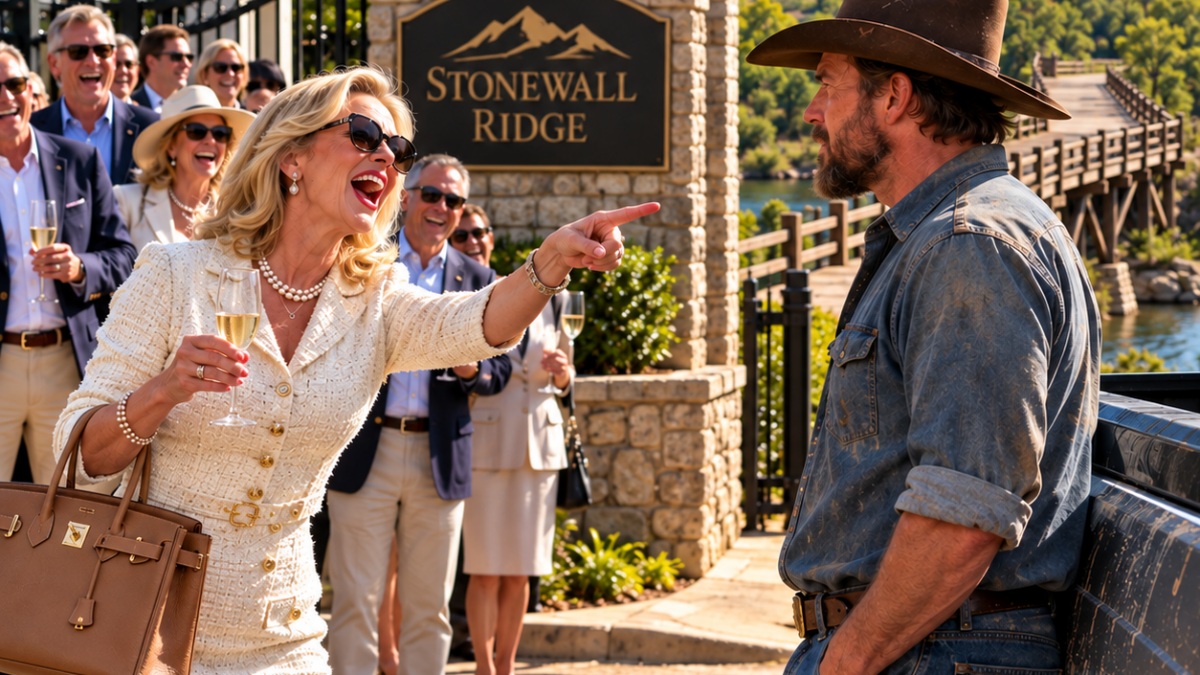
On my third day, Victoria Hargrove introduced herself.
She arrived in a white Range Rover Sport.
Not drove up.
Arrived.
Some people enter spaces as if cameras are already rolling.
Victoria was one of them.
Honey-blonde hair.
Perfect.
Cream linen dress.
Sunglasses expensive enough to have their own insurance.
Camel-colored Birkin tucked over one arm.
She stepped out and looked at my mud-splattered pickup the way a museum curator might examine vandalism.
“So you’re the one who bought all that dirt.”
Her voice had polished Southern warmth with nothing warm underneath.
“Cole Ashford.”
I offered my hand.
She glanced at it.
Did not take it.
“Victoria Hargrove.”
“I know.”
She smiled.
“Of course you do.”
She looked toward my pasture.
“You bought fifteen hundred acres?”
“Yes, ma’am.”
Her eyebrows rose.
“With what?”
That question told me almost everything I needed to know.
“Money, mostly.”
Her smile tightened.
“I heard you were retired.”
“I am.”
“So young.”
“Depends who you ask.”
She lifted her phone.
Apparently her husband was already on speaker.
“Preston, I’m standing with the man who bought the Ridgeline acreage.”
A male voice answered.
“Already?”
Victoria laughed.
“He says all fifteen hundred acres.”
Pause.
Then she said:
“Bless his heart. Somebody should tell him dirt doesn’t appreciate.”
I looked past her.
At the Range Rover.
At the road.
At the Bull Creek bridge she had crossed to insult me.
I said nothing.
That night, Nate Simmons came over.
Nate was sixty-eight.
Retired carpenter.
Owned a small cabin on three acres that somehow sat between my boundary and the formal HOA plat.
He brought two beers and a warning.
We sat on my porch.
He nodded toward Stonewall Ridge.
“Met Victoria?”
“Yes.”
“How bad?”
“She insulted my dirt.”
Nate laughed.
“That’s practically friendship.”
He drank.
Then became serious.
“Three families owned pieces out here before you.”
“Ridgeline parcels?”
“Small ones.”
“What happened?”
“Victoria.”
He counted.
“Hendersons lasted eleven months.”
“Coopers eight.”
“Warners five.”
“Why?”
“Fines.”
“They weren’t HOA members.”
“Didn’t matter to her.”
“Legally it does.”
Nate smiled without humor.
“She doesn’t operate on legally. She operates on exhaustion.”
He pointed toward the plateau.
“She’ll complain.”
“Send letters.”
“Call agencies.”
“Make neighbors hate you.”
“Block contractors.”
“Anything to make living here harder than selling.”
“Why?”
“She doesn’t want neighbors, Cole.”
He looked at me.
“She wants subjects.”
My first HOA letter arrived the following Monday.
Cream envelope.
Calligraphy return address.
Crest so elaborate I thought it might be a wedding invitation.
NOTICE OF VIOLATION.
I read it twice.
My cattle, according to Section 4.7B of the Stonewall Ridge Covenants, Conditions and Restrictions, created an “aesthetic degradation” visible from residential properties.
Fine:
Two hundred dollars per day until removed.
I laughed.
Then pulled the recorded plat map from my kitchen wall.
Stonewall Ridge boundary.
My boundary.
Separate.
Completely.
The HOA had as much jurisdiction over my pasture as it did over Kansas.
I wrote one page.
Polite.
No emotion.
Attached certified plat.
Explained my parcel was not subject to Stonewall Ridge covenants.
Sent certified mail.
Return receipt.
Three days later, Victoria escalated.
Not with paper.
With binoculars.
Nate texted me from his cabin.
You need to see this.
I called.
“What?”
“Beautification Committee.”
“What’s that?”
“Seven women on the clubhouse terrace drinking wine and looking at your cows.”
I thought he was joking.
He wasn’t.
“They have binoculars.”
“Seriously?”
“They counted fourteen head.”
Pause.
“Apparently three of your hay bales are irregularly positioned.”
“What does that mean?”
“No idea.”
Another pause.
“And Victoria described your truck as aggressively unwashed.”
I stared at my truck.
Mud.
Dust.
Hay.
Perfectly normal.
“Aggressively?”
“Direct quote.”
The next letter looked more serious.
Heavy bonded paper.
Formatting that mimicked a county notice.
CEASE AND DESIST.
It accused my cattle operation of creating livestock odor and fly infestation dangerous to Stonewall Ridge residents.
It referenced “public health compliance action.”
To somebody unfamiliar with government documents, it looked official.
I had spent eighteen years reading actual government orders.
This was theater.
Expensive theater.
I called the Taney County Health Department.
A field supervisor named Dan checked.
“No complaint, Mr. Ashford.”
“Nothing?”
“Nothing.”
“No inspection request?”
“No.”
“So the HOA never contacted you?”
“Not us.”
I sat at the kitchen table.
Looked at the letter.
Victoria had not filed a complaint.
She had simply dressed intimidation in government-looking language and hoped I would panic.
I created a folder.
Wrote one word on the tab.
VICTORIA.
It grew quickly.
The first time she actually cost me money involved twelve tons of crushed limestone.
I found it blocking my farm road.
My road.
The one running from the south pasture to County Route 7.
Granddad had graded its original path in 1963.
That morning, a four-foot wall of white rock covered the full width.
Dump-truck tracks still fresh.
Dust hanging in the air.
Victoria stood on the far side.
Cream yoga pants.
White linen blazer.
Birkin.
Two contractors leaning against their truck.
“Oh, Cole.”
She smiled.
“Sweetie, that little road was dangerous.”
“Was it?”
“No drainage.”
“No reflectors.”
“Loose gravel.”
“The board voted unanimously to correct the safety problem.”
I looked around.
Stonewall Ridge sat hundreds of yards uphill.
Nobody from the subdivision used this road.
Nobody needed it.
This was not safety.
It was control.
If the farm road became unusable, my practical route out would require crossing Stonewall Ridge’s main gate.
Victoria controlled access codes.
Cameras.
Guest approvals.
My trucks.
My feed deliveries.
My life.
I looked at her.
“The board voted on my road?”
“Yes.”
“You think your board controls my land?”
Victoria gave me the look adults use on children who have asked something tiresome.
“This affects the community.”
“What community?”
“Ours.”
“Then block your own road.”
Her smile disappeared.
I did not argue further.
Photographed everything.
Truck plates.
Contractor information.
Four angles.
Dashcam timestamp.
Called county records.
The farm road had a recorded private access easement dating back to 1963.
Nobody could obstruct it without my consent.
County sent notice.
Remove obstruction.
Victoria waited until day twenty-nine.
Then complied.
Naturally.
The contractor removed the limestone.
They also stripped much of my original gravel surface down to red clay.
First rain turned it into soup.
Repair cost:
Roughly four thousand dollars.
Nate stood beside me looking at the mud.
“She did this to Henderson.”
“With limestone?”
“Mulch.”
“Seriously?”
“Six yards across his driveway.”
“She called it landscaping.”
He looked toward Stonewall Ridge.
“He sold four months later.”
I didn’t sell.
Instead, I acquired something better than a repaired road.
The county complaint process produced the HOA’s contractor invoice.
Eight thousand four hundred dollars.
Paid from HOA general funds.
Board authorized.
Community money used to obstruct private property outside the HOA boundary.
I placed the invoice in the folder.
The rubber band strained.
Then came the environmental complaint.
Runoff from my cattle was allegedly contaminating Bull Creek.
Nutrient loading.
Riparian violations.
Waste management.
This one was formally filed.
County sent inspector Tom Bradley.
Quiet man.
Rubber boots.
Clipboard.
Four hours on my land.
Water samples.
Measurements.
Pasture inspection.
My cattle grazed more than two hundred feet from the creek.
Natural buffer exceeded recommendations.
Water samples were clean.
Cleaner than the upstream monitoring point.
Tom closed his clipboard.
“Mr. Ashford.”
“Yes?”
“This is one of the cleaner small cattle operations I’ve inspected in this county.”
“Appreciate it.”
He looked toward Stonewall Ridge.
“Whoever filed that complaint hasn’t walked your property.”
He paused.
“Or didn’t care what they’d find.”
The official complaint was closed as unfounded.
Victoria responded by throwing a party.
Protect Our Water.
Protect Our Property Values.
Organic rosé.
Artisan cheese.
Petition.
Sixty-one residents signed a demand that the county impose additional restrictions on farms near Stonewall Ridge.
Legally meaningless.
Politically annoying.
County dismissed it.
Victoria posted online:
IF THE COUNTY WON’T PROTECT OUR FAMILIES, WE WILL PROTECT OURSELVES.
Three weeks later, somebody cut my fence.
Three separate points.
Clean bolt-cutter cuts.
Fourteen cattle scattered into timber.
It took two days to recover them.
One heifer sliced her leg on limestone.
Vet bill.
Stitches.
That night I installed trail cameras.
Six.
Infrared.
Weatherproof.
The same type I had used on remote federal sites.
I did not accuse Victoria.
Could not prove anything.
But I stopped assuming the problem ended at letters.
Then I did something that changed everything.
I read my deed.
Not the summary.
Not just the boundary description.
Every page.
Every exhibit.
Every appendix.
It took hours.
Coffee went cold.
Night settled over the farmhouse.
Appendix C listed structures included with the Ridgeline sale.
Equipment shed.
Timber frame.
Stock pond dam.
Earth.
Then item seven.
Bull Creek Bridge — reinforced concrete span — constructed 2009.
I stopped.
Read again.
Bull Creek Bridge.
The bridge Stonewall Ridge used.
The bridge every one of eighty-seven families crossed.
The bridge carrying their school buses.
Delivery trucks.
Garbage trucks.
Visitors.
The bridge between their gate and every public road outside.
My bridge?
No.
That could not be right.
Next morning I was at the county recorder’s office before opening.
Doris worked the counter.
She had been filing property records long enough to remember most developers by personality flaws.
I gave her the parcel.
“Bull Creek bridge.”
She looked over her glasses.
“What about it?”
“I need every recorded document.”
She pulled files.
Ridgeline Development.
Bridge permit.
March 2009.
Subdivision infrastructure.
Parcel 7C.
My parcel.
Temporary construction and access easement.
Five years.
Expiration:
March 15, 2014.
I stared.
“What replaced it?”
Doris searched.
Nothing.
“Permanent easement?”
Nothing.
“County dedication?”
She found one.
My pulse rose.
Deed of dedication.
Prepared.
Signed.
Notarized.
Then I saw the problem.
Recording stamp blank.
County acceptance blank.
Never completed.
Ridgeline filed bankruptcy four months later.
The transfer died.
The county never accepted Bull Creek Bridge.
No permanent public dedication.
No permanent HOA easement.
Temporary access expired years ago.
When Ridgeline’s remaining parcel assets sold, structures on parcel 7C transferred with the land.
I owned the bridge.
I stood at the counter speechless.
Doris said:
“You all right?”
“I think I own Stonewall Ridge’s only road.”
She blinked.
“That sounds inconvenient.”
Very.
Then the records became uglier.
Ridgeline bankruptcy files contained correspondence involving Preston Hargrove.
Victoria’s husband.
Thirty-percent equity interest in parts of the development during Ridgeline’s decline.
He had participated in creditor meetings.
Reviewed property matters.
One letter from bankruptcy counsel stated clearly:
The Bull Creek Bridge easement has expired. Until replacement access rights or dedication are recorded, subdivision use remains legally unauthorized.
Preston had received it years before I bought the acreage.
He knew.
And later email records showed Victoria knew too.
They had hidden it.
Why?
Because a gated luxury subdivision without guaranteed road access is not luxury real estate.
It’s a title problem with chandeliers.
Preston’s current real-estate firm sold Stonewall Ridge homes.
Disclosure would destroy listings.
Financing.
Values.
I sat in my truck outside the courthouse holding copies.
Called Nate.
He answered.
“You still have beer?”
“Depends.”
“How much?”
“A lot.”
Pause.
“How much trouble?”
“A lot.”
My attorney was Jim Callaway.
Springfield.
Twenty-two years of property law.
Office above a barber shop.
Elevator permanently broken.
Calmest man I knew.
He read everything.
Deed.
Expired easement.
Unrecorded dedication.
County records.
Bankruptcy papers.
Preston emails.
Forty minutes without speaking.
Then removed his glasses.
“Cole.”
“Yeah?”
“In twenty-two years, I have never seen an entire luxury subdivision built on what amounts to a handshake bridge.”
“So?”
“You own it.”
I exhaled.
“No question?”
“No question that the structure sits on your parcel and transferred with the property, subject to whatever rights others can establish.”
“Can the HOA claim prescriptive access?”
“They’ll try.”
He tapped the original temporary easement.
“But their use began with written permission.”
“Which matters?”
“Very much.”
He explained that adverse-use arguments become complicated when access began permissively.
The HOA could not simply pretend decades of use had always been hostile when the original developer had expressly granted temporary permission.
“Funny thing,” Jim said.
“What?”
“The document they’ll rely on to prove long use also proves why they were allowed there in the first place.”
I smiled.
“That’s useful.”
“Don’t smile yet.”
“Why?”
“Because you own a bridge carrying eighty-seven families.”
He leaned forward.
“You are not going to block it tomorrow.”
“I wasn’t planning to.”
“You were thinking about it.”
“No.”
“Cole.”
“Maybe briefly.”
“No.”
“Safety inspection first.”
That was something I understood.
I spent two days inspecting Bull Creek Bridge.
Concrete hammer.
Crack gauge.
Rebar locator.
Camera.
Measurements.
I knew bridges.
That one worried me.
Thirteen years old.
No documented maintenance inspection.
Concrete spalling along wing walls.
Exposed reinforcement.
Deck cracking.
Creek erosion at the abutments.
Bearing pads compressed.
Drainage neglected.
Passenger cars?
Currently safe.
Heavy vehicles?
Problem.
I ran load calculations.
Wrote a certified assessment.
Under five tons:
Acceptable with monitoring.
UPS trucks?
Too heavy.
FedEx?
Depending on configuration, too heavy.
County garbage trucks?
Definitely too heavy.
Major rehabilitation:
Roughly $380,000.
Replacement:
Possibly $1.2 million.
Now this was no longer merely a property dispute.
It was public safety.
I felt sick.
Eighty-seven families had crossed that bridge every day believing somebody maintained it.
Nobody did.
I ordered signs.
PRIVATE BRIDGE.
PROPERTY OF ASHFORD LAND TRUST.
ACCESS SUBJECT TO OWNER AUTHORIZATION.
WEIGHT RESTRICTIONS PENDING ENGINEERING REVIEW.
I installed them on both approaches.
Steel posts.
Concrete anchors.
Trail cameras.
Then waited.
First Range Rover slowed.
Stopped.
Driver photographed the sign.
Eleven minutes later, Victoria arrived.
Nate timed it.
White Range Rover.
Forty miles per hour on a twenty-five-mile road.
She stopped.
Sat in the driver’s seat for half a minute.
Then got out.
Cream blazer.
White jeans.
Red designer heels.
Birkin.
She read my sign.
Once.
Twice.
Then grabbed the post.
Pulled.
Nothing.
Pulled harder.
Nothing.
One heel caught in a crack.
Her hand slipped.
A nail broke.
The camera caught everything.
I sat on my tailgate across the bridge eating a sandwich.
No confrontation.
No smile.
Nothing.
Victoria called Preston.
He arrived seventeen minutes later.
Black BMW.
Tie loose.
Face different.
Not angry.
Afraid.
He read the sign slowly.
Then looked across at me.
He knew exactly what had happened.
Victoria pointed at me.
Bridge.
Sign.
Her broken nail.
Preston grabbed her arm.
Spoke quietly.
Then led her back to the Range Rover.
They left.
That night, she called an emergency board meeting.
According to Nate’s sources, she told the board:
“A neighboring property owner has installed illegal signs on our community bridge.”
One board member asked:
“Can he?”
Victoria responded immediately.
“Of course not.”
“It’s our bridge.”
Her hand shook the whole time.
The board hired attorney Dwight Emerson.
Dwight had handled deals for Preston.
That was Victoria’s mistake.
A lawyer can owe you referrals.
He still owes the truth to the client he currently represents.
Dwight took the file home.
Next morning he called Preston.
“Where is the permanent easement?”
Silence.
Then:
“What easement?”
“The recorded easement allowing eighty-seven homes to cross someone else’s land.”
More silence.
Dwight understood.
Within two days, the board understood.
Within one week, half Stonewall Ridge knew.
The private Facebook group exploded.
Questions:
DO WE HAVE LEGAL ACCESS?
CAN COLE CLOSE THE BRIDGE?
WILL OUR MORTGAGES BE AFFECTED?
WHY DIDN’T THE BOARD KNOW?
WHO OWNS THE ROAD?
WHO MAINTAINS THE BRIDGE?
IS IT SAFE?
Victoria kept smiling publicly.
But people who watched closely stopped believing it.
She retaliated.
First with competing signs.
HOA COMMUNITY ACCESS.
AUTHORIZED ROADWAY.
Installed directly in front of mine.
I left them.
Photographed them.
More evidence.
Second, Preston called county officials.
Nobody wanted involvement.
Once government staff understood the county had never accepted the bridge, nobody wanted to accidentally imply responsibility.
Third came the midnight visit.
2:17 a.m.
Trail camera alert.
Two men.
Dark clothing.
Angle grinder.
Pry bar.
They cut my sign bolts.
Pulled the posts.
Carried everything into the trees.
High-definition footage.
Faces visible.
One man had worked for the contractor who dumped limestone on my farm road.
I called the sheriff.
Deputy Keith Landers came.
Watched footage.
Twice.
Drove to Stonewall Ridge.
Nate later told me Victoria could be heard shouting from inside the clubhouse.
“He’s the one trespassing on our bridge!”
Keith apparently answered:
“County records say that bridge is on Mr. Ashford’s land.”
The argument ended quickly after that.
Dwight sent the board a formal letter.
Negotiate.
Get a permanent easement.
Independent counsel recommended due to conflicts.
Victoria intercepted as much as she could.
Then sent me her own “settlement proposal.”
Permanent unrestricted bridge access.
No payment.
No maintenance contribution.
No liability allocation worth discussing.
Essentially:
Give us your bridge.
Jim read it.
Then laughed.
Not a chuckle.
Actual laughter.
“They want it free.”
“Yes.”
“And they’re refusing maintenance responsibility.”
“Yes.”
“After thirteen years of neglect.”
“Yes.”
He stopped.
“Counter?”
“Not yet.”
Jim looked at me.
“What are you waiting for?”
“To see if she runs.”
Three days later, Victoria and Preston’s house quietly appeared on a private MLS network.
$1.1 million.
Motivated seller.
No sign.
She was planning to leave.
Sell before the access defect spread.
Take her equity.
Leave eighty-seven families behind.
I saved the listing.
Added it to the folder.
By then I needed a second rubber band.
The final meeting happened on a Saturday.
Stonewall Ridge Clubhouse.
Eighty-four of eighty-seven households represented.
Victoria still arranged rosé.
Linen tablecloth.
Calligraphy name cards.
Habit is powerful.
I arrived with Nate and a laptop.
Victoria stopped me at the door.
“This is a private HOA meeting.”
“Article nine, section three permits affected property owners to address the board on infrastructure matters.”
She stared.
She had spent years quoting rules at everyone else.
Apparently she had never read all of them.
I walked in.
Set up the projector.
Victoria opened first.
“This community is facing an attempted extortion by a neighboring landowner making false claims regarding Stonewall Ridge infrastructure.”
Silence.
No applause.
No nodding.
I waited.
Then stood.
“I’m not here to extort anybody.”
Slide one.
Recorded deed.
Parcel 7C.
My name.
Bull Creek Bridge highlighted.
Slide two.
Temporary access easement.
Expiration:
March 15, 2014.
Slide three.
Dedication document.
Signed.
Never recorded.
County acceptance blank.
Slide four.
Structural assessment.
Photographs.
Spalled concrete.
Exposed rebar.
Cracks.
Erosion.
Load rating.
I said:
“Your passenger vehicles are currently within my recommended load threshold.”
People exhaled.
Then I continued.
“Commercial delivery and garbage vehicles are not.”
Silence.
“Without rehabilitation, conditions will continue deteriorating.”
Someone asked:
“How much?”
“Current estimate is approximately $380,000.”
The room erupted.
Victoria stepped forward.
“This is fearmongering.”
I clicked.
Slide five.
Trail-camera footage.
Victoria yanking my sign.
Broken nail.
Red heels scraping bridge deck.
People laughed.
Not kindly.
Her face hardened.
Next:
The nighttime removal.
Two men cutting signs.
Then:
Preston’s emails.
His attorney:
THE BULL CREEK BRIDGE EASEMENT HAS EXPIRED.
ALL SUBDIVISION ACCESS IS LEGALLY UNAUTHORIZED UNTIL REPLACEMENT RIGHTS ARE RECORDED.
Preston’s reply:
UNDERSTOOD. DO NOT CIRCULATE FURTHER.
The room changed.
People stopped looking at me.
They looked at Preston.
He sat beside Victoria.
Pale.
I clicked again.
Email forwarded to Victoria.
Her response:
DON’T TELL ANYONE. IT’LL KILL PROPERTY VALUES.
Noise rolled through the clubhouse.
Somebody cursed.
A woman in the second row shouted:
“You knew?”
Victoria raised both hands.
“This is being taken out of context.”
“What context?”
Another homeowner stood.
“You knew we had no permanent access?”
“Everyone had access.”
“That wasn’t the question.”
Preston said:
“The documents were complicated.”
A man near the back laughed.
“Not complicated enough to hide from buyers, apparently.”
That mattered.
Preston’s firm had listed homes.
People had bought without knowing the access issue.
Then Pam Keller stood.
HOA treasurer.
Quiet woman.
Glasses.
Manila folder.
Victoria looked irritated.
“Pam, not now.”
Pam opened the folder.
“Actually, now.”
The room stilled.
“What fund, Victoria?”
“What?”
“The forty-seven thousand dollars in clubhouse improvements you authorized last March.”
Victoria froze.
Pam continued.
“I reviewed the invoices.”
“Every payment went to Hargrove Custom Interiors.”
Preston’s cousin’s company.
“Every delivery address was your residence.”
She pulled photos.
“Heated flooring.”
“Cedar wall panels.”
“Sound system.”
“Mirrors.”
“Your private yoga studio.”
The room imploded.
People shouted.
Someone demanded Victoria resign.
Someone else yelled at Preston.
A homeowner started recording.
Victoria stood perfectly still.
Then picked up her Birkin.
Smoothed her blazer.
Walked through the crowd.
No goodbye.
No explanation.
The heels clicked across the hardwood.
For six years, that sound had apparently announced authority.
That night it sounded like retreat.
Her Range Rover left two minutes later.
Nobody followed.
I stood at the front.
Raised my hand.
Eventually the room quieted.
“I need everyone to understand something.”
They watched.
“I am not closing the bridge.”
Somebody exhaled audibly.
“I am not trying to trap eighty-seven families inside their neighborhood.”
Silence.
“I am not suing everyone in this room because two people hid a title problem.”
I looked around.
“But the bridge is privately owned.”
“And it needs major repairs.”
“Those facts do not disappear because Victoria left.”
Pam nodded.
I continued.
“We can fix this.”
That was the difference between me and Victoria.
I did not want subjects.
I wanted a solution.
Jim negotiated with the new interim board.
My proposal:
I would pay forty percent of the bridge rehabilitation.
Approximately $152,000.
The HOA would pay sixty percent.
Spread across eighty-seven households over three years.
Roughly manageable compared with the alternative.
In return, I would grant a permanent recorded easement guaranteeing unrestricted residential vehicular access across Bull Creek Bridge.
No monthly toll.
No gate games.
No revenge.
Permanent access.
Three conditions.
First:
Full HOA board election within sixty days.
Second:
Every fake violation and claim ever issued against my land formally rescinded.
Third:
Each household contributes two dollars per month into a Bull Creek Conservation Fund for creek restoration and local environmental education.
Vote:
Eighty-four yes.
Three abstentions.
No votes against.
Pam Keller joined the new board and received authority to oversee a forensic audit.
The audit was ugly.
Forty-seven thousand dollars for Victoria’s yoga studio.
Eight thousand four hundred for the limestone blockade.
Eleven thousand in conflicted legal fees.
Other questionable expenses.
At least $66,400 directly connected to her vendetta or personal benefit.
Former property owners heard what happened.
Henderson.
Cooper.
Warner.
They filed civil claims.
Those cases eventually settled.
Preston’s real-estate activities drew scrutiny too.
An agent selling homes while knowing access rights are defective creates questions nobody in the profession enjoys answering.
His listings disappeared.
Victoria pulled her own house from market after disclosure issues made the $1.1 million asking price laughable.
It eventually sold months later for far less.
Then they left Stonewall Ridge.
Branson, I heard.
Nate saw Victoria once at a grocery store.
He called immediately.
“Guess who.”
“I don’t know.”
“Different handbag.”
I laughed harder than I should have.
Bridge rehabilitation took eleven weeks.
I supervised.
Personally.
Some work you delegate.
Some you don’t.
We removed damaged deck sections.
Repaired reinforcement.
Stabilized abutments.
Improved drainage.
Replaced bearing components.
Upgraded barriers.
Reworked approaches.
New inspection schedule.
New load rating:
Twenty tons.
Enough for normal emergency and service vehicles.
During construction, Stonewall Ridge residents used controlled temporary crossings.
People brought coffee.
Lunch.
One homeowner apologized almost every day until I finally said:
“You signed a petition, Linda.”
“I know.”
“You didn’t sabotage Pearl Harbor.”
She laughed.
The hostility faded.
Not all at once.
But faster than I expected.
People I had thought of as “Victoria’s eighty-seven” became individuals.
Mike, retired airline pilot.
Pam, accountant.
Linda, nurse.
Jeremy, teacher.
The older couple who watched every afternoon from lawn chairs.
The teenager who wanted to study civil engineering.
Most had never cared about my cattle.
They cared about the story Victoria told them.
That was uncomfortable to admit.
It is easier to hate a group.
Harder when you learn names.
The Bull Creek Conservation Fund collected more than expected in its first year.
Creek cleanup.
Stream-bank stabilization.
Educational scholarships.
That part was Sarah.
Not officially.
Nobody knew.
But when Jim asked what I wanted for the third condition, I thought about Sarah.
She had believed if you had leverage, you should use at least some of it to leave a place better than you found it.
So two dollars.
Not enough to punish.
Enough to create continuity.
On reopening day, Stonewall Ridge held a festival.
Their idea.
Barbecue.
Bluegrass.
Hay-bale maze.
Kids everywhere.
Nate built a cedar arch.
Hand-carved sign:
GLENN ASHFORD MEMORIAL BRIDGE
Established 2009
Restored 2024
A bronze plaque on the railing read:
BUILT BY DEVELOPERS.
SAVED BY A FARMER.
OWNED BY THE COMMUNITY.
Technically the bridge remained mine, with a permanent access easement.
I almost corrected the plaque.
Then decided community meant more than title.
That evening, when everyone left, I stood over Bull Creek.
Water moved over limestone ledges.
Same current my grandfather knew.
Nate walked up.
Handed me a beer.
“Your granddad would’ve liked this.”
I looked at the cedar sign.
“Maybe.”
“He would’ve hated the font.”
“Definitely.”
We drank.
Crickets started.
The air was warm.
For the first time since Sarah died, silence did not feel like something I was trying to survive.
It felt full.
That should have been the end.
It mostly was.
But people kept asking me why I didn’t shut the bridge the moment I discovered I owned it.
Because I wasn’t insane.
That is the short answer.
The longer answer is that ownership creates responsibility too.
Eighty-seven families had purchased homes believing their access was secure.
Children lived there.
Elderly residents.
People with jobs.
Medical appointments.
Ambulances.
School buses.
Victoria and Preston’s dishonesty did not make those families expendable.
Could I have gone to court and demanded access fees?
Probably.
Could I have leveraged panic into a ridiculous price?
Maybe.
Would that make me different from Victoria?
Legally yes.
Morally less than I wanted.
The bridge gave me power.
Power reveals character faster than hardship does.
Victoria had spent six years using authority to make other people’s lives smaller.
The first thing I wanted to do when authority shifted was make mine useful.
That does not mean I became a saint.
I enjoyed watching her lose control.
Absolutely.
I laughed at the trail-camera footage more than once.
I enjoyed the moment her own email appeared on the projector.
I enjoyed being right.
I am human.
But revenge is a terrible engineering principle.
You do not design a bridge to hurt the previous owner.
You design it to carry the next load safely.
That became my rule for everything after Stonewall Ridge.
Fix the load path.
Not the ego.
The new HOA board invited me to meetings occasionally.
I declined most.
My land still sat outside their jurisdiction.
That boundary mattered.
Pam once asked:
“You want a non-voting advisory position?”
“No.”
“Why?”
“I worked too hard to stay out of an HOA.”
She laughed.
Fair.
My relationship with Stonewall Ridge became strangely normal.
Their kids helped during creek cleanups.
Residents bought beef from me.
One family leased a small meadow for horses.
The HOA newsletter stopped complaining about agricultural aesthetics and ran an article titled:
WHY WORKING FARMS MATTER TO OZARK WATERSHEDS.
Nate brought me a copy.
“You’ve corrupted them.”
“I know.”
“Next they’ll buy boots.”
“Let’s not get carried away.”
My cattle remained visible.
The hay bales remained irregular.
My truck remained aggressively unwashed.
Nobody fined me.
Progress.
Years later, I found the original first letter.
Livestock aesthetic degradation.
Two hundred dollars per day.
I had kept it in the Victoria folder.
By then the folder had become two boxes.
Evidence.
Emails.
Invoices.
Photos.
Inspection reports.
Legal correspondence.
I considered throwing it all away.
Jim told me to keep essential records.
So I did.
But I burned the first letter.
Standing at the same wood stove my grandfather had used.
The cream paper curled.
Blackened.
Disappeared.
It felt good.
Not dramatic.
Just finished.
The bridge still requires inspections.
Every two years professionally.
Annual visual check.
I do many of them myself.
Old habits.
Sometimes somebody from Stonewall Ridge stops.
“Everything okay?”
Usually I say:
“Yes.”
Once a little girl asked:
“What are you doing?”
“Checking the bridge.”
“Why?”
“So it stays a bridge.”
She accepted that.
Children understand maintenance better than adults.
Adults prefer to assume things remain stable automatically.
Bridges.
Marriages.
Communities.
Property rights.
Grief.
Nothing does.
Everything requires attention.
That may be the largest lesson I took from the whole mess.
Victoria assumed control would remain hers because it had been hers yesterday.
Preston assumed the expired easement would never matter because nobody had asked yet.
Ridgeline assumed somebody would record the dedication.
The county assumed private developers handled their paperwork.
Homeowners assumed the road they drove every day belonged to somebody responsible for it.
I assumed my deed contained nothing important beyond land boundaries.
Every disaster began with an assumption nobody checked.
Seven words changed mine:
Bull Creek Bridge reinforced concrete span.
Seven words.
Buried between an equipment shed and a stock pond dam.
I had owned fifteen hundred acres for months before realizing the most important structure on the property was a strip of concrete barely wide enough for two cautious vehicles.
People laugh when I tell them that.
They expect ownership to announce itself.
A giant key.
Ceremony.
Something.
Most important rights in real estate live inside boring documents.
Deeds.
Easements.
Appendices.
Recorded plats.
Signatures.
Dates.
The dramatic part comes later, when somebody discovers everyone ignored them.
I still think about Preston’s email.
UNDERSTOOD. DO NOT CIRCULATE FURTHER.
Six words.
He knew.
That bothers me more than Victoria’s insults.
Victoria was loud.
Preston was quiet.
Quiet concealment can hurt more people than loud arrogance.
Every house he listed after learning about the bridge carried a problem buyers had no reason to suspect.
The investigation into him took years.
Licensing consequences followed.
Financial penalties.
His reputation never fully recovered.
I never celebrated that the way I expected.
By then I cared more about the bridge inspection schedule than Preston Hargrove.
That is one of the strangest things about conflict.
At first the antagonist becomes enormous.
They occupy your thoughts.
Every letter.
Every sound.
Every vehicle.
Then one day your life grows larger than the fight again.
Victoria stopped mattering.
Sarah remained.
Granddad remained.
The land remained.
The creek.
The bridge.
People worth knowing stay important.
People worth forgetting eventually become stories.
Nate died at seventy-four.
Heart attack.
Fast.
Unfair.
His family scattered his ashes near Bull Creek.
At his memorial, somebody placed two beers beside the cedar bridge sign.
One for Nate.
One for Glenn.
I added a third in my head for Sarah.
The bridge had become something none of us intended.
Not just infrastructure.
A point where several lives crossed.
Grandfather.
Developer.
HOA.
Victoria.
Me.
Nate.
Children who would never know any of the fight.
That is what infrastructure really is.
A bridge is not concrete.
Concrete is only how the bridge happens to exist.
The bridge is the ability to cross.
To get home.
To leave.
To return.
For a while, Victoria treated that access as an invisible entitlement.
Then I treated it as a responsibility.
The difference changed Stonewall Ridge.
A few years after rehabilitation, severe storms hit Taney County.
Bull Creek rose fast.
Several small roads flooded.
Our bridge held.
I stood in rain watching brown water slam the abutments.
Drainage worked.
Bank stabilization held.
Residents crossed safely before deputies temporarily closed the road for flood monitoring.
Pam called.
“Glad you fixed it.”
“So am I.”
“What would have happened with the old bridge?”
I looked at the water.
“I don’t like guessing.”
Truth.
Engineers learn humility around water.
After the storm, we inspected.
Minor debris.
No structural damage.
The conservation fund paid for additional stream-bank work.
Two-dollar contributions.
Tiny individually.
Useful collectively.
Victoria would have hated that.
Not because of money.
Because it worked without anybody needing to dominate anybody else.
Stonewall Ridge also stopped being the social kingdom it had been under her.
That was good.
Board meetings became boring.
Budgets.
Landscaping.
Insurance.
Reserve studies.
Boring governance is underrated.
If your HOA meeting feels like palace politics, something has gone wrong.
Pam served one term as president.
Then stepped down voluntarily.
When I teased her, she said:
“Nobody should want this job longer than two years.”
Smartest HOA president I ever met.
My fifteen hundred acres appreciated, by the way.
Victoria had been wrong about that too.
Not that it mattered.
I restored pastures.
Thinned cedar.
Rebuilt Glenn’s workshop.
Expanded cattle slowly.
Added conservation fencing near Bull Creek.
I never became wealthy in the way Stonewall Ridge defined wealth.
No Birkin.
No Range Rover.
No infinity pool.
But I woke every morning with land under my boots.
I knew which oak caught sunrise first.
I knew where deer crossed.
I knew which calf belonged to which cow by sound.
I knew where Sarah’s photograph sat in the farmhouse.
That was enough.
Sometimes people ask whether Sarah would have wanted me to spend our savings on fifteen hundred acres.
I used to feel guilty about that.
We had saved together.
Retirement.
Travel.
A future.
I spent it after she died.
One evening years later, I found an old notebook of hers.
She had written a list.
Places we might live someday.
Colorado.
Northern Arkansas.
Ozarks.
Beside Ozarks:
Cole would finally stop talking about his grandfather’s farm.
I laughed until I cried.
Maybe she knew.
Maybe buying the land was not abandoning our future.
Maybe it was carrying part of it somewhere else.
That thought helped.
The bridge helped too.
Not because of Victoria.
Because it gave me work when grief wanted emptiness.
Inspect.
Document.
Repair.
Design.
Negotiate.
Build.
Engineering again.
Different scale.
Same purpose.
Make something safe enough to carry weight.
That was what I needed too.
A structure capable of carrying what came next.
The land did that.
Nate did.
Even Stonewall Ridge did, eventually.
The last time I saw Victoria was not dramatic.
No courtroom.
No shouting.
Years after she moved.
I was in Branson picking up equipment.
Grocery store.
Produce aisle.
I saw blonde hair.
Turned.
Victoria.
Older.
Different handbag, just as Nate had promised.
She saw me too.
For a second, both of us froze.
Then she gave a small nod.
I nodded back.
That was all.
No apology.
No victory speech.
No mention of the bridge.
I continued toward apples.
She continued toward whatever she was buying.
I felt nothing.
That surprised me.
Then relieved me.
Hatred is another kind of easement.
You give somebody permanent access to your mind.
I had finally terminated hers.
Driving home, I crossed Bull Creek.
My tires moved over concrete I had spent years studying.
The Glenn Ashford sign stood near the approach.
Kids’ stickers had appeared on one corner after a festival.
Technically unauthorized.
I left them.
I parked on the far side.
Walked back.
Put my hand on the railing.
Water below.
Warm evening.
No cameras.
No meetings.
No Victoria folder.
Just a bridge.
People love to tell this story as revenge.
HOA laughs at farmer.
Farmer discovers he owns their bridge.
HOA panics.
Villain falls.
I understand why.
It is satisfying.
But living through it taught me a different ending.
I could have used the bridge to punish eighty-seven households for one woman’s arrogance.
I didn’t.
I could have charged outrageous fees.
Didn’t.
Could have closed access until they paid whatever I demanded.
Didn’t.
Instead, the thing Victoria thought would make me powerful became the thing that forced me to decide what kind of neighbor I wanted to be.
That decision mattered more than winning.
Power does not prove who you are when you have none.
It proves who you are after the balance shifts.
Victoria got that wrong.
I tried not to.
The bridge is still technically on my parcel.
The easement is permanent.
Recorded.
Clear.
Future owners of my land cannot simply revoke it.
Future Stonewall Ridge boards cannot pretend they own my surrounding property.
Everybody knows the line now.
That is what a good agreement does.
Not give one side victory.
Remove the need for future war.
Every property buyer in Stonewall Ridge now receives bridge disclosure documents at closing.
Ownership.
Easement.
Maintenance obligations.
Inspection schedule.
No secrets.
Preston would hate that most of all.
Sunlight is expensive for people who profit from darkness.
A few summers ago, the county engineering scholarship funded partly through the conservation program went to a girl from Stonewall Ridge.
Seventeen.
Wanted to study civil engineering.
She came to the ranch before college.
Asked if I would show her the bridge.
We walked it.
She pointed at repaired concrete.
“Is that where the spalling was?”
“Yes.”
“Was the reinforcement actually exposed?”
“About eighteen inches here.”
She crouched.
Touched the patch.
“Bad?”
“Bad enough.”
She smiled.
“I want to design bridges.”
“Why?”
“Because everybody notices when they fail.”
She stood.
“Nobody notices when they’re working.”
I smiled.
“Exactly.”
That kid understood the profession already.
Before leaving, she looked toward my pasture.
“Mrs. Hargrove really fined you for cows?”
“Tried.”
“And your truck?”
“Apparently aggressively dirty.”
She laughed.
“I’ve heard that story forever.”
“Stories improve.”
“Did she really break a nail pulling your sign?”
I nodded toward one of the trail cameras.
“High definition.”
Her eyes widened.
“You still have the video?”
“Yes.”
“Can I see it?”
“No.”
“Why?”
“Character development.”
She rolled her eyes.
Kids.
The video still exists.
So does the first violation letter.
Somewhere.
Maybe.
I stopped caring enough to know.
But I remember the beginning clearly.
Victoria standing on my gravel drive.
Looking at fifteen hundred acres.
Laughing.
“Dirt doesn’t appreciate.”
Then later:
“I decide who belongs here.”
That was the sentence underneath everything.
Not cows.
Not odor.
Not water.
Belonging.
She believed money created a private right to decide who deserved to exist nearby.
That attitude ruins communities faster than bad roads.
My grandfather had the opposite philosophy.
His nearest neighbor lived nearly a mile away.
Still, Glenn said:
“A gate keeps cattle in. It shouldn’t keep decency out.”
I never understood that as a kid either.
Now I do.
Stonewall Ridge had a gate.
My land had fences.
Both were boundaries.
The problem was never boundaries.
The problem was confusing boundaries with superiority.
I respect a fence.
Tell me where your property ends.
I’ll stay out.
Expect the same from me.
Simple.
Victoria wanted her rules to cross my fence while my rights stopped at hers.
That imbalance was the whole war.
The bridge revealed it.
Her community’s survival depended on property she treated as inferior.
That irony is almost too perfect.
But the best part is not that I could have closed the bridge.
The best part is that once everybody understood who owned what, we no longer needed threats.
Documents replaced assumptions.
Maintenance replaced neglect.
Cooperation replaced control.
A failing bridge became a safe one.
A fake environmental fight became real conservation.
An HOA that had driven families out became one people could live with.
And fifteen hundred acres of “dirt” became home again.
Granddad’s fence posts are mostly gone now.
Cedar lasts a long time.
Not forever.
I kept one.
Weathered gray.
Split by hand.
Iron stain near the bottom.
It sits inside my rebuilt workshop.
Beside it is a photograph of Sarah.
She’s laughing.
Wind in her hair.
Taken years before illness.
When I have hard days, I stand there.
Two pieces of the life that brought me back.
Granddad.
Sarah.
One taught me land could hold memory.
The other taught me memory does not have to become a prison.
Outside, cattle move through pasture.
Bull Creek keeps going.
Stonewall Ridge sits on the plateau.
Cars cross the bridge.
Nobody thinks about it most days.
That is success.
The safest bridge is the one people are free not to think about.
The best property agreement is the one nobody needs to fight over.
And maybe the strongest revenge is reaching a point where revenge no longer interests you.
Victoria laughed when I bought fifteen hundred acres.
She thought I had wasted my wife’s insurance money on steep Missouri dirt.
She thought grief had made me stupid.
She thought muddy boots meant ignorance.
She thought an HOA letter carried authority everywhere her confidence could reach.
She thought her husband had buried the bridge problem deeply enough that nobody would ever read the old files.
She was wrong.
I did read them.
Every page.
Every exhibit.
Every appendix.
And there, between an equipment shed and an old stock pond dam, were the seven words that changed everything:
Bull Creek Bridge — reinforced concrete span.
That line did not give me revenge.
It gave me responsibility.
And once Stonewall Ridge finally understood that the only road home crossed land belonging to the man they had laughed at, I had a choice.
I could make them pay for Victoria’s arrogance.
Or I could build something better than she ever had.
So we repaired the bridge.
Recorded the easement.
Cleaned the creek.
Removed the lies.
And made sure eighty-seven families would never again have to wonder whether they had a legal road home.
Every evening, cars still cross Bull Creek.
Headlights pass through the trees.
Tires hum over repaired concrete.
Then disappear toward the gate.
I sometimes watch from the porch.
No anger.
No satisfaction.
Just traffic going home.
Mine is the farmhouse behind me.
Theirs is Stonewall Ridge above the creek.
And between us stands a bridge neither side has to fear anymore.
My grandfather would have understood that.
A fence tells you where one person’s ground stops.
A bridge tells you what happens when two sides decide they still need a way across.

