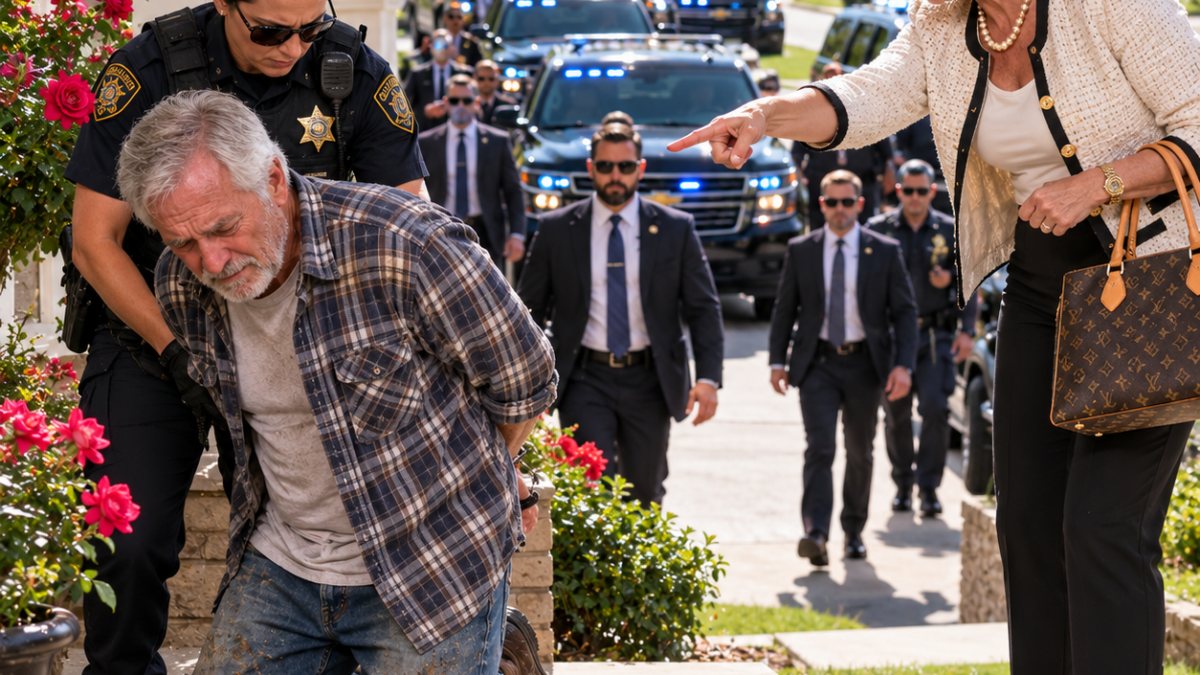
HOA Karen Had My 72-Year-Old Veteran Father Handcuffed on His Own Porch—Then Six Black SUVs Rolled In After I Handed the DA a 712-Page Case Against Her.
PART2:
People who believed rank, access, or friendship with the right officer placed them above ordinary rules.
After leaving government service, I started Devo Protective Solutions in Charlotte.
Corporate investigations.
Fraud reviews.
Security consulting.
Internal misconduct.
Executive protection when necessary.
Forty-seven employees.
Sixteen former federal or military investigators.
Three forensic accountants.
And one corporate attorney named Cynthia Okafor who had spent twelve years at the Department of Justice before discovering private practice offered better coffee and fewer windowless conference rooms.
I had spent most of my adult life learning that evidence becomes weaker when anger touches it.
So I stepped from my car calmly.
Closed the door.
Straightened my jacket.
Then walked toward my father.
Brenda saw me first.
Her phone moved.
PART3:
For a fraction of a second, surprise crossed her face.
Then the expression vanished beneath the smile she had used on half the neighborhood for three years.
“Marcus.”
She said my name as if we were arriving at the same charity luncheon.
“You need to stay back.”
I kept walking.
The deputy turned.
Kyle Burgess.
Thirty-four.
Wake County deputy sheriff.
Off duty that afternoon.
Moonlighting under an approved secondary-employment arrangement as Magnolia Ridge’s private security coordinator.
That distinction mattered.
His county badge did not disappear because he was off duty.
Neither did his obligations.
But the HOA did not become a police department merely because it paid a deputy thirty-five dollars an hour to drive slowly through the neighborhood.
Kyle held one hand up.
“Sir, stop there.”
I stopped.
Ten feet from the porch.
“Deputy Burgess.”
His face changed.
“You know me?”
“I know your name.”
I looked at my father.
“Dad?”
Raymond Devo raised his head.
“I’m fine.”
He always said that.
He said it after my mother died.
After his knee replacement.
After falling from a ladder at sixty-eight.
Fine was my father’s word for:
The problem still exists, but I remain standing.
Except he was not standing now.
He was on his knees.
I looked back at Kyle.
“What is the legal basis for the detention?”
Brenda answered.
“Your father violated a court order.”
“I asked Deputy Burgess.”
Her mouth tightened.
Kyle said:
“Ms. Whitmore has a temporary no-contact order.”
“I know.”
“She reported your father approached her within the prohibited distance.”
“Where?”
“Here.”
I looked around.
“My father’s porch?”
Kyle’s confidence softened by half a degree.
“He made contact.”
I glanced at the nearest security camera beneath the porch eave.
Then another at the workshop.
Another over the driveway.
Four total.
Every second stored remotely.
I said:
“I have continuous video showing Ms. Whitmore drove to this address, parked on the public street, approached the property, and initiated contact while my father remained seated in that chair.”
Kyle’s eyes moved toward the camera.
Brenda said:
“That is not what happened.”
“It is exactly what happened.”
“You weren’t here.”
“No.”
I nodded toward the camera.
“But they were.”
My father shifted slightly.
The cuffs clicked.
That sound reached somewhere inside me words could not.
I kept my voice even.
“Kyle, call your on-duty supervisor.”
His jaw tightened.
“You don’t direct me.”
“No.”
“You’re right.”
“I’m asking you to verify whether you have lawful grounds to continue restraining a seventy-two-year-old man who was sitting on his own porch when the protected party voluntarily approached him.”
Brenda stepped forward.
“He has intimidated me repeatedly.”
“Good morning is not intimidation.”
Her eyes flashed.
“You have no idea what he has put this community through.”
Behind us, an engine turned onto Brierwood Lane.
Then another.
Brenda looked past me.
The first black Chevrolet Suburban came around the bend.
Then the second.
Third.
Fourth.
Fifth.
Sixth.
Single file.
No emergency lights.
No speeding.
Dark windows.
Small DEVO PROTECTIVE SOLUTIONS logos along the rear panels.
They rolled down the street at twenty-five miles an hour.
Exactly the limit.
My father had taught me something when I was nine.
If you have to break a rule to prove you respect rules, you have probably lost the argument.
The convoy was not law enforcement.
It was not a tactical team.
Nobody was coming to drag Brenda away.
That made what happened next more important.
The SUVs carried investigators.
Accountants.
Cynthia.
Witness support.
People who had spent months building a record.
Brenda had always depended on a performance of authority.
Clipboard.
Board title.
Deputy in a black Explorer.
Legal-sounding letters.
A Porsche at the curb.
The convoy did not give me power over her.
It simply destroyed the visual monopoly she had built.
For three years, she had been the largest presence on Brierwood Lane.
Now she was not.
The Suburbans parked along the opposite curb.
Doors opened.
My employees stepped out.
No one rushed.
No one surrounded anybody.
They moved to assigned places.
Two investigators went toward Earl Gibson’s house because Earl had witnessed the entire detention.
Janelle Brice, our forensic accountant, stepped onto the sidewalk with a document bag.
David Chen carried two camera cases.
Cynthia emerged from the third SUV in a charcoal suit holding a thick envelope.
Brenda lowered her phone.
Kyle stared.
I said:
“Deputy.”
He looked at me.
“Call your supervisor.”
This time he did.
While he spoke quietly into his phone, I crouched near my father.
“I’m sorry.”
Dad looked annoyed.
“For what?”
“For not getting here sooner.”
“You’re here now.”
His eyes went toward the SUVs.
“You brought the cavalry.”
“Accountants.”
“Worse.”
Despite everything, I almost laughed.
Brenda recovered enough to speak.
“This is a private community.”
Cynthia heard her.
She walked over.
“No, Ms. Whitmore.”
Brenda looked at her.
Cynthia extended a business card.
“This is a privately governed homeowners association containing public streets and individually owned property.”
Brenda did not take the card.
Cynthia lowered her hand.
“The distinction is important.”
“Who are you?”
“Cynthia Okafor.”
“I represent Raymond Devo and Devo Protective Solutions.”
“I already have counsel.”
“That is excellent.”
Cynthia held up the envelope.
“Then please deliver this to counsel without substantive response.”
“What is it?”
“A filed civil complaint, preservation notice, and supporting motion challenging the association’s lien, the purported enforcement authority over Mr. Devo’s parcel, and the factual basis for your no-contact petition.”
Brenda’s face changed.
Not much.
Enough.
My father had lived at Fourteen Brierwood Lane since 1989.
That fact sat beneath everything Brenda had done.
He bought the house for sixty-seven thousand dollars.
Three bedrooms.
Brick ranch.
Detached workshop.
Half-acre lot.
Concrete driveway he poured with two union friends on a Saturday morning.
The original Brierwood Lane had eight houses.
No HOA.
No clubhouse.
No landscaping committee.
People mowed.
Waved.
Borrowed ladders.
Returned them eventually.
My mother Clara planted roses the spring she and Dad moved in.
Hybrid teas near the back fence.
Climbing roses over the workshop trellis.
Red floribundas near the patio.
A pale pink New Dawn climber along the old brick wall.
She had rules.
Morning water.
No spraying during heat.
Coffee grounds in compost.
Dad mocked every one of those rules for thirty years.
Then ovarian cancer took her in 2018.
She was sixty-nine.
After the funeral, my father began following every gardening instruction she had ever given him.
He had been a master electrician for forty-two years.
Hospitals.
Schools.
Courthouses.
Commercial buildings.
Hundreds of houses.
The man could calculate load requirements in his head and diagnose a bad neutral from the smell of an overheated panel.
Roses confused him.
So he learned.
He watched videos.
Bought pruning books.
Called a nursery employee named Theresa so often that she eventually began answering:
“What did Raymond do now?”
Within two years, Clara’s roses looked better than when she was alive.
Dad never admitted this.
I never told him.
The garden became the one conversation with my mother he could still continue.
Every morning.
Coffee.
Pruning shears.
Check leaves.
Pull weeds.
Talk to her when he thought nobody could hear.
That was the garden Brenda Whitmore called a “landscaping irregularity.”
Magnolia Ridge Estates rose around Brierwood Lane years after Dad bought his house.
Former farmland became four hundred twelve planned homes.
Stone entrance.
Pool.
Clubhouse.
Private amenities.
HOA dues high enough to require their own line in a family budget.
At some point after development began, the association started treating the original eight houses on Brierwood Lane as though they belonged to Magnolia Ridge.
Dad did not challenge it initially.
Why would he?
The HOA sent newsletters.
He threw them away.
They sent pool cards.
He never used the pool.
They asked for dues.
For a while he paid them because, as he put it:
“It was cheaper than listening to them.”
Then Brenda became president.
Brenda Whitmore was forty-eight.
Former real-estate broker.
Image-conscious to a degree that would have been funny if she had not attached penalties to it.
She had spent years turning presentation into leverage.
Beautiful house.
Beautiful clothes.
Beautiful car.
Beautiful stationery.
Everything communicated:
I understand how respectable people behave.
The problem was not that Brenda liked nice things.
There is nothing wrong with liking expensive shoes.
The problem was that she began treating aesthetics as evidence of character.
New paint meant responsibility.
Old siding meant laziness.
Perfect shrubs meant respect.
A wheelchair ramp without architectural approval meant disorder.
My father’s roses, growing according to thirty years of Clara’s preferences instead of Brenda’s landscape manual, became proof that the old houses on Brierwood Lane did not belong in the new community.
Her first violation notice arrived in April 2021.
Mailbox.
Fence.
Driveway.
Landscaping.
Dad replaced the mailbox.
Not because the old one was dangerous.
Because he did not care.
He refused the fence violation after a county inspector confirmed the cedar fence met code.
Brenda replied that county code did not satisfy the association’s “aesthetic enhancement protocol.”
Then came daily fines.
Driveway discoloration.
Workshop siding.
Garden layout.
Within two months, the balance was thousands.
Dad did not call me.
That was Raymond.
He would have called if his television remote stopped working before he called to say somebody had placed a lien on his house.
The first thing he mentioned was Clara’s roses.
“New Dawn came in.”
“Good.”
“Better than last year.”
“You finally learned not to butcher it?”
“You don’t know anything about roses.”
“Neither did you.”
“Your mother left instructions.”
“She spent thirty years giving you instructions.”
“She was right about some of them.”
Then, as if remembering the weather:
“Some woman says I owe her forty-eight hundred dollars.”
I stopped walking.
“What?”
“HOA.”
“Why?”
“Fence.”
“Garden.”
“Driveway.”
“She doesn’t like the roses.”
That sentence bothered me more than the money.
Not because roses are legally protected memorials.
They are not.
Because my father’s voice changed.
Small.
Not weak.
Wounded.
“She called them an informal planting arrangement.”
I pictured him looking at the letter.
Clara had chosen every bush.
She knew which colors bloomed earliest.
Which one caught morning light.
Where cardinals nested.
And someone had converted thirty years of marriage into “informal planting.”
“Send me everything.”
“No.”
“Dad.”
“I can handle it.”
“I know you can.”
“I don’t need you coming up here making this into an investigation.”
“Then don’t make me investigate.”
“You investigate toothpaste if the cap is crooked.”
“Only suspicious toothpaste.”
He laughed.
That delayed me.
I regret that.
Months passed.
Brenda filed code complaints.
Electrical panel.
HVAC.
Gutters.
Workshop.
County inspectors found nothing significant.
The electrical inspector told Dad his panel was cleaner than many new houses.
Brenda filed again.
Police complaints followed.
Noise.
Suspicious activity.
Hazardous materials.
Aggressive behavior.
Fourteen calls in eleven months.
Not one produced a criminal charge.
One officer wrote:
Resident watching television at ordinary volume.
Another:
Resident watering garden.
Another:
No disturbance observed.
I learned most of this later.
Dad kept copies in a drawer beneath spare batteries and old receipts.
He never told me the number.
Then Earl Gibson called.
Earl had delivered mail on Brierwood Lane for three decades before retiring.
Sixty-eight.
Skin like leather.
Knew every family.
Every dog.
Every divorce.
Every child who had moved away.
“Marcus.”
“Yes, sir?”
“That woman put a lien on your dad’s house.”
“What?”
“Six thousand something.”
I stood up from my desk.
“When?”
“Recorded last week.”
“How do you know?”
“My daughter works in the register’s office.”
He hesitated.
“She’s trying to run those old houses out.”
“Why?”
“I don’t know.”
Then:
“But three already sold.”
That sentence started the investigation.
I drove to Raleigh the following weekend.
Dad looked older.
Not dramatically.
The kind of older only a son notices.
His shoulders were lower.
The rose beds had weeds.
That scared me.
My father had watered those roses with influenza.
He had wrapped his knee in ice and pruned them sitting down after surgery.
For him to let weeds grow meant something.
We sat on the metal glider.
“She wants me gone.”
“Who?”
“Brenda.”
“What exactly has she said?”
“That the house drags down the street.”
“That I should think about whether maintaining an older home is still practical for me.”
His mouth tightened.
“Then a real-estate fellow called two days later.”
“Who?”
“Pinnacle something.”
My investigator’s brain woke up.
“What did he offer?”
“Three sixty.”
“What is the house worth?”
“Probably five.”
“Did Brenda know about the call?”
“I don’t know.”
“Did the agent mention her?”
“No.”
I looked toward the rose garden.
Three old homes had already sold.
All on the same side of Brierwood Lane.
“Who bought the others?”
“Developer.”
“Pinnacle?”
“I think so.”
The next morning, I met Brenda.
She drove up while Dad knelt beside Clara’s tea roses.
White Porsche.
White trousers.
Dark sunglasses.
She walked to the edge of his yard.
“Mr. Devo.”
Dad looked up.
“Morning.”
“I see the landscaping violation remains.”
Dad looked at the roses.
“These?”
“Yes.”
“My wife planted them.”
“I understand they have sentimental value.”
The sentence almost sounded human.
Then:
“But private sentiment cannot override community standards.”
Dad wiped his pruning shears on a cloth.
“My wife was here before your community standards.”
Brenda’s smile tightened.
“History doesn’t provide exemption.”
Dad looked at her.
“County says there’s nothing wrong with them.”
“This is not a county issue.”
I stood inside the kitchen watching.
Brenda lifted her camera.
Photographed the bed.
Then the workshop.
Then Dad.
That was the moment I stopped hoping she was merely overzealous.
I started asking why.
With Dad’s written authorization, my firm began examining association records available to members and public filings.
Janelle Brice took finances.
David Chen handled corporate and property records.
Cynthia reviewed covenants, liens, and litigation.
I interviewed residents.
The first surprise came from the title documents.
The original Brierwood Lane parcels were older than Magnolia Ridge.
The HOA claimed a 2004 amendment had annexed them.
Cynthia read it twice.
Then called me.
“Marcus.”
“Yeah?”
“This is garbage.”
“Legal term?”
“Highly technical.”
The amendment described a boundary expansion.
But the original eight parcels had never been subject to a declaration reserving unilateral annexation rights.
The recorded document contained no signatures from my father or several other original owners.
No deeds incorporating the later covenants.
No written joinder.
The HOA had spent years behaving as if a map and board vote could attach private land to restrictive covenants retroactively.
Maybe there was some other document.
We looked.
Nothing.
Cynthia said:
“I’m not saying the court outcome is automatic.”
“Good.”
“But they have a serious problem proving authority over Raymond’s parcel.”
That meant the fines and lien were no longer merely abusive.
They might never have been authorized at all.
Then Janelle found the money.
In three years, Magnolia Ridge had paid more than four hundred thousand dollars to Ridgeline Property Services.
Owner:
Dale Whitmore.
Brenda’s brother-in-law.
Some work existed.
Some invoices were inflated.
One large irrigation upgrade could not be located in the field despite six figures in payments.
A tree-management project cost far above market and conveniently removed mature trees near the original Brierwood houses.
Then administrative expenses.
Consulting payments.
Transfers to an LLC connected to Brenda.
Not every transaction was necessarily theft.
Some had vague board approval.
Others did not.
We flagged them.
Then the real-estate pattern.
Three original households had sold.
Harrison.
Garcia.
Washington.
All after escalating HOA enforcement.
All below nearby appraised values.
All to Pinnacle Luxury Communities or related entities.
Pinnacle had preliminary plans for a townhome project.
Six contiguous parcels were needed.
Three acquired.
Three remaining.
Dad’s sat in the middle.
The Harrisons had been fined for exterior lighting and bird feeders.
The Garcias faced repeated complaints over a swing set, parking, and “excess occupancy” whenever relatives visited.
Louise Washington was seventy-four and used a wheelchair.
The association first challenged her ramp.
When counsel pointed out fair-housing protections, the enforcement strategy shifted to porch railings, paint, and landscaping.
Louise lasted fourteen months.
Then sold.
I interviewed her at her daughter’s apartment.
She kept the old house key on her keychain.
“You still carry it?”
She looked down.
“I forget to take it off.”
I knew that wasn’t true.
She told me Brenda visited twice before the sale.
Not as HOA president, she claimed.
“As a neighbor.”
Brenda told Louise:
“Maybe the house has become too much for you.”
Then supplied a contact for Pinnacle.
The sale closed for less than Louise’s prior appraisal.
Several weeks later, an entity associated with Brenda received a “consulting referral” payment.
Janelle found similar payments around the other sales.
Twenty-six thousand dollars total.
Now the motive had shape.
Not:
Brenda hates roses.
More dangerous.
Brenda had discovered that rules could create pressure.
Pressure created sales.
Sales created money.
Appearance enforcement became acquisition strategy.
We built the record.
Carefully.
No hacking.
No unauthorized databases.
No intimidation.
Public records.
Association records.
Bank records later obtained through lawful process after referral.
Witness interviews.
Copies of letters.
Police dispatch records.
County inspection files.
Doorbell cameras provided voluntarily.
Dad’s new cameras on his own property.
Forty-three documented drive-bys.
Brenda photographing.
Stopping.
Writing.
One camera captured her lifting Dad’s mailbox lid enough to look at envelopes.
We referred that to counsel rather than inventing our own federal case.
Evidence first.
Characterizations later.
In February, Brenda escalated.
She petitioned for a temporary no-contact order.
Her affidavit described four incidents.
Dad greeting her at the mailbox.
Dad asking why she was photographing his workshop.
Dad walking along his own driveway while she drove past.
Dad looking toward her vehicle while seated on his porch.
She turned ordinary behavior into threatening behavior through adjectives.
“Confronted.”
“Advanced.”
“Paced aggressively.”
“Sustained intimidating eye contact.”
The temporary order was issued ex parte pending a hearing.
That sounds shocking until you understand what ex parte orders are.
Courts sometimes make temporary decisions from one side’s allegations because waiting can be dangerous in legitimate cases.
They are temporary precisely because a fuller hearing follows.
The order prohibited Dad from contacting Brenda and required distance when reasonably possible.
It did not ban him from his own porch.
It did not give Brenda the right to approach him and then manufacture a violation.
But Dad reacted the way many older men react to official paper.
He became terrified of doing something wrong.
He stopped attending HOA meetings.
Changed his morning walk.
Asked Earl to retrieve mail if Brenda was outside.
The roses suffered again.
That made me angrier than the lien.
Dad had survived combat engineers in Vietnam.
Forty-two years around high voltage.
Cancer with my mother.
He was now checking through his blinds before walking to his own mailbox.
Kyle Burgess entered the story then.
Brenda convinced the HOA board to hire security.
Kyle had an approved secondary-employment arrangement.
He drove a black Ford Explorer.
Some residents assumed it was an official sheriff vehicle.
It was not.
He wore plain clothes with a badge and sidearm when appropriate to his off-duty status.
That created a dangerous ambiguity.
Brenda loved ambiguity.
Kyle drove past Dad’s house repeatedly.
Photographed.
Logged.
Followed Dad once from the porch to the mailbox.
Earl recorded it.
Dad brought Kyle coffee one morning.
Kyle refused.
“Why?”
Dad asked me later.
“He’s monitoring you.”
“He can monitor and drink coffee.”
“That is the most Raymond response imaginable.”
Dad shrugged.
“No point wasting a cup.”
Cynthia reviewed everything.
Seven hundred twelve pages by the time the file was organized.
She sat in our conference room in Charlotte late one night.
Folders around her.
Laptop open.
“Marcus.”
“What?”
“This has crossed beyond an HOA dispute.”
“I know.”
“You have potential fraudulent lien issues.”
“Possible embezzlement.”
“Possible false pretenses.”
“Perjury concerns.”
“Developer coordination.”
“Maybe licensing issues.”
“Maybe abuse of process.”
She looked at me.
“And one serious procedural problem.”
“What?”
“Your father should never have waited this long to tell you.”
I laughed.
“Good luck prosecuting that.”
We made a referral.
Not to social media.
Not to a reporter.
Not to Brenda.
To the appropriate authorities.
The Wake County District Attorney’s office accepted a meeting with Cynthia and me, along with a financial-crimes investigator from the sheriff’s office.
The assistant district attorney who reviewed the package was Patricia Okonkwo.
Fourteen years prosecuting white-collar and public-integrity matters.
She read quietly.
Asked smart questions.
Did not promise charges.
That increased my confidence.
People who promise outcomes before investigation usually care more about certainty than accuracy.
She said:
“This is thorough.”
“Thank you.”
“We’ll have investigators verify independently.”
“That’s what we want.”
“Do not confront the subjects.”
“I won’t.”
“Your father?”
“He knows enough to stay out of it.”
She looked at me over her glasses.
“Does Brenda know?”
“No.”
“Good.”
We left her office just after lunch.
My team had driven to Raleigh because we planned a second round of witness interviews and evidence collection while Cynthia worked on the civil case.
Six Suburbans sat in a North Hills hotel lot.
At 2:17, Earl called.
“Marcus.”
I knew from his voice.
“What happened?”
“You need to get here.”
I stood.
“Dad?”
“He’s on the porch.”
“Brenda just pulled up.”
“With Kyle.”
My stomach tightened.
“What are they doing?”
“Walking toward him.”
I grabbed my keys.
“Stay on the phone.”
The restaurant was twenty minutes away in ordinary traffic.
Earl narrated.
“She’s recording.”
“What’s Dad doing?”
“Drinking coffee.”
“Has he moved?”
“No.”
“Kyle’s on the steps.”
Then Dad’s voice faint through Earl’s phone:
“I’m sitting on my own porch.”
Kyle:
“Sir, I need you to stand.”
Brenda’s voice:
“This is another violation.”
I got into the car.
“Earl.”
“I’m here.”
“Do not interfere physically.”
“I know.”
“Record from your property.”
“I am.”
“Tell Helen and anybody else the same thing.”
“Just watch.”
Then:
“He’s cuffing him.”
My vision narrowed.
I put the phone on speaker.
“Why?”
“She says your dad came too close.”
“He hasn’t moved?”
“Not once.”
The cuffs clicked.
I heard them through a phone from across the street.
My father said:
“What did I do?”
Kyle:
“Sir, we’re going to sort this out.”
I called Cynthia.
“Get everyone into the vehicles.”
“What happened?”
“Brenda manufactured contact.”
“Kyle has Dad cuffed.”
Her voice changed.
“I’m drafting emergency relief.”
“Also call the sheriff’s duty supervisor.”
“Already doing it.”
Then David.
“Pull the live cameras.”
“Every angle.”
“Preserve original files and hashes.”
“Done.”
Janelle:
“Bring the financial summary.”
“Why?”
“Because if Brenda wants to create a public scene, I want her served with the civil record today.”
“That sounds personal.”
“It’s lawful service.”
“Marcus.”
I exhaled.
“Fine.”
“You’re right.”
“Bring what counsel says.”
“That’s better.”
The convoy left.
I arrived first.
Saw the mug.
Dad.
Cuffs.
Brenda.
Then the SUVs.
Kyle finished his call.
His face looked different.
He crouched beside my father.
“Mr. Devo.”
“Yes?”
“I’m removing the restraints while this is reviewed.”
Dad said:
“Appreciate it.”
No sarcasm.
That somehow made Kyle look worse.
He unlocked one cuff.
Then the other.
My father rubbed his wrists.
I offered my hand.
He ignored it and stood by himself.
Of course.
An on-duty lieutenant arrived three minutes later in a marked sheriff SUV.
That mattered more than all six of mine.
He separated Kyle.
Brenda.
Dad.
Witnesses.
He collected initial statements.
Asked to see the camera footage.
David provided a preserved copy.
The footage was painfully simple.
Dad sitting on porch.
Brenda’s Porsche arriving.
Brenda exiting.
Walking toward property.
Speaking.
Kyle approaching.
Dad never leaving chair until directed to stand.
The lieutenant watched twice.
Then looked at Brenda.
“Ms. Whitmore.”
She lifted her chin.
“Yes?”
“Did Mr. Devo approach you before you came to this property?”
“He has engaged in a campaign of intimidation.”
“That was not my question.”
Her face tightened.
“No.”
“You approached him?”
“I was documenting violations.”
“While subject to a no-contact order?”
“The order protects me from him.”
The lieutenant looked toward Dad.
“Not the other way around?”
Brenda said nothing.
He turned to Kyle.
“Deputy.”
Kyle’s shoulders dropped.
They walked toward the marked SUV.
Whatever he said there became part of his internal review.
I did not need to hear it.
Cynthia served Brenda through the method permitted for the filed civil matter.
A copy of the complaint.
Preservation notice.
No threats.
No line about being “president of nothing.”
No humiliation.
She simply said:
“Please provide this to your counsel.”
Brenda stared at the envelope.
“What exactly are you alleging?”
Cynthia answered:
“Among other things, that Magnolia Ridge lacks enforceable covenant authority over Raymond Devo’s parcel, that the lien recorded against his property is invalid, that enforcement actions were undertaken in bad faith, and that certain property and financial conduct caused compensable harm.”
Brenda glanced toward Janelle.
Then the investigators.
Then me.
“This is because of today?”
“No.”
I answered before Cynthia could.
“Today is simply the first day you saw the file.”
That sentence broke through.
Her expression changed.
“How long?”
I did not answer.
She looked toward the cameras.
The neighbors.
The team.
Dad.
Then:
“You were investigating me.”
“Yes.”
“This is harassment.”
“No.”
“We examined records you created and conduct witnesses voluntarily described.”
“You put cameras on this property.”
“My father put cameras on his own property after fourteen police complaints and repeated surveillance.”
Brenda looked at Dad.
He was bending down to pick up the coffee mug.
I moved to help.
“Leave it.”
He picked it up.
Coffee gone.
Mug intact.
He inspected the chip.
Still fine.
Then he looked at Brenda.
Not angry.
That seemed to bother her.
She said:
“Mr. Devo, surely you understand none of this would have happened if you had simply complied.”
Dad stared.
Then walked toward his rose garden.
Brenda called:
“Did you hear me?”
He stopped.
Turned.
“My wife planted those roses before your first house was built.”
Silence.
“I spent forty-two years following electrical code because bad wiring can kill somebody.”
He pointed toward her envelope.
“Rules should have a reason.”
Then he walked away.
That was the closest my father ever came to giving Brenda a speech.
The next morning, Cynthia argued the emergency motion.
The temporary no-contact order was dissolved pending fuller proceedings.
The court reviewed the surveillance footage.
The same judge who had issued the temporary order watched Brenda drive to Dad’s home.
Approach.
Create the proximity.
Then characterize his continued presence on his own porch as prohibited contact.
The judge’s face did not reveal much.
Judges learn that skill.
But when the footage ended, he removed his glasses.
“The court entered temporary relief based upon representations that now appear materially incomplete.”
Brenda’s attorney shifted.
The judge continued.
“The protected party cannot deliberately initiate proximity and then rely on the respondent’s failure to abandon his own home as proof of prohibited contact.”
The order was vacated.
Any further request would require full evidence and notice.
Dad nodded.
Nothing more.
Outside, reporters were not waiting.
Nobody cared yet.
Good.
Publicity ruins facts before facts are ready.
The civil title question came next.
Cynthia filed for declaratory relief.
The HOA fought it initially.
Then their independent counsel conducted a title review.
Three weeks later, he called Cynthia.
His first sentence:
“We have a problem.”
The original eight Brierwood Lane parcels had not been properly annexed.
The developer’s 2004 amendment expanded a map.
It did not legally bind parcels whose owners had never agreed and whose prior deeds contained no annexation mechanism authorizing unilateral attachment.
The HOA had been collecting dues from some original residents for years under an assumption nobody challenged.
That did not automatically resolve every past payment.
The legal issues were more complicated.
But as to ongoing restrictive enforcement against Dad’s property, the association’s position collapsed.
The lien was released.
The fines were withdrawn.
The rose garden ceased, overnight, to be an “informal planting arrangement.”
Funny how flowers become compliant when the lawyer reads the deed.
The criminal investigation moved more slowly.
As it should.
Sheriff’s financial crimes investigators and the district attorney independently verified our work.
They interviewed the Harrisons.
Garcias.
Louise Washington.
Board members.
Contractors.
Dale Whitmore.
Todd Pinnacle.
Bank records came later through proper process.
Those records showed what our analysis had suggested.
Payments from Pinnacle-related entities routed through consulting agreements connected to Brenda after the acquisition of several Brierwood parcels.
The defense called them legitimate referral and consulting fees.
Investigators asked why they were not disclosed to homeowners she was simultaneously fining and encouraging to consider selling.
Then the HOA money.
Eighty-six thousand dollars in questioned administrative transfers associated with entities Brenda controlled or benefited from.
Not every dollar became a criminal count.
Evidence must be specific.
But enough transactions lacked authorization or involved false documentation to move the case forward.
Ridgeline contracts received scrutiny.
Several projects were overpriced.
One major upgrade was invoiced but not completed as represented.
Competitive bid documents included proposals companies later said they had never created.
Someone had manufactured the appearance of competition.
Dale Whitmore eventually retained separate counsel.
That was when family loyalty became documentary evidence.
Todd Pinnacle did the same.
The developer had texted Brenda about “clearing the last three.”
One message:
Raymond is the key lot.
Another:
How hard is he going to be?
Brenda:
Old.
Stubborn.
But everyone has a number.
Todd:
And if he doesn’t?
Brenda:
Then we increase the cost of staying.
That message sat on a screen in an interview room for a very long time.
No metaphor needed.
No narrator needed to explain motive.
Increase the cost of staying.
That was the scheme in five words.
Make home expensive emotionally.
Financially.
Administratively.
Call police.
Issue fines.
Record liens.
Challenge ramps.
Inspect fences.
Then arrive with a developer’s number.
It worked on three families.
It almost worked on my father.
When the charges finally came, Brenda was not arrested on my father’s lawn.
No convoy.
No dramatic line.
Investigators went to her home on a Tuesday morning.
She surrendered through counsel.
That was appropriate.
She faced counts tied to false financial records, obtaining property or money through deceptive conduct, perjury-related allegations arising from sworn representations, and misuse of association funds.
Todd Pinnacle faced his own investigation and later separate charges and civil claims connected to the property-acquisition scheme.
Dale Whitmore’s contracts became part of civil recovery actions.
Kyle’s case stayed administrative.
The body-camera and neighborhood footage showed a deputy working a private detail who failed to separate Brenda’s interpretation of a civil order from an independent legal assessment.
He had not beaten my father.
Had not threatened him.
Had not transported him.
When contrary facts emerged, he uncuffed him.
Those facts mattered.
So did the unjustified restraint.
Kyle received significant discipline.
Suspension.
Remedial training.
His secondary-employment approval for private HOA security was revoked.
His disciplinary finding included a sentence Cynthia loved:
Deputy Burgess failed to distinguish private direction from independent law-enforcement authority.
She printed it.
Did not frame it.
I told her that would be petty.
She said:
“I am capable of growth.”
The civil case resolved partly through settlements and partly through court orders.
My father’s lien disappeared.
His disputed fines disappeared.
Several original Brierwood homeowners received refunds or credits after the HOA acknowledged it had overreached on parcels that had not been validly brought under its restrictive covenants.
Louise Washington’s case hurt the most.
She had already sold.
You cannot order time returned.
The new ownership had moved forward.
Her attorneys negotiated a substantial settlement tied to the documented harassment and sale circumstances.
I visited her afterward.
She lived with her daughter.
Her wheelchair sat beside the window.
“You got your father’s house back.”
“He never lost it.”
“You know what I mean.”
“Yes, ma’am.”
She looked outside.
“I wish somebody had done this two years earlier.”
“So do I.”
“You blame yourself?”
“Some.”
“That’s foolish.”
“Probably.”
She smiled.
“Your father always said you overthink.”
“He says thinking is expensive because I went to college.”
Louise laughed.
Then:
“Don’t make this about saving old people.”
“I wasn’t.”
“Yes, you were.”
She tapped the arm of her wheelchair.
“We are not helpless because we’re old.”
“I know.”
“We were isolated.”
“That’s different.”
That sentence became part of how I understood everything Brenda had done.
She did not select people because they were weak.
She selected people she thought would have to fight alone.
Older residents.
Families busy with children.
People without lawyers.
People unfamiliar with HOA procedure.
People embarrassed to tell neighbors they were getting fines.
Isolation was the leverage.
My convoy shocked Brenda because it destroyed that assumption in one instant.
Dad was not alone.
But the convoy was also the least important part of the case.
Evidence mattered.
Witnesses mattered.
Documents mattered.
Neighbors finally talking to one another mattered.
One person standing beside another person matters long before six SUVs appear.
Magnolia Ridge held a special election.
Brenda resigned before the vote.
Her remaining board allies did not seek reelection.
Earl Gibson somehow became HOA president.
He had never wanted it.
That helped.
At his first meeting, he brought a yellow legal pad.
No embossed stationery.
No gold crest.
No mission statement.
He sat at the same giant walnut table Brenda had purchased with HOA funds.
“First order of business.”
Everybody waited.
“This table cost nine thousand dollars?”
The treasurer nodded.
Earl stared.
“Does it do anything?”
Someone laughed.
“No.”
“Good.”
He tapped the legal pad.
“Then we’re keeping it until it falls apart because we already paid for the stupid thing.”
More laughter.
“Second.”
He lifted a stack of old Community Excellence policies.
“These are suspended pending legal review.”
Applause started.
Earl raised one hand.
“Don’t clap yet.”
“Third.”
“All financial contracts involving relatives of board members are being reviewed.”
“Fourth.”
“Quarterly financial reports go to every homeowner.”
“Fifth.”
“If you have a problem with your neighbor’s trash can, I am begging you to survive the emotional hardship until trash day.”
That brought the first real laughter Brierwood Lane had heard in years.
Dad did not attend.
He was home watering roses.
The criminal case against Brenda took more than a year.
By then the story had reached local media.
“HOA Fraud Investigation.”
“Developer Dealings Under Review.”
“Elderly Residents Say Enforcement Pressured Sales.”
Reporters discovered the handcuff footage.
That became the image everyone wanted.
My father hated it.
A seventy-two-year-old veteran on his knees.
Cuffed.
Brenda filming.
People called him a hero.
He became angry.
“I didn’t do anything.”
“You stayed calm.”
“I drank coffee.”
“You also survived Brenda.”
“So did the roses.”
A national program requested an interview.
He refused.
Local station.
Refused.
Newspaper.
Refused.
A veterans group wanted to recognize him.
He said:
“For what?”
When I explained they admired how he conducted himself, he answered:
“I sat there because standing up would’ve made that deputy nervous.”
To him, restraint was not heroism.
It was basic sense.
Brenda eventually entered a plea rather than take every count to trial.
The agreement required substantial restitution.
She admitted misconduct involving association funds and false representations connected to the enforcement and property scheme.
There were criminal penalties.
Probation after custody.
Financial judgments.
Loss of real-estate-related professional privileges.
Civil settlements.
I am deliberately not turning the sentence into poetry.
Courts are not revenge machines.
The meaningful consequences were concrete.
Money returned.
Liens removed.
Fraud recorded.
Professional trust lost.
People who had been labeled troublemakers had records corrected.
Todd Pinnacle’s planned Brierwood townhome project died.
Not because development is evil.
Because this acquisition strategy was contaminated.
Three parcels the company had acquired became tied up in litigation.
One former owner negotiated a buyback.
Another chose money.
Louise did not want her house back.
“That place has too many ghosts now.”
She used part of her settlement to buy a smaller accessible home ten minutes from her daughter.
The front ramp required no committee approval.
She sent Dad a picture.
On the back:
NO ONE HAS FINED ME FOR THE RAILING YET.
Dad placed it beside his union calendar.
The Garcias moved back to Brierwood Lane.
Not their exact old house.
A different one came available.
Their children were older.
The swing set was gone.
Tom Garcia built another anyway.
Earl saw it.
Walked over.
Tom waited.
Earl said:
“You anchoring that thing?”
“Yes.”
“Good.”
Then left.
That became the new enforcement model.
Dad’s roses recovered.
Of course they did.
He pruned aggressively that spring.
Too aggressively, according to me.
“You’re cutting them too far.”
He stared.
“Where did you study horticulture?”
“Internet.”
“You spent money on college and came out citing internet.”
“I also own a company.”
“Does the company grow roses?”
“No.”
“Then move.”
I moved.
The pale pink New Dawn climbed across the workshop again.
Cardinals nested inside it.
One morning, Dad found a new letter from the HOA.
He stared at the envelope for almost a full minute before opening it.
I was there.
“What does it say?”
He handed it over.
Dear Mr. Devo,
Following independent title review, Magnolia Ridge Estates Homeowners Association acknowledges that Fourteen Brierwood Lane is not subject to the later restrictive covenants under which prior violations were issued.
All fines and liens have been withdrawn.
We apologize for the enforcement actions taken against you.
Sincerely,
Earl Gibson
President
Dad read it again.
Then walked to the bedroom.
He returned with an old wooden cigar box.
Inside:
Bronze Star.
My mother’s wedding ring.
Two photographs.
One hospital bracelet.
Several old union cards.
He folded Earl’s letter.
Placed it inside.
I looked at him.
“You’re keeping that?”
“Yes.”
“Why?”
“Your mother would enjoy it.”
That was Raymond.
The most sentimental man alive pretending every emotion belonged to somebody else.
After the case ended, my company reduced its Raleigh presence.
The cameras stayed at Dad’s house.
His choice.
The six Suburbans went back to Charlotte.
For months, neighbors joked that whenever Dad had a problem, “the fleet” might appear.
Dad hated that.
One afternoon Earl said:
“Raymond, if somebody complains about the roses again, just whistle and summon the convoy.”
Dad looked at him.
“I’ll hit them with the hose.”
“Also effective.”
The cuffs left marks on his wrists for less than a day.
The emotional damage took longer.
For several weeks he flinched when an unfamiliar car slowed outside.
He stopped sitting on the porch in late afternoon.
That was the part no settlement captured.
Wrongful use of authority changes a place.
A porch becomes the place you were cuffed.
A mailbox becomes the place somebody followed you.
A garden becomes the thing a stranger threatened.
Restoring legal rights is faster than restoring ease.
One evening I found Dad inside instead of on the glider.
Beautiful weather.
Roses blooming.
“You going outside?”
“Later.”
I sat.
Television showed Wheel of Fortune.
Volume fourteen.
Same volume from one of Brenda’s noise complaints.
“Dad.”
“Hmm?”
“You afraid she’ll come back?”
He looked at me.
“No.”
“Then what?”
He watched the television.
Finally:
“I don’t like feeling watched.”
That hurt more than anything Brenda said.
The man had lived on that property thirty-five years.
He built the workshop.
Poured the drive.
Buried family pets beneath an oak tree.
Held my mother’s hand there while hospice nurses came and went.
Now a woman with a clipboard had managed to make him feel like a guest.
I said:
“Come outside.”
“No.”
“Dad.”
“I’m watching this.”
“You’ve watched Wheel of Fortune since Carter was president.”
“Pat Sajak wasn’t even hosting when Carter took office.”
“You know what I mean.”
“Facts matter.”
There he was.
I turned off the television.
He stared.
“That is elder abuse.”
“Call the HOA.”
He almost smiled.
I went outside.
Sat on the metal glider.
After two minutes, Dad came out carrying two coffees.
He handed me one.
Sat.
We rocked.
Nothing happened.
A car passed.
No one stopped.
A dog barked.
Somebody’s sprinkler clicked.
The sun dropped behind trees.
Next evening, Dad sat out again.
Then the next.
Recovery was not dramatic.
It was repetition.
You reclaim a porch by sitting on it.
You reclaim a mailbox by walking to it.
You reclaim a garden by pruning the next rose.
Years later, whenever people ask me about the convoy, they expect that to be my favorite part.
Six black SUVs.
Doors opening.
Brenda’s jaw dropping.
The private investigators.
The lawyer.
The financial files.
The instant she understood Raymond Devo was not alone.
Yes.
I remember it.
There was satisfaction.
I would be lying if I said otherwise.
But the convoy did not defeat Brenda Whitmore.
A convoy cannot void a fraudulent lien.
It cannot vacate a court order.
It cannot authenticate financial records.
It cannot return stolen money.
It cannot make a frightened witness tell the truth.
The SUVs changed a visual.
The evidence changed the outcome.
And if I had learned anything from Army CID, it was this:
People who abuse authority usually build themselves a stage.
Uniform.
Title.
Desk.
Badge.
Luxury office.
Boardroom.
Clipboard.
They depend on everyone else accepting the set.
The easiest mistake is thinking you beat them by building a larger stage.
You don’t.
You beat bad authority by making it answer questions.
What rule?
What jurisdiction?
What evidence?
Who authorized it?
Where is the vote?
Where is the contract?
Where did the money go?
What did the witness actually see?
Who benefited?
Brenda hated those questions.
Her entire system was designed to prevent them.
She wanted residents discussing whether roses looked tidy.
Not whether her company received money.
Whether a ramp matched the porch.
Not who had a financial relationship with a developer.
Whether my father looked threatening.
Not why she had driven to his house.
Aesthetics were camouflage.
Procedure was camouflage.
Fear was camouflage.
Once people stopped arguing about shrubs and started following money, everything changed.
Dad is seventy-six now.
Still in the same house.
Still claims he can do electrical work he absolutely should not be doing from ladders.
I removed his twelve-foot extension ladder.
He bought another.
I removed that one.
He called me a communist.
We compromised on six feet.
The roses remain.
Clara’s New Dawn covers almost the entire workshop trellis.
Each spring it produces more pale pink flowers than seem physically possible.
Dad still waters early.
Still talks to Mom occasionally.
I stopped pretending not to hear.
One Sunday I visited.
He was sitting on the glider.
Local 379 mug in hand.
The same one that rolled across the porch when Kyle cuffed him.
The chip along the rim had grown into a crack.
“You need a new mug.”
“No.”
“It’s cracked.”
“Still holds coffee.”
“That is not the standard.”
Dad looked at me.
“You sound like Brenda.”
I nearly choked.
“Take that back.”
He laughed harder than I had heard him laugh in months.
Then we sat quietly.
Across the street, Earl walked Daisy, his elderly beagle.
Tom Garcia drove by with lumber in his truck.
A child rode a bicycle down the road.
No security Explorer.
No Porsche.
No clipboard.
No camera pointed at Dad’s garden.
Just Brierwood Lane.
The way it had been before someone decided governing a community meant owning everybody inside it.
Dad took a sip.
“You remember that day?”
I looked at him.
“Which day?”
He nodded toward the porch floor.
Where the coffee had spilled.
“Yes.”
“You looked angry.”
“I was.”
“I thought you were going to punch somebody.”
“So did I.”
He smiled.
“Your mother would’ve been furious.”
“At Brenda?”
“At you.”
“Why me?”
“For bringing twelve people.”
“It was eleven.”
“Six trucks.”
“Suburbans.”
“Whatever.”
“You were handcuffed.”
“I know.”
I stared.
“You’re criticizing the rescue?”
“I didn’t need rescuing.”
That stung.
He saw.
Then said:
“I needed witnesses.”
I waited.
“You brought those.”
His eyes went to the roses.
“Difference.”
It took me a moment.
Then I understood.
My father had not wanted a powerful son to arrive and overpower Brenda.
He wanted the truth not to disappear.
Witnesses.
Cameras.
Records.
Counsel.
People willing to stand there and say:
I saw what happened.
That is a different kind of protection.
Better, probably.
I said:
“You know I would’ve come with one car.”
“Would’ve been easier to park.”
“Cynthia sent the team.”
“Smart woman.”
“She says the same about you.”
“She should.”
He drank.
Then:
“What ever happened to Kyle?”
“Still working.”
“Good.”
That surprised me.
“You’re glad?”
“He did something stupid.”
“Yes.”
“He lost private work.”
“Got suspended.”
“Got retrained.”
“Yes.”
“He admit it?”
“Eventually.”
“Then good.”
“That simple?”
Dad looked at me.
“No.”
“Just enough.”
Raymond had never needed people destroyed.
He wanted them stopped.
That may be why he survived Brenda without becoming like her.
Brenda measured justice in compliance.
If someone resisted, increase pressure.
Dad measured it differently.
Fix what’s wrong.
Make it safe.
Turn the power back on.
Move on.
Electrician’s morality.
Simple.
Useful.
The last time I heard Brenda’s name from him was accidental.
A news article mentioned the final settlement.
I asked whether he wanted to read it.
“No.”
“Why?”
“Roses need feeding.”
“That’s your answer?”
“She has taken enough time.”
He walked outside.
And that was that.
No revenge speech.
No curse.
No interest in where she moved or what she drove.
He had his house.
His workshop.
His mailbox.
His porch.
His wife’s roses.
Brenda no longer had any authority over them.
That was enough.
For years, people on Brierwood Lane had believed Brenda was powerful because no one stopped her.
Those are not the same thing.
Power has boundaries.
Authority has sources.
A badge has rules.
A board has documents.
A court order has terms.
A lien needs a legal foundation.
A developer’s money does not turn coercion into consent.
And a beautiful envelope with an embossed crest cannot create rights that were never granted.
Brenda learned all of that painfully.
So did Kyle.
So did the board.
So did I.
Because I learned something about my father too.
I thought protecting him meant arriving with everything I had.
Investigators.
Lawyers.
Evidence.
Vehicles.
Connections.
Experience.
But none of those made Raymond Devo dignified.
He already was.
He was dignified when Brenda called Clara’s roses a mess.
When police came over a television at volume fourteen.
When a deputy followed him to the mailbox.
When he sat on his own porch and refused to be baited.
When the cuffs clicked.
When he got back up.
My convoy did not give him power.
It simply arrived in time to witness the fact that Brenda had never managed to take it.
The spring after everything ended, Clara’s climbing rose covered almost the entire side of the workshop.
Dad called me.
“New Dawn’s blooming.”
“I’ll come Sunday.”
“You don’t have to.”
“I know.”
That was the thing about Raymond.
Every invitation came disguised as permission not to come.
Sunday morning, I drove from Charlotte.
One car.
No convoy.
Dad was in the garden.
He handed me pruning shears.
“I don’t know what I’m doing.”
“You’ve said that for years.”
“Still true.”
He showed me where to cut.
We worked for an hour.
No HOA inspector appeared.
Nobody photographed us.
Nobody measured the flower bed.
The only violation was that I cut one branch too far back and Dad acted like I had destroyed thirty years of botanical history.
“That was healthy growth.”
“It was in my way.”
“Plants don’t care about your convenience.”
“You sound like Mom.”
He stopped.
Looked at the roses.
Then smiled.
“Yeah.”
We finished.
Sat on the glider.
The pale pink flowers moved slightly in the morning breeze.
Dad’s mug rested on the porch rail.
And for the first time in years, Brierwood Lane felt like what it had always been before somebody tried to turn it into a kingdom.
A street.
A few houses.
People living their lives.
Nothing more.
Nothing less.
Sometimes that is the freedom worth fighting hardest to keep.
Not the right to win every argument.
Not the right to make everybody else live like you.
Just the right to sit on your own porch, drink your own coffee, tend the roses planted by someone you loved, and know that no clipboard, no developer, no HOA title, and no borrowed badge can lawfully make your home stop being yours.
Brenda thought my father was alone.
That was her first mistake.
She thought he was weak because he stayed quiet.
That was her second.
But the mistake that finally ended everything was simpler.
She believed nobody had been keeping track.
We had.
Every letter.
Every call.
Every photograph.
Every dollar.
Every lie.
Every mile her Porsche drove past the house.
Every second my father remained seated while she walked toward him and called his existence a violation.
The convoy only made her look up.
The evidence was already there.
And when six black SUVs turned onto Brierwood Lane that afternoon, the thing Brenda Whitmore finally saw was not an army coming to destroy her.
It was a street full of witnesses.
People who had stopped being afraid.
People who had started asking questions.
People who were finally willing to stand beside the old man she had expected to kneel alone.
That was the moment her power ended.
Not when the cuffs came off.
Not when charges were filed.
Not when the board removed her.
It ended when everybody watching understood the same thing at once:
Raymond Devo had never been the problem on Brierwood Lane.
He was simply the man who had lived there long enough to remember what the street was supposed to be before Brenda Whitmore decided peace required her permission.

