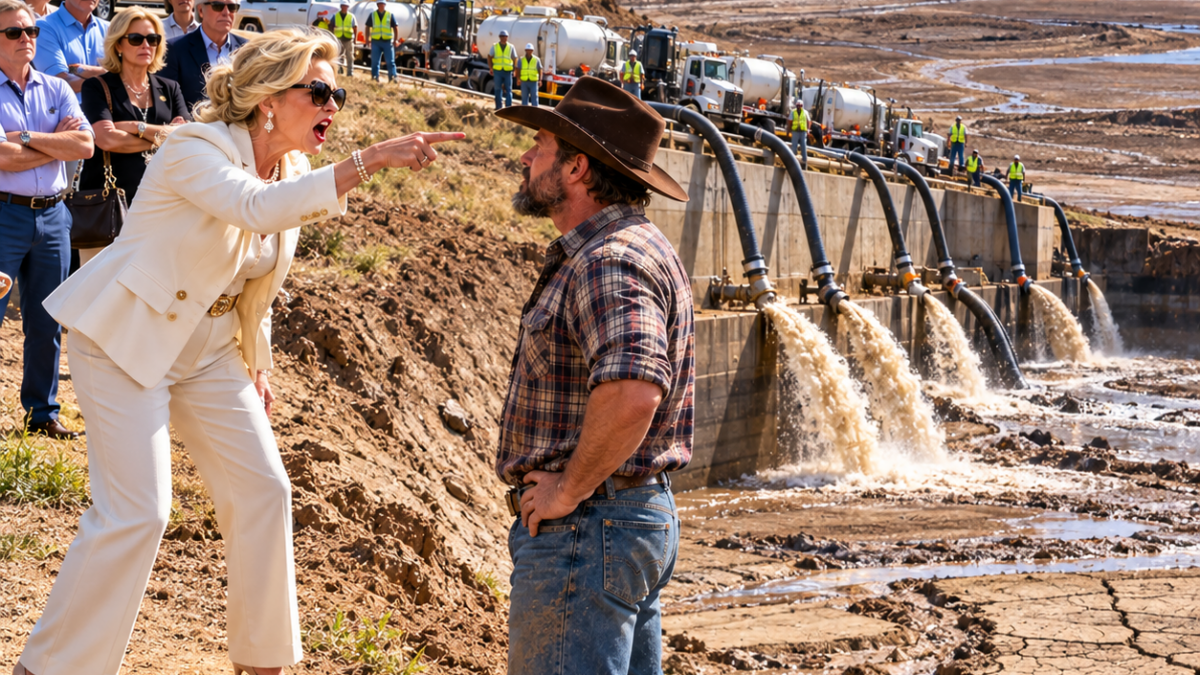
HOA Karen Drained My $8M Reservoir for Revenge—Then 300 Farming Families Sued Her for $12 Million
PART3:
Coffee I never finished.
Claire apologizing because she couldn’t eat.
Me telling her not to apologize.
Lily sitting beside the hospital bed coloring a horse purple because she said brown was too sad.
Claire laughed.
Even then.
After she died, the house changed.
Not physically.
That’s what hurt.
Her cup stayed in the cabinet.
Her shoes remained near the mudroom.
The jasmine bloomed.
The wind chimes kept moving.
Everything continued doing exactly what it had done before except Claire.
Lily was eleven when the reservoir war began.
One evening she sat on the porch steps with her knees against her chest.
It was August.
The pump house was running.
Crickets loud.
She asked:
“Daddy?”
“Yeah?”
“When does summer stop being sad?”
I didn’t know what to say.
So I sat beside her.
Sometimes fatherhood is having the right answer.
Sometimes it is staying beside your child because there isn’t one.
Three years before that summer, developer Dale Lockhart purchased six hundred acres of retired dairy property east of us.
He built Ridgecrest Estates.
One hundred eighty homes.
Stucco.
Tile roofs.
Three-car garages.
Tiny lawns demanding more water per square foot than half my crops.
Clubhouse.
Pool.
Decorative retention pond.
The neighborhood marketed itself as “modern valley living surrounded by authentic agricultural heritage.”
That line still makes me laugh.
They loved agricultural heritage.
Actual agriculture was another matter.
Dale’s wife, Brenda, made herself HOA president almost before the final model home closed.
The first time she drove onto my property, she was wearing cream linen pants and red-soled shoes that sank into the gravel.
White Escalade.
Platinum hair pulled tight.
Huge black sunglasses.
Everything about Brenda looked deliberate.
Even standing in dust.
She approached the equipment yard while I was changing a hydraulic hose.
“Mr. Holloway?”
“That’s me.”
She looked at the old pump house.
Then the tractors.
Then the distant reservoir.
“The agricultural odor from your operation is already generating complaints.”
I wiped my hands on a rag.
“You’ve lived here how long?”
“Excuse me?”
“When did you move into Ridgecrest?”
“Almost two years ago.”
“My grandfather started farming this land in 1962.”
She smiled.
“I’m aware.”
“Then I guess you bought next to the smell.”
Her smile tightened.
“Everything changes, Mr. Holloway.”
“Some things.”
“Residential property values are now a significant county interest.”
“So is agriculture.”
“Of course.”
The way she said of course told me she meant the opposite.
“We need to discuss reducing your operational footprint near our boundary.”
“No.”
I didn’t shout.
Didn’t explain.
Just no.
She tilted her head.
“Excuse me?”
“My land isn’t in your HOA.”
“We aren’t claiming it is.”
“Then you don’t control my operations.”
She looked at me for a long moment.
Then smiled again.
Not warmly.
“Everything changes.”
Then she got into her Escalade and drove away.
Two weeks later, the complaints started.
Noise.
Pump-house vibration.
Dust.
Odor.
Runoff.
Fertilizer.
Fourteen complaints in six weeks.
All filed with Tulare County.
Code Enforcement sent Phil Dominguez.
Phil had been an inspector nineteen years and had the weary expression of a man who had seen every version of neighbor warfare available in California.
He checked the pump house.
Noise within standards.
Water.
Clean.
Chemical storage.
Compliant.
Runoff.
Compliant.
Fertilizer logs.
Compliant.
Pesticide records.
Compliant.
On his third visit, he stood beside his county truck and rubbed the back of his neck.
“Garrett.”
“Yeah?”
“Your operation is cleaner than most places I inspect.”
“Thanks.”
“That wasn’t a compliment.”
“It sounded like one.”
He smiled.
Then became serious.
“Whoever is filing these isn’t trying to fix violations.”
“I know.”
“They’re building paper.”
That was exactly what the Corps had taught me.
Paper matters before emergencies.
Document before the flood.
Once water rises, nobody has time to reconstruct history.
I began saving everything.
Complaints.
Emails.
Letters.
Photos.
Inspection reports.
Certified-mail receipts.
The HOA letters arrived next.
That was when Brenda stopped pretending her authority had limits.
First letter:
Cease agricultural activity within five hundred feet of Ridgecrest Estates.
Second:
Install commercial sound barriers around my pump equipment.
Estimated cost forty-two thousand dollars.
Third:
Daily HOA penalties of two hundred fifty dollars for continued noncompliance.
I read that one twice.
Then downloaded Ridgecrest’s recorded covenants.
My parcel wasn’t included.
Of course it wasn’t.
Ridgecrest’s HOA had as much authority to fine me as a book club in Oregon.
I wrote Brenda:
My property is not subject to Ridgecrest Estates CC&Rs. No assessments, fines, architectural restrictions, or operating rules apply. Further demands will be retained as evidence of harassment.
Her reply came twelve minutes later.
Mr. Holloway, your dismissive attitude toward legitimate community concerns is unfortunate.
I printed that too.
Earl Pemberton visited that Saturday.
Earl farmed almonds two miles north.
Sixty-eight.
Hands like machinery.
He had known my grandfather.
Helped carry my father’s casket.
He sat on my tailgate eating sunflower seeds.
“She isn’t after noise.”
“I know.”
“She’s after something.”
“What?”
Earl spit a shell into the dirt.
“That’s your job to figure out.”
The answer began taking shape when Brenda launched a petition.
One hundred forty-two Ridgecrest residents signed a demand that the county investigate the “public-health impacts” of neighboring agricultural activity.
The language mentioned children.
Air quality.
Asthma.
Chemical exposure.
All the phrases guaranteed to frighten families.
Earl called.
“She has women signing it outside school.”
“What is she saying?”
“Your fertilizer makes kids sick.”
My fertilizer was compost.
Applied according to county and state agricultural standards.
Facts didn’t matter.
Fear rarely asks for lab results.
Then Brenda requested a zoning review.
She wanted my twelve hundred acres reconsidered for residential designation.
If that succeeded, farming could eventually become impossible.
Three generations.
Water agreements.
Orchards.
Processing tomatoes.
All of it converted from livelihood into “future development opportunity.”
That was when I understood Earl’s question.
My land was in the way.
But I still didn’t understand the whole plan.
Then someone called Child Protective Services.
I was checking an irrigation pump when my phone rang.
The woman identified herself.
Explained a report alleged Lily was living in unsafe conditions due to chemical contamination associated with commercial farming.
I sat in my truck.
Didn’t speak for several seconds.
“Mr. Holloway?”
“Yes.”
“We need to schedule a home visit.”
I had dealt with flood emergencies where levees were one foot from overtopping.
I had watched my wife die.
Very few things make me feel helpless.
That call did.
Because Brenda had moved beyond me.
She had reached for my daughter.
The CPS worker arrived Thursday.
Sandra.
Professional.
Kind.
She inspected the kitchen.
Water.
Bedrooms.
Food.
Asked about chemicals.
Asked Lily questions.
Forty-five minutes.
Before leaving she told me:
“I don’t see a safety issue.”
“When will it close?”
“Likely immediately after review.”
“Can you tell me who reported it?”
“No.”
“I figured.”
She paused.
Then said quietly:
“I’m sorry your daughter had to experience this.”
That sentence told me Sandra understood too.
That evening Lily barely ate.
Finally she asked:
“Did I do something?”
I crouched beside her.
“No.”
“Then why did she look in my room?”
“Someone was worried and made a report.”
“Are they going to take me away?”
That question nearly broke me.
I put both hands around hers.
“No.”
“Promise?”
“Yes.”
I knew parents aren’t supposed to promise things they cannot guarantee.
I promised anyway.
After Lily went to bed, I sat in my office.
Didn’t turn on the main light.
Just the desk lamp.
Earl called.
“She used your kid?”
“Yes.”
There was silence.
Then:
“You find out why.”
“I will.”
The cease-and-desist came Monday.
Eight pages from a Bakersfield firm.
Hartwell, Crane & Associates.
Environmental regulations.
Water rules.
Nuisance law.
Threats of litigation exceeding two million dollars.
Demand:
Cease reservoir operations pending environmental review.
That was the first time the reservoir moved to the center of the attack.
Not tractors.
Not smell.
Water.
Two weeks later Brenda petitioned the county Water Advisory Board to reopen review of our 1968 agreements.
At the hearing she brought an environmental consultant named Dr. Kenneth Pratt.
He presented charts showing possible groundwater contamination.
Graphs.
Lab tables.
Scientific language.
It looked good from the audience.
But something felt wrong.
I had spent years around engineers and environmental scientists.
Real experts love methodology.
They may bore you to death with it.
Pratt avoided it.
When asked where samples came from, he became vague.
When asked which laboratory ran tests, he shuffled papers.
During public comment, I asked:
“Who employs you?”
He said:
“Valley Environmental Services.”
“And who owns that company?”
Silence.
Eventually:
“Lockhart Development Group.”
The room shifted.
Brenda’s husband’s company.
The independent expert was not independent.
The board postponed action.
Afterward Brenda cornered me in the hallway.
“You think you won?”
“No.”
“I’m going to drain that pond.”
I stared.
“It is a reservoir.”
“When it is empty and your farmers start failing, they’ll come looking for buyers.”
There it was.
Then she said:
“And we’ll be ready.”
My blood went cold.
Not because she threatened the reservoir.
Because she said buyers.
Plural.
“Brenda.”
“What?”
I pointed toward the security camera above the hallway.
“You may want to think about where you say things like that.”
Her face changed.
One second.
Then she walked away.
I went home.
Put Lily to bed.
Then began searching.
Lockhart Development Group.
Dale Lockhart.
Related companies.
Corporate filings.
County land records.
Hours passed.
Then a name appeared.
Valley Vista Holdings LLC.
Same registered law firm used by Dale.
Same mailing structure.
Further digging connected Dale directly.
Then I searched recent land transactions.
Options.
Not sales.
Options to buy agricultural properties.
Six farms.
Forty-two hundred acres.
Prices around twenty-eight hundred dollars per acre.
Land valued far above that.
Why would anybody agree?
Because options become attractive when owners are scared.
I drove to Earl’s house.
Spread the records across his kitchen table.
He studied them.
Then tapped two parcels.
“Henderson.”
“What?”
“He sold.”
“This one too?”
“Carpenter.”
“Why?”
“Water problems.”
I looked up.
“Brenda?”
“Complaints. Challenges.”
We stared at each other.
The whole machine suddenly appeared.
The HOA wasn’t the business.
It was the weapon.
Step one:
File complaints against farms.
Step two:
Create environmental uncertainty.
Step three:
Challenge water rights.
Step four:
Pressure farmers financially.
Step five:
Offer low-price purchase options through an LLC nobody associated publicly with the HOA.
Step six:
Acquire contiguous acreage.
Step seven:
Rezone.
Build.
Profit.
And at the center:
Holloway Reservoir.
Kill the reservoir and hundreds of farms become weaker at once.
The potential development value of the acreage under option ran into tens of millions.
I called water-rights attorney Teresa Navarro.
She listened.
Then said:
“Bring everything.”
Her Fresno office was lined with maps.
She read forty-five minutes without speaking.
Then:
“This is bigger than an HOA dispute.”
“I figured.”
“If evidence connects the harassment and water challenges to acquisition efforts, you’re looking at potential coordinated fraud.”
“Can we stop them?”
“We can challenge what they’ve done.”
“That’s not what I asked.”
Teresa looked at me.
“You think she’s going to damage the reservoir.”
“She told me she would drain it.”
“Did you report the threat?”
“Not yet.”
“Do it.”
“Will that stop her?”
“Maybe.”
She leaned back.
“But here’s the more important question.”
“What?”
“Can you prove it if she tries?”
I understood.
That afternoon I bought cameras.
Eight weatherproof units.
Night vision.
Motion detection.
Cellular uploads.
Cloud backup.
Overlapping fields of view.
Valve house.
Pump station.
Levee road.
East access.
West access.
Spillway.
Main discharge assembly.
Then a water-level sensor.
Pressure transducer.
Independent cellular alarm.
Anything more than two inches of unplanned drop in fifteen minutes would wake me.
I upgraded locks.
Documented every access point.
Teresa notified county authorities about the threat.
I also contacted investigative reporter Wade Emerson.
Wade worked agricultural and water stories.
He looked at the land-option map.
Looked at the HOA complaint timeline.
Said:
“This is either an extraordinary coincidence or one hell of a story.”
“Which?”
“I need more proof.”
“So do I.”
We weren’t setting a trap.
That matters.
I didn’t leave valves unlocked.
Didn’t make access easy.
Didn’t invite sabotage.
I secured everything more than before.
But if Brenda attempted what she had threatened, I wanted evidence.
I also called twelve farmers.
Largest users.
We sat at kitchen tables.
Looked at maps.
Every farmer told variations of the same story.
Complaints.
Environmental challenges.
Purchase approaches.
Three hundred families eventually retained Teresa’s firm.
Then I sent what we had to federal authorities.
Corporate relationships.
Land options.
Interstate communications.
Possible fraud.
I didn’t know whether anything would happen.
Federal cases move differently than television.
Slow.
Quiet.
Selective.
Then everything became silent.
Six weeks.
No Brenda.
No letters.
No complaints.
No hearings.
Nothing.
I hated it.
Silence from reasonable people can mean resolution.
Silence from people like Brenda usually means preparation.
The alarm went off at 2:15 on a Tuesday morning.
A sound I had programmed specifically to be impossible to sleep through.
CRITICAL WATER LEVEL LOSS.
I sat straight up.
Looked at the reading.
Six inches down in twenty minutes.
I didn’t call anybody first.
That was stupid.
I put on boots and ran.
Four hundred yards.
Dark.
Moonlight.
Then I heard it.
Water.
Not canal flow.
Roaring.
The main discharge valve was fully open.
Millions of gallons were ripping through the channel.
The reservoir surface was visibly dropping.
Water exploded across lower ground where it was never supposed to go.
The sound was enormous.
I remember standing on the levee and thinking:
She did it.
Not shocked.
Sick.
Because part of me had hoped all the preparation would prove unnecessary.
Floodlights triggered.
Two men sprinted from the valve structure.
Dark clothes.
Caps.
One ran toward a white work pickup.
The other stumbled, recovered.
The truck started.
Turned.
And the side door entered the floodlight.
LOCKHART DEVELOPMENT GROUP.
Blue letters.
White door.
I stared.
Couldn’t believe they were that careless.
Then remembered criminals are not usually masterminds.
They’re people who convince themselves nobody will catch them.
The cameras captured faces.
License plates.
Truck.
Valve.
Timestamps.
Water.
Everything was already uploading before they reached the road.
I called the sheriff.
Then Teresa.
Then Wade.
Teresa said:
“Don’t touch the hardware unless necessary for safety. Photograph everything.”
I shut the discharge once law enforcement confirmed scene documentation was sufficient.
But the damage was done.
The reservoir had already lost an enormous portion of its capacity.
Channels were devastated.
Pumps had run under conditions they were never designed to tolerate.
By dawn, the main canal was dry.
I had never seen that.
Not once in my life.
Concrete where water had flowed since 1968.
Cracked silt.
Mineral lines.
Dead fish trapped in shallow sections.
I crouched.
Touched the bottom.
Warm.
My grandfather had built that system.
My father maintained it.
I had grown up listening to water move through it.
Now nothing.
At 7:03, Earl called.
“My turnout is dry.”
“I know.”
“How long?”
“I don’t know.”
“My almonds can’t take this.”
“I know.”
Then other calls.
Tomatoes.
Alfalfa.
Dairies.
Orchards.
Three hundred families.
People often hear “farm loss” and imagine corporate balance sheets.
I heard:
College tuition.
Mortgage payments.
Equipment loans.
Seasonal crews.
Grandparents who had signed the original water agreements.
Families deciding whether one bad year ended a hundred years of farming.
Estimated crop losses climbed into millions almost immediately.
Infrastructure damage was worse.
Then, that afternoon, Brenda posted on Facebook.
Great news for Ridgecrest families!
The reservoir issue adjacent to our community has been resolved.
Expect improved quality of life and stronger property values.
Thank you for trusting your HOA board.
Brenda Lockhart
President
Earl’s granddaughter sent me the screenshot.
I read it twice.
Then sent it to Teresa.
My message:
She celebrated it.
Teresa called.
“Don’t contact her.”
“I wasn’t going to.”
“Don’t post.”
“I won’t.”
“Don’t answer reporters except through us.”
“Fine.”
“Garrett.”
“What?”
“This is no longer neighborhood harassment.”
“I know.”
“It is now evidence.”
The class-action lawsuit was filed the next morning.
Three hundred farming families.
Defendants:
Brenda Lockhart.
Dale Lockhart.
Lockhart Development Group.
Valley Vista Holdings.
Others connected as facts developed.
Claimed damages exceeded twelve million dollars.
Wade’s article went live that afternoon.
The surveillance still showing the Lockhart truck spread fastest.
Then the Facebook post.
Then the land-option map.
Brenda held a press conference.
White blazer.
Pearls.
Calm voice.
She called the reservoir a safety hazard.
Said her actions had been mischaracterized.
Claimed activists and agricultural interests were targeting residential families.
She denied ordering sabotage.
Her attorney filed counterclaims against me.
Environmental nuisance.
Attractive nuisance.
Dangerous water infrastructure.
The law firm withdrew shortly afterward.
Nobody told me exactly why.
Teresa didn’t need to.
“They saw the video.”
Meanwhile crops browned.
That is the part I wish the internet had cared about more.
Everyone loved the scandal.
The HOA president.
The cameras.
The FBI.
The lawsuit.
But while people argued online, trees were stressed.
Tomato vines collapsed.
Alfalfa dried.
Workers lost hours.
Farmers drove fields at dawn calculating what could still be saved.
Earl’s almonds worried me most.
Years of investment.
Trees don’t restart next season like tomatoes.
Emergency water was arranged.
County allocations.
Temporary pumping.
Tankers for livestock.
Everything possible.
Not enough to prevent damage.
Lily saw it.
One evening we drove past a field of tomatoes curling brown.
She said:
“Did Brenda do that?”
I gripped the steering wheel.
“People connected to her opened the reservoir.”
“Why?”
“For money.”
She stared out the window.
“That’s stupid.”
“Very.”
“How much money?”
“A lot.”
“More than all the food?”
I didn’t answer.
Children ask questions adults spend careers learning not to ask.
Federal investigators contacted me quietly.
Special Agent Colleen Price.
No drama.
No black SUVs racing into the ranch.
Conference room.
Questions.
Files.
Cloud credentials.
Company records.
Timeline.
Threat in the county hallway.
Land options.
Consultant conflict.
CPS report, though we couldn’t prove who filed it.
Brenda’s public post.
Agent Price took notes.
At the end she said:
“You documented extensively.”
“Habit.”
“Good habit.”
That was all.
Weeks passed.
Then the county Board of Supervisors scheduled a packed public hearing on emergency agricultural impacts.
Three hundred people came.
Farmers filled the room.
Not matching shirts.
Not political signs.
Work clothes.
Boots.
Dust.
Some had families with them.
Earl wore a clean flannel and held his hat in his lap.
Brenda and Dale sat opposite.
She looked composed.
He looked like a man calculating exits.
When public comment opened, I walked to the microphone.
I didn’t insult Brenda.
Didn’t yell.
I presented sequence.
1968 water agreements.
Reservoir operations.
Complaint campaign.
Fake HOA enforcement.
Zoning effort.
CPS incident.
Water-rights challenges.
Pratt conflict.
Brenda’s hallway statement.
Valley Vista.
Land options.
Then video.
The county technician put the surveillance footage on a twelve-foot screen.
1:53 a.m.
Two men.
Valve house.
Main discharge opened.
Floodlights.
Pickup.
LOCKHART DEVELOPMENT GROUP.
Nobody spoke.
Then the water footage.
Millions of gallons.
Then Brenda’s Facebook post.
GREAT NEWS FOR RIDGECREST FAMILIES.
A voice from the back said:
“Great news?”
Just that.
Brenda stood.
“This is a coordinated attempt—”
The side door opened.
Sheriff’s deputies entered first.
Then federal agents.
Agent Price.
Two others.
The room became still.
Brenda stopped speaking.
Price approached.
“Brenda Lockhart.”
Dale stood.
An agent told him:
“Remain seated.”
Brenda’s face changed.
Only slightly.
Price told them they were being taken into custody pursuant to federal warrants related to the ongoing fraud and sabotage investigation.
No cheering.
That is another thing dramatic retellings get wrong.
Three hundred farmers did not leap to their feet celebrating.
We watched.
Because arrests do not restore water.
Handcuffs do not revive tomatoes.
Prison doesn’t erase debt.
But when the cuffs closed around Brenda’s wrists, Earl put one hand on my shoulder.
I looked at the room.
Families who had depended on Holloway water for generations.
And for the first time since the reservoir emptied, I felt less alone.
The criminal cases took months.
The civil case too.
Evidence was extensive.
Surveillance.
Corporate records.
Messages.
Payments.
Land options.
Communications between Dale’s companies.
The Facebook post.
Witnesses.
Eventually settlements and criminal resolutions followed.
Civil recovery totaled roughly $12.4 million across defendants and liquidated assets.
Crop losses.
Infrastructure restoration.
Legal costs.
Other damages.
Not every farmer felt fully compensated.
Money rarely makes damage disappear.
But it kept some families alive.
The reservoir required major work.
Valve system replaced.
Pump damage repaired.
Security upgraded.
Two-person authorization for major discharge.
Biometric access.
Additional cameras.
Independent monitoring.
Emergency alerts connected to multiple operators instead of only me.
It took months to restore normal capacity.
The county secured emergency water allocations while the system recovered.
Brenda received a federal prison sentence.
Dale received longer.
Valley Vista Holdings was dissolved.
Several land-option agreements obtained during the pressure campaign were challenged and unwound.
Farmers kept their land.
That mattered.
More than seeing Brenda sentenced.
More than the press.
More than the settlement.
Not one of the targeted properties ended up becoming another Lockhart subdivision.
The first day Holloway Reservoir reached operating level again, I woke Lily before sunrise.
She was not pleased.
“Daddy.”
“Get dressed.”
“Why?”
“Come on.”
We drove to the levee.
Mist sat low over the water.
Pump house running.
The surface looked like dark glass.
Then sunlight touched the eastern edge.
Lily stood beside me wrapped in one of my jackets.
She looked at the reservoir.
“The water’s back.”
“Yeah.”
She smiled.
For a second I heard Claire in her voice.
Not exactly.
Children don’t become replacements for people we’ve lost.
But sometimes familiar pieces appear.
A turn of phrase.
A look.
A laugh.
Lily said:
“Summer doesn’t feel as sad.”
I looked at her.
She was staring at the water.
Claire’s wind chimes were too far away to hear.
But in my head I heard them anyway.
I used part of our recovery to create the Holloway Agricultural Trust.
Not a revenge project.
A defensive one.
Farmers shouldn’t need an engineering degree, twenty years of records, and connections to three hundred neighbors to survive predatory development pressure.
The trust helps small operations with water-law reviews.
Legal consultations.
Conservation easements.
Irrigation upgrades.
Emergency bridge loans.
We now hold or help maintain conservation protections over thousands of acres.
Earl became the first trustee.
I asked him at the fence.
He handed me a sunflower seed.
“You sure?”
“Yes.”
“Do I have meetings?”
“Sometimes.”
“I hate meetings.”
“I know.”
“Fine.”
Then he handed me five hundred dollars.
“First donation.”
“You don’t have to do that.”
“Your granddad would’ve.”
That ended the argument.
Ridgecrest changed too.
After Brenda, residents elected Connie Whitfield.
Retired teacher.
First time she visited, she brought banana bread.
That alone placed her ahead of Brenda.
She stood on my porch.
Not in heels.
Comfortable shoes.
“Mr. Holloway.”
“Garrett.”
“I’d like to start over.”
“Okay.”
“We know the HOA has no authority over your property.”
“Excellent beginning.”
She laughed.
“We’d like permission for residents to use part of the reservoir access road as a walking path during daylight hours.”
I stared at her.
She waited.
Actually waited.
No letter.
No threat.
No “community entitlement.”
Just a request.
“What section?”
She showed me a map.
Reasonable.
Away from pumps.
No vehicles.
HOA liability coverage.
Trash responsibility.
I said yes.
She looked surprised.
“Really?”
“You asked.”
That simple.
Permission changes everything.
The first Saturday, families walked along the designated path.
Kids.
Dogs.
Strollers.
Lily sold lemonade during the trust’s harvest festival later that year.
Made one hundred twelve dollars.
Donated all of it.
I told her she could keep some.
She said:
“I have stuff.”
I laughed.
Claire would have been proud.
Then Earl became ill.
Cancer.
Different kind.
Slower than Claire’s.
He remained impossible through treatment.
I drove him once.
He complained about hospital parking.
Food.
Chairs.
Doctors being twelve years old.
He died two years after the reservoir case ended.
I stood at another graveside.
Another piece of the old valley gone.
Afterward his son gave me Earl’s mug.
WORLD’S OKAYEST FARMER.
I still use it.
The almond orchard survived.
Not perfectly.
There were losses.
But enough.
His son runs it now.
Some mornings I drive past and see crews working.
That matters to me.
People think legacy means monuments.
Usually it means somebody gets up and turns the irrigation on.
The biggest lesson I took from Brenda wasn’t about HOA power.
HOAs are easy villains because people recognize the type.
Embossed letters.
Fines.
Committees.
Control.
But Brenda’s HOA title was only camouflage.
The real threat was economic.
She used community authority to manufacture distress.
If she could make farming look dirty, unsafe, outdated, legally uncertain, then land became cheaper.
If water became unreliable, farmers became desperate.
If enough farmers sold, developers could redraw an entire section of the valley.
Brenda didn’t hate agriculture because it smelled.
She hated agriculture because somebody else owned the ground.
That distinction changed how I look at every land-use conflict now.
Whenever someone says:
“This land would be more valuable if…”
I ask:
More valuable to whom?
A subdivision can be valuable.
Housing matters.
Cities grow.
People need places to live.
Development is not automatically evil.
But farm ground has value too.
Food.
Jobs.
Water systems.
Culture.
Families.
Open space.
Soil that took decades to build.
The mistake is pretending one value makes another invisible.
Dale saw forty-two hundred acres as units.
Roads.
Lot premiums.
Projected margins.
My grandfather saw water schedules.
Earl saw almond bloom.
I saw Claire’s jasmine.
Lily saw home.
All real.
All part of value.
Years later I encountered a former Ridgecrest resident at a hardware store.
He recognized me.
“Garrett?”
“Yes?”
He looked uncomfortable.
“My wife and I signed Brenda’s original petition.”
“Okay.”
“We thought your farm was causing problems.”
“Okay.”
He waited.
I realized he expected anger.
“I wanted to apologize.”
“Thank you.”
“She told us there were chemical risks.”
“I know.”
“We believed her.”
“I know.”
“Why aren’t you angrier?”
I thought about it.
“I was.”
“What changed?”
“She went to prison.”
He laughed awkwardly.
I didn’t.
Then I smiled.
“I don’t need you to punish yourself forever because you signed a petition.”
He nodded.
“But check next time.”
“I will.”
Good enough.
I still receive strange mail because of the story.
People send articles.
Requests for advice.
Some want to know how to fight HOAs.
Some describe situations where they’re clearly the unreasonable neighbor and expect me to agree with them.
I don’t.
Property rights run both ways.
Your ownership doesn’t give you authority to damage somebody else.
Neither does theirs.
We answer most legitimate requests through the trust.
The first thing Teresa tells people:
“Document before you escalate.”
That came from me.
The second:
“Don’t confuse being angry with being legally right.”
That came from her.
Both matter.
One farmer called after discovering a neighboring developer had redirected runoff onto his land.
He wanted to block a culvert immediately.
Teresa told him not to.
Engineers inspected.
Permits reviewed.
County got involved.
Problem fixed without anybody going to jail.
I told him afterward:
“Boring outcome.”
He said:
“I like boring.”
So do I now.
For years, I thought justice would feel loud.
Courtroom.
Handcuffs.
Headlines.
It didn’t.
The moment that felt like justice happened at 5:40 one October morning.
I opened a canal gate.
Water moved.
Not dramatically.
A thin sheet first.
Then deeper.
Flowing through concrete.
Reaching the first branch.
Then another.
The sound returned.
I stood there alone.
No cameras.
No reporters.
No Brenda.
Just water.
I cried.
Not because we won.
Because something broken was working.
That is more satisfying.
Claire used to say I had an engineer’s brain because I trusted anything that could be repaired with measurements.
Grief offended me because it couldn’t.
You cannot calculate how much missing someone will hurt tomorrow.
No graph.
No design standard.
No replacement valve.
For two years after Claire, I tried to fix sadness by staying busy.
Farm.
Lily.
Paperwork.
Work.
Then Brenda gave me a war.
For a while, anger felt easier than grief.
Anger has direction.
An enemy.
A task list.
Grief sits beside you when everything is done.
After the case ended, it came back.
That surprised me.
One night the reservoir was full.
Legal battle mostly finished.
Lily asleep.
I sat on the porch.
Wind chimes moving.
Jasmine blooming.
And suddenly I missed Claire harder than I had in months.
No reason.
Maybe because I no longer had Brenda occupying every spare thought.
I said out loud:
“We won.”
The porch stayed empty.
Then:
“You’d hate that sentence.”
She would have.
Claire hated treating life like competition.
I laughed.
Cried.
Sat there.
Eventually Lily opened the screen door.
“Dad?”
“Hey.”
“Are you crying?”
“Yes.”
“Why?”
“Mom.”
She sat beside me.
No questions.
We listened to the pump house.
Years earlier she’d asked when summer stopped being sad.
I think the answer was never.
Not completely.
You just make room for other things beside sadness.
Water.
Work.
People.
Trust.
Laughter.
A ridiculous banana bread from an HOA president who asks permission.
A daughter running a lemonade stand.
An old farmer cracking sunflower seeds.
A reservoir reflecting dawn.
The Holloway Reservoir is worth far more now than the eight-million-dollar damage figure newspapers liked quoting.
You cannot price fifty years of shared infrastructure cleanly.
The concrete can be valued.
Pumps.
Valves.
Land.
But what is a system worth when three hundred families plan their year around it?
What is a reservoir worth when farms would disappear without it?
That’s what Brenda never understood.
She looked at water and saw leverage.
My grandfather saw survival.
One October, we held the trust’s harvest festival near the reservoir.
Three hundred families were invited.
Many came.
Children played.
Farm stands.
Almonds.
Tomatoes.
Honey.
Cheese.
Music.
Connie from Ridgecrest organized trash volunteers.
That made me laugh.
An HOA cleaning up after a farm festival.
History has jokes.
Near sunset, Lily came running.
Fourteen then.
She had Claire’s hair.
She pointed toward the levee.
“Dad.”
“What?”
“Look.”
Families stood near the water.
Farmers.
Ridgecrest residents.
Kids tossing stones.
Nothing dramatic.
“What am I looking at?”
“Everybody.”
I understood.
The reservoir Brenda had tried to turn into a dividing line had become the place both communities were standing beside.
Not because everyone agreed.
They didn’t.
We still had arguments.
Traffic.
Dust.
Water use.
Development.
But arguments weren’t warfare anymore.
Connie called before filing anything.
I called before equipment work near their boundary.
People acted like neighbors.
Which is mostly communication and knowing when to mind your own business.
The HOA eventually installed a plaque near the walking path.
They asked first.
It read:
HOLLOWAY RESERVOIR
ESTABLISHED 1968
AGRICULTURE BUILT THIS VALLEY.
NEIGHBORSHIP HELPS KEEP IT STRONG.
I thought the wording was sentimental.
Lily liked it.
So it stayed.
There is no plaque mentioning Brenda.
I didn’t want one.
People asked why.
“Shouldn’t there be a warning?”
“No.”
I pointed toward the cameras.
“Those are the warning.”
Security remains strict.
Two-person discharge control.
Biometric entry.
Pressure monitoring.
Automatic alerts.
Cloud video.
Emergency protocol.
Nobody opens forty-seven million gallons by turning one unprotected wheel anymore.
That failure was partly mine.
I had trusted history.
Because nobody had attacked the system in fifty years, I treated intentional sabotage as impossible.
Engineering teaches you to design against known failures.
Mechanical.
Hydraulic.
Environmental.
We had not designed for malice.
Now we do.
That’s another uncomfortable lesson.
Safety isn’t believing people will behave.
It’s making one person’s bad decision insufficient to destroy everyone else.
Brenda had too much access to harm because we never imagined somebody would want to do it.
I will never make that mistake again.
I visited the federal courthouse once during Dale’s case.
Didn’t attend every proceeding.
Couldn’t.
I had a farm.
Lily.
Reservoir reconstruction.
But I went to sentencing.
Dale looked smaller.
Not physically.
The swagger was gone.
Brenda wasn’t there.
Her own case had already resolved.
Dale’s attorney talked about development pressures.
Economic ambition.
Poor decisions.
Community growth.
Then the judge said something I remember:
“You treated existing livelihoods as obstacles on a spreadsheet.”
That was it.
Exactly.
Obstacles.
My farm.
Earl’s orchard.
Three hundred families.
Water rights.
All obstacles between Dale and a projected profit number.
He apologized.
I believed parts of it.
Not all.
Did that matter?
Maybe not.
The judge sentenced him.
I left before reporters gathered outside.
Wade caught up.
“Garrett.”
I stopped.
“You don’t want to say anything?”
“No.”
“This is the end of a three-year story.”
“No.”
He looked confused.
“What do you mean?”
“The end is when the reservoir’s full.”
He smiled.
“Engineer.”
“Reporter.”
We shook hands.
Wade eventually wrote a book chapter about the case.
He sent me a copy.
I read half.
Too much Brenda.
Not enough irrigation.
But that’s how stories work.
Conflict gets pages.
Maintenance doesn’t.
Nobody writes:
Man checks pump. Pump works. Crops grow.
Yet that’s the real victory.
Normal.
The morning after the harvest festival, I woke at five.
Made coffee in Earl’s mug.
Walked outside.
Claire’s wind chimes moved.
Jasmine smelled sweet.
Lily asleep.
I drove to the reservoir.
Parked on the levee.
The water was still.
For a moment I saw another morning.
Dry canals.
Dead fish.
Earl’s phone call.
Crops browning.
Then the image passed.
Current reality remained.
Full water.
Secure valves.
Working pumps.
The sun rose.
I thought about Brenda’s threat.
I’m going to drain that pond.
She succeeded.
For one night.
Forty-seven million gallons disappeared.
Millions of dollars lost.
Hundreds of families hurt.
That damage was real.
No happy ending should erase it.
Some growers never recovered the full season.
One family sold later anyway.
Not to Lockhart.
But farming had become too hard.
Others downsized.
Jobs disappeared.
People carried debt.
Justice does not reverse time.
That is why I dislike stories that end with the villain in handcuffs as if everything broken snaps back together.
It doesn’t.
We rebuilt.
Different.
Stronger in some ways.
Scarred in others.
That’s the truth.
The reservoir wall still carries a faint discoloration where the level plunged that night.
We could probably clean it.
I haven’t.
Sometimes a scar is useful.
Not to worship the past.
To remember the failure mode.
Lily once asked:
“Why don’t you paint over that?”
“Because I want future operators to ask what happened.”
“And then?”
“We tell them.”
She nodded.
History as maintenance.
My grandfather would approve.
Today, if you drive south of Fresno and eventually find Holloway Farm, you won’t see anything dramatic.
Rows of almonds.
Alfalfa.
Tomatoes depending on season.
Old farmhouse.
Yellow kitchen.
Jasmine.
Wind chimes.
Pump house.
And beyond it, water.
Forty-seven million gallons when full.
You might see Ridgecrest homes in the distance.
No war.
No protest.
No Escalade blocking my road.
Just a subdivision next to agriculture.
Exactly what it could have been from the beginning.
Connie retired as HOA president.
Her replacement came to introduce himself.
Young guy.
Software executive.
I braced myself.
He brought two jars of homemade salsa.
“My wife said banana bread set a precedent.”
I laughed.
“What do you need?”
“Nothing.”
“Nothing?”
“I figured we should meet before either of us needs anything.”
That might be the wisest HOA policy I have ever heard.
We talked twenty minutes.
He left.
No letter followed.
Progress.
The trust now protects more than six thousand acres through conservation agreements and legal assistance.
Not because development must stop.
Because farmers should negotiate from strength instead of manufactured desperation.
If somebody wants land, offer a fair price.
If the farmer says no, build somewhere else.
If water rights are genuinely problematic, challenge them honestly.
If environmental harm exists, prove it.
What Brenda and Dale did was different.
They tried to manufacture failure.
Then profit from it.
That is what made it fraud.
That is what made it cruel.
And when fraud finally collided with forty-seven million gallons of missing water, hiding became impossible.
Sometimes I think about the moment Brenda wrote that Facebook post.
Great news.
Was she excited?
Did she believe we’d collapse immediately?
Did Dale congratulate her?
Did they imagine farmers calling Valley Vista within days?
We’ll probably never know.
But I know this.
Her post helped destroy her defense.
Confidence again.
The same quality that had made neighbors believe her ultimately made her careless enough to celebrate before understanding what evidence existed.
People mistake confidence for strength.
They’re different.
Strength can survive questions.
Confidence without facts usually can’t.
My grandfather was not a confident man.
He checked measurements three times.
Asked neighbors.
Changed plans.
Admitted mistakes.
Still built something that lasted fifty years.
Brenda entered every room certain.
Her certainty lasted until agents entered one.
I prefer Grandpa’s way.
One last thing.
Years after the case, Lily turned eighteen.
Graduation.
She had been accepted to Cal Poly.
Environmental engineering.
I swear I did not pressure her.
She says I did by existing.
At dinner I asked:
“You sure?”
“Yes.”
“You know engineers are boring.”
“You’re boring.”
“Exactly.”
She smiled.
Then said:
“I want to work with water.”
That hit me.
I looked at Claire’s empty chair.
Still part of the room after all those years.
“What kind?”
“Don’t know.”
“Flood control?”
“Maybe.”
“Irrigation?”
“Maybe.”
“Water treatment?”
“Dad.”
“Sorry.”
She laughed.
Later we walked to the reservoir.
She said:
“You know what I remember most from that summer?”
“What?”
“Not the FBI.”
I laughed.
“Good.”
“Not Brenda.”
“Better.”
“I remember everybody coming over.”
“What do you mean?”
“Farmers.”
She looked toward the water.
“They’d show up at the house. Bring food. Maps. Paper. They’d talk with you.”
I nodded.
“I thought we were losing everything.”
She paused.
“But there were always people here.”
I didn’t speak.
“That’s what I remember.”
She looked at me.
“You weren’t alone.”
I had spent years thinking the story was about protecting the reservoir.
Maybe Lily understood it better.
Water linked three hundred families long before Brenda tried to destroy it.
She thought draining the reservoir would separate us.
Instead, it proved how connected we already were.
The following morning I stood at the main valve with Lily.
New system.
Two-person authorization.
I pressed my credential.
She watched.
“Why two people?”
“Because no one person should be able to empty this again.”
She smiled.
“Even you?”
“Especially me.”
Second operator arrived.
Authorized.
Valve opened.
Water entered the canal.
Slowly.
Steadily.
The way it had for decades.
Lily watched it.
I watched her.
The reservoir had survived my grandfather.
My father.
Me.
Brenda.
One day, maybe Lily would be the one teaching someone else why the system was built the way it was.
That mattered more than revenge.
More than twelve million dollars.
More than seeing Brenda lose her title, her money, or her freedom.
Because Brenda’s plan depended on one assumption.
That if she drained enough water, everything depending on it would die.
She misunderstood farms.
She misunderstood families.
She misunderstood communities.
And she badly misunderstood mine.
Yes, crops died.
Yes, we lost millions.
Yes, the canals went dry.
But three hundred families did not crawl to her husband begging to sell.
They hired one lawyer.
They opened their records.
They compared timelines.
They stood together.
And when Brenda Lockhart finally learned what all three hundred of those families were worth when pushed in the same direction, the twelve-million-dollar lawsuit was only the beginning.
She drained our reservoir to make us weak.
Instead, she showed us exactly why we had to protect it together.
And every morning now, when I hear water moving through the Holloway canal system, I remember the night forty-seven million gallons disappeared into darkness.
Then I listen a little longer.
Because the water came back.

