HOA Karen Declared My 240-Acre Farm “Abandoned” and Sold the $4 Million Property for $195,000—She Didn’t Know I Was a Vanderbilt-Trained Real Estate Attorney.
PART2:
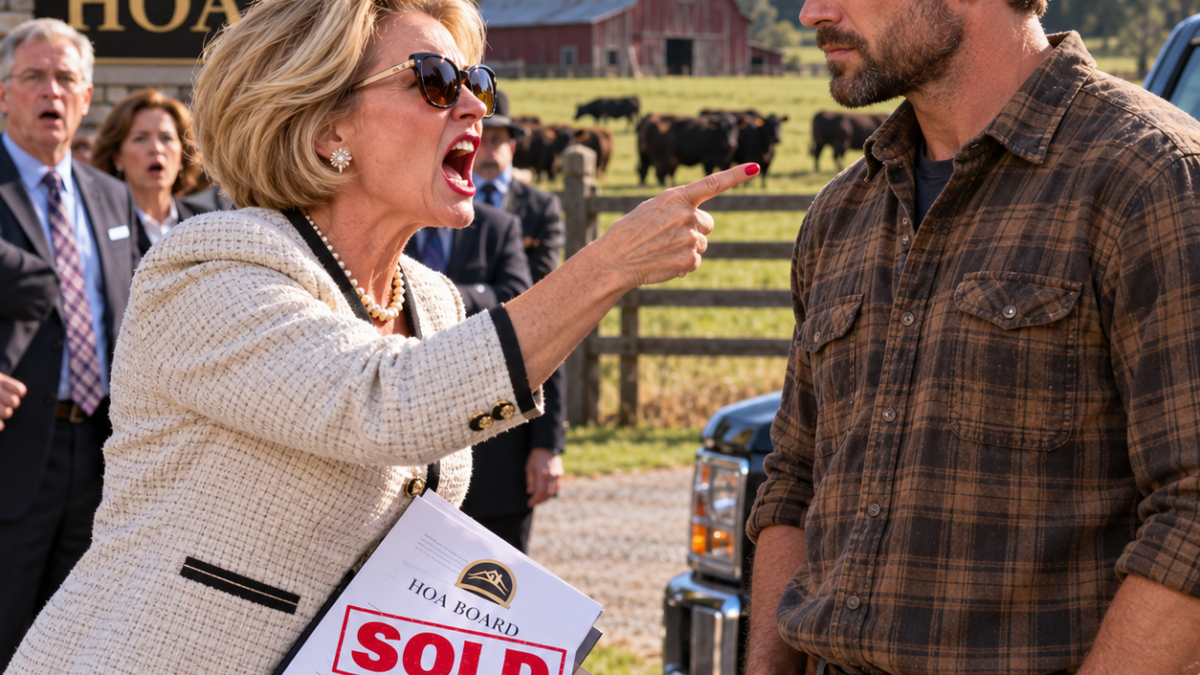
A view of my pasture she had complained about since the day she became HOA president.
I said:
“There are cattle standing behind you.”
She glanced toward them.
“And they stink.”
“Cattle do that.”
“So does your manure pile.”
“It’s a farm.”
“Yes.”
Her smile sharpened.
“That’s the problem.”
I stepped closer to the gate.
“Diane, what exactly are you telling me?”
She seemed to enjoy the question.
“The HOA declared the property abandoned.”
“The county recognized the nuisance status.”
“A delinquency proceeding followed.”
“And Tyson Ridge Development purchased the property.”
PART3:
For a second, none of those words belonged together.
HOA.
Abandoned.
Delinquency.
Purchased.
My brain rejected the sequence the way a body rejects poison.
“You sold my farm?”
She laughed.
“Technically, the county sold it.”
“Then why are you standing here telling me?”
“Because somebody needs to explain reality.”
She looked at my boots.
Mud dried along the soles.
I had spent six weeks helping my seventy-four-year-old aunt Pearl recover from hip surgery outside Bowling Green.
That morning I had loaded my bags, kissed her forehead, endured thirty minutes of her insisting she could “run circles around me now,” and driven south believing I was coming home to cattle, bills, fencing, and maybe three days of sleep.
Instead, two surveyors from Tyson Ridge Development had been driving stakes into my south pasture.
A notice was taped to my gate.
PROPERTY TRANSFERRED.
FORMER OCCUPANT TO VACATE.
Seventy-two hours.
Diane tilted her head.
“You really should have paid more attention.”
“To what?”
“Your mail.”
“My taxes are paid.”
“Apparently not.”
I looked at her.
She smiled again.
That was the moment I understood something was wrong.
Not merely unfair.
Wrong.
I knew my taxes were paid because I had written the check myself from Aunt Pearl’s kitchen table.
Thirty-eight hundred dollars.
Williamson County Trustee.
I remembered tearing the check from the book.
Remembered the envelope.
Remembered my aunt telling me the county charged too much because “half those people couldn’t find a cow in a barn.”
I remembered putting it in the outgoing mail box at the end of her driveway.
Diane said:
“You should walk away.”
I kept looking at her.
“This land has been in my family sixty-two years.”
“Was.”
She emphasized it.
“Past tense.”
Then she gave me the sentence that probably changed her life more than mine.
“You’re nobody, Eli.”
“A farmer in muddy boots who doesn’t understand zoning law, county procedure, or what happens when government paperwork starts moving.”
I did not say anything.
She mistook silence for defeat.
“Men like you don’t fight back.”
She got into her Range Rover.
The tires rolled over my gravel.
Her little Pomeranian, Chanel, sat in the passenger seat wearing a pink harness.
Diane drove away.
I stood beside the gate until the sound of her engine disappeared.
Then I looked across the farm.
Two hundred forty acres in Williamson County.
Rolling pasture.
Hardwood ridge.
Creek bottom.
One old barn.
One newer equipment shed.
One farmhouse that had been repaired, patched, repainted, and refinanced so many times no two walls seemed to remember the same decade.
My grandfather, Herschel Mercer, bought the property in 1961.
He had spent twelve years driving a feed-company truck before he had enough money for the down payment.
My father used to tell me that Grandpa walked the high ridge above the south pasture before buying it.
He stood there looking west toward the Harpeth River Valley and said:
“This is where I want to die.”
He did not die there.
Heart failure took him in a hospital in Nashville thirty years later.
But for most of his life, he woke before sunrise and worked that ground as if he expected the land to remember whether he showed up.
He cleared cedar.
Set fence posts.
Dug drainage.
Built the original barn with rough-sawn oak.
My father Thomas took over in 1989.
He expanded the herd.
Cut hay.
Rebuilt the cattle chute twice.
He died at fifty-eight.
Stroke.
Inside the same barn.
My mother June ran the place after him.
Five feet two.
Barely one hundred twenty pounds.
Could back a thirty-two-foot livestock trailer straighter than most men who bragged about knowing how.
When people asked how she managed cattle alone, she said:
“They don’t care that I’m a woman.”
“They care that I show up.”
Pancreatic cancer took her in 2019.
Three months from diagnosis to funeral.
After she died, the farm became mine.
But there was something Diane Prescott never bothered to learn about Elijah Mercer.
I had not always been only a farmer.
I graduated from Franklin High School.
Then the University of Tennessee.
Political science.
Then Vanderbilt Law.
Property law had fascinated me from the first semester.
Not because deeds are romantic.
They are not.
But land has memory.
A deed is a story told in legal language.
Who owned.
Who transferred.
Who reserved an easement.
Who granted access.
Who mortgaged.
Who inherited.
Who made a mistake seventy years ago that suddenly matters because someone wants to build a shopping center.
After law school, I joined Caldwell Shore & Associates in Nashville.
Six years.
Title disputes.
Boundary litigation.
Easements.
Fraudulent conveyances.
Quiet-title actions.
Tax-sale challenges.
Zoning fights.
I learned county records the way farmers learn weather.
Small signs matter.
A missing signature.
A wrong address.
A legal description copied from the wrong plat.
A notice sent to someone who never lived there.
One sentence can move millions of dollars.
One missing sentence can move them back.
When Mom got sick, I took leave.
After she died, I never returned full time.
I moved home.
Renewed my Tennessee bar license every year.
Kept up my continuing education.
Handled occasional matters for old clients when Martin Shore called.
But mostly I became what I had been raised around.
Cattle.
Hay.
Fence.
Mud.
Diesel.
I liked that people nearby did not know about the law degree.
I had spent six years in rooms where everybody wanted to sound smarter than everybody else.
Cattle are refreshingly uninterested in résumés.
Diane’s biggest mistake was assuming muddy boots meant empty head.
My second-biggest advantage was that she was not working alone.
Because conspiracies are rarely as clean as people imagine.
People talk.
People text.
People leave drafts.
People use cousins.
People reuse photographs.
People think deleting an email means deleting an event.
Most important, arrogant people document themselves because they believe the document proves authority.
That night I went inside.
I did not unpack.
I opened my laptop at the kitchen table.
The farm Wi-Fi was slow enough to make legal research feel punitive, but by 9:00 p.m. I had the Williamson County register open.
At 9:17, I found the deed.
TYSON RIDGE DEVELOPMENT LLC.
Recorded May 18.
Consideration:
$195,000.
I stared at that number.
My property had been appraised privately the year before at approximately $4.1 million.
Garrett Tyson knew that.
He had offered me $2.1 million in 2021.
I told him no.
He smiled and said:
“Everything has a number.”
Apparently he had decided mine was whatever he could manufacture through process.
The deed referenced a tax sale.
I pulled the proceeding.
Delinquent tax.
Notice.
Abandonment complaint.
County inspection.
HOA resolution.
The farther I read, the calmer I became.
People assume rage makes lawyers dangerous.
It doesn’t.
Rage makes you loud.
Clarity is dangerous.
At 10:03, I found the first defect.
Notice of tax delinquency had been mailed to a post office box.
E MERCER PROPERTIES LLC.
I had never created E Mercer Properties LLC.
I had never rented that box.
The county assessor still listed my residence as 4417 Mercer Farm Road.
There was no reason tax-sale notice should have gone exclusively to a PO box I did not own.
At 10:21, I found the HOA resolution.
ADJACENT PROPERTY HAZARD ASSESSMENT.
The language was almost theatrical.
Extended absence of owner.
No visible management.
No evidence of ongoing agricultural activity.
Threat to property values.
Potential danger to neighboring residents.
I looked out my kitchen window.
A hundred cattle were asleep in the dark pasture.
No evidence of agricultural activity.
I almost laughed.
Then I saw Wayne Holt’s name.
County property inspector.
I knew the name.
Not personally.
But county work generates county names.
I searched.
Forty-one.
Eight years in the office.
Then I opened Diane’s public social-media account.
I normally dislike using personal relationships as investigative shortcuts.
But Diane documented everything.
Christmas.
Birthday.
Brunch.
Family reunion.
There was Wayne.
Arm around Diane’s shoulder.
Caption:
COUSINS SINCE DAY ONE.
I leaned back.
“Well.”
I made coffee.
At 11:15, I reviewed the inspection.
One site visit.
Fifteen minutes.
Seven photographs.
Driveway.
Dark house.
Fence post.
Barn exterior.
No attempt to enter.
No contact with me.
No contact with Cody Weaver.
No evidence the inspector had asked who was tending the cattle.
No conflict disclosure.
The photographs bothered me.
One showed a leaning fence post.
I knew the post.
It was on the north line.
I had repaired it the previous winter.
I enlarged the photo.
The wire was loose.
Freshly.
Not weathered.
Maybe coincidence.
Maybe not.
Do not outrun evidence.
That is one of the first things good litigators learn.
Suspicion is not proof.
Write down what you know.
Separate it from what you believe.
By midnight I had two columns.
FACTS.
QUESTIONS.
At 12:14, I called Cody.
He answered half asleep.
“Eli?”
“Did Diane Prescott tell you I sold the farm?”
Silence.
Then:
“Yeah.”
“How?”
“She came out.”
“When?”
“Couple weeks after you left.”
“What did she say?”
“That you sold to Tyson.”
“Anything else?”
“She showed me texts.”
My hand stopped.
“From me?”
“Yeah.”
“What number?”
“I thought it was yours.”
“Do you still have them?”
Another silence.
“Probably.”
“Cody.”
“Yeah?”
“Do not delete anything.”
He was awake now.
“What’s happening?”
“I never sold the farm.”
“What?”
“I never texted Diane.”
“Those messages were fake.”
“Jesus.”
“Screenshot everything.”
“Original thread too.”
“Send it to me.”
Cody’s breathing changed.
“I packed up because she said you told me my last check was at Tyson’s office.”
“I know.”
“I should’ve called.”
“You didn’t know.”
“I should’ve known.”
“Stop.”
I leaned over the table.
“This is not the moment to assign blame.”
“It’s the moment to preserve evidence.”
Ten minutes later, the screenshots arrived.
The messages were good.
Not perfect.
Good enough for a twenty-six-year-old ranch hand reading quickly in a pasture.
Fake number.
My first name.
Language close enough to mine.
The sale is final.
Tyson takes possession Monday.
Go ahead and clear your tools.
Final pay will be arranged.
I stared at one line.
Thanks for everything, Cody.
I had never ended a message to him that way in my life.
We usually ended texts with:
Yep.
Nope.
Gate shut?
Need mineral.
Weather coming.
Whoever created the messages understood events better than voice.
At 1:00 a.m., I opened my bank account.
The tax check had cleared.
That made no sense.
If the county marked taxes unpaid, where had the money gone?
Image of canceled check.
I downloaded it.
My original handwriting.
$3,800.
Williamson County Trustee.
Except the payee line had been altered.
Not completely.
Enough.
The endorsement on the back went to an account I did not recognize.
I sat absolutely still.
Mail redirection.
Intercepted check.
Altered payee.
Deposit.
Now we were beyond HOA arrogance.
Beyond administrative abuse.
Beyond civil title defects.
Someone had stolen my money and used the resulting delinquency to create the condition they needed.
I called Martin Shore at 1:17 in the morning.
He answered after five rings.
“If this is social, I hate you.”
“Someone stole my farm.”
Silence.
Then:
“Start over.”
I did.
By the time I finished, it was nearly two.
Martin said:
“You’re sure about the check?”
“I’m looking at the image.”
“Sure about the deed?”
“Recorded.”
“Sale amount?”
“One ninety-five.”
Another silence.
Then Martin laughed once.
Not because it was funny.
Because lawyers sometimes laugh when facts become absurd enough to feel offensive.
“Eli.”
“Yeah?”
“This is either one of the ugliest coordinated property-fraud schemes I’ve ever heard or the dumbest.”
“I’m leaning dumb.”
“Don’t.”
“What?”
“Don’t assume.”
I smiled.
He had trained me.
“Evidence.”
“Exactly.”
“I’ll be in Franklin by eight.”
“Sleep.”
“No.”
“Then at least stop calling people until morning.”
“Why?”
“Because furious witnesses contaminate themselves.”
He was right.
I closed the laptop at 2:06.
Did not sleep.
At sunrise, I walked the ridge.
Same view Grandpa had loved.
Morning fog along creek bottom.
Cattle moving slowly toward water.
For the first time since coming home, I felt fear.
Not of losing the lawsuit.
Of losing time.
Developers move quickly once paper says they own something.
Clearing.
Grading.
Financing.
Third-party contracts.
Construction liens.
The longer false title exists, the more people become attached to it.
At 7:42, three Tyson trucks turned toward my gate.
I locked it.
Garrett Tyson got out of the first one.
Fifty-two.
Tan sport coat.
Expensive boots with no dirt on them.
He had the relaxed confidence of a man who believed a recorded deed ended every argument.
“Eli.”
“Garrett.”
“You’re trespassing.”
I almost admired the sentence.
“On my grandfather’s farm?”
“On Tyson Ridge property.”
“Your deed is being challenged.”
He smiled.
“By who?”
“Me.”
“You’re a cattleman.”
“Among other things.”
His project manager stepped out.
Two survey crews waited behind them.
Garrett pointed at the gate.
“We own this.”
“No.”
“The county sold it.”
“The sale is void.”
“That’s not your call.”
“You’re right.”
“It’ll be the chancery court’s.”
He studied me.
“What are you talking about?”
I reached into the truck.
Pulled out a business card I had not used in years.
ELIJAH T. MERCER, ESQ.
Caldwell Shore & Associates was still printed beneath my name.
Old card.
Still accurate enough.
Garrett took it.
His face changed almost imperceptibly.
“You’re a lawyer?”
“Licensed Tennessee attorney.”
“What kind?”
“Real-estate litigation.”
He looked toward the card again.
I continued:
“Title disputes.”
“Tax-sale challenges.”
“Fraudulent conveyances.”
“Easements.”
“Quiet-title litigation.”
His project manager looked away.
Garrett’s smile disappeared.
I said:
“You purchased a four-million-dollar farm for one hundred ninety-five thousand dollars through a sale created by an intercepted tax payment, defective notice, a fraudulent abandonment process, and an HOA resolution based on false information.”
“That’s a serious accusation.”
“Yes.”
“You’d better be able to prove it.”
“I agree.”
That was the last time Garrett Tyson ever told me that.
Martin arrived at eight-thirty.
Gray Mercedes.
Gray suit.
Gray hair.
Sixty-three years old.
He stepped onto the gravel, looked at my barn, and said:
“You left Nashville for this?”
“Yes.”
He looked toward ridge.
“Actually, I understand.”
We spent the morning at the courthouse.
The clerk recognized me.
She looked from my flannel shirt to Martin’s suit.
“Eli Mercer.”
“Morning, Donna.”
“I thought you quit law.”
“So did I.”
“What happened?”
“Someone made me nostalgic.”
We pulled everything.
Tax records.
Trustee records.
Sale documents.
Published notice.
Mailing certificates.
Inspection logs.
HOA submissions.
Wayne’s photographs.
Recorded deed.
Then the board minutes.
Three votes for Diane’s resolution.
One against.
One abstention.
Tom Krauss had voted no.
I called him.
He answered immediately.
“Eli?”
“You knew?”
“I knew Diane was trying something.”
“Why didn’t you call me?”
“I didn’t have your number.”
“You could’ve found it.”
He went quiet.
“You’re right.”
That mattered.
People like to turn wrongdoing into one villain and everybody else into helpless bystanders.
Real harm usually needs smaller failures.
Tom had objected.
But he had not pushed.
Sandra had abstained.
But she had not demanded proof.
Three board members voted yes because Diane spoke confidently and they wanted the meeting to end.
Nobody asked enough questions.
Tom said:
“She claimed she had tried contacting you.”
“That’s false.”
“She said county code enforcement had already indicated concern.”
“Also false at that time.”
“She showed pictures.”
“Of my driveway?”
“And fence.”
“Any cattle?”
“No.”
“Hay?”
“No.”
“Cody?”
“No.”
“Did she disclose Wayne Holt was her cousin?”
“Who?”
Exactly.
By afternoon, Martin had enough for emergency relief.
Quiet-title action.
Temporary restraining request.
Lis pendens.
Notice to Tyson Ridge and lender.
We did not ask the judge to decide every issue instantly.
We asked the court to stop changes to the property until title could be examined.
That is what careful law looks like.
Not speeches.
Freeze the damage.
Preserve the record.
Then prove.
The order came the next morning.
No construction.
No conveyance.
No encumbrance.
No demolition.
No material alteration.
Garrett’s crews stopped.
By noon Diane drove through my gate.
Uninvited.
Again.
White blazer.
Dark jeans.
Clipboard.
Her hands were shaking.
That was new.
“Mr. Mercer.”
“Diane.”
“I think there has been a misunderstanding.”
“No.”
“We should mediate.”
“No.”
“The HOA is willing to discuss—”
“Stop talking.”
She actually stopped.
I had never seen anyone surprise her with a boundary.
“You told your board my property was abandoned.”
She opened her mouth.
“I have the minutes.”
Closed it.
“You fabricated text messages to get Cody off the property.”
“I did not—”
“We have the messages.”
Her throat moved.
“You submitted misleading photographs.”
“You used your board’s resolution to support a county complaint.”
“Your cousin performed the inspection.”
Her face changed.
“You never disclosed the relationship.”
“I don’t control county—”
“A forged change-of-address request redirected my mail.”
Her fingers tightened around the clipboard.
“My tax check was intercepted.”
“Altered.”
“Deposited somewhere other than the trustee’s office.”
“I don’t know anything about that.”
“Good.”
I nodded.
“Then your attorney can explain why the PO box is tied to E Mercer Properties LLC, an entity I never formed.”
Diane’s lips parted.
That was the first moment I knew.
Not proved.
Knew.
Her reaction.
Again:
Suspicion is not evidence.
But bodies sometimes testify before mouths.
I continued.
“You were right about one thing.”
She stared.
“I am a farmer.”
Her eyes moved toward the barn.
“My grandfather was a farmer.”
“My father.”
“My mother.”
“I’m proud of that.”
I took one step closer.
“But you made one assumption that is going to be expensive.”
She said nothing.
“I graduated from Vanderbilt Law.”
“Practiced property litigation for six years.”
“I’ve spent more time challenging bad deeds than you’ve spent writing grass-height violations.”
Her face lost color.
“Right now your HOA resolution is an exhibit in a quiet-title action.”
“The county is reviewing the inspection.”
“The bank is tracing my altered tax check.”
“And I’m making a referral concerning the mail redirection.”
Her voice came smaller.
“You’re threatening me.”
“No.”
“Threats are about future leverage.”
“I’m explaining what has already happened.”
Diane looked toward the pasture.
For the first time since I met her, she seemed to notice it as land rather than scenery.
“I want my lawyer.”
“Yes.”
“That is the smartest thing you’ve said to me.”
She left.
She missed the Range Rover handle on the first try.
I watched her sit behind the wheel for almost a minute.
Then drive away.
She did not check her reflection.
Two days later, the county suspended Wayne Holt pending review.
They found something Martin had suspected from the photographs.
Wayne claimed two inspections.
Thirty-three days apart.
The same seven photographs appeared in both reports.
Identical clouds.
Identical shadows.
Identical cattle in the distant background of one cropped image.
The second visit did not happen.
Wayne had backdated paperwork to satisfy the appearance of procedure.
Then came the conflict.
First cousins.
Undisclosed.
Then phone records showed fourteen calls between Diane and Wayne during the relevant month.
Then text messages.
Nothing dramatically criminal on their face.
But enough to show coordination.
She wrote:
Need the second inspection wrapped this week.
He replied:
I know.
Another:
Tyson is getting impatient.
Another:
Don’t overcomplicate it.
Wayne answered:
I’ve got it.
Wayne’s attorney later tried to argue he believed the property truly had been abandoned.
The problem was cattle.
You can argue an empty farmhouse.
You can argue temporary absence.
You cannot stand beside one hundred plus registered cattle, hay inventory, functioning agricultural equipment, and maintained fencing and honestly conclude nobody is operating the property without asking at least one additional question.
The bank trace on my check was worse.
The deposit led to an account controlled by Diane.
Not Garrett.
Not Wayne.
Diane.
That gave investigators a direct financial act.
Then postal inspectors obtained records for the PO box.
Application signed:
E. Mercer.
My name.
Not my signature.
Surveillance footage from the post office was limited, but the clerk remembered the applicant because she had worn “huge sunglasses indoors” and argued about identification.
Diane had used documents linked to the LLC.
The LLC itself had been formed online three weeks earlier.
Registered agent:
A commercial filing service.
Contact email traced to one of Diane’s old personal accounts.
Arrogance leaves fingerprints.
Cody came back to work the week after the injunction.
He drove in before sunrise.
Walked into the barn.
Put on gloves.
Started cleaning a stall.
No speech.
Around eight, he said:
“I’m sorry.”
“For what?”
“I believed her.”
“She showed you fabricated messages.”
“I still should’ve called.”
“Yes.”
He looked up.
I had surprised him.
I continued:
“You should have called.”
“So should I when your message about the sale came through.”
“I read it and didn’t ask what you meant.”
“That was my mistake.”
Cody leaned on the shovel.
“So we’re both idiots?”
“In different ways.”
That made him smile.
Accountability works better when it is specific.
He did not betray me.
He made a mistake.
I did too.
Diane had exploited both.
Those are different things.
Creekstone Ridge turned against her quickly once court filings became public.
That part bothered me.
Not because she did not deserve scrutiny.
Because many residents had tolerated her behavior for years when the targets were other people.
Trash-can fines.
Grass measurements.
Sidewalk chalk.
Petty harassment.
They called it annoying.
They joked.
They voted her back in.
Only when the conduct threatened millions in association liability did some of them discover moral clarity.
Tom Krauss came to my farm one evening carrying beer.
“I should’ve done more.”
“Yes.”
He looked surprised by the answer.
“I expected you to say it wasn’t my fault.”
“It wasn’t your scheme.”
“That doesn’t mean you did everything you could.”
Tom nodded.
“Fair.”
He told me three of the board members who voted for Diane’s abandonment resolution were willing to sign affidavits.
They admitted she had told them county officials had already confirmed the property was effectively abandoned.
She had not disclosed that I was caring for a relative.
She had not told them cattle were still being managed.
She had implied taxes were delinquent before the delinquency existed.
One board member, Steven Hall, said:
“She made it sound like the county was asking us to act.”
That was important.
Diane had not merely used the board.
She had created circular legitimacy.
She told the board the county was concerned.
Then told the county the board had formally declared a problem.
Each side saw the other side’s document and assumed somebody else had verified the underlying fact.
That is how institutional fraud often works.
Not one forged master document.
A circle of small papers validating one another.
Martin called it:
“Administrative laundering.”
I liked the phrase.
The court hearing came in July.
Chancery Court in Franklin.
Judge Margaret Callaway.
Sixty-one.
Fourteen years on the bench.
Known for reading exhibits before arguments.
That last part is terrifying if your case depends on performance.
Martin sat beside me.
Across the room:
Garrett Tyson.
His attorney Harlan Beck.
Two associates.
Diane’s separate counsel.
Diane herself was present this time.
Dark navy suit.
No sunglasses.
No clipboard.
Wayne sat behind his lawyer.
Cody waited outside with witnesses.
The courtroom did not look dramatic.
That is another thing stories get wrong.
Courtrooms where life-changing things happen often look boring.
Wood.
Fluorescent lights.
Papers.
Water pitchers.
People whispering.
The power is in the record.
Martin started with ownership.
Mercer deed.
Transfers through family.
Current appraisal.
Tax history.
Then my tax check.
Mailed on time.
Cleared.
Not received by county.
Altered.
Deposited into Diane’s account.
Then the mail-forwarding request.
Forged.
Then Cody.
He testified about the fake texts.
Diane’s visit to north pasture.
Her statement that I had sold.
His departure.
Harlan tried to make Cody look careless.
“You never called Mr. Mercer to verify?”
“No, sir.”
“So you accepted Ms. Prescott’s statement?”
“I accepted what looked like messages from my boss.”
“You could have called.”
“Yes.”
“You didn’t.”
“No.”
Harlan smiled as though he had scored something.
Cody continued:
“And she knew that was probably what I’d do.”
The smile disappeared.
Then Tom testified.
Board meeting.
Diane’s presentation.
Claims.
Vote.
Then Sandra.
Then another board member.
Three affidavits.
Martin entered the HOA resolution.
The same document Diane believed gave her power now became the cleanest map of the scheme.
Then Wayne’s reports.
Two inspections.
Same photographs.
Judge Callaway compared them.
She leaned toward one image.
“Mr. Holt.”
Wayne looked up.
“Your report says these photographs were taken thirty-three days apart.”
His attorney stood.
“Your Honor—”
“I’m reading his signed government record.”
She held both pages.
“The cloud formations are identical.”
Nobody answered.
“The same cow appears in the same position.”
Still nothing.
Then came conflict disclosure.
None.
Phone records.
Calls to Diane.
Cousin relationship.
Wayne’s attorney stopped trying to make him look meticulous.
After lunch, I testified.
Martin asked about my background.
“Occupation?”
“Farmer.”
He waited.
The judge looked at him.
Martin smiled.
“Anything else?”
“I’m licensed to practice law in Tennessee.”
Diane looked straight ahead.
“Prior employment?”
“Caldwell Shore & Associates.”
“Practice area?”
“Real-estate litigation.”
“How long?”
“Six years.”
“Experience challenging tax sales?”
“Yes.”
“Title disputes?”
“Yes.”
“Fraudulent conveyance?”
“Yes.”
“Quiet title?”
“Yes.”
Martin said:
“So when you returned to the farm and found the recorded deed, what did you do?”
“I read it.”
A few people smiled.
“What did you find?”
Then I walked the court through the timeline.
Not theatrically.
No speeches at Diane.
No revenge.
Lawyers who make themselves the star often hurt their own case.
Dates.
Documents.
Missing notice.
False mailing address.
Intercepted check.
Abandonment complaint.
Inspection defects.
Board resolution.
Tax-sale petition.
Sale price.
Tyson’s prior offer.
Then Martin asked:
“Did you ever abandon the Mercer farm?”
“No.”
“Did you ever intend to?”
“No.”
“Were cattle continuously present?”
“Yes.”
“Was the operation active?”
“Yes.”
“Was Mr. Weaver employed to maintain it while you were gone?”
“Yes.”
“Why were you away?”
“My aunt broke her hip.”
“How long?”
“Six weeks.”
“Did you sell the property?”
“No.”
“Authorize anyone to redirect your mail?”
“No.”
“Form E Mercer Properties?”
“No.”
“Authorize Ms. Prescott to act for you?”
“No.”
“Authorize the HOA?”
“No.”
“Authorize Mr. Tyson?”
“No.”
Martin sat.
Harlan stood for cross.
He wanted to make the case about carelessness.
No chip—wrong story.
That was Otis.
Wrong universe.
Here, he wanted to make it about absence.
“You left the property for six weeks.”
“Yes.”
“You were not physically present.”
“Correct.”
“Your ranch hand left.”
“After being shown fabricated messages.”
“Still, nobody lived in the farmhouse.”
“For several weeks.”
“Would you agree the property appeared unoccupied?”
“The residence appeared unoccupied.”
“Is that not abandonment?”
“No.”
He paused.
“Because?”
“Ownership does not evaporate when someone visits an injured relative.”
A few people looked down to hide smiles.
Judge Callaway did not.
Harlan continued.
“Your tax account became delinquent.”
“Because my payment was intercepted.”
“Nevertheless, county records showed delinquency.”
“After someone stole the payment.”
“Mr. Mercer—”
“You asked.”
Judge Callaway said:
“He answered.”
Harlan changed direction.
He asked whether I had rejected a prior offer from Tyson.
“Yes.”
“How much?”
“Approximately $2.1 million.”
“And you refused.”
“Yes.”
“Is it possible the later sale merely reflected distressed tax-sale conditions?”
I looked at him.
“For a 240-acre Williamson County farm valued around four million?”
“Possible?”
“Anything is possible.”
“Reasonable?”
“No.”
He sat ten minutes later.
Then came the check.
Bank records.
Diane’s account.
Her attorney objected to how some records were being used in the civil hearing.
Some objections were sustained.
Some denied.
That mattered.
Good judges do not become avenging characters because one side seems awful.
Rules still apply.
Finally Judge Callaway asked Tyson’s attorney:
“Does your client contend he was unaware of the abandonment strategy before the sale?”
Harlan stood slowly.
“My client contends he relied upon county records.”
“Did he fund the HOA infrastructure account?”
“Yes.”
“Five thousand dollars?”
“Yes.”
“Did he communicate with Ms. Prescott concerning the Mercer property before the abandonment complaint?”
Pause.
“Yes.”
“How often?”
“I would need to review—”
“I have the exhibit.”
She looked down.
“Forty-one text messages in six weeks.”
Harlan’s shoulders changed.
Judge Callaway said:
“Would your client like to maintain that his only involvement began at the auction?”
Harlan looked at Garrett.
Garrett looked down.
“Your Honor, my client is prepared to consent to rescission.”
Judge Callaway’s eyes lifted.
“Rescission is not a favor you are offering the court.”
Silence.
“The question is whether the tax sale is legally sustainable.”
No answer.
“It is not.”
I did not breathe.
She continued.
“The notice process was defective.”
“The underlying mailing address was compromised.”
“The abandonment record is unreliable.”
“The inspection process is materially deficient.”
“There is substantial evidence that the owner remained in continuous possession through active agricultural use, notwithstanding temporary physical absence.”
“The deed arising from the tax sale is therefore void.”
I closed my eyes.
One second.
That was all.
Martin touched my arm.
Title restored.
Not because I gave a speech.
Because documents failed.
Because fraud is unstable once someone forces every piece into the same light.
Then Judge Callaway looked toward Diane.
“The court will separately preserve all evidence relevant to potential civil damages and criminal investigation.”
Diane’s expression did not change.
She had learned not to perform.
Outside the courthouse, reporters waited.
I did not talk.
Garrett’s attorney did.
He called the matter:
“A procedural misunderstanding.”
Martin heard him.
He laughed.
“Eli.”
“Yeah?”
“If that’s a misunderstanding, arson is aggressive heating.”
I laughed for the first time in weeks.
The farm was mine again.
Legally.
But consequences were not finished.
Wayne Holt lost his county job after the internal investigation confirmed falsified reports and undisclosed conflict.
I will not pretend I celebrated every personal consequence that followed him.
People told me about his marriage.
His money.
His pension dispute.
I did not care.
The relevant consequence was professional.
He had been trusted to document facts.
He documented fiction.
He lost the job that required trust.
Diane faced both state and federal investigations.
The forged mail-forwarding application was not a cute HOA trick.
Neither was intercepting and altering a tax check.
Her attorney eventually negotiated a plea.
The exact legal counts shifted through the process.
What mattered was that she admitted conduct involving fraudulent redirection of mail, misuse of my tax payment, and false documentation connected to the property scheme.
She received prison time.
Supervised release.
Restitution.
The civil case hurt more financially.
Legal fees.
Lost farm income during the dispute.
Costs tied to interrupted contracts.
Punitive damages.
Her house became part of satisfying the judgment.
There is a version of this story where I say I danced when I heard.
I did not.
I sat at my kitchen table.
Marla—because of course Marla had become part of another story in another universe, ignore that.
No.
This story was mine.
Cody sat across from me with a sandwich.
We read the notice.
Then he said:
“You going to buy it?”
I looked at him.
“Buy what?”
“Her house.”
I laughed.
Then realized he was serious.
“Why would I want Diane’s house?”
“Office.”
“We have an office.”
“We have a desk in the barn.”
“That is an office.”
“Your chair has a cracked seat.”
“It builds character.”
Cody chewed.
“Three-car garage.”
That got my attention.
Diane’s house eventually went to auction.
I bought it through a separate entity after counsel confirmed there was no conflict in the process.
Not for revenge.
Mostly.
The three-car garage became the farm office.
One bay for records.
One for tools.
One for veterinary supplies and small equipment.
The great room became a meeting area.
The kitchen became a break room.
Cody began eating lunch every day at the Italian marble island Diane had once used for carefully staged photographs.
The first day, he unwrapped a ham sandwich.
Looked at the marble.
Then at me.
“You think this needs a placemat?”
“No.”
“Good.”
He put mustard directly on the countertop by accident.
We both stared.
Then laughed until it hurt.
Creekstone Ridge held a special HOA election.
Diane was removed overwhelmingly.
David Park, a retired schoolteacher, became president.
His campaign promises were simple.
Stop harassing neighbors.
Stop inventing committees.
Follow the bylaws.
Apparently moderation can be revolutionary.
David visited the farm a week after taking over.
He brought the HOA’s records.
“I want you to know the association is not claiming anything against your property.”
“It never had anything.”
“I know.”
“We’re putting that in writing anyway.”
“Good.”
He looked toward the pasture.
“I’m sorry.”
“You didn’t do it.”
“I lived there.”
“That isn’t the same.”
“I watched it happen.”
Closer.
David nodded.
“We should’ve stopped her sooner.”
“Yes.”
He accepted it.
That became something I respected about him.
No automatic excuse.
No theatrical guilt.
Just:
Yes.
We should have.
The HOA formally rescinded the abandonment resolution.
Not because the resolution had ever transferred ownership.
It had not.
But symbols matter when symbols are used as weapons.
They held the vote in Diane’s former great room.
Now my meeting room.
I sat in back.
Tom Krauss read the new resolution.
The association acknowledged the farm had never been abandoned.
Acknowledged prior statements were unsupported.
Acknowledged the Mercer farm predated Creekstone Ridge by decades.
Acknowledged agricultural operations were lawful neighboring use.
Then David asked if I wanted to say anything.
I stood.
Looked around at residents.
Some had supported Diane.
Some had hated her.
Some had barely paid attention until the scandal.
I said:
“I don’t want an apology every time a cow makes noise.”
A few people laughed.
“I don’t want special treatment.”
“I don’t want the HOA afraid of me.”
“I want everyone here to understand one thing.”
I pointed through the windows toward the pasture.
“That farm is not an empty view between houses.”
“It is not undeveloped space waiting for someone richer to discover a better use.”
“It is work.”
“History.”
“Food.”
“People.”
“And property.”
“You do not have to like the smell.”
“You do not have to like tractors at seven in the morning.”
“But you do have to understand the subdivision moved next to a farm.”
“The farm did not move next to you.”
That got applause.
I waited until it stopped.
Then:
“And one more thing.”
“If somebody in authority tells you something serious about another person, ask what they actually verified.”
“Do not let confidence substitute for evidence.”
“That is how this started.”
Not with a deed.
Not with a forged check.
With a room full of people hearing one confident person say:
Trust me.
Three people voted yes.
That vote became a letter.
The letter became a complaint.
The complaint became an inspection.
The inspection became a record.
The record became a tax-sale narrative.
By the time anyone asked whether the first statement was true, my farm had a new deed.
That is the part that stayed with me.
People imagine injustice arriving like a bulldozer.
Sometimes it arrives like paperwork.
Cream-colored.
Neatly stapled.
Signed by people who assume somebody else checked.
A year after the case ended, I repaired my grandfather’s barn.
Not replaced.
Repaired.
New tin roof.
Reinforced posts.
Fresh siding where needed.
The original rough-sawn oak stayed.
Some things you do not tear down merely because they are old.
You strengthen them.
Cody became farm manager.
I started taking occasional legal cases again.
Very occasional.
Mostly landowners.
Farmers.
Families facing title problems.
One man drove two hours from East Tennessee because a utility company had claimed an easement wider than his deed allowed.
Another woman inherited forty acres from her father and discovered a neighbor had been using a road across it for thirty years.
I helped where I could.
Then went back to cattle.
Martin loved making fun of me.
“You’re practicing law.”
“No.”
“You filed a complaint last week.”
“Temporary relapse.”
“You billed someone.”
“I had expenses.”
“You attended court.”
“Against my will.”
“You renewed malpractice insurance.”
I paused.
“That proves nothing.”
He laughed.
The truth was I had changed.
Before Diane, I thought leaving litigation meant choosing farming.
One identity.
One life.
The whole experience reminded me my mother had been right.
Cattle do not care what you call yourself.
They care that you show up.
Maybe people are not that different.
Farmer.
Lawyer.
Son.
Employer.
Neighbor.
You can be more than one thing without betraying the others.
Years after the case, I still walked the ridge most mornings.
Coffee.
Boots.
Sun coming over Creekstone roofs.
Some residents waved now.
Some did not.
The cattle did not care.
One October morning, I found an old piece of cream paper in a storage box from the lawsuit.
Diane’s HOA resolution.
ADJACENT PROPERTY HAZARD ASSESSMENT.
I read it once.
Then walked to the barn.
Cody was replacing a latch.
“What’s that?”
“History.”
“Bad history?”
“Funny history now.”
I showed him.
He read the line declaring the Mercer property “apparently abandoned.”
Then looked past me.
Cattle.
Tractor.
Hay trailer.
My truck.
Two hired hands repairing fence.
He laughed.
“Looks abandoned.”
“Tragic.”
“What are you doing with it?”
For a second I thought about framing it.
Like the old complaint about “repetitive bovine vocalization.”
Then I folded it.
Put it into a file marked MERCER FARM — TITLE.
Because even ridiculous documents deserve preservation when they teach something useful.
Later that afternoon, I drove past Diane’s old house.
Our farm office now.
Landscape lights came on automatically.
Purple for fall.
Cody hated them.
I kept them.
He said:
“They make us look like a wedding venue.”
“They make me happy.”
“That is not a business reason.”
“I own the business.”
“Sounds like something Diane would say.”
I stopped the truck.
He realized what he had done.
“Oh no.”
I stared.
“Get out.”
He laughed.
“Eli—”
“Walk.”
We were half a mile from the barn.
He laughed harder.
I drove away slowly enough that he could climb into the truck bed.
Somewhere along that road, I thought about the first day Diane visited the farm.
White pants.
Designer sandals.
Disgust on her face.
She believed land value came from what a developer could build after removing everything that existed.
My grandfather would not have understood people like that.
He thought value was simpler.
Good water.
Good soil.
A roof that did not leak.
Cattle that gained weight.
Fence that held.
Family who came home.
Diane looked at two hundred forty acres and saw phase two.
Garrett Tyson saw seventy lots.
I saw my father’s chute.
My mother’s kitchen window.
My grandfather’s ridge.
That did not make me morally superior.
Sentiment can make people foolish too.
But property rights exist partly because different people value the same land differently.
The person with more money does not automatically get the last word.
Neither does the prettier rendering.
Neither does the louder HOA president.
A deed is not a suggestion.
Notice is not optional.
Government procedure is not theater.
And absence is not abandonment simply because somebody wants what you own.
Diane never understood that until a judge explained it with orders she could not ignore.
The last time I saw her was not dramatic.
No courtroom.
No police.
No designer clothes.
Several months after her release, I was buying fencing staples at a hardware store in Franklin.
I turned down an aisle.
She was there.
Jeans.
Gray sweater.
Hair shorter.
No Chanel sunglasses.
No Range Rover.
She saw me.
Stopped.
I expected anger.
Maybe shame.
Maybe some last insult.
She said:
“Eli.”
“Diane.”
Silence.
Then:
“I was wrong.”
It was the first apology I had ever heard from her that did not contain the word misunderstanding.
I waited.
She continued.
“I kept telling myself the farm was wasted.”
“That the subdivision would be worth more.”
“That everybody would benefit.”
I said:
“You stole my tax payment.”
Her face tightened.
“I know.”
“You forged things.”
“I know.”
“You used your cousin.”
“I know.”
“You nearly destroyed Cody’s livelihood.”
“I know.”
“And you told yourself it was development?”
She looked at the floor.
“No.”
“What did you tell yourself?”
For a long time she said nothing.
Then:
“That you couldn’t stop me.”
There it was.
Cleaner than any apology.
Not aesthetics.
Not cows.
Not property values.
Power.
She believed I could not stop her.
I nodded.
“That was your mistake.”
“Yes.”
Another silence.
Then she said:
“I’m sorry.”
I looked at her.
I believed she meant it.
That did not undo anything.
Forgiveness is not a receipt people earn by saying the correct sentence.
“I hope you do better.”
She nodded.
“So do I.”
We walked in opposite directions.
No collapse.
No final humiliation.
No cheering crowd.
I preferred it that way.
The consequences had already happened where consequences belonged.
Court.
Licensing.
Employment.
Money.
Freedom.
I did not need her destroyed every day forever.
I needed my farm back.
I got it.
I needed the fraudulent deed voided.
It was.
I needed the people who abused public processes held accountable.
They were.
Everything beyond that belonged to their lives.
Not mine.
These days, when people hear the story, they usually focus on the reveal.
“She didn’t know you were a lawyer?”
“No.”
“That must have been amazing.”
It was satisfying.
For about twelve seconds.
But that was never the most important part.
Suppose I had not been a lawyer.
Would Diane have been more entitled to steal the farm?
Of course not.
Suppose I never attended Vanderbilt.
Suppose I could barely read a deed.
Suppose I had spent my entire life repairing fences and raising cattle.
The fraud would still have been fraud.
The farm would still have been mine.
That is the lesson I care about now.
Competence helps you defend rights.
It does not create them.
Diane’s real mistake was not underestimating my education.
It was believing a person’s dignity, intelligence, and ability to fight could be measured by clothes, occupation, accent, or mud on his boots.
She saw:
Farmer.
She decided:
Easy.
She saw:
Temporary absence.
She decided:
Abandoned.
She saw:
HOA president.
She decided:
Authority.
She saw:
Paper.
She decided:
Truth.
Every step was an assumption.
And when enough untested assumptions were stacked together, they became a crime with a file number.
My grandfather used to say fences are not built to insult the neighbor.
They are built so everybody knows where responsibility begins and ends.
Law is like that.
Boundaries.
Notice.
Process.
Ownership.
Authority.
Not perfect.
Not always fair.
But necessary.
The morning after I met Diane in that hardware store, I walked the ridge before sunrise.
Fog sat in the valley.
Creekstone Ridge glowed behind me.
My cattle were moving below.
The original barn roof caught first light.
I thought about Grandpa.
Dad.
Mom.
Cody.
Martin.
Tom.
Even Diane.
All the people who had touched that land for good or bad.
Then I remembered the sentence she had supposedly used at that HOA meeting.
“He’s just a farmer.”
Followed by:
“What’s he going to do?”
I smiled.
Not because I had beaten her.
Because the answer had never required anything dramatic.
I did what my family had always done when something threatened the farm.
I showed up.
I checked the fence.
I read the paper.
I followed the trail.
And I refused to leave.
That was all.
Sometimes that is enough to make people who thought you were powerless discover how badly they misunderstood you.

