HOA Karen Called My Family’s Water Tank an Eyesore—Then She Filled It With Concrete and 142 Homes Went Dry
PART3:
Not much.
Enough to offset pump electricity and maintenance.
The agreement included permanent access easements for the tank, pump house, and buried lines.
It specifically exempted our system from HOA aesthetic control.
Dad’s attorney made sure of that.
Dad signed.
Quinn signed.
The county recorded everything.
For twenty years, it worked.
Lone Star Bluffs grew into 142 houses.
Nice houses.
Most people living there were decent.
They worked.
Raised kids.
Walked dogs.
Complained about taxes.
Borrowed tools and forgot to return them.
Normal neighbors.
Most never thought about our tank.
Why would they?
People think about water only when water stops.
They turned sprinkler systems on.
Grass stayed green.
The community pool maintained level.
The clubhouse passed fire inspections.
During drought years, our supplemental system reduced pressure on the municipal network.
Nobody had to understand why.
The old-timers knew.
Roy Gutierrez lived next door.
Frank and Patty Odom were downhill.
Every July Patty brought peach cobbler.
“Payment for keeping us alive.”
She exaggerated.
But only a little.
The drought of 2011 nearly crushed municipal supply.
Watering limited to two days a week.
Our well kept the common areas from dying.
More important, our emergency system remained available if brush fire came through.
You learn to respect backup systems after enough bad summers.
I eventually took over maintenance completely.
Every morning before leaving for work, I checked the tank.
Pressure.
Pump noise.
Filter housing.
Leaks.
Water level.
I recorded readings in the same paper log Dad used.
People made fun of the notebook.
“Why not an app?”
Because notebooks do not need software updates.
And if my grandfather could maintain a well for decades with pencil, I could survive another fifteen seconds without Bluetooth.
Then Debbie Prescott moved in.
Spring of 2023.
Twenty-nine years old.
White Porsche Cayenne.
Personalized plates.
Honey-blonde hair that looked professionally wind-resistant.
Designer clothes.
Designer sunglasses.
Designer workout clothes for workouts she apparently documented more than completed.
I later learned she had worked in Dallas as a lifestyle brand strategist.
I still do not know exactly what that means.
Roy said:
“It means she gets paid to tell people beige is inspirational.”
Close enough.
Debbie announced at her first neighborhood mixer that she had moved to the Hill Country for a more authentic lifestyle.
She said that while standing underneath imported string lights drinking rosé from Provence.
Within six months, she ran for HOA president.
Her campaign slogan was:
ELEVATE THE BLUFFS.
Nobody else really wanted the job.
That matters.
HOAs rarely get taken over by masterminds.
Usually ordinary people become tired.
Nobody volunteers.
Then the person with the most energy, strongest opinions, and weakest understanding of boundaries ends up holding the clipboard.
Debbie won by eleven votes.
At first, she was annoying.
Not dangerous.
Mailbox color standards.
Approved front-door palette.
Rules about visible trash cans.
A “visual harmony initiative” that somehow required everyone to remove ceramic frogs.
Frank Odom had owned the same ceramic frog since 1998.
He took its removal personally.
He kept it in his garage afterward.
Called it “the exile.”
Still, none of that mattered.
Then Debbie noticed the tank.
Saturday morning.
I was cleaning the pump house.
White Porsche stopped near my fence.
Debbie stepped out wearing cream linen, high-waisted trousers, and red-soled heels.
She carried a monogrammed clipboard.
I am not joking.
The clipboard had her initials.
She also had a rose-gold measuring tape.
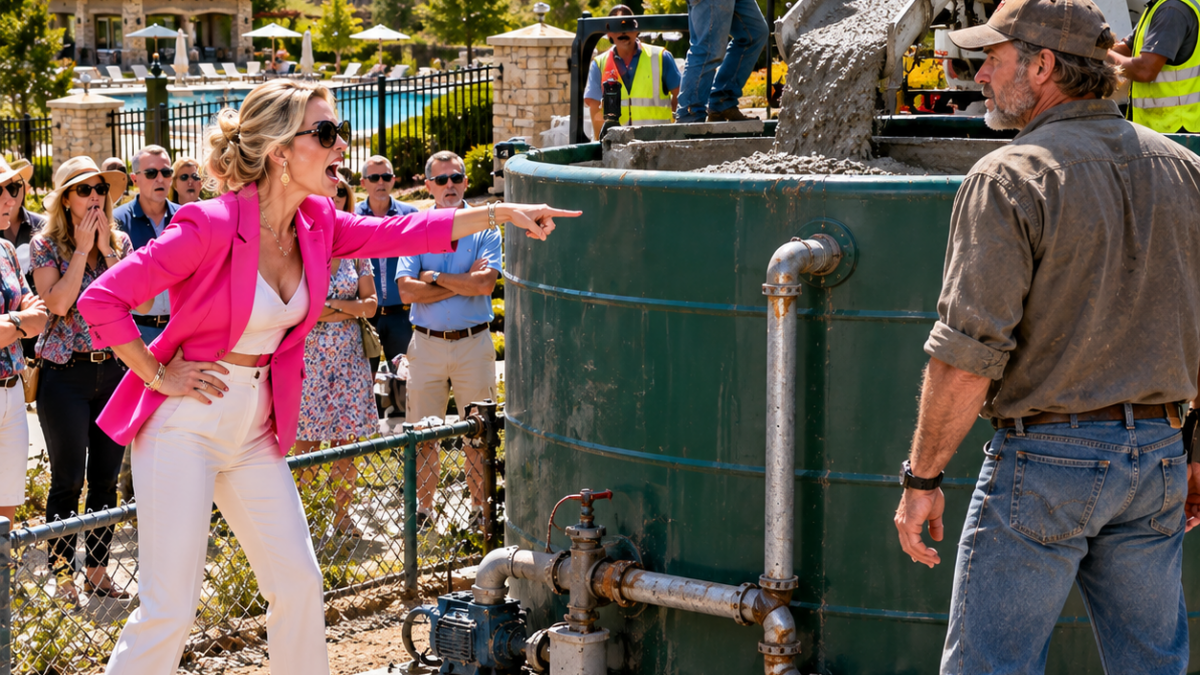
She stared at the green steel tank.
Not curious.
Offended.
“That thing is hideous.”
No hello.
No introduction.
I wiped my hands.
“Morning.”
She wrote something.
“What exactly is it?”
“A water tank.”
“I know it’s a tank.”
“Then we’re doing well.”
She finally looked at me.
“I’m Debbie Prescott.”
“I know.”
“HOA president.”
“I’ve heard.”
Her expression said she was accustomed to people being more impressed.
She pointed toward the tank.
“It needs to come down.”
“No.”
She blinked.
“At minimum, it needs architectural screening.”
“No.”
“Repainting.”
“No.”
“Landscape concealment.”
“Already green.”
“That green is dated.”
I looked at the tank.
“What year does green become outdated?”
She ignored that.
“It conflicts with the community’s visual identity.”
“This system predates the community by thirty-two years.”
“Everything within the neighborhood is subject to HOA standards.”
“My property isn’t.”
“Your property is surrounded by Lone Star Bluffs.”
“Geography does not create membership.”
She sighed.
The way people sigh when they believe reality is being difficult intentionally.
“I’ll send paperwork.”
“Send the development agreement first.”
“What development agreement?”
That was my first warning.
The president of an HOA whose common infrastructure depended on a private water agreement did not know the agreement existed.
I explained.
Our family tank.
Supplemental system.
Fire suppression.
Easements.
HOA payment.
She looked through her sunglasses at the green tank.
Then back at me.
“I’ll have our legal people review it.”
Good.
I thought that would be the end.
That was mistake number one.
The first violation letter arrived Tuesday.
Pink envelope.
Scented.
Actually scented.
Peonies, I think.
The letter cited CC&R section 4.2.
Unauthorized structure.
Removal or screening required.
Daily fines possible.
I pulled our development agreement from the safe.
Section eleven.
Paragraph three.
Water storage and distribution infrastructure located on Dawson parcel shall not be subject to HOA aesthetic review, modification standards, or removal directives.
Could not have been clearer.
I copied it.
Highlighted it.
Mailed it certified.
My note:
Ms. Prescott,
Please review the attached recorded agreement. The tank is protected utility infrastructure and is not subject to HOA authority.
Respectfully,
Cole Dawson.
A week later, another pink envelope.
Same perfume.
Sticky note attached.
Easements don’t override community standards. Remove it or pay.
I stared at that sentence.
Then placed it in a file.
That was mistake number two.
I thought evidence was mainly useful if a dispute reached court.
I did not yet understand that with Debbie Prescott, evidence was going to become the only language that mattered.
The fines started.
Two hundred fifty dollars a day.
By month’s end:
$7,500.
I called the HOA management company.
The woman sounded embarrassed.
“These were approved in executive session.”
“Was my property suddenly annexed into the HOA?”
“I don’t have that information.”
“Did anybody read the recorded development agreement?”
“You can appeal.”
“I’m asking a factual question.”
Long pause.
“You may want an attorney.”
Good advice.
Sandra Reeves had represented landowners around Central Texas for thirty years.
She specialized in water and property disputes.
She was sixty-one, five foot three, and had the terrifying calm of someone who enjoyed footnotes.
I brought the papers.
She read for fifteen minutes.
Then:
“She can’t do this.”
“I know.”
“She really wrote ‘easements don’t override community standards’?”
“Yes.”
Sandra adjusted her glasses.
“I may frame that.”
She sent a cease-and-desist.
Recorded easement.
Development agreement.
Property boundaries.
Utility protections.
Void fines.
Notice of potential civil liability.
The normal stuff adults send when trying to stop another adult from doing something stupid.
Debbie responded by holding a special community meeting.
I was not invited.
Roy attended.
Called me afterward.
“You’re going to love this.”
“I doubt that.”
“She made a PowerPoint.”
Of course.
Title:
COMMUNITY WATER SAFETY CONCERNS.
Professional design.
Animated transitions.
Photographs of my tank taken with a telephoto lens.
Surface rust circled.
Debbie told more than a hundred residents the tank was old.
Unregulated.
Potentially contaminated.
Structurally questionable.
She claimed it sat on HOA common property.
Every statement either misleading or false.
But apparently she looked excellent saying it.
White sheath dress.
Perfect lighting.
People believe confidence.
Especially when confidence comes with graphics.
Forty-three residents signed a petition demanding county inspection.
Fine.
I welcomed it.
County sent Mike Salazar.
Environmental health.
Twenty-two years experience.
Work boots.
Clipboard.
No animated transitions.
He sampled water.
Four points.
Checked pump.
Sediment.
Filter.
Tank condition.
Flow.
Registration.
By afternoon:
System passed.
Water quality excellent.
Cleaner than the subdivision’s municipal sample in several categories.
Mike handed me the report.
“Your tank is ugly.”
I looked at him.
He grinned.
“Couldn’t find anything else wrong.”
“Thanks.”
Debbie never shared the report.
The residents who had signed the petition did not know their complaint had actually proven me right.
Three weeks later, I drove home from a job and found a landscaping crew inside my property.
Post-hole diggers.
Lumber.
Concrete bags.
Building a fence around the tank.
I stopped.
“Who hired you?”
Foreman wiped his forehead.
“Mrs. Prescott.”
“Debbie?”
“Said the HOA owns this utility parcel.”
“It doesn’t.”
I showed him the survey pin.
Deed map.
Easement.
“You’re on my property.”
He looked sick.
“She told us owner approved.”
“I am the owner.”
He put down the post-hole digger.
Debbie arrived twenty minutes later.
Leather ankle boots.
Silk blouse.
Porsche spraying gravel.
She got out.
“The fence stays.”
“No.”
“Board-approved improvement.”
“The board cannot authorize construction on my property.”
She turned to the foreman.
“Continue.”
I looked at him.
“If one more post goes in, I’m filing trespass and property-damage complaints.”
He took two steps backward.
Smart man.
Debbie pointed at me.
“This is not over.”
“No.”
I looked at the unfinished holes.
“Apparently not.”
Crew filled them.
Apologized.
Left.
Next came a condemnation petition.
Sixty-one signatures.
Community safety initiative.
County reviewed.
Denied in four business days.
Current permit.
Passed inspection.
Protected property right.
Closed.
That should have ended it.
Instead, it changed her.
Before that, Debbie had been trying to bend systems.
After the denial, she started ignoring them.
The access road to our pump house ran beside the subdivision.
Granddad built it.
Recorded access protected permanently.
One Monday morning, a steel chain appeared across it.
Two steel posts.
Padlock.
Laminated sign:
HOA PROPERTY.
AUTHORIZED ACCESS ONLY.
VIOLATORS TOWED.
I sat in the truck looking at it.
Then called Sandra.
She sent notice before noon.
Seventy-two hours to remove obstruction or we seek emergency injunction.
Debbie replied personally.
HOA letterhead.
She claimed the board had reclassified the road as common property and no longer recognized my easement.
Signed:
Debbie Prescott ♥
Yes.
Heart.
Sandra called me.
“She put a heart on it.”
“She does that.”
“She is trying to cancel a recorded easement with a heart.”
“Yes.”
“Cole.”
“Yes?”
“I love my job.”
The chain came down.
Posts remained another week.
Then the HOA stopped paying the six-hundred-dollar annual water fee.
Bill Muñoz, the treasurer, called.
He sounded frustrated.
“She struck it from the budget.”
“Why?”
“She says there is no valid water agreement.”
“You showed her?”
“Last year’s payment.”
“And?”
“She called it an accounting error.”
Twenty years of payments.
Apparently all one giant accident.
That night, I finally got serious.
I spent three hours documenting the entire system.
Photographs.
Serial numbers.
Pump condition.
Tank condition.
Pressure readings.
Flow tests.
Permit sticker.
Filter.
Maintenance records.
Water samples.
I photographed everything with timestamps.
If she was building a narrative that the system was abandoned or dangerous, I wanted proof of exactly what condition it was in.
Six weeks later, she destroyed it.
September 14.
I left before sunrise.
Well job outside Llano.
Sixty miles away.
Submersible pump trouble.
Big job.
At 2:13 p.m., Roy called.
His first words:
“Cole, get home.”
I stepped away from the drill rig.
“What happened?”
“Concrete truck.”
My stomach tightened.
“Where?”
“Your tank.”
“No.”
“Big mixer. They’re pouring something in.”
“What?”
“And Debbie is standing there directing them.”
I did not remember hanging up.
I told the rancher I had an emergency.
Got in the F-250.
Called the sheriff while driving.
Called Sandra.
Then I drove home.
I am not proud of the speed.
I will say only that sixty miles disappeared in forty-seven minutes.
I came around the final curve and saw the mixer.
Full-sized truck.
Drum turning.
Workers near my access hatch.
Flexible chute running into the tank.
White Porsche nearby.
I jumped out before the truck fully stopped.
“STOP!”
Workers turned.
“Stop the pour!”
One reached for the control.
Concrete slowed.
Too late.
Debbie walked toward me.
White silk blouse.
White linen pants.
White leather shoes.
She had dressed for demolition like it was a ribbon cutting.
Monogrammed clipboard.
Lip gloss.
The whole performance.
“It’s done, Mr. Dawson.”
I stared past her.
Wet concrete inside the tank.
Gray.
Heavy.
Four cubic yards.
It had filled the lower section.
Buried the intake.
Encased the pump components.
Blocked the supply.
Contaminated the well connection.
I climbed the platform.
Looked inside.
Concrete still settling.
Water displaced upward around it.
That sound.
Wet aggregate sloshing against steel.
I will remember it until I die.
Granddad built that system.
Dad maintained it.
I maintained it.
Fifty-three years.
Three generations.
Gone because one person decided steel was ugly.
Debbie called up:
“The board voted to decommission it.”
I looked down.
“What board?”
“The association.”
“You do not own this tank.”
“The system creates a safety hazard.”
“You have the county report.”
She folded her arms.
“The community has moved beyond obsolete infrastructure.”
I stared at her.
“Do you know what this tank supplies?”
Her face barely changed.
“Nothing essential.”
There it was.
The sentence that would eventually destroy her.
Nothing essential.
I climbed down.
The concrete driver approached.
“Sir, I’m sorry.”
“You knew this was active?”
“No.”
“Who hired you?”
He pointed at Debbie.
“She said she’s property owner.”
Debbie snapped:
“Do not involve my contractors.”
The driver looked at her.
“You told us abandoned cistern.”
“That’s what it is.”
I said:
“No.”
The driver looked at me.
“I would’ve never poured into a live system.”
“I believe you.”
Debbie laughed.
“It’s not live anymore.”
I turned toward her.
For the first time all day, she stopped smiling.
I did not yell.
That bothered her.
People like Debbie understand screaming.
It gives them something to answer.
Calm scares them.
I took out my phone.
Photographed the truck.
License plate.
Work order.
Chute.
Tank.
Concrete.
Workers.
Debbie.
She actually smiled for some photographs.
Muscle memory, I suppose.
Imagine posing beside your own criminal evidence because a camera appears.
I called the sheriff again.
Then Sandra.
Then forty-seven photographs.
Exactly.
I counted later.
That night, I sat at my kitchen table.
Spread out the file.
Every pink envelope.
Sticky note.
Fines.
Cease-and-desist.
Inspection report.
Development agreement.
Easement.
Blocked-road letter.
Instagram screenshot.
Maintenance logs.
Quarterly test results going back fifteen years.
The tank was gone.
The evidence wasn’t.
Sandra called.
“She filled the tank?”
“Yes.”
“With concrete?”
“Yes.”
“How much?”
“Four cubic yards.”
“Quick-set?”
“Looks like.”
“Pump?”
“Buried.”
“Intake?”
“Buried.”
“Supply?”
“Dead.”
Long silence.
Then Sandra said:
“Cole, this is bigger than property damage.”
“I know.”
“This was part of the registered utility system.”
“Yes.”
“Community supply.”
“Yes.”
“Fire suppression?”
“Yes.”
“She just crossed from HOA stupidity into criminal utility interference.”
“That’s what I figured.”
“Tomorrow you report it to every relevant authority.”
“I have a list.”
She laughed once.
“Of course you do.”
At seven the next morning, I called the county water authority.
The intake officer made me repeat it.
“She poured what?”
“Concrete.”
“Inside?”
“Yes.”
“How much?”
“Four cubic yards.”
Silence.
“In twelve years, I’ve never…”
“I know.”
At 8:15, prosecutor’s office.
Formal complaint.
Trespass.
Property destruction.
False ownership representation.
Utility interference.
The clerk asked:
“Documentation?”
I placed the binder on her desk.
She looked at its thickness.
“You were expecting this?”
“No.”
“My family has been keeping records since 1971.”
At nine, I called a local television station.
Not because I wanted fame.
Because Debbie had spent months controlling the neighborhood narrative.
If this stayed a private argument, she would tell everyone I destroyed my own system out of spite.
The station called back in eleven minutes.
At 10:30, I called Mike Salazar.
The inspector who had certified the system months earlier.
“Mike.”
“Cole.”
“You remember my tank?”
“The ugly healthy one?”
“It’s full of concrete.”
Silence.
“What?”
“Debbie hired a truck.”
“She did what?”
“System is dead.”
He swore.
Then his tone changed.
Professional.
“That feeds the clubhouse fire loop.”
“Yes.”
“I have to notify Fire Marshal Reyes.”
“I know.”
By noon, five agencies had reports.
I had not knocked on Debbie’s door.
Had not sent one angry message.
Had not threatened anybody.
People sometimes ask how I stayed calm.
I wasn’t calm.
I was furious.
But anger is energy.
You can spend it screaming.
Or use it.
Granddad taught me that fixing a well begins with diagnosing what failed.
So I treated Debbie like a failed system.
Document.
Isolate.
Measure.
Then let reality do the rest.
The consequences began that evening.
Roy’s sprinklers did not start.
Frank Odom’s line went dry.
Entrance fountain stopped.
Community pool refill alarmed.
By the next morning, the entire supplemental network was dead.
Within three days, Lone Star Bluffs started changing color.
Common medians browned.
Ornamental grasses wilted.
Plants Debbie had selected as part of her “elevated landscape palette” curled in the heat.
The pool dropped.
Automatic refill failed.
Pump began cavitating.
Then burned out.
Fourteen thousand dollars.
Pool gate locked.
Temporary municipal refill would cost hundreds monthly.
Debbie’s social-media backdrop became a dry concrete rectangle.
Then Fire Marshal Ellen Reyes inspected.
I liked Ellen immediately.
No interest in politics.
She tested.
Confirmed fire-suppression failure.
Issued notice.
Thirty days to restore code-compliant service or clubhouse closes.
That clubhouse mattered to Debbie.
Board meetings.
Wine events.
Private rentals.
Her stage.
Now her own decision threatened to padlock it.
Funny how infrastructure becomes attractive when somebody needs it.
Then came the part that stopped being funny.
June Kepler called.
“Cole?”
Her voice shook.
“What happened?”
“What do you mean?”
“Harold’s humidifier.”
Harold was eighty-one.
Home oxygen.
His system included a whole-house humidification setup partly fed from the supplemental line.
When water pressure failed, it stopped.
His oxygen became painfully dry.
He coughed through the night.
June cried.
I felt anger all over again.
Not at her.
At myself, briefly.
As if I should have somehow known and prevented it.
I drove over.
Rigged a temporary connection from their municipal service.
Helped order a portable unit.
Eleven hundred dollars.
I paid.
June argued.
I refused.
Another family had a child with severe skin problems.
Daily therapeutic baths.
Filtered supplemental water had helped.
They called the HOA.
“We’re looking into it.”
No.
They were looking for somebody else to blame.
Five days after the pour, emergency board meeting.
Seven board members.
Only three came.
Two had resigned.
Two refused to sit while Debbie remained president.
Debbie appeared anyway.
Cashmere wrap dress.
Gold jewelry.
Sat at the head.
Declared the water failure was my fault.
Bill Muñoz stood.
“Debbie.”
She raised her chin.
“The chair recognizes—”
“No.”
He pointed toward her.
“You hired the concrete truck.”
She stiffened.
“You poured four cubic yards into a working water system.”
“I decommissioned an unauthorized hazard.”
“Every person here knows that is false.”
“You are out of order.”
Bill laughed.
“No, Debbie.”
He stood.
“You are out of your mind.”
Then walked out.
No quorum.
Meeting dead.
Debbie sat alone at the head of the table.
I heard that detail later from Roy.
Something about it stayed with me.
For months she wanted control.
Finally she had the room entirely to herself.
The county issued her a personal citation the next morning.
Her homeowners insurance carrier denied coverage for intentional acts.
That got her attention.
Then television arrived.
Reporter Amanda Torres.
Cameraman.
Drone.
They filmed the tank.
Concrete hardened through the access hatch like a gray scar.
Dead landscaping.
Pool gate.
Fire-marshal notice.
Old chain posts where Debbie tried blocking my access.
Then Amanda interviewed me.
“How long has your family maintained this?”
“Since 1971.”
“How many homes are affected?”
“One hundred forty-two.”
“Did Ms. Prescott know it was active?”
“I sent her the development agreement.”
“Did she receive it?”
“Certified.”
“You had inspections?”
I handed her Mike’s report.
“Four months earlier.”
“Water quality?”
“Passed.”
“Did she have board approval?”
“Not that I’ve seen.”
“What did the contractor believe?”
“That she owned the property and it was an abandoned cistern.”
Amanda stared at me.
“Why would someone do this?”
I looked toward the tank.
“Because she wanted it gone.”
The piece aired at six.
By nine, clips were everywhere.
The headline wrote itself.
HOA PRESIDENT ACCUSED OF FILLING COMMUNITY WATER TANK WITH CONCRETE DURING DROUGHT.
Debbie responded online.
Worst possible choice.
She posted the old telephoto photograph.
Circled rust.
Declared the tank abandoned.
Nonfunctional.
Dangerous.
Then wrote:
I did what the board wouldn’t. You’re welcome.
People lost their minds.
Neighbors posted working-sprinkler videos from before September 14.
Roy posted footage of water running through my test valve three days before.
HOA management emails surfaced describing the Dawson system as the supplemental supply.
Debbie deleted her post.
Screenshots remained.
The internet is many things.
Forgetful is not one.
The county prosecutor opened a formal investigation.
Detective Carolyn Webb took over.
She was thorough.
Concrete-company records.
Debbie’s payment.
$3,200 from her personal account.
Not HOA money.
Not board-authorized payment.
Personal.
Driver statement.
Work order.
Signed by Debbie.
Description:
Filling abandoned cistern on residential property.
Owner:
Debbie Prescott.
My address.
My parcel.
My tank.
Her signature.
That was when the case stopped being complicated.
Three board members gave statements.
No vote.
No authorization.
No emergency action.
No decommissioning approval.
Debbie acted alone.
Her defense attorney issued one statement:
My client will have no further comment.
First intelligent sentence from her side in months.
October emergency meeting.
One hundred thirty-seven homeowners.
Clubhouse capacity ninety.
People stood outside.
Doors open.
Debbie attended.
Pearl-gray blazer.
Black trousers.
Perfect makeup.
Attorney beside her.
He told the residents she had acted out of concern for safety, aesthetics, and property values.
Nobody bought it.
Frank Odom stood.
Seventy-two.
Quiet man.
Had barely spoken at meetings in nineteen years.
He walked to the microphone.
“Miss Prescott.”
Debbie looked at him.
“I watched you stand here three months ago and lie about that tank.”
Her attorney shifted.
“You showed us photographs designed to scare us.”
Frank held up Mike’s report.
“You had this.”
Silence.
“You knew the water passed inspection.”
Debbie stared forward.
“You told us Cole’s family was endangering our community.”
Frank pointed toward the dry landscaping outside.
“That man and his father and grandfather spent more than fifty years maintaining the system you destroyed.”
Applause started.
He raised a hand.
Stopped it.
“I’m not finished.”
Everyone quieted.
“You came here eighteen months ago.”
His voice remained steady.
“You have done more damage to this neighborhood in eighteen months than drought, wildfire, recession, or any developer managed in fifty-three years.”
Debbie’s hands trembled.
Barely.
But I saw.
Frank said:
“I am ashamed I didn’t stop you sooner.”
That received real applause.
The removal vote:
131 to 6.
Six supporters.
Her book club.
When the count was announced, Debbie sat absolutely still.
The mask cracked for one second.
Fear.
Then she stood.
Smoothed her blazer.
Shouldered her bag.
Walked out.
Heels clicking.
Nobody said goodbye.
David Chen became interim president.
Retired civil engineer.
Lived there twelve years.
His first action:
Restore development agreement.
Resume annual utility payment.
Void Debbie’s fines.
Written apology to my family.
Second action:
Damage assessment.
The estimate came back:
$214,000.
Not simply scrape concrete out.
The concrete had compromised too much.
Well contamination concerns.
Pump destroyed.
Intake destroyed.
Supply connections damaged.
Pool pump.
Fire-suppression restoration.
Landscaping losses.
Replacement tank.
New bore.
New filtration.
Two hundred fourteen thousand dollars.
Debbie had paid $3,200 to destroy a system requiring sixty-seven times that amount to restore.
Sandra said:
“Impressive return on investment.”
Criminal charges followed.
Felony criminal mischief based on damage.
Utility-related charges.
Trespass.
False instrument.
Her attorney tried negotiating everything down.
Prosecutor had television footage.
Driver testimony.
Written warnings.
Certified receipts.
County reports.
Her Instagram posts.
Her work order.
The case was not about one mistake anymore.
It was months of escalation ending in destruction.
Debbie eventually pleaded no contest to felony criminal mischief.
Additional utility charge held under conditions.
Three years supervised probation.
Restitution.
$214,000 into restoration.
$15,000 fine.
Court costs.
And one condition that must have hurt more than the money.
No future position of authority within a Texas HOA during the ordered restriction period.
Sandra laughed when she told me.
“She wanted community leadership.”
“She got community service.”
Civil case was easier.
Trespass.
Harassment.
Invalid fines.
Easement interference.
Property destruction.
Utility interference.
Attorney fees.
Her counsel saw my file.
The pink envelopes.
The heart-signed letters.
Inspector report.
Photos.
Contractor statements.
Everything.
Settlement:
$340,000.
Permanent injunction.
No contact with me.
No entry onto my property.
No interference with the water infrastructure.
Total financial consequences exceeded half a million dollars.
People online celebrated.
I didn’t.
Not much.
I thought about June and Harold.
The child needing therapeutic baths.
Landscaping employees dealing with angry residents.
Board members who should have stopped Debbie earlier.
Neighbors who trusted someone because they were too busy to attend meetings.
Consequences spread.
Justice rarely hits only the person who deserves it.
That’s why prevention matters.
The new well went in December.
Four hundred feet.
Thirty feet west of Granddad’s original bore.
Fifteen-thousand-gallon tank.
Larger than before.
Dark green.
I insisted.
Variable-speed pump.
Digital monitoring.
Improved filtration.
Redundant emergency bypass.
Mike Salazar inspected.
He walked around twice.
Looked at me.
“Still ugly.”
“Perfect.”
He signed.
I hung Dad’s old maintenance notebook inside the new pump house.
Same nail.
Opened a fresh notebook.
First entry:
December 18.
New system online.
Pressure normal.
Water clear.
Then I paused.
Added:
Granddad would complain about the electronics.
Probably true.
David Chen’s board proposed an amendment.
Dawson water system designated essential community infrastructure.
Permanent exemption from HOA aesthetic review.
No board may modify, obstruct, remove, enter, or interfere without recorded consent and lawful authority.
Vote:
136 to zero.
I asked:
“Where’s the one missing?”
Roy said:
“Vacation.”
Fair.
January came cold.
Roy helped install a bronze plaque.
DAWSON WATER SUPPLY
SERVING THIS COMMUNITY SINCE 1971
IN MEMORY OF HANK DAWSON
TAKE CARE OF THE WATER AND THE WATER TAKES CARE OF EVERYONE.
Roy stepped back.
“Your granddad would like that.”
“He’d hate the new tank.”
“Why?”
“Too fancy.”
Roy laughed harder than I’d heard him laugh in months.
Debbie put her house up for sale in February.
Sold in March.
Forty-two thousand below asking.
Rumor said she moved back to Dallas.
High-rise.
No yard.
No HOA presidency.
No rusty tank visible anywhere.
I hope she learned something.
Not because I forgive what she did.
Because people who do not learn repeat.
A young couple bought her house.
San Antonio.
Toddler.
Baby coming.
I brought them bottled water and Patty’s peach cobbler.
The wife stood on the porch.
Looked down the road.
Pointed.
“What’s that big green thing?”
I smiled.
“That?”
She nodded.
“That’s the thing that keeps everything running.”
They became good neighbors.
Life settled.
The pool reopened.
Clubhouse passed inspection.
Landscaping recovered.
Harold got his system updated.
June still calls me occasionally.
Frank put the ceramic frog back in his front garden after the new board eliminated half Debbie’s aesthetic rules.
The frog now wears a tiny plastic crown.
Nobody has dared complain.
The biggest change was not infrastructure.
It was people.
Before Debbie, most residents had no idea where water came from.
Afterward, everyone knew.
Kids toured the pump house.
David asked me to explain the system at an annual safety meeting.
I hated public speaking.
Did it anyway.
I showed photographs of Granddad.
Dad.
Old tank.
New tank.
Then told them:
“Water does not appear because you pay an HOA fee.”
People laughed.
I continued.
“Somebody maintains the pump.”
“Somebody tests quality.”
“Somebody repairs the line at two in the morning.”
“Somebody notices the pressure gauge moved.”
“Most important systems are invisible right up until the moment they fail.”
Nobody laughed then.
I pointed toward the new tank.
“Respect the things you depend on.”
That was the whole speech.
Debbie’s name never came up.
Did not need to.
Years later, people still ask whether I would have stopped the concrete truck if I’d been home.
Obviously.
But sometimes I wonder what would have happened if I had.
Maybe Debbie gets another fine.
Another warning.
Another meeting.
Maybe she backs down.
Maybe not.
Instead, she completed the act.
Destroyed the system.
And exposed herself so completely nobody could pretend anymore.
I do not believe disasters are good because they create lessons.
That is something people say after they survive one.
I would rather still have Granddad’s original tank.
Rust and all.
But since I don’t, I can at least tell the truth about what happened.
One person’s arrogance almost broke a community.
Not because she hated water.
Because she never understood the difference between appearance and function.
The tank looked old.
Therefore useless.
Cole wore work boots.
Therefore unsophisticated.
Recorded agreement was inconvenient.
Therefore irrelevant.
County inspection contradicted her narrative.
Therefore hide it.
Easement blocked her plan.
Therefore declare it invalid.
Every step depended on the same mistake.
Believing that reality changes when you dislike how it looks.
It doesn’t.
Concrete taught her.
The hard way.
The new system has digital alarms now.
Pressure data goes to my phone.
I still walk out every morning.
Old habit.
Coffee.
Gauge.
Pump.
Notebook.
Technology is useful.
Eyes are better.
One morning last spring, a little girl from the neighborhood rode her bike to the fence.
Maybe nine.
“Mr. Dawson?”
“What?”
“My dad says that tank saved our house.”
“Probably exaggerating.”
“He said without it firefighters wouldn’t have water.”
“Emergency backup.”
She looked up.
“Why is it so ugly?”
I laughed.
Kids will kill you with honesty.
“I don’t know.”
She thought.
“Could we paint flowers on it?”
“No.”
“Stars?”
“No.”
“A giant frog?”
I pictured Frank.
“Maybe.”
She rode away.
I looked at the tank.
Dark green.
Large.
Functional.
Beautiful.
People spend fortunes disguising useful things.
Pipes behind walls.
Wires under floors.
Pumps underground.
Utility boxes hidden with landscaping.
I understand aesthetics.
Nobody wants to live inside an industrial plant.
But sometimes the things keeping you alive are not beautiful.
Fire extinguishers.
Storm drains.
Backup generators.
Water tanks.
Older neighbors who remember why something was built in the first place.
You hide all of that too well and eventually somebody mistakes it for unnecessary.
That is what happened at Lone Star Bluffs.
Debbie saw rust.
I saw my grandfather.
She saw visual clutter.
I saw a fire reserve.
She saw old steel.
I saw 142 homes connected through an agreement older than her adult life.
She wanted to curate the landscape.
Reality refused.
The old tank is gone now.
We cut it apart after the investigation released it.
Concrete-filled steel.
Nearly impossible to move.
I kept one section.
A piece of the outer shell.
Green paint.
Rust line.
About two feet wide.
It hangs inside my workshop.
Next to Granddad’s pipe wrench.
People ask:
“What’s that?”
I tell them:
“A reminder.”
“Of what?”
“Read the paperwork before you order concrete.”
Usually gets a laugh.
The deeper answer stays with me.
Listen before you destroy something you don’t understand.
The HOA’s annual fee is no longer six hundred dollars.
New board insisted on increasing it to cover real maintenance.
I protested.
David ignored me.
“Twenty years of underpayment.”
“Dad negotiated six hundred.”
“Your father negotiated before electricity cost what it does now.”
“Still.”
David pointed at the new digital system.
“Do you want us supporting this correctly or not?”
I hated being logically defeated by an HOA president.
But I signed.
The first check came with a note.
Not scented.
No pink envelope.
Just plain paper.
Thank you for taking care of the water.
I pinned it beside the notebook.
Harold Kepler died two years later.
Natural causes.
June asked me to speak at the memorial.
I said no.
She said:
“He wanted you to.”
So I did.
Harold had been an Army mechanic.
Never told me.
Thirty years in the neighborhood and I had known him mainly as the man with oxygen tubing who liked pecan pie.
Funny how little we know about people living fifty yards away.
After the service, June handed me an envelope.
Inside was a small note Harold wrote.
Cole,
When the water stopped, you showed up before the people whose job it was to show up.
Thank you.
That note means more than Debbie’s settlement ever did.
Money repairs infrastructure.
It does not define what happened.
The real story was responsibility.
Granddad took responsibility for water.
Dad did.
I did.
Harold needed help.
I went.
Concrete driver discovered the truth.
He cooperated.
Board members realized silence had consequences.
They spoke.
Residents realized they had trusted presentation over evidence.
They changed the system.
Even justice is just another form of responsibility.
Who did what?
Who knew?
Who warned them?
Who ignored it?
Who pays?
Debbie’s greatest failure was not being young.
Or wealthy.
Or fashionable.
Or inexperienced.
It was believing authority removed responsibility.
Actually, authority increases it.
That is something too many people learn late.
Sometimes after four cubic yards of concrete.
The Texas drought eventually broke.
Rain came.
Real rain.
Hard enough to turn dust into mud and fill low-water crossings.
One evening I stood beside the new tank listening to drops strike steel.
Same sound I heard as a kid.
Dad and Granddad checking gauges.
Storm moving across the hills.
For a moment, fifty years collapsed.
I could almost hear Granddad.
Take care of the water.
The water takes care of everyone.
I finally understood the second half better.
It was never only about equipment.
You take care of the systems people depend on.
You take care of agreements.
Access.
Trust.
Records.
You take care of neighbors even when they do not understand what you’re doing for them.
Especially then.
Because when everybody assumes somebody else is paying attention, things fail.
The tank failed because Debbie attacked it.
The community failed earlier because too many people let her.
That part matters too.
She sent letters.
Fines.
False claims.
Blocked easements.
Ignored county findings.
Tried trespassing construction.
The warning signs were everywhere.
A board could have stopped her.
Residents could have asked questions.
Management could have refused invalid fines.
People were busy.
Tired.
Uncomfortable.
So they let the loudest person lead.
Until she drove a concrete truck onto my property.
Nobody ignored her after that.
Maybe that is the lesson I wish more communities understood.
Do not wait for concrete.
Pay attention when the first rule gets bent.
The first false statement.
The first person treated like they do not matter.
The first authority claim with no document behind it.
Small abuses are rehearsals.
If nobody stops them, somebody eventually orders the truck.
I still live in the same house.
Still drive the same F-250.
Transmission has now cost more than Debbie’s shoes, unfortunately.
Still fix wells.
Still check the tank.
Every once in a while, a new resident stops me.
“Are you Cole?”
“Depends.”
“The water guy?”
“Unfortunately.”
They usually thank me.
I tell them:
“Don’t thank me.”
“Why?”
“Pay your HOA fee on time.”
Most laugh.
David doesn’t.
He says:
“Finally, someone respects governance.”
I tell him not to get excited.
Lone Star Bluffs has become quieter.
Less curated.
Ceramic frogs everywhere.
Mailboxes no longer all the exact same shade.
People planted native flowers.
One family put up a ridiculous purple front door.
Debbie would’ve had a medical event.
Property values did not collapse.
Funny.
Turns out buyers care about functioning utilities more than coordinated taupe.
The new tank is still visible from several houses.
Nobody complains.
Somebody planted bluebonnets along the fence.
In spring, green steel sits behind a field of blue.
Even I admit it looks good.
Sometimes I wonder whether Debbie ever sees photographs.
Whether she understands.
Whether she still believes she was right.
Probably depends on the day.
But I no longer need her to understand.
Accountability is not the same thing as agreement.
The system works.
Her restitution paid.
The community learned.
My family history survived.
That is enough.
A few months ago, I found Granddad’s original drilling receipt.
Yellowed paper.
Handwritten.
Depth:
380 feet.
Result:
GOOD WATER.
Two words.
I framed it.
Hung it in the pump house beside the new digital monitor displaying flow rate, tank level, pressure, and filter status.
Fifty-three years between those two technologies.
Same job.
Keep the water running.
The first time a visitor asked what the old receipt meant, I said:
“It means somebody did the hard part before we got here.”
That’s true of more things than wells.
People inherit functioning systems and assume function is automatic.
It isn’t.
Somebody built them.
Somebody maintains them.
Somebody paid.
Somebody remembers why the ugly part exists.
Lose that memory and eventually you get a person standing in white leather shoes beside a concrete truck saying:
“It’s done.”
She was right about one thing.
It was done.
The old tank.
Her presidency.
Her reputation.
Her authority.
The illusion that nobody would hold her accountable.
All of it.
Done.
And what replaced it was stronger.
A new well.
A better tank.
A smarter board.
Neighbors who understood their own infrastructure.
Recorded protections nobody could reinterpret.
A community that had finally learned the difference between looking good and working properly.
Last week, the young couple who bought Debbie’s old house invited me over.
Their daughter is three now.
Baby became another daughter.
They have toys everywhere.
Crayon marks near one baseboard.
A plastic slide in the backyard.
Debbie would hate it.
Perfect.
The older girl pointed toward the tank.
“Mommy says that’s your water castle.”
I looked at her mother.
She shrugged.
“It was easier than explaining pumps.”
The little girl asked:
“Do you live in it?”
“No.”
“Why not?”
“Too wet.”
She considered.
Then ran away.
Her mother handed me coffee.
“I’ve been meaning to ask.”
“What?”
“Is it true the woman who lived here before us filled the old one with concrete?”
“Yes.”
“Why?”
I looked toward the tank.
Then at the house.
Then the sprinklers lightly watering the backyard.
“Because she didn’t know what it was.”
Her mother frowned.
“But didn’t anyone tell her?”
I smiled.
“Oh, everybody told her.”
And that was the whole story.
Not ignorance.
Refusal.
There is a difference.
Ignorance can be fixed.
Refusal has to meet consequences.
Debbie met hers.
The rest of us rebuilt.
And every morning when I open the pump-house door, check the gauge, and hear that new motor humming beneath fifteen thousand gallons of clean Hill Country water, I think about Granddad.
Take care of the water, and the water takes care of everyone.
He was right.
He usually was.
The tank may look like an ugly green cylinder to someone passing by.
To me, it is fifty-three years of family history.
To Lone Star Bluffs, it is irrigation, backup supply, pool water, and fire protection.
To Harold Kepler, it once meant being able to breathe easier through the night.
To the people who learned the hard way what infrastructure means, it is a reminder.
And to one former HOA president somewhere in Dallas, I imagine it will always be the ugliest thing she ever tried to destroy—
because it was the thing that finally exposed exactly who she was.

