HOA Karen Called 911 Because My Jeep Was Ruining Her Party—The Dispatcher Said, “Ma’am, That’s Our Fire Chief”
HOA Karen Called 911 Because My Jeep Was Ruining Her Party—The Dispatcher Said, “Ma’am, That’s Our Fire Chief”
Brenda Waverly spent three years trying to force my late father’s old Jeep out of my driveway because she said the mud, winch, light bar, and fire-department markings made our Virginia neighborhood look cheap.
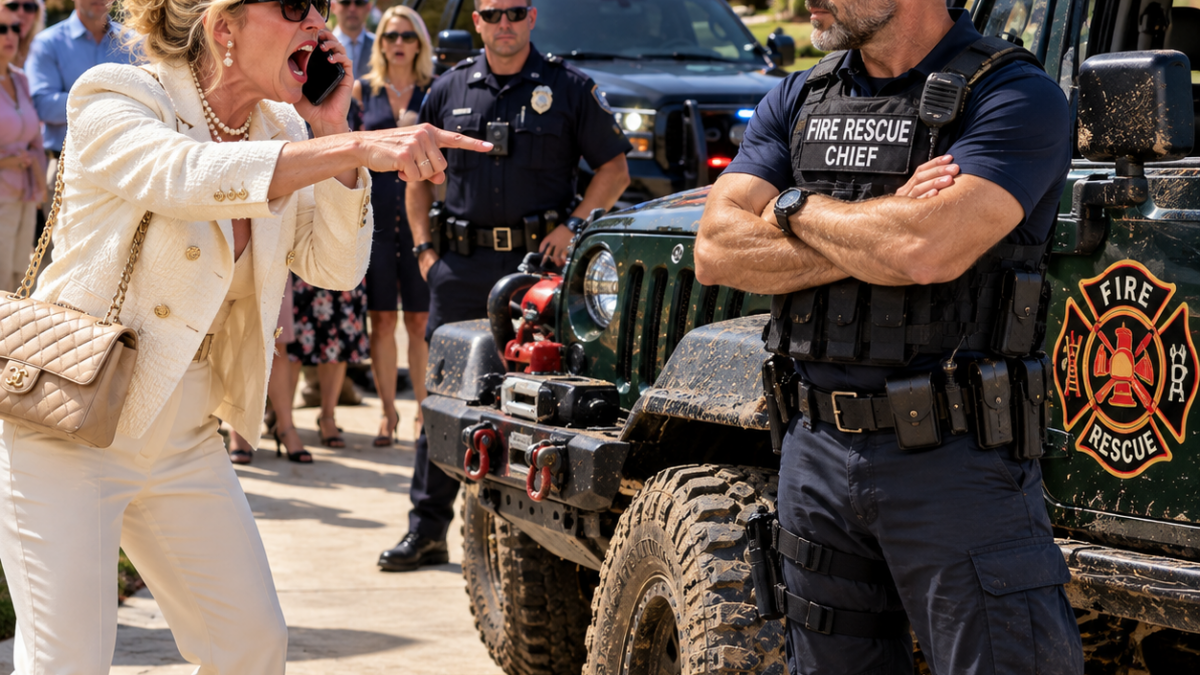
When twenty-three violation letters, a failed tow attempt, fabricated HOA rules, fake traffic cones, and a public vote still could not make me move it, she waited until her backyard cocktail party was full of guests and called 911 to report the Jeep as an abandoned military vehicle blocking her visitors.
The dispatcher recognized it before Brenda finished complaining and calmly told her, “Ma’am, that Jeep belongs to Chief Ethan Cole”—and with one phone call, Brenda handed me the final piece of evidence I had been documenting for three years.
My name is Ethan Cole.
I was forty-seven years old when a woman across the street decided the ugliest thing in Cedar Bluff Estates was the vehicle that had once belonged to my father.
That is not how she phrased it.
Brenda Waverly preferred words like incompatible.
Visually disruptive.
Nonconforming.
Aesthetic hazard.
Neighborhood blight.
She had a vocabulary for making cruelty sound like architecture.
I just called it Dad’s Jeep.
A 1997 Jeep Wrangler TJ.
Forest green.
Two doors.
Five-speed manual.
A rebuilt frame.
Four-inch lift.
Thirty-five-inch BFGoodrich tires.
Steel front bumper.
Old winch.
Amber emergency light bar on the roof.
County radio mounted beneath the dash.
Harland County Fire and Rescue markings on the rear quarter panel.
It was never pretty in the way Brenda understood pretty.
It was not polished.
It was not elegant.
It did not match landscaping.
It carried scratches from brush roads.
Mud from mountain trails.
Ash from wildfire lines.
A dent on the rear corner from a tree that fell during an ice storm.
The driver’s seat had a split near the left bolster.
The radio knob was missing the black plastic cap.
The glove box still contained one of my father’s old turnout-glove clips.
I could have restored it until it looked like a museum piece.
I never wanted that.
PART2:
The Jeep mattered because it still looked like work.
My father’s name was William Cole.
Everybody called him Billy.
Billy Cole ran Harland County Fire and Rescue from 1989 until September 4, 2003.
He had been a firefighter twenty-eight years.
Chief fourteen.
That night, a feed warehouse on Route 7 caught fire.
By the time Engine 3 arrived, half the roofline was burning.
Someone reported the night watchman missing.
Dad went inside with a crew.
The watchman was already home.
Nobody knew.
The roof collapsed at 12:06 a.m.
They pulled Dad out sixteen minutes later.
He died before sunrise.
Fifty-one years old.
My mother Ruth.
Me.
And a Jeep.
I was twenty-six.
Already five years into the department.
A lieutenant.
Old enough to understand death professionally.
Young enough to discover that none of the professional words mean anything when the body under the flag belongs to your father.
At the funeral, I remember three things.
My mother’s hand shaking inside mine.
The sound of bagpipes.
And Dad’s Jeep parked behind the hearse with black ribbon tied to the antenna.
Afterward, Mom handed me the keys.
“Take it.”
“Mom.”
“Your father drove that thing everywhere.”
“I know.”
“He built that department one call at a time.”
She put the keys into my palm.
“That Jeep was how he got there.”
“I want it with somebody who still goes.”
I did not answer.
I drove it home.
Then I spent two years rebuilding it.
Not because it needed everything I replaced.
Because grief needs somewhere to go.
Some men drink.
Some disappear into work.
Some get angry.
I rebuilt suspension.
Replaced a frame that probably could have lasted longer.
Pulled the engine.
Repainted the body in the original forest green.
Welded a bumper after midnight in the department shop.
Mounted a new winch.
Rewired lights.
Installed the county radio.
Every bolt gave me something I could fix.
That was important because I could not fix the one thing I wanted.
Twenty years later, the Jeep still responded.
Brush fires.
Flood rescues.
Missing hikers.
Vehicle crashes down logging roads.
Storm damage.
Places where a normal command SUV could not go.
I used department vehicles for most calls.
But if the pager went off while I was home and the incident was up one of those fire roads behind our subdivision, Dad’s Jeep was often fastest.
Every dispatcher knew it.
Every deputy.
Every paramedic.
They knew the forest-green Wrangler with the amber light bar.
They knew the radio call sign.
They knew if they heard that engine climbing the ridge at three in the morning, Chief Cole was already moving.
Brenda did not know any of that when she first complained.
Or maybe she did not care.
Cedar Bluff Estates sat four miles south of the Harland County courthouse in southwestern Virginia.
Ninety-four houses.
Half-acre lots.
Built between 2016 and 2018.
Nothing ridiculous.
Comfortable homes.
Playground.
Retention pond.
Mailbox station.
The kind of neighborhood where people borrowed ladders and complained online about whose dog left something near the sidewalk.
I bought lot 114 in 2017.
Last house on the cul-de-sac.
The rear line bordered county land.
From my backyard I could reach a network of fire roads crossing the ridges and hollows south of town.
That access mattered.
My son Owen was fourteen when the trouble became serious.
He lived with me full-time.
His mother Sarah had died from pancreatic cancer four years earlier.
Quietly.
She had always been quiet.
The kind of woman who apologized to nurses while dying because she thought she was inconveniencing them.
After she died, Owen and I survived through routine.
School.
Fire station.
Baseball on the radio.
Pizza on Thursdays.
Jeep maintenance on Sunday afternoons.
Routine is not healing.
But sometimes it holds the roof up until healing decides to arrive.
Brenda Waverly lived directly across the street.
Thirty-nine years old.
Real estate agent.
HOA president.
Pearl-white Mercedes-Benz GLE coupe.
Perfect hair.
Perfect teeth.
Designer sunglasses.
Red-soled heels.
A diamond necklace that spelled PRES.
Short for president.
She had actually purchased jewelry identifying her as HOA president.
That tells you more than I could in ten paragraphs.
She carried a leather folio embossed BW.
Violation notices came on custom stationery with a gold Cedar Bluff crest she had commissioned herself.
The original HOA logo apparently did not feel authoritative enough.
Brenda became president six months after her divorce.
Her ex-husband kept paying much of the mortgage.
She kept the house.
The Mercedes.
And the board.
She sold homes for the same development family that built Cedar Bluff.
That mattered.
Curb appeal was not abstract to Brenda.
It was money.
Every tidy lawn supported her listings.
Every uniform mailbox supported her sales pitch.
Every clean driveway helped preserve the illusion that Cedar Bluff was not merely a neighborhood.
It was a product.
And Dad’s Jeep offended the product.
The first time she mentioned it to me, I had been outside checking oil.
She walked across the street carrying coffee.
Cream blazer.
Black trousers.
Heels clicking on asphalt.
“That thing is revolting.”
I looked over the hood.
“Morning to you too.”
She pointed toward the Jeep.
“It makes the street look like a trailer park.”
“It’s a Jeep.”
“It’s filthy.”
“It rained.”
“There’s mud halfway up the doors.”
“Fire road.”
She stared as if I had given the wrong answer.
“It needs to be inside your garage.”
“My garage has tools.”
“That is not my problem.”
“Neither is the Jeep.”
She stepped closer.
Her heels stopped on my driveway.
“This neighborhood has standards.”
“So does the fire department.”
“That vehicle does not meet them.”
“It’s registered.”
“Insured.”
“On my property.”
“And useful.”
“Useful isn’t the same as appropriate.”
I closed the hood.
“It belonged to my father.”
“I don’t care whose it was.”
Something in my chest tightened.
Not because she insulted the Jeep.
Because she dismissed him without knowing him.
Still, I kept my voice flat.
“It stays.”
She smiled.
Not friendly.
“Sweetheart, I’ve pushed families out of this neighborhood for less than a mailbox violation.”
I stared.
She continued.
“You think I can’t handle one man who smells like a fire station?”
I had been called worse by people with weapons.
“I guess we’ll find out.”
She walked home.
The first violation letter arrived six months later.
CC&R Section 4.7B.
NO COMMERCIAL, RECREATIONAL, OR MODIFIED VEHICLE SHALL BE STORED OR DISPLAYED IN ANY AREA VISIBLE FROM COMMON ROADWAYS.
Brenda classified my Jeep as:
MODIFIED COMMERCIAL-TYPE VEHICLE.
That phrase became important because the Wrangler was legally registered as a private passenger vehicle.
Not commercial.
Not fleet.
Not recreational storage.
Private.
I wrote one response.
Ms. Waverly,
The 1997 Jeep Wrangler parked at Lot 114 is registered, taxed, and insured as a personal passenger vehicle under Virginia law. It is legally parked on my private driveway and does not violate the cited provision.
No action will be taken.
Respectfully,
Ethan Cole
Chief, Harland County Fire and Rescue
Eleven days later, another letter.
Section 4.9A.
Oversized vehicle causing visual obstruction.
Same answer.
Two weeks later:
letter three.
Then four.
Five.
Eight by end of year.
Fifteen by year two.
Twenty-three by year three.
Every letter about one Jeep.
Not my lawn.
Not my gutters.
Not my trash cans.
Not noise.
The Jeep.
Brenda circled modifications in red on photographs.
Light bar.
NONSTANDARD.
Winch.
NONSTANDARD.
Lift.
NONSTANDARD.
Tires.
VISUAL IMPACT.
She once included a laser-measured distance from her kitchen window to my driveway.
One hundred forty feet.
Owen read that one.
“She measured it?”
“Apparently.”
“Why?”
“Because hobbies are important.”
He laughed.
Then asked:
“Why does she keep doing this?”
I was washing coffee cup.
“Because she thinks repetition changes reality.”
“Does it?”
“No.”
“Are you ever moving it?”
I looked through window.
The forest-green paint caught sunset.
“No.”
The first tow truck came while I was on shift.
Tri County Towing.
Driver named Carl Benton.
Brenda had apparently represented the Jeep as an HOA violation subject to removal.
Carl backed into cul-de-sac.
Lowered bed.
Walked to Jeep.
Then saw the department markings.
Light bar.
County radio.
He stopped.
Pulled out phone.
Later I heard call.
“Rhonda?”
“Yeah.”
“I’m at address.”
“Vehicle’s got Harland Fire markings.”
“Chief’s radio.”
“I’m pretty sure this is Ethan Cole’s rig.”
Pause.
“Yeah.”
“That’s what I thought.”
He left.
Did not touch it.
That afternoon, he left me voicemail.
“Chief Cole, Carl from Tri County.”
“Some lady tried to have your Wrangler towed.”
“I turned it down.”
“Also my daughter is in the explorer program at Station 3.”
“Thought you should know.”
When I got home, Carl’s card was under wiper.
Brenda’s card too.
Her real estate headshot.
Perfect lighting.
Handwritten on back:
NEXT TIME I’LL USE A COMPANY THAT FOLLOWS THROUGH.
I added it to folder.
The folder had her name.
WAVERLY.
By year three it was thicker than some fire investigations.
I never threatened her.
Never knocked on her door.
Never told neighbors what she was doing.
I answered in writing.
Filed everything.
Then came the cones.
Four orange traffic cones appeared across the bottom of my driveway.
Each had laminated sticker.
CEDAR BLUFF HOA TRAFFIC MANAGEMENT.
DO NOT REMOVE.
I had just finished forty-eight-hour shift.
I stood there in uniform.
Coffee thermos in one hand.
Stared.
Then looked across street.
Brenda’s blinds moved.
I picked up cones.
Carried them across.
Set them neatly on her curb.
Went home.
Two days later:
Violation notice.
Unauthorized removal of HOA traffic-management devices.
Fine:
$150.
I called Ridgeline Property Services, management company.
Deborah Henkins answered.
“Deborah.”
“Chief.”
“Did the board authorize cones blocking my driveway?”
“No.”
“Did board authorize fine for removing them?”
Pause.
“What section?”
“6.2D.”
“That covers damage to common-area fencing.”
“So Brenda invented it.”
Another pause.
“I didn’t say that.”
“You didn’t need to.”
Deborah sent written confirmation.
Added to folder.
Then Brenda tried to change rules.
Annual HOA meeting.
September.
Proposed amendment:
No modified, lifted, or commercial-appearing vehicle exceeding 5,500 pounds gross rating could remain visible in private driveways more than forty-eight hours.
Written for one Jeep.
Everybody knew.
Brenda gave presentation.
Twelve slides.
Projected photographs of my driveway.
Charts.
“Visual impact assessment.”
A laser pointer.
At one point she called the Jeep a threat to Cedar Bluff’s market reputation.
That was when Colonel Walt Dietrich stood.
Seventy-one.
Retired Army colonel.
Lot 108.
Walt had never spoken more than five minutes at any meeting.
That night he did not need five.
“Brenda.”
She paused.
“Yes, Colonel?”
“That Jeep has responded to three emergencies in this neighborhood.”
Nobody moved.
He pointed toward screen.
“Peterson kitchen fire.”
“Chief Cole got there before first engine.”
“Water-main rupture on Cedar Lane.”
“He staged sandbags before county crew arrived.”
Then Walt’s voice changed.
“And the night Helen had a cardiac event.”
Brenda looked at him.
Walt’s wife.
I remembered.
Two in morning.
Route 19 pileup.
Ambulance delayed.
I put Helen in Jeep and drove her to Harland General.
Fast.
Careful.
She survived.
Walt continued.
“Ambulance was twenty-two minutes out.”
“Ethan drove my wife in that Jeep.”
“She is alive.”
“So if you want to explain to Helen why your curb appeal matters more than that vehicle being available, I will go home right now and bring her here.”
The room stayed silent.
Brenda did not answer.
The amendment failed.
Seventy-one to twenty-three.
That should have ended things.
Instead, humiliation made Brenda worse.
Owen watched her sit in Mercedes afterward.
“Eleven minutes.”
he said.
“What?”
“She’s been sitting there eleven minutes.”
“Maybe making a call.”
“No.”
“She’s loading next level.”
He was right.
After that vote, I created spreadsheet.
Dates.
Letters.
Tow attempt.
Cones.
Fabricated section.
Management confirmation.
Amendment vote.
Everything.
Then took it to Harland County Attorney Janet Rawlings.
Janet had known Dad.
There was a photograph from his memorial on her shelf.
She read file.
Forty minutes.
Then:
“Ethan.”
“Yeah?”
“The line you’re asking about is behind you.”
“What?”
“She crossed it a while ago.”
Janet explained the Jeep was legally parked.
Many citations Brenda relied on did not apply.
Board authorization had not existed for her enforcement campaign.
False emergency reporting could become criminal.
Harassment could support civil action.
“You have enough for cease-and-desist.”
I shook my head.
“Not yet.”
“Why?”
“Because right now every stupid thing she does becomes another page.”
Janet watched me.
“You’re thinking like investigator.”
“No.”
“Fire chief.”
“What’s difference?”
“Fire tells you where it wants to go if you watch.”
She smiled.
“When she does next thing, call.”
Brenda filed code complaint.
Claim:
illegal commercial auto repair operation.
Evidence:
photograph of me changing oil in driveway.
Inspector Tom Ridley came.
Looked at Jeep.
Oil pan.
Toolbox.
Then me.
“Chief.”
“Tom.”
“Someone says you’re running mechanic shop.”
“I’m changing oil.”
“I can see that.”
He wrote:
UNFOUNDED.
Then added quietly:
“Complainant might need a hobby.”
Page forty-four.
Then the Jeep was keyed.
That stopped being funny.
Three scratches.
Front fender to rear quarter.
Deep.
Through green.
Primer.
Bare metal.
Parallel.
Deliberate.
I stood touching one line.
The same body I had sanded after Dad died.
The same green mixed from his original color.
Owen came outside.
“Dad?”
He saw.
“Was it her?”
“I don’t know.”
He looked across street.
“I heard a car.”
“What kind?”
“Quiet.”
“Luxury quiet.”
Could have been Brenda’s Mercedes.
Could have been someone else.
Suspicion is not proof.
I filed police report.
No accusation.
Installed camera.
The repair estimate was $3,200.
I did not fix it immediately.
Maybe part of me wanted scratches visible.
Evidence that something had changed.
Then summer social invitations went out.
Every household except mine.
That was fine.
I did not need Brenda’s cocktail party.
What mattered was note sent to residents on Cedar Bluff Drive.
As a courtesy, residents were asked to relocate oversized or modified vehicles during event.
Again:
one vehicle.
Mine.
I did not move it.
Saturday.
Clear.
Seventy-four degrees.
White tents across street.
Catering.
Music.
Wine.
String lights.
Brenda in pale yellow designer dress greeting neighbors.
The Jeep sat in driveway.
Exactly where always.
Not blocking road.
Not sidewalk.
Not mailbox.
Not guest parking.
Inside, Owen and I watched Braves game and ate leftover pizza.
At 4:47 p.m., Brenda called 911.
I did not hear call live.
Lisa Hernandez did.
Twelve years dispatch.
The kind of dispatcher who can talk terrified parent through CPR while coordinating units on two different channels.
Brenda reported an abandoned military-style vehicle.
Said it was obstructing access for guests.
Requested tow.
Lisa asked for description.
Forest-green Jeep Wrangler.
Lifted.
Large tires.
Emergency-style lights.
County markings.
Lisa knew.
Everybody at dispatch knew.
“Ma’am, is this vehicle at Lot 114?”
“Yes.”
“Ma’am, that’s Chief Cole’s Jeep.”
Pause.
Brenda apparently said:
“I don’t care whose it is.”
Lisa explained vehicle was known emergency-response support vehicle owned by county fire chief and legally parked.
Brenda insisted it was interfering with HOA function.
Lisa warned that 911 was emergency line.
Brenda continued.
Lisa advised knowingly false reports could carry consequences.
Brenda hung up.
Six minutes later my phone rang.
“Chief.”
“Lisa.”
“You’re going to love this.”
“I doubt that.”
“Woman at 119 Cedar Bluff called asking us to tow your Jeep.”
I looked through kitchen window.
Across street, Brenda was pouring wine.
“Why?”
“Says abandoned military vehicle blocking her guests.”
I looked at empty street around Jeep.
“Did you tell her?”
“Yes.”
“What happened?”
“She said she didn’t care who you were.”
That made me smile.
Not because funny.
Because clean.
“Lisa.”
“Yes?”
“Log it.”
“Already.”
“Preserve recording.”
“Already.”
“I’m filing Monday.”
“Figured.”
I hung up.
Owen asked:
“What happened?”
I took iced tea.
“Brenda called 911 on Grandpa’s Jeep.”
His eyes widened.
“Seriously?”
“Seriously.”
“What are you going to do?”
“Watch baseball.”
Braves scored three in seventh.
Monday morning I sat in Janet’s office.
Waverly folder.
Fifty-one pages.
Flash drive.
She played 911 call twice.
Stopped after:
“I don’t care who he is.”
Janet looked at me.
“She called 911 about a legally parked vehicle.”
“Yes.”
“Described it as abandoned.”
“Yes.”
“Requested tow.”
“Yes.”
“Continued after dispatcher identified you.”
“Yes.”
“And after warning?”
“Yes.”
Janet closed folder.
“All right.”
Brenda was served at work.
Not home.
Pinnacle Properties.
A deputy handed paperwork to her in front of coworkers.
Word spread.
By Thursday, most of Cedar Bluff knew.
The local paper obtained transcript.
Headline:
HOA PRESIDENT CALLS 911 ON FIRE CHIEF’S PARKED JEEP.
That was bad for Brenda.
Emergency board meeting was worse.
For first time, full board saw folder.
Tow truck.
Cones.
Fake subsection.
Code complaint.
Twenty-three letters.
They had not authorized most of it.
Brenda had used HOA name as costume for personal campaign.
Board member Richard Fenn, a CPA, stood.
Quiet man.
Usually spoke in numbers.
That evening he spoke plainly.
“Brenda.”
She looked at him.
“You used this association’s name to harass one homeowner for three years.”
She opened mouth.
He continued.
“You attempted unauthorized towing.”
“You fabricated enforcement language.”
“You placed unauthorized objects in a resident’s driveway.”
“You filed unsupported code complaint.”
“And now you called 911 because you didn’t want an emergency-response vehicle visible during a party.”
He took breath.
“I move for immediate removal as president.”
Vote was brutal.
Eighty-seven to six.
Brenda voted for herself.
Of course.
She gathered binder.
Walked out.
Sat in Mercedes.
Owen texted me from porch.
6:50 this time. Faster.
The criminal matter resolved months later.
No contest plea.
Fine.
Community service.
Temporary prohibition from serving in HOA leadership.
The judge had been volunteer firefighter before bench.
He looked at Brenda and then at file.
His words were not as theatrical as people later repeated them online, but point was unmistakable.
The Jeep she had treated as neighborhood embarrassment had responded to emergencies.
My father had died serving county.
I had spent twenty-five years doing same work.
911 was not a tool for aesthetic disputes.
The judge ordered community service.
Brenda completed much of it at food bank.
No heels.
No blazer.
No diamond president pendant.
Just work.
I hope it taught something.
I do not know.
Colonel Walt Dietrich became new HOA president.
His campaign platform was one sentence.
“I’m going to do less.”
He won.
His first note to me came on plain white paper.
No crest.
No foil.
Chief Cole,
On behalf of Cedar Bluff Estates, I apologize.
We allowed one person to use HOA rules as a weapon against a resident who has repeatedly served this neighborhood.
That ends now.
Respectfully,
Walt Dietrich
Second thing he did was pass amendment protecting emergency-response vehicles owned by certified first responders residing in community.
Ninety-one to zero.
That amused Owen.
“The people who voted for Brenda changed?”
“Apparently.”
“Cowards.”
“Maybe.”
“Or maybe people need cover before admitting they were wrong.”
That was Sarah talking through him.
She always had more grace than me.
The Jeep went back to Abbington body shop.
Same shop that mixed Dad’s forest green.
They repaired scratches.
When I picked it up, the paint matched perfectly.
Owen walked around twice.
“Looks new.”
“No.”
I said.
“Looks like Grandpa’s.”
He smiled.
Brenda listed her house the next year.
Sold for less than she hoped.
Moved.
No dramatic parade.
No crowd watching moving truck.
I did not stand in driveway.
By then I was tired.
Not victorious.
Just tired.
Three-year war over one Jeep had taken more emotional space than it deserved.
That is something people do not tell you about petty harassment.
Each incident is small.
A letter.
A cone.
A photograph.
A complaint.
Nothing worth ruining your day over.
But repetition changes weight.
Water does that to stone.
One drop means nothing.
Years matter.
Brenda’s campaign did not hurt me because any single notice scared me.
It hurt because it tried to turn home into place where I was constantly defending right to exist normally.
That is why I documented everything.
Not for revenge.
For reality.
When somebody keeps changing story, records protect memory.
Dad taught me that too, though differently.
Fire reports.
Equipment logs.
Training records.
A chief who does not document eventually discovers memory is weak evidence.
Same rule at home.
Owen understood earlier than I realized.
One Sunday after Brenda moved, we were washing Jeep.
A new family had moved two houses down.
Mother and little girl walked over.
The woman looked at Wrangler.
“That’s beautiful.”
That word surprised me.
Not because Jeep was ugly.
Because Brenda had spent years teaching neighborhood to call it opposite.
“My dad had one like it.”
the woman said.
Owen wrung out rag.
“This was my grandpa’s.”
“He was fire chief before Dad.”
“He died in a warehouse fire.”
The woman’s smile softened.
“I’m sorry.”
Owen shrugged in the way teenagers do when emotions get close.
“Dad rebuilt everything.”
She looked at Jeep again.
“Well.”
“It looks like it belongs right here.”
Owen glanced at me.
Then smiled.
“It does.”
That was better than court.
Better than newspaper.
Better than Brenda losing presidency.
It belongs right here.
Simple.
Today the Jeep still sits in same driveway.
I am older.
Owen is grown.
He has keys now.
That scares me more than any HOA ever did.
The radio still crackles.
The amber bar still works.
Winch has been rebuilt twice.
One tire size smaller now because my knees and common sense finally reached agreement.
Dad’s glove clip remains in glove box.
I sometimes take it out.
Turn it over.
Put it back.
The vehicle has carried three generations of hands.
Dad.
Me.
Owen.
Objects do not become people.
I know that.
The Jeep is not my father.
If it disappeared tomorrow, memory would remain.
But objects can hold continuity.
A steering wheel touched by somebody gone.
A stain.
A dent.
The smell of old vinyl.
We are physical creatures.
Sometimes grief needs something it can put a hand on.
Brenda could not understand that because she saw only appearance.
Mud.
Height.
Steel bumper.
Ugly modifications.
She did not see Dad driving to station at 5:30.
Mom handing me keys.
Two years rebuilding through grief.
Colonel Dietrich’s wife in passenger seat during cardiac emergency.
Sandbags.
Brush fires.
Rescues.
She saw curb appeal.
That was her tragedy.
Not that she lacked information.
That she had trained herself to value surfaces above stories.
Ironically, as a real estate agent, she should have known better.
A house is not siding.
A neighborhood is not synchronized mailboxes.
Community is who shows up at two in morning.
Who carries someone down stairs.
Who cuts fallen trees.
Who brings generator.
Who knows which elderly resident needs oxygen when power goes out.
Who recognizes chief’s Jeep before woman across street does.
That 911 dispatcher understood community better than HOA president ever had.
Lisa never attended a Cedar Bluff meeting.
Never measured lawn.
Never sold house there.
But she knew:
Forest-green Wrangler.
Lot 114.
Chief Cole.
Not abandoned.
Not threat.
Not aesthetic problem.
Resource.
That distinction made all difference.
Years after everything, Lisa retired.
At her retirement dinner I brought a framed photograph.
Dad’s Jeep.
Parked outside dispatch center.
Underneath:
MA’AM, THAT’S OUR CHIEF.
She laughed until she cried.
“Did I actually say it like that?”
“Close enough.”
“I should have been meaner.”
“You were perfect.”
She kept picture.
Walt remained HOA president two years.
Then resigned.
“I said I’d do less.”
he told everybody.
“I have now done enough.”
Best president Cedar Bluff ever had.
Meetings dropped from ninety minutes to twenty-seven.
Fines fell.
Arguments fell.
Home values did not collapse because somebody’s pickup was visible.
Civilization survived wind chimes.
Children hung birthday banners.
Therapy dog barked.
Nobody called animal control.
Progress.
One afternoon Walt and I sat on curb while Owen worked under Jeep.
Walt looked across street at Brenda’s old house.
“You know what bothers me?”
“What?”
“We knew.”
“Knew what?”
“That she was a bully.”
“Most of us knew.”
“Why didn’t we stop her?”
I did not answer immediately.
Then:
“Because she usually targeted one person at a time.”
Walt nodded.
“That’s it.”
“When it’s not you, it feels easier to stay out.”
“Until everybody realizes they’ve all been alone separately.”
That sentence stayed.
Brenda’s power came from isolation.
One homeowner fought mailbox fine.
Another lawn.
Another banner.
Another dog.
I fought Jeep.
Each looked petty alone.
Together they became pattern.
That is another reason documentation matters.
It lets isolated events meet each other.
People often tell story as if Brenda destroyed herself with one call.
She did not.
She spent three years building pile.
911 call simply knocked it over.
Without the twenty-three letters, tow attempt, cones, fabricated rule, failed amendment, code complaint, the call might have been dismissed as one bad decision.
With them?
Pattern.
That is how consequences usually work.
The final act gets attention.
Earlier acts make it meaningful.
I never proved Brenda keyed Jeep.
Important.
People assume.
I suspect.
Owen suspected.
Luxury car heard.
Timing.
Motive.
None of that is proof.
So I never accused.
The police report remained unsolved.
That frustrated me.
Still does.
But discipline means accepting what you cannot establish.
If you turn suspicion into certainty because story feels better, you become the thing you criticize.
Brenda’s entire problem was treating belief as authority.
I would not copy that.
So officially:
Unknown person damaged Jeep.
Period.
The rest of evidence was enough.
Years later, I saw Brenda once.
Roanoke.
Grocery store parking lot.
She recognized me before I recognized her.
No president pendant.
No binder.
Just woman with cart.
“Ethan.”
“Brenda.”
She looked at me.
“I heard your son has the Jeep now.”
“Sometimes.”
Silence.
Then she said:
“I hated that thing.”
“I know.”
“I still think it’s ugly.”
I laughed.
Couldn’t help it.
She almost smiled.
Then:
“I shouldn’t have called 911.”
“No.”
“I was angry.”
“I know.”
“The party…”
She stopped.
“It doesn’t matter.”
“No.”
“It didn’t.”
She looked toward her car.
Not Mercedes.
Small Volvo.
“Did I really send twenty-three letters?”
“Yes.”
She winced.
“I don’t remember that many.”
“I do.”
That was the point.
The person applying pressure may not remember each act.
The person receiving it often remembers every one.
Brenda said:
“I thought if you moved it, everything would look better.”
I considered.
“Maybe.”
She looked surprised.
“But?”
“But looking better isn’t same as being better.”
She nodded.
No apology beyond that.
Enough.
We went separate ways.
When I returned home, Jeep was in driveway.
Owen had borrowed it.
Mud on passenger side.
I stared.
Then laughed.
Sarah would have laughed too.
Dad definitely.
Some things survive because nobody makes them sacred.
We still use it.
That is important.
It gets dirty.
Scratched.
Repaired.
If I had turned it into shrine, Brenda’s obsession might have won in different way.
Dad’s Jeep was built to go.
Mom’s words.
I want it with somebody who still goes.
So it goes.
When tones drop for brush fire on ridge, I go.
When flood closes county road, I go.
When a kid gets lost on trail, I go.
Sometimes in department SUV.
Sometimes the Jeep.
At three morning, if amber light crosses Cedar Bluff, blinds open.
Neighbors know.
Nobody complains.
One summer lightning storm set woods above community smoking.
I was home.
Owen too.
We loaded Jeep.
Reached fire road before first engine.
Found brush fire creeping toward ridge.
Called coordinates.
Started containment with hand tools until crew arrived.
Walt later said:
“Imagine if Brenda had gotten it towed.”
I said:
“Engine would still have come.”
“Eventually.”
He looked at Jeep.
“That is point.”
Yes.
Minutes matter.
Not every time.
Enough times.
The vehicle Brenda wanted gone because it looked like work existed precisely because work sometimes arrives without invitation.
Fire does not care about aesthetics.
Cardiac arrest does not care about HOA standards.
Floodwater does not care whether truck has matching paint.
Emergencies strip vanity away fast.
Service lives in that stripped-down world.
Can it reach?
Can it pull?
Can it carry?
Can it arrive?
Dad understood.
That is why Jeep still means him to me.
He was not elegant.
He did not perform authority.
His chief’s shirt was often wrinkled.
Boots always dirty.
He believed titles existed so somebody knew who had responsibility when things went wrong.
Not so people could feel important when things were calm.
Brenda wore PRESIDENT around neck.
Dad rarely wore CHIEF outside work.
That difference could be whole story.
One person used title to control what she saw.
The other used title to run toward what others feared.
I became fire chief partly because of him.
I hope I learned the right half.
On the night he died, somebody had to decide whether to enter warehouse.
Information said watchman missing.
Dad went.
Information was wrong.
That does not make decision wrong.
It means service sometimes costs too much.
For years I was angry at watchman.
Then not.
He had gone home.
Forgot to tell supervisor.
Ordinary mistake.
Dad still gone.
Life resists clean villains.
Maybe that is why Brenda’s story felt easier.
She was clearly wrong.
But even with her, I learned not to reduce a person to worst choices.
She was arrogant.
Controlling.
Cruel.
She also eventually worked food-bank hours.
Maybe she learned.
Maybe not.
I do not need to know.
Justice was never making Brenda miserable.
Justice was stopping misuse.
Removing power she abused.
Correcting record.
Protecting emergency system.
Leaving Jeep where it legally belonged.
Everything beyond that was her life.
That realization helped me move on.
Otherwise you remain tied to antagonist forever, waiting for them to suffer enough to validate you.
I had fires to fight.
A son to raise.
A Jeep to keep running.
Better uses of time.
The Waverly folder still exists.
I almost threw it away.
Owen stopped me.
“Why keep it?”
I asked.
“History.”
“Bad history.”
“Still history.”
He put it beside Dad’s old fire-service records.
Twenty-three letters.
Tow card.
Cone notice.
Ridgeline email.
Meeting minutes.
Code complaint.
Police report.
911 transcript.
Removal vote.
A paper trail from obsession to consequence.
Maybe someday Owen’s children will read it.
Maybe laugh.
I hope lesson they take is not:
Never mess with fire chief.
That would miss point.
The law did not protect Jeep because I was chief.
The rules applied because it was legally parked.
Dispatcher recognized me, yes.
That made call especially absurd.
But Brenda’s complaint would have been wrong if Jeep belonged to plumber, teacher, mechanic, or cashier.
Position made story dramatic.
Rights existed anyway.
That distinction matters to me.
Authority should not decide whose property deserves respect.
Law should.
I tell new fire recruits something similar.
Uniform gives responsibility.
Not superiority.
People see badge, helmet, title and often comply.
That trust is borrowed.
Misuse it and you damage more than one interaction.
Brenda borrowed HOA title and spent trust recklessly.
By end, nobody believed her.
Walt rebuilt some of it by doing almost nothing dramatic.
Transparent votes.
Actual bylaws.
Plain notes.
No invented sections.
No gold foil.
Funny how humility repairs institutions faster than branding.
Today Cedar Bluff is ordinary again.
Trash Wednesday.
Kids at playground.
Facebook arguments about deer eating hostas.
The retention-pond bench is still mostly empty.
My old house still last on cul-de-sac.
Dad’s Jeep still visible.
If Brenda saw it now, she would probably still hate it.
That is fine.
Freedom includes disliking your neighbor’s Jeep.
It does not include inventing authority to remove it.
That is line.
The night after her removal vote, Owen and I sat on hood.
He asked:
“Did Grandpa ever deal with someone like Brenda?”
I laughed.
“Your grandfather dealt with county commissioners.”
“So worse?”
“Different species.”
“What would he have done?”
I thought about Dad.
His calm.
Stubbornness.
He would have read first letter.
Folded it.
Probably said one sentence.
“It’s my Jeep.”
Then gone to station.
Owen smiled.
“That’s it?”
“Pretty much.”
“He wouldn’t have made folder?”
“No.”
“Grandma would have.”
That was true.
We sat in quiet.
Then Owen said:
“I’m glad you didn’t move it.”
“Me too.”
“Because of Grandpa?”
“Yes.”
Then I added:
“And because it was ours to decide.”
That may be the bigger answer.
Ownership is not sacred because property matters more than people.
It matters because consent matters.
Brenda kept trying to replace my consent with her preference.
She thought if her preference wore enough stationery, enough clauses, enough cones, enough votes, enough phone calls, it became authority.
It did not.
Twenty-three letters did not turn no into yes.
A tow truck did not.
Fake cones did not.
A failed amendment did not.
911 certainly did not.
If anything, each escalation made original truth clearer.
The Jeep was legal.
The driveway was mine.
Her guests were not blocked.
There was no emergency.
And when Lisa Hernandez looked at screen in dispatch and heard Brenda describe forest-green Wrangler with fire markings, she knew immediately what Brenda had refused to learn for three years.
That Jeep belonged there.
Not because it was beautiful.
Not because it matched neighborhood.
Not because the owner was chief.
Because it had a legal right to be there.
And because sometimes the things that look roughest in quiet times become the things you are most grateful to see when something starts burning.
Dad knew that.
Now Cedar Bluff does too.
Every night, when the forest-green paint catches streetlight and old amber lenses glow faintly, I still see him.
Not ghost.
Memory.
A man climbing into Jeep before dawn.
Coffee in holder.
Radio crackling.
One hand on wheel.
Going where somebody needed him.
Mom asked me to keep it with someone who still goes.
I have.
Owen will too.
And if someone someday decides it ruins the view?
They are welcome to dislike it.
They can close blinds.
Because after twenty-three letters, one failed tow, four orange cones, a fabricated rule, one rejected amendment, and the most expensive unnecessary 911 call Brenda Waverly ever made, Cedar Bluff finally learned a lesson my father never needed written on gold stationery.
Looking important is not authority.
Showing up is.




