HOA Karen Burned My Lake House While Developers Were Already Measuring My Shoreline—Then the Fire Marshal Found Something in the Ashes They Never Expected to Survive.
PART3:
“You didn’t need to do that.”
“Apparently I did.”
“We’ve always had cooperative access.”
“For two months.”
“You’re being unnecessarily rigid.”
“No. I’m being clear.”
That was the beginning.
After that came letters.
Not violations, because she had no authority to issue them.
“Community concerns.”
My dock was visually inconsistent.
My shoreline vegetation created wildlife issues.
The old cedar siding reduced neighboring values.
A small utility shed was “not in keeping with lake aesthetics.”
I ignored most of them.
Once, after she mailed me a three-page recommendation about paint colors, I sent back one page.
MY PROPERTY IS NOT SUBJECT TO SOUTH RIDGE HOA.
THANK YOU.
She stopped writing for six months.
I thought the message had landed.
It hadn’t.
It had merely delayed something larger.
The week my house burned, I had been forty miles outside Great Falls inspecting repairs to a reservoir spillway.
The project finished early.
Thursday afternoon instead of Saturday.
I could have stayed at the hotel.
The room was paid through the weekend.
Instead I wanted my own bed.
My own coffee.
My own dock.
So I pointed the truck west.
The first sign something was wrong appeared before I saw smoke.
Orange survey flags.
Bright ones.
Staked along the edge of my gravel drive.
I slowed.
There should have been no survey crew.
I hadn’t hired one.
The flags continued toward the shoreline.
Then the road curved.
I saw the smoke.
Black at the base.
Gray higher.
My foot came off the accelerator.
For one second, my brain rejected the scene.
That’s not mine.
Then I saw the chimney.
Stone.
Still standing.
Everything around it black.
My truck stopped crooked across the road.
Fire engines were already leaving.
One passed me slowly.
The firefighter in the passenger seat looked through the windshield.
His expression changed when he saw me.
That was the first thing that made the scene feel wrong.
Not pity.
Surprise.
I climbed out.
Wet ash hit my nose.
Burned pine.
Insulation.
Plastic.
A metallic smell from electrical components and appliances.
The roof had collapsed.
The front wall was mostly gone.
Steam rose where firefighters had drowned hot spots.
The cedar swing my father and I built the first summer I owned the place hung by one blackened chain.
I stared at it.
That was when I saw Deborah.
She stood beside my former driveway in a cream jacket.
Clean.
Not one speck of soot.
Leather folder under one arm.
Two men in reflective vests near her.
Another man in a navy blazer.
A survey tripod was set up less than one hundred yards from what remained of my home.
Pointed toward the shoreline.
Not the ruins.
The shoreline.
I walked toward them.
Neighbors stopped speaking.
Two sheriff’s deputies looked at each other.
Deborah turned.
For half a second, the expression on her face was pure shock.
Then it disappeared.
“Mr. Brooks.”
I stopped.
“Deborah.”
She walked toward me.
“I am so sorry.”
“What happened?”
She lowered her voice.
“It appears there may have been structural or electrical issues.”
I stared at her.
“Appears to who?”
“Emergency crews.”
“Which emergency crew told you that?”
She didn’t answer.
Instead:
“The association had raised concerns.”
“My house isn’t in your association.”
She sighed as if I was exhausting.
“Ethan, now isn’t the time.”
I looked past her.
“Who are they?”
“The surveyors?”
“Yes.”
“Preliminary assessment.”
“Assessment of what?”
“Shoreline conditions.”
“My house is still smoking.”
“The condition of the property affects everyone around the lake.”
That sentence made my grief pause.
“What are you doing on my land?”
Deborah looked toward the blackened house.
“Trying to prevent further community harm.”
I started walking toward the survey crew.
She moved in front of me.
“Ethan.”
“Move.”
“Let’s not make this emotional.”
I laughed.
My house was burning behind her.
“That’s your advice?”
A deputy approached.
“Mr. Brooks?”
I turned.
“Deputy Collins.”
He kept his voice calm.
“Fire marshal still has an active scene. I need you outside the tape.”
“Fine.”
“I’m sorry.”
“Do you know what happened?”
“Too early.”
“Electrical?”
He glanced toward Deborah.
Tiny movement.
Then back at me.
“Too early.”
That glance stayed with me.
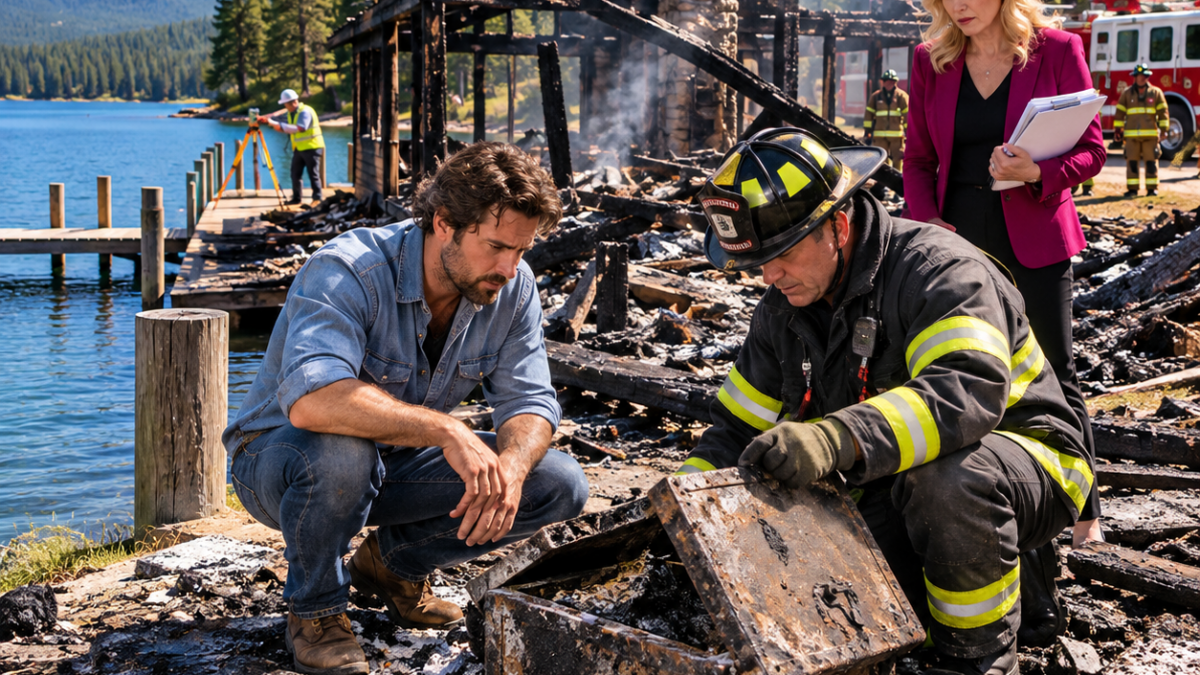
A man knelt near my front entry.
Dark county jacket.
Gloves.
Flashlight.
He wasn’t looking at the charred walls.
He was examining the floor.
I walked as close as the yellow tape allowed.
He noticed.
“Ethan Brooks?”
“Yes.”
He stood.
“Lucas Mercer. State Fire Marshal.”
We shook hands.
“Can you tell me anything?”
“Not yet.”
“Deborah says electrical.”
His eyes shifted toward her.
“Deborah isn’t conducting my investigation.”
Good answer.
He pointed toward several wires melted into the ruins.
“Your electrical panel was on that wall?”
“Yes.”
“Original?”
“Panel was replaced four years ago.”
“By who?”
“Licensed electrician. Permit closed.”
“You have records?”
“Yes.”
“Security system?”
“Four hardwired cameras. DVR in the utility room.”
“Probably gone.”
“Probably.”
He crouched again.
I asked:
“Does it look accidental?”
He stopped.
Didn’t look at me immediately.
Then:
“I’ve been doing fire investigations twenty-three years.”
“Okay.”
“People think fire destroys evidence.”
“Doesn’t it?”
“Sometimes.”
He looked toward the foundation.
“More often it rearranges it.”
I waited.
He lowered his voice.
“I can’t tell you cause yet.”
“Understood.”
“But someone wanted this one to present like an ordinary structure fire.”
My stomach tightened.
“What does that mean?”
Before he answered, Deborah stepped beside us.
“Marshal Mercer.”
Lucas’s face became professionally blank.
Deborah opened her folder.
“The HOA has documentation relating to longstanding safety concerns.”
I almost smiled.
“Of course you do.”
She ignored me.
She handed Mercer several pages.
“Electrical deterioration, structural issues, exterior neglect.”
I stepped closer.
“I never received those.”
“They were mailed.”
“To where?”
“Your address of record.”
“This is my address of record.”
Deborah paused.
“Then perhaps delivery failed.”
“How many notices?”
“Five.”
“Five notices disappeared?”
She looked at Mercer.
“The association did its duty.”
Lucas accepted the papers without endorsing them.
I said:
“Let’s see the dates.”
Deborah held the folder closed.
“Your counsel can request copies.”
“My counsel?”
I hadn’t hired a lawyer.
Then a silver SUV arrived.
A woman around forty climbed out carrying a briefcase.
She walked straight toward me.
“Ethan Brooks?”
“Yes.”
“Olivia Bennett.”
She handed me a card.
PROPERTY RIGHTS & LAND USE.
“I didn’t call you.”
“No.”
“Who did?”
“Someone at the county clerk’s office who thought you might want to know a redevelopment request involving your shoreline was filed at eight fifteen this morning.”
I looked at the ruins.
“What time was the fire reported?”
Lucas answered.
“Approximately five forty.”
I looked at Olivia.
“Three hours.”
“Yes.”
“The house wasn’t even cold.”
“No.”
Deborah said:
“The association acted responsibly.”
Olivia turned.
“By filing redevelopment paperwork on privately owned land?”
“Emergency conditions required action.”
“Whose emergency?”
“The community’s.”
Olivia opened her briefcase.
“Do you have written authority from Mr. Brooks?”
Deborah’s jaw moved slightly.
“There are broader interests.”
“That wasn’t my question.”
Deborah looked at me.
“I would advise you not to let an unfortunate event become an unnecessarily adversarial process.”
There was the threat.
Polite.
Carefully packaged.
I said:
“My house burned down this morning.”
“Yes.”
“And you filed plans for my shoreline before breakfast.”
“Preliminary plans.”
“You brought surveyors.”
“For safety.”
“They’re measuring toward the boat launch.”
Her eyes hardened.
“The association plans ahead.”
Olivia said quietly:
“So do attorneys.”
Deborah closed her folder.
“Our counsel will contact you.”
She walked away.
I watched her shake hands with the man in the navy blazer.
He wasn’t a county official.
Olivia followed my gaze.
“You know him?”
“No.”
She took out her phone.
Snapped a photo from a distance.
“Garrett Vaughn.”
That name I knew.
Anyone involved in western Montana land knew it.
Garrett Vaughn Development Group.
Luxury shoreline projects.
Private marinas.
Vacation homes.
Resort communities.
He had turned three smaller lakes into high-end developments over the previous decade.
He specialized in buying undervalued waterfront parcels, consolidating access, and selling lifestyle.
The phrase his company liked was:
Curated Western Living.
My father would have hated him on principle.
“What is he doing here?”
Olivia stared at the survey stakes.
“That seems like an excellent question.”
The insurance adjuster came that afternoon.
His name was Philip Ross.
Polite.
Sympathetic.
Too careful.
He photographed everything.
Then asked:
“Were you aware of complaints regarding electrical conditions?”
“No.”
He opened a file.
“The HOA submitted notices.”
“I’m not in the HOA.”
“I understand.”
“Do you?”
He sighed.
“My job is to evaluate all potential contributing information.”
“Who gave you the notices?”
“South Ridge.”
“When?”
“This morning.”
Of course.
“What do they say?”
He handed me copies.
I read.
Three letters were supposedly mailed to me.
One claimed exposed wiring near the porch.
Another claimed unauthorized generator installation.
Another claimed exterior fire risk caused by untreated cedar.
The photographs attached were strange.
One showed my porch.
But the date stamp said February.
There should have been three feet of snow.
The photo showed dry grass.
I pointed.
“This timestamp is impossible.”
Philip looked.
His expression changed.
“Why?”
“February ninth. Look at the ground.”
He understood.
I photographed the page.
“Don’t lose that.”
He stiffened.
“I don’t lose records.”
“Good.”
By sunset, I was exhausted enough to feel detached from my own life.
I couldn’t stay at the property.
Deputies maintained the scene.
No utilities.
No roof.
No bed.
No house.
Noah Pierce let me stay at his place.
Noah lived three miles south.
Sixty-three.
Retired equipment operator.
His father had worked on the original reservoir infrastructure decades earlier.
We sat at his kitchen table.
I showed him photos of the survey flags.
He zoomed in.
“These weren’t there Sunday.”
“You’re sure?”
“I drove past your entrance Sunday morning.”
“Survey equipment?”
He looked closer.
“Development crew.”
“How can you tell?”
“Trimble total station. High-end GPS rover. They’re mapping construction boundaries.”
“Not fire damage.”
“No.”
“What would Garrett Vaughn need my shoreline for?”
Noah looked toward the dark window.
“Something he’s building.”
The next morning Olivia and I met at county records.
My deed was clean.
Property boundary exact.
No HOA authority.
No transfer rights.
Then we found Garrett’s filing.
SHORELINE DEVELOPMENT REVIEW.
Submitted at 8:15 a.m.
Applicant:
Vaughn Development Group.
Partnering entity:
South Ridge Lakes Association.
I looked at Olivia.
“Partnering?”
She nodded.
“Keep reading.”
Future marina expansion.
Private docking system.
Commercial boat storage.
Clubhouse.
Improved access road.
I read twice.
“They need my land.”
“Yes.”
“Did I miss a purchase offer?”
“No.”
“Then why is my shoreline inside their preliminary project boundary?”
Olivia tapped a paragraph.
“Because they describe this section as anticipated acquisition.”
“Anticipated by who?”
“No indication.”
I laughed.
Not because it was funny.
Because anger needed somewhere to go.
That evening Garrett Vaughn appeared at the property.
Alone.
Dark SUV.
Expensive watch.
Perfect calm.
I walked toward him before he reached the ruins.
“Mr. Brooks.”
“You know who I am.”
“Everyone knows who owns the best undeveloped shoreline on the south basin.”
“Then you also know it’s not for sale.”
He looked toward the ruins.
“Circumstances change.”
“Not ownership.”
“Sometimes holding onto damaged property becomes financially irrational.”
“My property wasn’t damaged when you drew the marina plan.”
He stopped smiling.
Only for a second.
Then:
“I don’t know what you’re referring to.”
“Good night, Garrett.”
He didn’t move.
“You’re going to have cleanup costs.”
“I have insurance.”
“Insurance can be complicated.”
That sounded less like advice now.
I stepped closer.
“Are you threatening my claim?”
“No.”
“Then what are you doing?”
“Offering perspective.”
“Here’s mine.”
I pointed toward the road.
“Get off my property.”
His smile returned.
“Think carefully before you make this personal.”
“My house is ash.”
I looked at the shoreline stakes.
“You made it personal before I got home.”
He drove away.
Lucas Mercer called the next day.
“Need you at the fire scene.”
I met him near the foundation.
He walked through debris slowly.
Then stopped beside the old utility room.
“Security system.”
“Destroyed.”
“All cameras tied to the DVR?”
I thought.
Then remembered.
Wildlife camera.
Years earlier I’d installed one near the dock after black bears kept getting into a fish-cleaning station.
Battery powered.
Local memory card.
Hidden in a wooden enclosure facing the service path.
I had forgotten it existed.
Lucas and I went down.
The enclosure was scorched on one side.
Camera lens dirty.
Memory card intact.
He bagged it.
At the sheriff’s office, a technician copied the files.
Hours of deer.
Wind.
Boats.
Raccoons.
Then:
Three nights before the fire.
11:47 p.m.
Black SUV.
Entering through the service path.
Two people got out.
First:
Garrett Vaughn.
Second:
Deborah Sinclair.
Nobody spoke.
The recording had no useful audio.
But visuals were enough.
Garrett unrolled a map on the hood.
Deborah pointed along my shoreline.
Then toward the house.
A third vehicle entered.
Contractor truck.
VAUGHN CONSTRUCTION.
Timestamp.
License plate.
Faces.
Lucas paused the video.
“Were they authorized to be here?”
“No.”
“Did either contact you?”
“No.”
Olivia leaned forward.
“This predates every safety filing.”
“Yes.”
Then the video showed something else.
A contractor walked from the truck carrying a measuring wheel.
He traced the distance between my house and a future road alignment.
Garrett photographed it.
Deborah stood beside him.
Intent.
Not to burn.
Not yet.
But to plan.
The deeper Olivia dug, the worse it became.
Six weeks before the fire, Garrett’s firm had completed a preliminary marina concept.
My shoreline appeared in red.
CRITICAL ACQUISITION PARCEL.
A future access road crossed my land.
A marina basin expansion required my boat launch.
The project also depended on the old protected maintenance corridor tied to reservoir infrastructure.
I had always known the easement existed.
I had never understood its strategic importance.
The corridor was the only legally recognized heavy-equipment route to the southern basin control structures.
Without my land, Garrett could build docks.
Maybe houses.
But not the marina configuration he was selling investors.
Not without expensive alternatives and new environmental review.
Olivia placed an old engineering map in front of me.
“Your property is the key.”
“To the marina.”
“To everything.”
“How much is the project worth?”
“Projected buildout?”
“Yes.”
“Eighty to a hundred million, depending on final density.”
I sat back.
My house suddenly seemed tiny.
“They don’t want my home.”
“No.”
“They want the corridor.”
“Yes.”
“And the shoreline.”
“Yes.”
“And if the house becomes a declared hazard…”
“They argue redevelopment serves public safety.”
I stared at the map.
“Create the problem.”
“Then sell the solution.”
Noah brought old maps from his father’s barn.
Original reservoir construction documents.
Same corridor.
Same shoreline.
One handwritten note from 1974:
PRIVATE OWNERSHIP TO REMAIN INDEPENDENT. ACCESS LIMITED TO WATER SYSTEM MAINTENANCE ONLY. NO COMMERCIAL DEVELOPMENT.
That sentence became important later.
At the time, all it did was confirm my instincts.
Deborah called me that evening.
“Ethan.”
“Deborah.”
“You’ve been making accusations.”
“I haven’t publicly accused you of anything.”
“You’ve hired counsel.”
“Yes.”
“You’re interfering with legitimate planning.”
“On my property.”
“The community has substantial interests.”
“Then buy your own shoreline.”
Her voice sharpened.
“You’re making this more difficult than necessary.”
“Did you meet Garrett on my property three nights before the fire?”
Silence.
Long.
Then:
“You should be careful with allegations.”
“That’s not an answer.”
“There are reasonable explanations for site review.”
“At midnight?”
Another silence.
I said:
“Good night.”
“Ethan.”
“What?”
“Everyone eventually realizes when they’re standing in the way of progress.”
I ended the call.
That sentence bothered me more than I wanted to admit.
Not because I feared her.
Because I understood her.
Deborah didn’t think of herself as stealing.
She thought she was advancing something bigger.
The neighborhood.
The marina.
Property values.
Progress.
Once people decide their goal is morally superior, boundaries become obstacles instead of rules.
Olivia filed preservation demands.
HOA emails.
Board minutes.
Developer correspondence.
Financial records.
County complaints.
Survey contracts.
No deletion.
No alteration.
No disposal.
Deborah responded publicly.
Not legally first.
Publicly.
Local community Facebook group.
She never named me directly.
Instead she posted about “abandoned shoreline structures.”
“Environmental risk.”
“Unsafe private parcels affecting shared lake welfare.”
Someone posted a picture of my ruins.
Caption:
SOMETIMES COMMUNITIES HAVE TO MAKE HARD CHOICES.
That made me furious.
I wanted to respond.
Olivia stopped me.
“No.”
“They’re calling my house abandoned.”
“I know.”
“I was gone four days.”
“I know.”
“They’re lying.”
“Yes.”
“Then why am I quiet?”
She looked at me.
“Because they’re not trying to win an argument.”
“What are they doing?”
“Creating a version of you.”
I stopped.
She continued.
“Negligent owner.”
“Absent.”
“Unstable.”
“Obstacle to public safety.”
“If that identity sticks, every aggressive thing they do later appears reasonable.”
“So I just let them?”
“No.”
She tapped the file.
“You replace story with evidence.”
That required patience I didn’t possess.
Noah attended the emergency HOA meeting.
He called afterward.
“She’s good.”
“At lying?”
“At sounding reasonable.”
“What did she say?”
“That your property may require temporary community management.”
I stood.
“What?”
“County intervention if environmental risk increases.”
“Community management of private property?”
“Residents are scared.”
“Of what?”
“She keeps saying runoff from burned materials could affect the lake.”
That concern was not completely absurd.
Post-fire contamination is real.
Which is what made the strategy effective.
Use one legitimate concern to justify ten illegitimate actions.
I hired an independent environmental firm.
Water samples.
Soil testing.
Ash containment.
Temporary erosion barriers.
I paid for cleanup planning myself.
Every report showed risks were manageable.
No emergency takeover needed.
I sent copies to the county.
Deborah escalated anyway.
Emergency property review request.
Temporary restrictions on my shoreline access.
Authority for association contractors to enter.
Olivia read the filing.
“They need time.”
“For what?”
“Your ownership doesn’t disappear.”
“No.”
“But if they establish temporary control during cleanup, Garrett can continue planning.”
“Then delay becomes leverage.”
“Yes.”
The county scheduled a hearing.
Then Lucas called.
Three days before the hearing.
“Come to the property.”
His tone was different.
Focused.
I drove immediately.
He stood near what remained of the utility room.
Folder in hand.
“We have lab results.”
I stopped.
“Electrical?”
“No.”
One word.
My stomach dropped.
“Cause?”
He opened the report.
“Multiple indicators of deliberate ignition.”
I stared.
“Arson.”
“Yes.”
The word felt different from suspicion.
He continued.
“Your wiring was manipulated.”
“How?”
“Several protective elements were bypassed or damaged before ignition.”
“Someone made it look electrical.”
“That appears to have been the intent.”
“What started the fire?”
Lucas removed an evidence bag.
Inside was a charred metal component.
Small.
Twisted.
“Part of a commercially manufactured remote ignition assembly.”
I looked at him.
“You found that under my floor?”
“Near the utility room origin area.”
“Can it be traced?”
“We traced procurement.”
He handed me another page.
Purchasing account:
VAUGHN CONSTRUCTION SERVICES.
I read it twice.
“That doesn’t prove Garrett put it there.”
“No.”
“Could somebody else buy it through the company?”
“Yes.”
“So what does it prove?”
“That an ignition component found at an intentionally set fire on your property was purchased through the account of a company that had surveyed your land before the fire and filed redevelopment documents immediately afterward.”
Lucas looked at me.
“That is enough to change the direction of an investigation.”
Sheriff Daniel Cross joined us.
He had been cautious from the start.
Now he looked angry.
Not dramatic.
Quiet.
“We reviewed Deborah’s emergency filing.”
“And?”
“Several statements conflict with county records.”
“Which?”
“She says your property had been abandoned for months.”
“I was here last week.”
“We know.”
“She claims the HOA possessed redevelopment authority.”
“It doesn’t.”
“We know.”
“She references prior notices.”
“I never got them.”
“We’re investigating the mailing records.”
That became another crack.
The certified-mail numbers on two notices didn’t correspond to my address.
One corresponded to a PO box used by South Ridge itself.
Another tracking number belonged to an unrelated package mailed months earlier.
Fabricated recordkeeping.
Not sophisticated.
Confident.
People do sloppy things when nobody has challenged them for years.
Then came Carol Whitman.
Former HOA treasurer.
She contacted Olivia.
Wanted a private meeting.
Carol was sixty-one.
Retired accountant.
Nervous hands.
She carried a cardboard file box.
“I should have come earlier.”
“Why didn’t you?” I asked.
She looked at Olivia.
Then me.
“Because Deborah knows how to punish people without putting threats in writing.”
“What happened to you?”
“Nothing obvious.”
She opened the box.
“When I questioned the Vaughn payments, suddenly residents filed complaints against my landscaping.”
“Coincidence?”
“No.”
“My husband’s boat slip assignment was revoked.”
“Why?”
“Administrative issue.”
She smiled bitterly.
“My daughter runs a catering company. South Ridge canceled three contracts with her in one week.”
I sat back.
“So you resigned.”
“Yes.”
“What did you keep?”
“Everything I thought she might later deny.”
The box was devastating.
Board notes.
Printed emails.
Bank statements.
Invoices.
Draft contracts.
Eight months before the fire:
SHORELINE ACQUISITION STRATEGY.
My parcel number.
My name.
Objective:
Obtain control or create conditions favorable to transfer.
I looked at Carol.
“What does that mean?”
She swallowed.
“It means they discussed ways to make keeping your property expensive.”
“Who is they?”
“Deborah. Garrett. Two board members. Association counsel attended one meeting.”
“What kind of pressure?”
“Code complaints.”
“Insurance concerns.”
“Environmental review.”
“Access disputes.”
“All before the fire?”
“Yes.”
Then financial records.
Payments from HOA accounts to Garrett-affiliated consulting companies.
“Community planning.”
“Lake improvement assessment.”
“Future shoreline safety.”
Thousands at first.
Then tens of thousands.
Carol tapped one transfer.
“That invoice didn’t match any work.”
“What was it?”
“Thirty-eight thousand dollars.”
“To?”
“Vaughn Planning Services.”
“For?”
“Shoreline feasibility.”
“My shoreline.”
She nodded.
I felt sick.
Three hundred homeowners were paying dues.
Some of that money had financed plans to pressure me off my land.
Then Carol placed a USB drive on the table.
Olivia looked at it.
“What is this?”
“Original meeting audio.”
“The HOA records meetings?”
“Some executive sessions, yes.”
“Why do you have it?”
“Because the version posted to our archive was edited.”
My skin went cold.
“Edited how?”
“Fourteen minutes removed.”
“What was in them?”
Carol looked at me.
“You.”
We played the recording.
Deborah’s voice first.
Calm.
The same tone she used beside my burning house.
“This parcel remains the primary impediment to Phase Two.”
Garrett:
“Brooks has rejected informal interest before.”
Deborah:
“He hasn’t been presented with structured pressure.”
Another board member:
“What does that mean?”
Deborah:
“Code exposure. Insurance. Access compliance. Carrying costs. There are ways to make independent ownership less attractive.”
Then Garrett.
“What we cannot have is another season lost. Investor commitments assume shoreline acquisition this year.”
Someone asked:
“What if he refuses?”
Garrett laughed.
“Everyone sells when holding becomes more expensive than leaving.”
No direct mention of fire.
Not then.
But motive became undeniable.
Later in the same recording:
Deborah:
“If the structure were ever declared unsafe, the county process would accelerate dramatically.”
Silence followed.
Then the board moved to another topic.
I replayed that sentence.
Once.
Twice.
Olivia stopped me.
“Enough.”
“This was eight months before the fire.”
“Yes.”
“She talked about the house becoming unsafe.”
“Yes.”
“Then it burns.”
“Yes.”
“We’re done pretending this is coincidence.”
Olivia nodded.
“Law enforcement gets everything.”
The county hearing arrived before any arrests.
Packed courtroom.
Residents.
Reporters.
HOA members.
Developers.
Deborah wore charcoal.
Garrett navy.
Perfectly composed.
I wore the same boots I used at work.
Olivia told me to buy a suit.
I did.
Still wore the boots.
The HOA attorney spoke first.
Burned property.
Environmental hazards.
Shoreline instability.
Temporary restriction necessary.
Community welfare.
He used photographs of the ruins.
Ash.
Collapsed roof.
Black beams.
No context.
Just destruction.
Then Olivia stood.
“Your Honor, opposing counsel is asking the court to begin after the fire.”
She displayed the marina map.
“We need to begin six weeks before it.”
Date.
Garrett Vaughn Development.
My shoreline marked critical acquisition.
Next:
11:47 p.m. wildlife camera.
Garrett.
Deborah.
Contractor truck.
My land.
Three nights before the fire.
Then:
8:15 a.m. redevelopment filing.
Hours after ignition.
Then my deed.
Historic protected corridor.
No HOA authority.
No commercial marina rights.
Judge Miriam Calloway looked at Deborah.
“Did your association possess written authority from Mr. Brooks to survey his land?”
Deborah’s attorney stood.
“The association believed—”
Judge Calloway raised a hand.
“I asked a narrow question.”
Silence.
“No, Your Honor.”
“Did the association have an ownership interest?”
“No.”
“An easement granting commercial development rights?”
“No.”
“Then explain the survey.”
The lawyer asked for time to respond.
The judge looked unimpressed.
Carol testified.
Her voice shook at first.
Then became steady.
She described pressure.
Hidden payments.
Edited minutes.
Acquisition planning.
Then Olivia played the recording.
You could feel the room changing.
Nobody coughed.
Nobody shifted.
Deborah’s voice filled the courtroom:
“There are ways to make independent ownership less attractive.”
Garrett:
“Everyone sells when holding becomes more expensive than leaving.”
A woman behind me whispered:
“Oh my God.”
Then Lucas Mercer testified.
Fire origin.
Altered protective systems.
Multiple ignition indicators.
Commercial device fragment.
Purchase account.
Vaughn Construction.
Garrett’s attorney attacked chain of custody.
Manufacturer records.
Whether someone else could have obtained the device.
Lucas never exaggerated.
That made him stronger.
“Can you state that Garrett Vaughn personally placed the device?”
“No.”
“Can you state that Deborah Sinclair did?”
“No.”
“So you cannot tell this court who started the fire.”
“Correct.”
The attorney smiled.
Lucas continued before he sat.
“But I can state with professional certainty that this was an intentionally set fire made to resemble an electrical failure.”
The smile vanished.
Olivia didn’t need more for the property hearing.
Judge Calloway denied the HOA request.
Rejected South Ridge authority over my acreage.
Temporarily enjoined any HOA or developer entry onto my shoreline.
Ordered preservation of records.
Reaffirmed my access rights.
Then Olivia stood again.
“We are providing the court and county attorney additional evidence for criminal review.”
That was the first time Deborah lost control.
She turned toward Garrett.
Not toward her attorney.
Garrett looked away.
Tiny movement.
But I saw it.
Outside, reporters crowded the steps.
I said nothing.
Olivia said nothing.
Lucas walked to his truck.
Daniel Cross gave me a look.
“Don’t celebrate yet.”
“I’m not.”
“Good.”
The criminal investigation took months.
That mattered.
Online stories later made it sound like deputies walked out of court and handcuffed everyone.
They didn’t.
Real cases move slowly.
Search warrants.
Bank records.
Phones.
Email servers.
Contractor interviews.
Purchase logs.
Insurance documents.
Vehicle GPS.
Surveillance.
One contractor became important.
Mason Reed.
Forty-one.
Worked for Vaughn Construction as an electrical subcontractor.
His company card purchased the ignition assembly.
At first he denied knowing anything.
Then investigators showed him vehicle-location data.
His work truck had entered my service road the night before the fire.
Not the camera night.
The next night.
2:13 a.m.
He changed his story.
Said he had been sent to inspect an “unsafe electrical panel.”
By who?
Garrett’s operations manager.
Did I authorize?
No.
Did he enter the house?
Yes.
How?
A key.
Whose?
He didn’t know.
Investigators found text messages.
Operations manager to Mason:
Need panel condition documented before county action.
Mason:
Owner aware?
Response:
HOA has authority.
False.
Then a deleted message recovered from his phone:
G wants failure scenario plausible.
That phrase eventually became central.
Mason insisted he believed they wanted evidence of an existing fault, not a fire.
The prosecution later argued he did more.
I don’t know everything that happened.
I wasn’t there.
But evidence continued.
Purchase of ignition equipment.
Cash bonus.
Instructions.
Vehicle GPS.
A disposable phone tied to Garrett’s office connecting near my property the night of the fire.
Then Deborah’s messages.
Not:
Burn the house.
Nothing that clean.
People imagining conspiracies expect villains to write confessions.
Real people use euphemisms.
One message from Deborah to Garrett two days before the fire:
County won’t act without a triggering event.
His reply:
Then timing needs to change.
Another:
Once safety status changes, acquisition path opens.
Her response:
Understood.
That was enough to destroy her claim that she knew nothing about the development pressure.
Whether she knew the precise method of the fire became a matter for prosecutors and eventually a jury.
The HOA board collapsed first.
Residents demanded records.
Emergency meeting.
Deborah tried to preside.
Linda McCarthy, a retired teacher, stood in the second row.
“You knew his land wasn’t ours.”
Deborah answered:
“This is more complex than—”
“No.”
Linda held up my deed copy.
“You knew.”
Other residents followed.
“Why were our dues paying Garrett Vaughn?”
“Why did the board hide the acquisition plan?”
“Why were meeting recordings edited?”
“Why were we told Ethan abandoned his house?”
Deborah lost the vote seven to zero.
Removed.
Interim board installed.
Carol returned temporarily to help reconstruct accounts.
She didn’t want the job.
Residents begged.
She agreed for ninety days.
The new board’s first act was a written statement acknowledging my property had never been subject to HOA authority.
Second:
Withdraw every complaint filed against me.
Third:
Terminate all development agreements with Vaughn.
The marina died that week.
Not because I won a dramatic confrontation.
Because investors hate criminal investigations.
Financing withdrew.
County review suspended.
Environmental permits froze.
Garrett Vaughn’s “curated Western living” brochures disappeared from his website.
My insurance fight was another battle.
The carrier initially questioned whether HOA complaints indicated prior hazards.
Olivia dismantled that.
Fake dates.
Unverified notices.
Closed electrical permits.
Fire marshal arson finding.
Eventually they paid.
Not enough to recreate everything.
Insurance never recreates everything.
My father’s cedar swing was gone.
His old fly rods were burned.
A box of my mother’s letters became wet ash.
Tools melted into shapes I kept for no reason.
Photographs.
Books.
A coffee mug my daughter had painted when she was eight.
Gone.
That is the part revenge stories don’t know what to do with.
Winning doesn’t bring objects back.
Justice doesn’t unburn a house.
You can win every court hearing and still stand in a hotel room at midnight realizing the shirt you want no longer exists because everything you owned smelled like smoke or had become smoke.
My daughter, Claire, was twenty-four then.
She lived in Seattle.
When she flew in, she stood beside the ruins.
Didn’t speak for several minutes.
Then:
“Grandpa’s swing?”
I shook my head.
She cried.
That nearly broke me.
Not the house.
The swing.
My father and I built it in one afternoon when Claire was six.
She used to sit between us.
Three generations.
One stupid cedar swing.
Gone.
“I’m sorry,” I said.
Claire looked at me like I’d said something insane.
“For what?”
“I should’ve—”
“What?”
She turned toward me.
“Been home so you could die too?”
I stopped.
She grabbed my jacket.
“Dad, don’t you dare turn surviving into guilt.”
That line stayed.
Because part of me had been doing exactly that.
What if I hadn’t returned early?
What if I’d been home?
What if the fire started while I slept?
That possibility sat underneath everything.
Garrett didn’t just threaten property.
Whoever set that fire couldn’t know for certain I was gone unless they had tracked me.
Investigators later found emails referencing my Great Falls inspection schedule.
That changed the charges again.
Someone knew.
The criminal trial began eleven months after the fire.
Garrett Vaughn faced conspiracy, arson-related charges, fraud, attempted unlawful acquisition, and filing-related offenses.
Deborah faced conspiracy, fraud, falsification, misuse of HOA funds, and charges tied to her participation in the scheme.
Mason took a plea agreement and testified.
That testimony was brutal.
He described Garrett’s operations manager instructing him to create an electrical-origin scenario.
He claimed Garrett authorized payment.
He said Deborah was present at one planning meeting where “a safety event” was discussed.
Deborah’s attorney attacked him.
Plea deal.
Self-interest.
Liar.
All true enough to raise questions.
Then documents backed parts of his testimony.
Payment.
Texts.
Meeting records.
GPS.
Camera footage.
Carol testified next.
She apologized before answering the first question.
The prosecutor asked why.
She looked toward the jury.
“Because I saw people doing things I knew were wrong before I understood how wrong they could become.”
She explained the hidden fees.
Pressure tactics.
Acquisition plan.
Edited recording.
The defense asked:
“Did Mrs. Sinclair ever tell you to burn Mr. Brooks’s home?”
“No.”
“Did you ever hear her use the word fire?”
“No.”
“Did you ever see her handle an ignition device?”
“No.”
Then the prosecutor asked:
“Did she participate in a plan to create pressure so Mr. Brooks would lose or sell his property?”
“Yes.”
“Did she know the HOA lacked authority over his land?”
“Yes.”
“Did she tell homeowners otherwise?”
“Yes.”
“Did she approve payments connected to the acquisition project?”
“Yes.”
That was the fraud case.
Lucas handled the fire.
Technical.
Precise.
No drama.
Fire patterns.
Material testing.
Electrical reconstruction.
Disabled protection.
Accelerant indicators.
Ignition fragment.
He recreated the sequence without claiming more than evidence supported.
Garrett’s defense offered an expert.
Electrical malfunction possible.
Lucas acknowledged almost anything is theoretically possible.
Then showed why this wasn’t.
Two separate manipulated systems.
Ignition point inconsistent with natural failure.
Commercial component.
Timing.
The defense got quieter.
Deborah took the stand.
That surprised everyone.
She remained polished.
Said she was trying to protect homeowners.
Said Garrett had misrepresented development certainty.
Said she believed the HOA had implied community rights.
Said she never authorized arson.
On direct examination, she almost sounded believable.
Then the prosecutor played her own meeting audio.
“County won’t act without a triggering event.”
She explained:
“I meant a structural failure, environmental report, anything requiring review.”
Then Garrett’s response:
“Then timing needs to change.”
Her:
“Understood.”
Prosecutor:
“What timing?”
She paused.
“Administrative timing.”
“Did you ask?”
“No.”
“Why not?”
“I assumed.”
“What?”
“That he meant planning.”
Then:
“Once safety status changes, acquisition path opens.”
Her own message.
She tried explaining.
The prosecutor didn’t shout.
Didn’t need to.
“Mrs. Sinclair, when Mr. Brooks’s house was still burning, where were you?”
“At the property.”
“Doing what?”
“Assisting residents.”
“Were surveyors there?”
“Yes.”
“Who called them?”
Pause.
“The association.”
“When?”
“I don’t recall.”
“Would reviewing the invoice help?”
Invoice displayed.
Survey mobilization authorized the previous evening.
Before the fire.
The courtroom went still.
That was one of the strongest moments in the case.
Surveyors scheduled before the blaze.
Not after.
Before.
Deborah said it was coincidental shoreline planning.
The jury saw the date.
So did everyone else.
Then the prosecutor showed the emergency redevelopment request.
Draft created the day before the fire.
Submitted 8:15 a.m. after.
Property already described as structurally unsafe.
Before investigators had determined anything.
The story collapsed.
Garrett didn’t testify.
Verdicts came after four days of deliberation.
Not guilty on every count prosecutors wanted.
That is another detail simplified online.
Some charges required proof beyond what existed.
But enough convictions remained.
Garrett was convicted on conspiracy, fraud, arson-related offenses tied to the scheme, and criminal property interference.
Deborah was convicted on conspiracy and fraud-related counts and several document offenses connected to the acquisition effort.
Sentencing came later.
Garrett received years in prison.
Deborah received a shorter sentence.
Restitution.
Civil judgments.
Financial ruin for Garrett’s development entity.
I didn’t feel satisfaction watching them taken away.
I expected to.
Instead I felt tired.
Maybe because punishment is not restoration.
The marina project was permanently denied.
The county reaffirmed the old reservoir corridor.
New land-use rules required clearer title review before shoreline developments could advance.
South Ridge changed.
New president.
New board.
Transparent meetings.
Carol refused permanent office.
Linda McCarthy became president.
The first time she came to my temporary rental, she brought a pie.
I stared at it.
“What is that?”
“Peace offering.”
“We’re not at war.”
“Good. Then dessert.”
She apologized for the HOA.
I told her she didn’t burn my house.
“No.”
“But we believed things we should’ve questioned.”
“That happens.”
“We repeated them.”
“That also happens.”
She looked uncomfortable.
I said:
“Linda.”
“Yes?”
“If you want to make this right, stop acting like the HOA owns things it doesn’t own.”
She smiled.
“We rewrote that policy yesterday.”
Good enough.
I rebuilt.
People expected a mansion.
After everything, reporters assumed I’d build something dramatic.
Glass.
Steel.
Three stories.
Revenge house.
No.
I built cedar again.
Smaller.
One story plus loft.
Metal roof.
Fire-resistant siding treatments.
Defensible space.
Sprinkler system.
Independent water reserve.
Cameras.
Lots of cameras.
Claire helped design the kitchen.
Noah supervised construction despite being retired and despite nobody asking.
He complained about every contractor.
Then brought them lunch.
I rebuilt the dock.
Same footprint.
Same view.
I salvaged one blackened stone from the old fireplace.
It’s set into the new hearth.
Not as a memorial to Garrett.
To my old life.
My father’s swing couldn’t be rebuilt exactly.
So Claire and I made another.
Same design.
We used cedar.
The first evening it hung, we sat together.
She was twenty-five by then.
She kicked her feet like she did as a kid.
“Grandpa would’ve complained.”
“About what?”
“Your measurements.”
“He always complained.”
“Exactly.”
We laughed.
Then cried a little.
That’s rebuilding.
Not replacing.
Carrying forward.
Sheriff Daniel Cross visited after the house was finished.
He stood on the porch.
“Looks good.”
“That’s all?”
“What do you want, architecture commentary?”
“Something.”
“Roof won’t leak.”
“Thank you.”
He walked to the dock.
For a while we watched the lake.
Then he said:
“You know, you could’ve sold.”
“I know.”
“Vaughn’s people would’ve paid a lot after the fire.”
“I know.”
“Why didn’t you?”
I thought about it.
At first the answer would’ve been anger.
Because they wanted it.
Because they tried to take it.
Because leaving would’ve felt like losing.
But years later, the answer was different.
“Because I still like it here.”
Daniel nodded.
“Better reason.”
The first winter in the new house was heavy.
Snow piled against the windows.
The lake froze near shore.
South Ridge was quiet.
One afternoon Deborah wrote to me from prison.
I almost threw the letter away.
Didn’t.
Her handwriting was smaller than I expected.
Ethan,
I don’t expect forgiveness.
I have had too much time to replay the sequence of decisions that led us here.
I told myself I was protecting a community and preserving an investment many families depended on.
That story allowed me to ignore boundaries I would have recognized immediately if the situation involved someone else’s property.
I knew your land was independent.
I knew Garrett needed it.
I knew pressure was being created.
I did not light your home, but I participated in the chain of decisions that made what happened possible.
That is something I can no longer explain away.
I am sorry for your home.
I am sorry for using the association as leverage.
I am sorry for lying to people who trusted me.
You owe me nothing.
Deborah Sinclair
I read it twice.
Then put it in a drawer.
Claire asked:
“You going to respond?”
“No.”
“Why not?”
“I don’t know what to say.”
“Then don’t.”
I didn’t.
Forgiveness is complicated.
People sometimes talk about it like a moral bill you must pay in order to heal.
I don’t believe that.
I stopped wanting Deborah destroyed.
That’s enough for me.
I can understand how she justified herself without absolving what she did.
I can accept her apology without writing back.
Healing does not require friendship with the person who harmed you.
Garrett never apologized.
Years later, one of his former project managers wrote a magazine article about the marina scheme.
He described Garrett as obsessed.
Investors had promised another round of financing if he secured the south basin corridor.
He had millions personally exposed.
Every delay cost money.
My refusal made me not a neighbor.
A number on a spreadsheet.
A bottleneck.
That’s how cruelty becomes easier.
Reduce a person to the obstacle between you and what you want.
My father used to say:
“Most bad engineering begins when someone decides reality should cooperate with the plan.”
Garrett did that with land.
The land wouldn’t cooperate.
So he tried removing the owner.
South Ridge eventually built a smaller community dock on property it actually owned.
Imagine that.
Permits.
Survey.
Purchase agreement.
No fire required.
Linda invited me to the opening.
I went.
Some residents still looked uncomfortable around me.
Others introduced themselves.
One man in his seventies approached.
“I’m Harold.”
“Ethan.”
“I voted for Deborah six times.”
“Okay.”
“I believed what she said about you.”
“Okay.”
He seemed frustrated by my lack of anger.
“I thought your place was abandoned.”
“It wasn’t.”
“I know.”
“Now.”
“Yes.”
He looked toward the water.
“I owe you an apology.”
I nodded.
“Accepted.”
He looked surprised.
“That easy?”
“You didn’t burn my house.”
He laughed nervously.
“No.”
“Then we’re good.”
Not everything needs to stay a war forever.
Carol Whitman became a friend.
She still felt guilty.
Too guilty.
Every time we talked, she returned to the same sentence.
“I should’ve spoken sooner.”
Eventually I told her:
“You spoke.”
“Late.”
“You still spoke.”
“It might’ve prevented the fire.”
“Maybe.”
“That doesn’t bother you?”
“Of course it bothers me.”
She looked down.
“Then how can you not blame me?”
“Because blame isn’t a time machine.”
That shut us both up.
Carol later helped establish a homeowners’ financial transparency group across several lake communities.
She became the person she wished she had been earlier.
That’s more useful than endless shame.
Lucas Mercer retired two years after the trial.
I invited him fishing.
He arrived with equipment organized so perfectly I mocked him.
“You investigate fish before catching them?”
“Fish leave evidence.”
He was terrible at fishing.
Excellent company.
At sunset, we sat on the dock.
I asked:
“When did you know?”
“The fire was set?”
“Yes.”
“First hour.”
“Seriously?”
“Suspected.”
“What gave it away?”
He smiled.
“You’re still trying to make me explain an open-and-shut clue.”
“There wasn’t one?”
“Fire rarely gives one.”
“So what was it?”
“Pattern.”
He pointed toward the new house.
“Things that should’ve failed didn’t.”
“Things that shouldn’t have failed did.”
“Fire moved in ways electricity alone didn’t explain.”
“Then the altered wiring.”
“Then lab work.”
“Then the device.”
I nodded.
“You ever think about what happens if you hadn’t found it?”
“All investigators think about what they miss.”
He looked at me.
“But don’t make the mistake of believing one object solved your case.”
“What did?”
“Everything.”
Camera.
Plans.
Payments.
Emails.
Survey invoice.
Witnesses.
County records.
Fire science.
Motive.
Timeline.
Truth wasn’t one dramatic discovery.
It was a structure.
Evidence supporting evidence.
That felt familiar.
Engineering works the same way.
People online still call it:
THE THING THE FIRE MARSHAL FOUND.
They want one secret hidden in the ashes.
There was one.
The ignition fragment mattered enormously.
But what Lucas really found was something larger.
He found a fire that didn’t behave like the story Deborah had prepared.
That’s where everything opened.
Prepared stories are dangerous.
They make ordinary facts look predetermined.
Unsafe house.
Absent owner.
Community concern.
Responsible HOA.
Helpful developer.
Accidental electrical fire.
Necessary redevelopment.
Neat.
Logical.
All they needed was nobody asking why the surveyors arrived before the smoke cleared.
Why marina plans existed six weeks earlier.
Why Deborah was on my land at midnight.
Why residents had paid Garrett through hidden consulting invoices.
Why “emergency” paperwork was drafted before the emergency.
Why electrical safeguards had been altered.
Why a commercial ignition component purchased through Garrett’s contractor account sat beneath my burned floor.
Ask enough small questions and big lies become very fragile.
I stayed in engineering.
Never became an activist.
Never ran for office.
Never started an anti-HOA channel.
People invited me to speak about property rights.
Sometimes I went.
When I did, I always disappointed the crowd that wanted war stories.
They expected me to say:
Never trust an HOA.
I didn’t.
South Ridge now functions fine.
They expected:
Fight everything.
I didn’t.
Sometimes the other side is correct.
They expected:
Never compromise.
I compromised with the new board on shoreline access, emergency response, wildfire planning, and shared conservation.
What I told them instead was:
“Authority should always be able to show you where it came from.”
If someone says:
We have the right.
Ask for the document.
If they say:
Everyone knows.
Ask for the document.
If they say:
This has always been the arrangement.
Ask for the document.
If they say:
Don’t make this difficult.
That’s when you definitely ask for the document.
Deborah relied on tone.
Garrett relied on money.
Neither was stronger than title records, timelines, and evidence.
My daughter eventually married.
They held the ceremony at the lake.
Small.
Forty people.
She wanted the dock.
I worried about weather for six months.
It was perfect.
No wind.
Late September.
Aspens yellow across the far ridge.
Before walking down the aisle, Claire stood beside the cedar swing.
Touched it.
“You okay?”
I asked.
She nodded.
“Grandpa should be here.”
“I know.”
Then she looked at the new house.
“But this is good.”
“Yeah.”
“It doesn’t feel like the fire house.”
“No.”
“It just feels like home.”
That was when I knew rebuilding was finished.
Not when the contractor handed over keys.
Not when insurance closed the claim.
Not when Garrett was sentenced.
Not when Deborah apologized.
When my daughter stopped seeing ashes.
A few years later, wildfire season became worse across Montana.
South Ridge and I created a shared emergency plan.
My protected reservoir corridor became useful again.
Fire crews could stage.
Draft water.
Access the southern basin.
Exactly the kind of public purpose the original agreement had been designed to preserve.
Garrett wanted to turn that corridor into a luxury marina entrance.
The old engineers had protected it for emergencies.
History has a sense of irony.
During one wildfire, crews used the corridor for forty hours.
At three in the morning, I stood beside a tanker while firefighters filled.
Linda arrived with coffee.
“You know.”
“What?”
“If Garrett had built his marina here, we’d have yachts parked where these trucks are.”
“Terrible trade.”
She smiled.
“Your dad would’ve hated the yachts.”
“You’ve heard too many stories.”
The fire never reached the neighborhood.
Nobody wrote articles.
No dramatic courtroom.
Just infrastructure doing the job it had been protected to do.
That felt better than revenge.
I still keep the orange survey flag from the day I came home.
One.
Pulled from the shoreline after the court order.
It hangs in my workshop next to the burned fireplace stone.
People ask why.
Because that flag was the first thing I noticed.
Before smoke.
Before Deborah.
Before I knew my house was gone.
Someone had already planted a marker on land they expected to control.
That is the image I remember.
Not flames.
A bright orange flag in morning sunlight.
Confidence.
Premature certainty.
The belief that what they wanted would inevitably become theirs.
That’s what destroyed them.
Not me.
Not Lucas.
Not Olivia.
Their own certainty.
They acted early.
Filed too fast.
Surveyed too soon.
Moved money carelessly.
Edited recordings instead of assuming originals might exist.
Prepared emergency paperwork before the emergency.
Scheduled crews before the outcome.
Every act designed to make their plan efficient became evidence of planning.
People ask whether I ever regret not selling.
Sometimes.
On winter mornings when the road needs plowing.
When a pump fails.
When insurance premiums arrive.
When tourists wander down the wrong access trail.
Owning lake property isn’t a permanent vacation.
It is maintenance.
Taxes.
Mud.
Fire risk.
Beavers destroying things.
But then there are mornings.
Coffee.
Fog.
A loon somewhere out on the water.
Sun hitting the mountains.
And I remember the day Garrett told me people hold onto things that no longer serve their future.
He had it backward.
This place didn’t need to serve my future financially.
It needed to remain mine long enough for me to decide what its future should be.
That’s ownership.
Not maximum profit.
Choice.
The right to say yes.
The right to say no.
The right to rebuild a modest cedar house instead of a marina.
The right to sit on a dock without somebody else deciding the land beneath you would produce a better return under another plan.
A home is not valuable only because of what someone can build after removing it.
Deborah understood that eventually.
Garrett never did.
One autumn evening, I found an envelope tucked into the mailbox.
No return address.
Inside was a photocopy of an old South Ridge board memo.
From nearly a decade before Deborah became president.
It said:
Brooks parcel is independent. No HOA authority. Any future shared shoreline project will require voluntary acquisition or easement negotiated directly with owner.
Someone had highlighted one word.
VOLUNTARY.
No note.
I never learned who sent it.
Maybe former board member.
Maybe Carol.
Maybe a resident cleaning old files.
It didn’t matter.
I framed that too.
My workshop is becoming ridiculous.
But I like evidence.
Voluntary.
That one word summarized everything.
They were allowed to ask.
They were allowed to offer money.
They were allowed to negotiate.
They were allowed to explain why a marina might benefit the area.
I was allowed to say no.
Once they decided no was unacceptable, everything after became coercion.
Complaints.
False authority.
Rumors.
Emergency filings.
Fraud.
And finally something that nearly killed me if their assumption about my travel schedule had been wrong.
I do not romanticize that.
There is nothing clever about arson.
Nothing satisfying.
A man could have died.
Firefighters could have been hurt.
Wind could have carried flames into the forest.
Homes across the lake could have burned.
That is what obsession does.
It narrows the world until consequences outside the goal stop feeling real.
Garrett saw marina plans.
Deborah saw community control.
Mason saw a paycheck.
None saw what a fire actually is.
Lucas did.
That’s why his discovery mattered.
Fire does not care about development schedules.
It does not stop neatly at property lines.
It is one of the worst tools anyone can choose to solve a human problem.
The strangest part is that my relationship with South Ridge became better after all of it.
Boundaries clarified.
Emergency agreements updated.
New board.
Transparent finances.
No more mysterious “community concerns.”
If Linda needs access, she calls.
If I need road coordination, I call.
Once, a resident complained that my porch light was too bright.
Linda forwarded the email.
I replied:
NOT IN YOUR HOA.
She wrote back:
I KNOW. I JUST THOUGHT YOU’D ENJOY THIS.
I did.
Some humor survives anything.
Olivia remained my attorney.
Unfortunately.
She bills aggressively.
I tell her she’s worse than the HOA.
She says:
“The HOA tried to steal your land.”
I say:
“You use six-minute billing increments.”
She says:
“Exactly.”
Years after the trial, she brought her husband to the lake for dinner.
We sat on the porch.
He asked:
“Was she always this calm?”
I looked at Olivia.
“During the fire?”
“Yes.”
“No. She threatened everyone politely.”
Olivia rolled her eyes.
“I did not.”
“You threatened to bury Garrett in discovery.”
“That is a normal legal phrase.”
Her husband laughed.
The ordinary evening mattered.
Because for a long time everybody connected to the lake existed in my mind through crisis.
Lucas in ash.
Daniel with warrants.
Olivia with files.
Carol crying in an office.
Linda confronting Deborah.
Noah pointing at maps.
Eventually they became people again.
Dinner.
Fishing.
Birthdays.
Normal.
Trauma shrinks when life grows around it.
Not disappears.
Shrinks.
I still smell smoke sometimes when nothing is burning.
If I come around the road and see orange survey flags for legitimate utility work, my chest tightens before my brain catches up.
The first few years, I woke whenever the security system sent an alert.
Most were deer.
Once a raccoon.
I hated that raccoon.
Therapy helped.
Claire insisted.
I resisted.
Then went.
My therapist asked:
“What would feeling safe look like?”
I said:
“Knowing nobody can burn the house.”
She smiled.
“That’s not possible.”
I hated her immediately.
She continued:
“Safety isn’t certainty nothing bad will happen.”
“What is it?”
“Knowing you can live even though certainty doesn’t exist.”
Not an engineering answer.
Engineers love certainty.
But she was right.
I upgraded fire systems.
Cameras.
Gates.
Lighting.
Insurance.
I did reasonable things.
Then stopped trying to eliminate every possible danger.
That took longer than rebuilding.
On the tenth anniversary of buying the property, I walked the shoreline alone.
Passed the old camera enclosure.
We kept it.
The camera inside is new.
The wooden box remains burned on one corner.
I touched it.
That forgotten camera captured the first evidence anyone could see.
But I don’t think of it as lucky anymore.
Luck is finding twenty dollars.
What happened was preparation accidentally intersecting truth.
I had installed it for deer.
It recorded people.
The fire marshal found evidence because he looked deeper.
Olivia found records because someone called her before the narrative hardened.
Carol kept audio because she was afraid.
Noah kept maps because his father never threw anything away.
Daniel noticed dates didn’t match.
Philip the insurance adjuster didn’t hide the fake notice stamps.
Dozens of small acts of attention.
That is how the truth survived.
Not one hero.
A chain.
Just like the chain of bad decisions that caused everything.
Maybe that’s the final lesson.
People build disasters one compromise at a time.
They also build justice that way.
One person saves a file.
One person asks a question.
One person refuses to edit a report.
One investigator bags a piece of metal instead of dismissing it.
One neighbor says, “Those flags weren’t here last week.”
One clerk notices redevelopment paperwork was filed too soon.
One attorney says, “Don’t get angry. Get documents.”
Then eventually the lie has nowhere left to stand.
My name is still Ethan Brooks.
The lake house stands again.
Cedar walls.
Metal roof.
Wide windows.
My father’s replacement swing on the porch.
Claire’s family visits every summer.
South Ridge still sits beyond the trees.
The marina was never built.
The protected corridor remains protected.
Some evenings, I walk down to the water just before dark.
The lake is usually calm.
The kind of calm Garrett Vaughn wanted to package and sell for millions.
He misunderstood something.
You can sell a view.
You can sell a dock.
You can sell access.
But peace becomes something else the moment you believe you’re entitled to destroy another person’s life to obtain it.
They burned my house because they thought the ashes would make my land easier to take.
Instead, the ashes preserved the evidence that proved what they had done.
They measured my shoreline before the flames went out.
They drafted redevelopment papers before anyone knew the cause.
They planted orange flags while my beams still smoked.
They thought I would be overwhelmed by grief, insurance, county hearings, public rumors, legal fees, and the simple exhaustion of fighting people with more money.
They were almost right about the exhaustion.
There were nights I wanted to leave.
Take the settlement.
Sell.
Never look at the lake again.
Then I would remember the survey stakes.
Not because I needed revenge.
Because selling under pressure would have turned their method into a successful business model.
Burn.
Pressure.
Acquire.
Build.
Profit.
No.
If I ever sold, it would be because I decided to sell.
Not because someone taught me that keeping my own land was too painful.
That distinction was worth fighting for.
One evening, long after the last court filing closed, I sat on the cedar swing with Claire.
Her little boy was asleep inside.
My grandson.
She looked at the water.
“Are you leaving this place to me?”
I smiled.
“That depends.”
“On what?”
“You want it?”
She thought.
“Maybe.”
“Terrible answer.”
“It’s a lot of work.”
“Correct.”
“Property taxes.”
“Yes.”
“Fire risk.”
“Yes.”
“HOA neighbors.”
I looked at her.
“Careful.”
She laughed.
Then became serious.
“What happens if I don’t want it?”
“Then you sell it.”
“Really?”
“Of course.”
“You fought this hard.”
“So I could choose.”
I pointed toward her.
“And so whoever comes after me can choose.”
That was the whole point.
Ownership wasn’t keeping the property forever.
It was protecting the decision from people who thought their money entitled them to make it for us.
Claire leaned against my shoulder.
Across the lake, South Ridge lights came on one by one.
Ordinary homes.
Ordinary people.
Most had never wanted any of this.
They had trusted the wrong leadership.
That mattered too.
Institutions are not the same as every person inside them.
HOA.
Company.
County.
Community.
Those are structures.
People decide what they become.
Deborah used one structure to pressure me.
Linda used the same structure later to repair trust.
Power itself wasn’t the villain.
Unaccountable power was.
The sun disappeared behind the ridge.
Water turned black.
Claire said:
“Grandpa would like this swing.”
“Your grandfather complained about everything I built.”
“He’d still like it.”
“Probably.”
We sat quietly.
The house behind us was different.
The dock was new.
The shoreline had healed.
The cedar trees near the old foundation had grown taller.
There was still one scar in the soil where the heat had been worst.
Grass grew around it.
I never covered it completely.
Not because I want to remember Garrett.
Because I want to remember what survived.
Land.
Truth.
Family.
Choice.
The fire took almost everything inside the walls.
It did not take the deed.
It did not take the reservoir corridor.
It did not take the camera card.
It did not take the records.
It did not take Carol’s USB.
And it did not take my right to stand on that shoreline and say no.
Fire Marshal Lucas Mercer once told me fire rearranges evidence.
I think life does too.
For a while, all I could see was what had burned.
Years later, I can see what the fire accidentally exposed.
Deborah’s hidden deal.
Garrett’s marina.
The false notices.
The prewritten emergency request.
The secret payments.
The edited meetings.
The criminal conspiracy.
None of those things began the morning my house burned.
They were already there.
Hidden.
The fire simply illuminated them badly enough that everyone finally looked.
That is why the strangest thing about the day I came home was never the smoke.
It was the orange survey stakes.
Someone had already decided what would replace me.
They just forgot one thing.
I came home early.
And when I did, the fire was still hot enough to speak.

