HOA Karen Built a 200-Person Festival on My Hay Field Without Permission—So I Turned On 22 Acres of Sprinklers During Her Big Speech
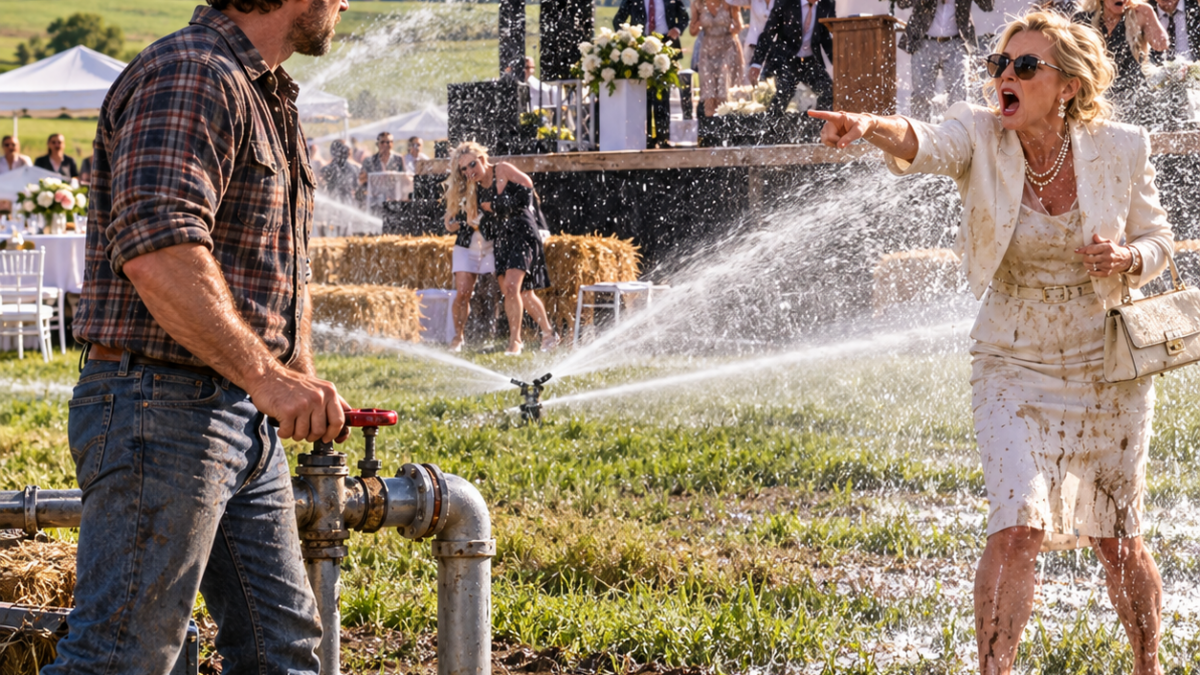
HOA Karen Built a 200-Person Festival on My Hay Field Without Permission—So I Turned On 22 Acres of Sprinklers During Her Big Speech.
The HOA president called me a “peasant” while standing on a full-sized stage her crew had built 112 feet inside my Oklahoma hay field, then ordered me to leave my own land because she said “people like me” didn’t get to interfere with people like her.
What Brenda Hargrove didn’t know was that beneath the grass, my late father had installed twenty-two acres of high-pressure irrigation—and inside his fireproof cabinet was a seventeen-year-old recorded covenant giving me the legal power to stop every large HOA event she had ever approved.
Nine days later, while Brenda stood in a white designer dress before two hundred residents announcing that my stolen field was now the “Ridgeview Community Green,” I pressed one button on my phone, twenty-two sprinkler heads rose from the earth, and the county inspectors arrived before she could finish screaming.
My name is Derek Holloway.
I was forty-four years old when an HOA president decided my family farm was empty enough to steal.
Not buy.
Not lease.
Not ask to borrow.
Steal.
She would never have used that word, of course.
People like Brenda Hargrove rarely do.
They prefer words like community.
Stewardship.
Shared benefit.
Improvement.
Beautification.
Progress.
If you dress theft in enough polite language, some people will applaud while you carry the furniture out.
My family had owned the land outside Collinsville, Oklahoma, since 1963.
My grandfather Earl Holloway bought the original two hundred acres after twenty years of pipeline work.
No inheritance.
No trust fund.
No land company.
Just wages saved until his back hurt too badly to keep welding pipe in summer heat.
The eastern half was scrub and rough pasture when he bought it.
Mesquite.
Blackberry.
Rock.
Clay.
Earl cleared most of it himself.
He dug irrigation trenches with a borrowed backhoe that broke down twice in the first month.
He built fence by hand.
He sank posts until his palms cracked open.
He planted Bermuda grass because a neighbor told him nothing else would survive his mistakes.
It survived anyway.
So did Earl.
My father, Warren, took over in the late eighties.
Dad was less sentimental about farming than Grandpa.
He loved the land, but he loved systems even more.
Pressure gauges.
Pump curves.
Soil reports.
Valve maps.
Maintenance logs.
He modernized everything.
PART2:
Center-pivot irrigation on the main field.
Underground PVC laterals across the South 40.
A four-hundred-foot agricultural well.
A pump station that could move enough water to turn dry Oklahoma grass green in August.
Dad treated that system like a living thing.
Every spring he walked the field before sunrise checking sprinkler heads.
Every fall he drained vulnerable lines.
Every repair was written down.
Date.
Part number.
Pressure reading.
Who did the work.
He once made me redo an entire valve connection because the PVC primer looked sloppy.
“It’ll hold,” I told him.
“That isn’t the point.”
“What is?”
“You either know your work is right or you hope.”
He tightened the valve.
“Hope is expensive.”
That sentence followed me longer than he did.
Dad died eighteen months before Brenda built her stage.
Heart attack.
Kitchen table.
One minute he was complaining that coffee had gotten too expensive.
The next he was gone.
No warning.
No long goodbye.
Just a half-finished cup beside his hand.
He left me eighty acres of the original farm, the equipment, the well rights, and a fireproof filing cabinet full of records going all the way back to Earl’s first deed.
I wasn’t wealthy.
People assumed landowners were.
Most farmers know better.
Land can make you look rich on paper while you’re checking diesel prices before filling the tractor.
I ran forty head of cattle.
Cut hay.
Did equipment repair for neighbors when money got tight.
My twelve-year-old son, Caleb, stayed with me most weekends after his mother and I divorced.
The divorce wasn’t ugly.
That almost made it worse.
No affair.
No betrayal.
Just years of becoming people who worked better apart.
Caleb carried the whole thing more quietly than either of us wanted.
He loved the farm because animals did not ask him which parent he preferred.
The cattle didn’t care about custody schedules.
Neither did fence.
He could sit on the tailgate eating crackers while I repaired a hydraulic line, and nobody needed to discuss feelings unless he wanted to.
That mattered.
Ridgeview Estates came later.
In 2009, Dad sold forty acres on the eastern boundary to a developer named Jim Tully.
Dad hated selling.
But cattle prices had collapsed, Mom needed surgery, and the offer made sense.
He negotiated the deal himself with a real-estate attorney named Gil Patterson.
The boundary was surveyed.
Recorded.
No ambiguity.
Ridgeview eventually grew into a hundred and twenty homes.
Large brick houses.
Three-car garages.
Landscaped entrances.
Decorative stone signs.
Most residents were fine.
Good people.
Accountants.
Teachers.
Nurses.
Sales managers.
A few retirees.
Some kids cut through our fence once chasing a soccer ball.
I returned it.
Their father apologized.
Normal neighbor stuff.
Then Brenda Hargrove became HOA president.
Brenda was fifty-two.
Tall.
Thin.
Blonde highlights maintained on a schedule more reliable than some public utilities.
She drove a white Range Rover that had somehow avoided every speck of mud in Oklahoma.
Designer handbags.
Silk blouses.
Cashmere wraps.
Louboutin heels.
Hermès scarves at board meetings.
If a luxury department store had created a person specifically to be annoyed by agricultural smells, it would have created Brenda.
Her husband had made money in medical equipment distribution.
Enough that she no longer needed a job.
The HOA became the job.
And then the identity.
She started with landscaping standards.
Mailbox rules.
Exterior paint.
Trash-can timing.
Then discovered authority felt good.
That was the dangerous part.
People usually imagine tyrants as angry.
Brenda was pleasant.
Soft voice.
Perfect smile.
She could fine a seventy-eight-year-old widow two hundred dollars for peeling mailbox paint and make it sound like a favor.
“We’re simply protecting everyone’s investment, Mrs. Watkins.”
She would smile while saying it.
Then charge late fees.
She had a particular talent for finding people unlikely to fight back.
Single mothers.
Older residents.
People who worked long hours.
People embarrassed to argue in public.
Her favorite phrase was:
“Rules exist for a reason.”
That phrase became ironic later.
The first time she reached beyond Ridgeview’s actual property, she complained about my tractor.
5:45 a.m.
Hay season.
She called the county.
Agricultural exemption.
Complaint dismissed.
Then cattle odor.
Another complaint.
Dismissed.
Then dust from my gravel road.
Dismissed.
Then my fencing.
She proposed that I install a “decorative vegetative screen” because barbed wire did not reflect Ridgeview’s visual standards.
I replied:
My cattle have not reviewed your visual standards.
She did not find that funny.
That should have been enough warning.
The day I found the stage, I was heading toward the South 40 to check a hydraulic leak on the baler.
I had cut that field twelve days earlier.
Twenty-two acres of coastal Bermuda.
Fresh stubble.
Clean rows.
The kind of field Dad would stand at the edge of and say nothing because silence was his version of praise.
I rounded the gravel bend.
Stopped the truck.
At first I thought I was looking at utility work.
Then I saw folding chairs.
Then lumber.
Then a platform.
Four men were building a stage in the center of my hay field.
Not near the road.
Not accidentally across the line.
Center.
Twenty feet wide.
Twelve deep.
Pressure-treated posts driven into my soil.
Plywood deck.
Steps.
A temporary railing.
Flatbed trailer blocking my tractor access road.
Tire ruts already cutting six inches into the gravel.
White folding chairs stacked nearby.
And Brenda.
White designer sneakers.
Linen pants.
Silk blouse.
Gold bracelet.
Leather planner.
Phone.
She pointed toward my south fence as though directing a hotel renovation.
I sat inside my truck for maybe thirty seconds.
Not because I was afraid.
Because my brain needed time to accept the level of arrogance required to do this.
Then I got out.
Walked across my field.
“Brenda.”
She turned.
“Oh.”
No surprise.
That mattered.
She knew exactly whose land she stood on.
“What are you doing?”
Her smile appeared.
“Derek, sweetheart, we’re setting up for the summer celebration.”
“On my field.”
“Yes.”
I waited for the rest.
It never came.
“You didn’t ask.”
She looked genuinely confused.
“Well, we didn’t think you’d mind.”
“We?”
“The board.”
“Your board voted to use land it doesn’t own?”
She laughed lightly.
“Don’t make it sound so dramatic.”
One worker slowed.
He had heard that.
I looked at the stage.
“You drove posts into my hay field.”
“They’re temporary.”
“You blocked my access road.”
“We’ll repair it.”
“You’re building an event venue on private property.”
Brenda sighed.
Then she looked down at my boots.
Mud.
Manure.
Dust.
Normal farm boots.
Her eyes went to my hands.
Grease beneath two fingernails from equipment work.
Something changed in her face.
Dismissal.
“This field sits empty most of the time.”
I stared at her.
“I baled it twelve days ago.”
“Congratulations.”
She smiled.
“You cut grass.”
One of the workers stopped moving entirely.
Brenda continued.
“The neighborhood needs open space.”
“The neighborhood has open space.”
“Not enough.”
“That isn’t my problem.”
She pushed her sunglasses higher.
“You’re being very provincial.”
“I’m being the owner.”
Then she actually laughed.
“Your land?”
I looked around.
“Yes.”
She gestured toward the subdivision roofs beyond the trees.
“Derek, look at you.”
“What about me?”
“Mud on your boots. Dirt under your nails.”
Her smile sharpened.
“You’re a farmer.”
“Yes.”
“A peasant, basically.”
Silence.
Even the workers heard it.
Brenda stepped closer.
“People like you need to understand when something is bigger than your little operation.”
My jaw tightened.
“People like me.”
“You know what I mean.”
“No.”
She looked toward the stage.
“We’ve sold tickets. We booked entertainment. Food trucks. Children’s activities.”
“How many people?”
“Two hundred.”
“Get it off my field.”
She turned back.
“No.”
One word.
Not shouted.
Not nervous.
Certain.
“The event is nine days away.”
“I don’t care.”
“You want to be the man who ruins summer for a hundred and twenty families?”
“I want you off my land.”
Her voice lowered.
“Don’t embarrass yourself.”
That line stayed with me.
I took my phone out.
Brenda smiled.
“Calling the sheriff?”
“No.”
I started taking photographs.
Stage.
Posts.
Workers.
Truck.
License plates.
Electrical cord.
Brenda.
“What are you doing?”
“Documenting.”
Her smile faded slightly.
“That’s unnecessary.”
“Probably.”
Photo thirty-one.
Thirty-two.
Thirty-three.
I photographed my survey stake.
GPS position.
The stage sat 112 feet inside my boundary.
Not close.
Not debatable.
I took thirty-seven photos.
Then walked back to my truck.
Brenda called after me:
“Be reasonable!”
I turned.
“You have until tomorrow morning to remove it.”
She laughed.
“Or what?”
I looked at her.
“I don’t know yet.”
That was true.
I didn’t rush home and smash anything.
Didn’t pull the posts.
Didn’t cut the stage apart.
Didn’t yell on Facebook.
Dad had taught me something valuable.
When someone else is making mistakes, don’t interrupt until you understand how useful those mistakes might become.
I drove home.
Made iced tea.
Sat at Dad’s old oak desk.
Created a folder on my laptop.
RIDGEVIEW STAGE.
Inside:
Photos.
GPS coordinates.
Survey.
Date.
Time.
Names.
Truck plates.
Then I wrote a factual summary.
No insults.
No emotion.
I emailed Brenda:
You are currently constructing an unpermitted structure on my private agricultural property without consent.
Remove all workers, equipment, and materials no later than 10:00 a.m. tomorrow.
Do not access the parcel again without written authorization.
Derek Holloway.
She replied fourteen minutes later.
The HOA disputes your characterization of the parcel and intends to proceed with the approved community event.
Approved by whom?
No answer.
The next morning the stage was still there.
Bigger.
Railing.
Steps.
Electrical work.
I walked closer.
That was when annoyance became concern.
The temporary orange extension cord was gone.
In its place was bare Romex.
Indoor residential cable.
Strung across an open agricultural field on wooden stakes.
No conduit.
No weather protection.
No GFCI.
It fed a homemade breaker panel screwed to the back of the stage.
Two exposed terminals.
About fourteen inches above grass.
Two hundred people expected.
Children.
Wet summer weather possible.
That wasn’t arrogance anymore.
That was dangerous.
I photographed everything.
Wire markings.
Connections.
Breaker.
Distances.
Then Brenda mailed me a certified letter.
It came from:
RIDGEVIEW ESTATES COMMUNITY STANDARDS OFFICE.
The HOA had no such office.
Brenda had created it.
There was even a crest.
Two crossed gavels.
Laurel wreath.
Beneath it:
EXCELLENCE IN COMMUNITY GOVERNANCE.
I stared at that for a while.
Then laughed.
The letter classified my field as:
NEGLECTED OPEN PARCEL.
It cited:
COMMUNITY BEAUTIFICATION ORDINANCE 14-B.
I knew Ridgeview’s CC&Rs better than Brenda apparently expected.
Section 14-B had nothing to do with neighboring property.
It covered retention-pond maintenance.
She had invented a law.
The letter claimed the HOA had a right of “community access” over unused adjacent land.
There is no such magical doctrine where a subdivision gets to take a farmer’s field because the grass is short.
I added the letter to the file.
Three days later, Brenda posted photos online.
Sunset.
Stage.
Filters.
Caption:
Our community deserves beautiful spaces.
Another:
Building the future together.
Then:
COMING SOON: RIDGEVIEW COMMUNITY GREEN.
Community Green.
My son saw it before I did.
Caleb was sitting beside me in the truck while I checked cattle.
“Dad.”
“Yeah?”
He held up his phone.
“Why are they calling our field their park?”
I took the phone.
There it was.
Ridgeview Summer Celebration.
A Community Tradition Begins Here.
“What does tradition mean?” Caleb asked.
“Usually something you’ve done long enough that people forget who started it.”
“They haven’t done it once.”
“Exactly.”
He watched the stage.
“Are they going to get away with it?”
Kids ask questions adults avoid.
I looked at him.
“No.”
“How do you know?”
“Because it’s ours.”
“But she says it isn’t.”
“Caleb.”
He looked at me.
“Someone saying something loudly doesn’t make it true.”
He nodded.
Then asked:
“Are we going to tear it down?”
“Not yet.”
“Why?”
“Sometimes the smartest thing you can do is let somebody keep digging.”
He smiled.
“Their own grave?”
“Your mother is going to blame me for that phrase.”
The next thing they stole was water.
Dad had installed a digital flow meter years earlier.
I checked it every evening.
Monday usage was more than double normal.
No irrigation scheduled.
No leak at cattle troughs.
I walked the south line.
Found fresh dirt.
Someone had excavated my buried supply.
Cut the PVC.
Installed a T-fitting.
Black polyethylene hose ran from it toward the stage.
Behind the stage sat a portable handwashing station.
Garden hose.
Temporary sink.
They had tapped my agricultural well.
I crouched beside the fitting.
PVC cement still glossy.
Recent.
I measured.
Photographed.
Recorded video.
Four gallons per minute.
Then drove to the sheriff’s office.
Deputy Jarvis Boone took the report.
Young guy.
Maybe thirty.
He kept rereading the address.
“Ridgeview event?”
“Yes.”
“And HOA president is Brenda Hargrove?”
“Yes.”
He exhaled.
“You sure you want this formal?”
“Why wouldn’t I?”
He hesitated.
“She’s… active.”
“That’s one word.”
“Connected.”
“That’s another.”
I slid the photo over.
“Someone cut into a permitted agricultural water line without authorization.”
He looked.
“This is yours?”
“Yes.”
“Registered well?”
“Yes.”
“Property line clear?”
“Yes.”
He sat straighter.
“I’ll file it.”
“Thank you.”
Paper trail.
That was all I wanted.
Brenda came to my house the next afternoon.
Cream blazer.
Gold buttons.
Perfume strong enough to reach the porch before she did.
“Derek.”
“Brenda.”
“I heard you contacted the sheriff.”
“Yes.”
“Over a little water.”
“Over theft.”
She smiled.
“That’s an ugly word.”
“So is trespass.”
“The HOA will reimburse you.”
“How much water did you use?”
Her smile tightened.
“I don’t know.”
“Then how will you reimburse me?”
“It was insignificant.”
“You cut my pipe.”
“Temporary connection.”
“You damaged permitted infrastructure.”
She lowered her voice.
“Do you know how ridiculous you’re being?”
“I do not.”
“This is about neighbors having a nice day.”
“No.”
I pointed toward the field.
“This is about you deciding permission is optional.”
Her eyes hardened.
“You really think you’re going to fight the entire subdivision?”
“No.”
“Then who are you fighting?”
“You.”
That got her.
For the first time, the polished mask disappeared.
“You should be very careful.”
“About what?”
“People can make life difficult.”
I smiled.
“Is that a threat?”
“No.”
She smiled again.
“Advice.”
“Good.”
I opened the door.
“Here’s mine.”
She waited.
“Stop committing things I can photograph.”
She left.
By Wednesday, cars were using my gravel road.
Event volunteers.
Catering van.
Trailer.
One vehicle blocked my tractor gate six hours.
I couldn’t move the baler.
I photographed it.
Measured tire ruts.
Logged lost work.
Thursday night I opened Dad’s fireproof cabinet.
I wasn’t looking for revenge.
I wanted the 2009 deed.
Dad’s folders were labeled by year.
His handwriting leaned left.
TULLY SALE — EAST 40 — 2009.
Underneath:
READ EVERYTHING.
Twice underlined.
Dad rarely underlined once.
I sat at the table.
Sale agreement.
Survey.
Boundary description.
Agricultural buffer covenant.
Drainage easement.
Then the third covenant.
I read it.
Again.
Then a third time.
Any organized gathering exceeding fifty persons on or adjacent to the retained Holloway agricultural parcel required written consent from the owner of said parcel.
Binding upon:
Developer.
Successors.
Lot owners.
Association.
In perpetuity.
Recorded.
Not hidden.
Not informal.
Attached to the original subdivision documents.
Dad had anticipated noise.
Traffic.
Livestock disruption.
Parking.
Liability.
He built consent into the deed before the first Ridgeview home existed.
In the margin he’d written in pencil:
Someday a neighbor will forget whose land built their neighborhood.
This page remembers.
I sat there with both hands on the table.
The house was silent.
Dad had been dead eighteen months.
For one irrational second, I felt like he was sitting across from me.
Not talking.
Just waiting for me to finish reading.
I called Gil Patterson.
Dad’s old friend.
Real-estate attorney.
Sixty-six.
Still practicing.
Gil drove out Friday.
He read everything.
My binder had eighty-seven documented entries by then.
Photos.
Emails.
Fake ordinance.
Water splice.
Sheriff report.
Road damage.
Electrical hazard.
Facebook posts.
Flyers.
Advertisements.
The deed.
Covenant.
Gil drank two cups of coffee.
Then removed his glasses.
“Your father was a pain in the ass.”
I smiled.
“You liked him.”
“That’s why.”
He tapped the covenant.
“This is enforceable.”
“How enforceable?”
“If you wanted, you could seek to stop every HOA event over fifty people held anywhere adjacent to your agricultural parcel until they obtained your written permission.”
“Every one?”
“Based on this language, yes.”
“Block parties?”
“If attendance exceeds fifty and location qualifies.”
“Holiday events?”
“Yes.”
“Bake sales?”
“How big is the bake sale?”
I laughed.
Gil didn’t.
“I’m serious.”
“So Brenda spent six years ruling people with CC&Rs she never read.”
“Apparently.”
I leaned back.
“What do I do?”
Gil pulled out a legal pad.
“First, don’t become Brenda.”
That surprised me.
“What?”
“You have leverage. Don’t confuse leverage with permission to be stupid.”
“Fair.”
“Use the covenant narrowly.”
“To stop the event.”
“Yes.”
Then he reviewed the stage.
“County code.”
Electrical.
“No permit?”
“None.”
“Fire?”
“None.”
“Public event permit?”
“Not that I can find.”
“Expected attendance?”
“Two hundred.”
Gil whistled.
“Single access road?”
“Yes.”
“Blocked by vendors?”
“Already.”
“Children?”
“Face painter and bounce house.”
He stared at the photos of exposed wiring.
“That is your strongest immediate safety issue.”
We mapped the response.
Code enforcement.
Fire marshal.
Sheriff documentation.
Civil demand.
Notice of covenant violation.
Not emotional.
Not theatrical.
Then the sprinklers.
I almost didn’t mention them.
Gil noticed the irrigation map.
“What is that?”
“Dad’s South 40 system.”
“Still active?”
“Yes.”
“Permitted?”
“Yes.”
“Used regularly?”
“Yes.”
“Field in production?”
“Yes.”
“When would you normally irrigate?”
“Depends.”
“Could Saturday be legitimate?”
I looked at him.
“Yes.”
Gil stared.
Then smiled.
“No.”
“What?”
“I know that face.”
“What face?”
“Your father’s.”
He pointed his pen at me.
“I am not advising you to spray an event.”
“Understood.”
“I am advising you that you retain the lawful right to operate permitted agricultural irrigation on your own active field.”
“Understood.”
“What happens to unauthorized personal property left within irrigation coverage is a separate issue.”
“Very understood.”
“Derek.”
“Yes?”
“Don’t electrocute anybody.”
That was the real concern.
Wet field.
Illegal wiring.
We agreed the power hazard had to be addressed first through inspectors and isolation.
I filed the complaints Friday morning.
Rogers County code enforcement.
Fire marshal.
Sheriff update.
I included photos.
Attendance estimate.
Electrical configuration.
Water theft.
Blocked emergency access.
Generator.
Temporary sanitation.
The fire marshal’s office called back.
“Event starts when?”
“Tomorrow.”
“We’ll inspect.”
Code enforcement said the same.
I did not tell Brenda.
Friday evening, I drove past.
The transformation was almost impressive.
Three hundred chairs now.
Two food trucks.
Portable toilets.
Bounce house.
String lights.
Large banner.
WELCOME TO THE RIDGEVIEW COMMUNITY GREEN.
ESTABLISHED 2024.
They had framed it.
A literal sign creating history on my land.
Caleb was in the truck.
He stared.
“They put ‘established.’”
“Yes.”
“Can they establish it just by writing that?”
“No.”
“What if everybody believes them?”
I looked at him.
“That matters socially.”
“Does it matter legally?”
I smiled.
“No.”
He grinned.
“I like legally.”
“So do I.”
Saturday started hot.
Oklahoma August heat.
By nine, vehicles lined the road.
By ten, my field looked like a county fair.
Parents.
Children.
Coolers.
Blue volunteer shirts.
Music.
Food trucks.
The smell of funnel cake and diesel.
I stayed on the north rise.
Not because I wanted families humiliated.
That mattered.
Most residents had no idea.
Brenda told them it was HOA-controlled community space.
They believed their president.
Some had probably never looked at a plat map in their lives.
Why would they?
I did not blame them.
I blamed the person who knew.
At eleven thirty, Brenda climbed onto the stage.
White linen dress.
Gold sandals.
Perfect hair.
Red lipstick.
Wireless microphone.
Leather planner tucked against her hip.
Caleb stood beside my truck.
“You’re really doing it?”
“Irrigation needs to run.”
He laughed.
“Dad.”
“Field’s dry.”
“Dad.”
I looked at him.
“Stay behind the fence.”
He nodded.
I checked the county road.
White code enforcement truck approaching.
Behind it:
Fire marshal vehicle.
Perfect.
Brenda raised the microphone.
“Good morning, Ridgeview!”
Cheers.
She smiled.
“I want to thank all of you for believing in what this community can become.”
More applause.
I started recording.
She continued.
“When I first looked at this beautiful open space…”
I whispered:
“My field.”
Caleb snorted.
“…I knew we had an opportunity.”
The code truck turned in.
Brenda didn’t see it.
“Our families deserve more than houses.”
The fire marshal vehicle followed.
“We deserve community.”
I opened the irrigation app.
Pump station.
Zone South 40.
Manual start.
Brenda lifted one hand.
“This is what happens when people refuse to accept artificial boundaries—”
That sentence decided it.
I pressed START.
Four seconds.
Deep mechanical hum from the pump house.
Pressure built underground.
Then the first head rose.
Pop.
Second.
Third.
A line of sprinklers emerged through the Bermuda stubble.
The back row noticed first.
Cold well water swept across chairs.
People screamed.
Then laughed.
Then moved.
A second arc crossed the food-truck area.
Operators pulled windows shut.
Another stream hit the bounce house.
Kids cheered like I’d built the world’s largest water park.
Parents grabbed phones.
The DJ did not cheer.
Water swept across his equipment area.
Fortunately, the illegal electrical feed had already been shut off minutes earlier by a volunteer after a fire marshal staffer at the gate told them not to energize it.
The speakers went quiet.
Then the big center sprinkler rotated.
Straight toward the stage.
Brenda saw it coming.
Her face changed.
“No.”
The stream hit her across the chest.
Cold well water.
Full pressure.
White linen turned dark and heavy instantly.
Her hair collapsed.
Mascara streaked.
Red lipstick smeared.
Her planner slipped from her hand and hit the wet plywood.
The crowd went silent for maybe one second.
Then chaos.
Brenda screamed:
“TURN IT OFF!”
I stayed by my truck.
The sprinkler rotated away.
Then came back.
“DEREK!”
Another pass.
Caleb covered his mouth.
I said:
“Do not laugh.”
He was shaking.
“I’m not.”
“You absolutely are.”
“I’m trying not to.”
County Code Enforcement officer Dale Rigsby walked onto the field in rubber boots.
Fifty-five.
Bald.
Calm.
The kind of man who had spent twenty years being yelled at by people convinced building codes were personal attacks.
He climbed the stage steps.
“Ma’am.”
Brenda turned.
Water dripping from her hair.
“What?”
“Dale Rigsby, Rogers County Code Enforcement.”
She froze.
“I need your building permit.”
“This is temporary.”
“Structure is approximately two hundred forty square feet.”
“It isn’t a building.”
“Still requires permit under applicable temporary-structure provisions.”
“This is an HOA event.”
“That does not exempt it.”
Brenda pointed at me.
“He turned sprinklers on us!”
Dale looked around.
“This is agricultural land.”
“Yes, but—”
“Active irrigation system?”
I called from the rise.
“Yes.”
“Permitted?”
“Yes.”
“Okay.”
Brenda looked like she might combust.
Captain Tanya Reeves from the fire marshal’s office arrived next.
Compact.
Dark hair.
No patience.
She inspected the stage.
Generator.
Wiring.
Access.
Exit.
Tent fabric.
Food trucks.
Bounce house.
Portable toilets.
Then:
“Who’s responsible for the event?”
Brenda raised one dripping hand.
“I am.”
“Fire permit?”
“This doesn’t need—”
“Event plan?”
“We’re an HOA.”
“Evacuation plan?”
Silence.
“Fire extinguishers?”
One food truck had one.
Stage didn’t.
“First-aid station?”
“No.”
“Secondary access?”
“No.”
“Electrical inspection?”
“No.”
Tanya looked at the field.
More than two hundred people.
Vehicles narrowing road access.
“Event is shut down.”
Brenda stared.
“You can’t shut down a private community event.”
Tanya pointed toward me.
“Is this your property?”
“Yes.”
Then back to Brenda.
“Are you the owner?”
Brenda’s face changed.
“No.”
“Do you have written permission from the owner?”
Silence.
I raised the covenant copy.
“No.”
Dale walked toward me.
“You filed the complaint?”
“Yes.”
“You have ownership documentation?”
I handed him the binder.
Survey.
Deed.
Photos.
He flipped.
Then stopped at the wiring section.
“This was energized?”
“Previously.”
“Who installed it?”
“I don’t know.”
He kept reading.
Water splice.
Road blockage.
Fake HOA letter.
He looked up.
“Mr. Holloway.”
“Yes?”
“I’ve been doing this twenty-two years.”
“Okay.”
“This may be the most organized citizen complaint I’ve ever seen.”
“My father believed in paper.”
“Smart man.”
Brenda approached us.
Mud on her legs.
Dress soaked.
Hair flattened.
She no longer looked rich or poor.
Just furious.
“Derek, shut the water off.”
“It needs to run.”
“Why?”
“Hay.”
“You’re doing this deliberately.”
“Yes.”
That answer surprised her.
I continued.
“I’m deliberately irrigating my agricultural field.”
“You’re humiliating me.”
“No.”
I looked around.
“I’m operating equipment on my property.”
She shook.
“You planned this.”
“Brenda.”
I pointed toward the stage.
“You built a platform on my land after I told you to remove it.”
Then toward the black water hose.
“You cut into my well.”
Then the road.
“You blocked my farm access.”
Then the county officers.
“You advertised a public event without permits.”
Then I held up her certified letter.
“You invented an ordinance.”
People nearby began listening.
Her face lost color.
One man from Ridgeview said:
“What do you mean invented?”
Brenda turned.
“Don’t engage with him.”
I laughed.
The resident stepped closer.
“Brenda.”
She ignored him.
Another resident:
“Is this actually his field?”
Silence.
That question moved through the crowd faster than water.
“Wait.”
“We were told this was HOA land.”
“She said community green.”
“Did we buy this?”
“No.”
“Who owns it?”
I said:
“I do.”
A woman stared at Brenda.
“You told us the HOA had rights.”
Brenda raised both hands.
“There are community access provisions.”
Gil Patterson arrived just then.
Excellent timing.
He walked across the wet grass wearing work boots.
Carrying a folder.
“Which provisions?”
Brenda stared.
“Who are you?”
“Gil Patterson.”
He handed her his card.
“Counsel for Mr. Holloway.”
Her expression collapsed another degree.
Gil opened the file.
“This parcel has never belonged to Ridgeview Estates.”
He showed the plat.
“The agricultural buffer prohibits permanent encroachment.”
Then the event covenant.
“And your association’s own founding documents require Mr. Holloway’s written permission for any organized gathering over fifty persons on or adjacent to this parcel.”
One resident said:
“Our own documents?”
Gil nodded.
“Recorded in 2009.”
Heads turned toward Brenda.
She looked at the paper.
“I’ve never seen that.”
Gil adjusted his glasses.
“That is unfortunate for an HOA president.”
Caleb later told me that was his favorite line.
Deputy Jarvis Boone arrived thirty minutes later.
He spoke with Dale.
Tanya.
Gil.
Me.
Then Brenda.
Formal citations.
Trespass complaint.
Water theft investigation.
Property damage.
Brenda signed each paper silently.
Her handwriting looked nothing like her normal elaborate signature.
Small.
Shaky.
The celebration ended by noon.
The sprinklers ran twenty-four minutes.
Exactly what the field required that week.
I shut them off after irrigation coverage was complete.
People left soaked.
Some angry at me.
More angry at Brenda.
A few apologized on their way out.
One father walked over with two wet kids.
“Mr. Holloway?”
“Yes?”
“I didn’t know.”
“I know.”
“She told us this was association space.”
“I know.”
“My kids didn’t damage anything, did they?”
I looked at two muddy children.
One was holding a ruined cotton candy.
“No.”
He smiled weakly.
“Thank you.”
“For what?”
“Not yelling at us.”
I understood then how easily this could have become the wrong story.
Farmer versus families.
Landowner ruining children’s event.
That was the story Brenda wanted if I resisted too early.
Instead she had given everyone nine days of evidence.
Flyers.
Tickets.
Posts.
Stage.
Water tap.
Fake ordinance.
Her own words.
She didn’t just dig the hole.
She installed lighting.
Cleanup took eight days.
I hired contractors.
Not because Brenda refused immediately.
Because I needed everything removed safely.
Stage dismantled.
Posts pulled.
Electrical wiring removed.
Two underground irrigation couplings had been cracked by steel stakes.
Repair.
$680.
Water line splice.
Licensed plumbing repair.
$420.
Road regrading.
$1,100.
Seed and fertilizer.
$1,400.
Lost hay productivity.
Documented.
Cattle stress from DJ testing.
Minor, but documented.
Generator oil contamination.
Soil remediation.
Portable toilet placement damage.
Every invoice went into the binder.
Gil filed suit.
Defendants:
Brenda Hargrove individually.
Ridgeview Estates HOA.
Travis Hargrove, Brenda’s cousin and attorney.
That part needs explaining.
Three days before the event, I had received a letter from:
LAW OFFICES OF TRAVIS HARGROVE.
Travis practiced DUI defense from a strip mall in Owasso.
He demanded that I recognize permanent recreational access across the South 40.
His letter cited doctrines Gil described as:
“creative to the point of fiction.”
It threatened injunction.
Attorney’s fees.
Potential adverse possession.
Gil laughed for a full minute.
“Adverse possession?”
“Yes.”
“On an actively farmed parcel with fresh hay bales?”
“Apparently.”
“He’s going to have a miserable month.”
The lawsuit sought actual damages.
Trespass.
Water theft.
Property damage.
Easement violation.
Covenant violation.
Attorney’s fees where recoverable.
Punitive damages based on willful conduct.
Initial demand:
$114,000.
Brenda hired a serious Tulsa property lawyer.
He did what good lawyers do.
He read.
All of it.
He reviewed our binder.
Then the recorded covenant.
Then the certified notice I sent nine days before the event.
Then Brenda’s reply refusing to stop.
Then her fabricated ordinance.
Then the sheriff’s report.
Then code violations.
Then fire inspection.
Then her public marketing claiming my land as HOA property.
After that meeting, a neighbor saw Brenda crying in the law-firm parking lot.
I did not celebrate.
Caleb did.
A little.
Settlement came three weeks later.
$87,000.
Brenda personally paid $31,000.
The HOA’s insurer covered part of the remaining loss but issued a nonrenewal notice citing intentional conduct by board leadership.
That mattered.
Homeowners suddenly had a very expensive reason to ask how Brenda had been running things.
An emergency HOA meeting was called.
Ninety-four of one hundred twenty households attended.
Motion:
Remove Brenda Hargrove as president.
Vote:
94 yes.
0 no.
0 abstentions.
Eleven minutes.
Fastest meeting Ridgeview ever held.
Brenda did not attend.
For six years, she had used meetings to embarrass homeowners publicly.
Now the neighborhood removed her without giving her a stage.
There was justice in that I didn’t need to manufacture.
But the part people remember is the sprinkler.
I understand why.
It’s visual.
A white dress.
Perfect hair.
Water.
Mud.
Stage.
Crowd.
People love watching arrogance become wet.
But that wasn’t the victory.
The victory was what happened afterward.
Because I had a choice.
The third covenant gave me enormous leverage.
I could have punished Ridgeview.
No large event near my property without written approval.
Block parties.
Holiday functions.
Community picnics.
Anything qualifying under the covenant.
I could have denied everything.
Forever.
Some neighbors expected that.
One man called me.
“I guess Brenda ruined events for all of us.”
“No.”
“What?”
“Brenda ruined one event.”
“But the covenant—”
“Ask.”
“Ask?”
“For permission.”
Silence.
“You’ll allow them?”
“If they’re reasonable.”
That seemed to confuse people.
Apparently, after being treated badly, you’re expected to become equally difficult so everyone can understand the plot.
I didn’t want Brenda’s role.
I wanted my boundary respected.
Those are different goals.
Three months after settlement, I walked the north edge of my property with Caleb.
There was a clearing beneath several mature pecans.
Higher ground.
Away from hay production.
Easy road access.
No irrigation laterals beneath it.
Caleb looked around.
“What are we doing?”
“Thinking.”
“About what?”
“Pavilion.”
His eyes widened.
“For us?”
“For people.”
“Ridgeview people?”
“Yes.”
He looked suspicious.
“Why?”
“Because they need somewhere to gather.”
“They stole our field.”
“Brenda stole our field.”
“They believed her.”
“Most people believe paperwork with a logo.”
He kicked at dirt.
“You’re not mad?”
“I’m still mad.”
“Then why help?”
I looked toward the South 40.
Green again.
Sprinklers hidden beneath grass.
“Because winning isn’t the same as staying angry.”
Caleb didn’t respond.
At twelve, maybe he understood.
Maybe he didn’t.
I didn’t fully understand either.
We built the pavilion.
Legally.
Imagine that.
Site plan.
Permit.
Concrete slab.
Steel-frame roof rated for Oklahoma wind.
Electrical trench inspected.
Every wire in conduit.
GFCI.
Water connection with proper backflow protection.
Fire extinguishers.
Accessible path.
Parking area.
Four cedar picnic tables.
Stone fire pit.
Trash bins.
No stage.
Caleb asked why.
“Trauma.”
He laughed.
We routed a wooden sign ourselves.
HOLLOWAY COMMUNITY PAVILION.
BUILT FOR NEIGHBORS BY A NEIGHBOR.
Beneath it, smaller:
PRIVATE PROPERTY — ACCESS BY PERMISSION.
That line mattered.
Not because I wanted everyone to feel inferior.
Because good relationships need clear boundaries.
The new Ridgeview HOA president was Linda Chan.
Retired middle-school principal.
Sixty-three.
Short.
Practical.
First time she came to my house, she brought three binders.
“I read everything.”
I stared at her.
“Everything?”
“The CC&Rs.”
“The original deed covenants?”
“Yes.”
“The amendments?”
“Yes.”
“Are you feeling okay?”
She laughed.
“I taught eighth grade thirty-five years. Nothing scares me.”
She asked whether Ridgeview could use the pavilion for a Fourth of July cookout.
“How many people?”
“Maybe one hundred.”
I smiled.
“You know why I’m asking.”
“Yes.”
“Written request?”
She handed me one.
“Insurance certificate?”
Second page.
“Trash plan?”
Third.
“Parking?”
Fourth.
“Fire extinguisher?”
She pointed toward the pavilion.
“You already mounted two.”
I nodded.
“Approved.”
She looked almost disappointed.
“That easy?”
“That easy.”
The first cookout was good.
Forty-two families.
Kids playing tag.
Hamburgers.
Sheet cake.
Caleb ran the drink cooler as if responsible for national security.
Tom Watkins, whose mother Brenda once fined for a mailbox, brought homemade ice cream.
Linda gave a short speech.
No microphone.
Good choice.
She thanked me.
I interrupted.
“Don’t thank me too much. I may charge for ketchup.”
People laughed.
Then something happened I did not expect.
A woman named Rachel Morrison approached.
Single mother.
Two daughters.
She lived three streets into Ridgeview.
“Can I tell you something?”
“Sure.”
“Brenda fined me eight hundred dollars three years ago.”
“For what?”
“Fence stain.”
I stared.
“She said it was the wrong brown.”
Of course she did.
Rachel continued.
“I couldn’t pay immediately.”
“She added fees?”
“Every month.”
“How much total?”
“Almost fourteen hundred.”
I shook my head.
“She threatened a lien.”
“I’m sorry.”
Rachel looked around at the pavilion.
“You know what bothered me most?”
“What?”
“She always made me feel stupid for asking questions.”
That hit.
Because that was the real pattern.
Not lawns.
Not mailboxes.
Not my stage.
Humiliation.
Authority becomes dangerous when the person using it needs other people to feel small.
Brenda called me peasant.
Not because she cared about farming.
Because she needed the hierarchy.
Her above.
Me below.
The sprinklers didn’t change my position.
They only made the illusion visible.
Months passed.
The South 40 recovered.
New Bermuda filled tire ruts.
PVC repaired.
Water usage normalized.
I upgraded Dad’s old cellular irrigation relay.
New controller.
Weather integration.
Pressure alerts.
Caleb helped.
“Can I name zones?”
“No.”
“Why?”
“Because I know you.”
He named one anyway.
Zone Three became:
BRENDA.
I changed it.
He changed it back.
Eventually I stopped trying.
Teenagers understand memorials differently.
Brenda sold her house the following year.
I saw the listing.
Beautiful photographs.
Fresh paint.
Pool.
Three-car garage.
No mention of the HOA scandal.
Real estate brochures rarely say:
Former owner attempted to annex hay field by personality.
Her husband stayed mostly out of the conflict.
People asked why.
Truth was, he and Brenda separated six months after the settlement.
I don’t know why.
Not my business.
I heard she moved to Dallas.
Someone said she joined a condominium board.
I hope that was a joke.
Travis Hargrove received a bar complaint.
He didn’t lose his license.
Gil predicted that.
He spent money defending the letter and accepted a professional reprimand connected to representations made without adequate factual basis.
Gil was delighted.
“He had to write an ethics response.”
“How long?”
“Twenty-two pages.”
I smiled.
“Cruel.”
“No sprinkler required.”
The county used photos from the stage in a temporary-event safety seminar.
Dale Rigsby told me that later.
“Your Romex picture is famous.”
“I always wanted fame.”
“It’s in PowerPoint.”
“Even better.”
Captain Tanya Reeves came to the pavilion once during a community event.
Walked the site.
Checked extinguishers.
Then looked at me.
“You invited me?”
“Linda did.”
“I thought maybe you wanted revenge inspection.”
“No.”
She smiled.
“Shame.”
Caleb got older.
The event became one of those stories kids repeat until details change.
According to one version, Brenda had five hundred guests.
According to another, I activated industrial fire cannons.
One teenager claimed a sprinkler launched Brenda off the stage.
Didn’t happen.
I corrected Caleb once.
He shrugged.
“Legends grow.”
“You’re supposed to stop lies.”
“This one’s fun.”
“Still.”
He eventually told the real version to a girl he brought home when he was sixteen.
I overheard from the porch.
“So Dad waited until she said ‘shared future,’ then hit the button.”
I walked around the corner.
“Irrigation schedule.”
The girl laughed.
Caleb rolled his eyes.
“Sure, Dad.”
Years later, when he applied to Oklahoma State for agricultural engineering, his admissions essay was about irrigation.
Not Brenda.
Dad.
Grandpa.
Pressure systems.
Water efficiency.
He wrote:
My grandfather built land.
My grandfather’s son built systems.
My father taught me systems also protect boundaries.
I read that sentence three times.
Didn’t tell Caleb.
He would’ve been embarrassed.
He got in.
Dad would’ve been unbearable about it.
The pavilion remained.
Ridgeview used it for cookouts.
A retirement party.
Scout meeting.
Holiday toy drive.
Never over fifty without written permission.
Mostly because Linda enjoyed sending forms.
I approved almost all.
One request I denied.
A private company wanted to host a promotional event for luxury landscaping services.
Four hundred attendees.
Vendor tents.
Music.
Vehicle display.
No.
Linda called.
“Reason?”
“It’s agricultural land, not an event venue.”
“Fair.”
No argument.
Imagine.
That is what Brenda never understood.
Permission isn’t humiliation.
Asking does not make you weak.
“No” is not an attack.
Boundaries are not disrespect.
The person hearing no decides whether it becomes conflict.
One evening, Gil and I sat on my porch.
He was seventy by then.
Semi-retired.
He still refused to admit retirement.
The South 40 shimmered green.
Sprinklers running far from the pavilion.
Gil held bourbon.
“Your father would’ve enjoyed the hearing.”
“You think?”
“He would’ve asked me why I settled.”
“Would he?”
“Yes.”
“What would you tell him?”
“That juries are expensive.”
I laughed.
Gil pointed toward the pavilion.
“He would’ve liked that.”
“Caleb says so.”
“Smart kid.”
“He gets that from his mother.”
Gil drank.
“Also Warren.”
We sat.
Then I asked something that had bothered me.
“Did Dad really write that event covenant because he expected this?”
“No.”
“What was he worried about?”
“Tully wanted future community access to the buffer.”
“For parties?”
“Mostly trail systems and seasonal events.”
“So Dad didn’t trust him.”
“Dad trusted contracts.”
Gil looked at me.
“There is a difference.”
He told me the covenant had been negotiated after Dad watched another development swallow a neighboring farmer’s informal access.
Handshakes became assumptions.
Assumptions became “historic use.”
Historic use became lawsuits.
Dad wanted clarity.
Not revenge.
Clarity.
That made sense.
The best legal protection in my story wasn’t a clever trap designed for Brenda.
It was a boring paragraph written seventeen years earlier by a farmer who understood human nature.
People forget.
Documents remember.
I framed Dad’s pencil note.
Someday a neighbor will forget whose land built their neighborhood.
This page remembers.
It hangs above the desk.
Next to Brenda’s fake “Community Standards Office” letter.
The crossed gavels still make me laugh.
Years later, Ridgeview amended its internal governance rules.
Linda asked whether I wanted to review them.
“No.”
“You sure?”
“Yes.”
“You’re basically trauma-qualified.”
“Still no.”
They added provisions requiring legal review before the HOA asserted rights over any parcel outside the recorded subdivision.
Board votes had to cite actual authority.
Good idea.
Financial penalties above a threshold required independent review.
Better.
Homeowners gained clearer appeal procedures.
Rachel Morrison joined the board.
The single mother Brenda once humiliated over fence stain.
She became vice president.
Linda told me:
“She asks too many questions.”
I smiled.
“Perfect.”
The field itself never cared.
That’s another thing farming teaches.
People can spend months arguing over power.
Grass still needs water.
Hay still needs cutting.
Cattle still break fence.
Rain still comes wrong.
The summer after the lawsuit, drought hit.
Real drought.
Not catastrophic.
Bad enough.
My irrigation system ran harder than usual.
Every time the heads rose, I remembered the festival.
At first I laughed.
Then eventually I stopped connecting them.
The sprinklers became sprinklers again.
That’s healing too.
Something dramatic happens.
For a while, an ordinary object holds the memory.
Then time returns it to its real purpose.
Water is water.
A field is a field.
A stage was temporary.
The land remained.
People sometimes tell me:
“You destroyed Brenda.”
No.
I didn’t.
Brenda destroyed her own authority when she decided ownership did not apply to people she considered beneath her.
I documented it.
The county enforced codes.
The fire marshal enforced safety.
The sheriff documented the splice.
Gil used the deed.
The homeowners used their votes.
Everybody played a part.
The sprinklers were just water.
Very well-timed water.
The money from the settlement did not make me rich.
Attorney’s fees.
Repairs.
Lost production.
Taxes.
Equipment upgrades.
I put some into Caleb’s college account.
Some into the pavilion.
Some into replacing an old tractor Dad refused to retire while alive.
The first time I started the new tractor, I heard his voice in my head:
Too much electronics.
He would have hated the touchscreen.
He would have loved the fuel efficiency.
I named it Warren.
Caleb called that sentimental.
I reminded him about Zone Brenda.
He stopped.
A few summers later, one of the original stage workers found me at a farm-supply store.
His name was Mike.
I recognized him.
He looked uncomfortable.
“Mr. Holloway?”
“Derek.”
“I’ve wanted to apologize.”
“For what?”
“The stage.”
“You were hired.”
“We knew something was weird.”
“How weird?”
He rubbed his neck.
“Brenda told us the HOA owned the field.”
“Okay.”
“Then you showed up.”
“And?”
“She told us you were a disgruntled tenant farmer.”
I laughed so hard a cashier looked over.
“Tenant?”
“That’s what she said.”
“On my own farm.”
“Yeah.”
Mike smiled awkwardly.
“We should’ve stopped.”
“Probably.”
“She doubled the labor rate.”
“There it is.”
He nodded.
“I needed the job.”
I understood.
There is a difference between understanding and approving.
“Don’t build on somebody else’s land next time.”
“I won’t.”
We shook hands.
That conversation mattered.
Because villains are rarely entire crews.
Sometimes people follow bad instructions because rent is due.
That doesn’t erase responsibility.
But life becomes easier when you stop flattening everyone into teams.
Brenda.
Workers.
Homeowners.
Inspectors.
Me.
Caleb.
We all had choices.
Different leverage.
Different knowledge.
Different consequences.
The reason I respected Linda later was simple.
She used authority without needing people afraid of her.
At one board meeting, a resident yelled about a parking rule.
Linda waited.
Then said:
“Would you like the rule changed or would you like to yell?”
The man stopped.
“Changed.”
“Good. Sit down and we’ll discuss it.”
That is leadership.
Not domination.
My father never ran an HOA.
Thank God.
But he understood the same principle.
A fence does not insult the neighbor.
It tells both people where responsibility changes hands.
When the boundary is clear, cooperation becomes easier.
Years after the summer celebration, I added a second pavilion.
Smaller.
Near the cattle pond.
Caleb came home from college to help.
We set posts.
Measured twice.
He corrected my level.
I told him it was fine.
He said:
“You either know your work is right or you hope.”
I stared.
“Did you just use Grandpa against me?”
“Yes.”
“Get off my property.”
He laughed.
“I’m family.”
“Temporary status.”
At sunset, we sat on the tailgate.
He asked:
“You ever wish you’d just ripped the stage down the first day?”
I thought.
“No.”
“Really?”
“Maybe for five minutes.”
“Why not?”
“Because then Brenda would’ve told everyone I destroyed community property.”
“It wasn’t.”
“Didn’t matter.”
“So you let her expose herself.”
“Yes.”
He nodded.
“That’s kind of evil.”
“No.”
“Strategic evil.”
I smiled.
“Documentation.”
“Same thing, but boring.”
He wasn’t wrong.
If I had torn the stage down immediately, there would have been an argument.
My word.
Her word.
Angry farmer.
Beloved HOA event.
By letting the facts accumulate, the dispute became something else.
Stage.
Fake law.
Water theft.
Road damage.
Unsafe electrical.
Ticket sales.
Event covenant.
Formal notice.
Public refusal.
She made intent obvious.
Patience didn’t create her misconduct.
It simply gave misconduct room to become undeniable.
That’s a lesson I use beyond property disputes.
When someone is unreasonable, the instinct is to interrupt.
Correct.
Argue.
Sometimes you should.
Sometimes the stronger move is:
Ask one clear question.
State one clear boundary.
Document the answer.
Then let them choose.
Brenda chose.
Again.
And again.
And again.
She told me to leave my own land.
She called me peasant.
She built anyway.
She stole water.
She invented authority.
She branded the field.
She sold tickets.
She ignored safety.
She ignored the covenant.
By Saturday, I barely needed to make a case.
She had built one herself.
Literally.
On plywood.
One spring morning, almost ten years after Dad died, I walked the South 40 before sunrise.
Caleb was away working an irrigation-design internship.
Cattle quiet.
Dew on Bermuda.
The old sprinkler heads sat invisible beneath the grass.
I stopped where Brenda’s stage had been.
You couldn’t tell.
No scar.
No foundation.
No sign.
Just hay.
That moved me more than I expected.
Human beings think our conflicts leave permanent marks.
Sometimes they don’t.
Sometimes grass grows back.
I crouched.
Pulled one blade between my fingers.
Healthy.
Dad would’ve checked root depth.
I just smiled.
Then the irrigation kicked on automatically.
One head rose twenty yards away.
Another.
Water crossed the field in silver arcs under sunrise.
For one second I could see Brenda again.
White dress.
Mascara.
Rage.
Then the memory faded.
Dad’s system.
Dad’s field.
My responsibility.
Caleb’s future, if he wanted it.
That was bigger.
The next Ridgeview summer celebration happened at the pavilion.
Legally.
Permit where needed.
Insurance.
Trash plan.
No stolen water.
Attendance 118.
Linda asked permission six weeks in advance.
I signed.
The event began at five.
I grilled.
No speeches longer than three minutes.
That was my rule.
At sunset, a kid pulled the wrong valve near the outdoor hose bib.
A sprinkler on the edge of the pavilion came on unexpectedly.
Water sprayed six adults.
Everyone froze.
Then laughed.
Linda looked at me.
“Did you do that?”
“No.”
“Sure?”
“Linda.”
She pointed.
“Historical pattern.”
I laughed.
The water got shut off.
Nobody sued anybody.
Progress.
There is a framed photograph in the pavilion now.
Not Brenda soaked.
I refused that.
Linda wanted local history.
We used a photo of Grandpa Earl standing beside the original pasture in 1964.
Young.
Lean.
Work shirt.
Fence posts behind him.
Below it:
HOLLOWAY FARM
EST. 1963
PRIVATE LAND SHARED BY PERMISSION, NEIGHBORSHIP, AND RESPECT.
That is the whole story in one sentence.
Private.
Shared.
Permission.
Respect.
Those words can coexist.
Brenda thought private meant selfish unless she controlled it.
She was wrong.
I share more of the farm with Ridgeview now than I ever did when she was president.
Kids visit during calving.
Families use the pavilion.
The HOA sponsors a hayride every October.
They ask.
I say yes.
Sometimes no.
Nobody dies.
Nobody becomes a peasant.
Nobody needs a decorative crest.
I still have the fake letter.
Caleb says I should donate it to a museum of “weaponized suburban nonsense.”
Maybe someday.
For now it stays in Dad’s cabinet.
Behind the real deeds.
Behind the real covenants.
Behind the survey.
Exactly where it belongs.
A fake authority sitting behind actual authority.
Small.
Paper-thin.
Harmless once exposed.
If you ask what I felt at 11:47 that Saturday when I pressed the green button, I’ll tell you the truth.
Satisfaction.
Absolutely.
I’m not going to pretend I was above it.
Brenda had stood on my land, insulted my work, mocked my father’s legacy without knowing she was doing it, lied to neighbors, stolen water, blocked my farm road, endangered children with electrical shortcuts, and announced my hay field as her creation.
Watching water erase her perfect stage moment felt good.
But satisfaction wasn’t the important feeling.
Relief was.
Because right behind her, county vehicles were entering the field.
Paperwork was arriving with boots on.
Authority she could not invent.
Rules she could not rewrite.
For days she had tried to make me feel powerless by pretending her title outranked my deed.
Then one inspector asked for a permit.
She didn’t have one.
One fire marshal asked for a safety plan.
She didn’t have one.
One deputy asked about the water splice.
She couldn’t explain it.
One attorney opened the recorded covenant.
She had never read it.
That was the real collapse.
Not makeup.
Not hair.
Not linen.
Certainty.
Her certainty washed away.
Years later, Caleb asked me what Grandpa would have thought.
I said:
“He’d be angry about the broken irrigation couplings.”
Caleb laughed.
“Not Brenda?”
“Dad would consider Brenda temporary.”
“What about the sprinklers?”
“He’d say twenty-four minutes wasn’t enough in August.”
That is probably true.
Dad measured rainfall.
Not drama.
I think that is why his records saved me.
He never documented things because he expected a villain.
He documented because facts are easier to protect before conflict begins.
Surveys.
Deeds.
Water rights.
Maintenance logs.
Covenants.
Boring things.
Until the day they aren’t.
The strongest weapon I had was not the pump.
It was a paragraph signed in 2009.
The strongest move I made was not pressing START.
It was taking thirty-seven photographs instead of shouting.
The strongest consequence Brenda faced was not public embarrassment.
It was ninety-four homeowners deciding they no longer trusted her.
And the best revenge wasn’t the settlement.
It was building something legal on my own land and inviting those same neighbors to use it.
Because that proved the point she never understood.
I was never against community.
I was against theft disguised as community.
There is a difference.
Today the South 40 still produces hay.
The irrigation system still runs.
The road is repaired.
The cattle still bunch near the shade when summer gets brutal.
Caleb is grown now.
He comes home and argues that my pump system could be thirty percent more efficient with variable-frequency drives.
He’s probably right.
I don’t tell him that.
Not immediately.
Some traditions deserve preservation.
Ridgeview still exists.
New houses.
New residents.
New board members.
The HOA pavilion calendar is busier than I expected.
Every large event request comes in writing.
Every one starts:
Dear Mr. Holloway,
We respectfully request permission…
That wording still makes me smile.
Not because I need them submissive.
Because I know everyone understands the line.
There is peace in that.
No confusion.
No assumption.
No one waking up one morning to find a stage in their field.
Sometimes I walk out before sunrise and stand where Brenda once held that microphone.
No marker.
No sign.
Nothing commemorates her.
Only grass.
That’s appropriate.
She tried to manufacture a tradition by naming land that wasn’t hers.
The land refused to remember.
It remembered my grandfather.
My father.
The irrigation lines.
The cuts.
The cattle.
Caleb’s childhood.
Rain.
Drought.
Work.
Real history is stubborn that way.
You don’t create it with a banner.
You earn it by staying.
And every sprinkler head is still buried right where Dad put it.
Quiet.
Legal.
Ready.
Which is exactly how he taught me power should be.

