HOA Karen Brought 30 People Onto My Farm for a “Community Picnic”—Then the Gate Closed and 35 Bulls Made Her Rethink Who the Land Belonged To.
PART2:
He said it about women too, though that was usually after two beers and a lecture I wished he’d stop giving.
The principle was simple.
Boundaries work when people respect them before consequences are necessary.
For most of my life, the land around our farm was other farmland.
Soybeans east.
Hay to the north.
An old orchard on the ridge.
Then the orchard sold.
Bulldozers appeared.
Roads appeared.
Utility crews.
Concrete.
Within two years, Willowbrook Estates rose on the far side of my north fence like somebody had planted houses overnight.
Honey colored siding.
Matching mailboxes.
Curving sidewalks.
Perfect little lawns with landscaping stones arranged as though nature had received architectural approval.
At first, I didn’t mind.
Most of the new homeowners were decent.
Some waved.
A few brought their kids to the fence and asked if they could see the cattle.
When they asked, I usually said yes.
One retired couple bought eggs from me.
A young man named Nate rented the last house on the cul de sac and occasionally came over for beer after work.
There are good suburban neighbors.
There are good farmers.
There are idiots in both places.
Then I met Karen.
I never learned her last name at first because she introduced herself as though one word should be enough.
“Karen. HOA president.”
PART3:
She said it the first time we met while leaning over my north fence.
Mid forties.
Blonde hair shaped into a helmet.
Large sunglasses.
White manicure.
Tan that looked professionally maintained.
She was wearing shoes that cost more than my work boots and would have lasted about nine minutes in manure.
Her eyes moved from the farmhouse to the barn to my old Ford parked beside the equipment shed.
“You know,” she said, “if you joined Willowbrook, we could help you modernize this whole rustic aesthetic.”
I looked at her.
“This is a farm.”
“I understand.”
“Do you?”
She smiled.
“What I mean is the subdivision could potentially incorporate your frontage into our landscaping plan.”
“My frontage?”
“The northern meadow.”
“That is hay ground.”
“It looks unused.”
“It isn’t.”
“There are no animals in it.”
“Today.”
She glanced behind her toward Willowbrook.
“That strip would make a beautiful passive recreation area.”
I had never heard a field insulted so politely.
“It’s not recreation area.”
“It could be.”
“No.”
“You haven’t heard what I’m proposing.”
“I heard enough.”
Her smile tightened.
“This community is going to surround you eventually.”
“Maybe.”
“You’ll benefit from being cooperative.”
“I am cooperative.”
She looked at fence.
“Doesn’t feel that way.”
I pointed at gate thirty yards down.
“You’re standing on your side. I’m standing on mine. That’s neighbors cooperating.”
That should have been the end of it.
It was the beginning.
A week later, I received an envelope from Willowbrook Estates Homeowners Association.
Not a legal notice.
Not exactly.
A “Community Compatibility Request.”
It asked me to stop storing equipment visible from Willowbrook, mow my north field more frequently, and consider replacing the barbed-wire section along the subdivision boundary with “decorative ranch-style fencing.”
Decorative ranch-style fencing.
There is fencing that holds livestock.
Then there is fencing that photographs well.
They are not always the same fence.
I called the number.
Karen answered.
“You got our letter.”
“I did.”
“What do you think?”
“I think my tractor doesn’t care whether your residents can see it.”
“This is about property values.”
“My tractor has property value.”
“Cole.”
“No.”
There was a pause.
“You know, there’s no reason this has to become adversarial.”
“I agree.”
“Good.”
“Stop mailing me rules.”
Another pause.
“You’re difficult.”
“My wife used to say that.”
That conversation bought me about a month.
Then Willowbrook opened a pedestrian gate in its southern perimeter fence.
Facing my north meadow.
I noticed one morning because three women in matching workout clothes stepped through it carrying water bottles.
I was on my tractor.
They walked maybe seventy yards into my field before I drove over.
I shut the tractor down.
“Morning.”
One woman smiled.
“Morning.”
“You ladies lost?”
“No. We’re just doing the loop.”
“What loop?”
“The greenbelt.”
I looked around.
“My hay field?”
She laughed.
“No, the Willowbrook nature path.”
“There isn’t a Willowbrook nature path here.”
Their smiles disappeared.
One woman held up her phone.
“The map shows it.”
She showed me Willowbrook’s resident app.
There, in pale green, was a looping line through the edge of my property.
FUTURE COMMUNITY GREENWAY
I stared.
“Future.”
She looked.
Then embarrassed.
“Oh.”
“Also community?”
She nodded slowly.
“Not currently.”
I walked them back to the gate.
Nobody argued.
They apologized.
I called Karen.
“What greenway?”
“It is an aspirational amenity.”
“On my farm.”
“It follows an existing open-space corridor.”
“It follows my field.”
“We were told the developer had a historical access arrangement.”
“With who?”
“The previous owner.”
“My family has owned this since 1954.”
Silence.
Then:
“I’ll check.”
The gate stayed.
The map stayed.
People kept coming.
Not daily.
Enough.
Joggers.
Dog walkers.
A father with two kids.
A teenager on electric scooter.
Every one said some version of:
“We thought this was Willowbrook.”
I put up signs.
PRIVATE FARM
NO PUBLIC ACCESS
LIVESTOCK AREA
DO NOT ENTER WITHOUT PERMISSION
Karen complained the signs were “aggressive.”
I added another.
PLEASE CLOSE GATE
That one was for everyone.
Including her.
The first real picnic happened in April.
Saturday.
Warm.
Wind light.
I was repairing a hydraulic line behind barn when I heard music.
Not distant neighborhood music.
Close.
I walked north.
Twenty people were in my meadow.
Blankets.
Coolers.
Folding chairs.
Children throwing a foam football.
Two dogs.
Karen stood beside a folding table with pitchers of lemonade.
She waved.
“Cole!”
Like I had arrived at her event.
“What is this?”
“Spring neighborhood social.”
“On my farm?”
She lowered sunglasses.
“This is the greenbelt.”
“No. It isn’t.”
“You need to relax.”
“Everyone needs to leave.”
A few people heard.
Conversation quieted.
Karen smiled the way people do when they want an audience to believe only one person is behaving strangely.
“We aren’t hurting anything.”
“You’re trespassing.”
“Cole.”
“There are cattle facilities fifty yards south.”
“No cattle are here.”
“Right now.”
A father started gathering toys.
Good instincts.
Karen spread both hands.
“The HOA has represented this space as shared open area since Willowbrook was developed.”
“Then HOA represented it wrong.”
“You can’t suddenly close something residents have been using.”
“They’ve been using it because you opened a gate in your fence.”
She laughed.
“Your father let people cross here years ago.”
“My father let the Orchard family cut through during harvest.”
“There you go.”
“No.”
“That’s historical use.”
“That is neighbor permission.”
People started packing.
Karen saw she was losing audience.
“This is exactly why communities struggle with legacy landowners.”
I stared.
“Legacy landowner?”
“You know what I mean.”
“I do.”
I pulled out my phone.
“I’m documenting names and vehicles. I’m also sending written notice Monday that neither you nor Willowbrook has permission to enter this pasture.”
Her face changed.
“You’re threatening residents.”
“No. I’m informing them.”
One older man stood.
“Karen, you said HOA owned this.”
She answered quickly.
“The association has usage rights.”
I looked at him.
“No, it doesn’t.”
He packed his chair.
Within ten minutes, almost everybody left.
Karen was last.
She picked up her cooler.
At gate she turned.
“You’re making a huge issue out of nothing.”
I pointed to sign.
“Ask first.”
She shook her head.
Then left gate open.
Of course.
I closed it.
Monday, I called a lawyer.
Not because twenty people had sat on grass.
Because Karen had said:
usage rights.
My attorney was a woman named Gloria Chen.
Real estate and agricultural law.
Gloria had grown up on a dairy farm and therefore had almost no patience for people who treated fences as decorative suggestions.
She checked deed.
Subdivision plat.
Title report.
County records.
No easement.
No recreational license.
No access agreement.
No greenway dedication.
Nothing.
The old orchard owners had once possessed a handwritten permission note from my father allowing seasonal wagon access across a corner for two harvest years.
It specifically said:
Permission is temporary and creates no permanent right.
Dad.
Of course.
Ask first.
Step second.
Gloria sent Willowbrook a letter.
Simple.
The Patton farm is private.
No HOA access rights.
The resident gate must not be used for entry onto Patton property.
No events.
No walking trail.
No implied easement.
Any future entry after written notice may be treated as trespass.
Willowbrook’s lawyer replied.
This is where story could have ended.
The lawyer was reasonable.
He acknowledged no recorded easement.
Recommended residents be told not to enter.
Said gate should remain locked or marked.
I relaxed.
Karen didn’t.
Three days later, a new sign appeared on Willowbrook’s side.
WILLOWBROOK GREENBELT ACCESS
I photographed.
Sent Gloria.
She sent Willowbrook counsel.
Counsel’s response:
We did not approve this sign.
Interesting.
Then Karen emailed me personally.
You cannot revoke community access unilaterally after years of established recreational use.
Years?
Willowbrook was barely three.
I responded through Gloria only.
That is another thing farmers learn late:
When someone wants legal conflict, stop giving them free sentences.
The sign disappeared.
The gate was zip-tied shut.
For two weeks.
Then cut.
People stopped coming mostly.
I thought maybe lawyers had succeeded.
Then one Thursday Nate knocked on my door.
“Cole.”
“What?”
“You know there’s an HOA picnic Saturday?”
“Probably.”
“In your field.”
I stopped.
“What?”
He showed me resident newsletter.
WILLOWBROOK FOUNDERS DAY FAMILY PICNIC
Saturday 10 a.m.–3 p.m.
Location:
South Greenbelt Meadow
Activities:
Bounce house.
Food truck.
Cornhole.
Family games.
Beer and wine garden.
HOA president address at noon.
I stared.
“South Greenbelt Meadow” was my north pasture.
I recognized photograph.
Mine.
Taken from Willowbrook side.
“Karen told everybody access dispute was resolved.”
“It wasn’t.”
“She’s telling people HOA counsel confirmed community rights.”
“He didn’t.”
Nate rubbed his neck.
“You should probably know vendors are coming through service lane at eight.”
I called Gloria.
She went very quiet.
Then:
“Don’t confront thirty people by yourself.”
“I wasn’t planning.”
“You were.”
“I was planning something.”
“Cole.”
“What?”
“Call sheriff non-emergency now. Send event flyer, our notice, their counsel’s acknowledgment. Ask for a deputy to be aware of possible trespass Saturday.”
“Okay.”
“Call Karen?”
“No. Written notice.”
We sent same day.
To Karen.
HOA manager.
HOA attorney.
Board members.
Food-truck vendor if we could identify.
Bounce-house company.
The letter said the advertised location was private agricultural property with active livestock operations and no permission had been granted.
Any event must be relocated.
The bounce-house company called me Friday.
“Mr. Patton?”
“Yes.”
“We got notice.”
“Good.”
“HOA says you are mistaken.”
“They can put bounce house on HOA land.”
“We just need owner authorization.”
“You don’t have mine.”
They canceled.
Or I thought they did.
Karen found another vendor.
Saturday morning, I had work.
This is the part that matters.
I was not sitting behind barn waiting with thirty-five bulls like some kind of rural supervillain.
We had planned a livestock move for that day two weeks earlier.
The east pasture needed rest.
The bulls were being moved through a central handling lane into the north holding section for veterinary checks, then into a different paddock.
That process involves gates.
A lot of gates.
Some open.
Some closed.
All deliberate.
At 8:20, my farmhand Miguel arrived.
Forty-one.
Worked with me eight years.
He knew the farm better than half my family.
At 8:35, a food truck drove through Willowbrook’s pedestrian/service opening because somebody had removed temporary bollards.
Then a pickup towing bounce house.
Then cars.
Miguel called from tractor.
“Cole.”
“Yes.”
“You got a party?”
“No.”
“Then you got a problem.”
I drove north.
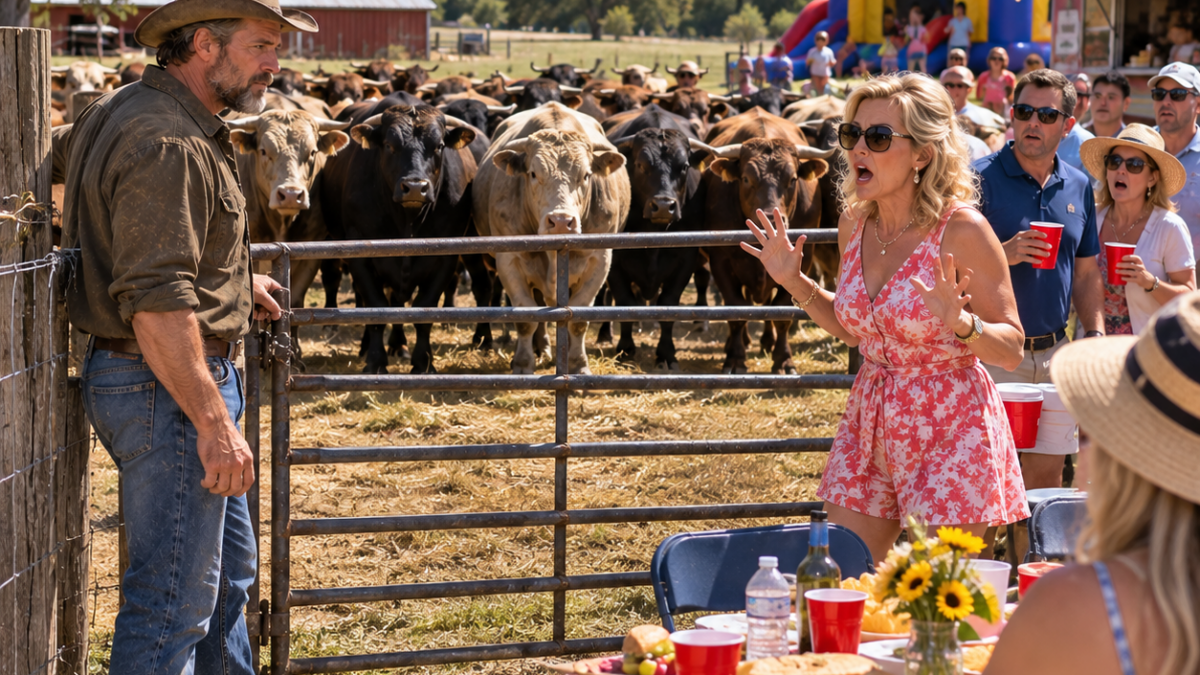
There they were.
Thirty people eventually.
Maybe thirty-two.
Tables.
Coolers.
Food truck.
A bright blue bounce house.
One portable speaker.
Karen had a megaphone.
Of course.
A small folding bar offered beer and canned wine.
Several children.
A few older people.
Two dogs again.
Some residents looked uncomfortable the moment they saw my truck.
Others waved.
Karen stood near food truck wearing a sun hat.
“You need to leave.”
She lifted megaphone.
I pointed.
“Don’t.”
She used it anyway.
“Good morning, Cole.”
The amplified voice rolled across pasture.
From the handling pens, thirty-five bulls lifted their heads.
Miguel looked at me.
“You want me to move them later?”
I nodded.
“Hold.”
I walked up.
Karen lowered megaphone.
“We have a permit.”
“For what?”
“Community event.”
“From who?”
“HOA.”
“HOA doesn’t own this.”
“We’ve covered this.”
“Yes. With lawyers.”
She smiled.
“Our position hasn’t changed.”
“Your lawyer’s has.”
A man beside her said:
“Karen, you said this was settled.”
She turned.
“It is.”
I pulled copies from truck.
Gloria’s notice.
HOA counsel response.
County parcel map.
My deed excerpt.
“Everybody listening?”
Some did.
“Willowbrook does not own this field. There is no recreational easement. HOA counsel was notified again Thursday. Vendors were warned.”
Karen laughed.
“Cole has been trying to bully Willowbrook for months.”
I looked at bounce house.
“Who owns that company?”
A young man raised hand slowly.
“Me.”
“Did Karen show you owner permission?”
“She signed as site representative.”
“She’s not.”
His face went pale.
Food-truck driver stepped out.
“Same question?”
I nodded.
He looked at Karen.
“You told me this was HOA property.”
“It is functionally part of our greenbelt.”
Functionally.
A dangerous word when deeds exist.
I called sheriff non-emergency.
They already had file.
Deputy was coming.
Karen heard.
“Unbelievable.”
“No.”
I pointed toward south end.
“What’s unbelievable is you’re holding an alcohol picnic on active livestock property after being warned in writing.”
She glanced.
“Your animals are fenced.”
“Correct.”
“And will remain fenced.”
“Yes.”
“So there is no danger.”
I stared.
That sentence would become important.
Miguel approached on ATV.
“Cole.”
“What?”
“Vet truck’s here.”
We had a veterinarian coming to pregnancy-check? Bulls don’t pregnancy-check. Breeding soundness exams maybe. Yes, planned breeding soundness evaluations on bulls. Need move them through north handling lane adjacent to picnic.
The bulls needed to move from east pasture through a fenced travel lane that ran along edge of north meadow to working pens.
The travel lane was separated from picnic field by heavy five-strand cattle fence and steel panels near gate.
Safe if nobody messed with anything.
But the public-access gate Karen had used opened into the same buffer area needed as livestock safety zone.
You cannot have families walking back and forth through a livestock working corridor while thirty-five bulls are being handled twenty yards away.
I told Miguel:
“Hold at east gate.”
Karen smirked.
“See? Problem solved.”
“No.”
I turned toward crowd.
“We have livestock work scheduled. You cannot remain here.”
One man began loading cooler.
A woman called to her kids.
Good.
Karen picked up megaphone.
“Everyone stay where you are. He is attempting to disrupt an authorized HOA event.”
I took megaphone out of her hand.
Not aggressively.
She released from surprise.
I set it on table.
“Do not amplify noise around bulls.”
“You can’t take my property.”
“It’s right there.”
Then the sheriff’s deputy arrived.
Deputy Alvarez.
Mid-thirties.
Calm.
He spoke to me.
Then Karen.
Read letters.
Checked county parcel map from dispatch.
Called HOA attorney number Gloria provided.
We all waited.
After ten minutes, Alvarez came back.
“Ms. Karen, HOA counsel says they advised association there is no confirmed access right here.”
Karen’s face tightened.
“That isn’t what they told board.”
“You can resolve that separately.”
He gestured toward field.
“For today, property owner has revoked permission and says no permission existed. Everyone needs to leave.”
Karen’s supporters started packing.
About half crowd moved toward gate.
Then came complication.
Not bulls charging.
Not trap.
A farm gate.
Miguel had closed the main north service gate behind the last vendor vehicle earlier because it was part of our livestock containment protocol.
He did not know guests had intended it as primary exit.
The little pedestrian gate remained, but food truck and several cars could not use that.
At same time, bulls began moving inside their own fenced lane because veterinarian had arrived and we could not hold entire operation indefinitely in heat.
Thirty-five bulls came around rise.
Slow.
Big.
Curious.
Separated from picnic by livestock fence.
Every head turned toward bright bounce house.
Then toward food smell.
Then toward thirty people.
The entire picnic went quiet.
You could hear diesel from vet truck.
One bull snorted.
A woman said:
“Oh my God.”
Another:
“Are those all bulls?”
I answered:
“Yes.”
Karen stared.
“They’re coming this way.”
“They’re moving to working pens.”
“Open the gate.”
“Not yet.”
Her head snapped.
“What do you mean, not yet?”
“The vehicle gate opens into livestock movement zone. We need bulls secured before we move cars through.”
“You’re trapping us.”
Deputy Alvarez immediately looked at me.
I said:
“No. People can leave on foot through pedestrian gate with deputy supervision. Vehicles and equipment wait until Miguel tells me lane is safe.”
Alvarez nodded after looking at layout.
“That sounds reasonable.”
Karen did not.
“You did this on purpose.”
“I scheduled bull exams two weeks ago.”
“You knew picnic was here.”
“I learned Thursday.”
“And didn’t cancel.”
I looked at her.
“Cancel my livestock operation because you scheduled a party on my farm?”
The food-truck owner muttered:
“Lady, this is on you.”
Karen ignored him.
The bulls continued.
Thirty-five animals.
Some over two thousand pounds.
None charging.
None threatening.
Just moving as a herd through a proper fenced lane.
But people who had spent morning treating field like park suddenly understood why warning signs existed.
A little boy climbed onto picnic table.
His father lifted him down.
“Stay with me.”
One of the dogs started barking.
That changed everything.
Three bulls stopped.
Heads lifted.
Miguel shouted:
“Dog quiet!”
Owner grabbed leash and held dog tight.
I walked over.
“Take him through pedestrian gate now.”
Deputy helped.
The bulls resumed.
Karen stood near bounce house staring.
Her entire idea of “open green space” was disappearing in real time.
One resident named Cheryl said:
“Karen, why would you put us here?”
Karen snapped:
“It’s perfectly safe.”
A bull hit a steel panel with his shoulder while turning toward chute.
Not an attack.
Just two thousand pounds touching metal.
The clang echoed.
Everybody flinched.
Cheryl looked at Karen.
“Perfectly safe?”
Karen turned toward me.
“Open the gate.”
“Five minutes.”
“I said open it.”
“And I said five minutes.”
“Those animals are dangerous.”
“Yes.”
She looked stunned.
Maybe because I admitted.
“Then why are they here?”
I almost laughed.
“Because this is a farm.”
That sentence ended something.
Not lawsuit.
Not dispute.
The illusion.
This was not Willowbrook’s backyard.
Not a developer greenbelt.
Not spare grass waiting for a picnic.
It was agricultural property.
With livestock.
Infrastructure.
Work schedules.
Hazards.
The fence wasn’t exclusion for fun.
The gate wasn’t symbolic.
Thirty-five bulls were not decorative.
Karen finally saw the farm as something other than land without houses.
The bulls entered working pen.
Miguel closed interior gate.
Double latched.
Then signaled me.
I opened main service gate.
Vehicles left one at a time.
Food truck first.
Bounce house trailer next after deflated enough to move.
Residents.
Coolers.
Tables.
Trash.
Nobody hurt.
No bull escaped.
No heroic chase.
No one trapped for hours.
The entire delay lasted maybe eighteen minutes.
It felt longer because thirty-five bulls were watching.
Karen was last again.
Of course.
She stood beside SUV.
Deputy Alvarez nearby.
“You endangered thirty families.”
I looked around.
“Thirty people.”
“Whatever.”
“You brought them onto a working cattle farm after written warning.”
“You could have moved bulls somewhere else.”
“I did.”
“You know what I mean.”
“Yes.”
“You did this to embarrass me.”
“No.”
I pointed toward pasture.
“I did not schedule your picnic.”
She looked at deputy.
“Are you seriously going to let him get away with this?”
Alvarez said:
“Get away with operating his farm?”
She stared.
He continued:
“Ms. Karen, you were given written notice not to use this property. I’ve confirmed with HOA counsel. You need to leave.”
“Am I being arrested?”
“No.”
“Then this is harassment.”
“No.”
He handed her paper.
Formal trespass warning.
“If you return without permission, future entry may be handled differently.”
Karen looked at it.
Then me.
Then bulls.
She got into SUV.
Left.
The meadow was a mess.
Not destroyed.
But tire ruts.
Trash.
Two beer cans.
Plastic forks.
A popped balloon tangled in grass.
Food grease near truck.
Bounce-house stakes had punched holes.
One stake dangerously near shallow irrigation line.
Miguel picked up a paper plate.
“Community property.”
I took it.
“Don’t start.”
He smiled.
“Thirty-five bulls disagree.”
The story spread through Willowbrook before dinner.
Not because I posted.
Residents did.
One video showed bulls walking in line with caption:
WHEN THE “GREENBELT” STARTS LOOKING BACK AT YOU
Another showed Karen arguing with deputy.
Another showed county parcel map.
Comments became ugly.
I stayed out.
Gloria told me:
“Do not comment online.”
“I don’t have account.”
“I know. It’s one of your better qualities.”
Monday brought HOA emergency meeting.
Nate attended.
So did Cheryl.
So did about seventy residents.
Karen opened by describing event as “deliberate livestock intimidation.”
Then HOA counsel corrected her publicly.
That was key.
The attorney, Melissa Grant, said:
“My office advised board in writing that Willowbrook had no recorded ownership, easement, or recreational right over the Patton property and recommended no community activity occur there without Mr. Patton’s written permission.”
Silence.
Cheryl stood.
“When?”
“Six weeks ago.”
Then someone:
“Before first picnic?”
“Yes.”
Another:
“Before Saturday?”
“Yes.”
Karen said:
“That advice was overly cautious and did not account for historical community usage.”
Melissa looked at her.
“There is no historical community usage sufficient to establish the right you represented.”
Karen:
“That’s an opinion.”
Melissa:
“It is legal advice you retained us to provide.”
That clip traveled too.
Then board treasurer asked about event insurance.
Karen had signed vendor forms stating HOA controlled site.
Problem.
The HOA’s event insurer had been given Willowbrook clubhouse address, not my farm parcel.
Food-truck vendor demanded reimbursement for lost sales and emergency pack-out.
Bounce-house company wanted damage fee.
I sent invoice through Gloria for field restoration and cleanup.
Not huge.
$3,860.
Karen called it extortion.
Board paid.
Then came more serious question.
Why had Karen been so certain my field belonged to Willowbrook?
The answer lived in developer marketing documents.
Early subdivision concept rendering showed a green belt along southern edge connecting to a proposed county trail.
The green shape extended over about six acres of my north meadow.
But it was conceptual.
Not title.
Not deed.
Not plat dedication.
The developer had hoped to negotiate future trail access with my father.
They never did.
My father had one letter in old file.
From development company.
We would like to discuss possible purchase or recreational easement across northern Patton acreage.
Dad’s handwritten note across top:
NO.
Underlined twice.
Classic Dad.
When Willowbrook transitioned from developer control to homeowner control, someone had included the concept map in a resident welcome packet.
Over time:
Proposed greenway became planned greenway.
Planned became future amenity.
Future amenity became community greenbelt.
Then Karen said community property.
Paper fantasy evolving through repetition.
No one maliciously forged deed.
They just stopped distinguishing plans from rights.
That happens more than people think.
A map is persuasive.
Color something green.
Draw walking path.
Put logo.
People assume ownership follows ink.
It doesn’t.
Gloria suggested we record a boundary acknowledgment with Willowbrook.
The new board agreed.
But first they had governance problem.
Karen.
Residents petitioned for recall.
Not because bulls.
Because she ignored legal advice, misrepresented property rights, exposed association to liability, and spent HOA money on an event after notice.
The board removed her as president before recall vote.
She stayed director for two weeks.
Then resigned.
No dramatic eviction.
No police escort.
Just email.
Effective immediately, I am stepping away due to hostile environment and personal attacks.
People argued.
Some defended her.
They said she had built community.
Organized events.
Improved landscaping.
Got speed humps installed.
Negotiated lower pool maintenance.
All probably true.
Bad decision does not erase every good one.
But good years did not make Saturday lawful.
That is the adult version.
The new president was Martin Reyes.
Retired civil engineer.
First thing he did was come to my gate.
He stayed outside.
“Cole?”
“Yeah?”
“I’m Martin.”
“I know.”
“I’m acting HOA president.”
“Sorry.”
He smiled.
“I’ve heard that.”
He held folder.
“I would like to apologize on behalf of board.”
“Okay.”
“And ask what you need to prevent this happening again.”
That question I liked.
“Lock your gate.”
“We will.”
“Remove greenbelt label from resident map.”
“Already requested.”
“Tell people farm is private.”
“Yes.”
“No HOA signs facing my pasture.”
“Yes.”
“And nobody comes through without calling.”
He nodded.
“Reasonable.”
Then:
“Would you ever allow supervised farm visits?”
I laughed.
“You’re brave.”
“Different from picnic.”
“Yes.”
“If you say no, that’s answer.”
I looked toward Willowbrook houses.
Kids sometimes watched cattle.
Most residents had done nothing wrong.
“Maybe.”
“That’s enough.”
We recorded agreement.
Willowbrook acknowledged no ownership, easement, license, or recreational rights over Patton farm.
Their pedestrian gate remained physically in HOA fence but had to stay locked and display:
NO PUBLIC ACCESS — PRIVATE AGRICULTURAL PROPERTY BEYOND THIS POINT
I insisted on wording.
Not:
Future Greenway Closed.
Private Agricultural Property.
Reality.
My title insurer liked.
Gloria liked.
Dad would’ve liked.
Life normalized.
Almost.
The bulls became local celebrities.
One of mine, a massive cream Charolais cross named Otis, appeared in every video because he stood at front staring at bounce house.
Children in Willowbrook started calling him “the HOA inspector.”
I hated that.
Laughed anyway.
Nate brought me a coffee mug printed with:
ASK OTIS FIRST
I told him to leave.
He didn’t.
I kept mug.
Six months later, Willowbrook asked to host a farm-safety day.
Not on my farm initially.
At clubhouse.
They wanted somebody explain fences, livestock, farm equipment, and why children should never crawl through agricultural barriers.
Martin asked if I’d speak.
“No.”
He asked Miguel.
Miguel said yes just to annoy me.
Then got sick.
So I went.
About forty parents and kids.
I brought photographs.
No live bull.
I explained.
A bull doesn’t hate you.
It also does not understand your legal argument.
A pasture is not empty just because animals aren’t visible.
Gate left open can create danger miles away.
Dogs can provoke livestock.
Noise matters.
Running matters.
Fences are safety equipment.
A little girl raised hand.
“Did the bulls want to eat the picnic?”
“No.”
“Why were they looking?”
“Because people were doing something unusual.”
“Would they chase Karen?”
Parents tried not laugh.
“No.”
“Why did she run?”
“She didn’t.”
Technically true.
The girl seemed disappointed.
Internet had improved story.
I said:
“The scary part wasn’t bulls attacking. They didn’t. The scary part was adults entered a livestock area without understanding what could happen.”
That is lesson.
Not animals as revenge weapon.
Boundaries prevent situations where nobody has good options.
Karen treated fence as insult.
It was protection.
For residents.
For cattle.
For me.
For insurance adjusters everywhere.
A year later, one of Willowbrook kids kicked a soccer ball over fence.
His father called number on sign.
“Mr. Patton?”
“Yes?”
“My kid’s ball is in field.”
“Which field?”
“North meadow.”
“Any livestock?”
“Don’t see.”
“Don’t enter. I’ll get it.”
“Okay.”
I drove ATV.
Retrieved ball.
Handed over fence.
Father said:
“Thanks.”
That was it.
Twenty seconds.
Permission works.
No lawsuits.
No bulls.
No megaphones.
It made me think of my father’s rule.
Ask first.
Step second.
Simple enough for children.
Apparently difficult for presidents.
The farm changed too.
I eventually sold eight acres on far west side to a young couple who wanted market garden.
People were shocked.
“Thought you never sell.”
I never said that.
I said boundaries matter.
Ownership includes choice.
Claire and I had once talked about downsizing herd.
After she died, I kept everything frozen for too long.
Same number acres.
Same cattle.
Same routines.
As if changing farm would change her memory.
It doesn’t work.
Grief can turn land into museum.
Eventually you have to live there again.
I cut bull numbers from thirty-five to twenty-two.
Better management.
Less feed.
More margin.
Otis died at twelve.
Natural.
I buried him on ridge.
Nate joked HOA should send flowers.
They actually did.
A card:
To the original Willowbrook boundary consultant.
Martin signed.
I laughed until I had to sit down.
Even Karen’s story softened with time.
I saw her once at grocery store two years after recall.
She was pushing cart.
No sunglasses.
Hair different.
She noticed me.
We both considered pretending not.
Then she walked over.
“Cole.”
“Karen.”
She looked tired.
“I hear Otis died.”
“How do you know?”
“People talk.”
“Yes.”
She stared at cereal shelves.
Then:
“I owe you apology.”
I did not expect.
“For what part?”
She almost smiled.
“Several.”
I waited.
“I believed that field was effectively Willowbrook’s.”
“You were told it wasn’t.”
“I know.”
“That matters.”
“Yes.”
She nodded.
“I thought the lawyers were being overly technical.”
“They’re lawyers. Technical is job.”
“I thought residents had used it enough that you couldn’t just close it.”
“They used because you told them they could.”
“I understand now.”
Good.
Then:
“The picnic was stupid.”
“Yes.”
“The alcohol was especially stupid.”
“Yes.”
“The megaphone?”
“Very stupid.”
She laughed once.
Then looked at me.
“I really thought you brought bulls out to scare us.”
“I really brought bulls out because a vet appointment cost me four hundred dollars before he touched one animal.”
“That sounds more like you.”
She shifted.
“I’m sorry.”
I studied her.
No crowd.
No board.
No need to win.
“I appreciate that.”
She looked relieved.
Not forgiven in ceremonial sense.
Just received.
Then:
“You know people still call me Bull Picnic Karen.”
I tried not smile.
Failed.
“That seems unfair.”
“It is.”
“Internet.”
She laughed.
“Take care, Cole.”
“You too.”
That was it.
No friendship.
No revenge.
No ruin.
A person learned maybe.
Enough.
What happened that Saturday became exaggerated every time someone retold.
In one version, I deliberately locked Karen and thirty residents inside bull pasture.
False.
Criminally stupid if true.
In another, bulls charged bounce house.
No.
Otis leaned against panel.
Different.
Someone claimed sheriff arrested Karen.
No.
Formal trespass warning.
Someone said Willowbrook paid me half million dollars.
I wish.
They paid $3,860 field restoration, some legal cost under settlement, and their own lawyers.
Someone said I released bulls after Karen called land community property.
Absolutely not.
You do not use livestock as weapon.
You especially do not use two-thousand-pound breeding bulls to make rhetorical point.
The real version is less insane.
Karen organized event on private agricultural land after written warning.
A scheduled livestock movement happened nearby.
Safety protocols temporarily restricted vehicle exit while animals moved through adjacent lane.
Residents saw thirty-five bulls at close enough distance to finally understand land was active farm.
Nobody hurt.
Then documents did rest.
That is good story.
Truth does not need charging bull.
What changed Willowbrook wasn’t fear alone.
It was contradiction.
Karen had spent months calling the meadow:
greenbelt.
open space.
community property.
Then the land behaved like what it had always been.
Farm.
No vote can make livestock schedule disappear.
No app label changes deed.
No HOA newsletter converts permission into ownership.
That lesson stayed with residents.
The new board became almost annoyingly careful.
Every vendor contract verified location.
Every event map checked.
No off-site land labeled amenity without recorded right.
Counsel reviewed.
Martin once called me about a drainage ditch.
“Is it yours or ours?”
“Survey says line runs center.”
“Can we clean our half?”
“Yes.”
“Can contractor cross your half to turn equipment?”
“Call me when scheduled.”
That is governance.
Boring.
Effective.
No viral video.
Thank God.
I grew older.
Farmhouse porch still there.
Claire’s chair too.
For years I couldn’t sit in it.
Eventually I did once by accident.
Didn’t feel haunted.
Just chair.
Grief releases objects slowly.
The red barn doors faded.
I repainted them same color.
Not because Claire told me.
Because I liked.
That distinction mattered.
I had been preserving her choices as if they were commandments.
One evening Nate sat porch with me.
He looked toward Willowbrook lights.
“Funny.”
“What?”
“People moved here because they wanted country living.”
“Yeah.”
“Then got mad country was next door.”
I laughed.
“Some.”
“Why do you think?”
“People like view of farms more than operation.”
He nodded.
“Like oceanfront without storms.”
“Exactly.”
“You ever sell to developer?”
“No plans.”
“What if number big?”
I looked at him.
“Everybody has number.”
“Really?”
“Probably.”
“What’s yours?”
“If I knew I’d never tell you.”
He laughed.
My father would have said no number.
Dad also died without seeing property taxes now.
People romanticize permanence because someone else pays carrying cost.
I don’t.
I want land preserved if it serves life.
Not worshiped.
The principle isn’t never change.
It’s consent.
If I sell one day, my decision.
If Willowbrook buys, contract.
If county needs road, process.
If kid wants see bull, ask.
If Karen wants picnic, definitely ask.
Boundaries allow generosity.
Without boundary, generosity becomes expectation.
Then entitlement.
Then conflict.
That is probably the real theme.
I let neighbors visit before Karen.
I let them visit after.
I wasn’t anti-community.
I was anti-assumption.
One Sunday, years later, Martin brought his grandson.
Called first.
Kid loved cattle.
I met them at gate.
We walked to safe observation pen.
The boy asked a thousand questions.
“Why rings in nose?”
“Some don’t.”
“Why bull bigger?”
“Genetics, age, breed.”
“Can I pet?”
“No.”
“Why?”
“Because ask first, step second.”
He looked confused.
I explained Dad’s rule.
At end he repeated:
“Ask first.”
“Yep.”
“Then step?”
“If answer yes.”
“What if no?”
“Then don’t step.”
A six-year-old understood.
That felt almost spiritual.
When they left, Martin said:
“Wish we’d done this before picnic.”
“Me too.”
“You would’ve said yes?”
“To picnic?”
“Maybe small. No bounce house. No alcohol. No megaphone.”
He laughed.
“So not Karen picnic.”
“No.”
That is irony.
Had she asked, I probably would’ve let twenty neighbors picnic in north meadow on a day with no livestock work.
Charge nothing.
Maybe bring hay wagon.
Claire used to host church people there.
What Karen wanted wasn’t impossible.
She made it impossible by deciding permission beneath her.
Power does that to some people.
They stop asking because asking admits somebody else can say no.
That is exactly why asking matters.
It recognizes other person’s authority over their own thing.
Land.
Body.
Time.
Home.
Gate.
My father knew.
He wasn’t educated beyond high school.
Still knew.
Ask first.
Step second.
I think about that every time I close north gate now.
Willowbrook beyond.
Farm behind.
A simple steel frame hanging on two hinges.
Worth maybe six hundred dollars.
That Saturday it became most important object in subdivision.
Not because I trapped anyone.
Because suddenly everybody understood gate was not decoration.
Closed gate meant:
Wait.
There is a reason.
Animals are moving.
This isn’t your space to manage.
A fence is information.
A gate is controlled exception.
Respect both and almost nothing dramatic happens.
Ignore both and you may find thirty-five bulls watching your bounce house while a sheriff explains county parcel records.
Nobody needs that Saturday.
Especially bulls.
If Claire had been alive, she would have enjoyed story.
She liked Karen types in small doses.
Not because cruel.
Because Claire could end conflict with one sentence.
I once told her a neighbor complained our rooster crowed too early.
Claire asked:
“What time would he prefer?”
Neighbor had no answer.
She would’ve asked Karen:
“If field is community property, why is county sending our tax bill?”
Then gone inside.
I miss that.
Years after she died, I still sometimes imagine what she would say.
Less now.
Good, maybe.
You eventually have to generate your own sentences.
Mine have gotten better.
Not Claire good.
Adequate.
So if someone asks me what happened when Karen brought thirty people onto my farm, I don’t tell them bulls taught her lesson.
That gives bulls too much credit.
Paper taught lesson.
Lawyers.
Deputy.
Board meeting.
Residents asking questions.
The bulls merely made abstract thing physical.
Private agricultural property sounds boring.
Thirty-five massive animals standing behind cattle panels while a bounce house deflates makes definition memorable.
But the lesson existed before they appeared.
Karen had no right to be there.
Even if pasture had been empty forever.
Even if I had no bulls.
Even if grass was short and perfect for picnic.
Unused does not mean unowned.
Open does not mean public.
Pretty does not mean community.
And a fence does not need dramatic danger behind it to deserve respect.
That is the part I wish people understood.
Because some internet comments said:
“Well, if bulls weren’t there, what’s harm?”
Wrong question.
Rights don’t activate only when trespass becomes dangerous.
The first picnic was wrong too.
No bulls.
No harm.
Still no permission.
Maybe if Karen had respected small no, there would never have been big lesson.
That’s how most conflicts work.
Early boundaries feel negotiable.
Ignore.
Push.
Reframe.
Then consequence arrives and everyone acts surprised.
I am sixty now.
Twenty-two bulls.
Two knees that complain.
One farm.
Willowbrook bigger.
Another phase started east.
New residents move in.
The current HOA welcome packet includes page:
ADJACENT AGRICULTURAL PROPERTY
It says:
Willowbrook borders privately owned working farms.
Residents should expect normal agricultural sounds, odors, vehicles, livestock activity, dust, and seasonal operations.
Do not enter neighboring property without express owner permission.
Do not feed or approach livestock.
Respect all gates and fences.
Martin sent draft before publication.
I added one line.
An open gate is not an invitation.
They included.
Good.
Karen’s old greenbelt path disappeared from app.
Now map stops at HOA boundary.
White beyond.
No label.
That blank makes me smile.
Not because nothing there.
Because map finally admits something exists beyond HOA authority without pretending to define it.
That is healthy.
One evening last fall, I stood at north fence.
A little league picnic was happening inside Willowbrook park.
Actual HOA property.
Bounce house.
Food truck.
Music.
No megaphone.
Kids running.
On my side, bulls grazed.
Everyone where they belonged.
A boy at fence waved.
I waved back.
His mother called:
“Don’t climb that!”
Good.
He didn’t.
No drama.
Best possible ending.
As sun dropped, Otis’s replacement—a black Angus named Boone—walked near fence and stared at bounce house.
The boy stared back.
Two creatures separated by proper boundary.
Curious.
Safe.
That’s what fences are for.
Not hostility.
Clarity.
Claire used to say people are nicest when they know where edges are.
I think she was right.
Karen thought community meant access.
I learned community works better with consent.
Willowbrook learned too.
The farm never needed to join subdivision to be a good neighbor.
The subdivision never needed my meadow to be a community.
They had parks.
Sidewalks.
Pool.
Clubhouse.
Each other.
What they lacked for a while was ability to hear one word.
No.
Once they learned, everything got easier.
So yes.
Karen brought thirty people onto my farm.
There was beer.
A food truck.
A bounce house.
A megaphone.
Thirty-five bulls appeared because it was their scheduled working day.
The gate closed because livestock gates close when livestock move.
Nobody got chased.
Nobody got hurt.
Nobody was held prisoner.
And Karen absolutely changed her mind about calling my pasture “community property.”
Not when I yelled.
I didn’t.
Not when the lawyer wrote.
Not enough.
Not even when deputy explained deed.
It happened when she looked past me and saw thirty-five bulls standing where her HOA map had painted a green recreation space.
For the first time, she wasn’t looking at land as empty.
She was looking at somebody else’s farm.
And once you finally see a boundary for what it is, the respectful thing is simple.
Ask first.
Step second.

